
The energy transition is in full swing across the U.S. and the world, but the changes now underway are not simple or linear. In an economy as complex and connected as ours, progress in one area will often affect other parts of the economy, creating winners and losers.
And then there are the changes that work together synergistically and leave everyone better off. This is what we will see as renewable energy overtakes fossil fuels and electric vehicles go mainstream. These transformations will deliver another enormous benefit, this time to farmland, as they pull the rug out from under the expensive and wasteful ethanol industry.
Counting Corn
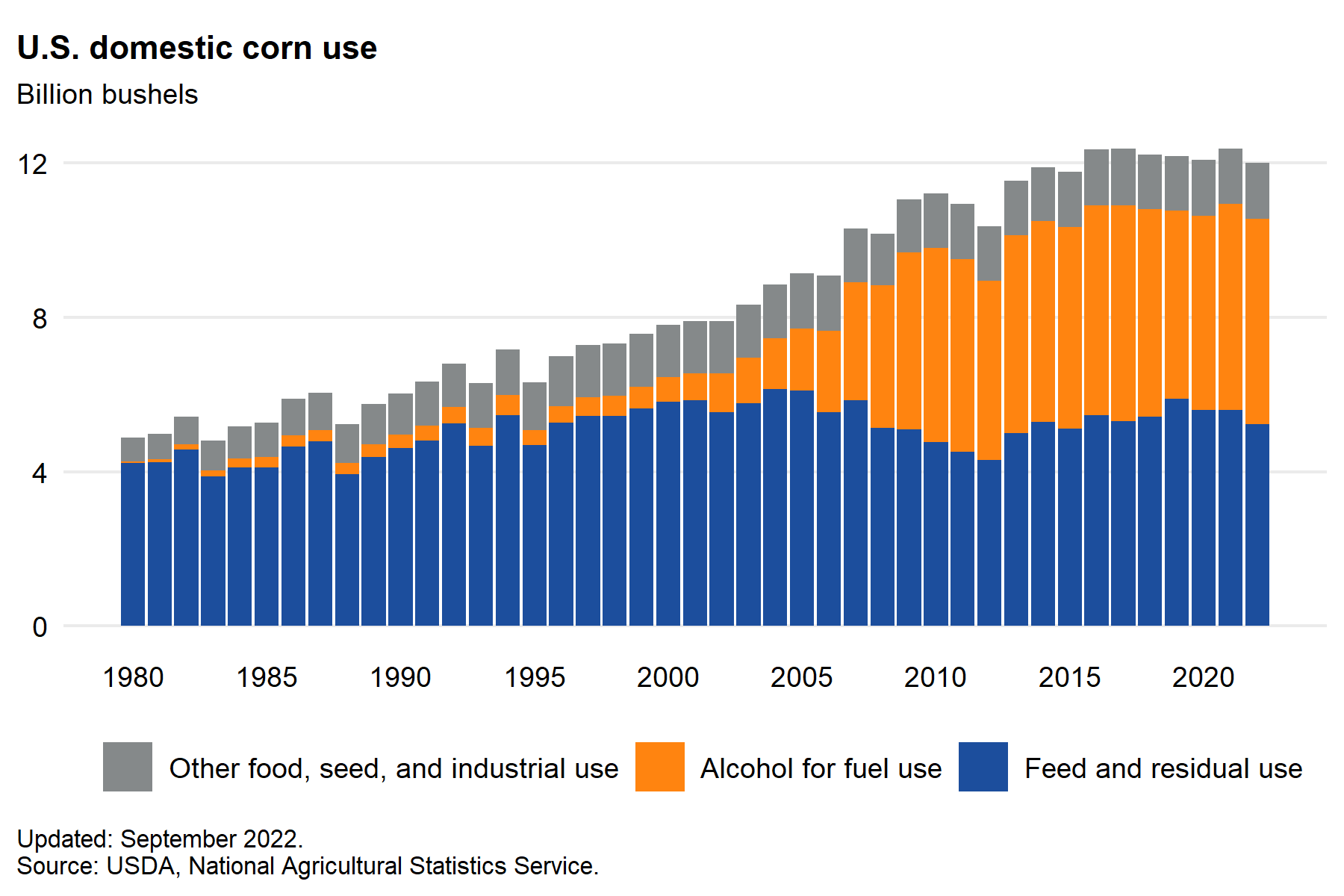
Across the United States, more than 30 million acres of farmland is currently devoted to growing corn for a purpose other than feeding humans and animals. The corn – over 5 billion bushels every year — is processed into ethanol and then added to gasoline to comply with a federal mandate.
The U.S. Renewable Fuel Standard (RFS), enacted in 2005, requires the nation’s oil refiners to mix 15 billion gallons of corn-based ethanol into the nation’s gasoline supply annually; this is the reason why most gasoline sold in the U.S. includes 10% ethanol. The mandate was intended to cut U.S. dependence on energy imports, support farmers and reduce emissions.
As it turned out, the RFS was primarily successful in increasing the acreage devoted to growing corn. Because of the ethanol mandate, an additional 6.9 million acres of corn were planted between 2008 and 2016. Corn is now the nation’s number one crop and, according to the U.S. Department of Agriculture, ethanol production accounts for 45% of the U.S. corn crop. Most of the rest goes to animal feed, with only 15% destined for human consumption. (A mere half of one percent of the total corn crop is sweet corn, a different plant entirely.)
As a way to reduce emissions, however, the mandate proved a failure. A study funded by the U.S. Department of Energy and the National Wildlife Federation concluded that ethanol is at least 24% more carbon-intensive than gasoline, once land use impacts are factored in.
It’s a bad deal for taxpayers, too. In addition to the ethanol mandate, the U.S. government subsidizes corn farmers through the federal crop insurance program, with taxpayers covering an average of 62% of the cost of insurance premiums. More than a quarter of the insurance subsidy goes to corn, and very little goes to small farms. Add to this the many concerns about water use, fertilizer, pesticides and land degradation, and it is hard to find much good in the corn ethanol program.
EVs threaten King Corn
The world is a different place now than it was in 2005, with the U.S. having become the largest oil producer in the world and a net exporter. Yet the ethanol subsidy is fiercely guarded by the corn lobby and, in spite of occasional bipartisan efforts at repeal, it seems to be untouchable politically. Indeed, last year’s Inflation Reduction Act, passed by Democrats, actually contains new credits for biofuel production that corn-state Republicans are keen on keeping even as they continue to seek rollbacks of other clean energy incentives.
The biggest threat to the corn lobby, though, isn’t a repeal of the mandate, it’s electric vehicles. When people no longer need gasoline, they can no longer be forced to buy corn ethanol.
Electric vehicle sales reached 5% of the U.S. new car market in 2022, and already this year they’ve hit 8.6%. JD Power projects 70% of new vehicles will be electric by 2035, with California leading the way at 94% by then.
Many agricultural communities are in denial about EVs, preferring to believe they will never catch on in numbers enough to threaten the importance of the corn crop. And indeed, it will take decades before the last gasoline-powered cars drive off to the junkyard. But most of us can see the writing on the wall. As more vehicles become electric, more land that is now devoted to corn ethanol will become available for other purposes.
While the ethanol industry looks to jet fuel and other possible new uses for its product, a far more promising “crop” is renewable energy. Planting wind turbines and solar panels, either alone or combined with actual crops that feed people, provides higher returns with less risk and is better for the planet.
“Planting” more solar energy instead of corn
Wind turbines already coexist with farmland across the Great Plains, but let’s focus on solar, since that is the form of renewable energy best suited to Virginia’s landscape. Solar energy is somewhat land-intensive, but not compared to corn. A decade ago, the National Renewable Energy Laboratory calculated that we could power the country’s entire electricity demand with 10 million acres of solar panels. That’s only one-third of the land now devoted to corn ethanol.
Since that study, solar efficiency has increased, while electricity demand has risen only modestly. With the electrification of vehicles, buildings, and everything else that can be electrified, however, electricity demand is likely to double. But even if we had no wind energy, hydropower or nuclear, and we needed 20 million acres of solar to meet the demand, that would represent only two-thirds of the land currently devoted to corn ethanol, leaving millions of acres more freed up for food crops, land conservation and rewilding.
A comparison of the energy yield of corn vs. solar shows why displacing ethanol with solar energy would be a welcome change. An acre of corn yields 328 gallons of ethanol, which is one-third less efficient than gasoline. If you could run an internal combustion automobile entirely on ethanol (you can’t), a car averaging 40 miles per gallon could go 8,738 miles on an acre of corn.
But that same acre “planted” in solar panels would yield 394-447 MWh per year of electricity. Even at the low end, that’s enough to power a Tesla Model 3 for over 100,000 miles.
Much of the corn crop is grown in places like Iowa and Nebraska, but even here in Virginia, 540,000 acres were planted in corn last year, second only to soybeans. Assuming 45% of Virginia’s crop goes to corn ethanol (I could not find an actual breakdown by state), that amounts to 243,000 acres that could be put to better use. That’s worth keeping in mind for the next time someone frets about farmland being “lost” to solar development.
Solar is also a more reliable crop, and a better one for small farmers. The profitability of corn growing varies by state and by year, but it is never exactly a lucrative business for any but the largest farm operations. In a good year, such as 2022, corn might return a profit of $450 per acre, minus land rents (or taxes). In a down year, such as the current one, returns can be negative once land costs are accounted for. (Rents vary considerably, averaging about $325 per acre.)
Meanwhile, solar lease rates range from $250 to $2000 per acre, depending on location and suitability. A guaranteed payment for 20 or 30 years with no work involved is a pretty attractive deal. Even putting just a portion of a farm into solar provides a form of insurance, guaranteeing a steady income flow regardless of weather and commodity price swings.
Solar is also a better deal than corn for the community, since it provides tax revenue, diversifies the local economy and conserves water. If the developer plants pollinator-friendly species around the solar panels or uses sheep instead of machinery to control grass, the benefits to the local economy increase further.
The ethanol industry is already looking for new uses for their product, but if they don’t find takers, it is one fuel we don’t need to mourn losing.
This article first appeared in the Virginia Mercury on September 19,2023.
 Power for the People VA
Thanks for such an interesting article. While I am kinda shocked at how big (and ugly) solar farms are, I never considered the impact compared to corn. Driving through Virginia looking at cornfields, they seem much nicer than solar farms. Nice to hear a direct comparison of the impact.
Rick
Beauty is in the eye of the beholder
A good post. Thank you 🌍🙏
Thanks for pointing out the problems with ethanol fuel. As usual the economics and environemental impact boils down to EROI, or Energy Returned on (Energy) Investment. Ethanol has EROI of 1.4 as shown here: https://static.scientificamerican.com/sciam/assets/Image/2018/the-true-cost-of-fossil-fuels_4.jpg That’s a diagram from one of a number of excellent articles on EROI from here: https://www.scientificamerican.com/article/how-to-measure-true-cost-fossil-fuels/
It’s important to read the discussion and look at the whole diagram. Ethanol from sugarcane (EROI of 9) is superior even to solar photovoltaics (EROI of 6) due to the efficiency of transforming sunlight to sugar and the efficiency of extracting the sugar. But in general solar photovoltaics are moving in the right direction: increasing EROI as they extract a greater proportion the sun’s energy using ever-more-economical panels.
In contrast the article points out the decline in fossil EROI as the fossil gets harder to extract. At the start of fossil we had giant pools of light oil not far below the surface which was cheap to extract and fairly cheap to process. Now we need fracking which requires more energy along with energy to gather up one of the main fracking inputs which is water. Tar sands and heavy oil from California are shown to be relatively poor at EROI of 4 or 5.
One last point on wind. Although wind has excellent EROI of 20, there’s not a lot of room for efficiency improvements. It will always require lots of concrete and steel. Offshore wind has another input not addressed in EROI which is labor. The cost of offshore wind in labor alone is $70 / MWh. Also not counted in EROI is the extra fuel and other ancillary costs placing turbines far out at sea where the wind is good.
The bottom line is we need to focus on the future which is solar long term and particularly the constant R&D needed to get the improvments that are needed to keep increasing the EROI. Use fossil and nuclear (for reliability) and wind on land realizing those are all mechanical energy stopgaps until solid state solar, demand control, and solid state storage can take over.
Thank you for the interesting addition to the discussion, Eric.
Hi Ivy,
*Per usual, another great article! *
Thanks,
Dave Kuebrich
Thank you, Dave.
Excellent statement of reasons to shift from corn for ethanol to solar. Pairs well with Bobby Whitescarver’s piece, also in today’s Virginia Mercury.
I thought so too–and I had no idea that one was coming!