Unknown's avatar

Will Virginia’s residential solar market survive the coming year?

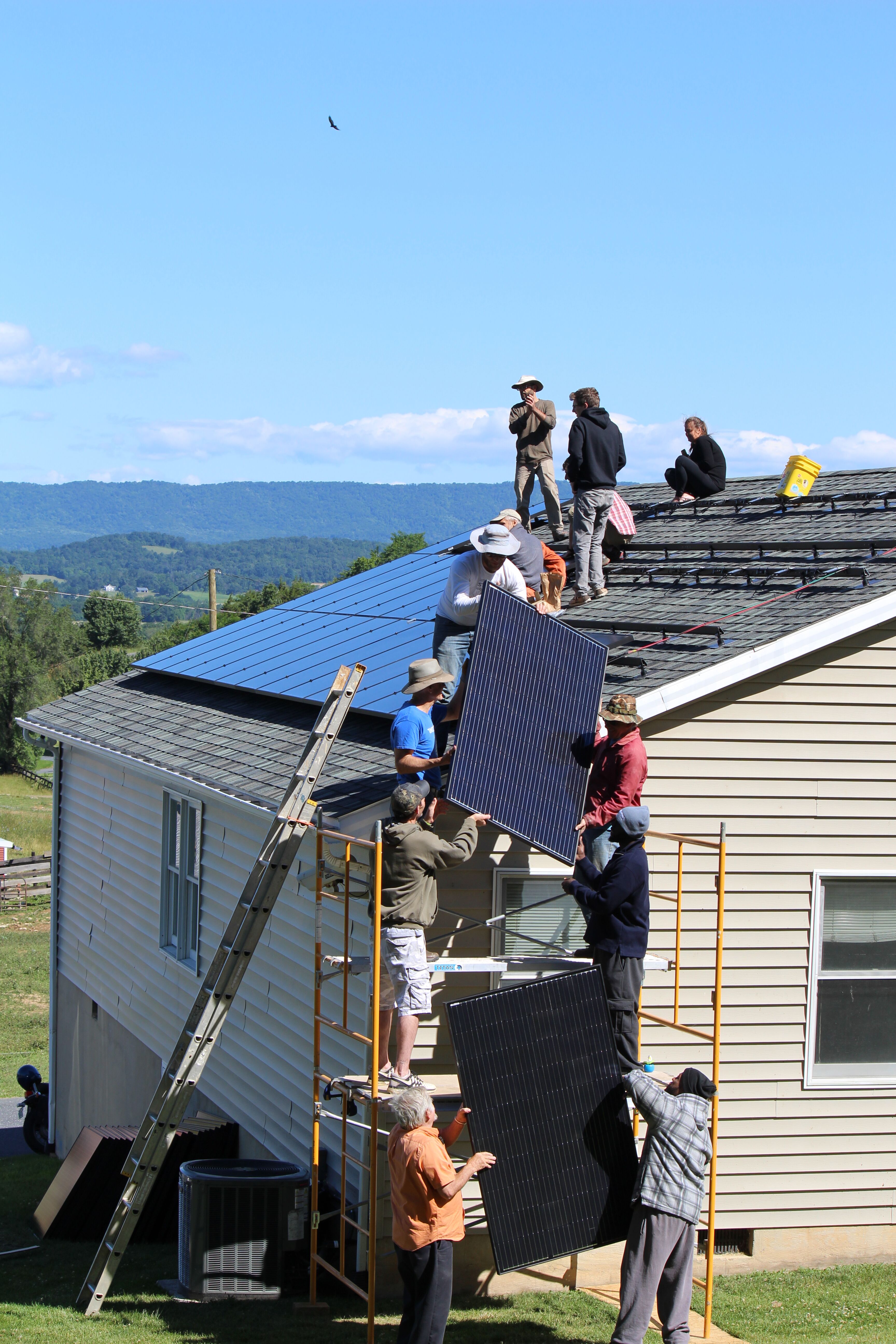
Installation of solar panels on the roof of a house.
Virginia utilities finally have an opportunity to attack net metering. Photo by Don Crawford.

When the Virginia Clean Economy Act became law in 2020, solar advocates celebrated. In addition to creating a framework for a transition to a zero carbon electricity sector by 2050, the VCEA and sister legislation known as Solar Freedom swept away multiple barriers to installing solar in Virginia. Among the new provisions were some that strengthened net metering, the program that allows residents, businesses and local governments who install solar onsite to be credited for excess electricity they feed back to the grid. 

Currently, the law requires that customers of Dominion Energy and Appalachian Power be credited for the electricity they supply to the grid at the full retail rate for electricity. The credit is applied against the cost of the electricity they draw from the grid at night. The policy makes solar affordable and supports small businesses across Virginia. 

However, the VCEA came with a ticking time bomb. It provided that in 2024 for Appalachian Power, and 2025 for Dominion, the State Corporation Commission would hold proceedings to determine the fate of net metering, and in particular the terms for compensating new net metering customers. 

Well, it’s 2024, and the bomb just went off. On May 6, the SCC issued an order directing the two utilities to file their suggested changes. Appalachian’s proposal is due by September 2; Dominion’s is due by May 1, 2025. The SCC will establish a schedule for each case that will include provisions for the public and interested parties to participate.

There are two important protections to note. First, low-income customers will have their choice of installing solar under either the existing rules or the new ones. Second, customers who install solar panels and interconnect to the grid before the SCC issues its final order will continue to be covered by the existing provisions for retail net metering. 

For anyone who’s been on the fence about installing solar, I can’t overstate the urgency of acting now. Nonprofits Solar United Neighbors and Solarize Virginia can help you get the best deal. Also check out the excellent advice and sample quotes from HR Climate Hub.

Make no mistake, utilities hate net metering and will destroy it if they can. The more customers who install solar, the less control the utility can exercise over them — and, even more critically, the less money the company makes for its shareholders from building new generation and transmission. 

That’s not what our utilities tell legislators and the SCC, though. Instead, they promote a narrative that net metering customers impose extra costs on other ratepayers, creating a “cost shift.” The idea is that residents who go solar are making everyone else pay more of the costs of the grid while they themselves rake in money with their free electricity from the sun.  

This argument has raged across the country for years. Utilities often argue that solar customers should be paid for their surplus electricity only the amount of money the utility would otherwise have had to spend to generate or buy that same amount of electricity from somewhere else. This “avoided cost” can be less than one-third of the retail rate for residential electricity. (The net metering changes would also affect commercial and non-profit properties, which pay a lower rate than residential – but still well above avoided cost.)

With a payback period of nine to 15 years in Virginia, residential solar is a reasonable investment with retail rate net metering, but it’s hardly a get-rich-quick scheme. Brandon Praileau, the Virginia program director for Solar United Neighbors, said in an email that lowering the net metering rate would eliminate the energy savings that homeowners see from solar today. 

“It is the full retail 1:1 value of solar that allows solar to not be a boutique purchase that only fits a certain demographic but something that every homeowner can benefit from,” he noted. 

Praileau added that the loss of net metering would also hit Virginia’s solar installers hard and lead to job losses, something I confirmed with industry members. Russ Edwards, president of Charlottesville-based Tiger Solar, says any devaluation of solar would have a “significantly adverse” impact on local companies like his that serve the residential market.

But the “cost shift” argument doesn’t actually depend on whether rooftop solar is affordable for customers or profitable for installers. The way utilities think about net metering, a homeowner could even lose money on solar and still be guilty of shifting the costs of maintaining the grid onto other customers.

Net metering supporters counter that rooftop solar provides valuable benefits to the grid and to other customers that the utilities overlook, like relieving grid congestion and lessening the need for utility investments in new generation and transmission. Solar also has larger societal benefits like increased energy security, local resilience, clean air and carbon reduction.

Over the years this dispute has spawned literally dozens of studies estimating the value of solar. A Michigan study found that rather than being subsidized by other ratepayers, residents who install solar actually subsidize their non-solar-owning neighbors. Closer to home, a Maryland study also concluded that distributed solar provided a value greater than the retail cost of energy. 

But every state is different. California’s public utility commission recently slashed the net metering rate all the way down to a so-called avoided cost, in part because the huge growth of solar in the state has led to a power glut in the middle of the day. The residential solar market cratered as a result of the PUC’s action, with an estimated 17,000 jobs lost in the solar industry.  

Virginia does not have California’s problem. With only about 6.5% of our electricity generated by solar and the world’s largest energy storage facility in the form of Bath County’s pumped hydro plant, rooftop solar still helps Virginia utilities meet peak demand. We also face a skyrocketing demand for electricity from data centers, which militates in favor of all the clean energy we can generate. 

Ten years ago, Virginia set out to do a study on the value of solar, led by the Department of Environmental Quality. Unfortunately, our utilities pulled out when they didn’t like what they were seeing, so the study never progressed beyond a framing of the issues. 

Since then, Dominion and APCo have often repeated the “cost shift” narrative but have never backed it up with evidence. Their efforts have had some effect with legislators, most recently with passage of a bill instructing the SCC to “make all reasonable efforts to ensure that the net energy metering program does not result in unreasonable cost-shifting to nonparticipating electric utility customers.”

But of course, that simply begs the question of whether a cost shift is actually occurring. Under the VCEA, the SCC will now have to “evaluate and establish” the amount a net metering customer should pay for “the cost of using the utility’s infrastructure,” and the amount the utility should compensate the customer for the “total benefits” the customer’s solar panels provide. The SCC is also instructed to evaluate and establish the “direct and indirect economic impact of net metering” and consider “any other information the Commission deems relevant.” 

Presumably, this other information should include the state’s energy policy. The policy specifically supports distributed solar, including “enhancing the ability of private property owners to generate their own renewable energy for their own personal use from renewable energy sources on their property.” 

The SCC will now have to navigate these opposing positions in what are certain to be contentious proceedings. Meanwhile, residents and businesses would be well advised to get their solar panels up this year.

This article was originally published in the Virginia Mercury on May 21, 2024.

Unknown's avatar

Data centers be damned, Virginia can still meet its climate goals

Virginia's capitol building in Richmond.

Following the General Assembly’s failure either to rein in the explosive growth of power-hungry data centers or to remove obstacles to increasing the supply of renewable energy in Virginia, a lot of people are wondering where we go from here.  

Dominion Energy Virginia’s answer, as described in its 2023 Integrated Resource Plan (IRP), is “build more fossil fuels.” The utility is pushing forward plans to build new methane gas generating units in Chesterfield. Dominion argues that although its IRP calls for dramatically increased carbon emissions, it sort of complies with the Virginia Clean Economy Act anyway because the VCEA has an escape clause when reliability is at risk. 

Dominion does not acknowledge that its own actions contribute to the problem. To be fair, though, it’s a huge problem, and even if our utilities were on board with the VCEA’s carbon-cutting agenda, we would need stronger legislative policy than we have now. Rejoining the Regional Greenhouse Gas Initiative is an important priority that Democrats are rightly pursuing, but the need for action goes much further. 

Sen. Dave Marsden, D-Fairfax, convened meetings the week before last to hear from utilities, industry members, environmental groups and others to get suggestions on ways to reform the VCEA. The interest groups met separately, and members of one group were not allowed to attend other group sessions to hear what those stakeholders had to say. The meetings were closed-door and confidential, with the express purpose of preventing a nosy public from learning anything through Freedom of Information Act requests. 

That secrecy makes me queasy, so I declined the invitation to attend the environmentalists’ session. I’d have cheerfully jettisoned my scruples, though, if I could have been in the utility session to hear what Dominion’s lobbyists were whispering in the senator’s ear. Alas, that was not on offer. 

But Marsden is asking the right questions, and of course, I always have answers, even when no one is asking. In my view, Virginia can stay on track to carbon neutrality by adopting four basic principles: data centers must pay their own way, both literally and carbon-wise; solar must be easy to build and interconnect; utilities must not build new fossil generation for “reliability” before exhausting non-carbon solutions; and efficient buildings must be added to the strategy.

Let’s start with the elephant outgrowing the room.

Data centers are sucking up all the energy

Without action, data centers will soon overtake residential customers to become Dominion’s largest category of customer. Already, they are driving the utility’s decision-making, as we saw from Dominion’s IRP. This year, the General Assembly deferred action to address the energy crisis until it sees the results of a study being undertaken by the Joint Legislative Audit and Review Commission (JLARC). 

It now appears that study won’t be published before the 2025 session convenes, and in fact there does not appear to be a deadline of any kind. Yet we already know enough about data center energy demand and its consequences for everyone else that legislators will be derelict in their duty if they put off all action until 2026.

The General Assembly must choose from three options if it still cares about the energy transition: stop the growth of the data center industry in Virginia, put the onus on data centers to source their own clean energy from the grid, or dramatically increase renewable energy generation and power line construction.  

Lawmakers show no desire to stop all data center growth, but as I’ve urged before, they can and should establish a joint state-local task force to choose appropriate sites for growth based on energy and transmission availability, water resource adequacy and good-neighbor factors, like distance from residential communities and parkland. 

Legislators should also require data centers to meet industry-best standards for energy efficiency, use alternatives to diesel generators for backup power and source carbon-free energy from facilities located on the grid that serves Virginia. They could buy this power either on their own or through a specially-designed utility tariff, as long as it meets all of their needs on a 24/7, hourly basis. In no case should other customers see higher electricity bills for infrastructure that’s only needed because of data centers.

These measures will take time to put in place, yet data center development is proceeding apace while the General Assembly takes its nap. There is no avoiding Virginia’s need for a lot more carbon-free generation, pretty much right away. A couple of small modular nuclear reactors ten years from now aren’t a solution.

Don’t expect climate leadership from Dominion

Dominion’s fossil-heavy IRP marked a sharp break away from the climate report that the company released just months before, which projected solar dominating the grid by 2040. Whether the IRP should be dismissed as political pandering to a conservative governor, or taken in earnest to mean the utility has thrown in the towel on renewable energy, is something of a Rorschach test for Virginia leaders. 

When Dominion releases its 2024 IRP this fall, we may get more clarity about what the company really thinks. More likely, we will still be left guessing. Dominion has a long history of playing to both sides to get what it wants, and what it wants is profit.   

There’s nothing wrong with a company making a profit, of course, as long as the company isn’t also allowed to make the rules it plays by. Asking Dominion’s lobbyists to help make energy policy is like recruiting burglars for a task force on crime prevention. 

Make it easier to build solar

While Virginia counties vie with each other to attract data centers, some are notably less keen on solar farms. Sprawling developments of windowless warehouses that suck power? Yes, they say. Grassy fields lined with rows of solar panels that produce power? No. Such is the horror with which some people view solar that localities have adopted moratoriums, acreage caps and other limits designed to keep projects at bay. The result is that an already-slow process for siting solar projects is getting even slower, more unpredictable and more expensive. 

Lawmakers rejected legislation this year that would have allowed the State Corporation Commission to overrule local permit denials. Yet it seems doubtful whether, in a Dillon Rule state like ours, local governments actually have the authority to enact blanket prohibitions and caps on specific kinds of land use. Legislators may want to ask the attorney general to clarify this point rather than waiting for landowners to challenge in court a locality’s refusal to let them put solar panels on their property. 

If the AG (or a court) rules these barriers illegal, localities would have to go back to evaluating the merits of project applications on a case-by-case basis — hardly a bad result. But it would be wiser and more orderly to pass legislation spelling out under what circumstances a local government may reject a solar project, and what the landowner’s recourse should be. 

New gas plants are the wrong solution for reliability

Though Dominion’s 2023 IRP didn’t win approval from the SCC, Dominion is going ahead with plans to build new methane gas combustion turbines in Chesterfield. Given that these “peaker” plants generate dirty power at a high price, Dominion should not be permitted to build gas combustion turbines if other alternatives are available. 

Which they are. Demand-response programs, advanced grid technologies and batteries charged by renewable energy are superior to gas peakers for reasons of cost, air quality and climate impact. 

Dominion is building some large batteries and testing long-duration battery storage technologies (and of course, Virginia already has the largest pumped storage facility in the world), but our utilities have not even begun to tap the potential of batteries in homes and businesses. Subsidizing the purchase of batteries by homeowners and businesses in exchange for the ability to draw on the batteries for peaking power, as some utilities do, would also build resilience into the grid and address power outages more cheaply than burying lines.

Imagine: If data centers had installed batteries instead of the 11 gigawatts of diesel generators at Loudoun and Fairfax County data centers, Virginia would already have more battery storage capacity than any country in the world.

Let everyone build solar 

The VCEA calls for 35% of its solar target to be satisfied by third-party developers. The purpose of this set-aside is two-fold: to attract more private capital, and to use competition to keep a lid on prices. Unfortunately, the SCC accepted Dominion’s argument that 35% should be read as a ceiling as well as a floor, to the detriment of ratepayers and solar developers. With Dominion now reneging on its solar commitments, it’s more important than ever that private developers be allowed to step in. One bill in the 2024 session would have corrected this problem by explicitly making 35% the minimum. The General Assembly should adopt that measure. 

Fix interconnection

Possibly the most inexplicable failure of the General Assembly this year was failing to pass legislation to resolve the dispute between Dominion and commercial customers over interconnection requirements. The onerous requirements that Dominion adopted in December of 2022  — imposed even in the face of a contrary SCC ruling — have wreaked havoc on plans by local governments to put solar on public buildings and schools. That is fine with Dominion; though the goal of the new requirements was to acquire upgraded distribution infrastructure at no cost to itself, its monopolistic lizard brain is equally satisfied with the result of shutting down competition from small solar companies. 

Legislators should not accept this result, though. The General Assembly adopted net metering years ago because encouraging residents and businesses to go solar is good for the economy and makes communities more resilient. Support for distributed renewable energy is even written into the Virginia Code as official policy

And distributed solar is hugely popular. Indeed, the very people who oppose utility-scale solar projects almost inevitably argue that society should maximize rooftop solar instead. In this they are at least half right: If we are really going to meet the energy challenge ahead of us, the very least we can do is milk every kilowatt-hour from sunshine falling on rooftops.

Customers have always paid to interconnect their solar to the utility’s grid. The dispute between Dominion and its customers is about whether Dominion can insist they pay the entire cost of expensive new fiber-optic wire and other cool technology that could make the distribution grid better for everyone, but which any one customer can’t afford. These upgrades could enable not just more solar but also electric vehicle charging in our communities, vehicle-to-grid technology and programs allowing utilities to make use of customers’ battery storage. But if the technology really is that valuable (a determination that should be made by the SCC, not Dominion), then getting it shouldn’t depend on how deep a customer’s pocket is — especially when that customer is a local government and, therefore, effectively, the Virginia taxpayer.

This year’s interconnection bill would have allowed a utility to recover the costs of these grid upgrades from ratepayers, with SCC oversight. Even Dominion would have been better off with the bill, something it would have recognized if its lizard brain weren’t in charge at the time. The General Assembly should pass the bill.

An untapped three gigawatts of energy are waiting off our coast

Dominion’s 2,600 megawatt Virginia offshore wind project is due to begin construction this year, but it is not the only game in town. The Kitty Hawk offshore wind area situated off North Carolina can deliver up to 3,500 megawatts of energy through a cable that will come ashore at Virginia Beach. All that is holding up the project is the lack of a customer.  Offshore wind is more expensive than solar, but we have a lot of power-hungry data centers who could pay a clean energy tariff that would include Kitty Hawk wind. 

Maximize efficiency in buildings 

Possibly the best piece of energy legislation to pass this year was the bill that directs local governments and schools to build to higher efficiency standards and incorporate renewable energy, as appropriate. The language could have been even stronger, but as it is, it will deliver significant cost savings for taxpayers.

In fact, local governments will now build to better standards than most homeowners get for themselves when they buy a house.  That’s because Virginia’s residential building code is pathetically behind the times when it comes to energy efficiency. Home buyers and renters would save more than enough money on utility bills to cover the upfront cost of better housing construction, but builders won’t voluntarily meet higher standards because it reduces profits. That should not be acceptable. 

Legislation passed in 2021 directed the Board of Housing and Community Development to consider amendments that would strengthen the building code. BHCD, which is dominated by builder and real estate interests, simply ignored the law. The matter is now in litigation (and the governor is trying to weaken the code even further), but the General Assembly could resolve the matter by directing BHCD to adopt efficiency measures at least as strong as the national standards set by the International Building Code Council (itself under fire for allowing builder interests to weaken efficiency standards), and to allow local governments to adopt stronger “stretch codes” to help residents save even more money and energy.

Going further, new and renovated buildings should be required to use electricity in place of methane gas, oil or propane for heating, cooling and appliances wherever practicable. Though building electrification increases electricity consumption, electricity is a more efficient technology than burning fossil fuels in the home, so it contributes to lower energy costs for residents and a smaller carbon footprint for the state overall. 

It’s a shame the General Assembly settled for simply not going backwards this year, but it is a good sign that Marsden and others are not waiting for next year to consider ways to get us back on the carbon-cutting wagon. With the climate clock ticking, we have no more time to lose.

A version of this article appeared in the Virginia Mercury on April 29, 2024.