Unknown's avatar

The data center energy crisis is now official

Data center between housing community and a bike path
A data center in Ashburn, Virginia. Photo by Hugh Kenny, Piedmont Environmental Council.

It is a truth universally acknowledged, that a politician in possession of elected office must be in want of large economic development projects. 

It does not seem to matter that in the case of Virginia, this compulsion is catapulting us into a costly energy crisis that will raise utility bills for residents; that the public shows no love for this industry; and that the benefits to be gained (mostly in the form of construction jobs) will continue only as long as new projects follow one another in perpetuity until the landscape is consumed by concrete and transmission wires. 

To the credit of the Joint Legislative Audit and Review Commission (JLARC), however, it has tried to sound the alarm. JLARC’s report, “Data Centers in Virginia,” released December 9, describes the challenges facing the state as a result of the massive, ongoing buildout of this astoundingly resource-intensive industry. Many of JLARC’s conclusions seem way too sanguine to me, especially around risks to regional water supplies and air pollution from diesel generators, and the policy options it offers don’t always hit the mark.

But on the threat to Virginia’s energy supply, JLARC is blunt: Building enough infrastructure to provide electricity for even just half the data centers projected for development across the state will be difficult, requiring far more generating facilities than are under development today. 

As for the current policy of allowing completely unconstrained data center growth – indeed, subsidizing it as we do now with tax exemptions to the tune of nearly a billion dollars per year – JLARC notes we are headed for a tripling of the state’s electricity usage over just the next decade and a half.  Meeting that much demand, says the report, would be “very difficult to achieve,” even if the state jettisoned the carbon emission limits imposed by the Virginia Clean Economy Act (VCEA).

For those of you unfamiliar with the vocabulary of bureaucrats, “very difficult to achieve” is a term of art that translates roughly as, “This is nuts.”

It might have been better if JLARC had employed the vernacular, because as it is, Virginia’s elected leaders will probably take “very difficult” to be a sort of heroic challenge, like beating the Russians to the moon, when what JLARC means is more like achieving lasting peace in the Middle East. 

One problem is cost. The law of supply and demand dictates that a massive increase in energy demand that isn’t matched by an equally massive increase in energy supply will lead to higher prices for all customers. Yet new energy projects cost money, and under traditional ratemaking principles that also means higher rates for everyone. The result is that it will be impossible to protect residents from higher utility bills, unless changes are made to the way costs get allocated. 

(Figuring out how to protect residents and other non-data center customers is currently a focus of the State Corporation Commission, which held a technical conference on data centers on December 16th. Judging by what the experts it convened had to say, the SCC has its work cut out for it.) 

Even if ordinary residents could be protected, the bigger problem is that increasing the supply of energy to keep up with soaring data center demand will not be easy, fast or cheap. JLARC warns that providing enough low-cost energy requires that gas plants, solar facilities, battery projects and transmission lines all be built at a pace Virginia has never achieved before, along with onshore wind farms that have never found takers here (though that may be changing), offshore wind projects that currently lack a pathway to development, and starting ten years from now, new nuclear plants in the form of small modular reactors (SMRs) that haven’t yet achieved commercial viability.

Moreover, most of that new generation and transmission will have to overcome local opposition. On the gas side, Dominion Energy’s plans for a new plant in Chesterfield County face fierce resistance from the local community, which argues it has been burdened by fossil fuel pollution for too many years already. Why should residents suffer to benefit Big Tech?

Clean energy also struggles at the local level. Industry representatives told members of the Commission on Electric Utility Regulation (CEUR) on December 17 that more than 30 localities have effectively banned utility solar projects within their borders. Rural leaders openly take pride in their prejudice against solar. Yet legislators are squeamish about overriding local siting authority, even when counties that welcome data centers turn down the solar facilities needed to power them. 

And of course, generation projects involve willing landowners. When it comes to transmission lines that are forced on property owners through eminent domain – many of which will be needed only to carry power to data centers – the public backlash is typically even greater.

Given so much local resistance to new generation and transmission, the fact that so many legislators nonetheless remain wedded to the data center buildout testifies to the ability of the human mind to compartmentalize. 

For legislators who care about climate, JLARC has more bad news: Fully half the new data center growth coming to Virginia is slated to occur in the territories of rural electric cooperatives, which are largely unaffected by VCEA limits. In addition, very large customers of Dominion and APCo have their own VCEA loophole: if they meet certain requirements, they can leave their utility to buy power from competitive service providers. Thus, if Virginia is serious about decarbonization, it will have to tighten, not loosen, the VCEA.

The report comes with some caveats. JLARC used a team of consultants to model approaches to meeting the supply gaps, and a lot of assumptions go into the consultant’s report without a lot of details. The consultant group says it chose its mix of resources with a view to least cost, but it acknowledges that different assumptions would change the results. It may not have accounted for the fact that renewable energy and storage prices continue to drop; meanwhile, fossil gas prices are so volatile that the one certain  thing you can say about any price forecast is that it will be wrong. Moreover, it appears the effects of re-entering the Regional Greenhouse Gas Initiative were not modeled; nor were the social costs of carbon, both of which favor zero-emission sources over fossil fuel plants. 

Where there are details, some beg to be questioned. Both the consultants and JLARC take for granted that a shortage of generation in Virginia can be made up by importing electricity from other states. An easy way out, sure, but it works only if other states are producing a surplus. Unless tech companies are required to secure their own carbon-free energy supply, there is no way to guarantee imports will be available. Contrary to one of JLARC’s suggestions, then, retail choice should not be curtailed. The better move is to expand shopping options for large customers, so long as the electricity they buy is zero-carbon.

Even more suspect is the idea that, in order to comply with the VCEA, all gas plants will convert to burning green hydrogen in 2045. The report might as well say, “and then a miracle occurs.” A miracle would be more likely.

However unserious, hydrogen as a placeholder for any hoped-for technology that isn’t available today demonstrates the fundamental problem confronting Virginia’s damn-the-torpedoes approach to data centers. A refusal to put constraints on the buildout means taking a leap into the unknown and hoping something will happen to save us from the consequences of our profligacy.

And sure, maybe it will work out. Legislators tend to be optimists, and they are already betting on bright, shiny objects like SMRs, fusion, and anything else not close enough for its costs and drawbacks to be fully evident. (Not that I’m immune, but personally I’m betting on advanced geothermal, which is not just bright and shiny but already here.) And hey, for all we know, artificial intelligence, the technology most culpable for today’s energy crisis, might even produce some unexpected new energy source. 

Or it might not. Given that most of the data center buildout will happen in just the next five years, we might need an actual miracle. 

On the flip side, maybe new technology will reduce the energy demand of data centers by orders of magnitude. That would be a fantastic outcome from the standpoint of climate, water and energy — though it would end the construction gravy train in Virginia and leave a wasteland of empty concrete warehouses and stranded energy infrastructure.

Either way, the unconstrained buildout of data centers has handed Virginia leaders a problem that is, in the parlance of JLARC, “very difficult” indeed.

A version of this article originally appeared in the Virginia Mercury on December 24, 2024.
Unknown's avatar

Data centers approved, solar farms rejected: What is going on in rural Virginia?


If Virginia Gov. Glenn Youngkin and Democratic leaders in the General Assembly are aligned on one thing, it’s their enthusiasm for bringing more data centers to the commonwealth. Where they part ways is in how to provide enough electricity to power them. Youngkin and most Republican legislators advocate for an “all of the above” approach that includes fossil gas as well as renewables; Democrats are committed to staying the course on the transition to zero-carbon energy, with a near-term emphasis on low-cost solar. 

Data centers are making the transition harder, but so is local resistance to building solar. General Assembly members mostly understand the connection, leading to a lively debate in last year’s legislative session over whether to override some local permit denials for solar projects – and if so, how to ensure the localities still have some say. Though none of the legislative proposals moved forward last year, the topic has become a central one for the recently revamped Commission on Electric Utility Regulation (CEUR). 

In January, the General Assembly is likely to consider legislation to override local solar permit denials in some cases, such as last year’s HB636 from Del. Rip Sullivan, D-Fairfax, or another approach that would break the solar logjam. It remains to be seen, however,  whether legislators will take any action on data centers.

The problem has grown only more urgent as localities have continued to approve new data center proposals with little thought given to where and how they will get the power to serve them.

Ann Bennett, Sierra Club Virginia’s data center chair, has been tracking data center permit applications across the state. She counts at least two dozen Virginia counties with data centers under development, including rural areas far outside the industry’s stronghold in suburban Northern Virginia. By Bennett’s calculation, data centers existing and under development in Virginia will consume at least 100,000 acres. 

Even as local governments woo data centers, many have become hostile to solar development. A presentation from the Weldon Cooper Center at the University of Virginia, which tracks solar permitting across Virginia, shows that far more local permits for solar facilities have been denied or withdrawn than were approved this year. 

In some cases, county boards that approve data center development also reject permits for solar farms. Sometimes, it happens even at the same meeting.

In an effort to understand this paradox, I watched footage from two county board meetings in Hanover County, one in March of this year and the other in September. At the March meeting, county supervisors approved a 1,200-acre data center complex for an area north of Ashland. Later the same night, they denied a permit for a utility-scale solar project. 

The parcels of land slated to be developed for the data center complex “included wooded areas, recently-logged areas, open fields, wetlands, ponds and stream corridors.” The developer plans to build about 30 data centers on the property, each 110 feet tall (about 10 stories), with setbacks from the property line ranging from 150 to 250 feet. The complex will require 700,000 gallons per day of cooling water. When fully developed, the data centers are expected to total a staggering 2,400 megawatts (MW) of power capacity, not far short of what all of Loudoun County had in 2022. There was no discussion of where so much electricity would come from. 

Public testimony was overwhelmingly negative. The objections echoed those that have been widely reported in response to projects such as the Prince William Digital Gateway: noise, light, a massive increase in truck traffic, secrecy surrounding the project, air pollution from diesel back-up generators. 

Yet the Hanover supervisors voted unanimously in favor of the project. It came down to money: the developer promised a tax benefit to the county over 20 years of $1.8 billion, plus upfront cash for road improvements and a $100,000 donation to a park. Supervisor Jeff Stoneman, who represents the Beaverdam district where the complex will be located, acknowledged his constituents’ concerns but noted that the revenue would be a “game-changer for this community.” 

Even for me, as thoroughly aware as I am of all the downsides of data center sprawl, the negative impacts on communities, the risks to our water and energy security, the possibility that folks will be left with nothing but regrets – well, I just have to say: It’s really hard to argue with $1.8 billion. Rural leaders see Loudoun County raking in revenue from data centers, letting it cut taxes for everyone else. Why wouldn’t they want in on that?

As I noted before, though, there was no discussion of how or where the enormous amount of electricity needed to power the data centers would be generated. This disconnect was underscored later in the same meeting when the supervisors voted to reject a 20 MW solar project on 100 acres of a 315-acre site, in the same district as the data center complex they had just approved. 

It was especially hard to understand the denial of this particular permit. Supervisors agreed the project met all the terms of the county’s solar ordinance, including provisions for the use of native grasses and pollinator plants. Most of the property would remain untouched. The county would receive an upfront cash contribution of $438,600, in addition to the increased tax revenue from the project. The planning commission had recommended approval. No one testified against it; a number of people, including the farmer across the street, testified in its favor.  

Most of the discussion of the project focused on screening the solar panels from view. Supervisors fussed that the trees to be planted at the entrance were too small, and worried that some of the existing mature trees along the road might die off over time and not be replaced. The developer agreed to put larger trees at the entrance, and even to walk the perimeter annually to monitor the health of the trees, and replace any if they needed to.

It was no use. Two of the supervisors wanted to approve the project, but they were outvoted. Stoneman, the Beaverdam supervisor who had led the way in supporting the data center complex, said he worried that erosion might impair the creek on the property, in spite of ample natural buffers, and said he did not have a “comfort level” with the project.

Evidently, the county’s solar ordinance, adopted in 2023, was irrelevant, or at least, misleading. Such objective standards make a developer think it will be worth their while to put in months of planning, public outreach, and working with county staff. But then it turns out that what actually matters is whether a supervisor can achieve a certain undefined “comfort level.” 

Six months after the approval of the 2,400 MW data center complex and the denial of the 20 MW solar facility, another solar project met the same fate, again with Stoneman making the motion to deny the permit. 

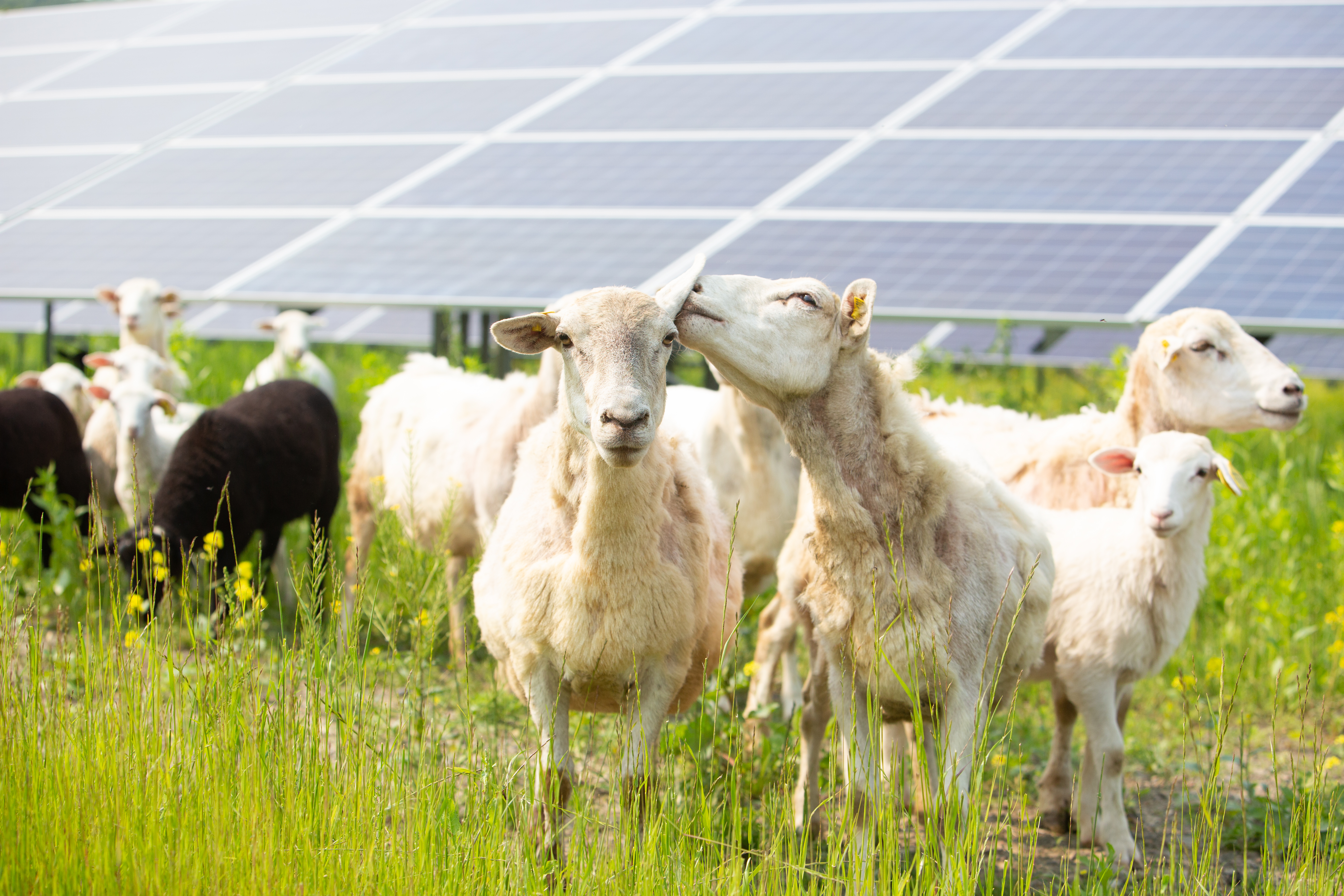
This time the project would take up 250 acres of a 1,500-acre site and produce 72 MW of electricity, achieved through stacking the panels to a double height. Again, the project more than met the requirements of the county solar ordinance. The land was described as currently consisting of managed pine forest, already subject to being cut over at any time, and fully 70% of the property would be preserved for conservation. Native grasses would be planted, and sheep would do most of the vegetation management. The shepherd, Marcus Gray of Gray’s Lambscaping, attended the hearing to describe the sheep operations he runs successfully at other solar sites.  

Approval of the project would earn the county roughly $1.7 million upfront, and $300,000 in annual tax revenue. 

Supervisors praised the developer for “a really good application” that “respected” the ordinance and the environment, for the company’s willingness to listen and respond to concerns, and for agreeing to build stormwater basins and sacrifice buildable space in favor of conservation. 

Several members of the public testified in favor of the project, but this time there were also opponents. Some of them repeated common myths about solar panel toxicity and the risk of fires. One woman stated flatly, and obviously incorrectly, that it was not possible to raise sheep at a solar farm because they would die from the heat. 

The supervisors themselves did not appear ill-informed or misinformed, though one expressed surprise that Gray could successfully sell his lamb at farmers markets when buyers knew where they had been raised. (Watching, I could only laugh, because I’ve always thought of the solar-sheep synergy as a great selling point for climate-conscious carnivores.) 

The concern raised most often was the risk of impacts to the nearby North Anna River, though the developer had agreed to shrink the project to accommodate a much greater setback from the river than required. 

Ultimately, however, Supervisor Stoneman’s argument for denying the permit rested on a different argument. He praised the developer for doing a good job, and noted the project was in accordance with all requirements. But, he said, “Beaverdam is just a different place.” People take pride in the rural character and forest and farmland. Our job, he noted, is to protect the trees that are harvested on the site currently, something “that is as important as the power.” 

“Money is not the most important thing,” concluded the man who led the cheering squad for a data center complex in his district six months earlier.  

The two supervisors who had supported the smaller solar facility that had been rejected in March made their best arguments for this project as well, though they ultimately voted with Stoneman as the home supervisor. One said she supported solar “because I’m pro-farm,” and solar is a way to preserve farmland from development. The other noted that the land would certainly be developed one way or another, and the results would almost certainly be worse. Maintaining rural culture is important, he noted, but “we are approving residential development and seeing by-right development that people don’t want either.”

He also warned his colleagues, as he had in the spring, that rejecting good solar projects was going to result in legislation that would take away local authority and give it to the unelected State Corporation Commission. He said he would go along with Stoneman’s motion to deny the permit because “I assume he knows something,” but he made it clear he considered it the wrong decision, and a dangerous one for local autonomy.

Evidently, he had been paying attention to the conversation at the General Assembly.

To be clear, my sympathies lie wholeheartedly with people whose instincts are to protect the woods and fields around them. I share the one Hanover supervisor’s belief that solar is a means to preserve land from permanent development and even improve soil health and wildlife habitat, but I also understand it may be years before some people see sheep grazing under solar panels as a welcome feature in their landscape. 

So I get how a rural county, having sold a little bit of its soul for $1.8 billion, might then slam the door to other development, even after applicants had worked with the county for months in good faith and done everything asked for. 

It’s not a choice I’d make – I’d take solar over data centers every time – but then, no one made it the county’s responsibility to contribute electricity to the grid that serves it, much less to produce the electricity needed to run the data centers it embraced.

This article originally appeared in the Virginia Mercury on December 3, 2024.