
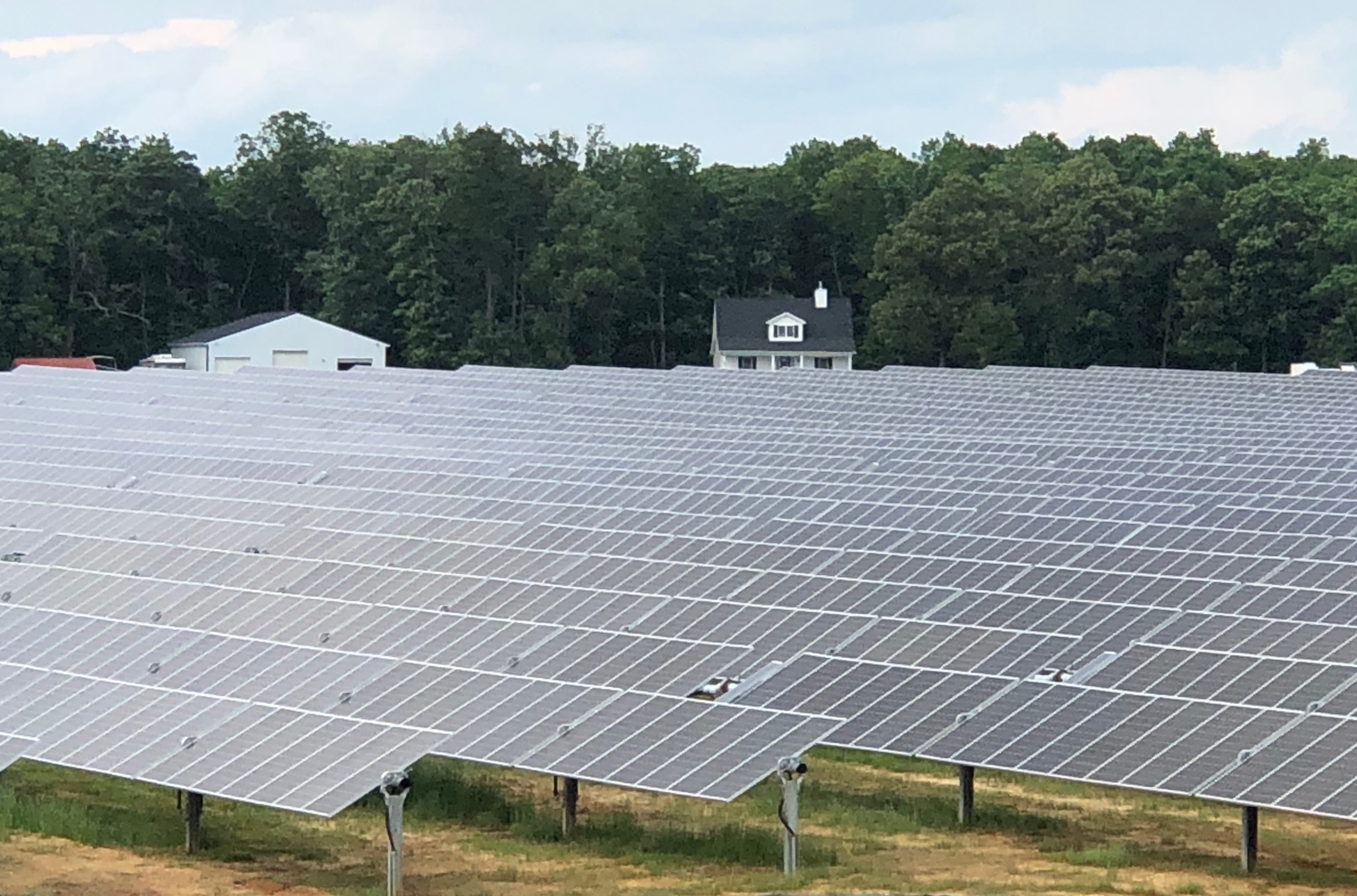
Reports show that 2025 was another record year for solar in the United States. The nation saw 27,225 MW of solar added last year, more than any other energy source and blowing away natural gas, the only fossil fuel that gained capacity. In fact, the U.S. also installed more energy storage and wind energy than gas. All in all, clean energy added 50 GW to the grid, fully 92% of all new generating capacity.
And this didn’t just happen in states with renewable energy mandates. Texas took the lead on clean energy from California, installing 11.6 GW of new solar and 7 GW of battery storage. Indiana, Florida, Arizona, Ohio, Utah, and Arkansas were also among the top 10 states for solar additions in 2025.
But then there was Virginia. Virginia installed only 716 MW of solar in 2025, the least amount since 2019 and less than half of what it installed in 2024. The state added no new battery storage, though the Department of Environmental Quality approved plans for several projects late in the year.
For a state with one of the most ambitious energy transition laws in the country, we should be doing a heck of a lot better. For context: 716 MW of solar is less than the amount of new data center capacity Dominion Energy Virginia says it’s receiving requests for each month.
Never mind the Virginia Clean Economy Act, Virginia is going backwards on climate.
In 2020, the VCEA set Virginia on a path to 100% carbon-free electricity by 2050, with clean energy targets that were both ambitious and achievable. In 2020, though, electricity use was barely growing. Today, our utilities are swamped with new demand from data centers.
Instead of ramping up additions of solar and storage, utilities are importing more fossil fuel electricity from other states – and in the case of Dominion, bucking the national trend towards renewables and instead pursuing a 944-MW gas peaker plant.
Sadly, the State Corporation Commission, which should enforce the VCEA, all but rubber-stamped Dominion’s flawed claim that the gas plant meets the requirements of the law’s reliability escape clause. The result will be higher bills for its customers, as Dominion’s increased reliance on fracked gas runs into the high gas prices that have made other states turn so heavily to clean energy.
The SCC also made it harder for the private sector to install solar. In February, the commission rejected a challenge from the Distributed Solar Alliance to Dominion’s punitive new interconnection requirements for projects over 250 kW, including most large rooftop projects on public schools. Again, the SCC simply accepted Dominion’s claims in the face of strong contradictory evidence.
All this backsliding has probably driven CO2 emissions higher instead of lower, though we don’t know for sure. Dominion used to calculate carbon emissions from its power plants in its integrated resource plans (IRPs) back when the numbers were declining. Its last couple of IRPs omitted the information, which might have drawn unwelcome attention to the incompatibility of new gas plants with climate action.
As for the state as a whole, the Department of Environmental Quality is responsible for keeping track of Virginia’s greenhouse gas emissions, updating an inventory it keeps on its website.
However, DEQ produced no updates during former Gov. Glenn Youngkin’s administration until Youngkin was on his way out at the end of 2025, when it released an update for 2021. In response to an email I sent to DEQ, a spokeswoman told me the agency is now working on the 2022 inventory, and that this lag time is totally normal.
We have to assume the numbers for 2022 won’t be good, but they will only have gotten worse between then and now. Nationwide, greenhouse gas emissions increased by 2.4% in 2025, including a 3.8% rise in power sector emissions due to utilities burning 13% more coal. The increase in coal-burning is attributed to rising data center demand and high natural gas prices, which motivated fuel-switching at utilities.
But all that was 2025; in 2026 we have a new Democratic governor and Democratic majorities in the House and Senate. Surely things are looking up?
Dominion’s 2,600 MW Coastal Virginia Offshore Wind (CVOW) project will start delivering carbon-free power this month, with full completion expected next winter. The General Assembly has sent to the governor’s office the most ambitious set of energy bills since the VCEA, along with legislation and a budget amendment that will put Virginia back into the Regional Greenhouse Gas Initiative (RGGI).
Returning to RGGI is important to reducing CO2, but it’s no panacea. RGGI works by sending a market signal to electricity generators in member states, rewarding efficiency and carbon-free energy and penalizing carbon-emitting generation.
However, it does not reach generators in non-member states, so the electricity Virginia imports is largely unmanaged. That’s a huge loophole that will only grow with the data center industry here, driving up overall carbon emissions. In the case of Northern Virginia Electric Cooperative – second in data center load only to Dominion – almost all of the electricity it provides to its customers is imported, and it is projecting enormous growth.
There are ways to close the loophole. Electric cooperatives could be required to meet the same renewable energy minimums that apply to Dominion and Appalachian Power, and data centers located anywhere in the state could be required to source clean energy. (The latter requirement was included in bills in both the House and Senate that died this year, though the House provisions might still be incorporated into a budget amendment that the governor and General Assembly leaders are debating.)
The SCC’s willingness to put consumers and the climate second to Dominion’s interests presents a separate problem. Some of the bills passed this year will make it harder for Dominion to propose further investments in gas plants; in particular, legislation requiring more storage and demand response and better management of the grid all work against the case for expensive peaker plants.
The House and Senate also passed integrated resource planning reform legislation that requires Dominion and Appalachian Power to present the SCC with plans that adhere more closely to the spirit of the VCEA. The General Assembly is also taking tentative stepstowards performance-based regulation, which would reward utilities for doing things like meeting clean energy and affordability goals rather than for just building more infrastructure.
But there is no way to fully tame profit-motivated utility monopolies that lavish elected officials with millions of dollars in campaign contributions. Gov. Abigail Spanberger and legislative leaders will have to remain vigilant and ready to counter SCC missteps like its orders on interconnection and Dominion’s gas plant, and to keep the pressure on the utilities to make money in ways that are better aligned with the public interest.
The good news is that Dominion tends to bend with the political winds. Though in the last few years it doubled down on gas in sync with Republican obsessions, back in 2022 it published a climate report that envisioned a grid dominated by solar. This year, with Democrats back in charge, Dominion is already acceding to some legislative initiatives it fought in past years.
But Spanberger needs to drive the agenda. She will have an opportunity to lay out a path forward this fall when she releases the energy plan that Virginia law requires of each new governor.
According to statute, the plan needs to identify actions to be taken over the next 10 years that further the goals of the Commonwealth Clean Energy Policy. The policy has a timeline that is even more aggressive than the VCEA’s (2040 instead of 2050 for electricity), and it targets the entire economy for decarbonization by 2045. That means the governor’s energy plan must address emissions from transportation, buildings, industry and agriculture as well as the power sector.
After that, it will be up to the governor to make sure her administration and the legislature follow through with the plan. Certainly, they face a daunting task in putting Virginia back on its climate track. But we won’t get there by building more gas and less solar.
Originally published in the Virginia Mercury on March 18, 2026.
 Power for the People VA