Unknown's avatar

Watch your wallets: Dominion getting license to build nation’s most expensive nuclear plant

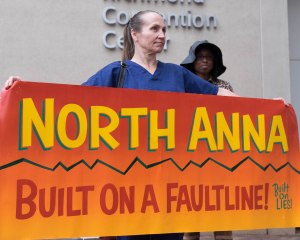
Erica Gray, Nuclear Issues Chair of the Sierra Club, at a protest against Dominion’s planned North Anna 3 nuclear reactor. Photo courtesy of the Sierra Club.

The Richmond Times-Dispatch reports that within the next few days, the Nuclear Regulatory Commission will approve a Combined Operating License (COL) for Dominion Virginia Power’s third nuclear power plant planned for its North Anna site in Louisa County, Virginia. That means that as far as the federal agency is concerned, North Anna 3 is good to go.

As far as Virginia residents are concerned, though, this project has gone way too far already. Dominion has poured hundreds of millions of dollars of ratepayers’ money into NA3, and that’s money we will never see again. But that’s better by far than moving forward with what would be the most expensive nuclear plant ever built in the United States.

Dominion Resources CEO Tom Farrell dearly wants this nuke precisely because of its price tag. The more expensive the plant, the greater the profit for Dominion, under the perverse incentives of Virginia law. Before Mr. Farrell gets his way, though, the State Corporation Commission has to issue a Certificate of Public Convenience and Necessity (CPCN).

The SCC has repeatedly made its skepticism plain. As recently as December 2016 it reiterated its warning that if Dominion were to be allowed to recover the $19.3 billion investment from its customers, it would “represent a large enough increase in electric bills for residential and business customers to impact Virginia’s economic climate.”

There is no reason to think the SCC will change its opinion now. Unless, that is, the legislature does something stupid to force the SCC to approve NA3. Given the power Dominion has over Virginia’s General Assembly, this can’t be ruled out.

So let’s briefly review the reasons why absolutely no one should want this nuclear plant to go forward.

NA3 is a terrible deal for the people who would have to pay for it.

The Attorney General’s office has calculated that the $19 billion price tag for NA3 would increase the bills of Dominion customers by 25% beginning its first year in operation. And that’s if it somehow avoids the cost overruns that have plagued other nuclear plants in recent years.

For a case study in how bad the economics of nuclear have become, one need look no further than South Carolina and Georgia, and the disastrous efforts of utilities SCANA and Southern Company to build the Summer and Vogtle nuclear plants. Construction is three years behind schedule and more than a billion dollars over budget, plagued by missteps that caused the bankruptcy of developer Westinghouse Electric Co. and threaten the survival of its parent Toshiba Corp.

The chairman of the Georgia Public Utilities Commission is questioning whether work on the Vogtle plants should even continue, given the escalating costs and the availability of lower-priced natural gas and renewables. Southern’s CEO recently told investors it may not be able to complete the project. Meanwhile, South Carolina customers have already seen their rates rise 20% to pay for the Summer plants, and SCANA is considering abandoning the project.

In states where utilities don’t have monopolies on generation, even existing nuclear plants are closing (including one owned by Dominion Resources in Wisconsin), or are begging for state subsidies to let them survive (as the company is doing in Connecticut). If fully-paid-for nuclear reactors aren’t competitive in today’s market, it can’t make sense to build a new one.

NA3 would make our electricity grid more vulnerable to outages.

Concentrating power generation at a single site is a bad idea. If something goes wrong, there is that much more power at risk. This is especially true when the site already has a known vulnerability, in this case its location on a fault line. An earthquake near North Anna in 2011 shut down the existing reactors for three months. A third plant in the same location, on the same fault line, increases the amount of generating capacity that could be forced offline without warning, challenging grid operators to find replacement sources—instantly.

National security experts say protecting the grid from weather events and physical and cyber-attacks requires moving away from large, centralized generating stations to dispersed sources located near consumers. NA3 would take us in the wrong direction.

We don’t need the power.

Virginia is part of PJM Interconnection, a regional power grid that covers all or part of thirteen states plus the District of Columbia, and includes over 1,300 generating units. Today, Dominion buys a portion of its power on the PJM wholesale market, at a price far below the projected cost of electricity from NA3. PJM already faces a power glut. Adding more generation to PJM would be expected to lower wholesale power prices. That would benefit buyers in other states, at the expense of the Virginia consumers paying for NA3.

Nuclear energy is not a climate solution.

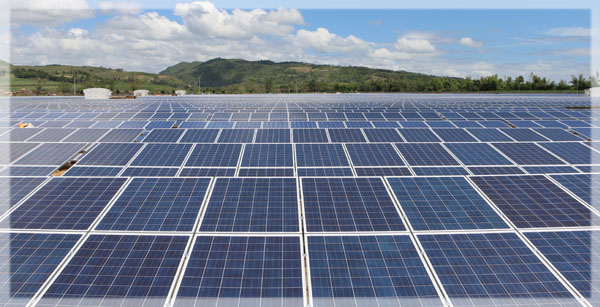
Low-cost wind and solar are increasingly viewed as the backbone of the 21st century electricity grid. Dominion’s latest integrated resource plan recognizes solar as the lowest-cost resource, even compared with “cheap” natural gas. Nuclear is not just more expensive; it is actually incompatible with large amounts of renewable energy. That’s because U.S. nuclear plants are designed to run all the time at a constant level, regardless of demand. At night when demand is low, nuclear plants still have to deliver power to the grid, even if it means turning off wind turbines that could supply free electricity.

Right now, Dominion stores surplus energy at its huge Bath County pumped storage facility. The stored energy supplies power in the daytime when demand rises. This pumped storage is good for consumers because it allows Dominion to run its baseload coal and nuclear plants for maximum efficiency. But it could just as well be used to store excess wind or solar energy.

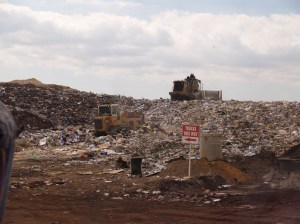
Finally, nuclear waste is piling up with no long-term storage plan in place. Deliberately adding more waste when we have no idea what to do with it is beyond reckless. Our environmental agencies are underfunded and dealing with more problems than they can handle, even as climate change increases the magnitude of those problems. Far from being a climate solution, nuclear energy simply increases the burdens on our children and future generations.

Unknown's avatar

Moving to block competition, Dominion files its own sort-of-green energy tariff

Just a couple of the great things that count as “renewable energy” in the Virginia Code.

Dominion Virginia Power has filed for permission from the State Corporation Commission (SCC) to offer a 100% renewable energy tariff to commercial and industrial customers with peak loads of over 1,000 kilowatts. In a footnote, Dominion states that it intends to propose a similar tariff for residential customers in the future. The case is PUR-2017-0060.

Customers who want only carbon-free energy like wind and solar will likely be disappointed. Dominion intends to use a “portfolio of resources” that will include “dispatchable resources”—i.e., hydropower and stuff that can be burned. Dominion promises the sources it uses will meet Virginia’s definition of renewable. That’s not reassuring. Under Virginia law, renewable energy can include sources like landfill gas and municipal solid waste, as well as “biomass, sustainable or otherwise (the definitions of which shall be liberally construed).”

Dominion’s filing comes scarcely one month after an SCC decision confirmed the right of independent renewable energy provider Direct Energy to offer its products to Dominion customers, but only so long as Dominion lacks its own green tariff for those customers. The SCC order (explained here) made clear that under Virginia law, a competitor like Direct Energy would be blocked from taking on new customers once Dominion has an approved tariff.

Dominion’s filing looks suspiciously like an effort to cut Direct Energy off at the knees. If the upstart competitor follows through with its plans to offer Virginia residents a renewable energy option, Dominion will surely propose a residential renewable energy tariff. SCC approval of Dominion’s tariff would shut out Direct Energy, which is targeting only residential consumers for its product. Under the language of the Code, it does not appear to matter whether a competitor can offer a better product, or a better price.

For the moment, Direct Energy is not backing down. The company has set up a web page to gauge the interest of residential consumers while it deliberates its next move. Ron Cerniglia, Director of Corporate and Regulatory Affairs for the Mid-Atlantic Region, told me he thinks the timing of Dominion’s filing is “curious,” given that “Dominion has had ten years to file a renewable energy tariff and hasn’t. We’re concerned about the implications of limiting choice for consumers. We don’t know if the move will actually offer a choice consumers want, or if it is just closing doors on others.”

Indeed, ten years have passed since Virginia enacted its current utility law, which includes the right of a customer to “purchase electric energy provided 100 percent from renewable energy” from another supplier if its own utility isn’t offering it. During most of that time, Dominion has sold Renewable Energy Certificates to customers under its “Green Power Program,” but it has never offered residential customers an opportunity to buy actual renewable energy. (See “Is a Green Power program worth your money?”)

This is slated to change as the utility works with the solar industry on implementing a new solar option under legislation passed this year. However, the new law specifies that the solar option will not count as a tariff for “electric energy provided 100 percent from renewable energy,” so it does not block competitive offerings like Direct Energy’s.

Dominion was agreeable to excluding the solar program because it interprets the Code’s reference to “electric energy provided 100% from renewable electricity” to mean the electricity must come from renewables 100% of the time, an interpretation almost no one else shares.

This seems to be the reason Dominion intends to include carbon-emitting sources into its renewable energy offering, even though it’s safe to say there are no customers clamoring to get their electricity from garbage or the clear-cutting of forests. It also means the new tariff will likely be priced higher than one that included only solar, because electricity from biomass is more expensive today than harvesting the sun. (No word from Dominion on why it doesn’t just assign a portion of its pumped storage capacity to serve an all-wind-and-solar product.)

But if customers want only wind and solar, they are also likely to be disappointed in Direct Energy’s product. Cerniglia says his company includes baseload sources like “cleaner biomass” in its renewable energy product to provide 24/7 power. He estimated that the initial mixture would consist of “50% to 60% municipal waste biomass (Pennsylvania and Virginia sourced) and 40% to 50% wind (Pennsylvania sourced) . . . We are also committing to not utilize virgin wood / clear cut wood biomass in our product mix at any time.”

Direct Energy also has not determined the pricing of its product yet, but Cerniglia said it would be “equal to or lower than what Dominion Virginia Power residential customers pay for ‘brown’ power.”

Perhaps most importantly, he noted, “The benefit of a competitive market is that customers can leave us at any time. They’re not captive.”


Update: On June 21, a Hearing Examiner for the SCC recommended rejection of a similar application for a renewable energy tariff filed last year by Appalachian Power. See my discussion here for how this may affect Dominion’s application. 

Unknown's avatar

Sierra Club files petition with SCC seeking Affiliates Act review before Dominion commits to Atlantic Coast Pipeline deal


By Pax Ahimsa Gethen – Own work, CC BY-SA 4.0, https://commons.wikimedia.org/w/index.php?curid=55451003

Today the Sierra Club filed a petition with the Virginia State Corporation Commission seeking a Declaratory Judgment that Dominion Virginia Power’s arrangement to obtain gas capacity in the Atlantic Coast Pipeline is subject to Commission approval under the Virginia Affiliates Act. That law requires a public service corporation to get the approval of the Commission before it enters into a “contract or arrangement” with an affiliated company.

The Affiliates Act applies, according to the Sierra Club, because Dominion Virginia Power’s parent corporation, Dominion Resources, is a partner in the Atlantic Coast Pipeline joint venture, and Dominion Virginia Power’s (DVP) fuel procurement subsidiary, Virginia Power Services Energy Corporation (VPSE), contracted for capacity on the pipeline. Put more simply, a utility—Dominion Virginia Power– and two of its corporate affiliates have negotiated a business deal, and the Affiliates Act directs the Commission to carefully review that deal to ensure that consumers don’t get the short end of the stick.

If the Commission grants Sierra Club’s petition, DVP will have to submit its agreement with Atlantic Coast to the Commission for formal review and approval. Sierra Club and other interested parties will then have a chance to weigh in on whether the agreement will actually benefit consumers.

There is good reason to think it won’t benefit consumers. Bill Penniman, a retired energy attorney who serves as Conservation Co-Chair for the Virginia Chapter of the Sierra Club, has studied Atlantic Coast’s filings with the Federal Energy Regulatory Commission (FERC). He notes that as of now, the amount of money that DVP (via VPSE) will pay Atlantic Coast for pipeline capacity is secret. The public filings reveal, however, that the maximum amount Atlantic Coast can charge any customer is more than three times the amount that another company, Transcontinental, can charge for pipeline capacity that services the exact same power plants as Atlantic Coast. And as it happens, says Penniman, DVP already has twenty-year shipping agreements with Transcontinental. The fact that DVP is now trying to enter into a whole new contract to ship gas to the same power plants via a much costlier pipeline ought to raise a lot of eyebrows.

If this talk of parent companies and subsidiaries is confusing, it might help to picture Dominion Resources as a giant spider with DVP as one leg and other Dominion-owned companies as other legs. Some of those legs have hairs on them; they are subsidiaries of the subsidiaries, but still part of the spider. VPSE is a hair on the DVP leg; its job is to buy fuel and whatever else the utility needs to run its power plants and make electricity.

In this case, VPSE has contracted with Atlantic Coast to buy a big chunk of space on the pipeline. DVP will use this pipeline capacity to deliver the gas needed to fire its Greenville and Brunswick facilities. Yet another leg on the spider, Dominion Transmission, has been hired to build and operate both Atlantic Coast and a connecting line called the Supply Header (which ups the price of the whole system).

To top it all off, the spider itself, Dominion Resources, owns 48% of the Atlantic Coast venture, along with Duke Energy and Southern Company. You can picture the Dominion spider teaming up with its spider buddies on the project, but I don’t recommend that if you tend towards arachnophobia and are already not happy with this analogy.

Having VPSE contract for capacity on Atlantic Coast is absolutely critical to the success of the whole pipeline venture. Atlantic Coast can’t get permission from the Federal Energy Regulatory Commission (FERC) to build the pipeline unless it can show the pipeline is needed, and the only way to show need is by having customers lined up to buy the capacity. If VPSE didn’t sign that contract, Atlantic Coast couldn’t get built.

But here’s the thing: while FERC has final authority for approving or rejecting the pipeline itself, Virginia’s State Corporation Commission has authority to decide whether any agreements between regulated utilities and their corporate affiliates are in the public interest. In fact, the law says that the Commission must review and approve inter-affiliate agreements before they take effect.

However, even though DVP has directed VPSE to buy pipeline capacity on Atlantic Coast for DVP to use at its power plants, DVP has never submitted VPSE’s arrangement with Atlantic Coast for Commission review. Atlantic Coast has assured FERC it has enough customers to justify building the pipeline, but the fact of the matter is, one of its key customers—VPSE (and, by extension, DVP)—may not have had authority to enter into the deal in the first place.

This is what the Affiliates Act is supposed to prevent. Virginia Code section 56-77 says that any “contract or arrangement” between a public service company and an affiliated interest for goods, property, or services requires prior approval from the Commission. The fact that VPSE is acting as a contractual middle man between DVP and Atlantic Coast makes no difference: this is an arrangement between DVP, VPSE, and Atlantic Coast that is made specifically for the benefit of DVP. They’re all the legs (and leg-hairs) of the same spider, and they are likely to put the spider’s welfare above anyone else’s. And that’s exactly the reason the General Assembly passed the Affiliates Act.

The Atlantic Coast Pipeline is a big deal for Dominion Resources. The company is all-in on natural gas, and building this $5 billion pipeline is expected to generate a lot of profit for shareholders. What’s missing from this equation is the public interest, and there are good reasons for the Commission to be skeptical. How does it benefit Virginians to construct an extraordinarily expensive pipeline when much cheaper pipeline capacity already exists? That’s the question the Sierra Club will pose to the Commission if grants the petition and requires DVP to submit its Atlantic Coast agreement for review.

Furthermore, why should DVP commit itself (and its customers) to a huge amount of natural gas capacity over twenty-year period when there are better, cleaner options available? While Dominion and all its spider legs may think that burning more gas is a great idea, the reality is, natural gas increasingly looks less like a long-term energy solution and more like a trap for companies that made the wrong bet. At the same time, renewable energy and efficiency resources are growing ever cheaper. The Commission might well question Dominion’s plan to lock its customers into a bad investment in fossil fuels over the next twenty years at the expense of smarter renewable alternatives.

There’s a reason the Affiliates Act exists, and this is it. Here’s hoping the Commission grants Sierra Club’s petition and gives the Dominion spider a good, hard look under the microscope.


Unknown's avatar

Dominion Power promises huge solar investments and a lower carbon footprint—or does it?

Dominion Virginia Power says energy from solar farms is now a low-cost option. Photo credit Kanadaurlauber.

Dominion Virginia Power released its updated Integrated Resource Plan (IRP) this week with a press release that promised thousands of megawatts (MW) of new solar power and a dramatically lower carbon footprint. In a remarkable turnabout, the Executive Summary declares, “The Company must now prepare for a future in which solar PV generation can become a major contributor to the Company’s overall energy mix.”

Alas, a closer look reveals Dominion will actually increase its carbon emissions over the period studied. Meanwhile, the solar would be built at a rate of only 240 MW per year over the 15-year period covered by the IRP, about the same amount being installed in Virginia this year. (Over 25 years, Dominion says its solar could reach 5,200 MW, which means the pace of installation would actually drop in the out years.) That should elicit yawns, not excitement.

The solar numbers pale in comparison to the more than 4,600 MW of new natural gas combined-cycle plants Dominion has been building just in this decade. (Remember that solar farms generate electricity at about 20-25% of “nameplate” capacity on average, while combined-cycle gas plants nationally average 50-60%, and can achieve 70% or higher.*) And even come 2032, the new solar will make up only a tiny fraction of a generation portfolio that consists almost entirely of coal, gas and nuclear.

I’ll be interested to see the numbers analyzed, but my guess is that all the renewable energy Dominion proposes to build over the next 15 years represents no more than 5-10% of its total electric generation. That’s too little, too late, in a state that can do so much better.

So the more things change, the more Dominion stays the same. Behind the hype being offered to the press stands a utility that is still committed to fossil fuels and nuclear power.

Virginia utilities file IRPs with the State Corporation Commission (SCC) every year. The plans are supposed to reflect the utilities’ best sense of how they will meet consumers’ needs for electricity while complying with state and federal laws and policies. This involves some guesswork about the direction of future regulations, including regulations of CO2 emissions.

In spite of President Trump’s determination to roll back climate protections while he is in office, Dominion’s IRP assumes an eventual price on carbon. Most utilities nationwide are doing the same thing. But given the uncertainties, Dominion has chosen (as it did last year) to model different scenarios instead of committing to a single plan.

Even the low-cost plan that wouldn’t comply with the EPA Clean Power Plan contains just as much solar as the other plans, reflecting the company’s assessment (on page 3) that solar is now “cost-competitive with other more traditional forms of generation, such as combined-cycle natural gas.”

Yet the carbon reductions Dominion promises in its press release appear to be something of a sleight-of-hand. For one thing, Dominion has chosen to compare its CO2 output in 2032 to its output in 2007, not 2017. CO2 emissions were markedly higher in 2007 than now, with the shale gas boom and the rise of renewables leading to massive coal retirements in the interim.

Moreover, a careful reading of the press release reveals the reductions Dominion promises are per-capita, not overall. A chart on page 115 of Dominion’s IRP shows every one of the scenarios Dominion studied will actually increase the company’s total CO2 emissions between now and 2042.

That reality exasperates climate activists. Glen Besa, former Director of the Virginia Chapter of the Sierra Club, comments, “The only impression you could have reading Dominion’s release was that it was making dramatic reductions in carbon pollution, which obviously is not the case.”

CO2 emissions would not increase if Dominion were simply shutting down coal and building more solar. But all of the alternative scenarios Dominion models for its IRP contain more gas plants: at least another 1,374 MW of gas combustion turbines in all plans, and 1,591 MW of combined cycle gas in some scenarios. Combustion turbines are more flexible than combined-cycle plants and so are better for meeting spikes in demand and integrating renewable energy like solar, but while they run less often, they are typically higher-polluting. Many utilities are using demand response or installing battery storage instead; Dominion appears to prefer gas.

All this gas means higher CO2 output. Not incidentally, burning more gas also means more business for Dominion’s parent corporation, Dominion Resources (soon to be known as Dominion Energy), which is heavily invested in gas transmission. And crucially, Dominion Energy needs more gas power plants to justify building the Atlantic Coast Pipeline. So building more gas plants serves the interests of Dominion’s affiliates, not its customers.

The problem with building new gas plants is that it lowers carbon only so far compared to coal, and then you’re stuck at that level for the life of the gas plants, unless you’re willing to abandon them early. That’s why any utility that’s serious about protecting ratepayers from stranded costs has to invest in wind, solar, energy efficiency and storage, not natural gas.

Speaking of wind, the IRP includes the 12 MW pilot project known as VOWTAP in all of the plans, even though Dominion lost millions of dollars in federal funding when it would not commit to building the two test turbines by 2020, three years past the original deadline. But none of the scenarios studied include any land-based wind, and none include a build-out of the federal offshore wind energy area Dominion bought the rights to, which could support at least 2,000 MW of offshore wind power. This is a strange omission given that Dominion continues to include a scenario in which it would build the world’s most expensive nuclear reactor, known as North Anna 3.

Polls consistently show overwhelming public support for renewable energy. Yet right now, ordinary Virginia ratepayers have no access to renewable energy unless they put solar on their own rooftop. Corporations like Amazon Web Services and Microsoft account for the bulk of the solar energy being installed in Virginia, with most of the remaining going to the military, state government, universities, and schools.

So 3,200 MW over 15 years won’t even begin to satisfy consumer demand. North Carolina installed almost 1,000 MW last year; I’d like to see Dominion set that as an annual target, bringing it up to the 15,000 MW over 15 years it modeled for last year’s IRP (before hiding the encouraging results from pubic view). Round out the solar with other cost-effective clean energy options, and we will see the kind of carbon reductions that don’t have to be fudged in a press release.


*On page 88 of the IRP, Dominion provides it own capacity factor forecasts: solar 25%, combined cycle gas 70%, gas combustion turbines 10%, nuclear 96%, onshore wind 42%, offshore wind 42%. The chart does not include a number for coal.

Unknown's avatar

Direct Energy wins right to sell renewable energy in Virginia, but there’s a catch

Direct Energy may have just won a Pyrrhic victory in its bid to sell renewable energy to Virginia residents. The State Corporation Commission ruled last week that the company can market 100% renewable electricity to Virginia customers of Dominion Virginia Power and Appalachian Power, but only as long as the utilities aren’t offering it themselves. Once they do, Direct Energy can continue to serve existing customers but won’t be able to sign up new ones.

The ruling makes it harder for Direct Energy to enter the residential market in Virginia. On the other hand, Direct Energy appears to have won a round on a second issue involving sales to large (over 5 megawatts in demand) commercial and industrial customers. The SCC ruled that these customers don’t have to give five years’ notice before they can switch back to their utility from a renewable energy provider like Direct Energy, as they would have to do if they were not buying renewable energy.

This is a significant win for Direct Energy’s ability to offer renewable energy to large customers, since Dominion’s position on the five-year notice requirement could scare off customers worried about being left without a supplier if Direct Energy were to leave the market. However, that part of the SCC’s order is under review in response to a motion for reconsideration filed by Dominion on Tuesday, so I won’t address that further here.

Direct Energy is a Delaware-based company currently licensed to sell natural gas in Virginia as a competitive service provider. Last August the company filed a petition for declaratory judgment (PUE-2016-00094) asking the SCC to clarify its rights under Virginia law to sell renewable energy to customers of Dominion Virginia Power. The SCC brought in Dominion and Appalachian Power, and Southern Environmental Law Center (SELC) intervened on behalf of environmental groups Appalachian Voices and Chesapeake Climate Action Network.

Section 56-577 (A)(5) of the Virginia Code explicitly allows sellers of 100% renewable energy into the territories of the state’s monopoly utilities if those utilities themselves aren’t offering renewable energy to their customers. Currently, neither Dominion nor Appalachian Power offer a tariff for renewable energy. That means the door is wide open for anyone else to do so.

But that open door is merely a tease, as the Commission’s order just confirmed. All Dominion or APCo has to do is jump in with its own product, and the door shuts in the face of the interloper. Once the SCC approves a utility’s program, Direct Energy can continue selling to any customers it has already signed up, but it won’t be able to sign up any new customers.

It can take months or years of marketing for a third-party supplier to build up enough of a customer base to make the whole effort worthwhile, so the SCC’s ruling makes the Virginia residential market much less attractive.

Direct Energy and the environmental groups had argued that once a competitive service provider got approval to sell 100% renewable electricity in Virginia, it ought to be able to continue signing up new customers, even once the SCC had approved a competing product from the incumbent utility. As the company explained in its Petition:

It would be illogical for the Virginia General Assembly to prohibit Direct Energy or any competitive service provider from continuing to market and serve additional customers once Dominion Virginia Power begins to offer a 100% renewable energy tariff. No retail business can survive if it cannot do business with new customers. This is certainly true in the retail energy market, in which customers move on and off a system with regularity, reacting to price signals and relocating in and out of utility service territories. Consequently, it is most reasonable to interpret Virginia Code § 56-577 (A) (5) (b) to allow Direct Energy to continue to serve additional customers to the class of customers to which it is marketing at the time that the Commission approves a Dominion Virginia Power 100% renewable energy tariff.

Unfortunately for Direct Energy, the Code was written to protect Virginia utilities from competition to the greatest extent possible consistent with also making them look good. What is logical and reasonable to anyone running a business doesn’t enter into it; nor, for that matter, does the best interest of the buying public.

The SCC’s order is a win for Dominion and APCo, but a loss for customers who have waited ten years for their utilities to offer them renewable energy. Both Dominion and APCo offer what they call “green power” but are simply sales of renewable energy certificates as an add-on to regular “brown” power.* Even if the utilities now gin up a their own renewable energy product, consumers would be better off having choices.

After all, the Virginia Code doesn’t say a utility program has to be better or cheaper than the one offered by a competitive service provider like Direct Energy. Indeed, some consumers have already expressed concern Dominion might close the door on Direct Energy with a product that meets the Virginia Code’s broad definition of renewable energy but is distinctly inferior.

“My worry is that Dominion will offer a “100% renewable” program that is biomass, hydro and other things that aren’t really zero carbon, but still slide by,” says Ruth Amundsen, a solar advocate in Norfolk. “And then Direct Energy would be out.”


*Legislation passed this year will allow customers to buy electricity generated from solar facilities from their utilities. The program is styled “community solar,” but it looks like it would satisfy the statutory definition of a sale of electricity generated from 100% renewable energy. However, a provision of the bill, added at the behest of SELC, states that it will not be considered such a product.

Why, you might ask, would Dominion agree to a provision that says their solar option isn’t a tariff for 100% renewable energy, especially with the Direct Energy petition outstanding? I have an answer, but first a word of caution: you are now getting deep in the weeds. Carry tick repellant.

Recall that the fight over third party power-purchase agreements (PPAs) involves two provisions of the Virginia code, including § 56-577 (A) (5)—the one we’re talking about here. Companies that want to help customers install on-site solar facilities by using PPAs have argued that this section clearly permits customers to buy solar electricity from third party suppliers when their utility doesn’t offer a renewable energy tariff. No green tariff, no bar to a PPA.

But the utilities argue that this kind of electricity sale doesn’t meet the statutory requirement, because although a solar facility is 100% renewable, it does not serve 100% of the customer’s load. A strange reading, yes; and wrong, too, according to an SCC hearing examiner who looked at the question back when APCo put together its own renewable energy product. APCo decided to withdraw its product rather than risk the SCC confirming the hearing examiner’s reading. That action meant the utilities could keep their reading of the statute as a live threat against any company that wants to offer a PPA under terms that don’t meet the terms of the pilot program Dominion negotiated a few years ago.

Apparently, preserving that argument mattered more to Dominion than chasing off would-be competitors like Direct Energy. The gamble will have paid off if Direct Energy drops its Virginia effort in light of the SCC’s ruling last week.


Update, April 7. Ron Cerniglia, Director of Corporate & Regulatory Affairs for Direct Energy, provided the company’s view of the SCC’s ruling for us. His note reads:

In its ruling on Direct Energy’s Petition for Declaratory Judgment, the State Corporation Commission (SCC) agreed with Direct Energy on two of the three major points on which Direct Energy sought clarification.  The SCC did not agree that a retailer could continue to provide 100% renewable service to residential and small (<5 MW) individual customers, including new customers, after the utility (e.g., APCo or Virginia Electric and Power Company) receives approval of their own 100% renewable tariff.  However, residential customers and individualized non-residential customers who sign-up with a retailer do not immediately return to utility service when and if a utility receives approval of their 100% renewable tariff.  Instead, the customer remains with the retailer for the term of the customer agreement.  
The SCC agreed with Direct Energy that a retailer may continue to offer 100% renewable service to large customers (>5 MW) or to customers aggregating to >5 MW even if such sales are no longer permitted because the utility  is offering its own 100% renewable tariff.  The SCC also agreed with Direct Energy that if a retailer is providing 100% renewable service to a large customer that several  conditions and limitation  do not apply.  That includes the requirement of  that 5 year advance notice must be given before a retailer’s customer can return to the utility for service.  It is on this last point that Dominion has filed a Petition for Reconsideration.  This week, the SCC granted Dominion’s petition without ruling up or down on its substance. 
We do not believe that Dominion has raised any issue that the SCC has not already considered. We are very appreciative of the SSC’s actions to date and are hopeful that it will make short work of the petition, and quickly enter another Order denying Dominion the relief it is requesting.  Direct Energy is excited to open up the Virginia market to competition with a 100% renewable product. Once the uncertainty has been addressed, we believe that Virginians will have the choice to choose a renewable power supply solution.
Update May 12. On April 26, the SCC issued an Order on Reconsideration confirming its earlier ruling that the five year advance notice requirement did not apply to large customers (over 5 MW) who return to the utility following cancellation of a renewable energy supply contract with a competitive service provider.
On May 9, 2017 Dominion filed with the SCC its own plan for a renewable energy tariff for large users.  (PUR-2017-00060.) The filing notes that Dominion intends to follow this with a residential green tariff.
Unknown's avatar

Memo to legislators: Virginia is not a low-cost energy state

Sure, there is something to be said for using a lot of energy–if you’re a Jack Russel Terrier. For the rest of us, not so much.
Photo credit Steve-65 – Own work, CC BY-SA 3.0, https-::commons.wikimedia.org:w:index.php?curid=17865919

Anyone who has attended the annual meeting of the House Energy Subcommittee has watched the Republican majority vote down all manner of legislation designed to improve Virginia’s poor ranking on energy efficiency. Since energy bills have to survive this subcommittee before the rest of the General Assembly gets to hear them, this little band of naysayers effectively holds back progress on initiatives that would save money and reduce energy use.

Why would they do that? As discussed in my last post, these delegates almost invariably vote the way Dominion Virginia Power wants them to. And Dominion doesn’t like these bills. The utility is in the business of selling electricity, and energy efficiency is bad for business.

Of course the utilities don’t put it that way. At this year’s subcommittee meeting, Dominion Virginia Power lobbyist Bill Murray explained his company’s opposition to one of Delegate Rip Sullivan’s energy efficiency bills by saying that real efficiency gains depend on the actions of individuals, and Virginians aren’t incentivized to take these actions because Dominion keeps our rates so admirably low.

This might put you in mind of former Vice President Dick Cheney’s dismissal of conservation as a sign of personal virtue but not a sound basis for energy policy. Let’s set that aside. Murray’s comments might also be thought unfair to his own client, which has tried and failed to get approval from the State Corporation Commission for various programs that would help consumers practice personal virtue. (If you wonder why, in that case, he was standing there opposing legislation designed to produce a better result, you are missing the point of the Subcommittee Hearing. It’s Kabuki theatre, people, and you really shouldn’t miss it.)

For now, however, let’s simply ask whether Mr. Murray’s claim is correct. Are we really paying less for energy than residents of other states?

We should first clarify whether we are talking about rates, or bills. Dominion prefers to focus on rates, but what people pay are bills. Few people can tell you what their electricity rate is, but most have a sense of the bottom line on their monthly bill.

According to the U.S. Energy Information Agency, Virginia’s 2016 residential rates stand at an average of 10.72 cents per kilowatt-hour, which is indeed about 12% below the national average of 12.21.* The average for our peer group, the South Atlantic region, is 11.11 cents per kWh, with Maryland at the high end (14.01 cents), and Georgia at the low end (9.92 cents).

When it comes to monthly bills, however, Virginia residential customers ($130.58) pay almost exactly the South Atlantic average ($131.20), but we are way above the national average ($114.03). (Note the bills are based on 2015 data; the EIA has not updated this chart for 2016.) If having to pay more for electricity is the primary motivation to adopt energy efficiency measures, Virginians are more motivated than most Americans.

Several factors can make a state have lower bills despite higher rates. Among these is energy efficiency. Energy efficiency is why a state like California, with high incomes and notoriously high residential electricity rates (16.99 cents/kWh), still has average monthly bills ($94.59) that are 30% below Virginia’s. California has succeeded in keeping per capita energy use flat for decades while the U.S. average climbed steadily, only flattening out in the past ten years. California is currently ranked 49th in the nation for per capita energy consumption, and 49th in total energy costs. “California” is a bad word among Virginia Republicans, who assume anything that state does must be bad, but California’s experience has to be considered by anyone who cares about energy costs.

Back at the Energy Subcommittee meeting, Bill Murray did not mention California, but he did offer his opinion on the cause of Virginia’s higher-than-average bills. He noted that many Virginians use electric heat pumps to heat their homes, which drives up winter electricity use, resulting in higher bills on average. (An EIA analysis using 2009 data showed that 55% of Virginia households heat with electricity, higher than the U.S. average but less than the South Atlantic average.)

To get a look at the whole energy picture across states, I created the table below that compares residents’ costs of electricity, natural gas and fuel oil across the U.S. Virginia ranked 18th out of 51. Because it isn’t weather-adjusted, it can’t tell the full story. However you slice it, though, Virginia is not a low-cost energy state.

It may still be true that middle-class homeowners don’t feel the bite of energy bills enough to go to the trouble of figuring out what they should do to save energy. If it’s hard, people don’t do it—which is one reason energy efficiency programs are designed to make it easier. But middle-class homeowners also aren’t the only ones who would benefit. Across Virginia, people with incomes below 50% of the poverty level spend at least 40%, and often more than half their income, on energy bills.

So if cost equals motivation, Virginians are motivated. What’s lacking are the energy efficiency programs to help people save energy, and the laws to enable those programs.


Overall Rank State Total Energy Cost Monthly Electricity Cost (Rank) Monthly Natural-Gas Cost (Rank) Monthly Home Heating-Oil Cost (Rank)
1 Connecticut $304 $155

(7)

$44

(20)

$104

(1)

2 Rhode Island $259 $107

(39)

$61

(5)

$91

(4)

3 Massachusetts $253 $115

(34)

$60

(6)

$78

(6)

4 Alaska $241 $129

(20)

$53

(13)

$59

(7)

5 New Hampshire $234 $127

(25)

$20

(44)

$87

(5)

6 Vermont $231 $120

(30)

$18

(48)

$93

(3)

7 New York $220 $115

(32)

$66

(3)

$39

(9)

8 Maine $217 $107

(40)

$6

(49)

$104

(2)

9 Pennsylvania $211 $121

(28)

$50

(15)

$40

(8)

10 Maryland $209 $145

(13)

$43

(22)

$21

(11)

11 Delaware $208 $152

(9)

$37

(26)

$19

(12)

12 Georgia $203 $157

(6)

$46

(19)

$0

(42)

13 New Jersey $200 $115

(33)

$63

(4)

$22

(10)

14 Alabama $197 $171

(3)

$26

(40)

$0

(39)

15 South Carolina $196 $177

(1)

$19

(47)

$0

(32)

16 Mississippi $184 $163

(4)

$21

(43)

$0

(49)

17 Ohio $183 $120

(29)

$59

(7)

$4

(19)

18 Virginia $182 $141

(14)

$31

(32)

$10

(13)

18 Hawaii $182 $177

(2)

$5

(50)

$0

(51)

20 Kansas $181 $125

(27)

$56

(11)

$0

(47)

21 Michigan $180 $106

(43)

$72

(2)

$2

(25)

22 North Dakota $179 $140

(15)

$32

(31)

$7

(15)

22 Texas $179 $155

(8)

$24

(41)

$0

(50)

24 Missouri $178 $134

(18)

$44

(21)

$0

(36)

25 Indiana $177 $129

(21)

$47

(17)

$1

(29)

26 Illinois $176 $96

(47)

$80

(1)

$0

(35)

27 Oklahoma $175 $135

(17)

$40

(24)

$0

(43)

28 Tennessee $174 $147

(10)

$27

(37)

$0

(37)

29 Wisconsin $171 $109

(37)

$57

(9)

$5

(17)

30 Minnesota $170 $108

(38)

$57

(10)

$5

(16)

31 Louisiana $169 $146

(11)

$23

(42)

$0

(46)

32 North Carolina $168 $145

(12)

$20

(45)

$3

(22)

33 Kentucky $167 $136

(16)

$30

(34)

$1

(30)

33 South Dakota $167 $129

(23)

$34

(28)

$4

(20)

35 Florida $164 $160

(5)

$4

(51)

$0

(44)

36 West Virginia $162 $126

(26)

$32

(30)

$4

(18)

36 Iowa $162 $109

(36)

$52

(14)

$1

(27)

38 Nevada $161 $128

(24)

$33

(29)

$0

(31)

38 Nebraska $161 $119

(31)

$42

(23)

$0

(33)

40 Arkansas $158 $129

(22)

$29

(36)

$0

(41)

41 Wyoming $154 $107

(41)

$46

(18)

$1

(28)

42 Arizona $153 $134

(19)

$19

(46)

$0

(48)

43 District of Columbia $148 $82

(51)

$58

(8)

$8

(14)

44 Idaho $146 $113

(35)

$30

(35)

$3

(23)

45 Montana $145 $103

(44)

$40

(25)

$2

(26)

46 Utah $144 $89

(49)

$55

(12)

$0

(34)

47 Colorado $141 $92

(48)

$49

(16)

$0

(38)

48 Oregon $135 $107

(42)

$26

(38)

$2

(24)

49 California $126 $96

(45)

$30

(33)

$0

(40)

50 Washington $125 $96

(46)

$26

(39)

$3

(21)

51 New Mexico $124 $88

(50)

$36

(27)

$0

(45)


Data derived from WalletHub, “2016’s Most & Least Energy-Expensive States,’ July 13, 2016, https://wallethub.com/edu/energy-costs-by-state/4833/#methodology. I was only interested in energy consumption in buildings, so I backed out the numbers for motor fuel cost.

______________________________

*The EIA data reflect statewide averages. Dominion’s own residential rates tend to be lower than Virginia’s statewide average. It costs more to bring electricity to rural areas, so APCo and the coops would be expected to have higher rates. And urban dwellers use less electricity on average than rural residents, which keeps bills lower for city folks in Dominion territory. But since most states have a mix of urban and rural residents, it seems correct to compare statewide averages.

Note, too, that the discussion here—and at the Energy Subcommittee meeting—concerned residential rates. Virginia’s commercial rates are significantly better than the U.S. average.


Unknown's avatar

Does Dominion buy votes? Sure, but not the way you think.

By Djembayz – Own work, CC BY-SA 3.0, https://commons.wikimedia.org/w/index.php?curid=26128831

Observers, critics, and even legislators agree that utility giant Dominion Resources is the single most powerful force in the Virginia General Assembly. It gets the legislation passed that it wants, and it almost always succeeds in killing bills it doesn’t like. Media stories point out one reason for this huge influence: the company gives more money to political campaigns than does any other individual or corporation.

But it’s more complicated than that. Dominion distributes its largesse among Republicans and Democrats alike according to rank and power, not according to party affiliation, and not according to how they vote. Legislators stay on the gravy train even when they occasionally vote against Dominion’s interests. (No lawmaker consistently votes against Dominion’s interests. That would be weird. It is, after all, a utility.)

In the General Assembly, the most money goes to members of the Senate and House Commerce and Labor Committees, which hear most of the bills affecting energy policy. But Dominion also donates to the campaigns of nearly every incumbent lawmaker, regardless of committee assignment. It does not, however, donate to their challengers. Only to the victors go the spoils.

So today let’s look at some of the lucky recipients of Dominion’s money. This information comes from the Virginia Public Access Project, vpap.org, supplemented by information available on the General Assembly website. 

Legislators whose campaigns have received more than $50,000 from Dominion (lifetime)

Recipient Party District number and region Total $ from Dominion 2014-2015 election cycle
Sen. Saslaw D 35  NoVa (Fairfax/Falls Church) 298,008 57,500
Del. Kilgore R 1    Southwest 162,000 35,000
Sen. Deeds D 25   Piedmont 109,700 1,500
Sen. Norment R 3    Middle Peninsula/Tidewater 107,740 21,500
Del. Cox* R 66   Central 90,799 29,099
Sen. Wagner R 7    Tidewater 79,735 26,885
Del. Plum** D 36   NoVa 78,750 4,000
Del. Hugo R 40  NoVa 54,400 11,000
Sen. Obenshain R 26  Shenandoah Valley 51,000 5,000

Notes:

  • Lifetime totals may include more than one campaign committee. Creigh Deeds collected money for Delegate, Senate, AG and Governor’s races, which explains how he racked up this much in donations; he was also formerly a member of Commerce and Labor, but by 2014 he’d been removed from the committee.
  • I chose 2014-2015 as a single election cycle comparison because both House and Senate seats were up that year.
  • *Cox is not on Commerce and Labor but is House Majority Leader, a position that propelled him into the ranks of top Dominion recipients.
  • **Plum is a former member of House Commerce and Labor and currently a member of the Commission on Electric Utility Regulation. (Other Commission members include Delegates Kilgore, Hugo, Miller, Villanueva and James; and Senators Norment, Lucas, Saslaw and Wagner.)

Saslaw, Kilgore, Norment, Wagner, Hugo and Obenshain all sit on the Commerce and Labor committees that hear most of the bills affecting Dominion’s business dealings. Wagner chairs Senate C&L and runs it as his personal fiefdom; Saslaw did the same when Democrats held the Senate. He will be Chairman again if control switches back. In addition to sitting on Senate C&L, Norment is the Senate Majority Leader.

Kilgore chairs House C&L, and like Wagner, he controls not just the docket but usually the outcome of votes. Hugo is House Majority Caucus Chairman in addition to being a member of C&L.

These powerful men (they are all men, and all white) get the biggest donations, but anyone with a seat on the committee can expect to collect donations from Dominion.

Dominion donations to Commerce and Labor Committee members

Senate

Senator Party District number and region Total $ from Dominion 2014-2015 election cycle
Wagner (Chair) R 7  Tidewater 81,985 26,885
Saslaw (former Chair, Minority Leader) D 35  NoVa (Fairfax/Falls Church) 298,008 57,500
Norment R 3    Middle Peninsula to Tidewater 107,740 21,500
Newman R 23 Roanoke area 20,500 3,000
Obenshain R 26  Shenandoah Valley 51,000 5,000
Stuart R 28  Fredericksburg area 20,750 6,000
Stanley R 20  Southside 19,500 9,000
Cosgrove R 14  Tidewater 7,000 2,000
Chafin R 38  Southwest 10,500 6,500
Dance D 16  Central 25,692 9,000
Lucas D 18  Tidewater 31,950 5,200
McDougle R 4    Central 47,250 10,000
Black R 13  NoVa (outer suburbs) 9,750 1,000
Sturtevant* R 10  Central 4,000
Spruill D 5    Tidewater 35,419 4,200

*Sturtevant joined the Senate in 2016.

House Commerce and Labor Special Subcommittee on Energy

Delegate Party District number, region Total $ from Dominion 2014-2015 cycle
Kilgore (Chair) R 1    Southwest 162,000 (top) 35,000
Byron R 22  Southwest 24,500 4,000
Ware, L. R 65  Central 26,800 4,000
Hugo R 40  NoVa 54,400 11,000
Marshall, D.W. R 14  Southside 20,250 5,000
Cline R 24  West (Lexington area) 13,750 3,000
Miller, J R 50  NoVa (western suburbs) 29,000 7,500
Loupassi R 68  Central 20,000 5,000
Habeeb R 8    Southwest 12,500 5,000
Villanueva R 21  Tidewater 11,000 3,500
Tyler D 75  Southside 17,000 4,000
Keam D 35  NoVa 8,750 2,750
Lindsey D 90  Tidewater 3,300 2,300

Other House Commerce and Labor members (not on energy subcommittee)

Delegate Party District number, region Total $ from Dominion 2014-2015 cycle
Bell, Robert B. R 58  Piedmont 14,500 3,500
Farrell* R 56  Central 0 0
O’Quinn R 5    Southwest 6,500 3,000
Yancey R 94  Tidewater 10,000 3,500
Ransone R 99  Northern Neck 8,500 2,500
Ward, J D 92  Tidewater 23,500 5,000
Filler-Corn D 41  NoVa 10,500 3,000
Kory D 38  NoVa 6,250 1,000
Bagby D 74  Central 2,000 1,000
  • Names appear in the order they are listed on the General Assembly website for each committee. In the Senate, this reflects seniority; in the House, Republicans come first, and then seniority.
  • *Peter Farrell is the son of Thomas Farrell, II, CEO of Dominion Resources. He gets no cash from Dominion and abstains on votes that directly affect the utility. Those who worry that the family relationship might keep him off the gravy train will be relieved to know his dear old dad gives his campaign $10,000 a year, and more than a dozen other top Dominion executives also pitch in hundreds or thousands of dollars apiece annually to make sure he stays on the public payroll.

Compared to whom?

One problem with singling out Dominion is that it is only the biggest and most conspicuous player of the influence game. It has plenty of company. Appalachian Power Company (APCo) also donates generously to legislators in leadership positions and those on C&L. And our utilities are not exceptions. Richmond is awash in corporate cash.

So let’s look at Appalachian Power Company’s top dozen Senate and House recipients in 2014-2015. We can compare these amounts to what these guys (all men again) received from Dominion and Altria, another large Virginia company that isn’t in the utility business. And just for fun, I’ve added columns showing donations from the solar industry trade group MDV-SEIA and the environmental group Sierra Club.

Recipient Party APCo Dominion Altria MDV-SEIA** Sierra Club***
Sen. Saslaw D 20,000 57,500 27,500 1,000 0
Sen. McDougle R 15,000 10,000 26,500 0 0
Sen. Wagner R 12,500 26,885 10,500 2,500 0
Sen. Norment R 12,500 21,500 35,000 2,500 0
Del. Hugo R 10,000 11,000 2,500 500 0
Del. Cox R 10,000 29,099 0 0 0
Del. Kilgore R 7,500 35,000 2,000 0 0
Del. Miller R 6,500 7,500 2,000 0 0
Sen. Alexander* D 4,500 5,000 1,500 0 0
Del. Habeeb R 4,000 5,000 500 0 0
Sen. Obenshain R 2,500 5,000 1,000 0 0
Sen. Stanley R 3,600 9,000 6,000 0 0
  • *Kenny Alexander was a member of Senate Commerce and Labor in 2014 and 2015.
  • **MDV-SEIA donated to only five candidates in the 2014-2015 election cycle. In addition to the contributions shown, the association gave $2,500 to Delegate Villanueva.
  • ***Sierra Club-Va. Chapter made a total of $33,410 in campaign contributions during the 2014-2015 election cycle, but very few of its recipients sit on Commerce & Labor. Of those who do, Delegate Villanueva received the largest donation, $200. Sierra Club Legislative Director Corrina Beall notes that “most of Sierra Club’s donations are in-kind donations rather than cash donations. Our contributions are made in staff time spent communicating with our members and supporters about candidates who we have endorsed.”

What do you get if you’re not a big shot or on C&L?

Dominion gives to almost everyone; after all, bills that pass committee still have to go to the floor. I chose half a dozen lesser-known delegates at random to compare to the Commerce and Labor committee members. All have been in the General Assembly for at least six years.

Here’s what they got for the 2014-2015 legislative cycle. I threw in APCo and Altria for comparison.

$ From Dominion $ From APCo $ from Altria
Anderson, R (R) 2,000 275 1,000
Edmunds, J   (R) 1,500 0 1,000
Knight, B (R) 3,500 1,275 1,000
McQuinn, D (D) 3,750 1,500 500
Watts, V (D) 2,000 500 1,000
Helsel, G (R)* 0 0 1,000
  • *Helsel received $2,500 from Dominion in 2011-2012 but nothing since, and has never received money from APCo.

So the little people did about as well as the C&L members who aren’t on the energy subcommittee, but less well than the subcommittee members.

What does the money buy?

Legislators swear they don’t allow the money to influence their votes. And yet it seems obvious that donors expect that very thing. There’s a clear gap between what the donors think their money buys, and what legislators think they give in return. You might call this the “credibility gap.” And yet as I’ve observed before, if a few thousand bucks is enough to buy a vote, then the real scandal isn’t that legislators can be bought, but that they can be bought so cheaply. Obviously, there is more to it.

Defenders of unlimited campaign contributions like to think donors give money to candidates whose views they share, or to lawmakers who have done a good job in office and need the money to win election and continue doing a fabulous job. That seems to describe Sierra Club’s approach, but it certainly doesn’t describe Dominion’s. Dominion gives money to everyone, and almost none of the recipients need the money to stay in office.

According to VPAP, more than 50% of Virginia legislators ran unopposed during the last election. Only 10% of members had races that could be described as anything close to competitive (defined as a margin of less than 10%). Even if you totally approve of the job these legislators are doing, you don’t need to give them money to make sure they keep their seats. The only purpose of contributions to these members is to buy influence by helping them build power.

House Commerce and Labor Chairman Terry Kilgore, for example, has not had an opponent since 2007, when he took 72% of the vote. Yet since 2008, he has collected $135,500 from Dominion, among almost $2 million in contributions from all sources.

What does he do with all that money? VPAP shows that during the 2014-2015 season he spent some $80,000 on staff and political consultants, $50,000 on legal and accounting, $35,000 on fundraising (hello?), $23,000 on something called “Community Goodwill,” $22,000 on mail, printing and postage, $12,000 on “Legislative Session,” $11,000 on travel and meals, $28,000 on advertising, signage, and phone calls, and another $15,000 or so on other campaign-related things. All this for a part-time legislator running unopposed.

But the biggest expense Kilgore reported was not for his campaign, but for the campaigns of fellow Republicans. Donations to other candidates and party committees in 2014 and 2015 added up to about $174,000. Dominion’s money indirectly helps candidates who might have competitive campaigns; directly, it helps Kilgore build power and influence for himself.

We could do a similar analysis on the Democratic side with Senator Saslaw, who draws at least token opposition in every election but has never won by less than a 17-point margin. He still collected over a million dollars in campaign contributions in 2014-2015, and spent all but a fraction of it on donations to party committees and other candidates.

In both cases, and for all the other top recipients of Dominion’s cash, the campaign donations have nothing to do with candidates getting elected, and everything to do with securing the loyalty of legislative power brokers who, by doling out money themselves, can deliver the votes on Dominion-backed bills when needed. Rank-and-file legislators don’t vote for a Dominion bill because they got a $1,000 donation. They vote for a bill when their party leader tells them to, especially when that leader can remind them he’s helped direct tens of thousands of dollars to their campaigns.

And then there’s this troubling aspect . . .

I’d be remiss not to mention one other peculiarity of Virginia election law, which is that candidates are not prohibited from using campaign money for personal expenses. The Washington Post ran a series of outraged editorials about this a few years ago that is worth looking up (I wrote about it here). This same practice cost now-Vice President Mike Pence an election way back in 1990, when records showed Pence used campaign donations to pay his mortgage and other personal expenses. But here in Virginia, the Post’s revelations about Delegate Hugo paying his cell phone bills with campaign money produced neither repercussions nor changes in the law.

Some legislators introduce legislation every year to ban the use of campaign cash for private gain; every year it fails in an unrecorded subcommittee vote. See, e.g., Delegate Marcus Simon’s HB 1446 this year.

Why doesn’t anyone turn down the money?

It’s pretty hard to find legislators who don’t take Dominion’s money. The vast majority who do includes Senator Chap Petersen, who made news this year first by calling for a repeal of the 2015 boondoggle that will net Dominion a billion-dollar windfall at customer expense, and when that bill failed (in Senate Commerce & Labor, ahem), by calling for a ban on campaign contributions from public service corporations like Dominion. Petersen received $2,500 from Dominion in the 2014-2015 cycle, and another $1,000 in 2016. Of course, that was before the 2017 session brouhaha.

One legislator who has sworn off Dominion’s money is Delegate Rip Sullivan, an Arlington Democrat known for his bills to improve Virginia’s dismal achievements on energy efficiency—bills that Dominion opposes when they come before Commerce and Labor. (The only efficiency bill that passed this year is one from Senator Dance that merely requires tracking of energy efficiency progress. Sullivan’s identical House bill was killed in the House energy subcommittee.)

I asked Sullivan why he doesn’t take Dominion’s money. I liked his answer so much that I’ll give him the last word:

“I have very publicly made clear from the day I announced for the HOD that I would not take any money from Dominion. I have been equally clear that a major part of my agenda in RVA relates to climate and renewable energy–as you know, I’ve introduced numerous bills on renewable energy tax credits, community solar, energy efficiency, etc. . . .

“I have also made clear that I understand the reality that to make progress on these issues in the GA I will need to interact and hopefully work with Dominion. And I have tried to establish and maintain relationships there to hopefully facilitate dialogue, understanding and hopefully progress on environmental issues. But I never want there to be any question about where–or with whom–I stand on these issues, and I don’t want anyone questioning my motives or actions with any suggestion about getting money from Dominion. And, of course, I want Dominion to understand that I am not beholden to them in any way. Frankly, it’s just cleaner (pardon the pun) to not take Dominion money, and shame on me if I can’t find somewhere else anyway to raise the thousand bucks they’d give me.”

Unknown's avatar

For minorities and the poor, “cheap” energy comes at a high cost

Utilities and other energy companies often resist clean energy mandates and tighter environmental regulation, but they swear it’s not about their lost profits. No, it is their single-minded devotion to the public good that drives them to defend fossil fuel pollution. Only by fouling the air and water can they keep energy costs low, especially—cue the crocodile tears—for minorities and poor people. Guest blogger Kendyl Crawford weighs in with a closer look at the real effect of fossil fuels on the folks polluters say they care about.

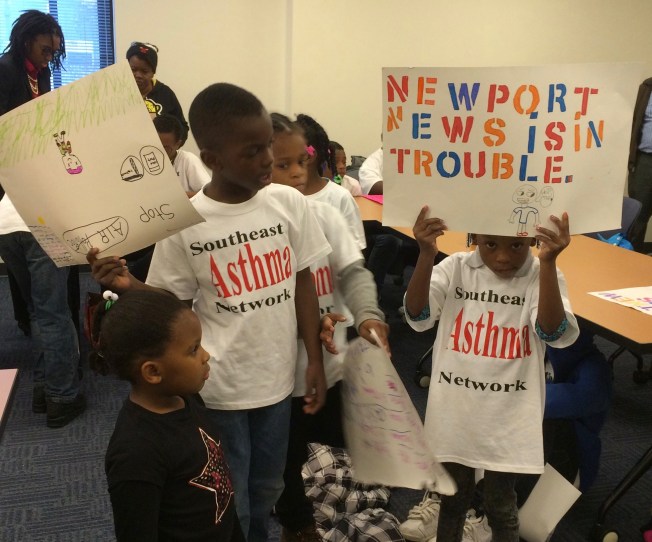
Children from the Southeast Care Coalition make their point about the link between air quality and asthma.

Children from the Southeast Care Coalition make their point about the link between air quality and asthma.

By Kendyl Crawford

There is an old adage that goes, “When White America sneezes, Black America catches pneumonia.” It describes the way problems affecting the economy as a whole are magnified for African-Americans, whose place on the economic ladder is already tenuous. The same can be said for Latinos, recent immigrants, and members of low-income communities. And just as these Americans are the ones hardest hit by economic setbacks, so they are the ones who suffer most from an energy economy based on fossil fuels.

Worse, they are often used as pawns by fossil fuel companies who declare that poor people need cheap energy, without accounting for the true cost of that energy. And that true cost can be very high. Over half a million people in Virginia live within 3 miles of coal-fired power plants. Of this group, 52% are minorities and 34% are members of the low-income community. This doesn’t seem like much of a disparity until you realize that Virginia has a total minority population of 35% and a low-income population of 26%.

The fossil fuel industry has a long history of siting power plants strategically, avoiding upper class, white areas whose residents have the power and influence to be able to cry NIMBY (Not In My Back Yard). Communities with less political and economic power got stuck with the facilities—often along with other unwanted neighbors like highways, heavy industry, and waste dumps. In many cases, the communities were there first and then became the victims of zoning changes that gave the green light to polluting facilities. Residents ended up with higher environmental health burdens and lower home values, often with no compensating economic boost from the presence of the facility. The term for siting highly-polluting facilities in these communities now even has its own acronym: PIMBY, for “Put it In Minorities’ Back Yard.”

The 2014 NAACP Coal Blooded: Putting Profits before People report gave five Virginia power plants an F for their environmental justice performance, a grade based on how much a particular plant impacts both low-income and minority communities. The score takes into account the amount of sulfur dioxide and nitrogen oxides air pollution; total population within a three-mile radius of a facility; median income; and the percentage of minorities that make up the population in the close vicinity.

The NAACP report also gave a failing environmental justice performance score to Virginia’s largest utility, Dominion Resources. Dominion ranked as the 6th worst performing company in the U.S. and a “worst offender” in terms of environmental justice.

It’s not just coal. The Clean Air Task Force report Gasping for Breath highlights the fact that nationwide the oil and gas industry releases 9 million tons of pollution such as methane and benzene annually. Many of these toxic pollutants have been linked to cancer and respiratory disorders as well as increasing smog. Every summer there are 2,000 visits to the emergency room for acute asthma attacks and more than 600 hospital admissions for respiratory diseases that are directly related to the ozone smog that results from oil and gas pollution.

Not surprisingly, asthma takes its greatest toll on minorities. According to the EPA, black children are about four times more likely to die from asthma than white children. They are also twice as likely to be hospitalized for asthma. From 2001 to 2009, the asthma rate for black children increased almost 50%. African Americans, with lower rates of health insurance coverage, have fewer resources to manage these added stressors.

Latino children fare similarly poorly. Higher poverty rates and lower rates of insurance coverage mean Latino children have more severe asthma attacks than non-Hispanic white children and are more likely to end up in emergency rooms.

Of course, it’s not just minorities who suffer the harmful consequences of fossil fuels. Low-income people in general have fewer choices in where to live, have less access to health care, and often have little political power. In Virginia, this includes many residents of coalfields communities, whose families may have worked in coal mines for generations and yet have little to show for it.

Climate change will only increase the burden on minorities and low-income communities. For instance, many African American communities have historically been relegated to the least-valued land in a particular city or county, and this land is often low-lying. A recent article exposed the fact that when public housing is destroyed due to sea level rise, stronger storm surges and more extreme storms, it often doesn’t get rebuilt, forcing folks to relocate permanently.

Atmospheric warming will also lead to more health issues related to air pollution, which tends to increase with higher temperatures. But heat itself will take a toll, too, especially for those in substandard housing or who can’t afford air conditioning.

Most at risk will be those who work outdoors, among them construction workers, landscapers and farmworkers. Again, these are disproportionately minorities. Latinos make up about 48% of farm workers and almost 30% of construction workers in the U.S. As noted in the report Nuestro Futuro: Climate Change and U.S. Latinos, Latinos are already three times more likely to die from heat-related causes on the job than non-Hispanic whites. Climate change is expected to increase temperatures further. Hispanic communities are also generally located in areas of cities that are the hottest due to lack of vegetation and green spaces and the use of heat-trapping building materials.

These health impacts will be compounded by high poverty levels and low rates of health insurance. A Hispanic who is employed has less of a chance of having health insurance than a non-Hispanic person. When conditions like cardiovascular disease or diabetes are not treated and controlled, they can trigger visits to the emergency room after being exposed to extreme heat. Not to mention, language barriers can make it harder to obtain care.

Recent immigrants may also face greater difficulties following severe weather events, which are expected to increase in both frequency and intensity. Depending on their immigration status, disaster assistance may be hard to obtain or even completely unavailable.

So when utilities and fossil fuel companies urge our political leaders to keep energy costs low for the poor folks, we should recognize that what they really want is to keep profits high for themselves. They aren’t doing their customers any favors.

Kendyl Crawford is a Program Conservation Manager with the Virginia Chapter of the Sierra Club.


Unknown's avatar

Virginia legislative session wraps up with action on solar, coal ash, and pumped storage

Next year I'm bringing him to lobby with me. Photo credit: Sierra Club

Next year I’m bringing him to lobby with me. Photo credit: Sierra Club

The Virginia General Assembly wraps up its 2017 session on Saturday, February 25. As usual, the results are a mixed bag for energy. On the plus side is the promise of a new solar purchase option for customers. On the downside, utility opposition to energy efficiency and distributed generation meant a lot of worthwhile initiatives never made it out of subcommittee.

Putting it into perspective, it could have been worse. For clean energy advocates in Virginia, that’s what we call a success!

Governor Terry McAuliffe has already acted on some of the bills that passed and will have until March 27 to act on the remaining bills. Under Virginia law, the governor can sign, veto, or amend the bills for legislators’ consideration.

“Rubin Group” bills move renewable energy forward—and back.

Negotiations between utilities, the solar industry trade association MDV-SEIA, and the group Powered by Facts produced three pieces of legislation that appear likely to become law (and all of which I’ve discussed previously). The most significant of these “Rubin Group” bills (named for facilitator Mark Rubin) is SB 1393 (Wagner), the so-called “community solar” bill, which is designed to launch a utility-controlled and administered solar option for customers. The utilities will contract for the output of solar facilities to be built in Virginia and will sell the electricity to subscribers under programs to be approved by the State Corporation Commission. Critical details such as the price of the offering will be determined during a proceeding before the State Corporation Commission.

This was the only one of the Rubin Group bills that had participation from members of the environmental community (Southern Environmental Law Center and Virginia League of Conservation Voters), and it received widespread (though not unanimous) support from advocates.

Broader legislation that would have enabled true community solar programs did not move forward. SB 1208 (Wexton) and HB 2112 (Keam and Villanueva), modeled on programs in other states, had the backing of the Distributed Solar Collaborative, a stakeholder group composed of everyone but utilities. In the Senate, Wexton’s bill was “rolled into” Wagner’s bill, but only her name, not the provisions of her bill, carried over.

SB 1395 (Wagner), a second Rubin Group bill, increases from 100 MW to 150 MW the size of solar or wind projects eligible to use the state’s Permit by Rule process, which is overseen by the Department of Environmental Quality. The legislation also allows utilities to use the PBR process for their projects instead of seeking a permit from the SCC, if the projects are not being built to serve their regulated ratepayers.

The third Rubin Group bill establishes a buy-all, sell-all program for agricultural generators of renewable energy. Although supported by MDV-SEIA as part of the package deal, passage of SB 1394 (Wagner) and HB 2303 (Minchew) should be considered a loss for solar. The program replaces existing agricultural net metering rules for members of rural cooperatives and could lead these coops to reach their 1% net metering cap prematurely, blocking other customers from being able to use net metering. And while negotiators say the program should be economically beneficial to participants, it appears to offer generators no options they don’t already have under existing federal PURPA law.

The governor has until March 27 to act on these bills.

Appalachian Power PPAs for private colleges only

Under HB 2390 (Kilgore), the existing pilot program that allows some third-party power purchase agreements (PPAs) in Dominion Power territory will be extended to Appalachian Power territory, but only for the private colleges and universities who could afford to hire a lobbyist to negotiate the special favor, and only up to a 7 MW program cap. APCo is expected to use passage of the bill to assert that PPAs for all other customers are now illegal. The governor has not indicated whether he will sign the bill.

Intellectual property

SB 1226 (Edwards, D-Roanoke) allows solar developers to keep confidential certain proprietary information that would otherwise be subject to disclosure under the state’s Freedom of Information Act (FOIA). It resolves a problem that has held up a solar project on the Berglund Center, a public building in Roanoke.

Storage, pumped or otherwise

HB 1760 (Kilgore) and SB 1418 (Chafin) allow Dominion Power to seek rate recovery for a scheme to use abandoned coal mines for pumped storage facilities. If you think this sounds weird and possibly dangerous, you are not alone. Usually the idea is to keep water out of coal mines to avoid the leaching of toxic chemicals into groundwater. Apparently no one has ever used coal mines for pumped storage before, and neither the company that would construct the project, nor the sites under consideration, nor the technology to be used, have been revealed.

SB 1258 (Ebbin) adds storage to the mandate of the Virginia Solar Energy Development Authority.

Dominion’s nuclear costs, and the politics of the “rate freeze”

HB 2291 (Kilgore) allows Dominion to charge ratepayers for the costs of upgrading its nuclear facilities. Because the charges will appear as a rider on top of base rates, consumers would not be protected by the “rate freeze” Dominion pushed through in 2015’s SB 1349.

That 2015 legislation, of course, was supposedly designed to shield customers from the impact of the EPA’s Clean Power Plan, a ruse that has been since laid bare. Instead, it will allow Dominion to keep an estimated billion dollars of customers’ money it would otherwise have had to refund or forego. This year, with the CPP on death row under Trump, Senator Chap Petersen introduced SB 1095, which would repeal the rate freeze. His bill was promptly killed in committee, but continues to gain support everywhere outside the General Assembly. Governor McAuliffe belatedly announced his support for Petersen’s bill, but did not use his authority to resurrect it.

Petersen is encouraging the Governor to offer an amendment to Kilgore’s HB 2291 that would repeal the rate freeze, an option allowed by Virginia’s legislative procedure since both provisions affect the same provision of the Code.

Dominion, of course, says the CPP isn’t actually dead and buried just yet, and Republicans seem to fear its resurrection. HB 1974 (O’Quinn) requires the Department of Environmental Quality to submit any Clean Power Plan implementation plan to the General Assembly for approval, so they can stab it with their steely knives.  The governor is expected to veto the bill.

State’s failures on energy efficiency will now be tracked

SB 990 (Dance) requires the Department of Mines, Minerals and Energy to track and report on the state’s progress towards meeting its energy efficiency goals. Or in Virginia’s case, its lack of progress.

HB 1712 (Minchew) expands the provisions of state law that allow public entities to use energy performance-based contracting.

That’s it for energy efficiency legislation this year. Several good bills were offered but killed off in the House Energy Subcommittee, notably HB 1703 (Sullivan), which would have required electric utilities to meet efficiency goals, and HB 1636 (Sullivan again), which would have changed how the SCC evaluates energy efficiency programs. Delegate Sullivan, by the way, introduced a companion bill to SB 990, but his was killed in that same House subcommittee, all on the same day.

Coal ash legislation watered down but passes

SB1398 (Surovell) will require Dominion Power to monitor pollution and study options for the closure of its coal ash impoundments, including removal of the ash to secure, lined landfills. Unfortunately amendments in the House will allow Dominion to proceed with capping the waste in unlined pits while it completes the study. As one editorial put it, “Why not do it right the first time?” The editorial—along with a lot of people who have to live near the coal ash dumps—would like to see the governor offer amendments to the bill, but we’ve heard nothing from the governor’s office on that yet.

Republicans keep trying to throw taxpayer money down a rathole; Governor vetoes

Governor McAuliffe has already vetoed HB 2198 (Kilgore), which would reinstate the coal employment and production incentive tax credit and extend the allowance of the coalfield employment enhancement tax credit. SB 1470 (Chafin) is identical to HB 2198 and so likely faces a veto as well.

Unknown's avatar

While U.S. leaders were worrying about coal jobs, clean energy snatched the lead: even Virginia now has more people working in solar than coal.


va-electric-sector-jobs

Jobs in electric generation do not include fuel jobs, so for example, the coal jobs in the two charts have to be added together to get total employment. Wind and solar, of course, have no fuel costs. Charts come from DOE.

Jobs in electric generation do not include fuel jobs, so for example, the coal jobs in the two charts have to be added together to get total employment. Wind and solar, of course, don’t need employees to produce their “fuel.” Charts come from DOE.

A new report from the U.S. Department of Energy takes stock of energy employment in the U.S. and comes up with fresh evidence of the rapid transformation of our nation’s electricity supply: more people today work in the solar and wind industries than in natural gas extraction and coal mining.

According to the January 2017 U.S. Energy and Employment Report, 373,807 Americans now work in solar electric power generation, while 101,738 people work in wind. By comparison, a total of 362,118 people work in the natural gas sector, including both fuel supply and generating plants.

Total coal employment stands at 160,119. And while renewable power employment grew by double digits last year—25% for solar, 32% for wind—total job numbers actually declined across the fossil fuel sectors, where machines now do most of the work.

If generating electricity employs a lot of people, not generating it employs even more. The number of Americans working in energy efficiency rose to almost 2.2 million, an increase of 133,000 jobs over the year before.

Those are nationwide figures, but the report helpfully breaks down the numbers by state. For Virginia, 2016 was a watershed year. In spite of the fact that our solar industry is still in its infancy and we have no operating wind farms yet, more Virginians now work in renewable energy than in the state’s storied coal industry. A mere 2,647 Virginians continue to work in coal mining, compared to 4,338 in solar energy and 1,260 in wind.

Dwarfing all of these numbers is the statistic for employment in energy efficiency in Virginia: 75,552.