The energy transition is in full swing across the U.S. and the world, but the changes now underway are not simple or linear. In an economy as complex and connected as ours, progress in one area will often affect other parts of the economy, creating winners and losers.
And then there are the changes that work together synergistically and leave everyone better off. This is what we will see as renewable energy overtakes fossil fuels and electric vehicles go mainstream. These transformations will deliver another enormous benefit, this time to farmland, as they pull the rug out from under the expensive and wasteful ethanol industry.
Counting Corn
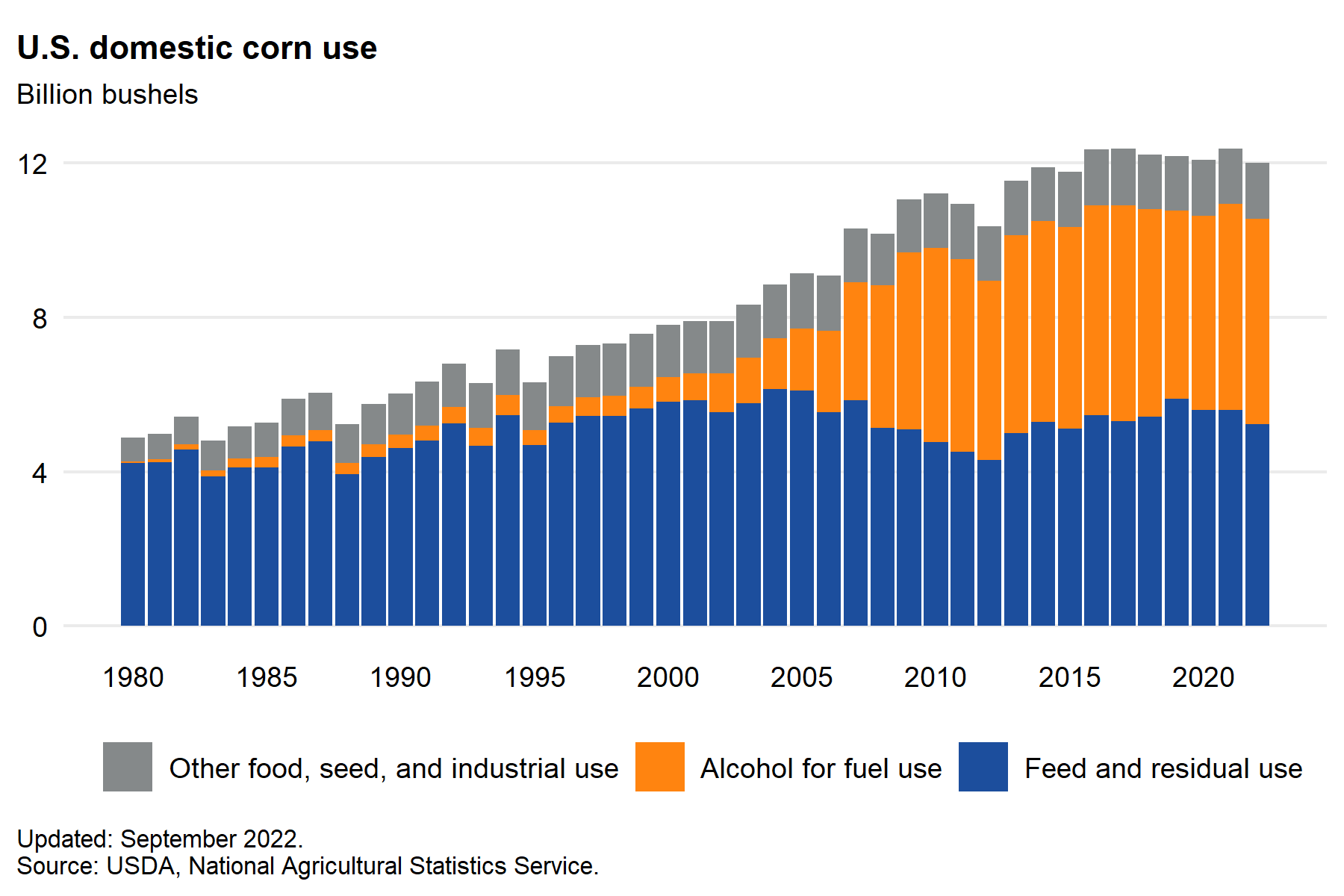
Across the United States, more than 30 million acres of farmland is currently devoted to growing corn for a purpose other than feeding humans and animals. The corn – over 5 billion bushels every year — is processed into ethanol and then added to gasoline to comply with a federal mandate.
The U.S. Renewable Fuel Standard (RFS), enacted in 2005, requires the nation’s oil refiners to mix 15 billion gallons of corn-based ethanol into the nation’s gasoline supply annually; this is the reason why most gasoline sold in the U.S. includes 10% ethanol. The mandate was intended to cut U.S. dependence on energy imports, support farmers and reduce emissions.
As it turned out, the RFS was primarily successful in increasing the acreage devoted to growing corn. Because of the ethanol mandate, an additional 6.9 million acres of corn were planted between 2008 and 2016. Corn is now the nation’s number one crop and, according to the U.S. Department of Agriculture, ethanol production accounts for 45% of the U.S. corn crop. Most of the rest goes to animal feed, with only 15% destined for human consumption. (A mere half of one percent of the total corn crop is sweet corn, a different plant entirely.)
As a way to reduce emissions, however, the mandate proved a failure. A study funded by the U.S. Department of Energy and the National Wildlife Federation concluded that ethanol is at least 24% more carbon-intensive than gasoline, once land use impacts are factored in.
It’s a bad deal for taxpayers, too. In addition to the ethanol mandate, the U.S. government subsidizes corn farmers through the federal crop insurance program, with taxpayers covering an average of 62% of the cost of insurance premiums. More than a quarter of the insurance subsidy goes to corn, and very little goes to small farms. Add to this the many concerns about water use, fertilizer, pesticides and land degradation, and it is hard to find much good in the corn ethanol program.
EVs threaten King Corn
The world is a different place now than it was in 2005, with the U.S. having become the largest oil producer in the world and a net exporter. Yet the ethanol subsidy is fiercely guarded by the corn lobby and, in spite of occasional bipartisan efforts at repeal, it seems to be untouchable politically. Indeed, last year’s Inflation Reduction Act, passed by Democrats, actually contains new credits for biofuel production that corn-state Republicans are keen on keeping even as they continue to seek rollbacks of other clean energy incentives.
The biggest threat to the corn lobby, though, isn’t a repeal of the mandate, it’s electric vehicles. When people no longer need gasoline, they can no longer be forced to buy corn ethanol.
Electric vehicle sales reached 5% of the U.S. new car market in 2022, and already this year they’ve hit 8.6%. JD Power projects 70% of new vehicles will be electric by 2035, with California leading the way at 94% by then.
Many agricultural communities are in denial about EVs, preferring to believe they will never catch on in numbers enough to threaten the importance of the corn crop. And indeed, it will take decades before the last gasoline-powered cars drive off to the junkyard. But most of us can see the writing on the wall. As more vehicles become electric, more land that is now devoted to corn ethanol will become available for other purposes.
While the ethanol industry looks to jet fuel and other possible new uses for its product, a far more promising “crop” is renewable energy. Planting wind turbines and solar panels, either alone or combined with actual crops that feed people, provides higher returns with less risk and is better for the planet.
“Planting” more solar energy instead of corn
Wind turbines already coexist with farmland across the Great Plains, but let’s focus on solar, since that is the form of renewable energy best suited to Virginia’s landscape. Solar energy is somewhat land-intensive, but not compared to corn. A decade ago, the National Renewable Energy Laboratory calculated that we could power the country’s entire electricity demand with 10 million acres of solar panels. That’s only one-third of the land now devoted to corn ethanol.
Since that study, solar efficiency has increased, while electricity demand has risen only modestly. With the electrification of vehicles, buildings, and everything else that can be electrified, however, electricity demand is likely to double. But even if we had no wind energy, hydropower or nuclear, and we needed 20 million acres of solar to meet the demand, that would represent only two-thirds of the land currently devoted to corn ethanol, leaving millions of acres more freed up for food crops, land conservation and rewilding.
A comparison of the energy yield of corn vs. solar shows why displacing ethanol with solar energy would be a welcome change. An acre of corn yields 328 gallons of ethanol, which is one-third less efficient than gasoline. If you could run an internal combustion automobile entirely on ethanol (you can’t), a car averaging 40 miles per gallon could go 8,738 miles on an acre of corn.
But that same acre “planted” in solar panels would yield 394-447 MWh per year of electricity. Even at the low end, that’s enough to power a Tesla Model 3 for over 100,000 miles.
Much of the corn crop is grown in places like Iowa and Nebraska, but even here in Virginia, 540,000 acres were planted in corn last year, second only to soybeans. Assuming 45% of Virginia’s crop goes to corn ethanol (I could not find an actual breakdown by state), that amounts to 243,000 acres that could be put to better use. That’s worth keeping in mind for the next time someone frets about farmland being “lost” to solar development.
Solar is also a more reliable crop, and a better one for small farmers. The profitability of corn growing varies by state and by year, but it is never exactly a lucrative business for any but the largest farm operations. In a good year, such as 2022, corn might return a profit of $450 per acre, minus land rents (or taxes). In a down year, such as the current one, returns can be negative once land costs are accounted for. (Rents vary considerably, averaging about $325 per acre.)
Meanwhile, solar lease rates range from $250 to $2000 per acre, depending on location and suitability. A guaranteed payment for 20 or 30 years with no work involved is a pretty attractive deal. Even putting just a portion of a farm into solar provides a form of insurance, guaranteeing a steady income flow regardless of weather and commodity price swings.
Solar is also a better deal than corn for the community, since it provides tax revenue, diversifies the local economy and conserves water. If the developer plants pollinator-friendly species around the solar panels or uses sheep instead of machinery to control grass, the benefits to the local economy increase further.
The ethanol industry is already looking for new uses for their product, but if they don’t find takers, it is one fuel we don’t need to mourn losing.
This article first appeared in the Virginia Mercury on September 19,2023.
Until this summer, climate change was a threat most Virginians could ignore most of the time. It was like being hopelessly in debt: too upsetting to think about, so you may as well ignore it. But then smoke kept drifting down from Canadian wildfires and the planet experienced its hottest days on record. People are dying of the heat across the American South and in Europe.
It’s as if the debt collectors suddenly switched from sending threatening letters to sending goons with baseball bats. Alarm is not too strong a reaction.
If the goons have gotten your attention for the first time, you will want to acquaint yourself with the work of the Intergovernmental Panel on Climate Change (IPCC). The concise Summary for Policymakers that accompanies the IPCC’s latest report can get you up to speed. Like sorting out shambled finances, though, it’s both boring and terrifying: Boring because mountains of scientific research inform conclusions couched in dry probabilities; terrifying because those conclusions are bleak.
Humans have overloaded the atmosphere with so much carbon dioxide, methane and other greenhouse gasses that further climate disruption is now unavoidable, no matter how fast we decarbonize. We are in for longer and more frequent heat waves, more extreme weather events, longer and more intense wildfire seasons, accelerating sea level rise, more people migrating to escape newly-uninhabitable lands, more loss of plant and animal species and the further spread of diseases.
On the plus side — oh wait, there isn’t a plus side. Not only is continued disruption inevitable, but if we were to continue business as usual, children born today would live to see New York and most other coastal cities underwater. Instead of 60,000 people dying from heat in a bad year, as happened last year in Europe, the number worldwide could reach well into the millions.
Then there are the possible tipping points that would bring devastation suddenly rather than gradually, and in ways we aren’t prepared for. The latest prediction to hit the news (though it has been discussed for years, with few people listening) is that meltwater from the Greenland ice sheet could force the powerful Atlantic Ocean current to stall sometime between 2025 (gah!) and 2095. That would make the tropics even hotter but send Europe into a deep freeze — a cure for their heat problems, but not the one they’re looking for.
However dismal these scenarios may be, though, we are not dead yet. In spite of the best efforts of the fossil fuel industry, business will not continue as usual. Efforts to decarbonize our economy started late and are taking too long, but they are working, and they will only accelerate. Investment in the energy transition equaled global investment in fossil fuels last year for the first time. In the course of this century, we will not just stop adding greenhouse gasses to the atmosphere, we’ll begin removing the excess.
The energy transition is just part of the changes ahead. We are in the early years of a golden age of invention that will make the 20th century look like a mere prologue. By the time today’s toddlers reach old age, they will have witnessed transformational innovations in technology, housing, transportation, industry, materials, food and agriculture.
I keep a running list of breakthrough inventions and new technologies that together could solve our climate problem many times over. They won’t all pan out, of course, and I’ve learned not to put too much stock in promising ideas backed only by early research.
On the other hand, something transformational could be in the mix that we don’t recognize yet. About 20 years ago I wrote a column mocking cell phones that could take grainy pictures as well as make calls, opining that only teenagers would pay $400 for such useless technology. Some ideas sputter and die, others change how we live.
What is certain is that improvements in wind, solar, battery storage and electric vehicles will continue these technologies’ march to dominance, while fossil fuels become niche. Concerns about the land needs of renewable energy are overblown; you could power the entire U.S. with solar panels on just one-third of the more than 30 million acres currently devoted to growing corn for climate-unfriendly ethanol. Indeed, solar doesn’t even have to displace farming. Agrivoltaics is already making solar and agriculture compatible and creating money-saving synergies.
In the near future, solar cells will be everywhere: on walls and windows as well as roofs, on top of electric cars and printed on paper. We will also have cheaper, safer, and longer-duration battery storage; already, hundred-hour batteries are set for deployment in 2025.
Innovative wind designs also promise more power for less cost. Offshore wind, still just getting started in the U.S., will be sending power to the East Coast, the West Coast, and Gulf states by the end of this decade. Longer term, autonomous, unmoored, floating wind turbines could guide themselves around the ocean, producing synthetic green fuels or performing direct-air carbon capture.
Similar progress is happening in all sectors of our economy. Artificial intelligence and machine learning will reduce costs and speed up the ongoing work on low-carbon solutions, including in materials and chemicals. Some futurists predict a revolution in food production that will have us all eating cheap, nutritious and tasty microbes instead of animals by 2030 (yes, really), freeing up hundreds of millions of acres of agricultural land for reforestation and wildlife habitat. That seems like a tall order, but then again: cell phones with cameras.
Look, I am not by nature an optimist. I wish I were; it’s obvious that optimists are happier than pessimists (or, as I like to call us, realists). Nor do I kid myself that humans will suddenly lose our tendencies to self-centeredness, greed and bigotry. We have the most astounding capacity for doing the wrong thing even when the right thing is standing there waving its arms frantically in the air and yelling, “Ooh, ooh! Choose me! Choose me!”
And even this summer’s record heat won’t stop climate “skeptics” from insisting the climate is not changing, or as they say now, that “no one knows why” the planet is warming. They are dosing themselves with an attractive snake oil; who wouldn’t like to hope that Nature might defy physics and start cooling us off again, either on a whim or because she secretly works for Chevron?
Let them have their snake oil. The rest of us have work to do.
This article was originally published in the Virginia Mercury on August 3, 2023.
In medieval Europe, the Roman Catholic church encouraged sinners to get square with God by performing good works and acts of charity. Since both of these might require spending money, some resourceful church leaders streamlined the process, taking the money and letting the good works slide. A rich sinner could buy “indulgences” to cover adultery, eating meat during Lent, or any number of other transgressions.
The historical record does not indicate that emitting carbon dioxide was among the redeemable sins. (Well, CO2 wouldn’t be discovered until 1754.) Still, medieval Christians would have recognized the attraction of buying indulgences in the form of carbon offsets rather than actually cutting back on CO2-emitting activities. We can’t help sinning, so if the act of atonement evens the score, why not grant absolution?
Here in the present, a whole industry has sprung up to sell climate indulgences to guilt-ridden liberals. As one website explains soothingly, “Carbon offsets work through supporting tree planting services and carbon offsetting projects to neutralize your emissions and mitigate your impact on the planet.” Buying these indulgences requires just a click of your mouse and a credit card. For $25 you can feel good about an airplane flight of up to 10,000 miles! That’s enough to get you from D.C. to Australia, where you can visit the Great Barrier Reef before it is completely destroyed by the ocean acidification resulting from your carbon emissions.
(I’ve committed this sin myself: I’ve been to Australia, on a miserably long flight the CO2 emissions of which I did not pay $25 to offset. They hadn’t invented $25 carbon offsets at the time, or I might have.)
Martin Luther, a 16th century priest who made a name for himself by opposing the selling of indulgences, put the matter succinctly: “Indulgences are most pernicious,” he wrote, “because they induce complacency and thereby imperil salvation.”
He meant saving souls, and we mean saving the planet; regardless, he had the psychology right. We’re more likely to excuse ourselves for driving gas-guzzlers and flying to cool places if we also pay to plant trees in Africa or bribe Brazilians not to deforest the Amazon.
Sadly, that approach doesn’t work. By one calculation, it would require planting at least 200 billion new trees to suck up the excess CO2 emissions of Americans alone. This assumes we don’t lose any trees to fire, drought, disease or clearing. And how’s that working out? As of the end of June, fires had already consumed 20 million acres of Canadian forest this year alone, in large part as a result of climate change. All the carbon those trees had stored up is now back in the atmosphere.
That doesn’t mean planting trees and saving the rainforest aren’t good works. They are. But there’s a high likelihood any carbon offsets you purchase will be among the 90% of rainforest offsets that a Guardian investigation found were worthless.
Yet fear not, sinners! Great minds are at work to find effective ways to remove CO2 from the air or the ocean and squirrel it away more or less permanently. Some ideas now in the research or pilot stage involve capturing CO2 from industrial processes like cement manufacturing or from direct-air capture. The CO2 is then injected underground or used as an ingredient in concrete or other products. (Carbon-negative food, anyone?) Technologies that let nature do the heavy lifting include spreading basalt rock dust on farm fields as a soil amendment and using microbes to gobble up CO2 in water.
Getting more attention, likely undeservedly, is the effort to capture and bury CO2 from fossil fuel power plant emissions. This isn’t carbon negative; it simply reduces the amount of CO2 that makes it out of the smokestack. Capturing CO2 where it is most abundant — right where coal and gas are burned — is more efficient than direct-air capture, but it’s expensive and energy-intensive. Shutting the plant and replacing it with renewable energy will almost always be the better option for the planet, and the cheaper one for whoever has to foot the bill.
Even with generous subsidies in the Inflation Reduction Act (IRA), cost remains the biggest barrier to a market for effective carbon offsets. Carbon capture and sequestration (CCS) projects still can cost upwards of $400 per ton of CO2. In 2021 the U.S. Department of Energy launched what it calls its Carbon Negative Shot, aimed at reducing the price of removing 1 ton of CO2 from the atmosphere to $100 in 1 decade. That would put the price closer to the U.S. Government’s current estimate for the social cost of carbon of $51 per ton, and below the $185 that might be the true cost.
The market is potentially enormous. Aviation, shipping, steelmaking, chemical manufacturing and cement production are especially challenging to decarbonize. Consider that steelmaking generates about 1.85 tons of CO2 per ton of steel, and the industry produces close to 2 billion tons annually.
Commercial aviation generated 900 million tons of CO2 in 2019. According to this handy flight calculator, that’s about 2.2 tons of CO2 for every passenger flying round-trip from Virginia’s Dulles Airport to Paris, France. It’s no wonder the voluntary carbon-offset market is expected to become a $250 billion industry by 2050.
Still, let’s be real. Carbon-negative technology is only needed because we continue to flood the atmosphere with greenhouse gasses from activities we can mostly decarbonize at far less cost today. Money being thrown at expensive CCS or ineffective forest offsets would have a greater impact spent on weatherizing homes, putting solar on rooftops or building renewable energy in fossil fuel-dependent areas.
In theory, buying renewable energy certificates can do this, too, but their effectiveness is questionable, in part because of the tendency of companies to use them for greenwashing. That is, they want carbon indulgences, but at a price that lets them continue business as usual.
Medieval sinners would surely relate.
This article was originally published in the Virginia Mercury on July 19, 2023.
Update: This article in The Guardian challenges the worthiness of pretty much every carbon offset program in existence. Our search for climate indulgences continues.
The divide politicians should be paying attention to is not between Democrats and Republicans. It’s between young people and old Republicans.
Photo courtesy of 350.org
Judging from the political rhetoric, you’d be justified in thinking that only Democrats feel the urgency of the climate crisis, while Republicans are united in dismissing it. Polling shows Democrats are better aligned with popular sentiment: the great majority of Americans support more climate action. But Republican leaders assume that even if their position is a losing one with the general population, at least they represent their party membership.
It turns out they are ignoring critical details. The divide they should be paying attention to is not between Democrats and Republicans. It’s between young people and old Republicans.
Recent polling from the Pew Research Center found that although 64% of Republicans over 65 oppose the U.S. taking steps to become carbon neutral, 67% of Republicans under 30 support doing so. Given that Millennials and members of Gen Z (those born after 1997) are less likely to identify as Republicans in the first place, you’d think the party leadership would pay close attention to the issues young Republicans care about, in hopes of growing their brand.
Instead, the party’s position on climate is driven by the opinions of the older, mostly white Republicans who dominate the conservative media echo chamber and control power in Congress and state legislatures. In Virginia, as in other states and Congress, lawmakers are older, whiter and more male than the people they represent. They can afford to dismiss climate change, because the worst impacts won’t happen until they have disappeared from the planet.
But that tendency of older voters to die off is exactly why catering to the curmudgeon bloc is a bad strategy for holding on to power in the long term. Greenhouse gas concentrations continue to increase; the planet keeps warming. The choking smoke from Canadian fires is merely a warning of what lies ahead.
The nothing-to-see-here narrative on climate change will only appear more fringe with every record wildfire season, every killer heat wave and every freak mega-storm. If Republicans don’t find a way to pivot, they will continue losing younger voters until they find themselves out of power.
That’s actually the best-case scenario. In the worst-case scenario, Republicans win the presidency and Congress and, having backed themselves into a corner pandering to the curmudgeons, will feel forced to undo recent federal climate legislation including the Inflation Reduction Act. Consequences for the planet and the American economy would be disastrous. The IRA is not just the most impactful climate law the U.S. has ever passed, it has unleashed enormous infusions of capital into red states.
And what demographic benefits most from the millions of new jobs being created in green energy and electric vehicles? Why, that would be the young people.
Some Republicans in Congress and state legislatures do recognize the climate is in crisis. Behind closed doors, they may even concede their party needs to do more. But each lawmaker has a different excuse for failing to act. They fear a primary challenge from someone even farther to the right, or they depend on donations from fossil fuel apologists like the Koch brothers (again, old white men!), or they fear retribution from party leaders if they buck their caucus. In the end, they fall back on obfuscation, deflection, Democrat-blaming and wishful thinking.
Recent news stories have featured much wringing of hands and pointing of fingers over Gen Z’s tendency towards pessimism and nihilism. Surveys show these young people are more likely to believe it is too late to avert climate change, and more than half feel “humanity is doomed.” Close to 40% say their fears about the future make them reluctant to have children.
Many young people are channeling their anxiety and anger into action. Election turnout among younger voters has surged, though it’s still woefully behind that of older generations. Young workers are more likely to seek jobs with a positive impact for people and the planet — which makes the green job incentives in the IRA all the more relevant to their lives.
Indeed, the good news for this generation is that the urgency of the climate crisis has spurred a remarkable acceleration of research and development into climate solutions. For young workers especially, there are more opportunities for meaningful work than at any time in history. The kids are right to worry about hard times ahead, but their generation may be the one to save humanity from this crisis of their elders’ making.
Success, however, requires that those elders acknowledge the crisis, find the courage to move past partisan politics, and help.
This article was originally published in the Virginia Mercury on June 13, 2023.
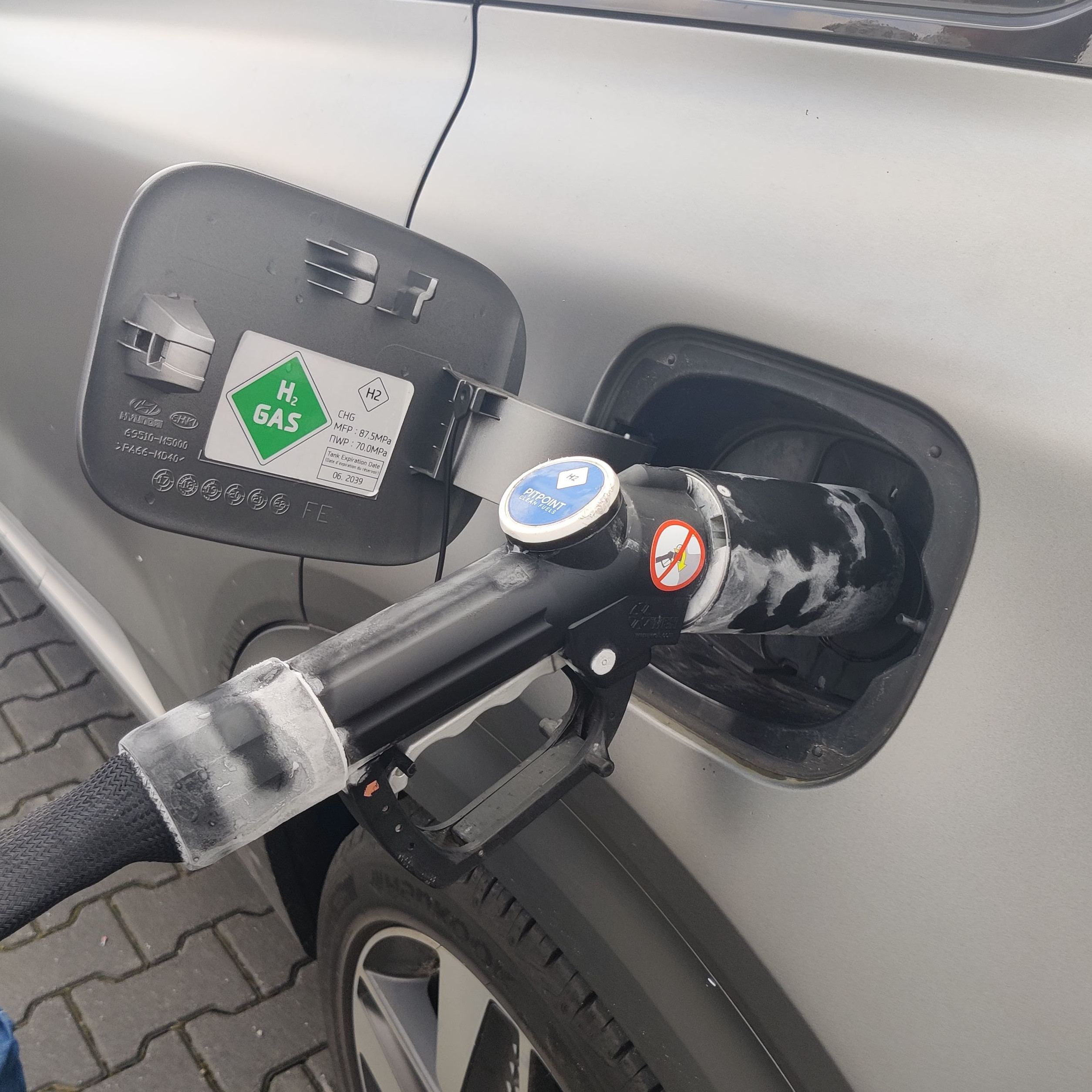
Refueling a hydrogen-powered vehicle. By Ogidya via Wikimedia Commons
The hydrogen gold rush is on. Spurred by the urgency of the climate crisis, and attracted by generous incentives in last year’s Inflation Reduction Act, companies ranging from oil majors to small start-ups are pouring money into the Next Big Thing in energy: a fuel that is flexible, transportable and carbon-free.
Is hydrogen a critical piece of the decarbonization puzzle that needs floods of new funding, or an over-hyped, not-ready-for-prime-time financial boondoggle?
At this point the answer seems to be both.
In his 2022 Energy Plan, Virginia Gov. Glenn Youngkin touted hydrogen as “a once-in-a-lifetime opportunity to reimagine Virginia’s future and meet energy needs through an abundant, dispatchable, and zero-emission fuel source where water is the only required input.”
This statement has its problems, including the fact that water is actually not the only required input. Making hydrogen from water requires a lot of energy, which must come from some other fuel. Therein lies the rub.
How the Department of Energy believes clean hydrogen could help decarbonize the U.S. economy. (U.S. Department of Energy)
One way to make hydrogen — and the method everyone is talking about — is using electricity to split water (H2O) into its components, hydrogen and oxygen, through electrolysis. Energy is lost in the process, so there is no point in using hydrogen for anything that can plug into the grid. Hydrogen is also more expensive and less efficient than battery storage, which explains why automakers are focusing on electric vehicles rather than ones that run on hydrogen fuel cells.
Yet some kinds of transportation (aviation, long-haul trucking) and many industrial processes are hard or impossible to electrify, at least for now. Hydrogen, ammonia and other products can often replace fossil fuels for these uses, and perhaps also play a role in long-term energy storage for grid power.
Recognizing this potential, last year’s Inflation Reduction Act included a range of incentives to spur investment in so-called green hydrogen, defined as hydrogen made from renewable energy. Growing the supply of green hydrogen will require a massive buildout of wind and solar as well as years of technological refinement, but airlines, steelmakers and other customers are already either starting to use green hydrogen or say they want it for their operations.
Unfortunately, any time the government dangles a subsidy, some businesses will look to exploit any opening to grab free money, even if the result is contrary to the whole point of the subsidy. Those businesses do find champions among politicians who are more interested in generating economic activity than in making sound public policy (or maybe they just confuse the two). But getting the rules right is critical for the climate, and for making sure customers get the carbon-free product they sign up for.
Hydrogen is already used in many industrial processes and in the manufacture of fertilizers but today it is mostly made from methane gas, at half the cost of green hydrogen. Oil companies like Chevron have urged that to build the market quickly, making hydrogen green is “secondary” to making it affordable.
This is all wrong. The great promise of hydrogen is the potential to make it from renewable energy once wind and solar have scaled up so much that there is a glut of cheap, emissions-free power.
That is not the situation today. Nationally, fossil fuels make up 60% of electricity generation, with all renewables together representing 21.5%. The regional grid that serves Virginia includes less than 10% wind and solar in the generation mix. Renewables are growing fast while coal shrinks, but few states have so much renewable energy that some of it occasionally goes to waste. California has experienced this under ideal conditions, and is likely to be the first to have surplus renewable energy on a predictable basis.
The challenge is that a company that invests in the capital costs of a hydrogen production facility may not want to run it only when there is surplus wind and solar. These companies will make the most money by running their electrolyzers around the clock; profitability might even depend on it. Their choices are to build new renewable energy and battery storage for their own purposes and cut back production when they have to, or manipulate the rules.
So as the U.S. Treasury Department writes the rules around eligibility for green hydrogen incentives, corporate America is asking for loopholes. NextEra, the world’s largest renewable power generator, wants to be allowedto use fossil fuels to fill in whenever there isn’t enough wind or solar energy on the grid, without losing the “green” designation and all the subsidies that accompany it. The company proposes buying carbon credits as an offset.
The proposal makes climate advocates very uneasy. We have seen this movie before. When the federal government first offered subsidies for ethanol made from corn in the 1970s, the idea was that blending American-made ethanol into gasoline would reduce our dependence on foreign oil and lower greenhouse gas emissions.
Forty years later, the program still consumes some 30 million acres of corn every year, and is estimated to have cost taxpayers billions of dollars, all while actually harming the climate. But just try scaling back ethanol subsidies today. Any politician who proposes such a thing gets their head handed to them by the powerful farm lobby.
That makes it really important that rules set into place today for hydrogen and other “green” fuels do not compromise on the requirement that they be made from carbon-free sources. Make an exception once, and we’ll never close the loophole.
This article was originally published in the Virginia Mercury on April 25, 2023.
At the heart of the political fight over Virginia’s participation in the Regional Greenhouse Gas Initiative (RGGI) is a seemingly simple question: does a requirement that Virginia power plants pay for the right to spew CO2 actually lower CO2 emissions? Critics argue no; supporters say yes. There is evidence for both, but in the long run, the benefits of RGGI for both Virginia and the climate are clear.
RGGI operates as a carbon cap-and-trade agreement between 12 northeastern states. Carbon-emitting power plants must buy allowances through an auction process. This makes high-carbon fossil fuel electricity more expensive relative to zero-carbon sources like wind, solar and nuclear. The result, in theory, is that utilities are incentivized to buy less of the former and more of the latter. In states like Virginia, where utilities own generating plants, RGGI provides an incentive for them to abandon coal plants and build more zero-carbon sources.
RGGI administrators say it has succeeded in lowering carbon emissions in member states by more than 50%, twice as fast as the nation as a whole. RGGI states typically spend at least some of the money raised in the carbon allowance auctions on energy efficiency improvements that allow people to use less electricity, further reducing emissions.
But RGGI doesn’t operate in isolation. Several RGGI states are members of the PJM regional grid, comprising 13 states, including some that don’t participate in RGGI. Critics point out that, instead of building or buying renewable energy, a utility in a RGGI state can buy electricity produced in a state that doesn’t participate in RGGI. Fossil fuel plants in a non-RGGI state like West Virginia don’t have to pay to pollute, giving them a competitive edge over similar Virginia plants.
This is known as “leakage,” a loophole that lets fossil fuel energy “leak” into RGGI states. If there were enough leakage, lower carbon emissions in RGGI could be offset by the higher emissions elsewhere in PJM, leaving overall emissions unchanged.
Stephen Haner, a respected advocate for low energy rates at the conservative Thomas Jefferson Institute for Public Policy, says this is what’s happening in Virginia. He cites data to show a big jump in electricity imports from 2020 to 2022. According to this calculation, CO2 emissions actually increased under RGGI, when they were supposed to be decreasing.
But there are problems with this analysis, starting with the fact that Virginia entered RGGI in 2020, at the onset of the pandemic. That year saw energy demand — and emissions — plummet. It would be strange indeed if Virginia emissions did not rise when the economy rebounded.
Energy demand is also increasing in Virginia due to the boom in data center construction. Data centers are huge energy hogs, and they are being built faster than our utilities can build new electricity generation to serve them. The new generation will be zero-emission solar and, soon, offshore wind; meanwhile the electricity has to be imported from elsewhere in PJM.
Bill Shobe, an economist with the Weldon Cooper Center at the University of Virginia who has done extensive work in support of Virginia’s energy transition, told me in an email there are other reasons to be skeptical of the conclusion that RGGI caused Virginia’s carbon emissions to increase. I’ll spare you the weedy details, but among other things, Virginia’s nuclear production decreased significantly from 2020 to 2021, which has nothing to do with RGGI. And as Shobe notes, the data centers would get built somewhere, if not here, so perhaps they should not be counted against us.
I am not as forgiving of data centers as Shobe is. Tech companies have chosen Virginia for its fiber optic network and generous tax incentives, and they point to Virginia’s climate laws as progress in meeting their own sustainability commitments. Data centers are taking our money and busting our carbon cap; they owe it to us to procure their own renewable energy, if not in Virginia, then within PJM.
Data centers notwithstanding, Shobe’s own calculations show leakage to be much less than Haner’s data suggests. “It is abundantly clear that emission leakage is relatively modest,” he told me. “In the end, the other advantages of RGGI (lowering compliance costs, revenue for efficiency and flood resilience, etc.) will swamp the small leakage margin.”
For RGGI critics like Haner and Gov. Glenn Youngkin, of course, effects on CO2 emissions are really beside the point anyway. They would gladly accept higher emissions if it meant lower rates.
This is analogous to what happens when American manufacturers move operations to countries with cheaper labor and lax environmental laws. One way to stem the tide would be to lower our own environmental standards and suppress wages in the U.S., removing the incentive to offshore operations by making life equally miserable everywhere.
The better alternative is to raise the bar everywhere so that everyone benefits. That’s not just the right thing to do; it actually works. In the international arena, American leadership on clean energy investment is already forcing other countries to discuss upping their game. Here in the U.S., RGGI has attracted new member states — like Virginia — and prompted discussions within PJM about creating a region-wide clean energy market.
Of course, Virginia alone doesn’t have the market power to force other states to change. Fortunately for us and for the climate, leakage will become less of an issue over time as renewable energy outcompetes fossil fuel power everywhere. PJM’s carbon emissions have trended steadily lower, first as methane displaced coal, and more recently as renewable energy displaces all fossil fuels. That displacement will accelerate with federal clean energy incentives in place and innovation continuing to drive renewable energy costs lower.
Meanwhile, Virginia crafted its energy transition framework with an eye for ensuring our economy gains, no matter what other states do. As Shobe noted, lowering carbon emissions is just one benefit of RGGI membership; carbon auctions fund energy efficiency and flood control projects here, and the switch away from high-emission coal plants means our residents breathe cleaner air.
Our RGGI law is also part of a larger package designed to create jobs and economic development here at home. The Virginia Clean Economy Act provides for utilities to procure electricity from solar and wind generating facilities and battery storage located in Virginia, which will reduce leakage over time. It also requires an increasing percentage of Dominion and Appalachian Power’s electricity to come from renewable energy. After 2025, most of that must come from in-state facilities.
As I’ve shown before, building low-cost wind and solar helps to lower rates and provides price stability when fossil fuel costs spike. Virginia’s energy transition is just getting underway, but it will deliver benefits for years to come.
This article was originally published in the Virginia Mercury on March 29, 2023.
When the Virginia General Assembly convenes this week for the 2023 session, Republicans will once again try to undo the commonwealth’s framework for a transition to renewable energy. Led by Gov. Glenn Youngkin, they will attack Virginia’s participation in the Regional Greenhouse Gas Initiative and the Virginia Clean Economy Act (VCEA) and continue seeking ways to keep a money-losing coal plant in Wise County in operation.
Meanwhile, Virginia’s largest utility has already decided that renewable energy, especially solar, is the future. Dominion Energy’s just-released Climate Report 2022 projects that under every set of assumptions modeled, solar energy will become the mainstay of its electricity generation fleet no later than 2040.
As for coal, it disappears from the energy mix by 2030 even in a scenario that assumes no change from present policy, in spite of the fact that the VCEA allows the Wise County coal plant to operate until 2045. As for fracked gas, it hangs on longer but in ever-smaller amounts, mostly to help meet winter peak demand.
Dominion modeled three scenarios for this report. The “current policy” scenario assumes the policy landscape and technology options stay the same as they are presently, and that Dominion does its part in driving a global temperature increase of 2.1°C by 2050. That’s in keeping with Virginia’s climate law, and also with Dominion’s internal commitment to achieve net-zero emissions by 2050.
That much warming is not a good outcome, considering the climate chaos the planet is experiencing today with barely over 1 degree of warming. Yet even under a 2.1°C scenario, Dominion’s model predicts solar energy will provide 40% of the electricity supply by 2040, followed by nuclear at 30% and (offshore) wind at 19%.
The “emerging technologies” scenario also assumes a temperature increase of 2.1°C by 2050, but adjusts for the likelihood that technological change will lead to “advanced dispatchable zero-carbon technology” options that could displace much of the need for energy storage. These might include hydrogen, carbon sequestration and storage, and methane gas produced as the result of poor animal waste disposal practices at factory farms — what Dominion calls renewable natural gas, or RNG.
Small modular reactors, SMRs, are not included in this scenario (and are hardly mentioned at all in the report), perhaps because operating them as peaker plants would be crazy expensive. Even without SMRs, though, the report says overall cost savings would be slight for this scenario, and solar would still be the leading source of electricity by 2040.
Finally, the report models an “accelerated transition” scenario that reduces emissions more aggressively, in line with an effort to keep the global temperature increase to 1.5°C by 2050. This is the upper bound of warming considered tolerable by many climate scientists, but it would require Dominion’s electricity business to reach net zero by 2035. Dominion’s model shows solar would make up nearly two-thirds of the electric supply in that scenario. Offshore wind would be held to just 17%, apparently because at that point more wouldn’t be needed.
I’d argue that offshore wind should carry more of the load to create a more balanced portfolio, but it’s a moot point: The report writers clearly think this scenario is just a thought exercise. The scenario consistent with keeping global warming to 1.5°C is described in a way that seems intended to discourage anyone from pursuing the matter.
“The heavier reliance on renewable capacity in this scenario,” it warns, “would require significantly greater capital investment at a much more rapid pace in preparation for a net zero mix by 2035. … Achieving such a rapid pace of emissions reductions would require predictable, dependable, and rapid wholesale shifts in public policy and technology advancements capable of maintaining system reliability and customer affordability. Also necessary would be supportive regulatory treatment and timely permitting for significant near-term zero-carbon infrastructure development and transmission system enhancements.”
In other words, the report seems to say, fuggedaboutit. It’s just too hard.
If that feels defeatist, it’s worth remembering how far Dominion has come to reach a point where it is even writing climate reports, not to mention declaring on page 1 that “climate change presents one of the greatest challenges of our time, and we take seriously our leadership role in helping to mitigate it.”
This is new, and you have to look back only a decade to appreciate how radical this declaration is. When 2013 opened, Dominion had just completed construction of that regrettable coal plant in Wise County and had begun a fracked gas plant building spree that would continue even after solar emerged as the cheapest source of new electricity in Virginia. Climate activists like myself were dismissed when we warned that new gas plants would be reduced to giant concrete paperweights well before the end of their design life, leaving ratepayers paying off stranded assets.
Even in 2016, when now-CEO Bob Blue was president of Dominion Virginia Power, Blue was proclaiming natural gas “the new default fuel” for electric generation. As late as the spring of 2020, the company’s integrated resource plan still called for building more gas plants. That plan acknowledged the strategy would violate Virginia’s new climate law, so it argued against the law.
Yet I suspect Blue may deserve credit for the remarkable about-face at Dominion beginning in 2020. That summer Dominion Energy began significantly reducing its investments in fossil gas outside of the electric sector, scrapping plans for the Atlantic Coast Pipeline and selling off its gas transmission and storage assets. That year it also sold half of its interest in the Cove Point liquified natural gas export facility. It is reportedly considering selling the other half now as part of what Blue called in November “a ‘top-to-bottom’ business review aimed at ensuring that it is best positioned to generate substantial long-term value for shareholders.”
Maybe Blue got religion on climate, maybe he’s just a savvy businessman. It’s a really good sign of the times that you can’t always tell the difference.
But of course, Dominion is stuck with a heck of a lot of gas generating plants that it has to justify post hoc, which helps to explain its lack of enthusiasm for the 1.5°C scenario. Another part of the explanation lies in Dominion’s remaining gas investments outside the electric sector. Although Dominion Energy Virginia is solely an electric utility and does not supply gas to retail customers in Virginia, a separate Dominion Energy subsidiary sells gas in other states. So far these assets don’t seem to be going the way of the gas transmission business and Cove Point.
Dominion’s climate report tries valiantly to justify holding onto its retail gas business. The report declares, “Natural gas is also part of our long-term vision and consistent with our Net Zero commitment.”
Sure, and the Tooth Fairy is real. Of the greenhouse gas reduction approaches cited — fixing leaks, making “renewable” methane from waste products, blending hydrogen into pipelines, and using creative carbon accounting with “offsets” — none make sense either economically or from a climate standpoint.
Maybe he cares about climate, but apparently Blue doesn’t want to give up yet on a profitable business. Fortunately, at least for the planet, the retail gas business is about to enter a terminal decline as homes and businesses electrify. Getting out now would be the smart move from both the business and climate perspective.
Because what will eventually power all these homes, no matter which scenario you choose? Renewable energy, and especially solar.
This article was originally published in the Virginia Mercury on January 6, 2023.
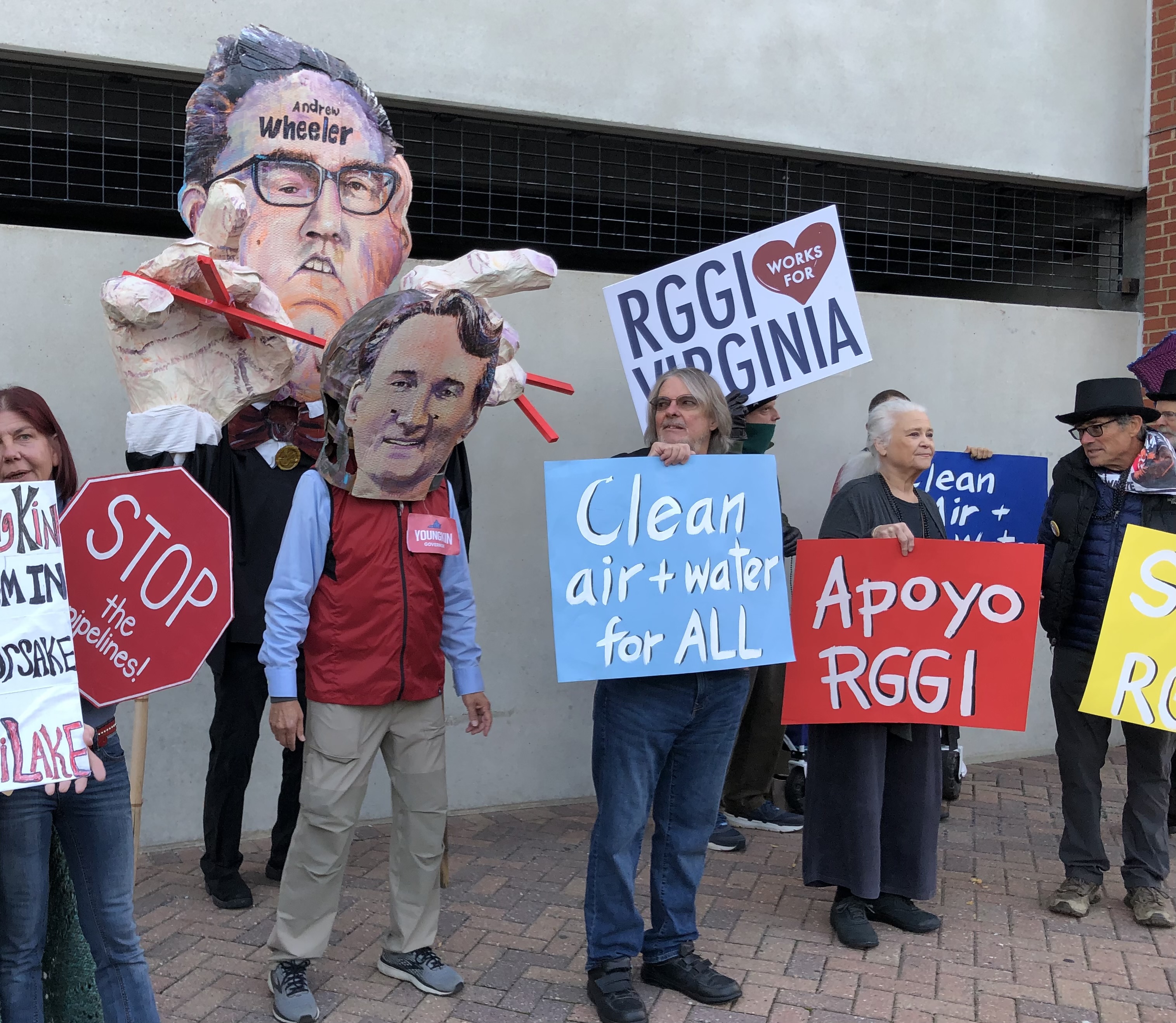
Protesters outside the Virginia Clean Energy Summit on October 21.
Governor Glenn Youngkin issued a press release on October 3 presenting what he says is his energy plan. Accompanying the press release was 26 pages labeled “2022 Virginia Energy Plan,” but that can’t be what he’s referring to. I mean, the Virginia Code is pretty specific about what makes up an energy plan, and this isn’t it.
Under Virginia law, the energy plan must identify steps the state will take over the next 10 years consistent with the Commonwealth Clean Energy Policy’s goal of a net-zero carbon economy by 2045 “in all sectors, including the electric power, transportation, industrial, agricultural, building, and infrastructure sectors.” Not only does Youngkin’s document not do that, it doesn’t even mention the policy it’s supposed to implement.
It’s also missing critical pieces. The plan is supposed to include a statewide inventory of greenhouse gas emissions, but it’s nowhere to be found. The inventory is the responsibility of the Department of Environmental Quality, which reports previous inventories on its website from 2005, 2010 and 2018. The one specifically required to be completed by October 1, 2022 isn’t there, nor is there any indication it’s in the works and just unfortunately delayed. Did I miss some fine print about how the requirement doesn’t apply if the governor is a Republican?
In fact, there is no discussion about climate change in Youngkin’s energy plan. The word “climate” appears nowhere. He simply ignores the problem: a modern Nero, fiddling while the planet burns.
Instead, Youngkin’s document mostly attacks the laws Virginia has passed in recent years to implement its decarbonization goals, including the Virginia Clean Economy Act, legislation allowing the state to participate in the Regional Greenhouse Gas Initiative and the Clean Cars law. In their place he offers a bunch of random ideas — some with merit, some without, some spinning off on tangents.
I did not really expect a conservative Republican with presidential aspirations to embrace all the recommendations for the energy plan that I laid out last month, or those from the many environmental, faith and consumer groups that support Virginia’s clean energy transition. Going further and faster down the road to decarbonization is a tall order for politicians beholden to fossil fuel interests, no matter how much it would benefit the public.
Yet Youngkin doesn’t have a lot of ammunition to use against the switch to renewable energy. With soaring coal and natural gas prices, it’s hard to keep pretending that fossil fuels are low-cost. The insistence that we need them for reliability is the only straw left to grasp at.
And indeed, underlying Younkin’s attack on the VCEA is a misunderstanding of how grid operators manage electricity. The critique boils down to “baseload good, intermittent bad.” But baseload is not the point; meeting demand is the point. Demand fluctuates hugely by day and hour. If grid operators had nothing to work with but slow-ramping coal plants or on/off nuclear reactors and no storage, they’d have as much trouble matching demand as if they had nothing but renewable energy and no storage. Pairing low-cost wind and solar with batteries makes them dispatchable — that is, better than baseload.
That’s not to say there aren’t good reasons to invest in higher-cost resources, but “baseload” is a red herring that stinks up Youngkin’s entire argument.
To his credit — and notwithstanding his “baseload” fixation — Youngkin supports Virginia’s move into offshore wind energy even with the high cost of the Coastal Virginia Offshore Wind project and other early U.S. developments. (The plan notes that Virginia’s project will be the largest “in the Free World,” a weirdly retro way to tell us China has leapt far ahead in installing offshore wind.)
The plan also supports removing barriers to customer purchases of solar energy, including shared solar and a greater ability for renewable energy suppliers to compete with utilities for retail sales. This is all phrased as a consumer choice issue rather than an endorsement of greater utility investments in solar; regardless, these would be welcome moves.
It’s also good to see the governor’s endorsement of rate reform. Republicans have been at least as much to blame as Democrats for Dominion Energy’s success in getting laws passed that let it bilk ratepayers. It will be interesting to see if Youngkin actually pursues the reforms he touts.
Less encouraging are Youngkin’s desires to jump into hydrogen (I’m guessing not the green kind, since we hardly have an excess of renewable energy) and, worse, to deploy “the nation’s first” commercial small modular nuclear reactor (SMR) in Southwest Virginia within 10 years.
You know what will happen there, right? Ratepayers will foot the bill, and it will be very expensive.
But unlike offshore wind, SMRs aren’t proven technology; they remain firmly in the research phase. The U.S. Department of Energy is hoping for a demonstration project “this decade.” If successful, the industry believes SMRs will eventually be able to produce electricity at a price that’s only two or three times that of solar and wind energy. Which begs an obvious question: Is there a reason to build SMRs?
Nor has anyone figured out the nagging problem of what to do with the radioactive waste, including the waste piling up at today’s nuclear plants because it’s too dangerous to move and there’s no place to put it. So Youngkin’s plan also “calls for developing spent nuclear fuel recycling technologies that offer the promise of a zero-carbon emission energy system with minimal waste and a closed-loop supply chain.” Great idea! But how about focusing on that first, Governor?
That’s not where Younkin is putting his focus, though. Last week, he proposed spending $10 million on a Virginia Power Innovation Fund, with half of that earmarked for SMR research and development. The announcement said nothing about waste.
Look, I happen to know some earnest climate advocates who believe SMRs are the silver bullet we’ve been waiting for. I follow the research with an open mind while also noting the astonishing advances in renewable energy technology announced almost daily. But the climate crisis is here and now. We can’t afford to press pause on known carbon-free technologies for 10 years in the hope that something even better will pan out.
Investing in research and development of new technologies is an important role for government, but kicking the climate can down the road isn’t an option. Rather than attacking our energy transition, Youngkin would have done more for Virginia by using his plan to build on it.
This article appeared first in the Virginia Mercury on October 18, 2022.
A murmuration of starlings. Photo by Jeremy Bolwell via Wikimedia
It was the best of summers, it was the worst of summers. It was the summer the United Nations declared a healthy environment a universal human right, and a summer that shattered heat records across the globe. The U.S. enacted a historic climate bill not long after the Supreme Court struck down the Environmental Protection Agency’s Clean Power Plan. Climate scientists said there was still hope for keeping global warming below 1.5 degrees Celsius, while the American West’s worst drought in 1,200 years continued for its 22nd summer.
The struggle to keep climate change from spinning out of control feels nothing short of epic, as if ordinary mortals were powerless observers to a battle between giants that will determine whether and how we survive. Yet if we weren’t collectively doing what modern humans do — burning fossil fuels, clearing land for agriculture, raising and eating billions of animals, driving on the roads we paved, making things in factories, consuming and consuming — there would be no epic struggle. We are the giants.
But being integral to the problem also makes every person integral to where we go from here. Powerlessness is an illusion. Like a murmuration of starlings wheeling through the air in a synchronized but unchoreographed ballet, small choices by individuals cascade across society and shift its direction, unpredictably and sometimes radically.
This is why there remains a case for hope, if not actual optimism, even as climate change accelerates toward climate chaos. Humans, working individually and collectively, have removed the biggest technological barriers to stopping the rise in greenhouse gas emissions. Most of the policy and economic barriers continue to crumble too, especially when it comes to replacing fossil fuels with wind and solar. As a result, our power supply will continue to get cleaner even in states that prefer their air polluted.
Government must still do much more, and many technical challenges still need to be worked out. For the first time, though, a decarbonizing grid finally gives ordinary people a role in determining the continued habitability of our planet, through individual actions that collectively push society in a new direction.
We’ve done this before. Consider the anti-littering campaign of the 1960s that made a once-commonplace behavior unthinkable for millions of Americans. Or take the public response to the ozone hole crisis of the 1970s, when scientists discovered that the chemical aerosols emitted by spray cans were migrating up to the stratosphere and reacting with sunlight to eat away at the Earth’s protective ozone layer. While the federal government dithered, consumers acted. They abandoned aerosols in favor of pump bottles for cleaning products, roll-on deodorants and sprays reformulated to remove the chlorofluorocarbons (CFCs) causing the problem. The public response led to government action, culminating in the 1987 Montreal Protocol phasing out CFCs worldwide.
Individual choices change history when people recognize the need to alter their behavior, but only if they have acceptable alternatives that others can copy easily. Once it becomes commonplace, the planet-friendly choice can even feel like the only morally acceptable option. Individuals and even companies want to avoid the stain of public opprobrium — the reason so many corporations today have adopted sustainability goals.
Many threats are too great to leave to voluntary action, or too hard for enough people to understand or act on individually. We needed top-down policies to decarbonize the electric sector; voluntary investments in rooftop solar alone could never do it. We will always need government agencies like the EPA and the Food and Drug Administration to regulate toxins and dangerous products. Simply trying to empower consumers can backfire, as Californians found when a right-to-know law enacted by proposition led to companies labeling pretty much everything as cancer-causing, just to be on the safe side.
But consumer choice will be a key factor in decarbonizing buildings and transportation now that renewable energy is taking over the electric grid. As people learn about the dangers of using natural gas indoors, they will opt instead for high-efficiency heat pumps and electric induction stoves, and builders will respond to changing demand by no longer connecting homes to gas lines. The new Inflation Reduction Act, with its generous rebatesfor home electrification, sped up the timeline for the demise of gas, but consumer preference will be the deciding factor.
Similarly, the IRA’s rebates for electric vehicle purchases will make consumers the killers of Big Oil. The transportation sector makes up the biggest slice of U.S. carbon emissions, and most of that is attributable to personal automobiles. Getting people out of their cars and on to bicycles or mass transit has been frustratingly hard because most of our communities were built around the automobile. The arrival of electric vehicles finally offers such an attractive alternative to the gas guzzler that it’s just a question of when, not if, the internal combustion engine goes the way of the horse-drawn buggy.
The battery technology that makes electric vehicles possible also allows every gasoline-powered tool to be electrified, including lawn mowers, weed-whackers and leaf blowers. Gasoline-powered lawn equipment is astoundingly polluting, in terms of both carbon emissions and smog-creating volatile organic compounds. It’s also so noisy that neighbors will pressure neighbors to switch to electric as the technology gets better and cheaper. California, Washington, D.C. and many localities have banned gas-powered leaf blowers, but consumer preference alone should eventually eliminate the market for them.
Consumer choice could also lower carbon emissions in sectors of the economy that are famously difficult to electrify. Within a few years you may be able to fly on a plane using biofuel or live in a building made with low-emission steel and concrete that sequesters carbon. As we’ve seen with other technologies, though, mass adoption depends on these alternatives being cheaper, better-performing or both. That will take time.
Eating a plant-based diet stands out as the individual action with the greatest climate impact, according to the climate solutions handbook Drawdown. People are beginning to catch on to the meat industry’s outsized impact on climate change, but it’s the second condition — people having alternatives they really like — that keeps the meat industry in business. Veganism is on the rise (led, of all people, by athletes), but meat consumption continues to grow too.
If some visionary thinkers are right, in a few years we will all happily be eating lab-grown meat and healthy plant-based meat substitutes because they will outcompete animal products on price, taste and convenience. Removing animals from our food supply will have cascading beneficial effects as it frees up land now used to grow animal feed for more planet-friendly uses such as carbon-sequestering forests and wildlife habitat.
For now, as anyone who has tried to stick to a diet can tell you, knowing what you ought to do is the easy part. Getting all of humanity to adopt a carbon diet is the challenge of our time. If we’re lucky and make the right choices, we may still have time to redirect the human murmuration toward a sustainable economy.
This article first appeared in the Virginia Mercury on September 8, 2022.
On Sunday the U.S. Senate passed the historic climate legislation package hammered out between Senate Majority Leader Chuck Schumer and West Virginia Senator Joe Manchin. The House is expected to follow suit this week, giving President Joe Biden a huge win on one of his administration’s priorities and finally making good on his pledge to tackle climate change.
The bill is titled the Inflation Reduction Act (IRA), apparently because the senators think inflation is the only thing most Americans care about right now. But whether it reduces inflation is beside the point. The IRA marks the federal government’s most significant investment in clean energy and transportation ever. Its $370 billion of climate spending will cut U.S. emissions roughly 42% below 2005 levels by 2030, only slightly less than the reductions that would have been achieved through Biden’s signature Build Back Better bill.
This is a huge piece of legislation, though, and some of the compromises Schumer was forced to make are not climate-friendly. Manchin, after all, is a coal baron representing a state so dominated by the extraction industries that it has lost sight of any other future. Climate hawks have to hold their noses (beaks?) to accept some noxious provisions, such as the bill’s requirement for new offshore drilling lease sales. No doubt that one will cheer motorists who wrongly assume the government could lower gasoline prices just by turning on a spigot, if only it wanted to.
The bill also comes with a side deal meant to ensure completion of the Mountain Valley Pipeline, which starts in Manchin’s home state. That news promptly soured many activists in Virginia on the whole package.
Hang in there, people. The pipeline deal isn’t actually part of the IRA, and Manchin knows better than anyone that a promise of some second bill to be voted on in the future is a castle in the air. Maybe he’ll get it, maybe he won’t. Meanwhile, the IRA’s incentives for renewable energy, energy storage, energy efficiency, building electrification and electric vehicles are overwhelmingly more impactful than provisions designed to increase oil and gas production. The business case for new pipelines will only get worse.
Three recurring themes stand out in the IRA. One is the attention paid to ensuring benefits flow to low- and moderate-income residents and communities impacted by fossil fuel extraction. A second is the effort to incentivize manufacturing and supply chain companies to bring operations back to the U.S., using tax credits for manufacturing and requirements for U.S.-made components. The third is job creation and training for career jobs that pay well. The combined effect is that the law will benefit former coal workers in Southwest Virginia looking for employment at least as much as Northern Virginia suburbanites jonesing for Teslas.
Every state will see clean energy investments soar if the bill becomes law, but Virginia is especially well positioned. Though we have embarrassingly little wind and solar in our energy mix today, we have huge potential for both, a strong tech sector and a well-educated workforce.
Just as important, laws passed by the General Assembly in the past few years already provide the framework for our energy transition. Among them, the Virginia Clean Economy Act and participation in the Regional Greenhouse Gas Initiative are pushing our utilities to decarbonize, including through investments in energy efficiency, solar and offshore wind. Solar Freedom removed barriers to private investments in distributed solar, while the Grid Modernization Act authorized upgrades to the distribution grid, and the Clean Cars Act started us down the road to vehicle electrification. For all of these, the IRA’s incentives make compliance easier and less expensive for both utilities and customers.
Renewable energy tax credits with an emphasis on equity and jobs
Photo courtesy of NREL
The IRA is a big bill with a lot of fine print detailing incentives for a wide range of technologies, mostly clean but with a few clunkers. (Hydrogen made from fracked gas, anyone?) Still, the largest share of the renewable energy tax credits will go to companies involved in the wind and solar industries. The credits will remain fixed for 10 years before ramping down, finally providing the business certainty and long planning window that clean tech companies have been begging for.
The more utilities take advantage of the law to install renewable energy, the greater the benefit to electricity customers. Renewable energy helps stabilize electricity costs, dampening the impact of high fossil fuel prices. The IRA’s tax credits will lower the cost of building wind and solar, saving money for Virginia customers as our utilities meet and exceed the VCEA’s targets for solar, storage and wind. (So, yes, the Inflation Reduction Act will live up to its name when it comes to electricity prices.)
For utility-scale projects like solar farms and offshore wind, obtaining the maximum tax credit requires that a steadily increasing percentage of the equipment used be American made. Credits available to manufacturers are intended to draw the supply chain back to the U.S. and will help those parts be cost-competitive. New prevailing wage and apprenticeship program requirements favor union labor and middle-class incomes for careers in green energy.
While large renewable energy facilities will contribute most to decarbonizing the grid, the most generous incentives in the IRA are reserved for distributed generation facilities under 1,000 kilowatts AC (1,300 kW DC), a category that includes most rooftop solar. For these projects, the investment tax credit will return to 30% for the next 10 years, with adders available if the facility is located on a brownfield or in an “energy community” (10%), uses domestic content (10%) or serves low-income residents (10-20%). The credits can be combined, making it entirely possible for a solar project on low-income housing in Virginia’s coalfields, built using American-made equipment, to qualify for tax credits of up to 70% of the cost.
Not only that, but taxpayers will be allowed to sell the credits, so people with no tax liability can still take advantage of the discounts. This feature will make solar affordable for homeowners who don’t owe enough in federal taxes to use the tax credits themselves. It will also make it possible for installers to discount the upfront cost of a solar array by the amount of the tax credit so customers don’t have to wait months for a tax refund.
A final feature is that the tax credits will now also be available as direct payments to tax-exempt entities like local governments, schools and churches. Direct pay will have the biggest impact in states that don’t allow third-party power purchase agreements (PPAs), but it’s a great option anywhere.
The “adder” for brownfields will be of interest to many Virginia localities that want to find ways to safely use closed landfills and old industrial sites, while Virginia’s government has already identified brownfields as a great opportunity for solar.
But the biggest market opportunities would seem to be for solar on low-income housing and in areas impacted by fossil fuel extraction. Carrie Hearne, associate director for renewable energy and energy efficiency at Virginia’s Department of Energy, said the many federal funding programs laid out in the IRA “would provide great opportunities for energy infrastructure investments in communities that are most in need, and in turn, help to lower energy bills. These federal funds could also contribute to the commonwealth’s goal of competitive rates, reliable and responsible delivery of energy alongside rural economic development.”
To understand how the solar industry sees these opportunities, I called the leaders of three solar companies that develop onsite solar in low-income areas and in the coalfields: Dan Conant of West Virginia-based Solar Holler, Tony Smith of Staunton-based Secure Futures and Ruth Amundsen of Norfolk Solar. Not surprisingly, they all predicted stunning growth in both distributed solar and jobs as a result of the IRA.
Solar has made fewer inroads in Southwest Virginia than in other parts of the state, which Conant sees as an opportunity. One of the few unionized solar companies in the area, and the only one I know of focused exclusively on Appalachia, Solar Holler has been expanding into Southwest Virginia and hiring workers at a steady clip. (Disclosure: I own a tiny stake in Solar Holler.)
The company already uses American-made components, so Conant said coalfields residents will be able to take advantage of two of the adders to install solar on their homes and businesses at half price, with low-income residents paying even less. The IRA’s manufacturing tax credits for American solar companies will further reduce the cost of the projects.
Conant was especially excited about the IRA’s impact on jobs in Appalachia. He expects to ramp up hiring significantly once the IRA becomes law. It took no prodding from me for him to add, “I truly believe this bill will let us get to 100% clean energy in 15 years.”
Secure Futures also has projects underway in Southwest Virginia as well as elsewhere across the state. The company uses third-party PPAs to allow tax-exempt customers like schools and nonprofits to go solar with no money down, paying just for the electricity produced by the panels. Although the IRA allows these customers to get the tax benefits without a PPA, Secure Futures president Tony Smith said tax-exempt entities will still do better using PPAs to take advantage of accelerated depreciation.
Smith said the IRA will make an already strong solar market in Virginia even stronger, as the higher tax credits will push down prices and the transferability of the credits will make it easier to attract more investors to solar. At the same time, a provision of the VCEA requiring Dominion Energy Virginia to acquire renewable energy certificates (RECs) from distributed generation facilities has created a strong market for these certificates, helping to finance projects and making solar even more affordable for institutional customers that sell their solar RECs.
On the other side of the commonwealth, Norfolk Solar also installs solar in low-income communities, offering PPAs to both commercial customers and low-income residents in economically distressed areas that qualify for special tax treatment as Qualified Opportunity Zones. (Under Virginia law, residential PPAs are available only to low-income customers.) Amundsen pointed out that the 10-year time horizon of the tax credits is an added benefit of the IRA to both her customers and potential investors because it allows for long-range planning and multi-year projects.
Energy storage will stand on its own
The VCEA established one of the most ambitious goals for energy storage development in the nation. But current federal law offers tax credits for energy storage only when it is part of a renewable energy project. The limitation has led to the proliferation of solar-plus-batteries projects around the country. It’s an ideal combination because it allows solar energy to be used when it is needed, unshackled from the time of day that it’s produced.
But uncoupling storage from renewable energy projects is a more efficient way to manage the grid, said Steve Donches, a Loudoun County attorney who represents battery storage companies and recently served on the Virginia Energy Storage Task Force.
“In many instances, the best location for storage supporting the grid is not where the renewables are located but rather near grid chokepoints or inside load pockets,” he said. “Moreover, site selection flexibility can often be important from a zoning permitting perspective. The new approach allows developers to be more nimble and locate where it is most useful and cost efficient.”
Recognizing this, the IRA provides a tax credit of up to 30% for energy storage whether or not it is part of a renewable energy facility.
This will make grid storage less expensive and easier for our utilities to install, and it will also benefit customers who want to put batteries in their buildings for back-up power. Amundsen noted that her customers sometimes can’t afford to include a battery at the time they install solar; the IRA will let them take the tax credit for storage even if they buy the battery later. This is especially important, she said, for resilience in low-income neighborhoods, where adding a battery to a solar-powered church or community center allows it to “island” during a power outage and provide a refuge for neighbors.
Homeowners will see huge benefits from building electrification
A cleaner electricity grid makes it possible to decarbonize other sectors of the economy by substituting electricity for fossil fuels in transportation and buildings; hence the climate advocates’ mantra “Electrify everything.” Yet while new electric appliances have become more energy efficient and attractive to consumers than the ones they replace, the switch comes with a price tag.
Under the new law, price will no longer be a barrier. The IRA offers rebates to residents to upgrade their homes with new electric technology such as heat pumps for heating and cooling (up to $8,000), electric induction stoves ($840), heat pump water heaters ($1,750) and upgrades to home electrical systems to support all the new load ($4,000). The rebates phase out for higher-income earners. Lower-income families replacing old and inefficient appliances will see the greatest energy savings as well as the highest rebates.
The federal rebates are a fantastic complement to existing Virginia programs for low-income energy efficiency upgrades. A major attraction of Virginia’s participation in the Regional Greenhouse Gas Initiative is the hundreds of millions of dollars it raises for low-income efficiency programs such as those devoted to upgrading multifamily housing like apartment buildings. Coordinating the state programs with the new federal rebates should be an urgent priority to ensure the broadest possible benefits to low-income Virginians.
Meanwhile, gas utilities had better start planning for the end of their business. There is no longer any reason to expand and upgrade gas distribution pipelines, because from here on in their customer base will be shrinking, not growing, resulting in stranded assets.
Electric vehicles aren’t just for the rich any more
Santeri Viinamäki, CC BY-SA 4.0 , via Wikimedia Commons
The IRA provides a $7,500 EV tax credit for new vehicles, including those made by manufacturers like Tesla and Toyota that had reached volume caps in previous law. Restrictions apply, including income limits, vehicle price caps and supply chain sourcing rules. The act also now adds a credit of up to $4,000 for used vehicles, making ownership possible for more people at all income levels.
Virginia is committed to vehicle electrification through its adoption of clean cars legislation in 2021 and a 2022 law requiring state agencies to buy electric light-duty vehicles whenever the total cost of ownership is less than it would be for a vehicle with an internal combustion engines. But further speeding up the transition to EVs will create ripple effects requiring careful planning. Electricity demand will increase and do so unevenly, requiring load management programs and upgrades to parts of the distribution grid.
Charging all these vehicles will also be an issue. Many would-be EV customers lack the ability to charge at home, either because they don’t own the space where they park or because their homes aren’t wired for easy installation of a charger. The problem is especially acute for people who rent apartments in buildings that lack charging stations.
No matter how generous the credits, people won’t buy EVs if they can’t charge them. Virginia must require multifamily buildings to include enough charging stations for all the residents who want them, ensure public charging stations are plentiful and convenient in low-income neighborhoods and improve its residential housing code to ensure new homes are wired to facilitate installation of chargers.
For best results, lean in
Photo credit iid.com
Virginia law requires each new governor to produce an energy plan in October of the first year in office, so Virginia’s Department of Energy is currently in the process of writing a plan that will have Gov. Glenn Youngkin’s stamp on it. The plan must be one that “identifies actions over a 10-year period consistent with the goal of the Commonwealth Clean Energy Policy set forth in § 45.2-1706.1 to achieve, no later than 2045, a net-zero carbon energy economy for all sectors, including the electricity, transportation, building, agricultural, and industrial sectors.”
Governor Youngkin hasn’t shown much enthusiasm for Virginia’s energy transition to date, having tried to gut the VCEA and repeal RGGI. Yet with the IRA making so many incentives available for clean energy and electric vehicles, leaning in to the energy transition now will allow the commonwealth to reap huge rewards in the form of economic development, job growth, cleaner air and lower energy bills.
The opportunities for Virginia are enormous; the governor should make the most of them.
This article originally ran in the Virginia Mercury on August 9, 2022.
Dear readers: Many of you know that although I write independently of any organization, I also volunteer for the Sierra Club and serve on its legislative committee. The Sierra Club’s Virginia Chapter urgently needs funds to support its legislative and political work towards a clean energy transition. So this summer I’m passing the hat and asking you to make a donation to our “Ten Wild Weekends” fundraising campaign. Thanks!