The human population of the Earth passed 8 billion in 2022, up from 7 billion in 2011 and less than 2 billion just a century ago. The United Nations projects that by 2050, the world will hit 9.7 billion people and continue rising to 10.9 billion in 2100. The average number of children women have in their lifetimes remains above the replacement rate of 2.1.
So why is there so much hand-wringing about a population bust?
It is true that population trends are uneven across the world, and some European and East Asian countries are struggling to address a decline in numbers. This is not the case in the U.S., however. Although our birth rate has been below the replacement rate for years, the Census projects our population increasing by another 33 million before it peaks in 2080. By 2100, the Census expects there will still be almost 10% more people in the U.S. than there are today.
Frankly, it’s more than a little odd to worry about something that won’t happen for at least three-quarters of a century, while ignoring that in the meantime, an ever-growing population using too many resources is pushing the planet to the brink of ecological collapse. You would think we could worry about that now, and save the hysterics over population decline for the next century.
Yet conservatives see the sky falling. The fear is most palpable among white supremacists spouting replacement theory, the notion that pale-skinned people, who are having fewer children, will be swamped by brown people, who are having more. They are pretty sure this is, in fact, a nefarious plan concocted by Jewish people, who apparently don’t count as white, with a goal of destroying Western civilization and all the great things that America stands for — by which they definitely do not mean democracy and civil rights.
Even some liberal Americans say they’re worried about the birth rate, and argue we need child tax credits, mandatory parental leave and publicly-subsidized daycare to reverse the decline. Of course, progressives support these policies anyway, so it’s hard to know how sincere their concern over birth rates really is.
I’m not sure about the sincerity on the right, either. Most of the people who express alarm about a declining birth rate are red-state Republicans who celebrate rural living and the small-town lifestyle. They hate traffic and the plethora of rules necessary to make life tolerable in crowded communities.
Meanwhile, I guarantee you no one in New York or LA looks around and says, “You know what would make this place better? More people!”
Of course, the pro-population-growth crowd absolutely rejects the one sure way to increase the US population: allowing more immigrants in.
They say it’s not racism. Theirs is just a preference for people who look like them, sound like them and do things the way they do them.
Yet immigration does all the things that the population alarmists say we need. It fills schools with children, bolsters the workforce, and keeps contributions flowing to Social Security and Medicare, extending the solvency of these programs.
Vastly more would-be immigrants are knocking at our doors than we are willing to allow in, and the numbers will only increase as climate change and the collapse of ecosystems spark further conflict and make it harder to eke out a living in more parts of the world. Countries that are able and willing to absorb the outflow of migrants from devastated areas will not be challenged by depopulation.
The U.S. is home to more migrants than any other country. Clearly many Americans, themselves descended from immigrants, are ready to shut the door behind them, but economists agree immigration is the secret sauce of our economic strength. That doesn’t mean the doors need to be wide open, with no one managing the flow, or that we shouldn’t try to help solve the crises that drive people to leave their home countries in the first place. And we still urgently need to work on transforming our consumption-based economy into a sustainable one.
But it does mean we needn’t fear a population bust in our lifetimes. While other advanced countries are figuring out how to retool their economies for a shrinking population, we will always have the numbers we desire, so long as we remain a society committed to equal opportunity, democracy and the striving for justice.
Obviously, this is not what the nativist right wants. But what they want — more American-born babies and limitless population growth, achieved by controlling women’s bodies rather than by strengthening the welfare state — is a fantasy served up with a helping of bad policy.
This article was previously published in the Virginia Mercury on August 20, 2024.
A data center in Ashburn, Virginia. Photo by Hugh Kenny, Piedmont Environmental Council.
Somehow, we were not prepared for this. Artificial intelligence was in development for decades, during which time we fantasized about all the wonderful things it was going to do for us. And then the bots launched almost fully formed like Athena springing from the forehead of Zeus with her sword in hand, and only then did we have our epiphany: Oh man, this is not going to go well.
What happened to the AI utopia? We were expecting self-driving cars that would let us drink too much on nights out while eliminating highway fatalities. We anticipated the seamless integration of all our devices and appliances, maybe even without cords! We imagined an unlocking of efficiencies at home and at work; medical breakthroughs; scientific innovation on steroids. We’d have three-day workweeks and go hiking on the weekends while the robots cooked and cleaned.
Maybe these things are still there in our future, along with world peace, but so far what we’ve got is a new way for kids to cheat on homework, a lot of derivative art, pernicious deepfakes and raging arguments over intellectual property theft. Oh, and an unprecedented increase in the demand for electricity that threatens to overwhelm the grid and make it impossible for us to stop burning fossil fuels before global warming destabilizes societies worldwide.
The wonder is why we thought this would go well. Shouldn’t we have known ourselves better?
In my view, the biggest problem with AI is that either humans are in charge, or the robots are. If it’s the robots, there is a good chance they will decide to kill us all, and we won’t see it coming. So we need to root for the humans, who could use the powerful new tools of AI to address hunger and climate change but so far mostly use it for financial fraud, child pornography and adding to the absurd percentage of the internet devoted to cat memes.
And instead of helping to lower CO2 emissions, right now the effect of AI is to increase the burning of fossil fuels. U.S. electricity consumption had flatlined after the mid-2000s, but AI is pushing it up again, and sharply. Data centers, where AI “lives,” could consume as much as 9% of U.S. electricity generation by 2030, double that of today.
We have a close-up view of this in Virginia, the data center capital of the world. In 2022, when I first tried to quantify Virginia’s data center problem, industry sources put the state’s data center demand at 1,688 megawatts (MW) — equivalent to about 1.6 million homes. With the advent of AI and its enormous appetite for power, the industry added 4,000 MW of new data centers in 2023. By the end of last year, data centers commanded fully 24%of the total electricity generated by Dominion Energy Virginia, the state’s largest utility. Over the next 15 years, Virginia’s data center demand is expected to quadruple.
Citing the need to supply data centers with power, Dominion did an about-face on its plan to achieve net zero carbon emissions by 2050. It now proposes to keep coal plants running past their previous retirement dates, and to build new gas-powered generation.
The problem is not confined to Virginia. Across the country, utilities are struggling to meet AI’s increased energy demand, and looking to fossil fuels to fill the gap.
And while tech companies talk a good game about meeting their power demand sustainably, the evidence says otherwise. Tech companies conspicuously did not push back on Dominion Energy’s plan, and their own efforts fall woefully short. Even Google, which has taken its carbon-cutting obligations more seriously than most companies, just reported a 13% rise in its greenhouse gas emissions in 2023, thanks to its investments in AI and data centers.
Apparently, Google and its competitors in the race to dominate AI think meeting climate goals is like getting a loan from a bank; you emit more today, grow your business and use the profits to clear the debt by emitting a lot less tomorrow.
But Mother Earth is not a bank. She is a loan shark, and she has started breaking fingers.
If we can’t rely on the inventors of AI to restrain their energy appetites, we have to turn to our politicians (sigh). Our leaders have to make and enforce limits on the growth of AI commensurate with the world’s ability to provide the resources without baking the planet. Admittedly, mustering that kind of willpower is hard to do in a country that has elevated corporations to personhood and defines the First Amendment to include both spreading lies and spending money to influence elections.
And that gets us to the second-biggest concern I have about AI, but the one that might upend society soonest: the unleashing of deepfakes in this fall’s elections, and the threat that the reins of government will go not to those most dedicated to tackling hard problems, but to those who prove themselves the biggest scoundrels.
The American Bar Association (ABA) defines deepfakes as “hoax images, sounds and videos that convincingly depict people saying or doing things that they did not actually say or do.” Noting that they have already been used in election campaigns in the U.S. and abroad, the ABA is promoting model state legislation to criminalize the creation of malicious deepfakes. Meanwhile, tech companies including Google and Meta have adopted advertising policies to require disclosures of altered content.
Both approaches are good as far as they go; websites should police content, and states should act swiftly to outlaw the deepfakes (though the ABA lists very few that have done so yet). But in a high-stakes situation like an election, punishing violators after the fact – if you can catch them at all – is very much a case of closing the barn door after the horses are out. Once voters have been exposed to “evidence” of a candidate’s unfitness for office, especially when media coverage has primed them to believe the lies, the damage is done.
Many voters, especially younger ones, are savvy enough to be wary of campaign-related materials generally, and of unattributed images that float around the internet in particular. But older people who came of age in the pre-internet-memes era are vulnerable to believing what they see and hear, and a lot of us won’t put ourselves to the trouble of questioning what feels true. A deepfake only has to fool some of the people some of the time to alter the results of an election.
But maybe I’m being needlessly alarmist about the dangers of AI, even if I have a lot of company. So I did the obvious thing: I asked a bot if AI would save humanity or kill us all.
ChatGPT responded with a list of pros and cons of AI, including the familiar benefits and concerns that have spawned a thousand op-eds. You can try this at home, so I won’t reiterate them here. But I will note the curious fact that the bot didn’t mention either carbon emissions or election-altering deepfakes.
Maybe that’s an oversight, or maybe it means my fears are unwarranted. But maybe it shows something even scarier than AI itself: It’s AI pretending it isn’t trying to take over.
We urgently need action from U.S. and corporate leaders. Stiff new taxes on data center energy use would lead to greater efficiencies and nudge companies to price data storage and AI use appropriately. New laws should put the onus on internet platforms to stop deepfakes before they can spread. Tech companies should prioritize what is good for human beings over what is good for corporate profit. If they can’t ensure AI is used only for good, they should pull the plug until they can.
If all this doesn’t happen, and soon – well, let’s just hope the robots are kind.
This article first appeared in the Virginia Mercury on July 11, 2024.
If you’d like to hear a deeper discussion about the climate challenge posed by data centers and AI, I’ll be addressing this topic tonight at a meeting of the IEEE Society on Social Implications of Technology (SSIT) Chapter of Northern Virginia/Washington/Baltimore in Oakton, Virginia, which you can also attend remotely. The presentation will be recorded.. https://events.vtools.ieee.org/m/424609
Who says solar can’t be an asset to the land? Photo credit Center for Pollinators in Energy, fresh-energy.org
It’s a problem that divides communities and stymies lawmakers: Virginia’s transition to clean energy depends on building thousands of acres’ worth of large solar facilities, but a backlash from some rural neighbors makes siting projects increasingly difficult.
Most of the objections are aesthetic – few people prefer to look at rows of solar panels if they once enjoyed a bucolic country scene – but some opponents say they worry about the loss of farmland and trees. Solar, they fear, is bad for the land as well as the eyes. It doesn’t help that some early solar development suffered from corner-cutting that resulted in soil compaction and erosion. If that is solar, many people want no part of it.
In 2022, land conservation groups banded together with agriculture and logging interests to lobby for legislation requiring mitigation whenever a solar project would disturb more than 50 acres of forest or 10 acres of “prime agricultural soils.” House Bill 206 applies to any solar project developed under Virginia’s sort-of-streamlined “permit by rule” process, which is available to all but the largest facilities.
The solar industry initially fought the legislation, joined by some climate advocacy groups. They pointed out that no other industry is subject to mitigation requirements, and that solar provides greater climate benefits than forests and agriculture. Moreover, solar panels can be removed and the land returned to farming or forestry. By contrast, once land is converted to a housing subdivision or strip mall or data center, the damage is permanent.
Eventually the solar industry accepted compromise language that put off the effective date until the start of 2025 and gave industry members a voice in an advisory panel under the auspices of Virginia’s Department of Environmental Quality (DEQ). The law tasked this group with helping to develop “criteria to determine if a significant adverse impact to prime agricultural soils or forest lands is likely to occur as a result of a proposed solar project,” and if so, the actions that should be considered in any mitigation plan. DEQ was to use the working group’s conclusions to draw up regulations.
As it turned out, the working group agreed on very little. Its 717-page report found consensus on only a few points, leaving DEQ itself with the task of resolving key issues. On May 13, the agency published its proposed regulations. The regulations are currently under executive branch review, after which Interested parties and the public will have the opportunity to comment.
Meanwhile, a few things have happened since the passage of HB 206.
In March of 2022, DEQ toughened its stormwater regulations to address the runoff and erosion problems that had given solar a bad name in some communities. Building on that, the agency just released a new stormwater handbook that will become effective July 1, 2024, with sections specific to solar development.
Some solar industry members complain that DEQ’s stormwater regulations are unreasonably onerous, but no one questions the importance of preventing runoff and erosion. In any case, many companies are already using land-friendly practices that make it easier to meet tougher rules. One is the use of terrain following trackers, a technology that allows solar to be installed on uneven terrain instead of bringing in bulldozers to level the site. The trackers maximize solar production in hilly areas while preserving topsoil and vegetation.
The new tracker technology is among the suite of low-impact approaches gaining ground as the solar industry matures. DEQ encourages another eco-friendly practice: planting native species among and around solar arrays. Native plants provide food and habitat for insects whose numbers have plummeted in recent years, threatening our ecosystems. Though only a few solar projects have achieved DEQ’s pollinator-smart certification to date, most of the developers I’ve spoken with say they are open to it.
Photo credit Solar Power World and Nexamp
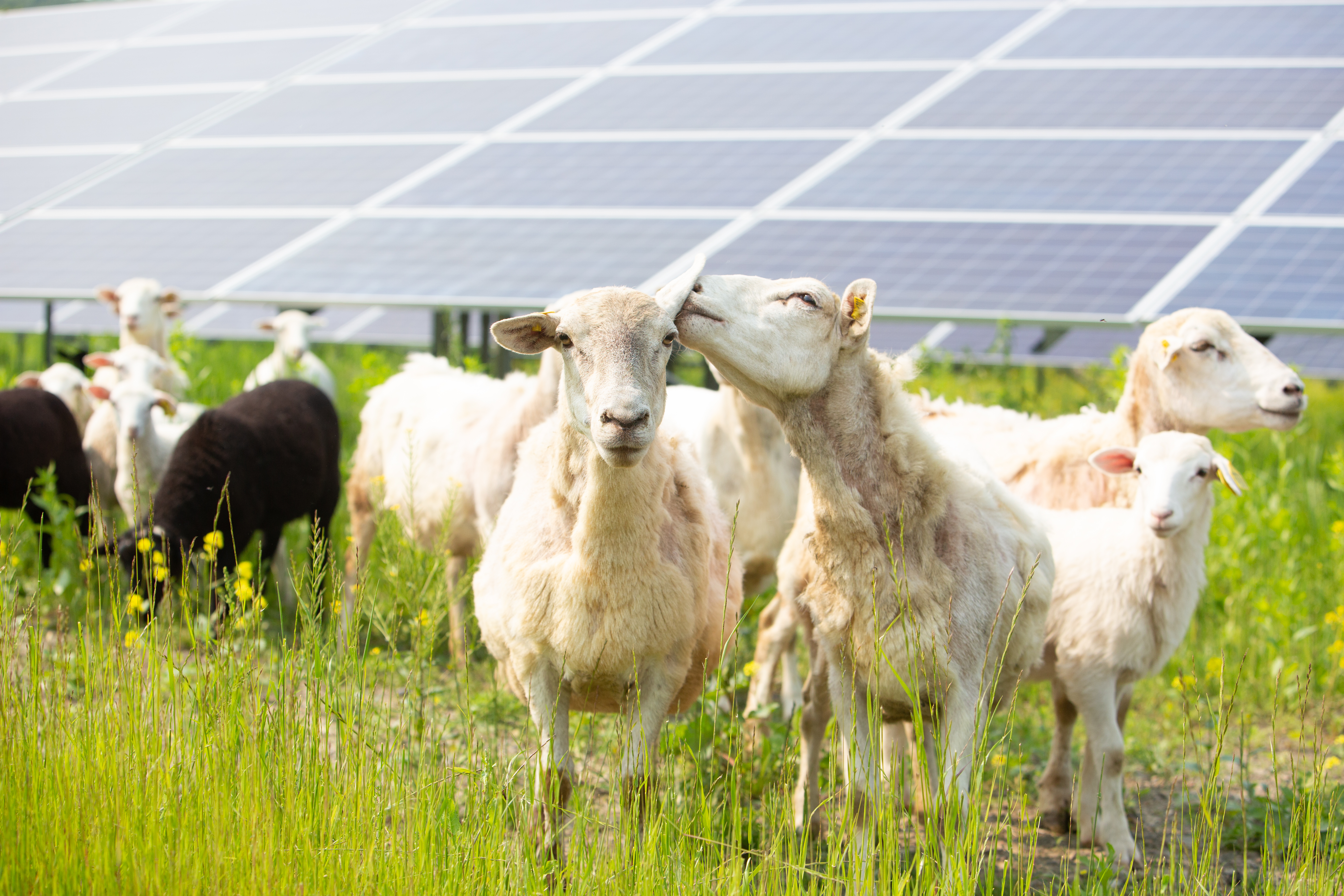
Gaining traction even faster is the practice of using grazing animals for vegetation management. Sheep hit the sweet spot: project owners save money they would have to spend on humans operating machinery, while the sheep thrive in the shade of solar panels and return nutrients to the soil. Already, 2% of sheep in the U.S. are being grazed under solar panels, according to an American Solar Grazing Association webinar, including at several large Virginia facilities providing power to Dominion Energy. Elsewhere, cattle graze under solar panels or crops grow between the rows, further erasing the distinction between solar facilities and agricultural use.
All-terrain trackers, topsoil preservation, native plants and incorporating active farming or grazing: all these practices ensure farmland isn’t “lost” to solar. Yet DEQ’s tougher stormwater rules, the solar industry’s increasingly land-friendly practices, and even the passage of HB 206 haven’t allayed concerns among solar opponents. Instead, rural counties have stepped up the pace of bans, caps and moratoriums.
One suspects the continued hostility isn’t because opponents lack familiarity with the ways solar can be eco-friendly, but because the opposition’s primary motivation isn’t preserving farmland. If what they really care about is keeping solar from cluttering up the viewshed (“preserving our rural heritage” is the euphemistic framing), then adding a new layer of mitigation requirements won’t change anything.
Admittedly, I never supported HB 206 in the first place. From an environmental perspective, solar is no worse for the land than monoculture pine plantations or commodity crops grown with pesticides and petroleum-based fertilizers. Done in a habitat-friendly way, solar can increase biodiversity and help heal the land. And solar addresses our CO2 problem, far more even than trees.
Still, DEQ’s job was to try to find a middle ground between the solar industry and its detractors, and in fairness, their effort gets some things right. The proposed rules recognize that there are degrees of impact a solar facility can have, and that practices like leaving topsoil undisturbed or incorporating agrivoltaics should be rewarded with lower mitigation requirements. A neat table delineates the various levels of impact and proposes differing levels of mitigation to match. Mitigation mostly takes the form of land set-asides, but can also be satisfied with per-acre payments.
And yet the proposal misses the mark on at least three fronts. First, it fails to give full credit to solar projects that minimize soil disturbance and incorporate agrivoltaics. DEQ should recognize that adopting best practices is itself mitigation, which should obviate the need for land set-asides or monetary payments.
Second, the proposed regulations make no exceptions for projects owned and operated by local farmers who incorporate solar into their farm activities in order to increase and diversify their income without having to sell their land. If the point of HB 206 was to protect farming, DEQ has shot wide of the mark.
Finally, the dollar amounts that DEQ proposes in lieu of land set-asides are punishingly high, with perverse effects. A solar company that has to pay a stiff penalty must pass that cost along in the form of a higher price for the electricity produced. If a utility has to pay more for electricity, ratepayers ultimately foot the bill.
The alternative is equally counterproductive. I noted at the start that DEQ’s permit-by-rule process is available to all but the largest projects, but it is not the only pathway open to developers. Projects over 150 MW are required to go to the SCC for approval, but smaller projects aren’t foreclosed from doing so. If DEQ makes its own process too onerous, solar developers will go to the SCC instead. The SCC requires that a developer secure a local permit, but not that it employ soil-saving practices, agrivoltaics or mitigation.
It would be great if DEQ could turn the lemon that is HB 206 into a lemonade of a solar industry adopting eco-friendly development practices and incorporating pollinator plantings, sheep grazing, and other agrivoltaic businesses. What we have instead is a proposal that may kill the permit-by-rule program without producing any benefit to anyone – in effect, turning lemonade into lemons.
There is still time to get it right. DEQ may not be able to resolve the solar wars, but a good set of regulations would position Virginia to make the most of a solar industry that is essential to our future.
This article was originally published in the Virginia Mercury on June 12, 2024.
Virginia utilities finally have an opportunity to attack net metering. Photo by Don Crawford.
When the Virginia Clean Economy Act became law in 2020, solar advocates celebrated. In addition to creating a framework for a transition to a zero carbon electricity sector by 2050, the VCEA and sister legislation known as Solar Freedom swept away multiple barriers to installing solar in Virginia. Among the new provisions were some that strengthened net metering, the program that allows residents, businesses and local governments who install solar onsite to be credited for excess electricity they feed back to the grid.
Currently, the law requires that customers of Dominion Energy and Appalachian Power be credited for the electricity they supply to the grid at the full retail rate for electricity. The credit is applied against the cost of the electricity they draw from the grid at night. The policy makes solar affordable and supports small businesses across Virginia.
However, the VCEA came with a ticking time bomb. It provided that in 2024 for Appalachian Power, and 2025 for Dominion, the State Corporation Commission would hold proceedings to determine the fate of net metering, and in particular the terms for compensating new net metering customers.
Well, it’s 2024, and the bomb just went off. On May 6, the SCC issued an order directing the two utilities to file their suggested changes. Appalachian’s proposal is due by September 2; Dominion’s is due by May 1, 2025. The SCC will establish a schedule for each case that will include provisions for the public and interested parties to participate.
There are two important protections to note. First, low-income customers will have their choice of installing solar under either the existing rules or the new ones. Second, customers who install solar panels and interconnect to the grid before the SCC issues its final order will continue to be covered by the existing provisions for retail net metering.
For anyone who’s been on the fence about installing solar, I can’t overstate the urgency of acting now. Nonprofits Solar United Neighbors and Solarize Virginia can help you get the best deal. Also check out the excellent advice and sample quotes from HR Climate Hub.
Make no mistake, utilities hate net metering and will destroy it if they can. The more customers who install solar, the less control the utility can exercise over them — and, even more critically, the less money the company makes for its shareholders from building new generation and transmission.
That’s not what our utilities tell legislators and the SCC, though. Instead, they promote a narrative that net metering customers impose extra costs on other ratepayers, creating a “cost shift.” The idea is that residents who go solar are making everyone else pay more of the costs of the grid while they themselves rake in money with their free electricity from the sun.
This argument has raged across the country for years. Utilities often argue that solar customers should be paid for their surplus electricity only the amount of money the utility would otherwise have had to spend to generate or buy that same amount of electricity from somewhere else. This “avoided cost” can be less than one-third of the retail rate for residential electricity. (The net metering changes would also affect commercial and non-profit properties, which pay a lower rate than residential – but still well above avoided cost.)
With a payback period of nine to 15 years in Virginia, residential solar is a reasonable investment with retail rate net metering, but it’s hardly a get-rich-quick scheme. Brandon Praileau, the Virginia program director for Solar United Neighbors, said in an email that lowering the net metering rate would eliminate the energy savings that homeowners see from solar today.
“It is the full retail 1:1 value of solar that allows solar to not be a boutique purchase that only fits a certain demographic but something that every homeowner can benefit from,” he noted.
Praileau added that the loss of net metering would also hit Virginia’s solar installers hard and lead to job losses, something I confirmed with industry members. Russ Edwards, president of Charlottesville-based Tiger Solar, says any devaluation of solar would have a “significantly adverse” impact on local companies like his that serve the residential market.
But the “cost shift” argument doesn’t actually depend on whether rooftop solar is affordable for customers or profitable for installers. The way utilities think about net metering, a homeowner could even lose money on solar and still be guilty of shifting the costs of maintaining the grid onto other customers.
Net metering supporters counter that rooftop solar provides valuable benefits to the grid and to other customers that the utilities overlook, like relieving grid congestion and lessening the need for utility investments in new generation and transmission. Solar also has larger societal benefits like increased energy security, local resilience, clean air and carbon reduction.
Over the years this dispute has spawned literally dozens of studies estimating the value of solar. A Michigan study found that rather than being subsidized by other ratepayers, residents who install solar actually subsidize their non-solar-owning neighbors. Closer to home, a Maryland study also concluded that distributed solar provided a value greater than the retail cost of energy.
But every state is different. California’s public utility commission recently slashed the net metering rate all the way down to a so-called avoided cost, in part because the huge growth of solar in the state has led to a power glut in the middle of the day. The residential solar market cratered as a result of the PUC’s action, with an estimated 17,000 jobs lost in the solar industry.
Virginia does not have California’s problem. With only about 6.5% of our electricity generated by solar and the world’s largest energy storage facility in the form of Bath County’s pumped hydro plant, rooftop solar still helps Virginia utilities meet peak demand. We also face a skyrocketing demand for electricity from data centers, which militates in favor of all the clean energy we can generate.
Ten years ago, Virginia set out to do a study on the value of solar, led by the Department of Environmental Quality. Unfortunately, our utilities pulled out when they didn’t like what they were seeing, so the study never progressed beyond a framing of the issues.
Since then, Dominion and APCo have often repeated the “cost shift” narrative but have never backed it up with evidence. Their efforts have had some effect with legislators, most recently with passage of a bill instructing the SCC to “make all reasonable efforts to ensure that the net energy metering program does not result in unreasonable cost-shifting to nonparticipating electric utility customers.”
But of course, that simply begs the question of whether a cost shift is actually occurring. Under the VCEA, the SCC will now have to “evaluate and establish” the amount a net metering customer should pay for “the cost of using the utility’s infrastructure,” and the amount the utility should compensate the customer for the “total benefits” the customer’s solar panels provide. The SCC is also instructed to evaluate and establish the “direct and indirect economic impact of net metering” and consider “any other information the Commission deems relevant.”
Presumably, this other information should include the state’s energy policy. The policy specifically supports distributed solar, including “enhancing the ability of private property owners to generate their own renewable energy for their own personal use from renewable energy sources on their property.”
The SCC will now have to navigate these opposing positions in what are certain to be contentious proceedings. Meanwhile, residents and businesses would be well advised to get their solar panels up this year.
This article was originally published in the Virginia Mercury on May 21, 2024.
Virginia’s 2024 legislative session wrapped up last month without any action to avert the energy crisis that is hurtling towards us.
Crisis is not too strong a word to describe the unchecked proliferation of power-hungry data centers in Northern Virginia and around the state. Virginia utilities do not have the energy or transmission capacity to handle the enormous increases in energy consumption. Dominion Energy projects a doubling of CO2 and a new fossil fuel buildout. Drinking water sources are imperiled.
The governor is unfazed. Legislators are going to study the matter.
Source: PJM
According to data gathered by regional grid operator PJM, half of the coming surge will occur in parts of Virginia served by Dominion Energy. In its 2023 Integrated Resource Plan (IRP), Dominion said it would meet the higher demand by increasing its use of expensive and highly polluting fossil fuels and building new methane gas-fired generating plants. Dominion admitted this will push up carbon emissions at a time when the Virginia Clean Economy Act requires the utility to build renewable energy and cut carbon.
PJM projects equally huge data center growth in areas served by Virginia electric cooperatives, especially Northern Virginia Electric Cooperative (NOVEC). The cooperatives are exempt from most VCEA requirements, and NOVEC buys the bulk of its power from PJM’s fossil fuel-heavy wholesale market. NOVEC’s latest annual report cites load growth of 12% per year, almost entirely from data centers, but fails to even mention the increase in carbon emissions that will accompany that growth.
Undeterred by these alarming statistics, the General Assembly put the growth on steroids with a new round of tax breaks in 2023, while beating back any conditions that might have slowed the onslaught. This year it turned away every bill that would have placed limits on the industry or protected ordinary consumers from the inevitable cost increases.
At the same time, legislators rejected a host of bills that would have enabled more renewable energy development in Virginia and given customers a greater ability to secure their own electricity supply. Together these bills could have brought thousands of megawatts of new solar projects online, lowered demand growth through increased energy efficiency, and prevented the increases in carbon pollution that now appear inevitable.
Legislators did greenlight Dominion Energy and Appalachian Power’s ability to spend their customers’ money on initial development efforts for two nuclear reactors of up to 500 megawatts (MW), one for each utility.
This is not a fix. It is like scheduling knee surgery for next year when you are having a heart attack today.
There is, famously, much doubt about whether small modular reactors (SMRs) will prove viable in the coming decades, but there is no doubt whatsoever that the surge in data center development is happening right now. Virginia’s hoped-for nuclear renaissance would be both too little and too late to meet a data center demand that Dominion says grew by 933 MW in 2023 alone. It’s expected to reach almost 20,000 MW by 2034, the year Dominion’s IRP shows its first small nuclear reactor delivering power.
In rejecting every serious measure to address data center demand, General Assembly leaders said they wanted to wait for a study being conducted this year by the Joint Legislative Audit and Review Commission (JLARC). What the General Assembly didn’t do was defer new data center development until the study is complete. Another year has to pass before lawmakers will even consider bills addressing land use, power and water concerns around data centers or make it easier for renewable energy to come online.
The consequences of inaction could be deadly. It was only a year ago that Virginia’s Department of Environmental Quality (DEQ) proposed allowing certain Northern Virginia data centers to violate their air quality permits by running more than 4,000 highly-polluting diesel generators during periods of grid stress. It doesn’t take much imagination to picture the public health disaster we’d have had if 4,000 diesel generators kicked into operation last summer when smoke from Canadian wildfires had already made Virginia air quality hazardous.
DEQ backed off its proposal after a massive public outcry, but the idea is likely still percolating at the agency and might reemerge as an emergency demand-response measure. Even without allowing the generators to provide grid support, more data centers with more diesel generators will worsen air quality with every power outage and every round of equipment testing.
As I argued at the time, the diesel generator fiasco could have been avoided in the first place if data centers had been equipped with renewable energy microgrids and battery storage. DEQ’s decision not to require battery storage as the first line of defense against power outages deprived Dominion of a demand-response option that would have been far cleaner and more useful than diesel generators.
One of the bills the General Assembly rejected this year would have prohibited the use of backup diesel generators by data centers that receive state tax subsidies, and would have required greater energy efficiency. It was a missed opportunity that means the problem can only get worse in the coming year.
The governor, however, could still avert the crisis by imposing a pause in data center development while the JLARC study is underway. He could accomplish this through an executive order directing the Virginia Economic Development Partnership (VEDP) not to enter a memorandum of understanding (MOU) with any data center operator until the JLARC study is complete and legislators have had the opportunity to act on it. These MOUs are a requirement for data center operators to access Virginia’s generous tax exemptions. Without the tax subsidies, most data center developers would likely choose not to pursue development here.
This is not a novel idea. Last spring, data center reform advocates asked VEDP to include stringent efficiency and siting conditions in MOUs it entered with Amazon Web Services. They never got an answer.
Down in Georgia, however, legislators just passed a Republican-led bill to suspend that state’s data center tax subsidies for two years pending the results of a study of grid capacity. Legislators expressed concern about Georgia Power’s ability to provide electricity to all the data centers that want to come to the state. And as Republican Sen. John Albers also noted, “The reality is these do not create many jobs. They create big buildings, but they do not create jobs.”
The Georgia tax subsidies were modeled on the ones Virginia implemented in 2010, which pushed our data center growth into overdrive. Isn’t it interesting that Georgia lawmakers so quickly learned a lesson that Virginia leaders refuse to even acknowledge?
This article was originally published in the Virginia Mercury on April 3, 2024.
Climate advocates felt hopeful last fall when Democrats won control of both the Senate and House with promises to protect the commonwealth’s climate laws, including the Virginia Clean Economy Act (VCEA) and the Clean Car Standard. It seemed possible the General Assembly might pass much-needed initiatives modest enough to avoid a veto from a Republican governor.
Apparently not. Democrats did fend off attacks on the VCEA and Clean Cars, and killed a lot of terrible bills. Through the budget process, they’re trying to require Virginia’s renewed participation in the carbon-cutting Regional Greenhouse Gas Initiative. But Gov. Youngkin won’t even get his shot at most of the priority bills from the environmental community. Of the bills that did pass, most were so watered down as to make their usefulness questionable. A few bills died even when they went unopposed. Some successful bills seem likely to add to Virginia’s energy problems rather than help solve them.
A lot of the blame can be laid at the feet of Dominion Energy, which took a bipartisan drubbing in the 2023 session, but was back this year stronger than ever like a plague that surges when we let our guard down.
But that’s only half the story. As a party, Democrats seemed to have simply lost interest in the fight. Climate change may be an urgent issue in the rest of the world, but in Virginia, a lot of lawmakers seem to think they already checked that box.
Two steps forward
In the spirit of optimism, let’s start with the positive highlights of the session, though admittedly they were more like flashlight beams than floodlights.
Most consequential for the energy transition is legislation establishing a statewide green bank, a requirement for accepting hundreds of millions of dollars in federal funding for clean energy projects. The House and Senate versions are different and will go to a conference committee. A show of opposition from Republicans in both chambers could attract a veto, but most governors welcome free money.
Similarly, new legislation directs the Department of Energy to identify federal funding available to further the commonwealth’s energy efficiency goals.
Another encouraging piece of legislation updates and expands on existing energy efficiency requirements for new and renovated public buildings, a category that would now include schools. Provisions for EV charging capabilities, resilience measures, and onsite renewable energy and storage are included. The measure attracted only a couple of Republican votes, so it may be at risk of a veto.
Another change will bring sales of residential rooftop solar within the consumer protections that apply to other contractors. Virginia’s Board for Contractors will be required to issue regulations requiring relevant disclosures.
The net metering law that supports customer-sited solar will now include provisions for the leasing of solar panels and the use of batteries under a measure that is not expected to draw a veto. A solar facility paired with a battery of equal capacity will be exempt from standby charges, and the customer may use the batteries in demand-response and peak-shaving programs. Though none of the bill’s provisions were controversial, Dominion exacted a price in the form of a line directing the SCC to “make all reasonable efforts to ensure that the net energy metering program does not result in unreasonable cost-shifting to nonparticipating electric utility customers.” Our utilities hope this will undermine the current full retail value for net metered solar when the SCC considers the future of net metering in proceedings later this year and next year.
A bill to require the Board of Education to develop materials for teaching students about climate change passed mainly along party lines.
Another bill allows, but does not require, local governments to create their own “local environmental impact funds,” to assist residents and businesses with the purchase of energy efficient lawn care and landscaping equipment, home appliances, HVAC equipment, or micro mobility devices (like electric scooters). Almost all Republicans voted against it, so modest as it is, it may draw a veto.
Both chambers have agreed to request the SCC form a work group to consider a program of on-bill financing for customer energy projects such as renewable energy, storage and energy efficiency improvements. The SCC will also be asked to study performance-based regulation and the impact of competitive service providers. Dominion will now also have to assess the usefulness of various grid enhancing technologies in its Integrated Resource Planning at the SCC.
Efficiency advocates had high hopes for a bipartisan measure they dubbed the SAVE Act to strengthen requirements for Dominion and APCo to achieve energy efficiency savings and to make it easier for efficiency programs to pass SCC scrutiny. Unfortunately, the final legislation does almost nothing, with most improvements pushed off to 2029.
A bill passed that designates each October 4 as Energy Efficiency Day. (I said these were small victories.)
Finally, in a rejection of one of the more inane initiatives of the governor’s regulation-gutting agenda, both Houses overwhelmingly passed legislation preventing changes to the building code before the next regular code review cycle. I imagine the governor will have to veto the bill, and Republican legislators will then be caught between party loyalty and a duty to govern intelligently, but any way you look at it, eggs are meeting faces.
Two steps back
Failure to pass a bill might seem to leave matters where they are, with no winners or losers. Inaction in the face of climate change, however, means we lose time we can’t afford to waste.
Inaction can also have devastating consequences in the here and now. Solar projects on public schools and other commercial properties in Dominion Energy’s territory have been delayed or outright canceled for more than a year due to new rules imposed by Dominion in December of 2022 that raised the cost of connecting these projects to the grid exponentially. Legislation promoted by the solar industry and its customers would have divided responsibility for grid upgrades between the customer and the utility, while giving Dominion the ability to recover costs it incurred. Through its lobbyists’ influence on legislators, Dominion killed the bills not for any compelling reason, but because it could.
Dominion’s obfuscations and half-truths often work magic when the subject is technical. But of all the votes taken this year on energy bills, this one actually shocks me. No one listening to the committee testimony could have misunderstood the significance of the legislation, affecting dozens of school districts and local governments. In desperation, the solar industry offered amendments that (in my opinion) would have given away the store, to no avail.
A cross-check of votes and campaign contributions shows the legislation failed due to the votes of committee members who happen to accept large campaign contributions from Dominion. This dynamic tanked a number of other climate and energy bills as well, and underlines why utilities must be barred from making campaign contributions.
Dominion’s influence also killed a priority bill for the environmental community that would have required the SCC to implement the Commonwealth Energy Policy, slimmed down SCC review of efficiency programs to a single test, increased the percentage of RPS program requirements that Dominion must meet from projects of less than 1 megawatt, and increased the percentage of renewable energy projects reserved for third-party developers. Two other bills that were limited to the Commonwealth Energy Policy provision also failed.
Dominion’s opposition was also enough to kill a bill designed to expand EV charging infrastructure statewide, especially in rural areas, in part by protecting gas station owners who install electric vehicle charging from competition by public utilities. Sheetz and other fuel retailers testified that they want to invest in charging infrastructure but won’t take the risk as long as Dominion can install its own chargers nearby. The reason is that using ratepayer money allows a public utility to undercut private business. Other states have dealt with this by prohibiting utilities from getting into the EV charging business. Here, the retailers asked for 12 miles between themselves and any utility-owned chargers. Dominion opposed the bill, and the fuel retailers lost in subcommittee. A second bill that would have created an EV rural infrastructure fund passed the House but could not get funding in the Senate.
Bills in both the House and Senate would have required most new local government buildings to include renewable energy infrastructure, especially solar. The House bill, though unopposed, was killed by Democrats in Appropriations because a fiscal impact statement erroneously said it might cost something, in spite of bill language exempting situations where the improvements would not be cost-effective. Then the same committee felt tradition-bound to kill the Senate bill when it came over, although that bill carried no fiscal impact concerns and it was by then clear that killing the House bill had been a mistake. A foolish consistency is the hobgoblin of little minds, but also of mindless rules.
Moving along: all of the bills that would have put limits on the ability of localities to bar solar projects in their jurisdictions failed, as did legislation that would have given solar developers essentially a right to appeal an adverse decision to the SCC.
None of the many bills supporting customer choice in electricity purchasing passed. Legislation to allow localities to regulate or ban gas-powered leaf blowers also failed, as did a bill that would have required Dominion and APCo to reveal how they voted in working groups advising grid operator PJM. This bill passed the House but, like so many others, it died in the heavily pro-utility Senate Commerce and Labor committee.
Two steps sideways?
Community solar, known as shared solar in Virginia, staggered a few steps forward, or maybe just sideways. Readers will recall that the Dominion program authorized in 2020 has proven a success only for low-income customers who don’t have to pay the high minimum bill Dominion secured in the SCC proceeding that followed enactment.
Trying to make the program work for the general public was the goal of legislation that advanced this year but may or may not help. As passed, the compromise language offers an opportunity to expand the program a little bit and to take the argument about the minimum bill back to the SCC with a different set of parameters.
In addition to modifying the program in Dominion territory, shared solar now has a modest opening in Appalachian Power territory under a similar bill. Again, the final bill offers far less than advocates hoped, and it lacks even the special provisions for low-income subscribers that make the original Dominion program work at all. Like Dominion, APCo fought the bill, though unlike Dominion, APCo’s rate base has been shrinking, so losing customers to alternative suppliers is a more legitimate concern.
(At least for now. All APCo needs to do to reverse the decline is to lure a couple of data centers from up north. Data centers are such energy hogs that they would swamp any losses from shared solar, and residents of NoVa would be glad to forgo a few. Or for that matter, a few dozen.)
Other new measures garnered support from many in the environmental community, but don’t really move the needle. One allows geothermal heat pumps, which reduce a building’s energy demand but don’t generate electricity, to qualify under Virginia’s renewable portfolio standard (RPS). Another allows an old hydroelectric plant to qualify for the RPS, a move that adds no new renewable energy to the grid but means the electric cooperative that gets the electricity from the plant can now sell the renewable energy certificates to Dominion and APCo.
Lying down and rolling over
In the face of the single greatest threat to Virginia’s — and the nation’s — energy security and climate goals, the General Assembly’s leaders chose to do nothing. In fact, doing nothing was their actual game plan for data centers. A quick death was decreed for legislation requiring data centers to meet energy efficiency and renewable energy procurement requirements as a condition of receiving state tax subsidies. Also killed were a bill that sought to protect other ratepayers from bearing the costs of serving data centers, and more than a dozen bills dealing with siting impacts, water resources, noise abatement, undergrounding of transmission lines and other location-specific issues.
The excuse for inaction is that the Joint Legislative Audit and Review Committee is undertaking a study to examine the energy and environmental effects of data centers. However, legislators did not impose a concomitant pause in data center development while the study is ongoing. Instead, for at least another year, Virginia’s leaders decreed that there will be no restraints or conditions on the growth of the industry, even as ever more new data center developments are announced and community opposition increases.
And falling for the boondoggle
Nuclear energy has always had its true believers at the General Assembly, and the prospect of small modular reactors (SMRs) has excited them again. Many of the same legislators who busied themselves killing climate and energy bills this year insist Virginia needs SMRs to address climate change. They are more than happy to let utilities charge ratepayers today for a nuclear plant tomorrow — or rather, ten years from now, or maybe never if things go as badly here as they did in South Carolina, Georgia and Idaho.
More cautious lawmakers say if Dominion or APCo wants to go all in on an unproven and risky technology like small modular reactors, they should shoulder the expense themselves and only then make the case for selling the power to customers.
Dominion has achieved a terrific success rate with boondoggles over the years. (See, e.g. its coal plant in Wise County, spending on a North Anna 3 reactor that was never built, and the so-called rate freeze, followed by the also-lucrative legislation undoing the rate freeze.) By now you’d think more legislators would have joined Team Skeptic. But as always, utility donations and lobbyists’ promises are the great memory erasers. So once again, the General Assembly voted to allow ratepayer money to be spent on projects that may never come to fruition.
This year APCo is in on the act as well. Two bills, one for APCo and the other for Dominion, will allow the utilities to charge ratepayers for initial work on nuclear plants of up to 500 MW. The final language of both bills requires SCC oversight and imposes limits on spending. That is, for now.
Will the real climate champions please step forward?
This round-up might leave readers thinking there aren’t many lawmakers in Richmond who take climate change seriously. Fortunately, this is not the case. Close to two dozen legislators introduced bills targeting stronger measures on energy efficiency, renewable energy, electric vehicles and utility reform. Del. Rip Sullivan, D-Fairfax, led the pack both in the sheer number of initiatives he introduced and the tenacity with which he pursued them, but he was not alone.
A few Republicans also supported good energy legislation, and even, in the case of Del. Michael Webert, R-Fauquier, sponsored priority bills like the SAVE Act. With groups like Energy Right and Conservatives for Clean Energy making the case from a conservative perspective, maybe we will see progress towards a bipartisan climate caucus to build on Virginia’s energy transition.
If that sounds too optimistic, consider that the alternative right now is the near-total inaction that marked this year’s session; we just don’t have time for that.
The more things change, the more they stay the same.
A year after Dominion Energy suffered its biggest legislative loss in decades, Virginia’s largest utility is back as the most powerful political force in Richmond. Its influence appears to be greater than ever, powered by campaign donations so large that they warp what it means for legislators to serve the public.
As recently as 2017 I could argue that Dominion did not buy legislators. The amount of money changing hands just wasn’t enough. Former Senate Majority Leader and famous friend-of-Dominion Dick Saslaw received $57,500 over the two-year period 2015-2016. Most rank-and-file legislators got $5,000 or less. It was a lot for those days, but if a politician were going to sell their soul to a utility, you’d expect them to demand a higher price.
What Dominion’s campaign contributions did buy was access for its many lobbyists, which led to relationships of trust, which in turn produced friendly votes. But if a legislator decided to vote against Dominion’s interest, the threat of losing a few thousand dollars in campaign cash would not have been a serious consideration.
It’s harder to make this case today. The amount of money Dominion contributes to its favored politicians has reached staggering heights. According to the Virginia Public Access Project (VPAP), Dominion has given out more than $11 million in campaign contributions so far in the 2023-2024 cycle, with the top five recipients of its largesse — three Democrats, two Republicans — each receiving at least $400,000. (As in the past, Dominion gives almost equally to Democrats and Republicans.)
VPAP shows the top recipient is House Majority Leader Don Scott, D-Portsmouth, whose campaign has accepted $720,000 from Dominion in this election cycle. Of this, $125,000 came in on January 5, 2024, five days before the start of the current legislative session. Legislators are not permitted to accept donations during session, presumably to avoid (or at any rate, slightly lessen) the odor of undue influence.
Scott received a total of 12 donations from Dominion between the end of the 2023 legislative session and the opening of the 2024 session, some of them to his campaign, others to the PAC he controls, from which he doles out donations to other Democrats.
I don’t mean to pick on Majority Leader Scott. Or rather, yes, I do, too, but it’s not just him. House Minority Leader Todd Gilbert, R-Shenandoah, reports receiving over $590,000 from Dominion since last April. Del. Terry Kilgore, R-Scott, has accepted $465,000 this election cycle.
In the Senate, the top recipient of Dominion dollars is Mamie Locke, D-Hampton, at $515,000 in 2023. Sen. Louise Lucas, D-Portsmouth, reports $400,000 from the utility in 2023. Senate Majority Leader Scott Surovell, D-Fairfax, received “only” $280,000 from Dominion, which almost makes one question the strength of the relationship.
The reason for the skyrocketing inflation in Dominion campaign contributions can be traced to a single source: the formation of the public interest group Clean Virginia in 2018. Wealthy businessman Michael Bills formed Clean Virginia specifically to counter Dominion’s influence. The deal was that Clean Virginia would donate to campaigns only if candidates agreed not to accept money from Dominion or Appalachian Power.
In its first couple of years, this meant Clean Virginia donated $2,500-$5,000 to most qualifying campaigns, which was more than ordinary rank-and-file members would have gotten from Dominion in the old days. Contributions in 2018 topped out at $12,659 for then-Sen. Chap Petersen, a well-known champion of campaign finance reform. Most, but not all, of those agreeing to eschew utility donations were Democrats, though the offer was nonpartisan. Clean Virginia’s contributions to all campaigns in 2018-2019 totaled $373,119.
Bills probably had no idea he was setting off a campaign finance arms race. Dominion fought back by increasing its donations to legislators who still accepted its money, causing Clean Virginia to do likewise. The nonprofit’s total contributions skyrocketed to more than $7 million over the 2021-22 cycle — but Dominion doled out over $7.6 million. In just the first year of the 2023-24 cycle, Clean Virginia’s donations totaled over $8.5 million, while Dominion’s exceeded $10.6 million.
Clean Virginia has also matched Dominion in the generosity of its donations. Seven Democrats received $400,000 or more in 2023, with freshman Sen. Russet Perry, D-Loudoun, leading the pack at $593,149. Four Republicans also received Clean Virginia backing, in amounts ranging from $5,000 to $155,000.
Where does this end? So far, at least, Dominion seems to be doubling down. In addition to increasing campaign contributions tenfold, Dominion has nearly doubled the ranks of its lobbyists, from 16 in 2017 to 31 today, at a cost of millions of dollars more. Add in the gifts its charitable arm makes to pet charities of legislators it wants to curry favor with, and all this political influence gets very expensive. Clearly, Dominion believes it makes a return on its investment in the form of favorable legislative outcomes, or it wouldn’t be doing this. (And this legislative session seems to be proving it right, as I’ll discuss in my next column.) But how long will Dominion’s shareholders be willing to keep this up?
For his part, Michael Bills seems to have dug in for the long haul. No longer content to serve as just a counterweight to utility money, Clean Virginia has expanded its own team of lobbyists and become an advocate for ratepayer interests at the General Assembly. Its donations swamp those of all other public interest groups, including the environmental groups that have traditionally battled Dominion. But almost all of Clean Virginia’s funding comes from Bills. How long will he keep this up?
Ironically, the more money gets spent by both sides, the harder it may be to get campaign finance reform passed. The arms race may be just too lucrative for all legislators.
Take what happened this year with Clean Virginia’s priority bill from Sen. Danica Roem, D-Prince William, which would bar campaign contributions from public utilities. Dominion opposed the legislation, as it always does. Nonetheless, the bill passed out of the Privileges and Elections committee on an 8-6 vote. The vote fell along party lines, but more telling was the fact that none of those supporting the bill accept money from Dominion; all those who voted against it do.
The vote should have meant clear sailing to the Senate floor, but Louise Lucas, the powerful Chair of Senate Finance (and a Democrat), insisted on the bill being re-referred to Finance, where she never put it on the docket. As a result, the rest of the Senate never voted on it.
Lucas, as noted before, accepted $400,000 from Dominion in 2023, four times as much as she received from the next largest donor, a homebuilder executive. Whether Dominion gave her so much money because of her long history of supporting the utility’s interests, or whether she supports the utility because they give her so much money, ultimately doesn’t matter.
Almost all of the campaign reform bills introduced this year are now dead, most from the same kind of machinations that killed Roem’s bill. Sadly, it’s not just Dominion allies doing the killing. As the Mercury reported, the House counterpart to Roem’s bill died when not a single one of the 22-member House Privileges and Elections Committee made a motion for or against it, including those on Clean Virginia’s good-guy list. Their inaction may well have been on orders from their leadership, but the result is that the arms race continues.
However our senators and delegates justify their votes, this is bad for democracy. If a legislator can count on an easy $200,000 by taking Dominion money, or a just-as-easy $200,000 by not taking Dominion money, there’s a growing danger of small donors – of small voices – becoming irrelevant.
And with the failure of election reform legislation this year, I’m afraid it will just get worse.
This post was first published in the Virginia Mercury on February 27, 2024.
Update: A colleague (not associated with Clean Virginia) wrote to complain that I had unfairly equated Dominion, a profit-seeking business entity, with Clean Virginia, a non-profit public interest group, making donations from both equally problematic. I would have said it is obvious that the public interest is not a special interest, but I have now made a memo to myself: if it goes without saying, say it anyway.
The letter landed in email inboxes Monday morning like a grenade tucked into a plain manila envelope. In keeping with Gov. Glenn Youngkin’s Executive Directive Number One requiring agencies to eliminate 25% of government regulations “not mandated by federal or state statute,” the administration planned to take its axe to the building code.
Yes, the building code. The Board of Housing and Community Development has been told to remove a quarter of the rules that protect homes and businesses against fires, bad weather and shoddy workmanship.
The Board only last summer completed its triennial update of the Virginia building code, so you’d think they would have removed any unnecessary provisions already. But that’s not the point. The point is that the Axe of Freedom must fall wherever regulations gather in big bunches, and the building code is, by definition, a bunch of regulations.
Wasting no time, the board plans to meet on January 26 to kick off what it is calling “the reduction cycle.” Virginians will have a chance to comment, although in keeping with what I’ve found to be board practice, only the comments the board likes will count. And as the governor appoints the board members, successful opinions will be those that confirm Youngkin’s vision.
From that perspective, the building code is shot full of nanny state rubbish. It dictates things like safe wiring and roofs that don’t fly off in a storm and plumbing that actually works. The governor no doubt believes we can safely trust these kinds of things to profit-maximizing corporations without state inspectors second-guessing their work. (I assume the requirement for inspections also falls to the Axe. There is nothing more nanny-state than inspections.)
But if the government does away with standards, won’t builders cut corners? Yes, of course they will. That is the whole point, because then they can make more money. And making money is the ultimate conservative value, second only to owning the libs.
As for the people who wind up living in unsafe, flimsy firetraps, I expect the administration thinks it’s about time those snowflakes took personal responsibility for the quality of their homes. If they can’t correct hidden defects before a house erupts in flames or grows black mold or the basement floods, that’s on them.
Housing advocates worry the administration might especially target energy efficiency requirements, though Lord knows the board already watered those down plenty, and illegally so. But things can always get worse, and Youngkin seems committed to ensuring they do.
(Indeed, that would make a great tagline for Youngkin’s 25% initiative. “Glenn Youngkin: Making Virginia Government One-Quarter Worse.” Feel free to use it, governor, with my compliments.)
Anyway, excising the energy efficiency section of the housing code could be a retro move to appeal to old folks’ nostalgic yearning for the days when houses were so drafty you could feel a breeze with the windows closed. Maybe you never thought we’d let new homes get built that were like those of my childhood, where the kitchen pipes froze when the temperature plunged unless you put a hot water bottle in the cupboard under the sink and left the faucet dripping.
But here we are. Will the board also remove the bans on lead paint and asbestos insulation?
The building code may be the first place to look for regulations to cut, but reaching his 25% goal will require Youngkin to take the Axe of Freedom to regulations wherever they lurk. And they lurk all over the place. Virginia’s administrative code contains 24 titles.
One colleague suggests simply removing every fourth word from every section of every title, which would have the virtue of wreaking havoc with the entire Deep State bureaucracy at once. And it would keep lawyers busy! Though not everyone would appreciate that feature (and sure enough, my colleague is a lawyer).
Another easy option might be to just remove a quarter of the titles indiscriminately. Chopping off the last 6 of the 24 would eliminate the following:
• Public safety (creating an interesting experiment in anarchy)
• Public utilities and telecommunications (turning the management of these critical functions over to the private sector, but what could go wrong?)
• Securities and retail franchising (as I have only a dim idea of what those are all about, it’s okay by me, but I expect these things have their defenders)
• Social services (this could be dicey when combined with the anarchy thing)
• Taxation (a popular title to jettison, with the added benefit of making the rest of government unworkable) and
• Transportation and motor vehicles (which would either allow everyone to speed to their heart’s content, or mean no one would do road repair; we’d just have to see how that went)
You will object that I’m proposing a totally mindless approach to regulatory reform. On the contrary, I’m just trying to help implement the governor’s regulatory reform agenda using the same level of care and foresight he did.
Let the Axe of Freedom fall!
This article was published in the Virginia Mercury on January 25, 2023. Later that day, the Department of Housing and Community Development sent out another letter, this one scheduling an additional meeting for January 31 due to “quorum concerns” surrounding the upcoming January 26 meeting. No explanation was offered as to why board members had chosen to absent themselves.
Members of Quiet Clean NOVA demonstrate the noise level of gas-powered leaf blowers on the grounds of the Capitol on January 11. Photo: Quiet Clean NOVA.
Fifteen years ago, when my husband and I expanded our snug 1970s-era house, we added a screened-in porch where I hung a hammock swing. In good weather I carry my computer and coffee out to work from what I call my “summer office.”
Except on Wednesdays. On Wednesdays my neighbor’s landscaping crew descends, and then begins the racket from the lawn mowers, trimmers and, most annoyingly, leaf blowers — which somehow manages to last for hours.
Less predictable is the neighbor on the other side of us, who seems to be addicted to his two-stroke gas-powered leaf blower. He’s outside with it several times a week in all seasons, in spite of not having a lawn. The noise is insufferable, and even if I could tune it out, the pollution produced by the apparently-not-very-well-maintained engine forces us indoors with windows shut tight. Not satisfied with his own efforts, last spring he hired a crew of day-laborers with gas-powered leaf blowers to spend most of the workday making sure not a leaf remained anywhere on the property, including (I kid you not) in the woods behind his house.
I love all my neighbors, but if I could vote these machines off the planet, I would. Gas-powered leaf blowers are far and away the worst instrument of neighborly ear torture known to suburban life, and that includes pickleball.
I’m not alone in making this assessment. Local governments across the country have banished them, citing air pollution, worker health risks, harm to wildlife and contributions to global warming, as well as noise. Two years ago in Virginia, an all-volunteer advocacy group called Quiet Clean NOVApromoted a bill in the Virginia legislature that would have given localities the power to regulate or prohibit gas-powered leaf blowers. Other lawn equipment and electric leaf blowers, being much less obnoxious, were not targeted. Even drawn so narrowly, the bill died in a House subcommittee on a 5-4 vote along party lines.
This year, Quiet Clean NOVA worked with Del. Rip Sullivan, D-Fairfax, and Sen. Saddam Salim, D-Fairfax, on a similar bill introduced in both the Virginia House and Senate. On January 11, volunteers from the group descended on Richmond with gas leaf blowers to do elected leaders the dubious favor of clearing detritus from the sidewalks around the Capitol, at full volume.
The thing about leaf blowers is that owning one is not exactly part of Maslow’s hierarchy of needs. When I was a child – lo these many years ago – leaves were removed from grass with a rake, and that didn’t seem to interfere with anyone’s quest for self-actualization.
Then, in the late 1970s, California became the first state to embrace leaf blowers. It has now become the first state to ban the gas-powered version, though without an apology to the rest of us for unleashing the scourge in the first place.
To be honest, I love power tools as much as the next homeowner. I’ve learned that a relaxed approach to leaves is better for wildlife and soil health, but a few times per year I bring out my electric leaf blower, connect it to an extension cord, and blow the accumulated leaves and debris off our roof. I do the same for our gravel driveway in the fall. The electric blower is about as loud as a vacuum cleaner, produces no fumes, and has never needed repair in the 20 years I’ve owned it. Should I ever need a new one, they sell for under a hundred bucks.
It would be a bit much to expect landscaping crews to run around tethered to extension cords, but that is where advances in battery technology come in. Battery-powered leaf blowers cost about as much as gas-powered blowers, but they are cleaner, quieter, easier to maintain and more reliable. Not to mention, the sound doesn’t penetrate walls and drive the neighbors batty. The catch is that a battery may need recharging before a big job is complete (or for my neighbor, before every leaf is out of the woods). A landscaping crew would need to carry spare batteries, which adds to the cost.
Opponents of legislation letting localities regulate gas blowers will argue that it isn’t fair to landscapers to make them invest in new equipment before the old equipment has reached the end of its useful life. A locality would have to weigh that consideration against the more diffuse, but much greater, costs to society imposed by the current use of gas blowers.
But that’s an argument about whether and how to regulate. That discussion should be had at the level of government that operates closest to neighborhoods and people, at city councils and boards of supervisors. Quiet Clean NOVA’s bill gives those localities the ability to regulate but does not require them to.
In Virginia’s General Assembly, though, even a modest bill may get caught up in the political moment. Few Virginia Republicans represent densely-populated districts where noise and pollution are serious issues. Most are blessed to represent quieter rural areas. It’s easy for some of them to frame any local regulation as an infringement on personal liberty. Still, I question whether any of these gentlefolk, when settling in for a pleasant spell on the porch, greet the sudden roaring of a leaf blower by exclaiming, “Ah! The sound of freedom!” I think they say the same unprintable things I do.
But I get the slippery slope argument. If you let communities decide for themselves whether to regulate things that harm people’s health and the environment, next thing you know they might start trying to control how people live their lives in private, possibly even banning things like drag queen story hours and library books about Black people.
Oh, wait. We’re there already, aren’t we?
So maybe let’s just look at this legislation as simply what it is: a way to give our local elected officials the right to hear the voices of their distressed constituents, crying out for a little peace and quiet.
A version of this article appeared in theVirginia Mercury on January 10, 2023.
Data centers increasingly dot the landscape of Northern Virginia, like this one sandwiched between a housing community and the W&OD bike path in Ashburn. Photo by Hugh Kenny, Piedmont Environmental Council.
None of the sessions at last month’s Virginia Clean Energy Summit(VACES) in Richmond were devoted to data centers, but data centers were what everyone was talking about. Explosive growth in that energy-hungry industry has everyone — utilities, the grid operator, and the industry itself — scrambling to figure out how Virginia will provide enough new power generation and transmission. And, worryingly, no one seems to have an answer.
Or rather, lots of people have answers, but none of them achieve the trifecta of providing data centers the energy they need while continuing the explosive growth trajectory that state leaders seem to want, and at the same time keeping Virginia’s transition to zero-carbon energy on track. Something has to give. Which will it be?
With no action, the “give” comes from the people of Virginia. Residents will see growth they don’t want, pay for infrastructure that doesn’t serve them, suffer from pollution that is not of their making, and see their tax dollars subsidize an industry that employs almost no one.
The no-action option isn’t a solution
But first, a quick recap. Northern Virginia already has the largest concentration of data centers in the world. As of late 2022, data center electricity demand had grown to 21% of Dominion Energy Virginia’s entire load, and likely an even larger percentage of the load of Northern Virginia Electric Cooperative (NOVEC), which serves much of Data Center Alley.
Worse, the industry is just getting started. Grid operator PJM’s grid forecast projects Dominion’s data center load will quadruple over the next 15 years, while NOVEC’s will rise to ten times what it is today. Other rural electric cooperatives in Virginia told PJM they also expect a huge demand from data centers, a prediction confirmed by news that Amazon Web Services expects to spend $11 billion on data centers in Louisa County, in the territory of Rappahannock Electric Cooperative.
In its Integrated Resource Plan (IRP) filing in May of this year, Dominion told the State Corporation Commission (SCC) that due to data center demand, it plans to ignore Virginia’s commitment to achieving a zero-carbon economy. Instead of increasing the pace of renewable energy and storage construction, it wants to keep coal plants running past their mandatory retirement dates and even build new gas combustion turbines as well as billions of dollars’ worth of new transmission infrastructure. The result will be higher costs for consumers and massive increases in carbon emissions, violating the carbon-cutting mandate of the Virginia Clean Economy Act.
Bill Murray, Dominion senior vice president for corporate affairs and communications, seems to have tried for a more conciliatory tone in talking to Senate Finance Committee members last week about the challenge of meeting data center load. Murray is quoted in the Richmond Times-Dispatch telling members, “We have worked through these challenges before.” Isn’t that reassuring? If only it were true.
If Dominion’s response has been less than adequate, others have not done better. PJM, already woefully behind on approving new renewable energy generation interconnection requests, blames states for wanting clean energy rather than doing its own job to help the market provide it. A PJM representative told the VACES audience utilities should just keep their fossil fuel plants running until it can work its way through the backlog, hopefully by 2026.
Virginia’s Data Center Coalition doesn’t see energy as its problem to solve, and its members seem strangely content to run on fossil fuels. Others in the industry are trying to do better, though. Whole conferences are devoted to the subject of lowering the carbon footprint of data centers. In addition to a pledge to use renewable energy 24/7, Google has achieved remarkable levels of energy efficiency (for you nerds, they claim an average PUE of 1.1). Google, however, has only a small footprint in Virginia.
Amazon Web Services, the biggest data center company in Virginia, buys renewable energy but is not striving for the 24/7 standard. AWS’ senior manager for energy and environment public policy, Craig Sundstrom, told a panel at VACES that by 2025, AWS will have offset its use of grid power with purchases of renewable energy on the PJM grid, and he pointed to 16 solar projects the company has in operation or under development in Virginia. That’s a great start, but it’s only a start. With no battery storage in the mix, AWS will still be using grid power from fossil fuels most of the time.
Wishful thinking will not solve this
So what should data centers do? Or, since most of the industry doesn’t want to do anything, what should Virginia utilities and policymakers do?
VACES conference attendees had a few suggestions. The nuclear energy true believers were there, touting small modular reactors (SMRs). Gov. Youngkin and many Virginia legislators are fans of nuclear, but the timing was unfortunate. A few weeks after VACES, the first SMR in development — the one that’s supposed to prove how great the technology is — lost its customers due to increasing cost projections. The chances of SMRs ever outcompeting solar paired with storage seems more remote than ever.
Green hydrogen, a vital part of our energy future, has cost and availability problems right now, too. Microgrids powered by hydrogen fuel cells would be a fantastic solution. I’ll set my alarm for 2030 to check on how that’s going.
Meanwhile, representatives of Washington Gas and Roanoke Gas earnestly tried to sell the VACES audience on the virtues of methane captured from wastewater treatment plants and hog waste cesspools like those at Smithfield Farms’ concentrated animal feeding operations (CAFOs).
Some of this so-called renewable natural gas (RNG) may be available now, but it is exceedingly hard to imagine there would ever be enough to supply even the back-up generators at Virginia data centers, to say nothing of meeting 21% (and growing!) of Dominion’s total load. North Carolina has incentivized pig waste biogas for many years, but it still makes up only a fraction of a percentage point of that state’s energy supply.
To hear the gas folks tell it, though, RNG is not just carbon-neutral but carbon-negative, achieving this Holy Grail status by capturing and burning methane that would otherwise escape into the air. They assert that mixing a mere 5% of this biogas into ordinary fossil methane will effectively decarbonize the entire pipeline. In other words, we should be glad CAFOs are such an environmental disaster.
That dog won’t hunt. If gas companies get to claim the virtues of pig waste biogas, they also have to account for its vices, including the greenhouse gas emissions and other pollution associated with methane capture and leakage throughout collection and delivery.
Also, if factory farming is the answer to the needs of data centers, God help us. Maybe the tech industry should move to Iowa.
A better approach
One of the better ideas coming out of VACES was a simple one: if clean energy can’t come to the load, the load should go to clean energy. Iowa, in fact, is just one of several states that get more than half their electricity from wind and solar. And indeed, some large tech companies are looking at separating their operations between those that are time-critical and need to be next to load centers and those that don’t, with the latter able to take advantage of better climates and greener energy.
Tech companies don’t necessarily have to look beyond Virginia to take their operations to clean energy. Nothing prevents them from locating in rural counties where they can surround their data centers with fields of solar panels and banks of batteries. For that matter, a large operator like AWS could buy offshore wind, starting with the Kitty Hawk project that is still seeking a customer.
Many Virginia data center operators, though, will still need to access the PJM market. They should be expected to follow Google and buy renewable energy and storage to meet at least most of their electricity needs on a 24/7, hourly matching basis. Given the PJM bottleneck, they will need a grace period of two or three years. After that: no renewable energy, no tax subsidy.
That’s point one of our data center strategy. Point two: data centers that have to source their own renewable energy will be motivated to use less energy, but Virginia can also set an energy efficiency minimum they should meet to qualify for Virginia’s tax subsidies. They need not match Google’s success, but they should come close.
Point three: Dominion claimed in its IRP that it could not build enough solar itself to meet the soaring data center demand; this was its excuse for keeping expensive coal plants running beyond their planned retirement dates. If Dominion can’t build it, let others do it. The General Assembly should remove the 35% limit on the amount of solar and storage capacity that third-party developers can provide. A little free-market competition never hurt anyone.
Point four: If the growth of data centers requires utilities to invest more for energy generation and power lines, the data centers should be the ones paying the extra cost, not residential customers.
Point five: Leaders should not separate the joy they feel in attracting data centers from the pain their constituents feel in living with data centers and transmission lines, breathing pollution from diesel back-up generators and having the quality and quantity of their freshwater resources threatened. Data center developers and revenue-hungry local governments are not the appropriate decision makers for development at this scale. The administration should convene a task force with the job and power to do comprehensive planning for data center siting, development and resource use.
Adopting these five points will not stop data centers from locating in Virginia, and that isn’t the goal. What it will ensure is that the development is well planned out, fair and equitable to everyone.
This article appeared in the Virginia Mercury on November 21, 2023.