
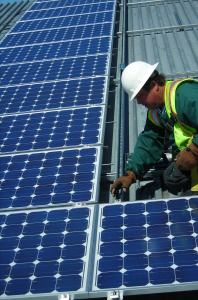
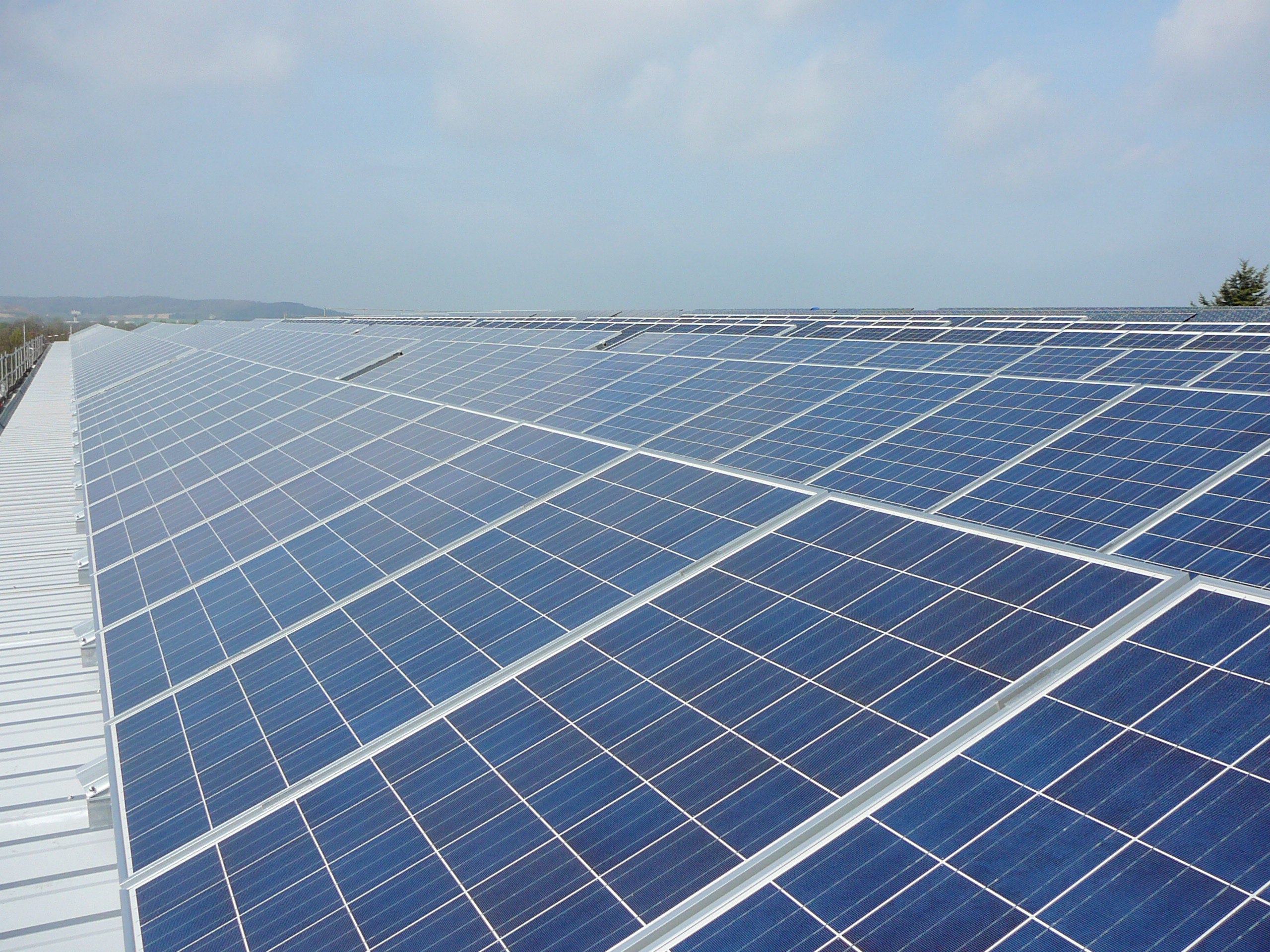
 This week’s news of an 18 megawatt solar facility to be installed at Naval Station Oceana in Newport News marks the latest in a string of announcements of new solar projects to be built in Virginia. The Commonwealth had only about 22 megawatts of solar installed as of the end of 2015, but by the end of this year, we should be comfortably into the triple digits. That’s still trivial compared to neighboring North Carolina, which added over 1,000 megawatts last year alone, but it’s grounds for celebration here in the “dark state.”
How is this happening? Customer demand, coupled with falling costs, finally wrought a change of attitude at Dominion Virginia Power. The state’s largest utility dragged its feet on solar for years until announcing, in early 2015, plans to spend $700 million on 400 megawatts of solar power in Virginia by 2020.
The welcome change comes with a caveat: while these new projects will supply solar to important and influential customers like Microsoft, Amazon, and even the state government itself, Dominion offers no programs to supply solar to ordinary Virginians. And indeed, even where ratepayers are footing the bill for projects, our regulators insist that the renewable energy certificates—the right to say it’s solar power—should be sold to someone else.
Dominion’s early adventures in solar were not altogether encouraging. In 2012 the General Assembly authorized the utility to “study” solar by building up to 30 megawatts of distributed (mostly rooftop) projects. The SCC approved $80 million for the “Solar Partnership Program” the following year, with the stipulation that Dominion should sell the renewable energy certificates to reduce the cost to ratepayers. A steep learning curve made for slow and expensive going, and while a number of schools, universities and commercial businesses signed up to host projects, they weren’t permitted to purchase the solar energy being produced right on their property.
In 2013, Dominion created a special tariff “Schedule RG” especially to allow commercial customers to buy renewable energy. Cumbersome, limited and expensive, it never attracted any takers. Dominion spokesman David Botkins suggested to reporters last May the problem was Dominion’s low rates. As in, who wants renewable energy when dirty power is so cheap?
That was one month before Amazon Web Services announced it had contracted for the output of an 80 megawatt solar farm to be built in Accomack County. The project sidestepped Dominion’s limitations by feeding power directly into the Delmarva Power grid in Maryland. Dominion promptly bought the project.
Schedule RG was clearly a failure, but just as clearly, there was money to be made on solar. Dominion just needed to figure out how.
The utility was already trying. In January of 2015 Dominion proposed to build a 20 megawatt solar farm near Remington, Virginia. The State Corporation Commission (SCC) originally rejected Dominion’s proposal, saying the company had not considered third-party alternatives that might be cheaper for ratepayers. (They were proved right when it turned out the Amazon project was slated to deliver power at a cost that was 25% less.)
Dominion didn’t give up on Remington, nor was it willing to turn the project over to a private developer. Instead, it got to work rejiggering the deal into what, this spring, became a public-private partnership. Governor McAuliffe arranged to have the state government, rather than ratepayers, buy the power output from Dominion, while Microsoft agreed to buy the renewable energy certificates (RECs) to meet its corporate commitment to buying renewable energy. (In every solar deal, watch what happens to the RECs.*)
Although I wondered at the time if the state might be taking a financial hit to make the deal work, more recent information suggests the opposite. According to Dominion’s website, “the construction and deployment of this solar asset will lower the cost of the energy purchased by the Commonwealth. The Commonwealth is projected to save $500,000 to $1M in energy costs over the lifetime of the project.”
This tells us two things: one, obviously, we should sell more solar to Microsoft. And two, either the website omits key details about the financing, or the cost of energy produced by solar panels is now pretty darn competitive.
The projects have started coming in more quickly in recent months. In February of this year, Dominion announced it would buy the output of a 20 megawatt solar farm in Chesapeake through a power purchase agreement (PPA) with a North Carolina developer. Other PPAs are said to be under consideration.
Then, on June 30, the SCC gave Dominion approval to move forward on building three new projects totaling 56 megawatts in Powhatan, Louisa, and Isle of Wight counties. The 800 local jobs associated with the projects sparked news stories across the state.
That brings us to this week’s announcement of the deal with the Commonwealth and the Department of the Navy at Oceana. According to Dominion’s press release, Dominion Virginia Power will own and operate the facility, and the Commonwealth will buy the electricity, with Dominion retiring the RECs on the Commonwealth’s behalf.
Deputy Secretary of Commerce Hayes Framme confirmed to me this deal is the first step toward satisfying Governor McAuliffe’s commitment to having the state government get 8% of its power from solar by the time he leaves office, an amount equal to roughly 110 megawatts. That should mean there will be more announcements to come.
The Navy’s role here is especially interesting. Although some news outlets reported the Navy would buy the electricity, this appears to be a misreading of the Navy’s press release. Naval Station Oceana will instead receive “in-kind consideration in the form of electrical infrastructure upgrades” for hosting the project on its land. But the press release dwells mainly on the benefit to the regional grid that serves the naval station:
“Renewable energy projects, like the one at NAS Oceana and others throughout the Mid-Atlantic Region, are win-win-win collaborations. They’re good for the utility companies, good for our installations and good for the communities surrounding our installations,” said Rear Adm. Jack Scorby, Jr., commander, Navy Region Mid-Atlantic. “These projects increase the energy security, energy diversity and energy resiliency of our bases. Energy security, or having assured access to reliable supplies of energy and the ability to protect and deliver sufficient energy to meet mission-essential requirements, is critical to our installations’ roles to support the Fleet.”
The reference to “energy security, energy diversity and energy resiliency” is key here. The Navy will benefit from having a large renewable generation source onsite, one that can be protected from attack and that is not susceptible to fuel supply disruptions.
Come to think of it, “energy security, energy diversity and energy resiliency” are three of the prime reasons we need more solar projects all across the state, and why the benefits shouldn’t be limited to large, influential customers. So yay, Dominion, for getting rolling on all these solar projects! Now please stop blocking the way for the rest of us.
*RECs were invented as a way to identify units of electricity generated by wind, solar and other sources, since the electrons themselves can’t be dyed green. But RECs don’t have to just follow electrons around; they can also be bought and sold separately from the underlying electricity. When the RECs associated with a solar project are sold separately (in the case of the Remington solar project, to Microsoft), the electricity loses its green quality, and the buyer (in this case, the Commonwealth) can’t claim to be buying solar energy. For a fuller explanation of RECs, see this earlier post on the subject.
 Power for the People VA