Unknown's avatar

Utility efforts to undermine rooftop solar meet stiff opposition from Virginia customers

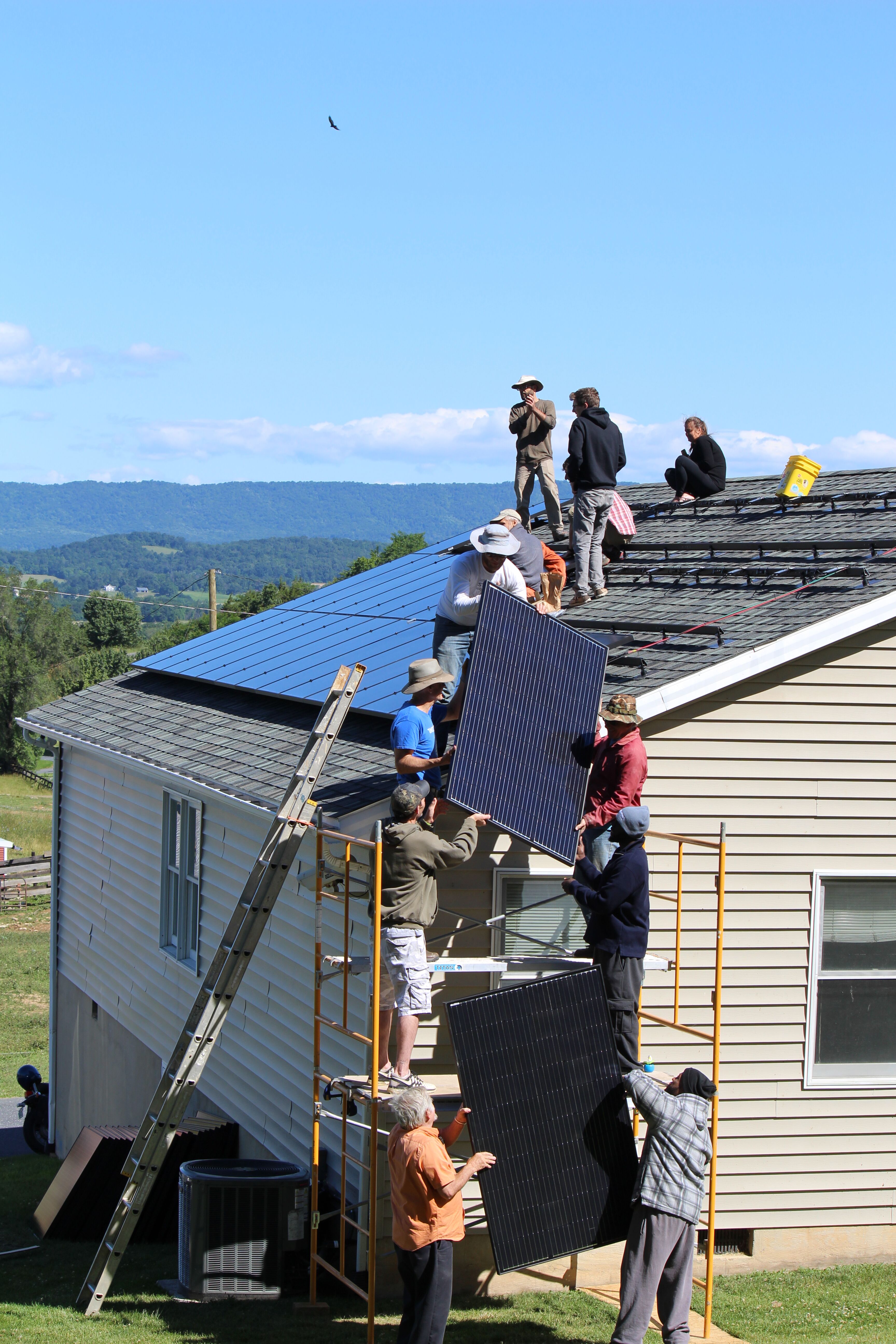
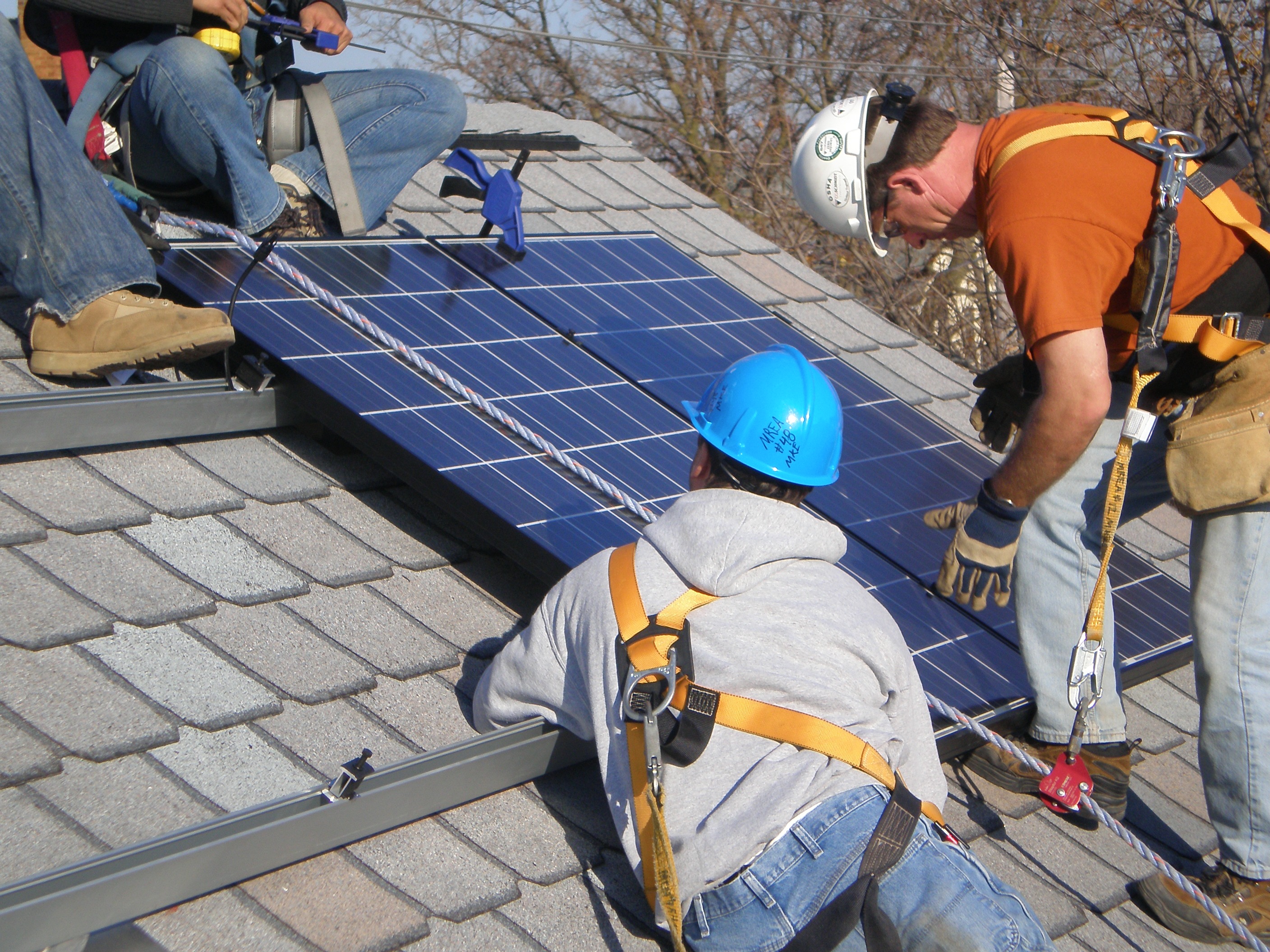
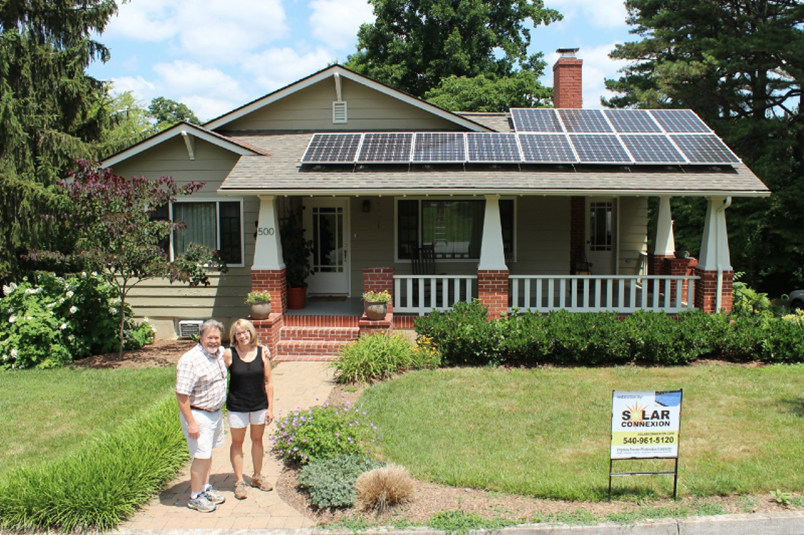
Photo courtesy of Solarize Blacksburg

Virginia’s investor-owned utilities thought 2025 would be the year they put an end to net metering – and with it, rooftop solar installers’ modest competition with their monopoly.. The 2020 Virginia Clean Economy Act (VCEA) removed many barriers that residents and businesses installing solar panels under the state’s net metering law had faced, but it also called for the State Corporation Commission to reevaluate the program, beginning right about now. 

 Not surprisingly, Dominion Energy and Appalachian Power are seizing this opportunity to push for changes that would undermine the economic calculus supporting customer-owned solar.  

Since at least 2007, Virginia law has required that customers of Dominion and APCo who have solar panels on their property be credited for surplus electricity they supply to the grid at the same retail rate they pay for electricity. The credit is applied against the cost of the electricity the customer draws from the grid at times when the panels aren’t generating, reducing what they owe on their electric bill. 

But now that they have the chance, both utilities have filed proposals to end net metering. Both essentially propose to charge new solar customers the full retail rate for the electricity they draw from the grid (with Dominion using a more complicated half-hour “netting”), but compensate them for electricity fed to the grid only at the utility’s “avoided cost,” or what it pays to buy electricity from other generators. By law, existing customers and new low-income customers with solar would be unaffected.

APCo calculates avoided cost as the wholesale cost of energy and capacity, plus transmission and ancillary services, for a total of less than 5 cents per kilowatt-hour. Thus, a homeowner with solar panels would now pay the full retail rate of about 17 cents/kWh for electricity drawn from the grid, while being credited at less than one-third that amount for electricity put back on the grid. 

Dominion’s approach instead pegs avoided cost to what it pays for solar generation and associated renewable energy certificates (RECs) bought from certain small producers under power purchase agreements, an average of about 9.5 cents/kWh. Dominion’s residential rate currently averages about 14 cents/kWh, but would go up to more than 16 cents if its latest rate increase request is granted.

The VCEA gave APCo the first swing at the piñata. APCo filed its proposal in September, and the SCC will hold an evidentiary hearing on May 20. Dominion only filed its petition last week, and no hearing date has been set yet. 

Not surprisingly, APCo’s proposal generated fierce opposition from advocates and solar installers. They point out that it’s hard enough to make the economics of home solar work with net metering at the retail rate; slashing the compensation for electricity returned to the grid by more than one-third, as Dominion proposes, or two-thirds, as APCo wants, would make solar a losing proposition for most homeowners. Maybe economies of scale and other factors would allow the market for commercial solar to survive under Dominion’s program, though Dominion’s insistence on confiscating customers’ RECs won’t make anyone happy.

If solar owners definitely lose under APCo’s plan, advocates say other ratepayers don’t necessarily win. A homeowner’s surplus generation travels only the short distance to the nearest neighbor, lessening the need for the utility to generate and transmit power to meet the neighbor’s demand. Since the utility charges that neighbor the regular retail rate for the electricity, without having to bring it from somewhere else, the utility saves on transmission costs. On top of that, the surplus solar comes in during the day, when demand is typically higher than at night and electricity is more costly, making solar more valuable to the utility. Plus, it is clean and renewable, and the customer bears all the cost and risk of the investment.

Utilities do not share this rosy view. By their way of thinking, solar customers use the grid as free energy storage and backup power, without paying their fair share of grid costs. Not only does this deprive the utility of revenue, but those grid costs now have to be spread out among the remaining customers. This, they say, creates a cost shift from solar owners to everyone else. 

More than a decade ago, Virginia took tentative steps towards resolving the dispute, with the Department of Environmental Quality setting up a stakeholder group to work towards a “value of solar” analysis. The process was never completed — the utilities walked away from the table when it appeared the results weren’t going to be what they wanted, and the group’s work product did not include numeric values or policy recommendations. 

Virginia is hardly alone in navigating these clashing narratives. 

Other states and regulators have arrived at very different conclusions as to the “correct” value of distributed solar to utilities, ratepayers, and society as a whole. States like Maryland kept net metering after a value of solar analysis concluded the benefits outweighed the costs. On the other hand, California famously ended its net metering program in 2022 when solar comprised almost 20% of electricity generated in the state and created a mid-day surplus without enough storage to absorb it; at the time, 45% of that solar was distributed. That same year, however, Florida Gov. Ron DeSantis vetoed an unpopular bill that would have phased out net metering in the state.

The experience of other states, combined with an abundance of research and analysis conducted over the years, gives the SCC a lot to work with as it considers the fate of net metering for APCo’s customers this year, and later for Dominion’s.

Countering the arguments of the utility’s hired witnesses, solar industry and environmental organizations have weighed in on the APCo docket with testimony from experts with nationwide experience. The experts pointed out a range of errors and omissions in the utility’s work product. They also presented their own benefit-cost analyses demonstrating a value for distributed solar in excess of the retail price of electricity, using tests often applied to energy efficiency and demand-response programs.

Perhaps even more significantly, SCC staff also filed an analysis that found many of the same problems with APCo’s proposal, including failures to comply with statutory requirements. The staff report did not include a quantitative analysis, but it urged the importance of considering benefits that APCo had ignored. Like the intervenors, staff recommended the commission reject APCo’s plan and retain its net metering program as it is, at least for now.  

Although the staff report would seem likely to carry weight with the commissioners, it’s never easy to predict what the SCC will do in any case before it. But in Virginia, unlike California, distributed solar makes up vanishingly little of total electric generation. Even taking the utilities’ arguments at face value, it seems foolish to upend this small but important market to remedy a perceived harm that is, at least for now, more theoretical than real. 

This article originally appeared in the Virginia Mercury on May 8, 2025.

Unknown's avatar

Will special rate classes protect Va. residents from the costs of serving data centers?

Data center between housing community and a bike path
A data center in Ashburn, Virginia. Photo by Hugh Kenny, Piedmont Environmental Council.

For the past few years, observers have been warning that the huge surge in demand for electricity to serve data centers will mean higher electricity bills. In its December 2024 report on data centers in Virginia, the Joint Legislative Audit and Review Commission (JLARC) confirmed projections that the increased demand for power and the need for new infrastructure to serve data centers would raise rates for everyone, not just the data centers. 

Right on cue, on March 31 Dominion Energy Virginia filed a request with the State Corporation Commission to increase the rates it charges to all customers. If granted, the increase would amount to an additional $10.50 on the monthly bill of an average resident. In a separate filing on the same day, Dominion asked to increase residents’ bills by another $10.92 per month to pay for higher fuel costs.  

Either out of a monumental failure to read the room, or because Dominion executives feel they might as well be hung for a sheep as a lamb, the rate filing also asks for an increase in the company’s authorized rate of return, from 9.7% currently to 10.4%.

But it’s not all bad news. Along with the rate increase request, Dominion filed a proposal to create a new rate class for large-load customers like data centers. The move coincides with enactment of new legislation requiringthe SCC to examine whether electric utilities should separate data centers into their own rate class to protect other customers, something the SCC was in fact already doing. 

And Dominion is not alone. Virginia’s other major investor-owned utility, Appalachian Power, filed a similar proposal on March 24, following onefrom Rappahannock Electric Cooperative (REC) on March 12. The proposals reflect a growing consensus that ordinary residents should not be forced to bear the cost of building new infrastructure needed only because of data centers. Moreover, if data centers close up shop before the costs of the new infrastructure are fully paid for, residents should not get stuck paying off these now-stranded assets.  

In Dominion’s case, there is good reason to worry. In the first day of testimony at the SCC regarding the company’s 2024 Integrated Resource Plan (IRP), a Dominion witness admitted that of the $7.6 billion worth of planned new transmission infrastructure listed in the IRP, residential customers will pay 55%, including for infrastructure that serves only data centers. 

It’s not immediately clear how much setting up a new rate class for data centers will change that outcome. Dominion proposes creating a new large-load class for customers using at least 25 MW at capacities of 75% or more (meaning that they have a consistently high level of electricity use, as data centers do). These customers would be subject to a number of new requirements, including posting collateral and paying for the substation equipment that supplies them. They would also have to sign 14-year contracts (including an optional 4-year ramp-up period) obligating them to pay for the greater of actual electricity use or 60% of the generation and 85% of the transmission and distribution capacity they sign up for, even if they use less.

Dominion says the proposed generation demand charge is much lower than that for transmission because transmission and distribution assets must be designed for 100% of capacity, while generation is only planned for 85% actual metered load. Based on that, though, you might think the correct demand charges would be set at 100% for transmission and 85% for generation. It’s also not clear whether 14 years is long enough to recover all the costs incurred to build new infrastructure, or whether that’s even the outcome Dominion is striving for. 

There are sure to be a lot more of these kinds of questions when the SCC takes up Dominion’s rate case. The SCC will have to evaluate Dominion’s proposed large-load tariff against a worst-case scenario: an industry-wide disruption that suddenly and dramatically reduces data center demand across the state, leaving a utility with excess generation and transmission capacity that can’t be backfilled and that other customers will be stuck paying for. 

Fortunately, Dominion’s proposal doesn’t have to be considered in isolation, since the SCC will be able to compare it to those from APCo, REC and utilities in other states. According to APCo’s filing, its new rate class would be limited to the largest new customers (those with at least 150 MW in total or 100 MW at a single site). These customers would be required to pay a minimum of 80% of contracted demand even if they use less, which the company says is a significant increase from the demand charge of 60% that applies to existing customers. (You’ll notice it’s also a lot more than the 60% demand charge Dominion is proposing for data centers.) 

APCo’s filing notes that its proposal is consistent with a data center tariff it recently agreed to in settling a case in West Virginia; in both cases, customers would have to sign 12-year contracts, following an optional ramping-up term of up to 4 years, with requirements for posting collateral and stiff exit terms. 

APCo has other experience to go on as well. Its parent company, American Electric Power (AEP), made news when its subsidiary in central Ohio proposed to charge data center customers at least 90% of contracted demand or 90% of their highest demand over the preceding 11 months, whichever is higher, and committing them to contract terms of at least 10 years, after a ramp-up period of up to four years. Data centers pushed back hard on these terms, and the Ohio Public Utilities Commission is considering different settlement proposals with somewhat lower demand charges. 

REC’s filing takes an entirely different approach. REC is the largest of Virginia’s co-ops, serving a territory that stretches from Frederick County in northwest Virginia down through Spotsylvania and as far east as King William County. As data center development pushes outward from Northern Virginia, REC finds itself overwhelmed with new demand. It now expects up to 17 gigawatts of data center demand by 2040, up from near zero in 2023, dwarfing all other customers’ loads.  

Like other utilities, electric cooperatives have an obligation to serve all comers in their territory, so if a new data center moves in, they have to provide the power. But unlike Dominion and other investor-owned utilities, co-ops are customer-owned nonprofits. They are highly motivated to protect their existing customers from the costs – and risks – involved in serving new ones. 

REC is a distribution cooperative only, with no generation of its own. Today, REC gets all its electricity from Old Dominion Electric Cooperative (ODEC), a sort of umbrella organization that owns generating plants and supplements those with power purchased on the PJM wholesale market. But when ODEC learned how much new data center load REC was expecting, it told REC to look elsewhere for the power. 

REC’s solution is to silo off big data centers and other customers with more than 25 megawatts in demand, and keep all the costs and risks involved within that space. According to the proposal the co-op filed with the SCC, data centers that want to get power from REC will have to post collateral, contribute to the cost of new infrastructure and sign two agreements, one for the power supply and one for its delivery. REC (or an affiliate it plans to create for this purpose) will buy electricity from PJM on the open market and pass through the cost. Alternatively, the data centers will be able to buy electricity from competitive service providers, allowing them, for example, to procure renewable energy.  

REC’s proposed delivery contract is similarly designed to ensure the data centers pay all the grid costs the utility will incur in serving them. In addition to contributing to the cost of new infrastructure, data centers will have to sign contracts with terms that must “be structured to recover the full cost of distribution and/or sub-transmission plant investment, maintenance and operation.” This includes payment of a demand charge that isn’t specified but appears to be as high as 100% of peak demand – meaning, there would be no risk that these grid costs would end up on the tab of residents and other customers outside the class.

REC’s approach might be seen as a sort of gold standard for protecting other ratepayers from the costs and risks involved in providing energy to data centers. It’s not a perfect antidote for rate increases, because the tight supply of generating capacity within PJM is already pushing up costs of electricity even for existing customers. And buying electricity on the open market may cost data center customers more than buying it from a utility that owns its own generation, as Dominion and APCo do. But that isn’t a concern that will keep REC’s other customers up at night. 

The very different approaches proposed by REC, on the one hand, and Dominion and APCo, on the other, reflect the difference between a nonprofit distribution cooperative and investor-owned utilities that build and own generation. Building stuff is how investor-owned utilities earn a profit. The bigger their customer base and the more electricity those customers demand, the more the profit. The data center industry looks to them like a big, fat golden goose. 

It isn’t surprising, then, that neither Dominion nor APCo are proposing solutions that put all the risks involved with serving data centers onto the industry, the way REC’s proposal does. As a new Harvard Law School reportdetails, the utility profit motive and the political muscle of Big Tech inevitably lead to a cost shift onto other customers.  

Maybe there is something different about data centers in Virginia that justifies involving ordinary residential customers in this risk. Dominion will surely make that pitch when the SCC takes up the case. 

It will be interesting to observe, but color me skeptical.

Originally published on April 25, 2025 in the Virginia Mercury.

Unknown's avatar

Will Virginia’s residential solar market survive the coming year?

Installation of solar panels on the roof of a house.
Virginia utilities finally have an opportunity to attack net metering. Photo by Don Crawford.

When the Virginia Clean Economy Act became law in 2020, solar advocates celebrated. In addition to creating a framework for a transition to a zero carbon electricity sector by 2050, the VCEA and sister legislation known as Solar Freedom swept away multiple barriers to installing solar in Virginia. Among the new provisions were some that strengthened net metering, the program that allows residents, businesses and local governments who install solar onsite to be credited for excess electricity they feed back to the grid. 

Currently, the law requires that customers of Dominion Energy and Appalachian Power be credited for the electricity they supply to the grid at the full retail rate for electricity. The credit is applied against the cost of the electricity they draw from the grid at night. The policy makes solar affordable and supports small businesses across Virginia. 

However, the VCEA came with a ticking time bomb. It provided that in 2024 for Appalachian Power, and 2025 for Dominion, the State Corporation Commission would hold proceedings to determine the fate of net metering, and in particular the terms for compensating new net metering customers. 

Well, it’s 2024, and the bomb just went off. On May 6, the SCC issued an order directing the two utilities to file their suggested changes. Appalachian’s proposal is due by September 2; Dominion’s is due by May 1, 2025. The SCC will establish a schedule for each case that will include provisions for the public and interested parties to participate.

There are two important protections to note. First, low-income customers will have their choice of installing solar under either the existing rules or the new ones. Second, customers who install solar panels and interconnect to the grid before the SCC issues its final order will continue to be covered by the existing provisions for retail net metering. 

For anyone who’s been on the fence about installing solar, I can’t overstate the urgency of acting now. Nonprofits Solar United Neighbors and Solarize Virginia can help you get the best deal. Also check out the excellent advice and sample quotes from HR Climate Hub.

Make no mistake, utilities hate net metering and will destroy it if they can. The more customers who install solar, the less control the utility can exercise over them — and, even more critically, the less money the company makes for its shareholders from building new generation and transmission. 

That’s not what our utilities tell legislators and the SCC, though. Instead, they promote a narrative that net metering customers impose extra costs on other ratepayers, creating a “cost shift.” The idea is that residents who go solar are making everyone else pay more of the costs of the grid while they themselves rake in money with their free electricity from the sun.  

This argument has raged across the country for years. Utilities often argue that solar customers should be paid for their surplus electricity only the amount of money the utility would otherwise have had to spend to generate or buy that same amount of electricity from somewhere else. This “avoided cost” can be less than one-third of the retail rate for residential electricity. (The net metering changes would also affect commercial and non-profit properties, which pay a lower rate than residential – but still well above avoided cost.)

With a payback period of nine to 15 years in Virginia, residential solar is a reasonable investment with retail rate net metering, but it’s hardly a get-rich-quick scheme. Brandon Praileau, the Virginia program director for Solar United Neighbors, said in an email that lowering the net metering rate would eliminate the energy savings that homeowners see from solar today. 

“It is the full retail 1:1 value of solar that allows solar to not be a boutique purchase that only fits a certain demographic but something that every homeowner can benefit from,” he noted. 

Praileau added that the loss of net metering would also hit Virginia’s solar installers hard and lead to job losses, something I confirmed with industry members. Russ Edwards, president of Charlottesville-based Tiger Solar, says any devaluation of solar would have a “significantly adverse” impact on local companies like his that serve the residential market.

But the “cost shift” argument doesn’t actually depend on whether rooftop solar is affordable for customers or profitable for installers. The way utilities think about net metering, a homeowner could even lose money on solar and still be guilty of shifting the costs of maintaining the grid onto other customers.

Net metering supporters counter that rooftop solar provides valuable benefits to the grid and to other customers that the utilities overlook, like relieving grid congestion and lessening the need for utility investments in new generation and transmission. Solar also has larger societal benefits like increased energy security, local resilience, clean air and carbon reduction.

Over the years this dispute has spawned literally dozens of studies estimating the value of solar. A Michigan study found that rather than being subsidized by other ratepayers, residents who install solar actually subsidize their non-solar-owning neighbors. Closer to home, a Maryland study also concluded that distributed solar provided a value greater than the retail cost of energy. 

But every state is different. California’s public utility commission recently slashed the net metering rate all the way down to a so-called avoided cost, in part because the huge growth of solar in the state has led to a power glut in the middle of the day. The residential solar market cratered as a result of the PUC’s action, with an estimated 17,000 jobs lost in the solar industry.  

Virginia does not have California’s problem. With only about 6.5% of our electricity generated by solar and the world’s largest energy storage facility in the form of Bath County’s pumped hydro plant, rooftop solar still helps Virginia utilities meet peak demand. We also face a skyrocketing demand for electricity from data centers, which militates in favor of all the clean energy we can generate. 

Ten years ago, Virginia set out to do a study on the value of solar, led by the Department of Environmental Quality. Unfortunately, our utilities pulled out when they didn’t like what they were seeing, so the study never progressed beyond a framing of the issues. 

Since then, Dominion and APCo have often repeated the “cost shift” narrative but have never backed it up with evidence. Their efforts have had some effect with legislators, most recently with passage of a bill instructing the SCC to “make all reasonable efforts to ensure that the net energy metering program does not result in unreasonable cost-shifting to nonparticipating electric utility customers.”

But of course, that simply begs the question of whether a cost shift is actually occurring. Under the VCEA, the SCC will now have to “evaluate and establish” the amount a net metering customer should pay for “the cost of using the utility’s infrastructure,” and the amount the utility should compensate the customer for the “total benefits” the customer’s solar panels provide. The SCC is also instructed to evaluate and establish the “direct and indirect economic impact of net metering” and consider “any other information the Commission deems relevant.” 

Presumably, this other information should include the state’s energy policy. The policy specifically supports distributed solar, including “enhancing the ability of private property owners to generate their own renewable energy for their own personal use from renewable energy sources on their property.” 

The SCC will now have to navigate these opposing positions in what are certain to be contentious proceedings. Meanwhile, residents and businesses would be well advised to get their solar panels up this year.

This article was originally published in the Virginia Mercury on May 21, 2024.

Unknown's avatar

Is your electricity bill keeping you in the dark?

A seemingly simple question came across my desk a few weeks ago: What does Dominion Energy Virginia charge residents per kilowatt-hour (kWh)? Given how frequently I write about Dominion, I was embarrassed not to have a quick answer. In my own defense, though, Dominion makes it hard to find out. And when you do find out, the answer is, it depends. 

Examine a recent bill, and you will see the number of kilowatt-hours you used in the preceding month, a confusing list of charges and the dollar amount that you owe. You can do the math to figure out what you paid this month per kilowatt-hour, but that’s more of a snapshot than the whole picture.

 A Fairfax resident’s Mar. 6, 2023 Dominion Energy electricity bill. (Ivy Main/The Virginia Mercury)

I asked colleagues to send me their utility bills to see what people were actually paying, and I got out my calculator. Everyone’s rate was different, and the more electricity they used, the less they paid per kWh. Even after I removed state and local taxes from the equation, rates ranged from a low of 12.2 cents per kWh for a home that used 2930 kWh in February, to a high of 17.3 cents for a home that, thanks to solar panels, drew just 179 kWh from the grid in the same time period. 

As that solar home shows, the flat rate of the basic customer charge skews the average price higher. That basic charge is currently $6.58 per month, according to Dominion’s residential rate schedule, but you won’t see it on your bill. 

The rate schedule reveals other information your bill doesn’t tell you, and that’s where the real impact lies: you pay less per kWh, in both generation and distribution charges, for the electricity you use in excess of 800 kilowatts per month from October through May. From June to September, you pay less in distribution charges for every kilowatt over 800, but more in generation charges.

You’re also charged a single rate year-round for transmission, which is different from distribution. Plus, every kilowatt-hour is subject to a list of riders – “charges applied to certain rate schedules to recover various costs associated with Dominion Energy’s electric operations and electricity production,” according to Dominion – and non-bypassable charges. The rate schedule doesn’t identify these charges, but the bill does, albeit with no explanation for how the amounts are determined. Your bill also lists fuel as a separate charge under Electricity Supply, though fuel does not appear in the rate schedule. 

Still with me? No? All of this must make sense to the State Corporation Commission, which approved the rate schedule, but it is thoroughly opaque to customers. 

The sufficiently dogged can find a worksheet on Dominion’s website that breaks out all these costs. If you plug in the month and a number of kWh you used, it will calculate a bill. You still need to do the math yourself to arrive at the price per kWh, but you can then play with numbers to see how usage affects rates. 

Doing that confirms what I saw in my colleagues’ bills. Assuming 1,000 kWh, the number Dominion uses to represent the “typical” customer, the price works out to 14 cents in winter.  Change that to a frugal 500 kWh and you get 15 cents. Raise it to 2,000 kWh, and it goes down to about 13 cents. 

When challenged about this in the past, Dominion justified its buy-more, pay-less winter rate structure by arguing it was needed to make bills affordable for customers with electric heating, whose use can double or triple in the wintertime. The company didn’t mention that it also benefits wealthier people with large homes, and decreases the incentive for customers to conserve energy.

It also turns out that large homes do well in summer, too. According to the worksheet, a customer using 1,000 kWh in June would pay 14.6 cents per kWh. For 2,000 kWh, it rises slightly to 14.7 cents. The customer who uses only 500 kWh pays the highest rate, at 15 cents. Energy efficiency, alas, is not rewarded. 

So Dominion’s bills aren’t just confusing, they mask a perverse incentive in the rate structure that rewards people who use more electricity. This year’s utility legislation changes a lot of things, but it doesn’t require greater clarity in billing,  nor does it fix that upside-down incentive.

All utility bills are not equal

This perverse incentive is shared by some other Virginia utilities, though not all, and not all hide the ball the way Dominion does. Appalachian Power’s website shows it charges a single rate no matter how much you use. There’s neither a price break nor a penalty for higher consumption. The website provides two examples, for customers using 1,000 and 2,000 kWh, respectively. This makes it easy to calculate what you’re paying per kWh (about 16.5 cents), though you won’t find that number on either the website or the bills themselves. But neither the bill nor APCo’s website mentions the existence or amount of the basic customer charge, which can only be inferred from the website examples.

I also looked at February bills sent me by customers of Northern Virginia Electric Cooperative (NOVEC) and Rappahannock Electric Cooperative (REC). In both cases the bills were easy to understand. They identify the flat monthly charge, though in both cases the charge is unfortunately more than twice as high as Dominion’s. The bills also list the rates applicable per kWh for generation, transmission and distribution. Both utilities give a year-round volume discount on the distribution charge for higher levels of usage, another regrettable feature. However, REC’s SCC filing shows it imposes a higher electricity supply charge in summer for monthly usage over 800 kWh. I could not find current information about NOVEC’s rates online; I hope its customers have better access. 

Being able to understand your electric bill matters. Virginia’s average residential rates increased 20% between December 2021 and December 2022, according to the U.S. Energy Information Agency, mostly due to last year’s spike in the price of methane gas and coal. Even before last year, our bills were higher than those in most other states. 

Consumers have an array of options to help them lower their energy costs, including new federal and state programs and incentives for weatherization, energy efficient appliances and renewable energy. But customers who are confused about what they currently pay are less likely to act.

For the same reason, utility rate structures should incentivize customers to take steps that conserve energy. Lower rates for using more electricity undercut the value of investments in energy efficiency. 

If utilities want to help their customers, they can start by sending the right message.

This article was originally published in the Virginia Mercury on March 16, 2023.

Unknown's avatar

The other shoe drops: APCo follows Dominion in seeking rate increase due to high fossil fuel costs

Virginia residents who buy electricity from Appalachian Power will see a rate increase of almost 16% this year if the State Corporation Commission approves the utility’s request to recover more than $361 million it has spent on higher-than-expected coal and natural gas prices. APCo proposes to recover the excess over two years, meaning rates will remain elevated even if fossil fuel prices drop. According to the filing, a customer who uses 1,000 kWh per month would see an increase of $20.17.

The SCC is likely to approve the request because it has little room to do otherwise. Virginia law allows utilities to recover their spending on fuel dollar-for-dollar, though they cannot tack on a profit for themselves. Last month, the SCC approved Dominion’s request to increase rates by an average of nearly $15 per month for the next three years to cover past excess fuel costs. 

The good news, says APCo, is that Virginia customers will see lower bills in the future because the utility is investing in renewable energy. “Incorporating more renewable sources of power into the company’s energy mix is another step in reducing customer fuel costs,” declares the company’s press release, issued the same day as its SCC filing. “As Appalachian Power adds more renewables, there is less need for coal and natural gas to generate power.”

Well, yes, but wouldn’t it have been nice if APCo had come to this conclusion before now? The current situation was entirely predictable. A supply glut kept natural gas prices low for almost a decade, but drilling companies weren’t making money. Today’s higher prices make it profitable to drill for gas, but oil and gas companies don’t trust that the market will stay strong, so they are returning profits to shareholders rather than investing in new wells. So tight supplies may keep prices high. Or not! Nobody knows. (As for coal, natural gas generation and coal are ready substitutes for each other, so coal prices track natural gas prices.) 

For years clean energy advocates like me have been urging utilities and the SCC to value price stability in generation planning, only to be ignored. Other states took the lead in installing price-stable renewable energy, while Virginia added more gas plants. When I dug into the data this summer, it became clear that the great majority of states with lower rates than Virginia also had higher amounts of renewable energy in their generation mix. I’ve reprinted a summary table here. 

StatePrice cents/kWh% REsource of RE
Virginia12.837biomass, hydro, solar
Idaho9.8674mostly hydro
Washington10.1275mostly hydro
North Dakota10.4840mostly wind
Utah10.6615mostly solar
Montana11.0052mostly hydro
Wyoming11.0619mostly wind
Nebraska11.1128mostly wind
Oregon11.2268mostly hydro, some wind
Missouri11.5412mostly wind
Arkansas11.7510mostly hydro
Louisiana11.984biomass
South Dakota12.0382wind, hydro
Iowa12.0960almost all wind
North Carolina12.2616mostly solar and hydro
Oklahoma12.3845mostly wind
Kentucky12.637hydro

I compiled this table in July, using then-current Energy Information Agency data. Now EIA has updated its data, and Virginia’s position is worse than ever. As of July 2022, Virginia’s average residential electricity rate has now hit 14.42 cents/kWh. This puts us above every state in the South Atlantic except Georgia. (Poor Georgia comes in at 16.02, but that’s what building nuclear plants will do for your rates.) Meanwhile, the states whose rates increased the least are those with high levels of wind, solar and hydro. 

This isn’t rocket science, folks. Wind and solar have lower levelized costs than coal and gas, and they insulate consumers from the volatility of the world oil and gas markets. You don’t have to be a climate advocate to understand this, but apparently it helps.

Unknown's avatar

Your electric bills are skyrocketing. Blame our failure to invest in renewable energy.

Photo by Pixabay on Pexels.com

Fossil fuel prices are higher everywhere, and the effect is hitting electric bills as well as prices at the gas pump. 

Utilities that generate power from natural gas and coal face fuel costs two or three times as high as they were just a couple of years ago —and those costs are passed on to customers. Some utilities employ hedging strategies and long-term contracts to reduce the impact of price spikes. But as a general matter, how painful your bill increase will be is a function of how much electricity your utility generates from fossil fuels. 

Gee, don’t you wish we had more renewable energy in Virginia? 

Let’s review the problem. Dominion Energy Virginia, our largest utility, generates most of its electricity from gas and coal, with 29 percent from nuclear and a tiny percentage from solar and biomass. Our second-largest utility, Appalachian Power, derives 85 percent of its power from coal and gas and only 15 percent from renewable energy, primarily wind and hydro. 

Both utilities are investing more in renewables now, but for years they lagged other states even as wind and solar became the lowest-cost sources of energy nationwide. Because the “fuel” for wind turbines and solar panels is free, those sources generate electricity at a stable price that looks even better when coal and gas prices go up. (Nuclear reactors are fueled by uranium, so they aren’t affected by the fossil fuel crunch either; even so, most of them need subsidies to compete in the wholesale market.) 

As previously reported in the Mercury, Dominion filed a request with the State Corporation Commission in May to increase the “fuel factor” portion of its customer bills, citing the higher prices. In the past year, according to Dominion, the price of the natural gas it bought has gone up 100 percent. High gas prices cause utilities to switch to coal generation when it’s cheaper, so the price of coal also rose by 92 percent. In all, the company said it incurred more than a billion dollars more in fuel costs over the past year than it budgeted for a year ago. 

Under Virginia law, Dominion and APCo “pass through” the costs of fuel directly to customers. They don’t collect a profit, but they don’t have to swallow unexpected increases themselves. Customers will have to pay higher rates for as long as it takes Dominion to recoup the extra spending. The only question for the SCC is how quickly Dominion should collect the money.

Consumers in other states are also being hit by higher electricity bills, but the effect is uneven across the country. States that built more renewable energy protected their residents from fuel price increases. 

Data collected by the U.S. Energy Information Agency shows that with few exceptions, states with lower electricity rates than Virginia’s have more renewable energy than we do. Since the EIA data doesn’t reflect all the planned increases due to rising coal and gas prices, the disparity will become even more pronounced over the coming year. 

States in the Pacific Northwest with a lot of inexpensive hydroelectric power have especially low rates, but wind and solar are the cheapest forms of new energy. The higher fossil fuel prices go, the better wind and solar look by comparison. 

States in the Great Plains have been building wind for years because it outcompetes everything else, so their rates are low and increasingly insulated from fossil fuel volatility. South Dakota residents pay less per kilowatt-hour than Virginians do, and the state gets a whopping 83 percent of its electricity from renewable energy, primarily wind. Even North Dakota, a deep red state wedded to fossil fuels, gets more than 35 percent of its electricity from wind and another 5 percent from hydro. Its rates are already much lower than Virginia’s, and its renewable energy will cushion fuel cost increases. 

Investments in solar are also paying off. Take Utah for example, where residential rates are also far lower than Virginia’s. Utah has a coal problem, with 61 percent of its electricity from that one dirty source, and another 24 percent from natural gas. But, as EIA reports, “almost all the rest of in-state generation came from renewable energy, primarily solar power.” Moreover, “solar energy powers about 93 percent of Utah’s electric generating capacity added since 2015.” Evidently, Utah spent the past seven years working to future-proof its energy supply, while Dominion kept building more gas plants. 

Virginia’s slow start on the transition to renewable energy is the direct result of poor investment decisions by our utilities and a disgraceful myopia on the part of the State Corporation Commission. Environmental advocates pointed out for years that our over-commitment to fracked gas meant we’ve been gambling on fuel costs and undervaluing price stability. But the SCC kept approving new fossil fuel projects, and actually urged Dominion to build more gas plants.

Indeed, our situation would be even worse if the General Assembly had not passed the Virginia Clean Economy Act in 2020. The VCEA requires our utilities to transition to carbon-free electricity by 2050 and establishes wind and solar targets for Dominion and APCo to achieve by 2035. The targets are still too low to meet the climate emergency — but until the VCEA became law, Dominion was planning to build even more gas plants

Now customers have to pay for Dominion’s folly. Dominion’s filing states that if it recovers the entire $1 billion shortfall over the coming year, residential bills would have to go up by 19.8 percent. Dominion instead proposes to spread the higher charges over three years to ease the shock, making the bill increase 12.2 percent.  The effect would be further moderated this year by other adjustments the company proposes, like moving the costs of participating in the Regional Greenhouse Gas Initiative into base rates, where they can be absorbed because those rates are so inflated. (On the other hand, the SCC just granted Dominion a separate rate increase for spending to extend the life of its aging nuclear plants—an undertaking projected to cost nearly $4 billion.) 

An SCC hearing examiner heard testimony in Dominion’s rate case on July 6 and 7. A ruling is expected later this summer, and the SCC seems likely to approve the three-year plan. 

Spreading the cost of higher fuel prices out over a longer time may reduce the rate shock, but there are drawbacks to this approach. First, Dominion will charge customers the financing costs of deferring collection on the full amount, adding to the total cost burden. (What, did you think the company was offering to absorb that cost itself?) The way it works is that ratepayers will borrow money to pay off our debt to Dominion, then repay the loan with interest over the next three years. 

The second problem is that if the high cost of fossil fuel isn’t temporary, extending the recovery period will lead to even greater shocks in coming years. If prices stay high and we keep kicking the can down the road, we will pay more financing costs and pile up more debt. Where does this end?

This is not mere speculation. Dominion’s filing already projects that “fuel costs will remain elevated over the next year,” and expert witness testimony in the case notes that Dominion revised its natural gas price projections upwards after it filed its request, without updating the amount it is seeking to collect to reflect the higher projections. 

Over at Appalachian Power the situation may not be any better. APCo typically seeks its fuel factor rate increases in September of each year. Last year the utility sought a $3 average increase in residential bills to cover higher fuel costs, at a time when coal and gas prices were still well below this year’s prices. When the company files for its next fuel factor increase two months from now, the rate increase it seeks is likely to pack a much bigger punch. 

What of other Virginia utilities? Our smallest publicly-owned utility, Kentucky Utilities (Old Dominion Power, which serves five counties in southwest Virginia), is also heavily dependent on fossil fuels although now planning to build more renewables. ODP filed for a modest rate increase in February of this year, just before Russia invaded Ukraine and sent world natural gas prices to heights not seen since the start of the fracking revolution. 

Chris Whelan, vice president for communications and corporate responsibility, told me ODP is able to dampen the effect of fuel price volatility through a “flexible fuel procurement strategy that includes long-term contracts to help hedge against price swings as well as the ability to purchase fuel on the spot market when prices drop.” Still, ODP will have to seek another increase next February unless prices suddenly plummet. The utility recovers excess fuel costs (or lowers rates if fuel costs fall) on an annual basis, so customers would pay off the full amount over 12 months. 

Electric cooperatives that buy electricity from Old Dominion Electric Cooperative also face price increases due to high fossil fuel prices and a paucity of renewables. ODEC’s 2021 energy profile shows it generates 38 percent of its electricity from gas, 14 percent from nuclear, and 4 percent from coal. It purchases the rest from the wholesale market (38 percent) and from renewable energy projects (6 percent). Electricity sold on the PJM wholesale market is generated mainly by natural gas, nuclear and coal, so wholesale market prices are also higher now.

According to Kirk Johnson, ODEC’s senior vice president for member engagement, ODEC has had to raise energy prices twice since the beginning of the year, effective May 1 and July 1. Assuming individual distribution cooperatives passed those costs through immediately, residential co-op customers will have seen a 16 percent increase in their electricity rates since Jan. 1. That’s a really steep increase, but Johnson notes ODEC will collect the full amount of the excess cost by Jan. 1, 2023. 

ODEC’s increase for six months is almost four percentage points lower than the increase Dominion would impose for 12 months if it were to collect its full $1 billion in the shortest time possible. Johnson said ODEC engages in a hedging strategy that acts like an insurance policy to limit the effect of fuel price volatility, and that this strategy has saved their ratepayers hundreds of millions of dollars.

So hedging and long-term contracts can smooth out fossil fuel volatility, but rates are going up everywhere in Virginia. The lesson is clear enough: “cheap” fracked gas was a bad bargain. Our utilities should have been building wind and solar over the last several years to protect us from fossil fuel price volatility, rather than waiting for the General Assembly to force them to act. 

Going forward, the more we invest in wind and solar, the more price stability we will have in our electricity rates, and the less we will have to worry about high fossil fuel prices in the future.  

This article originally appeared in the Virginia Mercury on July 18, 2022. I’ve corrected information for Utah.

*EIA’s webpage lists each state’s average residential price of electricity per kilowatt-hour, but finding the fuel mix for each state requires looking up each one separately. For those of you who like to dive into these details, I’ve assembled the information for you. Note that most of EIA’s data is for 2021, but some state data is for 2020. Unfortunately this includes Virginia.

StatePrice cents/kWh% REsource of RE
Virginia12.837biomass, hydro, solar
Idaho9.8674mostly hydro
Washington10.1275mostly hydro
North Dakota10.4840mostly wind
Utah10.6615mostly solar
Montana11.0052mostly hydro
Wyoming11.0619mostly wind
Nebraska11.1128mostly wind
Oregon11.2268mostly hydro, some wind
Missouri11.5412mostly wind
Arkansas11.7510mostly hydro
Louisiana11.984biomass
South Dakota12.0382wind, hydro
Iowa12.0960almost all wind
North Carolina12.2616mostly solar and hydro
Oklahoma12.3845mostly wind
Kentucky12.637hydro

Dear readers: Many of you know that although I write independently of any organization, I also volunteer for the Sierra Club and serve on its legislative committee. The Sierra Club’s Virginia Chapter urgently needs funds to support its legislative and political work towards a clean energy transition. So this summer I’m passing the hat and asking you to make a donation to our “Ten Wild Weekends” fundraising campaign. Thanks!

Unknown's avatar

West Virginia wants to raise Virginia power bills

photo of mountain scraped of soil for coal mining
Under the West Virginia order, customers will pay more to support the state’s coal industry. Sierra Club photo.

Most people are aware by now that inflation has hit the energy sector hard, with fossil fuels in particular skyrocketing in price over the past year. 

Dominion Energy Virginia, the state’s dominant utility, says it needs to charge residential customers an extra $14.93 per month on average to cover higher natural gas prices. Appalachian Power, which serves Southwest Virginia as well as West Virginia, has already asked the West Virginia Public Service Commission for permission to increase residential bills by an average of $18.41 to cover higher coal and gas prices, and is likely to seek a similar increase from Virginia customers this summer.  

But for residents of Southwest Virginia, that could be just the beginning of the rate increases: West Virginia wants to force APCo customers to pay even more, and not just in West Virginia. If the West Virginia PSC has its way, Virginia customers would have to shoulder their “share” of the cost of propping up two money-losing West Virginia coal plants. 

The PSC’s order of May 13 reiterates previous instructions to APCo to keep its West Virginia coal plants running at least 69 percent of the time, even when the plants lose money. This decision comes on top of a decision in October of 2021 allowing APCo to charge customers for hundreds of millions of dollars in costs to prolong the life of these coal plants out to 2040. An expert hired by the Sierra Club found it would cost up to $1.1 billion more to keep the plants operating until 2040 instead of retiring them in 2028. 

For Virginia customers, the problem is that these West Virginia coal plants, Amos and Mountaineer, also provide electricity to Southwest Virginia, so Southwest Virginia residents have to pay for them. Even before the fuel price spikes of the past year and a half, APCo wanted to charge its Virginia customers for the upgrades approved by the West Virginia PSC. The company will certainly also want Virginians to pay for the even higher costs that will follow from the 69 percent run requirement.

Virginia’s State Corporation Commission has so far held off on approving the millions of dollars that would be Virginia’s share of the costs to upgrade Amos and Mountaineer. But with the West Virginia PSC plowing ahead to support its state’s favored industry, it’s not at all clear the SCC will stand its ground. 

APCo’s study claims that closing Amos and Mountaineer will cost ratepayers more than keeping them open, ensuring there will be a battle of the experts come the September hearing. The study is opaque in its methodology and reasoning. But APCo almost certainly didn’t assume the plants would have to run 69 percent of the time regardless of market conditions, and it probably also didn’t factor in today’s sky-high fossil fuel costs that further support retiring the coal plants and investing in cheaper, price-stable wind and solar.

Obviously, the biggest losers here are West Virginia residents. They will bear the largest share of these costs, one more price of living in a state run by fossil fuel oligarchs.

In an alternate universe, West Virginia would have developed an economy that took advantage of its extraordinary natural beauty, one based on small farms, four-season tourism, artist enclaves and vacation homes: think Vermont but with better weather. Instead, fossil fuel and mining barons bought up mineral rights, paid off politicians, and despoiled vast swaths of the state, leaving most residents dependent on dirty jobs or piecing together a living from low-wage work. 

I’m rooting for West Virginia to change course for a post-coal world, but that’s not easy for a state where politicians, bureaucrats and industry conspire to maintain the power of extraction industries. Virginians, however, shouldn’t be forced to enable this misuse of power. The SCC should reject West Virginia’s effort to make Virginia customers pay to prop up West Virginia coal.

This article originally appeared in the Virginia Mercury on June 10, 2022.

Dear readers: Many of you know that although I write independently of any organization, I also volunteer for the Sierra Club and serve on its legislative committee. The Sierra Club’s Virginia Chapter urgently needs funds to support its legislative and political work towards a clean energy transition. So this summer I’m passing the hat and asking you to make a donation to our “Ten Wild Weekends” fundraising campaign. Thanks!

Unknown's avatar

Why most ‘renewable energy’ options don’t add new wind and solar to the grid

bucket of green paint with spill
Photo credit: Neep at the English Language Wikipedia.

Virginia residents who want to do right by the planet are confronted with a bewildering array of renewable energy and “green power” options. Unfortunately, few of these programs actually deliver renewable energy. People who want the gold standard — electricity from new wind and solar projects — are completely out of luck if their utility is Dominion Energy Virginia or Appalachian Power. 

To understand how there can be so many options and none of them good, we first have to talk about renewable energy certificates.  RECs are a topic that is way more interesting than it sounds because — well, it would have to be, wouldn’t it? RECs are how we know that some electricity can be attributed to a renewable source. If you want to know what kind of renewable energy your utility is buying, or if you yourself want to buy renewable energy, RECs matter.

RECs are not electricity; they aren’t even real certificates. They were conceived of as an accounting tool enabling a utility to show it is in compliance with a state mandate to include a percentage of renewable energy in its mix. A utility amasses RECs associated with its own renewable generating sources, or buys them from renewable sources it doesn’t own, and then “retires” them to show compliance with the law. Since RECs are separate from the electricity itself, they can be bought and sold independently. There is even an online marketplace for your REC shopping convenience. 

RECs are also how voluntary buyers of renewable energy, like customers of Arcadia or Dominion’s Green Power Program, know they’re actually getting what they pay for —assuming they understand that what they pay for is not actually energy, and may have no relationship to the electricity powering their home or business. If you buy RECs, you are still using whatever electricity your utility provides, but you are also paying a premium on top of your regular bill. 

There is no nationwide, generally accepted definition of “renewable energy,” just as there is no definition of “natural” in food labeling. In Virginia, there is a state law defining what counts as renewable, and it includes not just solar, wind and hydro, but also a range of burnable fuels like biomass and municipal solid waste that foul the air and contribute to climate change. Buyer beware!  

The Virginia Clean Economy Act narrowed the list of sources that Dominion and APCo can use to meet the law’s new renewable portfolio standard, and also limited the locations of qualifying facilities. After 2025, happily, most of the RECs retired by Dominion and APCo under the VCEA will come from Virginia wind and solar facilities. 

But crucially, the VCEA didn’t change the definition of renewable energy in the code. Dominion won’t be able to use RECs from its biomass plants to meet the VCEA, but it can still sell them to anyone else and label the product “renewable” without falling afoul of the law. Anyone buying a renewable energy product from Dominion had better check the list of ingredients. 

It’s not just Dominion. Anyone buying RECs from Arcadia or anywhere else should take a good look at what they are getting, and ask themselves if the money they spend means new renewable energy will be added to the grid. 

The answer is probably no. If the RECs come from a wind farm in Texas or Iowa, the electricity from those turbines doesn’t feed into the grid that serves Virginia, so you can’t even pretend it is powering your house. It also doesn’t mean anyone built a wind farm because of REC buyers like you. Wind energy is already the cheapest form of new energy in the central part of the U.S. People build wind farms because they are profitable, not because they can sell RECs. In fact, those wind farms are swimming in surplus RECs, because states in the center of the country don’t have renewable energy mandates to make their own utilities buy them.  

For that matter, a lot of RECs come from facilities that were built before the idea of RECs even existed. Hundred-year-old hydroelectric dams can sell RECs; so can fifty-year-old paper mills that sell biomass RECs from burning wood. 

With this background, let’s look at the offerings available in Virginia and see which are worth paying more for. 

Dominion Energy Virginia

In theory, Dominion customers will have the ability to buy real solar energy directly from independent providers beginning as early as 2023, thanks to shared solar legislation sponsored by Sen. Scott Surovell and Del. Jay Jones and passed in 2020. The law envisions independent solar developers building solar facilities in Virginia and selling the electricity (and the RECs) to subscribers who are Dominion customers. But the SCC opened a Pandora’s box last fall by allowing Dominion to propose the rules, and in an act of classic Dominion overreach, the utility has now proposed to collect an average of $75 a month as a “minimum bill” from every customer who buys solar energy from someone else. A fee like that would end the program before it ever started.

 The matter is hardly settled. The solar industry has asked for an evidentiary hearing and suggested that the minimum bill should be set at a single dollar. If all else fails, the program may go forward serving only low-income customers, whom the legislation exempts from the minimum bill. 

Dominion customers can hope for the best, but any shared solar option is still at least two years away. 

In the meantime, the utility’s website lists four renewable energy options: two that sell RECs, one that sells actual energy (and retires the RECs for you) and one that doesn’t exist. 

• The REC-based Green Power Program has been around for a decade, and as of 2019 it had more than 31,000 subscribers. Dominion’s “product content label” projected that for 2020 the program would likely consist of 56 percent wind RECs, 34 percent biomass RECs, and 10 percent solar RECs. Facilities are advertised as being “in Virginia and the surrounding region,” but the fine print reveals sources as far away as Mississippi, Georgia, Missouri and Alabama, none of which are part of the PJM transmission grid that serves Virginia.  (Side note: the biomass icon is a cow, not a tree, which is misleading but charming, unless they might be burning cows, in which case it is deeply disturbing.) With the website out of date, I contacted Dominion for current content information: solar is now up to 13 percent, but, sadly, biomass still makes up 35 percent of the mix (but now it has a leaf icon!).

• REC Select. When I say “buyer beware,” I have this offering in mind. Dominion has been authorized to go Dumpster diving to buy the cheapest RECs from around the country and from any facility that meets Virginia’s overly-expansive definition of renewable energy. The website implies that so far the company is only buying wind RECs from Oklahoma and Nebraska, an indication of just how cheap those are. But under the terms of the program, the RECs could come from 50-year-old paper mills in Ohio or hundred-year-old hydroelectric dams. No educated consumer would buy this product, and both Dominion and the SCC should be ashamed of themselves for putting it out there.

• The 100% Renewable Energy Program delivers actual energy from Virginia, and retires RECs on your behalf. That’s the good news. But only a few of the solar farms are new; the rest of the energy comes from old hydro plants and, worse, from biomass plants that are so highly polluting that they don’t qualify for Virginia’s renewable energy mandate under the VCEA. The inclusion of biomass makes the program more expensive than it would be otherwise. So why include biomass when no one wants it? Because Dominion doesn’t really care if you sign up for this program. The company only offers it to close off a provision in the law that allowed customers to buy renewable energy from competitors if their own utility doesn’t offer it.

• Dominion’s website does list one attractive program under the name “community solar.” Like the shared solar program already discussed, it would deliver actual solar energy from new facilities to be built in Virginia, while retiring the RECs on your behalf. This would pass all our tests, except that it doesn’t exist. The SCC gave Dominion the green light to offer the program more than two years ago, and we’ve heard nothing since, even though the enabling legislation appears to make it mandatoryfor both Dominion and APCo. 

Appalachian Power

APCo never developed a community solar program either, and the shared solar program discussed earlier would not be available to APCO customers even if it gets off the ground. But APCo does have two renewable energy offerings. 

• For its Virginia Green Pricing program, APCo put together wind and hydro from its own facilities. That means it’s actual energy and reasonably priced, at less than half a cent per kWh. But these are existing facilities that all its customers had been paying for until APCo figured out how to segment the market and make more money, and the hydro is old. (As with Dominion’s renewable energy program, the real purpose of the new product was to close off competition.) 

• Even cheaper is Alternative Option-REC, the RECs for which “may come from a variety of resources but will likely be associated with energy from waste, solid waste and hydro facilities.” No biomass, anyway, but I still have trouble imagining who would pay extra for (literally) garbage. 

Virginia electric coops

Some electric cooperatives offer real renewable energy to customers, and a couple have community solar programs that are quite attractive.  

• Central Virginia Electric Cooperative and BARC Electric Cooperativeoffer community solar programs that not only deliver actual solar energy, but also let customers lock in a fixed price for 20-25 years. Four other coops also offer a solar energy option, and at least one other is working on it.

• Many coops also sell RECs, of mixed quality. Shenandoah Valley Electric Cooperative offers RECs generated by wind farms owned or contracted byOld Dominion Electric Cooperative, the generation cooperative that supplies power to most Virginia coops. Rappahannock Electric Cooperative, however, sells only biomass RECs.

• Bottom line: if you are a member of an electric cooperative, you may have better options than either Dominion or APCo is offering — and if you don’t, hey, you’re an owner of the coop, so make some noise!

Arcadia

 If you like RECs, you don’t have to buy them from your own utility. The folks at Arcadia have struggled for years to offer products that put new renewable energy on the grid. In states that allow community solar, Arcadia now offers wind and solar from projects in those states. Everywhere else, they just sell RECs. The website provides no information indicating where the facilities are, meaning they could be out in the same central plains states that are awash in surplus wind RECs. Their game plan appears to be for all the nice liberals with climate guilt to throw enough money at red state RECs that eventually the day will come when demand exceeds supply and drives the price up enough to incentivize new projects. The plan sounds self-defeating to me, but in any case, buyers should keep in mind that the RECs bought before that glorious date will have incentivized precisely nothing. 

Other options

Obviously, if you have a sunny roof, you can install solar onsite and net-meter. Of all the programs available today, that’s the one that will save you money instead of making you spend more. 

If you don’t have a sunny roof, but you’d still like to see your money put solar onto the grid, consider contributing to a church, school or non-profit that is going solar, or to an organization that puts solar on low-income homes. Two that operate in Virginia are Give Solar, which puts solar on Habitat for Humanity houses, and GRID Alternatives, which trains workers to install solar on low-income homes here and abroad. If everyone in Virginia who is currently buying RECs were to choose this alternative instead, it would put millions of dollars to work building new solar in Virginia, and lowering the energy bills of people who most need the help.

And that might make it the best option of all.

A version of this article first appeared in the Virginia Mercury on May 21, 2021.

Unknown's avatar

COVID-19 throws a lemon at Virginia’s plan for an energy transition. It’s time for lemonade.

solar panels on a school roof

The solar panels on Wilson Middle School are saving money for Augusta County taxpayers. Photo courtesy of Secure Futures.

In mid-March, the Virginia General Assembly passed legislation to transition our economy from fossil fuels to clean energy over the coming years. Two weeks later, Virginia shut down in response to the COVID-19 pandemic. Among the businesses whose very existence is now in peril are the energy efficiency companies and solar installers we will be counting on to get us off fossil fuels.

Home weatherization and energy efficiency programs have come to an almost complete halt in Virginia, including programs run by Dominion Energy Virginia. Nationwide, the energy efficiency sector has lost almost 70,000 jobs. Meanwhile, companies that install solar, especially rooftop systems, report plummeting sales. The Solar Energy Industries Association reports that nationally, 55 percent of solar workers are already laid off or suffering cutbacks.

The timing seems terrible — although to be fair, there’s no good time for an economy-crushing, worldwide pandemic. Eventually, however, the virus will run its course or be defeated through vaccine or cure. At that point, we will face a choice: we can stagger blinking out into the sunlight aimlessly wondering now what?, or we can execute the well-developed plan we have spent these weeks and months formulating.

Let’s go with the second option.

First, it’s worth remembering that nothing happening now will change the trajectory of clean energy. Solar and wind had banner years in 2019, continuing their steady march to dominance. Wind has become the largest single source of electricity in two states, Iowa and Kansas. The island of Kauai in Hawaii is now 56 percent powered by renewable energy, mostly solar. Across the U.S. wind, solar and hydro produce more electricity than coal. Wind is the cheapest form of new electric generation nationally; solar takes pride of place in Virginia.

Meanwhile, fossil fuel is even more firmly on its way out. Six of the top seven U.S. coal companies have gone into bankruptcy since 2015. That was before the lockdown sent energy demand down, further hurting high-priced coal.

Fracked gas helped kill coal but is itself vulnerable to price competition from renewables. Odd as it sounds, the collapse in oil prices will make natural gas more expensive. That’s because oil producers in Texas and North Dakota are closing wells that produced natural gas along with oil. The tightening supply of gas may finally make fracking companies in Appalachia profitable, but it means higher prices for utilities. Wind and solar will just keep looking better.

The Trump administration is still trying futilely to hold back the tide, but the U.S. will get a lot farther riding the wave than struggling against it. Congressional leaders should declare the country “all in” on clean energy. Instead of bailing out the highly polluting fossil fuel industries, they should put that money to work creating more jobs and economic development — and actually doing something about climate change — with energy efficiency and renewables.

Congress should return the Investment Tax Credit for solar (and offshore wind) to the 30 percent level in effect last year and keep it there, instead of continuing the phase-out now in effect. Congress should also give solar owners the option of taking the credit as a cash grant, as it did during the last recession, and for the same reason: tax-based incentives are less useful in a recession, when companies can’t use the credits.

Virginia’s Sens. Tim Kaine and Mark Warner have a critical role to play in convincing their colleagues to support solar. So far neither is rising to the task.

On the state level, Northam did the right thing in signing this year’s energy legislation, allowing utilities and industry members to start planning for the future. But the Clean Economy Act gets wind and solar off to a very slow start; Dominion doesn’t have to build Virginia solar for five years yet. And though the new laws remove many policy constraints on customer-sited solar, they offer next to nothing in the way of financial incentives.

Governor Northam should make it clear he intends to make rooftop solar a priority for next year, along with projects on closed landfills, former coal mine areas, and other brownfields, with a special focus on areas hardest-hit economically. He can also encourage corporations that do business in Virginia to meet their sustainability goals with Virginia wind and solar, starting right now.

The governor should also prioritize building efficiency. Virginia will be adopting a new residential building code this year, and if past years are any indication, its energy efficiency provisions will fall short of the most recent model code standard. It’s up to the governor to make sure Virginia adopts the full code.

Local governments are already taking advantage of suddenly-empty buildings to accelerate maintenance and repairs. But it’s a good time to think bigger, with new financing tools available that make energy efficiency retrofits and solar facilities cash-positive right from the start.

Energy performance contracting allows the energy savings to pay for retrofits. The Department of Mines, Minerals and Energy keeps a list of pre-qualified energy service companies and offers expertise to help local government employees navigate the process.

This year’s legislation also greatly expanded local governments’ ability to finance on-site solar through third-party power purchase agreements, effective July 1. The PPAs are structured so that a school district, municipality or any commercial or non-profit customer can have a solar array installed at no cost, paying just for the energy produced.

In December, Fairfax County awarded contracts for PPAs to install solar on more than a hundred sites, including schools and other government buildings. The county’s contract is “rideable,” which allows other counties and cities to piggyback, getting the same terms without the need for new contract negotiations.

Unfortunately, local governments in southwest Virginia are prevented from pursuing PPAs — not by state legislation, which allows it starting July 1, but by a contract with Appalachian Power that governs their electricity purchases from the utility. The contract is up for renewal this year; disgracefully, APCo is refusing to agree to new terms allowing the localities to use solar PPAs. APCo should back off, and let local governments in economically depressed southwest Virginia start saving money and supporting solar jobs this year.

Arlington County has gone beyond on-site solar, contracting for a share of a large solar farm in southern Virginia that will provide more than 80 percent of the electricity for county government operations. It’s a model any locality can adopt.

Virginia residents and businesses also have good reasons to focus on clean energy. The enforced down-time many people are experiencing means more time to research options, and companies are motivated to offer low prices on energy efficiency upgrades and rooftop solar.

The federal government offers more generous tax credits this year than next. Credits for residential energy efficiency equipment and a deduction for energy efficient commercial buildings expire at the end of this year.

The investment tax credit for solar (as well as for geothermal heat pumps, fuel cells and small wind turbines) stands at 26% for projects placed in operation this year, but it will drop to 22% in 2021. It falls to 10% for commercial customers and disappears altogether for residential customers in 2022. If Congress acts to raise the credit to 30%, buyers will get an even bigger boost. If it doesn’t, there will be a rush this year to get projects done by the end of the year, so customers should secure their place in line now.

Virginia nonprofits have helped hundreds of residents and businesses save money on solar and EV chargers through bulk purchasing programs. Virginia Solar United Neighbors just announced a series of virtual information sessions to promote the Arlington Solar EV Co-op. And LEAP, which closed operations temporarily due to the virus, reports it has restarted two programs, Solarize NOVA and Solarize Piedmont.

In an ideal world, the U.S. would already be well along in executing a comprehensive plan for a clean energy transition, one that includes job retraining for workers, and that resists counterproductive efforts to save the fossil fuel industry. But we can do the next best thing, and use the tools of government, the market and consumer choice to speed us in the right direction.

COVID-19 has handed all of us a big, fat lemon. Let’s make some lemonade.


A version of this article appeared originally in the Virginia Mercury on April 30, 2020.


Unknown's avatar

With a framework for Virginia’s energy transition in place, here’s what happens next

workers installing solar panels on a roof

One expected effect of the Clean Economy Act will be a boom in solar jobs across Virginia. Photo courtesy of NREL.

With Democrats in charge, Virginia passed a suite of bills that establish a sturdy framework for a transition to renewable energy in the electric sector.

At the center of this transformation are the Clean Economy Act, HB1526/SB851, and the Clean Energy and Community Flood Preparedness Act, HB981/SB1027. Other new laws direct further planning, make it easier for customers to install solar, improve the process for siting wind and solar farms, and expand financing options for energy efficiency and renewable energy.

Gov. Ralph Northam has signed some bills already, and has until April 11 to sign the others or send them back to the General Assembly with proposed amendments. Once signed, legislation takes effect on July 1.

I assume the Governor has other things on his mind right now than asking the General Assembly to tinker further with a bill like the Clean Economy Act, though bill opponents may be using the virus pandemic to argue for delay. That would be a self-defeating move; as the economy restarts, Virginia is going to need the infusion of jobs and investment that come with the build-out of clean energy. And one of the strongest arguments in support of our energy transition, after all, is that it will save money for consumers.

So what happens after July 1? How does this all work? Let’s look at the way these major pieces of legislation will change the energy landscape in Virginia.

Virginia joins RGGI, and CO2 emissions start to fall. 

Virginia’s Department of Environmental Quality has already written the regulations that call for Virginia power plants to reduce emissions by 30 percent by 2030. The mechanism for achieving this involves Virginia trading with the Regional Greenhouse Gas Initiative, a regional carbon cap and trade market.

The regulations have been on hold as the result of a budget amendment passed last year, when Republicans still ruled the General Assembly. After July 1, DEQ will be able to implement the regulations, with the commonwealth participating in carbon allowance auctions as early as the last quarter of this year or the first quarter of 2021.

In addition to joining RGGI, the Clean Energy and Community Flood Preparedness Act also allows the commonwealth to earn money from the allowance auctions. The Department of Housing and Community Development will spend 50 percent of auction proceeds on “low-income efficiency programs, including programs for eligible housing developments.”

The Department of Conservation and Recreation will get 45 percent of the auction proceeds to fund flood preparedness and climate change planning and mitigation through the Virginia Community Flood Preparedness Fund. The last 5 percent of proceeds will cover administrative costs, including those for administering the auctions.

Energy efficiency savings become mandatory, not just something to throw money at.

Two years ago, the Grid Transformation and Security Act required Dominion and Appalachian Power to propose more than a billion dollars in energy efficiency spending over 10 years, but the law didn’t say the programs had to actually be effective in lowering electricity demand.

This year that changed. For the first time, Virginia will have an energy efficiency resource standard (EERS) requiring Dominion to achieve a total of 5 percent electricity savings by 2025 (using 2019 as the baseline); APCo must achieve a total of 2 percent savings. The SCC is charged with setting new targets after 2025. At least 15 percent of the costs must go to programs benefiting low-income, elderly or disabled individuals, or veterans.

The EERS comes on top of the low-income energy efficiency spending funded by RGGI auctions.

Dominion and Appalachian Power ramp up renewables and energy storage. 

The Clean Economy Act requires Dominion to build 16,100 megawatts of onshore wind and solar energy, and APCo to build 600 megawatts. The law also contains one of the strongest energy storage mandates in the country: 2,700 MW for Dominion, 400 MW for Appalachian Power.

Beginning in 2020, Dominion and Appalachian must submit annual plans to the SCC for new wind, solar and storage resources. We’ll have a first look at Dominion’s plans just a month from now: the SCC has told the company to take account of the Clean Economy Act and other new laws when it files its 2020 Integrated Resource Plan on May 1.

The legislation provides a strangely long lead time before the utilities must request approval of specific projects: by the end of 2023 for APCo (the first 200 MW) or 2024 for Dominion (the first 3,000 MW). But the build-out then becomes rapid, and the utilities must issue requests for proposals on at least an annual basis.

In addition to the solar and land-based wind, Dominion now has the green light for up to 3,000 MW of offshore wind from the project it is developing off Virginia Beach, and which it plans to bring online beginning in 2024. All told, the Clean Economy Act proclaims up to 5,200 MW of offshore wind by 2034 to be in the public interest.

Dominion’s plans for new gas plants come to a screeching halt.

Before the 2020 legislative session, Dominion’s Integrated Resource Plan included plans for as many as 14 new gas combustion turbines to be built in pairs beginning in 2022. In December, the company announced plans to build four gas peaking units totaling nearly 1,000 MW, to come online in 2023 and 2024.

But that was then, and this is now. The Clean Economy Act prohibits the SCC from issuing a certificate of convenience and necessity for any carbon-emitting generating plant until at least January 1, 2022, when the secretaries of natural resources and commerce and trade submit a report to the General Assembly “on how to achieve 100 percent carbon-free electric energy generation by 2045 at least cost to ratepayers.”

Even with no further moratorium, Dominion will find it hard to sell the SCC on the need for new gas plants on top of all the renewable energy and energy storage mandated in the Clean Economy Act. Solar and battery storage together do the same job that a gas peaker would have done — but they are required, and the gas peaker is not. Meanwhile, the energy efficiency provisions of the act mean demand should start going down, not up.

Dominion has already signaled that it recognizes the days of new gas plants are largely over. On March 24, Dominion filed a request with the SCC to be excused from considering new fossil fuel and nuclear resources in its upcoming Integrated Resource Plan filing, arguing that “significant build-out of natural gas generation facilities is not currently viable” in light of the new legislation.

Fossil fuel and biomass plants start closing.

By 2024, the Clean Economy Act requires the closure of all Dominion or APCo-owned oil-fueled generating plants in Virginia over 500 MW and all coal units other than Dominion’s Virginia City Hybrid plant in Wise County and the Clover Station that Dominion co-owns with Old Dominion Electric Cooperative.

This mandate is less draconian than it sounds; it forces the closure of just two coal units, both at Dominion’s Chesterfield plant. Other Dominion coal plants in Virginia have already been retired or switched to using gas or biomass, and one additional coal plant in West Virginia lies beyond the reach of the legislation. Oil-fired peaking units at Yorktown and Possum Point were already slated for retirement in 2021 and 2022. APCo owns no coal or biomass plants in Virginia.

Although the exceptions might appear to swallow the rule, the truth is that coal plants are too expensive to survive much longer anyway. One indication of this is a March 24 report Dominion filed with the SCC showing its fuel generation sources for 2019: coal has now fallen to below 8 percent of generation.

By 2028, Dominion’s biomass plants must shut down, another victory for consumers. All other carbon-emitting generating units in Virginia owned by Dominion and APCo must close by 2045, including the Virginia City plant and all the gas plants.

As of 2050, no carbon allowances can be awarded to any generating units that emit carbon dioxide, including those owned by the coops and merchant generators, with an exception for units under 25 MW as well as units bigger than 25 MW (if they are owned by politically well-connected multinational paper companies with highly-paid lobbyists).

Solar on schools and other buildings becomes the new normal.

In December, Fairfax County awarded contracts for the installation of solar on up to 130 county-owned schools and other sites, one of the largest such awards in the nation. Using a financing approach called a third-party power purchase agreement (PPA), the county would get the benefits of solar without having to spend money upfront. The contracts were written to be rideable, meaning other Virginia jurisdictions could piggyback on them to achieve cost savings and lower greenhouse gas emissions.

Fairfax County’s projects, along with others across the state, hit a wall when, on Jan. 7, the SCC announced that the 50 MW program cap for PPAs in Dominion territory had been reached. But with the passage of the Clean Economy Act and Solar Freedom legislation, customers will be able to install up to 1,000 MW worth of solar PPAs in Dominion territory and 40 MW in APCo territory.

Fairfax County schools will soon join their counterparts in at least 10 other jurisdictions across the state that have already installed solar. With the PPA cap no longer a barrier, and several other barriers also removed, local governments will increasingly turn to solar to save money and shrink their carbon footprints.

Virginia agencies start working on decarbonizing the rest of the economy. 

In spite of its name, the Clean Economy Act really only tackles the electric sector, with a little spillover into home weatherization. That still leaves three-quarters of the state’s greenhouse gas emissions to be addressed in transportation, buildings, agriculture and industry. Ridding these sectors of greenhouse gas emissions requires different tools and policies.

Other legislation passed this session starts that planning process. SB94(Favola) and HB714 (Reid) establish a policy for the commonwealth to achieve net-zero emissions economy-wide by 2045 (2040 for the electric sector) and require the next Virginia Energy Plan, due in 2022, to identify actions towards achieving the goal. Depending on who the next governor is, we may see little or nothing in the way of new proposals, or we may see proposals for transportation and home electrification, deep building retrofits, net-zero homes and office buildings, carbon sequestration on farm and forest land and innovative solutions for replacing fossil fuels in industrial use.

Collateral effects will drive greenhouse gas emissions even lower.

Proposed new merchant gas plants are likely to go away. With Virginia joining RGGI and all fossil fuel generating plants required to pay for the right to spew carbon pollution, the developers of two huge new merchant gas plants proposed for Charles City County will likely take their projects to some other state, if they pursue them at all.

Neither the 1,600 MW Chickahominy Power Station and the 1,050 C4GT plant a mile away planned to sell power to Virginia utilities; their target is the regional wholesale market, which currently rewards over-building of gas plant capacity even in the absence of demand. The Chickahominy and C4GT developers sought an exemption from RGGI through legislation; the bill passed the Senate but got shot down in the House.

If the C4GT plant goes away, so too should Virginia Natural Gas’ plans for a gas pipeline and compressor stations to supply the plant, the so-called Header Improvement Project.

Other coal plants will close. Although the CEA only requires Dominion to retire two coal units at its Chesterfield Power Station, other coal plants in the state will close by the end of this decade, too. That’s because the economics are so heavily against coal these days that it was just a matter of time before their owners moved to close them.

Adding the cost of carbon allowances under RGGI will speed the process along. That includes the Clover Station, which Dominion owns in partnership with Old Dominion Electric Cooperative (ODEC), and the Virginia City Hybrid Electric plant in Wise County, Dominion’s most expensive coal plant, which should never have been built. 

The Atlantic Coast and Mountain Valley Pipelines find themselves in more trouble than ever. If I had a dollar for every time a Dominion or Mountain Valley spokesperson said, “Our customers desperately need this pipeline,” I would not be worried about the stock market right now.

The fact is that no one was ever sure who those customers might be, other than affiliates of the pipeline owners themselves—and that doesn’t exactly answer the question. With Virginia now on a path away from all fossil fuels, neither pipeline has a path to profitability inside Virginia any longer, if they ever had one.


A version of this article originally appeared in the Virginia Mercury on March 31.