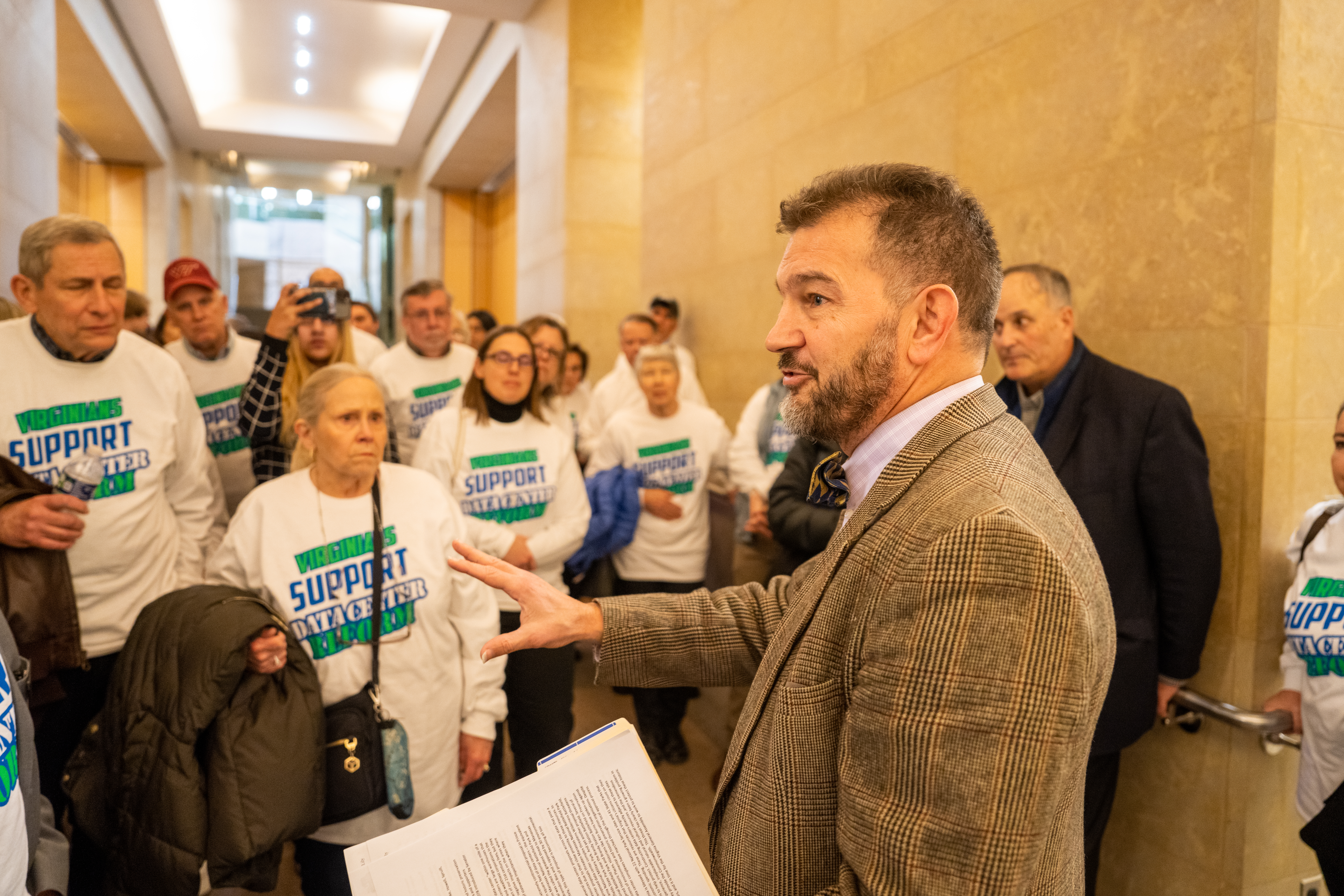
Senator Chap Petersen talks with advocates at the General Assembly on February 3. Photo courtesy of Piedmont Environmental Council
In 2019, with Northern Virginia’s data center boom well underway, I worked with the Sierra Club to provide comments to the Department of Environmental Quality (DEQ) on a proposed major source air permit for a data center.
We urged that the data center, owned by Digital Realty, be required to minimize its reliance on highly-polluting, back-up diesel generators by installing on-site solar and battery storage. While rooftop solar alone wouldn’t produce more than a fraction of the energy a data center uses, solar panels and batteries could provide a strong first line of defense against grid outages, without the air pollution.
It wasn’t a new idea; other data centers elsewhere were using clean energy and storage or installing microgrids capable of providing all of the power the facility needed. Yet DEQ rejected the suggestion and gave the go-ahead for the data center to install 139 diesel generators with no pollution controls.
Three years later, data centers have proliferated to such a degree that the power grid can’t keep up. DEQ is now proposing that more than 100 data centers in Loudoun, Prince William and Fairfax counties be given a variance from air pollution controls so they can run their diesel generators any time the transmission system is strained. DEQ is taking comments on the proposal through March 14 and will hold a hearing at its office in Woodbridge on February 27.
As a resident of Fairfax County, I’ll be one of the people forced to breathe diesel pollution to keep data centers running. Make no mistake: There would be no grid emergency without these data centers’ thousands of megawatts worth of electricity demand. And there wouldn’t be a threat to Northern Virginia’s air quality without their diesel generators.
It’s fair to ask: Should these data centers have been built if the infrastructure to deliver power to them wasn’t ready? I’d also like to know why DEQ thinks it’s okay to impose on residents the combined pollution from many thousands of diesel generators firing at once, when it has known since at least 2019 that viable, clean alternatives exist.
Batteries alone are an obvious solution for short-term emergency use, and can provide exactly the kind of help to the grid that will be needed this year. Instead of calling on data centers to run diesel generators, a grid operator can avoid the strain by tapping into a data center’s battery, a solution Google is implementing.
But data centers can economically lower their energy and water costs as well as reduce strain on the electric grid by reducing their energy use and using on-site renewable energy. Global energy management companies like Schneider Electric, Virginia AECOM and Arlington’s The Stella Group design microgrid solutions for data centers and other facilities that need 24/7 power.
I contacted Stella Group president Scott Sklar to ask how feasible it is for Northern Virginia’s data centers to meet their needs without diesel generators, given land constraints that limit their ability to meet demand with on-site solar. He told me data centers can start by reducing their cooling load by two-thirds by using efficiency and waste heat; cooling, he says, accounts for 38% to 47% of electricity demand. Cost-effective energy efficiency can reduce energy demand by one-third, and waste-heat-to-electricity can meet another 25% to 38% of the remaining electric load. “If you cut the cooling load and use waste heat to electricity, then you only need renewable energy and batteries for a maximum of half,” he concluded. “That’s doable.”
If Virginia data centers don’t start taking these kinds of measures, the situation will get worse. This year’s grid strain may be relieved through construction of new generation and transmission infrastructure, but the industry’s staggering growth rate threatens to create future problems. In 2019, when the Sierra Club was urging DEQ to think about the environmental impact of data centers, the industry consumed 12% of Dominion Virginia Energy’s total electric supply. Today, that number has risen to 21%, a figure that does not include the many data centers served by electric cooperatives rather than Dominion.
Just last month, Gov. Youngkin announced that Amazon Web Services will invest $35 billion in new data centers in Virginia, at least doubling Amazon’s existing investments here. By way of thanks, Youngkin wants taxpayers to provide up to $140 million in grant funding to Amazon and extend Virginia’s already-generous tax subsidy program. Ratepayers would also subsidize the build-out by contributing to the cost of new generation and transmission.
Amazon claims to lead the list of tech companies buying renewable energy, though its investments are mostly in other states and abroad. A scathing report in 2019 showed Amazon owned the majority of the data centers in Virginia at that time, but had made few investments in renewable energy here. Since then, Amazon has developed new solar facilities statewide, including enough to power its new Arlington headquarters. But as I discussed in a previous column, all the solar in Virginia would not be enough to make a dent in the energy appetite of Northern Virginia’s data centers, of which Amazon owns more than 100.
I have no special beef with Amazon, but I do think that a rich tech company with pretensions to sustainability leadership should do more to walk the walk in the state that hosts so much of its operations. Surely that includes not relying solely on diesel generators for back-up power at its data centers.
I also have no beef with data centers in general. They provide necessary services in today’s world, and they have to go somewhere. Data centers could be a valuable source of revenue and economic development for Southwest Virginia and other parts of the state that are not grid-constrained, if there are guardrails in place to protect nearby communities and the environment, and if they help rather than hurt our clean energy transition. Right now, none of this is the case.
Unfortunately, Gov. Youngkin not only doesn’t want guardrails, he doesn’t even want to know where and why they are needed. On February 3, a representative of his administration spoke in committee in opposition to legislation filed by Sen. Chap Petersen, D-Fairfax that would have the Department of Energy and DEQ study the impact of data centers on Virginia’s environment, energy supply and climate goals. The Senate agreed to the study, but a similar bill died in the House, and a House subcommittee killed Petersen’s Senate version Monday on a 2-1 vote. (The vote was later changed to 3-2 when two delegates who missed the meeting, and the discussion, added their votes. Killing a bill in a tiny subcommittee is one way House procedures allow delegates to avoid accountability on controversial issues — but that’s a topic for another day.)
I spoke with Sen. Petersen by phone after the subcommittee hearing. He pointed out that the administration would have been able to shape the study any way the governor wanted, and would have had control over the recommendations as well. Petersen’s conclusion: “He just doesn’t want anyone looking at it.”
Refusing to look at a problem, however, never makes it go away. And in this case, the problem is just getting bigger.
This article was originally published in the Virginia Mercury on February 15, 2023.
Update: On March 7, DEQ issued a new permit variance limited to data centers in Loudoun County. Although DEQ doesn’t say so, it appears that the original proposal has been modified. The comment period will now run through April 21, and another hearing will be held on April 6.
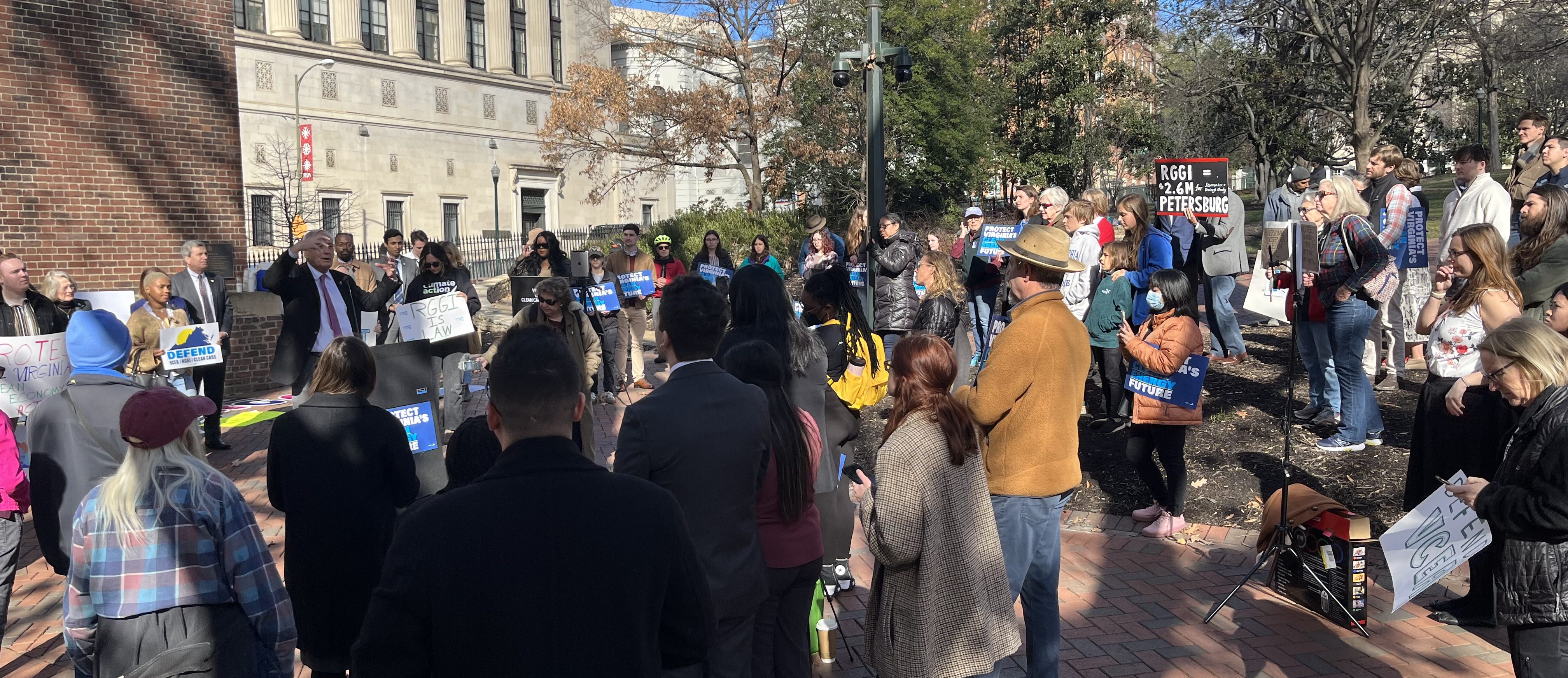
Climate advocates gathered at the Virginia Capitol on Friday to defend Virginia’s clean energy laws. Speakers included Senators Creigh Deeds, Ghazala Hashmi, David Marsden and Scott Surovell, and Delegates Rip Sullivan, Nadarius Clark, Rodney Willett and Alfonso Lopez. Photo courtesy of Mary-Stuart Torbeck, Virginia Sierra Club.
Every year I do a round-up of climate and energy bills at the start of the General Assembly session. This year, as expected, Republicans continue their assault on the hallmark legislation passed in 2020 and 2021 committing Virginia to a zero-carbon economy by 2050. In addition, this year features the usual assortment of bills doing favors for special interests, efforts to help residents and local governments go solar and a brand-new money and power grab by Dominion Energy.
Republicans are not down with the energy transition
Dominion Energy may have baked the transition to renewables into its planning, but unsurprisingly, the Virginia Republican Party thinks the fight to preserve fossil fuel dependence is a winning issue. The three foundational bills of Virginia’s energy transition — the Regional Greenhouse Gas Initiative (RGGI), the Virginia Clean Economy Act (VCEA) and Clean Cars — all come in for attack, either by outright repeal or death-by-a-thousand-cuts.
Senate Bill 1001 (Richard Stuart, R-Westmoreland) would repeal the Clean Energy and Community Flood Preparedness Act, the statute that propelled Virginia into the Regional Greenhouse Gas Initiative. Participation in RGGI is the vehicle by which utilities buy allowances to emit carbon pollution. Under RGGI, the number of allowances available declines every year, and Virginia’s power sector would reduce CO2 emissions 30% by 2030. The allowance auctions have already raised hundreds of millions of dollars that by law must be used for low-income energy efficiency programs and flood resilience projects. A similar bill failed last year, and Senate Democrats have pledged to block the effort again. Meanwhile, Gov. Glenn Youngkin is trying to withdraw Virginia from RGGI administratively, a move that former Attorney General Mark Herring ruled wasn’t legal.
Carbon allowance auctions are a foundational piece of the VCEA as well, but it is a much bigger law that touches on too many aspects of energy regulation for repeal of the whole thing. This isn’t stopping Republicans from trying to undermine key provisions. House Bill 2130 (Tony Wilt, R-Rockingham) and Senate Bill 1125 (Travis Hackworth, R-Tazewell) would give the State Corporation Commission more authority over closures of fossil fuel plants and require it to conduct annual reviews aimed at second-guessing the VCEA’s framework for lowering emissions and building renewable energy. Achieving the VCEA’s climate goals is decidedly not the purpose; meanwhile, the legislation would remove business certainty and undercut utility planning.
Other attacks on the VCEA take the form of favors for specific industries, but would effectively make the VCEA’s goal of reaching 100% carbon-free electricity by 2050 at the least cost to consumers impossible. I’ve dealt separately with small modular reactors, hydrogen and coal mine methane below.
In addition, House Bill 1430 and House Bill 1480 (Lee Ware, R-Powhatan) exempt certain industrial customers categorized as “energy-intensive trade-exposed industries” from paying costs that the VCEA makes all customers pay. The exemption would last four years. The result would be nice for those industries but would shift costs onto everyone else. The bill seems likely to pass the House, but the same bill last year died in the Senate. However, Senate Bill 1454 (Jeremy McPike, D-Prince William) proposes the SCC put together a group of experts to study the issue and make recommendations.
In the transportation sector, no fewer than seven bills sought to repeal the Air Pollution Control Board’s authority to implement the Advanced Clean Car Standard: House Bill 1372 (Buddy Fowler, R-Hanover), House Bill 1378 (Wilt), Senate Bill 778 (Stuart), Senate Bill 779 (Stephen Newman, R-Bedford), Senate Bill 781 (Bill DeSteph, R-Virginia Beach), Senate Bill 782 (Bryce Reeves, R-Fredericksburg) and Senate Bill 785 (Ryan McDougle, R-Hanover). The Senate bills were killed in committee on Tuesday. The House bills are likely to pass that Republican-led chamber, but it appears clear that Senate Democrats intend to hang fast to Clean Cars.
Although so many identical bills might look like a failure of legislators to coordinate efforts, in fact the senators all signed on as co-patrons to each other’s bills, along with a dozen House Republicans. Republicans think they have a winning issue for the November election, and lots of them want to claim they filed “the” legislation attempting to repeal Clean Cars.
Raiding the store for polluter interests
If the VCEA is here to stay, there are some decidedly non-green industries that want to claim the green mantle to get in on the action. It’s not about making themselves feel better about their high greenhouse gas emissions. It’s about getting a piece of the market for renewable energy certificates and undermining the integrity of the renewable energy label.
House Bill 1643 (Terry Kilgore, R-Scott) and Senate Bill 1121 (Hackworth) proclaim coal mine methane a renewable energy. House Bill 2178 (James Morefield, R-Tazewell) makes coal mine methane a qualifying industry for Virginia’s green job creation tax credit.
Burning wood for electricity produces as much CO2 as coal, at a cost much higher than solar energy today. Yet House Bill 2026 (Israel O’Quinn, R-Bristol) and Senate Bill 1231 (Lynwood Lewis, D-Accomack) remove the requirement in the VCEA for the retirement of Dominion’s generating facilities that burn wood for electricity and allow these generating plants to qualify as renewable energy sources.
SMRs and hydrogen
Speaking of raiding the store, House Bill 2197 (Kathy Byron, R-Bedford) allows “advanced nuclear technology” to qualify for Virginia’s renewable portfolio standard (RPS). The bill defines the term as “a small modular reactor or other technology for generating nuclear energy,” which looks like an opening for existing nuclear plants as well. Even if it isn’t, treating any kind of nuclear technology as a renewable resource upsets the VCEA’s calibrated approach to nuclear as a zero-carbon technology alongside renewable energy, not in place of it.
House Bill 2311 (Kilgore) goes a step further, declaring both nuclear and hydrogen to be renewable energy sources and making them eligible for the RPS. Hydrogen, of course, is a fuel made from other sources of energy, which can be renewable but are more typically fossil fuels currently. Given Youngkin’s interest in seeing hydrogen made from coal mine methane, you can see where this is headed.
House Bill 2333 (Danny Marshall, R-Danville) calls on the SCC to develop a pilot program to support building small modular nuclear reactors, with a goal of having the first one operational by 2032. In spite of the word “pilot,” the bill is ambitious. It contemplates four sites, each of which can have multiple reactors of up to 400 megawatts each.
Utility reform
Some of these bills are reform bills; some are “reform” bills. To recognize the difference, it helps to know whether the proponent is a public interest organization or the utility itself. When Dominion tells you it has a bill you’re going to love, you can be pretty sure the result will be bad for ratepayers.
Senate Bill 1321 (Jennifer McClellan, D-Richmond, and Creigh Deeds, D-Charlottesville) and House Bill 1604 (Ware), billed as the Affordable Energy Act, is real reform legislation that gives the SCC authority to lower a utility’s base rates if it determines that existing rates produce “unreasonable revenues in excess of the utility’s authorized rate of return.”
Other straightforward measures include House Bill 2267 (Wilt) and Senate Bill 1417 (David Suetterlein, R-Roanoke), which allow the SCC to decide to add the cost of a new utility generation project into base rates instead of granting a rate adjustment clause (RAC), and House Bill 1670 (Marshall), which returns rate reviews to every two years instead of the current three years.
Dominion, however, has its own “reform” bill, introduced by its favorite Democratic Senate and Republican House leaders. As is typical for Dominion, Senate Bill 1265 (Dick Saslaw, D-Fairfax) and House Bill 1770 (Kilgore) is long, dense and deadly effective in crushing competition and protecting profits. The bitter pill is sugarcoated with short-term rebates and concessions to minor reform proposals, such as biennial rate reviews in place of triennial reviews and consolidating many RACs into base rates. A somewhat less objectionable substitute moved forward in Senate subcommittee this week, but further negotiations are expected to produce yet more changes.
The warring factions may be able to find common ground in House Bill 2275 (Kilgore) and Senate Bill 1166 (Scott Surovell, D-Fairfax), legislation creating a structure for state energy planning.
House Bill 1777 (O’Quinn) and Senate Bill 1075 (Frank Ruff, R-Mecklenburg) change how the SCC regulates rates of Appalachian Power – but not Dominion. They require the SCC to conduct “annual rate true-up reviews (ART reviews) of the rates, terms and conditions for generation and distribution services” by March 31, 2025 and annually after. They also remove the requirement for an integrated resource plan.
Retail choice
Past years have seen efforts to restore the ability of customers to buy renewable energy from providers other than their own utilities, an important option for a resident or business that wants to buy renewable energy at a competitive rate. Senate Bill 1419 (Suetterlein) marks at least the fourth year in a row for this effort. A Senate subcommittee voted against it this week.
Dominion’s “reform” bill, on the other hand, clamps down further on retail choice. In light of Youngkin’s support for retail choice in his energy plan, it is interesting to see Republicans like Kilgore instead enabling Dominion’s anticompetitive efforts.
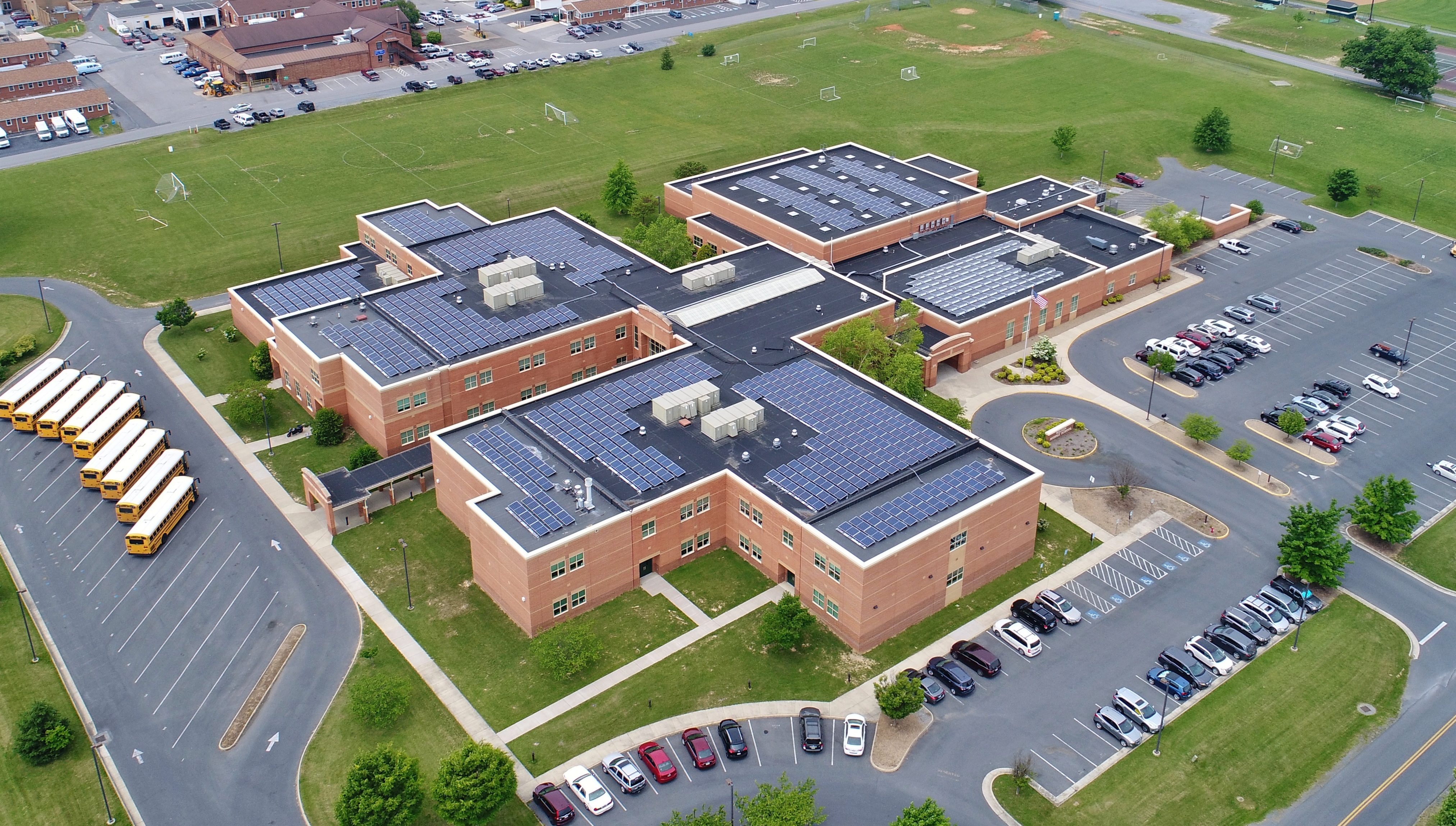
Wilson Middle School, Augusta County. Photo courtesy of Secure Futures.
Goosing investments in solar and efficiency
With the passage of the federal Inflation Reduction Act last summer, renewable energy and energy efficiency tax credits are more generous and easier to access than ever before. Senate Bill 848 (Barbara Favola, D-Arlington) and House Bill 1852 (Suhas Subramanyam, D-Loudoun) direct the Commission on School Construction and Modernization to figure out how to help schools take full advantage of onsite solar.
House Joint Resolution 545 (Briana Sewell, D-Prince William) directs the Department of Energy to study barriers to clean energy investments by localities and their residents and issue recommendations to help.
Senate Bill 1333 (Ghazala Hashmi, D-Richmond) creates a program within the Department of Energy to be known as the Commonwealth Solar and Economic Development Program. The program will implement solar, energy efficiency and other economic development projects in specified census tracts.
Senate Bill 1323 (McClellan) requires the SCC to establish for Dominion Energy Virginia annual energy efficiency savings targets for customers who are low-income, elderly, disabled or veterans of military service.
Senate Bill 984 (Monty Mason, D-Williamsburg) clarifies that lease arrangements for onsite solar are legal, whether or not they’re net metered, including when battery storage is part of the project. (For context: Leasing has always been an option for onsite solar, but the IRA has increased interest in this approach. It is considered especially attractive for residential projects that, except when the customer is low-income, are barred by Virginia law from using third-party power purchase agreements.) The bill also ensures owners can be paid for grid services using the facilities. Another welcome provision of the bill is removing standby charges for residential customers who have batteries along with their solar panels. Currently, residents with systems over 15 kW must pay hefty standby charges.
House Joint Resolution 487 (Marshall) directs the Department of Transportation to study the idea of putting solar panels in highway medians.
Meanwhile, House Bill 2355 (Jackie Glass, D-Norfolk) is a consumer-protection effort for buyers of rooftop solar and other small arrays, who have sometimes been the victims of unscrupulous companies that overcharge and under-deliver.
Shared solar
Virginia has been wading into community solar like a child at the seashore, dipping a toe in and then running away again and again, without ever truly entering the water. A 2020 law establishing a “shared solar” program in Dominion territory was supposed to get us swimming. At the SCC, however, Dominion won the right to impose such a high minimum bill as to make the program unworkable for any but low-income customers, who are exempt from the minimum bill.
Senate Bill 1266 (Surovell) attempts to address the problems with the shared solar program in Dominion territory. Surovell was the author of the 2020 law and criticized the SCC’s action for making shared solar unavailable to anyone other than low-income residents. His approach would limit the minimum bill to more than twice the basic customer charge, while also increasing the size of the program to at least 10% of the utility’s peak load and allowing non-jurisdictional customers like local governments to participate.
Senate Bill 1083 (Edwards and Surovell) creates a shared solar program in Appalachian Power territory. It builds on the framework of the existing program in Dominion territory, but the minimum bill is limited to $20. It also seeks to prevent the interconnection problems that industry members have complained about by limiting costs and requirements to those “consistent with generally accepted industry practices in markets with significant penetration levels of distributed generation.”
On the House side, House Bill 1853 (Suhas Subramanyam, D-Loudoun) combines both Senate bills into one bill that addresses both Dominion and Appalachian Power. For both, it limits the minimum bill to two times the basic customer charge, and it includes the interconnection language.
Offshore wind
Senate Bill 1441 (Mamie Locke, D-Hampton) moves up the VCEA’s deadline for offshore wind farm construction from 2034 to 2024, a change I don’t understand at all, given that the current timeline calls for completion of the Coastal Virginia Offshore Wind Project (CVOW) in 2026. The bill also requires that when Dominion seeks cost recovery, the SCC must give preference “for generating facilities utilizing energy derived from offshore wind that maximize economic benefits to the Commonwealth, such as benefits arising from the construction and operation of such facilities and the manufacture of wind turbine generator components.” I look forward to learning what’s behind that, too.
Senate Bill 1854 (Subramanyam) seeks annual reports from the SCC on the progress of CVOW, including “the status and the anticipated environmental impacts and benefits of such projects” that “analyze the current and projected capital costs and consumer rate impacts associated with such projects.” It also wants “an analysis of the ownership structure chosen by an electric utility for previously approved wind energy projects and the costs, benefits, and risks for consumers associated with utility-owned and third-party-owned projects.” This analysis would compare the Virginia project with other U.S. projects, potentially a useful analytical tool for the next offshore wind project that comes along.
House Bill 1797 (Nick Freitas, R-Culpeper) declares that ratepayers will be held harmless if CVOW’s annual net capacity factor falls below 42% as measured on a three-year rolling average. The capacity factor is the average output of the wind turbines as a percentage of their full potential. In its filing with the SCC, Dominion projected CVOW would hit that 42% mark. If wind speeds turn out to be stronger than projected, the turbines will produce more energy at a lower cost. If the wind (or the machinery) doesn’t meet expectations, the capacity factor will be lower and costs will be higher. The bill would make Dominion absorb the loss in that event. However, the SCC did just resolve this issue in a way that takes account of both ratepayer interests and the newness of the technology, making it unlikely that many legislators will want to revisit this topic.
Senate Bill 1477 (Lewis) allows Dominion, subject to SCC approval, to create an affiliated company to build some or all of its offshore wind project, with the purpose of having the affiliate secure equity financing.
House Bill 2444 (Bloxom) moves up the timeline for Virginia offshore wind projects under the VCEA from 2034 to 2032 (I wonder if this is what Senator Locke’s bill was supposed to say). It also requires the SCC to give preference to requests for cost recovery by Dominion for “generating facilities utilizing energy derived from offshore wind that maximize economic benefits to the Commonwealth.” I don’t understand if this is intended to discourage Dominion from pursuing projects off the shores of other states, or if it is a poorly-worded way to support in-state manufacturing of components.
Residential PACE
Senate Bill 949 (Petersen) makes homeowners eligible for property-assessed clean energy (PACE) programs, which provide low-cost financing for energy efficiency and renewable energy upgrades. Currently PACE loans are only available to commercial customers.
Data centers
Virginia has a data center problem. Northern Virginia hosts the largest concentration of data centers in the world, and the energy they consume now amounts to 21% of Dominion’s load. This growth has happened with no state oversight; indeed, it’s been goosed by a billion dollars’ worth of state tax incentives over the past decade. Meeting the energy demand of data centers requires more generation and more transmission lines, usually paid for by all utility customers.
Senate Joint Resolution 240 (Chap Petersen, D-Fairfax), and House Joint Resolution 522 (Danica Roem, D-Manassas) task the Department of Energy with studying data centers’ impact on Virginia’s environment, energy supply, electricity rates and ability to meet climate targets. The bills also ask for recommendations on whether tax incentives should be conditioned on use of renewable energy or on meeting siting criteria.
Both Roem and Petersen also have bills that deal with specific siting issues, mostly unrelated to energy. Senate Bill 1078 (Petersen) limits areas where data centers can be sited (e.g., not near parks and battlefields, a barb likely aimed at the Prince William Gateway project). However, it also requires localities to conduct site assessments for impacts on carbon emissions as well as water resources and agriculture.
Meanwhile, though, legislators seem determined to increase taxpayer handouts to data centers. Following Governor Youngkin’s announcement about Amazon’s plans to invest billions of dollars in new data centers in Virginia, Delegate Barry Knight (R-Virginia Beach) filed House Bill 2479, creating the Cloud Computing Cluster Infrastructure Grant Fund to throw more money at a corporation that seems likely to have more money already than Virginia does.
Return of the gas ban ban
Last year the natural gas industry tried to get a law passed to ban localities from prohibiting gas connections in new buildings. Some cities in other states have done that to protect the health and safety of residents and protect the climate; meanwhile, about 20 red states have passed laws to prevent their local governments from doing it. But no Virginia locality has attempted to ban gas connections, in part because as a Dillon Rule state, our local governments don’t appear to have that authority. That isn’t stopping the gas industry from seeking to ban bans here; House Bill 1783 (O’Quinn) and Senate Bill 1485 (Morrissey) would do just that. Obnoxiously, it calls the right to use gas “energy justice,” which is surely the best reason to oppose it.
A version of this article appeared in the Virginia Mercury on January 18, 2023.
Update January 19: Two new bills have been added since yesterday. Senator Morrissey filed SB1485 (gas ban ban), and Senator Lewis filed SB1477 (Dominion offshore wind affiliate).
Update January 23: Delegate Bloxom filed HB2444, added to the offshore wind section above. Delegate Knight filed HB2479, a bill to enrich Amazon; see data centers.
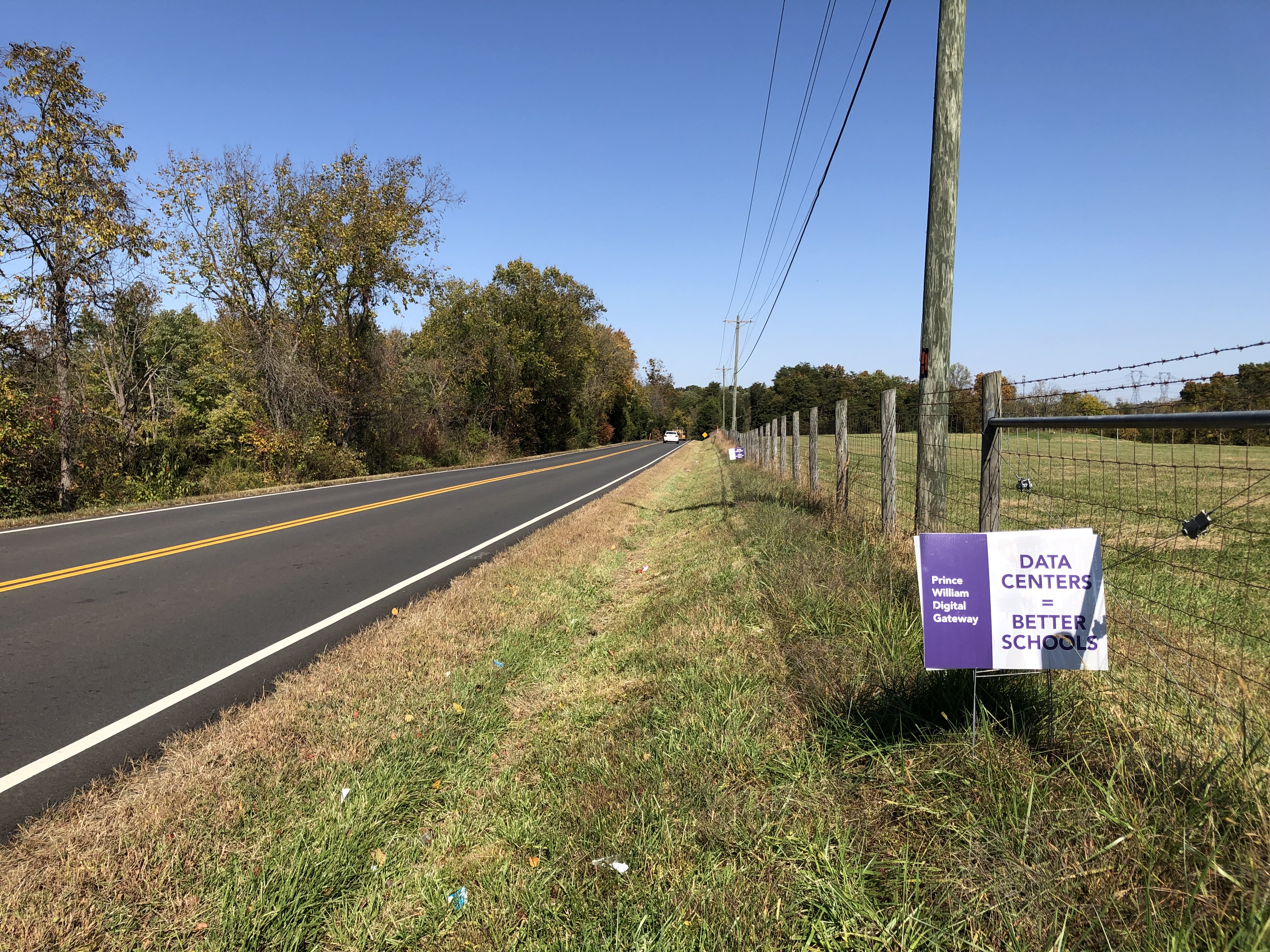
Pageland Lane is currently rural but would be expanded to four lanes as part of the PW Gateway project. Boosters say increased tax revenues will benefit parks and schools.
Actually, Virginia has several data center problems.
One seems like a good problem to have, at least if you are a locality looking to attract business.
Data centers pay a lot of local taxes while requiring little in the way of local services, and the steady buildout has supported thousands of construction jobs across the region. Indeed, so many data center companies have chosen to locate in Northern Virginia that we now host the largest concentration of data centers in the world. No wonder other regions of the commonwealth are angling to bring data centers to their neck of the woods too.
But there’s more to being the data center capital of the world than just raking in cash. To drive through Data Center Alley is to witness suburban sprawl on steroids, with its attendant deforestation, loss of farmland and loss of wildlife habitat. The environmental destruction doesn’t stop at a facility’s property line; a single building covers acres of land, causing massive rainwater runoff problems that can impact streams and drinking water resources miles downstream.
Other problems are unique to the industry. Cooling the servers requires a single data center to consume as much water as a city of 30,000-50,000 people, and giant fans make the surrounding area noisy day and night. The average data center has so many backup diesel generators onsite that it requires a major air source permit from the Department of Environmental Quality. The generators have to be started up regularly to ensure they will work in an outage. Multiply those startups by the total number of data centers in Northern Virginia, and the result is poorer air quality across the region.
Moreover, data centers require astonishing amounts of energy to power their operations and cool their servers. The industry uses over 12% of Dominion Energy Virginia’s total electricity supply, more than any other business category. Electric cooperatives supply more. Industry sources put Virginia’s total data center load at 1,688 megawatts as of 2021 — equivalent to about 1.6 million homes. Feeding ever more of these energy hogs requires utilities to build new electric generation and transmission lines, with costs and impacts borne by all ratepayers.
Many data center operators have pledged to run their operations on renewable energy, but only a few major tech companies have followed through on building solar facilities in Virginia. Indeed, their energy appetite is so great that if all Virginia data centers ran only on solar energy with battery backup, meeting their current demand would require all the solar currently installed in Virginia, Maryland, DC, Pennsylvania, West Virginia and Delaware put together. (For you energy nerds, I’m assuming a 25% capacity factor for solar; that is, meeting 1,688 megawatts of data center load would take 6,752 megawatts of solar.)
That’s not a reason to send data centers somewhere else — unless, of course, we’re talking about data centers that host cryptocurrency mining (and yes, they exist in Virginia, with more on the way). Those data centers we should certainly send elsewhere, preferably to Mars, unless scientists find life there, and in that case to the nearest black hole in outer space. As for the others, we’d just like them to be part of the climate solution rather than adding to our carbon footprint.
Why are data centers so keen to locate in Northern Virginia? Historically the draws were the fiber-optic network in Northern Virginia, proximity to Washington, D.C., relatively low-cost energy and a concerted early effort on the part of Loudoun County to make locating here as easy as possible.
Then there are the state subsidies. Since 2010, Virginia has offered tax incentives to data centers that locate in the commonwealth. The data center sales and use tax exemption is by far Virginia’s largest economic development incentive. It’s also an increasingly expensive one, rising from $30 million in outlays in 2010 to $138 million in 2020. A state audit showed Virginia taxpayers had provided over $830 million to data center operators through 2020; by now the total is certainly over $1 billion.
A 2019 report of the Joint Legislative Audit and Review Commission found that Virginia received back only 72 cents for every dollar of the data center tax incentive while creating very few jobs. That money-losing proposition was judged “moderately successful.”
Thus far, opposition to data centers has tended to be local and focused mainly on land use issues. Preservationists have been at the forefront of opposition to Prince William County’s proposed Digital Gateway, a data center development across more than 2,100 acres in an area known as the “Rural Crescent.” The development would abut parkland and Manassas National Battlefield, leading opponents to call this a new Battle of Manassas. Citizens have sued the board of county supervisors for approving an amendment to the county’s comprehensive plan that allows the data center expansion.
The battle has spilled across the border into Fairfax County, whose leaders worry that stormwater runoff from the development will pollute the county’s main drinking water source, the Occoquan Reservoir.
The divide on data center siting is polarizing, but it isn’t partisan. The Democratic majority on the Prince William board of supervisors approved the Gateway project over opposition from Republican Supervisor Yesli Vega and state Del. Danica Roem, a Democrat. In a scathing op-ed, Roem argues that there’s no such thing as a green data center.
Since data centers provide essential services and have to locate somewhere, the answer isn’t to ban them from the state (crypto-mining operations excepted!). A better approach would be for Virginia to guide development away from overburdened areas to parts of the state that are desperate for new businesses, and to link tax incentives to energy efficiency and the use of renewable energy and reclaimed water.
Right now Virginia is operating on auto-pilot, paying ever more in tax incentives and fueling conflict, sprawl and carbon emissions. That needs to change.
This commentary appeared in the Virginia Mercury on December 9, 2022. Following that publication, I received emails about a data center proposal in Fauquier County with complaints strikingly similar to those in Prince William County. In addition, a reader in Chesapeake wrote that plans for the development of the Frank T. Williams Farm between a wildlife management area and the Great Dismal Swamp have proceeded with minimal public knowledge or input.
On December 11, Senator Chap Petersen sent an email to constituents criticizing the PW Gateway proposal for its impact on the battlefield and stating, “In the 2023 session, I intend to file legislation to both study and set logical limits on the siting of server farms in historically sensitive areas, as well as on the conversion of agricultural land.”
UPDATE: In its Q3 earnings call, Dominion Energy revealed data centers now make up approximately 21% of its Virginia load (see slide 30). Richmond, we have a problem.
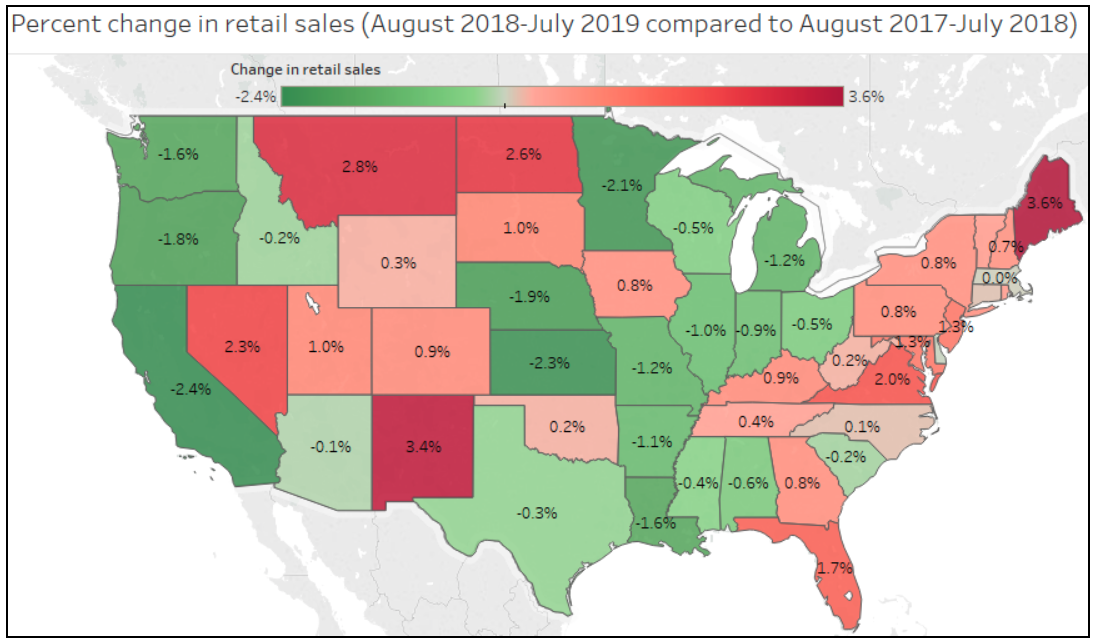
Data from the Energy Information Agency shows Virginia retail electricity sales increased by 2% year over year, one of the largest increases in the country. Nationwide, electricity sales declined slightly on average.
There’s bad news for Virginians looking to reduce our dependence on fossil fuels: The job just got 2% harder.
That’s the percentage increase in electricity use in Virginia over the past year, according to data from the U.S. Energy Information Agency (EIA).
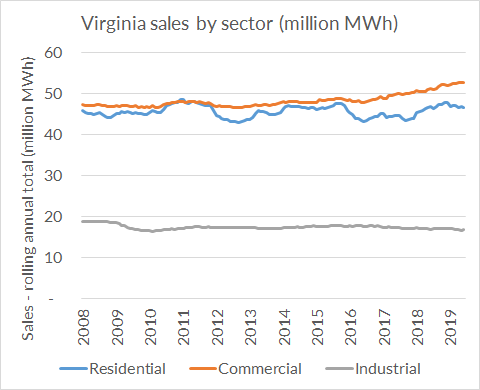
The increase was driven by the continuation of a three-year upward trend in the commercial sector. (My guess is it’s those data centers.) The somewhat better news is that residential use has stayed basically flat for 10 years.
The thing is, we would expect a 2% decrease in electricity demand every year, if we were among the states with the strongest energy efficiency programs. Needless to say, Virginia is not among them.
Virginia consumers share in the benefits of federal energy-saving programs for lighting, appliances and other equipment (advances that are now under attack from the Trump administration). These national standards, pretty much painless for consumers, have kept residential electricity usage from growing even as the population grows.
Yet Virginia makes little effort to build on these savings, and it shows. The American Council for an Energy-Efficient Economy ranks Virginia 29th in the nation overall in its 2019 State Energy Efficiency Scorecard; in the narrower category of electricity savings, Virginia came in a dismal 47th.
This should concern policy-makers, not least because wasting energy costs money. Recent EIA data reveals that in spite of Virginia having slightly lower electricity rates than the U.S. average, our residential bills are almost $20 per month higher, continuing a long and, especially for low-income residents, painful trend. Virginia residents use more electricity per household than any other state in the nation with the exception of just six southern states (Alabama, Kentucky, Mississippi, Tennessee, Louisiana and Texas).
Lobbyists for our utilities argue it’s the weather here. They say hot summers drive up the use of air conditioning, while cold winters keep electric heat pumps running. We’d like to see their data. The fact is, Virginia residents use more electricity (averaging 1165 kWh per month) and have higher bills (averaging $136.59) than residents of Maryland (1005 kWh, $133.68) and Delaware (977 kWh, $122.43), even though both of those states don’t just have colder winters, they have slightly warmer summers as well.
So if it isn’t weather, what is it? Policy. Both Maryland and Delaware have laws requiring reductions in energy consumption and have programs to make it happen.
It’s worth mentioning that Maryland and Delaware are members of the Regional Greenhouse Gas Initiative, the carbon-cutting compact of northeastern states that Virginia plans to join. Critics of the plan claim it will harm Virginia consumers. That makes it especially telling that of all the RGGI states, only Connecticut has higher residential electricity bills than Virginia.
Most RGGI states appear in the top ranks of the ACEEE scorecard. That’s not a coincidence; those states use money from the auctioning of carbon emission allowances to fund energy efficiency programs. Consumers benefit from the resulting trade-off: their electricity rates go up, but their bills go down.
Shrinking a state’s carbon footprint and reducing reliance on fossil fuels are prime objectives of energy efficiency in the RGGI states, but the lower bills give success that sweet taste that keeps them coming back for more.
Virginia has tackled energy efficiency in fits and starts over the years, with limited programs that tend to expire before they gain traction. That’s supposed to change now with implementation of 2018’s Grid Transformation and Security Act (GTSA). The GTSA requires Dominion Energy Virginia and Appalachian Power together to propose a billion dollars’ worth of energy efficiency programs over 10 years. The State Corporation Commission approved one round of spending from Dominion in May of this year.
The problem is that the GTSA only requires utilities to propose programs; it doesn’t say the programs have to be good ones, and it doesn’t require the SCC to approve them. Even the ongoing participation of a stakeholder group doesn’t change the fact that, as ever, the utilities are in the driver’s seat.
Since they’re spending their customers’ money, Dominion and APCo are happy with this set-up. Alas, they don’t have much incentive to produce really great programs. Quite the reverse: their business model depends on an ever-increasing demand for electricity. Successful energy efficiency programs are bad for business.
By contrast, the states at the top of the ACEEE scorecard all have laws called energy efficiency resource standards (EERS) that require utilities to achieve savings, not just spend money, or that take the job away from utilities entirely and entrust it to a separate entity without a conflict of interest.
More than half of states now have EERS, though not all target—or achieve—energy savings of 2% per year.
How does a good EERS work its magic? As ACEEE explains:
“In states ramping up funding in response to aggressive EERS policies, programs typically shift focus from widget-based approaches (e.g., installing new, more-efficient water heaters) to comprehensive deep-savings approaches that seek to generate greater energy efficiency savings per program participant by conducting whole-building or system retrofits.”
Some deep-savings approaches also draw on complementary efficiency efforts, such as utility support for full implementation of building energy codes. Deep-savings approaches may also promote whole-building retrofits, grid-interactive efficient buildings and comprehensive changes in systems and operations by including behavioral elements that empower customers.
The good news for Virginia is that, having failed to do much of anything on energy efficiency for all these years, we have a lot of low-hanging fruit. The GTSA can’t help but gather up some of it; a real EERS could do much more and at lower expense. We could also follow the lead of other states in adopting state-level appliance efficiency standards, tightening our building codes and allowing localities to go beyond state codes in their jurisdictions.
More and more, Virginia legislators accept the urgency of the climate crisis and the need to transition to renewable energy. It’s a job that requires lowering energy consumption as well as building wind and solar, and we can’t afford to do it wrong. Two years ago, most legislators settled for the flawed approach of the GTSA. In 2020, we should expect them to do better.
After all, to paraphrase Winston Churchill, you can always count on the General Assembly to do the right thing after they have tried everything else.
A version of this article appeared in the Virginia Mercury on October 11, 2019.
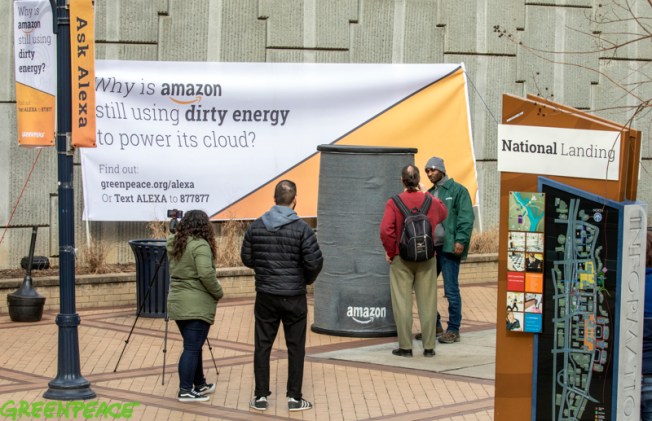
Greenpeace rebranded National Landing, the future home to Amazon’s HQ2, with a human-sized Alexa, lamppost signs and street posters highlighting the company’s stalled progress towards its commitment to power its cloud with 100% renewable energy. Photo credit Greenpeace.
More than 100 massive data centers, over 10 million square feet of building space, dot the Northern Virginia landscape around Dulles Airport in what is known as “Data Center Alley.”
And the industry is growing fast.
Local governments welcome the contribution to their tax revenue, but these data centers come with a dark downside: they are energy hogs, and the fossil fuel energy they consume is driving climate change.
A new report from Greenpeace called Clicking Clean Virginia: The Dirty Energy Powering Data Center Alley describes the magnitude of the problem:
“Not including government data centers, we estimate the potential electricity demand of both existing data centers and those under development in Virginia to be approaching 4.5 gigawatts, or roughly the same power output as nine large (500-megawatt) coal power plants.”
As these data center operations continue to grow, they are providing the excuse for utilities, primarily Dominion Energy Virginia, to build new fracked-gas infrastructure, including gas generating plants and the Atlantic Coast Pipeline.
Many of these same tech companies have publicly committed to using renewable energy, and in some cases they have invested heavily in solar and wind power in other states. With the exception of Apple, however, all these data center operators are falling far short in meeting their Virginia energy demand with renewables. Intentionally or not, that makes them complicit in Dominion’s fossil-fuel expansion.
One tech company in particular stands out in the report, due to the sheer size of its operations. Greenpeace calculates that Amazon Web Services, the largest provider of cloud hosting services in the world, has a larger energy load than the next four largest companies combined.
For a while, it looked like AWS would provide leadership commensurate with its size. In 2015, AWS helped break open the solar market in Virginia with an 80-megawatt solar farm. A year later it added another 180 megawatts of solar here, as well as a wind farm in North Carolina in Dominion territory.
Then the investments stopped, while the data center growth continued.
Today, Greenpeace estimates that AWS uses close to 1,700 megawatts for its Virginia data centers. Adjusted for their capacity factors, the renewable energy projects total just 132 megawatts, or less a tenth of the energy the data centers use.
The capacity factor of an energy facility reflects how much energy it actually produces, as opposed to its “nameplate” capacity. A solar facility produces only in daylight, but a data center consumes energy 24/7. To match all of its energy demand with solar energy, AWS would need more than 7,000 megawatts of solar—at least 15 times the amount in all of Virginia today.
For a company whose website promises a commitment to 100 percent renewable energy, that’s a major fail.
The Greenpeace report shows Amazon is not alone in data center operators that are dragging their feet on clean energy. It is simply, by far, the largest. The next three biggest data center operators—Cloud HQ, Digital Reality, and QTS—have no renewable energy at all in Virginia.
Better-known names like Microsoft and Facebook also operate Virginia data centers. Although both have invested in Virginia solar farms, they also fall well short of meeting their energy needs with renewables.
The tech giants are not entirely to blame in all this. As the Greenpeace report details, many of them have asked the General Assembly and the State Corporation Commission for more and better options for purchasing renewable energy. Their requests have largely been ignored.
Virginia’s monopoly system makes it hard for the companies to buy clean electricity from other providers. Our number one monopoly, Dominion Energy, claims to be working hard to meet the large customers’ demand for renewable energy, but its extensive investments in gas infrastructure pose a clear conflict of interest.
Surely, though, if anyone can stand up to Dominion on its home turf, it should be Amazon — which, of course, plans to make Virginia its home turf as well.
And AWS does have options, including more solar as well as land-based wind from the Rocky Forge wind farm and offshore wind from Virginia or North Carolina.
The fact that Amazon doesn’t even seem to be trying should be of great concern to Virginians. As Greenpeace puts it, “AWS’ decision to continue its rapid expansion in Virginia without any additional supply of renewable energy is a powerful endorsement of the energy pathway Dominion has chosen, including the building of the ACP, and a clear signal that its commitment to 100 percent renewable energy will not serve as a meaningful basis for deciding how its data center are powered.”
Amazon has already fired back at the Greenpeace report. In a statement, it asserts that “Greenpeace’s estimates overstate both AWS’ current and projected energy usage.”
However, the statement did not offer a different estimate. It also points to its investments in Virginia renewable energy (the same ones described in the report) and concludes, “AWS remains firmly committed to achieving 100 percent renewable energy across our global network, achieving 50 percent renewable energy in 2018. We have a lot of exciting initiatives planned for 2019 as we work towards our goal and are nowhere near done.”
Well, that’s nice.
But meanwhile, those data centers are using electricity generated from burning fossil fuels, driving climate change, and providing an excuse for new fracked gas infrastructure. Given the rapid pace of data center construction in Virginia, it’s going to take a lot of exciting initiatives from AWS — and all the other data center operators — to make any kind of meaningful impact.


 Power for the People VA