Unknown's avatar

Is sewage sludge laced with ‘forever chemicals’ contaminating Va. farmland?

It’s out of sight and out of mind, and it might just be killing people.

For decades, American factories have been sending their wastewater to municipal sewage treatment plants across the country, which handle it along with the effluent from other industries, homes and businesses. At the other end of the process, the separated and dried-out solids are often delivered to farmers as free fertilizer. The land application of this “sewage sludge” has long been encouraged by environmental regulators as a way to deal with what would otherwise be a vexing waste disposal problem. 

Yet not all of that wastewater, or the sludge that becomes fertilizer, is benign. An increasing number of industries discharge effluent laced with toxic per- and polyfluoroalkyl substances (PFAS), which most treatment plants aren’t equipped to remove. PFAS are notoriously long-lasting, so much so that they are nicknamed “forever chemicals.” And now some states are finding that PFAS-laced sewage sludge is contaminating farmland and poisoning consumers

PFAS are a relatively new class of synthetic chemical, emerging commercially in the 1950s to find their way into a wide range of useful products, including non-stick pans (most notoriouslyTeflon), waterproof clothing, stain-resistant fabrics and firefighting chemicals. Unfortunately, exposure to PFAS has been shown to cause an almost equally-wide range of environmental and human health harms, including cancer, kidney disease, thyroid disease, reproductive problems and obesity. 

After years of foot-dragging, the U.S. Environmental Protection Agency finally took action against two early types of PFAS that had already fallen out of use, setting drinking water standards for those and a few others. At the same time, however, chemical companies have been turning out literally thousands of new iterations that have been little studied and remain largely unregulated. PFAS have become so ubiquitous in the environment that scientists estimate 98% of Americans — and even some newborns — have detectable levels in their blood.  

In recent years, public health advocates have started to worry that PFAS may also be entering our food supply via the sewage sludge applied to farmland. According to the New York Times, five states – Texas, Michigan, New York, Maine and Tennessee – have detected PFAS on farmland treated with sewage sludge, sometimes in high levels. Crops grown in contaminated soil absorb the chemicals and pass them up the food chain. 

In Maine and Michigan, officials shut down farms after finding high concentrations of PFAS in the soil and in the meat of grazing animals. Maine officials found contamination on 56 farms and in 23% of more than 1,500 groundwater samples taken from farms and residences. 

In 2022, Maine banned the use of sewage sludge on agricultural land and prohibited most uses of PFAS in consumer products starting in 2030. The state is now working with affected farmers to compensate them or find alternative uses for contaminated land. Officials note that the testing programs are just beginning and fear that they may be seeing only the tip of the iceberg. 

The New York Times did not include Virginia among the states known to have PFAS-contaminated farmland. That’s not because we don’t have a problem. Rather, it’s because the Virginia Department of Environmental Quality (DEQ), which issues permits to municipal wastewater treatment plants, doesn’t require sludge to be tested.  

What little we do know is cause for concern. The conservation group Wild Virginia analyzed data submitted to DEQ in 2022 by a small number of drinking water and wastewater treatment plants that voluntarily tested their effluent. Limited and incomplete as it was, the information revealed that 20 of the 21 wastewater treatment plants that tested for PFAS found significant concentrations in their effluent. Only 8 of the plants also tested their sludge, but all 8 reported significant concentrations of PFAS. 

I talked by phone with David Sligh, Wild Virginia’s conservation director and a former DEQ employee, who told me the group plans to publish a report on this problem in the coming week. DEQ, he said, has the authority to regulate PFAS in treatment plants’ effluent and sludge and should be doing so to protect the public. His group has joined other members of the Virginia Conservation Network in calling on DEQ “to place the responsibility and cost of cleaning up PFAS on the industries that use and manufacture PFAS by requiring PFAS disclosure, monitoring, and limits in pollution discharge permits.”

DEQ, however, seems to be in no hurry. Neil Zahradka, manager of the land applications program at DEQ, wrote in an email to Tyla Matteson, a Sierra Club volunteer who works on sewage sludge issues, “To date, DEQ has relied upon the EPA biennial reviews to determine if additional regulation of biosolids is necessary beyond that contained in current permits, and no additional limits or criteria for PFAS have been set. … [A]ccording to the EPA PFAS Strategic Roadmap, they plan to complete the risk assessment for PFAS in biosolids this year.  We do plan to update the DEQ biosolids fact sheet once we have additional substantive information to offer landowners.”

Waiting for EPA to act first is convenient, but it does a grave disservice to Virginians. EPA itself has stalled for so long that Potomac Riverkeeper, Public Employees for Environmental Responsibility (PEER) and other groups finally sued the agency this year for its failure to regulate PFAS in sewage sludge used as fertilizer. According to PEER, EPA identified 10 different types of PFAS among some 250 pollutants contaminating sewage sludge, yet insists it is only obligated to identify the toxics in sewage sludge, not do anything about it.  

I suspect EPA and DEQ’s hesitance is due to the fear of what they would find in any extensive testing program. If testing confirmed widespread contamination in sewage sludge, DEQ would – one hopes – feel obligated to stop the practice of spreading it across the farms that produce our food. After all, if you identify a poison in your product, the answer is probably not to spread it among as many people as possible. 

Annoying as it would be for DEQ, industry and even farmers to learn the truth, though, the alternative is worse. PFAS can be removed, either in the wastewater treatment process or, ideally, before it leaves its industrial source. Not testing and treating means needlessly exposing farmers, their families and their animals – and ultimately all the rest of us – to chemicals that have no safe level of exposure. 

Given what we know about the harms PFAS causes, DEQ’s inaction is inexcusable. If Maine can tackle this threat to its land and people, surely Virginia can do it as well. We should expect no less.

This article was originally published in the Virginia Mercury on September 26, 2024.

Unknown's avatar

DEQ’s proposal to end the solar wars makes lemons out of lemonade

Wildflowers in front of solar panels illustrate pollinator plantings around solar panels
Who says solar can’t be an asset to the land? Photo credit Center for Pollinators in Energy, fresh-energy.org

It’s a problem that divides communities and stymies lawmakers: Virginia’s transition to clean energy depends on building thousands of acres’ worth of large solar facilities, but a backlash from some rural neighbors makes siting projects increasingly difficult. 

Most of the objections are aesthetic – few people prefer to look at rows of solar panels if they once enjoyed a bucolic country scene – but some opponents say they worry about the loss of farmland and trees. Solar, they fear, is bad for the land as well as the eyes. It doesn’t help that some early solar development suffered from corner-cutting that resulted in soil compaction and erosion. If that is solar, many people want no part of it.

In 2022, land conservation groups banded together with agriculture and logging interests to lobby for legislation requiring mitigation whenever a solar project would disturb more than 50 acres of forest or 10 acres of “prime agricultural soils.” House Bill 206 applies to any solar project developed under Virginia’s sort-of-streamlined “permit by rule” process, which is available to all but the largest facilities. 

The solar industry initially fought the legislation, joined by some climate advocacy groups. They pointed out that no other industry is subject to mitigation requirements, and that solar provides greater climate benefits than forests and agriculture. Moreover, solar panels can be removed and the land returned to farming or forestry. By contrast, once land is converted to a housing subdivision or strip mall or data center, the damage is permanent. 

Eventually the solar industry accepted compromise language that put off the effective date until the start of 2025 and gave industry members a voice in an advisory panel under the auspices of Virginia’s Department of Environmental Quality (DEQ). The law tasked this group with helping to develop “criteria to determine if a significant adverse impact to prime agricultural soils or forest lands is likely to occur as a result of a proposed solar project,” and if so, the actions that should be considered in any mitigation plan. DEQ was to use the working group’s conclusions to draw up regulations. 

As it turned out, the working group agreed on very little. Its 717-page report found consensus on only a few points, leaving DEQ itself with the task of resolving key issues. On May 13, the agency published its proposed regulations. The regulations are currently under executive branch review, after which Interested parties and the public will have the opportunity to comment.

Meanwhile, a few things have happened since the passage of HB 206.

In March of 2022, DEQ toughened its stormwater regulations to address the runoff and erosion problems that had given solar a bad name in some communities. Building on that, the agency just released a new stormwater handbook that will become effective July 1, 2024, with sections specific to solar development. 

Some solar industry members complain that DEQ’s stormwater regulations are unreasonably onerous, but no one questions the importance of preventing runoff and erosion. In any case, many companies are already using land-friendly practices that make it easier to meet tougher rules. One is the use of terrain following trackers, a technology that allows solar to be installed on uneven terrain instead of bringing in bulldozers to level the site. The trackers maximize solar production in hilly areas while preserving topsoil and vegetation. 

The new tracker technology is among the suite of low-impact approaches gaining ground as the solar industry matures. DEQ encourages another eco-friendly practice: planting native species among and around solar arrays. Native plants provide food and habitat for insects whose numbers have plummeted in recent years, threatening our ecosystems. Though only a few solar projects have achieved DEQ’s pollinator-smart certification to date, most of the developers I’ve spoken with say they are open to it. 

Photo credit Solar Power World and Nexamp

Gaining traction even faster is the practice of using grazing animals for vegetation management. Sheep hit the sweet spot: project owners save money they would have to spend on humans operating machinery, while the sheep thrive in the shade of solar panels and return nutrients to the soil. Already, 2% of sheep in the U.S. are being grazed under solar panels, according to an American Solar Grazing Association webinar, including at several large Virginia facilities providing power to Dominion Energy. Elsewhere, cattle graze under solar panels or crops grow between the rows, further erasing the distinction between solar facilities and agricultural use. 

All-terrain trackers, topsoil preservation, native plants and incorporating active farming or grazing: all these practices ensure farmland isn’t “lost” to solar. Yet DEQ’s tougher stormwater rules, the solar industry’s increasingly land-friendly practices, and even the passage of HB 206 haven’t allayed concerns among solar opponents. Instead, rural counties have stepped up the pace of bans, caps and moratoriums.  

One suspects the continued hostility isn’t because opponents lack familiarity with the ways solar can be eco-friendly, but because the opposition’s primary motivation isn’t preserving farmland. If what they really care about is keeping solar from cluttering up the viewshed (“preserving our rural heritage” is the euphemistic framing), then adding a new layer of mitigation requirements won’t change anything. 

Admittedly, I never supported HB 206 in the first place. From an environmental perspective, solar is no worse for the land than monoculture pine plantations or commodity crops grown with pesticides and petroleum-based fertilizers. Done in a habitat-friendly way, solar can increase biodiversity and help heal the land. And solar addresses our CO2 problem, far more even than trees.

Still, DEQ’s job was to try to find a middle ground between the solar industry and its detractors, and in fairness, their effort gets some things right. The proposed rules recognize that there are degrees of impact a solar facility can have, and that practices like leaving topsoil undisturbed or incorporating agrivoltaics should be rewarded with lower mitigation requirements. A neat table delineates the various levels of impact and proposes differing levels of mitigation to match. Mitigation mostly takes the form of land set-asides, but can also be satisfied with per-acre payments. 

And yet the proposal misses the mark on at least three fronts. First, it fails to give full credit to solar projects that minimize soil disturbance and incorporate agrivoltaics. DEQ should recognize that adopting best practices is itself mitigation, which should obviate the need for land set-asides or monetary payments. 

Second, the proposed regulations make no exceptions for projects owned and operated by local farmers who incorporate solar into their farm activities in order to increase and diversify their income without having to sell their land. If the point of HB 206 was to protect farming, DEQ has shot wide of the mark.

Finally, the dollar amounts that DEQ proposes in lieu of land set-asides are punishingly high, with perverse effects. A solar company that has to pay a stiff penalty must pass that cost along in the form of a higher price for the electricity produced. If a utility has to pay more for electricity, ratepayers ultimately foot the bill. 

The alternative is equally counterproductive. I noted at the start that DEQ’s permit-by-rule process is available to all but the largest projects, but it is not the only pathway open to developers. Projects over 150 MW are required to go to the SCC for approval, but smaller projects aren’t foreclosed from doing so. If DEQ makes its own process too onerous, solar developers will go to the SCC instead. The SCC requires that a developer secure a local permit, but not that it employ soil-saving practices, agrivoltaics or mitigation.

It would be great if DEQ could turn the lemon that is HB 206 into a lemonade of a solar industry adopting eco-friendly development practices and incorporating pollinator plantings, sheep grazing, and other agrivoltaic businesses. What we have instead is a proposal that may kill the permit-by-rule program without producing any benefit to anyone – in effect, turning lemonade into lemons.

There is still time to get it right. DEQ may not be able to resolve the solar wars, but a good set of regulations would position Virginia to make the most of a solar industry that is essential to our future.

This article was originally published in the Virginia Mercury on June 12, 2024.

Unknown's avatar

Don’t give data centers a pass on pollution


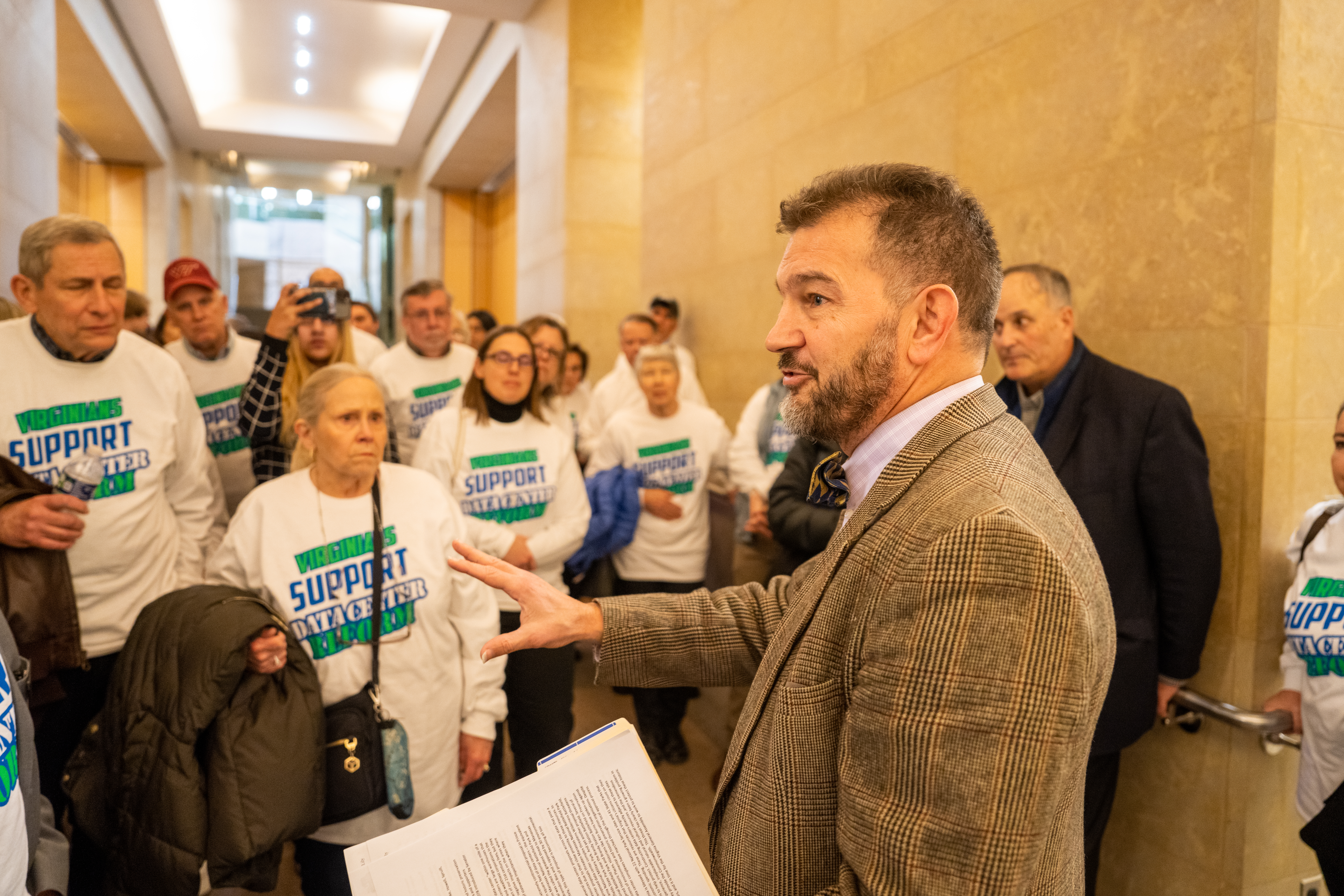
Senator Petersen and a group of advocates
Senator Chap Petersen talks with advocates at the General Assembly on February 3. Photo courtesy of Piedmont Environmental Council

In 2019, with Northern Virginia’s data center boom well underway, I worked with the Sierra Club to provide comments to the Department of Environmental Quality (DEQ) on a proposed major source air permit for a data center. 

We urged that the data center, owned by Digital Realty, be required to minimize its reliance on highly-polluting, back-up diesel generators by installing on-site solar and battery storage. While rooftop solar alone wouldn’t produce more than a fraction of the energy a data center uses, solar panels and batteries could provide a strong first line of defense against grid outages, without the air pollution. 

It wasn’t a new idea; other data centers elsewhere were using clean energy and storage or installing microgrids capable of providing all of the power the facility needed. Yet DEQ rejected the suggestion and gave the go-ahead for the data center to install 139 diesel generators with no pollution controls. 

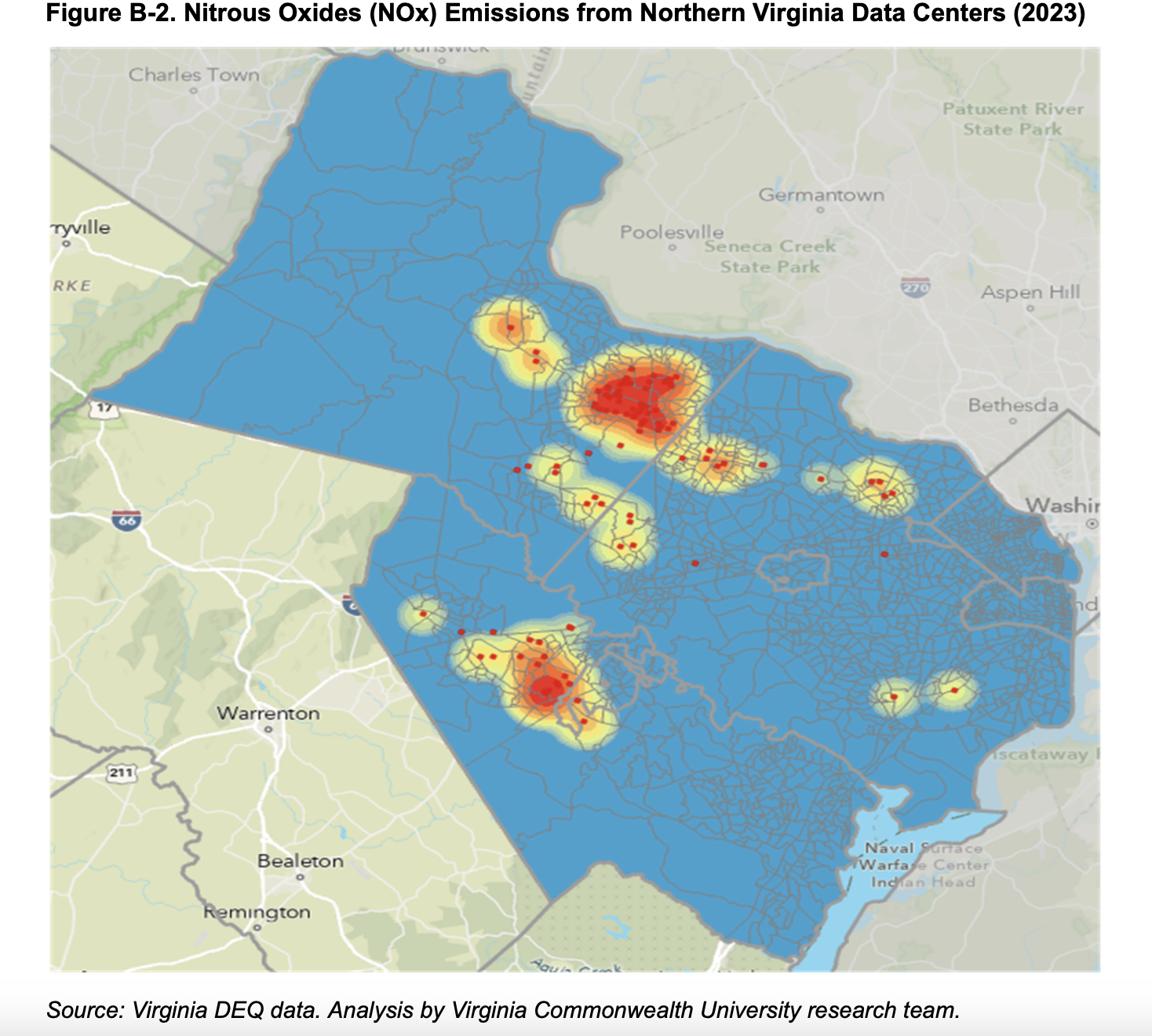
Three years later, data centers have proliferated to such a degree that the power grid can’t keep up. DEQ is now proposing that more than 100 data centers in Loudoun, Prince William and Fairfax counties be given a variance from air pollution controls so they can run their diesel generators any time the transmission system is strained. DEQ is taking comments on the proposal through March 14 and will hold a hearing at its office in Woodbridge on February 27.

As a resident of Fairfax County, I’ll be one of the people forced to breathe diesel pollution to keep data centers running. Make no mistake: There would be no grid emergency without these data centers’ thousands of megawatts worth of electricity demand. And there wouldn’t be a threat to Northern Virginia’s air quality without their diesel generators. 

It’s fair to ask: Should these data centers have been built if the infrastructure to deliver power to them wasn’t ready? I’d also like to know why DEQ thinks it’s okay to impose on residents the combined pollution from many thousands of diesel generators firing at once, when it has known since at least 2019 that viable, clean alternatives exist. 

Batteries alone are an obvious solution for short-term emergency use, and can provide exactly the kind of help to the grid that will be needed this year. Instead of calling on data centers to run diesel generators, a grid operator can avoid the strain by tapping into a data center’s battery, a solution Google is implementing.      

But data centers can economically lower their energy and water costs as well as reduce strain on the electric grid by reducing their energy use and using on-site renewable energy. Global energy management companies like Schneider Electric, Virginia AECOM and Arlington’s  The Stella Group design microgrid solutions for data centers and other facilities that need 24/7 power.

I contacted Stella Group president Scott Sklar to ask how feasible it is for Northern Virginia’s data centers to meet their needs without diesel generators, given land constraints that limit their ability to meet demand with on-site solar. He told me data centers can start by reducing their cooling load by two-thirds by using efficiency and waste heat; cooling, he says, accounts for 38% to 47% of electricity demand. Cost-effective energy efficiency can reduce energy demand by one-third, and waste-heat-to-electricity can meet another 25% to 38% of the remaining electric load. “If you cut the cooling load and use waste heat to electricity, then you only need renewable energy and batteries for a maximum of half,” he concluded. “That’s doable.”

If Virginia data centers don’t start taking these kinds of measures, the situation will get worse. This year’s grid strain may be relieved through construction of new generation and transmission infrastructure, but the industry’s staggering growth rate threatens to create future problems. In 2019, when the Sierra Club was urging DEQ to think about the environmental impact of data centers, the industry consumed 12% of Dominion Virginia Energy’s total electric supply. Today, that number has risen to 21%, a figure that does not include the many data centers served by electric cooperatives rather than Dominion.  

Just last month, Gov. Youngkin announced that Amazon Web Services will invest $35 billion in  new data centers in Virginia, at least doubling Amazon’s existing investments here. By way of thanks, Youngkin wants taxpayers to provide up to $140 million in grant funding to Amazon and extend Virginia’s already-generous tax subsidy program. Ratepayers would also subsidize the build-out by contributing to the cost of new generation and transmission.

Amazon claims to lead the list of tech companies buying renewable energy, though its investments are mostly in other states and abroad. A scathing report in 2019 showed Amazon owned the majority of the data centers in Virginia at that time, but had made few investments in renewable energy here. Since then, Amazon has developed new solar facilities statewide, including enough to power its new Arlington headquarters. But as I discussed in a previous column, all the solar in Virginia would not be enough to make a dent in the energy appetite of Northern Virginia’s data centers, of which Amazon owns more than 100.  

I have no special beef with Amazon, but I do think that a rich tech company with pretensions to sustainability leadership should do more to walk the walk in the state that hosts so much of its operations. Surely that includes not relying solely on diesel generators for back-up power at its data centers. 

I also have no beef with data centers in general. They provide necessary services in today’s world, and they have to go somewhere. Data centers could be a valuable source of revenue and economic development for Southwest Virginia and other parts of the state that are not grid-constrained, if there are guardrails in place to protect nearby communities and the environment, and if they help rather than hurt our clean energy transition. Right now, none of this is the case.

Unfortunately, Gov. Youngkin not only doesn’t want guardrails, he doesn’t even want to know where and why they are needed. On February 3, a representative of his administration spoke in committee in opposition to legislation filed by Sen. Chap Petersen, D-Fairfax that would have the Department of Energy and DEQ study the impact of data centers on Virginia’s environment, energy supply and climate goals. The Senate agreed to the study, but a similar bill died in the House, and a House subcommittee killed Petersen’s Senate version Monday on a 2-1 vote. (The vote was later changed to 3-2 when two delegates who missed the meeting, and the discussion, added their votes. Killing a bill in a tiny subcommittee is one way House procedures allow delegates to avoid accountability on controversial issues — but that’s a topic for another day.)

I spoke with Sen. Petersen by phone after the subcommittee hearing. He pointed out that the administration would have been able to shape the study any way the governor wanted, and would have had control over the recommendations as well. Petersen’s conclusion: “He just doesn’t want anyone looking at it.”

Refusing to look at a problem, however, never makes it go away. And in this case, the problem is just getting bigger.

This article was originally published in the Virginia Mercury on February 15, 2023.

Update: On March 7, DEQ issued a new permit variance limited to data centers in Loudoun County. Although DEQ doesn’t say so, it appears that the original proposal has been modified. The comment period will now run through April 21, and another hearing will be held on April 6.

Unknown's avatar

Ignoring state climate rules, Dominion decides what carbon regulations should look like

woman in dinosaur costume holding sign reading clean energy now

Four out of five dinosaurs agree. The fifth, that would be Dominion. Photo courtesy of Sierra Club Virginia Chapter.

For several years now, Dominion Energy Virginia has factored into its plans an assumption that electricity from carbon-emitting power plants will eventually include a cost reflecting CO2’s role as the primary driver of global warming. Dominion says it has even integrated this into its corporate goals, targeting an 80 percent reduction in CO2 emissions by 2050.

That promise may be more propaganda than corporate lodestar, but in any case the utility’s Integrated Resource Plans regularly point to the probability of future carbon regulations as a reason to build new renewable energy facilities and close old coal plants.

Planning for constraints on CO2 emissions proved wise this spring when Virginia’s Department of Environmental Quality finalized a state carbon cap-and-trade program. The DEQ regulations call for Virginia power plant owners to trade carbon allowances with those in the member states of the Regional Greenhouse Gas Initiative (RGGI). A Republican budget maneuver has delayed implementation of the new rules, but once they take effect they are expected to hasten the retirement of expensive old coal plants and support investments in new renewable energy projects.

But it’s not the DEQ regulations that Dominion is planning around. The utility’s 2019 update to its 2018 IRP, filed with the State Corporation Commission on Aug. 29, treats the DEQ regulations as hypothetical. Instead, it posits some unspecified future federal carbon regulations that, apparently, it would like much better.

The update describes three alternative scenarios, down from five in the 2018 IRP. The first is a “base case” that assumes no carbon emission constraints. The second assumes the state carbon limits take effect as well as some future federal regulations, and the third assumes federal (but not state) limits. However, the cover letter makes it clear that only the third scenario actually describes what Dominion intends to do. As it happens, that is the most expensive— and most profitable —plan.

The primary feature of the base case is that it keeps some old coal units running that will be closed in the other scenarios. According to Dominion, this makes it the least-cost approach to meeting electricity demand. Whether that’s true is a matter of dispute; these units hardly run at all any more, and experts for environmental organizations in the IRP hearing testified that retiring them will save money for customers.

It suits Dominion’s political strategy, however, to pretend that coal remains a low-cost option. This fiction makes coalfield legislators happy, and it allows Dominion to blame rising electricity rates on environmental regulations instead of on its own profligate spending and excess profits.

But Dominion Energy made a big bet on fracked gas, not coal. It won’t fight to keep outdated coal plants online and spewing out CO2 if it’s cheaper to close them. Gas plants are another matter. Dominion Energy’s massive investments in gas transmission and storage make the company keen to keep Virginia gas plants running full-tilt, and to build as much new gas generation as possible.

For that reason, Dominion hates the DEQ regulations. It warns the regional cap and trade plan will result in power from outside the state replacing electricity from Dominion’s combined-cycle gas plants, which provide baseload power. Dominion argues this will lead to higher, rather than lower, carbon emissions as well as higher consumer costs.

DEQ and others disagree on both counts, though the SCC takes Dominion’s view. So although Dominion labels its second scenario RGGI-compliant, it treats the DEQ regulations as hypothetical, as if Gov. Ralph Northam might change his mind any day now and order them scrapped.

Instead, Dominion offers its third scenario, positing only unspecified and (with Trump as president) truly hypothetical future federal carbon regulations. In Dominion’s fantasy, a federal plan will be strong enough to support Dominion building profitable new renewable energy and storage projects, but not so strong that it can’t also build a bunch of new gas plants.

Ergo, that’s what Dominion is shooting for. The cover letter accompanying the IRP update makes it clear that Dominion is already pursuing projects that appear only in the third plan. These include a 300 MW pumped hydro storage project that will take a decade to develop and cost upwards of $1.5 billion (if indeed it pans out), and an 852 MW offshore wind project slated for 2025, a year later than what Dominion told investors in March.

The third scenario also includes more than 3,000 MW of solar between now and the end of 2034, but that’s actually a whole lot less solar than under the RGGI scenario. Even the base case has more solar. Go figure.

Still missing is the rest of the 2,000 MW of offshore wind that the Virginia lease area can support. Also still missing are thousands more megawatts of wind and solar that Virginia would need if, instead of a gas-friendly plan, the federal government were to enact regulations actually sufficient to the climate crisis.

Dominion has not even modeled that possibility. The update’s third scenario still includes 10 new fracked-gas combustion turbines, a total of 2,425 MW, with two units coming online every year from 2022 through 2026.

Maybe the Dominion executive team thinks it knows more than the rest of us do about the federal climate plan we’ll see once Donald Trump is sent packing in 2020. More likely, Dominion is simply using its IRP carbon assumptions to bolster its case for more spending and higher profits.

In which case, the more things get updated, the more they stay the same.


This article originally appeared in the Virginia Mercury on September 13, 2019.

Unknown's avatar

In a last-ditch effort to stop climate regulations, Virginia Republicans try legislating by budget amendment

Dominion Energy Virginia's Chesterfield Coal Plant

Dominion’s coal-burning power plant in Chesterfield County.

The Northam administration is finalizing regulations to reduce the carbon pollution from Virginia power plants by 30 percent between 2020 and 2030. The Department of Environmental Quality (DEQ) estimates the move will cost consumers only about a dollar per month while accelerating the transition to clean energy.

Instead of celebrating this modest progress on climate action, Virginia Republicans have been fighting it every step of the way. Their latest effort takes the form of two amendments to the state budget that would effectively prevent Virginia from joining the Regional Greenhouse Gas Initiative (RGGI), a nine-state platform for trading carbon emission allowances. It would also stop the Commonwealth from participating in a new compact focused on reducing carbon emissions in transportation.

Virginia law gives the governor a line-item veto in the budget, which requires a two-thirds majority in the legislature to override. But for reasons known only to himself, Governor Northam has instead chosen to remove the amendments by offering his own amendments, which the General Assembly can reject by a simple majority vote.

This cues up the issue for a battle on the House floor on Wednesday, when the legislature returns for the “veto session.” The governor needs the votes of all the Democrats and at least two Republicans to prevail in the House, and those of at least one Republican and the Lieutenant Governor to prevail in the Senate.

Earlier this year, Republicans voted almost unanimously for legislation that, like the budget amendment, would have stopped Virginia from participating in RGGI. Northam vetoed that bill, saying it was bad policy and violated the state constitution. His action probably didn’t persuade any Republicans that he was right and they were wrong.

Still, there are reasons why a Republican who voted for the anti-RGGI bill might support the governor in the budget vote.

One is that using the budget to achieve a policy outcome you couldn’t reach through the legislative process makes a lot of legislators uneasy; it feels like bad governance.

Another is that the anti-RGGI bill was for show; everyone knew the governor would veto it. Moderate Republicans who privately acknowledge the urgency of the climate crisis were able to use their vote to demonstrate party loyalty without actually interfering with the DEQ program.

They bill vote also followed surprise testimony from State Corporation Commission staff members who claimed that trading with RGGI would cost Virginia households much more than DEQ modeling showed. The staff members provided no evidence, but hard-line Republicans saw the threat of rate increases as a gift horse they weren’t going to look in the mouth.

DEQ staff did look it in the mouth, however, and found a number of bad teeth.  DEQ Chief Deputy Chris Bast lambasted the SCC staff for coming into the discussion late, using incorrect assumptions, and failing to show their work.

The SCC staff members followed up after the end of the session with a letter stating their reasoning, though still without showing their math. The late release of the letter prompted Delegate David Toscano to write an editorial in the Washington Post decrying the staff members’ overtly political tactics as well as criticizing their analysis.

In its response to comments on the proposed carbon regulations, DEQ lists several flaws in the SCC staff’s analysis, ranging from significantly overestimating program costs to assuming that Virginia coal plants are immune to the economic stressors affecting coal plants across the U.S.

With time to reflect, many legislators will conclude the evidence supports DEQ. But more to the point, some Republicans may realize that holding Virginia back is bad economics and bad policy.

An analysisreleased this month shows wind and solar could replace 74 percent of coal plants nationwide at an immediate savings to customers; by 2025, that number will be 86 percent. Major utilities like Xcel and MidAmerican have targeted 100% renewable energy, saving money for customers in the process.

Meanwhile, voters across the country—and in Virginia—support renewable energy over fossil fuels by wide margins. Even polling by conservative groups shows strong support for clean energy.

It simply makes no sense for Virginia to opt out of the clean energy future. No doubt a lot of Republicans will vote to do it anyway in hopes of denying a win to a Democratic governor. But if they do, they run the risk of their constituents holding them accountable come November.

This article originally appeared in the Virginia Mercury on April 2. It has been updated to include DEQ’s response to the SCC staff’s letter.

Update April 4: Disappointingly but not surprisingly, the Governor’s amendments were defeated along party lines yesterday. If he wants to keep the carbon regulations moving towards implementation, he will have to exercise his veto authority. There have been questions raised about his authority to do that, so stay tuned. 

Unknown's avatar

As Virginia prepares to join carbon-trading states, arguments erupt over the price of admission

photo courtesy of the Sierra Club

Virginia won’t enter the nine-state carbon emissions trading program known as the Regional Greenhouse Gas Initiative until 2020 under regulations being finalized by the state, but debate about how much it might cost utility ratepayers is already heating up.

Estimates range from little or no cost — or even a cost savings — to as high as $12 per month for the average household, depending on who is doing the calculations and the assumptions they make.

An Associated Press article reports that State Corporation Commission staff testified before a legislative committee that joining RGGI via the Virginia Coastal Protection Act, SB 1666 and HB 2735, would cost Virginia households an added $7-12 per month. The Northam administration disputed the SCC figure, saying the true cost would be about a dollar per month.

Republicans killed the bill in both the Senate and House committees that day.

A few days later, the anti-RGGI bill, HB 2611 (Poindexter), sailed through the House on a party-line vote. It would prevent Virginia from participating in RGGI or any other carbon-reduction regimen. If it also passes the Senate in coming weeks, it faces certain veto by the governor.

So is joining RGGI an inexpensive way to incentivize utilities to save energy and lower carbon emissions, or will it pile costs onto customers?

RGGI, for those of you who need a quick brush-up on your carbon policies, is a cooperative, market-based effort that has been running in New England and the Mid-Atlantic states as far south as Maryland for the past decade.

It works by auctioning carbon pollution allowances to major emitters, gradually ratcheting down the number of allowances made available each year to incentivize conservation and the use of lower-carbon fuels. States use the money they raise to fund energy efficiency, community solar, weatherization and other programs, often focusing especially on low-income residents.

First things first: RGGI works.

According to a 2018 report by Analysis Group, the RGGI region has met its targets, and benefited economically as well:

“Over three years (2015-2017), the RGGI program led to $1.4 billion (net present value) of net positive economic activity in the nine-state region,” the report says. “Each RGGI state’s electricity consumers and local economy also experienced net benefits from the RGGI program. When spread across the region’s population, these economic impacts amount to nearly $34 in net positive value added per capita.”

Virginia’s carbon reduction plan, now in the final stages of drafting at DEQ, will have Virginia participate in the RGGI auctions but not raise money from auctioning allowances.

Beginning in 2020, RGGI will add Virginia carbon emissions (28 million tons, the baseline DEQ has chosen) to the total for the existing members (56 million tons), and our utilities will bid for and trade allowances with the utilities in the other nine states.

But unlike the existing RGGI states, under DEQ’s plan Virginia will distribute its share of carbon allowances to our utilities at no cost, based on their previous year’s electricity sales. Utilities will sell the allowances into the RGGI auction bucket and buy back as many as they need. Initially, at least, the effect on ratepayers should be pretty much a wash.

Chris Bast, chief deputy at the Virginia Department of Environmental Quality said DEQ’s modeling program estimated rates would increase about 1 percent as a result of the new regulations. That’s a much lower figure than the $7 per month the SCC estimated the program would cost even with free allowances.

State Corporation Commission spokesman Ken Schrad said the DEQ “has understated the price of carbon emissions and understated Dominion’s cost of money for future capital investments (borrowed from lenders or invested by shareholders).”

“DEQ modeled Dominion as if it was a deregulated utility in a competitive market,” Schrad said. “Dominion’s fossil fuel generating units must be paid for in rates regardless of whether they are generating electricity under its vertically integrated structure.”

Bast takes issue with this. “I don’t know where the SCC got its numbers,” Bast told me. “Many folks, including the DEQ, have done extensive modeling to determine the environmental and economic impacts of the rule. That modeling is part of the public record and is part of the extensive public process that has gone into crafting this regulation. The SCC’s analysis is an outlier by several orders of magnitude – nearly 600%. The SCC has not provided any comment about ratepayer impact during any of our regulatory proceedings.

“We’re simply asking the SCC to show their work. But, to date, they have refused to provide us with the analysis that supports their conclusions.”

Bast says DEQ has not modeled what the program would cost if utilities had to pay for allowances, as contemplated under the Coastal Protection Act. Paying for allowances, according to the SCC, could drive costs up by an additional $5 per month.

This is a moot point, for now, since the Coastal Protection Act did not pass. But advocates believe that auctioning allowances offers an opportunity to raise funds to invest in energy efficiency and climate programs, so the idea remains on everyone’s radar for next year.

How RGGI works:

Under the Coastal Protection Act, auction proceeds would go into the state’s coffers to fund energy efficiency and resiliency programs that benefit the public. Utilities would be able to recover the costs of buying allowances from their customers, so there would be more impact on rates than there would be if allowances are free.

The Coastal Protection Act takes an extra step and actually requires investor-owned utilities to build wind and solar to achieve at least 50 percent of the required emissions reduction. If that amount were to exceed what they planned to build anyway, it would mean more costs paid for by customers—though maybe not a lot, if it speeds up the retirement of old fossil fuel plants that ought to close anyway.

RGGI reduces carbon emissions over time by gradually decreasing the number of auction allowances available in the region year after year. As the carbon cap tightens, either allowances become more expensive, or utilities reduce emissions, or both.

So far the RGGI states have succeeded in reducing emissions without higher allowance prices. They have done this in large part by closing coal plants and investing in energy efficiency and renewable energy, including programs paid for by auctioning the carbon emissions allowances.

Most RGGI states also have mandates for efficiency and renewable energy, which Virginia lacks. (In spite of the hoopla around it, last year’s “grid mod” bill did not require utilities to achieve any specific efficiency or renewable energy outcomes.) The combined effect of all these actions is that the prices paid for auction allowances in RGGI have stayed low.

According to the Analysis Group, consumers in RGGI states have benefited:

“On the one hand, the inclusion of the cost of CO2 allowances in wholesale prices tends to increase wholesale electricity prices in the RGGI region at the beginning of the 2015-2017 period,” the report says.

“But these near-term impacts are more than offset during these years and beyond, because the states invest a substantial amount of the RGGI auction proceeds on energy efficiency programs that reduce overall electricity consumption and on renewable energy projects that reduce the use of higher-priced power plants. Consumers gain because their overall electricity bills go down.

“Since RGGI’s commencement in 2009, energy and dollar savings resulting from all states’ investments in energy efficiency and renewable energy has more than offset the wholesale market price increases associated with inclusion of allowance costs in market bids.”

Virginia is as well-positioned as any of the RGGI states to meet the carbon-reduction goals.

Utilities can reduce energy demand through energy efficiency, resulting in less need for carbon-emitting fuel to be burned. They can also replace coal-fired generation with power from gas (with about half the CO2 of coal) or renewables (zero C02 for wind, water and solar; biomass has CO2 emissions as high as coal, but decision-makers pretend it’s carbon neutral).

Our nuclear plants, which provide a big chunk of Virginia’s electricity, are already operating at full capacity, and that’s not expected to change.

Intuitively, the solutions wouldn’t be expected to cost very much. Some of Virginia’s coal plants aren’t running very much these days anyway, putting them precariously close to the point where it is cheaper to close them than keep paying to have them available. As for alternatives, Dominion says solar is the cheapest form of new energy.

And energy efficiency is, famously, the lowest-cost energy resource, and vastly underutilized in Virginia.

In fact, projections have Dominion coming in under the RGGI cap for at least several years, putting our utilities in the happy (for them) position of possibly making money in the auctions.

But that doesn’t quite settle the matter.

There is one other consideration that could affect rates: Virginia utilities participate in the regional transmission organization known as PJM, which runs the wholesale power market. Anything that makes Virginia power more expensive makes it less attractive to the market.

That is surely part of the SCC staff’s concern.

To understand this dynamic, I consulted economist Bill Shobe, a professor at the Center for Economic and Policy Studies at the Weldon Cooper Center for Public Service at the University of Virginia, who studies carbon markets.

Shobe said that if Virginia utilities get CO2 allowances for free based on their previous year’s electricity generation, as the DEQ plan calls for, there should be no impact on their power plants’ competitiveness in PJM. The cost to customers would be little or nothing.

But if a coal or gas plant has to add the cost of CO2 allowances to its price of power, as happens in other RGGI states, power plants from non-RGGI states that don’t have to charge for CO2 will have a price advantage.

Shobe said if a Virginia utility adds the cost of CO2 allowances to the price of power from its own fossil fuel plants, those plants won’t run as much. Even the utility itself might buy cheaper wholesale power rather than run its own plants. Worse, the imported power could be higher in CO2 than the Virginia power it displaces, a problem known as “leakage.”

Dominion Energy Virginia’s 2018 Integrated Resource Plan, a document that forecasts how the utility will meet electric demand, predicted that if Virginia joined RGGI, its four big gas plants would run only an average of 64 percent of the time in 2025, compared to 79 percent in a scenario with no carbon constraints.

Dominion also claimed the cheaper imported power would come with such a higher carbon footprint than the power it was replacing that the whole deal would be counterproductive as a CO2 reduction strategy.

Skeptics should note that Dominion didn’t report the assumptions behind the modeling. Even its consultant, ICF, included a disclaimer that it was using the information Dominion gave it but “makes no assurances as to the accuracy of any such information or any conclusions based thereon.”

It’s also not clear that Dominion recognized any difference between getting free allowances and having to pay for them.

Shobe explained that Dominion’s modeling program didn’t account for DEQ’s use of “output-based allocation”— that is, distributing carbon allowances for free based on a utility’s generation in the previous year. This approach, said Shobe, incentivizes the utility to keep generating as much zero- or low-carbon electricity as it can so it will get as many allowances the next year as possible, and it will use its allowances to keep its own power competitive with imports.

The modeling that ICF did for Dominion, say Shobe, “treats all allowances as if they are sold at auction. Period. They don’t even attempt to model free allowances much less output-based allocation.”

With free allowances, customer costs should be minimal.

What if we auction the allowances?

Shobe said auctioning allowances instead of distributing them for free would make the power from Virginia’s fossil fuel plants less competitive in the PJM market. Yet customers will still have to pay for the capital cost of these huge gas plants that the SCC itself foolishly allowed Dominion to build, even if the power they generate is less competitive in PJM.

(“Foolishly” is obviously my term for it. The SCC not only doesn’t admit it did anything wrong, it rejected Dominion’s IRP in part because the company didn’t propose building yet another giant gas plant.)

The SCC’s high-end estimate seems to be based on this concern, but its numbers are much higher than even Dominion’s.

Dominion’s IRP estimated that joining RGGI would “cost Virginia customers about $530 million over the period 2020 to 2030,” or $53 million per year. The IRP says the impact would be about $3.50-$5 per month for residential customers, depending on the approach taken.

Even that estimate has to be taken with a bucket of salt. As the SCC staff noted at the time, Dominion overestimated the costs of joining RGGI by using overly high demand projections and failing to assume any decrease in demand from the hundreds of millions of dollars in efficiency programs the utility is required to design.

Obviously, those programs will also lower carbon emissions, helping Virginia meet the RGGI targets—as will building the solar energy envisioned by the grid mod bill.

So how the SCC staff has now come up with cost estimates even higher than Dominion’s is a head-scratcher. Nothing in the Coastal Protection Act appears to add costs beyond what Dominion knew about for its IRP.

This debate is surely not over.

We hope DEQ and the SCC will come together on a shared set of facts and assumptions, but meanwhile it is worth noting two points.

One is that even Dominion agrees some sort of carbon regulation at the federal level is likely eventually, even if it doesn’t happen under President Donald Trump’s administration.

Starting to shrink our carbon footprint now instead of later is going to save us money, even apart from its climate and health benefits.

The other is that the RGGI approach brings proven economic benefits to customers. As the Analysis Group report showed, customers in RGGI states actually saw lower bills in spite of higher rates because of the investments in energy efficiency.

If that happens in Virginia, joining RGGI will actually put more money in the pockets of customers.


A version of this article first appeared in the Virginia Mercury on February 6, 2019.