Unknown's avatar

Why can’t I buy solar?

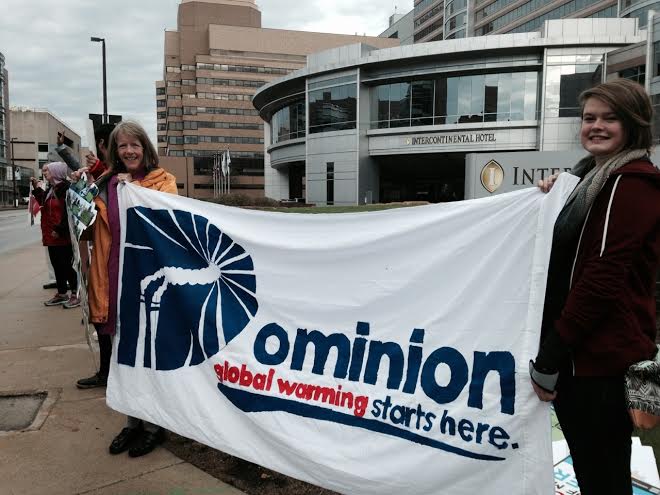
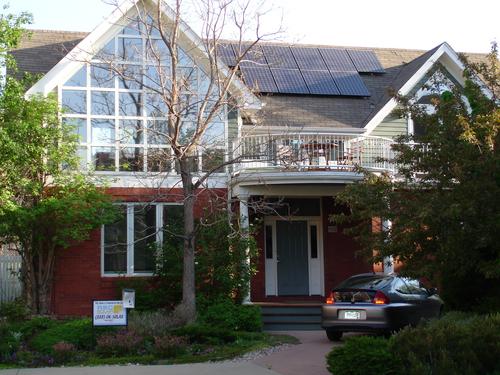
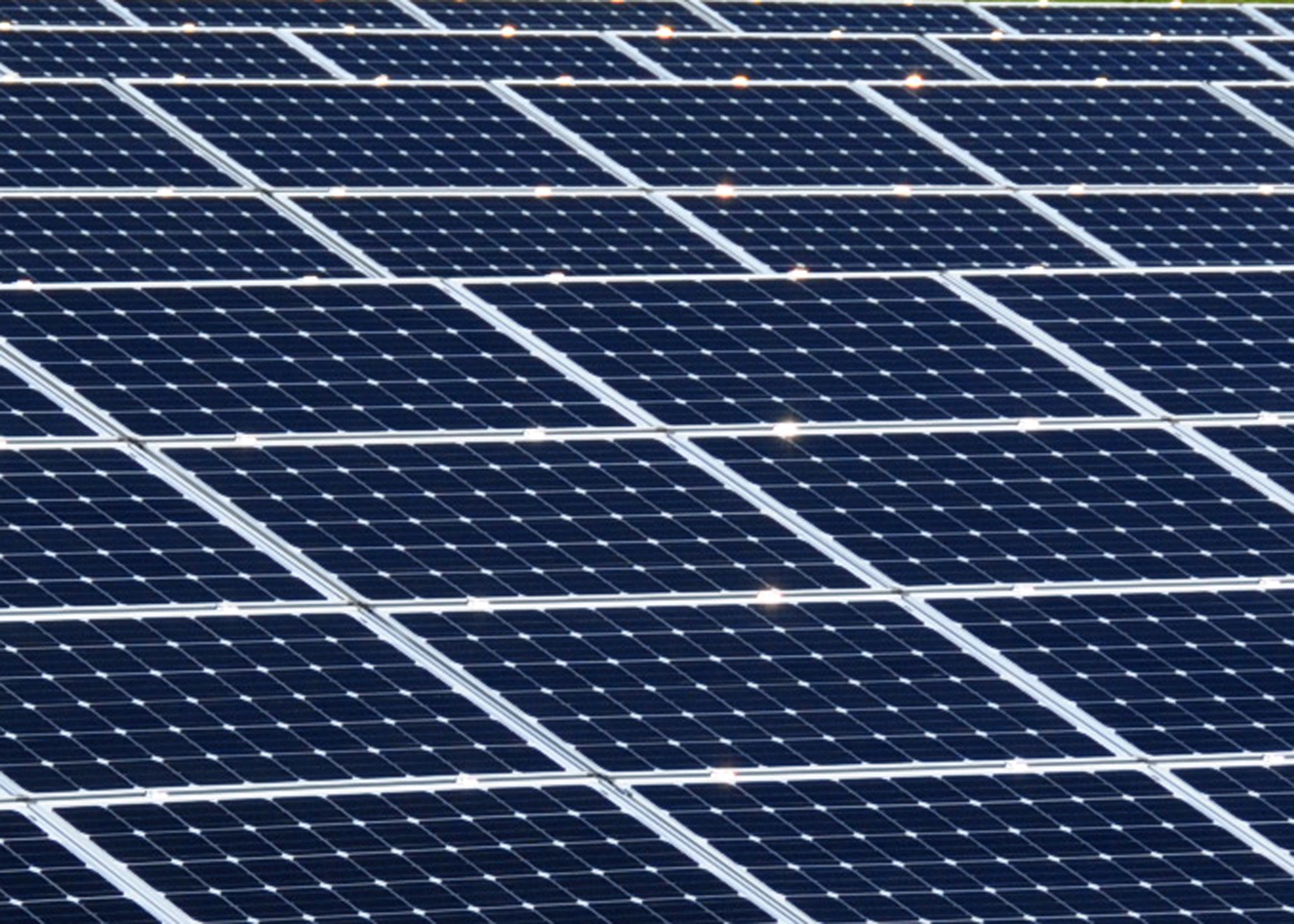
photoEvery year, on the first weekend in October, homeowners and businesses across the U.S. open their doors to a special kind of tourist: the solar wannabe. The American Solar Energy Society’s annual Solar Tour features homes with solar PV and hot water, along with an assortment of “green living” features that inspire envy and emulation.

Envy especially, I’m here to tell you. My home in the Northern Virginia suburbs is surrounded by beautiful mature trees that provide shade for my house, cooling for the neighborhood, carbon sequestration for the planet, and food for an abundance of insects, birds and other wildlife. What it doesn’t provide is a sunny place on the roof for solar panels. So when I go to houses on the DC Metro area tour, it’s a teeth-gritting experience.

I’m hardly alone. Less than a quarter of residents can install solar panels at their homes. The rest either have shade or other siting issues, or they are renters, or they live in condominiums where they don’t control the roof and common areas. That leaves the vast majority of us solar wannabes with nowhere to turn.

Some states let customers choose their electricity suppliers, which means they can select one that will supply them with renewable energy. But Virginia upholds the rights of monopolists to control our electricity supply. And my local monopolist, Dominion Virginia Power, sells only one electricity product: a mix of coal, nuclear, and natural gas, with barely a smidgen of stuff the legislature considers renewable (mainly wood trucked in from forests and burned).

I could subscribe to Dominion’s Green Power Program, but I’d still get the exact same dirty power. I’d just be paying extra for renewable energy certificates (RECs), mostly from wind farms in other states.

RECs don’t do it for me. Adding money to my utility bill for RECs is about as satisfying as buying a gallon of ordinary milk and adding a dollar extra to know that a buyer in Indiana paid for ordinary milk but got organic. Maybe both milks taste the same, but that’s not the point.

No, if I’m buying RECs, I want them to come attached to actual, Virginia-made wind or solar power. I know I’m not alone; the 20,000 people who have signed up for the Green Power Program, plus those who buy from other REC sellers like Pear and Arcadia, are proof that if Dominion cared to build wind or solar, it would find a ready market.

But it hasn’t. And Dominion also refuses to let the private market do the job. I’ve been approached by would-be solar developers who ask why they can’t put a solar array on unproductive farmland and sell the power to people like me. When that happens I swoon with delight for a moment, then glumly point them to the experience of Washington and Lee University three years ago. The university wanted to buy solar from a project on its campus but owned by a developer. Dominion came down on them like a ton of bricks, claiming a violation of its monopoly.

Dominion also opposes allowing customers to pool their money for a shared solar project, like an array on one house that could provide electricity for two or more. Sometimes called community net metering or solar gardens, and a growing trend in other states, shared solar unleashes the power of private investment by freeing up customers to build and own solar together and get credit on their utility bills for their percentage of the electricity the project puts on the grid. Imagine how much new economic activity we could create this way, and how much clean generation we could build, without state government mandates or subsidies.

There are thousands of Virginians like me who want renewable energy and are willing to pay for it. If our utilities don’t want to build it, they should step aside and let customers do it.
Unknown's avatar

Dominion’s ties to ALEC, McDonnell’s conviction, all part of one corrupt package

Group Dominion quit ALEc image 2

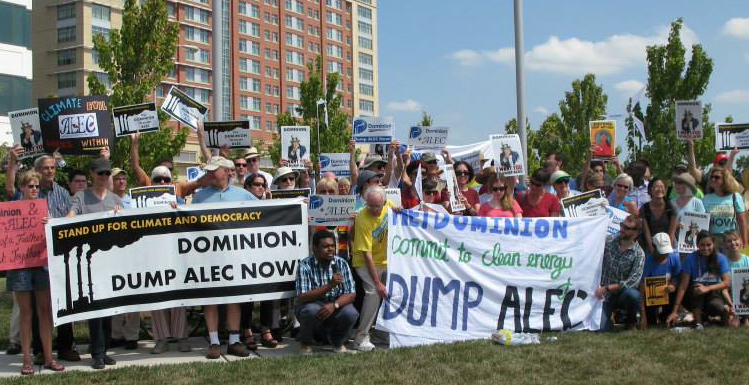
Protesters gather outside the Crystal City headquarters of ALEC

A crowd of protesters gathered at the Arlington headquarters of the American Legislative Exchange Council (ALEC) on September 4 to demand that Dominion Resources, the parent of public utility monopoly Dominion Virginia Power, drop its membership in the right wing “bill mill.”

On the very same day, a jury convicted ex-Governor Bob McDonnell and his wife on federal corruption charges, setting off a new round of debate about Virginia’s lax ethics laws.

The two news items sound like different topics, but in fact they are both about the corruption undermining our democratic system. The McDonnell trial, with its focus on swank vacations, golf clubs, designer clothes and other neat stuff, actually missed the bigger breach of public trust that goes on every day. This takes the form of unlimited corporate campaign contributions and gifts to members of both parties, and the influence over legislation purchased by this largesse.

Dominion Power has spent decades and many millions of dollars building its influence in Richmond this way, to the point where most legislators don’t bother pursuing a bill if the utility signals its opposition. That’s why Virginia has not followed so many other states in requiring its utilities to invest in energy efficiency, wind and solar. Economic arguments, jobs, electricity rates—all these are talked about in committee, and all are irrelevant to the fate of a bill. The only relevant question for legislators is, “What does Dominion think?”

What Dominion thinks, though, is not about what’s good for its customers, but what’s good for its own bottom line. And this is where ALEC comes in. Dominion Virginia Power’s president, Bob Blue, sits on an ALEC committee with representatives from the climate-denial group Heartland Institute, the Koch-funded anti-environment group Americans for Prosperity, and that most oxymoronic of lobby shops, the American Coalition for Clean Coal Electricity. Their purpose is to craft model state bills that protect fossil fuel profits and attack all efforts to regulate carbon emissions.

Dominion provides a straight shot from ALEC’s back-room bill-brokering to Virginia’s statute books, trampling environmental protections along the way and giving the lie to Dominion’s façade of environmental responsibility. No wonder so many of last week’s protesters were Dominion customers who objected to the utility using the money it charges them for electricity to pay its ALEC dues.

We see the result every year in the General Assembly, as bills drafted by ALEC pop up all over the place without attribution. In addition to attacking clean energy, ALEC bills oppose worker protections and minimum wage initiatives, promote stand-your-ground bills like the one at issue in the Trayvon Martin case, and of course, undermine the kinds of clean-government efforts that would reduce the influence of corporations—like campaign finance reform.

And because the voters are the only people who could prove more powerful than corporations—and the only ones who might ultimately cut off the corporate cash flow—ALEC works to undermine voting rights as well.

In the wake of the McDonnells’ convictions, Virginia legislators are once again mumbling about tightening up the rules on gifts. The discussion is half-hearted; the pay for their work is paltry and the hours are long, so they aren’t anxious to give up the perks.

But it’s too late for half-measures. Elected officials are going to have to subject themselves to a ban on gifts, and the prohibition should extend to ballgame tickets, golf getaways and sit-down dinners. The loophole that currently allows campaign funds to be used for personal use must also be closed to avoid an end-run around the gift ban.

But until we turn off the corporate cash spigot, our democracy will still have special interests, not voters, calling too many shots.

Unknown's avatar

Finally, utility-scale solar for Virginia?

111022-N-OH262-322After a solar buying spree in other states, Dominion Power is at last taking a look at the possibility of building utility-scale solar in Virginia.

As reported in the Richmond Times-Dispatch, Dominion Resources, the parent company of Dominion Virginia Power, is considering building 220 megawatts of solar projects in Virginia, starting in 2017. The plan would involve five 40-megawatt “greenfield” projects, plus 20 megawatts located at existing power stations. (A greenfield is an area that is not already developed. So the large projects would be on former farmland, say, not closed landfills or old industrial sites.)

The company’s recent solar buys in California, Connecticut, Indiana, Georgia and Tennessee have all involved the unregulated, merchant side of Dominion Resources. But in this case, the plan is for Dominion Virginia Power to own the Virginia projects and sell the electricity to its customers here in the Commonwealth. This would require approval of the State Corporation Commission—which, as we know, is no friend to renewable energy.

A little more digging confirmed that Dominion plans to sell the solar energy to the whole rate base, rather than, say, to participants in the voluntary Green Power Program. How would they get that past the SCC? That remains unclear, but they know keeping the cost down will be key. Right now they’re looking at all the options to make it work. The company is still at the conceptual stage, is still looking for good sites of 100 acres and up, and hasn’t even made a decision to proceed.

So we should probably hold our excitement in check for now. After all, Dominion has had wind farms in Virginia “under development” for the past several years, with nary a turbine in sight.

Solar does have a few advantages over wind, though, from a utility perspective. For one, it produces power during the day, when demand is higher, while onshore wind tends to blow more at night. (Offshore wind, on the other hand, picks up in the late afternoon and evening, right at peak demand time.) And unlike wind farms in the Midwest and Great Plains, where turbines coexist peacefully with cows and cornfields, turbines in the mountains of the east have generated opposition from people concerned about impacts on forests and viewsheds. You find some curmudgeons who think solar panels are ugly, but they aren’t trying to block them wholesale at the county level.

With the sharp drop in solar costs over the last few years, large-scale solar has been looking increasingly attractive to utilities that want to beef up their renewable energy portfolios. As we learned recently, Dominion’s got a long way to go before it competes with even an average utility elsewhere. That puts it in a poor position to respond to the rapid changes heading our way. These include not just growing public demand for wind and solar and new regulatory constraints on carbon emissions, but also the much-discussed upending of the traditional utility model that depends on a captive customer base and large centralized generating plants running baseload power. Distributed generation and batteries increasingly offer customers a way to untether themselves from the grid, while wind and solar together are pushing grid operators towards a more nimble approach to meeting demand—one in which baseload is no longer a virtue.

Dominion and its fossil fuel and nuclear allies are fighting hard against the tide, but in the end, Dominion will do whatever it takes to keep making money. And right now, the smart money is on solar.

None of this means we should expect Dominion to become more friendly to pro-solar legislation that will “let our customers compete with us,” as one Dominion Vice President put it. But it does suggest an opening for legislation that would promote utility-owned solar, perhaps through the RPS or stand-alone bills.

Legislators shouldn’t view utility-owned solar as an alternative to customer-owned solar; we need both. And if being grid-tied means being denied the right to affordable solar energy, we will see customers begin to abandon the grid. But those aren’t arguments against utility-scale solar, either. Big projects like the ones Dominion proposes are critical to helping us catch up to other states and reduce our carbon emissions.

So full speed ahead, Dominion! We’re all waiting.


Unknown's avatar

Report confirms Dominion’s worst-place standing on clean energy

photo courtesy of the Sierra Club

photo courtesy of the Sierra Club

A new report from the non-profit group Ceres shows Dominion Resources, the parent of Dominion Virginia Power, winning last place among investor-owned utilities on a nationwide ranking of renewable energy sales and energy efficiency savings.

That’s left Virginians wondering how a company that talks so big succeeds in doing so little. And more importantly, what would it take for Dominion to rank even among the average?

Dominion came in 30th out of 32 in renewable energy sales, at 0.52%. On energy efficiency, it achieved 31st out of 32 on savings measured cumulatively (0.41%), and 32nd out of 32 measured on an incremental annual level (at 0.03%). Together these put our team in last place overall—a notable achievement for a utility that trumpets its solar investments and carbon-cutting progress.

To show just how awful Dominion’s performance is, the top five finishers achieved between 16.67% and 21.08% on renewable energy sales, 10.62-17.18% on cumulative annual energy efficiency, and 1.46-1.77% on incremental annual energy efficiency. National averages were 5.29% for renewable energy sales, 4.96% for cumulative efficiency savings, and 0.73% for incremental annual efficiency savings. Rankings were based on 2012 numbers, the latest year for which data were available.

In case you’re wondering, American Electric Power, the parent company of Appalachian Power Co., earned 24th place for renewable energy, with 2.65% of sales from renewables—a number only half the national average and one we might have called pathetic if it weren’t five times higher than Dominion’s. AEP’s efficiency rankings also placed it firmly in the bottom half of utilities, running 23d and 20th for cumulative and incremental efficiency savings, respectively. However, AEP earned its own laurels recently as the nation’s largest emitter of carbon pollution from power plants due to its coal-centric portfolio.

A study of the rankings reveals that Dominion’s major competition for the title of absolute worst came from other utilities based in the South. The critic’s favorite, Southern Company, nabbed 31st place on the renewable energy sales measure, but failed to make the bottom five on one of the efficiency rankings. Another southeastern utility, SCANA, achieved rock bottom on renewable energy; but like Southern, its marginally better performance on efficiency disqualified it from an overall last-place ranking.

Why do utilities in the South do so poorly? Probably because they can. Most of the poor performers have monopoly control over their territories and are powerful players in their state legislatures. Lacking in competition, they do what’s best for themselves. Possessing political power, they are able to keep it that way.

Of course, they still have to contend with public opinion and the occasional legislator who gets out of line. For that it helps to have a well-worn narrative handy, like the one about how expensive clean energy is. Dominion has found that Virginia’s leaders fall for that one readily, even though it’s false.

And so, when asked about the Ceres report, Dominion responded that Virginia wouldn’t want to be like the states that have high-performing utilities. Dominion spokesman Dan Genest told the Daily Press, “The three states — California, Connecticut and Massachusetts — the report mentions as being leaders in those categories also have among the highest electric rates in the nation. Typical residential customer monthly bills are $228.85, $206.07 and $191.04, respectively. Dominion Virginia Power customers pay $112.45.”

This would be an excellent point, if it were true. Alas, Genest’s numbers appear to be a product of a fevered imagination. According to recent data reported in the Washington Post, California’s average monthly electric bill is only $87.91, Connecticut’s comes in at $126.75, and Massachusetts’ at $93.53, while Virginia’s is $123.72. (Virginia’s numbers presumably reflect an average of bills paid by customers statewide, probably accounting for the higher figure than Genest cites for Dominion’s “typical” customer.)

That’s right: in spite of higher rates, Californians pay way less for electricity than Virginians do, in part because they have achieved high levels of energy efficiency. If you do that, you can afford to invest in more renewable energy without people’s bills going up.

This is such a great idea that it seems like it would be worth trying it here. Remarkably, this is precisely the strategy that environmental groups have been urging for years in their conversations with legislators and their filings at the State Corporation Commission. With the pressure on from global warming and the EPA’s Clean Power Plan, this would seem to be a great opportunity to save money, cut carbon, and move us into the 21st century.

So go for it, Dominion. Aspire to lead! Or failing that, at least shoot for average.


Unknown's avatar

What’s wrong with Dominion’s Green Power Program

Better than Green Power: installing a solar system yourself. Photo credit: NREL

Better than Green Power: installing a solar system yourself. Photo credit: NREL

Renewable energy advocates in Virginia were astonished to learn a few weeks ago that the U.S. Environmental Protection Agency has given Dominion Virginia Power an award for its Green Power Program.

Dominion’s program is not, to put it mildly, a good one. Half of the money its customers contribute is siphoned off for overhead and “education.” The rest goes to buy renewable energy certificates from out of state. Over the years Dominion has collected millions of dollars in these voluntary contributions without building a single wind or solar facility to supply the program. Surely the only green award this merits is one for greenwashing.

So I called the EPA to find out what criteria they use in determining who gets an award. It turns out the agency only measures the growth of a green power program, and Dominion has signed up more customers than other utility programs have.

I had to laugh. Customers of utilities in most other states have real options to buy wind and solar. If you can buy wind energy from an alternative supplier or participate in a community solar project, or if your utility is aggressively incorporating renewables into its power supply, you don’t need a green power program.

But Dominion has never built more than token amounts of renewable energy, and it continues to use its monopoly position to erect barriers to competition from others. The utility has signed up 19,000 Green Power participants only because it has effectively denied its Virginia customers any meaningful way of participating in the renewable energy market.

News of this award will surely lure more people in. Yet even if every one of Dominion’s customers signed up for the program, it wouldn’t shrink Virginia’s carbon footprint. Instead, Dominion’s latest integrated resource plan reveals plans for more fossil fuel generation and increasing greenhouse gas emissions over the next fifteen years.

And it’s worse than that. As of this year, Dominion is actually using the Green Power Program to bankroll an attack on renewable energy—one the State Corporation Commission shamefully endorsed when it approved the company’s 3-megawatt “solar purchase program.”

In this charade, Dominion buys solar power from homeowners and businesses to resell to the Green Power Program. The deal nets sellers a few cents over the retail price of electricity, but costs the Green Power Program almost three times as much. This overcharging of the Green Power Program would be bad enough. But the more insidious problem lies in Dominion’s justification for the high charge. It claims that rooftop solar energy is no more valuable than power from fossil fuels that it can buy at wholesale.

Dominion’s position flies in the face of recent studies demonstrating the benefits of solar energy to the grid, including generating power where demand is, providing power during peak hours when energy is most expensive, avoiding the need for transmission upgrades, eliminating line losses, and reducing the need for new generation.

It also runs counter to trends in states like Georgia, where Georgia Power has put a higher–than-retail value on the solar distributed generation it plans to buy, and says that paying the extra won’t put upward pressure on rates.

This makes it especially difficult to understand why Virginia’s State Corporation Commission approved Dominion’s Green Power rip-off. And predictably, Dominion has followed up its win with a deeply flawed study it plans to use as a basis for a new round of standby charges on customers who net meter. (The case is PUE-2012-00064, available on the SCC web site.)

So what is a dedicated renewable energy advocate to do?

There are options. If you are determined to buy RECs, you don’t have to go through Dominion. Buy from another source. But better yet, install solar yourself if you can. The price of solar panels has dropped so precipitously over the past few years (down 60% since the start of 2011) that you may find it worth taking out a home equity loan.

If you don’t have a sunny roof yourself or can’t afford the whole upfront cost, you can work with your school, community center or place of worship to install solar panels in your neighborhood. Interest in solar is very high among Virginia faith congregations, driving large turnouts for presentations on the topic given by Sierra Club and others in cooperation with the solar industry.

Or you can take the money you were spending on Dominion’s program and give it to a charity that will use it to install renewable energy here in Virginia; this may even get you a tax deduction. Low-income housing providers like Richmond’s Better Housing Coalition now put solar panels on many of their facilities, and will accept donations specifically for that purpose.

The Virginia Center for Wind Energy at James Madison University accepts donations to its Wind for Schools program, which helps public schools across the commonwealth install wind turbines for educational purposes.

A new non-profit, Three Birds Foundation, is working to put solar on public schools that serve low-income children in Virginia and elsewhere.

All these charities are committed to doing what Dominion, apparently, doesn’t want to do: install solar and wind energy in Virginia.