Unknown's avatar

Remember when ethics in government mattered?

Protesters in front of a Tesla building.
People line up in front of a Tesla Service Center to protest Elon Musk. Rockville, Maryland. Photo by G. Edward Johnson via Wikimedia

It was only a decade ago that a governor of Virginia, Bob McDonnell, was embroiled in a corruption scandal resulting from his acceptance of $177,000 in gifts and loans from a businessman in exchange for promoting the company’s diet supplement. The quid pro quo struck many people at the time as more tacky than corrupt; and indeed, the U.S. Supreme Court eventually overturned his conviction on the grounds that using the governor’s mansion as a promotion venue wasn’t a sufficiently “official” act. 

These days, the kerfuffle raised by the exposure of McDonnell’s little side hustle feels almost quaint. It also feels like foreshadowing, anticipating President Donald Trump’s use of the White House lawn as a Tesla showroom to thank Elon Musk for his hard work in destroying American government. 

In the present-day version, though, it does not appear the carmaker’s $290 million in election spending played a role beyond instilling a warm fuzzy feeling in the bosom of the president. So while ordinary people may be appalled, and Democratic leaders like Rep. Gerry Connolly of Virginia are demanding an investigation, it’s hard to see the Supreme Court batting an eye. Is it so different from Justice Clarence Thomas accepting a luxury RV from a wealthy businessman?

Trading favors among the rich and powerful seems to be how it works in Trump’s America. Anyone who isn’t using his public position for his own gain is a chump. And while the laws prohibiting corruption are still on the books, Trump has ensured there are no federal prosecutors left with the independence to go after his allies. 

Besides which, in the unlikely event your cupidity actually gets you convicted of a crime, the president has a history going back to his first term of handing out pardons to MAGA loyalists regardless of their crimes. Sufficiently demonstrating fealty to the president may be enough to secure your place in his No Grifter Left Behind program. Frankly, the judge who sentences you has more to fear from the president than you do.  

By design, Trump’s attacks on American government, civil society and the world order have been so various and extreme as to leave opponents breathless. The resistance looks like a team of firefighters trying to deal with a large and very determined pack of juvenile arsonists. 

Yet, of all the fires now burning, Trump’s attacks on the rule of law might pose the single greatest threat to the country’s stability and prosperity. Trump’s firing of government watchdogs, blacklisting a law firm that represented his enemies, and defying judges who rule against him are unprecedented in modern U.S. history. Our economy as well as our democracy was built on a system of checks and balances that made corruption the newsworthy exception rather than the dismal norm.

This was brought home to me in a conversation I had recently with a rancher in, of all places, Patagonia, at the far tip of South America. (When the going gets tough, the not-very-tough go hiking.) The owner of an 8,000-acre estancia turned out to have been involved in Chilean politics for 30 years, representing his region in the Chilean Congress. He didn’t know much about what was going on in the U.S., he admitted, but he felt encouraged by the news that Trump was cutting waste and fraud. 

Okay, yes, I guffawed, but I was also struck that, with all the turmoil and crises going on in Washington, the only thing that survived a distance of 6,000 miles was Trump’s spin on his actions. Still, you hardly need to go to Chile to find people who accept Trump’s through-the-looking-glass framing of his dismantling of government institutions. 

A pro-Trump family member, as big-hearted a guy as you will ever meet, told me he was sad that people in developing countries would go without food and medicine as a result of Trump shutting down foreign aid, but it had to be done “because of all the fraud.” Virginia Gov. Glenn Youngkin is also an ardent supporter of Trump’s ever-expanding trims, last week defending the slashing of thousands of federal workers’ jobs as “dislocation” necessary to “gain efficiencies and reduce costs in the federal government.”

That’s the power of language. What Trump calls fraud and corruption turns out to be grants for things he doesn’t like, but his choice of words makes it seem he is fighting for the kind of honest government he is actually working to undermine. 

It’s not wrong for people to worry about corruption, though, whether it is the imaginary kind Trump invokes or the real kind we will face when no watchdogs are left to hold his appointees accountable. Whether conservative or socialist, corruption in government leads to a siphoning off of public dollars, the erosion of social cohesion and trust, economic distortion and lower levels of investment in education and health care. Sure, some businesses are going to prosper when they can evade laws with just a well-placed application of palm grease, but economists find that overall, official corruption is a drag on a country’s economic performance. Not to mention, most of us see it as fundamentally unAmerican.  

But has Trump actually launched the U.S. on a slippery slide down the corruption index? I talked over my concerns with a fellow Mercury contributor, Michael O’Grady. O’Grady is a research economist and Ph.D. candidate at Virginia Commonwealth University who studies public policy and administration, and he thinks the situation is even worse than I suggest. 

Like many scholars, he feels the face-off between Trump and the courts has brought the U.S. to what he calls “the biggest inflection point since at least U.S. v. Nixon, and maybe since Marbury v. Madison in 1803.”  And, he points out, if Musk’s Department of Government Efficiency was really uncovering fraud in government contracts, we should have seen cases being referred to the Department of Justice for prosecution. 

Meanwhile, he says, the firing of government watchdogs and the politicization of the federal government will have real consequences on people’s lives, affecting everything from housing costs to the stock market. When government oversight lapses, corporations tend to engage in market manipulation and tax evasion. To take one example, last summer the DOJ sued a company called RealPage for allowing competing landlords to collude in setting apartment rents. We aren’t likely to see that kind of action from the Trump administration.

O’Grady doesn’t see how this can end well, and neither do I. I’d like to think that in the U.S., our fifty state governments could provide some kind of pushback against malfeasance at the federal level. But I’m aware that’s delusional. For one thing, my own experience is that federal bureaucrats are saints compared to state and local officials, who have much more motivation to swap favors with people and businesses in their communities. And for another, Republican fealty to Trump is so strong that it’s hard to imagine a state attorney general from his own party taking action even if state laws were implicated. Recall that it wasn’t a state prosecutor who indicted Bob McDonnell; it was the U.S. Department of Justice. 

I’d have much less concern over Democrats rallying around a party leader if roles were reversed. Loyalty is a conservative value, not a liberal one. Recall how Democratic governor Ralph Northam was called on to resign by members of his own party over a blackface incident. Democrats eat their own.

For now, at least, one bulwark against Trumpism remains: an independent, non-partisan press committed to reporting the facts and holding government officials accountable. There has never been as great a need for unbiased journalism as there is today, or more need for ordinary Americans to support it. 

O’Grady reminded me of the (probably apocryphal) story of Benjamin Franklin describing the young United States as “a republic, if you can keep it.” Whether we keep it now depends on us.

This article was published in the Virginia Mercury on March 25, 2025.
Unknown's avatar

Why Trump won’t stop the clean energy revolution

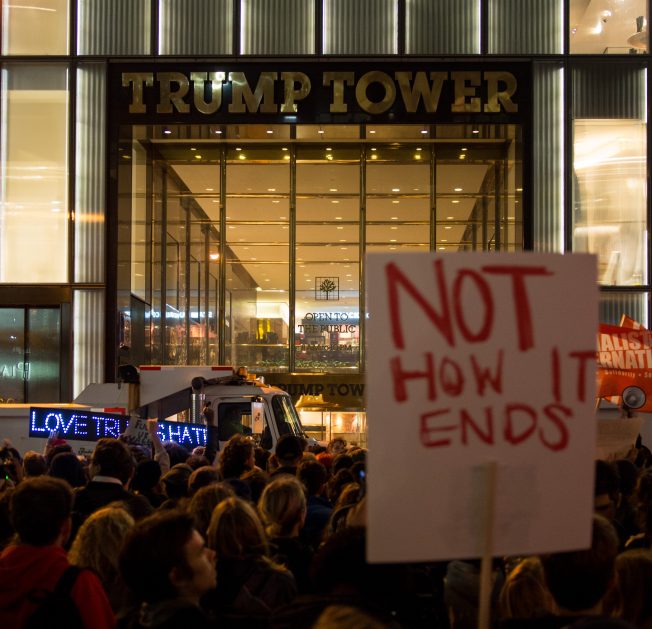
A protest in Manhattan against the presidency of Donald Trump, held the day after the election. Photo credit Rhododendrites - Own work, CC BY-SA 4.0, https://commons.wikimedia.org/w/index.php?curid=53011447

A protest in Manhattan against the presidency of Donald Trump, held the day after the election. Photo credit Rhododendrites – Own work, CC BY-SA 4.0, https://commons.wikimedia.org/w/index.php?curid=53011447

It is not an overstatement to say that Donald Trump’s win over Hillary Clinton horrified everyone who is worried about climate change. Reading the news Wednesday morning was like waking up from a nightmare to discover that there really is a guy coming after you with a meat cleaver.

You might not be done for, though. You could just end up maimed and bloodied before you wrest the cleaver away. So with that comforting thought, let’s talk about what a Trump presidency means for energy policy over the next four years.

I’ve had a lot of time to think about this. As a career pessimist, I’ve been worried about the possibility of a Trump win since last spring. I can fairly say I was panicking before panic became mainstream. But even with the worst-case scenario starting to play out, I’m convinced we will continue making progress on clean energy.

There is no getting around how much harder a Trump presidency makes it for those of us who want the U.S. to meet its obligations under the Paris climate accord. It’s not clear that Trump can actually “cancel” the accord, as he has promised to do. On the other hand, a man who puts fossil fuel lobbyists and climate skeptics in charge of energy policy is hardly likely to ask Congress for a carbon tax.

Nothing good can come of it when the people in charge relish chaos and embrace ignorance. Destroying the EPA will not stop glaciers melting and sea levels rising.

But just as politicians can’t repeal the laws of physics driving global warming, so there are other forces largely beyond their control. Laws and regulations currently in place; state-level initiatives; market competition; technological innovation; and popular attitudes towards clean energy have all driven changes that will withstand a fair amount of monkeying with. It’s worth a quick review of these realities.

Coal is still dead

Donald Trump’s promise to bring back coal jobs is about as solid as his promise to force American companies to bring jobs back from China. Even if he’s sincere, he can’t actually do it.

The economic case for coal no longer exists, and that remains true even if Trump and anti-regulation forces in Congress gut EPA rules protecting air and water. Fracking technology did more than the Obama administration to drive coal use down by making shale gas cheap. A glut of natural gas pushed prices down to unsustainable levels and kept them there so long that utilities chose to close coal plants or convert them to gas rather than wait.

What gas started, renewables are finishing. Today, coal can’t compete on price with wind or solar, either. That leaves coal with no path back to profitability. Not many utilities want to pollute when not polluting is cheaper.

Nor will the export market recover. China doesn’t want our coal, and a president who pursues protectionist trade policies will find it hard to get other countries to take our products.

It’s also hard to find serious political support for coal outside of a handful of coal states. Politicians say they care about out-of-work coal miners, but they care more about attracting industry to their states with cheap energy. That is certainly the case in Virginia, where Governor McAuliffe didn’t even include coal mining or burning anywhere in his energy plan.

If there is a silver lining for coal miners, it’s that without an Obama bogeyman to blame for everything, coal-state Republicans will have to seek real solutions to unemployment in Appalachia.

Solar and wind are still going to beat out conventional fuels

Analysts predict renewable energy, especially solar, will become the dominant source of electricity worldwide in the coming decades. Already wind and solar out-compete coal and gas on price in many places across the U.S. As these technologies mature, prices will continue to fall, driving a virtuous cycle of escalating installations and further price reductions.

While federal policies helped make the clean energy revolution possible, changes in federal policy now won’t stop it. Today the main drivers of wind and solar are declining costs, improvements in technology, corporate sustainability goals, and state-level renewable energy targets.

As the revolution unfolds over the next decade, the folly of investing in new fossil fuel and nuclear infrastructure will become increasingly clear. Natural gas itself is cheap right now, but new gas infrastructure built today will become worthless before it can recover its costs and return a profit. Corporations like Dominion Resources and Duke Energy are investing in gas transmission pipelines and gas generating plants only because they think they can profit from them now, and force captive utility customers to bear the cost of paying off the worthless assets later.

Advocates fighting new gas infrastructure have mostly had to work at the state level, since they’ve received little help from the Feds. That much won’t change. The cavalry isn’t coming to save us? Well, we are no worse off than we were before. We just have to do the job ourselves.

Dominion’s gas build-out is still a bad idea

Dominion Power is enthusiastic about natural gas, but we’ve seen this movie before. Environmentalists and their allies tried, and failed, to stop Dominion’s newest coal plant in Wise County from being built. Regulators approved it in spite of Dominion’s cost projections showing a levelized cost of energy of 9.3 cents per kilowatt-hour. That’s about twice the wholesale price of energy today, and well above where wind and solar would be even without subsidies.

Approval to construct the plant came in the fall of 2008. A mere eight years later, that looks like a terrible decision. Dominion Virginia Power shows no further interest in building coal plants. Instead, it has since built two huge natural gas plants and received approval to build a third. Its sister company is building the Atlantic Coast Pipeline to lock ratepayers into even more gas.

Eight years from now, those will look like equally bad decisions.

Renewable energy is popular with everyone

One of the most remarkable pieces of legislation passed during the last few years was the extension of the Investment Tax Credit and the Production Tax Credit, subsidies that have underpinned the rapid spread of solar and wind power. It turns out that Republicans don’t actually hate subsidies; they only hate the ones that benefit other people.

Wind energy is one of the bright spots in the red states of the heartland. Farmers facing volatile markets for agricultural products appreciate the stable income they get from hosting wind turbines among the cornfields, and they aren’t going to give that up.

And everybody, it turns out, loves solar energy. There’s a simple, populist appeal to generating free, clean energy on your own roof. The failure on Tuesday of a utility-sponsored ballot measure in Florida is especially notable: the constitutional amendment would have ended net metering and led to steep declines in solar installations in the Sunshine State. Voters said no. The lesson will resonate across the South: people want solar.

Indeed, public polling for years has shown overwhelming support for wind and solar energy, across the political spectrum. Even people who don’t understand climate change think it’s a good idea to pollute less. And the energy security benefits of having wind and solar farms dotting the landscape are simple and intuitive. So while the fossil fuel industry may use a friendly Trump administration to launch attacks on renewable energy, no populist army will back them.

The Clean Power Plan was important, but not transformative

Congressional Republicans have talked smack about the EPA for years, and the Clean Power Plan raised the needle on the right wing’s outrage meter to new levels. Most EPA rules have a layer of insulation from Congressional meddling as long as Senate Democrats retain the ability to filibuster legislation that would repeal bedrock environmental laws like the Clean Air Act. And laws protecting the air and water have such broad public backing that it is hard to imagine even the Chaos Caucus going there.

The Clean Power Plan could be different. Trump’s choice of a new Supreme Court justice will produce a conservative majority that might well strike down Obama’s most important carbon rule. For a handful of states that rely heavily on electricity from aging coal plants and aren’t compelled to close them under other air pollution rules, this will buy them a few years. (But see “Coal is still dead,” above.)

For most states, though, the Clean Power Plan was never going to be a game-changer. Many states were given targets that are easy to meet, or that they have already met. As I’ve pointed out before, Virginia’s target is so modest that the state could meet it simply by adopting a few efficiency measures and supplying new demand with wind and solar. That’s if the state decided to include newly-built generating sources in its implementation plan, which it doesn’t have to do.

By its terms, the Clean Power Plan applies only to carbon pollution from power plants in existence as of 2012. Newer generating plants are regulated under a different section of the Clean Air Act, under standards that new combined-cycle gas plants can easily meet. That’s a gigantic loophole that Dominion Virginia Power, for one, intends to exploit to the fullest, and it’s the reason the company supported the Clean Power Plan in court.

Regardless of whether it is upheld in the courts, however, the Clean Power Plan has already had a significant effect nationwide by forcing utilities and state regulators to do better planning. It led to a raft of analyses by consulting firms showing how states could comply and actually save money for ratepayers by deploying cost-effective energy efficiency measures. If the Clean Power Plan doesn’t become law, states can ignore those reports, but their residents should be asking why.

For Virginia, nothing has changed at the state level. Or has it?

Virginia has off-year elections at the state level, so Trump’s election has no immediate effect on state law or policy. Most significantly, Terry McAuliffe is still governor of Virginia for another year, he still knows climate change is real, and his Executive Order 57, directing his senior staff to pursue a strategy for CO2 reductions, is still in effect. McAuliffe has disappointed activists who hoped he would become a climate champion, but Trump’s win could light a fire under his feet. He has an opportunity to put sound policies in place, if he chooses to do so.

Offshore drilling in Virginia probably isn’t back on the table

Trump has promised to re-open federal lands for private exploitation, reversing moves by the Obama administration. His website says that includes offshore federal waters. However, the decision by the Bureau of Ocean Energy Management to take Virginia out of consideration for offshore drilling isn’t scheduled to be revisited for five years. Trump’s people could change the process, perhaps, but there’s not much demand for him to do so. With oil prices low, companies aren’t clamoring for more places to drill.

Environmental protection begins at home . . . and the grassroots will just get stronger

I would hate for anyone to mistake this stock-taking for optimism. The mere fact that the clean energy revolution is underway does not mean it will proceed apace. Opportunities abound for Trump to do mischief, and nothing we have heard or seen from him during the campaign suggests he will rule wisely and with restraint.

But advancing environmental protection has always been the job of the people. Left by itself, government succumbs to moneyed interests, and regulators are taken captive by the industries they are supposed to regulate. Americans who want clean air and water and a climate that supports civilization as we know it have to demand it. It will not be given to us.

Sound economics, common sense, and technological innovation are on our side. Most important, though, is the groundswell of public support for clean energy and action on climate. That never depended on the election, and it won’t stop now.