
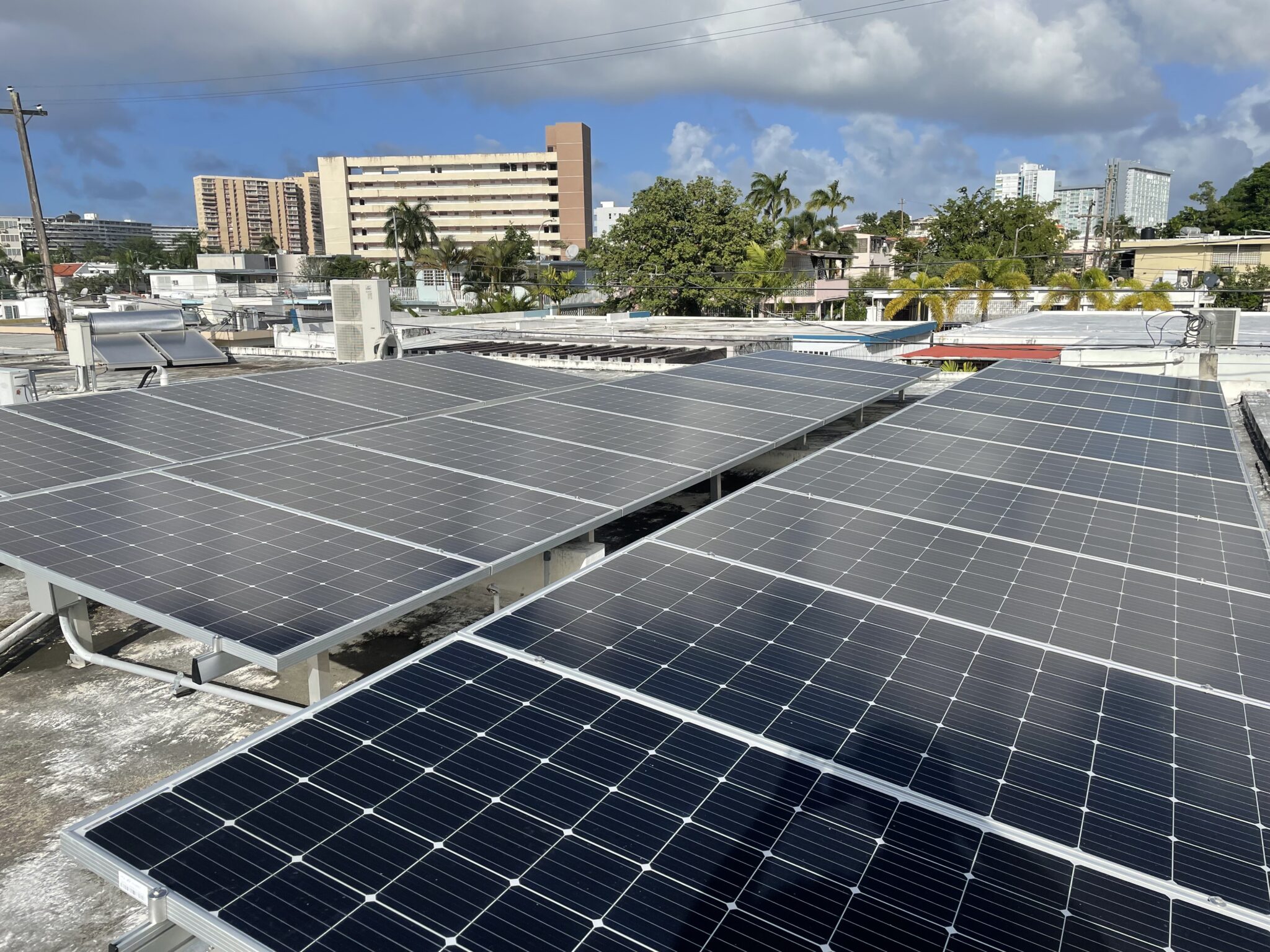
Rooftop solar panels are helping generate electricity after Hurricane Maria destroyed much of the island electrical infrastructure. (Photo by Aaron Sutch/Solar United Neighbors)
Back in 2017, a hurricane destroyed Puerto Rico’s power grid. The island struggled to rebuild it, with limited success, and continues to experience a severe electricity shortage and frequent power outages. Customers and nonprofits have stepped into the void, installing solar panels on rooftops all over the island and backing them up with batteries. Today, 175,000 households have solar — about 1 in 7 – and at least 160,000 of those also have battery backup. Thousands of new installations go in every month.
The solar and batteries don’t just secure electricity for the customers who install them. Through programs like one managed by the solar company Sunrun, Puerto Rico’s grid can draw on the batteries to provide power in times of emergency, reducing the frequency and duration of power outages for everyone.
Last month, as hurricane season got underway again, Puerto Rico’s grid operator announced it had reached a “major energy milestone.” In a statement posted on X, LUMA Energy said it “successfully dispatched approximately 70,000 batteries, contributing around 48 MW of energy to the grid.” That’s about as much as a gas peaker plant, with no need for fuel.
Puerto Rico’s experience shows how residents and businesses no longer need to be passive energy consumers. With a well-designed program they can play an active role in keeping the lights on in their communities, and get paid for it.
This customer participation creates what is called a “virtual power plant” (VPP), sometimes also called a community power plant. The VPP may use battery aggregation, as in Puerto Rico, or demand reduction measures like temporary adjustments to smart thermostats or shifting electric vehicle charging to off-peak times. The more these measures are combined, the bigger the benefit to the grid, and the less a utility needs to invest in new generation to meet peaks in demand.
VPPs offer such promise that this year Virginia’s General Assembly directed Dominion Energy to develop a pilot program for its customers, to be overseen by the State Corporation Commission.
HB2346, from Del. Phil Hernandez, D-Norfolk, calls for a program of up to 450 MW to “optimize demand” with distributed energy resources, mainly batteries but also smart thermostats, electric vehicle charging and non-battery storage (e.g., electric hot water heaters). The proposal, due to be filed with the SCC by December 1, must include incentives for at least 15 MW of residential batteries. The legislation calls for stakeholder participation in the development of the VPP, with opportunities for public input.
Dominion is also tasked with expanding the electric school bus program it began in 2019, which allows the utility to make use of school bus batteries at times of the day when the buses are not needed to transport children. As of March of 2024, Dominion had 135 electric buses in the program, spread across 25 school districts in Virginia.
The impact of VPPs can be significant. This summer, California’s grid operator conducted an experiment to determine how much customer batteries could contribute to the needs of the grid. More than 100,000 residential batteries across California delivered an average of 535 MW of power from 7 to 9 p.m. on July 29, an output equivalent to that of a coal plant.
Many other states are also using VPPs. Some are limited to solar-powered battery aggregation, like Xcel’s Colorado program and a new Texas program, while others involve demand response programs using smart appliances – anything that can be turned off and on remotely for short periods. In Michigan, DTE pays electric vehicle owners to charge at off-peak times, while Arizona Public Service’s VPP pays customers for the ability to access their smart thermostats to reduce peak demand.
Vermont’s Green Mountain Power runs two popular battery programs, one for people who own their own batteries and the other that leases batteries to customers. Both allow the utility to draw on the batteries when the power grid requires more capacity.
While Virginia has not had a VPP program before, appliance-based demand response will be familiar to residents who opted into Dominion Energy’s “Smart Cooling Rewards” program. Participants allowed the utility to remotely turn their air conditioners on and off for a few minutes at a time on hot days in exchange for an annual $40 payment. This helped the utility shave peak demand without affecting residents’ comfort.
Dominion ended the cooling rewards program in 2022 and now offers a “Peak Time Rebate” program that rewards customers for reducing energy use during certain times of high energy demand. This program, however, requires residents to take affirmative measures themselves, like adjusting thermostats and delaying laundry. A well-designed VPP program, by contrast, takes the burden off the individual.
Josephus Allmond, a lawyer with the Southern Environmental Law Center who helped to craft the Virginia VPP legislation, told me in an email that he expects school buses and smart thermostats will make up most of Dominion’s program initially, but he’d like to see the residential battery component grow significantly from the initial 15 MW. Even 100,000 aggregated residential batteries would be a minor share of Dominion’s 2.8 million residential accounts, he pointed out.
I emailed Nathan Frost, Dominion’s general manager for new business and customer solutions, to ask for more information about the VPP program. Frost replied only that Dominion is “actively developing our VPP framework and will be engaging stakeholders soon.”
Stakeholders, including customers themselves, are likely to have a lot to say. Clean energy advocates have long urged that VPPs, distributed generation sources and microgrids can contribute to a more efficient, secure and resilient grid, at less cost to everyone.
No doubt recentering the grid around customers is too tall an order for a monopoly utility with a profit model based on centralized generation. But from what we’ve seen in Puerto Rico, California and elsewhere, harnessing even some of the power of customer-owned resources is a worthwhile project whose time has finally come.
This article was originally published in the Virginia Mercury on September 2, 2025.
Update: on September 15, Dominion sent this note:
Dominion Energy Virginia is preparing to file a virtual power plant (“VPP”) pilot proposal by December 1, 2025, pursuant to House Bill 2346 and Senate Bill 1100. As part of this effort, Dominion Energy Virginia is seeking stakeholder input. Please visit our website at https://www.dominionenergy.com/vpp. The website contains an overview of the legislation, a timeline, an informational webinar about VPPs and the Company’s plan, and additional information. We encourage all interested stakeholders to review the materials posted on the website and provide feedback through the link on the website by October 6, 2025.
If you have questions, please contact virtualpowerplant@dominionenergy.com.
 Power for the People VA