Unknown's avatar

Joe Manchin’s Pyrrhic victory

The folly of building the Mountain Valley Pipeline should be obvious to anyone who hasn’t already committed billions of dollars to the project.
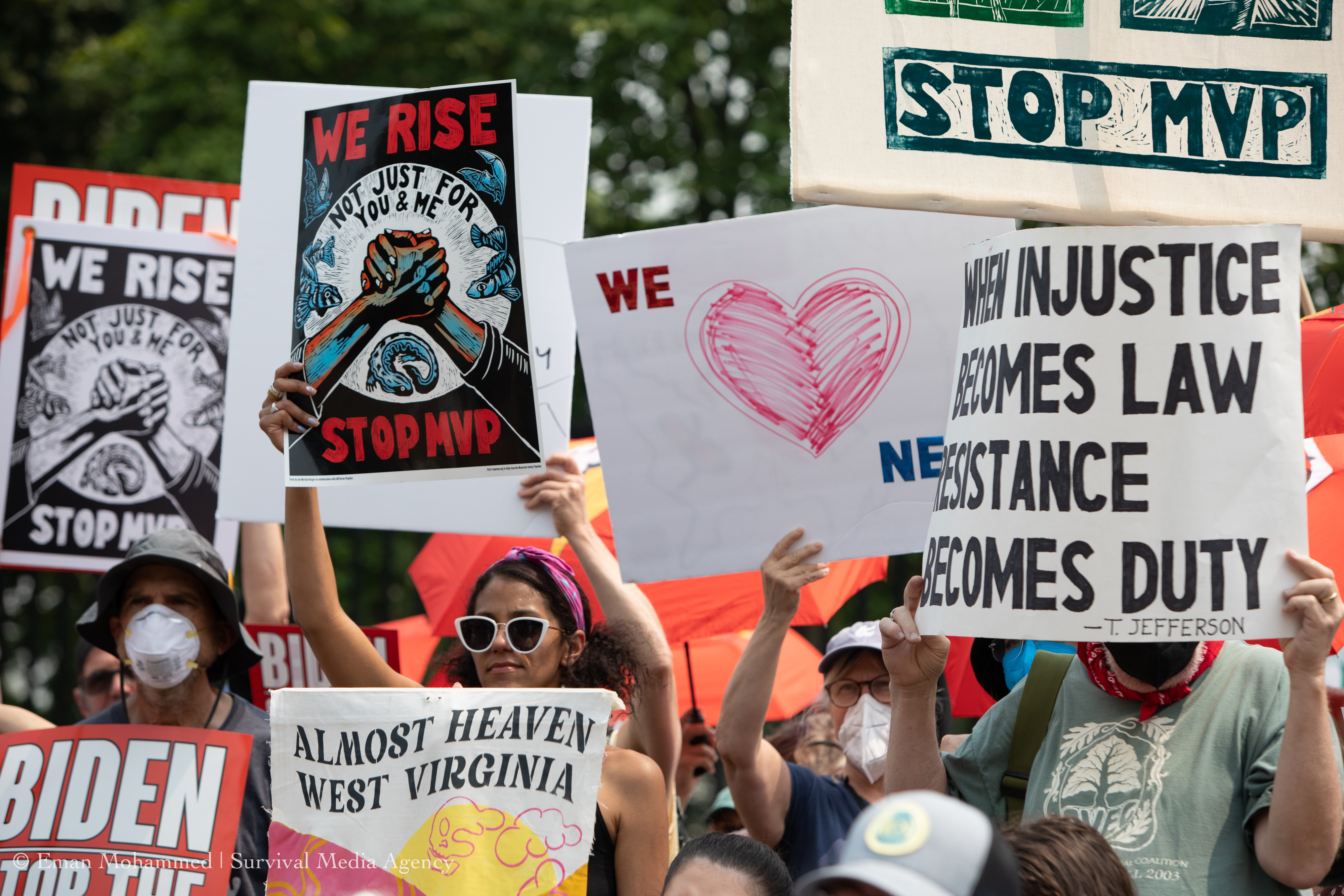
On Thursday, June 8, 2023, hundreds of frontline and Appalachian climate activists rallied at the White House against President Biden’s endorsement of the Mountain Valley Pipeline. (POWHR/Eman Mohammed/Survival Media Agency)


This spring’s passage of federal legislation raising the debt ceiling came with one provision that clean energy advocates had fought hard against: it sweeps away several legal challenges to the Mountain Valley Pipeline (MVP) that have stalled completion for more than four years. The pipeline is supposed to carry methane gas from the fracking fields of West Virginia into Virginia to connect to an existing interstate pipeline here, and getting it built has long been a priority of West Virginia Senator Joe Manchin.

Manchin surely believes he notched a victory with the inclusion of this provision in must-pass legislation. And in one respect, he’s right. Pipeline opponents aren’t conceding defeat, but stopping the MVP in court just got a heck of a lot harder. 

Whether the pipeline’s developers should be celebrating is another matter. The wisdom of building a new methane gas pipeline was questionable nine years ago when the MVP was conceived. Today, with the U.S. transitioning away from fossil fuels, the folly of building new gas infrastructure should be obvious to anyone who hasn’t already committed billions of dollars to the project.

Dominion Energy figured this out three years ago when it dropped plans to develop the Atlantic Coast Pipeline. Dominion is a big energy conglomerate and had other projects to pursue. Canceling the Atlantic Coast Pipeline saved it billions of dollars that it is now investing in offshore wind and other renewable energy assets. 

MVP’s two largest minority partners are also diversified companies with other options. NextEra Energy, which owns a 31% share in the partnership through its subsidiary Next Energy Resources, wrote off the value of its investment in MVP in 2021 and 2022, saying it planned to “reevaluate its investment in the Mountain Valley Pipeline.” 

A NextEra spokesperson did not answer my question about what the company plans to do about MVP now.  But if a picture is worth a thousand words, take a look at NextEra Energy Resources’ homepage. MVP isn’t mentioned anywhere on the website, which is largely a celebration of the company’s renewable energy assets. 

The third-largest stakeholder in the MVP is Consolidated Edison, with an initial 12.5% stake. In 2019 it exercised an option to cap its investment in MVP, and in 2020 it wrote down the value of its investment by almost half. ConEd CEO John McAvoy told investors that year the company would no longer invest in gas transmission projects and “certainly would” consider selling its stake in MVP. 

“We made those investments five to seven years ago,” he said, “and at that time we — and frankly many others — viewed natural gas as having a fairly large role in the transition to the clean energy economy. That view has largely changed, and natural gas, while it can provide emissions reductions, is no longer … part of the longer-term view.”

Unfortunately, these views aren’t shared by MVP’s majority owner and operator. Equitrans Midstream is solely a pipeline and gas storage company, having been spun off from a larger corporation, EQT, in 2018. MVP is its key to growth. The exit door may be wide open, but Equitrans doesn’t want to leave because it has nowhere to go.

That doesn’t mean it makes sense to stay, either. Many a gambler has learned the hard way that continuing to feed coins into a slot machine does not make it more likely to disgorge the jackpot. 

And really, if there ever was a jackpot for MVP, it is gone by now. In 2015, EQT saw an opportunity to undercut the price charged by existing pipelines to ship gas to an energy-hungry Southeast. Today, though, demand for methane gas has cooled in the face of cheap wind and solar, while MVP’s costs have ballooned to $6.6 billion from the initial projection of $3.25 billion. Analysts say MVP’s competitive advantage has evaporated, and its prospects for profitability look grim.  

Equitrans maintains that there is still a pressing need for its pipeline, but demand has always been hypothetical. From the very beginning, the partnership seemingly indulged in “build it and they will come” magical thinking. 

Getting a permit to build from the Federal Energy Regulatory Commission requires that pipeline developers have their customers lined up ahead of time in order to demonstrate a “need” for the project. Even in 2015 there were not enough customers clamoring for MVP’s services, so the partners named themselves as the buyers for more than half of the pipeline’s capacity. FERC’s approach to permitting allows this self-dealing, though the commission has been heavily criticized for it. 

Obviously, Equitrans was never going to be a customer; it isn’t in the business of generating power or selling gas at retail. Its field of dreams assumed demand for gas would grow, customers would be clamoring for pipeline capacity, and Equitrans would be able sell its share of the capacity and just reap the profits from owning the pipeline.

It’s hard to imagine that happening now. Economics had already started to favor wind and solar over fossil fuels when the MVP broke ground. Total natural gas consumption has been mostly flat nationwide since 2018, and the Energy Information Agency (EIA) projects it will decline steadily for the next decade. EIA also projects that more than half of all new electric generating capacity this year will be solar, with natural gas additions down to a mere 14%. Here in Virginia, methane gas burned by electric utilities has declined from a high in 2020.

The future will only get brighter for renewables and dimmer for gas. In 2020, Virginia committed to a zero-carbon energy future, and in 2022 Congress passed the strongest set of clean energy incentives in history. Betting on fossil fuels in today’s environment makes no sense.

Sure, Governor Youngkin is doing his level best to throw a wrench in the works, and Dominion Energy Virginia just proposed building a 1,000-megawatt gas combustion turbine, citing growing demand from data centers and electric vehicles. Misguided as that proposal is, it doesn’t signal good times ahead for the gas industry. Combustion turbines are not baseload plants; they run only when demand exceeds other sources of supply. Dominion has no plans to build new baseload gas plants.

MVP knows finding customers in Virginia will be hard. Before litigation and permit denials put construction on hold in 2018, the partnership had proposed an extension of the pipeline into North Carolina, perhaps hoping for better pickings in Duke Energy territory. Now that MVP has the congressional seal of approval, it is seeking to revive the proposed Southgate Extension, to the dismay of North Carolina activists. Yet economics don’t favor gas over solar there, either.

The liquefied natural gas export market has also been floated as a potential source of growth, but critics say the lack of liquefied natural gas terminal capacity prevents that from happening. 

It’s time to stop this travesty. Equitrans claims MVP is 94% complete, but opponents say the true figure is more like 56%, with many of the most difficult segments (like stream crossings) still to be tackled. Those are also the most environmentally sensitive parts of the line. Pulling the plug on MVP now would avoid not only the cost of completing the pipeline, but also the cost of fixing leaks, erosion damage and other problems critics believe are inevitable given the terrain and geology. 

That would be a much better result for everyone concerned than completing the pipeline to serve a market that doesn’t exist – a Pyrrhic victory if there ever was one.

This article was originally published in the Virginia Mercury on June 28, 2023.
Unknown's avatar

Southeastern electric utilities find their way to higher profits through gas pipelines and captive consumers

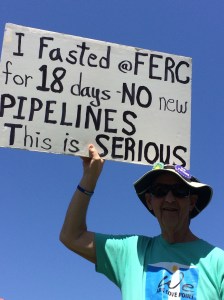
Charlie Strickler of Harrisonburg, Virginia, was one of a dozen activists who fasted last September in protest of FERC's role in approving natural gas pipelines, citing their contribution to climate change and harm to communities in their path. Photo by Ivy Main.

Charlie Strickler of Harrisonburg, Virginia, was one of a dozen activists who fasted last September in protest of FERC’s role in approving natural gas pipelines, citing their contribution to climate change and harm to communities in their path. Photo by Ivy Main.

Duke Energy, Southern Company, NextEra Energy and Dominion Resources—four of the largest investor-owned utilities in the U.S., all headquartered in the Southeast—have simultaneously adopted a growth strategy reliant on large volumes of fracked gas. With the nation’s energy sector turning decisively away from coal and nuclear energy, these companies are betting natural gas will be the dominant fuel for at least the next several decades. All four are investing billions of dollars in gas pipelines and other gas infrastructure to profit from the fracking boom.

Pipelines are attractive investments because they are typically allowed rates of return of around 14%, compared with the average regulated utility return allowed by public utility commissions of about 10%.

For the southeastern utilities, however, that rate of return is only part of the attraction. In a strategy that ought to concern regulators and electricity consumers, Duke, Dominion and NextEra all plan to use their regulated electric power subsidiaries to guarantee demand for the pipelines they’re building. The subsidiaries will build natural gas generating plants, paid for by electricity consumers, to be supplied with gas carried through the pipelines owned by their sister companies.

Southern is also investing in pipelines, but it currently doesn’t need new generation beyond the coal and nuclear plants it is struggling to complete—themselves object lessons in why coal and nuclear are kaput.

Southern just announced completion of its $12 billion acquisition of AGL Resources, a natural gas pipeline and distribution company. The move makes Southern Company “the nation’s second-largest combined gas and electric utility by customer base,” according to Utility Dive.

Dominion Resources was already heavily invested in the natural gas sector before it announced a $4.4 billion purchase of Questar Corp. News reports say the acquisition will bring Dominion an additional 27,500 miles of gas distribution pipelines, 3,400 miles of gas transmission pipeline and 56 billion cubic feet of working gas storage.

Duke Energy is making a $4.9 billion purchase of Piedmont Natural Gas, a natural gas transmission and distribution company. And NextEra recently spent $2.1 billion to acquire Texas-based NET Midstream through the limited partnership it formed, NextEra Partners, LLC.

Moody’s Investor Services issued a report in March criticizing Dominion, Southern and Duke for their natural gas transmission buys, saying the added financial risks offset the benefits of diversifying their businesses.

Moody’s may not have known how the utilities plan to use electricity customers as a hedge for at least two planned pipelines, the Atlantic Coast Pipeline (ACP) and Sabal Trail.

Using electricity customers to pay for pipelines

Companies owned by Duke, Southern and Dominion are partners in the 550-mile ACP, which will carry fracked gas from West Virginia through Virginia to the North Carolina coast. Duke and NextEra are partners in Sabal Trail, a 515-mile pipeline proposed to run from an existing pipeline in Alabama through Georgia to Florida, where Duke says it will fuel gas plants owned by Duke Energy Florida and Florida Power and Light, a subsidiary of NextEra.

ACP and Sabal Trail are only two of 15 new pipelines proposed on the East Coast competing to carry fracked gas flowing out of the Marcellus shale in Pennsylvania and West Virginia. So many pipelines are in development that analysts say there simply isn’t enough gas to fill them all. At the 2016 Marcellus-Utica Midstream Conference in February, attendees were warned that pipeline capacity “will be largely overbuilt by the 2016-2017 timeframe.”

But the ACP and Sabal Trail have an advantage most of the competition lacks. The utility partners all own electric power subsidiaries that use fracked gas to generate electricity. If the subsidiaries build new gas plants, these pipelines will be guaranteed a customer base. That means they can be profitable for their investors even when other pipelines struggle to find customers.

Indeed, Duke and Dominion’s electricity subsidiaries are making the kinds of investments you’d expect to see if the success of the pipelines were their top priority. Dominion Virginia Power is in the middle of a three-plant, 4,300 MW gas generation build-out. In the ACP’s application to the Federal Energy Regulatory Commission (FERC), Dominion Resources justifies the ACP in part by saying it will supply the newer of these plants. And the utility is just getting started with new gas generation; Dominion Virginia Power told Virginia officials last fall it expects to build another 9,000 MW of gas plants by 2040.

Meanwhile, Duke’s regulated subsidiaries, Duke Energy Carolinas and Duke Energy Progress, filed integrated resource plans in North and South Carolina that call for up to nine new natural gas generating units, totaling 8,300 MW. In February of this year, Duke received approval to build two 280 MW gas units in Asheville, NC, and sought approval for a third.

Bigger investments, greater risks

Linking pipelines to captive customers should prove a profitable arrangement for the utilities. For the customers who bear the costs and risks, it’s much more problematic. But state law gives them no say in the matter. In these southern states, the electric power subsidiaries hold legal monopolies in their designated territories. Once federal regulators approve the pipelines and state regulators approve the gas plants, the captive customers bear the loss if the bet turns sour.

Any one of several scenarios would make the gas investments a bad bet. The age of plentiful shale gas could end almost as quickly as it started, as some analysts predict, or gas prices could resume their historic volatility for other reasons. The U.S. could adopt newer, tighter carbon rules to meet international climate obligations, or enact a carbon tax that increases the cost of fossil fuels. Alternatives like wind, solar and energy storage seem likely to continue their astonishing march towards domination of the electric sector. As they become increasingly competitive, much new gas infrastructure is destined to become stranded investments.

And finally, the demand for natural gas, and for the pipelines themselves, may simply not be there; Americans are using less electricity, and generating more of it themselves through rooftop solar systems. The vertically-integrated, monopoly utility model that prevails in the Southeast relies on ever-increasing sales, which means it doesn’t require much of a change in consumer behavior to turn black ink red.

So while environmentalists are enraged by the recklessness of the southeastern utilities’ natural gas strategy in an age of climate change, customers who only care about the bottom line on their utility bills have reason to be just as upset. Capitalism is supposed to ensure that corporate shareholders bear the costs as well as receive the benefits of risky bets. With the risks of their gas gamble shifted onto captive customers, the utilities won’t be punished for not choosing clean energy instead.

Bucking the trend towards renewables and efficiency

It’s worth noting that the plans of Dominion, Duke and their fellow monopoly utilities run counter to the expressed desires of their customers. Natural gas companies work to brand their product as “clean,” but polls show Americans overwhelmingly believe the U.S. should emphasize wind and solar over oil and gas production, and oppose the use of fracking to extract oil and gas. Major corporations now threaten to vote with their feet, refusing to locate where they can’t access electricity from renewable sources.

It is not a coincidence that Duke and Dominion fall near the bottom of a just-released survey conducted by Ceres that ranks major utilities by their performance on energy efficiency and renewable energy. NextEra and Southern do no better. NextEra’s electricity subsidiary, Florida Power and Light, came in dead last for renewable energy sales. Ceres says it was unable to include Southern this year because it did not respond to requests for data, but in 2014 Southern ranked 31 out of 32 on renewable energy sales.

The southeastern utilities stand in marked contrast to utilities like Berkshire Hathaway’s Mid-American, which has announced a goal of meeting 85% of its customers’ needs with wind power. Even Dominion’s Virginia rival, Appalachian Power Company, filed an integrated resource plan last year with more new wind and solar generation projected than new natural gas. Perhaps that’s because neither Appalachian Power nor its parent company, American Electric Power, own any gas pipelines.

Effects on competition and consumers trigger an antitrust complaint

Customers may be the biggest losers when utilities use their electricity subsidiaries to guarantee the success of their gas subsidiaries, but the arrangement also harms other business interests. These include pipeline operators who don’t have the same self-dealing opportunity; non-utility electricity generators who can’t sell their product to utilities because the utilities now prefer to build their own gas generation; and companies that build wind and solar projects, who find themselves boxed out.

Already one non-utility generator is crying foul: Columbia Energy LLC, an operator of a 523 MW independent combined cycle gas generating plant that wants to sell electricity to Duke Power but finds itself left out in the cold. Columbia is challenging both Duke’s application for approval of a new gas plant in Ashville and the merger of Duke with Piedmont Natural Gas, another partner in the Atlantic Coast Pipeline.

The potential of the ACP to harm consumers and competition led to the filing in May of a complaint with the Federal Trade Commission (FTC). The complainant, retired Department of Justice antitrust lawyer Michael Hirrel, believes the utilities’ abuse of their legitimate monopoly power violates federal antitrust laws, and he is urging the FTC to investigate.

The Virginia Chapter of the Sierra Club, which opposes both the ACP and Dominion’s gas build-out, followed up with its own letter delving more deeply into the facts of Duke and Dominion’s self-dealing. (The letter and supporting documents, including Hirrel’s complaint, can be found at http://wp.vasierraclub.org/LetterInFull.pdf. Note that it’s a big file and may take time to load.) Hirrel has added both documents to the FERC file on the ACP application.

(Full disclosure: I led the team compiling the information for the Sierra Club submission. I’ve never met Mr. Hirrel and only learned about his complaint weeks after it was filed. However, I had been doing my own complaining—though evidently not to the proper authorities—about the utilities’ conflict of interest.)

But is anyone listening?

Aside from the FTC filing, opponents of the gas plants have pinned their hopes on state public utility commissions, while pipeline opponents are focused on the Federal Energy Regulatory Commission (FERC). Neither venue offers grounds for optimism. Virginia’s State Corporation Commission (SCC) has approved three of Dominion’s new gas plants in a row over the objections of environmental advocates, and North Carolina’s Utility Commission recently approved Duke’s new gas units in Asheville (though for now it has turned down a request for a third).

FERC poses its own challenge. Activists want FERC to review gas transmission proposals collectively instead of singly, to avoid overbuilding and the unnecessary damage to the environment and local communities that would result. This would be a departure for the agency, which traditionally reviews proposals individually, and has approved nearly every pipeline proposal that has come before it.

So far FERC has resisted arguments of this nature, as well as objections based on climate concerns. But in a possible sign that the agency recognizes times are changing, it has recently slowed the approval process for some proposed new pipelines, apparently to conduct more thorough environmental reviews.

There is no sign yet that the public utility commissions and FERC are communicating with each other or with the FTC. That leaves anti-pipeline groups and environmental activists in a difficult position. They can make a strong case the utilities are taking unfair advantage of captive ratepayers for a purpose that harms both the environment and the public. But is anyone listening?