Unknown's avatar

DEQ’s proposal to end the solar wars makes lemons out of lemonade

Wildflowers in front of solar panels illustrate pollinator plantings around solar panels
Who says solar can’t be an asset to the land? Photo credit Center for Pollinators in Energy, fresh-energy.org

It’s a problem that divides communities and stymies lawmakers: Virginia’s transition to clean energy depends on building thousands of acres’ worth of large solar facilities, but a backlash from some rural neighbors makes siting projects increasingly difficult. 

Most of the objections are aesthetic – few people prefer to look at rows of solar panels if they once enjoyed a bucolic country scene – but some opponents say they worry about the loss of farmland and trees. Solar, they fear, is bad for the land as well as the eyes. It doesn’t help that some early solar development suffered from corner-cutting that resulted in soil compaction and erosion. If that is solar, many people want no part of it.

In 2022, land conservation groups banded together with agriculture and logging interests to lobby for legislation requiring mitigation whenever a solar project would disturb more than 50 acres of forest or 10 acres of “prime agricultural soils.” House Bill 206 applies to any solar project developed under Virginia’s sort-of-streamlined “permit by rule” process, which is available to all but the largest facilities. 

The solar industry initially fought the legislation, joined by some climate advocacy groups. They pointed out that no other industry is subject to mitigation requirements, and that solar provides greater climate benefits than forests and agriculture. Moreover, solar panels can be removed and the land returned to farming or forestry. By contrast, once land is converted to a housing subdivision or strip mall or data center, the damage is permanent. 

Eventually the solar industry accepted compromise language that put off the effective date until the start of 2025 and gave industry members a voice in an advisory panel under the auspices of Virginia’s Department of Environmental Quality (DEQ). The law tasked this group with helping to develop “criteria to determine if a significant adverse impact to prime agricultural soils or forest lands is likely to occur as a result of a proposed solar project,” and if so, the actions that should be considered in any mitigation plan. DEQ was to use the working group’s conclusions to draw up regulations. 

As it turned out, the working group agreed on very little. Its 717-page report found consensus on only a few points, leaving DEQ itself with the task of resolving key issues. On May 13, the agency published its proposed regulations. The regulations are currently under executive branch review, after which Interested parties and the public will have the opportunity to comment.

Meanwhile, a few things have happened since the passage of HB 206.

In March of 2022, DEQ toughened its stormwater regulations to address the runoff and erosion problems that had given solar a bad name in some communities. Building on that, the agency just released a new stormwater handbook that will become effective July 1, 2024, with sections specific to solar development. 

Some solar industry members complain that DEQ’s stormwater regulations are unreasonably onerous, but no one questions the importance of preventing runoff and erosion. In any case, many companies are already using land-friendly practices that make it easier to meet tougher rules. One is the use of terrain following trackers, a technology that allows solar to be installed on uneven terrain instead of bringing in bulldozers to level the site. The trackers maximize solar production in hilly areas while preserving topsoil and vegetation. 

The new tracker technology is among the suite of low-impact approaches gaining ground as the solar industry matures. DEQ encourages another eco-friendly practice: planting native species among and around solar arrays. Native plants provide food and habitat for insects whose numbers have plummeted in recent years, threatening our ecosystems. Though only a few solar projects have achieved DEQ’s pollinator-smart certification to date, most of the developers I’ve spoken with say they are open to it. 

Photo credit Solar Power World and Nexamp

Gaining traction even faster is the practice of using grazing animals for vegetation management. Sheep hit the sweet spot: project owners save money they would have to spend on humans operating machinery, while the sheep thrive in the shade of solar panels and return nutrients to the soil. Already, 2% of sheep in the U.S. are being grazed under solar panels, according to an American Solar Grazing Association webinar, including at several large Virginia facilities providing power to Dominion Energy. Elsewhere, cattle graze under solar panels or crops grow between the rows, further erasing the distinction between solar facilities and agricultural use. 

All-terrain trackers, topsoil preservation, native plants and incorporating active farming or grazing: all these practices ensure farmland isn’t “lost” to solar. Yet DEQ’s tougher stormwater rules, the solar industry’s increasingly land-friendly practices, and even the passage of HB 206 haven’t allayed concerns among solar opponents. Instead, rural counties have stepped up the pace of bans, caps and moratoriums.  

One suspects the continued hostility isn’t because opponents lack familiarity with the ways solar can be eco-friendly, but because the opposition’s primary motivation isn’t preserving farmland. If what they really care about is keeping solar from cluttering up the viewshed (“preserving our rural heritage” is the euphemistic framing), then adding a new layer of mitigation requirements won’t change anything. 

Admittedly, I never supported HB 206 in the first place. From an environmental perspective, solar is no worse for the land than monoculture pine plantations or commodity crops grown with pesticides and petroleum-based fertilizers. Done in a habitat-friendly way, solar can increase biodiversity and help heal the land. And solar addresses our CO2 problem, far more even than trees.

Still, DEQ’s job was to try to find a middle ground between the solar industry and its detractors, and in fairness, their effort gets some things right. The proposed rules recognize that there are degrees of impact a solar facility can have, and that practices like leaving topsoil undisturbed or incorporating agrivoltaics should be rewarded with lower mitigation requirements. A neat table delineates the various levels of impact and proposes differing levels of mitigation to match. Mitigation mostly takes the form of land set-asides, but can also be satisfied with per-acre payments. 

And yet the proposal misses the mark on at least three fronts. First, it fails to give full credit to solar projects that minimize soil disturbance and incorporate agrivoltaics. DEQ should recognize that adopting best practices is itself mitigation, which should obviate the need for land set-asides or monetary payments. 

Second, the proposed regulations make no exceptions for projects owned and operated by local farmers who incorporate solar into their farm activities in order to increase and diversify their income without having to sell their land. If the point of HB 206 was to protect farming, DEQ has shot wide of the mark.

Finally, the dollar amounts that DEQ proposes in lieu of land set-asides are punishingly high, with perverse effects. A solar company that has to pay a stiff penalty must pass that cost along in the form of a higher price for the electricity produced. If a utility has to pay more for electricity, ratepayers ultimately foot the bill. 

The alternative is equally counterproductive. I noted at the start that DEQ’s permit-by-rule process is available to all but the largest projects, but it is not the only pathway open to developers. Projects over 150 MW are required to go to the SCC for approval, but smaller projects aren’t foreclosed from doing so. If DEQ makes its own process too onerous, solar developers will go to the SCC instead. The SCC requires that a developer secure a local permit, but not that it employ soil-saving practices, agrivoltaics or mitigation.

It would be great if DEQ could turn the lemon that is HB 206 into a lemonade of a solar industry adopting eco-friendly development practices and incorporating pollinator plantings, sheep grazing, and other agrivoltaic businesses. What we have instead is a proposal that may kill the permit-by-rule program without producing any benefit to anyone – in effect, turning lemonade into lemons.

There is still time to get it right. DEQ may not be able to resolve the solar wars, but a good set of regulations would position Virginia to make the most of a solar industry that is essential to our future.

This article was originally published in the Virginia Mercury on June 12, 2024.
Unknown's avatar

Will Virginia’s residential solar market survive the coming year?

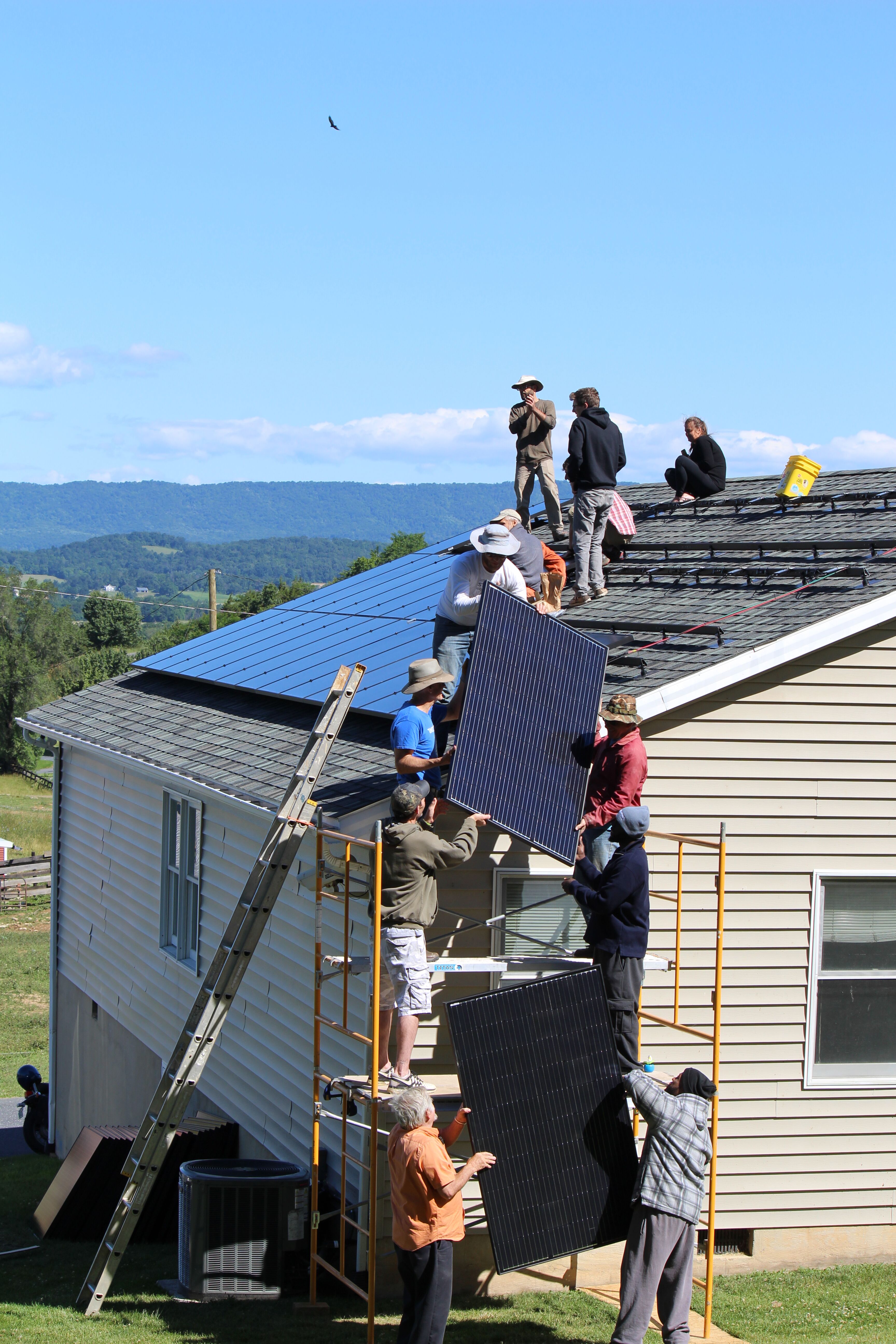
Installation of solar panels on the roof of a house.
Virginia utilities finally have an opportunity to attack net metering. Photo by Don Crawford.

When the Virginia Clean Economy Act became law in 2020, solar advocates celebrated. In addition to creating a framework for a transition to a zero carbon electricity sector by 2050, the VCEA and sister legislation known as Solar Freedom swept away multiple barriers to installing solar in Virginia. Among the new provisions were some that strengthened net metering, the program that allows residents, businesses and local governments who install solar onsite to be credited for excess electricity they feed back to the grid. 

Currently, the law requires that customers of Dominion Energy and Appalachian Power be credited for the electricity they supply to the grid at the full retail rate for electricity. The credit is applied against the cost of the electricity they draw from the grid at night. The policy makes solar affordable and supports small businesses across Virginia. 

However, the VCEA came with a ticking time bomb. It provided that in 2024 for Appalachian Power, and 2025 for Dominion, the State Corporation Commission would hold proceedings to determine the fate of net metering, and in particular the terms for compensating new net metering customers. 

Well, it’s 2024, and the bomb just went off. On May 6, the SCC issued an order directing the two utilities to file their suggested changes. Appalachian’s proposal is due by September 2; Dominion’s is due by May 1, 2025. The SCC will establish a schedule for each case that will include provisions for the public and interested parties to participate.

There are two important protections to note. First, low-income customers will have their choice of installing solar under either the existing rules or the new ones. Second, customers who install solar panels and interconnect to the grid before the SCC issues its final order will continue to be covered by the existing provisions for retail net metering. 

For anyone who’s been on the fence about installing solar, I can’t overstate the urgency of acting now. Nonprofits Solar United Neighbors and Solarize Virginia can help you get the best deal. Also check out the excellent advice and sample quotes from HR Climate Hub.

Make no mistake, utilities hate net metering and will destroy it if they can. The more customers who install solar, the less control the utility can exercise over them — and, even more critically, the less money the company makes for its shareholders from building new generation and transmission. 

That’s not what our utilities tell legislators and the SCC, though. Instead, they promote a narrative that net metering customers impose extra costs on other ratepayers, creating a “cost shift.” The idea is that residents who go solar are making everyone else pay more of the costs of the grid while they themselves rake in money with their free electricity from the sun.  

This argument has raged across the country for years. Utilities often argue that solar customers should be paid for their surplus electricity only the amount of money the utility would otherwise have had to spend to generate or buy that same amount of electricity from somewhere else. This “avoided cost” can be less than one-third of the retail rate for residential electricity. (The net metering changes would also affect commercial and non-profit properties, which pay a lower rate than residential – but still well above avoided cost.)

With a payback period of nine to 15 years in Virginia, residential solar is a reasonable investment with retail rate net metering, but it’s hardly a get-rich-quick scheme. Brandon Praileau, the Virginia program director for Solar United Neighbors, said in an email that lowering the net metering rate would eliminate the energy savings that homeowners see from solar today. 

“It is the full retail 1:1 value of solar that allows solar to not be a boutique purchase that only fits a certain demographic but something that every homeowner can benefit from,” he noted. 

Praileau added that the loss of net metering would also hit Virginia’s solar installers hard and lead to job losses, something I confirmed with industry members. Russ Edwards, president of Charlottesville-based Tiger Solar, says any devaluation of solar would have a “significantly adverse” impact on local companies like his that serve the residential market.

But the “cost shift” argument doesn’t actually depend on whether rooftop solar is affordable for customers or profitable for installers. The way utilities think about net metering, a homeowner could even lose money on solar and still be guilty of shifting the costs of maintaining the grid onto other customers.

Net metering supporters counter that rooftop solar provides valuable benefits to the grid and to other customers that the utilities overlook, like relieving grid congestion and lessening the need for utility investments in new generation and transmission. Solar also has larger societal benefits like increased energy security, local resilience, clean air and carbon reduction.

Over the years this dispute has spawned literally dozens of studies estimating the value of solar. A Michigan study found that rather than being subsidized by other ratepayers, residents who install solar actually subsidize their non-solar-owning neighbors. Closer to home, a Maryland study also concluded that distributed solar provided a value greater than the retail cost of energy. 

But every state is different. California’s public utility commission recently slashed the net metering rate all the way down to a so-called avoided cost, in part because the huge growth of solar in the state has led to a power glut in the middle of the day. The residential solar market cratered as a result of the PUC’s action, with an estimated 17,000 jobs lost in the solar industry.  

Virginia does not have California’s problem. With only about 6.5% of our electricity generated by solar and the world’s largest energy storage facility in the form of Bath County’s pumped hydro plant, rooftop solar still helps Virginia utilities meet peak demand. We also face a skyrocketing demand for electricity from data centers, which militates in favor of all the clean energy we can generate. 

Ten years ago, Virginia set out to do a study on the value of solar, led by the Department of Environmental Quality. Unfortunately, our utilities pulled out when they didn’t like what they were seeing, so the study never progressed beyond a framing of the issues. 

Since then, Dominion and APCo have often repeated the “cost shift” narrative but have never backed it up with evidence. Their efforts have had some effect with legislators, most recently with passage of a bill instructing the SCC to “make all reasonable efforts to ensure that the net energy metering program does not result in unreasonable cost-shifting to nonparticipating electric utility customers.”

But of course, that simply begs the question of whether a cost shift is actually occurring. Under the VCEA, the SCC will now have to “evaluate and establish” the amount a net metering customer should pay for “the cost of using the utility’s infrastructure,” and the amount the utility should compensate the customer for the “total benefits” the customer’s solar panels provide. The SCC is also instructed to evaluate and establish the “direct and indirect economic impact of net metering” and consider “any other information the Commission deems relevant.” 

Presumably, this other information should include the state’s energy policy. The policy specifically supports distributed solar, including “enhancing the ability of private property owners to generate their own renewable energy for their own personal use from renewable energy sources on their property.” 

The SCC will now have to navigate these opposing positions in what are certain to be contentious proceedings. Meanwhile, residents and businesses would be well advised to get their solar panels up this year.

This article was originally published in the Virginia Mercury on May 21, 2024.

Unknown's avatar

Data centers be damned, Virginia can still meet its climate goals

Virginia's capitol building in Richmond.

Following the General Assembly’s failure either to rein in the explosive growth of power-hungry data centers or to remove obstacles to increasing the supply of renewable energy in Virginia, a lot of people are wondering where we go from here.  

Dominion Energy Virginia’s answer, as described in its 2023 Integrated Resource Plan (IRP), is “build more fossil fuels.” The utility is pushing forward plans to build new methane gas generating units in Chesterfield. Dominion argues that although its IRP calls for dramatically increased carbon emissions, it sort of complies with the Virginia Clean Economy Act anyway because the VCEA has an escape clause when reliability is at risk. 

Dominion does not acknowledge that its own actions contribute to the problem. To be fair, though, it’s a huge problem, and even if our utilities were on board with the VCEA’s carbon-cutting agenda, we would need stronger legislative policy than we have now. Rejoining the Regional Greenhouse Gas Initiative is an important priority that Democrats are rightly pursuing, but the need for action goes much further. 

Sen. Dave Marsden, D-Fairfax, convened meetings the week before last to hear from utilities, industry members, environmental groups and others to get suggestions on ways to reform the VCEA. The interest groups met separately, and members of one group were not allowed to attend other group sessions to hear what those stakeholders had to say. The meetings were closed-door and confidential, with the express purpose of preventing a nosy public from learning anything through Freedom of Information Act requests. 

That secrecy makes me queasy, so I declined the invitation to attend the environmentalists’ session. I’d have cheerfully jettisoned my scruples, though, if I could have been in the utility session to hear what Dominion’s lobbyists were whispering in the senator’s ear. Alas, that was not on offer. 

But Marsden is asking the right questions, and of course, I always have answers, even when no one is asking. In my view, Virginia can stay on track to carbon neutrality by adopting four basic principles: data centers must pay their own way, both literally and carbon-wise; solar must be easy to build and interconnect; utilities must not build new fossil generation for “reliability” before exhausting non-carbon solutions; and efficient buildings must be added to the strategy.

Let’s start with the elephant outgrowing the room.

Data centers are sucking up all the energy

Without action, data centers will soon overtake residential customers to become Dominion’s largest category of customer. Already, they are driving the utility’s decision-making, as we saw from Dominion’s IRP. This year, the General Assembly deferred action to address the energy crisis until it sees the results of a study being undertaken by the Joint Legislative Audit and Review Commission (JLARC). 

It now appears that study won’t be published before the 2025 session convenes, and in fact there does not appear to be a deadline of any kind. Yet we already know enough about data center energy demand and its consequences for everyone else that legislators will be derelict in their duty if they put off all action until 2026.

The General Assembly must choose from three options if it still cares about the energy transition: stop the growth of the data center industry in Virginia, put the onus on data centers to source their own clean energy from the grid, or dramatically increase renewable energy generation and power line construction.  

Lawmakers show no desire to stop all data center growth, but as I’ve urged before, they can and should establish a joint state-local task force to choose appropriate sites for growth based on energy and transmission availability, water resource adequacy and good-neighbor factors, like distance from residential communities and parkland. 

Legislators should also require data centers to meet industry-best standards for energy efficiency, use alternatives to diesel generators for backup power and source carbon-free energy from facilities located on the grid that serves Virginia. They could buy this power either on their own or through a specially-designed utility tariff, as long as it meets all of their needs on a 24/7, hourly basis. In no case should other customers see higher electricity bills for infrastructure that’s only needed because of data centers.

These measures will take time to put in place, yet data center development is proceeding apace while the General Assembly takes its nap. There is no avoiding Virginia’s need for a lot more carbon-free generation, pretty much right away. A couple of small modular nuclear reactors ten years from now aren’t a solution.

Don’t expect climate leadership from Dominion

Dominion’s fossil-heavy IRP marked a sharp break away from the climate report that the company released just months before, which projected solar dominating the grid by 2040. Whether the IRP should be dismissed as political pandering to a conservative governor, or taken in earnest to mean the utility has thrown in the towel on renewable energy, is something of a Rorschach test for Virginia leaders. 

When Dominion releases its 2024 IRP this fall, we may get more clarity about what the company really thinks. More likely, we will still be left guessing. Dominion has a long history of playing to both sides to get what it wants, and what it wants is profit.   

There’s nothing wrong with a company making a profit, of course, as long as the company isn’t also allowed to make the rules it plays by. Asking Dominion’s lobbyists to help make energy policy is like recruiting burglars for a task force on crime prevention. 

Make it easier to build solar

While Virginia counties vie with each other to attract data centers, some are notably less keen on solar farms. Sprawling developments of windowless warehouses that suck power? Yes, they say. Grassy fields lined with rows of solar panels that produce power? No. Such is the horror with which some people view solar that localities have adopted moratoriums, acreage caps and other limits designed to keep projects at bay. The result is that an already-slow process for siting solar projects is getting even slower, more unpredictable and more expensive. 

Lawmakers rejected legislation this year that would have allowed the State Corporation Commission to overrule local permit denials. Yet it seems doubtful whether, in a Dillon Rule state like ours, local governments actually have the authority to enact blanket prohibitions and caps on specific kinds of land use. Legislators may want to ask the attorney general to clarify this point rather than waiting for landowners to challenge in court a locality’s refusal to let them put solar panels on their property. 

If the AG (or a court) rules these barriers illegal, localities would have to go back to evaluating the merits of project applications on a case-by-case basis — hardly a bad result. But it would be wiser and more orderly to pass legislation spelling out under what circumstances a local government may reject a solar project, and what the landowner’s recourse should be. 

New gas plants are the wrong solution for reliability

Though Dominion’s 2023 IRP didn’t win approval from the SCC, Dominion is going ahead with plans to build new methane gas combustion turbines in Chesterfield. Given that these “peaker” plants generate dirty power at a high price, Dominion should not be permitted to build gas combustion turbines if other alternatives are available. 

Which they are. Demand-response programs, advanced grid technologies and batteries charged by renewable energy are superior to gas peakers for reasons of cost, air quality and climate impact. 

Dominion is building some large batteries and testing long-duration battery storage technologies (and of course, Virginia already has the largest pumped storage facility in the world), but our utilities have not even begun to tap the potential of batteries in homes and businesses. Subsidizing the purchase of batteries by homeowners and businesses in exchange for the ability to draw on the batteries for peaking power, as some utilities do, would also build resilience into the grid and address power outages more cheaply than burying lines.

Imagine: If data centers had installed batteries instead of the 11 gigawatts of diesel generators at Loudoun and Fairfax County data centers, Virginia would already have more battery storage capacity than any country in the world.

Let everyone build solar 

The VCEA calls for 35% of its solar target to be satisfied by third-party developers. The purpose of this set-aside is two-fold: to attract more private capital, and to use competition to keep a lid on prices. Unfortunately, the SCC accepted Dominion’s argument that 35% should be read as a ceiling as well as a floor, to the detriment of ratepayers and solar developers. With Dominion now reneging on its solar commitments, it’s more important than ever that private developers be allowed to step in. One bill in the 2024 session would have corrected this problem by explicitly making 35% the minimum. The General Assembly should adopt that measure. 

Fix interconnection

Possibly the most inexplicable failure of the General Assembly this year was failing to pass legislation to resolve the dispute between Dominion and commercial customers over interconnection requirements. The onerous requirements that Dominion adopted in December of 2022  — imposed even in the face of a contrary SCC ruling — have wreaked havoc on plans by local governments to put solar on public buildings and schools. That is fine with Dominion; though the goal of the new requirements was to acquire upgraded distribution infrastructure at no cost to itself, its monopolistic lizard brain is equally satisfied with the result of shutting down competition from small solar companies. 

Legislators should not accept this result, though. The General Assembly adopted net metering years ago because encouraging residents and businesses to go solar is good for the economy and makes communities more resilient. Support for distributed renewable energy is even written into the Virginia Code as official policy

And distributed solar is hugely popular. Indeed, the very people who oppose utility-scale solar projects almost inevitably argue that society should maximize rooftop solar instead. In this they are at least half right: If we are really going to meet the energy challenge ahead of us, the very least we can do is milk every kilowatt-hour from sunshine falling on rooftops.

Customers have always paid to interconnect their solar to the utility’s grid. The dispute between Dominion and its customers is about whether Dominion can insist they pay the entire cost of expensive new fiber-optic wire and other cool technology that could make the distribution grid better for everyone, but which any one customer can’t afford. These upgrades could enable not just more solar but also electric vehicle charging in our communities, vehicle-to-grid technology and programs allowing utilities to make use of customers’ battery storage. But if the technology really is that valuable (a determination that should be made by the SCC, not Dominion), then getting it shouldn’t depend on how deep a customer’s pocket is — especially when that customer is a local government and, therefore, effectively, the Virginia taxpayer.

This year’s interconnection bill would have allowed a utility to recover the costs of these grid upgrades from ratepayers, with SCC oversight. Even Dominion would have been better off with the bill, something it would have recognized if its lizard brain weren’t in charge at the time. The General Assembly should pass the bill.

An untapped three gigawatts of energy are waiting off our coast

Dominion’s 2,600 megawatt Virginia offshore wind project is due to begin construction this year, but it is not the only game in town. The Kitty Hawk offshore wind area situated off North Carolina can deliver up to 3,500 megawatts of energy through a cable that will come ashore at Virginia Beach. All that is holding up the project is the lack of a customer.  Offshore wind is more expensive than solar, but we have a lot of power-hungry data centers who could pay a clean energy tariff that would include Kitty Hawk wind. 

Maximize efficiency in buildings 

Possibly the best piece of energy legislation to pass this year was the bill that directs local governments and schools to build to higher efficiency standards and incorporate renewable energy, as appropriate. The language could have been even stronger, but as it is, it will deliver significant cost savings for taxpayers.

In fact, local governments will now build to better standards than most homeowners get for themselves when they buy a house.  That’s because Virginia’s residential building code is pathetically behind the times when it comes to energy efficiency. Home buyers and renters would save more than enough money on utility bills to cover the upfront cost of better housing construction, but builders won’t voluntarily meet higher standards because it reduces profits. That should not be acceptable. 

Legislation passed in 2021 directed the Board of Housing and Community Development to consider amendments that would strengthen the building code. BHCD, which is dominated by builder and real estate interests, simply ignored the law. The matter is now in litigation (and the governor is trying to weaken the code even further), but the General Assembly could resolve the matter by directing BHCD to adopt efficiency measures at least as strong as the national standards set by the International Building Code Council (itself under fire for allowing builder interests to weaken efficiency standards), and to allow local governments to adopt stronger “stretch codes” to help residents save even more money and energy.

Going further, new and renovated buildings should be required to use electricity in place of methane gas, oil or propane for heating, cooling and appliances wherever practicable. Though building electrification increases electricity consumption, electricity is a more efficient technology than burning fossil fuels in the home, so it contributes to lower energy costs for residents and a smaller carbon footprint for the state overall. 

It’s a shame the General Assembly settled for simply not going backwards this year, but it is a good sign that Marsden and others are not waiting for next year to consider ways to get us back on the carbon-cutting wagon. With the climate clock ticking, we have no more time to lose.

A version of this article appeared in the Virginia Mercury on April 29, 2024.

Unknown's avatar

Virginia climate advocates find progress requires more than a Democratic majority

Virginia's capitol building in Richmond.

Climate advocates felt hopeful last fall when Democrats won control of both the Senate and House with promises to protect the commonwealth’s climate laws, including the Virginia Clean Economy Act (VCEA) and the Clean Car Standard. It seemed possible the General Assembly might pass much-needed initiatives modest enough to avoid a veto from a Republican governor.   

Apparently not. Democrats did fend off attacks on the VCEA and Clean Cars, and killed a lot of terrible bills. Through the budget process, they’re trying to require Virginia’s renewed participation in the carbon-cutting Regional Greenhouse Gas Initiative. But Gov. Youngkin won’t even get his shot at most of the priority bills from the environmental community. Of the bills that did pass, most were so watered down as to make their usefulness questionable. A few bills died even when they went unopposed. Some successful bills seem likely to add to Virginia’s energy problems rather than help solve them.

A lot of the blame can be laid at the feet of Dominion Energy, which took a bipartisan drubbing in the 2023 session, but was back this year stronger than ever like a plague that surges when we let our guard down.

But that’s only half the story. As a party, Democrats seemed to have simply lost interest in the fight. Climate change may be an urgent issue in the rest of the world, but in Virginia, a lot of lawmakers seem to think they already checked that box. 

Two steps forward

In the spirit of optimism, let’s start with the positive highlights of the session, though admittedly they were more like flashlight beams than floodlights.

Most consequential for the energy transition is legislation establishing a statewide green bank, a requirement for accepting hundreds of millions of dollars in federal funding for clean energy projects. The House and Senate versions are different and will go to a conference committee. A show of opposition from Republicans in both chambers could attract a veto, but most governors welcome free money.

Similarly, new legislation directs the Department of Energy to identify federal funding available to further the commonwealth’s energy efficiency goals. 

Another encouraging piece of legislation updates and expands on existing energy efficiency requirements for new and renovated public buildings, a category that would now include schools. Provisions for EV charging capabilities, resilience measures, and onsite renewable energy and storage are included. The measure attracted only a couple of Republican votes, so it may be at risk of a veto.

Another change will bring sales of residential rooftop solar within the consumer protections that apply to other contractors. Virginia’s Board for Contractors will be required to issue regulations requiring relevant disclosures.

The net metering law that supports customer-sited solar will now include provisions for the leasing of solar panels and the use of batteries under a measure that is not expected to draw a veto. A solar facility paired with a battery of equal capacity will be exempt from standby charges, and the customer may use the batteries in demand-response and peak-shaving programs. Though none of the bill’s provisions were controversial, Dominion exacted a price in the form of a line directing the SCC to “make all reasonable efforts to ensure that the net energy metering program does not result in unreasonable cost-shifting to nonparticipating electric utility customers.” Our utilities hope this will undermine the current full retail value for net metered solar when the SCC considers the future of net metering in proceedings later this year and next year. 

bill to require the Board of Education to develop materials for teaching students about climate change passed mainly along party lines. 

Another bill allows, but does not require, local governments to create their own “local environmental impact funds,” to assist residents and businesses with the purchase of energy efficient lawn care and landscaping equipment, home appliances, HVAC equipment, or micro mobility devices (like electric scooters). Almost all Republicans voted against it, so modest as it is, it may draw a veto.

Both chambers have agreed to request the SCC form a work group to consider a program of on-bill financing for customer energy projects such as renewable energy, storage and energy efficiency improvements. The SCC will also be asked to study performance-based regulation and the impact of competitive service providers. Dominion will now also have to assess the usefulness of various grid enhancing technologies in its Integrated Resource Planning at the SCC.

Efficiency advocates had high hopes for a bipartisan measure they dubbed the SAVE Act to strengthen requirements for Dominion and APCo to achieve energy efficiency savings and to make it easier for efficiency programs to pass SCC scrutiny. Unfortunately, the final legislation does almost nothing, with most improvements pushed off to 2029.  

bill passed that designates each October 4 as Energy Efficiency Day. (I said these were small victories.)

https://virginiamercury.com/2024/01/25/as-youngkin-takes-an-axe-to-the-deep-state-what-could-possibly-go-wrong/embed/#?secret=WWoGYRV68g#?secret=u72DtPLbbq

Finally, in a rejection of one of the more inane initiatives of the governor’s regulation-gutting agenda, both Houses overwhelmingly passed legislation preventing changes to the building code before the next regular code review cycle. I imagine the governor will have to veto the bill, and Republican legislators will then be caught between party loyalty and a duty to govern intelligently, but any way you look at it, eggs are meeting faces.

Two steps back 

Failure to pass a bill might seem to leave matters where they are, with no winners or losers. Inaction in the face of climate change, however, means we lose time we can’t afford to waste.

Inaction can also have devastating consequences in the here and now. Solar projects on public schools and other commercial properties in Dominion Energy’s territory have been delayed or outright canceled for more than a year due to new rules imposed by Dominion in December of 2022 that raised the cost of connecting these projects to the grid exponentially. Legislation promoted by the solar industry and its customers would have divided responsibility for grid upgrades between the customer and the utility, while giving Dominion the ability to recover costs it incurred. Through its lobbyists’ influence on legislators, Dominion killed the bills not for any compelling reason, but because it could. 

Dominion’s obfuscations and half-truths often work magic when the subject is technical. But of all the votes taken this year on energy bills, this one actually shocks me. No one listening to the committee testimony could have misunderstood the significance of the legislation, affecting dozens of school districts and local governments. In desperation, the solar industry offered amendments that (in my opinion) would have given away the store, to no avail.  

A cross-check of votes and campaign contributions shows the legislation failed due to the votes of committee members who happen to accept large campaign contributions from Dominion. This dynamic tanked a number of other climate and energy bills as well, and underlines why utilities must be barred from making campaign contributions.  

Dominion’s influence also killed a priority bill for the environmental community that would have required the SCC to implement the Commonwealth Energy Policy, slimmed down SCC review of efficiency programs to a single test, increased the percentage of RPS program requirements that Dominion must meet from projects of less than 1 megawatt, and increased the percentage of renewable energy projects reserved for third-party developers. Two other bills that were limited to the Commonwealth Energy Policy provision also failed.

Dominion’s opposition was also enough to kill a bill designed to expand EV charging infrastructure statewide, especially in rural areas, in part by protecting gas station owners who install electric vehicle charging from competition by public utilities. Sheetz and other fuel retailers testified that they want to invest in charging infrastructure but won’t take the risk as long as Dominion can install its own chargers nearby. The reason is that using ratepayer money allows a public utility to undercut private business. Other states have dealt with this by prohibiting utilities from getting into the EV charging business. Here, the retailers asked for 12 miles between themselves and any utility-owned chargers. Dominion opposed the bill, and the fuel retailers lost in subcommittee. A second bill that would have created an EV rural infrastructure fund passed the House but could not get funding in the Senate. 

Bills in both the House and Senate would have required most new local government buildings to include renewable energy infrastructure, especially solar. The House bill, though unopposed, was killed by Democrats in Appropriations because a fiscal impact statement erroneously said it might cost something, in spite of bill language exempting situations where the improvements would not be cost-effective. Then the same committee felt tradition-bound to kill the Senate bill when it came over, although that bill carried no fiscal impact concerns and it was by then clear that killing the House bill had been a mistake. A foolish consistency is the hobgoblin of little minds, but also of mindless rules.  

Moving along: all of the bills that would have put limits on the ability of localities to bar solar projects in their jurisdictions failed, as did legislation that would have given solar developers essentially a right to appeal an adverse decision to the SCC.

None of the many bills supporting customer choice in electricity purchasing passed. Legislation to allow localities to regulate or ban gas-powered leaf blowers also failed, as did a bill that would have required Dominion and APCo to reveal how they voted in working groups advising grid operator PJM. This bill passed the House but, like so many others, it died in the heavily pro-utility Senate Commerce and Labor committee.

Two steps sideways?

Community solar, known as shared solar in Virginia, staggered a few steps forward, or maybe just sideways. Readers will recall that the Dominion program authorized in 2020 has proven a success only for low-income customers who don’t have to pay the high minimum bill Dominion secured in the SCC proceeding that followed enactment.  

Trying to make the program work for the general public was the goal of legislation that advanced this year but may or may not help. As passed, the compromise language offers an opportunity to expand the program a little bit and to take the argument about the minimum bill back to the SCC with a different set of parameters.  

In addition to modifying the program in Dominion territory, shared solar now has a modest opening in Appalachian Power territory under a similar bill. Again, the final bill offers far less than advocates hoped, and it lacks even the special provisions for low-income subscribers that make the original Dominion program work at all. Like Dominion, APCo fought the bill, though unlike Dominion, APCo’s rate base has been shrinking, so losing customers to alternative suppliers is a more legitimate concern. 

(At least for now. All APCo needs to do to reverse the decline is to lure a couple of data centers from up north. Data centers are such energy hogs that they would swamp any losses from shared solar, and residents of NoVa would be glad to forgo a few. Or for that matter, a few dozen.) 

Other new measures garnered support from many in the environmental community, but don’t really move the needle. One allows geothermal heat pumps, which reduce a building’s energy demand but don’t generate electricity, to qualify under Virginia’s renewable portfolio standard (RPS). Another allows an old hydroelectric plant to qualify for the RPS, a move that adds no new renewable energy to the grid but means the electric cooperative that gets the electricity from the plant can now sell the renewable energy certificates to Dominion and APCo.

Lying down and rolling over

In the face of the single greatest threat to Virginia’s — and the nation’s — energy security and climate goals, the General Assembly’s leaders chose to do nothing. In fact, doing nothing was their actual game plan for data centers. A quick death was decreed for legislation requiring data centers to meet energy efficiency and renewable energy procurement requirements as a condition of receiving state tax subsidies. Also killed were a bill that sought to protect other ratepayers from bearing the costs of serving data centers, and more than a dozen bills dealing with siting impacts, water resources, noise abatement, undergrounding of transmission lines and other location-specific issues. 

The excuse for inaction is that the Joint Legislative Audit and Review Committee is undertaking a study to examine the energy and environmental effects of data centers. However, legislators did not impose a concomitant pause in data center development while the study is ongoing. Instead, for at least another year, Virginia’s leaders decreed that there will be no restraints or conditions on the growth of the industry, even as ever more new data center developments are announced and community opposition increases. 

And falling for the boondoggle

Nuclear energy has always had its true believers at the General Assembly, and the prospect of small modular reactors (SMRs) has excited them again. Many of the same legislators who busied themselves killing climate and energy bills this year insist Virginia needs SMRs to address climate change. They are more than happy to let utilities charge ratepayers today for a nuclear plant tomorrow — or rather, ten years from now, or maybe never if things go as badly here as they did in South CarolinaGeorgia and Idaho.

More cautious lawmakers say if Dominion or APCo wants to go all in on an unproven and risky technology like small modular reactors, they should shoulder the expense themselves and only then make the case for selling the power to customers. 

Dominion has achieved a terrific success rate with boondoggles over the years. (See, e.g. its coal plant in Wise County, spending on a North Anna 3 reactor that was never built, and the so-called rate freeze, followed by the also-lucrative legislation undoing the rate freeze.) By now you’d think more legislators would have joined Team Skeptic. But as always, utility donations and lobbyists’ promises are the great memory erasers. So once again, the General Assembly voted to allow ratepayer money to be spent on projects that may never come to fruition. 

This year APCo is in on the act as well. Two bills, one for APCo and the other for Dominion, will allow the utilities to charge ratepayers for initial work on nuclear plants of up to 500 MW. The final language of both bills requires SCC oversight and imposes limits on spending. That is, for now.

Will the real climate champions please step forward?

This round-up might leave readers thinking there aren’t many lawmakers in Richmond who take climate change seriously. Fortunately, this is not the case. Close to two dozen legislators introduced bills targeting stronger measures on energy efficiency, renewable energy, electric vehicles and utility reform. Del. Rip Sullivan, D-Fairfax, led the pack both in the sheer number of initiatives he introduced and the tenacity with which he pursued them, but he was not alone. 

A few Republicans also supported good energy legislation, and even, in the case of Del. Michael Webert, R-Fauquier, sponsored priority bills like the SAVE Act. With groups like Energy Right and Conservatives for Clean Energy making the case from a conservative perspective, maybe we will see progress towards a bipartisan climate caucus to build on Virginia’s energy transition. 

If that sounds too optimistic, consider that the alternative right now is the near-total inaction that marked this year’s session; we just don’t have time for that.

Unknown's avatar

To be or not to be a clean energy state, that is the question

For the third year in a row, a tug-of-war is going on in the General Assembly over whether Virginia stays the course of the energy transition laid out in 2020 and 2021, or rolls it back hard.

Democrats remain committed to a renewable energy future to address pollution, high electricity costs and the causes of catastrophic climate change. Gov. Glenn Youngkin and most Republican legislators cling to the familiar (dis)comfort of fossil fuels. Republicans are still lobbing grenades at the Virginia Clean Economy Act (VCEA) and the Clean Car Standard; Democrats are holding the line on those advances.

Last year House Republicans used small subcommittees to kill Democrats’ energy bills, even those that passed the Senate on a bipartisan basis. This year the Democrats’ slim majority in both chambers will let more bills get to the governor’s desk. But with the threat of a veto tempering expectations, the party of clean energy is not running big, ambitious bills, but is instead focused on solving problems that have popped up along the march to zero carbon.

Committees have already begun work on the hundreds of energy bills filed in past days. That’s too many for even the Mercury’s dedicated readers to review without more caffeine than is good for you, so let’s focus on just some that would have the most consequence for the clean energy transition.

To be: Democrats work to further the clean economy

Many of the Democratic bills contain small fixes to existing law that add up to big gains for clean energy. One of these is HB 638, from Del. Rip Sullivan, D-Fairfax, and SB 230, from Sen. Ghazala Hashmi, D-Richmond. Most of its provisions are tweaks to the VCEA. Among them are increasing from 1% to 5% the percentage of Dominion Energy Virginia and Appalachian Power’s renewable energy purchasing that must come from small projects like rooftop solar; streamlining the State Corporation Commission’s review of energy efficiency programs by creating a single cost-effectiveness test; and supporting competition in the development of renewable energy and energy storage facilities by specifying that “at least”35% of projects must come from third-party developers, instead of the simple 35% number currently in the law. 

The bill also contains a provision that goes beyond the VCEA. It states that the SCC has an “affirmative duty” to implement the Commonwealth Energy Policy at “lowest reasonable cost.” (Two other bills, one from Sen. Jennifer Carroll Foy, D-Fairfax, and the other from Del. Phil Hernandez, D-Norfolk, contain only this provision.) The energy policy is separate from the VCEA, and it sets ambitious goals for the decarbonization of Virginia’s whole economy, including a faster timeline for achieving net zero in the electricity sector. The catch is that the policy does not have teeth, and for that reason it is routinely ignored. Requiring the SCC not just to take account of it, but also to implement it, is a step towards broader decarbonization, though it is not clear how it would actually play out at the SCC. 

Legislation from Sen. Scott Surovell, D-Fairfax and Sullivan would resolve problems with the shared solar program in Dominion territory (including putting restraints on the minimum bill that the utility can charge) and expand it to Appalachian Power territory

SB 79, from Sen. Barbara Favola, D-Arlington, would save taxpayers money by requiring new or substantially renovated (over 50%) public buildings to have solar-ready roofs or, if solar is deemed impractical, to meet one of two high-efficiency alternatives. New or substantially renovated schools would have to be designed and built to net-zero energy standards, unless the locality determines that to be impractical or the school is a historic building. 

Sullivan and Sen. Suhas Subramanyam, D-Loudoun, have introduced legislation to resolve the interconnection problem that has stalled commercial solar projects across Dominion territory. The House and Senate bills specify that customers are responsible for costs on their side of the meter, while the utility pays for costs on its side, including upgrades to the distribution grid. 

A few bills seek to break through the local-level gridlock that has bedeviled utility-scale solar and wind projects. The most significant of these is HB 636from Sullivan and SB 567 from Sen. Creigh Deeds, D-Charlottesville, which provides an alternative permitting process for larger utility solar (50 MW or more), wind (100 MW or more) and renewable energy storage projects (at least 50 MW nameplate and discharge capacity of 200 MWh or more) that go through the local permitting process but end up without permits. Developers get a second chance at the SCC if they meet a list of requirements. These include safeguards for farmland protection, stormwater, setbacks, wetlands, wildlife corridors, etc. Applicants are also charged $75,000 to cover the locality’s cost of participating in the SCC proceeding. (There is some irony here that small projects, which have less impact, are left at the mercy of local whims, while the most impactful projects have what amounts to a right of appeal.) 

Vehicle electrification would also get support from Democratic legislation. One bill of particular interest is Sullivan’s HB 118, which requires Dominion and Appalachian Power to take charge of upgrades to the distribution grid needed to support EV charging by non-residential customers. The utilities are also tasked with filing detailed plans to “accelerate widespread transportation electrification across the Commonwealth in a manner designed to lower total ratepayer costs.” 

Regardless of the fate of these bills, Virginia’s efforts to transition to a zero-carbon economy will be swamped by new demand from the fast-growing data center industry, unless the industry itself can be made part of the solution. A dozen or so bills seek to put conditions on the industry in one way or another, but one takes on the energy demand directly. HB116, from Sullivan, and SB192, from Subramanyam, condition data center operators’ receipt of tax credits on demonstrating compliance with minimum standards for energy efficiency and renewable energy procurement, as well as not using diesel generators for backup power. 

Not to be: Republicans try out arguments against the energy transition 

Many of the Republican anti-clean energy transition bills are blunt instruments that are more about campaigning in Trump country than low-cost energy. For example, HB 397, from freshman Del. Tim Griffin, R-Bedford, would repeal most of the important provisions of the VCEA, while declaring that development of new nuclear is “in the public interest” (a phrase that pretty much means “watch your wallet”). 

Similarly, five bills seek to repeal outright the Advanced Clean Cars law passed in 2021, which effectively put Virginia among the states that follow California’s path to vehicle electrification. The law does not kick in until 2025, but trying to repeal it has become a Republican standby. A more subtle bill from Del. Lee Ware, R-Powhatan, would condition repeal on the Virginia Automobile Dealers certifying that Virginia is not meeting its annual EV sales targets. 

Some anti-EV bills are merely performative. One non-starter, from Griffin again, would provide a tax credit for purchases of vehicles with internal combustion engines. A bill from Sen. William Stanley, R-Franklin, would require any business selling an EV or any EV component to a public body to provide a sworn declaration that there was no child labor involved not just in the manufacturing but at any point anywhere along the supply chain, starting with mining minerals abroad. 

If Stanley were truly concerned about child labor violations, of course, he would seek to apply this sworn declaration requirement to all industries. He could start with the domestic meatpacking industry, where child labor violations are rife, including in Virginia. Ah, if only that were the point. 

It’s not just state-level decarbonization that comes in for a brute-force attack. A bill from another new delegate, Eric Zehr, R-Lynchburg, makes its target any federal regulations that “may threaten the production or supply of affordable, reliable, and secure energy within the Commonwealth.” If alerted to such a threat by a utility or the SCC, the Attorney General’s office would be required to intervene. This sort of bill is not intended to survive its first committee hearing, if it even gets a hearing. Its only purpose is to show off the patron’s hard right bona-fides.

To be fair, there are Republicans who are actually trying to solve real problems in the energy sector. As one example, take SB562 from Sen. Travis Hackworth, R-Tazewell. His bill would create a ratepayer-funded pilot program for utilities to figure out a way to use coalbed methane for electricity without burning it (perhaps with fuel cells?). The problem is, he proposes to make this electricity eligible for Virginia’s renewable portfolio standard (RPS). It’s a creative, if expensive-sounding, response to the real climate problem of methane leaking from old and often abandoned coal mines, part of the true cost of coal. But calling fossil methane renewable is, shall we say, counterfactual. Some problems are more effectively tackled head-on, using tax dollars or tax credits, rather than being used to undermine the integrity of the RPS.

To be: somewhere else entirely

The reality of renewable energy is that we have to build a great many wind, solar and storage projects, each one taking months or years of design, permitting and construction work and requiring acreage we would rather use for something else. Yes, it means economic activity, investment and jobs, but it’s also something of a slog. Wouldn’t it be nice if we had a magic solution that could just provide carbon-free electricity without all that bother?

That’s the dream that continues to attract both Democrats and Republicans to nuclear energy. Opinion is divided on whether small modular reactors (SMRs) could hold the answer to all our energy woes, or are just the latest con from an industry looking to attract a new set of deep-pocketed suckers. 

 Three things are clear at this point. One, SMRs are still many years away from commercialization, coming too late to solve the climate problem that is here and now. Second, SMRs are going to cost a lot. Not only is there no free nuclear lunch, there isn’t even a low-priced breakfast. And third, Dominion is frothing at the bit to build an SMR – but only if customers have to pay for it. 

Some legislators are happy to oblige, even with all these drawbacks. The most concerning of the bills are HB 1323 from Del. Danny Marshall, R-Danville, and SB 454 from Sen. David Marsden, D-Fairfax. The legislation would allow Dominion or Appalachian Power to charge ratepayers “at any time” to recover development costs of a small modular nuclear reactor, defined as a nuclear reactor not larger than 500 MW. Not only is that not small, but by the language of the bill it need not even be modular or use advanced technology. Heck, it doesn’t even have to be in Virginia. Dominion could build any kind of nuclear plant, anywhere it chooses, and satisfy the terms of the bill. 

But it’s that “at any time” language that should be a red flag for lawmakers. Charging customers for a nuclear plant before and during construction, including cost overruns and with no guarantee of completion, is precisely how residents of South Carolina got stuck paying billions of dollars for a hole in the ground

That amount of money buys a lot of low-cost renewable energy and storage, right in the here and now. Virginia needs to be a clean energy state for the sake of ratepayers, the economy and the climate, and there is no time to waste.

This article was first published on January 21, 2024 in the VIrginia Mercury.

Unknown's avatar

Commercial solar has stalled out in Virginia. Fortunately, there’s a simple fix.

 A ribbon-cutting ceremony marked Norfolk Solar’s array installation at the historic Wesley Union AME Zion church in Norfolk in September 2022. (Wesley Union AME Zion Church)

In 2019, Ruth Amundsen and Alden Cleanthes formed a company with a mission to bring the benefits of rooftop solar to low-income communities. Targeting development in Qualified Opportunity Zones, Norfolk Solar installed solar at the historic Wesley Union AME Zion church in Norfolk, the Southside Boys and Girls Club, a Habitat for Humanity ReStore, and other nonprofits. To increase the local benefits, Amundsen and Cleanthes required installers to hire local, low-income and typically minority workers. All told, the company did $2 million in business between 2019 and 2022, while creating jobs for local residents in the clean energy economy.

And then, it all came to a screeching halt. Last December, Dominion Energy Virginia unilaterally imposed new – and prohibitively expensive – interconnection requirements for most commercial solar. A solar array seeking interconnection approval this year faces total project costs that are 20 to 40%  higher than they were last year under the old rules.  

Though Norfolk Solar had hundreds of thousands of dollars of investor money committed to new projects, Cleanthes told me they were forced to break contracts and turn away funders. The company has not done a single project in 2023. 

Nonprofits are not the only victims of Dominion’s move. Plans to put solar on schools and municipal buildings have ground to a halt all across Dominion territory. A community solar project that would have served low-income residents had to be scuttled last December when Dominion demanded the developer install a high-speed fiber optic line that would have increased project costs by 50%.

Solar array on high school roof
A new solar array atop Meridien High School in Falls Church received interconnection approval before Dominion imposed onerous new requirements for net-metered solar. Now, advocates fear it may be one of the last projects of its kind built in Dominion’s territory. Photo: Ivy Main

Dominion says its requirements are about safety and reliability. Solar developers challenge that, noting that the equipment they install already meets industry standards, and that other utilities don’t demand the upgrades Dominion wants. They suspect Dominion is trying to offload onto solar customers the cost of grid improvements that Dominion will use for other purposes, and in so doing to crush the small competitors it has battled with for years.  

The details of the dispute are, to put it mildly, highly technical, but the impacts are readily discernible in the near-collapse of Virginia’s commercial solar market. Most noticeably, solar school projects have stalled out across Dominion’s service territory. Schools that were counting on using solar panels to lower their energy costs have been forced to cancel plans.

Cathy Lin, energy manager for Arlington Public Schools, told me she was shocked when the county’s solar developer told her about the increased costs, which she considers exorbitant. “We want to put on more solar,” she said. “We can’t afford to. The extra interconnection fees make solar unaffordable for us.” 

The Distributed Solar Alliance (of which I am a co-founder as a solar advocate) has spent much of this year fighting Dominion at the State Corporation Commission. The SCC ruled in the DSA’s favor on all points in August, but in November an SCC hearing examiner unexpectedly authorized Dominion to impose many of the same requirements on an “interim” basis – with no end in sight. 

Taking off my advocacy hat for a moment, I actually have some sympathy for the hearing examiner. If a utility tells you it has to have the latest in fiber-optic technology and fancy-pants equipment as a matter of safety and reliability, you’d better have a pretty deep understanding of grid technology before you say no. This guy had no expertise. How surprised can we be that he basically punted?

But the results are terrible for an entire sector of Virginia’s economy. The ruling is bad for developers like Norfolk Solar, which will not be able to continue its mission to bring solar and job training to low-income areas. It’s bad for schools, universities and other customers, who can’t afford to complete long-planned projects that were supposed to bring energy savings. 

And though the fight at the SCC is specific to net-metered solar projects between 250 kilowatts and 3 megawatts, allowing Dominion to impose requirements without demonstrating that they’re actually needed has dire implications for all distributed generation up and down the scale – and, logically, even for distributed battery storage and EV charging. 

Really, this result is not even great for Dominion, because relying on a single customer to fund an expensive substation or line upgrade will usually result in no upgrade happening. That’s no way to run a grid.

Fortunately, there is a way to resolve this matter without risking safety and reliability, while at the same time reinvigorating the distributed generation market and allowing stalled solar projects to move forward. 

The General Assembly could simply clarify that solar developers are responsible for safety equipment and other costs of interconnection on the premises. For off site improvements – including new fiber-optic lines, substation upgrades, and other investments that enhance the distribution system for all customers – Dominion should be specifically empowered to undertake this work and recover the costs from ratepayers, subject to SCC approval, as it does for the rest of its grid modernization program.

This approach would tamp down suspicion that Dominion is gold-plating its interconnection requirements as a way of stifling third-party solar. More importantly, it would support the kind of distribution grid upgrades needed to support all the elements of a resilient 21st century grid.

Unknown's avatar

A bright spot at the intersection of farming, electric vehicles and solar energy

Peggy Greb, USDA

The energy transition is in full swing across the U.S. and the world, but the changes now underway are not simple or linear. In an economy as complex and connected as ours, progress in one area will often affect other parts of the economy, creating winners and losers. 

And then there are the changes that work together synergistically and leave everyone better off. This is what we will see as renewable energy overtakes fossil fuels and electric vehicles go mainstream. These transformations will deliver another enormous benefit, this time to farmland, as they pull the rug out from under the expensive and wasteful ethanol industry. 

Counting Corn

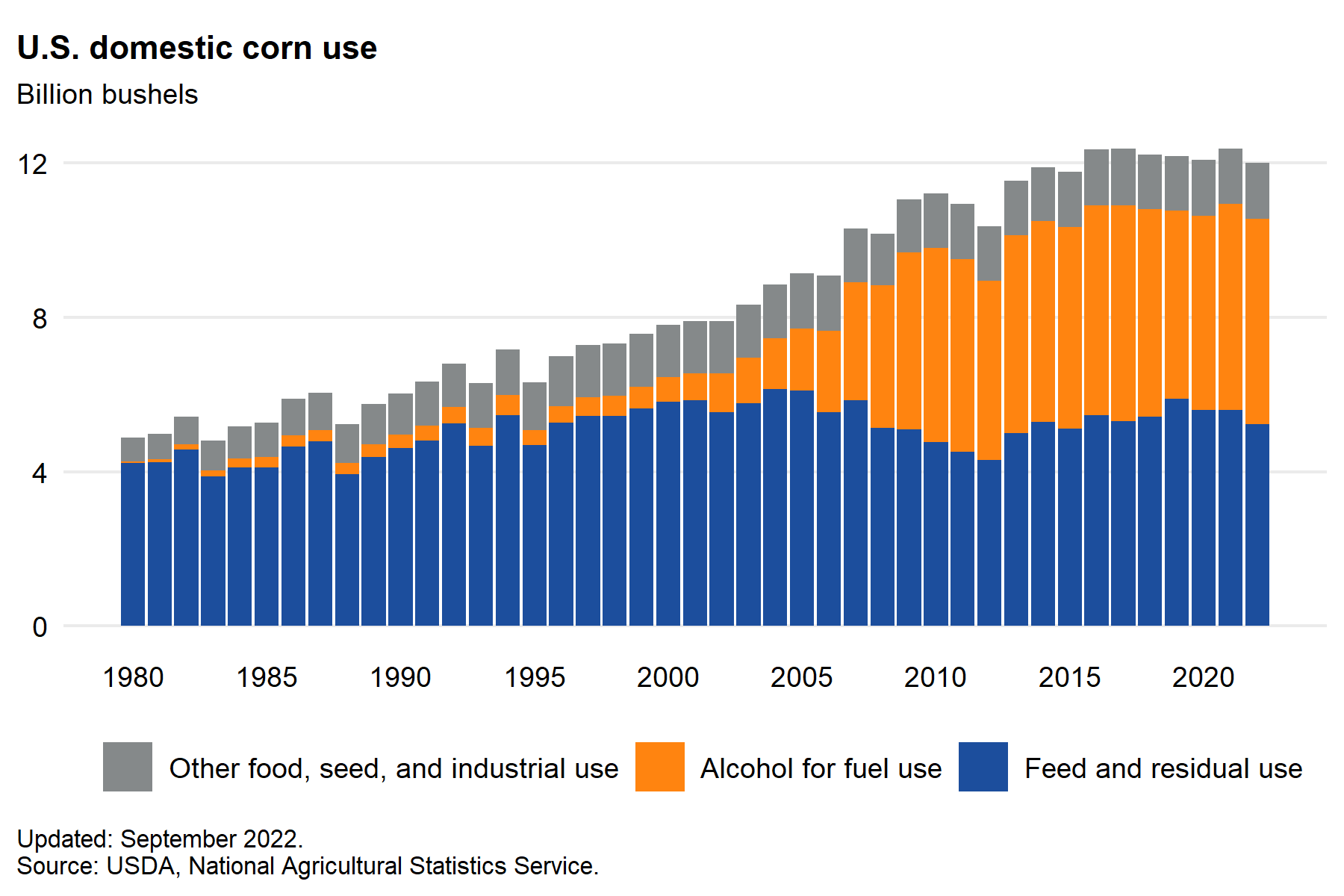
Across the United States, more than 30 million acres of farmland is currently devoted to growing corn for a purpose other than feeding humans and animals. The corn – over 5 billion bushels every year — is processed into ethanol and then added to gasoline to comply with a federal mandate.

The U.S. Renewable Fuel Standard (RFS), enacted in 2005, requires the nation’s oil refiners to mix 15 billion gallons of corn-based ethanol into the nation’s gasoline supply annually; this is the reason why most gasoline sold in the U.S. includes 10% ethanol. The mandate was intended to cut U.S. dependence on energy imports, support farmers and reduce emissions. 

As it turned out, the RFS was primarily successful in increasing the acreage devoted to growing corn. Because of the ethanol mandate, an additional 6.9 million acres of corn were planted between 2008 and 2016. Corn is now the nation’s number one crop and, according to the U.S. Department of Agriculture, ethanol production accounts for 45% of the U.S. corn crop. Most of the rest goes to animal feed, with only 15% destined for human consumption. (A mere half of one percent of the total corn crop is sweet corn, a different plant entirely.) 

As a way to reduce emissions, however, the mandate proved a failure. A study funded by the U.S. Department of Energy and the National Wildlife Federation concluded that ethanol is at least 24% more carbon-intensive than gasoline, once land use impacts are factored in. 

It’s a bad deal for taxpayers, too. In addition to the ethanol mandate, the U.S. government subsidizes corn farmers through the federal crop insurance program, with taxpayers covering an average of 62% of the cost of insurance premiums. More than a quarter of the insurance subsidy goes to corn, and very little goes to small farms. Add to this the many concerns about water use, fertilizer, pesticides and land degradation, and it is hard to find much good in the corn ethanol program.

EVs threaten King Corn

The world is a different place now than it was in 2005, with the U.S. having become the largest oil producer in the world and a net exporter. Yet the ethanol subsidy is fiercely guarded by the corn lobby and, in spite of occasional bipartisan efforts at repeal, it seems to be untouchable politically. Indeed, last year’s Inflation Reduction Act, passed by Democrats, actually contains new credits for biofuel production that corn-state Republicans are keen on keeping even as they continue to seek rollbacks of other clean energy incentives. 

The biggest threat to the corn lobby, though, isn’t a repeal of the mandate, it’s electric vehicles. When people no longer need gasoline, they can no longer be forced to buy corn ethanol. 

Electric vehicle sales reached 5% of the U.S. new car market in 2022, and already this year they’ve hit 8.6%. JD Power projects 70% of new vehicles will be electric by 2035, with California leading the way at 94% by then. 

Many agricultural communities are in denial about EVs, preferring to believe they will never catch on in numbers enough to threaten the importance of the corn crop. And indeed, it will take decades before the last gasoline-powered cars drive off to the junkyard. But most of us can see the writing on the wall. As more vehicles become electric, more land that is now devoted to corn ethanol will become available for other purposes. 

While the ethanol industry looks to jet fuel and other possible new uses for its product, a far more promising “crop” is renewable energy. Planting wind turbines and solar panels, either alone or combined with actual crops that feed people, provides higher returns with less risk and is better for the planet. 

“Planting” more solar energy instead of corn

Wind turbines already coexist with farmland across the Great Plains, but let’s focus on solar, since that is the form of renewable energy best suited to Virginia’s landscape. Solar energy is somewhat land-intensive, but not compared to corn. A decade ago, the National Renewable Energy Laboratory calculated that we could power the country’s entire electricity demand with 10 million acres of solar panels. That’s only one-third of the land now devoted to corn ethanol. 

Since that study, solar efficiency has increased, while electricity demand has risen only modestly. With the electrification of vehicles, buildings, and everything else that can be electrified, however, electricity demand is likely to double. But even if we had no wind energy, hydropower or nuclear, and we needed 20 million acres of solar to meet the demand, that would represent only two-thirds of the land currently devoted to corn ethanol, leaving millions of acres more freed up for food crops, land conservation and rewilding.

A comparison of the energy yield of corn vs. solar shows why displacing ethanol with solar energy would be a welcome change.  An acre of corn yields 328 gallons of ethanol, which is one-third less efficient than gasoline. If you could run an internal combustion automobile entirely on ethanol (you can’t), a car averaging 40 miles per gallon could go 8,738 miles on an acre of corn. 

But that same acre “planted” in solar panels would yield 394-447 MWh per year of electricity. Even at the low end, that’s enough to power a Tesla Model 3 for over 100,000 miles.

Much of the corn crop is grown in places like Iowa and Nebraska, but even here in Virginia, 540,000 acres were planted in corn last year, second only to soybeans. Assuming 45% of Virginia’s crop goes to corn ethanol (I could not find an actual breakdown by state), that amounts to 243,000 acres that could be put to better use. That’s worth keeping in mind for the next time someone frets about farmland being “lost” to solar development.

Solar is also a more reliable crop, and a better one for small farmers. The profitability of corn growing varies by state and by year, but it is never exactly a lucrative business for any but the largest farm operations. In a good year, such as 2022, corn might return a profit of $450 per acre, minus land rents (or taxes). In a down year, such as the current one, returns can be negative once land costs are accounted for. (Rents vary considerably, averaging about $325 per acre.)

Meanwhile, solar lease rates range from $250 to $2000 per acre, depending on location and suitability. A guaranteed payment for 20 or 30 years with no work involved is a pretty attractive deal. Even putting just a portion of a farm into solar provides a form of insurance, guaranteeing a steady income flow regardless of weather and commodity price swings.

Solar is also a better deal than corn for the community, since it provides tax revenue, diversifies the local economy and conserves water. If the developer plants pollinator-friendly species around the solar panels or uses sheep instead of machinery to control grass, the benefits to the local economy increase further. 

The ethanol industry is already looking for new uses for their product, but if they don’t find takers, it is one fuel we don’t need to mourn losing.

This article first appeared in the Virginia Mercury on September 19,2023.

Unknown's avatar

I’m a climate alarmist (and you should be too), but we aren’t dead yet

Photo courtesy of the Sierra Club.

Until this summer, climate change was a threat most Virginians could ignore most of the time. It was like being hopelessly in debt: too upsetting to think about, so you may as well ignore it. But then smoke kept drifting down from Canadian wildfires and the planet experienced its hottest days on record. People are dying of the heat across the American South and in Europe. 

It’s as if the debt collectors suddenly switched from sending threatening letters to sending goons with baseball bats. Alarm is not too strong a reaction. 

If the goons have gotten your attention for the first time, you will want to acquaint yourself with the work of the Intergovernmental Panel on Climate Change (IPCC). The concise Summary for Policymakers that accompanies the IPCC’s latest report can get you up to speed. Like sorting out shambled finances, though, it’s both boring and terrifying: Boring because mountains of scientific research inform conclusions couched in dry probabilities; terrifying because those conclusions are bleak.  

Humans have overloaded the atmosphere with so much carbon dioxide, methane and other greenhouse gasses that further climate disruption is now unavoidable, no matter how fast we decarbonize. We are in for longer and more frequent heat waves, more extreme weather events, longer and more intense wildfire seasons, accelerating sea level rise, more people migrating to escape newly-uninhabitable lands, more loss of plant and animal species and the further spread of diseases. 

On the plus side — oh wait, there isn’t a plus side. Not only is continued disruption inevitable, but if we were to continue business as usual, children born today would live to see New York and most other coastal cities underwater. Instead of 60,000 people dying from heat in a bad year, as happened last year in Europe, the number worldwide could reach well into the millions

Then there are the possible tipping points that would bring devastation suddenly rather than gradually, and in ways we aren’t prepared for. The latest prediction to hit the news (though it has been discussed for years, with few people listening) is that meltwater from the Greenland ice sheet could force the powerful Atlantic Ocean current to stall sometime between 2025 (gah!) and 2095. That would make the tropics even hotter but send Europe into a deep freeze — a cure for their heat problems, but not the one they’re looking for. 

However dismal these scenarios may be, though, we are not dead yet. In spite of the best efforts of the fossil fuel industry, business will not continue as usual. Efforts to decarbonize our economy started late and are taking too long, but they are working, and they will only accelerate. Investment in the energy transition equaled global investment in fossil fuels last year for the first time. In the course of this century, we will not just stop adding greenhouse gasses to the atmosphere, we’ll begin removing the excess. 

The energy transition is just part of the changes ahead. We are in the early years of a golden age of invention that will make the 20th century look like a mere prologue. By the time today’s toddlers reach old age, they will have witnessed transformational innovations in technology, housing, transportation, industry, materials, food and agriculture. 

I keep a running list of breakthrough inventions and new technologies that together could solve our climate problem many times over. They won’t all pan out, of course, and I’ve learned not to put too much stock in promising ideas backed only by early research. 

On the other hand, something transformational could be in the mix that we don’t recognize yet. About 20 years ago I wrote a column mocking cell phones that could take grainy pictures as well as make calls, opining that only teenagers would pay $400 for such useless technology. Some ideas sputter and die, others change how we live. 

What is certain is that improvements in wind, solar, battery storage and electric vehicles will continue these technologies’ march to dominance, while fossil fuels become niche. Concerns about the land needs of renewable energy are overblown; you could power the entire U.S. with solar panels on just one-third of the more than 30 million acres currently devoted to growing corn for climate-unfriendly ethanol. Indeed, solar doesn’t even have to displace farming. Agrivoltaics is already making solar and agriculture compatible and creating money-saving synergies.  

In the near future, solar cells will be everywhere: on walls and windows as well as roofs, on top of electric cars and printed on paper.  We will also have cheaper, safer, and longer-duration battery storage; already, hundred-hour batteries are set for deployment in 2025. 

Innovative wind designs also promise more power for less cost. Offshore wind, still just getting started in the U.S., will be sending power to the East Coast, the West Coast, and Gulf states by the end of this decade. Longer term, autonomous, unmoored, floating wind turbines could guide themselves around the ocean, producing synthetic green fuels or performing direct-air carbon capture. 

Similar progress is happening in all sectors of our economy. Artificial intelligence and machine learning will reduce costs and speed up the ongoing work on low-carbon solutions, including in materials and chemicals. Some futurists predict a revolution in food production that will have us all eating cheap, nutritious and tasty microbes instead of animals by 2030 (yes, really), freeing up hundreds of millions of acres of agricultural land for reforestation and wildlife habitat. That seems like a tall order, but then again: cell phones with cameras.

Look, I am not by nature an optimist. I wish I were; it’s obvious that optimists are happier than pessimists (or, as I like to call us, realists). Nor do I kid myself that humans will suddenly lose our tendencies to self-centeredness, greed and bigotry. We have the most astounding capacity for doing the wrong thing even when the right thing is standing there waving its arms frantically in the air and yelling, “Ooh, ooh! Choose me! Choose me!”

And even this summer’s record heat won’t stop climate “skeptics” from insisting the climate is not changing, or as they say now, that “no one knows why” the planet is warming. They are dosing themselves with an attractive snake oil; who wouldn’t like to hope that Nature might defy physics and start cooling us off again, either on a whim or because she secretly works for Chevron? 

Let them have their snake oil. The rest of us have work to do.

This article was originally published in the Virginia Mercury on August 3, 2023.

Unknown's avatar

A dog, a food fight and other highlights from the 2023 General Assembly session

Cartoon describes Amazon replacing Dominion as the major political power in Virginia

For followers of Virginia energy policy, 2023 will be remembered as the year Dominion Energy lost its stranglehold on the General Assembly. The utility’s all-out campaign to boost its return on equity earned it little more than crumbs. By contrast, a bill to return authority over rates to the State Corporation Commission garnered overwhelming support. 

Another surprise loser was the nuclear industry. Gov. Youngkin and boosters of small modular reactors (SMRs) expected a lot more love, and incentives, than legislators proved willing to dole out this early in the technology’s development. 

Less noticed was the rise to political power of one of Dominion’s largest customers, Amazon Web Services. Many legislators may still not have caught on, but the corps of lobbyists who haunt the hallways of the General Assembly building know a 500-pound gorilla when they see one. As one lobbyist put it: “Amazon is the new Dominion.”

These are the standout takeaways from a legislative session in which, otherwise, few significant energy bills emerged from the scrum. Senate Democrats ably protected the energy transition framework established in 2020 and 2021, but modest efforts to accelerate the transition mostly failed. Of the roughly 60 bills I followed this session, only a handful made it to the governor’s desk. 

Republican attacks on the energy transition failed

The three foundational bills of Virginia’s energy transition — the Regional Greenhouse Gas Initiative (RGGI), the Virginia Clean Economy Act (VCEA) and Clean Cars — all came under attack this year, as they did last year. And again, repeal efforts failed every time.

Senate Democrats blocked the one bill that would have pulled Virginia out of RGGI. Gov. Youngkin remains bent on achieving the pullout by regulation through  Department of Environmental Quality rulemaking. 

In the transportation sector, every bill to repeal the Air Pollution Control Board’s authority to implement the Advanced Clean Car Standard failed in the Senate as Democrats held the line. 

Efforts to undermine key parts of the VCEA failed, including House and Senate bills that would have given the State Corporation Commission more authority over closures of fossil fuel plants and require it to conduct annual reviews designed to second-guess the VCEA’s framework for lowering emissions and building renewable energy. 

A House bill that would have exempted certain industrial customers categorized as “energy-intensive trade-exposed industries” from paying their share of the VCEA’s costs passed the House on a party-line basis. However, with the bill facing certain death in Senate Commerce and Labor, patron Lee Ware, R-Powhatan, requested it be stricken. At the time, he had reason to expect that a compromise approach proposed by Sen. Jeremy McPike, D-Prince William, would pass. McPike’s bill would have had the SCC put together a group of experts to study the issue and make recommendations. After passing the Senate, however, McPike’s study bill went to House Energy and Commerce, which insisted on amending it to mirror Del. Ware’s bill. That did not go over well in the Senate, where the House substitute was  unanimously rejected. McPike then asked the Senate to kill his own bill, and the energy-intensive trade-exposed industries got nothing. 

Raids on the VCEA produced mixed results

One of the VCEA’s strengths is in creating incentives for clean energy. That’s also a vulnerability, because everybody and their brother wants in on the incentives — and this year, once again, the brothers came peddling some pretty sketchy stuff.

In the end, however, the VCEA sustained little damage. An effort to open up the renewable energy category to coal mine methane was modified to become simply a policy to encourage the beneficial capture and use of methane that would otherwise escape from old coal mines into the air. However, methane extraction jobs in four Southwest Virginia counties will now qualify for a “green jobs” tax credit.

More successful was an effort by the forestry industry to allow more woody biomass to qualify for the renewable portfolio standard (RPS); this was in spite of drawbacks including high levels of pollution, expense and large climate impact. As passed, the House and Senate bills will allow Dominion-owned biomass plants to remain open and have their output qualify for the RPS, so long as they burn only waste wood from forestry operations. Climate advocates opposed the change, but remain hopeful that Dominion and the SCC will want to close these uneconomic biomass plants to protect ratepayers. 

Two different House bills that tried to shoehorn nuclear and hydrogen into the RPS failed in the Senate. A third bill promoting small modular nuclear reactors (SMRs) got more traction initially; it would have had the SCC develop a pilot program for SMRs with a goal of having the first one operational by 2032. After it passed the House, the Senate Commerce and Labor committee adopted amendments to require the SCC to examine the cost of any SMRss  relative to alternatives, and to prevent ratepayers from being charged for the costs if an SMR never became operational. The Senate voted unanimously for the bill with these protections included, but the House rejected them. Ultimately, the bill died, a remarkable setback for the governor’s nuclear ambitions.

Utility reform consumed most of the session (again)

Dominion’s money grabs have turned into near-annual food fights. This one almost wrecked the cafeteria. 

The action proceeded along two fronts. One consisted of bipartisan, pro-consumer House and Senate legislation promoted as the Affordable Energy Act, intended to return ratemaking authority to the SCC. As passed, it merely authorizes the SCC to modify Dominion’s or Appalachian Power’s base rates going forward, if it determines that current rates will produce revenues outside the utility’s authorized rate of return. If that strikes you as hard to argue with, you’re not alone; no one in either chamber voted against it. 

Far more divisive was Dominion’s own effort to secure an increased rate of return on equity (ROE). This legislation earned its own bipartisan support from Dominion loyalists, led by Senate Majority Leader Dick Saslaw, D-Fairfax, for the Senate bill and House Majority Leader Terry Kilgore, R-Scott, for the House bill

As initially drafted, it probably should have been called the Unaffordable Energy Act instead of the reassuringly bureaucratic-sounding Virginia Electric Utility Regulation Act. The bill described a formula for determining Dominion’s allowed ROE that SCC staff calculated could result in an ROE as high as 11.57%, up from the currently-allowed 9.35%. SCC staff told legislators this could cost ratepayers $4 billion through 2040. In return, the bill offered some near-term savings for customers but also would have removed the last vestige of retail competition and opened VCEA coal plant retirement commitments to second-guessing by the SCC.

Dominion pulled out all the stops. The company supplemented its own in-house lobbying corps of 13 with another 17 top lobbyists from around Richmond. Former senator John Watkins signed on, as did former FERC commissioner Bernard McNamee. CEO Bob Blue showed up personally  to push the bill. Dominion ran full-page ads in the Washington Post and Virginia newspapers touting a provision of the bill that would save ratepayers $300 million (neglecting to mention that it was the ratepayers’ own money). The ad featured a dog so people could be sure Dominion was being friendly.

It didn’t work. The consumer advocates hung tough, and Gov. Youngkin, possibly a cat person, added his weight to the resistance. As the Mercury reported, the “compromise” that all parties now swear they are delighted with gives Dominion very little kibble. The coal plants will be retired on schedule, ratepayers will see savings and a larger percentage of over earnings will be returned to customers in the future. In exchange, Dominion’s future return on equity will be bumped up to 9.7%, but only for two years, after which the SCC will have discretion to set the ROE as it deems fair. (That is, if Dominion doesn’t start the next food fight first.)

Appalachian Power had its own troubles this session. APCo-only legislationthat would have replaced the requirement for an integrated resource plan with an “annual true-up review” was radically amended to become an entirely different bill. It now allows both utilities to finance the high fuel costs they’ve incurred due to soaring natural gas and coal prices. The amendments were welcomed both as a way to handle the fuel debt and so that no one had to figure out what a true-up review is. The bills passed handily.

One other successful piece of legislation may help avoid future food fights. Sen. Scott Surovell, D-Fairfax, and Del. Kilgore worked together to resuscitate the Commission on Electric Utility Regulation (CEUR) and create more transparency around utility planning. The original bill also created a structure for state energy planning, but that proved too much for House Republicans, who amended it down to the lean bill that passed. 

Over the years CEUR earned a bad reputation as an entity that rarely met but that served as an excuse for legislators to defer action on pro-consumer bills. That makes advocates somewhat wary of this bill. On the other hand, provisions welcoming stakeholders into the utility integrated resource planning process seems likely to benefit the public, if not the utilities.  

Elsewhere, consumers did poorly

Dominion may have taken a drubbing on its money grab, but it did pretty well in guarding its monopoly. The Dominion-friendly Senate Commerce and Labor committee killed a bill to allow customers to buy renewable energy at a competitive rate from a provider other than their own utility. Bills to expand shared solar passed the Senate but died in the House. 

Indeed, the House turned into a killing field for any bill with the word “solar” in it, no matter how innocuous or popular. A House Rules subcommittee killed a bill that would have helped schools take advantage of onsite solar, though it had passed the Senate unanimously. A resolution to study barriers to local government investments in clean energy was left in House Rules. A bill to create a solar and economic development fund passed the Senate but was tabled in House Appropriations. A resolution directing the Department of Transportation to study the idea of putting solar panels in highway medians never got a hearing in House Rules. A consumer-protection effort for buyers of rooftop solar was tabled in House Commerce and Energy. A bill clarifying the legality of solar leases passed the Senate unanimously, only to be left in House Commerce and Energy. 

Do we detect a little frustration on the part of House Republicans at the complete failure of their anti-clean energy agenda? Why, yes. Yes, we do.

The only pro-consumer legislation to pass was a very modest bill requiring the SCC to establish annual energy efficiency savings targets for Dominion customers who are low-income, elderly, disabled or veterans of military service. But legislation that would have made homeowners eligible for low-cost loans through property-assessed clean energy (PACE) programs failed.

Offshore wind remains on track

Dominion beat back an effort to make it hold ratepayers harmless if its Coastal Virginia Offshore Wind project fails to produce as much energy as expected. A bill to allow the company to create an affiliate to secure financing for the project passed. 

Legislation to move up the VCEA’s deadline for offshore wind farm construction from 2034 to 2032 passed; the law now also requires that the SCC consider economic and job creation benefits to Virginia in overseeing cost recovery. However, a bill that would have required the SCC to issue annual reports on the progress of CVOW failed. That bill would also have required the SCC to analyze alternative ownership structures that might save ratepayers money. 

The gas ban ban fails again

This year’s attempt to bar local governments from prohibiting new gas connections passed the House on a party-line vote but was killed in Senate Commerce and Labor. A Senate companion bill from Democrat Joe Morrissey, which had caused something of a tizzy initially, was stricken at Morrissey’s request. 

And this year’s big winner is … Amazon!

With data centers now making up over 21% of Dominion’s load and since they have already sucked up over a billion dollars in tax subsidies, this should have been the year Virginia government woke up to the need for state oversight of the industry. Alas, no. Bills that would limit where data centers could be sited failed. Senate legislation that would have simply tasked the Department of Energy with studying the impact of data centers passed the Senate on a voice vote but was killed in a subcommittee of House Rules on a 3-2 vote, the same fate suffered by a similar House bill

Who could be against studying the impact of an industry this big? Aside from the data center industry that is enjoying the handouts, the answer is the Youngkin administration. The governor is so pleased with Amazon’s plan to spend $35 billion on more data centers across Virginia that he promised the company even greater handouts. 

Those handouts take the form of a bill creating the Cloud Computing Cluster Infrastructure Grant Fund, with parameters that ensure only Amazon gets $165 million. In addition, the far more impactful sales and use tax exemption, currently set to expire in 2035, will be continued out to 2040 with an option to go to 2050; again, this is all just for Amazon, unless some other company manages to pony up $35 billion in data center investments. In return, Amazon must create a total of just  1,000 new jobs across the entire commonwealth, and only 100 of them must pay “at least one and a half times the prevailing wage.” A jobs bill, this is not.

With the sales and use tax exemption already costing Virginia $130 million per year and growing rapidly, this legislation will be very costly. You would not know it, though, from the budget analysis performed for legislators. Through the magic of accounting rules, that analysis managed to conclude that the budget impact of this legislation would be zero. 

As preposterous as that is, it may explain why only a few legislators voted against the bill. They have no idea what the governor is getting us into.

Unknown's avatar

These bills could bring more clean energy to your community

Solar schools, climate resiliency, energy efficiency: Local governments are now involved in energy planning – whether they feel ready for it or not. Some localities have adopted climate goals that require them to look for ways to lower carbon emissions; others just want to save money on high energy bills.

Virginia has chipped away at the barriers to renewable energy and started putting hundreds of millions of dollars into energy efficiency programs, thanks to laws like Solar Freedom, the Virginia Clean Economy Act (VCEA) and the Clean Energy and Community Flood Preparedness Act, which made Virginia part of the Regional Greenhouse Gas Initiative (RGGI). 

But even a positive policy environment doesn’t flatten all barriers. At all levels of government — and for that matter, in homes and businesses — energy-saving projects get stalled by confusing information, lack of money or financing, layers of opaque bureaucracy or fear of uncertain outcomes. 

Attacks on Virginia’s clean energy transition framework and utility reform get most of the ink during this legislative session, but some less-noticed bills are focused on moving ahead by removing stumbling blocks to clean energy and identifying funding. 

I made a brief mention of some of these in my bill round-up last week, including House Joint Resolution 545 from Briana Sewell, D-Prince William, asking the Department of Energy to recommend ways to overcome barriers that keep local governments and their constituents from purchasing clean energy. There is also Senate Bill 1333 from Ghazala Hashmi, D-Richmond, to facilitate local clean energy projects for low- and moderate-income residents. Senate Bill 1419 from David Suetterlein, R-Roanoke, would allow retail choice in renewable energy purchasing, and Senate Bill 949 from Chap Petersen, D-Fairfax, would allow residents to access low-cost public financing of clean energy. 

The shared solar bills I covered last week also allow local governments to participate. And although I’m not tracking them myself, there are other bills that encourage local resiliency planning, give localities authority to require electric vehicle charging infrastructure or support transit solutions. 

Overwhelmingly — but not exclusively! — the bills this year that try to move the ball forward on clean energy come from Democrats, a bad sign when the House and governor are Republican. I have seen many bills die in committee for reasons that have little to do with the bill, and Gov. Youngkin notoriously vetoed bills last year seemingly  as a “personal and political move” against the bills’ patron senator.  It’s also a short session this year, so if a bill is complicated or has opposition from favored industries, it goes into committee with a strike against it. 

But many of these bills support private investments or save money for taxpayers, which are thankfully still bipartisan priorities. And some energy innovations are now mainstream across Virginia, in red counties as well as blue. Among these are solar schools. 

So let’s take a deeper look at one piece of legislation, the solar school roofs study at the center of Senate Bill 848 from Barbara Favola, D-Arlington, and House Bill 1852 from Suhas Subramanyam, D-Loudoun.

solar panels on a school roof
Wilson Middle School, Augusta County. Photo courtesy of Secure Futures.

 I wish they all could be solar schools

In the summer of 2021, I was dismayed to learn that the school board for the city of Norfolk had been told none of their brand-new schools could be outfitted with solar panels because the roofs weren’t designed to take the extra weight. As a result, Norfolk could not do what dozens of school districts across Virginia have been doing: installing solar arrays to provide some or all of the energy the school consumed, saving money for taxpayers and giving students hands-on exposure to a fast-growing technology with terrific career potential.   

What a missed opportunity, and yet, Norfolk wasn’t alone. I soon learned about a new school in Richmond where educators were eager for solar, but the steep pitch of the roof on the main part of the building wasn’t suitable. That left only a flat-roofed side wing that couldn’t hold enough panels to meet more than a fraction of the school’s needs.

From conversations with architects and solar developers, I know that building a school with a roof that can hold solar panels doesn’t have to be an added expense; mainly, you just have to plan for it. Wyck Knox, the architect who designed Arlington’s two net-zero energy schools (among others), says even building a school that can produce as much energy as it uses doesn’t have to cost more, if you simply approach the design process with that goal

Designing a school with a solar-ready roof pays off when the school district enters a power purchase agreement (PPA) with a solar company that installs and owns the solar array. The school pays just for the electricity it produces, typically at a rate lower than what the utility charges. 

As of this year, the financing options have expanded. The Inflation Reduction Act allows tax-exempt entities like local governments and schools to claim federal tax credits for renewable energy and batteries directly. 

So why aren’t all schools solar schools? The answers might differ from one school district to the next, but generally it’s because nobody thought of it at the right time, or they don’t know how to go about it, or the right people aren’t on board. One stubborn facilities manager can stall a project indefinitely. 

The U.S. Department of Energy says energy is the second largest expensefor schools, after teacher salaries. Taxpayers should be able to expect their school districts will pursue strategies like onsite solar that reduce energy costs. 

Personally, I support requiring school districts to, at the very least, analyze whether they could save money with solar roofs before they lock in designs that don’t include them. However, House Republicans killed an effort last year to impose such a requirement. And some school officials say it isn’t needed because they want to do solar; they just need help with the process. 

With that in mind, Senate Bill 848 and House Bill 1852 task the Commission on School Construction and Modernization with developing recommendations to help schools incorporate renewable energy in the construction or renovation of schools. 

The commission itself recommended several pieces of legislation that are now before the General Assembly, including some around construction funding. That should make it easier to integrate solar recommendations into their other work. 

Favola said, “I am extraordinarily excited about the possibility of providing school systems with technical assistance on how to incorporate solar and other renewable energy components in their renovations and new buildings.”

You and me both, Senator. You and me both. 

This article was originally published in the Virginia Mercury on January 26, 2023.

Update January 27: I may have given Republicans too much credit, at least those in the House. Although Senator Favola’s bill sailed through a Senate committee and is headed for a floor vote, a House subcommittee killed Delegate Subramanyam’s companion bill–in spite of a long line of speakers in support and no opposition. It was a bad meeting for Subramanyam; his shared solar bill also died in that committee. Senator Sutterlein’s retail competition bill has also been killed in a bipartisan vote in Senate Commerce and Labor, a Dominion-friendly committee.