Unknown's avatar

The war on woke…energy?


I’ve been thinking a lot about language lately, and the strange way words that used to mean good things are now attacked as bad, and vice-versa. Diversity, equity and inclusion are radioactive. Mentioning environmental justice or climate change will get your federal program canceled. Coal is clean, even beautiful, and pointing out the connection to global warming makes you an alarmist, because speaking up when your government steers you towards disaster is now a bad thing to do. 

Recently I received an email excoriating “woke” energy policy, which seemed especially curious. I can see how awareness of historic racial injustice against Black people might nudge policy makers into greater support for renewable energy, given that pollution from fossil fuels tends to have a disparate impact on communities of color. But judging from the hostile tone of the email, I believe we may have different understandings of wokeness.  

Sometimes, though, words mean different things to different people without anyone realizing they aren’t using the same definition. That may be the case when Virginia leaders talk about the reliability of the electricity supply. Everyone agrees reliability is critical – but they may not be talking about the same thing.

Virginia’s need for power is growing at a terrific pace. Data centers consume so much electricity that our utilities can’t keep up, causing them to increase imports from out of state. That’s okay for now; West Virginia is not a hostile foreign nation. Also, Virginia is a member of a larger grid, the 13-state (plus D.C.) PJM Interconnection, which manages thousands of generating facilities to ensure output matches demand across the region. But even across this wider area, demand is increasing faster than supply, pushing up prices and threatening a shortfall. Unless we tell data centers to go elsewhere, we need more generation, and fast.

Democrats and Republicans are divided over how to increase the power supply. Democrats remain committed to the Virginia Clean Economy Act, which requires Virginia’s electricity to decarbonize by 2050. Meeting the VCEA’s milestones requires investments in renewable energy and storage, both to address climate change and to save ratepayers from the high costs of coal and fracked gas. 

Gov. Glenn Youngkin and members of his party counter that fossil fuels are tried-and-true, baseload sources of energy. They advocate abandoning the VCEA and building more gas plants, arguing that renewable energy just isn’t reliable. 

Note that these Republicans are not alarmists, so they ignore climate change. If they were the proverbial frog in a pot of water on the stove, they would consider it a point of pride that they boiled to death without acknowledging the reason.

Youngkin takes every chance he gets to slam the VCEA. As I’ve previously described, the governor sought to amend various energy-related legislation to become VCEA repeal bills, regardless of the original subject matter or how much good it could do.

Last month, Youngkin’s Director of the Department of Energy sent a report on performance-based utility regulation to the State Corporation Commission. With it was a cover letter that had nothing to say about performance-based regulation, but a lot to say about the big, bad VCEA. The letter insists that “By all models, VCEA is unable to meet Virginia’s growing energy demand” and urges the SCC to “prioritize ratepayer affordability and grid reliability over long-term VCEA compliance.” 

Unfortunately for the Youngkin administration, affordability hasn’t been an argument in favor of fossil fuels for many years now. A new solar farm generates a megawatt of electricity more cheaply than a new fossil gas plant, and that will still be true even if Congress revokes renewable energy subsidies – though doing so will make electricity less affordable. 

The argument from fossil fuel defenders then becomes that the cheapest megawatt is not a reliable megawatt. And that’s where meaning matters.

Reliability is so important that even the decarbonization mandate of the VCEA contains an important exception: a utility can build fossil fuel generation under certain circumstances, if it is the only way to keep the lights on. 

Dominion Energy is relying on this escape clause as it seeks regulatory approval to build new fossil gas combustion turbines on the site of an old coal plant in Chesterfield. The move is opposed by local residents, environmental justice advocates and climate activists. (No word on whether they are alarmists or simply alarmed.) They argue Dominion hasn’t met the conditions set out in the VCEA to trigger the escape clause, including achieving energy efficiency targets and proving it can’t meet its needs with renewable energy, energy storage and demand response programs.

Virginia Republicans not only side with Dominion on this, they increasingly favor building gas plants over renewables as a general matter, urging the reliability point. It’s an argument that never made much sense for me, given that renewables make up only 5% of PJM’s electricity. That’s way less than the national average of over 21%, and other grids aren’t crashing right and left. 

The light bulb went off for me while I was watching the May meeting of the Commission on Electric Utility Regulation. A PJM representative showed a chart of how the grid operator assigns numbers to different resources according to how they contribute to the electricity supply. Nuclear plants get the highest score because they run constantly, intermittent wind and solar sources get lower scores, with fossil fuel plants in the middle. PJM calls that a reliability score.

For some Republicans, that’s a slam-dunk: the chart proves renewable energy is unreliable. But in spite of its label, the chart doesn’t actually measure reliability; it gives points for availability, which is not the same thing. 

As I once heard a solar installer testify, few things are as reliable as the sun rising every morning (or rather, the earth rotating). With modern weather forecasting, grid operators can predict with great precision how much electricity from solar they can count on at any given time from solar facilities arrayed across the region. Solar energy is highly reliable, even though it is not always available. Add storage, and the availability issue is also resolved.

Obviously, the grid would not be reliable if solar were the only resource operators had to work with. But it isn’t. PJM calls on a mix of different sources, plus storage facilities and demand response, to ensure generation precisely matches the peaks and valleys of demand. Reliability is a matter of keeping resources in sync and ensuring a robust transmission and distribution system.

The threat to reliability today comes from the mad rush to connect new data centers. PJM has been roundly criticized for not approving new generating and storage facilities’ connection to the grid at a fast enough pace to keep up with the increase in demand and retirements of old, money-losing fossil fuel plants. Scrambling to recover, recently it decided to prioritize a smaller number of big, new gas plants over the thousands of megawatts of renewable energy and storage still languishing on its waiting list. 

Meanwhile, PJM wants utilities to keep operating coal plants even though it will make electricity less affordable and violate state climate laws. In this it is joined by the Trump administration, which wants to require utilities to keep running coal plants explicitly to support the coal industry

Analysts say this is the wrong way to achieve reliability. A recent report from the consulting firm Synapse estimates that PJM’s approach will raise residential electricity bills by 60% by 2036-2040. By contrast, reforming its interconnection process and enabling more renewable energy and storage to come online would lower bills by 7%. By Synapse’s calculation, Virginia would see the most savings of any state. 

In other words, Virginia Republicans are pursuing reliability the wrong way. Instead of pressuring Democrats to back away from the VCEA, they ought to be pressuring PJM to reform its approach. Reliable power doesn’t have to be expensive, if you take the politics out of it.

This article was originally published in the Virginia Mercury on June 3, 2025.

Unknown's avatar

Grid Transformation for the 21st Century: why Virginia needs to get this right

Thomas Hadwin served as an executive with electric and gas utilities in Michigan and New York. He is actively involved in promoting a modern energy system for Virginia.

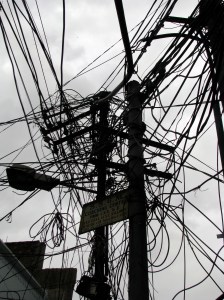
With proper planning, the 21st century power grid will be smart, efficient and resilient. Without good planning, it could be an expensive mess. Photo credit McKay Savage, India.

The General Assembly recently passed a bill intended to promote modernization of our existing electricity grid. It is important for Virginians to understand the costs, benefits and various ways of upgrading our state’s grid, so that they can decide for themselves whether the new legislation provides the best path forward. Making the right choices about this affects our family finances and the competitiveness of our state economy.

An electricity grid is the system of wires and facilities that move electricity from where it is produced to where it is used. Thomas Edison created the first utility in New York City in 1882. A portion of it was still in use until 2007.

The Traditional Grid

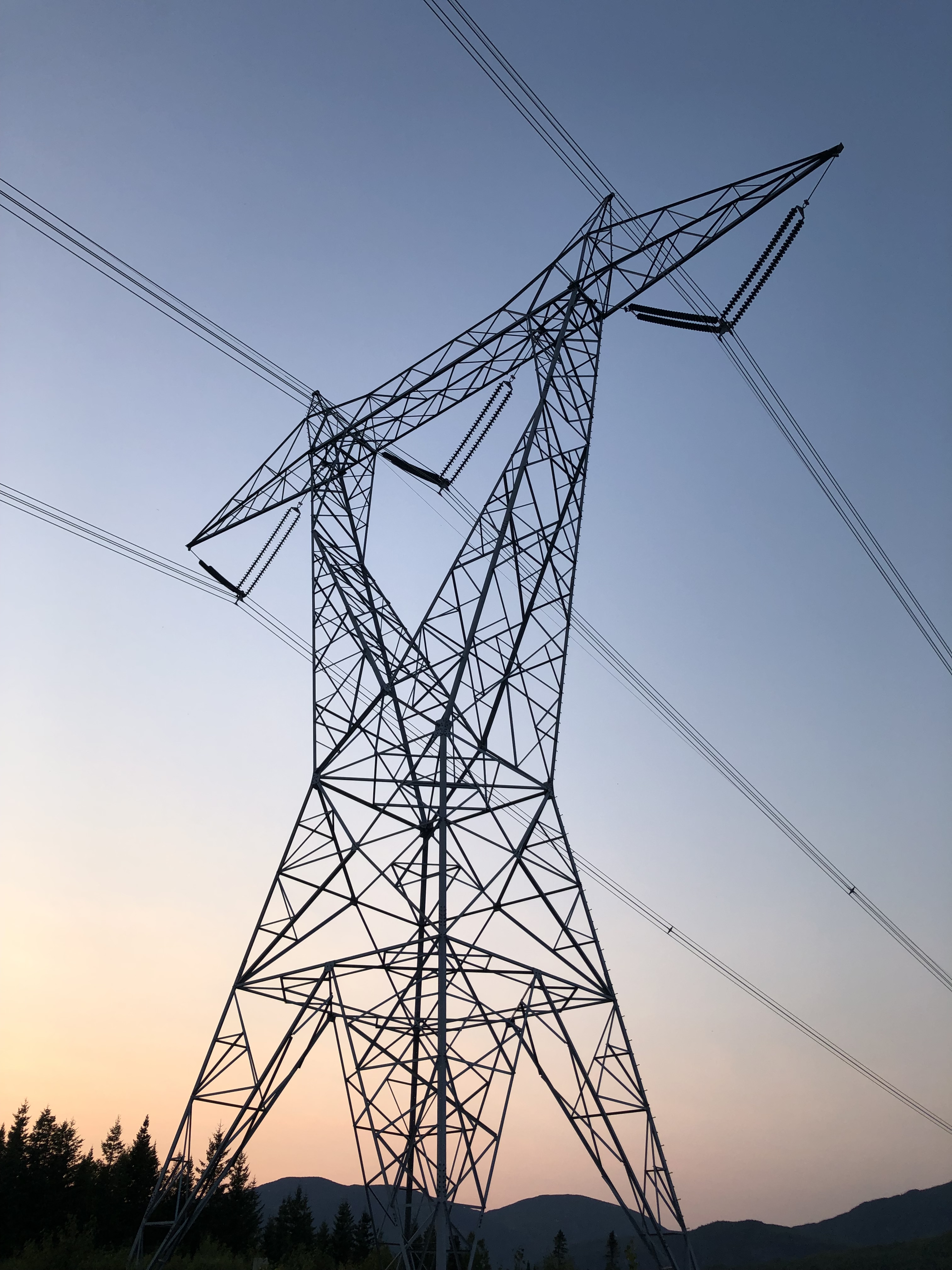
For over a century, the grid met the same basic functions and contained equipment that Edison would have recognized, at least in concept. The system evolved to have electricity produced at a distance from where it is used. Since more electricity is lost the farther it is transported, high voltage transmission lines were developed to minimize these losses. These are the very tall, usually lattice-like, steel towers with long drooping lines that you see from the highway. We can’t use electricity at such high voltage, so it is stepped down using big transformers to lower levels. Sometimes several types of lower voltage lines are used to get the energy closer to where it needs to go.

The transmission lines bring the electricity to a population center or industrial complex to where it will be used. At this point a complex set of equipment called a substation is used to reduce to reduce the voltage to the various levels used by industries, businesses and residences. Once the voltage is reduced at the substation, it enters the distribution system. These are the lines that you see on the poles along the street where you live, where the voltage is reduced one last time to the level you use in your home. Other wires are also on those poles for telephone and cable TV service. If you live in a city, or a new subdivision, those lines are often underground.

Electricity doesn’t move like cars on a road, from Point A to Point B. So you can’t really say where electricity was produced or where it was used.

For about 100 years, the design of the system worked well. There was a steady increase in demand. As generating stations got bigger, electricity became cheaper to produce. The centralized power plants feeding distant loads were easy to manage. Electricity flowed one-way, as did the information back to the utility grid supervisors.

Some things began to change in the second half of the 20th century. Transmission lines were interconnected between utilities so a surplus in one area could be used to meet a shortfall in another. These early “power pool” arrangements evolved into the sophisticated Regional Transmission Organizations (RTOs) and Independent System Operators (ISOs) that we have today. PJM is the organization that manages electric generation and transmission in a 13-state region that includes Virginia.

A Shift 40 years in the making

By the mid-1970s, new power plants became so expensive (especially nuclear units) that a fundamental change occurred. Every time a new conventional power plant (fossil or nuclear) was built, the price of electricity went up.

As fuel costs and electricity prices increased, appliances and buildings were designed to use energy more efficiently. Demand continued to increase, however, as a larger population and greater economic activity kept electricity use rising.

When the recession hit in 2008, families tightened their belts and businesses found ways to produce more goods and services using less energy. For the first time, growth in population and economic activity no longer created a higher demand for electricity. Over the past ten years, growth in U.S. electricity demand has been relatively flat. In 2017, a year of population growth and greater economic activity, total electricity use in the U.S. was 2.1 % lower than the year before.

Stable or declining growth in demand disrupted the utility business model which depended on the steady increase in electricity use to provide enough revenue to cover past investments and provide funds for new projects.

About the same time, new technologies were introduced that further complicated matters for utilities. Concern about environmental impacts associated with extracting and burning fossil fuels increased interest in methods of generating electricity using ways that did not require fuel. Electricity generated from solar and wind power used energy that was naturally renewed. These fuel-free methods were primarily technology driven and took advantage of a learning-curve that has resulted in on-going price reductions of 50% every 4-5 years.

Small modular solar units allowed electricity to be generated at customer locations. Although this reduced customer costs, it made things more challenging for utilities. It reduced their revenues at a time when those revenues were already challenged by flat growth in demand. And these units were located within the distribution network which could result in the flow of electricity opposite to the direction for which the system was designed.

The Modern Grid

It is a huge shift for utilities that have operated in the same way for 100 years to move to a new way of doing business. The energy industry is undergoing a similar transition to what the computer industry experienced several decades ago. We once had highly centralized mainframe computers controlled by a few specialists. Now we have networks of personal computers that provide choices and new possibilities for everyone.

Putting customer needs at the center of the modern grid requires a new mindset. Utilities, especially those owned by private holding companies, have been mostly focused on creating revenue streams to reward shareholders and reducing the effects of regulators’ actions on profits. Many utilities do not even think in terms of “customers.” Instead they talk about “ratepayers” because, from their private parent company’s point of view, that’s where the money comes from.

Smart meters, solar, and batteries

Creating a modern grid will require replacing old electro-mechanical controls and monitoring equipment with modern digital devices. Having a two-way flow of information will help utilities more quickly determine when a line is down and dispatch a crew to the correct location. Smart meters provide utilities with more information about customer usage and save the cost of reading meters. But regulators should be sure that the hundreds of millions spent on new meters (and paid for by ratepayers) also benefit the customers. If designed correctly, with reliable, rapid communications, customers can access that data for use by home energy systems that optimize comfort and lower costs. Water heaters, as well as heating and cooling systems, can be controlled remotely by utilities or private aggregators to turn off for a short period to reduce peaks and save customers money.

A system dependent on digital devices and software control is much more vulnerable to cyber-security threats and must be designed with that in mind.

Creating a two-way flow of energy will also make the grid more capable. Utility-scale solar provides clean energy at a lower cost, but it still follows the old central station philosophy and requires a connection to transmission lines. By installing a significant amount of new solar at dispersed locations within the distribution system, it improves the reliability and resiliency of the grid.

Output from solar units can be variable. But those variations can be highly predictable. Anticipated changes can be matched from other contributions throughout the grid, especially with PJM’s large surplus of generation. Batteries have economic applications now, but will be even more useful as prices decline by half every 4-5 years. Energy storage can supply backup power, frequency and voltage regulation, and other valuable grid services.

Consolidated Edison, the utility that serves New York City, is intending to use distributed solar, storage, energy efficiency and other grid improvements to avoid the need to construct a new $1 billion substation. When utilities avoid building new facilities in order to save customers money, they need to have other means of remaining financially sound.

Soon the use of electric vehicles will be widespread. Batteries paid for as part of the price of the vehicle can be used to store renewable energy during the times when it is plentiful for use at other times when it is more valuable.

Resilience and Reliability

Some grid investments improve the ability to withstand stresses without loss of service. This is called resilience. It can involve undergrounding distribution lines to reduce the exposure to storm damage. Resilience is in a large part about what does not happen and therefore, is closely related to reliability. But investments in undergrounding can be very expensive and have diminishing returns. Other investments might be more cost-effective.

Having some local generation and the ability to temporarily isolate from the larger grid, using microgrids, can maintain some level of operation if the larger grid goes down. Public buildings, hospitals, university and commercial campuses, and industrial parks can benefit from this. Battery storage can also contribute to both resiliency and reliability. These are complex issues and the tradeoffs must be carefully evaluated.

Transmission lines put underground can have lower reliability than overhead lines, which are typically not very vulnerable to storm damage. Underground transmission is projected to have half the life span of overhead lines. Once the great disruption during the lengthy construction period is complete, they do have less of a visual impact, however. But this comes at a much higher cost.

Creating a Modern Grid: the roles of regulators and utilities

States that are well underway with grid modernization have begun with a legislative directive that broadly defines the goals to be achieved and empowers the state regulator to embark on the process of establishing the regulatory framework to facilitate the necessary activities. Usually milestones are specified to evaluate progress.

Legislation often specifies the major goals of the modernized system such as: a more flexible grid that offers a wider variety of more personalized energy options; that is more secure against threats; with decisions made considering both cost and environmental sustainability; and has a more diverse mix of both centralized and distributed generation, etc. New laws also often encourage the development of research and development activities to attract innovative new businesses, and the establishment of funding sources that provide low-cost financing for energy efficiency and small-scale renewable projects.

The regulators then convene a series of stakeholder workshops to better understand the challenges faced by the utilities and the desires of their customers. This can be a transformative experience for a state. Collaboration between many interests can set the stage for long-term cooperation that lowers costs, provides new employment, and makes the state an attractive location for both businesses and residents.

Utility regulators must be strong and independent to objectively review and balance the various interests. A cooperative relationship with the legislature and the executive branch is helpful when new laws might be required to ensure the financial health of utilities serving in a new role.

Utilities have a central role in developing our modern grid, but not the only role. States that have provided opportunities for innovative private companies to provide various energy services have created a path for lower energy costs and greater employment. Utilities must provide the platform for this to take place and they can profit by providing services that enable transactions between private companies and utility customers.

We must give utilities a fair return on their legacy investments and provide an opportunity for them to prosper by serving their customers better, perhaps with performance based rates. A modern grid should not create winners and losers. It should be a place for many to prosper by providing value to customers.

The wires are the natural monopoly. The utilities have accepted regulatory oversight and fair rates in exchange for a fair return and freedom from competition (on the wires side). That agreement should remain intact and proper regulatory oversight must occur. Utilities can be responsible for the distribution platform and still allow opportunities for private companies to provide a variety of services that have value to customers and the grid. This leads to a vibrant state economy, lower costs and increased employment.

The high cost of doing it wrong

If we do not move forward, we will pay a price. If utilities are allowed to drag 20th century habits deep into the 21st century, it will eventually harm them and the rest of the state as well. For example, Duke Energy has proposed a $13 billion grid modernization program. Critics, including Google and the North Carolina ratepayer advocate, say the plan has little justification and will not benefit customers or clean energy.

The North Carolina Utility Commission has said that Duke has not provided “compelling evidence” that its plan to modernize the grid would result in “meaningful benefits to ratepayers despite its cost.” Duke, like Dominion, is struggling to justify building new power plants in the face of flat demand for electricity. Investments in “gold-plated distribution infrastructure” will provide it with the revenue it desires. A Google representative said the costs attributed by Duke to grid modernization are “seemingly arbitrary.” The staff of the state regulatory commission agreed, saying that they are “not persuaded that all the components of the . . .  initiative will result in modernizing the grid.” The staff went on to say there is “substantial uncertainty regarding what exactly will be included.”

The general counsel of the North Carolina Sustainable Energy Association noted that, “Some grid modernization is certainly needed, but the price tag put forward by Duke is shocking, and what’s in their proposal is shocking as well.” He added that “there’s been very little meaningful public input.”

“If the customers are paying for 100 percent of these programs in their rates,” said an EDF spokesman, “then let’s give them 100 percent of the benefits.”

Lessons for Virginia

This sounds like the opportunity just squandered by the Virginia General Assembly. Instead of putting us on the path to an effective modern grid, the legislators have given the utilities permission to spend billions over the next 10 years with diminished regulatory involvement. This will add significantly to utility bills in Virginia that are already the 10th highest in the nation. There are no specifics in the bill that identify how this money will be spent or whether the money paid by customers will actually result in a modern grid similar to what is being developed in other states.

Virginia can do much better than this. We should immediately embark on a program to get this right in the next legislative session in a way that is fair to the regulated utilities and their customers. Bringing in objective outside specialists could guide us toward an innovative, lower cost, clean, efficient and reliable energy future.