Unknown's avatar

Trump’s attack on offshore wind is hurting Virginia. Why aren’t Republican leaders fighting for us?

On May 5, attorneys general from 17 states and the District of Columbia — not including Virginia, regrettably —  sued the Trump administration over its attacks on the wind industry. The lawsuit challenges an executive order, signed by President Donald J. Trump on his first day in office, stopping all approvals, permits and funding for wind projects across the country and offshore. 

Since the order was signed, the administration hasn’t just blocked new projects, it’s issued a stop-work order for one project under construction in New York and revoked a permit for another. The actions inflict enormous damage on the wind industry and on the economies of states that need the energy and jobs this industry could deliver.

One state that will lose big under Trump’s order is Virginia, which has positioned itself to be a national leader in offshore wind deployment, supply chain and manufacturing. On top of that, Virginia badly needs the electricity from offshore wind to help meet the demand from data centers; it can’t afford to have a major new source of energy strangled in its infancy. Yet Attorney General Jason Miyares did not join the lawsuit.

Sure, Miyares wants to be a good soldier in the Trump putsch. And no doubt he wouldn’t feel at home among all those Democratic AGs (there were no Republicans signing the complaint). But he could at least speak up in his state’s interest. Some well-timed advocacy would go a long way in showing the administration that wind energy is not a partisan matter. 

It doesn’t have to be just our attorney general, either. The silence from Gov. Glen Youngkin has been equally deafening. What are they afraid of? Youngkin can’t run for reelection, and Miyares has already secured his party’s nomination in his bid for reelection this fall.

Any politician who styles himself as pro-business ought to be pushing back on the Trump administration’s interference with contracts, destruction of American jobs and infliction of billions of dollars in damage to a growing domestic industry. Especially when it is happening to their own state, the big risk is in not speaking out.

And let’s face it, attacking wind energy is Trump’s own peculiar hobbyhorse, not his party’s. Though Republican support for wind energy has dropped a bit in recent years, it remains above 50%. Onshore wind is the largest source of electricity in Iowa and South Dakota and a major source in several other Republican strongholds. Wind power is responsible for billions of dollars in economic investment while keeping utility rates low in states that rely on it. 

Offshore wind is more expensive, but states have embraced it for its potential to lower electricity bills over time while relieving grid congestion, creating well-paying jobs and providing clean, zero-carbon power to East Coast cities. Thirteen states have established offshore wind development goals, totaling over 112 gigawatts (GW) by 2050. 

In Virginia, Republican leaders have been among the biggest boosters of offshore wind for more than 15 years. Legislators from both parties supported the creation of the Virginia Offshore Wind Development Authority. With a boost from then-Gov. Bob McDonnell, the Virginia Department of Energy partnered with Dominion Energy on a research project that produced the nation’s first offshore wind turbines in federal waters. Republican support also paved the way for Dominion’s development of the 2.6 GW Coastal Virginia Offshore Wind (CVOW) project, now more than halfway to completion and expected to begin delivering electricity next year. 

Nor is CVOW a one-off; the Virginia Clean Economy Act declares twice as much offshore wind power to be “in the public interest.” At the offshore wind International Partnering Forum held in Virginia Beach last month, Dominion displayed a poster of the projects it has in the works. These include a project off Kitty Hawk, North Carolina, which Dominion acquired last October, as well as a huge lease area east of CVOW, which Dominion secured in a lease auction from the federal government last August. All told, Dominion’s projects could deliver a total of 9 GW of clean, renewable power. 

A poster displaying Dominion Energy’s planned offshore wind projects.

As important as the energy itself is, Virginia leaders believe offshore wind can be a driver of economic development and job creation for the Hampton Roads area. The Virginia Economic Development Partnership touts Virginia’s strategic location, strong maritime industry and ready workforce as draws for businesses up and down the offshore wind supply chain.

Some businesses have already set up shop in Virginia to serve the industry. These include most recently a Korean subsea cable manufacturer that is investing almost $700 million for a facility in Chesapeake. Gov. Glen Youngkin was on hand for the groundbreaking last month, calling it “a proud moment for Virginia.” Attracting the company was only possible because of Virginia’s commitment to the wind industry – as well as the availability of federal tax credits that Trump also intends to eliminate. 

CVOW will likely survive Trump’s attacks (albeit at a higher cost due to his tariffs), but Virginia’s ability to develop an offshore wind workforce and supply chain are very much at risk. The Trump administration’s war on wind power already threatens developers with losses in the billions of dollars. With permitting at a halt, companies are headed for the exits instead of creating the project pipeline necessary for offshore wind to become the powerhouse industry that it is in Europe and Asia.

Trump may have planned his economic sabotage to hurt northeastern states with Democratic governors, but the collateral damage to Virginia is considerable. As it is, our economy has taken a hit from Trump’s mass firings of federal workers, thousands of whom live here. We can’t afford to lose four years of offshore wind progress for no better reason than that Trump wills it. 

Silence is not an acceptable response. Miyares and Youngkin must speak up for Virginia.

Originally published in the Virginia Mercury on May 19, 2025.

Update: On May 20 we learned Trump’s Department of the Interior rescinded its order to shut down the $5 billion Empire Wind project in New York, reportedly after Gov. Kathy Hochul agreed to reverse a decision five years ago denying a permit to a natural gas pipeline. This is being billed as a “compromise,” which is apparently what extortion is called when the Trump administration does it.
Unknown's avatar

Utility efforts to undermine rooftop solar meet stiff opposition from Virginia customers

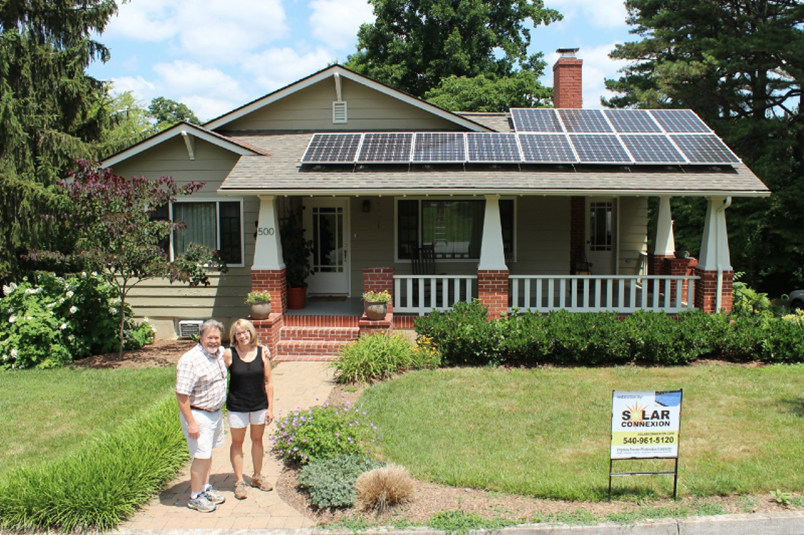
Photo courtesy of Solarize Blacksburg

Virginia’s investor-owned utilities thought 2025 would be the year they put an end to net metering – and with it, rooftop solar installers’ modest competition with their monopoly.. The 2020 Virginia Clean Economy Act (VCEA) removed many barriers that residents and businesses installing solar panels under the state’s net metering law had faced, but it also called for the State Corporation Commission to reevaluate the program, beginning right about now. 

 Not surprisingly, Dominion Energy and Appalachian Power are seizing this opportunity to push for changes that would undermine the economic calculus supporting customer-owned solar.  

Since at least 2007, Virginia law has required that customers of Dominion and APCo who have solar panels on their property be credited for surplus electricity they supply to the grid at the same retail rate they pay for electricity. The credit is applied against the cost of the electricity the customer draws from the grid at times when the panels aren’t generating, reducing what they owe on their electric bill. 

But now that they have the chance, both utilities have filed proposals to end net metering. Both essentially propose to charge new solar customers the full retail rate for the electricity they draw from the grid (with Dominion using a more complicated half-hour “netting”), but compensate them for electricity fed to the grid only at the utility’s “avoided cost,” or what it pays to buy electricity from other generators. By law, existing customers and new low-income customers with solar would be unaffected.

APCo calculates avoided cost as the wholesale cost of energy and capacity, plus transmission and ancillary services, for a total of less than 5 cents per kilowatt-hour. Thus, a homeowner with solar panels would now pay the full retail rate of about 17 cents/kWh for electricity drawn from the grid, while being credited at less than one-third that amount for electricity put back on the grid. 

Dominion’s approach instead pegs avoided cost to what it pays for solar generation and associated renewable energy certificates (RECs) bought from certain small producers under power purchase agreements, an average of about 9.5 cents/kWh. Dominion’s residential rate currently averages about 14 cents/kWh, but would go up to more than 16 cents if its latest rate increase request is granted.

The VCEA gave APCo the first swing at the piñata. APCo filed its proposal in September, and the SCC will hold an evidentiary hearing on May 20. Dominion only filed its petition last week, and no hearing date has been set yet. 

Not surprisingly, APCo’s proposal generated fierce opposition from advocates and solar installers. They point out that it’s hard enough to make the economics of home solar work with net metering at the retail rate; slashing the compensation for electricity returned to the grid by more than one-third, as Dominion proposes, or two-thirds, as APCo wants, would make solar a losing proposition for most homeowners. Maybe economies of scale and other factors would allow the market for commercial solar to survive under Dominion’s program, though Dominion’s insistence on confiscating customers’ RECs won’t make anyone happy.

If solar owners definitely lose under APCo’s plan, advocates say other ratepayers don’t necessarily win. A homeowner’s surplus generation travels only the short distance to the nearest neighbor, lessening the need for the utility to generate and transmit power to meet the neighbor’s demand. Since the utility charges that neighbor the regular retail rate for the electricity, without having to bring it from somewhere else, the utility saves on transmission costs. On top of that, the surplus solar comes in during the day, when demand is typically higher than at night and electricity is more costly, making solar more valuable to the utility. Plus, it is clean and renewable, and the customer bears all the cost and risk of the investment.

Utilities do not share this rosy view. By their way of thinking, solar customers use the grid as free energy storage and backup power, without paying their fair share of grid costs. Not only does this deprive the utility of revenue, but those grid costs now have to be spread out among the remaining customers. This, they say, creates a cost shift from solar owners to everyone else. 

More than a decade ago, Virginia took tentative steps towards resolving the dispute, with the Department of Environmental Quality setting up a stakeholder group to work towards a “value of solar” analysis. The process was never completed — the utilities walked away from the table when it appeared the results weren’t going to be what they wanted, and the group’s work product did not include numeric values or policy recommendations. 

Virginia is hardly alone in navigating these clashing narratives. 

Other states and regulators have arrived at very different conclusions as to the “correct” value of distributed solar to utilities, ratepayers, and society as a whole. States like Maryland kept net metering after a value of solar analysis concluded the benefits outweighed the costs. On the other hand, California famously ended its net metering program in 2022 when solar comprised almost 20% of electricity generated in the state and created a mid-day surplus without enough storage to absorb it; at the time, 45% of that solar was distributed. That same year, however, Florida Gov. Ron DeSantis vetoed an unpopular bill that would have phased out net metering in the state.

The experience of other states, combined with an abundance of research and analysis conducted over the years, gives the SCC a lot to work with as it considers the fate of net metering for APCo’s customers this year, and later for Dominion’s.

Countering the arguments of the utility’s hired witnesses, solar industry and environmental organizations have weighed in on the APCo docket with testimony from experts with nationwide experience. The experts pointed out a range of errors and omissions in the utility’s work product. They also presented their own benefit-cost analyses demonstrating a value for distributed solar in excess of the retail price of electricity, using tests often applied to energy efficiency and demand-response programs.

Perhaps even more significantly, SCC staff also filed an analysis that found many of the same problems with APCo’s proposal, including failures to comply with statutory requirements. The staff report did not include a quantitative analysis, but it urged the importance of considering benefits that APCo had ignored. Like the intervenors, staff recommended the commission reject APCo’s plan and retain its net metering program as it is, at least for now.  

Although the staff report would seem likely to carry weight with the commissioners, it’s never easy to predict what the SCC will do in any case before it. But in Virginia, unlike California, distributed solar makes up vanishingly little of total electric generation. Even taking the utilities’ arguments at face value, it seems foolish to upend this small but important market to remedy a perceived harm that is, at least for now, more theoretical than real. 

This article originally appeared in the Virginia Mercury on May 8, 2025.