Unknown's avatar

Are nuclear reactors a good fit for Southwest Virginia – or a solution in search of a problem?

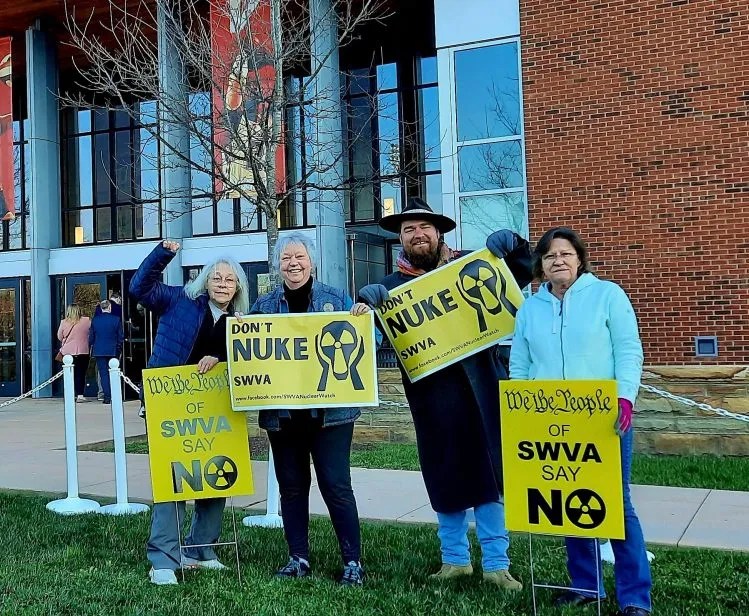
Sharon Fisher (second from left) and other members of Southwest Virginia Nuclear Watch. Courtesy of Fisher.

Gov. Glenn Youngkin wants to bring a small modular nuclear reactor (SMR) to Southwest Virginia in the course of the next decade. The administration has put together a small amount of funding to search for a larger amount of funding to pay for a study. One of the study questions is what they would use the reactor for – research, possibly, and to provide electricity for the University of Virginia at Wise, or perhaps a data center that the region has yet to attract.

If this all sounds a little sketchy, that’s because SMRs remain a little sketchy. Nuclear companies haven’t yet demonstrated they can attain the holy grail of safe, 24/7 carbon-free power at a competitive cost.  

It’s not for lack of trying. At last count, the Nuclear Energy Agency was tracking some 98 different design technologies around the world for SMRs ranging in size from 1 MW microreactors to utility-scale reactors of more than 300 MW. Only a handful of these have reached the construction phase, and none are operational in the U.S. 

This meager track record hardly reflects the enthusiasm surrounding the industry. It’s not just politicians and profit-seekers; many climate advocates believe the industry must succeed if the world is to have any hope of transitioning our energy supply away from fossil fuels. And polling shows that 56% of the public supports building more nuclear plants. That’s way less than the levels of support for wind and solar but more than support for fracking and coal mining. Still, concerns remain about safety and the proliferation of nuclear waste, a problem neither the industry nor the government yet has a strategy to deal with.

And then there’s the cost. SMRs haven’t shown an ability to compete in the energy marketplace, even against other carbon-free alternatives. As renewable energy and storage technologies continue to drop in price, the economic case for new nuclear remains an open question. 

Nonetheless, both of Virginia’s publicly-owned utilities are exploring SMRs, having secured legislation last year that will allow them to charge customers for millions of dollars in early development costs. Appalachian Power is targeting a site near Lynchburg (not Southwest Virginia), while Dominion Energy says it is evaluating the feasibility of an SMR next to its existing conventional reactors at North Anna. 

Dominion’s 2024 integrated resource plan shows an SMR could be part of its power mix as early as 2035; APCo has no timeline. For either utility, actually building an SMR will require making the economic case to the State Corporation Commission.  

The slow timeline and cloudy cost picture have not dampened enthusiasm for nuclear among Virginia’s elected leaders. The data center boom is exacerbating a shortage of energy and causing utility bills to skyrocket. Keeping the party going means making messy tradeoffs between polluting fuels with volatile prices and low-cost but land-hungry solar. No wonder Youngkin and other leaders hope nuclear will magically allow them to sidestep the hard decisions and party on.

But wishful thinking doesn’t put megawatts on the grid. A recent article surveying the state of the nuclear industry makes it clear that these are early times in the nuclear renaissance, if such it is. The industry won’t be able to scale unless and until production-line manufacturing becomes a reality, and that will be years from now. 

Fortunately for the nuclear industry, it has always been a darling of U.S. policymakers, and that remains true. Nuclear subsidies survived the axe in this year’s Republican budget law, while tax credits for wind and solar were revoked. 

Indeed, President Donald J. Trump is doing his best to further the industry’s prospects, albeit in a ham-handed fashion that almost seems calculated to erode public trust. 

Last month a representative of his Department of Government Efficiency reportedly told the head of the Nuclear Regulatory Commission, charged with ensuring the safety of the industry, that it was expected to provide “rubber stamp” approval to nuclear plant applications after they were tested by the Department of Energy or Defense. A few days later, Trump dismissed all but one of the members of the U.S. Nuclear Waste Technical Review Board, which provides oversight of spent fuel storage.  

These alarming moves may not do much to dampen the enthusiasm of the Youngkin administration and other boosters. The administration even hopes to lure nuclear manufacturing to Virginia – but it would be in Lynchburg, not Southwest Virginia. 

That calls into question Youngkin’s claims of economic benefits for an SMR in Wise County. If the SMR would be just a one-off for “research” purposes and needs a rich company or state-supported customer to buy the electricity, is it really an investment in the region, or a solution in search of a problem?

Many local residents are skeptical of the administration’s plans, trusting neither the governor nor the nuclear industry. Sharon Fisher, one of the leaders of the Southwest Virginia Nuclear Watch grassroots movement, told me in an email that her group “has extensively researched the nuclear industry with its enormous costs and contaminations.” 

 She pointed me to a 2023 study of health trends in a Tennessee county where a company called Nuclear Fuel Services generates highly enriched uranium fuels for naval reactors. Over the years, unintended releases of enriched uranium, plutonium and other substances have caused an accumulation of radioactivity in the local air, water, and food. The study documented rising cancer and mortality rates in the county, including a rate of premature deaths that is 61% above the U.S. average.   

Rees Shearer, an activist with the Appalachian Peace Education Center, told me in a phone call that SMRs are “the next wave of exploitation” of Southwest Virginia’s resources.

“First they came for the timber, then they came for the coal, now they are coming with radioactivity,” Shearer said.

He explained, “Coal left a terrible legacy of abandoned mines, polluted creeks, and leaking methane. But this pales compared to the potential legacy of high-level nuclear waste stored on site. With SMRs, the amount of this waste can be 100 times more per megawatt than conventional nuclear. This is waste that will last millions of years. This isn’t a fair trade.”

An SMR would also come with the risk of terrorism, either from hacking or a drone attack. “It makes a place that was never a target into a target,” he noted.

Both Fisher and Shearer challenged the notion that SMRs would provide jobs for Wise County residents, even in the construction phase. Modular facilities would be manufactured offsite and assembled by an expert crew from out of the area. The Nuclear Regulatory Commission has even approved remote operation of nuclear reactors from an offsite facility, they pointed out.

Well-paying jobs are certainly a priority for the area. Unemployment rates for Southwest Virginia counties have risen only slightly from their Biden-era lows, but poverty rates in some counties remain stubbornly high.

But Fisher says the key to a healthy economy lies in diversification. 

“Wise County was once a major producer of apples. We have vineyards and breweries, and fields for growing grains. Tourism is growing. [We should be] investing in local entrepreneurs and farmers, getting equitable tax revenues from the thousands of large absentee landholdings, which should be used for housing and development.” 

Energy jobs needn’t be off the table, but, said Shearer, “We think the better approach is to put solar on the abandoned mines. We have a ready workforce already trained to do this.” He pointed to an effort already underway that’s being spearheaded by the environmental group Appalachian Voices. 

What the region shouldn’t do, concluded Fisher, is “rely on one industry again that puts our lives and land at tremendous risk.”

This article was originally published in the Virginia Mercury on August 4, 2025.

Unknown's avatar

The SCC serves up a nothingburger

Dominion Energy headquarters, Richmond, VA

When Dominion Energy Virginia filed its latest integrated resource plan (IRP) last fall, critics (including me) complained that the company failed to lay out a cost-effective approach that would meet soaring energy demand from data centers while complying with Virginia’s decarbonization mandate. We hoped regulators at the State Corporation Commission would reject the IRP and demand better of our largest utility.

Instead, they chickened out. 

The SCC’s final order, issued July 15, is short but not really to the point. The order finds Dominion’s IRP “legally sufficient,” while citing previous SCC orders for the proposition that “acceptance” doesn’t mean approval “of the magnitude or specifics of Dominion’s future spending plans.” It would be hard to imagine a less enthusiastic endorsement, and the lack of analysis leaves advocates wondering, where’s the meat?

It’s true that an IRP is “only” a planning document; it doesn’t commit a utility to carrying out the plan, and the SCC still has to approve any project the utility decides to move forward with. But the point of the exercise is to ensure utilities are on the right track; that their demand projections are on target and their plans for meeting demand are realistic, cost-effective and comply with all relevant laws. This needs discussion and analysis, not merely an up-or-down vote.

Admittedly, the SCC has a long history of approving lousy IRPs while directing Dominion to do a better job the next time. That was the case here, too, with the order directing Dominion to do a few things differently in its next IRP, due in the fall of 2026. 

First, the SCC wants to see a 20-year timeline instead of the 15-year period that Dominion used this year, which is all the law requires. It’s an obvious ask, even apart from the fact the SCC cites that the regional grid operator PJM uses a 20-year planning window. A better reason is that we are just 20 years away from Dominion’s 2045 deadline for full decarbonization under the Virginia Clean Economy Act (VCEA), and anything the utility does now will have consequences extending out to that deadline. 

The SCC also neglected to mention that using just a 15-year window, and omitting the 25-year planning period that Dominion included in previous IRPs, allowed the company to avoid showing the economic consequences to consumers of spending money for fossil fuel generation that either will shut down or may become economically obsolete by 2045, long before the plants are paid off. If Dominion thinks it can justify sinking customers’ money into assets it knows will become stranded, we all deserve to see the rationale. 

The order also directs Dominion to include in its modeling at least one pathway that complies with the requirement of the VCEA that carbon-emitting facilities (including any new gas plants) be retired by 2045. This goes beyond obvious: the lack of a VCEA-compliant plan should have prompted the SCC to reject the IRP outright. 

But of course, Dominion claims new gas plants are needed for reliability, which would make them legal under the VCEA in spite of their carbon emissions and questionable long-term viability. Reliability is a red herring, as I’ve argued, and other parties to the IRP case modeled how Dominion can meet demand without building new fossil fuels. Dominion should have been required to prove its case.

But here again, the SCC chose not to engage on the issue. Requiring Dominion to do better next time is as far as it is willing to go. This is unfortunate, but the silence can’t last: in March, Dominion filed for approval of the first of its planned new gas plants. The SCC will have to address need and reliability to make a decision in that case, and it would have been better for all concerned if it had grappled with these questions now.

The order falls short in other ways, as well. While the SCC expresses concern about forecasted rate increases, it doesn’t even mention the data centers that are driving the problem. 

This is astonishing; even before Dominion filed its IRP last fall, the commission ordered the company to supplement the record with an analysis of data center impacts. When Dominion did so, it became clear that all of the load growth (and likely, much of the projected rate increases) results from this one industry. It’s beyond strange that the SCC does not even mention the supplement it ordered, or discuss whether Dominion’s duty to serve truly prevents it from protecting existing customers.

The order also accepts Dominion’s argument that it had to artificially limit the amount of low-cost solar it could include in its modeling, due to the increased difficulty of siting solar projects in Virginia. It’s true that many rural counties have been denying permits to solar projects, even as they approve data centers. But I’ve also heard a Dominion lobbyist tell legislators that permit denials have not been a problem for the company, an assertion that may have persuaded some legislators to vote against bills that would make solar siting easier. It appears Dominion tells legislators one thing and the SCC another. 

The SCC’s order contains a few other requirements for the next IRP, mostly things that really should have been included in this one. The IRP should model Virginia’s return to the Regional Greenhouse Gas Initiative, reflecting a Virginia court’s ruling that Gov. Glenn Youngkin’s withdrawal was unlawful. The IRP should assume Dominion achieves the energy efficiency targets that the SCC itself established for the company. Dominion should include an analysis of impacts on base rates and should share its modeling with utility watchdog Clean Virginia, as well as run modeling based on SCC staff inputs. Long-duration storage, a maturing technology that can replace gas combustion turbines, should be included in the next modeling.

“Do better next time” is a well-worn directive from the SCC to Dominion, but it is deeply disappointing at a time when Virginia is facing an unprecedented surge in demand from data centers and accompanying increases in utility rates. 

It’s disappointing in another way, too: this is the first major ruling from the SCC since two new judges were added to the three-member commission, and all three were appointed by a Democratically-controlled Senate. If there was ever a time for the SCC to get tough with Dominion on its climate obligations, this should have been it. 

No doubt, the problem lies in Dominion’s influence over the entire process. The utility doles out exceedingly generous campaign donations to members of both parties, so the company retains influence no matter who is in power. Not only does this give Dominion sway over who is appointed to the SCC, but commissioners have to be mindful that getting reappointed at the end of their six-year terms depends on how satisfied these Dominion-backed senators are with their rulings. 

As long as Dominion is allowed to shower senators with unlimited campaign cash, the SCC will never be free of the utility’s pernicious influence. 

Meanwhile, though, Dominion’s poor performance, and the SCC’s unwillingness to call it out, demonstrate the necessity of the comprehensive IRP reform legislation that the governor vetoed this spring. The Commission on Electric Utility Regulation is already working on similar legislation for the next session. 

Passing the IRP reform bill may not inject the SCC with greater courage, but it will ensure the commission, and the public, get a fuller look at the facts.

This article was originally published in the Virginia Mercury on July 21, 2025.

Unknown's avatar

Is it too hot for common sense?

smokestack
Photo credit Stiller Beobachter

Maybe it’s the heat. Heat-addled brains might explain the thinking of many Virginia lawmakers that what we need to do right now is burn more fossil fuels. 

Scientists have documented the way high temperatures affect the brain, impairing cognition and causing impulsivity and trouble concentrating. And this summer is already starting out hot, which is saying something given that 2024 was the hottest year on record, bumping 2023 off its baking pedestal. Scientists say this global fever is the natural result of burning fossil fuels and driving CO2 levels to their highest in millions of years.

Since burning more fossil fuels will drive more global warming, it’s exactly the reverse of what we should be doing.  Yes, but, these state leaders respond, how else are we going to power ever more data centers? 

Northern Virginia is the data center capital of the world, and data centers are notoriously power-hungry. Without them, Virginia electricity demand would be flat, and we could easily meet our electricity needs while gradually decarbonizing along the pathway laid out in the Virginia Clean Economy Act (VCEA).

Instead, Virginia taxpayers subsidize some of the richest corporations in America to the tune of almost a billion dollarsevery year to entice them to rip up land in Loudoun, Prince William and other Virginia counties instead of Atlanta or Dallas. In return, the tech companies keep construction workers busy, underwrite their host counties’ finances, make life miserable for nearby residents, raise everyone’s power bills, drain our rivers and aquifers and pollute our air with enough diesel generators to light up a major city.  

Virginia legislators obviously consider this a fair deal, because that’s what they keep voting for. Whether their constituents agree is another question; the evidence says they don’t.

For anyone just getting up to speed on data center issues, the Virginia Sierra Club’s new report, “Unconstrained Demand: Virginia’s Data Center Expansion and Its Impacts” (to which I contributed), covers the current state of data center development in Virginia and the problems that come with it. Fun fact: More than half of all the nation’s energy consumption attributed to data centers occurs in Virginia. 

That puts a special burden of leadership on our lawmakers. If we allow data centers to undermine our sustainability efforts here, we can only expect a race to the bottom in other states. As Virginia goes, so goes the nation. 

And yet we haven’t heard much outcry from Virginia leaders against the plans of our largest utility to build new generating plants powered by fracked gas. Dominion Energy laid out its plans in its 2024 integrated resource plan as well as a proposal for a 944 megawatts of gas combustion turbines in Chesterfield now pending before the State Corporation Commission. 

Dominion and its allies say more gas is needed for reliability, which could make it allowable under the VCEA. Indeed, “reliability” is a word that fossil fuel advocates frequently toss down like a trump card (in the unpresidential sense but with the same lack of thoughtful analysis). The claim is suspect. Fussing about reliability when your state ranks 24th in the nation for renewable energy is like worrying about the taxes you’ll owe if you win the lottery: we should be so lucky. 

Gov. Glenn Youngkin and Republican legislators are explicit in wanting to see the VCEA repealed and more gas plants built. Democrats defend the VCEA’s goals, but worry about the challenges of implementation and the effect on electricity rates. They all cite data center demand as the reason they contemplate backsliding on clean energy.

I wish I could say that our rich and powerful tech companies were aggressively championing carbon-free energy for their data centers in Virginia, but they are not. I attended a meeting of the Commission on Electric Utility Regulation where legislators were hashing out the problems of too much demand and too little supply. Representatives from the Data Center Coalition stood in the back of the room, observing but refusing to engage. Out of sight, they successfully lobbied against any bills that would slow the data center boom, force them to absorb more of its costs, or require them to source their own clean energy. 

Publicly, many tech companies tout their commitments to decarbonization. Amazon says it even met its goal to run its operations entirely on renewable energy. Yes, and I’m the Queen of Sheba. In fact, these companies are in a fierce competition to develop artificial intelligence as fast as possible. They’d like carbon-free power, but really, they’ll take whatever energy they can get wherever they can get it, and even among the industry’s best actors, climate now takes a back seat

Yet the likes of Mark Zuckerberg and Jeff Bezos would not be significantly worse off if forced to meet their climate commitments. Virginia leaders know – or at any rate, they have been exposed to the information, which I realize is not the same thing – that building new fossil gas generating plants is not just bad for the planet but more expensive than pursuing carbon-free alternatives.

Oh, I know, Congress just yanked back the federal tax incentives that helped make wind and solar as cheap as it is, one of the myriad ill-considered elements of the big beautiful debt bomb Republicans adopted against everyone’s better judgment. (Apparently heat affects spines as well as brains.) With passage of that bill, developers will need to have begun construction on new facilities by this time next year in order to qualify for the existing tax credits. 

There will be a mad rush to get construction underway immediately for facilities in the development pipeline. Thereafter, projects on the margin won’t get built. But others will, because even the loss of federal subsidies won’t destroy solar’s competitive edge against most new-build gas. 

Even so, utilities and their customers will pay higher prices for unsubsidized new renewable energy – as well as for existing fossil fuel generation that will command higher prices in the coming supply crunch. The Clean Energy Buyers Association estimates that commercial electricity costs in Virginia will be about 10% higher after the phase-out of federal incentives. 

A years-long backlog for orders of gas turbines will further squeeze energy supply and drive up prices for fossil power. On the plus side, the lack of available turbines will make fast-to-deploy solar not just the better option, but sometimes the only option.

I’ve never understood the conservative love affair with fossil fuels, when today’s clean technology is cleaner, cheaper and quicker to deploy. Trump would like to crush wind and solar altogether, which would eliminate 90% of the power capacity waiting to be connected to the grid and catapult the U.S into a serious energy crisis. In addition to much higher power prices, observers warn we would likely see a loss of data centers and other energy-intensive industries to parts of the world that are not on a mission to kill low-cost clean energy. 

Well, that would be one way to rid Virginia of the data center scourge.

Fortunately, the worst attacks on solar in Trump’s budget bomb did not survive, but the bill should nonetheless serve as a wake-up call for Virginia leaders. With little time left to secure federal clean energy incentives, our utilities need to acquire all the solar and storage they can right now. With or without data centers, locking in as much fuel-free generation as possible while it’s available at a discount is a prudent move to avoid the coming shortages and escalating costs of energy.

As for the tech companies, lawmakers should embrace the simplest approach to this problem, which happens also to be the one that spares ordinary Virginians from bearing the costs of the data center buildout: shifting responsibility for sourcing electricity onto the companies themselves, and requiring that they live up to their climate claims by making the power they buy carbon-free. 

It’s an approach other states can follow, holding Big Tech to the same responsibility no matter where they put their data centers. Certainly the tech titans can afford it; they just won big with massive tax cuts that our poorest residents will pay for. 

No doubt they will complain. Everyone would like somebody else to pay for what benefits them. But Virginians can’t afford to subsidize Big Tech, and we don’t want to. 

As for those legislators who think we should continue to do it anyway – well, all I can think is, it’s got to be the heat.

This article was originally published on July 8, 2025. On July 7, President Trump signed an executive order directing cabinet members to find more ways to hobble wind and solar energy, including directing the Secretary of the Treasury to interpret “beginning of construction” in a way that requires “a substantial portion” of a facility to have been built in order to qualify for tax incentives, counter to current regulation.

Unknown's avatar

Let’s hear it for the losers!


In Wise County earlier this month I met the candidate daring enough, or foolish enough, to run against the most powerful Republican member of Virginia’s House of Delegates. 

When I walked into the community center in Norton, where I was to give a presentation at the invitation of the Clinch River Coalition, I found a volunteer wrangling wires to plug in the audio equipment. He was introduced to me as Josh Outsey, the man who had taken on the thankless job of Democratic challenger to Del. Terry Kilgore, R-Scott, in this fall’s election. 

Before I could stop myself, I laughed. Terry Kilgore has been in the House for 31 years, and ran unopposed in the last three elections. A politically powerful member of a politically powerful family, Kilgore represents a district that’s over 92% White and voted 83.1% for Donald J. Trump. The 63-year-old lawyer was recently elected House Republican leader.

Joshua Outsey (pronounced OOT-see), 38, is a Black actor, singer and community organizer. As of June 5, Kilgore had raised $469,509, according to the Virginia Public Access Project. Outsey had raised $200. 

Outsey gives a respectable pitch for his candidacy, grounded in both experience and policy. If this were a contest for a seat in a more balanced district, I’d have no business being amused. But no one, least of all Outsey, is under any illusions that he can unseat Kilgore. 

Still, I am filled with admiration. It is one thing to say that democracy works best when voters have choices, and quite another to agree to make yourself that choice against impossible odds. 

I’ve seen up close what even a hopeless campaign can require. A couple or three decades ago, my friend Tom Horton ran for Congress against a well-funded Republican incumbent who was firmly entrenched in Virginia politics. Tom had no trouble securing the Democratic nomination – nobody else wanted it – but he didn’t have money for a staff, and he needed a policy director. I was at home with young children and glad for the mental stimulation, so I signed on. 

Unburdened by any real prospect of success, I had a great time writing position papers based largely on my own opinions. Every once in a while, I would stop and ask myself, “I wonder what Tom thinks about this?” then shrug and plunge on. Very occasionally, Tom would balk at a position I proposed he take, and then we would talk it out.

But mostly, he didn’t have time for that. Poor Tom spent every day of the campaign on the phone trying to raise money. In the evenings he knocked on doors. If he was lucky, sometimes he was interviewed on the radio or got a quote in the paper. It was an uphill slog all the way, and none of it mattered. He lost by about the same wide margin that polls had shown him losing by at the outset of the campaign. 

He had to be disappointed, but Tom told me he loved every minute of it and would run again in a heartbeat, if he didn’t have a family to support.

Maybe this is why I have a special place in my heart for underdogs. People like Tom who try, knowing they are likely to fail, and then indeed do fail, only to pick themselves up and say it was worth it anyway – they are heroes to me. Winners are dull by comparison. 

Outsey is far from being the only sacrificial lamb this election. Democrats are fielding candidates in every House race this fall, including other long-shot seats like those held by Will Morefield, another coalfields delegate who won in 2023 with 85% of the vote, and Minority Leader Todd Gilbert, who won his Shenandoah Valley district by more than 77%.

Republicans are not similarly contesting every seat, but some are taking on Democratic incumbents even in deep blue districts, including a few who are making a repeat appearance on the ballot.

These include retired technology professional Kristin Hoffman, who is challenging McLean Democratic Del. Rip Sullivan for the second time, in spite of losing by 23 points in the last election. A few miles to the east, in another Fairfax County district that voted overwhelmingly for Harris over Trump last fall, retired federal worker Ed McGovern will face Del. Kathy Tran for a third time. He lost by 20 points in 2021 and 30 points in 2023.  

I was unsuccessful in trying to reach these folks, so I don’t know their motivations. Regardless, I salute them.

Running against impossible odds can serve a purpose beyond dedication to the democratic process. Democrat Melody Cartwright told a Cardinal News reporter that she sees running for a second time against Del. Eric Phillips, R-Henry, after losing in 2023 by 40 points, as a way to support Abigail Spanberger’s gubernatorial campaign. She added candidly that forcing Republicans to spend money to defend Phillips’ seat would leave them less money to attack Democrats elsewhere.

Running for office with no expectation of winning can also be a tactic for raising awareness of a neglected cause, as many a Green Party candidate can attest. My colleague at the Mercury, Roger Chesley, recalls a candidate by the name of Gail Parker who ran for various local, state and federal offices seven times between 2006 and 2019. Calling herself “Gail for Rail,” she campaigned on the single issue of promoting light rail. A 2007 Washington Post headline snarkily called her a “One-Track Candidate.” Fair enough, but the record will reflect that Metro now extends out to Loudoun County. 

Deep in the heart of every candidate, of course, is the hope that lightning may strike. The opponent might stumble badly enough, or voters suddenly realize that who they wanted all along was someone just like the scrappy upstart, leading to an upset victory. 

It has happened. In a 2014 primary, libertarian college professor David Brat defeated Congressman Eric Cantor, the House Majority Leader at the time, in an upset that shocked the political establishment and gave hope to long-shot candidates everywhere. Brat won the general election, too, and served two terms.

Brat’s win over Cantor, followed by his loss to a Democrat in 2018 – to Abigail Spanberger, as it happened – demonstrates a final point: the political winds can shift suddenly, and when it happens, the people who benefit are the ones who’ve got their sails ready. 

Democrats have been able to field so many candidates this year because they sense such a shift coming as part of a backlash to the Trump presidency. Republicans say otherwise. Still, no matter which party wins control this fall, the outcome won’t help the longest of long-shot candidates. 

But that’s okay. Just running is a win for democracy.

This article was originally published in the Virginia Mercury on June 30, 2025.

Unknown's avatar

The war on woke…energy?


I’ve been thinking a lot about language lately, and the strange way words that used to mean good things are now attacked as bad, and vice-versa. Diversity, equity and inclusion are radioactive. Mentioning environmental justice or climate change will get your federal program canceled. Coal is clean, even beautiful, and pointing out the connection to global warming makes you an alarmist, because speaking up when your government steers you towards disaster is now a bad thing to do. 

Recently I received an email excoriating “woke” energy policy, which seemed especially curious. I can see how awareness of historic racial injustice against Black people might nudge policy makers into greater support for renewable energy, given that pollution from fossil fuels tends to have a disparate impact on communities of color. But judging from the hostile tone of the email, I believe we may have different understandings of wokeness.  

Sometimes, though, words mean different things to different people without anyone realizing they aren’t using the same definition. That may be the case when Virginia leaders talk about the reliability of the electricity supply. Everyone agrees reliability is critical – but they may not be talking about the same thing.

Virginia’s need for power is growing at a terrific pace. Data centers consume so much electricity that our utilities can’t keep up, causing them to increase imports from out of state. That’s okay for now; West Virginia is not a hostile foreign nation. Also, Virginia is a member of a larger grid, the 13-state (plus D.C.) PJM Interconnection, which manages thousands of generating facilities to ensure output matches demand across the region. But even across this wider area, demand is increasing faster than supply, pushing up prices and threatening a shortfall. Unless we tell data centers to go elsewhere, we need more generation, and fast.

Democrats and Republicans are divided over how to increase the power supply. Democrats remain committed to the Virginia Clean Economy Act, which requires Virginia’s electricity to decarbonize by 2050. Meeting the VCEA’s milestones requires investments in renewable energy and storage, both to address climate change and to save ratepayers from the high costs of coal and fracked gas. 

Gov. Glenn Youngkin and members of his party counter that fossil fuels are tried-and-true, baseload sources of energy. They advocate abandoning the VCEA and building more gas plants, arguing that renewable energy just isn’t reliable. 

Note that these Republicans are not alarmists, so they ignore climate change. If they were the proverbial frog in a pot of water on the stove, they would consider it a point of pride that they boiled to death without acknowledging the reason.

Youngkin takes every chance he gets to slam the VCEA. As I’ve previously described, the governor sought to amend various energy-related legislation to become VCEA repeal bills, regardless of the original subject matter or how much good it could do.

Last month, Youngkin’s Director of the Department of Energy sent a report on performance-based utility regulation to the State Corporation Commission. With it was a cover letter that had nothing to say about performance-based regulation, but a lot to say about the big, bad VCEA. The letter insists that “By all models, VCEA is unable to meet Virginia’s growing energy demand” and urges the SCC to “prioritize ratepayer affordability and grid reliability over long-term VCEA compliance.” 

Unfortunately for the Youngkin administration, affordability hasn’t been an argument in favor of fossil fuels for many years now. A new solar farm generates a megawatt of electricity more cheaply than a new fossil gas plant, and that will still be true even if Congress revokes renewable energy subsidies – though doing so will make electricity less affordable. 

The argument from fossil fuel defenders then becomes that the cheapest megawatt is not a reliable megawatt. And that’s where meaning matters.

Reliability is so important that even the decarbonization mandate of the VCEA contains an important exception: a utility can build fossil fuel generation under certain circumstances, if it is the only way to keep the lights on. 

Dominion Energy is relying on this escape clause as it seeks regulatory approval to build new fossil gas combustion turbines on the site of an old coal plant in Chesterfield. The move is opposed by local residents, environmental justice advocates and climate activists. (No word on whether they are alarmists or simply alarmed.) They argue Dominion hasn’t met the conditions set out in the VCEA to trigger the escape clause, including achieving energy efficiency targets and proving it can’t meet its needs with renewable energy, energy storage and demand response programs.

Virginia Republicans not only side with Dominion on this, they increasingly favor building gas plants over renewables as a general matter, urging the reliability point. It’s an argument that never made much sense for me, given that renewables make up only 5% of PJM’s electricity. That’s way less than the national average of over 21%, and other grids aren’t crashing right and left. 

The light bulb went off for me while I was watching the May meeting of the Commission on Electric Utility Regulation. A PJM representative showed a chart of how the grid operator assigns numbers to different resources according to how they contribute to the electricity supply. Nuclear plants get the highest score because they run constantly, intermittent wind and solar sources get lower scores, with fossil fuel plants in the middle. PJM calls that a reliability score.

For some Republicans, that’s a slam-dunk: the chart proves renewable energy is unreliable. But in spite of its label, the chart doesn’t actually measure reliability; it gives points for availability, which is not the same thing. 

As I once heard a solar installer testify, few things are as reliable as the sun rising every morning (or rather, the earth rotating). With modern weather forecasting, grid operators can predict with great precision how much electricity from solar they can count on at any given time from solar facilities arrayed across the region. Solar energy is highly reliable, even though it is not always available. Add storage, and the availability issue is also resolved.

Obviously, the grid would not be reliable if solar were the only resource operators had to work with. But it isn’t. PJM calls on a mix of different sources, plus storage facilities and demand response, to ensure generation precisely matches the peaks and valleys of demand. Reliability is a matter of keeping resources in sync and ensuring a robust transmission and distribution system.

The threat to reliability today comes from the mad rush to connect new data centers. PJM has been roundly criticized for not approving new generating and storage facilities’ connection to the grid at a fast enough pace to keep up with the increase in demand and retirements of old, money-losing fossil fuel plants. Scrambling to recover, recently it decided to prioritize a smaller number of big, new gas plants over the thousands of megawatts of renewable energy and storage still languishing on its waiting list. 

Meanwhile, PJM wants utilities to keep operating coal plants even though it will make electricity less affordable and violate state climate laws. In this it is joined by the Trump administration, which wants to require utilities to keep running coal plants explicitly to support the coal industry

Analysts say this is the wrong way to achieve reliability. A recent report from the consulting firm Synapse estimates that PJM’s approach will raise residential electricity bills by 60% by 2036-2040. By contrast, reforming its interconnection process and enabling more renewable energy and storage to come online would lower bills by 7%. By Synapse’s calculation, Virginia would see the most savings of any state. 

In other words, Virginia Republicans are pursuing reliability the wrong way. Instead of pressuring Democrats to back away from the VCEA, they ought to be pressuring PJM to reform its approach. Reliable power doesn’t have to be expensive, if you take the politics out of it.

This article was originally published in the Virginia Mercury on June 3, 2025.

Unknown's avatar

Trump’s attack on offshore wind is hurting Virginia. Why aren’t Republican leaders fighting for us?

On May 5, attorneys general from 17 states and the District of Columbia — not including Virginia, regrettably —  sued the Trump administration over its attacks on the wind industry. The lawsuit challenges an executive order, signed by President Donald J. Trump on his first day in office, stopping all approvals, permits and funding for wind projects across the country and offshore. 

Since the order was signed, the administration hasn’t just blocked new projects, it’s issued a stop-work order for one project under construction in New York and revoked a permit for another. The actions inflict enormous damage on the wind industry and on the economies of states that need the energy and jobs this industry could deliver.

One state that will lose big under Trump’s order is Virginia, which has positioned itself to be a national leader in offshore wind deployment, supply chain and manufacturing. On top of that, Virginia badly needs the electricity from offshore wind to help meet the demand from data centers; it can’t afford to have a major new source of energy strangled in its infancy. Yet Attorney General Jason Miyares did not join the lawsuit.

Sure, Miyares wants to be a good soldier in the Trump putsch. And no doubt he wouldn’t feel at home among all those Democratic AGs (there were no Republicans signing the complaint). But he could at least speak up in his state’s interest. Some well-timed advocacy would go a long way in showing the administration that wind energy is not a partisan matter. 

It doesn’t have to be just our attorney general, either. The silence from Gov. Glen Youngkin has been equally deafening. What are they afraid of? Youngkin can’t run for reelection, and Miyares has already secured his party’s nomination in his bid for reelection this fall.

Any politician who styles himself as pro-business ought to be pushing back on the Trump administration’s interference with contracts, destruction of American jobs and infliction of billions of dollars in damage to a growing domestic industry. Especially when it is happening to their own state, the big risk is in not speaking out.

And let’s face it, attacking wind energy is Trump’s own peculiar hobbyhorse, not his party’s. Though Republican support for wind energy has dropped a bit in recent years, it remains above 50%. Onshore wind is the largest source of electricity in Iowa and South Dakota and a major source in several other Republican strongholds. Wind power is responsible for billions of dollars in economic investment while keeping utility rates low in states that rely on it. 

Offshore wind is more expensive, but states have embraced it for its potential to lower electricity bills over time while relieving grid congestion, creating well-paying jobs and providing clean, zero-carbon power to East Coast cities. Thirteen states have established offshore wind development goals, totaling over 112 gigawatts (GW) by 2050. 

In Virginia, Republican leaders have been among the biggest boosters of offshore wind for more than 15 years. Legislators from both parties supported the creation of the Virginia Offshore Wind Development Authority. With a boost from then-Gov. Bob McDonnell, the Virginia Department of Energy partnered with Dominion Energy on a research project that produced the nation’s first offshore wind turbines in federal waters. Republican support also paved the way for Dominion’s development of the 2.6 GW Coastal Virginia Offshore Wind (CVOW) project, now more than halfway to completion and expected to begin delivering electricity next year. 

Nor is CVOW a one-off; the Virginia Clean Economy Act declares twice as much offshore wind power to be “in the public interest.” At the offshore wind International Partnering Forum held in Virginia Beach last month, Dominion displayed a poster of the projects it has in the works. These include a project off Kitty Hawk, North Carolina, which Dominion acquired last October, as well as a huge lease area east of CVOW, which Dominion secured in a lease auction from the federal government last August. All told, Dominion’s projects could deliver a total of 9 GW of clean, renewable power. 

A poster displaying Dominion Energy’s planned offshore wind projects.

As important as the energy itself is, Virginia leaders believe offshore wind can be a driver of economic development and job creation for the Hampton Roads area. The Virginia Economic Development Partnership touts Virginia’s strategic location, strong maritime industry and ready workforce as draws for businesses up and down the offshore wind supply chain.

Some businesses have already set up shop in Virginia to serve the industry. These include most recently a Korean subsea cable manufacturer that is investing almost $700 million for a facility in Chesapeake. Gov. Glen Youngkin was on hand for the groundbreaking last month, calling it “a proud moment for Virginia.” Attracting the company was only possible because of Virginia’s commitment to the wind industry – as well as the availability of federal tax credits that Trump also intends to eliminate. 

CVOW will likely survive Trump’s attacks (albeit at a higher cost due to his tariffs), but Virginia’s ability to develop an offshore wind workforce and supply chain are very much at risk. The Trump administration’s war on wind power already threatens developers with losses in the billions of dollars. With permitting at a halt, companies are headed for the exits instead of creating the project pipeline necessary for offshore wind to become the powerhouse industry that it is in Europe and Asia.

Trump may have planned his economic sabotage to hurt northeastern states with Democratic governors, but the collateral damage to Virginia is considerable. As it is, our economy has taken a hit from Trump’s mass firings of federal workers, thousands of whom live here. We can’t afford to lose four years of offshore wind progress for no better reason than that Trump wills it. 

Silence is not an acceptable response. Miyares and Youngkin must speak up for Virginia.

Originally published in the Virginia Mercury on May 19, 2025.

Update: On May 20 we learned Trump’s Department of the Interior rescinded its order to shut down the $5 billion Empire Wind project in New York, reportedly after Gov. Kathy Hochul agreed to reverse a decision five years ago denying a permit to a natural gas pipeline. This is being billed as a “compromise,” which is apparently what extortion is called when the Trump administration does it.

Unknown's avatar

Utility efforts to undermine rooftop solar meet stiff opposition from Virginia customers

Photo courtesy of Solarize Blacksburg

Virginia’s investor-owned utilities thought 2025 would be the year they put an end to net metering – and with it, rooftop solar installers’ modest competition with their monopoly.. The 2020 Virginia Clean Economy Act (VCEA) removed many barriers that residents and businesses installing solar panels under the state’s net metering law had faced, but it also called for the State Corporation Commission to reevaluate the program, beginning right about now. 

 Not surprisingly, Dominion Energy and Appalachian Power are seizing this opportunity to push for changes that would undermine the economic calculus supporting customer-owned solar.  

Since at least 2007, Virginia law has required that customers of Dominion and APCo who have solar panels on their property be credited for surplus electricity they supply to the grid at the same retail rate they pay for electricity. The credit is applied against the cost of the electricity the customer draws from the grid at times when the panels aren’t generating, reducing what they owe on their electric bill. 

But now that they have the chance, both utilities have filed proposals to end net metering. Both essentially propose to charge new solar customers the full retail rate for the electricity they draw from the grid (with Dominion using a more complicated half-hour “netting”), but compensate them for electricity fed to the grid only at the utility’s “avoided cost,” or what it pays to buy electricity from other generators. By law, existing customers and new low-income customers with solar would be unaffected.

APCo calculates avoided cost as the wholesale cost of energy and capacity, plus transmission and ancillary services, for a total of less than 5 cents per kilowatt-hour. Thus, a homeowner with solar panels would now pay the full retail rate of about 17 cents/kWh for electricity drawn from the grid, while being credited at less than one-third that amount for electricity put back on the grid. 

Dominion’s approach instead pegs avoided cost to what it pays for solar generation and associated renewable energy certificates (RECs) bought from certain small producers under power purchase agreements, an average of about 9.5 cents/kWh. Dominion’s residential rate currently averages about 14 cents/kWh, but would go up to more than 16 cents if its latest rate increase request is granted.

The VCEA gave APCo the first swing at the piñata. APCo filed its proposal in September, and the SCC will hold an evidentiary hearing on May 20. Dominion only filed its petition last week, and no hearing date has been set yet. 

Not surprisingly, APCo’s proposal generated fierce opposition from advocates and solar installers. They point out that it’s hard enough to make the economics of home solar work with net metering at the retail rate; slashing the compensation for electricity returned to the grid by more than one-third, as Dominion proposes, or two-thirds, as APCo wants, would make solar a losing proposition for most homeowners. Maybe economies of scale and other factors would allow the market for commercial solar to survive under Dominion’s program, though Dominion’s insistence on confiscating customers’ RECs won’t make anyone happy.

If solar owners definitely lose under APCo’s plan, advocates say other ratepayers don’t necessarily win. A homeowner’s surplus generation travels only the short distance to the nearest neighbor, lessening the need for the utility to generate and transmit power to meet the neighbor’s demand. Since the utility charges that neighbor the regular retail rate for the electricity, without having to bring it from somewhere else, the utility saves on transmission costs. On top of that, the surplus solar comes in during the day, when demand is typically higher than at night and electricity is more costly, making solar more valuable to the utility. Plus, it is clean and renewable, and the customer bears all the cost and risk of the investment.

Utilities do not share this rosy view. By their way of thinking, solar customers use the grid as free energy storage and backup power, without paying their fair share of grid costs. Not only does this deprive the utility of revenue, but those grid costs now have to be spread out among the remaining customers. This, they say, creates a cost shift from solar owners to everyone else. 

More than a decade ago, Virginia took tentative steps towards resolving the dispute, with the Department of Environmental Quality setting up a stakeholder group to work towards a “value of solar” analysis. The process was never completed — the utilities walked away from the table when it appeared the results weren’t going to be what they wanted, and the group’s work product did not include numeric values or policy recommendations. 

Virginia is hardly alone in navigating these clashing narratives. 

Other states and regulators have arrived at very different conclusions as to the “correct” value of distributed solar to utilities, ratepayers, and society as a whole. States like Maryland kept net metering after a value of solar analysis concluded the benefits outweighed the costs. On the other hand, California famously ended its net metering program in 2022 when solar comprised almost 20% of electricity generated in the state and created a mid-day surplus without enough storage to absorb it; at the time, 45% of that solar was distributed. That same year, however, Florida Gov. Ron DeSantis vetoed an unpopular bill that would have phased out net metering in the state.

The experience of other states, combined with an abundance of research and analysis conducted over the years, gives the SCC a lot to work with as it considers the fate of net metering for APCo’s customers this year, and later for Dominion’s.

Countering the arguments of the utility’s hired witnesses, solar industry and environmental organizations have weighed in on the APCo docket with testimony from experts with nationwide experience. The experts pointed out a range of errors and omissions in the utility’s work product. They also presented their own benefit-cost analyses demonstrating a value for distributed solar in excess of the retail price of electricity, using tests often applied to energy efficiency and demand-response programs.

Perhaps even more significantly, SCC staff also filed an analysis that found many of the same problems with APCo’s proposal, including failures to comply with statutory requirements. The staff report did not include a quantitative analysis, but it urged the importance of considering benefits that APCo had ignored. Like the intervenors, staff recommended the commission reject APCo’s plan and retain its net metering program as it is, at least for now.  

Although the staff report would seem likely to carry weight with the commissioners, it’s never easy to predict what the SCC will do in any case before it. But in Virginia, unlike California, distributed solar makes up vanishingly little of total electric generation. Even taking the utilities’ arguments at face value, it seems foolish to upend this small but important market to remedy a perceived harm that is, at least for now, more theoretical than real. 

This article originally appeared in the Virginia Mercury on May 8, 2025.

Unknown's avatar

Will special rate classes protect Va. residents from the costs of serving data centers?

Data center between housing community and a bike path
A data center in Ashburn, Virginia. Photo by Hugh Kenny, Piedmont Environmental Council.

For the past few years, observers have been warning that the huge surge in demand for electricity to serve data centers will mean higher electricity bills. In its December 2024 report on data centers in Virginia, the Joint Legislative Audit and Review Commission (JLARC) confirmed projections that the increased demand for power and the need for new infrastructure to serve data centers would raise rates for everyone, not just the data centers. 

Right on cue, on March 31 Dominion Energy Virginia filed a request with the State Corporation Commission to increase the rates it charges to all customers. If granted, the increase would amount to an additional $10.50 on the monthly bill of an average resident. In a separate filing on the same day, Dominion asked to increase residents’ bills by another $10.92 per month to pay for higher fuel costs.  

Either out of a monumental failure to read the room, or because Dominion executives feel they might as well be hung for a sheep as a lamb, the rate filing also asks for an increase in the company’s authorized rate of return, from 9.7% currently to 10.4%.

But it’s not all bad news. Along with the rate increase request, Dominion filed a proposal to create a new rate class for large-load customers like data centers. The move coincides with enactment of new legislation requiringthe SCC to examine whether electric utilities should separate data centers into their own rate class to protect other customers, something the SCC was in fact already doing. 

And Dominion is not alone. Virginia’s other major investor-owned utility, Appalachian Power, filed a similar proposal on March 24, following onefrom Rappahannock Electric Cooperative (REC) on March 12. The proposals reflect a growing consensus that ordinary residents should not be forced to bear the cost of building new infrastructure needed only because of data centers. Moreover, if data centers close up shop before the costs of the new infrastructure are fully paid for, residents should not get stuck paying off these now-stranded assets.  

In Dominion’s case, there is good reason to worry. In the first day of testimony at the SCC regarding the company’s 2024 Integrated Resource Plan (IRP), a Dominion witness admitted that of the $7.6 billion worth of planned new transmission infrastructure listed in the IRP, residential customers will pay 55%, including for infrastructure that serves only data centers. 

It’s not immediately clear how much setting up a new rate class for data centers will change that outcome. Dominion proposes creating a new large-load class for customers using at least 25 MW at capacities of 75% or more (meaning that they have a consistently high level of electricity use, as data centers do). These customers would be subject to a number of new requirements, including posting collateral and paying for the substation equipment that supplies them. They would also have to sign 14-year contracts (including an optional 4-year ramp-up period) obligating them to pay for the greater of actual electricity use or 60% of the generation and 85% of the transmission and distribution capacity they sign up for, even if they use less.

Dominion says the proposed generation demand charge is much lower than that for transmission because transmission and distribution assets must be designed for 100% of capacity, while generation is only planned for 85% actual metered load. Based on that, though, you might think the correct demand charges would be set at 100% for transmission and 85% for generation. It’s also not clear whether 14 years is long enough to recover all the costs incurred to build new infrastructure, or whether that’s even the outcome Dominion is striving for. 

There are sure to be a lot more of these kinds of questions when the SCC takes up Dominion’s rate case. The SCC will have to evaluate Dominion’s proposed large-load tariff against a worst-case scenario: an industry-wide disruption that suddenly and dramatically reduces data center demand across the state, leaving a utility with excess generation and transmission capacity that can’t be backfilled and that other customers will be stuck paying for. 

Fortunately, Dominion’s proposal doesn’t have to be considered in isolation, since the SCC will be able to compare it to those from APCo, REC and utilities in other states. According to APCo’s filing, its new rate class would be limited to the largest new customers (those with at least 150 MW in total or 100 MW at a single site). These customers would be required to pay a minimum of 80% of contracted demand even if they use less, which the company says is a significant increase from the demand charge of 60% that applies to existing customers. (You’ll notice it’s also a lot more than the 60% demand charge Dominion is proposing for data centers.) 

APCo’s filing notes that its proposal is consistent with a data center tariff it recently agreed to in settling a case in West Virginia; in both cases, customers would have to sign 12-year contracts, following an optional ramping-up term of up to 4 years, with requirements for posting collateral and stiff exit terms. 

APCo has other experience to go on as well. Its parent company, American Electric Power (AEP), made news when its subsidiary in central Ohio proposed to charge data center customers at least 90% of contracted demand or 90% of their highest demand over the preceding 11 months, whichever is higher, and committing them to contract terms of at least 10 years, after a ramp-up period of up to four years. Data centers pushed back hard on these terms, and the Ohio Public Utilities Commission is considering different settlement proposals with somewhat lower demand charges. 

REC’s filing takes an entirely different approach. REC is the largest of Virginia’s co-ops, serving a territory that stretches from Frederick County in northwest Virginia down through Spotsylvania and as far east as King William County. As data center development pushes outward from Northern Virginia, REC finds itself overwhelmed with new demand. It now expects up to 17 gigawatts of data center demand by 2040, up from near zero in 2023, dwarfing all other customers’ loads.  

Like other utilities, electric cooperatives have an obligation to serve all comers in their territory, so if a new data center moves in, they have to provide the power. But unlike Dominion and other investor-owned utilities, co-ops are customer-owned nonprofits. They are highly motivated to protect their existing customers from the costs – and risks – involved in serving new ones. 

REC is a distribution cooperative only, with no generation of its own. Today, REC gets all its electricity from Old Dominion Electric Cooperative (ODEC), a sort of umbrella organization that owns generating plants and supplements those with power purchased on the PJM wholesale market. But when ODEC learned how much new data center load REC was expecting, it told REC to look elsewhere for the power. 

REC’s solution is to silo off big data centers and other customers with more than 25 megawatts in demand, and keep all the costs and risks involved within that space. According to the proposal the co-op filed with the SCC, data centers that want to get power from REC will have to post collateral, contribute to the cost of new infrastructure and sign two agreements, one for the power supply and one for its delivery. REC (or an affiliate it plans to create for this purpose) will buy electricity from PJM on the open market and pass through the cost. Alternatively, the data centers will be able to buy electricity from competitive service providers, allowing them, for example, to procure renewable energy.  

REC’s proposed delivery contract is similarly designed to ensure the data centers pay all the grid costs the utility will incur in serving them. In addition to contributing to the cost of new infrastructure, data centers will have to sign contracts with terms that must “be structured to recover the full cost of distribution and/or sub-transmission plant investment, maintenance and operation.” This includes payment of a demand charge that isn’t specified but appears to be as high as 100% of peak demand – meaning, there would be no risk that these grid costs would end up on the tab of residents and other customers outside the class.

REC’s approach might be seen as a sort of gold standard for protecting other ratepayers from the costs and risks involved in providing energy to data centers. It’s not a perfect antidote for rate increases, because the tight supply of generating capacity within PJM is already pushing up costs of electricity even for existing customers. And buying electricity on the open market may cost data center customers more than buying it from a utility that owns its own generation, as Dominion and APCo do. But that isn’t a concern that will keep REC’s other customers up at night. 

The very different approaches proposed by REC, on the one hand, and Dominion and APCo, on the other, reflect the difference between a nonprofit distribution cooperative and investor-owned utilities that build and own generation. Building stuff is how investor-owned utilities earn a profit. The bigger their customer base and the more electricity those customers demand, the more the profit. The data center industry looks to them like a big, fat golden goose. 

It isn’t surprising, then, that neither Dominion nor APCo are proposing solutions that put all the risks involved with serving data centers onto the industry, the way REC’s proposal does. As a new Harvard Law School reportdetails, the utility profit motive and the political muscle of Big Tech inevitably lead to a cost shift onto other customers.  

Maybe there is something different about data centers in Virginia that justifies involving ordinary residential customers in this risk. Dominion will surely make that pitch when the SCC takes up the case. 

It will be interesting to observe, but color me skeptical.

Originally published on April 25, 2025 in the Virginia Mercury.

Unknown's avatar

With vetoes and destructive amendments, Youngkin acts to deepen Virginia’s energy woes

This year’s General Assembly session notably failed to produce legislation addressing the widening gap between electricity demand and supply in Virginia. Legislators shied away from measures that would address the growing demand from data centers, but they also couldn’t bring themselves to improve the supply picture by supporting landowners who want to host solar facilities. By the time the session ended, a mere handful of bills had passed that could improve our ability to meet demand.  

Still, the initiatives that did pass offered positive steps forward on energy efficiency, distributed generation, interconnection of rooftop solar, energy storage, EV charging and utility planning. In addition, two data center-related bills passed requiring more planning and transparency during the local permitting process and tasking utilities with developing a demand response program to relieve some of the added burden on the grid.

Sadly, however, Republican Gov. Glen Youngkin decided to use his powers of veto and amendment to water down or scuttle the limited (and mostly bipartisan) progress legislators made. The only two data center bills were effectively killed, as were most energy bills – some by veto, others by amendments that made them worse than no action at all. 

There’s nothing very subtle going on here. The governor loves data centers and isn’t about to limit their growth, regardless of the consequences to residential ratepayers and communities. He’s also stuck in a rut of attacking the Virginia Clean Economy Act (VCEA), which prioritizes low-cost renewable energy over legacy fossil fuels. He won’t be in office when the chickens come home to roost in the form of an electricity shortfall and skyrocketing rates, but he’s setting up his party to cast blame on the liberal climate agenda.   

Data centers

The General Assembly failed to pass legislation that would have shifted responsibility for sourcing clean energy onto the data center operators. The only bill to pass that even makes energy a consideration in the siting of data centers is HB 1601, sponsored by Del. Josh Thomas, D-Gainesville. In addition to site assessment provisions at the permitting stage, it requires the utility serving the facility to describe any new electric generating units, substations and transmission voltage that would be required.

Limited as these provisions are, the governor proposed amendments to further weaken the bill, then added a clause requiring that for the bill to take effect, it has to be passed all over again in 2026. That’s a veto by another name. 

SB 1047 from Sen. Danica Roem, D-Manassas, requires utilities to implement demand-response programs for customers with a power demand of more than 25 MW, a way of  relieving grid constraints during times of high demand. The governor vetoed the bill, deeming it unnecessary. 

The only data center-related bill that did get the governor’s approval is one of questionable utility. HB 2084 from Del. Irene Shin, D-Herndon, merely requires the SCC to use its existing authority during a regular proceeding sometime in the next couple of years to determine whether Dominion and Appalachian Power are using reasonable customer classifications in setting rates, and if not, whether new classifications are reasonable. The SCC seems to be doing this already anyway, but maybe this lets our leaders claim they are doing something to protect residential ratepayers. Plus, they can now call it a bipartisan effort!

Utility reform

 With Virginia fixed on a collision course between growing demand for energy from data centers and our leaders’ refusal to support low-cost solar to provide the power, it is more important than ever that our utilities engage in transparent and comprehensive planning through the integrated resource plans (IRPs) filed with the State Corporation Commission. Over the course of last fall, the Commission on Electric Utility Regulation hammered out what I think is truly good legislation to ensure Dominion and APCo present the information the SCC and the public need to be sure our utilities are making the decisions that will improve our energy position and put the needs of ratepayers ahead of corporate profits. 

In vetoing SB 1021 from Sen. Scott Surovell, D-Fairfax, and HB 2413 from Del. Candi Mundon King, D-Dumfries, the governor offered this muddled statement: “The State Corporation Commission has the expertise and the authority to make requirements and changes to the integrated resource plan process. The Virginia Clean Economy Act is failing Virginia and those that champion it should stop trying to buttress this failing policy. But rather should be focused on procuring the dependable power needed to meet our growing demand through optimizing for reliability, affordability, and increasingly clean power generation.”

We get it: Johnny One-Note doesn’t like the VCEA. He said that already. But right now, APCo isn’t filing IRPs at all, and the SCC has been so frustrated with Dominion’s filings that it didn’t approve the last one, and demanded a supplement to the most recent one even before it was filed. Clearly the SCC could use a little help here.  

Distributed energy sources

Advocates for small-scale solar were more successful this year than their colleagues who focus on utility-scale projects. Bipartisan majorities seemed to agree that if we can’t or won’t site large solar farms, at least we should make it easier to put solar on rooftops and other small sites close to users.

Sadly, however, only one bill survived the governor’s scrutiny relatively unscathed, though it’s an important one for customer-sited solar. HB 2266 from Del. Kathy Tran, D-Springfield, resolves the interconnection dispute that has stalled commercial solar projects in the 250 kW to 3 MW size range, which includes most rooftop solar on schools. Tran’s bill requires the SCC to approve upgrades to the distribution system that utilities say are needed to accommodate grid-connected solar, a safeguard that will prevent the utility from larding on costs. The utility must then spread the costs across all projects that benefit from the expanded capacity. 

Youngkin’s proposed amendment rearranges the language a bit and places it into a new section of code, but does not otherwise change it. He then adds a provision in the tax code to make grid upgrades tax-deductible. I would have thought they would be anyway, as business expenses, but it can only be helpful to spell it out.  

Unfortunately, that’s it for the good news. 

HB 1883 from Del. Katrina Callsen, D-Charlottesville, and SB 1040 from Sen. Schuyler VanValkenburg, D-Richmond, contain several provisions aimed at increasing the amount of distributed solar in Virginia. Among other things, the legislation increases the percentage of Dominion’s renewable portfolio standard (RPS) obligation that must be met with renewable energy certificates (RECs) from behind-the-meter small solar projects, a change that would make rooftop and other distributed solar more profitable for homeowners and businesses. 

HB 1883 also increases to 3 MW from 1 MW the size of solar projects that could qualify for this favored category. Additionally, for the first time it would give all residential ratepayers the right to use power purchase agreements (PPAs) to install solar with no money down, and would increase the amount of electricity Dominion would build or buy from solar facilities on previously developed project sites. To give the market a chance to ramp up, Callsen’s bill excuses Dominion from having to meet its REC obligations from Virginia projects for an additional two years, pushing that date from this year to 2027. 

Among all those changes, the only one the governor liked is the idea of softening the requirements around REC purchases. His proposed amendment would make all REC compliance voluntary for four years. Effectively, Virginia would have no renewable energy requirements until 2028, undercutting solar development of any size. His preferred version scraps all of the provisions of Callsen’s bill, leaving no provisions to support solar development and replacing them with an open attack on the VCEA. 

I checked in with Callsen by email to get her reaction. She responded, “We sent the administration bipartisan legislation that protects ratepayers, gives Virginians more options for solar on our homes and businesses, and saves rural land. Rather than sign HB 1883 into law,” Callsen wrote, “the governor used this opportunity to attack the Clean Economy Act from 2020. Instead of looking at the past, our Administration should look around; we have a developing energy crisis and are reliant on importing energy to meet our needs.”

The governor also offered a destructive amendment to HB 2346 from Del. Phil Hernandez, D-Norfolk, and SB 1100 from Sen. Ghazala Hashmi, D-Richmond, legislation establishing a pilot program in Dominion territory for virtual power plants (VPPs), which aggregate customer solar and storage resources and demand response capabilities. Although VPPs don’t by themselves add electricity on the grid, they allow time-shifting and other efficiencies that make it easier for utilities to meet peak demand without having to build new generation. The payments utilities make to customers for this service can justify customers’ investments in things like solar, battery storage and smart appliances.  

Instead of improving on the pilot program, however, the governor’s amendment scraps it and calls for the SCC to convene a proceeding to talk about VPPs. On the plus side, Youngkin suggests that the conversation include Appalachian Power as well as Dominion, and consider allowing the service to be provided by either the utilities or third-party aggregators, the latter being the favored approach of many industry members. Still, the amendment pushes off any hope of a program for at least another year, until the SCC has made its recommendations. Since it would have been feasible to both start a pilot program this year and have the SCC consider parameters for a broader program in the future, it’s hard to see the governor’s amendment as a step forward. 

When I asked her for a comment, Hashmi did not mince words, saying it was “incredibly disappointing” that Youngkin chose to offer a substitute instead of signing the legislation.

“This legislation was the result of several months of conversation among a variety of stakeholders, including our utility companies, energy partners, and environmental groups. The Virtual Power Plant has the promise of helping Virginia meet the goals of our increasing energy demands. The Governor’s substitute shows that he is not serious about responding to the growth of Virginia’s energy needs,” Hashmi wrote.

Other solar bills drew outright vetoes, including Mundon King’s HB 2356, establishing an apprenticeship program to help develop a clean energy workforce. The bill requires participants to be paid prevailing wages, a provision that was a certain veto magnet for Youngkin, whose veto statement reads, “This bill will increase the construction costs which will ultimately be passed along to ratepayers, raising costs for consumers.”

Another bill that drew an outright veto was HB 2037 from Del. David Bulova, D-Fairfax. His bill would allow local governments to include in their land development ordinances a requirement that certain non-residential applicants install solar on a portion of a parking lot. 

The governor vetoed it because, he said, it would be expensive for developers, and if it weren’t, they would do it without having to be told. (It’s a strange objection. Does he not understand the whole concept of government acting in the public good? Well, maybe not; see the veto.)

Also vetoed was Shin’s HB 2090, changing the rules around multifamily solar. Admittedly I was not crazy about this bill; although it allows solar facilities to be placed on nearby commercial buildings instead of being restricted to the multifamily building itself, it also imports the requirement for minimum bills that has made other shared solar programs in Virginia unworkable for all but the low-income customers who are excused from the minimum bills. 

Maybe the trade-off would have opened new opportunities for apartment buildings serving low-income households, which would make it a plus on balance. But among his objections to HB2090, the governor noted that excusing low-income customers from high minimum bills would shift costs onto other customers. 

Energy efficiency

The governor vetoed SB 1342 from Sen. Lamont Bagby, D-Richmond, and HB 2744 from Del. Mark Sickles, D-Franconia, that would have pushed Dominion and APCo harder to provide energy efficiency upgrades to low-income homes, setting a target of 30% of qualifying households. 

He also vetoed SB 777 from Sen. Mamie Locke, D-Hampton, and HB 1935from Del. Destiny LeVere Bolling, D-Richmond, which would have established a task force to address the needs of low-income customers for weatherization and efficiency upgrades. The governor said it isn’t needed. 

If you notice a pattern here when it comes to helping low-income households with their energy burden, you are not alone. 

Reached on maternity leave, LeVere Bolling had this to say: “Across our Commonwealth, high utility bills are forcing Virginians to choose between essentials like groceries and medication and keeping their home at a safe temperature during hot summers and cold winters. Virginia has the 10th least affordable residential energy bills in the country. Over 75% of Virginia households have an energy burden higher than the 6% affordability threshold.” She added that the governor’s veto represents a “missed opportunity to address the pressing energy needs of Virginia’s most vulnerable communities.”

 Electric vehicles

The governor offered a substitute for a bill intended to support electric vehicle charging. As passed by the General Assembly, Shin’s HB 2087requires Dominion and APCo to file detailed plans to “accelerate transportation electrification,” including for rural areas and economically disadvantaged communities. It also allows the utilities to file proposed tariffs with the SCC to supply the distribution infrastructure necessary for EV charging stations. 

The utilities are also authorized to develop their own fast-charging stations, but only at a distance from privately-owned charging stations, with the SCC determining the proper distance. This provision responds to the request of gas station chains like Sheetz that say they want to expand their EV charging options, but don’t want to face unfair competition from utilities that can rate-base their investments.

The governor’s amendment would prohibit Dominion and APCo from owning EV charging stations at all; in addition, it would allow retail providers of EV charging stations to buy electricity from any competitive service provider. However, the amendment repeals the section of code that allows the utilities to recover costs of investments in transportation electrification.  

According to Steve Banashek, EV legislative lead with the Virginia Sierra Club, that “negates the purpose of the enrolled bill.” The amendment, he told me in an email, “removes the requirement for utilities to file for tariffs to support implementation of EV charging and to plan for transportation electrification growth via the IRP process, which is critical for speeding up the transition to electric transportation.” 

As for the prohibition on the utilities owning charging stations, Banashek noted that there are areas of the state where private businesses aren’t likely to do it, including in those economically disadvantaged and rural communities. If we don’t want these areas left behind, either the utilities have to step up, or the state does.  

Apparently, however, Youngkin doesn’t intend for the state to do it either. Along with his amendments to Shin’s bill, the governor also vetoed HB 1791 from Sullivan, creating a fund to support EV charging in rural areas of the state.  

Energy storage

The need for more energy storage seems like it would be one area of bipartisan consensus. Batteries and other forms of energy storage are critical to filling in the generation gaps for low-cost, intermittent forms of energy like wind and solar. 

But storage is also required to make full use of baseload sources like nuclear that either can’t be ramped down at times when there is a surplus of energy being produced, or where doing so makes it harder to recover the cost of building the generation. (The already-high projected cost of electricity from small modular nuclear reactors becomes even higher if you assume they don’t run when the power isn’t needed.) 

Sullivan’s HB 2537 increases the energy storage targets for Dominion and APCo, and includes new targets for long-duration energy storage. Unfortunately, Youngkin’s substitute language repeals the entire section of code that includes Virginia’s renewable portfolio standard as well as even the existing storage targets. It’s another bit of anti-VCEA flag-waving that won’t help anyone.  

Just in case you thought Youngkin might be adhering to conservative free market principles with some kind of consistency, I note that he signed HB 2540 and SB 1207 from two Republicans, Del. Danny Marshall of Danville and Sen. Tammy Brankley Mulchi of Clarksville, which provides a $60 million grant to a manufacturer of lithium-ion battery separators. 

I asked Sullivan for a comment on the governor’s action on his bill. He replied, “The Governor’s ridiculous ‘recommendation’ on HB 2537 was disappointing, but hardly surprising. This was not an amendment; he deleted everything – everything – having to do with energy storage, and turned it into a one-sentence bill which would repeal the entire Clean Economy Act.”

Moreover, wrote Sullivan, “HB 2537 was the most closely and extensively negotiated bill among stakeholders that I’ve been involved with since the VCEA. It had broad support – including from Dominion – and should have easily fit into the Governor’s ‘all of the above’ energy strategy and his economic development goals, since it would have brought all sorts of business, jobs, and companies to the Commonwealth.”  

Sullivan concluded, “Needless to say, we cannot agree to the amendment.  We’ll easily pass this bill next session, and I suspect Governor Spanberger will sign it.” 

Sullivan may be right that it will take a new administration before Virginia gets serious about meeting its energy challenges – if it does even then – but this session needn’t have ended in a partisan stalemate and near-zero progress. Most of the bills the governor vetoed or gutted were passed with the help of Republicans, making Youngkin’s actions less of a rebuke to Democrats than to the members of his own party who were simply trying to do their job. The results, sadly, are bad for everyone.

This article originally appeared in the Virginia Mercury on April 1, 2025.

UPDATE May 8: As expected, the General Assembly rejected the governor’s destructive amendments to the bills described. The governor then vetoed all but one. The exception is HB2346 from Hernandez and SB1100 from Hashmi, establishing a pilot program in Dominion territory for virtual power plants (VPPs). That one has been signed into law, along with Tran’s HB2266.

Unknown's avatar

Remember when ethics in government mattered?

Protesters in front of a Tesla building.
People line up in front of a Tesla Service Center to protest Elon Musk. Rockville, Maryland. Photo by G. Edward Johnson via Wikimedia

It was only a decade ago that a governor of Virginia, Bob McDonnell, was embroiled in a corruption scandal resulting from his acceptance of $177,000 in gifts and loans from a businessman in exchange for promoting the company’s diet supplement. The quid pro quo struck many people at the time as more tacky than corrupt; and indeed, the U.S. Supreme Court eventually overturned his conviction on the grounds that using the governor’s mansion as a promotion venue wasn’t a sufficiently “official” act. 

These days, the kerfuffle raised by the exposure of McDonnell’s little side hustle feels almost quaint. It also feels like foreshadowing, anticipating President Donald Trump’s use of the White House lawn as a Tesla showroom to thank Elon Musk for his hard work in destroying American government. 

In the present-day version, though, it does not appear the carmaker’s $290 million in election spending played a role beyond instilling a warm fuzzy feeling in the bosom of the president. So while ordinary people may be appalled, and Democratic leaders like Rep. Gerry Connolly of Virginia are demanding an investigation, it’s hard to see the Supreme Court batting an eye. Is it so different from Justice Clarence Thomas accepting a luxury RV from a wealthy businessman?

Trading favors among the rich and powerful seems to be how it works in Trump’s America. Anyone who isn’t using his public position for his own gain is a chump. And while the laws prohibiting corruption are still on the books, Trump has ensured there are no federal prosecutors left with the independence to go after his allies. 

Besides which, in the unlikely event your cupidity actually gets you convicted of a crime, the president has a history going back to his first term of handing out pardons to MAGA loyalists regardless of their crimes. Sufficiently demonstrating fealty to the president may be enough to secure your place in his No Grifter Left Behind program. Frankly, the judge who sentences you has more to fear from the president than you do.  

By design, Trump’s attacks on American government, civil society and the world order have been so various and extreme as to leave opponents breathless. The resistance looks like a team of firefighters trying to deal with a large and very determined pack of juvenile arsonists. 

Yet, of all the fires now burning, Trump’s attacks on the rule of law might pose the single greatest threat to the country’s stability and prosperity. Trump’s firing of government watchdogs, blacklisting a law firm that represented his enemies, and defying judges who rule against him are unprecedented in modern U.S. history. Our economy as well as our democracy was built on a system of checks and balances that made corruption the newsworthy exception rather than the dismal norm.

This was brought home to me in a conversation I had recently with a rancher in, of all places, Patagonia, at the far tip of South America. (When the going gets tough, the not-very-tough go hiking.) The owner of an 8,000-acre estancia turned out to have been involved in Chilean politics for 30 years, representing his region in the Chilean Congress. He didn’t know much about what was going on in the U.S., he admitted, but he felt encouraged by the news that Trump was cutting waste and fraud. 

Okay, yes, I guffawed, but I was also struck that, with all the turmoil and crises going on in Washington, the only thing that survived a distance of 6,000 miles was Trump’s spin on his actions. Still, you hardly need to go to Chile to find people who accept Trump’s through-the-looking-glass framing of his dismantling of government institutions. 

A pro-Trump family member, as big-hearted a guy as you will ever meet, told me he was sad that people in developing countries would go without food and medicine as a result of Trump shutting down foreign aid, but it had to be done “because of all the fraud.” Virginia Gov. Glenn Youngkin is also an ardent supporter of Trump’s ever-expanding trims, last week defending the slashing of thousands of federal workers’ jobs as “dislocation” necessary to “gain efficiencies and reduce costs in the federal government.”

That’s the power of language. What Trump calls fraud and corruption turns out to be grants for things he doesn’t like, but his choice of words makes it seem he is fighting for the kind of honest government he is actually working to undermine. 

It’s not wrong for people to worry about corruption, though, whether it is the imaginary kind Trump invokes or the real kind we will face when no watchdogs are left to hold his appointees accountable. Whether conservative or socialist, corruption in government leads to a siphoning off of public dollars, the erosion of social cohesion and trust, economic distortion and lower levels of investment in education and health care. Sure, some businesses are going to prosper when they can evade laws with just a well-placed application of palm grease, but economists find that overall, official corruption is a drag on a country’s economic performance. Not to mention, most of us see it as fundamentally unAmerican.  

But has Trump actually launched the U.S. on a slippery slide down the corruption index? I talked over my concerns with a fellow Mercury contributor, Michael O’Grady. O’Grady is a research economist and Ph.D. candidate at Virginia Commonwealth University who studies public policy and administration, and he thinks the situation is even worse than I suggest. 

Like many scholars, he feels the face-off between Trump and the courts has brought the U.S. to what he calls “the biggest inflection point since at least U.S. v. Nixon, and maybe since Marbury v. Madison in 1803.”  And, he points out, if Musk’s Department of Government Efficiency was really uncovering fraud in government contracts, we should have seen cases being referred to the Department of Justice for prosecution. 

Meanwhile, he says, the firing of government watchdogs and the politicization of the federal government will have real consequences on people’s lives, affecting everything from housing costs to the stock market. When government oversight lapses, corporations tend to engage in market manipulation and tax evasion. To take one example, last summer the DOJ sued a company called RealPage for allowing competing landlords to collude in setting apartment rents. We aren’t likely to see that kind of action from the Trump administration.

O’Grady doesn’t see how this can end well, and neither do I. I’d like to think that in the U.S., our fifty state governments could provide some kind of pushback against malfeasance at the federal level. But I’m aware that’s delusional. For one thing, my own experience is that federal bureaucrats are saints compared to state and local officials, who have much more motivation to swap favors with people and businesses in their communities. And for another, Republican fealty to Trump is so strong that it’s hard to imagine a state attorney general from his own party taking action even if state laws were implicated. Recall that it wasn’t a state prosecutor who indicted Bob McDonnell; it was the U.S. Department of Justice. 

I’d have much less concern over Democrats rallying around a party leader if roles were reversed. Loyalty is a conservative value, not a liberal one. Recall how Democratic governor Ralph Northam was called on to resign by members of his own party over a blackface incident. Democrats eat their own.

For now, at least, one bulwark against Trumpism remains: an independent, non-partisan press committed to reporting the facts and holding government officials accountable. There has never been as great a need for unbiased journalism as there is today, or more need for ordinary Americans to support it. 

O’Grady reminded me of the (probably apocryphal) story of Benjamin Franklin describing the young United States as “a republic, if you can keep it.” Whether we keep it now depends on us.

This article was published in the Virginia Mercury on March 25, 2025.