Unknown's avatar

A charm offensive from the gas industry that’s mostly just offensive

iamNigelMorris, CC BY 2.0 , via Wikimedia Commons


The ad couldn’t help but catch my eye. “Building for Zero. Washington Gas’ Net Zero Energy Homes Initiative.“

This was a head-scratcher. Gas as part of a net-zero energy home? Do we need to define our terms? 

Natural gas is a product that Washington Gas sells to customers in Northern Virginia, D.C., and Maryland. I’m pretty sure we’re talking about the same stuff: fossil fuel, mostly the potent greenhouse gas methane but also small amounts of propane, ethane and butane, extracted by fracking using hazardous chemicals and then transported by pipeline to be burned in homes and businesses. The process emits carbon monoxide and other unpleasant pollutants as well as the planet’s number one greenhouse gas, carbon dioxide.

So far, so good – or bad, depending on how you feel about fossil fuel pollution. 

Now, a net-zero energy home is one that produces more energy than it consumes, usually from electricity generated by solar panels. Heating and appliances are typically electric to take full advantage of the solar. A home that’s heated by gas, and maybe also has a gas stove and water heater, can’t run on electricity from solar. Making the home net-zero means installing a whole lot of solar that the home can’t use to “offset” the very polluting fuel that it does use, with all the extra electricity going out on the grid. 

But at least in Virginia, you won’t get approval from your electric utility to install a solar facility that produces significantly more electricity than the house consumes. Waving the Washington Gas ad in the face of your electric company will not change the result. 

The ad, in other words, is offering Virginians the impossible. 

That sums up the problem facing the gas industry in this era of rapid technological change and climate crisis. How does it remain relevant? 

Washington Gas chose to do what any business does when faced with a superior competitor: call in the marketing team. Sure, it’s not likely that any of their customers will actually try to make their home net-zero energy while using fossil fuel-burning appliances, and thereby face a rude awakening from their electric utility, not to mention the bless-your-hearts of their more knowledgeable friends. But it allows the company to pretend it’s part of the solution. (Since they’re stretching anyway, they can also pretend that corporations are our friends, and unicorns are real.) 

Washington Gas is not alone in attempting a charm offensive. Just this year, the gas industry formed a new advocacy group, the Natural Gas Coalition of Virginia. Its press release states that its aim is “to provide decision-makers with trusted resources and insights, highlighting natural gas’s contribution to grid stability, economic development, and daily life.” It doesn’t say anything about contributing to net-zero energy homes, but then, it also doesn’t mention its contribution to global warming.

Quite the contrary. The press release claims that burning gas has helped lower CO2 emissions in Virginia. Let’s be clear, though: our utilities haven’t lowered CO2 emissions by burning more gas, but by burning less coal. Fossil gas is still one of the top emitters of carbon in its own right. Our utilities could have lowered emissions much further by replacing coal with zero-carbon renewable energy. 

The focus on carbon emissions also conveniently leaves out methane’s direct role in global warming. As a greenhouse gas, methane is 80 times more potent than CO2 across a 20-year time period, and its leakage from fracking wells, pipelines, storage and other infrastructure makes “natural” gas at least as great a contributor to global warming as coal

But hey, every dirty industry needs a brand refresh now and then. It wasn’t long ago that the gas guys saw themselves as part of the fight against global warming. They called their product a “bridge fuel,” with the implication that they would go away quietly once carbon-free alternatives were ready to take over. 

Soon, though, the addition of horizontal drilling to fracking operations made fossil gas cheaper, more plentiful and more lucrative. Suddenly industry executives began to speculate that their product was no longer a bridge, but a destination. 

(The first time I heard that line tried out at a conference, I guffawed. ‘What’s the destination?’ I asked, ‘Cleveland?’ I have since come to regret that slur on Cleveland, which I understand has become a very nice city in the decades since I lived in Ohio. Fracking, on the other hand, is still the same dirty industry.) 

Maybe the most disconcerting thing about the Natural Gas Coalition of Virginia is that its members include not just gas companies, pipeline operators and the American Petroleum Institute, but also Dominion Energy and Appalachian Power. As public utilities, shouldn’t our electric companies at least pretend to be fuel-agnostic, if not full partners with Virginia in its quest to decarbonize?  

Dominion, however, has seized the moment to build a lucrative gas-fired peaker plant in Chesterfield, jiggering the numbers and pretending it had secured an independent review when it had not. It is even funding its own astroturf group, the Virginia Energy Reliability Alliance, in an effort to make it appear the project has loads of supporters in the face of strong, sustained opposition from loads of detractors.  

In their defense, sort of, Dominion and APCo show themselves highly sensitive to shifts in political winds, so their current enthusiasm for gas may be partly a sop to Gov. Glenn Youngkin. Our Republican governor talks about “all of the above” and “increasingly clean” energy but acts like a brand ambassador for methane. You would not know from his advocacy that fossil gas already makes up 70% of the state’s electricity supply and is responsible for a lot of the increase in our electric bills. At a time when even Trump’s Department of Energy says diversifying energy sources is critical to reliability and resilience, Virginia hardly needs more fossil gas. 

Indeed, the wisdom of diversifying our generating sources was proved recently when APCo told the SCC it wants to lower residential rates by $10 per month due to lower fuel costs. APCo specifically cited its investments in renewable energy, which use no fuel.

Nevertheless, the Youngkin administration recently announced a partnership with gas pipeline operators and infrastructure companies “to increase natural gas power generation to meet unprecedented growth.” The press release cites a need for “more baseload power generation” (that is, gas) due to Virginia’s “economic momentum – driven by record job creation, population growth, advanced manufacturing, EV adoption, and more.” 

“And more”: that would be the data center industry, the one driver that’s actually responsible for the growth of electricity demand. The press release was crafted to avoid mentioning the industry that’s fast achieving pariah status in Virginia. While residents bemoan the impact of data centers on communities, drinking water supplies, and their utility bills, Youngkin celebrates “unprecedented growth.” 

And then there’s the kicker. To meet that growth, the press release says, the new partnership plans a study that “will identify locations between Roanoke and Bristol where new natural gas pipeline infrastructure can support new power generation facilities.”

I can only imagine how enthusiastic folks “between Roanoke and Bristol” will be to be singled out for yet another gas pipeline slashing through rural Virginia, this one solely in the service of Big Tech. 

No wonder Youngkin avoids connecting the dots for us. Maybe he should hire Washington Gas’ marketing team, and start pretending we can use the gas in net-zero homes.

This article was originally published in the Virginia Mercury on November 4, 2025.

Update: On November 12, the Virginia Mercury reported that former governor Terry McAuliffe joined a pro-natural gas group as its national co-chair. This helps explain why nobody in Virginia misses the guy.

Unknown's avatar

How Trump’s deal with Big Oil is raising your energy bills

smokestack
Photo credit Stiller Beobachter

There is a principle in law that says someone intends the natural result of their actions. You cannot throw me out a window and say you didn’t mean for me to get hurt. 

By the same principle, if you block new solar and wind generation, you can’t say you didn’t intend to throttle energy production. 

President Trump has made it clear he wants to kill wind and solar, and his appointees have followed through. The Department of Interior is refusing leases and permits to wind and solar projects, even as it moves ahead on lease sales for oil and gas drilling.

Interior even issued a stop-work order on an offshore wind farm that is 80% complete. The project was on track to supply enough energy for 350,000 homes in Rhode Island and Connecticut, until the Trump administration stepped in. A judge later lifted the order, but not before the company building the project saw its share price drop to a record low

Reducing the amount of low-cost, clean electricity developers can add to the grid will have an enormous impact. Clean energy is so much less expensive and faster to build than fossils fuels that renewable energy and batteries made up over 90% of the energy capacity added in the U.S. last year. 

It’s fortunate for consumers that Trump won’t be able to stop all wind and solar projects, because the small number of fossil fuel plants under development won’t fill the gap. It takes years to develop a new gas plant, and gas turbines face an order backlog of up to 7 years.

The shortfall in new generation is happening at a time when the use of electricity is surging, mainly due to demand from data centers. Other customers, including ordinary residents, now have to compete with data centers for increasingly expensive electricity. Rates are going up as a result, and grid operators warn we may soon face power shortages

Trump’s only concession to the power crunch is to order a few fossil fuel plants to stay open that their owners had planned to close for economic reasons. Ordering an uneconomic plant to stay open means someone loses money. Trump hasn’t offered federal dollars to pay the difference. The utilities that own the plants will pass the cost on to consumers.

If throttling energy production and raising energy costs is the natural result of Trump’s actions, it’s reasonable to assume that’s his intent. So many experts have pointed out the damage his policy will do that the alternative explanation – that the president is deluded and foolishly thinks his actions will somehow result in more energy production and lower costs – doesn’t hold up.

But why would the president deliberately hamstring American energy production and raise electricity costs for consumers? 

Because that’s the deal he made with oil and gas industry leaders at a closed-door fundraiser at Mar-a-Lago last year, in exchange for the more than $200 million the industry spent to get him elected. Actually, Trump asked for a billion dollars, and in return promised to dismantle environmental regulations, go after the wind industry and scrap President Biden’s policies promoting electric vehicles. 

At a later fundraiser, he also promised to approve new natural gas exports, in spite of warnings from critics that these exports would drive U.S. prices higher – which is exactly what happened.

Promises made, promises kept, as Trump’s fans like to say. Trump’s appointees have gutted environmental protections and done their best to keep wind and solar off the grid. Most people know the “One Big Beautiful Bill” revoked tax incentives for homes and businesses to install solar; less widely reported is that it included $18 billion in tax incentives for the oil and gas industry and lowered the amounts the industry must pay to lease federal lands for drilling, among other rewards. 

Less renewable energy and higher prices means more market share and higher profits for fossil fuels. The natural result is that the American consumer will have to pay through the nose for energy. 

Too bad, folks, but that was the deal.

This article was originally published in the Richmond Times-Dispatch on September 30, 2025.

Unknown's avatar

It’s the fossil fuels, stupid

For low-cost electricity, Virginia needs renewable energy — not gas plants

smokestack
Photo credit Stiller Beobachter via Wikimedia.

Southwest Virginia leaders are up in arms over electricity rate hikes. It’s understandable: Appalachian Power, which serves residents in 34 counties, has raised rates by over 46% since July 2021, and its rates now rank among the state’s highest. Last March, it sought another increase that would have resulted in residents paying $10.22 more per month on average. Although the State Corporation Commission’s November ruling granted APCo a much smaller rate hike, customers are raising a ruckus about the high bills.

Complaints have reached such a fever pitch that Del. James Morefield, a Republican who represents parts of five southwest Virginia counties, filed legislation this month to cap the rates APCo can charge. Over in the Senate, another southwest Virginia Republican, Travis Hackworth, has launched a direct attack on APCo’s monopoly: His legislation would allow any residential customer of APCo whose monthly bill exceeds 125% of the statewide average to buy electricity from another provider.  

These bills might be more performative than serious. But in this case, legislators themselves are at least partly to blame. In 2023, another Southwest Virginia Republican, Israel O’Quinn, drove legislation that excused APCo from having to write integrated resource plans (IRPs) – those pesky documents that tell regulators how a utility plans to comply with state laws and meet the needs of customers at least cost. Both Hackworth and Morefield voted for the bill. 

In 2024, O’Quinn also championed legislation that allows APCo to charge customers for costs of developing a small modular nuclear reactor. Hackworth also supported this new burden on ratepayers, though Morefield did not.

This year, the Commission on Electric Utility Regulation is promoting legislation to reform the IRP process, including making APCo file plans again. That may help. Fundamentally, though, the primary reason APCo’s customers are paying so much is that the utility remains so dependent on fossil fuels. As of the date of its 2022 IRP, APCo relied on coal and fracked gas for 85% of its electricity. Prices for both fuels spiked so high in 2021 and 2022 that utilities were left with huge bills to pay. 

 In 2022, APCo told the SCC it had spent an extra $361 million over budget on gas and coal. Virginia law allows fuel costs to be passed through to customers, so the SCC couldn’t prevent bills from rising to cover the outlay. Instead, the SCC allowed the company to recover the excess fuel costs from its customers over two years by charging roughly $20 more per month to residents, spreading out the pain but also extending it. O’Quinn’s 2023 legislation let the company finance the costs, which meant customers pay interest on top of the fuel costs.

 APCo was not the only utility passing along high gas costs. Dominion Energy Virginia also got caught off guard and asked to spread its excess fuel costs out over three years, adding an average of $15 to residential customer bills. Dominion customers are not happy either. 

 Gas prices have since dropped, and the remarkably short memories of legislators have led them to think they will now stay low forever. Having learned precisely nothing, they also insist that the only way to ensure an adequate supply of reliable, low-cost energy to serve the data center boom is for Virginia to increase its reliance on gas instead of transitioning away from it.    

 The evidence does not support this fantasy. Contrary to Republican orthodoxy, new renewable energy is cheaper than new fossil fuel generation. That’s why in 2024, 94% of all new power capacity in the U.S. came from solar, batteries and wind energy. Fossil gas made up just 4% of new generating capacity. Yes, many states are now proposing to build new gas plants, so the trend could reverse, but that’s only because the rush of data centers and new manufacturing has made large users desperate for more energy at any cost. 

 It’s true that solar, Virginia’s least-cost resource, only produces electricity when the sun shines. But even adding battery storage to solar energy, allowing it to serve as baseload power or a peak power resource, still results in lower electricity costs than the gas combustion plants that are used to produce electricity at peak times. (In Virginia, Del. Rip Sullivan, D-Fairfax, has introduced legislation to expand storage targets for Dominion and APco, including for long-duration storage.)

 The era of low-cost renewable energy is fairly new, but it is already impacting utility bills across the country. Virginia used to boast of its low rates; now there are 22 states with lower residential electricity rates than Virginia. And of those, U.S. Energy Information data shows that all but five generate a higher percentage of their electricity from renewable energy. 

With data centers proliferating across Virginia unchecked, utility rates are under even more pressure now. The Joint Legislative and Audit Review Commission data center study, released last month, warns that ratepayer costs will inevitably rise under an “unrestrained growth” scenario that reflects current policy.

It’s too early to tell whether any of the many bills to protect residential ratepayers and put guardrails on data center development will pass. For now, the governor and many Republicans seem to prefer to use the crisis to crush the transition to renewable energy. As in past years, Republicans have introduced bills to repeal the Virginia Clean Economy Act or undermine it in various ways.

Making solar more difficult and expensive to build is also part of the strategy. The party that used to stand for individual liberty and personal property rights now instead champions local governments that deny farmers the ability to put solar on their land.

Talking up fossil fuels and dumping on solar may make for good politics with the folks in rural districts. That doesn’t mean it’s in their interests. If high utility bills are what really matter, legislators should be pushing renewable energy and storage, not expensive gas plants. 

This article appeared in the Virginia Mercury on January 20, 2025. Interestingly, today writers at two other publications, Cardinal News and Bacon’s Rebellion, took up one aspect of this topic that I only alluded to, the fact that Virginia “imports” more electricity than any other state. Virginia politicians have been exercised on this topic for as long as I’ve been writing, and it has always struck me as strange. It’s not like we need to worry about the political ramifications of a trade imbalance with Pennsylvania.

But as Duane Yancey noted, those electrons coming into Virginia from elsewhere in PJM do tend to be dirty. That’s especially the case for APCo, which operates coal plants in West Virginia and has been ordered by the West Virginia Public Utilities Commission to run those plants at a 69% capacity factor, regardless of the economics. I have not been able to find out anywhere the percentage of APCo’s generation that comes from coal as opposed to gas, but the West Virginia PUC order unquestionably means APCo’s Virginia customers are paying too much.

One other thing to note on the topic of imports: when I wrote that APCo’s resource mix is 85% fossil fuels, that did not mean the other 15% is renewable. In fact, most of the rest is purchased power, meaning mostly fossil fuels also.

By the way, readers may notice a few discrepancies among the articles, which is worth explaining. Both Yancey and James Bacon cite figures for Virginia electricity rates and how they compare to other states that are different from my numbers. The reason is that they are working from combined rates for residential, commercial and industrial, where I’m using residential only. Virginia’s combined rate compares more favorably to those of other states than does its residential rate because our commercial and industrial rates are lower.

Virginia’s low commercial rates have been a major draw for data centers. But if you’re a residential customer right now, maybe that’s pretty cold comfort.

Unknown's avatar

The gas stove culture wars come to Virginia

Gas stoves have been in the headlines a lot recently. On the heels of a studyquantifying their contribution to childhood asthma, Consumer Product Safety Commission member Rich Trumka, Jr. issued a tweet suggesting the agency might take them off the market, a comment he later walked back. 

Too late: cue the outrage from the right. “If the maniacs in the White House come for my stove, they can pry it from my cold dead hands,” tweeted Rep. Ronny Jackson, R-Texas. A number of people tweeted back that they were eager to see this happen, but then it turned out no one in the White House actually wants to ban gas stoves, anyway.

What kind of stove you use might seem an odd contender for a culture war issue, but the outrage beast needs constant feeding. The ranting leaves no time for anyone to point out that electricity powers the great majority of U.S. stoves, methane gas isn’t even an option in much of the country, and — eh — we Americans don’t really cook that much, anyway. If we were arguing over microwave ovens, more of us would have a dog in this fight.

But the mere fact that you never gave your stove much thought before does not excuse you from taking sides now. If you are a Democrat, you must drool over induction stoves, even if you aren’t sure what they are or how they work. If you are a Republican, you must support burning fossil fuels in the kitchen and weep for the plight of Michelin-starred chefs whose restaurants you can’t afford to go to (and indeed, many of whom have been won over by induction, the ingrates). 

One of the difficulties the gas industry faces in politicizing stoves is that it wins over the wrong people. An Energy Information Agency map shows the percentage of households that cook with gas is highest in a bunch of blue states like California and New York, and lowest in the deep-red South and the Dakotas. 

The reasons are pragmatic, not political. Gas utilities in rural states like North Dakota are much less likely to have invested in the expensive network of distribution pipelines needed to bring service to far-flung communities. The rural geography problem affects much of the South as well, but weather is a factor, too. Since furnaces, not cookstoves, are the big fuel users, the relatively warm winters of the South make it a less lucrative market than the colder North. Thus, electricity dominates heating as well cooking in southern states. 

If gas companies have chosen not to serve areas where they would make less money, who can blame them? On the other hand, with gas furnaces increasingly unable to compete with more efficient heat pumps, they now risk losing their northern customers to electric alternatives. Either they sit and stare into the abyss of an all-electric future in which they are obsolete, or they have to do what they can to slow their inevitable decline.

And so they set out to convince state legislatures to prevent local governments from barring new gas hookups in their communities, as many left-leaning cities have been doing in the interests of climate and health. Gas stove diehards are the industry’s unwitting (and sometimes witting) poster children.  

On the face of it, the gas industry has been successful: at least 20 statescontrolled by Republican legislatures have enacted gas ban preemption laws. Sadly for the gas utilities, the wins have occurred in those southern and rural states where they don’t have as much business to protect anyway. 

That’s what makes Virginia an important next target. Almost one-third of Virginia households are customers of natural gas utilities, and only a handful of rural Virginia counties have no gas service at all. There is certainly room for growth. Yet a number of urban and suburban localities have adopted climate goals that call on their governments to lower greenhouse gas emissions. The gas industry fears these localities may decide banning new gas hookups could be one step towards the goal. 

The risk seems slight. Virginia is a Dillon Rule state, meaning local governments have only the authority delegated to them by the General Assembly. Given the difficulty Virginia localities have had even getting authority to ban single-use plastic bags (they still can only tax them, not pry them from your cold, dead hands), it seems unlikely they would seek, or get, authority to ban new gas hookups any time soon.

Indeed, when the General Assembly first considered legislation to preempt gas bans last year, the focus was on the City of Richmond and the incompatibility of the city’s 2050 carbon-neutrality pledge with its continued operation of its own gas utility. The city itself didn’t seem to be thinking that far ahead, and climate activists have since complained that Richmond is more intent on upgrading its gas infrastructure than in phasing it out. Still, the gas industry had a target to point to.

The House was willing to adopt the full gas preemption ban, but a Senate committee reworked the legislation to focus on the problem at hand. The law that passed imposed a requirement that any municipality with a gas utility notify its customers and put the utility up for sale before exiting the business. All parties pronounced themselves satisfied, declared victory and went home. 

This year the gas industry has no threat to point to but is nonetheless again trying to get the preemption bill passed. The bill language includes a kind of culture war code term, a declaration that “energy justice” means you have the right to buy gas if you can afford it and the gas company has the right not to supply you if you can’t, or if serving you isn’t profitable for the company. 

The better description for this, surely, is the free market, which is quite distinct from justice. So, is it justice or merely irony that even if it were to pass, many Republicans who voted for the bill still wouldn’t get gas service for their constituents because serving rural areas is not in the interests of the industry? 

As it did last year, the Republican-led House has passed the industry’s bill along party lines. In the Democratic-controlled Senate, though, matters get interesting. This year the gas industry secured a Senate patron, Democrat Joe Morrissey. Though Morrissey is hardly popular in the party, he is still at least one Democratic vote for the bill in a closely divided chamber. 

It seems obvious enough that the preemption ban is on the wrong side of history, at a time when our burning of fossil fuels is already causing climate chaos. It’s also not going to stave off the inevitable for long. Building electrification will continue. Over time, more consumers will choose heat pumps and induction stoves over methane gas, not for political reasons but for health reasons and because the technology is better. 

But if we agree the gas industry will lose out in the end, is it really a big deal if Virginia localities are barred from doing something they don’t seem to have authority to do anyway?

Well, actually, yes. Even if Virginia localities can’t make a blanket prohibition on new gas connections, it’s not hard to imagine that a locality might choose to reject a particular gas connection to a particular construction project or subdivision where the gas line would cross parkland or wetland, or be problematic for some other very specific, very local and very legitimate reason. 

Virginia’s balance of power has always recognized that land-use decisions should be made at the local level. This legislation hands a cudgel to the gas industry and developers to override a legitimate local land use decision.

For that, legislators should have a better reason than taking sides in a culture war.

This article was originally published by the Virginia Mercury on February 7, 2023.

Note: A reader in rural Virginia pointed out that the legislation also protects users of propane, which is a common heating fuel in rural areas that are not served by methane gas utilities. I didn’t address propane because although the bill addresses it, it’s really peripheral to the point of the legislation. The gas industry lives and dies on methane, not propane, and propane is so often used for heating in rural areas that there’s little chance of any rural locality wanting to ban it. So no, that still is not a reason to support the bill.

Unknown's avatar

Washington Gas loves its customers too much for their own good

Shows a lit gas stove ring
Choose your fuel source carefully: you are likely to have to live with your decision for the next 10-20 years. Image: iamNigelMorris, CC BY 2.0 , via Wikimedia Commons

Washington Gas has been emailing its Virginia customers this month to offer them rebates if they buy new gas appliances, including home heating equipment (up to $700) and water heaters (up to $400). What the message doesn’t say is that this is a terrible deal. Customers will be able to get far bigger incentives if they wait until January and buy electric equipment instead.

Under the just-passed Inflation Reduction Act (IRA), Uncle Sam will provide tax credits of up to $2,000 per year for electric heat pumps that provide both heating and air conditioning as well as heat pump water heaters. Lower-income customers will be able to access upfront discounts of up to $8,000 for a heat pump, $1,750 for a water heater, $840 for an induction stove, and other amounts for additional upgrades. If you’re converting from gas and your electric panel isn’t sized to handle the extra electric load, the IRA will help with an upgrade. (For a full rundown of rebates and tax credits for homes, see this list from Rewiring America.)

It used to be that gas furnaces were more efficient and cheaper to operate than most electric heating options, but today the reverse is true: An EnergyStar heat pump uses energy more efficiently and costs less to operate than a fossil fuel furnace or boiler. A heat pump water heater, which I’d never even heard of until recently, is more efficient than either gas or a standard electric hot water heater and, again, saves money on operation.

Advances in heat pump technology and induction stoves, concerns about climate change and growing awareness of the dangers of burning fossil fuels indoors mean the switchover from gas to electricity would have happened without the IRA. But the IRA’s rebates are expected to goose the transition and transform the building sector.

Many consumers haven’t heard about the IRA’s rebates yet, and they may not have given much thought to home electrification. They need this information, but they sure won’t get it from their gas company.

Washington Gas is pushing its gas appliance rebates now for an even bigger reason, though, and one that makes it especially important that customers give them a pass: Installing an expensive new gas furnace locks you into the company’s fond embrace for the life of the furnace, no matter how high natural gas prices go.

It’s true that electric appliances will further tie you to your electric utility (unless you have solar panels), and electricity rates have been going up as well. But electricity rates are going up mainly because fossil fuel costs have skyrocketed. Dominion Energy Virginia, for example, cited a 100% increase in the price of natural gas when it asked for a rate hike this summer. As the electric grid gets greener year by year, lower-priced wind and solar energy will have a moderating effect on electricity prices. Your gas utility, on the other hand, will never have anything to sell you but gas.

It gets worse. Gas companies have to maintain their network of pipelines and other infrastructure regardless of how many customers they have. Those costs will be spread over a shrinking rate base as more and more customers switch over to electricity, raising rates for the remaining customers. If you buy a new gas furnace now, you will be trapped in that shrinking pool of customers, paying ever more to maintain pipelines.

Today, Washington Gas charges customers a flat “system charge” of $11.25 per month, plus supply and distribution costs based on how much gas is used that month. Customers who electrify their homes escape the monthly system charge and gain the convenience of dealing with just one utility. But the real savings come in not being part of a shrinking rate base paying an ever-larger share of the gas company’s fixed costs.

That makes Washington Gas’s rebate offer doubly dangerous for customers who don’t know about the IRA. Someone whose old gas furnace is on the fritz might see the email and decide to use that small rebate to buy a new gas furnace, when they would be far better off keeping the old one limping along for a few more months. Come 2023, they would then reap the benefit of an electric heat pump with a much larger rebate or tax credit.

Consumers are set to save a lot of money and energy under the IRA’s incentives for home electrification — but not if they get locked into fossil fuels first.

This post was originally published in the Virginia Mercury on October 28, 2022.

Unknown's avatar

Getting gas out of buildings is critical for climate action, but the recipe isn’t easy

I grew up with brothers, so I knew from an early age that the surest way to make friends with guys was to feed them homemade cookies. I took this strategy with me to college, commandeering the tiny kitchenette tucked into the hallway of my coed dorm. The aroma of chocolate chip cookies hot out of the oven reliably drew a crowd.

One fan was so enthusiastic that he wanted to learn to make cookies himself. So the next time, he showed up at the start of the process. He watched me combine sugar and butter, eggs and flour.

Instead of being appreciative, he was appalled. It had never occurred to him that anything as terrific as a cookie could be made of stuff so unhealthy. It’s not that he thought they were created from sunshine and elf magic; he just hadn’t thought about it at all. He left before the cookies even came out of the oven.

I felt so bad about it, I ate the whole batch.

Cookies are practically health food compared to other things we consume without really understanding the dangers. 

It’s not just food. Plastic packaging, chemical additives, PFASphthalates and numerous other chemicals enter our homes and bodies without our conscious acquiescence, causing havoc for ourselves, our children and the rest of life on earth. It’s hard to know the risks, harder still to avoid them. So maybe you carry reusable bags and water bottles, buy organic if you can, and otherwise, try not to think too hard about it.

Where ignorance is bliss—or at any rate, a state of mind sufficient to keep you from a complete mental breakdown — you could be excused for feeling ‘tis folly to be wise. Why not just eat the cookies?

Well, because sometimes reading the ingredients can make a difference. Public pressure has been the major driver of government action on climate, particularly in decarbonizing the electric sector. People saw the recipe for their power supply and recoiled at all that fossil fuel. Short of installing solar panels on their rooftops, individuals in most states have little control over their source of electricity. It was a collective outcry that led to nearly half of all states setting carbon-free electricity targets. 

It seems odd, then, that we have not seen the same outcry when it comes to fossil fuel use in buildings, including natural gas in homes. As our electricity gets cleaner, buildings must become all-electric on the way to a fully decarbonized energy economy.  

Turns out, that’s a tall order. About 48 percent of American homes use natural gas for heating, and many also have gas appliances like stoves and hot water heaters. Starting in 2019, a few cities started banning new gas connections in an effort to speed the transition to all-electric homes. But in response, the gas industry persuaded legislatures in 20 states to prohibit localities from enacting such bans. (An industry effort to “ban the bans” in Virginia failed mainly because no localities have tried to go that route.)

For now at least, the industry seems to have public sentiment on its side. Natural gas is truly the chocolate-chip cookie of fossil fuels: it heats the air reliably, chefs love it and it’s lower in calories—I mean, carbon—than coal. Even the name sounds benign. What can be wrong with something “natural?” 

Disillusionment sets in only when you read the recipe. (“First, frack one well…”) Understanding the harmfulness of the ingredients is the key to getting people to insist on all-electric homes and businesses. The primary component of natural gas is methane, a greenhouse gas far more potent than CO2. Methane leaking from wellheads, pipelines, compressor stations and storage facilities contributes alarmingly to climate change. Older cities are riddled with leaking distribution pipelines running through neighborhoods, especially those housing low-income and non-White residents. Occasionally, they explode. 

Those beloved gas stoves leak methane even when turned off, and burning gas in buildings causes high levels of indoor air pollution. Cooking with gas releases respiratory irritants, including nitrogen dioxide, ultrafine particulate matter (PM 2.5), carbon monoxide and formaldehyde. The effect is particularly harmful to children, with studies showing children living in homes with gas stoves are 42 percent more likely to suffer from symptoms of asthma.

It used to be that gas outperformed electricity in buildings, but no longer. Recent advances in technology mean electric heat pumps provide heating and air conditioning efficiently and effectively even in very cold climates. Every gas appliance has an electric counterpart. Even for cooking, gas has met its match in electric induction stoves, which have been winning over chefs nationwide. In a few years, we will wonder why we ever allowed open flames in our kitchens.  

Cost and convenience also favor all-electric buildings. An electric heat pump instead of both a gas burner and electric air conditioning means only one system to maintain and one utility bill instead of two. 

The question isn’t why homeowners would give up gas, but why builders still include it. Clearly, no one is reading the recipe.

With so much gas infrastructure already in place, and so little public awareness of the dangers, getting the gas out of buildings will be a slow process. In Virginia, gas companies continue to propose pipeline projects that would actually increase supply, in the hopes of locking in new customers. This is, to use the technical term, nuts. Those pipelines will have to be abandoned within a couple of decades, not “just” because the climate crisis demands it, but because consumers won’t keep buying.

Certainly, it will take time for most people to grasp how harmful methane is and how superior the alternative is. Once consumers begin insisting on all-electric buildings, however, gas utilities will enter a death spiral as they are forced to raise prices for remaining customers, who will then switch to electricity, too. 

At that point, electrification of the building sector will be complete, and we will begin to close the (cook)book on gas.

This article originally appeared in the Virginia Mercury on July 7, 2022.

Dear readers: Many of you know that although I write independently of any organization, I also volunteer for the Sierra Club and serve on its legislative committee. The Sierra Club’s Virginia Chapter urgently needs funds to support its legislative and political work towards a clean energy transition. So this summer I’m passing the hat and asking you to make a donation to our “Ten Wild Weekends” fundraising campaign. Thanks!

Unknown's avatar

What new Virginia laws reveal about how the natural gas industry sees its future 

Natural gas is having a moment. The war in Ukraine spotlighted Europe’s heavy reliance on Russian gas and the challenge of replacing it with new supplies from elsewhere. Suddenly the Biden administration, after talking so much about the need to get off fossil fuels, wants to expand oil and gas production and boost exports of liquified natural gas. 

The president still intends to address the climate crisis, just not right now. The sudden shift brings to mind St. Augustine’s prayer: “Lord, make me virtuous, but not yet!”

Don’t be fooled, though. In fact, natural gas is facing an existential crisis. Back when it was cheap, it wasn’t profitable; now that prices are high, U.S. consumers have better alternatives. Europeans will want to import our expensive LNG only until they have other options. Today’s tight supplies obscure the big-picture reality that the gas industry is in the fight for its life. 

The fracking industry likes to bill its product as the cleaner and cheaper alternative to coal in generating electricity. And indeed, advances in fracking technology produced a years-long glut of gas, driving prices so low that gas overtook coal as the top fuel in U.S. power generation beginning in 2015. Gas made up 38.3 percent of electricity in 2021 compared to coal’s 21.8 percent. 

But competition from ever-cheaper wind and solar have stalled the gas industry’s growth in the power sector. Today utilities are more interested in building renewable energy and battery storage than new gas plants. Natural gas was projected to make up only 16 percent of new U.S. electricity generating capacity in 2021, compared to 39 percent for solar and 31 percent for wind. 

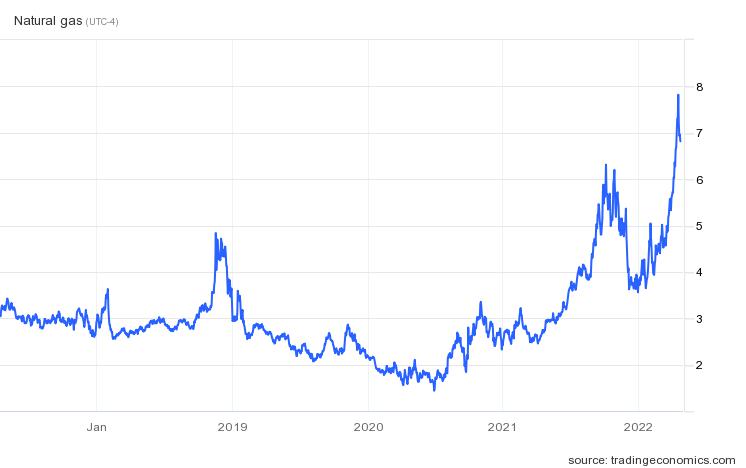
High prices will exacerbate this trend. Natural gas prices today are higher than at any time since 2008, having more than trebled in just the past two years. The rise began well before the war in Ukraine, and now international market demand has pushed it higher. This is good for fracking companies that spent the last 10 years losing money, but from a utility’s perspective, price-stable renewables just look better and better. 

Graph of 5 years of natural gas prices in US dollars.
Natural gas (USD/MMBtu) https://tradingeconomics.com/commodity/natural-gas

Fortunately for the gas industry, making electricity is just one use for its product. Methane remains the dominant fuel for heating buildings, with about half of U.S. homes and businesses using it for space heating, water heating, cooking and other appliances. It is also a feedstock for many industrial operations, including fertilizer and plastics manufacturing. Protecting the first use, and expanding the second, are critical to staving off obsolescence. 

That explains three pieces of legislation passed in Virginia in the past two years, all modeled on bills enacted in other states. One, which I’ll discuss in a minute, originally would have prohibited local governments from banning new gas connections within their jurisdiction, protecting the industry’s access to new retail customers. Another sets up a way for gas companies to include methane from pig waste lagoons and other non-fossil sources in their pipelines, allowing them to claim green credit — and subsidies — for marketing what they call renewable natural gas. 

Finally, 2021 legislation promotes “advanced recycling” of waste plastics — using a process called chemical conversion to turn plastic into other plastic or into fuel and then burning it — in part to forestall efforts to phase out single-use plastics like Styrofoam food containers and plastic bags. As a technology, chemical conversion is inelegant, being energy-intensive and highly polluting. As a business, the economics are questionable (and the main company benefiting from the law canceled plans for a facility in Virginia). But as PR, the reframing is brilliant. Why not expand plastics production forever if we can turn the waste into fuel or new plastic?

Indeed, the success of the law can be seen in Gov. Glen Youngkin’s new executive order ostensibly promoting recycling while overturning a previous order from Ralph Northam that required executive agencies to give up single-use plastics by 2025. General Assembly members are also falling for the propaganda, proposing via the state budget to delay the ban on polystyrene food containers that was to have taken effect beginning next year. 

Banning the bans: the gas industry fights building electrification

RNG and plastics are important for the gas industry, but protecting its market share in the building sector is central to its future. Ultimately it is doomed to failure. All-electric buildings are a requirement for a fully decarbonized economy, and their health and safety advantages make a compelling case for localities that want to help meet climate targets by preventing new homes from being connected to gas lines. Some cities in solidly blue states have banned new gas hook-ups; elsewhere, red state legislatures are passing laws to ban the bans.

Public support for these bans will grow as people learn more about the hazards of using gas in their homes. Read enough stories about methane leaking from underground pipes and in homes (and occasionally exploding and setting fire to buildings), or about the health impacts of indoor air pollution from gas heaters and stoves, and you may wonder why we ever thought it a good idea to have open flames in our homes. Yet once a house is built with a gas furnace and appliances, it is much harder for a homeowner to go all-electric. 

To be clear, though, no Virginia jurisdiction has sought to ban gas connections, and it’s not clear whether they could do so in a Dillon Rule state like Virginia. Right now, a law to keep them from doing so sounds a little on the hysterical side, like prohibiting people from walking tigers off-leash. 

Indeed, the proponents of HB1257 could cite only a much narrower threat. The City of Richmond recently committed itself to achieving net zero greenhouse gas emissions by 2050. Unlike almost any other city in Virginia, Richmond owns a gas utility that serves its residents and businesses. Sometime in the next 28 years, if the city is serious, it will have to sell the utility or shut down gas service, forcing customers to look elsewhere if they want gas. 

The gas industry and its industrial customers used this far-off threat as a pretext for a Virginia ban-the-ban bill. In its original form, HB1257 (Kilgore) declared it the right of every person to access natural gas, calling this “energy justice,” and explicitly forbidding any public entity from doing anything to interfere with this sacred right. (Oh, except that gas utilities don’t have to supply gas even to willing customers if they can’t make money doing so, and they are free to cut off service to anyone who can’t pay their bills. Justice stretches only so far as profit permits.) 

The Republican-led House passed the whole bill, but the Democratic-led Senate pared it back to deal just with a locality that gets out of the gas utility business, requiring that it give three years’ notice and try to sell or auction off the utility. The final version omits the “energy justice” language that was such an inspiring tribute to George Orwell, but it solves the “immediate” problem in Richmond. 

But it’s not likely that we have seen the end of legislative efforts in Virginia to ban local restrictions on natural gas connections. The gas industry needs to lock in new customers now, because its future is looking very bleak indeed. 

This column originally appeared in the Virginia Mercury on April 21, 2022.

Unknown's avatar

With a framework for Virginia’s energy transition in place, here’s what happens next

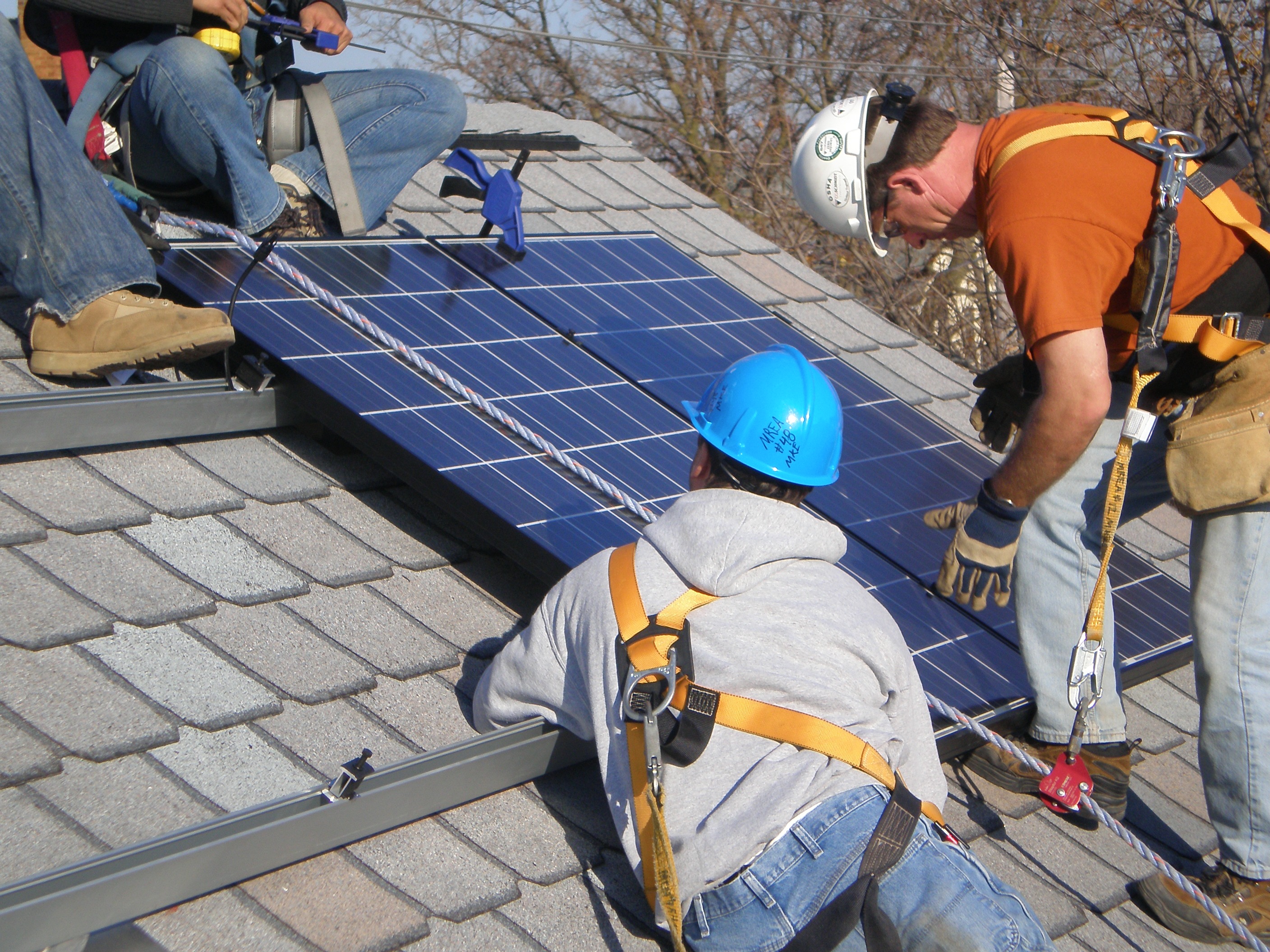
workers installing solar panels on a roof

One expected effect of the Clean Economy Act will be a boom in solar jobs across Virginia. Photo courtesy of NREL.

With Democrats in charge, Virginia passed a suite of bills that establish a sturdy framework for a transition to renewable energy in the electric sector.

At the center of this transformation are the Clean Economy Act, HB1526/SB851, and the Clean Energy and Community Flood Preparedness Act, HB981/SB1027. Other new laws direct further planning, make it easier for customers to install solar, improve the process for siting wind and solar farms, and expand financing options for energy efficiency and renewable energy.

Gov. Ralph Northam has signed some bills already, and has until April 11 to sign the others or send them back to the General Assembly with proposed amendments. Once signed, legislation takes effect on July 1.

I assume the Governor has other things on his mind right now than asking the General Assembly to tinker further with a bill like the Clean Economy Act, though bill opponents may be using the virus pandemic to argue for delay. That would be a self-defeating move; as the economy restarts, Virginia is going to need the infusion of jobs and investment that come with the build-out of clean energy. And one of the strongest arguments in support of our energy transition, after all, is that it will save money for consumers.

So what happens after July 1? How does this all work? Let’s look at the way these major pieces of legislation will change the energy landscape in Virginia.

Virginia joins RGGI, and CO2 emissions start to fall. 

Virginia’s Department of Environmental Quality has already written the regulations that call for Virginia power plants to reduce emissions by 30 percent by 2030. The mechanism for achieving this involves Virginia trading with the Regional Greenhouse Gas Initiative, a regional carbon cap and trade market.

The regulations have been on hold as the result of a budget amendment passed last year, when Republicans still ruled the General Assembly. After July 1, DEQ will be able to implement the regulations, with the commonwealth participating in carbon allowance auctions as early as the last quarter of this year or the first quarter of 2021.

In addition to joining RGGI, the Clean Energy and Community Flood Preparedness Act also allows the commonwealth to earn money from the allowance auctions. The Department of Housing and Community Development will spend 50 percent of auction proceeds on “low-income efficiency programs, including programs for eligible housing developments.”

The Department of Conservation and Recreation will get 45 percent of the auction proceeds to fund flood preparedness and climate change planning and mitigation through the Virginia Community Flood Preparedness Fund. The last 5 percent of proceeds will cover administrative costs, including those for administering the auctions.

Energy efficiency savings become mandatory, not just something to throw money at.

Two years ago, the Grid Transformation and Security Act required Dominion and Appalachian Power to propose more than a billion dollars in energy efficiency spending over 10 years, but the law didn’t say the programs had to actually be effective in lowering electricity demand.

This year that changed. For the first time, Virginia will have an energy efficiency resource standard (EERS) requiring Dominion to achieve a total of 5 percent electricity savings by 2025 (using 2019 as the baseline); APCo must achieve a total of 2 percent savings. The SCC is charged with setting new targets after 2025. At least 15 percent of the costs must go to programs benefiting low-income, elderly or disabled individuals, or veterans.

The EERS comes on top of the low-income energy efficiency spending funded by RGGI auctions.

Dominion and Appalachian Power ramp up renewables and energy storage. 

The Clean Economy Act requires Dominion to build 16,100 megawatts of onshore wind and solar energy, and APCo to build 600 megawatts. The law also contains one of the strongest energy storage mandates in the country: 2,700 MW for Dominion, 400 MW for Appalachian Power.

Beginning in 2020, Dominion and Appalachian must submit annual plans to the SCC for new wind, solar and storage resources. We’ll have a first look at Dominion’s plans just a month from now: the SCC has told the company to take account of the Clean Economy Act and other new laws when it files its 2020 Integrated Resource Plan on May 1.

The legislation provides a strangely long lead time before the utilities must request approval of specific projects: by the end of 2023 for APCo (the first 200 MW) or 2024 for Dominion (the first 3,000 MW). But the build-out then becomes rapid, and the utilities must issue requests for proposals on at least an annual basis.

In addition to the solar and land-based wind, Dominion now has the green light for up to 3,000 MW of offshore wind from the project it is developing off Virginia Beach, and which it plans to bring online beginning in 2024. All told, the Clean Economy Act proclaims up to 5,200 MW of offshore wind by 2034 to be in the public interest.

Dominion’s plans for new gas plants come to a screeching halt.

Before the 2020 legislative session, Dominion’s Integrated Resource Plan included plans for as many as 14 new gas combustion turbines to be built in pairs beginning in 2022. In December, the company announced plans to build four gas peaking units totaling nearly 1,000 MW, to come online in 2023 and 2024.

But that was then, and this is now. The Clean Economy Act prohibits the SCC from issuing a certificate of convenience and necessity for any carbon-emitting generating plant until at least January 1, 2022, when the secretaries of natural resources and commerce and trade submit a report to the General Assembly “on how to achieve 100 percent carbon-free electric energy generation by 2045 at least cost to ratepayers.”

Even with no further moratorium, Dominion will find it hard to sell the SCC on the need for new gas plants on top of all the renewable energy and energy storage mandated in the Clean Economy Act. Solar and battery storage together do the same job that a gas peaker would have done — but they are required, and the gas peaker is not. Meanwhile, the energy efficiency provisions of the act mean demand should start going down, not up.

Dominion has already signaled that it recognizes the days of new gas plants are largely over. On March 24, Dominion filed a request with the SCC to be excused from considering new fossil fuel and nuclear resources in its upcoming Integrated Resource Plan filing, arguing that “significant build-out of natural gas generation facilities is not currently viable” in light of the new legislation.

Fossil fuel and biomass plants start closing.

By 2024, the Clean Economy Act requires the closure of all Dominion or APCo-owned oil-fueled generating plants in Virginia over 500 MW and all coal units other than Dominion’s Virginia City Hybrid plant in Wise County and the Clover Station that Dominion co-owns with Old Dominion Electric Cooperative.

This mandate is less draconian than it sounds; it forces the closure of just two coal units, both at Dominion’s Chesterfield plant. Other Dominion coal plants in Virginia have already been retired or switched to using gas or biomass, and one additional coal plant in West Virginia lies beyond the reach of the legislation. Oil-fired peaking units at Yorktown and Possum Point were already slated for retirement in 2021 and 2022. APCo owns no coal or biomass plants in Virginia.

Although the exceptions might appear to swallow the rule, the truth is that coal plants are too expensive to survive much longer anyway. One indication of this is a March 24 report Dominion filed with the SCC showing its fuel generation sources for 2019: coal has now fallen to below 8 percent of generation.

By 2028, Dominion’s biomass plants must shut down, another victory for consumers. All other carbon-emitting generating units in Virginia owned by Dominion and APCo must close by 2045, including the Virginia City plant and all the gas plants.

As of 2050, no carbon allowances can be awarded to any generating units that emit carbon dioxide, including those owned by the coops and merchant generators, with an exception for units under 25 MW as well as units bigger than 25 MW (if they are owned by politically well-connected multinational paper companies with highly-paid lobbyists).

Solar on schools and other buildings becomes the new normal.

In December, Fairfax County awarded contracts for the installation of solar on up to 130 county-owned schools and other sites, one of the largest such awards in the nation. Using a financing approach called a third-party power purchase agreement (PPA), the county would get the benefits of solar without having to spend money upfront. The contracts were written to be rideable, meaning other Virginia jurisdictions could piggyback on them to achieve cost savings and lower greenhouse gas emissions.

Fairfax County’s projects, along with others across the state, hit a wall when, on Jan. 7, the SCC announced that the 50 MW program cap for PPAs in Dominion territory had been reached. But with the passage of the Clean Economy Act and Solar Freedom legislation, customers will be able to install up to 1,000 MW worth of solar PPAs in Dominion territory and 40 MW in APCo territory.

Fairfax County schools will soon join their counterparts in at least 10 other jurisdictions across the state that have already installed solar. With the PPA cap no longer a barrier, and several other barriers also removed, local governments will increasingly turn to solar to save money and shrink their carbon footprints.

Virginia agencies start working on decarbonizing the rest of the economy. 

In spite of its name, the Clean Economy Act really only tackles the electric sector, with a little spillover into home weatherization. That still leaves three-quarters of the state’s greenhouse gas emissions to be addressed in transportation, buildings, agriculture and industry. Ridding these sectors of greenhouse gas emissions requires different tools and policies.

Other legislation passed this session starts that planning process. SB94(Favola) and HB714 (Reid) establish a policy for the commonwealth to achieve net-zero emissions economy-wide by 2045 (2040 for the electric sector) and require the next Virginia Energy Plan, due in 2022, to identify actions towards achieving the goal. Depending on who the next governor is, we may see little or nothing in the way of new proposals, or we may see proposals for transportation and home electrification, deep building retrofits, net-zero homes and office buildings, carbon sequestration on farm and forest land and innovative solutions for replacing fossil fuels in industrial use.

Collateral effects will drive greenhouse gas emissions even lower.

Proposed new merchant gas plants are likely to go away. With Virginia joining RGGI and all fossil fuel generating plants required to pay for the right to spew carbon pollution, the developers of two huge new merchant gas plants proposed for Charles City County will likely take their projects to some other state, if they pursue them at all.

Neither the 1,600 MW Chickahominy Power Station and the 1,050 C4GT plant a mile away planned to sell power to Virginia utilities; their target is the regional wholesale market, which currently rewards over-building of gas plant capacity even in the absence of demand. The Chickahominy and C4GT developers sought an exemption from RGGI through legislation; the bill passed the Senate but got shot down in the House.

If the C4GT plant goes away, so too should Virginia Natural Gas’ plans for a gas pipeline and compressor stations to supply the plant, the so-called Header Improvement Project.

Other coal plants will close. Although the CEA only requires Dominion to retire two coal units at its Chesterfield Power Station, other coal plants in the state will close by the end of this decade, too. That’s because the economics are so heavily against coal these days that it was just a matter of time before their owners moved to close them.

Adding the cost of carbon allowances under RGGI will speed the process along. That includes the Clover Station, which Dominion owns in partnership with Old Dominion Electric Cooperative (ODEC), and the Virginia City Hybrid Electric plant in Wise County, Dominion’s most expensive coal plant, which should never have been built. 

The Atlantic Coast and Mountain Valley Pipelines find themselves in more trouble than ever. If I had a dollar for every time a Dominion or Mountain Valley spokesperson said, “Our customers desperately need this pipeline,” I would not be worried about the stock market right now.

The fact is that no one was ever sure who those customers might be, other than affiliates of the pipeline owners themselves—and that doesn’t exactly answer the question. With Virginia now on a path away from all fossil fuels, neither pipeline has a path to profitability inside Virginia any longer, if they ever had one.


A version of this article originally appeared in the Virginia Mercury on March 31. 

Unknown's avatar

SCC cracks open the door on Dominion’s Atlantic Coast Pipeline costs

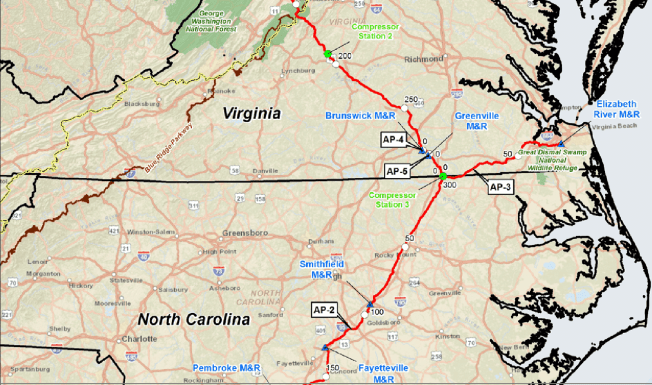
map showing VA and NC route of Atlantic Coast Pipeline

Costs to build the Atlantic Coast Pipeline are pegged at $7 billion. Partner Dominion Energy plans to charge captive electricity customers for the cost, regardless of whether the pipeline is needed. Image via the Federal Energy Regulatory Commission.

Dominion Energy Virginia employees were briefing a stakeholder group on the company’s Integrated Resource Plan (IRP) last Friday morning when text messages started popping up on phones all over the room: the State Corporation Commission had just rejected the IRP and ordered a do-over.

Awkward.

The SCC has never rejected a Dominion IRP before, mostly because the plan doesn’t have a binding effect. It is simply a way for Dominion to show regulators how it might meet the needs of customers over a 15-year period. If the company actually wants to build new generation or implement new programs, it still has to get permission through a separate proceeding.

But the IRP is important in establishing the context for new generation or programs. The SCC’s order on Friday shows commissioners think the company has presented a picture so distorted as to be unreliable.

The SCC order gives Dominion 90 days to correct a list of items it says the company got wrong, from unrealistically high demand forecasts to overly-optimistic assumptions about solar energy.

The order also instructs Dominion to look at an option the company ruled out: building yet another big combined-cycle gas plant. The SCC says it doesn’t necessarily want Dominion to build such a plant, only that the company ought to construct a true least-cost scenario to compare all other options against, and a least-cost option might include more baseload gas.

Then, buried down in footnote 14, the SCC added this:

The record reflects that the Company did not include fuel transportation costs in the modeled costs of certain natural gas generation facilities. Tr. 610. For purposes of the corrected 2018 IRP, the Company should include a reasonable estimate of fuel transportation costs, including interruptible transportation, if applicable, associated with all natural gas generation facilities in addition to the fuel commodity costs.

Wait a moment. Did the SCC just ask Dominion about the cost to ratepayers of its Atlantic Coast Pipeline?

Or does it just want to see different kinds of natural gas facilities modeled on an apples-to-apples basis, which Dominion failed to do? Even if it is the latter, can the SCC really open the door on transportation costs at all without letting the $7 billion elephant into the room?

If that happens, Dominion will find this the most expensive footnote in company history.

Dominion says the footnote is absolutely not about the ACP, and the company is shocked that anyone might think that. In a statement quoted in Energy News Network, the company lambasted environmental groups for perceiving a link between fuel transportation costs and a pipeline that provides fuel transportation:

“Instead of supporting Dominion Energy and policymaker’s (sic) push for carbon-free generation, [the Sierra Club and SELC] are distorting the SCC’s official order to pander to their donor base without regard for the truth,” the statement said.

This begs the question of how Dominion plans to comply with the order without mentioning its parent company’s pipeline. The company’s hysterical attack on its environmental critics seems designed to beat back expectations for the ACP’s cost to ratepayers becoming an issue in the IRP.

Footnote or no footnote, the SCC really should look at those pipeline costs

Admittedly, dropping a bombshell in a footnote would be only slightly more surprising than the SCC taking up the pipeline question at all right now. Pipeline critics have been trying in vain for two years to get the SCC to examine the contract between various Dominion subsidiaries obligating Virginia customers to pay for 20 percent of the ACP’s capacity. This blatant self-dealing is central to the pipeline’s profitability.

The SCC has previously refused to question the deal, and the Virginia Supreme Court refused to force the Commission to do it. The SCC maintained at the time that it could wait for the pipeline to be built before it decides whether it is fair to charge ratepayers for it. But it doesn’t have to wait; the Supreme Court says the SCC can take up the question any time.

And it should, because the SCC’s very silence encourages Dominion to think it will get away with charging customers for a hefty portion of the $7 billion pipeline. It is long past time for Dominion to present its evidence on the ACP.

As the SCC’s IRP order found, “the load forecasts contained in the Company’s past IRPs have been consistently overstated” and the SCC “has considerable doubt regarding the reasonableness of the Company’s load forecasts.” These questionable load forecasts, of course, underpin Dominion’s case for the ACP.

William Penniman, an energy lawyer who served as an expert witness for the Sierra Club in Dominion’s 2017 IRP case, testified that, based on publicly-available ACP filings, the contract with the ACP could cost utility customers in Virginia over $200 million of fixed charges annuallyfor 20 years—over $4 billion over the 20-year life of the contract, whether or not it ships any gas at all. He also showed that, even if more gas were needed, other pipeline options were much cheaper than Dominion’s affiliate deals.

And, given that Dominion already has contracts with another pipeline company to serve the utility’s existing gas plants, the money paid for capacity in the ACP will be entirely wasted—unless, of course, Dominion builds a bunch of new gas plants or drops lower-priced transportation arrangements in favor of its costly affiliate deals.

The pipeline came up again in the 2018 IRP. Gregory Lander, a witness for the Southern Environmental Law Center pointed out that Dominion’s IRP merely embeds the costs of the ACP into its generation scenarios without quantifying or justifying them.

“In essence,” Lander testified, “the IRP asks the Commission to accept that the Atlantic Coast Pipeline is built and that ratepayers should pay for it without ever explaining to the Commission what those costs are and why they are justified in a least-cost planning exercise.”

Rather than challenging the expert testimony, Dominion sought to exclude it, hoping to keep all mention of the ACP out of the case. In another footnote in its IRP order, however, the SCC specifically admitted Lander’s testimony, without finding facts.

Dominion would prefer the SCC to consider the ACP a “sunk cost.” Dominion’s theory goes like this: Since the contract obligates the utility to pay reservation charges for roughly half of the ACP’s capacity regardless of actual usage, that expense shouldn’t be factored into the cost of building any new gas plant. Instead, it argues, the SCC only needs to consider the cost of paying for the fuel itself.

That’s like buying a Ferrari and then saying the only expense of owning it is the gasoline. (And meanwhile, the trusty station wagon is running just fine.)

If the SCC is finally interested in the ACP’s cost to ratepayers, Dominion’s IRP do-over will have to be just the first step in a more thorough analysis of what Dominion’s self-dealing will cost Virginia consumers. There is plenty of evidence to suggest that will not go well for Dominion.

But what’s up with the SCC and gas?

Footnote 14 is not the only oddity in the SCC’s order. On the one hand, the SCC rightly says a fair accounting of a gas plant’s cost necessarily includes all the cost of transporting the fuel. On the other hand, even before it sees the transportation costs, the SCC seems to assume that a new baseload gas plant would be the economic thing to build, were it not for pesky carbon regulations and the General Assembly’s measures to promote renewable energy.

A major theme of the SCC’s order is the commission’s desire to force lawmakers to confront their own profligacy in passing the giant 2018 energy bill that the SCC opposed. SB 966 allows Dominion to redirect billions of dollars in over-earnings away from ratepayer refunds to massive spending on grid projects like undergrounding wires, with only limited regulatory oversight. The SCC thinks this is going to be bad for customers, and it wants legislators to appreciate just how bad.

That’s understandable, but it doesn’t excuse the SCC’s insistence on regarding gas as a low-cost option. Even Dominion knows better.

Dominion just announced the opening of its latest huge new combined-cycle plant in Virginia. The Greensville station joins a glut of new gas plants fed by Appalachia’s fracking industry. The oversupply is so bad that our regional grid already has almost 30% more power supply than it needs to meet peak demand—and grid operator PJM doesn’t expect this situation to change any time soon.

Most of the other new gas plants in PJM are funded by private equity. If they go bust, utility customers won’t be the ones to suffer. But Virginia’s regulated monopoly system means customers are precisely the ones who suffer when a utility’s bet on gas goes sour.

So Dominion’s IRP instead envisions a steady build-out of smaller gas plants it hopes to justify as complements to new solar farms. The idea is that these combustion turbines, often called “peaker” plants, will provide electricity to fill in around the variable output of solar panels.

Yet peakers are idle most of the time, making them questionable investments as well. Other states achieve the same reliability results at lower cost using demand response and battery storage.

The Rocky Mountain Institute (RMI) issued a report in May of this year comparing new gas generating plants—both combined-cycle and peakers—to well-designed clean energy generation portfolios. In almost every case, renewable energy, storage and demand response already beat gas on cost, even without considering environmental benefits.

And moreover, the trends favor clean energy, as RMI’s press release stresses: “More dramatically, the new-build costs of clean energy portfolios are falling quickly, and likely to beat just the operating costs of efficient gas-fired power plants within the next two decades.”

So in telling Dominion to present a gas-heavy scenario as low-cost, the SCC is asking the impossible. Whether the Commissioners know it or not, Dominion isn’t the only one here presenting a distorted picture.


This post originally appeared as a column in the Virginia Mercury on December 14, 2018.

Unknown's avatar

Dominion won’t build new baseload gas plants. So why is it still building the Atlantic Coast Pipeline?

gas pipeline protesters standing in front of solar panels

The message from several Virginians was clear at the opening of a new solar farm in Troy, Virginia last month. Protesters want Governor Ralph Northam to speak out against the ACP and the Mountain Valley Pipeline, both under development in Virginia.

Utility giant Dominion Energy and gas turbine maker General Electric reportedly agree on a startling fact: there is no market for new baseload gas plants.

As recently as two years ago, Dominion’s utility subsidiary in Virginia had as much as 8,000 megawatts (MW) of new combined cycle gas plants on the drawing board. Combined cycle plants, designed to run most of the time, have become the dominant source of power generation in Virginia.

This year, new combined cycle plants are noticeably absent from Dominion Energy Virginia’s Integrated Resource Plan. Proposed instead are a series of smaller, peak-serving combustion turbines. Although the utility is proposing a bunch of them, they will have to compete with increasingly-competitive storage options for regulatory approval.

It’s not just Virginia. According to the Forbesarticle linked above, Dominion Energy has no plans to build any more combined cycle plants anywhere, due to competition from wind and solar.

Other utilities are also losing interest in combined cycle gas pants, as GE has learned to its chagrin. GE is cutting 12,000 jobs in its GE Power unit, says Forbes.

A new study from the Rocky Mountain Institute (RMI) shows why utilities are smart to avoid building new gas plants. RMI says that as early as 2026, cost declines for wind and solar will make it more expensive to operate natural gas infrastructure than to abandon it and replace it with new wind and solar facilities. When that happens, gas plant owners will be left with stranded assets.

Even in today’s market, RMI concludes gas is a risky investment:

RMI examined four case studies of proposed gas plants from utilities across the US. These cases included two combined-cycle gas turbine (CCGT) power plants, planned for high-capacity factor operation, and two combustion turbine power plants, planned for peak-hour operation. These power plants are proposed for a wide variety of regions with different resource availability, resource costs, climate- and weather-driven demand needs, and customer bases.

In all four cases, RMI found clean energy portfolios to be cost-competitive with proposed gas-fired generation, while meeting all required grid services and supporting system-level reliability. In three of the four cases, optimized, region-specific clean energy portfolios cost 8–60 percent less than the proposed gas plant, based on industry-standard cost forecasts and without subsidies. In only one case was the clean energy portfolio’s cost slightly higher than the proposed gas plant. However, further analysis revealed that modest carbon pricing (i.e., < $8/ton) or feasible community-scale solar cost reductions would easily reverse the result. Similarly, two more years of anticipated renewable and storage cost reductions would also eliminate the difference in cost between the clean energy portfolio and the gas plant.

All this is very bad news for the Atlantic Coast Pipeline. The ACP received approval from the Federal Energy Regulatory Commission (FERC) last year on the strength of supply contracts with the utility subsidiaries of Dominion Energy and Duke Energy, Dominion’s major partner in the pipeline. If these utilities don’t actually need the gas, the whole basis for FERC’s approval of the pipeline collapses.

No wonder Dominion Energy wants to extend its reach into South Carolina. Plans for new nuclear plants in the state recently imploded, potentially leaving a supply gap that new gas plants could fill.

And no wonder Dominion Energy Virginia continues to propose gas combustion turbines and ignore energy storage in spite of its cost declines. Dominion is scrambling to save the ACP.

How did Dominion get it so wrong? Recall that Dominion and its partners announced plans for the Atlantic Coast Pipeline in early September of 2014; the rationale for the pipeline would have relied on industry forecasts from 2013 and before. At that time, the gas industry was giddy about fracked gas displacing coal. While critics (including me) said new baseload gas plants would be giant concrete paperweights before they’d reached the end of their useful life, most utilities were drinking the fracked gas Kool-Aid.

In the intervening years, coal has certainly continued its exit (Donald Trump’s half-baked rescue plans notwithstanding), but solar and wind have become the cheapest source of electricity in the U.S., according to federal statistics. The cost of electricity from utility-scale solar farms has dropped by half since 2013, and by last year Dominion had identified solar as the cheapest source of new electricity in Virginia.

The problem for Dominion Energy is that the ACP is the only big trick it has now, after the failure of its own ambitions for new nuclear. Dominion doubled down on natural gas in 2016 when it paid 4.4 billion dollars for natural gas distribution company Questar, paying a 23% premium on the deal. It can’t back down from gas now. Either it has to spend 6 billion dollars (and rising) on this new pipeline, or admit its entire growth plan was based on a serious mistake.

Abandoning the ACP could make Dominion’s stock price tumble, giving it something else in common with GE. But as the saying goes, if you find yourself in a hole, you should really stop digging. In this case, literally.