Unknown's avatar

Virginia, Energy Suburb

Today marks the start of the third Governor’s Conference on Energy in Virginia, which means it is the third year of the Governor’s Confusion of Virginia with some other state, because he is once again promoting the slogan, “Virginia, Energy Capital of the East Coast.”

The first year, nobody said anything. He was a new governor, and it didn’t seem polite to point out the error. Rookie mistake, the conference attendees told each other. Someone will clue him in.

The second year, the slogan reappeared, and we were dumbfounded. People nudged each other and said, “You tell him.” “No, you tell him.” We drew straws, but apparently whoever got the short straw welched. And now, after three years, well, it would be really, really awkward to point out that while the slogan is charming, it is not exactly factual.

In factual terms, Virginia isn’t an energy capital, or even an energy major city. If Governor McDonnell were to call Virginia the Energy Suburb of the East Coast, that would be closer to the truth. We’re a bigger importer of electricity than any state except California. Of course it’s not like we’re importing our electrons from a hostile foreign nation. West Virginia isn’t suddenly going to cut us off if we don’t release their political prisoners.

And really, you might think there is something to be said for letting other states foul their own air with power plants while sending the electrons over to us. It’s like outsourcing manufacturing to China; they get the jobs and the pollution, we get cheap electronics that we toss in our landfills every time there’s an upgrade. In the case of out-of-state power plants, we get the electricity to run the cheap electronics.

But since emissions from power plants sneak across state lines and head straight for anyone who happens to be breathing, we are getting the pollution as well as the electrons, and all we’re losing to other states is the jobs. To a governor, losing jobs to other states is the Worst Thing Ever. If you are a governor, your highest priority is luring businesses to your state instead of to the state next door, to keep up with whatever luring that state is doing to get business away from your state. The governor with the most jobs wins.

So Governor McDonnell has been trying very hard to develop energy projects in Virginia. His signature plan was to open our coast to environmentally safe offshore oil drilling, with Congress cutting Virginia in on the royalties so we could fund our transportation priorities without taxing ourselves. But while Congress was still giggling at the revenue-sharing proposal, an environmentally safe offshore oil rig exploded and sent 5 million barrels of environmentally unsafe crude oil into the Gulf of Mexico, shutting down the fishing industry and fouling several hundred miles of Louisiana shoreline.

Our governor did not blink. He is not a man to learn from mere actual events. Nonetheless, he turned his attention to other projects that could still make Virginia an energy leader. After all, McDonnell is an “all of the above” man, so in addition to oil, he likes nuclear, coal and natural gas. These haven’t worked out so well, either. The Energy Information Agency has since announced that the price tag for new nuclear now exceeds that for solar energy. Since Virginians regard solar as a luxury for wine-sipping liberal urbanites, that can only be a bad sign for nuclear.

And then there’s coal. McDonnell came into office a champion of coal, in proportion to the amount of campaign money he received from coal and coal-burning utilities. You cannot accuse the man of disloyalty. When some critics tried to suggest that taxpayers should not be shelling out $45 million per year in handouts for coal mining, he took umbrage. He also took more money. All that give and take did nothing to prevent the coal industry in Virginia from continuing its long decline.

This leaves natural gas. One of the panels for this year’s conference is titled, “What do we do with all this natural gas?” There isn’t an exclamation point at the end of the question, but there should be. Nationally, gas fracking has saved energy’s Old Guard, just when it looked like fossil fuels were washed up. The old energy guys are ecstatic. It’s not like they would ever have admitted that God’s carbon gifts might be finite, but there was an ugly shadow looming for a while that has backed off. They are hoping they can shove it into a closet with other difficult ideas, like groundwater pollution, global warming, ocean acidification and sea level rise.

From Governor McDonnell’s perspective, the only problem with Virginia being the Fracking Capital of the East Coast is how little shale gas we have, compared with Pennsylvania and New York. Still, a few counties in the western part of the state could host drilling rigs if they chose, along with the round-the-clock truck traffic, land disturbance, noise, and inevitable spills of contaminated wastewater. For some reason, they’ve rejected the idea. Look for legislation this year to take away their right to refuse.

Meanwhile, what can our governor do to make Virginia a leader on energy? There’s only one area left untried: renewable energy. We could build wind and solar facilities in Virginia, adding jobs without pollution. We know we have the resources and the businesses eager to build if the state wants them.

Until 2008, our annual energy conference was known as the Commonwealth of Virginia Energy and Sustainability Conference (COVES). Governor McDonnell discarded  “sustainability,” and since then the conference has offered less and less to interest wind and solar businesses. Yet there’s no law saying the only way to become the Energy Capital of the East Coast is by burning coal and gas.

At least, there isn’t yet. I shouldn’t give the governor any ideas.
Unknown's avatar

The case for diversity: natural gas plus renewables

Natural gas is currently cheap. It’s so cheap right now that some producers are losing money with every cubic foot they pump out of the ground. So what better time to be a buyer, right? That’s the thinking of utilities like Dominion Virginia Power, which plans to shut its oldest, worst-performing coal plants and replace them only with new natural gas-fired electric generation.

In fact, it’s the thinking of utilities across the U.S., many of which are planning the same move. But ratepayers and regulators at Virginia’s State Corporation Commission should insist that Dominion take this opportunity to diversify its fuels. New natural gas generation should be at least evenly balanced with price-stable renewable energy like wind and solar. Here are three reasons why.

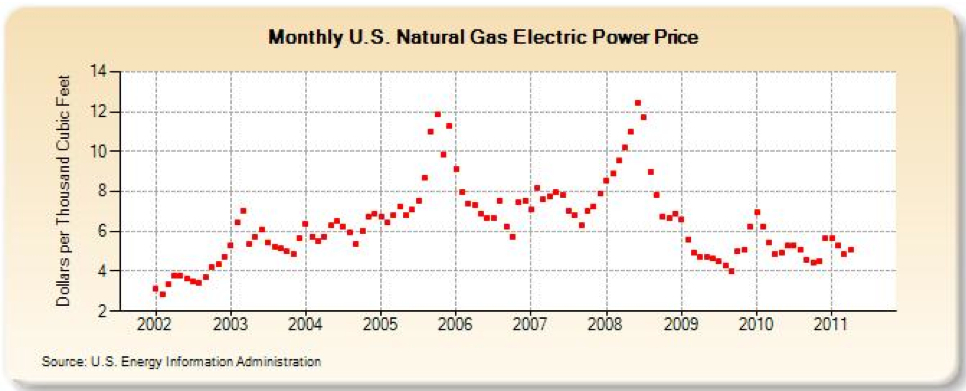
Natural gas prices will not stay low. Producers are currently pulling back on production because they can’t afford to lose money selling below their costs. And with utilities rushing to build new gas-fired electric generating plants, demand is set to soar in the coming years. Exports of liquid natural gas (LNG) will also serve new markets overseas, where gas prices are much higher than in the U.S., further pushing up demand here. Finally, with the price of oil about 10 times the current price of gas when measured per unit of energy, gas will increasingly displace oil in other uses such as powering heavy trucks and possibly conversion of gas to liquid fuels.

With all these factors pushing up demand, the price of natural gas has to go up, and the only question is how high. Longer term production will likely increase as well, dampening the price shocks, but natural gas prices have a long history of volatility, and there is no reason to think they will stabilize now.

Gas plants might outlive the boom. The Energy Information Agency says the U.S. has enough “technically recoverable” natural gas to last us 92 years at 2010 consumption levels,[1] a figure it has revised so often, and by so much, that no one places much confidence in it. Assuming they have it right this time, 92 years at 2010 levels is not as reassuring as it sounds. Higher consumption rates as utilities replace coal with gas plants, coupled with a rise in exports of LNG into the international market, will cause that 92 year-supply figure to shrink dramatically. Supplying gas generating plants for their full 30-plus year lifespans might require us to pay much higher prices or to import LNG at whatever price the international market sets. (Indeed, LNG terminals conceived just a few years ago were built as import terminals.)

Recoverable gas supplies could also decrease dramatically if states or localities impose drilling bans or cutbacks due to concerns about drinking water contamination and air pollution associated with gas “fracking”; because of problems disposing of the contaminated wastewater; or due to an unwillingness in dry states to allocate the huge amounts of fresh water consumed in the fracking process.

Price stability doesn’t matter to utilities—but it does to consumers. Utilities pass through the cost of fuel directly to ratepayers, so price spikes have no effect on a utility’s bottom line. Dominion Virginia Power earns a high profit on the capital cost of a new generating plant, so its incentive is to build as much new generation as it can. From a profit standpoint, it is indifferent to fuel costs.

From a consumer’s perspective, however, fuel costs matter very much. We pay for both the construction of the new plant and for the cost of fuel for as long as the plant operates.  For us, a new coal or gas plant is like a variable rate mortgage; we know what our monthly payment will be in the first year, but after that it is anybody’s guess. Worse, we’re locked in for 30 years with no ability to refinance or renegotiate. If you had a choice, would you agree to buy something for 30 years when you only know the price today?

As it happens, we do have a choice. Wind turbines and solar panels are like a fixed-rate mortgage. Once you’ve built the wind farm or installed the solar panels, the fuel is free. You know from the start exactly what you will be paying over the life of the project. People choose higher fixed-rate mortgages over variable rate mortgages for the same reasons we should favor renewable energy over new fossil fuel plants, even with the ultra-low teaser rate being offered for natural gas today.

Virginia’s State Corporation Commission has been reluctant to embrace renewable energy, feeling itself on solid ground only with the certainty of fossil fuels priced with time horizons of three years or less. This attitude has likely influenced Dominion to favor a natural-gas-only strategy over one that would hedge unsustainably low current gas prices with the long-term price stability of renewable energy. Yet a hedging strategy would be the more prudent one. Using the savings from cheap gas today to pay for equal amounts of renewable energy would give us lower electricity costs both now and for the next thirty years, compared to what we would have with natural gas alone.

There are many other reasons for Virginia to invest in renewable energy, from job creation to cleaner air and water, to getting in on the ground floor of innovative technologies. Dominion should not close off these options by filling all its new generation needs with natural gas plants that commit us for the next 30 years. Ratepayers should insist on a strategy that incorporates at least as much renewable energy as natural gas.

A version of this article originally appeared in the Virginian-Pilot on September 16, 2012 

Unknown's avatar

Virginia needs clean energy

Welcome to Power for the People VA! I’ve been advocating for wind and solar energy in Virginia for a good many years, and yet we are still stuck in the starting block. So let’s talk about why that is, and what we can do about it.