Unknown's avatar

Virginia wind and solar policy, 2015 update

where are the renewables 1

[Note: Although this is a terrific article, it is now a bit dated.  You can find the 2017 update to the Virginia Wind and Solar Policy Guide here.]

The past year has seen a lot of activity on wind and solar in the Old Dominion, and yet Virginia lags further than ever behind neighboring states in installations to date. Why? And more importantly, what can we do about it?

I’ll try to answer these questions as briefly as possible in this third annual update of Virginia renewable energy law and policy. But yes, this is a long post. If you’re the kind of person who only reads executive summaries or prefers the elevator pitch to the full Ted Talk, let me try this:

Virginia’s utility model is built on monopoly control and large, centralized generating systems, and this model does not serve 21st century needs and technologies. The free market solution is to open Virginia’s electricity market to competition and lower the barriers to customer-sited wind and solar generation.

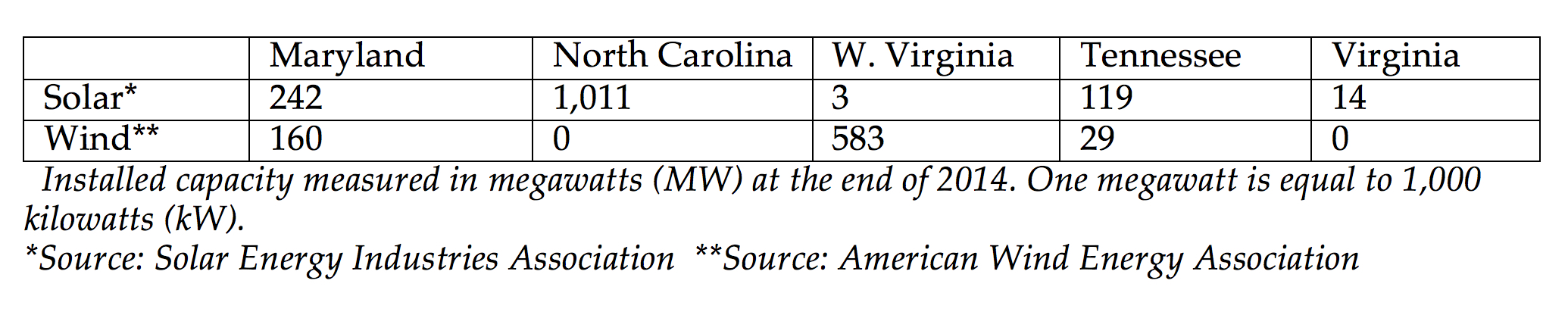
Virginia is further than ever behind
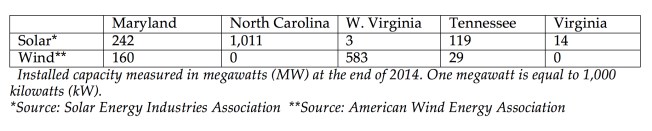
2015 wind and solar table copy

Virginia still has no utility scale wind or solar projects and very little in the way of customer-owned and other distributed generation. The 2015 legislative session improved prospects for solar at the utility scale, but utility interest in wind remains low. Meanwhile, barriers to the rapid adoption of customer-owned generation remain firmly in place.

Virginia utilities won’t sell wind or solar to customers (and they won’t let anyone else do it either)

With one very narrow exception for commercial customers, Virginia residents can’t pick up the phone and call their utility to buy electricity generated by wind and solar farms. Worse, they can’t even buy renewable energy elsewhere.

This wasn’t supposed to happen. Section 56-577(A)(6) of the Virginia code allows utilities to offer “green power” programs, and if they don’t, customers are supposed to be able to go elsewhere for it. (See the section on third-party-owned systems for what happened when one customer tried to go elsewhere.)

Ideally, a utility would use money from voluntary green power programs to build or buy renewable energy for these customers. However, Virginia utilities have not done this, except in very tiny amounts. Instead, utilities pay brokers to buy renewable energy certificates (RECs) on behalf of the participants. Participation by consumers is voluntary. Participants sign up and agree to be billed extra on their power bills for the service. Meanwhile, they still run their homes and businesses on regular “brown” power.

In Dominion’s case, these RECs meet a recognized national standard, and some of them originate with wind turbines, but they primarily represent power produced and consumed out of state, and thus have no effect on the power mix in Virginia. For a fuller discussion of the Dominion Green Power Program, see What’s wrong with Dominion’s Green Power Program.

In the case of Appalachian Power, the RECs come from an 80 MW hydroelectric dam in West Virginia. No wind, and no solar.

The State Corporation Commission ruled that REC-based programs like these do not qualify as selling renewable energy, so under the terms of §56-577(A)(6), customers are permitted to turn to other licensed suppliers of electric energy “to purchase electric energy provided 100 percent from renewable energy.” Unfortunately (and in this English major’s opinion, wrongly), Virginia utilities claim that the statute’s words mean that not only must another licensed supplier provide 100% renewable energy, it must also supply 100% of the customer’s demand. Obviously, the owner of a wind farm or solar facility cannot do that; the customer will need to draw from the grid part of the time. Ergo, say the utilities, a customer cannot go elsewhere. Checkmate!

The SCC may rule on this interpretation some day, but there is still another problem with the statute: under its terms, customers are allowed to turn to other electric suppliers only if their own utility doesn’t offer a qualifying program. So if the SCC sides with the English majors on this one, Dominion could (and surely would) gin up a variation of its Green Power Program consisting of true renewable energy. It would still not have to offer Virginia-based wind and solar—crappy biomass and old hydro would do, so long as it was actual energy “bundled” with the RECs. Nor would it have to offer a competitive price.

Really, the statute doesn’t ask much. It’s astonishing the utilities haven’t taken steps already to close that loophole. But surely they’re ready, and that’s enough to scare off any would-be competitors.

Earlier this year Dominion seemed poised to offer customers a program to sell electricity from solar panels, which would have qualified. Notwithstanding its name, however, the “Dominion Community Solar” program is not an offer to sell electricity generated from solar energy, and seems likely to attract customers only to the extent they are deceived into believing it is something it is not.

For customers to have real energy choice in Virginia, the GA has to change the terms of §56-577(A)(6). Let people buy wind and solar from any willing seller, whether it be their utilities or the private market. Utilities will benefit by customers taking on their job of lowering Virginia’s carbon emissions. Virginians will benefit from cleaner air, new clean energy jobs, and a stronger grid.

Virginia’s Renewable Portfolio Standard (RPS) is a miserable sham

Many advocates focus on an RPS as a vehicle for inducing demand. In Virginia, that’s a mistake. Virginia has only a voluntary RPS, which means utilities have the option of participating but don’t have to. On the other hand, it costs them nothing to do it, because any costs they incur in meeting the goals can be charged to ratepayers. Until a few years ago, utilities even got to collect bonus money as a reward for virtue, until it became clear that there was nothing very virtuous going on.

Merely making our RPS mandatory rather than voluntary would do nothing for wind and solar in Virginia without a complete overhaul. Most important, the statute takes a kitchen-sink approach to what counts as renewable energy, so meeting it requires no new investment and no wind or solar.

The targets are also modest to a fault. Although nominally promising 15% renewables by 2025, the statute sets a 2007 baseline and contains a sleight-of-hand in the definitions section by which the target is applied only to energy not produced by nuclear plants. The combined result is an effective 2025 target of about 7%.

The RPS is as impotent in practice as it is in theory. In the case of Dominion Virginia Power, the RPS has been met largely with old hydro projects built prior to World War II, trash incinerators, and wood burning, plus a small amount of landfill gas and—a Virginia peculiarity—RECs representing R&D rather than electric generation.

There appears to be no appetite in the General Assembly for making the RPS mandatory, and even efforts to improve the voluntary goals have failed in the face of utility opposition. The utilities have offered no arguments why the goals should not be limited to new, high-value, in-state renewable projects, other than that it would cost more to meet them than to buy junk RECs.

But with the GA hostile to a mandatory RPS and too many parties with vested interests in keeping the kitchen-sink approach going, it is hard to imagine our RPS becoming transformed into a useful tool to incentivize wind and solar.

That doesn’t mean there is no role for legislatively-mandated wind and solar. But it will be easier to pass a bill with a simple, straightforward mandate for buying or building a certain number of megawatts than it would be to repair a hopelessly broken RPS.

Customer-owned generation: for most, the only game in town

Given the lack of wind or solar options from utilities, people who want renewable energy generally have to build it themselves. A federal 30% tax credit makes it cost-effective for those with cash or access to low-cost financing. The credit is available until the end of 2016 (when it falls to 10% for commercial but goes away entirely for residential).

This year the GA passed legislation enabling Property Assessed Clean Energy (PACE) loans for commercial customers. This should help bring low-cost financing to energy efficiency and renewable energy projects at the commercial level. That would make it the year’s most helpful piece of legislation from the standpoint of customer-owned generation.

Now that some barriers to residential PACE have been removed at the federal level, we hope the legislature will extend the law to let localities offer PACE loan programs to homeowners in the near future.

Virginia offers no cash incentives or tax credits for wind or solar. The Virginia legislature passed a bill in 2014 that would offer an incentive, initially as a tax credit and then as a grant program, but it did not receive funding, and the same bill, reintroduced in 2015, died in a subcommittee. North Carolina’s tax credit for solar is widely credited with making that state a solar leader, and it could have the same effect here. With solar panel prices continuing their breathtaking descent, utility and commercial-scale solar probably won’t need that kind of help for long, so a modest program of three-to-five years duration would suffice to catalyze the market. Residential solar would benefit from longer-lasting support.

The lack of a true RPS in Virginia means Virginia utilities generally will not buy solar renewable energy certificates (SRECs) from customers. SRECs generated here can sometimes be sold to utilities in other states (as of now only Pennsylvania) or to brokers who sell to voluntary purchasers.

Limits to net metering hamper growth

Section 56-594 of the Virginia code allows utility customers with wind and solar projects to net energy meter. System owners get credit from their utility for surplus electricity that’s fed into the grid at times of high output. That offsets the grid power they draw on when their systems are producing less than they need. Their monthly bills reflect only the net energy they draw from the grid.

If a system produces more than the customer uses in a month, the credits roll over to the next month. However, at the end of the year, the customer will be paid for any excess credits only by entering a power purchase agreement with the utility. This will likely be for a price that represents the utility’s “avoided cost” of about 4.5 cents, rather than the retail rate, which for homeowners is closer to 11 cents. Given the current cost of installing solar, this effectively stops people from installing larger systems than they can use themselves.

Legislation passed in 2015 makes it less likely that new solar owners will have any surplus. At Dominion’s insistence, the definition of “eligible customer-generator” was amended to limit system sizes to no larger than needed to meet the customers demand, based on the previous 12 months of billing history. The SCC is currently writing regulations that should address issues of new construction as well as questions arising from other new language in the law.

This limitation is crazy, no? If customers want to install more clean, renewable energy than they need and sell the surplus electricity into the grid at the wholesale power price, why would you stop them from performing this service to society? And what were Dominion lobbyists thinking, since it is clearly in their company’s interest to buy peak power at a cut-rate price? We can only speculate that the primal fear of customers with solar must be stronger even than the smell of money.

Virginia law also does not allow system owners to share the electricity with other consumers through community net metering or solar gardens. Several bills that would have permitted this were introduced in the 2013 and 2014 sessions but defeated due to utility opposition. Community net metering remains one of the solar industry’s highest priorities as a way to open the market to people who can’t own solar facilities themselves. It would also spur the market for community wind.

In August of this year, Dominion received permission from the SCC to begin a program the company is calling “Dominion Community Solar.” Reading the fine print, however, makes it apparent that participants will not actually buy solar power. They will pay a significant premium on their electric bills to fund construction of a solar installation, but the electricity generated will be sold to other people rather than credited to the participants.

Under a bill introduced by Delegate Randy Minchew (R-Leesburg) and passed in 2013, owners of Virginia farms with more than one electric meter are permitted to attribute the electricity produced by a system that serves one meter (say, on a barn) to other meters on the property (the farmhouse and other outbuildings). This is referred to as “agricultural net metering.” The law took effect July 1, 2014 for investor-owned utilities (Dominion and Appalachian Power) and July 1, 2015 for the cooperatives.

Standby charges hobble the market for larger home systems and electric cars

Dominion Power and Appalachian Power are at the forefront of a national pushback against policies like net metering that facilitate customer-owned generation.

The current system capacity limit for net-metered solar installations is 1 MW for commercial, 20 kW for residential. However, for residential systems between 10 kW and 20 kW, a utility is allowed to apply to the State Corporation Commission to impose a “standby” charge on those customers.

Seizing the opportunity, Dominion won the right to impose a standby charge of up to about $60 per month on these larger systems, eviscerating the market for them just as electric cars were increasing interest in larger systems. (SCC case PUE- 2011-00088.) Legislative efforts to roll back the standby charges were unsuccessful, and more recently, Appalachian Power instituted even more extreme standby charges. (PUE-2014-00026.)

The standby charges supposedly represent the extra costs to the grid for transmission and distribution. In the summer of 2013, in a filing with the SCC (PUE-2012-00064, Virginia Electric and Power Company’s Net Metering Generation Impacts Report), Dominion claimed it could also justify standby charges for its generation costs, and indicated it expected to seek them after a year of operating its Solar Purchase Program (see discussion below). As far as I can tell, it hasn’t carried out this threat yet, and it would likely need legislation to do so.

A bit of good news for residential solar: homeowner association bans on solar are largely a thing of the past

Homeowner association (HOA) bans and restrictions on solar systems have been a problem for residential solar. In the 2014 session, the legislature nullified bans as contrary to public policy. The law contains an exception for bans that are recorded in the land deeds, but this is said to be highly unusual; most bans are simply written into HOA covenants. In April of 2015 the Virginia Attorney issued an opinion letter confirming that unrecorded HOA bans on solar are no longer legal.

Even where HOAs cannot ban solar installations, they can impose “reasonable restrictions concerning the size, place and manner of placement.” This language is undefined. The Maryland-DC-Virginia Solar Energy Industries Association has published a guide for HOAs on this topic.

Third-party ownership of renewable energy facilities could open the market, but Virginia utilities won’t step aside

One of the primary drivers of solar installations in other states has been third-party ownership of the systems, including third-party power purchase agreements (PPAs), under which the customer pays only for the power produced by the system. For customers that pay no taxes, including non-profit entities like churches and colleges, this is especially important because they can’t use the 30% federal tax credit to reduce the cost of the system if they purchase it directly. Under a PPA, the system owner can take the tax credit and pass along the savings in the form of a lower electricity price.

In 2011, when Washington & Lee University attempted to use a PPA to finance a solar array on its campus, Dominion Virginia Power issued cease and desist letters to the university and its Staunton-based solar provider, Secure Futures LLC. Dominion claimed the arrangement violated its monopoly on power sales within its territory, under that same §56-577(A)(6) we previously discussed. Secure Futures and the university thought that even if what was really just a financing arrangement somehow fell afoul of Dominion’s monopoly, surely they were covered by the exception available to customers whose own utilities do not offer 100% renewable energy.

Yet the threat of prolonged and costly litigation was too much. The parties scuttled the PPA contract, though the solar installation was able to proceed using a different financial arrangement.

After a long and very public fight in the legislature and the press, in 2013 Dominion and the solar industry negotiated a compromise that specifically allows customers in Dominion territory to use third-party PPAs to install solar or wind projects under a pilot program capped at 50 MW. Projects must have a minimum size of 50 kW, unless the customer is a tax-exempt entity, in which case there is no minimum. Projects can be as large as 1 MW. The SCC is supposed to review the program every two years beginning in 2015 and has authority to make changes to it.

Appalachian Power and the electric cooperatives declined to participate in the PPA deal-making, so the legal uncertainty about PPAs continues in their territories. In June of this year, Appalachian Power proposed an alternative to PPAs that does not offer anything like a viable solution. The matter is before the SCC. The case is No. PUE-2015-00040. An evidentiary hearing is scheduled for September 29, 2015.

Meanwhile, Secure Futures has developed a third-party-ownership business model that it says works like a PPA for tax purposes but does not include the sale of electricity, and therefore should not trigger a challenge from Appalachian Power or other utilities. Currently Secure Futures is the only solar provider offering this option, which it calls a Customer Self-Generation Agreement.

Tax exemption for third-party owned solar may prove a market driver

In 2014 the General Assembly passed a law exempting solar generating equipment “owned or operated by a business” from state and local taxation for installations up to 20 MW. The law now classifies solar equipment as “pollution abatement equipment.” Note that this applies only to the equipment, not to the buildings or land underlying the installation, so real estate taxes aren’t affected.

The law was a response to a problem that local “machinery and tools” taxes were mostly so high as to make third-party PPAs uneconomic in Virginia. In a state where solar was already on the margin, the tax could be a deal-breaker.

The 20 MW cap was included at the request of the Virginia Municipal League and the Virginia Association of Counties, and it seemed at the time like such a high cap as to be irrelevant. However, with solar now becoming increasingly attractive economically, Virginia’s tax exemption is turning out to be a draw for solar developers. We are told Amazon’s 80 MW solar farm will proceed in four stages, indicating a desire to work around the cap—and suggesting that the tax exemption may have been a factor in the choice of Virginia as the project’s location.

Dominion “Solar Partnership” Program suggests distributed solar might be better left to the private sector

In 2011, the General Assembly passed a law allowing Dominion to build up to 30 MW of solar energy on leased property, such as roof space on a college or commercial establishment. The SCC approved $80 million of spending, to be partially offset by selling the RECs (meaning the solar energy would not be used to meet Virginia’s RPS goals). The program has resulted in several commercial-scale projects on university campuses and corporate buildings. Unfortunately, it has also been plagued by delays and over-spending.

The program was supposed to proceed in two phases, with 10 MW in place by the end of 2013, and another 20 MW by December 31, 2015. However, the program got off to a very slow start. In August of 2014 the company acknowledged it was behind schedule and would likely not achieve more than 13 or 14 MW of the 30 MW authorized before it ran out of money. On May 7, 2015 Dominion filed a notice with the SCC that it needed to extend the phase 2 end date to December 31, 2016, and confirmed that it would install less than 20 MW altogether.

Dominion’s Solar Purchase Program: bad for sellers, bad for buyers, and not popular with anyone

The same legislation that enabled the Community Solar initiative also allowed Dominion to establish “an alternative to net metering” as part of the demonstration program. The alternative turned out to be a buy-all, sell-all deal for up to 3 MW of customer-owned solar. As approved by the SCC, the program allows owners of small solar systems on homes and businesses to sell the power and the associated RECs to Dominion at 15 cents/kWh, while buying regular grid power at retail for their own use. Dominion then sells the power to the Green Power Program at an enormous markup.

I’ve ripped this program from the perspective of the Green Power Program buyers, but the program is also a bad deal for most sellers. Some installers who have looked at it say it’s not worth the hassle given the costs involved and the likelihood that the payments represent taxable income to the homeowner. There is also a possibility that selling the electricity may make homeowners ineligible for the 30% federal tax credit on the purchase of their system. Sellers beware.

And then there’s the problem that selling the solar power means you aren’t powering your home or business with solar—which is the whole point of installing it, right?

Dominion’s Renewable Generation tariff for large users of energy finds no takers; Amazon votes with its feet

Currently renewable energy projects are subject to a size limit of 1 MW. These limitations constrain universities, corporations, data centers, and other large users of energy that might want to run on wind or solar. On top of this, the utilities’ interpretation of Virginia law prohibits a developer from building a wind farm or a solar array and selling the power directly to users under a power purchase agreement.

In 2013, Dominion Power rolled out a Renewable Generation Tariff (PUE-2012-00142) to allow customers to buy larger amounts of renewable power from providers, with the utility acting as a go-between and collecting a monthly administrative fee.

From the start the program appeared flawed, cumbersome and bureaucratic, and as far as we know there have been no takers. Amazon Web Services chose to contract directly with a developer for the 80 MW solar farm it announced this year (avoiding Dominion’s monopoly restrictions by selling the electricity directly into the PJM market).

2015 marks Dominion’s foray into utility-scale solar

Late in 2014, Dominion signaled an interest in building utility-scale solar in Virginia. In 2015, at the utility’s behest, two bills promoted the construction of utility-scale solar by declaring it in the public interest for utilities to build solar energy projects of at least 1 MW, and up to an aggregate of 500 MW. At the solar industry’s urging, the bill was amended to allow utilities the alternative of entering into PPAs for solar power prior to purchasing the generation facilities at a later date, an option with significant tax advantages.

Dominion’s first solar project is expected to be a 20 MW solar farm in Remington, Virginia. The proposal is before the SCC (PUE-2015-00006). Dominion proposes to build and operate the facility itself, which will earn it a return on investment but give up tax advantages that would save money for ratepayers.

On July 17, Dominion issued a Request for Proposals for third party bidders to develop up to 20 MW of additional projects. The RFP came with an absurdly short deadline, surely limiting the number of good responses, but developers are nonetheless hopeful the results will be strong enough to convince Dominion to follow it with a larger request.

2015 will be another year without a wind farm, but there is hope

No Virginia utility is actively moving forward with a wind farm on land. For the past few years, Dominion Power’s website has listed 248 MW of land-based wind in Virginia as under development, without any noticeable progress. There has been a lot of press about the current standoff in Tazewell County, where supervisors are blocking Dominion’s proposed wind farm. Yet Dominion’s advocacy for its project feels perfunctory. The company has signaled it prefers solar, and its 2015 IRP dismisses wind as too costly. On the other hand, Appalachian Power’s IRP suggests an interest in wind as a low-cost renewable resource that could help it meet the Clean Power Plan.

With no utility buyers, Virginia has not been a friendly place for independent wind developers. In previous years a few wind farm proposals made it to the permitting stage before being abandoned, including in Highland County and on Poor Mountain near Roanoke.

As of 2015, however, Apex Clean Energy is in the development stages for a wind farm of up to 80 MW in Botetourt County. No customer has been announced, but the company believes the project can produce electricity at a competitive price.

As for Virginia’s great offshore wind resource, the perception that offshore wind energy will be costly continues to hold back progress. In 2013 Dominion won the federal auction for the right to develop about 2000 MW of offshore wind power, and the lease terms call for the company to file construction plans within five years. The federal government’s timeline leads to wind turbines being built off Virginia Beach around 2020. As I’ve discussed elsewhere, Dominion is something less than committed to seeing the process through. This puts advocates in the legislature and in the business and environmental communities in the odd position of being keener on a development than the developer is.

Meanwhile, however, Dominion is part of a Department of Energy-funded team designing a pilot project of two 6-MW offshore wind test turbines, originally scheduled for installation in 2017. This year Dominion declared it was taking a “step back” when the sole bid for the contract came in way too high. Stakeholders have been meeting this summer to help chart a path forward.

Will a Solar Development Authority help?

One of the MacAuliffe Administration’s initiatives this year was a bill to establish the Virginia Solar Development Authority. The Authority is explicitly tasked with helping utilities find financing for solar projects; there is no similar language about supporting customer-owned solar. The Authority is supposed to identify barriers to solar, but isn’t given any tools to remove them. The Authority has not been given funding. And members have not been named yet. Meanwhile, the clock is ticking on that December 31, 2016 expiration of the 30% federal tax credit.

The Clean Power Plan: better to switch than fight

On August 3, 2015, EPA issued the final rule known as the Clean Power Plan. Under the rule, states with existing fossil-fuel generating plants must develop plans to reduce total carbon pollution from power plants. In Virginia, the task will fall to the Department of Environmental Quality.

While Virginia’s goals under the plan are modest, the rule means the state, utilities and the SCC must for the first time take carbon emissions into account in their planning. The EPA has signaled a strong interest in seeing wind and solar deployed as solutions.

Some legislators have succumbed to partisan pressure to attack the Clean Power Plan, using talking points provided by fossil fuel front groups. Not only does this do a disservice to Virginians already suffering the effects of climate change, it’s bad economic policy. EPA’s analysis shows Virginia is already on track to meet or come close to our Clean Power Plan goals. Wasting time fighting the plan, or mandating that utilities keep outdated coal plants open, makes far less sense than using the plan as a catalyst to begin an efficient and cost-effective energy transition.

The transition need not even happen fast, as EPA’s numbers suggest that all we need to do is keep our total carbon emissions from increasing over time. Energy efficiency has a huge role to play in achieving this, but so would a requirement that utilities meet any increases in electrical demand with wind and solar. Freeing up the private market will go a long way towards achieving that goal. And of course, when customers install solar “behind the meter,” it keeps electric demand from growing.

The Department of Environmental Quality will be holding “listening sessions” this fall to take public comment prior to developing a state implementation plan under the rule.

 

Unknown's avatar

As sea level rise accelerates, buying shorefront property becomes a game of musical chairs

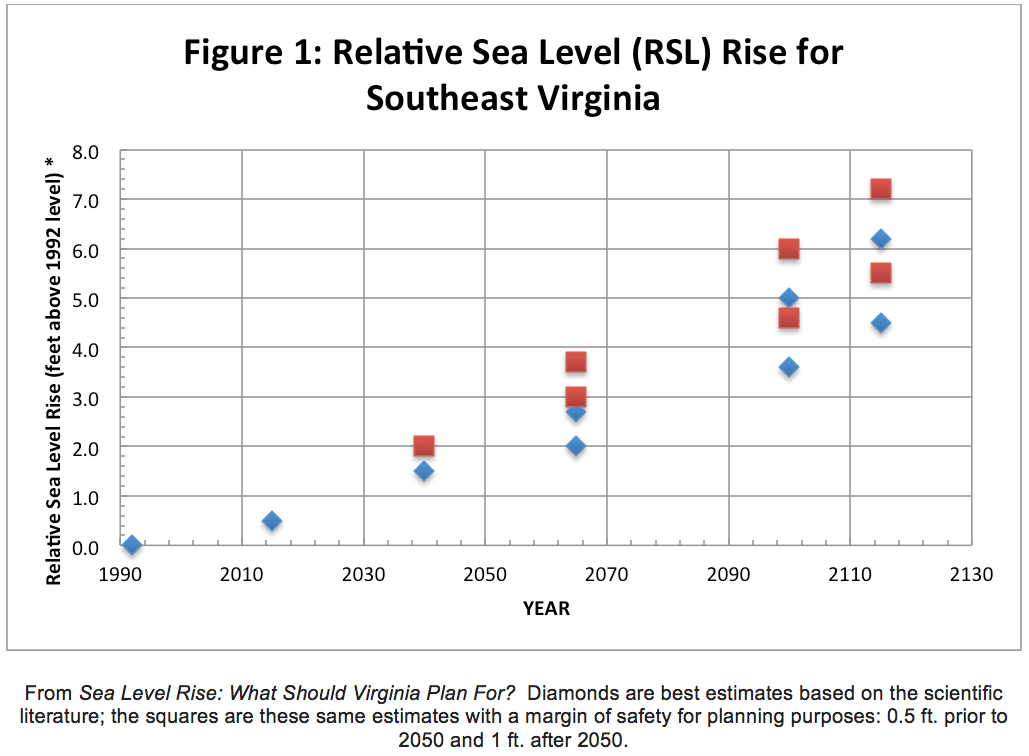
Sea level rise graphThank God for climate change deniers. They may eventually be the only buyers for shorefront real estate.

Sea level rise may not cause widespread flooding until later in this century or into the next one, but real estate deals involve long timelines: the useful life of a new house or a commercial building can be at least fifty years, while an infrastructure project might last a hundred years or more.

And of course, it’s one thing to lose your house, and another to lose the ground beneath it. Sea level rise means low-lying real estate now comes with an expiration date.

So smart buyers—and landowners—have to consider not just today’s flood maps, but also ones that haven’t been drawn yet. If a rising sea will threaten property some decades from now, it will depreciate over time, like a car. At some point only chumps and climate deniers will buy.

Head-in-the-sand posturing still dominates the headlines, like Florida Governor Rick Scott’s alleged ban on the use of the term “climate change,” or the North Carolina legislature’s silly (and costly) attempt to legislate sea level rise out of existence. Now the Federal Emergency Management Agency (FEMA) hopes to force states to get serious about climate change by requiring states to do a better job planning for natural disasters caused in part by global warming. FEMA’s goal is to save money through better planning, but conservatives have attacked the requirement as politically motivated.

Meanwhile, however, many states and localities have already begun using sea level rise forecasting in their planning. The projections will help land use planners determine not just where to allow growth, but also where to defend existing development against the incursion of the sea, and where the wiser course is to retreat. And of course, the studies should inform the decisions of anyone thinking of buying property on the coast.

Two recent studies provide a picture of sea level rise in Virginia. The Virginia Institute of Marine Science (VIMS) issued its report in January 2013, titled Recurrent Flooding Study for Tidewater Virginia. Building on that study and others, on March 10 of this year the Sierra Club released Sea Level Rise: What Should Virginia Plan For?

Both studies agree on some pretty sobering numbers. By the end of this century, the sea level in Norfolk, Virginia, is projected to be 3.6-5 feet above the level in 1992. By that point, the sea will be rising more than half a foot per decade. The numbers are higher for Virginia than for many states, in part because the land around Hampton Roads is also sinking at a rate of about one foot per century.

Although Hampton Roads gets most of the media attention, sea level rise threatens the entire Virginia coastline and the tidal portions of rivers, including the Potomac River all the way up to Alexandria and Washington, D.C. A whole lot of people should be consulting topographic maps before they make their next real estate decision.

The Sierra Club report focuses in on specific timeframes that matter in real estate decisions: twenty-five years for short-term projects, fifty years for new homes, and a hundred years for infrastructure projects. With a one-foot margin of safety added in, the report recommends that anyone considering a new project or building today with a 50-year expected life should plan for as much as 3.7 feet of sea level rise over the 1992 baseline. That number becomes 5.5-7.2 feet when the planning horizon is extended out a hundred years, to 2115.

(The “good” news is that the sea rose half a foot between 1992 and today, so you get to subtract six inches from these projections if you are starting now.)

Results are stated as a range rather than a precise number because the actual level will depend on many factors. Researchers agree that a certain amount of sea level rise is “baked in” as a result of greenhouse gas emissions to date, but future emissions will play a big role in determining how much the seas rise in the long run. Providing a range allows users to decide how much risk they are willing to take. Even at the high end, there are caveats; new information about melting ice in Eastern Antarctica could make today’s projections too conservative.

Right now many shore communities are hosting a game of musical chairs. Developers continue to build and sell new housing, figuring they can earn a good return on their investment and get out before the market collapses. Buyers aren’t told about the risks. Sea level rise is bad for business, so business would rather not talk about it. And some local governments soft-peddle the news, afraid of setting off a panic that will make the collapse of the real estate market a self-fulfilling prophecy.

The Virginia General Assembly took action this year to require localities in the Hampton Roads Planning District Commission to include measures addressing sea level rise in their comprehensive plans. The District includes 16 local governments in southeast Virginia, but that’s only a fraction of the counties and cities vulnerable to sea level rise.

Another bill requires that the disclaimer form provided to home buyers across the state include language warning that the seller makes no representations about whether the property is located in a “special flood hazard area” or may require flood insurance, putting the onus on buyers to inquire. While prudent buyers will follow through (and mortgage lenders will make sure they do), today’s flood maps don’t reflect tomorrow’s reality.

So these bills are a good start, but Virginia needs to do more. Local governments outside of Hampton Roads need specific guidance for planning, and the public needs better education about the floods to come. By the time the sea claims low-lying neighborhoods from Virginia Beach up to Alexandria, there may not be enough climate deniers left to buy everyone out.

Unknown's avatar

Criticism mounts over Dominion’s effort to lock in earnings, lock out audits

Dominion buildingSenator Frank Wagner’s bill to permit Virginia’s largest utility to keep its books closed until 2023 cleared a Senate subcommittee last week, but not without a bruising. What Dominion Virginia Power thought would be an easy sell—a promise to freeze rates at their current level—is being widely criticized as another money grab from a company known for resorting to legislative maneuvers to hang on to overearnings. As a result, SB 1349 faces an uncertain future in full committee today, and if it passes, should expect rough treatment on the Senate floor.

As I explained last week, the bill plays on fears that the EPA’s carbon-cutting Clean Power Plan will be costly to implement. According to Senator Wagner and Dominion spokesman Dan Weekly, ratepayers need protection from jarring rate increases.

Of course, if the Clean Power Plan were really likely to raise costs, a for-profit company like Dominion would hardly want to give up the ability to raise rates. Dominion’s eager embrace of a rate freeze puts me in mind of Brer Rabbit’s pleading not to be thrown into the briar patch.

Last year Dominion got away with legislation allowing it to keep hundreds of millions of dollars in over-earnings, catching the press, the new Administration and many legislators flat-footed. It may get away with it again this year, but it won’t be pretty.

For one thing, the press is fully awake this time around. Several papers raised questions, and a hard-hitting article in the Washington Post correctly reframed the issue as whether Dominion should be allowed to escape routine public financial audits. The Post article also hit one of my favorite themes, the outsized influence Dominion wields in the state due to the campaign cash it lavishes on Republicans and Democrats alike. But then it did me one better, noting that Senator Wagner owns stock in Dominion Resources.

An article in the Virginian-Pilot put the value of that stock at $250,000. [Update: a February 2 AP story put the value of Wagner’s stock at only $5,000. Regardless of the actual amount, on February 3, the AP reported that, in response to the story, Wagner sold his Dominion stock.]

Meanwhile the Capital News Service had caught on that the “rate freeze” actually puts a floor, not a ceiling, on utility bills. “Proposal would let Dominion hike electric bills,” ran the headline in multiple newspapers.

So when a small subcommittee of Senate Commerce and Labor* met to consider the bill on Thursday, it was not the easy pass that Senator Wagner and Dominion expected. Lining up against the bill were environmental groups, the Attorney General’s office, SCC staff, and the Virginia Citizens Consumer Council.

Even Senator Dick Saslaw, usually a reliable ally of Dominion, expressed his discomfort with the bill and told Dominion spokesman Dan Weekly that he had better answer the concerns that had been expressed.

But then Saslaw and the other senators voted to move it along. Apparently, just being a bad bill wasn’t enough to kill it.

Update: the full committee of Senate Commerce and Labor reported SB 1349 on a 14-1 vote, with only Senator Newman dissenting. Action now moves to the full Senate, which has many saner heads. But lest optimism get the better of us, I should note that pretty much all of them take Dominion money too.

———————————————

*This is the little hand-picked group I reported on that was supposed to form a joint subcommittee with House members to review all Clean Power Plan legislation. That’s not what happened. The joint subcommittee held two meetings that could best be described as EPA bash-fests, but only Wagner’s bill ended up assigned to the subcommittee, and only the Senate members met to consider his bill. The House members seem to have been unceremoniously dropped from the process altogether.

So what happened to the other climate bills? The Senate bills mostly ended up in Agriculture and Natural Resources, and the House bills mostly in Commerce and Labor (where they have been assigned to the Energy subcommittee). Why the change in plan? Beats me.

Unknown's avatar

Dominion’s ties to ALEC, McDonnell’s conviction, all part of one corrupt package

Group Dominion quit ALEc image 2

Protesters gather outside the Crystal City headquarters of ALEC

A crowd of protesters gathered at the Arlington headquarters of the American Legislative Exchange Council (ALEC) on September 4 to demand that Dominion Resources, the parent of public utility monopoly Dominion Virginia Power, drop its membership in the right wing “bill mill.”

On the very same day, a jury convicted ex-Governor Bob McDonnell and his wife on federal corruption charges, setting off a new round of debate about Virginia’s lax ethics laws.

The two news items sound like different topics, but in fact they are both about the corruption undermining our democratic system. The McDonnell trial, with its focus on swank vacations, golf clubs, designer clothes and other neat stuff, actually missed the bigger breach of public trust that goes on every day. This takes the form of unlimited corporate campaign contributions and gifts to members of both parties, and the influence over legislation purchased by this largesse.

Dominion Power has spent decades and many millions of dollars building its influence in Richmond this way, to the point where most legislators don’t bother pursuing a bill if the utility signals its opposition. That’s why Virginia has not followed so many other states in requiring its utilities to invest in energy efficiency, wind and solar. Economic arguments, jobs, electricity rates—all these are talked about in committee, and all are irrelevant to the fate of a bill. The only relevant question for legislators is, “What does Dominion think?”

What Dominion thinks, though, is not about what’s good for its customers, but what’s good for its own bottom line. And this is where ALEC comes in. Dominion Virginia Power’s president, Bob Blue, sits on an ALEC committee with representatives from the climate-denial group Heartland Institute, the Koch-funded anti-environment group Americans for Prosperity, and that most oxymoronic of lobby shops, the American Coalition for Clean Coal Electricity. Their purpose is to craft model state bills that protect fossil fuel profits and attack all efforts to regulate carbon emissions.

Dominion provides a straight shot from ALEC’s back-room bill-brokering to Virginia’s statute books, trampling environmental protections along the way and giving the lie to Dominion’s façade of environmental responsibility. No wonder so many of last week’s protesters were Dominion customers who objected to the utility using the money it charges them for electricity to pay its ALEC dues.

We see the result every year in the General Assembly, as bills drafted by ALEC pop up all over the place without attribution. In addition to attacking clean energy, ALEC bills oppose worker protections and minimum wage initiatives, promote stand-your-ground bills like the one at issue in the Trayvon Martin case, and of course, undermine the kinds of clean-government efforts that would reduce the influence of corporations—like campaign finance reform.

And because the voters are the only people who could prove more powerful than corporations—and the only ones who might ultimately cut off the corporate cash flow—ALEC works to undermine voting rights as well.

In the wake of the McDonnells’ convictions, Virginia legislators are once again mumbling about tightening up the rules on gifts. The discussion is half-hearted; the pay for their work is paltry and the hours are long, so they aren’t anxious to give up the perks.

But it’s too late for half-measures. Elected officials are going to have to subject themselves to a ban on gifts, and the prohibition should extend to ballgame tickets, golf getaways and sit-down dinners. The loophole that currently allows campaign funds to be used for personal use must also be closed to avoid an end-run around the gift ban.

But until we turn off the corporate cash spigot, our democracy will still have special interests, not voters, calling too many shots.

Unknown's avatar

Report confirms Dominion’s worst-place standing on clean energy

photo courtesy of the Sierra Club

photo courtesy of the Sierra Club

A new report from the non-profit group Ceres shows Dominion Resources, the parent of Dominion Virginia Power, winning last place among investor-owned utilities on a nationwide ranking of renewable energy sales and energy efficiency savings.

That’s left Virginians wondering how a company that talks so big succeeds in doing so little. And more importantly, what would it take for Dominion to rank even among the average?

Dominion came in 30th out of 32 in renewable energy sales, at 0.52%. On energy efficiency, it achieved 31st out of 32 on savings measured cumulatively (0.41%), and 32nd out of 32 measured on an incremental annual level (at 0.03%). Together these put our team in last place overall—a notable achievement for a utility that trumpets its solar investments and carbon-cutting progress.

To show just how awful Dominion’s performance is, the top five finishers achieved between 16.67% and 21.08% on renewable energy sales, 10.62-17.18% on cumulative annual energy efficiency, and 1.46-1.77% on incremental annual energy efficiency. National averages were 5.29% for renewable energy sales, 4.96% for cumulative efficiency savings, and 0.73% for incremental annual efficiency savings. Rankings were based on 2012 numbers, the latest year for which data were available.

In case you’re wondering, American Electric Power, the parent company of Appalachian Power Co., earned 24th place for renewable energy, with 2.65% of sales from renewables—a number only half the national average and one we might have called pathetic if it weren’t five times higher than Dominion’s. AEP’s efficiency rankings also placed it firmly in the bottom half of utilities, running 23d and 20th for cumulative and incremental efficiency savings, respectively. However, AEP earned its own laurels recently as the nation’s largest emitter of carbon pollution from power plants due to its coal-centric portfolio.

A study of the rankings reveals that Dominion’s major competition for the title of absolute worst came from other utilities based in the South. The critic’s favorite, Southern Company, nabbed 31st place on the renewable energy sales measure, but failed to make the bottom five on one of the efficiency rankings. Another southeastern utility, SCANA, achieved rock bottom on renewable energy; but like Southern, its marginally better performance on efficiency disqualified it from an overall last-place ranking.

Why do utilities in the South do so poorly? Probably because they can. Most of the poor performers have monopoly control over their territories and are powerful players in their state legislatures. Lacking in competition, they do what’s best for themselves. Possessing political power, they are able to keep it that way.

Of course, they still have to contend with public opinion and the occasional legislator who gets out of line. For that it helps to have a well-worn narrative handy, like the one about how expensive clean energy is. Dominion has found that Virginia’s leaders fall for that one readily, even though it’s false.

And so, when asked about the Ceres report, Dominion responded that Virginia wouldn’t want to be like the states that have high-performing utilities. Dominion spokesman Dan Genest told the Daily Press, “The three states — California, Connecticut and Massachusetts — the report mentions as being leaders in those categories also have among the highest electric rates in the nation. Typical residential customer monthly bills are $228.85, $206.07 and $191.04, respectively. Dominion Virginia Power customers pay $112.45.”

This would be an excellent point, if it were true. Alas, Genest’s numbers appear to be a product of a fevered imagination. According to recent data reported in the Washington Post, California’s average monthly electric bill is only $87.91, Connecticut’s comes in at $126.75, and Massachusetts’ at $93.53, while Virginia’s is $123.72. (Virginia’s numbers presumably reflect an average of bills paid by customers statewide, probably accounting for the higher figure than Genest cites for Dominion’s “typical” customer.)

That’s right: in spite of higher rates, Californians pay way less for electricity than Virginians do, in part because they have achieved high levels of energy efficiency. If you do that, you can afford to invest in more renewable energy without people’s bills going up.

This is such a great idea that it seems like it would be worth trying it here. Remarkably, this is precisely the strategy that environmental groups have been urging for years in their conversations with legislators and their filings at the State Corporation Commission. With the pressure on from global warming and the EPA’s Clean Power Plan, this would seem to be a great opportunity to save money, cut carbon, and move us into the 21st century.

So go for it, Dominion. Aspire to lead! Or failing that, at least shoot for average.


Unknown's avatar

APCo wants higher bills for homeowners who go solar

Workers installing solar on a roof. Photo credit: Dennis Schroeder, NREL

Workers installing solar on a roof. Photo credit: Dennis Schroeder, NREL

Update: The SCC approved APCo’s standby charges with a small modification. As it had when considering Dominion’s standby charge, the SCC declined to consider the benefits of solar to APCo. See http://www.scc.virginia.gov/docketsearch/DOCS/303%2301!.PDF at page 36-37.


Appalachian Power Company (APCo) is seeking permission from utility regulators to impose new “standby” charges on residential customers who install solar systems over 10 kilowatts (kW). The fee is included in the company’s latest rate proposal, now before the State Corporation Commission.

According to the filing, the transmission and distribution charges would add $3.77 per kW to the monthly bill of a customer who goes solar with a large residential system. That means homeowners with 10 kW systems would pay an added $37.70 per month. Charges would escalate to $75.40 per month for homes with 20 kW systems, the largest size allowed under net-metering rules.

So the potential is there for a solar homeowner to owe over $900 per year in new charges on his electric bill. But according to APCo, only three customers in all of its Virginia territory have systems large enough to qualify for a standby charge, with no additional big systems in the queue.

That’s right: APCo is spending many, many thousands of dollars on lawyers and consultants so it can change rules that affect three people.

Ahem. Lest anyone think APCo is worried about cost. APCo’s decision to move now proves this is not about freeloaders on the grid. This is about protecting the corporate monopoly on electric power by shutting down the independent solar industry while it is still small.

In this, APCo is following the lead of Dominion Power, which got the SCC to approve similarly onerous standby charges on its own large residential solar customers in 2011. The utility’s ability to do so was authorized that year by a bill amending section 56-594 of the Virginia Code. The statute leaves it up to utilities and the SCC to determine the amount.

The Virginia solar industry acquiesced to the standby charge language as part of a deal that raised the residential net metering limit from 10 kW to 20 kW. Industry members assumed any charges the SCC approved under the law would be modest, given the many benefits solar brings to the grid.

Their assumption proved spectacularly wrong. The SCC bought Dominion’s arguments about solar homeowners not paying their “fair share,” dismissing expert testimony and findings from other states that solar enhances grid security and offsets peak demand.

The result has been a clear setback for the solar industry’s ability to sell larger home systems. Dominion’s steep standby charges “are forcing the solar industry to take a step backward when we’ve worked so hard to make positive steps forward,” says Andrew Skinner, Project Manager with Prospect Solar in Sterling, Virginia. “Working with several small farms and residences in rural VA, we have had to design right up to the threshold of the standby charge to make the economic case most compelling.”

Dominion and APCo are following the playbook of the American Legislative Exchange Council (ALEC), a secretive corporate lobbying organization that seeks to roll back pro-renewable energy laws across the country. The parent companies of both Dominion and APCo are members of ALEC, and Dominion’s president, Bob Blue, served on ALEC’s energy and environment task force with representatives from the American Petroleum Institute, the American Coalition for Clean Coal Electricity, the science-obfuscation shop Heartland Institute, and other champions of all things fossil. (Greenpeace recently announced that six utilities have resigned from ALEC; unfortunately our guys were not among them.)

Given that APCo’s proposed standby charges are so similar to Dominion’s, APCo probably figures its request is a slam-dunk at the SCC. And given how few people are affected, it may be tempting to ignore it. But just last summer Dominion signaled its intent to try to extend its own standby charges to more solar customers, which makes the issue relevant to everyone who owns a solar system, wants one, or supports the rights of others to buy them.

Whether utilities should be loading up their solar customers with added fees is also at the heart of two studies getting underway in Virginia this year examining the costs and benefits of solar, one of them under the auspices of the Department of Mines, Minerals and Energy and the Department of Environmental Quality, and the other by the SCC itself. With a consumer backlash growing nationwide against utility efforts to “tax the sun,” APCo’s move looks like a way to lock in a rate increase on solar owners before the data is in—and before its customers catch on.

It’s especially unfortunate that the utilities’ push against net metered solar comes at a time when we are beginning to see a flourishing of the solar market. Total installed solar in Virginia has leapt from under 5 megawatts just a couple of years ago to perhaps 18 megawatts today. Okay, that’s a paltry figure compared to, say, North Carolina’s 557 megawatts or New Jersey’s more than 1200 megawatts, but starting from next to nothing gives us a really fantastic growth curve.

The rapid drop in solar prices has been a major factor driving Virginia sales. Says Skinner, “With the advancements in the solar market over the past couple years, even here in Virginia, we have been inching closer to the 10 year or less payback period. We talk to people every day that tell us they’ll go solar here when the payback is less than 10 years. A standby charge reverses that trend based on an argument with flawed economics. While other states are making progress on the true value of solar, we’re here with our head held under water.”

He concludes, “Even while holding our breath we are still creating jobs and installing solar arrays all over our beautiful state. I was born and raised here, and I’m proud to work for a VA based company; we just need to get rid of these backward policies so we can keep moving forward.”

APCo’s rate case is PUE-2014-00026, which can be found on the SCC website. For a discussion of the standby charge proposal, look for the exhibit containing the testimony of Jennifer Sebastian. The deadline for submitting comments on APCo’s application is September 9, 2014, and a public hearing will be held on September 16 at the SCC offices in Richmond.


Unknown's avatar

A new business model for non-profits brings solar into hostile territory


Solar panels over the entrance to the First Congregational Christian United Church of Christ. Photo credit: Matt Ruscio

Solar panels over the entrance to the First Congregational Christian United Church of Christ. Photo credit: Matt Ruscio

Fourteen solar panels crown the entrance to the First Congregational Christian United Church of Christ in Chesterfield, Virginia. The small array generates 10% or so of the church’s electricity, but the project is notable for a different reason: it was the first solar system installed anywhere under a new kind of contract called a Customer Self-Generation Agreement. The agreement allowed the church go solar with no money down, and without increasing its electricity costs.

The Customer Self-Generation Agreement (CSGA) is the brainchild of Tony Smith, founder and CEO of Secure Futures LLC, a solar developer based in Staunton, Virginia. Under its agreement with the church, Secure Futures owns the solar panels and reaps the federal tax benefits that make solar affordable. The church gets the electrical output of the system over the twenty-year life of the contract. Neither a lease (which would bar the church from getting the tax benefits) nor a third-party power purchase agreement (which the incumbent utility would have opposed), the CSGA occupies a financing niche all of its own.

For Secure Futures, the CSGA was born of necessity. In 2011, the company was blocked from completing a solar array at Washington and Lee University when Dominion Virginia Power sent “cease and desist” letters claiming the parties’ use of a third-party power purchase agreement (PPA) violated the utility’s monopoly on the sale of electricity. Although convinced it had the law on its side, Secure Futures backed down in the face of expensive litigation. The solar installation was only completed by turning the PPA into a lease and losing some of the tax benefits.

Tony Smith. Courtesy of Secure Futures.

Tony Smith. Courtesy of Secure Futures.

Secure Futures had been building a place for itself in the nonprofit world, appealing especially to colleges and universities that want solar power as part of their sustainability goals. The company’s 104-kW solar array at Eastern Mennonite University in Harrisonburg, Virginia, completed in 2010, was the first PPA in Virginia and, at the time, the largest solar array in the state. But that project was not in Dominion’s territory.

For a state like Virginia with few policies to support solar, accessing the federal tax credits is critical to financing a solar project. Tax-exempt entities like municipalities, schools and churches are a natural customer base for solar, but because they cannot use the federal tax credits themselves, they must partner with a tax-paying company that can own the project. Third-party PPAs have been the answer in states that allow them. PPAs also frequently offer a no-money-down option, which has proven a huge market driver in recent years for homes and businesses as well as non-profits.

Solar array installed by Secure Futures for the Harrisonburg Redevelopment and Housing Authority using a CSGA. Photo courtesy of Secure Futures.

Solar array installed by Secure Futures for the Harrisonburg Redevelopment and Housing Authority using a CSGA. Photo courtesy of Secure Futures.

But after the Washington and Lee experience demonstrated both Dominion’s hostility to PPAs and its willingness to use its legal firepower, Tony Smith decided to seek another way through the legal thicket. Working with regulatory lawyer Eric Hurlocker and tax specialists at Hunton and Williams, Secure Futures developed an innovative contract model that could provide the tax benefits of a PPA without running afoul of utility monopoly claims. CSGAs are contracts for solar services but, crucially, don’t involve the sale of electricity.

Although Dominion Power eventually relented enough to cooperate on a bill passed in 2013 that allows a small number of PPAs within its territory on a “pilot project” basis, Secure Futures has continued to use the CSGA model in subsequent projects because it offers features that a standard PPA does not.

Perhaps more importantly, neither Dominion nor any other utility has signaled opposition to CSGAs. Suddenly, Secure Futures’ niche looks huge. The ability to use CSGAs wherever PPAs would make financial sense opens up new opportunities among non-profits not just in Virginia, but in all of the 28 states where PPAs are currently either illegal or of uncertain status. As Smith notes, no state bars customers from generating electricity for their own use.

While Smith is eager to see his company grow, he says his larger goal has always been to open the floodgates for solar projects across the country where they are held back now only by outdated laws and flawed policies. He hopes to license the CSGA approach, ideally to a non-profit that could work with developers across the South to make this contract model widely available.

Virginia has always been a hard place to do business for solar companies, so much so that Smith refers to it as a ”dark state.” Knocking down the PPA barrier won’t bring the sunshine in all by itself, but it does create an opening.


Unknown's avatar

From Massachusetts to New York, offshore wind energy now ready to deliver

Interior Secretary Sally Jewell addresses a packed ballroom

Interior Secretary Sally Jewell addresses a packed ballroom at the American Wind Energy Association offshore wind conference

The long-awaited Cape Wind offshore wind farm will finally begin construction off the coast of Massachusetts in 2014. So, too, will the much smaller Block Island Wind Farm off Rhode Island. When completed, Cape Wind’s 130 wind turbines will supply almost 75% of the power needs of Cape Cod, Martha’s Vineyard and Nantucket, while the 5-turbine Block Island Farm will supply enough clean energy to power over 17,000 homes.

2014 also seems likely to see a power purchase agreement for some of the energy to be generated by a 900 MW wind farm off the tip of Long Island that would feed power to a growing and hungry New York market, at a cost that’s economic now.

And with a second round of grants from the Department of Energy expected next spring, demonstration projects of 12-25 MW will also go forward in three more locations, producing power in 2017 and helping set the stage for rapid growth in the industry. The first-round grants went to projects in Oregon, Texas, Ohio, Maine, New Jersey and Virginia.

These were a few of the highlights from the American Wind Energy Association 2013 offshore wind conference, held October 22 and 23 in Providence, Rhode Island. More than 700 attendees packed a ballroom to hear Secretary of Interior Sally Jewell, Rhode Island Governor Lincoln Chafee, U.S. Senator Sheldon Whitehouse and others make the case for why offshore wind energy will play a growing role in the U.S., starting in the Northeast.

Five years have passed since the American Wind Energy Association, the University of Delaware and the Sierra Club brought together researchers and wind developers for America’s first-ever conference on offshore wind energy, in Dover, Delaware. Since then, the conference has grown in scope and attendance, but the only wind turbine to make it to U.S. waters is a one-eighth-scale test model off the coast of Maine.

While Europe surged ahead and now has more than fifty offshore wind farms, the U.S. has been hampered by a slow federal leasing process, uncertainty about tax credits, and a political process ill-suited to the long-range planning and regional cooperation needed to realize the potential of this industry.

But as this year’s conference showed, the industry is moving ahead. The Obama Administration and several states identify offshore wind as a critical part of the response to climate change, as well as an opportunity to develop jobs. As many speakers explained, there is also a strong business case to be made for it. Given the price spikes that have plagued natural gas in New England and elsewhere, it makes sense to diversify power sources. In addition to providing price stability, wind energy has been shown to suppress wholesale energy prices, saving consumers money.

Perhaps most significantly, offshore wind power is likely to be the least-cost option in locations where demand is high, energy is expensive, and alternatives are few. This describes much of the Northeast, especially the densely populated area from northern New Jersey up to Massachusetts.

An analysis from AWS Truepower showed several factors that make offshore wind energy a good option in these areas:

  • A growing demand for power, driven in part by new data centers;
  • An already-congested transmission grid, coupled with the difficulty of either building new generation close to the load center or adding new transmission lines to bring in power from outside the area;
  • The proximity of offshore wind energy areas to these load centers along the coast;
  • High localized marginal prices for electricity, making offshore wind competitively priced; and
  • The ability of offshore wind to provide power when demand is greatest.

This last element is especially compelling for utilities, which have to meet a demand for power that changes throughout the day. Unlike onshore wind, which blows most strongly at night, and solar energy, which peaks in the middle of the day, offshore wind picks up in the late morning and continues through the evening hours, matching times of highest demand. According to Bruce Bailey, CEO of AWS Truepower, this fact means that in the New York market, the revenues from offshore wind energy will be about two and a half times that of onshore wind energy.

Whitney Wilson, the engineer who conducted the analysis for AWS Truepower, told me that when they looked at all the factors and then at the potential locations for offshore wind farms, one location stood out: a tract of ocean thirty miles off the coast of Montauk Point on Long Island, within the southern section of the Massachusetts/Rhode Island Wind Energy Area. Building wind farms there, her analysis showed, would provide the biggest bang for the buck.

Developer Deepwater Wind, LLC, won the right to develop the lease area last summer in the U.S.’s first-ever offshore wind lease auction. One likely customer may be the Long Island Power Authority, which put out an RFP for 280 MW of renewable energy, specifically mentioning offshore wind.

Lisa Dix, a Senior Campaign Representative with the Sierra Club’s Beyond Coal Campaign in New York who was also at the conference, says offshore wind makes perfect sense for Long Island, and complements the Long Island utility’s recent approval of a feed-in tariff for solar energy.

Other utilities seem likely to follow suit as they assess the benefits of offshore wind for their own customers. A greater understanding of these benefits will lead to the full buildout of the RI/MA area and the soon-to-be-leased New Jersey area.

The experience of Deepwater, Cape Wind, and the developers of the DOE-funded demonstration projects will help build the industry supply chain and workforce, and will produce the kind of learning that leads to lower prices for future projects. One such project involves the 2000 MW of the Virginia Wind Energy Area, which Dominion Power now holds the right to develop. While the economics are not currently as compelling in the cheap-energy South, this would change if the early movers achieve the cost reductions they are aiming for.

If states work together, these cost reductions and the development of a robust, domestic supply chain and workforce will happen better, sooner and smarter. Coordinated regional planning will support rapid growth in the industry while driving down costs in a virtuous cycle.

Given the urgency of climate change and the need to move the electric grid beyond fossil fuels as quickly as possible, Congress also has to make the growth of the offshore wind industry a national priority. Passing a long-term extension of the investment tax credit is a critical first step to support the tremendous renewable resource just off our coast.

Unknown's avatar

What’s wrong with Dominion’s Green Power Program

Better than Green Power: installing a solar system yourself. Photo credit: NREL

Better than Green Power: installing a solar system yourself. Photo credit: NREL

Renewable energy advocates in Virginia were astonished to learn a few weeks ago that the U.S. Environmental Protection Agency has given Dominion Virginia Power an award for its Green Power Program.

Dominion’s program is not, to put it mildly, a good one. Half of the money its customers contribute is siphoned off for overhead and “education.” The rest goes to buy renewable energy certificates from out of state. Over the years Dominion has collected millions of dollars in these voluntary contributions without building a single wind or solar facility to supply the program. Surely the only green award this merits is one for greenwashing.

So I called the EPA to find out what criteria they use in determining who gets an award. It turns out the agency only measures the growth of a green power program, and Dominion has signed up more customers than other utility programs have.

I had to laugh. Customers of utilities in most other states have real options to buy wind and solar. If you can buy wind energy from an alternative supplier or participate in a community solar project, or if your utility is aggressively incorporating renewables into its power supply, you don’t need a green power program.

But Dominion has never built more than token amounts of renewable energy, and it continues to use its monopoly position to erect barriers to competition from others. The utility has signed up 19,000 Green Power participants only because it has effectively denied its Virginia customers any meaningful way of participating in the renewable energy market.

News of this award will surely lure more people in. Yet even if every one of Dominion’s customers signed up for the program, it wouldn’t shrink Virginia’s carbon footprint. Instead, Dominion’s latest integrated resource plan reveals plans for more fossil fuel generation and increasing greenhouse gas emissions over the next fifteen years.

And it’s worse than that. As of this year, Dominion is actually using the Green Power Program to bankroll an attack on renewable energy—one the State Corporation Commission shamefully endorsed when it approved the company’s 3-megawatt “solar purchase program.”

In this charade, Dominion buys solar power from homeowners and businesses to resell to the Green Power Program. The deal nets sellers a few cents over the retail price of electricity, but costs the Green Power Program almost three times as much. This overcharging of the Green Power Program would be bad enough. But the more insidious problem lies in Dominion’s justification for the high charge. It claims that rooftop solar energy is no more valuable than power from fossil fuels that it can buy at wholesale.

Dominion’s position flies in the face of recent studies demonstrating the benefits of solar energy to the grid, including generating power where demand is, providing power during peak hours when energy is most expensive, avoiding the need for transmission upgrades, eliminating line losses, and reducing the need for new generation.

It also runs counter to trends in states like Georgia, where Georgia Power has put a higher–than-retail value on the solar distributed generation it plans to buy, and says that paying the extra won’t put upward pressure on rates.

This makes it especially difficult to understand why Virginia’s State Corporation Commission approved Dominion’s Green Power rip-off. And predictably, Dominion has followed up its win with a deeply flawed study it plans to use as a basis for a new round of standby charges on customers who net meter. (The case is PUE-2012-00064, available on the SCC web site.)

So what is a dedicated renewable energy advocate to do?

There are options. If you are determined to buy RECs, you don’t have to go through Dominion. Buy from another source. But better yet, install solar yourself if you can. The price of solar panels has dropped so precipitously over the past few years (down 60% since the start of 2011) that you may find it worth taking out a home equity loan.

If you don’t have a sunny roof yourself or can’t afford the whole upfront cost, you can work with your school, community center or place of worship to install solar panels in your neighborhood. Interest in solar is very high among Virginia faith congregations, driving large turnouts for presentations on the topic given by Sierra Club and others in cooperation with the solar industry.

Or you can take the money you were spending on Dominion’s program and give it to a charity that will use it to install renewable energy here in Virginia; this may even get you a tax deduction. Low-income housing providers like Richmond’s Better Housing Coalition now put solar panels on many of their facilities, and will accept donations specifically for that purpose.

The Virginia Center for Wind Energy at James Madison University accepts donations to its Wind for Schools program, which helps public schools across the commonwealth install wind turbines for educational purposes.

A new non-profit, Three Birds Foundation, is working to put solar on public schools that serve low-income children in Virginia and elsewhere.

All these charities are committed to doing what Dominion, apparently, doesn’t want to do: install solar and wind energy in Virginia.

Unknown's avatar

Nuclear power: lessons from Japan (and Murphy)

Dominion Virginia Power said Monday that it intends to move forward with plans for a third reactor at its North Anna Power Station as the international nuclear energy industry reels from the disaster at the Dai-ichi nuclear plant in Japan.—WSLS10, March 15, 2011

The operator of Japan’s tsunami-hit nuclear power plant sounded the alarm on the gravity of the deepening crisis of containment at the coastal site on Friday, saying that there are more than 200,000 tons of radioactive water in makeshift tanks vulnerable to leaks, with no reliable way to check on them or anywhere to transfer the water. –The New York Times, August 23, 2013

A friend asked me recently whether I thought the ongoing disaster at the Fukishima nuclear plant in Japan would have repercussions here in Virginia, where Dominion Power operates four nuclear reactors at two plants and wants to build another. I feel pretty sure the answer is no. Economics will kill Dominion’s nuclear dream, but not risk. We just don’t think that way.

We think like this: Fukishima was taken out by a tsunami. There are no tsunamis in central Virginia. Ergo, there is no risk to Virginia’s nuclear plants from a tsunami, so Japan’s sudden revulsion against nuclear power shouldn’t put us off our feed half a world away.

So why did countries like Germany, which also has no tsunamis, freak out and swear off nuclear for good?

They drew an entirely different lesson: Japan is a smart, technologically-advanced nation. Japan did not anticipate the disaster that destroyed Fukishima. Ergo, unanticipated disasters happen even in smart, technologically-advanced nations.

Or put another way: Murphy’s Law also applies to nuclear plants. We ignore Murphy at our peril.

But ignore him we do. We had our own brush with nuclear disaster two years ago, when a rare, magnitude 5.8 earthquake shook central Virginia and led to a months-long shutdown of the two North Anna nuclear reactors. No one expected an earthquake of this strength there, least of all the plants’ designers. Fortunately, the reactors survived intact, but I don’t know of anyone who wants to repeat the experiment. Presumably Dominion intends the “next” North Anna reactor to be designed to withstand stronger earthquakes. Do you feel better about nuclear now, or worse?

Murphy’s Law operates with ferocity across the energy sector. An industry expert told me the BP oil spill in the Gulf happened in spite of four different safeguards in place on the drilling rig, each of which should have stopped the blowout from happening. And that spill was not an isolated incident; only the year before, a similar blowout off the coast of Australia created a 2,300 square mile oil slick—about the size of Delaware. U.S. papers largely ignored it. Spills are so common in oil drilling that they rarely warrant a headline. Yet somehow those who support offshore oil drilling off the coast of Virginia feel sure it won’t happen here.

Or take mountaintop removal coal mining (please). Right now powerful explosives are blasting away the tops of mountains in southwest Virginia and across Appalachia. The rubble is being dumped into stream valleys, while huge machines scrape off the thin seams of coal. Federal law provides that no streams should be harmed, and the mountains should afterwards be restored—requirements so fanciful that neither mining companies nor state officials take them seriously. So it’s not surprising that streams and rivers are polluted, species disappear, building foundations crack, and residents die young. That’s not the plan going wrong, it’s the plan.

In the past most Americans participated in an unspoken agreement to ignore the risks involved in producing energy, because we had no intention of stopping what we were doing. If it’s a choice between risky energy and no energy, we will go with risky every time. Denying the risks is a coping mechanism that lets us sleep at night. Not incidentally, this is also the strategy used by fossil fuel interests to keep the public from demanding action on climate change.

But the widespread availability of cleaner alternatives gives us energy options we didn’t feel we had before. Increases in energy efficiency and tumbling prices for wind and solar mean we can afford to look more honestly at the damage we do and the risks we run by powering our 21st century economy with 20th century fuels.

I like to think the Virginia legislature’s decision to maintain the ban on uranium mining—for now—shows that our ability to ignore risks has its limits. Mining anything hazardous is inherently risky in a climate like Virginia’s, where rainfall continually recharges the water table. Put nasty stuff between the rain and the water table, and you will find contamination downstream. The idea that water can be kept out of millions of tons of radioactive mine tailings for thousands of years strains credulity. The idea that this might be accomplished by a mining company whose sole purpose is to make money shatters credulity altogether.

The fact that a good many of Virginia’s politicians lined up on the side of the mining company anyway is not necessarily evidence of their capacity for ignoring risk. More likely, it simply demonstrates how extreme is the corrupting power of money in Virginia politics. Unfortunately, that shows no signs of changing.