Unknown's avatar

As Youngkin takes an axe to the deep state, what could possibly go wrong?

The letter landed in email inboxes Monday morning like a grenade tucked into a plain manila envelope. In keeping with Gov. Glenn Youngkin’s Executive Directive Number One requiring agencies to eliminate 25% of government regulations “not mandated by federal or state statute,” the administration planned to take its axe to the building code. 

Yes, the building code. The Board of Housing and Community Development has been told to remove a quarter of the rules that protect homes and businesses against fires, bad weather and shoddy workmanship. 

The Board only last summer completed its triennial update of the Virginia building code, so you’d think they would have removed any unnecessary provisions already. But that’s not the point. The point is that the Axe of Freedom must fall wherever regulations gather in big bunches, and the building code is, by definition, a bunch of regulations. 

Wasting no time, the board plans to meet on January 26 to kick off what it is calling “the reduction cycle.” Virginians will have a chance to comment, although in keeping with what I’ve found to be board practice, only the comments the board likes will count. And as the governor appoints the board members, successful opinions will be those that confirm Youngkin’s vision. 

From that perspective, the building code is shot full of nanny state rubbish. It dictates things like safe wiring and roofs that don’t fly off in a storm and plumbing that actually works. The governor no doubt believes we can safely trust these kinds of things to profit-maximizing corporations without state inspectors second-guessing their work. (I assume the requirement for inspections also falls to the Axe. There is nothing more nanny-state than inspections.)

But if the government does away with standards, won’t builders cut corners? Yes, of course they will. That is the whole point, because then they can make more money. And making money is the ultimate conservative value, second only to owning the libs. 

As for the people who wind up living in unsafe, flimsy firetraps, I expect the administration thinks it’s about time those snowflakes took personal responsibility for the quality of their homes. If they can’t correct hidden defects before a house erupts in flames or grows black mold or the basement floods, that’s on them. 

Housing advocates worry the administration might especially target energy efficiency requirements, though Lord knows the board already watered those down plenty, and illegally so. But things can always get worse, and Youngkin seems committed to ensuring they do. 

(Indeed, that would make a great tagline for Youngkin’s 25% initiative. “Glenn Youngkin: Making Virginia Government One-Quarter Worse.” Feel free to use it, governor, with my compliments.)

Anyway, excising the energy efficiency section of the housing code could be a retro move to appeal to old folks’ nostalgic yearning for the days when houses were so drafty you could feel a breeze with the windows closed. Maybe you never thought we’d let new homes get built that were like those of my childhood, where the kitchen pipes froze when the temperature plunged unless you put a hot water bottle in the cupboard under the sink and left the faucet dripping. 

But here we are. Will the board also remove the bans on lead paint and asbestos insulation?

The building code may be the first place to look for regulations to cut, but reaching his 25% goal will require Youngkin to take the Axe of Freedom to regulations wherever they lurk. And they lurk all over the place. Virginia’s administrative code contains 24 titles. 

One colleague suggests simply removing every fourth word from every section of every title, which would have the virtue of wreaking havoc with the entire Deep State bureaucracy at once. And it would keep lawyers busy! Though not everyone would appreciate that feature (and sure enough, my colleague is a lawyer).

Another easy option might be to just remove a quarter of the titles indiscriminately. Chopping off the last 6 of the 24 would eliminate the following: 

     • Public safety (creating an interesting experiment in anarchy) 

     • Public utilities and telecommunications (turning the management of these critical functions over to the private sector, but what could go wrong?) 

     • Securities and retail franchising (as I have only a dim idea of what those are all about, it’s okay by me, but I expect these things have their defenders) 

     • Social services (this could be dicey when combined with the anarchy thing) 

     • Taxation (a popular title to jettison, with the added benefit of making the rest of government unworkable) and 

     • Transportation and motor vehicles (which would either allow everyone to speed to their heart’s content, or mean no one would do road repair; we’d just have to see how that went)

You will object that I’m proposing a totally mindless approach to regulatory reform. On the contrary, I’m just trying to help implement the governor’s regulatory reform agenda using the same level of care and foresight he did. 

Let the Axe of Freedom fall!

This article was published in the Virginia Mercury on January 25, 2023. Later that day, the Department of Housing and Community Development sent out another letter, this one scheduling an additional meeting for January 31 due to “quorum concerns” surrounding the upcoming January 26 meeting. No explanation was offered as to why board members had chosen to absent themselves.

Unknown's avatar

Fed up with leaf blowers? You’ve got company – and now, reason for hope

Members of Quiet Clean NOVA demonstrate the noise level of gas-powered leaf blowers on the grounds of the Capitol on January 11. Photo: Quiet Clean NOVA.

Fifteen years ago, when my husband and I expanded our snug 1970s-era house, we added a screened-in porch where I hung a hammock swing. In good weather I carry my computer and coffee out to work from what I call my “summer office.”

Except on Wednesdays. On Wednesdays my neighbor’s landscaping crew descends, and then begins the racket from the lawn mowers, trimmers and, most annoyingly, leaf blowers — which somehow manages to last for hours. 

Less predictable is the neighbor on the other side of us, who seems to be addicted to his two-stroke gas-powered leaf blower. He’s outside with it several times a week in all seasons, in spite of not having a lawn. The noise is insufferable, and even if I could tune it out, the pollution produced by the apparently-not-very-well-maintained engine forces us indoors with windows shut tight. Not satisfied with his own efforts, last spring he hired a crew of day-laborers with gas-powered leaf blowers to spend most of the workday making sure not a leaf remained anywhere on the property, including (I kid you not) in the woods behind his house.

I love all my neighbors, but if I could vote these machines off the planet, I would. Gas-powered leaf blowers are far and away the worst instrument of neighborly ear torture known to suburban life, and that includes pickleball.

I’m not alone in making this assessment. Local governments across the country have banished them, citing air pollution, worker health risks, harm to wildlife and contributions to global warming, as well as noise. Two years ago in Virginia, an all-volunteer advocacy group called Quiet Clean NOVApromoted a bill in the Virginia legislature that would have given localities the power to regulate or prohibit gas-powered leaf blowers. Other lawn equipment and electric leaf blowers, being much less obnoxious, were not targeted. Even drawn so narrowly, the bill died in a House subcommittee on a 5-4 vote along party lines.

This year, Quiet Clean NOVA worked with Del. Rip Sullivan, D-Fairfax, and Sen. Saddam Salim, D-Fairfax, on a similar bill introduced in both the Virginia House and Senate. On January 11, volunteers from the group descended on Richmond with gas leaf blowers to do elected leaders the dubious favor of clearing detritus from the sidewalks around the Capitol, at full volume.

The thing about leaf blowers is that owning one is not exactly part of Maslow’s hierarchy of needs. When I was a child – lo these many years ago – leaves were removed from grass with a rake, and that didn’t seem to interfere with anyone’s quest for self-actualization. 

Then, in the late 1970s, California became the first state to embrace leaf blowers. It has now become the first state to ban the gas-powered version, though without an apology to the rest of us for unleashing the scourge in the first place. 

To be honest, I love power tools as much as the next homeowner. I’ve learned that a relaxed approach to leaves is better for wildlife and soil health, but a few times per year I bring out my electric leaf blower, connect it to an extension cord, and blow the accumulated leaves and debris off our roof. I do the same for our gravel driveway in the fall. The electric blower is about as loud as a vacuum cleaner, produces no fumes, and has never needed repair in the 20 years I’ve owned it. Should I ever need a new one, they sell for under a hundred bucks. 

It would be a bit much to expect landscaping crews to run around tethered to extension cords, but that is where advances in battery technology come in. Battery-powered leaf blowers cost about as much as gas-powered blowers, but they are cleaner, quieter, easier to maintain and more reliable. Not to mention, the sound doesn’t penetrate walls and drive the neighbors batty. The catch is that a battery may need recharging before a big job is complete (or for my neighbor, before every leaf is out of the woods). A landscaping crew would need to carry spare batteries, which adds to the cost. 

Opponents of legislation letting localities regulate gas blowers will argue that it isn’t fair to landscapers to make them invest in new equipment before the old equipment has reached the end of its useful life. A locality would have to weigh that consideration against the more diffuse, but much greater, costs to society imposed by the current use of gas blowers.  

But that’s an argument about whether and how to regulate. That discussion should be had at the level of government that operates closest to neighborhoods and people, at city councils and boards of supervisors. Quiet Clean NOVA’s bill gives those localities the ability to regulate but does not require them to.

In Virginia’s General Assembly, though, even a modest bill may get caught up in the political moment. Few Virginia Republicans represent densely-populated districts where noise and pollution are serious issues. Most are blessed to represent quieter rural areas. It’s easy for some of them to frame any local regulation as an infringement on personal liberty. Still, I question whether any of these gentlefolk, when settling in for a pleasant spell on the porch, greet the sudden roaring of a leaf blower by exclaiming, “Ah! The sound of freedom!” I think they say the same unprintable things I do.  

But I get the slippery slope argument. If you let communities decide for themselves whether to regulate things that harm people’s health and the environment, next thing you know they might start trying to control how people live their lives in private, possibly even banning things like drag queen story hours and library books about Black people.

Oh, wait. We’re there already, aren’t we?

So maybe let’s just look at this legislation as simply what it is: a way to give our local elected officials the right to hear the voices of their distressed constituents, crying out for a little peace and quiet.

A version of this article appeared in the Virginia Mercury on January 10, 2023.

Unknown's avatar

A 5-point plan for Virginia’s data centers

Data center between housing community and a bike path
Data centers increasingly dot the landscape of Northern Virginia, like this one sandwiched between a housing community and the W&OD bike path in Ashburn. Photo by Hugh Kenny, Piedmont Environmental Council.

None of the sessions at last month’s Virginia Clean Energy Summit(VACES) in Richmond were devoted to data centers, but data centers were what everyone was talking about. Explosive growth in that energy-hungry industry has everyone — utilities, the grid operator, and the industry itself — scrambling to figure out how Virginia will provide enough new power generation and transmission. And, worryingly, no one seems to have an answer. 

Or rather, lots of people have answers, but none of them achieve the trifecta of providing data centers the energy they need while continuing the explosive growth trajectory that state leaders seem to want, and at the same time keeping Virginia’s transition to zero-carbon energy on track. Something has to give. Which will it be?

With no action, the “give” comes from the people of Virginia. Residents will see growth they don’t want, pay for infrastructure that doesn’t serve them, suffer from pollution that is not of their making, and see their tax dollars subsidize an industry that employs almost no one.

The no-action option isn’t a solution

But first, a quick recap. Northern Virginia already has the largest concentration of data centers in the world. As of late 2022, data center electricity demand had grown to 21% of Dominion Energy Virginia’s entire load, and likely an even larger percentage of the load of Northern Virginia Electric Cooperative (NOVEC), which serves much of Data Center Alley.

Worse, the industry is just getting started. Grid operator PJM’s grid forecast projects Dominion’s data center load will quadruple over the next 15 years, while NOVEC’s will rise to ten times what it is today. Other rural electric cooperatives in Virginia told PJM they also expect a huge demand from data centers, a prediction confirmed by news that Amazon Web Services expects to spend $11 billion on data centers in Louisa County, in the territory of Rappahannock Electric Cooperative. 

In its Integrated Resource Plan (IRP) filing in May of this year, Dominion told the State Corporation Commission (SCC) that due to data center demand, it plans to ignore Virginia’s commitment to achieving a zero-carbon economy. Instead of increasing the pace of renewable energy and storage construction, it wants to keep coal plants running past their mandatory retirement dates and even build new gas combustion turbines as well as billions of dollars’ worth of new transmission infrastructure. The result will be higher costs for consumers and massive increases in carbon emissions, violating the carbon-cutting mandate of the Virginia Clean Economy Act. 

Bill Murray, Dominion senior vice president for corporate affairs and communications, seems to have tried for a more conciliatory tone in talking to Senate Finance Committee members last week about the challenge of meeting data center load. Murray is quoted in the Richmond Times-Dispatch telling members, “We have worked through these challenges before.” Isn’t that reassuring? If only it were true. 

If Dominion’s response has been less than adequate, others have not done better. PJM, already woefully behind on approving new renewable energy generation interconnection requests, blames states for wanting clean energy rather than doing its own job to help the market provide it. A PJM representative told the VACES audience utilities should just keep their fossil fuel plants running until it can work its way through the backlog, hopefully by 2026.

Virginia’s Data Center Coalition doesn’t see energy as its problem to solve, and its members seem strangely content to run on fossil fuels. Others in the industry are trying to do better, though. Whole conferences are devoted to the subject of lowering the carbon footprint of data centers. In addition to a pledge to use renewable energy 24/7, Google has achieved remarkable levels of energy efficiency (for you nerds, they claim an average PUE of 1.1). Google, however, has only a small footprint in Virginia. 

Amazon Web Services, the biggest data center company in Virginia, buys renewable energy but is not striving for the 24/7 standard. AWS’ senior manager for energy and environment public policy, Craig Sundstrom, told a panel at VACES that by 2025, AWS will have offset its use of grid power with purchases of renewable energy on the PJM grid, and he pointed to 16 solar projects the company has in operation or under development in Virginia. That’s a great start, but it’s only a start. With no battery storage in the mix, AWS will still be using grid power from fossil fuels most of the time.

Wishful thinking will not solve this 

So what should data centers do? Or, since most of the industry doesn’t want to do anything, what should Virginia utilities and policymakers do? 

VACES conference attendees had a few suggestions. The nuclear energy true believers were there, touting small modular reactors (SMRs). Gov. Youngkin and many Virginia legislators are fans of nuclear, but the timing was unfortunate. A few weeks after VACES, the first SMR in development — the one that’s supposed to prove how great the technology is — lost its customers due to increasing cost projections. The chances of SMRs ever outcompeting solar paired with storage seems more remote than ever.

Green hydrogen, a vital part of our energy future, has cost and availability problems right now, too. Microgrids powered by hydrogen fuel cells would be a fantastic solution. I’ll set my alarm for 2030 to check on how that’s going. 

Meanwhile, representatives of Washington Gas and Roanoke Gas earnestly tried to sell the VACES audience on the virtues of methane captured from wastewater treatment plants and hog waste cesspools like those at Smithfield Farms’ concentrated animal feeding operations (CAFOs). 

Some of this so-called renewable natural gas (RNG) may be available now, but it is exceedingly hard to imagine there would ever be enough to supply even the back-up generators at Virginia data centers, to say nothing of meeting 21% (and growing!) of Dominion’s total load. North Carolina has incentivized pig waste biogas for many years, but it still makes up only a fraction of a percentage point of that state’s energy supply.

To hear the gas folks tell it, though, RNG is not just carbon-neutral but carbon-negative, achieving this Holy Grail status by capturing and burning methane that would otherwise escape into the air. They assert that mixing a mere 5% of this biogas into ordinary fossil methane will effectively decarbonize the entire pipeline. In other words, we should be glad CAFOs are such an environmental disaster. 

That dog won’t hunt. If gas companies get to claim the virtues of pig waste biogas, they also have to account for its vices, including the greenhouse gas emissions and other pollution associated with methane capture and leakage throughout collection and delivery.

Also, if factory farming is the answer to the needs of data centers, God help us. Maybe the tech industry should move to Iowa. 

A better approach

One of the better ideas coming out of VACES was a simple one: if clean energy can’t come to the load, the load should go to clean energy. Iowa, in fact, is just one of several states that get more than half their electricity from wind and solar. And indeed, some large tech companies are looking at separating their operations between those that are time-critical and need to be next to load centers and those that don’t, with the latter able to take advantage of better climates and greener energy.  

Tech companies don’t necessarily have to look beyond Virginia to take their operations to clean energy. Nothing prevents them from locating in rural counties where they can surround their data centers with fields of solar panels and banks of batteries. For that matter, a large operator like AWS could buy offshore wind, starting with the Kitty Hawk project that is still seeking a customer

Many Virginia data center operators, though, will still need to access the PJM market. They should be expected to follow Google and buy renewable energy and storage to meet at least most of their electricity needs on a 24/7, hourly matching basis. Given the PJM bottleneck, they will need a grace period of two or three years. After that: no renewable energy, no tax subsidy.

That’s point one of our data center strategy. Point two: data centers that have to source their own renewable energy will be motivated to use less energy, but Virginia can also set an energy efficiency minimum they should meet to qualify for Virginia’s tax subsidies. They need not match Google’s success, but they should come close.  

Point three: Dominion claimed in its IRP that it could not build enough solar itself to meet the soaring data center demand; this was its excuse for keeping expensive coal plants running beyond their planned retirement dates. If Dominion can’t build it, let others do it. The General Assembly should remove the 35% limit on the amount of solar and storage capacity that third-party developers can provide. A little free-market competition never hurt anyone.  

Point four: If the growth of data centers requires utilities to invest more for energy generation and power lines, the data centers should be the ones paying the extra cost, not residential customers. 

Point five: Leaders should not separate the joy they feel in attracting data centers from the pain their constituents feel in living with data centers and transmission lines, breathing pollution from diesel back-up generators and having the quality and quantity of their freshwater resources threatened. Data center developers and revenue-hungry local governments are not the appropriate decision makers for development at this scale. The administration should convene a task force with the job and power to do comprehensive planning for data center siting, development and resource use. 

Adopting these five points will not stop data centers from locating in Virginia, and that isn’t the goal. What it will ensure is that the development is well planned out, fair and equitable to everyone.

This article appeared in the Virginia Mercury on November 21, 2023.

Unknown's avatar

Houses can be built to use much less energy. Why aren’t they?

A house under construction in McLean, VA
A home under construction in McLean, Virginia. Ivy Main

Every three years, a nationwide group of building safety professionals known as the International Code Council (ICC) publishes updated model building codes that form the basis for most U.S. state and local building codes. ICC codes address essential features like structural integrity, fire safety, plumbing and energy use. As technologies improve, so do the model codes. A home built to the 2021 International Energy Conservation Code(IECC), for example, uses 9.38% less energy than one built to the 2018 model code, which was itself a significant improvement on the 2015 model code, etc.

Most home buyers take these things for granted. We don’t know the ins and outs of building technologies or codes, and we don’t want to. It is the job of ICC professionals to set modern standards, and the job of state and local government to ensure builders meet them. Right?

Except it doesn’t always work that way. Some states and localities do adopt each new iteration of the model codes as a matter of course; Maryland is one such state. Across the river in Virginia, however, important energy efficiency elements of the residential building code are stuck all the way back in 2009, because the builder-dominated board in charge of Virginia’s building code refuses to adopt more rigorous standards. 

This intransigence has cost Virginia residents millions of dollars over the years in higher energy bills, especially for heating and cooling. A July 2021 analysis by Pacific Northwest National Laboratory showed that adopting the 2021 IECC would save Virginians $2.5 billion over 30 years, the typical mortgage term. Their analysis assumed mortgages included the added cost of meeting the updated requirements, so the $2.5 billion is pure savings, reflected in yearly cash flow savings averaging $250 per homeowner.

Faced with high utility bills, owners of existing homes sometimes spring for expensive retrofits to upgrade heating and cooling systems, install new windows and add insulation. These investments often pay off in lower utility bills, but it costs more to retrofit than to build it right the first time. There are also limits to how much energy can be saved through retrofits. It can be very difficult, for example, to add insulation to the walls of an existing home. The right time to make a house weather-proof and energy efficient is during design and construction. 

Builders resist meeting the highest efficiency standards for one simple reason: it costs more to build high-efficiency homes, cutting into profits. Builders insist they are just trying to keep home prices down, but that rings hollow. Anyone who has gone house-shopping knows the price of a home is determined by supply and demand, not building cost. Builders will charge whatever they can get. 

Builders also say home buyers don’t ask for efficient homes, but that claim is also suspect. Unlike granite counters and high-end finishes, energy upgrades are frequently invisible to buyers, so they don’t know to ask for them or how to evaluate any claims a builder makes about them. Let’s face it, most of us wouldn’t know an R-value if a batt of insulation fell on our heads. Nor should we have to know. This is why we have building codes.

Unfortunately, protecting consumers from drafty homes and high utility bills is not a priority of the building industry and its allies that control Virginia’s code adoption process. For years the Board of Housing and Community Development (BHCD) has refused to adopt the full model efficiency code, leaving old exceptions in place. Standards for wall insulation and air leakage (the measure of how drafty a home feels) haven’t been updated since 2009.

The cost to residents mounts with each failed opportunity. Most people don’t buy new homes, after all. They buy (or rent) existing homes built according to previous building codes. BHCD’s repeated failures to raise standards condemns residents to decades of poorer-quality homes. Lower-income Virginians, in particular, end up energy burdened by living in homes that are unnecessarily expensive to heat and cool.

The General Assembly knows this is a problem. Virginia law has long required BHCD to adopt standards consistent with model codes such as the IECC. Faced with the board’s continuing intransigence, in 2021 legislators passed a new  law directing BHCD to “consider adopting Building Code standards that are at least as stringent as those contained in [each] new version of the IECC.” 

“Consider” looks like a loophole you could drive a truck through, but the new law goes on to add a specific requirement that the BHCD “shall assess the public health, safety, and welfare benefits of adopting standards that are at least as stringent as those contained in the IECC, including potential energy savings and air quality benefits over time compared to the cost of initial construction.”  

Now that sounds like a slam-dunk for adoption of the IECC standards, given the studies confirming that building to the higher standards benefits occupants and the public with better air quality and with utility bill savings over time that far exceed what it costs a builder to meet those standards. Legislators and advocates who worked to pass the legislation reasonably expected BHCD to adopt the 2021 IECC in its entirety, if not go beyond it.

That did not happen. During the slow process of updating Virginia’s residential building code over the ensuing months, BHCD never took the new law seriously. It never conducted the required analysis, and there is no indication it even “considered” adopting the full 2021 IECC standards, in spite of in-depth comments from experts and testimony from the public.

The building code update BHCD proposed in December of 2022 and approved in its final form on August 28 of this year neither removed past weakening amendments nor adopted more stringent standards.  Indeed, BHCD even decided this year to roll some commercial efficiency standards back to 2006 levels! 

Perhaps this sad state of affairs should not surprise us too much, given who our governors  – past and present  – have appointed to the board. By my count, 8 of the 11 appointed members  represent home builders; another member works for a mortgage company. The foxes are in charge of the hen house. 

Those appointments were not a matter of luck. Public records show construction and real estate companies gave almost $13 million to Glenn Youngkin’s 2021 campaign for governor, the second largest industry donor to his campaign. Four years previously, the industry donated “only” $2.5 million to the campaign of Youngkin’s Democratic predecessor, Ralph Northam. In both cases, the board appointments that followed heavily favored the home building industry, with the result that Virginia’s residential building codes seem to be permanently stuck in the past.

Virginia leaders pride themselves on being pro-business, but that doesn’t have to mean being anti-consumer. The commonwealth as a whole would benefit from a housing stock that is more weather-resilient and healthier for occupants, that saves energy, and that reduces residents’ utility bills.   

Is that really too much to ask?

This article first appeared in the Virginia Mercury on October 19, 2023.

Unknown's avatar

Up for a vote in this election: clean energy, data centers and utility influence

Virginia voters will decide next month who will represent them at the State Capitol in January.

How much do Virginia’s elections matter in an off year? Measured by the turnout in past elections, you’d think the answer is “not much.” The percentage of registered voters who show up at the polls in Virginia typically drops well below 50% when no federal or statewide candidates are on the ballot. 

But measured by how much the outcome of this year’s election could affect the lives of regular people, the battle for control of the Virginia Senate and House of Delegates matters enormously. With a Republican in the governor’s mansion, a Democratic edge in either or both chambers would continue the status quo of divided government and (mostly) consensus-based lawmaking. A Republican takeover of both chambers, on the other hand, would lead to a wave of new legislation imposing the conservative social agenda on abortion, gay rights, transgender issues, education and welfare.

It would also put an end to Virginia’s leadership on climate and clean energy and lead to costly initiatives protecting fossil fuels, at the expense of consumers and the environment.

Some of the divisions between the two parties are well-known, and the consequences of one party edging out the other are clear. For some issues, however, the party positions are not as obvious, and it takes a look under the hood to understand where elections matter. 

Virginia’s clean energy transition is at risk

Let’s start with the obvious: the broad framework of Virginia’s energy transition to clean energy is a signature achievement of Democrats that Republicans have in the crosshairs. 

Three and a half years ago, Virginia made history as the first Southern state to commit to zero-carbon electricity by 2050 with detailed and specific guidance. The next year, the General Assembly followed up with legislation to begin the transition to electric vehicles. 

Clean energy investments soared after passage of the Virginia Clean Economy Act (VCEA). Solar installations in 2020 and 2021 dwarfed previous numbers, and the state solar market is now a $5.1 billion industry employing over 4,700 workers. Private investment dollars have poured into small-scale renewable energy as well, funding solar on schools, churches and government buildings. 

The VCEA’s support for offshore wind gave that industry the certainty it needed to move beyond the pilot project stage. Foundations for the first of 176 turbines of the Coastal Virginia Offshore Wind project are currently on their way to the Portsmouth Marine Terminal. By the end of 2026, the turbines are expected to provide enough electricity to power more than 600,000 homes. 

Communities benefited from Virginia’s entry into the carbon-cutting Regional Greenhouse Gas Initiative (RGGI), as $730 million in new revenue flowed to the Commonwealth for flood mitigation and low-income home weatherization. 

And after passage of the Clean Cars law, sales of electric vehicles in Virginia are set to double by the end of next year, and to double again by 2026.

In 2021, however, the election of Gov. Glenn Youngkin and a narrow Republican majority in the House of Delegates put these gains at risk. Early on, Youngkin declared his intent to repeal the VCEA and the Clean Cars law and pull Virginia out of RGGI. Only a Democratic majority in the Senate stopped legislative rollbacks passed by House Republicans in 2022 and 2023. Loss of that majority would ensure repeal of Clean Cars and the evisceration of VCEA.

As for RGGI, the failure to repeal the law led Youngkin to attempt to pull Virginia out through an administrative rulemaking that will be contested in court. He could sidestep a court battle and do it legally through legislation if his party takes control of the General Assembly. 

“No-brainer” bills killed in small committees

While a clear divide separates the two parties on signature Democratic initiatives like VCEA and RGGI, party membership is the determining factor on other energy and climate bills in less obvious ways. House rules allow a subcommittee consisting of as few as 5 members to vote down a bill by majority vote, keeping it from being heard by the full committee. With Republicans in control of the House, every subcommittee has a Republican majority, and Democratic bills routinely die on 3-2 votes. This can be true even if a bill has already passed the Senate, and even if the Senate vote was bipartisan – or for that matter, unanimous.

The Senate operates very differently. There, a subcommittee can only make recommendations. It takes a vote of the full committee to kill a bill in the Senate. 

You might wonder: if a bill is such a no-brainer that it passes the Senate unanimously or by a wide bipartisan majority, why would it get voted down in the House at all? Wouldn’t the bipartisan endorsement suggest this is actually a good bill that even the party in charge of the House would want to support, or at least have heard in full committee?

Indeed, when a no-brainer bill is killed in a tiny House subcommittee along party lines, it is rarely because the bill’s patron just happened to find the only few people in the General Assembly who don’t like the bill. More typically, it’s because the governor or the caucus itself has taken a position against the bill, but doesn’t want to draw attention to that fact. The subcommittee members tasked with doing the killing let everyone else in the party keep their hands clean. 

This explains the fate of Fairfax Democrat Sen. Chap Petersen’s bill to study the effect of data centers on Virginia’s environment, economy, energy resources and ability to meet carbon-reduction goals. The bill passed unanimously by voice vote in the Senate before dying at the hands of three Republicans in a five-person subcommittee of the House Rules committee. 

The data center study was the very definition of a no-brainer bill. The unbridled growth of data centers has ignited protests in communities across Virginia, and the industry’s voracious appetite for energy is blowing up Virginia’s climate goals, according to Dominion Energy. How can it be that House Republicans don’t even want to study the issue?

The answer lies in the fact that the Youngkin administration testified against the three data center bills that were heard in the Senate. One of Youngkin’s proudest achievements in office was the deal with Amazon to bring another $35 billion worth of data centers to Virginia. He does not want a study that would bring negative realities to light, so the bill had to die. The Republican members of the subcommittee were merely the executioners.

Another no-brainer bill that never made it to a full committee vote is one that gets introduced year after year: a prohibition on using campaign funds for personal purposes. This year’s legislation passed the Senate unanimously before just five Republicans voted to scuttle the bill in a House Privileges and Elections subcommittee.

My guess is you could not find a voter anywhere in Virginia who thinks legislators should be able to take money donated to their election campaigns and spend it on themselves. Justifying it requires legislators to turn themselves into logical pretzels. 

The combination of unlimited campaign giving by donors and unrestricted spending by the recipients makes it easy for powerful corporations like Dominion Energy to buy influence. Dominion has long been the largest corporate donor to legislators of both parties. The company’s influence has cost consumers billions of dollars and kept its fossil fuel plants burning.

Dominion’s influence was clearly at work this year when a House subcommittee killed a bill from Fairfax Senator Scott Surovell that would have made shared solar available to more Virginians, over Dominion’s opposition. The bill passed the Senate with bipartisan support before losing 4-2 on a party-line vote in a House Commerce and Energy subcommittee. 

It is less clear whether Dominion had a hand in the death of a bill that would help localities put solar on schools. The legislation passed the Senate unanimously before being killed in House Appropriations, again on a straight party-line vote. 

Certainly, there have been plenty of Democrats over the years who have voted for Dominion’s interest time and again. Conversely, not all the no-brainer bills killed by House Republicans reflect a hostility to the energy transition; sometimes the problem seems to be a hostility to environmental protections in general. Thus a bill to require customer notification when water tests show contamination from PFAS – known commonly as “forever chemicals” – passed the Senate unanimously and then was killed in a House subcommittee on, yet again, a party-line vote. 

It would be hard to identify a consistent line of reasoning behind all the anti-environment votes across all the various subcommittees, but the pattern is clear enough. It reflects not just the positions of individual legislators, but a firm party line. 

Whether voters care about these votes now is not clear, mainly because the news media rarely look at the role of the environment, climate and energy in elections. Regardless, these issues will be very much at stake at the polls next month. 

This article originally appeared in the Virginia Mercury on October 4, 2023.

Unknown's avatar

A bright spot at the intersection of farming, electric vehicles and solar energy

Peggy Greb, USDA

The energy transition is in full swing across the U.S. and the world, but the changes now underway are not simple or linear. In an economy as complex and connected as ours, progress in one area will often affect other parts of the economy, creating winners and losers. 

And then there are the changes that work together synergistically and leave everyone better off. This is what we will see as renewable energy overtakes fossil fuels and electric vehicles go mainstream. These transformations will deliver another enormous benefit, this time to farmland, as they pull the rug out from under the expensive and wasteful ethanol industry. 

Counting Corn

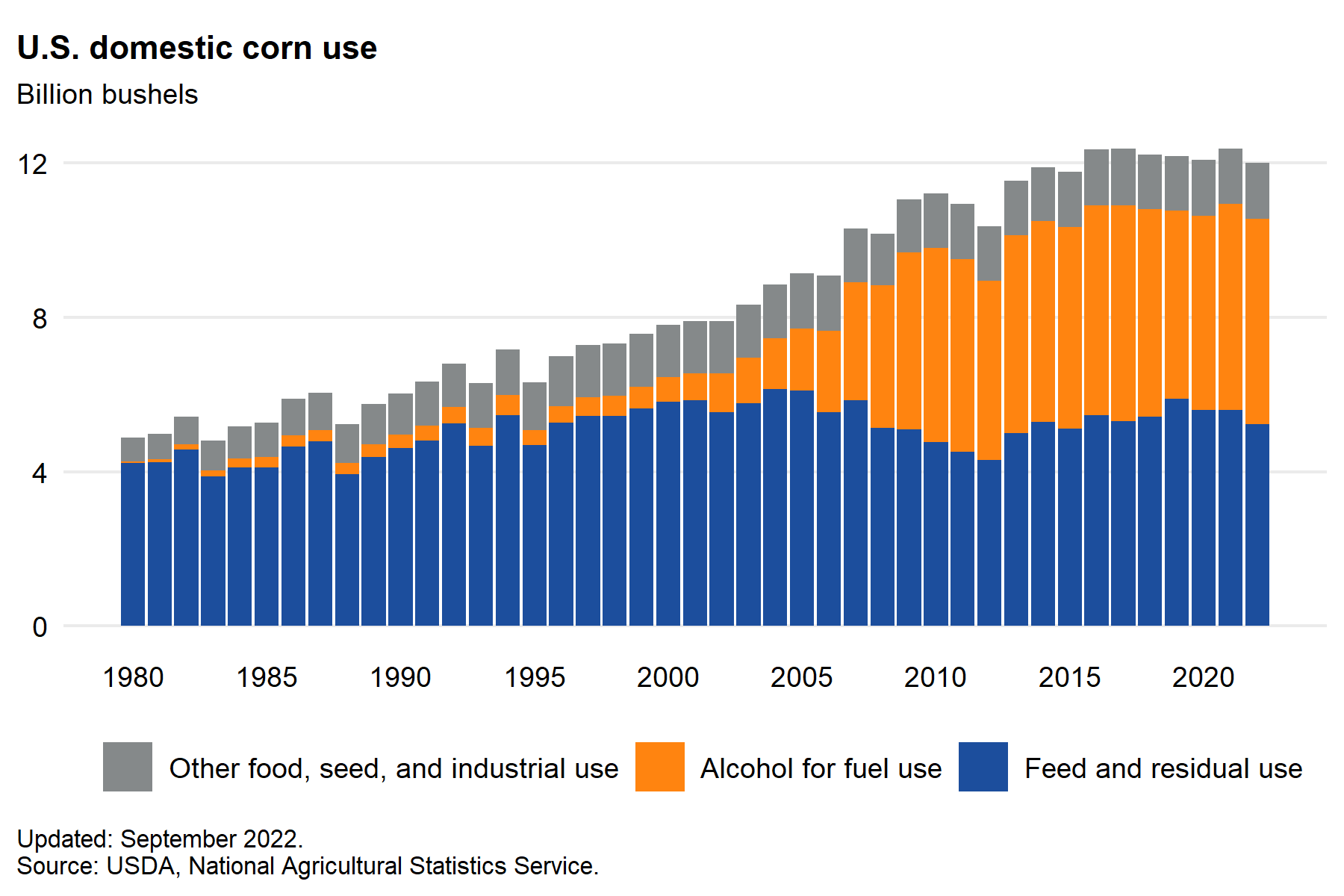
Across the United States, more than 30 million acres of farmland is currently devoted to growing corn for a purpose other than feeding humans and animals. The corn – over 5 billion bushels every year — is processed into ethanol and then added to gasoline to comply with a federal mandate.

The U.S. Renewable Fuel Standard (RFS), enacted in 2005, requires the nation’s oil refiners to mix 15 billion gallons of corn-based ethanol into the nation’s gasoline supply annually; this is the reason why most gasoline sold in the U.S. includes 10% ethanol. The mandate was intended to cut U.S. dependence on energy imports, support farmers and reduce emissions. 

As it turned out, the RFS was primarily successful in increasing the acreage devoted to growing corn. Because of the ethanol mandate, an additional 6.9 million acres of corn were planted between 2008 and 2016. Corn is now the nation’s number one crop and, according to the U.S. Department of Agriculture, ethanol production accounts for 45% of the U.S. corn crop. Most of the rest goes to animal feed, with only 15% destined for human consumption. (A mere half of one percent of the total corn crop is sweet corn, a different plant entirely.) 

As a way to reduce emissions, however, the mandate proved a failure. A study funded by the U.S. Department of Energy and the National Wildlife Federation concluded that ethanol is at least 24% more carbon-intensive than gasoline, once land use impacts are factored in. 

It’s a bad deal for taxpayers, too. In addition to the ethanol mandate, the U.S. government subsidizes corn farmers through the federal crop insurance program, with taxpayers covering an average of 62% of the cost of insurance premiums. More than a quarter of the insurance subsidy goes to corn, and very little goes to small farms. Add to this the many concerns about water use, fertilizer, pesticides and land degradation, and it is hard to find much good in the corn ethanol program.

EVs threaten King Corn

The world is a different place now than it was in 2005, with the U.S. having become the largest oil producer in the world and a net exporter. Yet the ethanol subsidy is fiercely guarded by the corn lobby and, in spite of occasional bipartisan efforts at repeal, it seems to be untouchable politically. Indeed, last year’s Inflation Reduction Act, passed by Democrats, actually contains new credits for biofuel production that corn-state Republicans are keen on keeping even as they continue to seek rollbacks of other clean energy incentives. 

The biggest threat to the corn lobby, though, isn’t a repeal of the mandate, it’s electric vehicles. When people no longer need gasoline, they can no longer be forced to buy corn ethanol. 

Electric vehicle sales reached 5% of the U.S. new car market in 2022, and already this year they’ve hit 8.6%. JD Power projects 70% of new vehicles will be electric by 2035, with California leading the way at 94% by then. 

Many agricultural communities are in denial about EVs, preferring to believe they will never catch on in numbers enough to threaten the importance of the corn crop. And indeed, it will take decades before the last gasoline-powered cars drive off to the junkyard. But most of us can see the writing on the wall. As more vehicles become electric, more land that is now devoted to corn ethanol will become available for other purposes. 

While the ethanol industry looks to jet fuel and other possible new uses for its product, a far more promising “crop” is renewable energy. Planting wind turbines and solar panels, either alone or combined with actual crops that feed people, provides higher returns with less risk and is better for the planet. 

“Planting” more solar energy instead of corn

Wind turbines already coexist with farmland across the Great Plains, but let’s focus on solar, since that is the form of renewable energy best suited to Virginia’s landscape. Solar energy is somewhat land-intensive, but not compared to corn. A decade ago, the National Renewable Energy Laboratory calculated that we could power the country’s entire electricity demand with 10 million acres of solar panels. That’s only one-third of the land now devoted to corn ethanol. 

Since that study, solar efficiency has increased, while electricity demand has risen only modestly. With the electrification of vehicles, buildings, and everything else that can be electrified, however, electricity demand is likely to double. But even if we had no wind energy, hydropower or nuclear, and we needed 20 million acres of solar to meet the demand, that would represent only two-thirds of the land currently devoted to corn ethanol, leaving millions of acres more freed up for food crops, land conservation and rewilding.

A comparison of the energy yield of corn vs. solar shows why displacing ethanol with solar energy would be a welcome change.  An acre of corn yields 328 gallons of ethanol, which is one-third less efficient than gasoline. If you could run an internal combustion automobile entirely on ethanol (you can’t), a car averaging 40 miles per gallon could go 8,738 miles on an acre of corn. 

But that same acre “planted” in solar panels would yield 394-447 MWh per year of electricity. Even at the low end, that’s enough to power a Tesla Model 3 for over 100,000 miles.

Much of the corn crop is grown in places like Iowa and Nebraska, but even here in Virginia, 540,000 acres were planted in corn last year, second only to soybeans. Assuming 45% of Virginia’s crop goes to corn ethanol (I could not find an actual breakdown by state), that amounts to 243,000 acres that could be put to better use. That’s worth keeping in mind for the next time someone frets about farmland being “lost” to solar development.

Solar is also a more reliable crop, and a better one for small farmers. The profitability of corn growing varies by state and by year, but it is never exactly a lucrative business for any but the largest farm operations. In a good year, such as 2022, corn might return a profit of $450 per acre, minus land rents (or taxes). In a down year, such as the current one, returns can be negative once land costs are accounted for. (Rents vary considerably, averaging about $325 per acre.)

Meanwhile, solar lease rates range from $250 to $2000 per acre, depending on location and suitability. A guaranteed payment for 20 or 30 years with no work involved is a pretty attractive deal. Even putting just a portion of a farm into solar provides a form of insurance, guaranteeing a steady income flow regardless of weather and commodity price swings.

Solar is also a better deal than corn for the community, since it provides tax revenue, diversifies the local economy and conserves water. If the developer plants pollinator-friendly species around the solar panels or uses sheep instead of machinery to control grass, the benefits to the local economy increase further. 

The ethanol industry is already looking for new uses for their product, but if they don’t find takers, it is one fuel we don’t need to mourn losing.

This article first appeared in the Virginia Mercury on September 19,2023.

Unknown's avatar

If Dominion’s plan is so bad, is there a better one? (Spoiler alert: yes, there is.)

Courtesy of Lowell Feld, Blue Virginia

In my last column I took Dominion’s Integrated Resource Plan (semi-) seriously, giving the utility the benefit of the doubt in its projections for data center growth and the alleged need for more fossil fuels to keep up with the power demands of that ravenous industry. But as I also noted, Dominion doesn’t deserve to be taken seriously with this document.

Under Virginia law, an Integrated Resource Plan (IRP) is supposed to explain how the utility expects to meet demand reliably and at low cost within the constraints of the law. In this IRP, however, Dominion asked a different question: how to make Gov. Glenn Youngkin happy by keeping fossil fuels dominant regardless of both law and cost. 

Coming up with a favorable answer required Dominion to ignore the Virginia Clean Economy Act (VCEA), create arbitrary limits on solar deployment, use wishful thinking instead of facts and, for good measure, do basic math wrong. They also assume the Youngkin administration will succeed in pulling Virginia out of the carbon-cutting Regional Greenhouse Gas Initiative (RGGI), a move that is being challenged in court. This makes Dominion’s IRP, with its plan to double carbon emissions, a sort of evil twin to a plan from any RGGI state. 

Sure enough, the governor loves it. Elsewhere, however, this evil twin found a cold reception. Experts retained by environmental, consumer and industry groups all agree that this IRP should be chucked in the trash bin and Dominion told to start over.

It’s worth taking a look at the testimony from these groups to understand where Dominion went so badly wrong, and what a better plan might look like. 

It’s all about the data centers

Northern Virginia data centers are the driving force behind Dominion’s plans to burn more coal and gas, but there is some disagreement whether their growth will be absolutely off-the-charts crazy, or merely eye-poppingly huge. Dominion’s IRP projects the data center industry’s power use in its territory will quadruple over the next 15 years, rising from 2,767 megawatts (MW) in 2022 to more than 11,000 MW in 2038. At that point it would represent close to 40% of Dominion’s load. 

Experts testifying in the IRP case believe data center demand won’t reach the dizzying heights Dominion projects. They question whether Virginia communities will accept so much new data center development, given the pushback already evident in localities like Prince William and Fauquier Counties. Their thinking is essentially that if things can’t go on this way, they probably won’t.

They also suggest that some of the demand Dominion expects may also be reflected in the plans of other utilities serving Northern Virginia’s Data Center Alley, leading to double-counting. A load forecast published by grid operator PJM shows that Northern Virginia Electric Cooperative (NOVEC) projects its data center demand to rise from about 400 MW in 2022 to 4,000 by 2028 and 8,000 by 2034. Two other cooperatives project a combined 3,000 MW of data center development in the same time period. 

Aside from data centers, demand for electricity in Dominion territory is flat or declining over the next fifteen years; presumably this is due to the increased efficiency of homes and businesses offsetting the increased demand from electric vehicles and building electrification. 

If you were already experiencing vertigo over Dominion’s data center numbers, and you are now hearing for the first time that Dominion’s numbers represent only half of the total projected data center load coming to Virginia, maybe you won’t find it all that cheering that some of that added demand could be illusory. Still, it is a reasonable point. If you reduce demand by a few thousand megawatts here and there, pretty soon you might not “need” a new gas plant.

As an aside, one Virginia utility stands out for apparently not expecting much in the way of new data centers in its territory. Appalachian Power, which serves customers in Southwest Virginia, West Virginia and Tennessee, has experienced declining demand for years, and rural Virginia leaders would dearly love to see data centers come there. Yet the PJM forecast shows Appalachian Power’s parent company, American Electric Power (AEP), told grid operators it expected only about another 200 MW on top of the 500 MW of data center load it serves across its entire 11-state territory. AEP seems to regard this as quite a lot, which, when compared with what is happening in Northern Virginia, seems rather sweet.

I can’t help but wonder how Gov. Youngkin managed to make a deal with Amazon to bring $35 billion worth of new data centers to Virginia without securing a guarantee that many of the facilities would be located in a part of the state that actually has surplus energy capacity and desperately needs new economic development. Southwest Virginia voters may have put Youngkin in office; you’d think he’d be looking out for them.

Instead of real investment today, Youngkin promises the area a little nuclear plant a decade from now, when and if small modular reactors (SMRs) prove viable. Local leaders must be muttering, “Gee, thanks.”

And this leads to another point raised by several of the experts in the IRP case: All of the load growth Dominion projects is due to a single industry in Northern Virginia; elsewhere, demand is decreasing. Yet, instead of crafting a solution specific to the industry and region experiencing runaway growth, Dominion proposes to build a fossil fuel plant 140 miles away in Chesterfield and a nuclear plant 300 miles away in another utility’s territory.

Gregory Abbott, a former SCC Deputy Director, offers a particularly withering assessment of the IRP in his testimony on behalf of environmental advocacy group Appalachian Voices. Dominion’s computer model, he says, “is proposing supply-side solutions that are not focused on solving the actual problem, are likely unnecessary, and driving costs higher than they should be.”

Although Dominion insists this IRP represents just a “snapshot in time,” Abbott says that’s misleading: The IRP “sets the stage for multi-billion-dollar investments that Dominion’s customers will pay for decades to come. If a future snapshot in time changes, based on new public policy goals or market dynamics, ratepayers are stuck with paying for these sunk costs.” 

Garbage in, garbage out

Abbott and others also note that unlike factories or other high consumers of energy, data center operators can shift some functions to other data centers elsewhere for short periods of time. Dominion could save money and reduce the need for new investments by capitalizing on this capability to develop demand-response programs tailored specifically to this industry. 

Instead, Dominion treated the surge in demand as if it were statewide and spread across all its customers; then it used a computer model to figure out how to meet the soaring demand. 

An expert for the Sierra Club, Devi Glick of Synapse Energy Economics, noted several problems with Dominion’s approach. Among them: the company told its computer model that it couldn’t select energy efficiency as a resource; it had to include gas combustion turbines in 2028; it had to adhere to artificial limits on solar, wind and battery storage; and it had to assume prices for solar that were “substantially higher than industry projections.” Dominion also did not instruct the model to account for proposed (and since finalized) new federal pollution limits that will raise the cost of burning fossil fuels, and miscalculated — by a billion dollars — the penalties associated with failure to meet the VCEA’s renewable energy requirements. 

As they say, garbage in, garbage out. The model did what it was told, and produced plans that limited solar and battery storage, called for new gas combustion turbines and/or SMRs, and kept uneconomic coal plants running past their previously-planned retirement dates. Accordingly, none of the modeled scenarios complied with Virginia law and all would be unnecessarily expensive for customers.

Synapse ran its own computer model that kept most of Dominion’s load and cost assumptions but corrected for the company’s errors and artificial constraints. The results, not surprisingly, show that building more solar and storage and retiring coal plants earlier than Dominion wants to will lower carbon emissions and “reduce costs for Dominion’s ratepayers by between $4.1 and $9.0 billion over the 25-year study period.”  

When Synapse then tweaked the model to reflect the new federal pollution rules and prices for solar and battery storage in line with industry projections, the results saw solar and battery investments soaring, while the “need” for firm capacity such as a new gas plant disappeared altogether during the planning period.  

Clean energy, vindicated

So finally, we begin to see a path forward founded on real data and not constrained by political expediency. With none of its plans meeting the basic requirements of Virginia law, Dominion should be ordered to go back to the drawing board. The company should reexamine its data center load projections and design a demand-response program tailored to that industry. Then it should re-run its computer model with energy efficiency allowed as a resource, with no artificial constraints on battery storage and renewable energy,with federal and state compliance costs associated with fossil fuels fully included and with cost estimates for solar and storage consistent with industry norms.   

The General Assembly has a role to play, too, in ensuring the data center industry does not shift costs onto other customers and cause Virginia to fall short of its carbon reduction goals. Data centers should be required to meet energy efficiency targets and to secure an increasing percentage of renewable energy on their own as a condition of obtaining generous state tax subsidies. Likewise, the State Corporation Commission should be required to ensure that data centers pay for the transmission upgrades they need. Finally, the General Assembly should pass the data center study bill adopted by the Senate this year before being killed in the House.

Finally, it’s clear that the computer models will select as much low-cost solar as they are allowed to, so the General Assembly should make it easier to build solar projects at competitive rates. They can do this by further opening the market to third-party developers, who are currently constrained by an interpretation of the VCEA that caps their share of the solar Dominion procures at 35%.

The SCC will hold a hearing on the IRP beginning September 18.

An earlier version of this article appeared in the Virginia Mercury on September 5, 2023.

Unknown's avatar

Joe Manchin’s Pyrrhic victory

The folly of building the Mountain Valley Pipeline should be obvious to anyone who hasn’t already committed billions of dollars to the project.

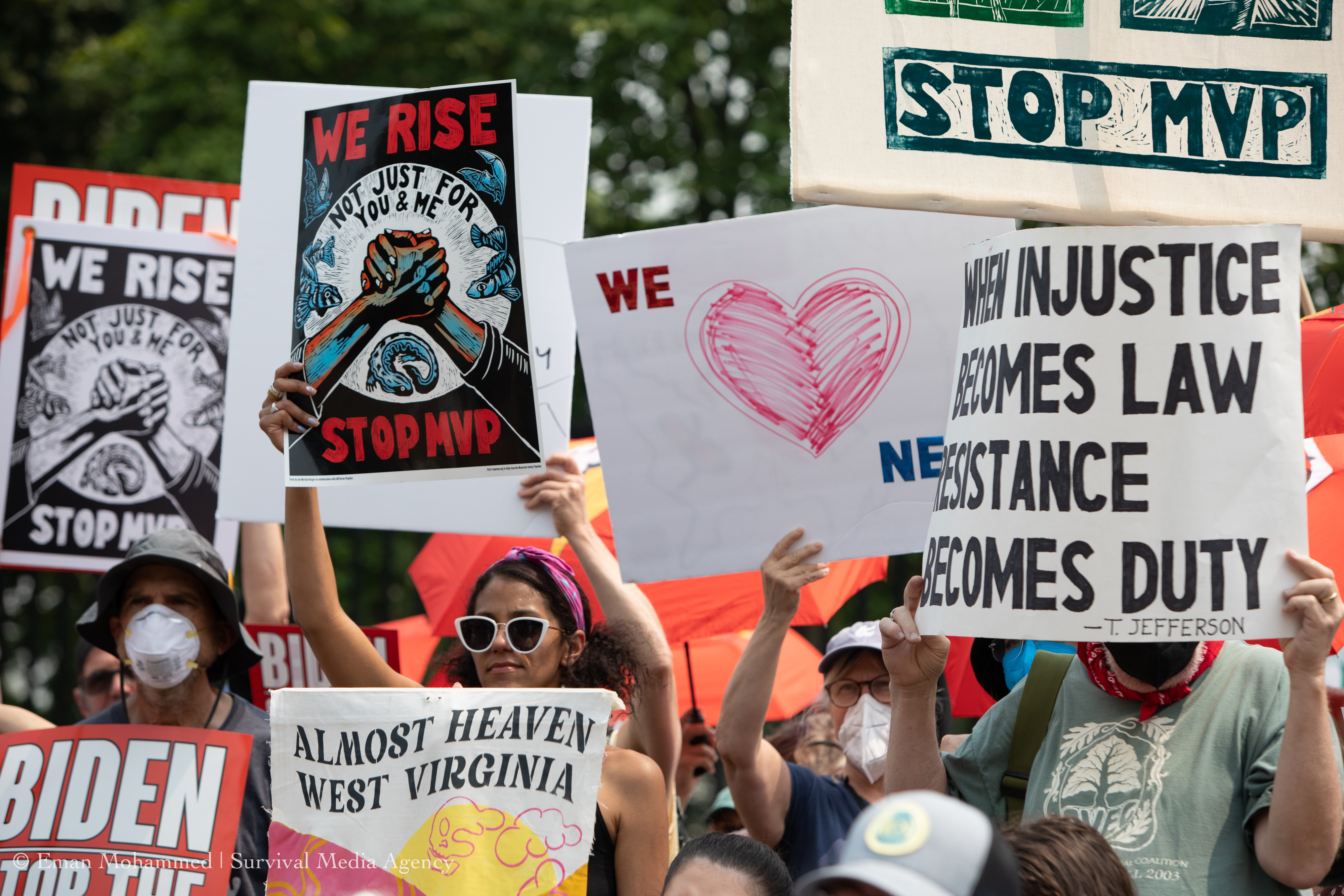
On Thursday, June 8, 2023, hundreds of frontline and Appalachian climate activists rallied at the White House against President Biden’s endorsement of the Mountain Valley Pipeline. (POWHR/Eman Mohammed/Survival Media Agency)


This spring’s passage of federal legislation raising the debt ceiling came with one provision that clean energy advocates had fought hard against: it sweeps away several legal challenges to the Mountain Valley Pipeline (MVP) that have stalled completion for more than four years. The pipeline is supposed to carry methane gas from the fracking fields of West Virginia into Virginia to connect to an existing interstate pipeline here, and getting it built has long been a priority of West Virginia Senator Joe Manchin.

Manchin surely believes he notched a victory with the inclusion of this provision in must-pass legislation. And in one respect, he’s right. Pipeline opponents aren’t conceding defeat, but stopping the MVP in court just got a heck of a lot harder. 

Whether the pipeline’s developers should be celebrating is another matter. The wisdom of building a new methane gas pipeline was questionable nine years ago when the MVP was conceived. Today, with the U.S. transitioning away from fossil fuels, the folly of building new gas infrastructure should be obvious to anyone who hasn’t already committed billions of dollars to the project.

Dominion Energy figured this out three years ago when it dropped plans to develop the Atlantic Coast Pipeline. Dominion is a big energy conglomerate and had other projects to pursue. Canceling the Atlantic Coast Pipeline saved it billions of dollars that it is now investing in offshore wind and other renewable energy assets. 

MVP’s two largest minority partners are also diversified companies with other options. NextEra Energy, which owns a 31% share in the partnership through its subsidiary Next Energy Resources, wrote off the value of its investment in MVP in 2021 and 2022, saying it planned to “reevaluate its investment in the Mountain Valley Pipeline.” 

A NextEra spokesperson did not answer my question about what the company plans to do about MVP now.  But if a picture is worth a thousand words, take a look at NextEra Energy Resources’ homepage. MVP isn’t mentioned anywhere on the website, which is largely a celebration of the company’s renewable energy assets. 

The third-largest stakeholder in the MVP is Consolidated Edison, with an initial 12.5% stake. In 2019 it exercised an option to cap its investment in MVP, and in 2020 it wrote down the value of its investment by almost half. ConEd CEO John McAvoy told investors that year the company would no longer invest in gas transmission projects and “certainly would” consider selling its stake in MVP. 

“We made those investments five to seven years ago,” he said, “and at that time we — and frankly many others — viewed natural gas as having a fairly large role in the transition to the clean energy economy. That view has largely changed, and natural gas, while it can provide emissions reductions, is no longer … part of the longer-term view.”

Unfortunately, these views aren’t shared by MVP’s majority owner and operator. Equitrans Midstream is solely a pipeline and gas storage company, having been spun off from a larger corporation, EQT, in 2018. MVP is its key to growth. The exit door may be wide open, but Equitrans doesn’t want to leave because it has nowhere to go.

That doesn’t mean it makes sense to stay, either. Many a gambler has learned the hard way that continuing to feed coins into a slot machine does not make it more likely to disgorge the jackpot. 

And really, if there ever was a jackpot for MVP, it is gone by now. In 2015, EQT saw an opportunity to undercut the price charged by existing pipelines to ship gas to an energy-hungry Southeast. Today, though, demand for methane gas has cooled in the face of cheap wind and solar, while MVP’s costs have ballooned to $6.6 billion from the initial projection of $3.25 billion. Analysts say MVP’s competitive advantage has evaporated, and its prospects for profitability look grim.  

Equitrans maintains that there is still a pressing need for its pipeline, but demand has always been hypothetical. From the very beginning, the partnership seemingly indulged in “build it and they will come” magical thinking. 

Getting a permit to build from the Federal Energy Regulatory Commission requires that pipeline developers have their customers lined up ahead of time in order to demonstrate a “need” for the project. Even in 2015 there were not enough customers clamoring for MVP’s services, so the partners named themselves as the buyers for more than half of the pipeline’s capacity. FERC’s approach to permitting allows this self-dealing, though the commission has been heavily criticized for it. 

Obviously, Equitrans was never going to be a customer; it isn’t in the business of generating power or selling gas at retail. Its field of dreams assumed demand for gas would grow, customers would be clamoring for pipeline capacity, and Equitrans would be able sell its share of the capacity and just reap the profits from owning the pipeline.

It’s hard to imagine that happening now. Economics had already started to favor wind and solar over fossil fuels when the MVP broke ground. Total natural gas consumption has been mostly flat nationwide since 2018, and the Energy Information Agency (EIA) projects it will decline steadily for the next decade. EIA also projects that more than half of all new electric generating capacity this year will be solar, with natural gas additions down to a mere 14%. Here in Virginia, methane gas burned by electric utilities has declined from a high in 2020.

The future will only get brighter for renewables and dimmer for gas. In 2020, Virginia committed to a zero-carbon energy future, and in 2022 Congress passed the strongest set of clean energy incentives in history. Betting on fossil fuels in today’s environment makes no sense.

Sure, Governor Youngkin is doing his level best to throw a wrench in the works, and Dominion Energy Virginia just proposed building a 1,000-megawatt gas combustion turbine, citing growing demand from data centers and electric vehicles. Misguided as that proposal is, it doesn’t signal good times ahead for the gas industry. Combustion turbines are not baseload plants; they run only when demand exceeds other sources of supply. Dominion has no plans to build new baseload gas plants.

MVP knows finding customers in Virginia will be hard. Before litigation and permit denials put construction on hold in 2018, the partnership had proposed an extension of the pipeline into North Carolina, perhaps hoping for better pickings in Duke Energy territory. Now that MVP has the congressional seal of approval, it is seeking to revive the proposed Southgate Extension, to the dismay of North Carolina activists. Yet economics don’t favor gas over solar there, either.

The liquefied natural gas export market has also been floated as a potential source of growth, but critics say the lack of liquefied natural gas terminal capacity prevents that from happening. 

It’s time to stop this travesty. Equitrans claims MVP is 94% complete, but opponents say the true figure is more like 56%, with many of the most difficult segments (like stream crossings) still to be tackled. Those are also the most environmentally sensitive parts of the line. Pulling the plug on MVP now would avoid not only the cost of completing the pipeline, but also the cost of fixing leaks, erosion damage and other problems critics believe are inevitable given the terrain and geology. 

That would be a much better result for everyone concerned than completing the pipeline to serve a market that doesn’t exist – a Pyrrhic victory if there ever was one.

This article was originally published in the Virginia Mercury on June 28, 2023.

Unknown's avatar

Law? What law? Pandering to the governor, Dominion’s new plan ignores Virginia’s climate law

Dominion Energy headquarters, Richmond, VA

Last December, Dominion Energy produced a remarkable document: a climate report predicting that by 2040 its electricity supply will be dominated by renewable energy. Coal will be gone by 2030, and methane gas will hang around in ever-smaller amounts, just to fill in the energy gaps. Small modular nuclear reactors (SMRs) probably won’t play a role for at least 15 years, during which time solar will become the mainstay of the electricity supply. According to the report, this strategy will allow Dominion to meet its goal of becoming carbon-neutral by 2050.  

Fast forward a few months, and the same company, using the same information, projects a future full of new methane-burning plants and SMRs. Dominion Energy Virginia’s 2023 Integrated Resource Plan (IRP), released May 1, now insists that the phenomenal growth of the data center industry and, to a lesser degree, the adoption of electric vehicles require so much energy that it can’t possibly meet legally-mandated climate goals. Accordingly, the plan doesn’t even try.

Instead of decarbonizing in accordance with Virginia’s role in the Regional Greenhouse Gas Initiative (RGGI) and the requirements of the Virginia Clean Economy Act (VCEA), Dominion now says it must build new methane-burning plants and keep old, expensive coal plants running “beyond statutory retirement deadlines established in the VCEA.”  All the alternatives examined in the IRP “assume that Virginia exits the Regional Greenhouse Gas Initiative (‘RGGI’) before January 1, 2024,” in violation of Virginia law. Most of the alternatives include the same SMRs its Climate Report recognized as unready. Compared to Dominion’s 2022 IRP update (filed just last September!), now costs have ballooned and CO2 emissions will skyrocket. 

What could possibly have happened in the course of a few months to produce this about-face? The astounding growth projections for the data center industry may be news to many Virginians, but not to the utility that provides their power. Vehicle electrification is hardly a surprise either. SMRs did not achieve any breakthroughs in technology or economics this winter, nor did anyone suddenly discover a way for new gas plants to make sense for the climate or ratepayers. Dominion makes a big deal out of the Christmas cold snap, but you have to try pretty hard to believe that requires upending all previous planning.

What did happen was the 2023 General Assembly session, in which Gov. Glenn Youngkin played a decisive role in handing Dominion a major – and unaccustomed – defeat. With Dominion Energy holding its shareholder meeting today, the company badly needs to show it is back in the governor’s good graces. And the governor, as we know, is not a fan of the energy transition. 

In other words, the IRP is a political document, not a serious approach to meeting Virginia’s electricity needs, at a time when climate change is accelerating and fossil fuels are giving way to superior renewable energy technologies.  

Market watchers will recall that Dominion’s stock price tanked in the fall of 2022, losing more than 30% of its value from August to November. So the company came up with a bill that would have increased the profit margin for its Virginia utility from 9.35% to 10.77%. This number was calculated to improve Dominion’s standing on Wall Street but would cost consumers an extra $4 billion, according to the State Corporation Commission’s estimate. The company also expected to be able to defeat pro-consumer legislation that would return more authority over rates to the SCC.

Dominion’s bill was widely panned, but that hardly made it a non-starter. In past years, the company has gotten what it wanted more often than not, thanks to powerful friends like Senate Majority Leader Dick Saslaw, D-Fairfax, and House Majority Leader Terry Kilgore, R-Scott. This is the beauty of doing business in a state that allows corporations, even public utilities, to supply unlimited campaign donations to elected officials. Over the years, Dominion’s contributions to Republican Kilgore nearly match its contributions to Democrat Saslaw. Most other General Assembly members get contributions from Dominion, too, helping to cement bipartisan support for the company’s priorities.

As the patrons of this year’s money bill, Saslaw and Kilgore should have been able to deliver enough votes from members of both parties to ensure a profitable outcome for their biggest campaign donor. They were not counting on the governor poking holes in the plan. 

Dominion’s beating this year grew from seeds it sowed in 2021. That year, Dominion made a bad bet on Democrat Terry MacAuliffe to win the governorship, secretly funding a dark money group to run ads attacking Youngkin. 

This year, Youngkin took his revenge. As a Wall Street guy himself, he knows how to hit a corporation where it hurts. 

Youngkin forced Dominion to accept changes to the bill that increase the company’s return on equity modestly (and only temporarily), but take away other avenues of profit. Adding insult to injury, the General Assembly also adopted the pro-consumer legislation that allows the SCC to set “fair and reasonable” rates in the future. 

Dominion declared itself satisfied with the result, but Wall Street judged otherwise. The company’s stock, which had started to rally in January, reached a ten-year low this spring. 

Aside from punishing Dominion, the governor achieved none of his energy goals in the legislative session. Rolling back the VCEA, exiting RGGI through legislation, reversing the Clean Car Standard — none of that happened. And as long as the Democrats keep control of at least one chamber in the General Assembly in this fall’s election, none of that is likely to happen. 

So Dominion’s IRP violates Virginia’s laws and the public’s trust (such as it is), makes a mockery of its own climate plan and proposes “solutions” that will drive up both costs and carbon emissions. As a plan, it can’t be taken seriously.  

All that, however, is beside the point. It makes the governor happy. And what makes the governor happy, Dominion hopes, will make its shareholders happy. 

That assumes the shareholders don’t care about climate change, or that they hold values that are as malleable as those of Dominion CEO Bob Blue and the rest of the company’s leadership. 

Climate change? What climate change?

An earlier version of this article was published in the Virginia Mercury on May 10, 2023.

Unknown's avatar

It’s time for Virginia to plan its next offshore wind farm

offshore wind turbines

Virginia’s first commercial offshore wind farm is on track to start construction next year and to be fully operational in 2026.  The Coastal Virginia Offshore Wind (CVOW) project being developed by Dominion Energy will be the single largest offshore wind farm in the U.S. and among the first full-scale commercial wind projects built in U.S. waters. 

Yet it has taken us 10 years to get this far. Future projects will have shorter timelines now that the industry is gaining its footing and government bodies have figured out how to regulate it. Even so, the complexity of planning, permitting and building giant wind turbines 25 miles out in the ocean means Virginia needs to start planning the next project now to ensure that the supply chain businesses that have located here, and the workers we are training to build CVOW, still have reason to remain in Virginia come 2027. 

For most Virginians, offshore wind may still feel experimental because it has produced only two small projects in the U.S.: a 5-turbine wind farm off of Rhode Island’s Block Island built in 2016 and a two-turbine pilot project 27 miles out from Virginia Beach that started generating power in 2020. But at least 30 other projects are underway up and down the East Coast, including one currently under construction off Massachusetts and another off of New York that will begin construction this year. Plans are also underway for wind farms in the Great Lakes, off the West Coast and in the Gulf of Mexico. 

Together these projects add up to more than 53,000 megawatts (MW), exceeding the Biden Administration’s 30,000 MW by 2030 goal – enough to power 10 million homes with clean, renewable energy. According to the U.S. Department of Energy, independent forecasts show that goal to be solidly realistic. The U.S. offshore wind industry itself recently announced a longer-term target of 110,000 MW, reflecting the business community’s expectations for growth. 

The industry is also far more mature in other parts of the world. Global capacity passed the 50,000 MW milestone last year, and the global pipeline stands at more than 368,000 MW. (Surprise, surprise: China is eating our lunch, installing 13,790 MW in 2021 alone.)

Perhaps the most compelling evidence for the promise of the offshore wind industry in the U.S. is the size of industry events. In the course of a dozen years, U.S. offshore wind conferences have gone from gatherings of a few hundred academics, environmentalists and entrepreneurs in a hotel ballroom to the nearly 4,000 business people and hundreds of exhibitors who packed the Baltimore convention center at the end of March for the Business Network for Offshore Wind’s International Offshore Wind Partnering Forum (IPF).

Often the governor of a state hosting one of these annual conferences uses the occasion to unveil new goals or infrastructure investments; Maryland Gov. Wes Moore did not miss his chance this year. He announced that Maryland plans to develop 8,500 MW once the federal Bureau of Ocean Energy Management makes new lease areas available, a goal behind only New Jersey’s 11,000 MW target and New York’s 9,000 MW. Virginia’s goal begins to look cautious by comparison.

The industry does face challenges. Inflation and supply chain issues have disrupted timelines and threatened profitability. There aren’t enough workers. Transmission constraints hinder the ability to get power to customers. Permitting is a pain in the neck. Here in the mid-Atlantic, it’s hard to identify new areas of the ocean suitable for wind farms, in large part because the Department of Defense wants it all for itself. 

Other challenges are more of the good kind, such as the fact that wind turbine sizes are increasing faster than ships capable of transporting and installing them can be built. Larger turbines mean more power at less cost, and no one is quite sure what the upper size limit might be. On land, the difficulty of transporting blades that can be the length of a football field means turbines are limited to about 3 MW. Fabricating parts at coastal facilities allows turbines to scale up as far as physics and advanced material manufacturing allow.

Dominion installed 6-MW turbines for its pilot project, which was seen as the new standard a few years ago. Today the company plans to use 15-MW turbines. Each one of these massive turbines is said to produce enough energy to power 20,000 European households. I have not seen that figure translated into U.S. suburban McMansions, but it is still an eye-popping amount of emissions-free power from a single structure.  

Oh, and Dominion handled the installation ship issue by building its own vessel, which it will rent out for the Massachusetts and New York projects until it is needed for Virginia’s and others in the queue. Problem solved, at least for Virginia, though the industry needs many more ships.  

Will the cost of energy come down? 

Virginia’s CVOW project has been criticized for its high overall cost, largely the result of our immature domestic industry. The Biden Administration has set a goal to lower costs by one-third by 2030. If history is any indication, this should be readily achievable. A National Renewable Energy Laboratory (NREL) analysis shows costs have fallen by more than half since 2016, and projects that by 2030, the levelized cost of energy from offshore wind turbines will fall by another third.  

Scaling up turbines to capture more wind energy is one approach to bringing the per-kilowatt-hour price down. Economies of scale, a U.S. supply chain, and a range of innovative technologies are all expected to contribute. And of course, the Inflation Reduction Act, with its tax credits for domestic manufacturing and renewable energy, is creating a gold rush of sorts, as companies compete to get a piece of the action. 

Another significant factor in reducing costs is automation and machine learning. Some of the gains are incremental, such as optimizing turbine operation and improving turbine siting through improved wind and wake modeling. Other advances seem like windows into a future where robots take charge. Multiple exhibitor booths at IPF displayed crewless, self-piloting survey and depth-monitoring vessels and underwater robots capable of doing more tasks than humans can. Biologists and geologists stay comfortably ashore while on-board computers collect information at sea around the clock and send the data back. 

Today’s innovation will inform the next great leap forward for the industry: floating wind turbines that open deep water to energy production. Right now, floating turbines must be tethered to the seafloor  and connected to cables to bring power to shore. For various reasons this technology is more expensive than fixed-foundation turbines, but here, too, the industry expects to become competitive in the future. 

Some people are thinking much bigger. Walt Musial, a principal engineer at NREL who is one of the top researchers in the field, gave an IPF audience a look into the future. There, automation and AI could make it possible for unmoored, cableless turbines to pilot themselves around the oceans, chasing the best winds, avoiding hurricanes and turning electricity into liquid fuels like ammonia to drop off at ports of call or offshore “energy islands.”  Musial even referred to these turbines as “vessels,” evoking a whole new kind of wind-powered transportation.

 A display at the Business Network for Offshore Wind’s IPF conference exhibits an autonomous wind turbine that could contribute to the nation’s future wind energy capacity. (Ivy Main/The Virginia Mercury)

It’s a great time for workers entering the industry — if you can find them 

Though un-crewed, AI-directed traveling wind turbines may be the future, the present still requires foundations, cables, service vessels and, especially, a large workforce. Attracting and training an offshore wind workforce has become such an urgent issue that the topic earned its own track at IPF. 

To its credit, this heavily male, heavily white-dominated industry says it is committed to recruiting a diverse workforce and ensuring equitable development of offshore wind, also a goal of the Biden Administration. It will have to; right now, no one has enough workers, so finding them means recruiting from overlooked communities and addressing the social and economic barriers that have kept many people out of the skilled labor force. 

While not new to other large infrastructure projects, Community Benefit Agreements with detailed commitments covering local job creation and other investments, are new for offshore wind. Dominion has not entered any such agreement in Virginia, but as part of its case before the State Corporation Commission last fall in which it received permission to proceed with CVOW, the company signed a stipulation agreeing to an extensive and diverse community outreach program. Eileen Woll, Offshore Energy Program Director for the Sierra Club’s Virginia Chapter, told me Dominion is following through on this pledge.

Woll is also part of a task force made up of academic and community groups from the Hampton Roads area that has developed a plan for community engagement and outreach to identify potential workers from harder-to-reach demographic groups. She told me the “Breaking Barriers” project team has applied for a $500,000 grant from the U.S. Department of Energy to fund their work.  

The Virginia booth at IPF. (Ivy Main)

Halting steps towards Virginia’s next project 

The Virginia Clean Economy Act made special provision for Dominion’s CVOW project as part of an overall target of 5,200 MW. If CVOW makes up 2,600 MW, where will the rest come from? A project under development off Kitty Hawk, North Carolina, would connect to the grid in Virginia Beach, but Dominion has shown no interest in buying the power; nor has Duke Energy. Dominion makes more money acting as its own developer. Huge energy users like the data centers operated by Amazon Web Services in Virginia could absorb all the energy from several Kitty Hawks, but Amazon hasn’t stepped up either.

Meanwhile, the federal Bureau of Ocean Energy Management (BOEM) has identified 1.7 million acres offshore North Carolina, Virginia, Maryland and Delaware with potential for new leasing. The challenge is to make space for wind in an area already claimed by fishing interests, the Coast Guard, and the Department of Defense. If Virginia leaders are serious about building an enduring offshore wind industry here, they will have to engage in some tough negotiations.

For his part, Gov. Glenn Youngkin seems to be trying to ensure that the next Virginia project will be subject to competitive bidding to avoid a repeat of the process that made Dominion Energy the sole developer and holder of the only Virginia lease area. The governor amended an offshore wind bill from Sen. Mamie Locke, D-Hampton, that was something of a nothingburger as passed by the General Assembly. Youngkin’s amendment turns the legislation into a plan requiring Dominion to work with the State Corporation Commission and other government agencies on a competitive solicitation process for the next offshore wind project. 

There is no guarantee that this will work, given that BOEM awards leases to high bidders. But if BOEM offers multiple wind energy areas for lease near Virginia, and awards the leases to multiple developers, then an SCC-led competitive process seems feasible, with a better result for consumers.

The governor’s language may have been inspired by a House bill from Del. Suhas Subramanyam, D-Loudoun, that would have had the SCC study the ownership structure of offshore wind projects and report on how to achieve the best outcome for consumers. Republicans killed that bill, but presumably they will be more open to promoting competition when the idea comes from their own party. 

The General Assembly will consider the governor’s amendment when it reconvenes on April 12. Let’s hope his amendment indicates that Youngkin is ready and willing to start the next phase of Virginia’s offshore wind industry.

This article was originally published in the Virginia Mercury on April 10, 2023.