Unknown's avatar

In Puerto Rico, customers are helping to keep the lights on. Could a Virginia program do the same?

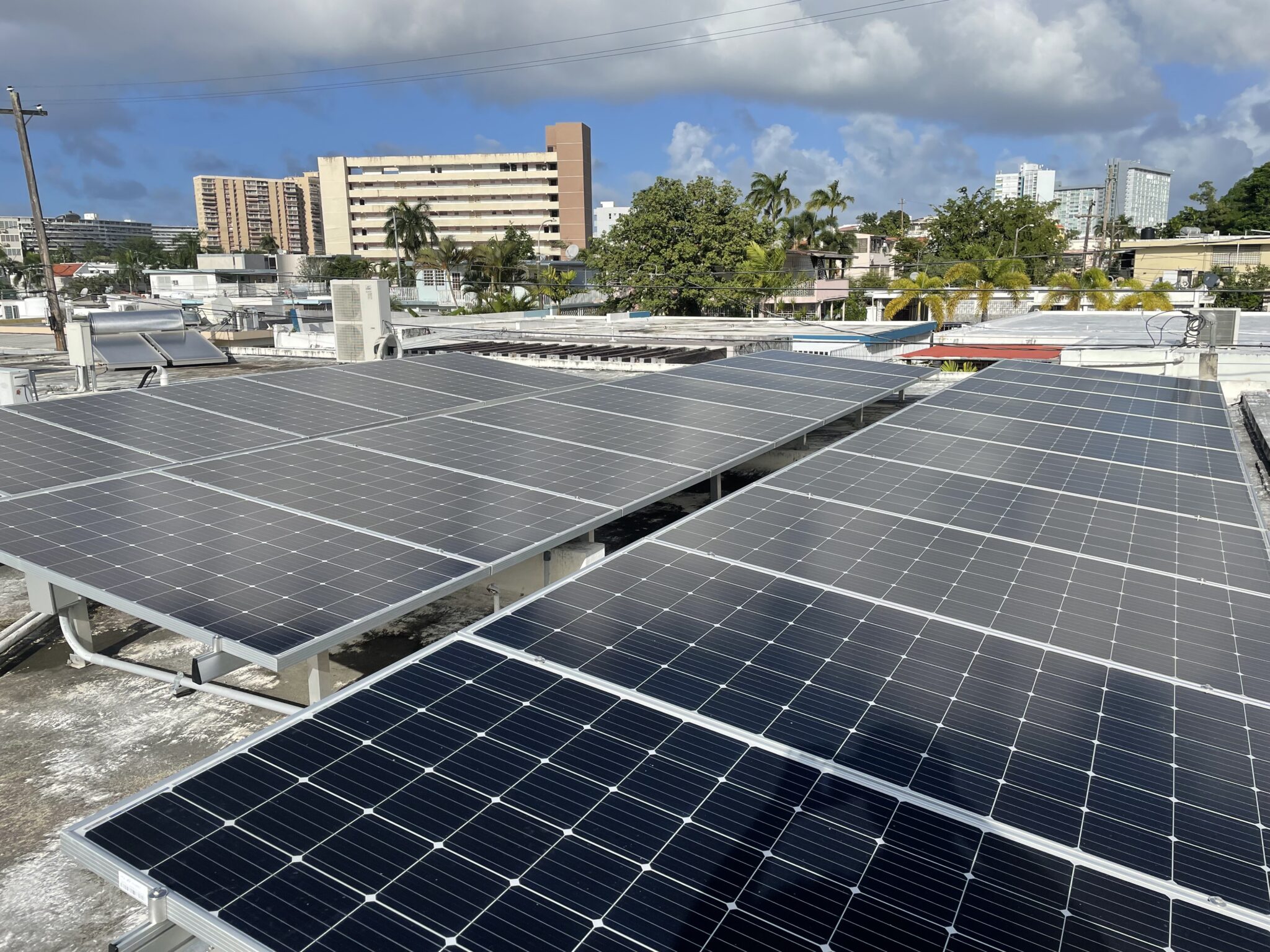
 Rooftop solar panels are helping generate electricity after Hurricane Maria destroyed much of the island electrical infrastructure. (Photo by Aaron Sutch/Solar United Neighbors)

Back in 2017, a hurricane destroyed Puerto Rico’s power grid. The island struggled to rebuild it, with limited success, and continues to experience a severe electricity shortage and frequent power outages. Customers and nonprofits have stepped into the void, installing solar panels on rooftops all over the island and backing them up with batteries. Today, 175,000 households have solar — about 1 in 7  – and at least 160,000 of those also have battery backup. Thousands of new installations go in every month.

The solar and batteries don’t just secure electricity for the customers who install them. Through programs like one managed by the solar company Sunrun, Puerto Rico’s grid can draw on the batteries to provide power in times of emergency, reducing the frequency and duration of power outages for everyone. 

Last month, as hurricane season got underway again, Puerto Rico’s grid operator announced it had reached a “major energy milestone.” In a statement posted on X, LUMA Energy said it “successfully dispatched approximately 70,000 batteries, contributing around 48 MW of energy to the grid.” That’s about as much as a gas peaker plant, with no need for fuel.

Puerto Rico’s experience shows how residents and businesses no longer need to be passive energy consumers. With a well-designed program they can play an active role in keeping the lights on in their communities, and get paid for it. 

This customer participation creates what is called a “virtual power plant” (VPP), sometimes also called a community power plant. The VPP may use battery aggregation, as in Puerto Rico, or demand reduction measures like temporary adjustments to smart thermostats or shifting electric vehicle charging to off-peak times. The more these measures are combined, the bigger the benefit to the grid, and the less a utility needs to invest in new generation to meet peaks in demand. 

VPPs offer such promise that this year Virginia’s General Assembly directed Dominion Energy to develop a pilot program for its customers, to be overseen by the State Corporation Commission. 

HB2346, from Del. Phil Hernandez, D-Norfolk, calls for a program of up to 450 MW to “optimize demand” with distributed energy resources, mainly batteries but also smart thermostats, electric vehicle charging and non-battery storage (e.g., electric hot water heaters). The proposal, due to be filed with the SCC by December 1, must include incentives for at least 15 MW of residential batteries. The legislation calls for stakeholder participation in the development of the VPP, with opportunities for public input. 

Dominion is also tasked with expanding the electric school bus program it began in 2019, which allows the utility to make use of school bus batteries at times of the day when the buses are not needed to transport children. As of March of 2024, Dominion had 135 electric buses in the program, spread across 25 school districts in Virginia. 

The impact of VPPs can be significant. This summer, California’s grid operator conducted an experiment to determine how much customer batteries could contribute to the needs of the grid. More than 100,000 residential batteries across California delivered an average of 535 MW of power from 7 to 9 p.m. on July 29, an output equivalent to that of a coal plant. 

Many other states are also using VPPs. Some are limited to solar-powered battery aggregation, like Xcel’s Colorado program and a new Texas program, while others involve demand response programs using smart appliances – anything that can be turned off and on remotely for short periods. In Michigan, DTE pays electric vehicle owners to charge at off-peak times, while Arizona Public Service’s VPP pays customers for the ability to access their smart thermostats to reduce peak demand.

Vermont’s Green Mountain Power runs two popular battery programs, one for people who own their own batteries and the other that leases batteries to customers. Both allow the utility to draw on the batteries when the power grid requires more capacity. 

While Virginia has not had a VPP program before, appliance-based demand response will be familiar to residents who opted into Dominion Energy’s “Smart Cooling Rewards” program.  Participants allowed the utility to remotely turn their air conditioners on and off for a few minutes at a time on hot days in exchange for an annual $40 payment. This helped the utility shave peak demand without affecting residents’ comfort. 

Dominion ended the cooling rewards program in 2022 and now offers a “Peak Time Rebate” program that rewards customers for reducing energy use during certain times of high energy demand. This program, however, requires residents to take affirmative measures themselves, like adjusting thermostats and delaying laundry. A well-designed VPP program, by contrast, takes the burden off the individual.

Josephus Allmond, a lawyer with the Southern Environmental Law Center who helped to craft the Virginia VPP legislation, told me in an email that he expects school buses and smart thermostats will make up most of Dominion’s program initially, but he’d like to see the residential battery component grow significantly from the initial 15 MW. Even 100,000 aggregated residential batteries would be a minor share of Dominion’s 2.8 million residential accounts, he pointed out.

I emailed Nathan Frost, Dominion’s general manager for new business and customer solutions, to ask for more information about the VPP program. Frost replied only that Dominion is “actively developing our VPP framework and will be engaging stakeholders soon.”    

Stakeholders, including customers themselves, are likely to have a lot to say. Clean energy advocates have long urged that VPPs, distributed generation sources and microgrids can contribute to a more efficient, secure and resilient grid, at less cost to everyone. 

No doubt recentering the grid around customers is too tall an order for a monopoly utility with a profit model based on centralized generation. But from what we’ve seen in Puerto Rico, California and elsewhere, harnessing even some of the power of customer-owned resources is a worthwhile project whose time has finally come.

This article was originally published in the Virginia Mercury on September 2, 2025.

Update: on September 15, Dominion sent this note:

Dominion Energy Virginia is preparing to file a virtual power plant (“VPP”) pilot proposal by December 1, 2025, pursuant to House Bill 2346 and Senate Bill 1100.  As part of this effort, Dominion Energy Virginia is seeking stakeholder input.  Please visit our website at https://www.dominionenergy.com/vpp.  The website contains an overview of the legislation, a timeline, an informational webinar about VPPs and the Company’s plan, and additional information.  We encourage all interested stakeholders to review the materials posted on the website and provide feedback through the link on the website by October 6, 2025.

If you have questions, please contact virtualpowerplant@dominionenergy.com

Unknown's avatar

The SCC serves up a nothingburger

Dominion Energy headquarters, Richmond, VA

When Dominion Energy Virginia filed its latest integrated resource plan (IRP) last fall, critics (including me) complained that the company failed to lay out a cost-effective approach that would meet soaring energy demand from data centers while complying with Virginia’s decarbonization mandate. We hoped regulators at the State Corporation Commission would reject the IRP and demand better of our largest utility.

Instead, they chickened out. 

The SCC’s final order, issued July 15, is short but not really to the point. The order finds Dominion’s IRP “legally sufficient,” while citing previous SCC orders for the proposition that “acceptance” doesn’t mean approval “of the magnitude or specifics of Dominion’s future spending plans.” It would be hard to imagine a less enthusiastic endorsement, and the lack of analysis leaves advocates wondering, where’s the meat?

It’s true that an IRP is “only” a planning document; it doesn’t commit a utility to carrying out the plan, and the SCC still has to approve any project the utility decides to move forward with. But the point of the exercise is to ensure utilities are on the right track; that their demand projections are on target and their plans for meeting demand are realistic, cost-effective and comply with all relevant laws. This needs discussion and analysis, not merely an up-or-down vote.

Admittedly, the SCC has a long history of approving lousy IRPs while directing Dominion to do a better job the next time. That was the case here, too, with the order directing Dominion to do a few things differently in its next IRP, due in the fall of 2026. 

First, the SCC wants to see a 20-year timeline instead of the 15-year period that Dominion used this year, which is all the law requires. It’s an obvious ask, even apart from the fact the SCC cites that the regional grid operator PJM uses a 20-year planning window. A better reason is that we are just 20 years away from Dominion’s 2045 deadline for full decarbonization under the Virginia Clean Economy Act (VCEA), and anything the utility does now will have consequences extending out to that deadline. 

The SCC also neglected to mention that using just a 15-year window, and omitting the 25-year planning period that Dominion included in previous IRPs, allowed the company to avoid showing the economic consequences to consumers of spending money for fossil fuel generation that either will shut down or may become economically obsolete by 2045, long before the plants are paid off. If Dominion thinks it can justify sinking customers’ money into assets it knows will become stranded, we all deserve to see the rationale. 

The order also directs Dominion to include in its modeling at least one pathway that complies with the requirement of the VCEA that carbon-emitting facilities (including any new gas plants) be retired by 2045. This goes beyond obvious: the lack of a VCEA-compliant plan should have prompted the SCC to reject the IRP outright. 

But of course, Dominion claims new gas plants are needed for reliability, which would make them legal under the VCEA in spite of their carbon emissions and questionable long-term viability. Reliability is a red herring, as I’ve argued, and other parties to the IRP case modeled how Dominion can meet demand without building new fossil fuels. Dominion should have been required to prove its case.

But here again, the SCC chose not to engage on the issue. Requiring Dominion to do better next time is as far as it is willing to go. This is unfortunate, but the silence can’t last: in March, Dominion filed for approval of the first of its planned new gas plants. The SCC will have to address need and reliability to make a decision in that case, and it would have been better for all concerned if it had grappled with these questions now.

The order falls short in other ways, as well. While the SCC expresses concern about forecasted rate increases, it doesn’t even mention the data centers that are driving the problem. 

This is astonishing; even before Dominion filed its IRP last fall, the commission ordered the company to supplement the record with an analysis of data center impacts. When Dominion did so, it became clear that all of the load growth (and likely, much of the projected rate increases) results from this one industry. It’s beyond strange that the SCC does not even mention the supplement it ordered, or discuss whether Dominion’s duty to serve truly prevents it from protecting existing customers.

The order also accepts Dominion’s argument that it had to artificially limit the amount of low-cost solar it could include in its modeling, due to the increased difficulty of siting solar projects in Virginia. It’s true that many rural counties have been denying permits to solar projects, even as they approve data centers. But I’ve also heard a Dominion lobbyist tell legislators that permit denials have not been a problem for the company, an assertion that may have persuaded some legislators to vote against bills that would make solar siting easier. It appears Dominion tells legislators one thing and the SCC another. 

The SCC’s order contains a few other requirements for the next IRP, mostly things that really should have been included in this one. The IRP should model Virginia’s return to the Regional Greenhouse Gas Initiative, reflecting a Virginia court’s ruling that Gov. Glenn Youngkin’s withdrawal was unlawful. The IRP should assume Dominion achieves the energy efficiency targets that the SCC itself established for the company. Dominion should include an analysis of impacts on base rates and should share its modeling with utility watchdog Clean Virginia, as well as run modeling based on SCC staff inputs. Long-duration storage, a maturing technology that can replace gas combustion turbines, should be included in the next modeling.

“Do better next time” is a well-worn directive from the SCC to Dominion, but it is deeply disappointing at a time when Virginia is facing an unprecedented surge in demand from data centers and accompanying increases in utility rates. 

It’s disappointing in another way, too: this is the first major ruling from the SCC since two new judges were added to the three-member commission, and all three were appointed by a Democratically-controlled Senate. If there was ever a time for the SCC to get tough with Dominion on its climate obligations, this should have been it. 

No doubt, the problem lies in Dominion’s influence over the entire process. The utility doles out exceedingly generous campaign donations to members of both parties, so the company retains influence no matter who is in power. Not only does this give Dominion sway over who is appointed to the SCC, but commissioners have to be mindful that getting reappointed at the end of their six-year terms depends on how satisfied these Dominion-backed senators are with their rulings. 

As long as Dominion is allowed to shower senators with unlimited campaign cash, the SCC will never be free of the utility’s pernicious influence. 

Meanwhile, though, Dominion’s poor performance, and the SCC’s unwillingness to call it out, demonstrate the necessity of the comprehensive IRP reform legislation that the governor vetoed this spring. The Commission on Electric Utility Regulation is already working on similar legislation for the next session. 

Passing the IRP reform bill may not inject the SCC with greater courage, but it will ensure the commission, and the public, get a fuller look at the facts.

This article was originally published in the Virginia Mercury on July 21, 2025.

Unknown's avatar

The war on woke…energy?


I’ve been thinking a lot about language lately, and the strange way words that used to mean good things are now attacked as bad, and vice-versa. Diversity, equity and inclusion are radioactive. Mentioning environmental justice or climate change will get your federal program canceled. Coal is clean, even beautiful, and pointing out the connection to global warming makes you an alarmist, because speaking up when your government steers you towards disaster is now a bad thing to do. 

Recently I received an email excoriating “woke” energy policy, which seemed especially curious. I can see how awareness of historic racial injustice against Black people might nudge policy makers into greater support for renewable energy, given that pollution from fossil fuels tends to have a disparate impact on communities of color. But judging from the hostile tone of the email, I believe we may have different understandings of wokeness.  

Sometimes, though, words mean different things to different people without anyone realizing they aren’t using the same definition. That may be the case when Virginia leaders talk about the reliability of the electricity supply. Everyone agrees reliability is critical – but they may not be talking about the same thing.

Virginia’s need for power is growing at a terrific pace. Data centers consume so much electricity that our utilities can’t keep up, causing them to increase imports from out of state. That’s okay for now; West Virginia is not a hostile foreign nation. Also, Virginia is a member of a larger grid, the 13-state (plus D.C.) PJM Interconnection, which manages thousands of generating facilities to ensure output matches demand across the region. But even across this wider area, demand is increasing faster than supply, pushing up prices and threatening a shortfall. Unless we tell data centers to go elsewhere, we need more generation, and fast.

Democrats and Republicans are divided over how to increase the power supply. Democrats remain committed to the Virginia Clean Economy Act, which requires Virginia’s electricity to decarbonize by 2050. Meeting the VCEA’s milestones requires investments in renewable energy and storage, both to address climate change and to save ratepayers from the high costs of coal and fracked gas. 

Gov. Glenn Youngkin and members of his party counter that fossil fuels are tried-and-true, baseload sources of energy. They advocate abandoning the VCEA and building more gas plants, arguing that renewable energy just isn’t reliable. 

Note that these Republicans are not alarmists, so they ignore climate change. If they were the proverbial frog in a pot of water on the stove, they would consider it a point of pride that they boiled to death without acknowledging the reason.

Youngkin takes every chance he gets to slam the VCEA. As I’ve previously described, the governor sought to amend various energy-related legislation to become VCEA repeal bills, regardless of the original subject matter or how much good it could do.

Last month, Youngkin’s Director of the Department of Energy sent a report on performance-based utility regulation to the State Corporation Commission. With it was a cover letter that had nothing to say about performance-based regulation, but a lot to say about the big, bad VCEA. The letter insists that “By all models, VCEA is unable to meet Virginia’s growing energy demand” and urges the SCC to “prioritize ratepayer affordability and grid reliability over long-term VCEA compliance.” 

Unfortunately for the Youngkin administration, affordability hasn’t been an argument in favor of fossil fuels for many years now. A new solar farm generates a megawatt of electricity more cheaply than a new fossil gas plant, and that will still be true even if Congress revokes renewable energy subsidies – though doing so will make electricity less affordable. 

The argument from fossil fuel defenders then becomes that the cheapest megawatt is not a reliable megawatt. And that’s where meaning matters.

Reliability is so important that even the decarbonization mandate of the VCEA contains an important exception: a utility can build fossil fuel generation under certain circumstances, if it is the only way to keep the lights on. 

Dominion Energy is relying on this escape clause as it seeks regulatory approval to build new fossil gas combustion turbines on the site of an old coal plant in Chesterfield. The move is opposed by local residents, environmental justice advocates and climate activists. (No word on whether they are alarmists or simply alarmed.) They argue Dominion hasn’t met the conditions set out in the VCEA to trigger the escape clause, including achieving energy efficiency targets and proving it can’t meet its needs with renewable energy, energy storage and demand response programs.

Virginia Republicans not only side with Dominion on this, they increasingly favor building gas plants over renewables as a general matter, urging the reliability point. It’s an argument that never made much sense for me, given that renewables make up only 5% of PJM’s electricity. That’s way less than the national average of over 21%, and other grids aren’t crashing right and left. 

The light bulb went off for me while I was watching the May meeting of the Commission on Electric Utility Regulation. A PJM representative showed a chart of how the grid operator assigns numbers to different resources according to how they contribute to the electricity supply. Nuclear plants get the highest score because they run constantly, intermittent wind and solar sources get lower scores, with fossil fuel plants in the middle. PJM calls that a reliability score.

For some Republicans, that’s a slam-dunk: the chart proves renewable energy is unreliable. But in spite of its label, the chart doesn’t actually measure reliability; it gives points for availability, which is not the same thing. 

As I once heard a solar installer testify, few things are as reliable as the sun rising every morning (or rather, the earth rotating). With modern weather forecasting, grid operators can predict with great precision how much electricity from solar they can count on at any given time from solar facilities arrayed across the region. Solar energy is highly reliable, even though it is not always available. Add storage, and the availability issue is also resolved.

Obviously, the grid would not be reliable if solar were the only resource operators had to work with. But it isn’t. PJM calls on a mix of different sources, plus storage facilities and demand response, to ensure generation precisely matches the peaks and valleys of demand. Reliability is a matter of keeping resources in sync and ensuring a robust transmission and distribution system.

The threat to reliability today comes from the mad rush to connect new data centers. PJM has been roundly criticized for not approving new generating and storage facilities’ connection to the grid at a fast enough pace to keep up with the increase in demand and retirements of old, money-losing fossil fuel plants. Scrambling to recover, recently it decided to prioritize a smaller number of big, new gas plants over the thousands of megawatts of renewable energy and storage still languishing on its waiting list. 

Meanwhile, PJM wants utilities to keep operating coal plants even though it will make electricity less affordable and violate state climate laws. In this it is joined by the Trump administration, which wants to require utilities to keep running coal plants explicitly to support the coal industry

Analysts say this is the wrong way to achieve reliability. A recent report from the consulting firm Synapse estimates that PJM’s approach will raise residential electricity bills by 60% by 2036-2040. By contrast, reforming its interconnection process and enabling more renewable energy and storage to come online would lower bills by 7%. By Synapse’s calculation, Virginia would see the most savings of any state. 

In other words, Virginia Republicans are pursuing reliability the wrong way. Instead of pressuring Democrats to back away from the VCEA, they ought to be pressuring PJM to reform its approach. Reliable power doesn’t have to be expensive, if you take the politics out of it.

This article was originally published in the Virginia Mercury on June 3, 2025.

Unknown's avatar

Will special rate classes protect Va. residents from the costs of serving data centers?

Data center between housing community and a bike path
A data center in Ashburn, Virginia. Photo by Hugh Kenny, Piedmont Environmental Council.

For the past few years, observers have been warning that the huge surge in demand for electricity to serve data centers will mean higher electricity bills. In its December 2024 report on data centers in Virginia, the Joint Legislative Audit and Review Commission (JLARC) confirmed projections that the increased demand for power and the need for new infrastructure to serve data centers would raise rates for everyone, not just the data centers. 

Right on cue, on March 31 Dominion Energy Virginia filed a request with the State Corporation Commission to increase the rates it charges to all customers. If granted, the increase would amount to an additional $10.50 on the monthly bill of an average resident. In a separate filing on the same day, Dominion asked to increase residents’ bills by another $10.92 per month to pay for higher fuel costs.  

Either out of a monumental failure to read the room, or because Dominion executives feel they might as well be hung for a sheep as a lamb, the rate filing also asks for an increase in the company’s authorized rate of return, from 9.7% currently to 10.4%.

But it’s not all bad news. Along with the rate increase request, Dominion filed a proposal to create a new rate class for large-load customers like data centers. The move coincides with enactment of new legislation requiringthe SCC to examine whether electric utilities should separate data centers into their own rate class to protect other customers, something the SCC was in fact already doing. 

And Dominion is not alone. Virginia’s other major investor-owned utility, Appalachian Power, filed a similar proposal on March 24, following onefrom Rappahannock Electric Cooperative (REC) on March 12. The proposals reflect a growing consensus that ordinary residents should not be forced to bear the cost of building new infrastructure needed only because of data centers. Moreover, if data centers close up shop before the costs of the new infrastructure are fully paid for, residents should not get stuck paying off these now-stranded assets.  

In Dominion’s case, there is good reason to worry. In the first day of testimony at the SCC regarding the company’s 2024 Integrated Resource Plan (IRP), a Dominion witness admitted that of the $7.6 billion worth of planned new transmission infrastructure listed in the IRP, residential customers will pay 55%, including for infrastructure that serves only data centers. 

It’s not immediately clear how much setting up a new rate class for data centers will change that outcome. Dominion proposes creating a new large-load class for customers using at least 25 MW at capacities of 75% or more (meaning that they have a consistently high level of electricity use, as data centers do). These customers would be subject to a number of new requirements, including posting collateral and paying for the substation equipment that supplies them. They would also have to sign 14-year contracts (including an optional 4-year ramp-up period) obligating them to pay for the greater of actual electricity use or 60% of the generation and 85% of the transmission and distribution capacity they sign up for, even if they use less.

Dominion says the proposed generation demand charge is much lower than that for transmission because transmission and distribution assets must be designed for 100% of capacity, while generation is only planned for 85% actual metered load. Based on that, though, you might think the correct demand charges would be set at 100% for transmission and 85% for generation. It’s also not clear whether 14 years is long enough to recover all the costs incurred to build new infrastructure, or whether that’s even the outcome Dominion is striving for. 

There are sure to be a lot more of these kinds of questions when the SCC takes up Dominion’s rate case. The SCC will have to evaluate Dominion’s proposed large-load tariff against a worst-case scenario: an industry-wide disruption that suddenly and dramatically reduces data center demand across the state, leaving a utility with excess generation and transmission capacity that can’t be backfilled and that other customers will be stuck paying for. 

Fortunately, Dominion’s proposal doesn’t have to be considered in isolation, since the SCC will be able to compare it to those from APCo, REC and utilities in other states. According to APCo’s filing, its new rate class would be limited to the largest new customers (those with at least 150 MW in total or 100 MW at a single site). These customers would be required to pay a minimum of 80% of contracted demand even if they use less, which the company says is a significant increase from the demand charge of 60% that applies to existing customers. (You’ll notice it’s also a lot more than the 60% demand charge Dominion is proposing for data centers.) 

APCo’s filing notes that its proposal is consistent with a data center tariff it recently agreed to in settling a case in West Virginia; in both cases, customers would have to sign 12-year contracts, following an optional ramping-up term of up to 4 years, with requirements for posting collateral and stiff exit terms. 

APCo has other experience to go on as well. Its parent company, American Electric Power (AEP), made news when its subsidiary in central Ohio proposed to charge data center customers at least 90% of contracted demand or 90% of their highest demand over the preceding 11 months, whichever is higher, and committing them to contract terms of at least 10 years, after a ramp-up period of up to four years. Data centers pushed back hard on these terms, and the Ohio Public Utilities Commission is considering different settlement proposals with somewhat lower demand charges. 

REC’s filing takes an entirely different approach. REC is the largest of Virginia’s co-ops, serving a territory that stretches from Frederick County in northwest Virginia down through Spotsylvania and as far east as King William County. As data center development pushes outward from Northern Virginia, REC finds itself overwhelmed with new demand. It now expects up to 17 gigawatts of data center demand by 2040, up from near zero in 2023, dwarfing all other customers’ loads.  

Like other utilities, electric cooperatives have an obligation to serve all comers in their territory, so if a new data center moves in, they have to provide the power. But unlike Dominion and other investor-owned utilities, co-ops are customer-owned nonprofits. They are highly motivated to protect their existing customers from the costs – and risks – involved in serving new ones. 

REC is a distribution cooperative only, with no generation of its own. Today, REC gets all its electricity from Old Dominion Electric Cooperative (ODEC), a sort of umbrella organization that owns generating plants and supplements those with power purchased on the PJM wholesale market. But when ODEC learned how much new data center load REC was expecting, it told REC to look elsewhere for the power. 

REC’s solution is to silo off big data centers and other customers with more than 25 megawatts in demand, and keep all the costs and risks involved within that space. According to the proposal the co-op filed with the SCC, data centers that want to get power from REC will have to post collateral, contribute to the cost of new infrastructure and sign two agreements, one for the power supply and one for its delivery. REC (or an affiliate it plans to create for this purpose) will buy electricity from PJM on the open market and pass through the cost. Alternatively, the data centers will be able to buy electricity from competitive service providers, allowing them, for example, to procure renewable energy.  

REC’s proposed delivery contract is similarly designed to ensure the data centers pay all the grid costs the utility will incur in serving them. In addition to contributing to the cost of new infrastructure, data centers will have to sign contracts with terms that must “be structured to recover the full cost of distribution and/or sub-transmission plant investment, maintenance and operation.” This includes payment of a demand charge that isn’t specified but appears to be as high as 100% of peak demand – meaning, there would be no risk that these grid costs would end up on the tab of residents and other customers outside the class.

REC’s approach might be seen as a sort of gold standard for protecting other ratepayers from the costs and risks involved in providing energy to data centers. It’s not a perfect antidote for rate increases, because the tight supply of generating capacity within PJM is already pushing up costs of electricity even for existing customers. And buying electricity on the open market may cost data center customers more than buying it from a utility that owns its own generation, as Dominion and APCo do. But that isn’t a concern that will keep REC’s other customers up at night. 

The very different approaches proposed by REC, on the one hand, and Dominion and APCo, on the other, reflect the difference between a nonprofit distribution cooperative and investor-owned utilities that build and own generation. Building stuff is how investor-owned utilities earn a profit. The bigger their customer base and the more electricity those customers demand, the more the profit. The data center industry looks to them like a big, fat golden goose. 

It isn’t surprising, then, that neither Dominion nor APCo are proposing solutions that put all the risks involved with serving data centers onto the industry, the way REC’s proposal does. As a new Harvard Law School reportdetails, the utility profit motive and the political muscle of Big Tech inevitably lead to a cost shift onto other customers.  

Maybe there is something different about data centers in Virginia that justifies involving ordinary residential customers in this risk. Dominion will surely make that pitch when the SCC takes up the case. 

It will be interesting to observe, but color me skeptical.

Originally published on April 25, 2025 in the Virginia Mercury.

Unknown's avatar

With vetoes and destructive amendments, Youngkin acts to deepen Virginia’s energy woes

This year’s General Assembly session notably failed to produce legislation addressing the widening gap between electricity demand and supply in Virginia. Legislators shied away from measures that would address the growing demand from data centers, but they also couldn’t bring themselves to improve the supply picture by supporting landowners who want to host solar facilities. By the time the session ended, a mere handful of bills had passed that could improve our ability to meet demand.  

Still, the initiatives that did pass offered positive steps forward on energy efficiency, distributed generation, interconnection of rooftop solar, energy storage, EV charging and utility planning. In addition, two data center-related bills passed requiring more planning and transparency during the local permitting process and tasking utilities with developing a demand response program to relieve some of the added burden on the grid.

Sadly, however, Republican Gov. Glen Youngkin decided to use his powers of veto and amendment to water down or scuttle the limited (and mostly bipartisan) progress legislators made. The only two data center bills were effectively killed, as were most energy bills – some by veto, others by amendments that made them worse than no action at all. 

There’s nothing very subtle going on here. The governor loves data centers and isn’t about to limit their growth, regardless of the consequences to residential ratepayers and communities. He’s also stuck in a rut of attacking the Virginia Clean Economy Act (VCEA), which prioritizes low-cost renewable energy over legacy fossil fuels. He won’t be in office when the chickens come home to roost in the form of an electricity shortfall and skyrocketing rates, but he’s setting up his party to cast blame on the liberal climate agenda.   

Data centers

The General Assembly failed to pass legislation that would have shifted responsibility for sourcing clean energy onto the data center operators. The only bill to pass that even makes energy a consideration in the siting of data centers is HB 1601, sponsored by Del. Josh Thomas, D-Gainesville. In addition to site assessment provisions at the permitting stage, it requires the utility serving the facility to describe any new electric generating units, substations and transmission voltage that would be required.

Limited as these provisions are, the governor proposed amendments to further weaken the bill, then added a clause requiring that for the bill to take effect, it has to be passed all over again in 2026. That’s a veto by another name. 

SB 1047 from Sen. Danica Roem, D-Manassas, requires utilities to implement demand-response programs for customers with a power demand of more than 25 MW, a way of  relieving grid constraints during times of high demand. The governor vetoed the bill, deeming it unnecessary. 

The only data center-related bill that did get the governor’s approval is one of questionable utility. HB 2084 from Del. Irene Shin, D-Herndon, merely requires the SCC to use its existing authority during a regular proceeding sometime in the next couple of years to determine whether Dominion and Appalachian Power are using reasonable customer classifications in setting rates, and if not, whether new classifications are reasonable. The SCC seems to be doing this already anyway, but maybe this lets our leaders claim they are doing something to protect residential ratepayers. Plus, they can now call it a bipartisan effort!

Utility reform

 With Virginia fixed on a collision course between growing demand for energy from data centers and our leaders’ refusal to support low-cost solar to provide the power, it is more important than ever that our utilities engage in transparent and comprehensive planning through the integrated resource plans (IRPs) filed with the State Corporation Commission. Over the course of last fall, the Commission on Electric Utility Regulation hammered out what I think is truly good legislation to ensure Dominion and APCo present the information the SCC and the public need to be sure our utilities are making the decisions that will improve our energy position and put the needs of ratepayers ahead of corporate profits. 

In vetoing SB 1021 from Sen. Scott Surovell, D-Fairfax, and HB 2413 from Del. Candi Mundon King, D-Dumfries, the governor offered this muddled statement: “The State Corporation Commission has the expertise and the authority to make requirements and changes to the integrated resource plan process. The Virginia Clean Economy Act is failing Virginia and those that champion it should stop trying to buttress this failing policy. But rather should be focused on procuring the dependable power needed to meet our growing demand through optimizing for reliability, affordability, and increasingly clean power generation.”

We get it: Johnny One-Note doesn’t like the VCEA. He said that already. But right now, APCo isn’t filing IRPs at all, and the SCC has been so frustrated with Dominion’s filings that it didn’t approve the last one, and demanded a supplement to the most recent one even before it was filed. Clearly the SCC could use a little help here.  

Distributed energy sources

Advocates for small-scale solar were more successful this year than their colleagues who focus on utility-scale projects. Bipartisan majorities seemed to agree that if we can’t or won’t site large solar farms, at least we should make it easier to put solar on rooftops and other small sites close to users.

Sadly, however, only one bill survived the governor’s scrutiny relatively unscathed, though it’s an important one for customer-sited solar. HB 2266 from Del. Kathy Tran, D-Springfield, resolves the interconnection dispute that has stalled commercial solar projects in the 250 kW to 3 MW size range, which includes most rooftop solar on schools. Tran’s bill requires the SCC to approve upgrades to the distribution system that utilities say are needed to accommodate grid-connected solar, a safeguard that will prevent the utility from larding on costs. The utility must then spread the costs across all projects that benefit from the expanded capacity. 

Youngkin’s proposed amendment rearranges the language a bit and places it into a new section of code, but does not otherwise change it. He then adds a provision in the tax code to make grid upgrades tax-deductible. I would have thought they would be anyway, as business expenses, but it can only be helpful to spell it out.  

Unfortunately, that’s it for the good news. 

HB 1883 from Del. Katrina Callsen, D-Charlottesville, and SB 1040 from Sen. Schuyler VanValkenburg, D-Richmond, contain several provisions aimed at increasing the amount of distributed solar in Virginia. Among other things, the legislation increases the percentage of Dominion’s renewable portfolio standard (RPS) obligation that must be met with renewable energy certificates (RECs) from behind-the-meter small solar projects, a change that would make rooftop and other distributed solar more profitable for homeowners and businesses. 

HB 1883 also increases to 3 MW from 1 MW the size of solar projects that could qualify for this favored category. Additionally, for the first time it would give all residential ratepayers the right to use power purchase agreements (PPAs) to install solar with no money down, and would increase the amount of electricity Dominion would build or buy from solar facilities on previously developed project sites. To give the market a chance to ramp up, Callsen’s bill excuses Dominion from having to meet its REC obligations from Virginia projects for an additional two years, pushing that date from this year to 2027. 

Among all those changes, the only one the governor liked is the idea of softening the requirements around REC purchases. His proposed amendment would make all REC compliance voluntary for four years. Effectively, Virginia would have no renewable energy requirements until 2028, undercutting solar development of any size. His preferred version scraps all of the provisions of Callsen’s bill, leaving no provisions to support solar development and replacing them with an open attack on the VCEA. 

I checked in with Callsen by email to get her reaction. She responded, “We sent the administration bipartisan legislation that protects ratepayers, gives Virginians more options for solar on our homes and businesses, and saves rural land. Rather than sign HB 1883 into law,” Callsen wrote, “the governor used this opportunity to attack the Clean Economy Act from 2020. Instead of looking at the past, our Administration should look around; we have a developing energy crisis and are reliant on importing energy to meet our needs.”

The governor also offered a destructive amendment to HB 2346 from Del. Phil Hernandez, D-Norfolk, and SB 1100 from Sen. Ghazala Hashmi, D-Richmond, legislation establishing a pilot program in Dominion territory for virtual power plants (VPPs), which aggregate customer solar and storage resources and demand response capabilities. Although VPPs don’t by themselves add electricity on the grid, they allow time-shifting and other efficiencies that make it easier for utilities to meet peak demand without having to build new generation. The payments utilities make to customers for this service can justify customers’ investments in things like solar, battery storage and smart appliances.  

Instead of improving on the pilot program, however, the governor’s amendment scraps it and calls for the SCC to convene a proceeding to talk about VPPs. On the plus side, Youngkin suggests that the conversation include Appalachian Power as well as Dominion, and consider allowing the service to be provided by either the utilities or third-party aggregators, the latter being the favored approach of many industry members. Still, the amendment pushes off any hope of a program for at least another year, until the SCC has made its recommendations. Since it would have been feasible to both start a pilot program this year and have the SCC consider parameters for a broader program in the future, it’s hard to see the governor’s amendment as a step forward. 

When I asked her for a comment, Hashmi did not mince words, saying it was “incredibly disappointing” that Youngkin chose to offer a substitute instead of signing the legislation.

“This legislation was the result of several months of conversation among a variety of stakeholders, including our utility companies, energy partners, and environmental groups. The Virtual Power Plant has the promise of helping Virginia meet the goals of our increasing energy demands. The Governor’s substitute shows that he is not serious about responding to the growth of Virginia’s energy needs,” Hashmi wrote.

Other solar bills drew outright vetoes, including Mundon King’s HB 2356, establishing an apprenticeship program to help develop a clean energy workforce. The bill requires participants to be paid prevailing wages, a provision that was a certain veto magnet for Youngkin, whose veto statement reads, “This bill will increase the construction costs which will ultimately be passed along to ratepayers, raising costs for consumers.”

Another bill that drew an outright veto was HB 2037 from Del. David Bulova, D-Fairfax. His bill would allow local governments to include in their land development ordinances a requirement that certain non-residential applicants install solar on a portion of a parking lot. 

The governor vetoed it because, he said, it would be expensive for developers, and if it weren’t, they would do it without having to be told. (It’s a strange objection. Does he not understand the whole concept of government acting in the public good? Well, maybe not; see the veto.)

Also vetoed was Shin’s HB 2090, changing the rules around multifamily solar. Admittedly I was not crazy about this bill; although it allows solar facilities to be placed on nearby commercial buildings instead of being restricted to the multifamily building itself, it also imports the requirement for minimum bills that has made other shared solar programs in Virginia unworkable for all but the low-income customers who are excused from the minimum bills. 

Maybe the trade-off would have opened new opportunities for apartment buildings serving low-income households, which would make it a plus on balance. But among his objections to HB2090, the governor noted that excusing low-income customers from high minimum bills would shift costs onto other customers. 

Energy efficiency

The governor vetoed SB 1342 from Sen. Lamont Bagby, D-Richmond, and HB 2744 from Del. Mark Sickles, D-Franconia, that would have pushed Dominion and APCo harder to provide energy efficiency upgrades to low-income homes, setting a target of 30% of qualifying households. 

He also vetoed SB 777 from Sen. Mamie Locke, D-Hampton, and HB 1935from Del. Destiny LeVere Bolling, D-Richmond, which would have established a task force to address the needs of low-income customers for weatherization and efficiency upgrades. The governor said it isn’t needed. 

If you notice a pattern here when it comes to helping low-income households with their energy burden, you are not alone. 

Reached on maternity leave, LeVere Bolling had this to say: “Across our Commonwealth, high utility bills are forcing Virginians to choose between essentials like groceries and medication and keeping their home at a safe temperature during hot summers and cold winters. Virginia has the 10th least affordable residential energy bills in the country. Over 75% of Virginia households have an energy burden higher than the 6% affordability threshold.” She added that the governor’s veto represents a “missed opportunity to address the pressing energy needs of Virginia’s most vulnerable communities.”

 Electric vehicles

The governor offered a substitute for a bill intended to support electric vehicle charging. As passed by the General Assembly, Shin’s HB 2087requires Dominion and APCo to file detailed plans to “accelerate transportation electrification,” including for rural areas and economically disadvantaged communities. It also allows the utilities to file proposed tariffs with the SCC to supply the distribution infrastructure necessary for EV charging stations. 

The utilities are also authorized to develop their own fast-charging stations, but only at a distance from privately-owned charging stations, with the SCC determining the proper distance. This provision responds to the request of gas station chains like Sheetz that say they want to expand their EV charging options, but don’t want to face unfair competition from utilities that can rate-base their investments.

The governor’s amendment would prohibit Dominion and APCo from owning EV charging stations at all; in addition, it would allow retail providers of EV charging stations to buy electricity from any competitive service provider. However, the amendment repeals the section of code that allows the utilities to recover costs of investments in transportation electrification.  

According to Steve Banashek, EV legislative lead with the Virginia Sierra Club, that “negates the purpose of the enrolled bill.” The amendment, he told me in an email, “removes the requirement for utilities to file for tariffs to support implementation of EV charging and to plan for transportation electrification growth via the IRP process, which is critical for speeding up the transition to electric transportation.” 

As for the prohibition on the utilities owning charging stations, Banashek noted that there are areas of the state where private businesses aren’t likely to do it, including in those economically disadvantaged and rural communities. If we don’t want these areas left behind, either the utilities have to step up, or the state does.  

Apparently, however, Youngkin doesn’t intend for the state to do it either. Along with his amendments to Shin’s bill, the governor also vetoed HB 1791 from Sullivan, creating a fund to support EV charging in rural areas of the state.  

Energy storage

The need for more energy storage seems like it would be one area of bipartisan consensus. Batteries and other forms of energy storage are critical to filling in the generation gaps for low-cost, intermittent forms of energy like wind and solar. 

But storage is also required to make full use of baseload sources like nuclear that either can’t be ramped down at times when there is a surplus of energy being produced, or where doing so makes it harder to recover the cost of building the generation. (The already-high projected cost of electricity from small modular nuclear reactors becomes even higher if you assume they don’t run when the power isn’t needed.) 

Sullivan’s HB 2537 increases the energy storage targets for Dominion and APCo, and includes new targets for long-duration energy storage. Unfortunately, Youngkin’s substitute language repeals the entire section of code that includes Virginia’s renewable portfolio standard as well as even the existing storage targets. It’s another bit of anti-VCEA flag-waving that won’t help anyone.  

Just in case you thought Youngkin might be adhering to conservative free market principles with some kind of consistency, I note that he signed HB 2540 and SB 1207 from two Republicans, Del. Danny Marshall of Danville and Sen. Tammy Brankley Mulchi of Clarksville, which provides a $60 million grant to a manufacturer of lithium-ion battery separators. 

I asked Sullivan for a comment on the governor’s action on his bill. He replied, “The Governor’s ridiculous ‘recommendation’ on HB 2537 was disappointing, but hardly surprising. This was not an amendment; he deleted everything – everything – having to do with energy storage, and turned it into a one-sentence bill which would repeal the entire Clean Economy Act.”

Moreover, wrote Sullivan, “HB 2537 was the most closely and extensively negotiated bill among stakeholders that I’ve been involved with since the VCEA. It had broad support – including from Dominion – and should have easily fit into the Governor’s ‘all of the above’ energy strategy and his economic development goals, since it would have brought all sorts of business, jobs, and companies to the Commonwealth.”  

Sullivan concluded, “Needless to say, we cannot agree to the amendment.  We’ll easily pass this bill next session, and I suspect Governor Spanberger will sign it.” 

Sullivan may be right that it will take a new administration before Virginia gets serious about meeting its energy challenges – if it does even then – but this session needn’t have ended in a partisan stalemate and near-zero progress. Most of the bills the governor vetoed or gutted were passed with the help of Republicans, making Youngkin’s actions less of a rebuke to Democrats than to the members of his own party who were simply trying to do their job. The results, sadly, are bad for everyone.

This article originally appeared in the Virginia Mercury on April 1, 2025.

UPDATE May 8: As expected, the General Assembly rejected the governor’s destructive amendments to the bills described. The governor then vetoed all but one. The exception is HB2346 from Hernandez and SB1100 from Hashmi, establishing a pilot program in Dominion territory for virtual power plants (VPPs). That one has been signed into law, along with Tran’s HB2266.

Unknown's avatar

It’s the fossil fuels, stupid

For low-cost electricity, Virginia needs renewable energy — not gas plants

smokestack
Photo credit Stiller Beobachter via Wikimedia.

Southwest Virginia leaders are up in arms over electricity rate hikes. It’s understandable: Appalachian Power, which serves residents in 34 counties, has raised rates by over 46% since July 2021, and its rates now rank among the state’s highest. Last March, it sought another increase that would have resulted in residents paying $10.22 more per month on average. Although the State Corporation Commission’s November ruling granted APCo a much smaller rate hike, customers are raising a ruckus about the high bills.

Complaints have reached such a fever pitch that Del. James Morefield, a Republican who represents parts of five southwest Virginia counties, filed legislation this month to cap the rates APCo can charge. Over in the Senate, another southwest Virginia Republican, Travis Hackworth, has launched a direct attack on APCo’s monopoly: His legislation would allow any residential customer of APCo whose monthly bill exceeds 125% of the statewide average to buy electricity from another provider.  

These bills might be more performative than serious. But in this case, legislators themselves are at least partly to blame. In 2023, another Southwest Virginia Republican, Israel O’Quinn, drove legislation that excused APCo from having to write integrated resource plans (IRPs) – those pesky documents that tell regulators how a utility plans to comply with state laws and meet the needs of customers at least cost. Both Hackworth and Morefield voted for the bill. 

In 2024, O’Quinn also championed legislation that allows APCo to charge customers for costs of developing a small modular nuclear reactor. Hackworth also supported this new burden on ratepayers, though Morefield did not.

This year, the Commission on Electric Utility Regulation is promoting legislation to reform the IRP process, including making APCo file plans again. That may help. Fundamentally, though, the primary reason APCo’s customers are paying so much is that the utility remains so dependent on fossil fuels. As of the date of its 2022 IRP, APCo relied on coal and fracked gas for 85% of its electricity. Prices for both fuels spiked so high in 2021 and 2022 that utilities were left with huge bills to pay. 

 In 2022, APCo told the SCC it had spent an extra $361 million over budget on gas and coal. Virginia law allows fuel costs to be passed through to customers, so the SCC couldn’t prevent bills from rising to cover the outlay. Instead, the SCC allowed the company to recover the excess fuel costs from its customers over two years by charging roughly $20 more per month to residents, spreading out the pain but also extending it. O’Quinn’s 2023 legislation let the company finance the costs, which meant customers pay interest on top of the fuel costs.

 APCo was not the only utility passing along high gas costs. Dominion Energy Virginia also got caught off guard and asked to spread its excess fuel costs out over three years, adding an average of $15 to residential customer bills. Dominion customers are not happy either. 

 Gas prices have since dropped, and the remarkably short memories of legislators have led them to think they will now stay low forever. Having learned precisely nothing, they also insist that the only way to ensure an adequate supply of reliable, low-cost energy to serve the data center boom is for Virginia to increase its reliance on gas instead of transitioning away from it.    

 The evidence does not support this fantasy. Contrary to Republican orthodoxy, new renewable energy is cheaper than new fossil fuel generation. That’s why in 2024, 94% of all new power capacity in the U.S. came from solar, batteries and wind energy. Fossil gas made up just 4% of new generating capacity. Yes, many states are now proposing to build new gas plants, so the trend could reverse, but that’s only because the rush of data centers and new manufacturing has made large users desperate for more energy at any cost. 

 It’s true that solar, Virginia’s least-cost resource, only produces electricity when the sun shines. But even adding battery storage to solar energy, allowing it to serve as baseload power or a peak power resource, still results in lower electricity costs than the gas combustion plants that are used to produce electricity at peak times. (In Virginia, Del. Rip Sullivan, D-Fairfax, has introduced legislation to expand storage targets for Dominion and APco, including for long-duration storage.)

 The era of low-cost renewable energy is fairly new, but it is already impacting utility bills across the country. Virginia used to boast of its low rates; now there are 22 states with lower residential electricity rates than Virginia. And of those, U.S. Energy Information data shows that all but five generate a higher percentage of their electricity from renewable energy. 

With data centers proliferating across Virginia unchecked, utility rates are under even more pressure now. The Joint Legislative and Audit Review Commission data center study, released last month, warns that ratepayer costs will inevitably rise under an “unrestrained growth” scenario that reflects current policy.

It’s too early to tell whether any of the many bills to protect residential ratepayers and put guardrails on data center development will pass. For now, the governor and many Republicans seem to prefer to use the crisis to crush the transition to renewable energy. As in past years, Republicans have introduced bills to repeal the Virginia Clean Economy Act or undermine it in various ways.

Making solar more difficult and expensive to build is also part of the strategy. The party that used to stand for individual liberty and personal property rights now instead champions local governments that deny farmers the ability to put solar on their land.

Talking up fossil fuels and dumping on solar may make for good politics with the folks in rural districts. That doesn’t mean it’s in their interests. If high utility bills are what really matter, legislators should be pushing renewable energy and storage, not expensive gas plants. 

This article appeared in the Virginia Mercury on January 20, 2025. Interestingly, today writers at two other publications, Cardinal News and Bacon’s Rebellion, took up one aspect of this topic that I only alluded to, the fact that Virginia “imports” more electricity than any other state. Virginia politicians have been exercised on this topic for as long as I’ve been writing, and it has always struck me as strange. It’s not like we need to worry about the political ramifications of a trade imbalance with Pennsylvania.

But as Duane Yancey noted, those electrons coming into Virginia from elsewhere in PJM do tend to be dirty. That’s especially the case for APCo, which operates coal plants in West Virginia and has been ordered by the West Virginia Public Utilities Commission to run those plants at a 69% capacity factor, regardless of the economics. I have not been able to find out anywhere the percentage of APCo’s generation that comes from coal as opposed to gas, but the West Virginia PUC order unquestionably means APCo’s Virginia customers are paying too much.

One other thing to note on the topic of imports: when I wrote that APCo’s resource mix is 85% fossil fuels, that did not mean the other 15% is renewable. In fact, most of the rest is purchased power, meaning mostly fossil fuels also.

By the way, readers may notice a few discrepancies among the articles, which is worth explaining. Both Yancey and James Bacon cite figures for Virginia electricity rates and how they compare to other states that are different from my numbers. The reason is that they are working from combined rates for residential, commercial and industrial, where I’m using residential only. Virginia’s combined rate compares more favorably to those of other states than does its residential rate because our commercial and industrial rates are lower.

Virginia’s low commercial rates have been a major draw for data centers. But if you’re a residential customer right now, maybe that’s pretty cold comfort.

Unknown's avatar

Under pressure from the SCC, Dominion reveals the true cost of data centers

New filing shows electricity demand would be flat without the industry

Data center between housing community and a bike path
A data center in Ashburn, Virginia. Photo by Hugh Kenny, Piedmont Environmental Council.

Ever since data centers started spreading across the Virginia landscape like an invasive pest, one important question has remained unanswered: How much does the industry’s insatiable demand for energy impact other utility customers? Under pressure from the SCC, this month Dominion Energy Virginia finally provided the answer we feared: Ordinary Virginia customers are subsidizing Big Tech with both their money and their health.

Dominion previously hid data centers among the rest of its customer base, making it impossible to figure out if residents were paying more than their fair share of the costs of building new generation and transmission lines. Worse, if data centers are the reason for burning more fossil fuels, then they are also responsible for residents being subjected to pollution that is supposed to be eliminated under the 2020 Virginia Clean Economy Act (VCEA). The VCEA calls for most coal plants in the state to be closed by the end of this year – which is not happening – and sets rigorous conditions before utilities can build any new fossil fuel plants. 

Dominion’s 2023 Integrated Resource Plan (IRP), filed a year and a half ago, projected steep increases in energy demand and the cost of electricity. The utility asserted that for reliability purposes it needed to keep coal plants operating, build new methane gas generating units without meeting the VCEA’s conditions, and add small nuclear reactors beginning in 2034.

Dominion’s failure to file a plan that complied with the VCEA led to an unusual stalemate at the SCC, with the IRP neither approved nor rejected. Ignoring the foul-weather warning, Dominion filed a similarly-flawed 2024 IRP in October.  None of the modeled scenarios showed coal plants closing, none met the energy efficiency requirements set by law, and all proposed building new gas and nuclear reactors, with the first small nuclear plant now pushed off to 2035.

Neither of the two filings separated out the role of data centers in driving the changes. 

Even before the 2024 IRP was filed, though, the SCC directed the utility to file a supplement. It was obvious the IRP would project higher costs and increased use of fossil fuels. How much of that, the SCC demanded to know, is attributable to data centers? 

A lot, as it turns out. Though Dominion continues to obfuscate key facts, the document it filed on November 15 shows future data center growth will drive up utility spending by about 20%. Dominion did not take the analysis further to show the effect on residential rates.  

The filing also shows that but for new data centers, peak demand would actually decrease slightly over the next few years, from 17,353 MW this year to 17,280 MW in 2027, before beginning a gentle rise to 17,818 MW in 2034 and 18,608 MW in 2039. 

In other words, without data centers, electricity use in Dominion territory would scarcely budge over the next decade. Indeed, the slight decrease over the next three years is especially interesting because near-term numbers tend to be the most reliable, with projections getting more speculative the further out you look.  

Surprised? You’re not alone. We’ve heard for years that electric vehicles and building electrification will drive large increases in energy demand. When Dominion talks about the challenges of load growth, it cites these factors along with data centers, suggesting that ordinary people are part of the problem. We’re not. 

Decreasing demand is a testament to the profound effect of energy efficiency, as advances in things like lighting, heat pumps and other appliances allow consumers to do more with less. Presumably, the electrification of transportation and buildings will eventually outpace gains in efficiency – no doubt reflected in the projections for slightly increasing demand over the 2030s – but the effect is still modest. Electrification is not to blame for demand growth; data centers are.

In a future without new data centers, there should be no reason for Virginia’s energy transition to get off track. Solar, offshore wind and battery storage could increasingly displace fossil fuels, clean our air and bring down greenhouse gas emissions at an orderly pace. 

At least, that’s the intuitive result, though Dominion fights hard to counter it. The new filing is supposed to show what a VCEA-compliant plan would look like without data centers, but it retains assumptions from its IRPs that skew the results in favor of fossil fuels. These include limiting energy efficiency and artificially capping the amounts of solar and storage that its computer model could select. Obviously, if you won’t invest in low-cost energy efficiency and solar, you need more of something else. 

Dominion’s computer model also doesn’t choose offshore wind in spite of the fact that the 2,600-MW Virginia Coastal Offshore Wind project is under construction. No doubt the higher cost of offshore wind is responsible for this counter-factual omission, but again, leaving it out requires that something else be selected. Nuclear similarly doesn’t make the cut due to cost. 

By limiting or eliminating all zero-carbon options, Dominion would like you to conclude that, with or without data centers, it “needs” more gas plants.

There are other reasons to be skeptical of this manufactured result. As with the 2024 IRP itself, Dominion does not appear to have incorporated the social cost of carbon in its supposedly-VCEA-compliant plan, a mandatory consideration for any new fossil fuel generation. It’s also worth noting that Dominion will once again have to buy carbon emission allowances to run its coal and gas plants now that a court has nullified Gov. Glenn Youngkin’s illegal withdrawal of Virginia from the Regional Greenhouse Gas Initiative (RGGI). (Youngkin has vowed to appeal.) 

On the other hand, President-elect Donald Trump and Republicans in Congress seem likely to overturn new EPA regulations tightening pollution standards for fossil fuel plants. That would make fossil fuels appear cheaper by shifting costs onto residents in the form of worse health outcomes and climate-related weather disasters. 

In addition to showing what the energy mix might look like without data centers, the SCC directed Dominion to identify which of its approximately 200 planned transmission projects were needed solely because of data centers. The 4-page table in Dominion’s supplemental filing reveals that about half of the projects are solely data center-driven, with two or three dozen more serving a mix of customers that includes data centers. I tried to add up the numbers but lost track at a billion dollars’ worth of projects needed solely for data centers – and I was still on the second page. 

There is one more caveat to keep in mind. Since the SCC’s order applied only to future growth, Dominion’s new numbers don’t show the cost and energy impact of data centers in operation today. Data centers already make up a quarter of Dominion’s sales, and that growth was the main reason the utility pivoted back to fossil fuels in its 2023 IRP. 

Still, most of the data center growth lies ahead of us, as does Dominion’s plans for new fossil fuel and nuclear generation. With state leaders avidly chasing more data centers in the name of economic development, ordinary Virginians are left to watch the assault on their energy supply, their water, and their environment and wonder: Is anyone going to fix this?

This article was originally published in the Virginia Mercury on November 26, 2024.

Unknown's avatar

Will Virginia’s residential solar market survive the coming year?

Installation of solar panels on the roof of a house.
Virginia utilities finally have an opportunity to attack net metering. Photo by Don Crawford.

When the Virginia Clean Economy Act became law in 2020, solar advocates celebrated. In addition to creating a framework for a transition to a zero carbon electricity sector by 2050, the VCEA and sister legislation known as Solar Freedom swept away multiple barriers to installing solar in Virginia. Among the new provisions were some that strengthened net metering, the program that allows residents, businesses and local governments who install solar onsite to be credited for excess electricity they feed back to the grid. 

Currently, the law requires that customers of Dominion Energy and Appalachian Power be credited for the electricity they supply to the grid at the full retail rate for electricity. The credit is applied against the cost of the electricity they draw from the grid at night. The policy makes solar affordable and supports small businesses across Virginia. 

However, the VCEA came with a ticking time bomb. It provided that in 2024 for Appalachian Power, and 2025 for Dominion, the State Corporation Commission would hold proceedings to determine the fate of net metering, and in particular the terms for compensating new net metering customers. 

Well, it’s 2024, and the bomb just went off. On May 6, the SCC issued an order directing the two utilities to file their suggested changes. Appalachian’s proposal is due by September 2; Dominion’s is due by May 1, 2025. The SCC will establish a schedule for each case that will include provisions for the public and interested parties to participate.

There are two important protections to note. First, low-income customers will have their choice of installing solar under either the existing rules or the new ones. Second, customers who install solar panels and interconnect to the grid before the SCC issues its final order will continue to be covered by the existing provisions for retail net metering. 

For anyone who’s been on the fence about installing solar, I can’t overstate the urgency of acting now. Nonprofits Solar United Neighbors and Solarize Virginia can help you get the best deal. Also check out the excellent advice and sample quotes from HR Climate Hub.

Make no mistake, utilities hate net metering and will destroy it if they can. The more customers who install solar, the less control the utility can exercise over them — and, even more critically, the less money the company makes for its shareholders from building new generation and transmission. 

That’s not what our utilities tell legislators and the SCC, though. Instead, they promote a narrative that net metering customers impose extra costs on other ratepayers, creating a “cost shift.” The idea is that residents who go solar are making everyone else pay more of the costs of the grid while they themselves rake in money with their free electricity from the sun.  

This argument has raged across the country for years. Utilities often argue that solar customers should be paid for their surplus electricity only the amount of money the utility would otherwise have had to spend to generate or buy that same amount of electricity from somewhere else. This “avoided cost” can be less than one-third of the retail rate for residential electricity. (The net metering changes would also affect commercial and non-profit properties, which pay a lower rate than residential – but still well above avoided cost.)

With a payback period of nine to 15 years in Virginia, residential solar is a reasonable investment with retail rate net metering, but it’s hardly a get-rich-quick scheme. Brandon Praileau, the Virginia program director for Solar United Neighbors, said in an email that lowering the net metering rate would eliminate the energy savings that homeowners see from solar today. 

“It is the full retail 1:1 value of solar that allows solar to not be a boutique purchase that only fits a certain demographic but something that every homeowner can benefit from,” he noted. 

Praileau added that the loss of net metering would also hit Virginia’s solar installers hard and lead to job losses, something I confirmed with industry members. Russ Edwards, president of Charlottesville-based Tiger Solar, says any devaluation of solar would have a “significantly adverse” impact on local companies like his that serve the residential market.

But the “cost shift” argument doesn’t actually depend on whether rooftop solar is affordable for customers or profitable for installers. The way utilities think about net metering, a homeowner could even lose money on solar and still be guilty of shifting the costs of maintaining the grid onto other customers.

Net metering supporters counter that rooftop solar provides valuable benefits to the grid and to other customers that the utilities overlook, like relieving grid congestion and lessening the need for utility investments in new generation and transmission. Solar also has larger societal benefits like increased energy security, local resilience, clean air and carbon reduction.

Over the years this dispute has spawned literally dozens of studies estimating the value of solar. A Michigan study found that rather than being subsidized by other ratepayers, residents who install solar actually subsidize their non-solar-owning neighbors. Closer to home, a Maryland study also concluded that distributed solar provided a value greater than the retail cost of energy. 

But every state is different. California’s public utility commission recently slashed the net metering rate all the way down to a so-called avoided cost, in part because the huge growth of solar in the state has led to a power glut in the middle of the day. The residential solar market cratered as a result of the PUC’s action, with an estimated 17,000 jobs lost in the solar industry.  

Virginia does not have California’s problem. With only about 6.5% of our electricity generated by solar and the world’s largest energy storage facility in the form of Bath County’s pumped hydro plant, rooftop solar still helps Virginia utilities meet peak demand. We also face a skyrocketing demand for electricity from data centers, which militates in favor of all the clean energy we can generate. 

Ten years ago, Virginia set out to do a study on the value of solar, led by the Department of Environmental Quality. Unfortunately, our utilities pulled out when they didn’t like what they were seeing, so the study never progressed beyond a framing of the issues. 

Since then, Dominion and APCo have often repeated the “cost shift” narrative but have never backed it up with evidence. Their efforts have had some effect with legislators, most recently with passage of a bill instructing the SCC to “make all reasonable efforts to ensure that the net energy metering program does not result in unreasonable cost-shifting to nonparticipating electric utility customers.”

But of course, that simply begs the question of whether a cost shift is actually occurring. Under the VCEA, the SCC will now have to “evaluate and establish” the amount a net metering customer should pay for “the cost of using the utility’s infrastructure,” and the amount the utility should compensate the customer for the “total benefits” the customer’s solar panels provide. The SCC is also instructed to evaluate and establish the “direct and indirect economic impact of net metering” and consider “any other information the Commission deems relevant.” 

Presumably, this other information should include the state’s energy policy. The policy specifically supports distributed solar, including “enhancing the ability of private property owners to generate their own renewable energy for their own personal use from renewable energy sources on their property.” 

The SCC will now have to navigate these opposing positions in what are certain to be contentious proceedings. Meanwhile, residents and businesses would be well advised to get their solar panels up this year.

This article was originally published in the Virginia Mercury on May 21, 2024.

Unknown's avatar

In this arms race, the public loses

The more things change, the more they stay the same.

A year after Dominion Energy suffered its biggest legislative loss in decades, Virginia’s largest utility is back as the most powerful political force in Richmond. Its influence appears to be greater than ever, powered by campaign donations so large that they warp what it means for legislators to serve the public.

As recently as 2017 I could argue that Dominion did not buy legislators. The amount of money changing hands just wasn’t enough. Former Senate Majority Leader and famous friend-of-Dominion Dick Saslaw received $57,500 over the two-year period 2015-2016. Most rank-and-file legislators got $5,000 or less. It was a lot for those days, but if a politician were going to sell their soul to a utility, you’d expect them to demand a higher price.  

What Dominion’s campaign contributions did buy was access for its many lobbyists, which led to relationships of trust, which in turn produced friendly votes. But if a legislator decided to vote against Dominion’s interest, the threat of losing a few thousand dollars in campaign cash would not have been a serious consideration.

It’s harder to make this case today. The amount of money Dominion contributes to its favored politicians has reached staggering heights. According to the Virginia Public Access Project (VPAP), Dominion has given out more than $11 million in campaign contributions so far in the 2023-2024 cycle, with the top five recipients of its largesse — three Democrats, two Republicans — each receiving at least $400,000. (As in the past, Dominion gives almost equally to Democrats and Republicans.) 

VPAP shows the top recipient is House Majority Leader Don Scott, D-Portsmouth, whose campaign has accepted $720,000 from Dominion in this election cycle. Of this, $125,000 came in on January 5, 2024, five days before the start of the current legislative session. Legislators are not permitted to accept donations during session, presumably to avoid (or at any rate, slightly lessen) the odor of undue influence. 

Scott received a total of 12 donations from Dominion between the end of the 2023 legislative session and the opening of the 2024 session, some of them to his campaign, others to the PAC he controls, from which he doles out donations to other Democrats.

I don’t mean to pick on Majority Leader Scott. Or rather, yes, I do, too, but it’s not just him. House Minority Leader Todd Gilbert, R-Shenandoah, reports receiving over $590,000 from Dominion since last April. Del. Terry Kilgore, R-Scott, has accepted $465,000 this election cycle. 

In the Senate, the top recipient of Dominion dollars is Mamie Locke, D-Hampton, at $515,000 in 2023. Sen. Louise Lucas, D-Portsmouth, reports $400,000 from the utility in 2023. Senate Majority Leader Scott Surovell, D-Fairfax, received “only” $280,000 from Dominion, which almost makes one question the strength of the relationship.  

The reason for the skyrocketing inflation in Dominion campaign contributions can be traced to a single source: the formation of the public interest group Clean Virginia in 2018. Wealthy businessman Michael Bills formed Clean Virginia specifically to counter Dominion’s influence. The deal was that Clean Virginia would donate to campaigns only if candidates agreed not to accept money from Dominion or Appalachian Power.

In its first couple of years, this meant Clean Virginia donated $2,500-$5,000 to most qualifying campaigns, which was more than ordinary rank-and-file members would have gotten from Dominion in the old days. Contributions in 2018 topped out at $12,659 for then-Sen. Chap Petersen, a well-known champion of campaign finance reform. Most, but not all, of those agreeing to eschew utility donations were Democrats, though the offer was nonpartisan. Clean Virginia’s contributions to all campaigns in 2018-2019 totaled $373,119. 

Bills probably had no idea he was setting off a campaign finance arms race. Dominion fought back by increasing its donations to legislators who still accepted its money, causing Clean Virginia to do likewise. The nonprofit’s total contributions skyrocketed to more than $7 million over the 2021-22 cycle — but Dominion doled out over $7.6 million. In just the first year of the 2023-24 cycle, Clean Virginia’s donations totaled over $8.5 million, while Dominion’s exceeded $10.6 million.

Clean Virginia has also matched Dominion in the generosity of its donations. Seven Democrats received $400,000 or more in 2023, with freshman Sen. Russet Perry, D-Loudoun, leading the pack at $593,149. Four Republicans also received Clean Virginia backing, in amounts ranging from $5,000 to $155,000.

Where does this end? So far, at least, Dominion seems to be doubling down. In addition to increasing campaign contributions tenfold, Dominion has nearly doubled the ranks of its lobbyists, from 16 in 2017 to 31 today, at a cost of millions of dollars more. Add in the gifts its charitable arm makes to pet charities of legislators it wants to curry favor with, and all this political influence gets very expensive. Clearly, Dominion believes it makes a return on its investment in the form of favorable legislative outcomes, or it wouldn’t be doing this. (And this legislative session seems to be proving it right, as I’ll discuss in my next column.) But how long will Dominion’s shareholders be willing to keep this up?

For his part, Michael Bills seems to have dug in for the long haul. No longer content to serve as just a counterweight to utility money, Clean Virginia has expanded its own team of lobbyists and become an advocate for ratepayer interests at the General Assembly. Its donations swamp those of all other public interest groups, including the environmental groups that have traditionally battled Dominion. But almost all of Clean Virginia’s funding comes from Bills. How long will he keep this up?

Ironically, the more money gets spent by both sides, the harder it may be to get campaign finance reform passed. The arms race may be just too lucrative for all legislators. 

Take what happened this year with Clean Virginia’s priority bill from Sen. Danica Roem, D-Prince William, which would bar campaign contributions from public utilities. Dominion opposed the legislation, as it always does. Nonetheless, the bill passed out of the Privileges and Elections committee on an 8-6 vote. The vote fell along party lines, but more telling was the fact that none of those supporting the bill accept money from Dominion; all those who voted against it do. 

The vote should have meant clear sailing to the Senate floor, but Louise Lucas, the powerful Chair of Senate Finance (and a Democrat), insisted on the bill being re-referred to Finance, where she never put it on the docket. As a result, the rest of the Senate never voted on it. 

Lucas, as noted before, accepted $400,000 from Dominion in 2023, four times as much as she received from the next largest donor, a homebuilder executive. Whether Dominion gave her so much money because of her long history of supporting the utility’s interests, or whether she supports the utility because they give her so much money, ultimately doesn’t matter. 

Almost all of the campaign reform bills introduced this year are now dead, most from the same kind of machinations that killed Roem’s bill. Sadly, it’s not just Dominion allies doing the killing. As the Mercury reported, the House counterpart to Roem’s bill died when not a single one of the 22-member House Privileges and Elections Committee made a motion for or against it, including those on Clean Virginia’s good-guy list. Their inaction may well have been on orders from their leadership, but the result is that the arms race continues.

However our senators and delegates justify their votes, this is bad for democracy. If a legislator can count on an easy $200,000 by taking Dominion money, or a just-as-easy $200,000 by not taking Dominion money, there’s a growing danger of small donors – of small voices  – becoming irrelevant.

And with the failure of election reform legislation this year, I’m afraid it will just get worse.

This post was first published in the Virginia Mercury on February 27, 2024.

Update: A colleague (not associated with Clean Virginia) wrote to complain that I had unfairly equated Dominion, a profit-seeking business entity, with Clean Virginia, a non-profit public interest group, making donations from both equally problematic. I would have said it is obvious that the public interest is not a special interest, but I have now made a memo to myself: if it goes without saying, say it anyway.

Unknown's avatar

If Dominion’s plan is so bad, is there a better one? (Spoiler alert: yes, there is.)

Courtesy of Lowell Feld, Blue Virginia

In my last column I took Dominion’s Integrated Resource Plan (semi-) seriously, giving the utility the benefit of the doubt in its projections for data center growth and the alleged need for more fossil fuels to keep up with the power demands of that ravenous industry. But as I also noted, Dominion doesn’t deserve to be taken seriously with this document.

Under Virginia law, an Integrated Resource Plan (IRP) is supposed to explain how the utility expects to meet demand reliably and at low cost within the constraints of the law. In this IRP, however, Dominion asked a different question: how to make Gov. Glenn Youngkin happy by keeping fossil fuels dominant regardless of both law and cost. 

Coming up with a favorable answer required Dominion to ignore the Virginia Clean Economy Act (VCEA), create arbitrary limits on solar deployment, use wishful thinking instead of facts and, for good measure, do basic math wrong. They also assume the Youngkin administration will succeed in pulling Virginia out of the carbon-cutting Regional Greenhouse Gas Initiative (RGGI), a move that is being challenged in court. This makes Dominion’s IRP, with its plan to double carbon emissions, a sort of evil twin to a plan from any RGGI state. 

Sure enough, the governor loves it. Elsewhere, however, this evil twin found a cold reception. Experts retained by environmental, consumer and industry groups all agree that this IRP should be chucked in the trash bin and Dominion told to start over.

It’s worth taking a look at the testimony from these groups to understand where Dominion went so badly wrong, and what a better plan might look like. 

It’s all about the data centers

Northern Virginia data centers are the driving force behind Dominion’s plans to burn more coal and gas, but there is some disagreement whether their growth will be absolutely off-the-charts crazy, or merely eye-poppingly huge. Dominion’s IRP projects the data center industry’s power use in its territory will quadruple over the next 15 years, rising from 2,767 megawatts (MW) in 2022 to more than 11,000 MW in 2038. At that point it would represent close to 40% of Dominion’s load. 

Experts testifying in the IRP case believe data center demand won’t reach the dizzying heights Dominion projects. They question whether Virginia communities will accept so much new data center development, given the pushback already evident in localities like Prince William and Fauquier Counties. Their thinking is essentially that if things can’t go on this way, they probably won’t.

They also suggest that some of the demand Dominion expects may also be reflected in the plans of other utilities serving Northern Virginia’s Data Center Alley, leading to double-counting. A load forecast published by grid operator PJM shows that Northern Virginia Electric Cooperative (NOVEC) projects its data center demand to rise from about 400 MW in 2022 to 4,000 by 2028 and 8,000 by 2034. Two other cooperatives project a combined 3,000 MW of data center development in the same time period. 

Aside from data centers, demand for electricity in Dominion territory is flat or declining over the next fifteen years; presumably this is due to the increased efficiency of homes and businesses offsetting the increased demand from electric vehicles and building electrification. 

If you were already experiencing vertigo over Dominion’s data center numbers, and you are now hearing for the first time that Dominion’s numbers represent only half of the total projected data center load coming to Virginia, maybe you won’t find it all that cheering that some of that added demand could be illusory. Still, it is a reasonable point. If you reduce demand by a few thousand megawatts here and there, pretty soon you might not “need” a new gas plant.

As an aside, one Virginia utility stands out for apparently not expecting much in the way of new data centers in its territory. Appalachian Power, which serves customers in Southwest Virginia, West Virginia and Tennessee, has experienced declining demand for years, and rural Virginia leaders would dearly love to see data centers come there. Yet the PJM forecast shows Appalachian Power’s parent company, American Electric Power (AEP), told grid operators it expected only about another 200 MW on top of the 500 MW of data center load it serves across its entire 11-state territory. AEP seems to regard this as quite a lot, which, when compared with what is happening in Northern Virginia, seems rather sweet.

I can’t help but wonder how Gov. Youngkin managed to make a deal with Amazon to bring $35 billion worth of new data centers to Virginia without securing a guarantee that many of the facilities would be located in a part of the state that actually has surplus energy capacity and desperately needs new economic development. Southwest Virginia voters may have put Youngkin in office; you’d think he’d be looking out for them.

Instead of real investment today, Youngkin promises the area a little nuclear plant a decade from now, when and if small modular reactors (SMRs) prove viable. Local leaders must be muttering, “Gee, thanks.”

And this leads to another point raised by several of the experts in the IRP case: All of the load growth Dominion projects is due to a single industry in Northern Virginia; elsewhere, demand is decreasing. Yet, instead of crafting a solution specific to the industry and region experiencing runaway growth, Dominion proposes to build a fossil fuel plant 140 miles away in Chesterfield and a nuclear plant 300 miles away in another utility’s territory.

Gregory Abbott, a former SCC Deputy Director, offers a particularly withering assessment of the IRP in his testimony on behalf of environmental advocacy group Appalachian Voices. Dominion’s computer model, he says, “is proposing supply-side solutions that are not focused on solving the actual problem, are likely unnecessary, and driving costs higher than they should be.”

Although Dominion insists this IRP represents just a “snapshot in time,” Abbott says that’s misleading: The IRP “sets the stage for multi-billion-dollar investments that Dominion’s customers will pay for decades to come. If a future snapshot in time changes, based on new public policy goals or market dynamics, ratepayers are stuck with paying for these sunk costs.” 

Garbage in, garbage out

Abbott and others also note that unlike factories or other high consumers of energy, data center operators can shift some functions to other data centers elsewhere for short periods of time. Dominion could save money and reduce the need for new investments by capitalizing on this capability to develop demand-response programs tailored specifically to this industry. 

Instead, Dominion treated the surge in demand as if it were statewide and spread across all its customers; then it used a computer model to figure out how to meet the soaring demand. 

An expert for the Sierra Club, Devi Glick of Synapse Energy Economics, noted several problems with Dominion’s approach. Among them: the company told its computer model that it couldn’t select energy efficiency as a resource; it had to include gas combustion turbines in 2028; it had to adhere to artificial limits on solar, wind and battery storage; and it had to assume prices for solar that were “substantially higher than industry projections.” Dominion also did not instruct the model to account for proposed (and since finalized) new federal pollution limits that will raise the cost of burning fossil fuels, and miscalculated — by a billion dollars — the penalties associated with failure to meet the VCEA’s renewable energy requirements. 

As they say, garbage in, garbage out. The model did what it was told, and produced plans that limited solar and battery storage, called for new gas combustion turbines and/or SMRs, and kept uneconomic coal plants running past their previously-planned retirement dates. Accordingly, none of the modeled scenarios complied with Virginia law and all would be unnecessarily expensive for customers.

Synapse ran its own computer model that kept most of Dominion’s load and cost assumptions but corrected for the company’s errors and artificial constraints. The results, not surprisingly, show that building more solar and storage and retiring coal plants earlier than Dominion wants to will lower carbon emissions and “reduce costs for Dominion’s ratepayers by between $4.1 and $9.0 billion over the 25-year study period.”  

When Synapse then tweaked the model to reflect the new federal pollution rules and prices for solar and battery storage in line with industry projections, the results saw solar and battery investments soaring, while the “need” for firm capacity such as a new gas plant disappeared altogether during the planning period.  

Clean energy, vindicated

So finally, we begin to see a path forward founded on real data and not constrained by political expediency. With none of its plans meeting the basic requirements of Virginia law, Dominion should be ordered to go back to the drawing board. The company should reexamine its data center load projections and design a demand-response program tailored to that industry. Then it should re-run its computer model with energy efficiency allowed as a resource, with no artificial constraints on battery storage and renewable energy,with federal and state compliance costs associated with fossil fuels fully included and with cost estimates for solar and storage consistent with industry norms.   

The General Assembly has a role to play, too, in ensuring the data center industry does not shift costs onto other customers and cause Virginia to fall short of its carbon reduction goals. Data centers should be required to meet energy efficiency targets and to secure an increasing percentage of renewable energy on their own as a condition of obtaining generous state tax subsidies. Likewise, the State Corporation Commission should be required to ensure that data centers pay for the transmission upgrades they need. Finally, the General Assembly should pass the data center study bill adopted by the Senate this year before being killed in the House.

Finally, it’s clear that the computer models will select as much low-cost solar as they are allowed to, so the General Assembly should make it easier to build solar projects at competitive rates. They can do this by further opening the market to third-party developers, who are currently constrained by an interpretation of the VCEA that caps their share of the solar Dominion procures at 35%.

The SCC will hold a hearing on the IRP beginning September 18.

An earlier version of this article appeared in the Virginia Mercury on September 5, 2023.