Unknown's avatar

So many bills filed, so few remain: almost-halftime status report on climate and energy legislation

Virginia statehouse, where the General Assembly meetsTuesday, January 5 marks “crossover” at the Virginia General Assembly, the date when House bills go over to the Senate, and Senate bills to the House. Any legislation that hasn’t made it through the gantlet to a successful vote in its starting chamber evaporates in a puff of smoke, if it has not already died due to causes natural or unnatural.

I’ve hot-linked the bill numbers to their pages in the Legislative Information Service; follow the links on the page to read the legislation or see vote results. The information below is based on what was available as of yesterday, February 3.

Many of the committee hearings were recorded on video.

Renewable energy bills

Solar Freedom, the bill to remove barriers to customer-owned solar statewide, met implacable resistance from Republicans in control of the Commerce and Labor committees, as did narrower bills focused just on power purchase agreements (PPAs). That meant the only significant renewable energy legislation moving forward is a bill negotiated between the rural electric cooperatives and solar advocates that will ease restrictions on customer solar in coop territory. See HB 2547 (Hugo) and SB 1769 (Sturtevant), below.

Two bills that would have provided financial support for solar have passed their committees, but only after the money part got taken out.

A watered-down municipal renewable energy bill survives, but in a disappointingly limited form. An interesting solar-on-schools bill now looks less interesting.

Legislation enabling localities to impose new decommissioning requirements on large solar farms will likely move forward.

Here is the status of the renewable energy bills I’ve been tracking, with a little color commentary sprinkled in:

 HB 2329 (Keam) and SB 1456 (McClellan and Edwards) is the Solar Freedom bill that would have removed 8 barriers to renewable energy installations by utility customers, including lifting the 1% net metering cap, removing PPA caps, and allowing municipal net metering.  Advocates gave this everything they had, with hundreds of citizens lobbying for the bill and showing up at the subcommittee hearings.But Republicans held firm for their utility friends. HB 2329 was defeated in Commerce and Labor 8-7 on a party-line vote with two Democrats absent and one (Lindsay) present but strangely not voting. The Senate companion was killed in Commerce and Labor on a 10-3 party-line vote. Some of the reforms in Solar Freedom also appear in weakened form in one bill (HB 2547 and SB 1769) that moves forward—but only for the electric cooperatives.   

HB 1683 (Ware) gives electric cooperatives greater autonomy, including authority to raise their total system caps for net metering up to 5% of peak load. Amended to remove the net metering language, then withdrawn by patron.

HB 1809 (Gooditis) follows up on last year’s HB 966 by making the renewable energy and energy efficiency provisions mandatory. If utilities don’t meet annual targets, they have to return their retained overearnings to customers. Defeated in Commerce and Labor subcommittee 3 on party-line vote, with only Democrats supporting.

HB 1869 (Hurst), SB 1483 (Deeds) and SB 1714 (Edwards) creates a pilot program allowing schools that generate a surplus of solar or wind energy to have the surplus credited to other schools in the same school district. HB 1869 defeated in Commerce and Labor subcommittee 3 on party-line vote. In Senate Commerce and Labor, SB 1714 was incorporated into SB 1483, then defeated unanimously.

HB 1902(Rasoul) would provide a billion dollars in grant funding for solar projects, paid for by utilities, who are required to contribute this amount of money through voluntary contributions (sic). Killed in Appropriations subcommittee on party-line vote.

HB 1928 (Bulova) and SB 1460 (McClellan) expands utility programs allowing third-party power purchase agreements (PPAs) for renewable energy while continuing to restrict the classes of customers who are allowed to have access to this important financing tool. In committee hearings, utility lobbyists claimed there was no need for the legislation because there is “plenty of room left” under the existing caps. Industry members testified that there is a lot more in the queue than is public, and caps will likely be reached this year. HB 1928 killed in Commerce and Labor subcommittee 3 by a 6-4 vote; Republican Tim Hugo voted with Democrats in support of the bill. SB 1460 killed in Senate Commerce and Labor 10-3, with only Democrats supporting.

HB 2117 (Mullin) and SB 1584 (Sutterlein) fixes the problem that competitive service providers can no longer offer renewable energy to a utility’s customers once the utility has an approved renewable energy tariff of its own. Now that the SCC has approved a renewable energy tariff for APCo, this is a live issue. HB 2117 defeated in Commerce and Labor subcommittee 3 on party-line vote. Although the patron of SB 1584, David Sutterlein, is a Republican, his bill died in Senate Commerce and Labor 11-1, with only fellow Republican Ben Chafin voting for it, and Republican Stephen Newman abstaining.

STILL ALIVE: HB 2165 (Davis and Hurst) and HB 2460 (Jones and Kory), and SB 1496 (Saslaw) provide an income tax credit for nonresidential solar energy equipment installed on landfills, brownfields, in economic opportunity zones, and in certain utility cooperatives. This is a Rubin Group bill. HB 2165 and HB 2460 remain stuck in the Committee on General Laws (not a good sign). SB 1496 was amended in Finance to change it from a tax credit to a grant-funded program, but with no money. Then it passed the committee unanimously. 

STILL ALIVE:  HB 2192 (Rush) and SB 1331 (Stanley) is a school modernization initiative that includes language encouraging energy efficient building standards and net zero design. It also encourages schools to consider lease agreements with private developers (apparently there is one particular North Carolina firm that wants this). It does not contemplate the more common use of third-party power purchase agreements. HB 2192 was amended in General Laws, where it passed unanimously. It still has nice (but not mandatory) language on net zero schools. It allows leases with private developers who will construct and operate buildings and facilities. It permits public schools to contract with utilities for solar energy as part of the school modernization project. New language requires that renewable energy facilities must be on school property and cannot be used to serve any other property. PPAs are still not mentioned. Ambiguous language in these provisions may cause problems for schools. SB 1331 was amended with what appears to be the same language as its House counterpart. It reported unanimously from Finance.

HB 2241 (Delaney) establishes a green jobs training tax credit. Failed in House Finance subcommittee on party-line vote.

HB 2500 (Sullivan) establishes a mandatory renewable portfolio standard (RPS) for Virginia, eliminates carbon-producing sources from the list of qualifying sources, kicks things off with an extraordinarily ambitious 20% by 2020 target, and ratchets up the targets to 80% by 2027. Failed in Commerce and Labor subcommittee 3 with only Democrat Mark Keam supporting it.

STILL ALIVE:  HB 2547 (Hugo) and SB 1769 (Sturtevant) makes changes to the net metering program for customers of electric cooperatives. The overall net metering cap is raised from the current 1 percent to a total of 5%, divided into separate buckets by customer type and with an option for coops to choose to go up to 7%. Customers will be permitted to install enough renewable energy to meet up to 125% of previous year’s demand, up from 100% today. Third-party PPAs are generally legal, with a self-certification requirement. However, the coops will begin imposing demand charges on customers with solar, to be phased in over several years, replacing any standby charges. This bill was negotiated between the coops and the solar industry via the “Rubin Group.” You have to hand it to the coops, this is huge movement on their part, if not perfect, and it is too bad that Dominion and APCo held fast to their obstructionist position rather than allow their customers more freedom to install solar. An amendment to the bill establishes a stakeholder group for further discussions with Dominion and APCo on net metering, a prospect that will appeal only to eternal optimists and amnesiacs who don’t remember the past five years of time-wasting, fruitless negotiations. Delegate Hugo told me he tried to get Dominion and APCo to sign on to the coop deal but couldn’t persuade them—and I understand from others that he did make a real effort. But he scoffed at my suggestion that maybe Dominion shouldn’t have the final say. HB 2547 reported unanimously from Commerce and Labor. SB 1769 was amended to include the same stakeholder language requiring the mice to continue negotiations with the cat. It has now passed the Senate unanimously.

STILL ALIVE: HB 2621 (Ingram) and SB 1398 (Stanley) authorize a locality to require the owner or developer of a solar farm, as part of the approval process, to agree to a decommissioning plan. This is a Rubin Group bill. An amended version of HB 2621 reported from Counties, Cities and Towns unanimously. SB 1398 was incorporated into SB 1091.

HB 2641 (Gooditis) makes third-party power purchase agreements for distributed renewable energy resources legal statewide. Killed in Commerce and Labor subcommittee 3 by a 6-3 vote. Delegate Hugo, who had voted for Bulova’s narrower PPA bill, joined the other Republicans in voting against this broader one.

HB 2692 (Sullivan) allows the owner of a multifamily residential building to install a renewable energy facility and sell the output to occupants or use for the building’s common areas. Stricken from docket.

STILL ALIVE: HB 2741 (Aird) establishes a rebate program for low and moderate-income households that install solar. Amended so it retains the structure of the program but removes funding; otherwise it was going to be sent to Appropriations to die. As amended it was reported Commerce and Labor unanimously.

STILL ALIVE: HB 2789 (O’Quinn) requires Dominion and APCo to apply for approval of three-year programs to incentivize low-income energy efficiency and solar totaling $25 million each. The efficiency spending comes out of the money utilities are required to spend under last year’s grid mod legislation. The solar spending is new money. Somehow I missed this bill in my earlier round-up. It passed the House 88-11. The nay votes are  all Republicans: Adams, L.R., Byron, Cole, Fariss, Freitas, Gilbert, Landes, Poindexter, Wright, Brewer and LaRock.

STILL ALIVE: HB 2792 (Tran) and SB 1779 (Ebbin) establishes a 6-year pilot program for municipal net metering for localities that are retail customers of investor-owned utilities. The initial bill negotiated with the utilities was predictably much more limited than most localities wanted; further amendments have left it useful for only a few small on-site projects that don’t need PPAs. Fairfax County supervisor Jeff McKay testified in committee it would do nothing to help the county’s projects.Tran presented the amended bill in committee just a day or two after coming under fire from conservative Republicans for a bill that would ease one restriction on late-term abortions. In an obviously orchestrated attempt to demonstrate that conservative middle-aged white men still wield the power in Richmond, Delegate Hugo said he needed time to read the amendment. Committee chairman Terry Kilgore obliged, saying they would come back to it. Kilgore then kept Tran waiting through several hours of other bills, many of which also had new amendments, before letting her bill come back up. (Proving once again that middle school has nothing on the General Assembly.) As amended, HB 2792 reported from Commerce and Labor 19-2, with only Republicans Hugo and Head voting no.

HJ 656 (Delaney) would have the Virginia Resources Authority study the process of transitioning Virginia’s workforce from fossil-fuel jobs to green energy jobs. Failed to report from Rules subcommittee on party-line vote, all Republicans voting against it.

STILL ALIVE: SB 1091 (Reeves) imposes expensive bonding requirements on utility-scale solar farms, taking a more drastic approach than HB 2621 (Ingram) and SB 1398 (Stanley) to resolving the concerns of localities about what happens to solar farms at the end of their useful life. SB 1091 was amended to conform to the compromise language of HB 2621 and has passed the Senate unanimously.

Energy Efficiency (some of which have RE components)

We’re seeing modest progress in efficiency bills this year, mostly of the greasing-the-wheels variety. One of particular interest is Chap Petersen’s bill enabling Property Assessed Clean Energy (PACE) financing programs for residential buildings.

HB 2243 (Sullivan) creates an energy efficiency revolving fund to offer no-interest loans to local government, public schools, and public institutions of higher learning. Killed in Appropriations subcommittee on party-line vote.

STILL ALIVE: HB 2292 (Sullivan) and SB 1662 (Wagner), dubbed the “show your work bill,” requires the SCC to provide justification if it rejects a utility energy efficiency program. HB 2292 reported from Commerce and Labor with a substitute. SB 1662 passed the Senate with only 6 Republicans in opposition.

STILL ALIVE: HB 2293 (Sullivan) establishes a stakeholder process to provide input on the development of utility energy efficiency programs. Reported unanimously from Commerce and Labor with a substitute.

HB 2294 (Sullivan) establishes mandatory energy efficiency goals for electric and gas utilities. Killed in Commerce and Labor subcommittee 3 on party-line vote.

HB 2295 (Sullivan) creates an energy efficiency fund and board to administer it. Killed in an Appropriations subcommittee on a party-line vote.

STILL ALIVE: HB 2332 (Keam) protects customer data collected by utilities while allowing the use of aggregated anonymous data for energy efficiency and demand-side management efforts. Reported unanimously from Commerce and Labor with a substitute.

SB 1111 (Marsden) requires utilities to provide rate abatements to certain customers who invest at least $10,000 in energy efficiency and, by virtue of their lower consumption, end up being pushed into a tier with higher rates. Stricken at the request of the patron.

STILL ALIVE: SB 1400 (Petersen) removes the exclusion of residential buildings from the Property Assessed Clean Energy (PACE) program, which allows localities to provide low-interest loans for energy efficiency and renewable energy improvements on buildings. Passed the Senate unanimously.

HB 2070 (Bell, John) provides a tax deduction for energy saving products, including solar panels and Energy Star products, up to $10,000. Stricken from docket in Finance subcommittee.

Energy transition and climate

Bills designed to push Virginia towards a clean energy future died in the face of unanimous Republican opposition. House Republicans also united to pass a bill prohibiting Virginia from implementing its carbon reduction plan. But in a faint nod to reality, most Republicans and Democrats support legislation to help southwest Virginia develop renewable energy and energy storage (as long as it doesn’t cost anything).

HB 1635 (Rasoul, with 9 co-patrons) imposes a moratorium on fossil fuel projects, including export facilities, gas pipelines and related infrastructure, refineries and fossil fuel exploration; requires utilities to use clean energy sources for 80% of electricity sales by 2028, and 100% by 2036; and requires the Department of Mines, Minerals and Energy to develop a (really) comprehensive climate action plan, which residents are given legal standing to enforce by suit. This is being referred to as the “Off Act.” Defeated on the floor of the House 86-12.

HB 1686 (Reid, with 14 co-patrons) and SB 1648 (Boysko) bans new or expanded fossil fuel generating plants until Virginia has those 5,500 MW of renewable energy we were promised. This is referred to as the “Renewables First Act.” HB 1686: Defeated in Commerce and Labor Subcommittee 3. 2 Democrats voted for it, 6 Republicans and 1 Democrat against. SB 1648 PBI’d 12-0 in Commerce and Labor.

STILL ALIVE: HB 2611 (Poindexter) would prohibit Virginia from joining or participating in RGGI without support from two-thirds of the members of the House and Senate, making it sort of an anti-Virginia Coastal Protection Act. Passed the House on party-line vote.

HB 2501 (Rasoul) directs the Division of Energy at DMME to include a greenhouse gas emissions inventory in the Virginia Energy Plan. Killed in Commerce and Labor subcommittee 3 on party-line vote.

HB 2645 (Rasoul, with 13 co-patrons), nicknamed the REFUND Act, prohibits electric utilities from making nonessential expenditures and requires refunds if the SCC finds they have. It also bars fuel cost recovery for more pipeline capacity than appropriate to ensure a reliable supply of gas. Other reforms in the bill would undo some of the provisions of last year’s SB 966, lower the percentage of excess earnings utilities can retain, and require the SCC to determine rates of return based on cost of service rather than peer group analysis. Democrat Steve Heretick voted with Republicans to kill the bill in Commerce and Labor subcommittee 3.

HB 2735 (Toscano) and SB 1666 (Lewis and Spruill) is this year’s version of the Virginia Coastal Protection Act, which would have Virginia formally join the Regional Greenhouse Gas Initiative (RGGI). It dedicates money raised by auctioning carbon allowances to climate adaptation efforts, energy efficiency programs, and coalfields transition. HB 2735 died in Commerce and Labor subcommittee 3 on party-line vote. SB 1666 met the same fate in Agriculture, Conservation and Natural Resources, with Democrat Rosalyn Dance abstaining.

STILL ALIVE: HB 2747 (Kilgore) and SB 1707 (Chafin) create a Southwest Virginia Energy Research and Development Authority which will, among other things, promote renewable energy on brownfield sites, including abandoned mine sites, and support energy storage, including pumped storage hydro. HB 2747 reported unanimously from Commerce and Labor and was referred to Appropriations, where it passed with a substitute (presumably removing its fiscal impact, though I haven’t looked closely enough to confirm that). SB 1707 reported from Local Government and then from Finance, also with a substitute, presumably the same one.

HJ 724 (Rasoul) is a resolution “Recognizing the need for a Green New Deal in Virginia which promotes a Just Transition to a clean energy economy through lifting working families.” This was referred to Commerce and Labor subcommittee 3, but there is no further information about it in the LIS.

Other utility regulation

 Bills that preserve, protect, and extend the monopoly power of our utilities are doing well. On the other hand, Dominion has so far failed to kill a bill strengthening the standards of review the SCC will use in considering whether to allow rate recovery for pipeline capacity. 

STILL ALIVE: HB 1718 (Ware) requires an electric utility to demonstrate that any pipeline capacity contracts it enters are the lowest-cost option available, before being given approval to charge customers in a fuel factor case. The discussion in the committee was lively. Delegate Ware assured the committee the bill was not intended to stop the Atlantic Coast Pipeline, but would simply guide the SCC’s review of a rate request after the pipeline is operational. Dominion’s lobbyist argued the legislation was unnecessary because the SCC already has all the authority it needs, and it shouldn’t be allowed to look back to second-guess the contents of the ACP contract. The bill passed the committee 11-8, with Democrats Keam, Kory, Bagby, Toscano, Heretick, Mullin and Bourne joining Republicans Ware, Byron, Webert and Wilt in support.  Republicans voting against were Kilgore, Hugo, Marshall, Robert Bell, O’Quinn, Yancey, Ransone, and Head. Democrat Eileen Filler-Corn abstained. [UPDATE 2/5/19: HB 1718 passed the House on a bipartisan vote of 57-40, with Filler-Corn abstaining again. Here is the tally of who voted on which side.]

STILL ALIVE: HB 1840 (Danny Marshall) allows utilities to develop transmission infrastructure at megasites in anticipation of development, charging today’s customers for the expense of attracting new customers. Reported from Commerce and Labor with a substitute. Democrats Bagby, Heretick, Mullin and Bourne joined the Republicans in support.

STILL ALIVE: HB 2477 (Kilgore) would eliminate one of the few areas of retail choice allowed in Virginia by preventing large customers from using competitive retail suppliers of electricity, including for the purpose of procuring renewable energy, in any utility territory with less than 2% annual load growth. A substitute bill in Commerce and Labor removes this language but replaces it with other requirements designed to make it difficult for large customers to leave the embrace of their incumbent monopoly. The substitute passed 15-2, with only Delegates Filler-Corn and Keam opposed.

HB 2503 (Rasoul) requires the State Corporation Commission to conduct a formal hearing before approving any changes to fuel procurement arrangements between affiliates of an electric utility or its parent company that will impact rate payers. This addresses the conflict of interest issue in Dominion Energy’s arrangement to commit its utility subsidiary to purchase capacity in the Atlantic Coast Pipeline.  Stricken from docket.

STILL ALIVE: HB 2691 (O’Quinn) establishes a pilot program for electric utilities to provide broadband services in underserved areas, and raise rates for the rest of us to pay for it, proclaiming this to be in the public interest. A substitute bill has utilities only providing the capacity on their lines to private broadband suppliers, and makes the investment eligible for recovery as an electric grid transformation project (seriously!), but prevents utilities from going into broadband services themselves. The amended bill passed Commerce and Labor unanimously.

HB 2697 (Toscano) and SB 1583 (Sutterlein) supports competition by shortening the time period that a utility’s customer that switches to a competing supplier is barred from returning as a customer of its utility from 5 years to 90 days. HB 2697 died in House Commerce and Labor subcommittee 3 on a party-line vote, with all the Republicans voting against it. SB 1583 died in Senate Commerce and Labor 11-2, with only Republicans Newman and Chafin voting for it. Democrats Saslaw, Dance and Lucas joined the rest of the Republicans in demonstrating their Dominion-friendly bonafides.

STILL ALIVE: HB 2738 (Bagby) and SB 1695 (Wagner) authorizes utilities to acquire rights of way on land that the Virginia Economic Development Partnership Authority decides could attract new customers to the site, and allows utilities to recover costs from existing customers. Because, you know, having utilities seize Virginians’ land for speculative development is already going so well for folks in the path of the pipelines. Who could complain about paying higher rates to help it happen more places?  A substitute tightens the requirements somewhat without changing the basics. HB 2738 reported from Commerce and Labor 19-1 (Kory opposing, Keam abstaining). SB 1695 now has a similar amendment; it passed the Senate 34-6 and has been referred to House Commerce and Labor. The dissenting senators are an interesting mix of Rs and Ds: Chase, McPike, Newman, Peake, Spruill, and Suetterlein.

SB 1780 (Petersen) requires, among other things, that utilities must refund to customers the costs of anything the SCC deems is a nonessential expenditure, including spending on lobbying, political contributions, and compensation for employees in excess of $5 million. It directs the SCC to disallow recovery of fuel costs if a company pays more for pipeline capacity from an affiliated company than needed to ensure a reliable supply of natural gas. It requires rate reviews of Dominion and APCo in 2019 and makes those biennial instead of triennial, and provides for the SCC to conduct an audit going back to 2015. It tightens provisions governing utilities’ keeping of overearnings and provides for the allowed rate of return to be based on the cost of providing service instead of letting our utilities make what all the other monopolists make (“peer group analysis”).  Killed in Commerce and Labor 12-1, with only Republican Richard Stuart supporting the bill.

Unknown's avatar

Your guide to 2019 climate and energy bills

Virginia statehouse, where the General Assembly meetsUpdated (again!) January 23.

Clean energy and climate action are mainstream concepts with the public these days, but at Virginia’s General Assembly they have yet to gain much traction. Last year saw one renewable energy bill after another die in committee, along with legislation mandating lower energy use through energy efficiency and climate measures like having Virginia join the Regional Greenhouse Gas Initiative (RGGI).

The only major energy legislation to pass the GA in 2018 was the infamous SB 966, the so-called “grid mod” bill that included spending on energy efficiency and a stipulation that 5,500 megawatts (MW) of utility-owned or controlled solar and wind is “in the public interest.” But the bill didn’t actually mandate any efficiency savings or renewable energy investments, and it contained no support for customer-owned solar.

So clean energy advocates and climate activists are trying again, though the odds against them look as tough as ever. Republicans hold a bare majority of seats overall, but they dominate the powerful Commerce and Labor Committees that hear most energy bills. And Republicans overall (though with some exceptions) are more hostile to clean energy legislation than Democrats, and more willing to side with utilities against customers and competitors.

In particular, the House energy subcommittee has been a regular killing field for renewable energy bills. It consists of 7 Republicans and 4 Democrats, and last year every clean energy bill but one lost on party-line votes. Bills don’t advance to the full committee, much less to the House floor, unless they garner a majority in the subcommittee.

Over at Senate Commerce and Labor, Republicans hold an 11-4 majority on the full committee, and none of the Democrats are what you would call environmental champions. The electric utility subcommittee does not appear to be active this year.

A scattering of other clean energy and climate bills have been assigned to House Rules (which Republicans dominate 11-6) and Appropriations (12-10), where a subcommittee will several energy-related bills with fiscal impacts (at least three have been assigned to date). Some Senate bills will go to Finance.

Of course, this is an election year in Virginia, with every House and Senate seat up this fall. Legislators have reason to worry that the 2017 “blue wave” could turn into a 2019 flood tide that sweeps out not just vulnerable Republicans, but Democrats facing primary challenges from the left.

Will that persuade some of them to finally support clean energy, or at least some of the pragmatic initiatives that have broad popular support?

That’s the hope driving a number of bills framed around supporting market competition and customer choice, enabling private investments in renewable energy, and saving money for consumers and taxpayers. These are themes that appeal as much to conservatives as to liberals.

But a lot of these bills have the same problem they’ve always had. Dominion Energy opposes them, and Dominion controls the legislature.

Both Dominion and elected leaders maintain the fiction that it’s the other way around. That fiction allowed Senator Wagner and Delegate Kilgore, the chairmen of the Commerce and Labor Committees, to “refer” solar bills for secret negotiation between utilities and the solar industry via the private, closed-door Rubin Group.

About that Rubin Group

Frankly, I’ve never understood the notion that the solar industry ought to be able to work things out with the utilities so legislators don’t have to make decisions themselves. Solar installers negotiating with Dominion is like mice negotiating with the cat. The cat is not actually interested in peaceful coexistence, so it’s hard to imagine an outcome that makes life better for the mice.

And however much they insist they support solar, Kilgore, Wagner and company act like they’re secretly pleased that Kitty is such a good mouser. I don’t know how else to explain the way they lecture the mice on the virtues of compromise.

The Rubin Group has managed to produce legislation where the interests of the utilities and the solar industry align, primarily in ways that help utility-scale solar farms. When it comes to net metering and customer solar generally, however, Dominion hasn’t been willing to give up anything unless it gets something in return—and as it already has everything but the crumbs, progress seems to have stalled. I hear negotiations remain ongoing, however, so this isn’t the last word.

On the other hand, the solar industry did reach an accommodation with the electric cooperatives this year over customer solar. As member-owned non-profits, the coops are sometimes more responsive to the desires of their customer-owners, and this seems to be evidence of that. (Though see this blogpost from Seth Heald about the failures of democracy and transparency at Virginia’s larges coop, an issue now in litigation before the SCC.)

With the solar industry stalled in its talks with Dominion and a sense of urgency mounting, customer groups and other solar industry alliances have stepped into the void. Several bills seek to preserve and expand the market for customer solar with bills removing policy barriers. The most comprehensive of these is the Solar Freedom legislation put forward by Delegate Keam (HB 2329) and Senators McClellan and Edwards (SB 1456), removing 8 non-technical barriers to renewable energy deployment buy customers. Other net metering bills have similar provisions that tackle just one barrier at a time.

Another group of bills don’t seem intended to win Republican support, much less Dominion’s. Bills that will dramatically alter our energy supply, put Virginia at the forefront of climate action and rein in utility power have no chance of passage this year, but may become part of a platform for strong climate action next year if a pro-environment majority wins control of the GA.

The list below may look overwhelming, so let me just note that this is not even comprehensive, and additional bills may yet be filed.

I’ve separated the bills into categories for easier reference, but watch for overlap among them. I’ve put Solar Freedom up first (because I can!); after that, bills are ordered by number, with House bills first.

Solar Freedom 

HB 2329 (Keam) and SB 1456 (McClellan and Edwards) is the Solar Freedom bill that removes barriers to renewable energy installations by utility customers, mostly in the net metering provisions, and adds language to the Commonwealth Energy Policy supporting customer solar. The 8 provisions are:

  • Lifting the 1% cap on the total amount of solar that can be net metered in a utility territory
  • Making third-party financing using power purchase agreements (PPAs) legal statewide for all customer classes
  • Allowing local government entities to install solar facilities of up to 5 MW on government-owned property and use the electricity for other government-owned buildings
  • Allowing all customers to attribute output from a single solar array to multiple meters on the same or adjacent property of the same customer
  • Allowing the owner of a multi-family residential building or condominium to install a solar facility on the building or surrounding property and sell the electricity to tenants
  • Removing the restriction on customers installing a net-metered solar facility larger than required to meet their previous 12 months’ demand
  • Raising the size cap for net metered non-residential solar facilities from 1 MW to 2 MW
  • Removing standby charges for residential and agricultural net metering customers

Other renewable energy bills

HB 1683 (Ware) gives electric cooperatives greater autonomy, including authority to raise their total system caps for net metering up to 5% of peak load.

HB 1809 (Gooditis) follows up on last year’s HB 966 by making the renewable energy and energy efficiency provisions mandatory. If utilities don’t meet annual targets, they have to return their retained overearnings to customers.

HB 1869 (Hurst), SB 1483 (Deeds) and SB 1714 (Edwards) creates a pilot program allowing schools that generate a surplus of solar or wind energy to have the surplus credited to other schools in the same school district.

HB 1902 (Rasoul) would provide a billion dollars in grant funding for solar projects, paid for by utilities, who are required to contribute this amount of money through voluntary contributions (sic).

HB 1928 (Bulova) and SB 1460 (McClellan) expands utility programs allowing third-party power purchase agreements (PPAs) for renewable energy while continuing to restrict the classes of customers who are allowed to have access to this important financing tool.

HB 2117 (Mullin) and SB 1584 (Sutterlein) fixes the problem that competitive service providers can no longer offer renewable energy to a utility’s customers once the utility has an approved renewable energy tariff of its own. Now that the SCC has approved a renewable energy tariff for APCo, this is a live issue.

HB 2165 (Davis and Hurst) and HB 2460 (Jones and Kory), and SB 1496 (Saslaw) provide an income tax credit for nonresidential solar energy equipment installed on landfills, brownfields, in economic opportunity zones, and in certain utility cooperatives. This is a Rubin Group bill.

HB 2192 (Rush) and SB 1331 (Stanley) is a school modernization initiative that includes language encouraging energy efficient building standards and net zero design. It also encourages schools to consider lease agreements with private developers, but does not seem to contemplate the more common use of third-party power purchase agreements.

HB 2241 (Delaney) establishes a green jobs training tax credit.

HB 2500 (Sullivan) establishes a mandatory renewable portfolio standard (RPS) for Virginia, eliminates carbon-producing sources from the list of qualifying sources, kicks things off with an extraordinarily ambitious 20% by 2020 target, and ratchets up the targets to 80% by 2027.

HB 2547 (Hugo) and SB 1769 (Sturtevant) makes changes to the net metering program for customers of electric cooperatives. The overall net metering cap is raised from the current 1 percent to a total of 5%, divided into separate buckets by customer type and with an option for coops to choose to go up to 7%. Customers will be permitted to install enough renewable energy to meet up to 125% of previous year’s demand, up from 100% today. Third-party PPAs are generally legal, with a self-certification requirement. However, the coops will begin imposing demand charges on customers with solar, to be phased in over several years, replacing any standby charges. In the House version only, one additional provision allows investor-owned utilities (Dominion and APCo) to ask the SCC to raise the net metering cap if they feel like it, but I’m told it is not expected to be in the final legislation. This bill was negotiated between the coops and the solar industry via the “Rubin Group.”

HB 2621 (Ingram) and SB 1398 (Stanley) authorize a locality to require the owner or developer of a solar farm, as part of the approval process, to agree to a decommissioning plan. This is a Rubin Group bill.

HB 2641 (Gooditis) makes third-party power purchase agreements for distributed renewable energy resources legal statewide.

HB 2692 (Sullivan) allows the owner of a multifamily residential building to install a renewable energy facility and sell the output to occupants or use for the building’s common areas.

HB 2741 (Aird) establishes a rebate program for low and moderate-income households that install solar.

HB 2792 (Tran) and SB 1779 (Ebbin) establishes a 6-year pilot program for municipal net metering for localities that are retail customers of investor-owned utilities.

HJ 656 (Delaney) would have the Virginia Resources Authority study the process of transitioning Virginia’s workforce from fossil-fuel jobs to green energy jobs.

SB 1091 (Reeves) imposes expensive bonding requirements on utility-scale solar farms, taking a more drastic approach than HB 2621 (Ingram) and SB 1398 (Stanley) to resolving the concerns of localities about what happens to solar farms at the end of their useful life.

Energy Efficiency (some of which have RE components)

HB 2243 (Sullivan) creates an energy efficiency revolving fund to offer no-interest loans to local government, public schools, and public institutions of higher learning.

HB 2292 (Sullivan) and SB 1662 (Wagner), dubbed the “show your work bill,” requires the SCC to provide justification if it rejects a utility energy efficiency program.

HB 2293 (Sullivan) establishes a stakeholder process to provide input on the development of utility energy efficiency programs.

HB 2294 (Sullivan) establishes mandatory energy efficiency goals for electric and gas utilities.

HB 2295 (Sullivan) creates an energy efficiency fund and board to administer it.

HB 2332 (Keam) protects customer data collected by utilities while allowing the use of aggregated anonymous data for energy efficiency and demand-side management efforts.

SB 1111 (Marsden) requires utilities to provide rate abatements to certain customers who invest at least $10,000 in energy efficiency and, by virtue of their lower consumption, end up being pushed into a tier with higher rates.

SB 1400 (Petersen) removes the exclusion of residential buildings from the Property Assessed Clean Energy (PACE) program, which allows localities to provide low-interest loans for energy efficiency and renewable energy improvements on buildings.

HB 2070 (Bell, John) provides a tax deduction for energy saving products, including solar panels and Energy Star products, up to $10,000.

Energy transition and climate

HB 1635 (Rasoul, with 9 co-patrons) imposes a moratorium on fossil fuel projects, including export facilities, gas pipelines and related infrastructure, refineries and fossil fuel exploration; requires utilities to use clean energy sources for 80% of electricity sales by 2028, and 100% by 2036; and requires the Department of Mines, Minerals and Energy to develop a (really) comprehensive climate action plan, which residents are given legal standing to enforce by suit. This is being referred to as by the Off Act. (Update: HB 1635 passed Commerce and Labor on January 23 and heads to the floor of the House. Read this blogpost to understand what’s going on.)

HB 2735 (Toscano) and SB 1666 (Lewis and Spruill) is this year’s version of the Virginia Coastal Protection Act, which would have Virginia formally join the Regional Greenhouse Gas Initiative (RGGI). It dedicates money raised by auctioning carbon allowances to climate adaptation efforts, energy efficiency programs, and coalfields transition. The Governor has made this bill a priority.

HB 1686 (Reid, with 14 co-patrons) and SB 1648 (Boysko) bans new or expanded fossil fuel generating plants until Virginia has those 5,500 MW of renewable energy we were promised. This is referred to as the Renewables First Act.

HB 2611 (Poindexter) would prohibit Virginia from joining or participating in RGGI without support from two-thirds of the members of the House and Senate, making it sort of an anti-Virginia Coastal Protection Act.

HB 2501 (Rasoul) directs the Division of Energy at DMME to include a greenhouse gas emissions inventory in the Virginia Energy Plan.

HB 2645 (Rasoul, with 13 co-patrons), nicknamed the REFUND Act, prohibits electric utilities from making nonessential expenditures and requires refunds if the SCC finds they have. It also bars fuel cost recovery for more pipeline capacity than appropriate to ensure a reliable supply of gas. Other reforms in the bill would undo some of the provisions of last year’s SB 966, lower the percentage of excess earnings utilities can retain, and require the SCC to determine rates of return based on cost of service rather than peer group analysis.

HB 2747 (Kilgore) and SB 1707 (Chafin) create a Southwest Virginia Energy Research and Development Authority which will, among other things, promote renewable energy on brownfield sites, including abandoned mine sites, and support energy storage, including pumped storage hydro.

HJ 724 (Rasoul) is a resolution “Recognizing the need for a Green New Deal in Virginia which promotes a Just Transition to a clean energy economy through lifting working families.”

Other utility regulation

HB 1718 (Ware) requires an electric utility to demonstrate that any pipeline capacity contracts it enters are the lowest-cost option available, before being given approval to charge customers in a fuel factor case.

HB 1840 (Danny Marshall) allows utilities to develop transmission infrastructure at megasites in anticipation of development, charging today’s customers for the expense of attracting new customers.

HB 2477 (Kilgore) would eliminate one of the few areas of retail choice allowed in Virginia by preventing large customers from using competitive retail suppliers of electricity, including for the purpose of procuring renewable energy, in any utility territory with less than 2% annual load growth. (I haven’t confirmed this, but that might be Dominion as well as APCo.)

HB 2503 (Rasoul) requires the State Corporation Commission to conduct a formal hearing before approving any changes to fuel procurement arrangements between affiliates of an electric utility or its parent company that will impact rate payers. This addresses the conflict of interest issue in Dominion Energy’s arrangement to commit its utility subsidiary to purchase capacity in the Atlantic Coast Pipeline.

HB 2691 (O’Quinn) establishes a pilot program for electric utilities to provide broadband services in underserved areas, and raise rates for the rest of us to pay for it, proclaiming this to be in the public interest.

HB 2697 (Toscano) and SB 1583 (Sutterlein) supports competition by shortening the time period that a utility’s customer that switches to a competing supplier is barred from returning as a customer of its utility from 5 years to 90 days.

HB 2738 (Bagby) and SB 1695 (Wagner) authorizes utilities to acquire rights of way on land that the Virginia Economic Development Partnership Authority decides could attract new customers to the site, and allows utilities to recover costs from existing customers. Because, you know, having utilities seize Virginians’ land for speculative development is already going so well for folks in the path of the pipelines. Who could complain about paying higher rates to help it happen more places?

SB 1780 (Petersen) requires, among other things, that utilities must refund to customers the costs of anything the SCC deems is a nonessential expenditure, including spending on lobbying, political contributions, and compensation for employees in excess of $5 million. It directs the SCC to disallow recovery of fuel costs if a company pays more for pipeline capacity from an affiliated company than needed to ensure a reliable supply of natural gas. It requires rate reviews of Dominion and APCo in 2019 and makes those biennial instead of triennial, and provides for the SCC to conduct an audit going back to 2015. It tightens provisions governing utilities’ keeping of overearnings and provides for the allowed rate of return to be based on the cost of providing service instead of letting our utilities make what all the other monopolists make (“peer group analysis”).


This article originally appeared in the Virginia Mercury on January 17, 2019. I’ve updated it to include later-filed bills and one or two that I missed originally. 

Unknown's avatar

All I want for Christmas is a 500 MW offshore wind farm

Ivy Main with wind turbine

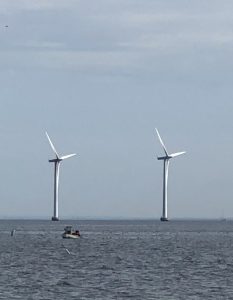
Yes, you will say I have expensive taste. But it’s not for me, it’s for the children! Picture their shining faces on Christmas morning when they find Santa has delivered 62 SiemensGamesa 8.0-megawatt, pitch-regulated, variable speed offshore wind turbines sporting a rotor diameter of 167 meters each, to a patch of ocean 27 miles east of Virginia Beach. 

Or the turbines could be GE’s sleek Haliade 150-6 MW like my friends up in Rhode Island got two years ago, or the MHI Vestas 10 MW beast that the cool kids are talking about. It sports a hub height of 105 meters and has blades 80 meters long. A single one of those bad boys can power over 5,000 homes.

But really I am not particular; these are just suggestions. 

I know we’re getting two turbines in 2020 as a demonstration project, and I’m grateful, I really am. But all the clued-in states are serious about offshore wind, and they’re building projects of 200 MW and up. We’ll be left behind if we don’t get in the game.

The states north of us are making port upgrades, attracting new businesses, and doing workforce training. They look at offshore wind as not just a jobs generator, but as a way to save money on energy costs, meet sustainability goals, improve the environment and reduce their reliance on fracked gas and imported energy. 

They’re positioning themselves to be serious players in a huge industry that a decade from now will employ tens of thousands of Americans. In the decade after that, offshore wind turbines will start delivering power to the West Coast, Hawaii and the Great Lakes region.  The effect will be transformative, as offshore wind energy feeds East Coast cities, pushes out the last of the Midwestern coal plants and leaves the fracking industry without a market.

Think that’s just the eggnog talking? Consider these indicators of an industry that’s taking off: 

1. Offshore wind is now a global industry.Offshore wind got its start in Europe more than 20 years ago as a way to get more wind energy without sacrificing valuable land space. But just in the last few years, it has spread to China, South Korea, Taiwan, Japan, and Vietnam in addition to the U.S. Analysts estimate China alone will have 28,000 megawatts installed by 2027. 

Offshore wind has been slow to advance in the U.S. because building 600-foot tall machines and planting them twenty-five miles out to sea is not cheap or easy, and the federal government had to devise a regulatory scheme from scratch. As the kinks get worked out and a manufacturing and supply chain emerges, the U.S. will move to the forefront of the industry. We always do.

2. Offshore wind competes on price in many markets. Offshore wind is cheaper than fossil fuels and nuclear in Europe already. That hasn’t been so true in the U.S. thanks to abundant coal and fracked gas, but even here, tumbling offshore wind prices have states looking at offshore wind as a way to help customers save money on energy. Bloomberg reported that Massachusetts’ first commercial-scale offshore wind farm will save electricity users $1.4 billion over 20 years. 

3. Early movers in the U.S. are already doubling down. Massachusetts and New York, which committed to a limited number of offshore wind projects early in order to capture a piece of the jobs pie, now want more projects. New York has set a goal of 2,400 MW by 2030; this fall Governor Andrew Cuomo announced a solicitation for 800 MW. This fall New Jersey announced a solicitation for 1,100 MW of capacity, a down payment on the state’s goal of 3,500 MW by 2030. 

3. Large multinational companies are buying the entrepreneurial start-ups.This year Ørsted, the energy giant formerly known as DONG Energy (for Danish Oil and Natural Gas) acquired Deepwater Wind, the scrappy developer of the Block Island project as well as projects in other states. French company EDF Renewables bought Fishermen’s Energy, another homegrown company that sought to give fishing interests a stake in wind projects. 

Along with big developers have come big law firms. You know there’s going to be serious money involved when $800 an hour lawyers trawl for clients at industry conferences. 

4. Oil and gas companies have moved in. Shell Oil and its partner EDP Renewables just spent $135 million for the right to develop a lease area off Massachusetts large enough to accommodate 1,600 MW of wind turbines. Norway’s Equinor (formerly Statoil) also put in $135 million for another section of the lease area, with the third piece going to a European partnership. 

American oil companies haven’t shown the same level of interest yet, but their suppliers in the Gulf of Mexico are handing out cards at offshore wind conferences, advertising their offshore expertise in everything from cables to shipbuilding.

5.  Offshore wind turbines have evolved away from their land-based kin. Unfettered by space limitations, offshore turbines now average close to 6 MW, more than twice the size of the typical land-based turbine. Wind farms slated for completion over the next several years will use even larger turbines, ranging in size up to a General Electric 12 MW turbine expected to deploy in 2021, and even larger ones still on the drawing boards. 

Foundations are diversifying, too, away from the original “monopile” design that mimics its land-based counterparts. Floating turbines will become mainstream in the next decade, enormously increasing design options as well as potential locations for wind farms. 

This will prove a special boon to the U.S., because while most of the East Coast is blessed with a shallow outer continental shelf that allows for fixed foundations even 30 miles from shore, the deep waters of the West Coast require floating technology to feed energy-hungry California. And the open ocean offers a lot of space.

So what’s holding Virginia back?

Dominion Energy holds the lease on the commercial-scale Wind Energy Area off Virginia. The company won it for a mere $1.6 million back in 2013, and not a whole lot seems to have happened with it since then. Dominion needs a customer, or perhaps just competition.

But Governor Northam is determined to see Virginia become a supply chain hub for at least the Mid-Atlantic states, and he has adopted a goal of achieving 2,000-MW of wind energy off our coast by 2030. 

That means I am not the only person in Virginia who wants a wind farm in my Christmas stocking, although I am likely the only one trying to get you to picture that image.

Admittedly, even Santa could find this a tall order (ho ho ho!), but Virginia is now rife with data centers that consume huge amounts of energy, owned by corporations that have promised the energy will be clean. So far the actions of these corporate players have lagged behind their promises. 

So if Santa can’t bring the governor and me a 500 MW wind farm off the coast of Virginia, maybe Amazon will deliver.

This column originally appeared in the Virginia Mercury on December 24, 2018. As this is now December 26, perhaps you think people are asking me if I got my wind farm yesterday. But no one has. Because of course they know it is out there, only waiting for us to do the hard work to make it a reality.

Unknown's avatar

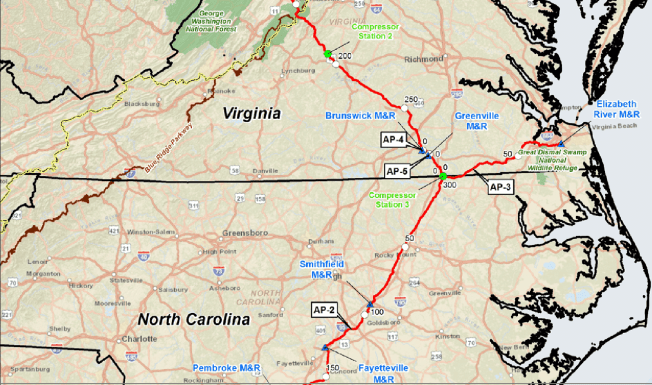
SCC cracks open the door on Dominion’s Atlantic Coast Pipeline costs

map showing VA and NC route of Atlantic Coast Pipeline

Costs to build the Atlantic Coast Pipeline are pegged at $7 billion. Partner Dominion Energy plans to charge captive electricity customers for the cost, regardless of whether the pipeline is needed. Image via the Federal Energy Regulatory Commission.

Dominion Energy Virginia employees were briefing a stakeholder group on the company’s Integrated Resource Plan (IRP) last Friday morning when text messages started popping up on phones all over the room: the State Corporation Commission had just rejected the IRP and ordered a do-over.

Awkward.

The SCC has never rejected a Dominion IRP before, mostly because the plan doesn’t have a binding effect. It is simply a way for Dominion to show regulators how it might meet the needs of customers over a 15-year period. If the company actually wants to build new generation or implement new programs, it still has to get permission through a separate proceeding.

But the IRP is important in establishing the context for new generation or programs. The SCC’s order on Friday shows commissioners think the company has presented a picture so distorted as to be unreliable.

The SCC order gives Dominion 90 days to correct a list of items it says the company got wrong, from unrealistically high demand forecasts to overly-optimistic assumptions about solar energy.

The order also instructs Dominion to look at an option the company ruled out: building yet another big combined-cycle gas plant. The SCC says it doesn’t necessarily want Dominion to build such a plant, only that the company ought to construct a true least-cost scenario to compare all other options against, and a least-cost option might include more baseload gas.

Then, buried down in footnote 14, the SCC added this:

The record reflects that the Company did not include fuel transportation costs in the modeled costs of certain natural gas generation facilities. Tr. 610. For purposes of the corrected 2018 IRP, the Company should include a reasonable estimate of fuel transportation costs, including interruptible transportation, if applicable, associated with all natural gas generation facilities in addition to the fuel commodity costs.

Wait a moment. Did the SCC just ask Dominion about the cost to ratepayers of its Atlantic Coast Pipeline?

Or does it just want to see different kinds of natural gas facilities modeled on an apples-to-apples basis, which Dominion failed to do? Even if it is the latter, can the SCC really open the door on transportation costs at all without letting the $7 billion elephant into the room?

If that happens, Dominion will find this the most expensive footnote in company history.

Dominion says the footnote is absolutely not about the ACP, and the company is shocked that anyone might think that. In a statement quoted in Energy News Network, the company lambasted environmental groups for perceiving a link between fuel transportation costs and a pipeline that provides fuel transportation:

“Instead of supporting Dominion Energy and policymaker’s (sic) push for carbon-free generation, [the Sierra Club and SELC] are distorting the SCC’s official order to pander to their donor base without regard for the truth,” the statement said.

This begs the question of how Dominion plans to comply with the order without mentioning its parent company’s pipeline. The company’s hysterical attack on its environmental critics seems designed to beat back expectations for the ACP’s cost to ratepayers becoming an issue in the IRP.

Footnote or no footnote, the SCC really should look at those pipeline costs

Admittedly, dropping a bombshell in a footnote would be only slightly more surprising than the SCC taking up the pipeline question at all right now. Pipeline critics have been trying in vain for two years to get the SCC to examine the contract between various Dominion subsidiaries obligating Virginia customers to pay for 20 percent of the ACP’s capacity. This blatant self-dealing is central to the pipeline’s profitability.

The SCC has previously refused to question the deal, and the Virginia Supreme Court refused to force the Commission to do it. The SCC maintained at the time that it could wait for the pipeline to be built before it decides whether it is fair to charge ratepayers for it. But it doesn’t have to wait; the Supreme Court says the SCC can take up the question any time.

And it should, because the SCC’s very silence encourages Dominion to think it will get away with charging customers for a hefty portion of the $7 billion pipeline. It is long past time for Dominion to present its evidence on the ACP.

As the SCC’s IRP order found, “the load forecasts contained in the Company’s past IRPs have been consistently overstated” and the SCC “has considerable doubt regarding the reasonableness of the Company’s load forecasts.” These questionable load forecasts, of course, underpin Dominion’s case for the ACP.

William Penniman, an energy lawyer who served as an expert witness for the Sierra Club in Dominion’s 2017 IRP case, testified that, based on publicly-available ACP filings, the contract with the ACP could cost utility customers in Virginia over $200 million of fixed charges annuallyfor 20 years—over $4 billion over the 20-year life of the contract, whether or not it ships any gas at all. He also showed that, even if more gas were needed, other pipeline options were much cheaper than Dominion’s affiliate deals.

And, given that Dominion already has contracts with another pipeline company to serve the utility’s existing gas plants, the money paid for capacity in the ACP will be entirely wasted—unless, of course, Dominion builds a bunch of new gas plants or drops lower-priced transportation arrangements in favor of its costly affiliate deals.

The pipeline came up again in the 2018 IRP. Gregory Lander, a witness for the Southern Environmental Law Center pointed out that Dominion’s IRP merely embeds the costs of the ACP into its generation scenarios without quantifying or justifying them.

“In essence,” Lander testified, “the IRP asks the Commission to accept that the Atlantic Coast Pipeline is built and that ratepayers should pay for it without ever explaining to the Commission what those costs are and why they are justified in a least-cost planning exercise.”

Rather than challenging the expert testimony, Dominion sought to exclude it, hoping to keep all mention of the ACP out of the case. In another footnote in its IRP order, however, the SCC specifically admitted Lander’s testimony, without finding facts.

Dominion would prefer the SCC to consider the ACP a “sunk cost.” Dominion’s theory goes like this: Since the contract obligates the utility to pay reservation charges for roughly half of the ACP’s capacity regardless of actual usage, that expense shouldn’t be factored into the cost of building any new gas plant. Instead, it argues, the SCC only needs to consider the cost of paying for the fuel itself.

That’s like buying a Ferrari and then saying the only expense of owning it is the gasoline. (And meanwhile, the trusty station wagon is running just fine.)

If the SCC is finally interested in the ACP’s cost to ratepayers, Dominion’s IRP do-over will have to be just the first step in a more thorough analysis of what Dominion’s self-dealing will cost Virginia consumers. There is plenty of evidence to suggest that will not go well for Dominion.

But what’s up with the SCC and gas?

Footnote 14 is not the only oddity in the SCC’s order. On the one hand, the SCC rightly says a fair accounting of a gas plant’s cost necessarily includes all the cost of transporting the fuel. On the other hand, even before it sees the transportation costs, the SCC seems to assume that a new baseload gas plant would be the economic thing to build, were it not for pesky carbon regulations and the General Assembly’s measures to promote renewable energy.

A major theme of the SCC’s order is the commission’s desire to force lawmakers to confront their own profligacy in passing the giant 2018 energy bill that the SCC opposed. SB 966 allows Dominion to redirect billions of dollars in over-earnings away from ratepayer refunds to massive spending on grid projects like undergrounding wires, with only limited regulatory oversight. The SCC thinks this is going to be bad for customers, and it wants legislators to appreciate just how bad.

That’s understandable, but it doesn’t excuse the SCC’s insistence on regarding gas as a low-cost option. Even Dominion knows better.

Dominion just announced the opening of its latest huge new combined-cycle plant in Virginia. The Greensville station joins a glut of new gas plants fed by Appalachia’s fracking industry. The oversupply is so bad that our regional grid already has almost 30% more power supply than it needs to meet peak demand—and grid operator PJM doesn’t expect this situation to change any time soon.

Most of the other new gas plants in PJM are funded by private equity. If they go bust, utility customers won’t be the ones to suffer. But Virginia’s regulated monopoly system means customers are precisely the ones who suffer when a utility’s bet on gas goes sour.

So Dominion’s IRP instead envisions a steady build-out of smaller gas plants it hopes to justify as complements to new solar farms. The idea is that these combustion turbines, often called “peaker” plants, will provide electricity to fill in around the variable output of solar panels.

Yet peakers are idle most of the time, making them questionable investments as well. Other states achieve the same reliability results at lower cost using demand response and battery storage.

The Rocky Mountain Institute (RMI) issued a report in May of this year comparing new gas generating plants—both combined-cycle and peakers—to well-designed clean energy generation portfolios. In almost every case, renewable energy, storage and demand response already beat gas on cost, even without considering environmental benefits.

And moreover, the trends favor clean energy, as RMI’s press release stresses: “More dramatically, the new-build costs of clean energy portfolios are falling quickly, and likely to beat just the operating costs of efficient gas-fired power plants within the next two decades.”

So in telling Dominion to present a gas-heavy scenario as low-cost, the SCC is asking the impossible. Whether the Commissioners know it or not, Dominion isn’t the only one here presenting a distorted picture.


This post originally appeared as a column in the Virginia Mercury on December 14, 2018.

Unknown's avatar

It’s time for the General Assembly to side with customers, not utilities, on solar

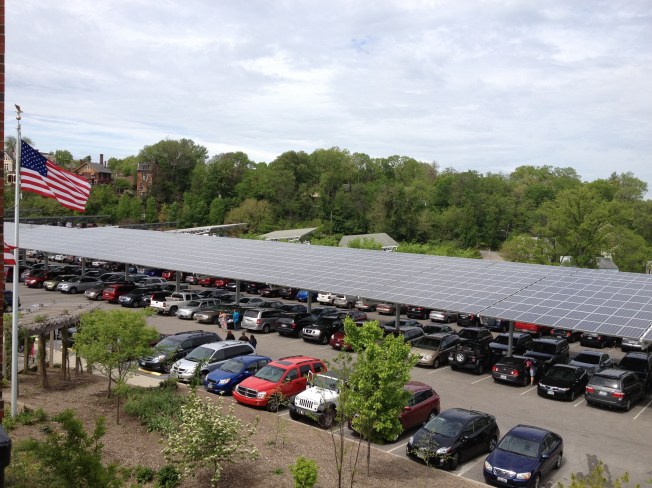
Solar canopy over a parking lot

Solar panels on parking lots, landfills, rooftops and other sites could provide a lot of clean electricity if policy barriers are removed.

Last winter, the Virginia General Assembly passed legislation giving utilities the green light to develop 5,500 megawatts (MW) of wind and solar energy. This marks a milestone for Virginia, offering the possibility for an amount of solar equal in output to Dominion Energy’s newest gas-fired power plant in Greensville.*

Amid the general celebration of this support for utility solar and wind, few legislators noticed that the bill did nothing to help residents and businesses that want to build renewable energy for their own use. Private investment drives most of the solar market in many other states, so leaving it out of the picture means squandering an opportunity.

Customers—and the solar companies who depend on small-scale solar— hope it’s their turn this year. They’d like to see the General Assembly give customer-built solar the same level of love in 2019 that it gave utility solar in 2018.

Unfortunately, that doesn’t square with the agenda of our utilities, which want to protect their monopolies on electric generation. Over the past few years, Dominion Energy and its fellow utilities have blocked dozens of bills aimed at removing some of the policy barriers stifling the market.

Just one example: Fairfax County, like many jurisdictions across the state, owns a closed landfill. It can’t be used for most purposes, but it could hold a solar array large enough to power multiple county buildings.

Yet no fewer than four different provisions of Virginia’s net metering law keep a cost-effective project from moving forward: a 1 MW limit on commercial solar arrays; a requirement that electricity from a solar facility must be used onsite; a rule that a solar facility can’t be larger than needed to meet the site’s electric demand over the preceding year; and a prohibition on meter aggregation that keeps a customer with solar on one building from sharing it with another building.

These would all be simple legislative fixes, but for years now Dominion and the other utilities have opposed the reforms.

Other reforms are needed, too. The solar industry faces a ceiling on the total amount of solar customers can own under the net metering program; utilities killed bills that would raise the ceiling. Businesses tried to lift restrictions on third-party financing using power purchase agreements. Utilities killed the bills. Homeowners tried to get out from under the oppressive fees called standby charges that utilities impose to keep customers from putting up more than 10 kilowatts (kW) of solar panels. Utilities killed the bills.

Killing bills clearly must get tedious. So, this year, Dominion is using the occasion of a report to the General Assembly on solar energy last month to launch a propaganda campaign against the whole radical idea of customers producing their own energy supply.

The 44-page, glossy brochure boasts photographs of sunlight slanting across solar panels nestled in fields of dandelions. Much of it is devoted to touting Dominion’s own progress in installing solar. Dominion claims its 1,600 MW of solar make it a national leader, though that might have to be taken with a grain of salt given that the U.S. now has more than 58,000 MW of solar.

And of course, most of Dominion’s solar is in other states; and of the solar in Virginia, most is being built in response to demand from the state government and corporate customers. Only a few of the solar farms Dominion includes will actually serve ordinary ratepayers.

The achievements amount to even less for Dominion’s customer-sited projects. The company’s Solar Partnership Program for commercial customers built only 7.7 MW out of the 30 MW the SCC approved five years ago. The Solar Purchase Program that Dominion once hoped might replace net metering has produced a grand total of 2 MW.

And then there are the 18 schools across the commonwealth that are the lucky recipients of solar panels in Dominion’s “Solar for Students” program. Each school gets 1.2 kW worth of solar panels, or roughly enough to run an old refrigerator. (In fairness, those old refrigerators are electricity hogs. If you have one, replace it.)

If these programs demonstrate Dominion’s level of competence building rooftop solar, that seems like reason enough to open up the private market.

It’s also worth keeping in mind that the reason customers are trying so hard to remove Virginia’s policy barriers is that they don’t just want electricity, they want solar. Yet absolutely none of the solar energy from any project Dominion builds or buys, even those paid for by Virginia ratepayers, will stay in Virginia to meet our voluntary renewable portfolio standard (RPS).

If that surprises you, check out a different document Dominion filed last month, with significantly less fanfare than it gave the solar report. The other filing, Dominion’s annual report to the State Corporation Commission (SCC) on renewable energy, confirms that Dominion sells the “renewable attributes” of solar energy produced here to utilities in other states in the form of renewable energy certificates (RECs).

Then, for the Virginia RPS, Dominion buys cheaper RECs from facilities like out-of-state, century-old hydro dams, biomass (wood) burners, trash incinerators, and a large but mysterious category called “thermal” that is nowhere defined but definitely has nothing to do with solar. So other states get the bragging rights to our solar, and we get dams, trash and wood, plus a mystery ingredient.

But regardless of who gets to claim it, all solar is good solar in a world threatened by climate change. That’s my attitude, anyway, and I only wish Dominion shared it. But, returning our attention to the glossy solar brochure, we find Dominion instead doing its darnedest to undermine the idea of solar built by anyone but the lovable monopoly itself.

The report offers up a poll that concludes: “Solar power is the most popular energy source of all those tested in this polling (Nuclear, Wind, Solar, Natural Gas, and Coal).” But then it goes on to suggest customers don’t understand solar, don’t want to spend much money on it, and don’t really value it very highly after all.

For example, the report follows news of solar’s 82% positive rating with this caveat: “However, when asked to choose what is most important to them regarding their own electricity provider . . .customers chose as follows: dependability and reliability 53%; affordability 28%; investing in renewable energy 16%.”

The poll apparently didn’t give respondents the option of choosing solar andreliability andaffordability. Pollsters must not have told folks that customers in other states enjoy all three at once, or that solar actually has a positive effect on grid reliability and customer savings.

If the question had been, “How biased is this poll?” I bet they could have scored 100%.

After delivering a few more similarly manipulated polling results, the report goes on to discuss the results of last summer’s solar stakeholder process. Readers may recall that Dominion hired consultant Meridian Institute to convene a series of meetings to get feedback on renewable energy policy questions. Hundreds of Virginians took the trouble to attend in person or by phone to share their expertise and opinions.

The result, presented in an 18-page appendix to Dominion’s report, is impressive only for how completely inane it is.

Here, for example, is how Meridian opens its summary of stakeholder feedback:

Most stakeholders who expressed a general opinion about the expansion of renewable energy in Virginia indicated that they support such expansion. Others indicated that their support for renewable energy was dependent on a variety of factors. Some stakeholders did not express a general opinion about the expansion of renewable energy in Virginia.

I am sorry to say it goes on like that for pages.

If you persist in reading the Meridian summary, the most you will get out of it is what we all knew going into it: utilities disagree with customers and the solar industry about whether existing restrictions on customer solar are good or bad.

Except, the report does not even say that. It only says the “participants” in the solar stakeholder process disagreed on these questions. Putting it that way leaves open the possibility that some customer, somewhere, in one of those meetings, might have taken the utilities’ side.

If so, the customer’s name was Tooth Fairy.

I have little doubt Dominion provided a copy of its pretty solar report to every legislator in Richmond, and is already using it in its fight against expanding the rights of customers in Virginia to go solar. Dominion will point to its report as proof that customers are too stupid and too conflicted to be allowed to make their own decisions. Ergo, Dominion should control all solar in Virginia, on rooftops as well as elsewhere.

Legislators should indeed read the report. And then after they’ve had a good laugh, they should tell Dominion no.

——————

*That equivalence is because Dominion projects its 1,588 MW Greensville plant will run at 80% of its full capacity. Solar farms, generating only during daylight hours, achieve capacity factors in the range of 25%, while rooftop solar comes in a little less.


This post originally appeared in the Virginia Mercury on December 7, 2018.

Unknown's avatar

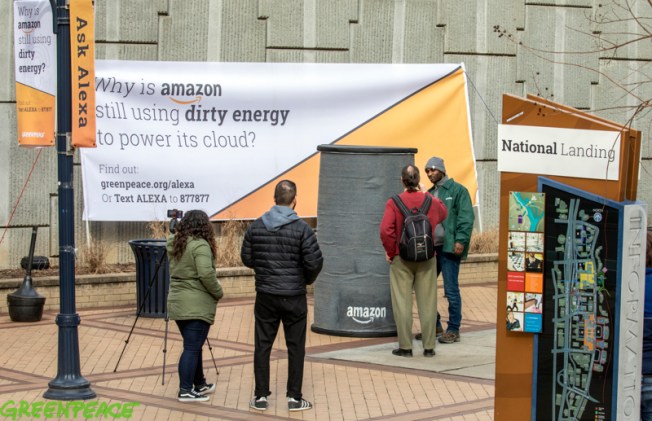
Amazon will need even more energy in Virginia. Will they make it clean?

Entrance to Crystal City Metro Station in Arlington, Virginia

Crystal City in Arlington will be the heart of Amazon’s new Virginia headquarters. Renewable energy options on site are limited. Photo credit Woogers via Wikimedia Commons.

Amazon Web Services jump-started the utility solar industry in Virginia in 2015, when it announced plans for its first solar farm in Accomack County. Three years later, Amazon remains the biggest purchaser of solar in the commonwealth, allowing it to offset some of the enormous amount of energy used by its data centers.

Yet the company’s energy footprint in Virginia far exceeds the energy output of its solar projects. The addition of a new headquarters in Arlington will further increase its need for electricity, and will attract new residents who will also use electricity. All this demand poses a problem for the company and the climate: Dominion Virginia Power will burn more coal and fracked gas to meet Amazon’s energy need, unless Amazon acts to ensure the power comes from renewable sources.

Like many big tech companies, Amazon has adopted aggressive sustainability goals, including a “long-term commitment to achieve 100% renewable energy usage” for its data centers. But the details of its commitment are fuzzy, and the qualifier “long-term” makes the commitment meaningless.

Earth to Jeff Bezos: in the “long term” climate change will put HQ2 under water.

If Amazon still wants a habitable planet to compete in, it should consider the entire energy footprint of its operations, and make sure it is meeting these needs 24/7 with clean, renewable energy. Solar should be a big part of the plan, but so should land-based wind and offshore wind, which complement solar by providing power in the evening and at night. An investment in battery storage would round out the package nicely.

Virginia officials made a perfunctory mention of renewable energy availability to Amazon in the state’s bid package (see page 184). This was accompanied by a quote from Bob Blue of Dominion Energy, promising to sell the company renewable energy. (Be pleased, Mr. Bezos; that’s not a promise he’s made to the rest of us.)

Arlington County has reportedly discussed with Amazon how to make its new campus as environmentally-friendly as possible. Arlington is considering making a commitment to 100 percent renewable energy by 2035, so it has a real incentive to ensure that newcomers are part of the solution, not part of the problem.

Given today’s building technology, there is no reason the National Landing campus should not set a new standard for energy-efficient design. Ideally that will include on-site solar as well. Local officials also want to see enough improvements to transit, pedestrian and biking routes to keep 25,000 new commuters from spewing air pollution while they sit in traffic.

Even if Amazon and Arlington do everything right, though, the campus will need to purchase electricity from off-site generation—and there is still the matter of those power-hungry data centers.

Amazon can take Bob Blue up on his offer and let Dominion supply the company with all the renewable energy it needs. Caveat emptor, though: Dominion’s idea of renewable energy includes resources of dubious value to the climate, like the burning of trash and woody biomass.

And, thanks largely to Dominion’s clout in the General Assembly, Virginia has many barriers to on-site solar, which limit customers’ ability to supply their own renewable energy. We also boast a renewable portfolio standard that works approximately opposite to that of every other state, by ensuring wind and solar will never be part of our resource mix.

Come to think of it, we could really use Amazon’s negotiating chops with our legislators.

In any case, with or without Dominion’s help, Amazon will find plenty of opportunities to procure wind as well as more solar in Virginia. Apex Clean Energy’s Rocky Forge wind farm near Roanoke is already permitted and ready for construction as soon as a customer shows up. Apex now has two additional wind farms in development in southwest Virginia—a nice way to support areas of the state outside of Northern Virginia.

Offshore wind is another opportunity to deliver energy at scale while supporting jobs in the Hampton Roads region. Although offshore wind is poised to become a huge industry in the U.S. within the next ten years, right now only the northeastern states are moving forward with offshore wind farms in the near term. Amazon could make it happen here, too.

Dominion Energy has secured approval for two test turbines off the Virginia coast, but the utility has been slow-walking plans to develop hundreds more turbines in the commercial lease area it owns the rights to. In part that’s because Dominion doesn’t see how to get the State Corporation Commission (SCC) to approve the cost to ratepayers.

That wouldn’t be an issue if Amazon were the buyer, but nor is Amazon limited to Dominion as a supplier of offshore wind. Amazon could let Dominion and its developer, Ørsted, compete against Avangrid, the developer that holds the lease on the Kitty Hawk offshore wind area just over the border in North Carolina. The power from both areas has to come to shore at the same point in Virginia Beach, where a high-voltage transmission line is available. Avangrid has already announced that it is speeding up its development work in hopes of appealing to Virginia customers.

It will take several years for Amazon to build out HQ2, but given how much electricity the company already uses in Virginia, there is no reason to wait on making new investments in renewable energy. Virginians, and the planet, will thank you.

This post first appeared in the Virginia Mercury on November 26, 2018. 

Unknown's avatar

SCC rips into Dominion’s offshore wind pilot, approves it anyway

Photo credit: Phil Holman

The Virginia State Corporation Commission (SCC) approved Dominion Energy Virginia’s proposed Coastal Virginia Offshore Wind (CVOW) project on Friday, but not happily. A press releasefrom the SCC complains about the project’s “excessive costs” and the way it is structured to make customers, rather than the developer, shoulder risks:

The offshore wind project consists of two wind turbines to be built by Dominion that would begin operating in December 2020. In its factual findings, the Commission determined that the company’s proposal puts “essentially all” of the risk of the project, including cost overruns, production and performance failures, on Dominion’s customers. Currently, the estimated cost of the project is at least $300 million, excluding financing costs.

The Commission found that the offshore wind project was not the result of a competitive bidding process to purchase power from third-party developers of offshore wind. Doing so would likely have put all or some of the risks on developers as has been done with other offshore wind projects along the East Coast of the United States. The Commission also found that any “economic benefits specific to [the project] are speculative, whereas the risks and excessive costs are definite and will be borne by Dominion’s customers.”

In spite of these harsh words, the SCC goes on to conclude that the language of the giant energy bill passed by the General Assembly last winter, SB 966, leaves regulators no choice but to approve CVOW:

The Commission concluded that the offshore wind project “would not be deemed prudent [under this Commission’s] long history of utility regulation or under any common application of the term.” However, the Commission ruled, as a matter of law, that recent amendments to Virginia laws that mandate that such a project be found to be “in the public interest” make it clear that certain factual findings must be subordinated to the clear legislative intent expressed in the laws governing the petition.

Obviously, the SCC has a point about the high cost of CVOW. Even Dominion agreed that if you just want 12 megawatts (MW) of power, you can get it a lot more cheaply than $300 million. The SCC’s Final Orderis even harsher on this topic. Moreover, the SCC doesn’t see any future for offshore wind as a matter of pure economics.

Nor is it all that reassuring that Dominion has said the price tag won’t have any impact on rates. What Dominion means is that we ratepayers have already paid for it, and as we aren’t going to get our money back anyway, we may as well enjoy seeing it put to use in building an offshore wind industry.

That’s where Dominion is (sort of) right, and the SCC (sort of) wrong. CVOW is the first step in the Northam administration’s plan to build an offshore wind industry in Virginia and install at least 2,000 MW of offshore wind turbines in the coming decade, a goal shared by many members of the General Assembly.

Northam says CVOW will lead to the commercial projects. Dominion says maybe, maybe not (“It’s too soon to have that conversation,” in the words of Dominion’s Katharine Bond). At any rate, it sure won’t happen without CVOW first.

Critics have said it’s silly to insist on a pilot project when other states are going forward with full-scale wind farms. That’s not entirely fair. As the first project in federal waters, the first in the Mid-Atlantic, and the first to be located 27 miles out to sea, CVOW’s two turbines will have much to teach the industry about offshore wind installation and performance in this part of the world. The whole U.S. offshore wind industry stands to benefit.

And also, Dominion has us over a barrel. Dominion holds the lease for the 2,000 MW; nobody else can come in and build it. So if Northam wants an offshore wind industry with thousands of new jobs, he has to do it Dominion’s way or not at all.

Clearly the SCC would choose not to do it at all. But then, the SCC has never shown any understanding of the climate crisis and the pressing need for Virginia to respond by developing as much wind and solar as possible, as rapidly as possible.

In the long term, we have to build out much more than 2,000 MW of offshore wind. As we do, and as costs decline in response to increasing economies of scale and technological improvements, the price tag of one pilot project will shrink in proportion to the billions of dollars flowing into the offshore wind industry and decarbonizing our electricity supply.

If it’s Dominion’s way or the highway, we have to do it Dominion’s way—for now—and then make sure it gets done.

No doubt the SCC would disagree. Yet to its credit, on Friday the SCC also approved Dominion’s purchase of power from a proposed 80-megawatt solar facility dubbed the “Water Strider” project. Unlike the offshore wind project, the solar project met the Commission’s prudency test because it involves a purchase from a private developer and followed a competitive bidding process. This resulted in a price to customers that the SCC felt is “in line with market rates.”

Though the Water Strider project looks like a clear winner for ratepayers, its approval wasn’t a foregone conclusion either. After a long history of approving one fossil fuel project after another, the SCC has belatedly begun to question Dominion’s projections about its need for more generation, at precisely the time when the new generation happens to be solar and wind.

For now, the SCC believes it must bow to the will of the General Assembly. For these two projects, that’s a good thing, but ratepayers will be in trouble if the SCC declines to assert its oversight authority in other filings under SB 966. Dominion wants to spend billions of dollars over the coming years on smart meters, software, burying power lines and other grid projects. Customers still need the SCC to make sure we get our money’s worth.

This article originally appeared in the Virginia Mercury

Unknown's avatar

There’s a lot to like in Northam’s energy plan, but missed opportunities abound

electric vehicle plugged in

Vehicle electrification gets a boost under the energy plan.

There is a lot to like in the Northam Administration’s new Virginia Energy Plan, starting with what is not in it. The plan doesn’t throw so much as a bone to the coal industry, and the only plug for fracked gas comes in the discussion of alternatives to petroleum in transportation.

The 2018 Energy Plan is all about energy efficiency, solar, onshore wind, offshore wind, clean transportation, and reducing carbon emissions. That’s a refreshing break from the “all of the above” trope that got us into the climate pickle we’re in today. Welcome to the 21stcentury, Virginia.

But speaking of climate, the Intergovernmental Panel on Climate Change (IPCC) just released a special report that makes it clear we need “rapid, far-reaching and unprecedented changes in all aspects of society” to keep warming below 1.5 degrees Celsius. That’s only half again the amount of warming that has already brought us melting glaciers, a navigable Arctic Ocean, larger and more destructive hurricanes, and here in Virginia, the swampiest summer in memory. The fact that things are guaranteed to get worse before they get better (if they get better) is not a happy thought.

Perhaps no Virginia politician today has the courage to rise to the challenge the IPCC describes. Certainly, Governor Northam shows no signs of transforming into a rapid-change kind of leader. But as we celebrate the proposals in his Energy Plan that would begin moving us away from our fossil fuel past, we also have to recognize that none of them go nearly far enough, and missed opportunities abound.

Let’s start with the high points, though. One of the plan’s strongest sections champions offshore wind energy. It calls for 2,000 megawatts (MW) of offshore wind by 2028, fulfilling the potential of the area of ocean 27 miles off Virginia Beach that the federal government leased to Dominion Energy. In the short term, the Plan pledges support for Dominion’s 12-MW pilot project slated for completion in 2020.

Other East Coast states like Massachusetts and New York have adopted more ambitious timelines for commercial-scale projects, but the economics of offshore wind favor the Northeast over the Southeast, and they aren’t saddled with a powerful gas-bloated monopoly utility.  For Virginia, a full build-out by 2028 would be a strong showing, and better by far than Dominion has actually committed to.

Another strong point is the Administration’s commitment to electric vehicles. The transportation sector is responsible for more carbon emissions even than the electric sector, and vehicle electrification is one key response.

Even better would have been a commitment to smart growth strategies to help Virginians get out of their cars. Overlooking this opportunity is a costly mistake, and not just from a climate standpoint. Today’s popular neighborhoods are the ones that are walkable and bikeable, not the ones centered on automobiles. If we want to create thriving communities that attract young workers, we need to put smart growth front and center in urban planning—and stop making suburban sprawl the cheap option for developers.

Speaking of developers, how about beefing up our substandard residential building code? Lowering energy costs and preparing for hotter summers requires better construction standards. Houses can be built today that produce as much energy as they consume, saving money over the life of a mortgage and making homes more comfortable. The only reason Virginia and other states don’t require all new homes to be built this way is that the powerful home builders’ lobby sees higher standards as a threat to profits.

The Energy Plan mentions that updated building codes were among the recommendations in the Virginia Energy Efficiency Roadmap that was developed with funding from the U.S. Department of Energy and published last spring. I hope the only reason the Energy Plan doesn’t include them among its recommendations is that the Administration is already quietly taking action.

Meanwhile, it is not reassuring to see that the section of the plan devoted to attaining Virginia’s ten percent energy efficiency goal simply describes how our utilities will be proposing more efficiency programs as a result of this year’s SB 966 (the “grid mod” bill).

States that are serious about energy efficiency don’t leave it up to companies whose profits depend on a lack of efficiency. They take the job away from the sellers of electricity and give it to people more motivated. So if the Governor’s plan is merely to leave it up to Dominion and APCo without changing their incentives, we should abandon all hope right now.

Indeed, it is strange how often the Energy Plan finishes an in-depth discussion of an issue with a shallow recommendation, and frequently one that has the distinct odor of having been vetted by Dominion.

That observation leads us straight to grid modernization. The plan opens with a very fine discussion of grid modernization, one that shows the Administration understands both the problem and the solution. It opens by declaring, “Virginia needs a coordinated distribution system planning process.” And it notes, “One important rationale for a focus on grid modernization is that the transitions in our electricity system include a shift away from large, centralized power stations to more distributed energy resources.”

Well, exactly! Moreover: “The grid transformation improvements that the Commonwealth is contemplating include a significant focus on the distribution system, but our current resource planning process (Integrated Resource Plan or IRP) does not fully evaluate the integration of these resources. One overarching focus of this Energy Plan is the development of a comprehensive analysis of distributed energy resources.”

But just when you feel sure that the plan is about to announce the administration is setting up an independent process for comprehensive grid modernization, the discussion comes to a screeching halt. The plan offers just one recommendation, which starts out well but then takes a sudden turn down a dead-end road:

To ensure that utility investments align with long-term policy objectives and market shifts, Virginia should reform its regulatory process to include distribution system level planning in Virginia’s ongoing Integrated Resource Planning requirement.

Seriously? We need regulatory reform, but we will let the utilities handle it through their IRPs? Sorry, who let Dominion write that into the plan?

It’s possible the Administration is punting here because it doesn’t want to antagonize the State Corporation Commission (SCC). The SCC pretty much hated the grid mod bill and resented the legislation’s attack on the Commission’s oversight authority. And rightly so, but let’s face it, the SCC hasn’t shown any interest in “reforming the regulatory process.”

The Energy Plan’s failure to take up this challenge is all the more discouraging in light of a just-released report from the non-profit Grid Lab that evaluates Dominion’s spending proposal under SB 966 and finds it sorely lacking. The report clearly lays out how to do grid modernization right. It’s disheartening to see the Administration on board with doing it wrong.

Dominion’s influence also hobbles the recommendations on rooftop solar and net metering. This section begins by recognizing that “Net metering is one of the primary policy drivers for the installation of distributed solar resources from residential, small business, and agricultural stakeholders.” Then it describes some of the barriers that currently restrain the market: standby charges, system size caps, the rule that prevents customers from installing more solar than necessary to meet past (but not future) demand.

But its recommendations are limited to raising the 1% aggregate cap on net metering to 5% and making third-party power purchase agreements legal statewide. These are necessary reforms, and if the Administration can achieve them, Virginia will see a lot more solar development. But why not recommend doing away with all the unnecessary policy barriers and really open up the market? The answer, surely, is that Dominion wouldn’t stand for it.

Refusing to challenge these barriers (and others—the list is a long one) is especially regrettable given that the plan goes on to recommend Dominion develop distributed generation on customer property. Dominion has tried this before through its Solar Partnership Program, and mostly proved it can’t compete with private developers. If it wants to try again, that’s great. We love competition! But you have to suspect that competition is not what this particular monopoly has in mind.

The need to expand opportunities for private investment in solar is all the more pressing in light of the slow pace of utility investment. Legislators have been congratulating themselves on declaring 5,000 megawatts (MW) of solar and wind in the public interest, and the Energy Plan calls for Dominion to develop 500 MW of solar annually. I suspect our leaders don’t realize how little that is. After ten years, 5,000 MW of solar, at a projected capacity factor of 25%, would produce less electricity than the 1,588-MW gas plant Dominion is currently building in Greensville, operating at a projected 80% capacity.

Offshore wind capacities are in the range of 40-45%, so 2,000 MW of offshore wind will produce the amount of electricity equivalent to one of Dominion’s other gas plants. It won’t quite match the 1,358-MW Brunswick Power Station, or even the 1,329-MW Warren County Power Station, but Dominion also has several smaller gas plants.

But at this point you get the picture. If all the solar and wind Virginia plans to build over ten years adds up to two gas plants, Virginia is not building enough solar and wind.

That gets us back to climate. The Administration can claim credit for following through on developing regulations to reduce carbon emissions from power plants by 30% by 2030, using the cap-and-trade program of the Regional Greenhouse Gas Initiative (RGGI) of the northeastern states. If successful, that still leaves us with 70% of the carbon emissions in 2030, when we need to be well on our way to zero. And for that, we don’t have a plan.

Of course, Ralph Northam has been Governor for only nine months. He has some solid people in place, but right now he has to work with a legislature controlled by Republicans and dominated by Dominion allies in both parties, not to mention an SCC that’s still way too fond of fossil fuels. Another blue wave in the 2019 election could sweep in enough new people to change the calculus on what is possible. In that case, we may yet see the kind of leadership we need.


This article first appeared in the Virginia Mercury on October 15, 2018.

Unknown's avatar

After the grid mod bill, the SCC wants to know how much authority it still has over utility spending

offshore wind turbines

Offshore wind turbines, Copenhagen, Denmark. Dominion Energy has asked the SCC for permission to proceed with building two wind turbines off the Virginia coast as a test project. Photo by Ivy Main.

It’s no secret the State Corporation Commission didn’t like this year’s big energy bill, the Grid Transformation and Security Act. SCC staff testified against SB 966 in committee, and their objections played a major role in amendments removing the “double dip” provision that would have let Dominion Energy Virginia double its earnings on infrastructure projects. Since passage of the bill, the SCC has raised questions about the constitutionality of the law’s provisions favoring in-state renewable energy, and its staff has issued broadsides about the costs of the legislation.

Now the SCC is mulling the question of how much authority it still has to reject Dominion’s proposals for spending under the bill. Dominion has filed for approval of a solar power purchase agreement (case number PUR-2018-00135) and two offshore wind test turbines it plans to erect in federal waters 24 nautical miles out from Virginia Beach (PUR-2018-00121). The utility has also requested permission to spend a billion dollars on grid upgrades and smart meters (PUR-2018-00100).

In an order issued September 12, the SCC asked participants in the solar and offshore wind cases to brief them on legal issues arising from the legislation. The SCC has focused in on two new sections of the Virginia Code. One is the language making it “in the public interest” for a utility to buy, build, or purchase the output of up to 5,000 megawatts (MW) of Virginia-based wind or solar by January 1, 2024. The SCC noted that subsection A of the provision says such a facility “is in the public interest, and the Commission shall so find if required to make a finding regarding whether such construction or purchase is in the public interest.”

The other new Code section gives a utility the right to petition the SCC at any time for a “prudency determination” for construction or purchase of a solar or wind project located in Virginia or off its coast, or for the purchase of the output of such a project if developed by someone else.

Together these sections give Dominion a good deal of latitude, but they don’t actually force the SCC to approve a project it thinks is a bad deal for ratepayers. In other words, wind and solar may be in the public interest, but that doesn’t mean every wind and solar project has to be approved.

The SCC asked for briefs on seven questions:

  • What are the specific elements that the utility must prove for the Commission to determine that the project is prudent under Subsection F?
  • Is the “prudency determination” in Subsection F different from the “public interest” findings mandated by Subsections A or E?
  • Do the public interest findings mandated by either Subsections A or E supersede a determination under Subsection F that a project is not prudent? If not, then what is the legal effect of either of the mandated public interest findings?
  • If the construction (or purchase or leasing) is statutorily deemed in the public interest, is there any basis upon which the Commission could determine that such action is not prudent? If so, identify such basis or bases.
  • In determining whether the project is prudent, can the Commission consider whether the project’s: (a) capacity or energy are needed; and (b) costs to customers are unreasonable or excessive in relation to capacity or energy available from other sources?
  • Do the statutorily-mandated public interest findings under either Subsections A or E override a factual finding that the project’s: (a) capacity or energy are not needed for the utility to serve its customers; and/or (b) costs to customers are unreasonable or excessive in relation to capacity or energy available from other sources, including but not limited to sources of a type similar to the proposed project?
  • Does the utility need a certificate of public convenience and necessity, or any other statutory approval from the Commission, before constructing the proposed projects?

Even if the Commission decides it has latitude in deciding which wind and solar projects to approve, that doesn’t necessarily spell disaster for the two projects at issue. The SCC could still decide they meet the standard for prudency and approve them.

Oral argument on the issues is scheduled for October 4.

Should approval of smart meters depend on how the meters will be used?

The SCC is also mulling over its authority in the grid modernization docket. One day after it asked lawyers in the solar and offshore wind cases to weigh in on the meaning of prudency, it issued a similar order asking for input on what the new law means by “reasonable and prudent” in judging spending under the grid modernization provisions. (Yes, the grid mod section of the law insists that spending be “reasonable” in addition to “prudent,” begging the question of whether spending can be prudent but not reasonable. Perhaps thankfully, the SCC order does not pursue it.)

The SCC’s questions to the lawyers show an interest in one especially important point: Dominion wants to spend hundreds of millions of dollars of customer money on smart meters, without using them smartly. Smart meters enable time-of-use rates and customer control over energy use, and make it easier to incorporate distributed generation like rooftop solar. None of these are in Dominion’s plan. Is it reasonable and prudent for Dominion to install the meters anyway, just because they are one of the categories of spending that the law allows?

Or as the SCC put it:

If the evidence demonstrates that advanced metering infrastructure enables time-of- use (also known as real-time) rates and that such (and potentially other) rate designs advance the stated purposes of the statute, i.e., they accommodate or facilitate the integration of customer-owned renewable electric generation resources and/or promote energy efficiency and conservation, may the Commission consider the inclusion or absence of such rate designs in determining whether a plan and its projected costs are reasonable and prudent?

Reading the tea leaves at the SCC: Staff comments on Dominion’s IRP

The SCC’s question about smart meters surely indicates how the commissioners feel about the matter: they’d like to reject spending on smart meters, at least until Dominion is ready to use them smartly. If the SCC concludes it has the authority to reject this part of Dominion’s proposal as not “reasonable and prudent,” it seems likely to do so.

It is harder to know where the SCC might land on the solar and offshore wind spending. The SCC’s staff, at least, are skeptical of Dominion’s plans to build lots of new solar generation. In response to Dominion’s 2018 Integrated Resource Plan (IRP), Commission staff questioned whether Dominion was going to need any new electric generation at all, given the flattening out of demand. But if it does, according to the testimony of Associate Deputy Director Gregory Abbott, Dominion ought to consider a new combined-cycle (baseload) gas plant, not solar. (Combined-cycle gas was the one generating source Dominion almost completely ruled out.)

Abbott criticized Dominion’s presentation of the case for solar, though he took note of the technology’s dramatic cost declines. Instead of seeing that as a reason to invest, however, he suggested it would be better to wait for further cost declines, or at least leave the construction of solar to third-party developers who can provide solar power more cheaply than the utility can. Remarkably, he also suggested Dominion offer rebates to customers who install solar, urging that Dominion’s spending under the grid transformation law “is designed specifically to handle these [distributed energy resources].”

Abbott also seemed supportive of Dominion’s venture into offshore wind. The only offshore wind energy in the IRP is the 12 MW demonstration project known as CVOW, but as Abbott noted, “the Company indicated that it will pursue a much larger roll-out of utility-scale offshore wind, beginning in 2024, if the demonstration project shows it to be economic.”

This suggests staff are inclined to support Dominion’s spending on the CVOW project, but for Abbott, it was one more reason Dominion should not invest in solar. He concluded, “If the demonstration project proves that utility-scale offshore wind is economic compared to solar, then it may make sense to get the results of the CVOW demonstration project before deploying a large amount of solar.”

This post originally appeared in the Virginia Mercury on September 24.

Unknown's avatar

Does the SCC finally see the light on customer-owned solar?

two men installing solar panels on a roof

Photo credit NREL.

Almost four years ago, Virginia’s State Corporation Commission (SCC) approved a request from Appalachian Power to impose “standby charges” on grid-connected homeowners who installed solar arrays between 10 and 20 kilowatts (kW). The approval came not long after the SCC had given the same authority to Dominion Power (now Dominion Energy Virginia).

The standby charges, dubbed a “tax on the sun,” effectively shut down the market for these larger home systems. Since then, Virginia utilities have made no bones about their desire to dismantle the rest of the Virginia law that has enabled the growth of the private solar market.

The law permits solar owners to “net meter,” giving them credit at the retail rate for the electricity they feed onto the grid on sunny days, and letting them use that credit when they draw electricity from the grid at other times.

Utilities say net metering customers don’t pay their fair share of grid costs. Solar advocates say the subsidy runs the other way: both the utility and society at large benefit when more customers install solar. Independent studies find the “value of solar” to be above the retail rate; utility-funded studies find much lower values. In Virginia, the debate continues to rage, but in 2014, at least, the SCC came down squarely on the utility’s side.

Fast forward to 2018. This year the General Assembly passed a law called the Grid Transformation and Security Act that, among other things, envisions an electric grid of the future that incorporates distributed generation like rooftop solar. And suddenly the staff of the SCC sees customer-owned solar in a new light.

Members of the Commission staff filed testimony last month in response to Dominion’s 2018 Integrated Resource Plan, which proposes large amounts of utility-built and owned solar. Associate Deputy Director Gregory Abbott devoted much of his testimony to bashing Dominion’s solar plans.

But just when a reader might have concluded that Abbott hates solar, he pivoted to the suggestion that Dominion should consider offering rebates for customers who install their own rooftop solar:

Given that the Company is developing a Grid Transformation Plan that is designed specifically to integrate customer-level DERs [distributed energy resources], and given the Company’s peak load forecast, Staff believes the Company should explore developing a rebate program to incent customer-owned rooftop solar systems. Staff believes that it is logical to incent these DERs particularly since the Company’s Grid Transformation Plan pursuant to the GTSA is designed specifically to handle these DERs. Staff also notes that such a program could be considered to be a peak shaving program and eligible for cost recovery through Rider CIA. To the extent that the program passed the economic tests, it may obviate the need for some of the more expensive capacity resources as described in the Company’s proposed build plan. Such a program would be more environmentally benign as it would take advantage of
existing brownfield sites rather than the greenfield sites required for utility-scale
 solar.

These are, of course, precisely the arguments made by advocates for distributed solar.

The support from SCC staff comes at an opportune moment, as the Northam Administration considers making distributed solar a centerpiece of its new Energy Plan. It could also complicate Dominion’s efforts to limit and penalize customer investments in solar. Last year Dominion’s opposition doomed a raft of bills intended to make it easier for customers to use Virginia’s net metering law. When solar advocates try again in the 2019 session, having the support of the SCC could change the minds of legislators who, until now, have been happy to accept Dominion’s arguments.

All this assumes the SCC commissioners agree with their staff on the value of customer-owned solar to the grid. If they do, it could signal a new day in Virginia for customer-owned solar.

This article originally appeared in the Virginia Mercury, the new, non-profit on-line news source founded by Robert Zullo, formerly a reporter for the Richmond Times-Dispatch.