Unknown's avatar

To be or not to be a clean energy state, that is the question

For the third year in a row, a tug-of-war is going on in the General Assembly over whether Virginia stays the course of the energy transition laid out in 2020 and 2021, or rolls it back hard.

Democrats remain committed to a renewable energy future to address pollution, high electricity costs and the causes of catastrophic climate change. Gov. Glenn Youngkin and most Republican legislators cling to the familiar (dis)comfort of fossil fuels. Republicans are still lobbing grenades at the Virginia Clean Economy Act (VCEA) and the Clean Car Standard; Democrats are holding the line on those advances.

Last year House Republicans used small subcommittees to kill Democrats’ energy bills, even those that passed the Senate on a bipartisan basis. This year the Democrats’ slim majority in both chambers will let more bills get to the governor’s desk. But with the threat of a veto tempering expectations, the party of clean energy is not running big, ambitious bills, but is instead focused on solving problems that have popped up along the march to zero carbon.

Committees have already begun work on the hundreds of energy bills filed in past days. That’s too many for even the Mercury’s dedicated readers to review without more caffeine than is good for you, so let’s focus on just some that would have the most consequence for the clean energy transition.

To be: Democrats work to further the clean economy

Many of the Democratic bills contain small fixes to existing law that add up to big gains for clean energy. One of these is HB 638, from Del. Rip Sullivan, D-Fairfax, and SB 230, from Sen. Ghazala Hashmi, D-Richmond. Most of its provisions are tweaks to the VCEA. Among them are increasing from 1% to 5% the percentage of Dominion Energy Virginia and Appalachian Power’s renewable energy purchasing that must come from small projects like rooftop solar; streamlining the State Corporation Commission’s review of energy efficiency programs by creating a single cost-effectiveness test; and supporting competition in the development of renewable energy and energy storage facilities by specifying that “at least”35% of projects must come from third-party developers, instead of the simple 35% number currently in the law. 

The bill also contains a provision that goes beyond the VCEA. It states that the SCC has an “affirmative duty” to implement the Commonwealth Energy Policy at “lowest reasonable cost.” (Two other bills, one from Sen. Jennifer Carroll Foy, D-Fairfax, and the other from Del. Phil Hernandez, D-Norfolk, contain only this provision.) The energy policy is separate from the VCEA, and it sets ambitious goals for the decarbonization of Virginia’s whole economy, including a faster timeline for achieving net zero in the electricity sector. The catch is that the policy does not have teeth, and for that reason it is routinely ignored. Requiring the SCC not just to take account of it, but also to implement it, is a step towards broader decarbonization, though it is not clear how it would actually play out at the SCC. 

Legislation from Sen. Scott Surovell, D-Fairfax and Sullivan would resolve problems with the shared solar program in Dominion territory (including putting restraints on the minimum bill that the utility can charge) and expand it to Appalachian Power territory

SB 79, from Sen. Barbara Favola, D-Arlington, would save taxpayers money by requiring new or substantially renovated (over 50%) public buildings to have solar-ready roofs or, if solar is deemed impractical, to meet one of two high-efficiency alternatives. New or substantially renovated schools would have to be designed and built to net-zero energy standards, unless the locality determines that to be impractical or the school is a historic building. 

Sullivan and Sen. Suhas Subramanyam, D-Loudoun, have introduced legislation to resolve the interconnection problem that has stalled commercial solar projects across Dominion territory. The House and Senate bills specify that customers are responsible for costs on their side of the meter, while the utility pays for costs on its side, including upgrades to the distribution grid. 

A few bills seek to break through the local-level gridlock that has bedeviled utility-scale solar and wind projects. The most significant of these is HB 636from Sullivan and SB 567 from Sen. Creigh Deeds, D-Charlottesville, which provides an alternative permitting process for larger utility solar (50 MW or more), wind (100 MW or more) and renewable energy storage projects (at least 50 MW nameplate and discharge capacity of 200 MWh or more) that go through the local permitting process but end up without permits. Developers get a second chance at the SCC if they meet a list of requirements. These include safeguards for farmland protection, stormwater, setbacks, wetlands, wildlife corridors, etc. Applicants are also charged $75,000 to cover the locality’s cost of participating in the SCC proceeding. (There is some irony here that small projects, which have less impact, are left at the mercy of local whims, while the most impactful projects have what amounts to a right of appeal.) 

Vehicle electrification would also get support from Democratic legislation. One bill of particular interest is Sullivan’s HB 118, which requires Dominion and Appalachian Power to take charge of upgrades to the distribution grid needed to support EV charging by non-residential customers. The utilities are also tasked with filing detailed plans to “accelerate widespread transportation electrification across the Commonwealth in a manner designed to lower total ratepayer costs.” 

Regardless of the fate of these bills, Virginia’s efforts to transition to a zero-carbon economy will be swamped by new demand from the fast-growing data center industry, unless the industry itself can be made part of the solution. A dozen or so bills seek to put conditions on the industry in one way or another, but one takes on the energy demand directly. HB116, from Sullivan, and SB192, from Subramanyam, condition data center operators’ receipt of tax credits on demonstrating compliance with minimum standards for energy efficiency and renewable energy procurement, as well as not using diesel generators for backup power. 

Not to be: Republicans try out arguments against the energy transition 

Many of the Republican anti-clean energy transition bills are blunt instruments that are more about campaigning in Trump country than low-cost energy. For example, HB 397, from freshman Del. Tim Griffin, R-Bedford, would repeal most of the important provisions of the VCEA, while declaring that development of new nuclear is “in the public interest” (a phrase that pretty much means “watch your wallet”). 

Similarly, five bills seek to repeal outright the Advanced Clean Cars law passed in 2021, which effectively put Virginia among the states that follow California’s path to vehicle electrification. The law does not kick in until 2025, but trying to repeal it has become a Republican standby. A more subtle bill from Del. Lee Ware, R-Powhatan, would condition repeal on the Virginia Automobile Dealers certifying that Virginia is not meeting its annual EV sales targets. 

Some anti-EV bills are merely performative. One non-starter, from Griffin again, would provide a tax credit for purchases of vehicles with internal combustion engines. A bill from Sen. William Stanley, R-Franklin, would require any business selling an EV or any EV component to a public body to provide a sworn declaration that there was no child labor involved not just in the manufacturing but at any point anywhere along the supply chain, starting with mining minerals abroad. 

If Stanley were truly concerned about child labor violations, of course, he would seek to apply this sworn declaration requirement to all industries. He could start with the domestic meatpacking industry, where child labor violations are rife, including in Virginia. Ah, if only that were the point. 

It’s not just state-level decarbonization that comes in for a brute-force attack. A bill from another new delegate, Eric Zehr, R-Lynchburg, makes its target any federal regulations that “may threaten the production or supply of affordable, reliable, and secure energy within the Commonwealth.” If alerted to such a threat by a utility or the SCC, the Attorney General’s office would be required to intervene. This sort of bill is not intended to survive its first committee hearing, if it even gets a hearing. Its only purpose is to show off the patron’s hard right bona-fides.

To be fair, there are Republicans who are actually trying to solve real problems in the energy sector. As one example, take SB562 from Sen. Travis Hackworth, R-Tazewell. His bill would create a ratepayer-funded pilot program for utilities to figure out a way to use coalbed methane for electricity without burning it (perhaps with fuel cells?). The problem is, he proposes to make this electricity eligible for Virginia’s renewable portfolio standard (RPS). It’s a creative, if expensive-sounding, response to the real climate problem of methane leaking from old and often abandoned coal mines, part of the true cost of coal. But calling fossil methane renewable is, shall we say, counterfactual. Some problems are more effectively tackled head-on, using tax dollars or tax credits, rather than being used to undermine the integrity of the RPS.

To be: somewhere else entirely

The reality of renewable energy is that we have to build a great many wind, solar and storage projects, each one taking months or years of design, permitting and construction work and requiring acreage we would rather use for something else. Yes, it means economic activity, investment and jobs, but it’s also something of a slog. Wouldn’t it be nice if we had a magic solution that could just provide carbon-free electricity without all that bother?

That’s the dream that continues to attract both Democrats and Republicans to nuclear energy. Opinion is divided on whether small modular reactors (SMRs) could hold the answer to all our energy woes, or are just the latest con from an industry looking to attract a new set of deep-pocketed suckers. 

 Three things are clear at this point. One, SMRs are still many years away from commercialization, coming too late to solve the climate problem that is here and now. Second, SMRs are going to cost a lot. Not only is there no free nuclear lunch, there isn’t even a low-priced breakfast. And third, Dominion is frothing at the bit to build an SMR – but only if customers have to pay for it. 

Some legislators are happy to oblige, even with all these drawbacks. The most concerning of the bills are HB 1323 from Del. Danny Marshall, R-Danville, and SB 454 from Sen. David Marsden, D-Fairfax. The legislation would allow Dominion or Appalachian Power to charge ratepayers “at any time” to recover development costs of a small modular nuclear reactor, defined as a nuclear reactor not larger than 500 MW. Not only is that not small, but by the language of the bill it need not even be modular or use advanced technology. Heck, it doesn’t even have to be in Virginia. Dominion could build any kind of nuclear plant, anywhere it chooses, and satisfy the terms of the bill. 

But it’s that “at any time” language that should be a red flag for lawmakers. Charging customers for a nuclear plant before and during construction, including cost overruns and with no guarantee of completion, is precisely how residents of South Carolina got stuck paying billions of dollars for a hole in the ground

That amount of money buys a lot of low-cost renewable energy and storage, right in the here and now. Virginia needs to be a clean energy state for the sake of ratepayers, the economy and the climate, and there is no time to waste.

This article was first published on January 21, 2024 in the VIrginia Mercury.

Unknown's avatar

A bright spot at the intersection of farming, electric vehicles and solar energy

Peggy Greb, USDA

The energy transition is in full swing across the U.S. and the world, but the changes now underway are not simple or linear. In an economy as complex and connected as ours, progress in one area will often affect other parts of the economy, creating winners and losers. 

And then there are the changes that work together synergistically and leave everyone better off. This is what we will see as renewable energy overtakes fossil fuels and electric vehicles go mainstream. These transformations will deliver another enormous benefit, this time to farmland, as they pull the rug out from under the expensive and wasteful ethanol industry. 

Counting Corn

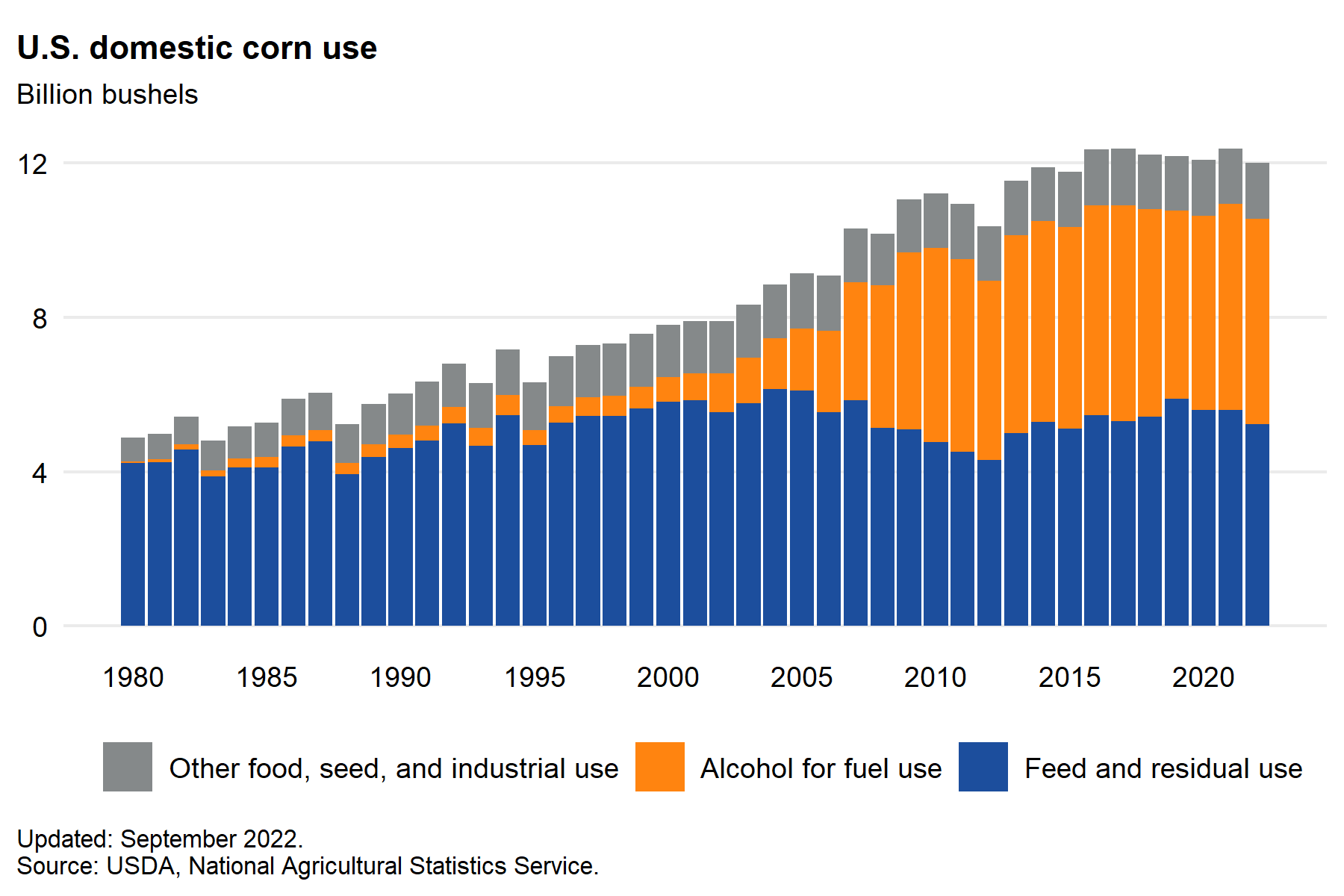
Across the United States, more than 30 million acres of farmland is currently devoted to growing corn for a purpose other than feeding humans and animals. The corn – over 5 billion bushels every year — is processed into ethanol and then added to gasoline to comply with a federal mandate.

The U.S. Renewable Fuel Standard (RFS), enacted in 2005, requires the nation’s oil refiners to mix 15 billion gallons of corn-based ethanol into the nation’s gasoline supply annually; this is the reason why most gasoline sold in the U.S. includes 10% ethanol. The mandate was intended to cut U.S. dependence on energy imports, support farmers and reduce emissions. 

As it turned out, the RFS was primarily successful in increasing the acreage devoted to growing corn. Because of the ethanol mandate, an additional 6.9 million acres of corn were planted between 2008 and 2016. Corn is now the nation’s number one crop and, according to the U.S. Department of Agriculture, ethanol production accounts for 45% of the U.S. corn crop. Most of the rest goes to animal feed, with only 15% destined for human consumption. (A mere half of one percent of the total corn crop is sweet corn, a different plant entirely.) 

As a way to reduce emissions, however, the mandate proved a failure. A study funded by the U.S. Department of Energy and the National Wildlife Federation concluded that ethanol is at least 24% more carbon-intensive than gasoline, once land use impacts are factored in. 

It’s a bad deal for taxpayers, too. In addition to the ethanol mandate, the U.S. government subsidizes corn farmers through the federal crop insurance program, with taxpayers covering an average of 62% of the cost of insurance premiums. More than a quarter of the insurance subsidy goes to corn, and very little goes to small farms. Add to this the many concerns about water use, fertilizer, pesticides and land degradation, and it is hard to find much good in the corn ethanol program.

EVs threaten King Corn

The world is a different place now than it was in 2005, with the U.S. having become the largest oil producer in the world and a net exporter. Yet the ethanol subsidy is fiercely guarded by the corn lobby and, in spite of occasional bipartisan efforts at repeal, it seems to be untouchable politically. Indeed, last year’s Inflation Reduction Act, passed by Democrats, actually contains new credits for biofuel production that corn-state Republicans are keen on keeping even as they continue to seek rollbacks of other clean energy incentives. 

The biggest threat to the corn lobby, though, isn’t a repeal of the mandate, it’s electric vehicles. When people no longer need gasoline, they can no longer be forced to buy corn ethanol. 

Electric vehicle sales reached 5% of the U.S. new car market in 2022, and already this year they’ve hit 8.6%. JD Power projects 70% of new vehicles will be electric by 2035, with California leading the way at 94% by then. 

Many agricultural communities are in denial about EVs, preferring to believe they will never catch on in numbers enough to threaten the importance of the corn crop. And indeed, it will take decades before the last gasoline-powered cars drive off to the junkyard. But most of us can see the writing on the wall. As more vehicles become electric, more land that is now devoted to corn ethanol will become available for other purposes. 

While the ethanol industry looks to jet fuel and other possible new uses for its product, a far more promising “crop” is renewable energy. Planting wind turbines and solar panels, either alone or combined with actual crops that feed people, provides higher returns with less risk and is better for the planet. 

“Planting” more solar energy instead of corn

Wind turbines already coexist with farmland across the Great Plains, but let’s focus on solar, since that is the form of renewable energy best suited to Virginia’s landscape. Solar energy is somewhat land-intensive, but not compared to corn. A decade ago, the National Renewable Energy Laboratory calculated that we could power the country’s entire electricity demand with 10 million acres of solar panels. That’s only one-third of the land now devoted to corn ethanol. 

Since that study, solar efficiency has increased, while electricity demand has risen only modestly. With the electrification of vehicles, buildings, and everything else that can be electrified, however, electricity demand is likely to double. But even if we had no wind energy, hydropower or nuclear, and we needed 20 million acres of solar to meet the demand, that would represent only two-thirds of the land currently devoted to corn ethanol, leaving millions of acres more freed up for food crops, land conservation and rewilding.

A comparison of the energy yield of corn vs. solar shows why displacing ethanol with solar energy would be a welcome change.  An acre of corn yields 328 gallons of ethanol, which is one-third less efficient than gasoline. If you could run an internal combustion automobile entirely on ethanol (you can’t), a car averaging 40 miles per gallon could go 8,738 miles on an acre of corn. 

But that same acre “planted” in solar panels would yield 394-447 MWh per year of electricity. Even at the low end, that’s enough to power a Tesla Model 3 for over 100,000 miles.

Much of the corn crop is grown in places like Iowa and Nebraska, but even here in Virginia, 540,000 acres were planted in corn last year, second only to soybeans. Assuming 45% of Virginia’s crop goes to corn ethanol (I could not find an actual breakdown by state), that amounts to 243,000 acres that could be put to better use. That’s worth keeping in mind for the next time someone frets about farmland being “lost” to solar development.

Solar is also a more reliable crop, and a better one for small farmers. The profitability of corn growing varies by state and by year, but it is never exactly a lucrative business for any but the largest farm operations. In a good year, such as 2022, corn might return a profit of $450 per acre, minus land rents (or taxes). In a down year, such as the current one, returns can be negative once land costs are accounted for. (Rents vary considerably, averaging about $325 per acre.)

Meanwhile, solar lease rates range from $250 to $2000 per acre, depending on location and suitability. A guaranteed payment for 20 or 30 years with no work involved is a pretty attractive deal. Even putting just a portion of a farm into solar provides a form of insurance, guaranteeing a steady income flow regardless of weather and commodity price swings.

Solar is also a better deal than corn for the community, since it provides tax revenue, diversifies the local economy and conserves water. If the developer plants pollinator-friendly species around the solar panels or uses sheep instead of machinery to control grass, the benefits to the local economy increase further. 

The ethanol industry is already looking for new uses for their product, but if they don’t find takers, it is one fuel we don’t need to mourn losing.

This article first appeared in the Virginia Mercury on September 19,2023.

Unknown's avatar

Questions Dominion didn’t answer at its shareholder meeting

Dominion Energy headquarters, Richmond, VA

Dominion Energy held its annual shareholder meeting virtually on May 5. Prior to the meeting, some shareholders submitted questions to the company in hopes of getting better transparency about its thinking regarding a range of pressing questions facing both the company and society at large. In an article that ran in the Virginia Mercury the week before the meeting, I offered a list of questions I’d really like answers to as well. 

I wasn’t able to attend the shareholder meeting, but I understand the questions mostly did not get answers at that time, with the exception of a non-sequitur CEO Bob Blue offered up in response to a question about third-party sales of renewable energy (read on!).  The company has promised to email responses to the people who submitted questions. 

Here are my questions:

1. We learned in Dominion’s Integrated Resource Plan (IRP) case last year that the Virginia City Hybrid Energy Center, the coal plant it owns in Wise County, has a 10-year net present value of negative $472 million. Why isn’t Dominion retiring it immediately to save money and reduce the number of emission allowances it has to buy now that Virginia has joined the Regional Greenhouse Gas Initiative?

2. In last year’s IRP, Dominion’s preferred scenario would have it keeping its gas plants open indefinitely, even past 2045, when the Virginia Clean Economy Act requires them to be closed. The refusal to plan for full compliance with the law almost certainly impacts the decisions Dominion is making today. Now that Bob Blue has taken over the reins of Dominion from former CEO Tom Farrell, has that changed, and can we expect Dominion to take actions consistent with a full phase-out of fossil fuels before 2045?

3. The energy transition will require construction of tens of thousands of megawatts of solar on hundreds of thousands of acres of land across Virginia. However, community resistance to utility-scale solar farms in Virginia is growing, in large part because they look more like industrial uses than like agricultural uses. As a result, some projects are not being permitted, a costly waste of the company’s time and resources. It’s possible to combine solar with traditional agricultural uses like animal grazing, or to install native plants to support pollinators and provide wildlife habitat, both of which would increase community acceptance. Dominion installs pollinator plantings along some of its transmission line rights-of-way, so the company has experience in this area. Will Dominion begin doing this at its solar projects? If not, what is Dominion doing to “sweeten the pot” for local communities in order to secure permits? 

4. Dominion offers residential customers the option of a renewable energy product that includes biomass energy, a source that is not carbon-free and produces more air pollution than coal. The inclusion of biomass also makes the tariff more expensive than it would be without biomass. In contrast to this unattractive option, two years ago Dominion received SCC approval to sell solar to residential customers via a “community solar” product. This would have appealed to far more customers, but Dominion never followed through.  Why not? 

5. With no solar option available, residents who don’t own a house with a sunny roof are currently shut out of the solar market in Dominion’s Virginia territory. In 2019 and 2020 the General Assembly considered legislation that would have allowed customers to buy renewable energy from third party providers. The bill passed the House each year but failed in a Senate committee due to Dominion’s opposition. If Dominion isn’t interested in selling solar to its customers today, why not let them buy it from others? 

Mr. Blue reportedly answered this question at the meeting by exclaiming, “Because deregulated markets don’t work, they fail! Look at Texas!” 

I can, with difficulty, draw a line from the question to Blue’s answer, but it is not a straight one. Nor is it an honest one, since the causes of the Texas debacle don’t apply here (beyond a similar overreliance on natural gas). 

Here is the answer that is most probably true: “We threw together our so-called renewable energy offering for the sole purpose of blocking out competitors, and the SCC stupidly let us get away with it. If we cared about climate change, we would offer a clean renewable energy product people actually want, but we only care about profit. That requires us to keep our customers locked in, but nothing says we have to make them happy.”

But because hope springs eternal, I’ll also add an answer that I would much prefer Mr. Blue to give: “Under my new leadership, we are taking climate science seriously and will develop the renewable energy options our customers want. My goal is to offer a solar tariff so good that none of our customers will want to look elsewhere, and the question will become moot.”

6. According to Dominion’s 2020 IRP, data centers make up 12 percent of Dominion’s load in Virginia, a number that has been increasing by 20 percent per year. Data center operators say they want renewable energy but have trouble getting it from Dominion. The biggest tech companies negotiate deals for solar, but smaller customers have fewer attractive options. What is Dominion doing to ensure that data centers have access to solar energy at attractive market rates?

Notice how the answers to the previous question apply here. Dominion has a huge opportunity to lead on climate, requiring only that the company actually care.

7. A year ago Dominion canceled the Atlantic Coast Pipeline, losing the almost $3 billion already spent on the project but saving the additional $5 billion-plus it would have cost to complete the project. About the same time, Dominion sold off its entire gas transmission business, indicating it had come to see pipelines as poor investments. This makes sense since the company already gets all the gas it needs through existing pipelines, and going forward, climate policies and the increasing competitiveness of renewable energy and battery storage mean gas use will decline. But then the company contracted for 12.5% of the shipping capacity of the Mountain Valley Pipeline through its subsidiary Public Service Company of North Carolina, at a cost of at least $50 million per year. How can the company justify this investment? Is there an exit clause in the contract, or will shareholders suffer in the event the company is not allowed to pass this cost on to ratepayers?

8. Dominion is currently pursuing relicensing of its two aging nuclear reactors at North Anna, which are already beyond their 40-year design life. According to the 2020 IRP, Dominion plans to run the North Anna reactors, as well as its two reactors in Surry County, at least through 2045, the period covered by the IRP. Nuclear is a carbon-free resource, but so are wind and solar, and nuclear plants in other states are closing because they are no longer economically competitive. What will it cost Dominion to refurbish these nuclear plants to keep them in operation safely so far beyond their design life? And what will it cost the company if, in spite of refurbishing, one or more of the reactors can’t pass a safety inspection, or even suffers a major failure?

9. Millions of customers in Virginia, North Carolina and South Carolina are at risk from hurricanes and other weather events that can knock out power for many days at a time. Today, onsite solar-plus-storage can keep critical facilities operating and allow community centers and schools to serve local residents who have lost power, ensuring they have a place to store medicines that need refrigeration and to charge cellphones, motorized wheelchairs and other devices. If Dominion were to supply the batteries for these facilities, the company could access them for grid storage and services when they are not needed as backup power. In addition to offering a new profit center, it would relieve some of the pressure on line crews who work to restore power after a storm. When will Dominion offer this lifesaving service to its customers? 

10. Electric vehicle charging will increase demand for electricity in Virginia, and it also offers an opportunity for the company to deploy vehicle-to-grid technology, making use of the batteries in buses and private vehicles to help balance the grid. Virginia’s General Assembly rejected legislation that would have allowed Dominion to own and control the batteries in school buses in Virginia, but it passed a bill to help local school districts buy electric buses. Will Dominion now support the ability of the school districts to buy electric school buses and own the batteries themselves, and work with them to implement a vehicle-to-grid program? 

Unknown's avatar

There’s a lot to like in Northam’s energy plan, but missed opportunities abound

electric vehicle plugged in

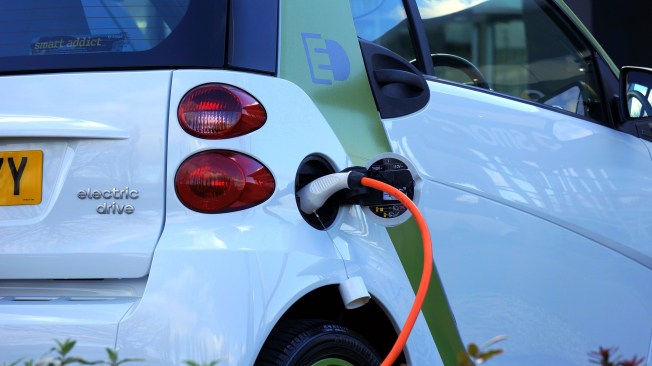
Vehicle electrification gets a boost under the energy plan.

There is a lot to like in the Northam Administration’s new Virginia Energy Plan, starting with what is not in it. The plan doesn’t throw so much as a bone to the coal industry, and the only plug for fracked gas comes in the discussion of alternatives to petroleum in transportation.

The 2018 Energy Plan is all about energy efficiency, solar, onshore wind, offshore wind, clean transportation, and reducing carbon emissions. That’s a refreshing break from the “all of the above” trope that got us into the climate pickle we’re in today. Welcome to the 21stcentury, Virginia.

But speaking of climate, the Intergovernmental Panel on Climate Change (IPCC) just released a special report that makes it clear we need “rapid, far-reaching and unprecedented changes in all aspects of society” to keep warming below 1.5 degrees Celsius. That’s only half again the amount of warming that has already brought us melting glaciers, a navigable Arctic Ocean, larger and more destructive hurricanes, and here in Virginia, the swampiest summer in memory. The fact that things are guaranteed to get worse before they get better (if they get better) is not a happy thought.

Perhaps no Virginia politician today has the courage to rise to the challenge the IPCC describes. Certainly, Governor Northam shows no signs of transforming into a rapid-change kind of leader. But as we celebrate the proposals in his Energy Plan that would begin moving us away from our fossil fuel past, we also have to recognize that none of them go nearly far enough, and missed opportunities abound.

Let’s start with the high points, though. One of the plan’s strongest sections champions offshore wind energy. It calls for 2,000 megawatts (MW) of offshore wind by 2028, fulfilling the potential of the area of ocean 27 miles off Virginia Beach that the federal government leased to Dominion Energy. In the short term, the Plan pledges support for Dominion’s 12-MW pilot project slated for completion in 2020.

Other East Coast states like Massachusetts and New York have adopted more ambitious timelines for commercial-scale projects, but the economics of offshore wind favor the Northeast over the Southeast, and they aren’t saddled with a powerful gas-bloated monopoly utility.  For Virginia, a full build-out by 2028 would be a strong showing, and better by far than Dominion has actually committed to.

Another strong point is the Administration’s commitment to electric vehicles. The transportation sector is responsible for more carbon emissions even than the electric sector, and vehicle electrification is one key response.

Even better would have been a commitment to smart growth strategies to help Virginians get out of their cars. Overlooking this opportunity is a costly mistake, and not just from a climate standpoint. Today’s popular neighborhoods are the ones that are walkable and bikeable, not the ones centered on automobiles. If we want to create thriving communities that attract young workers, we need to put smart growth front and center in urban planning—and stop making suburban sprawl the cheap option for developers.

Speaking of developers, how about beefing up our substandard residential building code? Lowering energy costs and preparing for hotter summers requires better construction standards. Houses can be built today that produce as much energy as they consume, saving money over the life of a mortgage and making homes more comfortable. The only reason Virginia and other states don’t require all new homes to be built this way is that the powerful home builders’ lobby sees higher standards as a threat to profits.

The Energy Plan mentions that updated building codes were among the recommendations in the Virginia Energy Efficiency Roadmap that was developed with funding from the U.S. Department of Energy and published last spring. I hope the only reason the Energy Plan doesn’t include them among its recommendations is that the Administration is already quietly taking action.

Meanwhile, it is not reassuring to see that the section of the plan devoted to attaining Virginia’s ten percent energy efficiency goal simply describes how our utilities will be proposing more efficiency programs as a result of this year’s SB 966 (the “grid mod” bill).

States that are serious about energy efficiency don’t leave it up to companies whose profits depend on a lack of efficiency. They take the job away from the sellers of electricity and give it to people more motivated. So if the Governor’s plan is merely to leave it up to Dominion and APCo without changing their incentives, we should abandon all hope right now.

Indeed, it is strange how often the Energy Plan finishes an in-depth discussion of an issue with a shallow recommendation, and frequently one that has the distinct odor of having been vetted by Dominion.

That observation leads us straight to grid modernization. The plan opens with a very fine discussion of grid modernization, one that shows the Administration understands both the problem and the solution. It opens by declaring, “Virginia needs a coordinated distribution system planning process.” And it notes, “One important rationale for a focus on grid modernization is that the transitions in our electricity system include a shift away from large, centralized power stations to more distributed energy resources.”

Well, exactly! Moreover: “The grid transformation improvements that the Commonwealth is contemplating include a significant focus on the distribution system, but our current resource planning process (Integrated Resource Plan or IRP) does not fully evaluate the integration of these resources. One overarching focus of this Energy Plan is the development of a comprehensive analysis of distributed energy resources.”

But just when you feel sure that the plan is about to announce the administration is setting up an independent process for comprehensive grid modernization, the discussion comes to a screeching halt. The plan offers just one recommendation, which starts out well but then takes a sudden turn down a dead-end road:

To ensure that utility investments align with long-term policy objectives and market shifts, Virginia should reform its regulatory process to include distribution system level planning in Virginia’s ongoing Integrated Resource Planning requirement.

Seriously? We need regulatory reform, but we will let the utilities handle it through their IRPs? Sorry, who let Dominion write that into the plan?

It’s possible the Administration is punting here because it doesn’t want to antagonize the State Corporation Commission (SCC). The SCC pretty much hated the grid mod bill and resented the legislation’s attack on the Commission’s oversight authority. And rightly so, but let’s face it, the SCC hasn’t shown any interest in “reforming the regulatory process.”

The Energy Plan’s failure to take up this challenge is all the more discouraging in light of a just-released report from the non-profit Grid Lab that evaluates Dominion’s spending proposal under SB 966 and finds it sorely lacking. The report clearly lays out how to do grid modernization right. It’s disheartening to see the Administration on board with doing it wrong.

Dominion’s influence also hobbles the recommendations on rooftop solar and net metering. This section begins by recognizing that “Net metering is one of the primary policy drivers for the installation of distributed solar resources from residential, small business, and agricultural stakeholders.” Then it describes some of the barriers that currently restrain the market: standby charges, system size caps, the rule that prevents customers from installing more solar than necessary to meet past (but not future) demand.

But its recommendations are limited to raising the 1% aggregate cap on net metering to 5% and making third-party power purchase agreements legal statewide. These are necessary reforms, and if the Administration can achieve them, Virginia will see a lot more solar development. But why not recommend doing away with all the unnecessary policy barriers and really open up the market? The answer, surely, is that Dominion wouldn’t stand for it.

Refusing to challenge these barriers (and others—the list is a long one) is especially regrettable given that the plan goes on to recommend Dominion develop distributed generation on customer property. Dominion has tried this before through its Solar Partnership Program, and mostly proved it can’t compete with private developers. If it wants to try again, that’s great. We love competition! But you have to suspect that competition is not what this particular monopoly has in mind.

The need to expand opportunities for private investment in solar is all the more pressing in light of the slow pace of utility investment. Legislators have been congratulating themselves on declaring 5,000 megawatts (MW) of solar and wind in the public interest, and the Energy Plan calls for Dominion to develop 500 MW of solar annually. I suspect our leaders don’t realize how little that is. After ten years, 5,000 MW of solar, at a projected capacity factor of 25%, would produce less electricity than the 1,588-MW gas plant Dominion is currently building in Greensville, operating at a projected 80% capacity.

Offshore wind capacities are in the range of 40-45%, so 2,000 MW of offshore wind will produce the amount of electricity equivalent to one of Dominion’s other gas plants. It won’t quite match the 1,358-MW Brunswick Power Station, or even the 1,329-MW Warren County Power Station, but Dominion also has several smaller gas plants.

But at this point you get the picture. If all the solar and wind Virginia plans to build over ten years adds up to two gas plants, Virginia is not building enough solar and wind.

That gets us back to climate. The Administration can claim credit for following through on developing regulations to reduce carbon emissions from power plants by 30% by 2030, using the cap-and-trade program of the Regional Greenhouse Gas Initiative (RGGI) of the northeastern states. If successful, that still leaves us with 70% of the carbon emissions in 2030, when we need to be well on our way to zero. And for that, we don’t have a plan.

Of course, Ralph Northam has been Governor for only nine months. He has some solid people in place, but right now he has to work with a legislature controlled by Republicans and dominated by Dominion allies in both parties, not to mention an SCC that’s still way too fond of fossil fuels. Another blue wave in the 2019 election could sweep in enough new people to change the calculus on what is possible. In that case, we may yet see the kind of leadership we need.


This article first appeared in the Virginia Mercury on October 15, 2018.

Unknown's avatar

General Assembly chews on, spits out healthy legislation, while still trying to digest a huge hunk of pork

They just keep getting fatter.

If you were bewildered by the sheer volume of bills addressing solar, efficiency, storage, and other energy topics that I outlined last month, take heart: clean energy advocates don’t have nearly as many bills to keep track of now. So few bills survived the Finance and Commerce and Labor Committees that it will be easier to talk about what is left than what got killed.

The bigger story, of course, is the Dominion Ratepayer Rip-Off Act of 2018, which the utility would dearly love you to think of as the “grid modernization bill,” but which might be better imagined as an oozing pork barrel. Recent amendments do make it less obnoxious than it was last week (begging the question of why it wasn’t introduced that way in the first place). The Governor now says he supports the bill, the Attorney General continues to oppose it, and the SCC keeps issuing poisonous analyses.

But right now let’s just run down the fate of the other bills we’ve been following. For explanations of these bills, see previous posts on solar; efficiency, storage and EVs; and energy choice, carbon and coal.

Of the bills affecting customer-sited solar, only a handful remain:

  • HB 1252 (Kilgore), expanding the pilot program for third-party PPAs in APCo territory to cover all nonprofits and local government: amendment ensures current Dominion pilot is unchanged, passes the House, goes to the Senate
  • HB 1451 (Sullivan), allowing a school district to attribute surplus electricity from a solar array on one school to other schools in the district: amendment turns it into a pilot program, passes House C&L
  • SB 191 (Favola), allowing customers to install solar arrays large enough to meet 125% of previous demand (up from 100% today): amended to exclude customers in coop territory*, passes Senate C&L

Delegate Toscano’s bills promoting energy storage remain alive. HB 1018, offering a tax credit for energy storage devices, passed a House Finance subcommittee last week with an amendment to delay its start date to 2020. HJ 101, calling for a study, passed Rules but then was sent to Appropriations, where it was to be heard yesterday. (The Legislative Information Service does not yet show its fate.)

HB 922 (Bulova), allowing localities to install EV charging stations, has been reported from General Laws with amendments. The companion bill, SB 908 (McClellan) passed the Senate.

The Rubin Group’s land use bills passed their respective houses with amendments. The bills are SB 429 (Stanley), its companion bill HB 508 (Hodges), SB 179 (Stanley) and companion bill HB 509 (Hodges).

All other customer-focused solar bills died. So did energy efficiency goals, the mandatory renewable portfolio standard, LED light bulb requirements, and tax credits for EVs and renewable energy. Direct Energy’s energy choice legislation died in both House and Senate in the face of Dominion’s opposition, in spite of an astonishingly diverse array of business supporters; even the support of Conservatives for Clean Energy was not enough to garner any Republican votes in the House C&L subcommittee.

Republicans also killed the Governor’s RGGI bills while passing Delegate Poindexter’s anti-RGGI bill, HB 1270, in the House. Delegate Yancey’s anti-regulation HB 1082, appears to be alive in a subcommittee, though Delegate Freitas’ anti-regulation bill died, and Senator Vogel’s effort to change the constitution to allow legislative vetoes of regulations died in committee.

Delegate Kilgore’s HB 665, restoring tax subsidies to coal companies to facilitate destroying Virginia mountains, passed House Finance on a party-line vote. Shockingly, Senator Chafin’s similar bill, SB 378, passed the Senate with support from Democrats Marsden, Petersen, Edwards, Dance, Lewis, Mason and Saslaw.

So once again, in spite of a remarkable election that swept progressive Democrats into the House and nearly upended Republican rule, clean energy advocates have done poorly this year. Some of their priorities are now part of the Dominion pork barrel legislation, to be sure. But that legislation enables utility solar and utility spending; it does nothing for customer-owned renewable energy, market competition, climate action, or consumer choice.

Dominion still rules the General Assembly, though the legislators who voted in line with the utility’s wishes won’t admit it—or give any other explanation. The Republican members of the House Commerce and Labor subcommittee slashed their way through the pro-consumer bills with ruthless efficiency, and did not bother explaining their votes. (A special shout-out goes to Democratic delegates Kory, Ward, Heretick and Bourne for just as stubbornly voting in support of the good bills.)

But over in Senate C&L, chairman Frank Wagner tried to maintain the pretense that he was merely “referring” his colleagues’ bills to the Rubin Group instead of actually killing them.

The closed-door, private, invitation-only, utility-centric Rubin Group has no legislators among its members and proposes only changes to the law that all its members like, so “sending” a bill there that the utilities oppose is pure farce. Yet that was the fate of Senator Edwards’ bills on third party PPAs, agricultural net metering, and community solar, and Senator Wexton’s community solar bill. Wagner instructed these Senators to “work with” the Rubin Group on their bills. None of the other committee members objected.

But it’s not like the Rubin Group achieved much, either. Its hallmark legislation putting 4,000 MW of utility solar in the public interest got thrown into the Dominion pork barrel (and was later upped to 5,000 MW), along with energy efficiency bills designed to eliminate the SCC’s over-reliance on the RIM test, requirements for utility spending on energy efficiency, and Delegate Habeeb’s nice battery storage pilot program. They all became tasty morsels designed to offset legislators’ queasiness over the ratepayer rip-off and, not incidentally, to maneuver advocates and bill patrons into supporting Dominion’s bill as the only way to get their own legislation passed into law.


Unknown's avatar

More 2018 bills: energy efficiency, storage, and electric vehicles


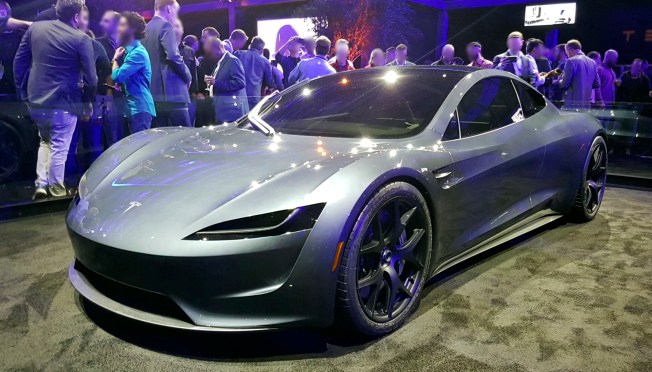
This prototype of the 2020 Tesla Roadster is not among the EVs available for test drives at Conservation Lobby Day. I’m using the picture anyway because it is as close as I will ever come to owning one. Photo credit Smnt via Wikimedia Commons.

My post last week covered the significant renewable energy bills, especially solar bills, introduced by the end of the first week of the 2018 legislative session. In this post I tackle three other bill categories of interest to clean energy advocates: energy efficiency, energy storage, and electric vehicles.

There is more to some of these bills than my brief description indicates; I just highlight the points I think are most interesting. Also, as with the solar bills, there may be more bills added in the coming week, so keep checking back for updates.

Energy Efficiency

Virginia’s woeful performance on energy efficiency was the subject of a recent guest post here by my colleague Melissa Christensen. A number of legislators have tried in recent years to turn this around, with remarkably little success.

Delegate Rip Sullivan has worked as hard as anyone on finding legislative fixes. He has several efficiency bills this year. HB 963 is the most impactful, requiring electric and gas utilities to meet energy efficiency targets, and to submit plans to the State Corporation Commission (SCC) for its approval describing how they will achieve the targets. The bill would also require utilities and the SCC to prioritize money-saving efficiency measures over proposals for new generation or transmission facilities.

Taking a narrower approach to the problem, two other Sullivan bills address the four tests the SCC uses to determine whether to approve an energy efficiency program proposed by a utility. The SCC has relied on the Ratepayer Impact Measure (RIM) test to reject programs that otherwise would provide cost-effective energy savings. HB 964 removes the RIM test from the list of tests the SCC is required to consider when determining that an energy efficiency program proposed by an electric utility is in the public interest. Instead, the SCC would consider whether the net present value of a program’s benefits exceeds the net present value of its costs as determined under the Total Resource Cost Test, the Utility Cost Test, and the Participant Test.

Taking a different tack, HB 965 defines the Total Resource Cost Test as a test to determine if the benefit-cost ratio of a proposed energy efficiency program or measure is greater than one. An energy efficiency program or measure that meets the Total Resource Cost Test is declared to be in the public interest. If it fails the test, it would then be reviewed under the other tests.

Delegate Tim Hugo’s HB 1261 proposes another way to undercut the SCC’s over-reliance on the RIM test. The bill provides that an energy efficiency program proposed by an electric utility is in the public interest if the net present value of the benefits exceeds the net present value of the costs as determined by any three of the existing law’s four benefit-cost tests. At least, that is surely the intent. Other reviewers say the bill’s wording could potentially be interpreted in a way that undermines its intent.

Two other Sullivan bills also deserve mention. HB 560 establishes a revolving fund to provide no-interest loans to any locality, school division, or public institution of higher education for energy conservation or efficiency projects. HB 204 would allow localities to adopt ordinances to assist commercial building owners in getting energy usage data for tenants in the building.

Finally, Delegate Bell’s HB 58 would generally require state agencies to use LED bulbs instead of incandescent light bulbs for new outdoor lighting fixtures or when replacing bulbs in existing fixtures.

Energy storage

Energy storage is one of the hot topics in energy today. In most states, the focus is on advanced battery technology, which can take the form of battery packs small enough for residential and commercial customers, or arrays large enough to provide utilities with an alternative to new generating plants. The value of customer-sited battery systems goes beyond being able to use solar energy at night; batteries can also provide grid services and help communities prepare for widespread power outages caused by storms or attacks on the grid.

In Virginia, Dominion Energy currently seems more interested in pumped storage hydropower, a decades-old technology that uses reservoirs to store surplus energy, traditionally energy generated at night from coal and nuclear plants, for use in the daytime. A 2017 law gives Dominion support for pumped storage using old coal mines, potentially a boost for the economy of Southwest Virginia but an unproven technology rife with questions about its economic viability and environmental impacts.

At any rate, energy storage will be playing an increasingly important role in Virginia as elsewhere, and three of this year’s bills address it. Delegate Toscano’s HB 1018 seeks to incentivize customer acquisition of energy storage systems with a tax credit of 30% of an energy storage system’s cost, up to $5,000 for a residential storage system or $75,000 for a commercial system. Delegate Habeeb’s HB 782 addresses energy storage at the utility level. It requires the SCC to establish a pilot program under which Dominion and APCo would submit proposals to deploy batteries, up to 10 MW for APCo and up to 30 MW for Dominion.

HJ 101 (Toscano) is a study bill. It tasks the Department of Mines, Minerals and Energy with conducting a two-year study to determine what regulatory reforms and market incentives are necessary to increase the use of energy storage devices in Virginia (including pumped storage hydropower).

Electric Vehicles

As with battery storage, electric vehicle technology is only just starting to register as an important topic in Virginia, and its impact—on utilities, the grid, air pollution and the economy—is just beginning to be discussed. This may be the year legislators become engaged. DriveElectric RVA, an electric vehicle advocacy group, plans to offer test drives of EVs at the capitol on January 22, Conservation Lobby Day.

Three bills deal with EVs this year. HB 469 (Reid) offers a tax credit of up to $3,500 for purchase of a new electric vehicle. HB 922 authorizes local governments to install charging stations and charge for the electricity (individuals and businesses can already do so). HJ 74 (Reid) requires a study of the impacts of vehicle electrification, including on workers in the automotive repair industry. One of the selling points for EVs is that they require minimal maintenance.