Unknown's avatar

Offshore oil drilling in Virginia: undead and ugly

Photo: U.S. Coast Guard

Drilling for oil off Virginia’s coast is once again a possibility, popping up like a zombie when we thought it was dead (again). As the New York Times reported, “Efforts are focusing on Virginia because the public, politicians in both parties and energy companies all favor opening the waters to drilling.”

It will be news to many members of the Virginia public that we favor drilling off our coast, but there’s no doubt that oil companies are itching to open the Atlantic coast to drilling rigs, and plenty of Virginia politicians make it a talking point. Senators Warner and Webb are on board, as is Senator-elect Tim Kaine. Most famously, Governor McDonnell came into office dreaming of the highways he would build when his tanker ship came in.

For oil companies, Virginia is the thin edge of the wedge. Our share of federal waters is quite small because of the odd way that boundary lines are drawn. Virginia is targeted mainly as a means of cracking the line of resistance created by other eastern states. It’s a shame so many of our politicians are eager to help in the cracking.

It used to be that when Democrats and Republicans agreed on something, that improved the odds of it being a good idea. These days, it often just means they are taking money from the same corporations. Money alone may not buy a politician’s votes, but it most certainly buys lobbyists access to politicians, and access has a way of producing votes. So perhaps the surprise is not how many politicians have jumped on the drill-baby-drill bandwagon, but how many have not.

Some naysayers, including Congressman Gerry Connolly (D-Fairfax), point out that drilling off our coast is opposed by the U.S. Navy, which uses most of Virginia’s leasing area for its operations. These include testing air and surface missiles and bombs, which traditionally don’t pair well with oil rigs and tankers. (On the other hand, the Navy supports offshore wind farms, which would be located away from operations.)

Other legislators, like Congressman Bobby Scott (D-Newport News) oppose drilling because of the environmental hazards, and the danger posed to fishing and tourism.

Of course, no politician will admit to being unconcerned about the environment, including the ones who are very obviously unconcerned about the environment. This is why they say they support “environmentally safe offshore oil drilling.” The phrase is so familiar that we have come to take it for granted, but it actually bears some thinking about. Saying he supports “safe oil drilling” suggests a politician has in mind another kind of oil drilling–the unsafe kind–that he would not support.

But you’d be hard-pressed to find any restrictions on the drilling industry that the drill-baby-drill crowd supports. These politicians considered offshore drilling “environmentally safe” right up to the day millions of barrels of oil began gushing into the Gulf of Mexico and causing billions of dollars’ worth of damage. Drilling methods haven’t changed since the Deepwater Horizon disaster, and oil spills have continued to occur in the Gulf and elsewhere.

So let’s put in a plug for Truth in Advertising. Politicians, if you think extra American oil is worth the occasional catastrophic oil spill, then say so. Pretending there will never again be another Deepwater Horizon makes you look out of touch with reality, and the fact that a significant proportion of the voters are also out of touch with reality is not an excuse.

If you’re okay with drilling, tell us your Plan B for Virginia: how you would deal with the effects of a spill that fouls our coastline, kills wildlife, and contaminates everything that lives in the ocean, over an area that could be hundreds or thousands of square miles. If winds and tides spread the contamination onto Assateague Island or into the Chesapeake Bay, what’s your plan?

The folks in our commercial and fishing industries, and all the people who live and work in beach towns, should hear you talk about how confident you are in their ability to get by for a season on government handouts; if there’s longer-lasting damage, how maybe they can move to Northern Virginia and work in retail. I’m sure you can make it sound appealing.

And if you can’t, then maybe it’s time to kill the drilling zombie for good. You may be taking money from oil companies, but your job is to look out for Virginia.

Unknown's avatar

Mother Nature to be sued for copyright infringement

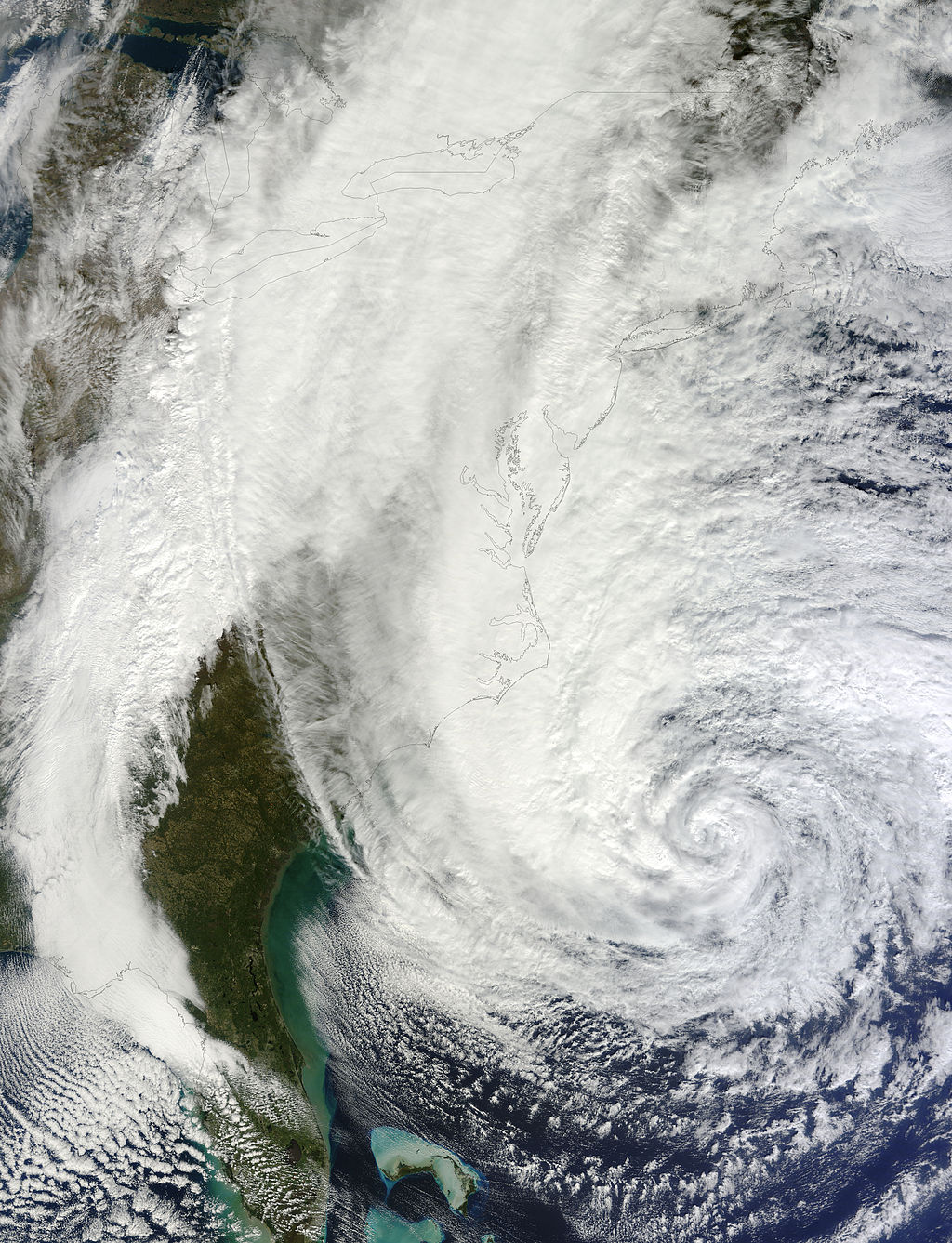
Hurricane Sandy, in an image clearly copied from “The Day After Tomorrow”

To: Mother Nature, d/b/a “Hurricane Sandy”

Re: Copyright infringement

Dear Ms. Nature,

It has come to our attention that you and/or your agents have made unauthorized use of certain intellectual property belonging to our client, Twentieth Century Fox Film Corporation (“Fox”), including images, illustrations, plotlines, audio and video unlawfully appropriated from “The Day After Tomorrow,” a motion picture owned by Fox. This letter is to notify you that we believe your actions constitute a violation of U.S. copyright law, 17 U.S.C. § 101 et seq.

It is clear that the plotline of Hurricane Sandy has been substantially copied from portions of “The Day After Tomorrow.” The motion picture is a dramatization in which a storm of epic proportions bears down on the eastern United States, causing massive destruction and widespread flooding, including in Manhattan. Scientists in the movie say human-induced climate change is the reason for the storm’s unusual size and damaging force.

Your agent, Hurricane Sandy, was a storm of epic proportions that bore down on the eastern United States, causing massive destruction and widespread flooding, including in Manhattan. Scientists in real life say human-induced climate change is the reason for the storm’s unusual size and damaging force.

Certain scenes from Hurricane Sandy appear to be copied directly from portions of the motion picture. Photographs taken during and after your storm depict waves swamping buildings, taxicabs in floodwaters up to the windows, lower Manhattan completely dark, and a flooded subway system—images closely replicating events in “The Day After Tomorrow.” We believe this demonstrates a clear infringement of our client’s copyright.

Moreover, we feel it is incumbent on us to point out that your actions in turning a fictional and hypothetical entertainment into actual fact violate the expectations of the public that climate change is and will remain a matter of mere speculation concerning events that are firmly in the future. The American audience expects the continued burning of fossil fuels to produce entertaining epics like “The Day After Tomorrow,” while having no actual effect whatsoever on their lives. Your insistence on demonstrating that a warming ocean will produce larger and more damaging hurricanes is, frankly, in poor taste.

This letter will serve as notice of our intent to pursue any and all remedies available to our client under applicable law, including an injunction against further infringing activities.

Yours truly,

I.M. Cole

Law Offices of Cole & Oyle, LLC

Unknown's avatar

Coal and the big lie

Hurricane Sandy swept into town this week, reminding Americans that climate change may be the Issue That Cannot Be Talked About, but that doesn’t mean it has gone away. Suddenly the fact that the two presidential candidates have been trying to outdo each other in professing their love for coal comes across as unseemly, if not downright perverse. Surely this would be a good time to acknowledge the impossibility of preventing the catastrophic effects of increasing carbon emissions if we are unwilling to stop burning the things that emit carbon—chief among them, coal.

So a war on coal might be a good idea, although the idea that the Obama Administration has been waging one is nonsense. The reasons for the decline of the coal industry are primarily the flood of cheap natural gas, which is out-competing coal as a fuel for electric generation, and the increasing cost of coal, especially in Appalachia.

Indeed, the Appalachian coal industry has been on the decline for years. The richest and most easily-reached coal has been mined, leaving thin seams that take more effort and expense to extract, pushing the price of Central Appalachian coal well above that of coal from the Powder River Basin further west.

From 1990 to 2006–before the recession, before the Obama presidency, and before the price of natural gas collapsed–Virginia coal mining declined from about 10,000 workers to about 4,500.  The U.S. Energy Information Agency projects that Virginia coal production will continue to decline through the rest of this decade.

But coal executives prefer to lie to workers than admit they can’t compete in the free market, and the politicians who’ve taken hundreds of thousands of dollars from the coal companies would rather parrot their lies than admit they have failed their constituents. Coal companies and their political bedfellows have been exploiting coal miners for two centuries; it’s no surprise to see them using these workers now as pawns in the presidential campaign.

But fingering the real culprits for coalworkers’ distress is the easy part; what’s harder is helping the residents of the coalfields areas find new jobs to replace the ones that are never coming back.

Ironically, in Virginia it has been environmental groups like the Sierra Club and Appalachian Voices that have championed a plan to do just that. For several years they have been urging an end to the approximately $45 million annually in state taxpayer subsidies that currently go to enrich coal companies, and replacing them with incentives to support new jobs in tourism, technology, clean energy and other industries.

This proposal should have gotten traction last year, when a report by the state’s Joint Legislative Audit and Review Commission (JLARC) concluded that the subsidies do not achieve their goal of supporting coal employment, and indeed that  “changes in coal mining activity appear unaffected by the credits.”

One would have thought that Republicans especially might have jumped at the chance to cut $45 million per year of wasteful spending, or that Governor “Bob-for-Jobs” McDonnell would have gladly seized the opportunity to build a jobs program that did not add a new line-item to the budget.

Following the release of the JLARC study, the legislature and the Governor did act—to extend the coal company subsidies for several more years. The message to the residents of southwest Virginia could not have been any clearer: it’s the coal company executives and their money we care about, not the miners and their families.

The presidential election will be over in a few days. Regardless of who wins, the Virginia coal industry will continue its decline. The only question left is how long the miners will accept being lied to.

Unknown's avatar

What the heck is a REC? Renewable Electricity Certificates, Renewable Portfolio Standards, and why it all matters anyway

More than 30 states have Renewable Portfolio Standards (RPS) to increase the amount of renewable energy their residents use. Renewable energy does not always cost more than conventional energy, but when it does, renewable energy certificates (RECs) may provide the means for making up the cost difference. Whether RPS laws work well, or whether they cost their residents money without providing a value, depends on how well the laws are written. Policy makers, industry watchdogs, and the public all need a basic understanding of how RPS laws and the REC markets work to ensure that the laws are actually serving the public.

So what the heck is a REC?

“REC” stands for “renewable energy certificate.” A REC is a way to monetize the environmental attributes of energy from a renewable resource, so the extra value can be bought and sold independent of the electrons that form the energy itself.

We’ll use an example to make it easier to understand. Say you want to put solar panels on your roof, but you can’t because your house is shaded by tall trees. So you go to your neighbor with the sunny location next door and tell her that if she will put solar panels on her roof, you will buy the electricity from her. You work out a deal, call a solar installer, and soon she’s got a solar array that produces, on average, exactly the amount of electricity your house uses. [1]

As it happens, though, you can’t buy the actual solar energy her panels are producing. That electricity is powering her house, and any excess electricity is feeding into the grid through her meter. Once power is in the grid, it’s all just electrons. The electrons don’t look different whether they come from a coal plant or a wind farm or a solar array. So there is no way to identify and claim the specific electrons that come on the grid from specific solar panels.

What you can buy from your neighbor is the right to say you’re running your house on solar energy, up to whatever amount of power her solar panels produce. This is the essence of a renewable energy certificate. A REC doesn’t represent electricity, but rather the extra value to society of that electricity having been produced by solar panels. So you continue to buy your electricity off the grid from your utility, and then you pay your neighbor something extra for the RECs. You are not actually using solar power, but you are paying for the right to say you are.

Chances are, there won’t be any actual paper certificates involved. You will simply have a contract with your neighbor that states how much you’re paying her per kilowatt-hour. Your contract would also prevent her from making the same deal with any other neighbor, double-dipping by selling the RECs twice.

It is a short step from there to creating a whole market for RECs as a commodity. If you were to stop buying your neighbor’s RECs, she could sell them to someone else, perhaps a “green” business that wanted to say it was running its store on solar power. The price would depend on supply and demand for renewable energy in your area.

What’s a REC got to do with an RPS?

Now let’s scale up our example and add utilities to the story. Your state, it turns out, has a Renewable Portfolio Standard (RPS), a law that tells utilities that they must obtain a certain percentage of their power from renewable sources. Utilities that own their own generation sources may choose to invest in wind, solar, biomass, or other renewable generation facilities, depending on what the law defines as renewable. Utilities that don’t own their own generation, or that can’t produce enough renewable electricity, have to buy that power from others.

This is where RECs come in. When the utility offers to buy renewable power from someone who is generating it, it will want to buy the RECs as well. Buying the RECs allows the utility to demonstrate its compliance with RPS targets. Indeed, in some states, RECs are the only measure of compliance.

If the utility has to go beyond its own service area to find enough renewable energy, the RECs can take on a life of their own as they get bought and sold independently of the power generated. If the state RPS law allows it, a utility could even buy RECs from a renewable power facility that isn’t part of the same regional transmission grid. In that case, the facility sells the power to its local utility, and sells the RECs to the utility that needs them for its RPS obligations. There is no longer any connection between the electricity and its renewable attributes.

The problem with separating RECs from the energy itself

The REC market is important for making an RPS work, and it makes sense when the power generated is within the state that sets the RPS. But when a utility goes beyond the borders of a state, or even of its own service area, to buy RECs, the usefulness of the program to ratepayers declines, and the likelihood of double-counting and confusion increases.

Let’s go back to our example of the two houses. You have a contract with your neighbor to buy the RECs from her solar panels. Buying the RECs gives you the right to say you are powering your home with solar power. But here’s the rub: now that you’ve bought her RECs, she doesn’t have the right to say she is powering her home with solar, even though the panels are on her house. After all, you can’t both claim the same solar power, right?

You can see how easy it would be for double-counting to occur. She has the solar panels, you have the RECs, but there’s only one house’s worth of solar being produced.

Now let’s scale up again to the utility level, where it can get really weird. No two states have the same RPS laws. Some states have strict requirements for what counts as renewable, some have looser requirements, and some have no RPS at all. Utilities want to spend as little as possible to meet their requirements, so they may buy and sell RECs to make sure that the most expensive RECs (usually from solar power) are being used to meet only the toughest standards. If a state doesn’t have a minimum requirement for solar, the utility will try to sell any solar RECs it’s holding to a utility in another state that requires solar, and then buy cheaper RECs (perhaps from landfill gas or older hydroelectric projects) to satisfy its own state’s less-stringent requirements.

The result is just like the example of the two houses: a utility might own a big wind farm or a giant solar array, but if the state has no RPS or only a weak one, it will sell the RECs from that wind or solar facility to utilities in states that do have strong RPS laws. The utility that buys the RECs buys the right to claim that it is providing its customers with renewable energy. The utility that sells the RECs has sold the right to make that same claim. It may own a wind farm, and power from it may flow through its wires, but legally, it’s just selling electrons.

This is not just a theoretical problem. Dominion Virginia Power does precisely this when it advertises its West Virginia wind farms as producing power for Virginia. In fact, it sells the RECs to utilities in other states that have tougher RPS laws than Virginia’s. In this case, Virginia is getting neither the benefit of the wind jobs nor the right to say it is using renewable energy.  Meanwhile, the ratepayers in the state with the tougher RPS, who pay for those RECs, are getting the bragging rights and paying the bill, but they are not seeing the clean energy jobs that the RPS incentivizes. Only West Virginia gets those jobs, along with the actual wind farms.

The ratepayers are like the owners of the two houses. People in the state where the renewable energy is produced may think they are getting renewable energy, but so do the people in the state whose utility is buying the RECs. Customers in the state with the tough RPS are paying for the renewable energy to be produced, but the benefits—jobs, economic development and cleaner air—go to the state where the project is. They are told they are buying renewable energy, but if they understand what is happening, they might well feel like chumps.

What does a good RPS look like?

The problem we just described is why a well-crafted RPS will limit out-of-state RECs purchased separately from the power itself.[2] It is in the interest of ratepayers to create a market for renewable energy in their own area, so jobs are created close to home, and so nearby dirty energy sources are displaced by clean energy, resulting in healthier air and cleaner streams and rivers.

An effective RPS will also include “carve-outs” (minimum levels) for higher-value types of renewable energy like wind and solar that may cost more to produce than biomass, landfill gas, or hydro. Creating demand for wind and solar supports higher prices and can make a project economically feasible when it wouldn’t be otherwise. Again, stimulating these investments means jobs and economic development in the state as well as cleaner air and water when older, dirtier facilities are shut down.

The worst RPS laws are ones that allow RECs from energy that isn’t really renewable (like coal-bed methane), from projects that don’t actually produce energy (like research and development), or that would be produced anyway (like energy from facilities that pre-date the RPS law). Giving credit for these kinds of power devalues the RECs from new and truly renewable projects and undercuts the economic incentives that can make new investments in renewable energy possible.

What does this mean for policy-makers and the public?

There are two main lessons from all this:

  1. Don’t be fooled by appearances. If your state’s RPS can be met with out-of-state RECs from old hydro plants, don’t assume it’s being met with energy from that new wind farm or utility-scale solar array you’ve been reading about here in your state. Those RECs are being sold somewhere else. The only way to find out what you’re paying for in your state’s RPS is to require your utilities to disclose the sources it is using—and then check.
  1. Looser requirements are not better. A kitchen-sink approach to what qualifies as renewable energy ends up being counter-productive because the cheapest sources will always be chosen over higher-quality projects.

Mandatory vs. voluntary RPS lawsIn most states, the RPS is mandatory; utilities that don’t meet the targets are fined by means of an “alternative compliance payment.” In Virginia, which has a “voluntary” RPS, utilities are free to decide whether they want to participate in the program. There is no fine for failing to meet the goals; instead, utilities are rewarded for meeting them, by being allowed to earn a significantly greater profit on their sales of electricity. Since this means charging ratepayers more, this voluntary RPS will cost ratepayers more than a mandatory RPS for the same amount of renewable energy incentivized.

Virginia’s all-carrot, no-stick approach ensures that no utility declines to participate because it costs them nothing to do so (all the costs of compliance are passed through to the consumers), while generating bonus money. The “voluntary” nature of the program is therefore meaningless—and after all, it is mandatory for the ratepayers.

Conclusion: Caveat ratepayer!

Mandatory RPS laws, requirements that the energy be produced in state or that RECs come “bundled” with the energy they represent, stricter standards for what counts as renewable, and carve-outs for wind and solar all produce the most value for the residents who are paying the bills.

Done right, RPS laws and RECs can lead to more renewable energy, job growth, economic development, and a healthier environment for all. But poorly-crafted laws do a disservice to ratepayers and fail at their central purpose. Policy-makers and the public must act like smart consume


[1] Your neighbor will likely enter into a “net-metering” arrangement with your utility, under which she feeds extra power into the grid on sunny days but draws electricity off the grid at night and on cloudy days. Most states now have laws allowing net-metering, but details differ.

[2] Although states are increasingly limiting their RPS programs to in-state RECs, there is some question whether doing so, at least for mandatory programs, could violate the Commerce Clause of the U.S. Constitution. See, e.g., Elefant and Holt, “The Commerce Clause and Implications for State Renewable Portfolio Standard Programs.” Clean Energy States Alliance, March 2011.

Unknown's avatar

RPS Wars: The Empire Nips Back

The $76 million rip-offf

For much of the past year, critics have been assailing Dominion Power for its “$76 million rip-off”: a bonus the company claimed for meeting Virginia’s renewable energy goals using old dams, trash and wood, much of it out of state. Environmental groups say Dominion should get a bonus only if the company invests in new wind and solar projects in Virginia. Attorney General Ken Cuccinelli says utilities shouldn’t get bonuses for renewable energy at all.

This month the company finally piped up, appearing to deny all charges.  Ratepayers haven’t had to pay anything, said the carefully-worded response to a media inquiry. Base rates are frozen until December 1, 2013, and its compliance with the renewable energy goal will “be only one of a large number of factors that affect the SCC setting our rates going forward.”

Reporters were left scratching their heads. A year ago the State Corporation Commission, which regulates Virginia utilities, determined that the company has “earned” the $76 million bonus by meeting the absurdly lax terms of the state’s renewable energy law. (See SCC case PUE-2011-00027.)  So if customers aren’t paying, how is Dominion collecting?

But of course, customers are paying, and you can bet Dominion intends to get every dime. To understand how this can happen, imagine that you hire a contractor for a long-term project. You agree to pay her a set amount every month. Out of your payments, the contractor will take her expenses and profit, and when she meets a particular goal, she can take out a bonus as well. At the end of two years, you will recalculate your monthly payments to ensure the contractor recoups anything still owed to her, as well as to cover what she is entitled to going forward—expenses, profit and bonuses—and the work will continue.

This is roughly how electric rates are determined in Virginia (although utility customers’ payments also depend on how much electricity they use). Regulators set the rates, and Dominion takes its expenses and profit, including any bonus, out of the payments it receives from customers. If there is money left over at the end of the rate period, Dominion has to refund 60 percent of the excess to ratepayers. (Why doesn’t the company have to refund the entire overcharge, you ask? Sorry, that’s a different rip-off, and I can handle only one at a time.)

On the other hand, if the rates don’t bring in enough revenue to cover expenses and profit, they will be reset at a higher level for the next rate period. One way or another, the utility get its money.

So Dominion’s lawyerly response to critics turns out to be both correct, and irrelevant.  Utility rates are currently frozen, but that tells us nothing about whether the company is collecting its bonus. And if Dominion does not collect the full $76 million before the end of 2013, it will be one of the “factors that affect the SCC setting our rates going forward.” That is, rates will be set to ensure Dominion collects the full amount.

Sorry, ratepayers. The rip-off continues.

Unknown's avatar

Virginia, Energy Suburb

Today marks the start of the third Governor’s Conference on Energy in Virginia, which means it is the third year of the Governor’s Confusion of Virginia with some other state, because he is once again promoting the slogan, “Virginia, Energy Capital of the East Coast.”

The first year, nobody said anything. He was a new governor, and it didn’t seem polite to point out the error. Rookie mistake, the conference attendees told each other. Someone will clue him in.

The second year, the slogan reappeared, and we were dumbfounded. People nudged each other and said, “You tell him.” “No, you tell him.” We drew straws, but apparently whoever got the short straw welched. And now, after three years, well, it would be really, really awkward to point out that while the slogan is charming, it is not exactly factual.

In factual terms, Virginia isn’t an energy capital, or even an energy major city. If Governor McDonnell were to call Virginia the Energy Suburb of the East Coast, that would be closer to the truth. We’re a bigger importer of electricity than any state except California. Of course it’s not like we’re importing our electrons from a hostile foreign nation. West Virginia isn’t suddenly going to cut us off if we don’t release their political prisoners.

And really, you might think there is something to be said for letting other states foul their own air with power plants while sending the electrons over to us. It’s like outsourcing manufacturing to China; they get the jobs and the pollution, we get cheap electronics that we toss in our landfills every time there’s an upgrade. In the case of out-of-state power plants, we get the electricity to run the cheap electronics.

But since emissions from power plants sneak across state lines and head straight for anyone who happens to be breathing, we are getting the pollution as well as the electrons, and all we’re losing to other states is the jobs. To a governor, losing jobs to other states is the Worst Thing Ever. If you are a governor, your highest priority is luring businesses to your state instead of to the state next door, to keep up with whatever luring that state is doing to get business away from your state. The governor with the most jobs wins.

So Governor McDonnell has been trying very hard to develop energy projects in Virginia. His signature plan was to open our coast to environmentally safe offshore oil drilling, with Congress cutting Virginia in on the royalties so we could fund our transportation priorities without taxing ourselves. But while Congress was still giggling at the revenue-sharing proposal, an environmentally safe offshore oil rig exploded and sent 5 million barrels of environmentally unsafe crude oil into the Gulf of Mexico, shutting down the fishing industry and fouling several hundred miles of Louisiana shoreline.

Our governor did not blink. He is not a man to learn from mere actual events. Nonetheless, he turned his attention to other projects that could still make Virginia an energy leader. After all, McDonnell is an “all of the above” man, so in addition to oil, he likes nuclear, coal and natural gas. These haven’t worked out so well, either. The Energy Information Agency has since announced that the price tag for new nuclear now exceeds that for solar energy. Since Virginians regard solar as a luxury for wine-sipping liberal urbanites, that can only be a bad sign for nuclear.

And then there’s coal. McDonnell came into office a champion of coal, in proportion to the amount of campaign money he received from coal and coal-burning utilities. You cannot accuse the man of disloyalty. When some critics tried to suggest that taxpayers should not be shelling out $45 million per year in handouts for coal mining, he took umbrage. He also took more money. All that give and take did nothing to prevent the coal industry in Virginia from continuing its long decline.

This leaves natural gas. One of the panels for this year’s conference is titled, “What do we do with all this natural gas?” There isn’t an exclamation point at the end of the question, but there should be. Nationally, gas fracking has saved energy’s Old Guard, just when it looked like fossil fuels were washed up. The old energy guys are ecstatic. It’s not like they would ever have admitted that God’s carbon gifts might be finite, but there was an ugly shadow looming for a while that has backed off. They are hoping they can shove it into a closet with other difficult ideas, like groundwater pollution, global warming, ocean acidification and sea level rise.

From Governor McDonnell’s perspective, the only problem with Virginia being the Fracking Capital of the East Coast is how little shale gas we have, compared with Pennsylvania and New York. Still, a few counties in the western part of the state could host drilling rigs if they chose, along with the round-the-clock truck traffic, land disturbance, noise, and inevitable spills of contaminated wastewater. For some reason, they’ve rejected the idea. Look for legislation this year to take away their right to refuse.

Meanwhile, what can our governor do to make Virginia a leader on energy? There’s only one area left untried: renewable energy. We could build wind and solar facilities in Virginia, adding jobs without pollution. We know we have the resources and the businesses eager to build if the state wants them.

Until 2008, our annual energy conference was known as the Commonwealth of Virginia Energy and Sustainability Conference (COVES). Governor McDonnell discarded  “sustainability,” and since then the conference has offered less and less to interest wind and solar businesses. Yet there’s no law saying the only way to become the Energy Capital of the East Coast is by burning coal and gas.

At least, there isn’t yet. I shouldn’t give the governor any ideas.

Unknown's avatar

Is the EPA killing coal?

Coal industry executives, their friends at Fox News, and politicians trolling for votes in coal country are up in arms about what they are calling “the war on coal.” The “war” consists of EPA regulations affecting both the oldest coal-burning electric generation plants and ones not yet built. Under the first set of rules, the aging dinosaurs in the coal fleet—those grandfathered in under the original Clean Air Act in the 1970s–will finally have to meet modern-day pollution standards for mercury and smog-forming chemicals, so they kill fewer people. These plants have all outlived their 30-year design life, and many of them are 60 years old or more. They aren’t worth retrofitting, so they are closing down.

If that seems like too slim a provocation for rebellion, look at the war’s other front: another EPA rule that pretty much outlaws construction of anything but those “clean coal” plants that grab carbon dioxide right out of the smokestack and shove it underground. Given that those plants are thus far only creatures of myth and longing, it’s fair to say the EPA carbon rule would stop a new coal plant.

And yet, the EPA rule has absolutely nothing to do with why no one is building coal plants in America.

The situation reminds me of a nature hike I went on once, where we came across a box turtle. The naturalist told us that the box turtle might be extinct, only it didn’t know it yet. This odd state of affairs is because, for various reasons, the turtles seem not to be reproducing. No matter how many of them there are today, if there aren’t any babies, they are effectively extinct.

That’s the case with coal-fired power plants in America. There are hundreds of them in existence, and they still supply a third of our electricity, but nobody is building any new ones.

This has been true for the last few years, so blaming the Obama EPA smacks of political opportunism. Not that anyone would accuse politicians of that.

Of course, there are differences between a turtle and a coal plant. For one thing, everybody likes turtles. Coal plants, not so much. Over the last decade, all across the country, local people have banded together to shut the worst coal plants and to stop new ones from being built, citing health costs from breathing toxic pollutants and eating mercury-contaminated fish, the effects of mountaintop removal coal mining, and problems dealing with the toxic ash that is the primary waste product of coal burning.

But I think the real reason no one wants a new coal plant has to do with an ad campaign the coal industry ran when environmentalists started attacking the myth of “clean coal.” The coal industry figured it was just setting the record straight when it ran its own ads trumpeting the information that burning coal is a major way America gets electricity. “Coal keeps the lights on!” they announced.

And Americans, who thought their electricity came from little switches on the wall, were appalled.

“We’re burning what?” they asked each other. And that was the beginning of the end for coal.

Still, what Americans want, and what actually happens, doesn’t always coincide, so let’s move on to a second cause of coal’s decline. We’re talking about a force more powerful than either Fox News or public opinion: money.

That’s right: if you really want to find the culprit behind the death of coal, you have to finger the free market. That’s because coal’s chief competitor for making electricity is natural gas, and natural gas is ridiculously cheap today. For this we have to thank new methods of shale fracking that have people almost as upset as they are about coal burning, but with less success because gas is profitable and coal is not.

If you thought it was a bad idea for utilities to be single-mindedly dependent on coal, then you probably also think it’s bad that, after dropping coal like so much fool’s gold, the same utilities are now panting just as hard after natural gas. But if you stood up for coal on the basis that it was (a) cheap and (b) American, then you really can’t be heard to complain about its death at the hands of natural gas.

It’s far more convenient to blame the EPA, because it had the courage to come out of its mouse-hole, wave its tiny sword around, and announce, once no one wanted any new coal plants, that it was going to make it darn hard to build any new coal plants.

Puh-leeze.

The EPA isn’t waging a war on coal; the free market is. But that makes for a lousy sound bite.