Unknown's avatar

To be or not to be a clean energy state, that is the question

For the third year in a row, a tug-of-war is going on in the General Assembly over whether Virginia stays the course of the energy transition laid out in 2020 and 2021, or rolls it back hard.

Democrats remain committed to a renewable energy future to address pollution, high electricity costs and the causes of catastrophic climate change. Gov. Glenn Youngkin and most Republican legislators cling to the familiar (dis)comfort of fossil fuels. Republicans are still lobbing grenades at the Virginia Clean Economy Act (VCEA) and the Clean Car Standard; Democrats are holding the line on those advances.

Last year House Republicans used small subcommittees to kill Democrats’ energy bills, even those that passed the Senate on a bipartisan basis. This year the Democrats’ slim majority in both chambers will let more bills get to the governor’s desk. But with the threat of a veto tempering expectations, the party of clean energy is not running big, ambitious bills, but is instead focused on solving problems that have popped up along the march to zero carbon.

Committees have already begun work on the hundreds of energy bills filed in past days. That’s too many for even the Mercury’s dedicated readers to review without more caffeine than is good for you, so let’s focus on just some that would have the most consequence for the clean energy transition.

To be: Democrats work to further the clean economy

Many of the Democratic bills contain small fixes to existing law that add up to big gains for clean energy. One of these is HB 638, from Del. Rip Sullivan, D-Fairfax, and SB 230, from Sen. Ghazala Hashmi, D-Richmond. Most of its provisions are tweaks to the VCEA. Among them are increasing from 1% to 5% the percentage of Dominion Energy Virginia and Appalachian Power’s renewable energy purchasing that must come from small projects like rooftop solar; streamlining the State Corporation Commission’s review of energy efficiency programs by creating a single cost-effectiveness test; and supporting competition in the development of renewable energy and energy storage facilities by specifying that “at least”35% of projects must come from third-party developers, instead of the simple 35% number currently in the law. 

The bill also contains a provision that goes beyond the VCEA. It states that the SCC has an “affirmative duty” to implement the Commonwealth Energy Policy at “lowest reasonable cost.” (Two other bills, one from Sen. Jennifer Carroll Foy, D-Fairfax, and the other from Del. Phil Hernandez, D-Norfolk, contain only this provision.) The energy policy is separate from the VCEA, and it sets ambitious goals for the decarbonization of Virginia’s whole economy, including a faster timeline for achieving net zero in the electricity sector. The catch is that the policy does not have teeth, and for that reason it is routinely ignored. Requiring the SCC not just to take account of it, but also to implement it, is a step towards broader decarbonization, though it is not clear how it would actually play out at the SCC. 

Legislation from Sen. Scott Surovell, D-Fairfax and Sullivan would resolve problems with the shared solar program in Dominion territory (including putting restraints on the minimum bill that the utility can charge) and expand it to Appalachian Power territory

SB 79, from Sen. Barbara Favola, D-Arlington, would save taxpayers money by requiring new or substantially renovated (over 50%) public buildings to have solar-ready roofs or, if solar is deemed impractical, to meet one of two high-efficiency alternatives. New or substantially renovated schools would have to be designed and built to net-zero energy standards, unless the locality determines that to be impractical or the school is a historic building. 

Sullivan and Sen. Suhas Subramanyam, D-Loudoun, have introduced legislation to resolve the interconnection problem that has stalled commercial solar projects across Dominion territory. The House and Senate bills specify that customers are responsible for costs on their side of the meter, while the utility pays for costs on its side, including upgrades to the distribution grid. 

A few bills seek to break through the local-level gridlock that has bedeviled utility-scale solar and wind projects. The most significant of these is HB 636from Sullivan and SB 567 from Sen. Creigh Deeds, D-Charlottesville, which provides an alternative permitting process for larger utility solar (50 MW or more), wind (100 MW or more) and renewable energy storage projects (at least 50 MW nameplate and discharge capacity of 200 MWh or more) that go through the local permitting process but end up without permits. Developers get a second chance at the SCC if they meet a list of requirements. These include safeguards for farmland protection, stormwater, setbacks, wetlands, wildlife corridors, etc. Applicants are also charged $75,000 to cover the locality’s cost of participating in the SCC proceeding. (There is some irony here that small projects, which have less impact, are left at the mercy of local whims, while the most impactful projects have what amounts to a right of appeal.) 

Vehicle electrification would also get support from Democratic legislation. One bill of particular interest is Sullivan’s HB 118, which requires Dominion and Appalachian Power to take charge of upgrades to the distribution grid needed to support EV charging by non-residential customers. The utilities are also tasked with filing detailed plans to “accelerate widespread transportation electrification across the Commonwealth in a manner designed to lower total ratepayer costs.” 

Regardless of the fate of these bills, Virginia’s efforts to transition to a zero-carbon economy will be swamped by new demand from the fast-growing data center industry, unless the industry itself can be made part of the solution. A dozen or so bills seek to put conditions on the industry in one way or another, but one takes on the energy demand directly. HB116, from Sullivan, and SB192, from Subramanyam, condition data center operators’ receipt of tax credits on demonstrating compliance with minimum standards for energy efficiency and renewable energy procurement, as well as not using diesel generators for backup power. 

Not to be: Republicans try out arguments against the energy transition 

Many of the Republican anti-clean energy transition bills are blunt instruments that are more about campaigning in Trump country than low-cost energy. For example, HB 397, from freshman Del. Tim Griffin, R-Bedford, would repeal most of the important provisions of the VCEA, while declaring that development of new nuclear is “in the public interest” (a phrase that pretty much means “watch your wallet”). 

Similarly, five bills seek to repeal outright the Advanced Clean Cars law passed in 2021, which effectively put Virginia among the states that follow California’s path to vehicle electrification. The law does not kick in until 2025, but trying to repeal it has become a Republican standby. A more subtle bill from Del. Lee Ware, R-Powhatan, would condition repeal on the Virginia Automobile Dealers certifying that Virginia is not meeting its annual EV sales targets. 

Some anti-EV bills are merely performative. One non-starter, from Griffin again, would provide a tax credit for purchases of vehicles with internal combustion engines. A bill from Sen. William Stanley, R-Franklin, would require any business selling an EV or any EV component to a public body to provide a sworn declaration that there was no child labor involved not just in the manufacturing but at any point anywhere along the supply chain, starting with mining minerals abroad. 

If Stanley were truly concerned about child labor violations, of course, he would seek to apply this sworn declaration requirement to all industries. He could start with the domestic meatpacking industry, where child labor violations are rife, including in Virginia. Ah, if only that were the point. 

It’s not just state-level decarbonization that comes in for a brute-force attack. A bill from another new delegate, Eric Zehr, R-Lynchburg, makes its target any federal regulations that “may threaten the production or supply of affordable, reliable, and secure energy within the Commonwealth.” If alerted to such a threat by a utility or the SCC, the Attorney General’s office would be required to intervene. This sort of bill is not intended to survive its first committee hearing, if it even gets a hearing. Its only purpose is to show off the patron’s hard right bona-fides.

To be fair, there are Republicans who are actually trying to solve real problems in the energy sector. As one example, take SB562 from Sen. Travis Hackworth, R-Tazewell. His bill would create a ratepayer-funded pilot program for utilities to figure out a way to use coalbed methane for electricity without burning it (perhaps with fuel cells?). The problem is, he proposes to make this electricity eligible for Virginia’s renewable portfolio standard (RPS). It’s a creative, if expensive-sounding, response to the real climate problem of methane leaking from old and often abandoned coal mines, part of the true cost of coal. But calling fossil methane renewable is, shall we say, counterfactual. Some problems are more effectively tackled head-on, using tax dollars or tax credits, rather than being used to undermine the integrity of the RPS.

To be: somewhere else entirely

The reality of renewable energy is that we have to build a great many wind, solar and storage projects, each one taking months or years of design, permitting and construction work and requiring acreage we would rather use for something else. Yes, it means economic activity, investment and jobs, but it’s also something of a slog. Wouldn’t it be nice if we had a magic solution that could just provide carbon-free electricity without all that bother?

That’s the dream that continues to attract both Democrats and Republicans to nuclear energy. Opinion is divided on whether small modular reactors (SMRs) could hold the answer to all our energy woes, or are just the latest con from an industry looking to attract a new set of deep-pocketed suckers. 

 Three things are clear at this point. One, SMRs are still many years away from commercialization, coming too late to solve the climate problem that is here and now. Second, SMRs are going to cost a lot. Not only is there no free nuclear lunch, there isn’t even a low-priced breakfast. And third, Dominion is frothing at the bit to build an SMR – but only if customers have to pay for it. 

Some legislators are happy to oblige, even with all these drawbacks. The most concerning of the bills are HB 1323 from Del. Danny Marshall, R-Danville, and SB 454 from Sen. David Marsden, D-Fairfax. The legislation would allow Dominion or Appalachian Power to charge ratepayers “at any time” to recover development costs of a small modular nuclear reactor, defined as a nuclear reactor not larger than 500 MW. Not only is that not small, but by the language of the bill it need not even be modular or use advanced technology. Heck, it doesn’t even have to be in Virginia. Dominion could build any kind of nuclear plant, anywhere it chooses, and satisfy the terms of the bill. 

But it’s that “at any time” language that should be a red flag for lawmakers. Charging customers for a nuclear plant before and during construction, including cost overruns and with no guarantee of completion, is precisely how residents of South Carolina got stuck paying billions of dollars for a hole in the ground

That amount of money buys a lot of low-cost renewable energy and storage, right in the here and now. Virginia needs to be a clean energy state for the sake of ratepayers, the economy and the climate, and there is no time to waste.

This article was first published on January 21, 2024 in the VIrginia Mercury.

Unknown's avatar

A 5-point plan for Virginia’s data centers

Data center between housing community and a bike path
Data centers increasingly dot the landscape of Northern Virginia, like this one sandwiched between a housing community and the W&OD bike path in Ashburn. Photo by Hugh Kenny, Piedmont Environmental Council.

None of the sessions at last month’s Virginia Clean Energy Summit(VACES) in Richmond were devoted to data centers, but data centers were what everyone was talking about. Explosive growth in that energy-hungry industry has everyone — utilities, the grid operator, and the industry itself — scrambling to figure out how Virginia will provide enough new power generation and transmission. And, worryingly, no one seems to have an answer. 

Or rather, lots of people have answers, but none of them achieve the trifecta of providing data centers the energy they need while continuing the explosive growth trajectory that state leaders seem to want, and at the same time keeping Virginia’s transition to zero-carbon energy on track. Something has to give. Which will it be?

With no action, the “give” comes from the people of Virginia. Residents will see growth they don’t want, pay for infrastructure that doesn’t serve them, suffer from pollution that is not of their making, and see their tax dollars subsidize an industry that employs almost no one.

The no-action option isn’t a solution

But first, a quick recap. Northern Virginia already has the largest concentration of data centers in the world. As of late 2022, data center electricity demand had grown to 21% of Dominion Energy Virginia’s entire load, and likely an even larger percentage of the load of Northern Virginia Electric Cooperative (NOVEC), which serves much of Data Center Alley.

Worse, the industry is just getting started. Grid operator PJM’s grid forecast projects Dominion’s data center load will quadruple over the next 15 years, while NOVEC’s will rise to ten times what it is today. Other rural electric cooperatives in Virginia told PJM they also expect a huge demand from data centers, a prediction confirmed by news that Amazon Web Services expects to spend $11 billion on data centers in Louisa County, in the territory of Rappahannock Electric Cooperative. 

In its Integrated Resource Plan (IRP) filing in May of this year, Dominion told the State Corporation Commission (SCC) that due to data center demand, it plans to ignore Virginia’s commitment to achieving a zero-carbon economy. Instead of increasing the pace of renewable energy and storage construction, it wants to keep coal plants running past their mandatory retirement dates and even build new gas combustion turbines as well as billions of dollars’ worth of new transmission infrastructure. The result will be higher costs for consumers and massive increases in carbon emissions, violating the carbon-cutting mandate of the Virginia Clean Economy Act. 

Bill Murray, Dominion senior vice president for corporate affairs and communications, seems to have tried for a more conciliatory tone in talking to Senate Finance Committee members last week about the challenge of meeting data center load. Murray is quoted in the Richmond Times-Dispatch telling members, “We have worked through these challenges before.” Isn’t that reassuring? If only it were true. 

If Dominion’s response has been less than adequate, others have not done better. PJM, already woefully behind on approving new renewable energy generation interconnection requests, blames states for wanting clean energy rather than doing its own job to help the market provide it. A PJM representative told the VACES audience utilities should just keep their fossil fuel plants running until it can work its way through the backlog, hopefully by 2026.

Virginia’s Data Center Coalition doesn’t see energy as its problem to solve, and its members seem strangely content to run on fossil fuels. Others in the industry are trying to do better, though. Whole conferences are devoted to the subject of lowering the carbon footprint of data centers. In addition to a pledge to use renewable energy 24/7, Google has achieved remarkable levels of energy efficiency (for you nerds, they claim an average PUE of 1.1). Google, however, has only a small footprint in Virginia. 

Amazon Web Services, the biggest data center company in Virginia, buys renewable energy but is not striving for the 24/7 standard. AWS’ senior manager for energy and environment public policy, Craig Sundstrom, told a panel at VACES that by 2025, AWS will have offset its use of grid power with purchases of renewable energy on the PJM grid, and he pointed to 16 solar projects the company has in operation or under development in Virginia. That’s a great start, but it’s only a start. With no battery storage in the mix, AWS will still be using grid power from fossil fuels most of the time.

Wishful thinking will not solve this 

So what should data centers do? Or, since most of the industry doesn’t want to do anything, what should Virginia utilities and policymakers do? 

VACES conference attendees had a few suggestions. The nuclear energy true believers were there, touting small modular reactors (SMRs). Gov. Youngkin and many Virginia legislators are fans of nuclear, but the timing was unfortunate. A few weeks after VACES, the first SMR in development — the one that’s supposed to prove how great the technology is — lost its customers due to increasing cost projections. The chances of SMRs ever outcompeting solar paired with storage seems more remote than ever.

Green hydrogen, a vital part of our energy future, has cost and availability problems right now, too. Microgrids powered by hydrogen fuel cells would be a fantastic solution. I’ll set my alarm for 2030 to check on how that’s going. 

Meanwhile, representatives of Washington Gas and Roanoke Gas earnestly tried to sell the VACES audience on the virtues of methane captured from wastewater treatment plants and hog waste cesspools like those at Smithfield Farms’ concentrated animal feeding operations (CAFOs). 

Some of this so-called renewable natural gas (RNG) may be available now, but it is exceedingly hard to imagine there would ever be enough to supply even the back-up generators at Virginia data centers, to say nothing of meeting 21% (and growing!) of Dominion’s total load. North Carolina has incentivized pig waste biogas for many years, but it still makes up only a fraction of a percentage point of that state’s energy supply.

To hear the gas folks tell it, though, RNG is not just carbon-neutral but carbon-negative, achieving this Holy Grail status by capturing and burning methane that would otherwise escape into the air. They assert that mixing a mere 5% of this biogas into ordinary fossil methane will effectively decarbonize the entire pipeline. In other words, we should be glad CAFOs are such an environmental disaster. 

That dog won’t hunt. If gas companies get to claim the virtues of pig waste biogas, they also have to account for its vices, including the greenhouse gas emissions and other pollution associated with methane capture and leakage throughout collection and delivery.

Also, if factory farming is the answer to the needs of data centers, God help us. Maybe the tech industry should move to Iowa. 

A better approach

One of the better ideas coming out of VACES was a simple one: if clean energy can’t come to the load, the load should go to clean energy. Iowa, in fact, is just one of several states that get more than half their electricity from wind and solar. And indeed, some large tech companies are looking at separating their operations between those that are time-critical and need to be next to load centers and those that don’t, with the latter able to take advantage of better climates and greener energy.  

Tech companies don’t necessarily have to look beyond Virginia to take their operations to clean energy. Nothing prevents them from locating in rural counties where they can surround their data centers with fields of solar panels and banks of batteries. For that matter, a large operator like AWS could buy offshore wind, starting with the Kitty Hawk project that is still seeking a customer

Many Virginia data center operators, though, will still need to access the PJM market. They should be expected to follow Google and buy renewable energy and storage to meet at least most of their electricity needs on a 24/7, hourly matching basis. Given the PJM bottleneck, they will need a grace period of two or three years. After that: no renewable energy, no tax subsidy.

That’s point one of our data center strategy. Point two: data centers that have to source their own renewable energy will be motivated to use less energy, but Virginia can also set an energy efficiency minimum they should meet to qualify for Virginia’s tax subsidies. They need not match Google’s success, but they should come close.  

Point three: Dominion claimed in its IRP that it could not build enough solar itself to meet the soaring data center demand; this was its excuse for keeping expensive coal plants running beyond their planned retirement dates. If Dominion can’t build it, let others do it. The General Assembly should remove the 35% limit on the amount of solar and storage capacity that third-party developers can provide. A little free-market competition never hurt anyone.  

Point four: If the growth of data centers requires utilities to invest more for energy generation and power lines, the data centers should be the ones paying the extra cost, not residential customers. 

Point five: Leaders should not separate the joy they feel in attracting data centers from the pain their constituents feel in living with data centers and transmission lines, breathing pollution from diesel back-up generators and having the quality and quantity of their freshwater resources threatened. Data center developers and revenue-hungry local governments are not the appropriate decision makers for development at this scale. The administration should convene a task force with the job and power to do comprehensive planning for data center siting, development and resource use. 

Adopting these five points will not stop data centers from locating in Virginia, and that isn’t the goal. What it will ensure is that the development is well planned out, fair and equitable to everyone.

This article appeared in the Virginia Mercury on November 21, 2023.

Unknown's avatar

It’s time for Virginia to plan its next offshore wind farm

offshore wind turbines

Virginia’s first commercial offshore wind farm is on track to start construction next year and to be fully operational in 2026.  The Coastal Virginia Offshore Wind (CVOW) project being developed by Dominion Energy will be the single largest offshore wind farm in the U.S. and among the first full-scale commercial wind projects built in U.S. waters. 

Yet it has taken us 10 years to get this far. Future projects will have shorter timelines now that the industry is gaining its footing and government bodies have figured out how to regulate it. Even so, the complexity of planning, permitting and building giant wind turbines 25 miles out in the ocean means Virginia needs to start planning the next project now to ensure that the supply chain businesses that have located here, and the workers we are training to build CVOW, still have reason to remain in Virginia come 2027. 

For most Virginians, offshore wind may still feel experimental because it has produced only two small projects in the U.S.: a 5-turbine wind farm off of Rhode Island’s Block Island built in 2016 and a two-turbine pilot project 27 miles out from Virginia Beach that started generating power in 2020. But at least 30 other projects are underway up and down the East Coast, including one currently under construction off Massachusetts and another off of New York that will begin construction this year. Plans are also underway for wind farms in the Great Lakes, off the West Coast and in the Gulf of Mexico. 

Together these projects add up to more than 53,000 megawatts (MW), exceeding the Biden Administration’s 30,000 MW by 2030 goal – enough to power 10 million homes with clean, renewable energy. According to the U.S. Department of Energy, independent forecasts show that goal to be solidly realistic. The U.S. offshore wind industry itself recently announced a longer-term target of 110,000 MW, reflecting the business community’s expectations for growth. 

The industry is also far more mature in other parts of the world. Global capacity passed the 50,000 MW milestone last year, and the global pipeline stands at more than 368,000 MW. (Surprise, surprise: China is eating our lunch, installing 13,790 MW in 2021 alone.)

Perhaps the most compelling evidence for the promise of the offshore wind industry in the U.S. is the size of industry events. In the course of a dozen years, U.S. offshore wind conferences have gone from gatherings of a few hundred academics, environmentalists and entrepreneurs in a hotel ballroom to the nearly 4,000 business people and hundreds of exhibitors who packed the Baltimore convention center at the end of March for the Business Network for Offshore Wind’s International Offshore Wind Partnering Forum (IPF).

Often the governor of a state hosting one of these annual conferences uses the occasion to unveil new goals or infrastructure investments; Maryland Gov. Wes Moore did not miss his chance this year. He announced that Maryland plans to develop 8,500 MW once the federal Bureau of Ocean Energy Management makes new lease areas available, a goal behind only New Jersey’s 11,000 MW target and New York’s 9,000 MW. Virginia’s goal begins to look cautious by comparison.

The industry does face challenges. Inflation and supply chain issues have disrupted timelines and threatened profitability. There aren’t enough workers. Transmission constraints hinder the ability to get power to customers. Permitting is a pain in the neck. Here in the mid-Atlantic, it’s hard to identify new areas of the ocean suitable for wind farms, in large part because the Department of Defense wants it all for itself. 

Other challenges are more of the good kind, such as the fact that wind turbine sizes are increasing faster than ships capable of transporting and installing them can be built. Larger turbines mean more power at less cost, and no one is quite sure what the upper size limit might be. On land, the difficulty of transporting blades that can be the length of a football field means turbines are limited to about 3 MW. Fabricating parts at coastal facilities allows turbines to scale up as far as physics and advanced material manufacturing allow.

Dominion installed 6-MW turbines for its pilot project, which was seen as the new standard a few years ago. Today the company plans to use 15-MW turbines. Each one of these massive turbines is said to produce enough energy to power 20,000 European households. I have not seen that figure translated into U.S. suburban McMansions, but it is still an eye-popping amount of emissions-free power from a single structure.  

Oh, and Dominion handled the installation ship issue by building its own vessel, which it will rent out for the Massachusetts and New York projects until it is needed for Virginia’s and others in the queue. Problem solved, at least for Virginia, though the industry needs many more ships.  

Will the cost of energy come down? 

Virginia’s CVOW project has been criticized for its high overall cost, largely the result of our immature domestic industry. The Biden Administration has set a goal to lower costs by one-third by 2030. If history is any indication, this should be readily achievable. A National Renewable Energy Laboratory (NREL) analysis shows costs have fallen by more than half since 2016, and projects that by 2030, the levelized cost of energy from offshore wind turbines will fall by another third.  

Scaling up turbines to capture more wind energy is one approach to bringing the per-kilowatt-hour price down. Economies of scale, a U.S. supply chain, and a range of innovative technologies are all expected to contribute. And of course, the Inflation Reduction Act, with its tax credits for domestic manufacturing and renewable energy, is creating a gold rush of sorts, as companies compete to get a piece of the action. 

Another significant factor in reducing costs is automation and machine learning. Some of the gains are incremental, such as optimizing turbine operation and improving turbine siting through improved wind and wake modeling. Other advances seem like windows into a future where robots take charge. Multiple exhibitor booths at IPF displayed crewless, self-piloting survey and depth-monitoring vessels and underwater robots capable of doing more tasks than humans can. Biologists and geologists stay comfortably ashore while on-board computers collect information at sea around the clock and send the data back. 

Today’s innovation will inform the next great leap forward for the industry: floating wind turbines that open deep water to energy production. Right now, floating turbines must be tethered to the seafloor  and connected to cables to bring power to shore. For various reasons this technology is more expensive than fixed-foundation turbines, but here, too, the industry expects to become competitive in the future. 

Some people are thinking much bigger. Walt Musial, a principal engineer at NREL who is one of the top researchers in the field, gave an IPF audience a look into the future. There, automation and AI could make it possible for unmoored, cableless turbines to pilot themselves around the oceans, chasing the best winds, avoiding hurricanes and turning electricity into liquid fuels like ammonia to drop off at ports of call or offshore “energy islands.”  Musial even referred to these turbines as “vessels,” evoking a whole new kind of wind-powered transportation.

 A display at the Business Network for Offshore Wind’s IPF conference exhibits an autonomous wind turbine that could contribute to the nation’s future wind energy capacity. (Ivy Main/The Virginia Mercury)

It’s a great time for workers entering the industry — if you can find them 

Though un-crewed, AI-directed traveling wind turbines may be the future, the present still requires foundations, cables, service vessels and, especially, a large workforce. Attracting and training an offshore wind workforce has become such an urgent issue that the topic earned its own track at IPF. 

To its credit, this heavily male, heavily white-dominated industry says it is committed to recruiting a diverse workforce and ensuring equitable development of offshore wind, also a goal of the Biden Administration. It will have to; right now, no one has enough workers, so finding them means recruiting from overlooked communities and addressing the social and economic barriers that have kept many people out of the skilled labor force. 

While not new to other large infrastructure projects, Community Benefit Agreements with detailed commitments covering local job creation and other investments, are new for offshore wind. Dominion has not entered any such agreement in Virginia, but as part of its case before the State Corporation Commission last fall in which it received permission to proceed with CVOW, the company signed a stipulation agreeing to an extensive and diverse community outreach program. Eileen Woll, Offshore Energy Program Director for the Sierra Club’s Virginia Chapter, told me Dominion is following through on this pledge.

Woll is also part of a task force made up of academic and community groups from the Hampton Roads area that has developed a plan for community engagement and outreach to identify potential workers from harder-to-reach demographic groups. She told me the “Breaking Barriers” project team has applied for a $500,000 grant from the U.S. Department of Energy to fund their work.  

The Virginia booth at IPF. (Ivy Main)

Halting steps towards Virginia’s next project 

The Virginia Clean Economy Act made special provision for Dominion’s CVOW project as part of an overall target of 5,200 MW. If CVOW makes up 2,600 MW, where will the rest come from? A project under development off Kitty Hawk, North Carolina, would connect to the grid in Virginia Beach, but Dominion has shown no interest in buying the power; nor has Duke Energy. Dominion makes more money acting as its own developer. Huge energy users like the data centers operated by Amazon Web Services in Virginia could absorb all the energy from several Kitty Hawks, but Amazon hasn’t stepped up either.

Meanwhile, the federal Bureau of Ocean Energy Management (BOEM) has identified 1.7 million acres offshore North Carolina, Virginia, Maryland and Delaware with potential for new leasing. The challenge is to make space for wind in an area already claimed by fishing interests, the Coast Guard, and the Department of Defense. If Virginia leaders are serious about building an enduring offshore wind industry here, they will have to engage in some tough negotiations.

For his part, Gov. Glenn Youngkin seems to be trying to ensure that the next Virginia project will be subject to competitive bidding to avoid a repeat of the process that made Dominion Energy the sole developer and holder of the only Virginia lease area. The governor amended an offshore wind bill from Sen. Mamie Locke, D-Hampton, that was something of a nothingburger as passed by the General Assembly. Youngkin’s amendment turns the legislation into a plan requiring Dominion to work with the State Corporation Commission and other government agencies on a competitive solicitation process for the next offshore wind project. 

There is no guarantee that this will work, given that BOEM awards leases to high bidders. But if BOEM offers multiple wind energy areas for lease near Virginia, and awards the leases to multiple developers, then an SCC-led competitive process seems feasible, with a better result for consumers.

The governor’s language may have been inspired by a House bill from Del. Suhas Subramanyam, D-Loudoun, that would have had the SCC study the ownership structure of offshore wind projects and report on how to achieve the best outcome for consumers. Republicans killed that bill, but presumably they will be more open to promoting competition when the idea comes from their own party. 

The General Assembly will consider the governor’s amendment when it reconvenes on April 12. Let’s hope his amendment indicates that Youngkin is ready and willing to start the next phase of Virginia’s offshore wind industry.

This article was originally published in the Virginia Mercury on April 10, 2023.

Unknown's avatar

You call that an energy plan?

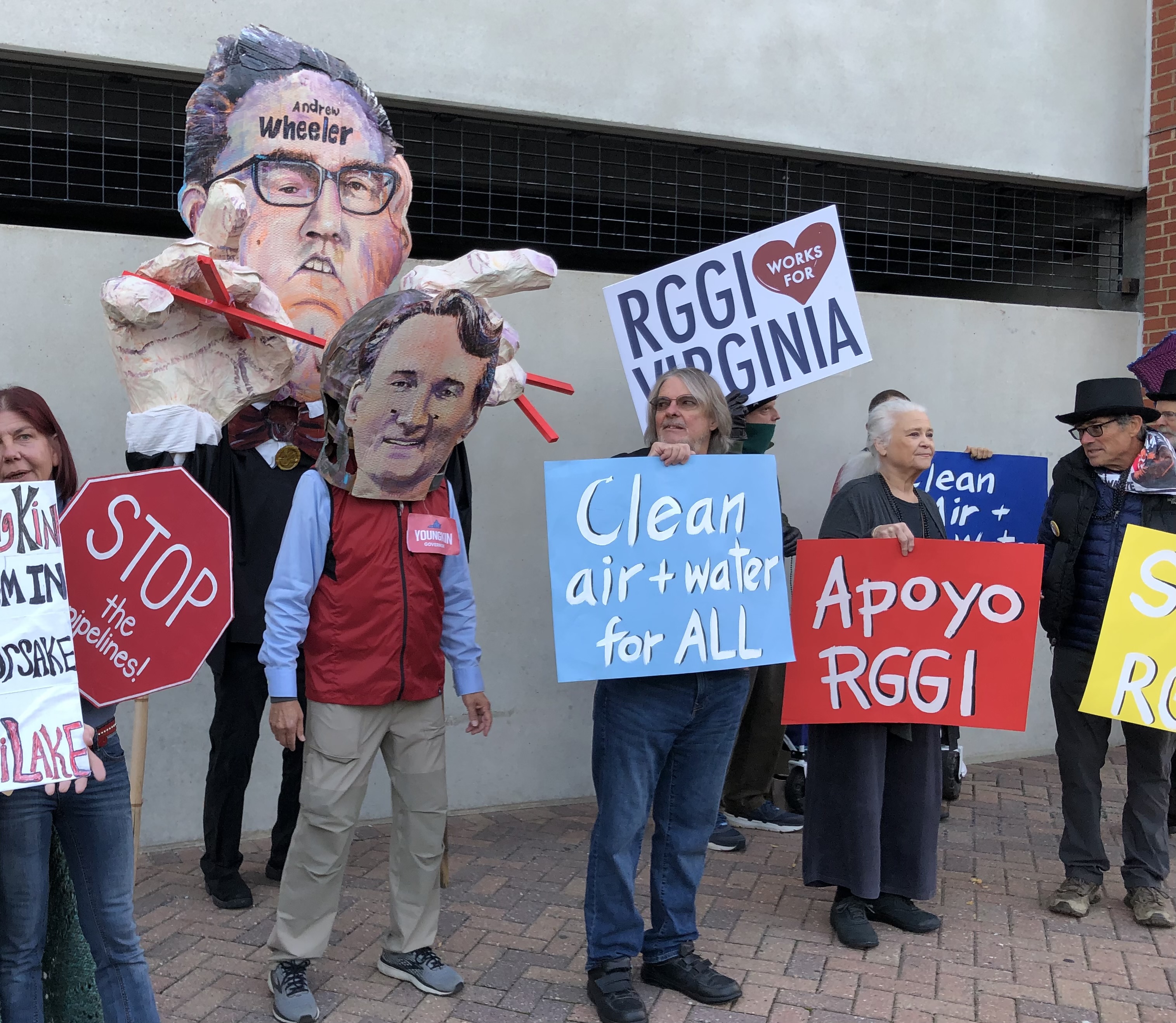
Protesters outside the Virginia Clean Energy Summit on October 21.

Governor Glenn Youngkin issued a press release on October 3 presenting what he says is his energy plan. Accompanying the press release was 26 pages labeled “2022 Virginia Energy Plan,” but that can’t be what he’s referring to. I mean, the Virginia Code is pretty specific about what makes up an energy plan, and this isn’t it.

Under Virginia law, the energy plan must identify steps the state will take over the next 10 years consistent with the Commonwealth Clean Energy Policy’s goal of a net-zero carbon economy by 2045 “in all sectors, including the electric power, transportation, industrial, agricultural, building, and infrastructure sectors.”  Not only does Youngkin’s document not do that, it doesn’t even mention the policy it’s supposed to implement.

It’s also missing critical pieces. The plan is supposed to include a statewide inventory of greenhouse gas emissions, but it’s nowhere to be found. The inventory is the responsibility of the Department of Environmental Quality, which reports previous inventories on its website from 2005, 2010 and 2018. The one specifically required to be completed by October 1, 2022 isn’t there, nor is there any indication it’s in the works and just unfortunately delayed. Did I miss some fine print about how the requirement doesn’t apply if the governor is a Republican?

In fact, there is no discussion about climate change in Youngkin’s energy plan.  The word “climate” appears nowhere. He simply ignores the problem: a modern Nero, fiddling while the planet burns.

Instead, Youngkin’s document mostly attacks the laws Virginia has passed in recent years to implement its decarbonization goals, including the Virginia Clean Economy Act, legislation allowing the state to participate in the Regional Greenhouse Gas Initiative and the Clean Cars law. In their place he offers a bunch of random ideas — some with merit, some without, some spinning off on tangents.

I did not really expect a conservative Republican with presidential aspirations to embrace all the recommendations for the energy plan that I laid out last month, or those from the many environmental, faith and consumer groups that support Virginia’s clean energy transition. Going further and faster down the road to decarbonization is a tall order for politicians beholden to fossil fuel interests, no matter how much it would benefit the public.

Yet Youngkin doesn’t have a lot of ammunition to use against the switch to renewable energy. With soaring coal and natural gas prices, it’s hard to keep pretending that fossil fuels are low-cost. The insistence that we need them for reliability is the only straw left to grasp at.

https://www.virginiamercury.com/blog-va/regulators-approve-dominion-bill-increase-for-rising-fuel-costs-appalachian-power-also-seeking-hike/embed/#?secret=Vd8muOhz01

And indeed, underlying Younkin’s attack on the VCEA is a misunderstanding of how grid operators manage electricity. The critique boils down to “baseload good, intermittent bad.” But baseload is not the point; meeting demand is the point. Demand fluctuates hugely by day and hour. If grid operators had nothing to work with but slow-ramping coal plants or on/off nuclear reactors and no storage, they’d have as much trouble matching demand as if they had nothing but renewable energy and no storage. Pairing low-cost wind and solar with batteries makes them dispatchable — that is, better than baseload.

That’s not to say there aren’t good reasons to invest in higher-cost resources, but “baseload” is a red herring that stinks up Youngkin’s entire argument.

To his credit — and notwithstanding his “baseload” fixation — Youngkin supports Virginia’s move into offshore wind energy even with the high cost of the Coastal Virginia Offshore Wind project and other early U.S. developments. (The plan notes that Virginia’s project will be the largest “in the Free World,” a weirdly retro way to tell us China has leapt far ahead in installing offshore wind.)

The plan also supports removing barriers to customer purchases of solar energy, including shared solar and a greater ability for renewable energy suppliers to compete with utilities for retail sales. This is all phrased as a consumer choice issue rather than an endorsement of greater utility investments in solar; regardless, these would be welcome moves.

It’s also good to see the governor’s endorsement of rate reform. Republicans have been at least as much to blame as Democrats for Dominion Energy’s success in getting laws passed that let it bilk ratepayers. It will be interesting to see if Youngkin actually pursues the reforms he touts.

Less encouraging are Youngkin’s desires to jump into hydrogen (I’m guessing not the green kind, since we hardly have an excess of renewable energy) and, worse, to deploy “the nation’s first” commercial small modular nuclear reactor (SMR) in Southwest Virginia within 10 years.

You know what will happen there, right? Ratepayers will foot the bill, and it will be very expensive.

But unlike offshore wind, SMRs aren’t proven technology; they remain firmly in the research phase. The U.S. Department of Energy is hoping for a demonstration project “this decade.” If successful, the industry believes SMRs will eventually be able to produce electricity at a price that’s only two or three times that of solar and wind energy. Which begs an obvious question: Is there a reason to build SMRs?

Nor has anyone figured out the nagging problem of what to do with the radioactive waste, including the waste piling up at today’s nuclear plants because it’s too dangerous to move and there’s no place to put it. So Youngkin’s plan also “calls for developing spent nuclear fuel recycling technologies that offer the promise of a zero-carbon emission energy system with minimal waste and a closed-loop supply chain.” Great idea! But how about focusing on that first, Governor?

That’s not where Younkin is putting his focus, though. Last week, he proposed spending $10 million on a Virginia Power Innovation Fund, with half of that earmarked for SMR research and development.  The announcement said nothing about waste.

Look, I happen to know some earnest climate advocates who believe SMRs are the silver bullet we’ve been waiting for. I follow the research with an open mind while also noting the astonishing advances in renewable energy technology announced almost daily. But the climate crisis is here and now. We can’t afford to press pause on known carbon-free technologies for 10 years in the hope that something even better will pan out.

Investing in research and development of new technologies is an important role for government, but kicking the climate can down the road isn’t an option. Rather than attacking our energy transition, Youngkin would have done more for Virginia by using his plan to build on it.

This article appeared first in the Virginia Mercury on October 18, 2022.

Unknown's avatar

A tale of two realities: how individual choices could pull us back from the brink of climate chaos

A murmuration of starlings. Photo by Jeremy Bolwell via Wikimedia

It was the best of summers, it was the worst of summers. It was the summer the United Nations declared a healthy environment a universal human right, and a summer that shattered heat records across the globe. The U.S. enacted a historic climate bill not long after the Supreme Court struck down the Environmental Protection Agency’s Clean Power Plan. Climate scientists said there was still hope for keeping global warming below 1.5 degrees Celsius, while the American West’s worst drought in 1,200 years continued for its 22nd summer.

The struggle to keep climate change from spinning out of control feels nothing short of epic, as if ordinary mortals were powerless observers to a battle between giants that will determine whether and how we survive. Yet if we weren’t collectively doing what modern humans do — burning fossil fuels, clearing land for agriculture, raising and eating billions of animals, driving on the roads we paved, making things in factories, consuming and consuming — there would be no epic struggle. We are the giants.

But being integral to the problem also makes every person integral to where we go from here.  Powerlessness is an illusion. Like a murmuration of starlings wheeling through the air in a synchronized but unchoreographed ballet, small choices by individuals cascade across society and shift its direction, unpredictably and sometimes radically.

This is why there remains a case for hope, if not actual optimism, even as climate change accelerates toward climate chaos. Humans, working individually and collectively, have removed the biggest technological barriers to stopping the rise in greenhouse gas emissions. Most of the policy and economic barriers continue to crumble too, especially when it comes to replacing fossil fuels with wind and solar. As a result, our power supply will continue to get cleaner even in states that prefer their air polluted.

Government must still do much more, and many technical challenges still need to be worked out. For the first time, though, a decarbonizing grid finally gives ordinary people a role in determining the continued habitability of our planet, through individual actions that collectively push society in a new direction.

We’ve done this before. Consider the anti-littering campaign of the 1960s that made a once-commonplace behavior unthinkable for millions of Americans. Or take the public response to the ozone hole crisis of the 1970s, when scientists discovered that the chemical aerosols emitted by spray cans were migrating up to the stratosphere and reacting with sunlight to eat away at the Earth’s protective ozone layer. While the federal government dithered, consumers acted. They abandoned aerosols in favor of pump bottles for cleaning products, roll-on deodorants and sprays reformulated to remove the chlorofluorocarbons (CFCs) causing the problem. The public response led to government action, culminating in the 1987 Montreal Protocol phasing out CFCs worldwide.

Individual choices change history when people recognize the need to alter their behavior, but only if they have acceptable alternatives that others can copy easily. Once it becomes commonplace, the planet-friendly choice can even feel like the only morally acceptable option. Individuals and even companies want to avoid the stain of public opprobrium — the reason so many corporations today have adopted sustainability goals.

Many threats are too great to leave to voluntary action, or too hard for enough people to understand or act on individually. We needed top-down policies to decarbonize the electric sector; voluntary investments in rooftop solar alone could never do it. We will always need government agencies like the EPA and the Food and Drug Administration to regulate toxins and dangerous products. Simply trying to empower consumers can backfire, as Californians found when a right-to-know law enacted by proposition led to companies labeling pretty much everything as cancer-causing, just to be on the safe side.

But consumer choice will be a key factor in decarbonizing buildings and transportation now that renewable energy is taking over the electric grid. As people learn about the dangers of using natural gas indoors, they will opt instead for high-efficiency heat pumps and electric induction stoves, and builders will respond to changing demand by no longer connecting homes to gas lines. The new Inflation Reduction Act, with its generous rebatesfor home electrification, sped up the timeline for the demise of gas, but consumer preference will be the deciding factor.

Similarly, the IRA’s rebates for electric vehicle purchases will make consumers the killers of Big Oil. The transportation sector makes up the biggest slice of U.S. carbon emissions, and most of that is attributable to personal automobiles. Getting people out of their cars and on to bicycles or mass transit has been frustratingly hard because most of our communities were built around the automobile. The arrival of electric vehicles finally offers such an attractive alternative to the gas guzzler that it’s just a question of when, not if, the internal combustion engine goes the way of the horse-drawn buggy.

The battery technology that makes electric vehicles possible also allows every gasoline-powered tool to be electrified, including lawn mowers, weed-whackers and leaf blowers. Gasoline-powered lawn equipment is astoundingly polluting, in terms of both carbon emissions and smog-creating volatile organic compounds. It’s also so noisy that neighbors will pressure neighbors to switch to electric as the technology gets better and cheaper. California, Washington, D.C. and many localities have banned gas-powered leaf blowers, but consumer preference alone should eventually eliminate the market for them.

Consumer choice could also lower carbon emissions in sectors of the economy that are famously difficult to electrify. Within a few years you may be able to fly on a plane using biofuel or live in a building made with low-emission steel and concrete that sequesters carbon. As we’ve seen with other technologies, though, mass adoption depends on these alternatives being cheaper, better-performing or both. That will take time.

Eating a plant-based diet stands out as the individual action with the greatest climate impact, according to the climate solutions handbook Drawdown. People are beginning to catch on to the meat industry’s outsized impact on climate change, but it’s the second condition — people having alternatives they really like — that keeps the meat industry in business. Veganism is on the rise (led, of all people, by athletes), but meat consumption continues to grow too.

If some visionary thinkers are right, in a few years we will all happily be eating lab-grown meat and healthy plant-based meat substitutes because they will outcompete animal products on price, taste and convenience. Removing animals from our food supply will have cascading beneficial effects as it frees up land now used to grow animal feed for more planet-friendly uses such as carbon-sequestering forests and wildlife habitat.

For now, as anyone who has tried to stick to a diet can tell you, knowing what you ought to do is the easy part. Getting all of humanity to adopt a carbon diet is the challenge of our time. If we’re lucky and make the right choices, we may still have time to redirect the human murmuration toward a sustainable economy.

This article first appeared in the Virginia Mercury on September 8, 2022.

Unknown's avatar

Looking backward, Virginia Republicans attack climate action and coddle coal

Photo credit: Mark Dixon from Pittsburgh, PA, CC BY 2.0 , via Wikimedia Commons

Even before taking office, Governor Glenn Youngkin made two rookie mistakes: he declared his intention to pull Virginia out of the Regional Greenhouse Gas Initiative (RGGI) by executive order, not realizing it can only be done by legislation; and he nominated the much-reviled Trump-era EPA chief Andrew Wheeler to be his Secretary of Natural Resources, apparently unaware the appointment would need approval from the Democratic-led Senate he had just infuriated with the RGGI announcement. 

Evidently not a man to admit a blunder, on his first day in office Youngkin signed an  executive order directing the Department of Environmental Quality to notify RGGI of his intent to withdraw Virginia from the carbon-cutting program, and to develop an “emergency regulation” to send to the Air Pollution Control Board for the same purpose. The language in the order is a little less than he pledged, and yet still not legal.

These are unfortunate signs that Youngkin, who ran for governor as a moderate Republican, intends to govern as a burn-the-house-down extremist when it comes to the environment. 

It’s surprising to see Youngkin pursuing Trumpist energy policies, and not just because they failed so dismally when Trump tried them. As the former CEO of a multibillion-dollar private equity investment company, Youngkin is, presumably, not an idiot. He has acknowledged climate change is real and affecting Virginia, and he has access to the same polls the rest of us do that show Americans are concerned and want government action to address the crisis. Corporate America is also calling for action; CEOs of more than 70 of the world’s largest corporations wrote a letter last June calling on governments to adopt policies capable of capping the global rise in temperature at no more than 1.5 decrees Celsius. 

The legislation that put Virginia into RGGI will lead to a 30 percent cut in the Commonwealth’s electric sector CO2 emissions by 2030. Companion legislation, the Virginia Clean Economy Act (VCEA), extends the carbon cutting out to 2050, to hit zero carbon emissions from the electric sector. Youngkin complains that RGGI costs ratepayers money, but it’s not like the money raised through carbon allowance auctions disappears into the ether: it pays for coastal flood-control projects and low-income energy efficiency programs that Virginia wasn’t funding before. Maybe Youngkin intends to replace these hundreds of millions of dollars with some of the federal funding coming to Virginia through the federal infrastructure bill—you know, the legislation that Virginia’s Republican congressmen voted against

Or maybe he doesn’t really care about the human consequences of his actions, since Virginia governors can’t run for reelection. Even last fall Youngkin was being talked about as a potential presidential candidate based on his ability to say nothing of substance for an entire campaign season. It was a good trick, but it’s a hard one to pull off twice. If Youngkin runs for president, he’ll be doing it as the guy who started his governorship by torching Virginia’s climate action plan.

Whether they are fellow flame-throwers or not, General Assembly Republicans are rallying around the new governor. Two bills filed last week seek to do legally what Youngkin wanted to do by executive fiat. SB532 (Stuart) and HB1301 (Kilgore) would repeal the Clean Energy and Community Flood Preparedness Act, direct DEQ to suspend the Commonwealth’s participation in the Regional Greenhouse Gas Initiative and remove provisions for using revenues from the auctions. 

SB81 (Stanley) would prohibit the Air Pollution Control Board from considering health, environmental, scientific, or economic factors when making regulations—an attack on both RGGI and clean car regulation, as well as on the independence and very mission of the Air Board. SB657 (Stuart) also attacks the Air Board’s authority (and that of the Water Board for good measure).

HB118 (Freitas) goes bigger. It repeals key features of the VCEA, including achieving zero carbon emissions by 2050; allowing the SCC to approve new fossil fuel plants only if a utility has met energy-saving goals and can prove cost-effectiveness; allowing utilities to recover costs of compliance with Virginia’s new renewable portfolio standard; and making wind, solar and offshore wind projects “in the public interest,” magic words that assure utilities they will get paid for making these investments.

The Freitas bill might pass the House, now that Republicans hold a slim majority, but neither of these two bills should pass the Senate with Democrats in charge. Creating the framework for the energy transition was a signature success for Virginia Democrats, and it’s hard to imagine a scenario in which they will let it be taken from them. 

That isn’t stopping other Republicans from taking their own shots. Several bills seek to undermine the energy transition in various ways; all of them are bad policy.

  • HB74 (also Ware) would subsidize certain large industrial customers by allowing them to share in the benefits, yet exempting them from the costs, of the energy transition, shifting their share of the costs onto all other customers. 
  • HB5 (Morefield) raids the RGGI funds to get money for his own district. 
  • HB892 (Kilgore) and SB398 (McDougle) subsidize RGGI costs for certain fossil fuel generators, another raid on the funds. 
  • HB1204 (Kilgore) prevents the RPS from taking effect until 2025 and guts the carve-out for distributed generation permanently. It also removes the authority of the Air Pollution Control Board over air pollution permits for “minor” sources of pollution.
  • HB1257 (Kilgore, on a roll!) guarantees customers access to natural gas in the name of “energy justice,” banning local electrification efforts, and making it really hard for the city of Richmond to terminate its gas utility.
  • HB1261 (Bloxom) also strips the Air and Water Boards of their permit-granting authority. 
  • HB73 (Ware) and SB761 (Sutterlein) eliminates language putting wind, solar and offshore wind in the public interest, undercutting the market certainty that put Virginia into the top ranks for solar energy in the past year and attracted a major offshore wind turbine blade manufacturing facility to Portsmouth. (The bill also lets the SCC put costs of new facilities into a utility’s rate base instead of tacking on a rate adjustment clause. If this were the only thing the bill did, it would be worth supporting.)

Not all the bills we are likely to see this year have been filed yet, so there is a good chance we will see further attacks on climate action, all with the pretense of saving money. I will continue updating this post when I hear of other bills like these. 

“Virginia is no longer anti-coal,” — new Virginia Attorney General Jason Miyares. 

Speaking of things that cost ratepayers money, bills to subsidize coal are back this year. As we have all learned, coal is no longer a competitive fuel in Virginia. It lost out first to fracked gas, and more recently to solar. But in a compromise with coalfields Republicans, the VCEA excluded one coal plant, the Virginia City Hybrid Energy Center (VCHEC) in Wise County, from a requirement that Dominion Energy Virginia close its Virginia coal plants this decade. In theory, VCHEC could stay open until 2045, when the VCEA requires Dominion to reach zero carbon across all its generation.

In reality, though, the reprieve isn’t enough to save the coal plant. Dominion’s own analysis, from its 2020 Integrated Resource Plan case, assigned VCHEC a net present value of negative $472 million just for the ten years from 2020-2029. Dominion didn’t try to extend that analysis out to 2045, but clearly the cost to customers from running a money-losing coal plant for 25 years would top a cool billion. Not surprisingly, the SCC is considering requiring Dominion to retire VCHEC to save money for its customers.

Given concerns about RGGI’s cost to consumers, you might think Southwest Virginia Republicans would lead the charge to retire the money-losing coal plant in their midst. You would be wrong. To understand why, it will help you to know that the counties making up Southwest Virginia are not in Dominion’s service territory, but in Appalachian Power’s. The people who benefit from keeping a coal plant open in Wise County are not the same people who have to pay for the plant’s spectacular losses. 

As an excuse to keep the plant open, coalfields Republicans claim it’s to help the environment. Yes, really. Some of VCHEC’s fuel is waste coal excavated from the piles of mining waste that litter the coalfields, a toxic legacy of the era when coal was king and environmental regulations went unenforced. Burning the waste coal is one way to get rid of it, though not the only way or, for that matter, the right way. 

As a new report from the Appalachian State School of Law discusses, the federal infrastructure bill (again, the same one Virginia Republicans voted against) will provide millions of dollars to Virginia to remediate abandoned minelands, including these piles of toxic waste. (The report, titled Addressing Virginia’s Legacy GOB Piles, has been sent to General Assembly members but is not yet available online.)

In a letter to Senator John Edwards, report lead author Mark “Buzz” Belleville expressed his strong disagreement with bills aimed at encouraging the burning of waste coal. As he wrote, “Waste coal is of lower quality, requiring additives for combustion and resulting in even greater CO2 emissions and traditional air pollution than newly-mined coal. As the report notes, existing GOB piles can be disposed of or remediated in other manners that do not undermine Virginia’s commitment to a transition to clean energy.”

Rather than use the coming federal funds to remediate GOB piles, Republicans would prefer that Dominion customers be forced to pay hundreds of millions of dollars in higher energy costs and put more pollution into the air. 

So at the same time they rail against the costs of RGGI and VCEA, Republicans are using waste coal as a reason to raise costs even more. 

  • HB656 (Wampler) dangles a tax credit for using waste coal. 
  • SB120 (Hackworth) and HB657 (Wampler) declare waste coal a “renewable energy” source and exempts VCHEC from the requirement that it close by 2045. 
  • HB894 (Kilgore) outright prohibits the SCC from requiring Dominion to retire VCHEC “before the end of its useful life.” (Would that be before or after Virginia becomes so hot we all move to Canada?)
  • HB1326 (Kilgore, trying everything he can think of) makes it “in the public interest” for utilities to use waste coal, and gives utilities a way to charge ratepayers extra for doing so.

Electricity customers had better get used to being used as a political football by legislators who attack the costs of the energy transition but have no qualms about making ratepayers subsidize coal. 

This post originally appeared in the Virginia Mercury on January 20, 2022. It has been updated to include bills filed since then.

Unknown's avatar

A divided General Assembly can find common ground on clean energy

Almost two years ago, Virginia’s General Assembly made history with a series of laws shepherding Virginia towards a future of clean, low-cost wind and solar energy. During this year’s election campaign, Republican talking points included attacks on the Virginia Clean Economy Act (VCEA), the law at the center of the transition. But talk, as they say, is cheap. With the VCEA protected by the Democratic majority in the Senate, Republicans didn’t have to put forward a serious alternative, and they didn’t.

Now that the Republicans have won the governorship and a majority in the House of Delegates, passing any new legislation (or repealing anything already in place) will require bipartisan action. Democrats want to protect Virginia’s progress in tackling carbon emissions and putting equity into energy planning. Republicans want to reduce burdens on industry. Both sides want affordable electricity and a robust economy that creates jobs. Rhetoric aside, there is much to agree on.

Solar is wildly popular with conservatives as well as liberals, in part because it saves money. With no fuel costs, and ever-falling prices of solar panels, solar arrays are now the go-to choice for utilities that need more power. It is cheaper for a utility to build a new solar facility today than to operate an existing coal plant in Virginia. 

As for existing gas plants, they compete with solar only when the price of fracked gas is low. Gas prices have doubled in the past year, so Virginia’s current reliance on natural gas for 60% of our electricity generation hurts everyone’s wallets. 

And while fracked gas is imported from other states, we can build solar and wind facilities here in the Commonwealth and off our coast, so our own workers and businesses benefit. The faster we bring on the energy transition, the better for our economy. 

The energy transition also means cleaner air and water for our children, improving the efficiency of homes to make them more comfortable and less costly to live in, reducing the energy burden on low-income residents, helping coastal communities adapt to rising sea levels, and giving people greater freedom to invest their own money in solar panels on their own property. All of these are part of the VCEA and the other bills that guide our energy transition, and repealing them now would be shooting ourselves in both feet.

Nonetheless, there is room for improvement. Last year legislators established a fund to put renewable energy on abandoned mine sites and other brownfields, but didn’t allocate money. Under the bipartisan infrastructure bill just passed in Congress, Virginia will receive an estimated $23,579,905 annually in federal abandoned mine land funding. Once former mine sites are cleaned up, they will be ideal locations for solar facilities, and the General Assembly should make sure that happens. 

Other federal funding will support smart grid and transmission investments. Some of these projects are already underway in Virginia, and the General Assembly should make sure that savings go to ratepayers, not to utilities.

Solar on schools has been one of the greatest success stories of the past few years in Virginia, with more than 45 jurisdictions signing contracts that will put solar panels on school roofs at no up-front cost, and with energy savings every year. But some schools are still built with roofs that aren’t designed to support solar. That has to change. 

Indeed, in 2019 the General Assembly passed a Republican-sponsored bill that went further, declaring it “the intent of the General Assembly that new public school buildings and facilities and improvements and renovations to existing public school buildings and facilities be designed, constructed, maintained, and operated to generate more electricity than consumed.” In 2022, legislators could turn this into a requirement, saving money for taxpayers across the Commonwealth. 

Community solar offers another money-saving opportunity. Legislation passed in 2020 will allow residents and businesses to buy electricity from shared solar projects developed by private companies. The initial program is small and confined to customers of Dominion Energy, which is trying to persuade regulators to mandate crushingly high minimum bills. Legislators can fix these problems by expanding the program statewide and capping the minimum bill. 

The General Assembly has repeatedly failed to rein in the power of utilities like Dominion, which uses its influence to protect its profits at the expense of consumers. The ability to make unlimited political contributions backfired on Dominion when its $200,000 contribution to an anti-Youngkin campaign was exposed. But public utilities should not be allowed to buy influence, period. Let’s make this the year that stops.

This op-ed appeared in the Richmond Times-Dispatch on November 27,2021. 

Unknown's avatar

You call that democracy? How Virginia’s electric co-ops fail their member-owners.

Virginia’s thirteen electric cooperatives were exempted from most provisions of the 2020 Virginia Clean Economy Act, which caps carbon pollution from power plants and requires investor-owned utilities to meet renewable-energy and energy-efficiency targets. In lobbying for the VCEA exemption, cooperatives no doubt touted their claimed status as member-owned and democratically governed. In theory that means co-op members can direct their co-ops to adopt programs friendly to consumers and the environment. But events last month showed again that some of the commonwealth’s electric co-ops are not as democratic as they claim. 

Summer is annual-meeting time for electric co-ops. Like all consumer cooperatives, electric co-ops are owned by their customers (called “member-owners”). Democratic control of the cooperative is one of seven “cooperative principles” that all electric cooperatives claim to adhere to. The key to genuine democratic control is board-of-director elections, which happen at each co-op’s annual meeting, where member-owners vote for board candidates. 

Two examples from Virginia electric co-op annual meetings last month demonstrate ways large and small in which incumbent co-op boards game the election process to help their favored board candidates. The most egregious case occurred at Rappahannock Electric Cooperative (REC), which serves rural and suburban Virginians in 22 counties. In a five-way race in REC’s August board election there was a clear winner among co-op member-owners who selected a candidate. Hanover County businessman Roddy Mitchell got more than twice as many member-owner votes as any of the four other candidates. You might call that a landslide win.

But through REC’s needlessly arcane and confusing proxy-voting process, REC’s board was able to allocate some 6,000 additional votes to the board-favored candidate, thereby swinging the election win to him. That board-favored candidate came in fourth out of five when looking at votes that member-owners cast for candidates.

When a board controls 40 to 60 percent or more of all votes, as REC’s board generally does, the board effectively controls the election outcome and “democracy” is an empty label.  

REC’s board controls huge numbers of votes each year because proxy ballots left blank are deemed by REC’s board as a delegation of the member-owner’s vote to the incumbent board to decide whom to cast them for. Moreover, REC offers those who send in a proxy, even a blank one, a chance to win cash prizes. That encourages member-owners to submit blank proxies, even if they have no interest in the election or makeup of the board. REC election tally forms going back over a decade show that every year REC’s incumbent board controls enough proxies to control election outcomes. For at least the past twelve years no candidate has won a race without getting the board-controlled votes. 

So the way to win an REC board election is to please incumbent board members, not to get the most votes from member-owners. That isn’t fair and it isn’t democratic. It leads to board groupthink, insulates boards from the concerns of member-owners, and discourages well-informed, knowledgeable co-op members from running for board.

A National Rural Electric Cooperative Association governance task force report recommended against using board-controlled proxies to swing election results. But REC’s board continues to ignore that recommendation years after it was made.  

Meanwhile, neighboring Shenandoah Valley Electric Cooperative’s (SVEC) board changed the co-op’s bylaws at a closed board meeting in June to help out an incumbent board member facing a strong challenge from another candidate in the August election. The board added a bylaw provision saying that in the case of a tie between an incumbent and non-incumbent candidate the incumbent would be deemed the winner of a one-year board term! 

As if that isn’t bad enough, REC board chair Chris Shipe said publicly a few weeks ago that SVEC’s board is considering changing its (fair) direct election process next year to a proxy system like REC’s. If SVEC follows through on that, then its board, like REC’s, will be able to determine election outcomes. That would make SVEC’s new tie-vote bylaw unnecessary. There are no ties when incumbent board members control election outcomes. 

SVEC’s board would then be fully insulated from member-owner concerns. That would greatly help incumbent board members, who recently approved major fixed-monthly-charge increases that disproportionately affect the co-op’s low-income member-owners and those who’ve invested in rooftop solar or energy efficiency.

There is currently no government oversight of Virginia electric co-op elections, and no law to ensure fair board-election procedures, prohibit abusive proxy practices, or prohibit using board-imposed bylaw changes to favor incumbents. This is important because electric cooperatives are essential service providers that operate as monopolies. Monopoly utilities seldom act in the best interest of their customers unless subjected to meaningful scrutiny, accountability, and independent oversight. Such oversight is lacking when entrenched co-op boards have ironclad control of board-election outcomes. It’s time for the General Assembly to step in and ensure basic, fair election practices to give Virginia electric cooperative member-owners a true say in the governance of the utilities they own.

Seth Heald is a retired U.S. Justice Department lawyer and has a master of science degree in energy policy and climate. He is a member-owner of Rappahannock Electric Cooperative and co-founder of Repower REC, a campaign to bring genuine democracy to Virginia’s electric co-ops. More information at RepowerREC.com

Unknown's avatar

COVID-19 throws a lemon at Virginia’s plan for an energy transition. It’s time for lemonade.

solar panels on a school roof

The solar panels on Wilson Middle School are saving money for Augusta County taxpayers. Photo courtesy of Secure Futures.

In mid-March, the Virginia General Assembly passed legislation to transition our economy from fossil fuels to clean energy over the coming years. Two weeks later, Virginia shut down in response to the COVID-19 pandemic. Among the businesses whose very existence is now in peril are the energy efficiency companies and solar installers we will be counting on to get us off fossil fuels.

Home weatherization and energy efficiency programs have come to an almost complete halt in Virginia, including programs run by Dominion Energy Virginia. Nationwide, the energy efficiency sector has lost almost 70,000 jobs. Meanwhile, companies that install solar, especially rooftop systems, report plummeting sales. The Solar Energy Industries Association reports that nationally, 55 percent of solar workers are already laid off or suffering cutbacks.

The timing seems terrible — although to be fair, there’s no good time for an economy-crushing, worldwide pandemic. Eventually, however, the virus will run its course or be defeated through vaccine or cure. At that point, we will face a choice: we can stagger blinking out into the sunlight aimlessly wondering now what?, or we can execute the well-developed plan we have spent these weeks and months formulating.

Let’s go with the second option.

First, it’s worth remembering that nothing happening now will change the trajectory of clean energy. Solar and wind had banner years in 2019, continuing their steady march to dominance. Wind has become the largest single source of electricity in two states, Iowa and Kansas. The island of Kauai in Hawaii is now 56 percent powered by renewable energy, mostly solar. Across the U.S. wind, solar and hydro produce more electricity than coal. Wind is the cheapest form of new electric generation nationally; solar takes pride of place in Virginia.

Meanwhile, fossil fuel is even more firmly on its way out. Six of the top seven U.S. coal companies have gone into bankruptcy since 2015. That was before the lockdown sent energy demand down, further hurting high-priced coal.

Fracked gas helped kill coal but is itself vulnerable to price competition from renewables. Odd as it sounds, the collapse in oil prices will make natural gas more expensive. That’s because oil producers in Texas and North Dakota are closing wells that produced natural gas along with oil. The tightening supply of gas may finally make fracking companies in Appalachia profitable, but it means higher prices for utilities. Wind and solar will just keep looking better.

The Trump administration is still trying futilely to hold back the tide, but the U.S. will get a lot farther riding the wave than struggling against it. Congressional leaders should declare the country “all in” on clean energy. Instead of bailing out the highly polluting fossil fuel industries, they should put that money to work creating more jobs and economic development — and actually doing something about climate change — with energy efficiency and renewables.

Congress should return the Investment Tax Credit for solar (and offshore wind) to the 30 percent level in effect last year and keep it there, instead of continuing the phase-out now in effect. Congress should also give solar owners the option of taking the credit as a cash grant, as it did during the last recession, and for the same reason: tax-based incentives are less useful in a recession, when companies can’t use the credits.

Virginia’s Sens. Tim Kaine and Mark Warner have a critical role to play in convincing their colleagues to support solar. So far neither is rising to the task.

On the state level, Northam did the right thing in signing this year’s energy legislation, allowing utilities and industry members to start planning for the future. But the Clean Economy Act gets wind and solar off to a very slow start; Dominion doesn’t have to build Virginia solar for five years yet. And though the new laws remove many policy constraints on customer-sited solar, they offer next to nothing in the way of financial incentives.

Governor Northam should make it clear he intends to make rooftop solar a priority for next year, along with projects on closed landfills, former coal mine areas, and other brownfields, with a special focus on areas hardest-hit economically. He can also encourage corporations that do business in Virginia to meet their sustainability goals with Virginia wind and solar, starting right now.

The governor should also prioritize building efficiency. Virginia will be adopting a new residential building code this year, and if past years are any indication, its energy efficiency provisions will fall short of the most recent model code standard. It’s up to the governor to make sure Virginia adopts the full code.

Local governments are already taking advantage of suddenly-empty buildings to accelerate maintenance and repairs. But it’s a good time to think bigger, with new financing tools available that make energy efficiency retrofits and solar facilities cash-positive right from the start.

Energy performance contracting allows the energy savings to pay for retrofits. The Department of Mines, Minerals and Energy keeps a list of pre-qualified energy service companies and offers expertise to help local government employees navigate the process.

This year’s legislation also greatly expanded local governments’ ability to finance on-site solar through third-party power purchase agreements, effective July 1. The PPAs are structured so that a school district, municipality or any commercial or non-profit customer can have a solar array installed at no cost, paying just for the energy produced.

In December, Fairfax County awarded contracts for PPAs to install solar on more than a hundred sites, including schools and other government buildings. The county’s contract is “rideable,” which allows other counties and cities to piggyback, getting the same terms without the need for new contract negotiations.

Unfortunately, local governments in southwest Virginia are prevented from pursuing PPAs — not by state legislation, which allows it starting July 1, but by a contract with Appalachian Power that governs their electricity purchases from the utility. The contract is up for renewal this year; disgracefully, APCo is refusing to agree to new terms allowing the localities to use solar PPAs. APCo should back off, and let local governments in economically depressed southwest Virginia start saving money and supporting solar jobs this year.

Arlington County has gone beyond on-site solar, contracting for a share of a large solar farm in southern Virginia that will provide more than 80 percent of the electricity for county government operations. It’s a model any locality can adopt.

Virginia residents and businesses also have good reasons to focus on clean energy. The enforced down-time many people are experiencing means more time to research options, and companies are motivated to offer low prices on energy efficiency upgrades and rooftop solar.

The federal government offers more generous tax credits this year than next. Credits for residential energy efficiency equipment and a deduction for energy efficient commercial buildings expire at the end of this year.

The investment tax credit for solar (as well as for geothermal heat pumps, fuel cells and small wind turbines) stands at 26% for projects placed in operation this year, but it will drop to 22% in 2021. It falls to 10% for commercial customers and disappears altogether for residential customers in 2022. If Congress acts to raise the credit to 30%, buyers will get an even bigger boost. If it doesn’t, there will be a rush this year to get projects done by the end of the year, so customers should secure their place in line now.

Virginia nonprofits have helped hundreds of residents and businesses save money on solar and EV chargers through bulk purchasing programs. Virginia Solar United Neighbors just announced a series of virtual information sessions to promote the Arlington Solar EV Co-op. And LEAP, which closed operations temporarily due to the virus, reports it has restarted two programs, Solarize NOVA and Solarize Piedmont.

In an ideal world, the U.S. would already be well along in executing a comprehensive plan for a clean energy transition, one that includes job retraining for workers, and that resists counterproductive efforts to save the fossil fuel industry. But we can do the next best thing, and use the tools of government, the market and consumer choice to speed us in the right direction.

COVID-19 has handed all of us a big, fat lemon. Let’s make some lemonade.


A version of this article appeared originally in the Virginia Mercury on April 30, 2020.


Unknown's avatar

It was a messy, chaotic General Assembly Session. It also worked out pretty well.

Solar arrays on Richmond Public Schools were some of the last projects to go forward before a statutory limit on PPAs halted similar projects across the state. Legislation this year raises the cap on PPAs. Photo credit Secure Futures.

This time last year, I didn’t have much good to say about the General Assembly session that had just concluded. This year, try as I might to be cynical and gloomy (and I do make a good effort), I see mostly blue skies. Or at worst, light gray. What follows is a brief run-down of the bills that passed.

Bills that were still alive at the time of my halftime report but that don’t appear in today’s roundup are dead for the year.

Most of these bills don’t yet have the Governor’s signature. Virginia allows the Governor to propose amendments, so what you see here may not be the final word. Bills that do get signed take effect July 1.

Energy Transition

HB1526/SB851, the Clean Economy Act, is an omnibus energy bill that contains a two-year moratorium on new fossil fuel plants, mandatory carbon reductions, mandatory energy efficiency savings, mandatory construction of wind, solar and offshore wind, mandatory energy storage acquisition targets, mandatory closures of some coal and biomass plants, and a mandatory renewable portfolio standard, along with cost recovery provisions, a new program to limit utility bills of low-income earners, and some loosening of restrictions on net metering and third-party power purchase agreements.

The bill is not perfect, and the clean energy transformation it strives for is incomplete. Its provisions mostly don’t apply to electric cooperatives, and while it forces the eventual closure of Dominion’s biomass plants, it actually requires utility customers to subsidize biomass use by paper companies. Dominion is given too free a rein on spending, the energy efficiency targets are weak, and the bill focuses on utility-scale projects to the almost total exclusion of customer-sited projects.

For all that, the legislation is groundbreaking and transformational. Advocates will be back next year with refinements to the bill and proposals to fill the gaps, but putting this necessary framework in place is a huge achievement for Virginia.

SB94 (Favola) and HB714 (Reid) rewrites the Commonwealth Energy Policy to bring it in line with Virginia’s commitment to dealing with climate change, and even to challenge leaders to do more. The bill sets a target for net-zero greenhouse gas emissions economy wide by 2045, and in the electric sector by 2040. These targets are more ambitious than what is in the Clean Economy Act; not only is the electric sector decarbonization deadline earlier (and inclusive of the coops), this is the first legislation to set a target for the economy as a whole. The Commonwealth Energy Policy is advisory and tends to be ignored in practice; however, the bill also requires that the Virginia Energy Plan, developed every four years in the first year of a new governor’s term, include actions to achieve a net-zero economy by 2045 for all sectors.

HB672 (Willett) establishes a policy “to prevent and minimize actions that contribute to the detrimental effects of anthropogenic climate change in the Commonwealth.” State agencies are directed to consider climate change in any actions involving state regulation or spending. Local and regional planning commissions are required to consider impacts from and causes of climate change in adapting comprehensive plans.

RGGI

The Democratic takeover of the General Assembly means Virginia will finally join the Regional Greenhouse Gas Initiative (RGGI). HB981 (Herring) and SB1027 (Lewis), the Clean Energy and Community Flood Preparedness Act, directs DEQ to enter the RGGI auction market. Auction allowances are directed to funds for flood preparedness, energy efficiency and climate change planning and mitigation. As with the Clean Economy Act, votes for the RGGI fell along partisan lines but for one Republican senator, Jill Vogel, who voted for both.

RPS

The Clean Economy Act contains a mandatory renewable portfolio standard (RPS) requiring utilities to include in their electricity mix a percentage of renewable energy that ratchets up over time. It’s weak, especially for distributed solar, and it allows paper company biomass to qualify—an inexcusable corporate welfare provision for politically powerful WestRock and International Paper.

Customer-sited solar/net metering

Watch this space for a post dedicated to net metering, PPAs and community solar bills. Meanwhile, here’s the short version:

Solar Freedom SB710 (McClellan), HB572 (Keam) and HB1184 (Lopez) lift barriers to customer-sited renewable energy such as rooftop solar. HB1647 (Jones) contains some of the elements of Solar Freedom, but a few provisions are in conflict. Advocates have asked the Governor to sign the first three bills but not the fourth. Some Solar Freedom provisions are also in the Clean Economy Act. The new provisions lift the net metering cap to 6% for IOUs; raise the PPA cap to 1,000 MW in Dominion territory and 40 MW in APCo territory; remove standby charges below 15 kW in Dominion territory and completely for APCo; raise the residential size cap to 25 kW and the commercial project size cap to 3 MW; allow Dominion customers to install enough solar to meet 150% of the previous year’s demand (APCo stays at 100%); allow shared solar on multifamily buildings; and enable a 5 MW landfill solar project in Fairfax County to move forward. The provisions do not apply to electric cooperatives.

HOAs HB414 (Delaney) and SB504 (Petersen) clarifies the respective rights of homeowners associations (HOAs) and residents who want to install solar. The law allows HOAs to impose “reasonable restrictions,” a term some HOAs have used to restrict solar to rear-facing roofs regardless of whether these get sunshine. The bill clarifies that HOA restrictions may not increase the cost of the solar facility by more than 5%, or decrease the expected output by more than 10%.

Community solar

SB629 (Surovell) and HB1634 (Jones) creates a program for shared-solar that allows customers to purchase subscriptions in a solar facility no greater than 5 MW.

HB573 (Keam) requires that an investor-owned utility that offers a so-called “community solar” program as authorized by 2017 legislation must include facilities in low-income communities “of which the pilot program costs equal or exceed the pilot program costs of the eligible generating facility that is located outside a low-income community.”

Offshore wind

The Clean Economy Act contains detailed provisions for the buildout and acquisition of offshore wind. SB998 (Lucas), SB860 (Mason) and HB1664 (Hayes) puts the construction or purchase of at least 5,200 MW of offshore wind in the public interest and governs cost recovery for the wind farms under development by Dominion. The bills appear to have the same language that is in the Clean Economy Act.

HB234 (Mugler) establishes a Division of Offshore Wind within the Department of Mines, Minerals and Energy. Its role is to help facilitate the Hampton Roads region as a wind industry hub, coordinate the word of state agencies, develop a stakeholder engagement strategy, and basically make sure this industry gets underway.

Nuclear

SB828 (Lewis) defines “clean” and “carbon-free” energy to include nuclear energy for purposes of the Code. SB817 (Lewis) declares that nuclear energy is considered a clean energy source for purposes of the Commonwealth Energy Policy.

HB1303 (Hurst) and SB549 (Newman) direct DMME to develop a strategic plan for the role of nuclear energy in moving toward renewable and carbon-free energy.

Energy Efficiency

HB1526/SB851, the Clean Economy Act, contains a mandatory energy efficiency resource standard (EERS) and other provisions for spending on low-income EE programs. HB1450 (Sullivan) appears to be the same as the efficiency provisions of the Clean Economy Act. A sentence added late in the process provides that the bill won’t take effect until passed again in 2021. Presumably the passage of the Clean Economy Act makes this bill moot.

HB981 (the RGGI bill) specifies that a portion of the funds raised by auctioning carbon allowances will fund efficiency programs.

HB1576 (Kilgore) makes it harder for large customers to avoid paying for utility efficiency programs. In the past, customers with over 500 kW of demand were exempt; this bill allows only customers with more than 1 MW of demand to opt out, and only if the customer demonstrates that it has implemented its own energy efficiency measures.

HB575 (Keam) beefs up the stakeholder process that Dominion and APCo engage in for the development of energy efficiency programs.

SB963 (Surovell) establishes the Commonwealth Efficient and Resilient Buildings Board to advise the Governor and state agencies about ways to reduce greenhouse gas emissions and increase resiliency. Every agency is required to designate and energy manager responsible for improving energy efficiency and reducing greenhouse gas emissions.

SB628 (Surovell) requires the residential property disclosure statement provided by the Real Estate Board on its website to include advice that purchasers should obtain a residential building energy analysis as well as a home inspection prior to settlement.

Energy storage

The Clean Economy Act requires that by 2035, Appalachian Power will construct 400 MW of energy storage and Dominion 2,700 MW. None of the projects can exceed 500 MW, except for one project of up to 800 MW for Dominion (a possible reference to the pumped storage project Dominion is reportedly considering). Projects must meet competitive procurement requirements, and at least 35% of projects must be developed by third-party developers.

SB632 (Surovell) has a fair amount of overlap with the Clean Economy Act, but the details are different, and it will be interesting to see what the Governor does about that. SB632 makes it in the public interest to develop 2,700 MW of energy storage located in Virginia by 2030. At least 65% must take the form of a “purchase by a public utility of energy storage facilities owned by persons other than a public utility or the capacity from such facilities.” Up to 25% of facilities do not have to satisfy price competitiveness criteria “if the selection of the energy storage facilities materially advances non-price criteria, including favoring geographic distribution of generating facilities, areas of higher employment, or regional economic development.” Utility Integrated Resource Plans must include the use of energy storage and must include “a long-term plan to integrate new energy storage facilities into existing generation and distribution assets to assist with grid transformation.”

SB632 also fixes a problem introduced a couple of years ago, when the ownership or operation of storage facilities was added to the definition of a utility in one chapter of the Code (§56.265.1), though not in others. With the fix, a public utility may own or operate storage, but so can third parties without them thereby becoming utilities.

HB1183 (Lopez) requires the SCC to establish a task force on bulk energy storage resources.

Siting, permitting, and other issues with utility-scale renewable energy 

HB1327 (Austin) allows localities to impose property taxes on generating equipment of electric suppliers utilizing wind turbines at a rate that exceeds the locality’s real estate tax rate by up to $0.20 per $100 of assessed value. Under current law, the tax may exceed the real estate rate but cannot exceed the general personal property tax rate in the locality.

HB656 (Heretick) and SB875 (Marsden) allow (but do not require) local governments to incorporate into their zoning ordinances national best practices standards for solar PV and batteries.

HB1131 (Jones) and SB762 (Barker) authorize localities to assess a revenue share of up to $1,400 per megawatt on solar PV projects, in exchange for which an existing tax exemption is expanded.

HB657 (Heretick) exempts solar facilities of 150 MW or less from the requirement that they be reviewed for substantial accord with local comprehensive plans, if the locality waives the requirement.

HB1434 (Jones) and SB763 (Barker) provides a step-down of the existing 80% machinery and tools tax exemption for large solar projects, and eliminates it after 2030 for projects over 5 MW.

SB870 (Marsden) authorizes local planning commissions to grant special exceptions for solar PV projects in their zoning ordinances and include certain regulations and provisions for conditional zoning for solar projects.

HB1675 (Hodges) requires anyone wanting to locate a renewable energy or storage facility in an opportunity zone to execute a siting agreement with the locality.

Grants, tax deductions, tax credits and other financing

HB654 (Guy) authorizes DMME to sponsor a statewide financing program for commercial solar, energy efficiency and stormwater investments. The effect would be to boost the availability of Commercial Property Assessed Clean Energy (C-PACE) in areas of the state where the locality has not developed a program of its own.

SB754 (Marsden) authorizes electric cooperatives to establish on-bill financing programs for energy efficiency and renewable energy.

HB1656 (O’Quinn) authorizes Dominion and APCo to design incentives for low-income people, the elderly, and disable persons to install energy efficiency and renewable energy, to be paid for by a rate adjustment clause.

HB1707 (Aird) makes changes to the Clean Energy Advisory Board, which is (already) authorized to administer public grant funding.

SB1039 (Vogel) allows a real property tax exemption for solar energy equipment to be applied retroactively if the taxpayer gets DEQ certification within a year.

SB542 (Edwards) repeals the sunset date on crowdfunding provisions and provides fixes for certain existing obstacles to this financing approach.

Customer rights to shop for renewable energy

HB868 (Bourne) allows customers to buy 100% renewable energy from any licensed supplier, regardless of whether their own utility has its own approved tariff. The Senate killed a companion bill, and Commerce and Labor passed HB868 only with an amendment that requires the bill to be reenacted in 2021. (Credit Edwards, Deeds, Ebbin and Bell for not going along with the amendment.) After Senate passage the bill went to conference, and the House conferees caved. So technically the bill passed, but it has no effect. Interesting note: 41 House Republicans still voted against it in the end.

HB 889 (Mullin) was originally broader than HB868, but after the Senate got through with it, the bill is now a pilot program for the benefit of just those large corporations that, as of February 25, 2019, had filed applications seeking to aggregate their load in order to leave Dominion and buy renewable energy elsewhere. The pilot program is capped at 200 MW, and the SCC will review it in 2022.

Other utility regulation

HB528 (Subramanyam) requires the SCC to determine the amortization period for recovery of costs due to the early retirement of generating facilities owned or operated by investor-owned utilities. In the absence of this legislation, Dominion would have been allowed to use excess earnings for immediate payoffs of the costs of early fossil fuel plant closures; this puts the SCC back in charge of the schedule. The fact that this bill passed is nothing short of miraculous. House Republicans voted against it en masse, and it made it through Senate Commerce and Labor over the objections of Dominion’s best friends from both parties (though most came around for the floor vote when it was clear it would pass).

SB731 (McClellan) affects a utility’s rate of return. The SCC determines this rate by looking first at the average returns of peer group utilities, and then often going higher. The bill lowers the maximum level that the SCC can set above the peer group average. Note that although this bill is recorded as having passed both chambers, it looks like there were amendments that do not appear on the Legislative Information Service website.

HB167 (Ware) requires an electric utility that wants to charge customers for the cost of using a new gas pipeline to prove it can’t meet its needs otherwise, and that the new pipeline provides the lowest-cost option available to it. (Note that this cost recovery review typically happens after the fact, i.e., once a pipeline has been built and placed into service.) Ware acceded to some amendments that Dominion wanted, and eventually Dominion told legislators the company was not opposed to the bill. Hence it passed both chambers unanimously. Notwithstanding Dominion’s happy talk, this bill makes cost recovery for the Atlantic Coast Pipeline much, much more difficult, one more indication that Dominion may be preparing to fold up shop on this project.

[Updated March 17 to correct an error–I had included a bill as having passed that in fact died in the House. Bummer.]