Unknown's avatar

AI could usher in a golden age of technological breakthroughs – if it doesn’t kill us first

Data center between housing community and a bike path
A data center in Ashburn, Virginia. Photo by Hugh Kenny, Piedmont Environmental Council.

Somehow, we were not prepared for this. Artificial intelligence was in development for decades, during which time we fantasized about all the wonderful things it was going to do for us. And then the bots launched almost fully formed like Athena springing from the forehead of Zeus with her sword in hand, and only then did we have our epiphany: Oh man, this is not going to go well.

What happened to the AI utopia? We were expecting self-driving cars that would let us drink too much on nights out while eliminating highway fatalities. We anticipated the seamless integration of all our devices and appliances, maybe even without cords! We imagined an unlocking of efficiencies at home and at work; medical breakthroughs; scientific innovation on steroids. We’d have three-day workweeks and go hiking on the weekends while the robots cooked and cleaned. 

Maybe these things are still there in our future, along with world peace, but so far what we’ve got is a new way for kids to cheat on homework, a lot of derivative art, pernicious deepfakes and raging arguments over intellectual property theft. Oh, and an unprecedented increase in the demand for electricity that threatens to overwhelm the grid and make it impossible for us to stop burning fossil fuels before global warming destabilizes societies worldwide. 

The wonder is why we thought this would go well. Shouldn’t we have known ourselves better?

In my view, the biggest problem with AI is that either humans are in charge, or the robots are. If it’s the robots, there is a good chance they will decide to kill us all, and we won’t see it coming. So we need to root for the humans, who could use the powerful new tools of AI to address hunger and climate change but so far mostly use it for financial fraudchild pornography and adding to the absurd percentage of the internet devoted to cat memes

And instead of helping to lower CO2 emissions, right now the effect of AI is to increase the burning of fossil fuels. U.S. electricity consumption had flatlined after the mid-2000s, but AI is pushing it up again, and sharply. Data centers, where AI “lives,” could consume as much as 9% of U.S. electricity generation by 2030, double that of today. 

We have a close-up view of this in Virginia, the data center capital of the world. In 2022, when I first tried to quantify Virginia’s data center problem, industry sources put the state’s data center demand at 1,688 megawatts (MW) — equivalent to about 1.6 million homes. With the advent of AI and its enormous appetite for power, the industry added 4,000 MW of new data centers in 2023. By the end of last year, data centers commanded fully 24%of the total electricity generated by Dominion Energy Virginia, the state’s largest utility. Over the next 15 years, Virginia’s data center demand is expected to quadruple.  

Citing the need to supply data centers with power, Dominion did an about-face on its plan to achieve net zero carbon emissions by 2050. It now proposes to keep coal plants running past their previous retirement dates, and to build new gas-powered generation. 

The problem is not confined to Virginia. Across the country, utilities are struggling to meet AI’s increased energy demand, and looking to fossil fuels to fill the gap. 

And while tech companies talk a good game about meeting their power demand sustainably, the evidence says otherwise. Tech companies conspicuously did not push back on Dominion Energy’s plan, and their own efforts fall woefully short. Even Google, which has taken its carbon-cutting obligations more seriously than most companies, just reported a 13% rise in its greenhouse gas emissions in 2023, thanks to its investments in AI and data centers.   

Apparently, Google and its competitors in the race to dominate AI think meeting climate goals is like getting a loan from a bank; you emit more today, grow your business and use the profits to clear the debt by emitting a lot less tomorrow. 

But Mother Earth is not a bank. She is a loan shark, and she has started breaking fingers.

If we can’t rely on the inventors of AI to restrain their energy appetites, we have to turn to our politicians (sigh). Our leaders have to make and enforce limits on the growth of AI commensurate with the world’s ability to provide the resources without baking the planet. Admittedly, mustering that kind of willpower is hard to do in a country that has elevated corporations to personhood and defines the First Amendment to include both spreading lies and spending money to influence elections. 

And that gets us to the second-biggest concern I have about AI, but the one that might upend society soonest: the unleashing of deepfakes in this fall’s elections, and the threat that the reins of government will go not to those most dedicated to tackling hard problems, but to those who prove themselves the biggest scoundrels.

The American Bar Association (ABA) defines deepfakes as “hoax images, sounds and videos that convincingly depict people saying or doing things that they did not actually say or do.” Noting that they have already been used in election campaigns in the U.S. and abroad, the ABA is promoting model state legislation to criminalize the creation of malicious deepfakes. Meanwhile, tech companies including Google and Meta have adopted advertising policies to require disclosures of altered content. 

Both approaches are good as far as they go; websites should police content, and states should act swiftly to outlaw the deepfakes (though the ABA lists very few that have done so yet). But in a high-stakes situation like an election, punishing violators after the fact – if you can catch them at all – is very much a case of closing the barn door after the horses are out. Once voters have been exposed to “evidence” of a candidate’s unfitness for office, especially when media coverage has primed them to believe the lies, the damage is done. 

Many voters, especially younger ones, are savvy enough to be wary of campaign-related materials generally, and of unattributed images that float around the internet in particular. But older people who came of age in the pre-internet-memes era are vulnerable to believing what they see and hear, and a lot of us won’t put ourselves to the trouble of questioning what feels true. A deepfake only has to fool some of the people some of the time to alter the results of an election. 

But maybe I’m being needlessly alarmist about the dangers of AI, even if I have a lot of company. So I did the obvious thing: I asked a bot if AI would save humanity or kill us all. 

ChatGPT responded with a list of pros and cons of AI, including the familiar benefits and concerns that have spawned a thousand op-eds. You can try this at home, so I won’t reiterate them here. But I will note the curious fact that the bot didn’t mention either carbon emissions or election-altering deepfakes.

Maybe that’s an oversight, or maybe it means my fears are unwarranted. But maybe it shows something even scarier than AI itself: It’s AI pretending it isn’t trying to take over.  

We urgently need action from U.S. and corporate leaders. Stiff new taxes on data center energy use would lead to greater efficiencies and nudge companies to price data storage and AI use appropriately. New laws should put the onus on internet platforms to stop deepfakes before they can spread. Tech companies should prioritize what is good for human beings over what is good for corporate profit. If they can’t ensure AI is used only for good, they should pull the plug until they can.

If all this doesn’t happen, and soon – well, let’s just hope the robots are kind.

This article first appeared in the Virginia Mercury on July 11, 2024.

If you’d like to hear a deeper discussion about the climate challenge posed by data centers and AI, I’ll be addressing this topic tonight at a meeting of the IEEE Society on Social Implications of Technology (SSIT) Chapter of Northern Virginia/Washington/Baltimore in Oakton, Virginia, which you can also attend remotely. The presentation will be recorded.. https://events.vtools.ieee.org/m/424609
Unknown's avatar

Yay, Dominion is building solar! Just not for you.

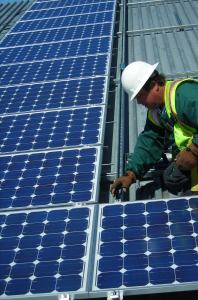
solar installation public domainThis week’s news of an 18 megawatt solar facility to be installed at Naval Station Oceana in Newport News marks the latest in a string of announcements of new solar projects to be built in Virginia. The Commonwealth had only about 22 megawatts of solar installed as of the end of 2015, but by the end of this year, we should be comfortably into the triple digits. That’s still trivial compared to neighboring North Carolina, which added over 1,000 megawatts last year alone, but it’s grounds for celebration here in the “dark state.”

How is this happening? Customer demand, coupled with falling costs, finally wrought a change of attitude at Dominion Virginia Power. The state’s largest utility dragged its feet on solar for years until announcing, in early 2015, plans to spend $700 million on 400 megawatts of solar power in Virginia by 2020.

The welcome change comes with a caveat: while these new projects will supply solar to important and influential customers like Microsoft, Amazon, and even the state government itself, Dominion offers no programs to supply solar to ordinary Virginians. And indeed, even where ratepayers are footing the bill for projects, our regulators insist that the renewable energy certificates—the right to say it’s solar power—should be sold to someone else.

Dominion’s early adventures in solar were not altogether encouraging. In 2012 the General Assembly authorized the utility to “study” solar by building up to 30 megawatts of distributed (mostly rooftop) projects. The SCC approved $80 million for the “Solar Partnership Program” the following year, with the stipulation that Dominion should sell the renewable energy certificates to reduce the cost to ratepayers. A steep learning curve made for slow and expensive going, and while a number of schools, universities and commercial businesses signed up to host projects, they weren’t permitted to purchase the solar energy being produced right on their property.

In 2013, Dominion created a special tariff “Schedule RG” especially to allow commercial customers to buy renewable energy. Cumbersome, limited and expensive, it never attracted any takers. Dominion spokesman David Botkins suggested to reporters last May the problem was Dominion’s low rates. As in, who wants renewable energy when dirty power is so cheap?

That was one month before Amazon Web Services announced it had contracted for the output of an 80 megawatt solar farm to be built in Accomack County. The project sidestepped Dominion’s limitations by feeding power directly into the Delmarva Power grid in Maryland. Dominion promptly bought the project.

Schedule RG was clearly a failure, but just as clearly, there was money to be made on solar. Dominion just needed to figure out how.

The utility was already trying. In January of 2015 Dominion proposed to build a 20 megawatt solar farm near Remington, Virginia. The State Corporation Commission (SCC) originally rejected Dominion’s proposal, saying the company had not considered third-party alternatives that might be cheaper for ratepayers. (They were proved right when it turned out the Amazon project was slated to deliver power at a cost that was 25% less.)

Dominion didn’t give up on Remington, nor was it willing to turn the project over to a private developer. Instead, it got to work rejiggering the deal into what, this spring, became a public-private partnership. Governor McAuliffe arranged to have the state government, rather than ratepayers, buy the power output from Dominion, while Microsoft agreed to buy the renewable energy certificates (RECs) to meet its corporate commitment to buying renewable energy. (In every solar deal, watch what happens to the RECs.*)

Although I wondered at the time if the state might be taking a financial hit to make the deal work, more recent information suggests the opposite. According to Dominion’s website, “the construction and deployment of this solar asset will lower the cost of the energy purchased by the Commonwealth. The Commonwealth is projected to save $500,000 to $1M in energy costs over the lifetime of the project.”

This tells us two things: one, obviously, we should sell more solar to Microsoft. And two, either the website omits key details about the financing, or the cost of energy produced by solar panels is now pretty darn competitive.

The projects have started coming in more quickly in recent months. In February of this year, Dominion announced it would buy the output of a 20 megawatt solar farm in Chesapeake through a power purchase agreement (PPA) with a North Carolina developer. Other PPAs are said to be under consideration.

Then, on June 30, the SCC gave Dominion approval to move forward on building three new projects totaling 56 megawatts in Powhatan, Louisa, and Isle of Wight counties. The 800 local jobs associated with the projects sparked news stories across the state.

That brings us to this week’s announcement of the deal with the Commonwealth and the Department of the Navy at Oceana. According to Dominion’s press release, Dominion Virginia Power will own and operate the facility, and the Commonwealth will buy the electricity, with Dominion retiring the RECs on the Commonwealth’s behalf.

Deputy Secretary of Commerce Hayes Framme confirmed to me this deal is the first step toward satisfying Governor McAuliffe’s commitment to having the state government get 8% of its power from solar by the time he leaves office, an amount equal to roughly 110 megawatts. That should mean there will be more announcements to come.

The Navy’s role here is especially interesting. Although some news outlets reported the Navy would buy the electricity, this appears to be a misreading of the Navy’s press release. Naval Station Oceana will instead receive “in-kind consideration in the form of electrical infrastructure upgrades” for hosting the project on its land. But the press release dwells mainly on the benefit to the regional grid that serves the naval station:

“Renewable energy projects, like the one at NAS Oceana and others throughout the Mid-Atlantic Region, are win-win-win collaborations. They’re good for the utility companies, good for our installations and good for the communities surrounding our installations,” said Rear Adm. Jack Scorby, Jr., commander, Navy Region Mid-Atlantic. “These projects increase the energy security, energy diversity and energy resiliency of our bases. Energy security, or having assured access to reliable supplies of energy and the ability to protect and deliver sufficient energy to meet mission-essential requirements, is critical to our installations’ roles to support the Fleet.”

The reference to “energy security, energy diversity and energy resiliency” is key here. The Navy will benefit from having a large renewable generation source onsite, one that can be protected from attack and that is not susceptible to fuel supply disruptions.

Come to think of it, “energy security, energy diversity and energy resiliency” are three of the prime reasons we need more solar projects all across the state, and why the benefits shouldn’t be limited to large, influential customers. So yay, Dominion, for getting rolling on all these solar projects! Now please stop blocking the way for the rest of us.


*RECs were invented as a way to identify units of electricity generated by wind, solar and other sources, since the electrons themselves can’t be dyed green. But RECs don’t have to just follow electrons around; they can also be bought and sold separately from the underlying electricity. When the RECs associated with a solar project are sold separately (in the case of the Remington solar project, to Microsoft), the electricity loses its green quality, and the buyer (in this case, the Commonwealth) can’t claim to be buying solar energy. For a fuller explanation of RECs, see this earlier post on the subject.

Unknown's avatar

McAuliffe rides to Dominion’s rescue on Remington solar plant

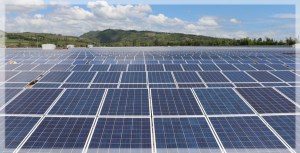
photo credit Kanadaurlauber

photo credit Kanadaurlauber

Last October, Virginia’s State Corporation Commission turned down an application from Dominion Virginia Power to build a 20-megawatt solar facility on land it owns near Remington, Virginia. The SCC told Dominion it had failed to meet its statutory obligation to consider third-party market alternatives that could save ratepayers money.

Rather than going back to the drawing board, we learned today that Dominion has found another way to build the project. In what is being billed as a “public-private partnership,” Dominion will sell the power from the project to the state of Virginia, and then will sell the associated renewable energy certificates (RECs) to Microsoft to help it meet its renewable energy goals for its data centers.

Governor McAuliffe announced the deal today at an event in Richmond, touting its ability “to reduce Virginia’s carbon emissions and diversify our energy portfolio.”

The deal seems to offer a great outcome for Dominion and Microsoft. A Dominion spokesperson told me the company will have to file a new application with the SCC for a certificate of public convenience and necessity, which they anticipate doing in May. But with no ratepayer impact now, they don’t expect the SCC would deny it this time around.

In this way, Dominion avoids having to consider less expensive means of acquiring solar energy, such as power purchase agreements or bids from third party developers.

The announcement did not say whether the state would pay a premium for power generated at the Remington site. It is also not clear how the deal relates to Governor McAuliffe’s goal, announced last December 21, of having the state derive 8% of its electricity from solar energy within three years. Legally, if Microsoft buys the RECs from the Remington project, the state cannot claim to be purchasing solar energy. So we hope the Governor has not been misled into thinking the state is buying solar energy with this deal.

As a general matter, though, supporting a large solar project fits well within the Governor’s ambitious jobs agenda, and it may be money well spent if it leads to more projects and greater investment. Certainly it beats handing out tens of millions of dollars annually to an ever-shrinking coal industry, as Virginia still does.

But we should keep this 20 MW project in perspective. North Carolina installed 1,134 MW of solar in 2015 alone. And meanwhile over at the SCC, Dominion is awaiting approval of its latest natural gas plant, the 1,600-MW Greensville Power Station, which will increase Virginia’s CO2 emissions by much more than the Remington project could possibly reduce them.

Which is to say, the further we go, the behinder we get.