Unknown's avatar

Will special rate classes protect Va. residents from the costs of serving data centers?

Data center between housing community and a bike path
A data center in Ashburn, Virginia. Photo by Hugh Kenny, Piedmont Environmental Council.

For the past few years, observers have been warning that the huge surge in demand for electricity to serve data centers will mean higher electricity bills. In its December 2024 report on data centers in Virginia, the Joint Legislative Audit and Review Commission (JLARC) confirmed projections that the increased demand for power and the need for new infrastructure to serve data centers would raise rates for everyone, not just the data centers. 

Right on cue, on March 31 Dominion Energy Virginia filed a request with the State Corporation Commission to increase the rates it charges to all customers. If granted, the increase would amount to an additional $10.50 on the monthly bill of an average resident. In a separate filing on the same day, Dominion asked to increase residents’ bills by another $10.92 per month to pay for higher fuel costs.  

Either out of a monumental failure to read the room, or because Dominion executives feel they might as well be hung for a sheep as a lamb, the rate filing also asks for an increase in the company’s authorized rate of return, from 9.7% currently to 10.4%.

But it’s not all bad news. Along with the rate increase request, Dominion filed a proposal to create a new rate class for large-load customers like data centers. The move coincides with enactment of new legislation requiringthe SCC to examine whether electric utilities should separate data centers into their own rate class to protect other customers, something the SCC was in fact already doing. 

And Dominion is not alone. Virginia’s other major investor-owned utility, Appalachian Power, filed a similar proposal on March 24, following onefrom Rappahannock Electric Cooperative (REC) on March 12. The proposals reflect a growing consensus that ordinary residents should not be forced to bear the cost of building new infrastructure needed only because of data centers. Moreover, if data centers close up shop before the costs of the new infrastructure are fully paid for, residents should not get stuck paying off these now-stranded assets.  

In Dominion’s case, there is good reason to worry. In the first day of testimony at the SCC regarding the company’s 2024 Integrated Resource Plan (IRP), a Dominion witness admitted that of the $7.6 billion worth of planned new transmission infrastructure listed in the IRP, residential customers will pay 55%, including for infrastructure that serves only data centers. 

It’s not immediately clear how much setting up a new rate class for data centers will change that outcome. Dominion proposes creating a new large-load class for customers using at least 25 MW at capacities of 75% or more (meaning that they have a consistently high level of electricity use, as data centers do). These customers would be subject to a number of new requirements, including posting collateral and paying for the substation equipment that supplies them. They would also have to sign 14-year contracts (including an optional 4-year ramp-up period) obligating them to pay for the greater of actual electricity use or 60% of the generation and 85% of the transmission and distribution capacity they sign up for, even if they use less.

Dominion says the proposed generation demand charge is much lower than that for transmission because transmission and distribution assets must be designed for 100% of capacity, while generation is only planned for 85% actual metered load. Based on that, though, you might think the correct demand charges would be set at 100% for transmission and 85% for generation. It’s also not clear whether 14 years is long enough to recover all the costs incurred to build new infrastructure, or whether that’s even the outcome Dominion is striving for. 

There are sure to be a lot more of these kinds of questions when the SCC takes up Dominion’s rate case. The SCC will have to evaluate Dominion’s proposed large-load tariff against a worst-case scenario: an industry-wide disruption that suddenly and dramatically reduces data center demand across the state, leaving a utility with excess generation and transmission capacity that can’t be backfilled and that other customers will be stuck paying for. 

Fortunately, Dominion’s proposal doesn’t have to be considered in isolation, since the SCC will be able to compare it to those from APCo, REC and utilities in other states. According to APCo’s filing, its new rate class would be limited to the largest new customers (those with at least 150 MW in total or 100 MW at a single site). These customers would be required to pay a minimum of 80% of contracted demand even if they use less, which the company says is a significant increase from the demand charge of 60% that applies to existing customers. (You’ll notice it’s also a lot more than the 60% demand charge Dominion is proposing for data centers.) 

APCo’s filing notes that its proposal is consistent with a data center tariff it recently agreed to in settling a case in West Virginia; in both cases, customers would have to sign 12-year contracts, following an optional ramping-up term of up to 4 years, with requirements for posting collateral and stiff exit terms. 

APCo has other experience to go on as well. Its parent company, American Electric Power (AEP), made news when its subsidiary in central Ohio proposed to charge data center customers at least 90% of contracted demand or 90% of their highest demand over the preceding 11 months, whichever is higher, and committing them to contract terms of at least 10 years, after a ramp-up period of up to four years. Data centers pushed back hard on these terms, and the Ohio Public Utilities Commission is considering different settlement proposals with somewhat lower demand charges. 

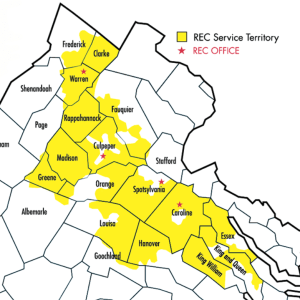
REC’s filing takes an entirely different approach. REC is the largest of Virginia’s co-ops, serving a territory that stretches from Frederick County in northwest Virginia down through Spotsylvania and as far east as King William County. As data center development pushes outward from Northern Virginia, REC finds itself overwhelmed with new demand. It now expects up to 17 gigawatts of data center demand by 2040, up from near zero in 2023, dwarfing all other customers’ loads.  

Like other utilities, electric cooperatives have an obligation to serve all comers in their territory, so if a new data center moves in, they have to provide the power. But unlike Dominion and other investor-owned utilities, co-ops are customer-owned nonprofits. They are highly motivated to protect their existing customers from the costs – and risks – involved in serving new ones. 

REC is a distribution cooperative only, with no generation of its own. Today, REC gets all its electricity from Old Dominion Electric Cooperative (ODEC), a sort of umbrella organization that owns generating plants and supplements those with power purchased on the PJM wholesale market. But when ODEC learned how much new data center load REC was expecting, it told REC to look elsewhere for the power. 

REC’s solution is to silo off big data centers and other customers with more than 25 megawatts in demand, and keep all the costs and risks involved within that space. According to the proposal the co-op filed with the SCC, data centers that want to get power from REC will have to post collateral, contribute to the cost of new infrastructure and sign two agreements, one for the power supply and one for its delivery. REC (or an affiliate it plans to create for this purpose) will buy electricity from PJM on the open market and pass through the cost. Alternatively, the data centers will be able to buy electricity from competitive service providers, allowing them, for example, to procure renewable energy.  

REC’s proposed delivery contract is similarly designed to ensure the data centers pay all the grid costs the utility will incur in serving them. In addition to contributing to the cost of new infrastructure, data centers will have to sign contracts with terms that must “be structured to recover the full cost of distribution and/or sub-transmission plant investment, maintenance and operation.” This includes payment of a demand charge that isn’t specified but appears to be as high as 100% of peak demand – meaning, there would be no risk that these grid costs would end up on the tab of residents and other customers outside the class.

REC’s approach might be seen as a sort of gold standard for protecting other ratepayers from the costs and risks involved in providing energy to data centers. It’s not a perfect antidote for rate increases, because the tight supply of generating capacity within PJM is already pushing up costs of electricity even for existing customers. And buying electricity on the open market may cost data center customers more than buying it from a utility that owns its own generation, as Dominion and APCo do. But that isn’t a concern that will keep REC’s other customers up at night. 

The very different approaches proposed by REC, on the one hand, and Dominion and APCo, on the other, reflect the difference between a nonprofit distribution cooperative and investor-owned utilities that build and own generation. Building stuff is how investor-owned utilities earn a profit. The bigger their customer base and the more electricity those customers demand, the more the profit. The data center industry looks to them like a big, fat golden goose. 

It isn’t surprising, then, that neither Dominion nor APCo are proposing solutions that put all the risks involved with serving data centers onto the industry, the way REC’s proposal does. As a new Harvard Law School reportdetails, the utility profit motive and the political muscle of Big Tech inevitably lead to a cost shift onto other customers.  

Maybe there is something different about data centers in Virginia that justifies involving ordinary residential customers in this risk. Dominion will surely make that pitch when the SCC takes up the case. 

It will be interesting to observe, but color me skeptical.

Originally published on April 25, 2025 in the Virginia Mercury.

Unknown's avatar

Is your electricity bill keeping you in the dark?

A seemingly simple question came across my desk a few weeks ago: What does Dominion Energy Virginia charge residents per kilowatt-hour (kWh)? Given how frequently I write about Dominion, I was embarrassed not to have a quick answer. In my own defense, though, Dominion makes it hard to find out. And when you do find out, the answer is, it depends. 

Examine a recent bill, and you will see the number of kilowatt-hours you used in the preceding month, a confusing list of charges and the dollar amount that you owe. You can do the math to figure out what you paid this month per kilowatt-hour, but that’s more of a snapshot than the whole picture.

 A Fairfax resident’s Mar. 6, 2023 Dominion Energy electricity bill. (Ivy Main/The Virginia Mercury)

I asked colleagues to send me their utility bills to see what people were actually paying, and I got out my calculator. Everyone’s rate was different, and the more electricity they used, the less they paid per kWh. Even after I removed state and local taxes from the equation, rates ranged from a low of 12.2 cents per kWh for a home that used 2930 kWh in February, to a high of 17.3 cents for a home that, thanks to solar panels, drew just 179 kWh from the grid in the same time period. 

As that solar home shows, the flat rate of the basic customer charge skews the average price higher. That basic charge is currently $6.58 per month, according to Dominion’s residential rate schedule, but you won’t see it on your bill. 

The rate schedule reveals other information your bill doesn’t tell you, and that’s where the real impact lies: you pay less per kWh, in both generation and distribution charges, for the electricity you use in excess of 800 kilowatts per month from October through May. From June to September, you pay less in distribution charges for every kilowatt over 800, but more in generation charges.

You’re also charged a single rate year-round for transmission, which is different from distribution. Plus, every kilowatt-hour is subject to a list of riders – “charges applied to certain rate schedules to recover various costs associated with Dominion Energy’s electric operations and electricity production,” according to Dominion – and non-bypassable charges. The rate schedule doesn’t identify these charges, but the bill does, albeit with no explanation for how the amounts are determined. Your bill also lists fuel as a separate charge under Electricity Supply, though fuel does not appear in the rate schedule. 

Still with me? No? All of this must make sense to the State Corporation Commission, which approved the rate schedule, but it is thoroughly opaque to customers. 

The sufficiently dogged can find a worksheet on Dominion’s website that breaks out all these costs. If you plug in the month and a number of kWh you used, it will calculate a bill. You still need to do the math yourself to arrive at the price per kWh, but you can then play with numbers to see how usage affects rates. 

Doing that confirms what I saw in my colleagues’ bills. Assuming 1,000 kWh, the number Dominion uses to represent the “typical” customer, the price works out to 14 cents in winter.  Change that to a frugal 500 kWh and you get 15 cents. Raise it to 2,000 kWh, and it goes down to about 13 cents. 

When challenged about this in the past, Dominion justified its buy-more, pay-less winter rate structure by arguing it was needed to make bills affordable for customers with electric heating, whose use can double or triple in the wintertime. The company didn’t mention that it also benefits wealthier people with large homes, and decreases the incentive for customers to conserve energy.

It also turns out that large homes do well in summer, too. According to the worksheet, a customer using 1,000 kWh in June would pay 14.6 cents per kWh. For 2,000 kWh, it rises slightly to 14.7 cents. The customer who uses only 500 kWh pays the highest rate, at 15 cents. Energy efficiency, alas, is not rewarded. 

So Dominion’s bills aren’t just confusing, they mask a perverse incentive in the rate structure that rewards people who use more electricity. This year’s utility legislation changes a lot of things, but it doesn’t require greater clarity in billing,  nor does it fix that upside-down incentive.

All utility bills are not equal

This perverse incentive is shared by some other Virginia utilities, though not all, and not all hide the ball the way Dominion does. Appalachian Power’s website shows it charges a single rate no matter how much you use. There’s neither a price break nor a penalty for higher consumption. The website provides two examples, for customers using 1,000 and 2,000 kWh, respectively. This makes it easy to calculate what you’re paying per kWh (about 16.5 cents), though you won’t find that number on either the website or the bills themselves. But neither the bill nor APCo’s website mentions the existence or amount of the basic customer charge, which can only be inferred from the website examples.

I also looked at February bills sent me by customers of Northern Virginia Electric Cooperative (NOVEC) and Rappahannock Electric Cooperative (REC). In both cases the bills were easy to understand. They identify the flat monthly charge, though in both cases the charge is unfortunately more than twice as high as Dominion’s. The bills also list the rates applicable per kWh for generation, transmission and distribution. Both utilities give a year-round volume discount on the distribution charge for higher levels of usage, another regrettable feature. However, REC’s SCC filing shows it imposes a higher electricity supply charge in summer for monthly usage over 800 kWh. I could not find current information about NOVEC’s rates online; I hope its customers have better access. 

Being able to understand your electric bill matters. Virginia’s average residential rates increased 20% between December 2021 and December 2022, according to the U.S. Energy Information Agency, mostly due to last year’s spike in the price of methane gas and coal. Even before last year, our bills were higher than those in most other states. 

Consumers have an array of options to help them lower their energy costs, including new federal and state programs and incentives for weatherization, energy efficient appliances and renewable energy. But customers who are confused about what they currently pay are less likely to act.

For the same reason, utility rate structures should incentivize customers to take steps that conserve energy. Lower rates for using more electricity undercut the value of investments in energy efficiency. 

If utilities want to help their customers, they can start by sending the right message.

This article was originally published in the Virginia Mercury on March 16, 2023.

Unknown's avatar

Customer-owned utilities should be leaders on clean energy. Why do most of them fail to deliver?

map shows territory of Rappahannock Electric Cooperative

The territory of the Rappahannock Electric Cooperative in Virginia, from the coop’s website.

More than one in six Virginia residents gets electricity from a rural electric cooperative rather than a big investor-owned utility like Dominion Energy or Appalachian Power. Co-ops don’t get much attention from clean energy advocates and the press, but that might be a mistake. Co-op members aren’t just customers; they’re owners.

In theory, that should put co-ops at the head of the energy transition.

The current reality is mostly quite different, both in Virginia and nationwide. While a few co-ops have adopted innovative customer-friendly programs, most actively resist change. Here in Virginia, a battle over reform of the Rappahannock Electric Cooperative (REC) shows how difficult it is for co-op members to make their voices heard.

According to the reform group Repower REC, the co-op’s management not only refuses to make changes that would save members money, it actively cuts members out of the decision-making process. Repower REC is endorsing a slate of reform board candidates and proposing amendments to the co-op’s bylaws that would give members the right to fair elections and to obtain basic information about REC’s management and finances.

The lack of transparency and democracy at REC turns out to be a common failing of co-ops. A 2016 report from the Institute for Self-Reliance described three reasons why co-ops are laggards rather than leaders in the energy transition: overreliance on coal, long-term contracts with suppliers and a failure of democracy in governance.

Coal accounts for 75% of energy generated by electric cooperatives nationwide, compared to less than 28% today for all utilities nationally. Worse, failing to see the promise of distributed generation, most co-ops have locked themselves into long-term supply contracts that give them little room for self-generation with solar and wind. Having tied their members to fossil fuels, it’s not surprising that co-op managers don’t want their governance scrutinized too closely.

In fact, stuck with the dirty black stuff, rural electric cooperatives are much more likely than investor-owned utilities to support coal and oppose climate regulations. This may even help explain why rural voters are so much more likely than urban voters to support coal even in non-coal states, and to doubt climate science. Certainly their co-ops, which are supposed to educate consumers about the electric power industry, are not helping to educate them about the realities of climate science.

But according to the Institute’s report, it’s the third reason that holds co-ops back the most. Co-op member-owners have the right to vote but mostly don’t, often because they’re presented with no real choices, and lack basic information needed to cast an informed vote.

A host of other barriers, such as a lack of transparency, and the practice of collecting blank “proxy ballots” that incumbent board members complete as they see fit, ensures the reelection of entrenched board members and their hand-picked successors. Board members pay themselves handsomely for very part-time work, with many staying on boards for decades if not life.

All of these problems are present at REC, according to Repower REC. Seth Heald, a Repower REC founder who’s been an REC member for over a decade, says “the total lack of transparency surrounding the co-op’s board meetings seems designed to keep REC members from knowing whether their board members are well-informed, engaged and advocating for consumers. It also prevents us from learning the extent to which management may exercise control over compliant board members.”

To be fair, other Virginia co-ops show the promise of the member-owned model. The only community solar programs offered in Virginia today are run by coops: BARC in southwest Virginia and Central Virginia Electric Cooperative in the Charlottesville area. BARC also installed solar on all three Bath County schools, putting it way ahead of larger and richer jurisdictions like Fairfax and Loudoun that get power from Dominion.

Virginia co-ops also reached a deal with the solar industry this year designed to ease some of the barriers to rooftop solar, a deal neither Dominion nor APCo would agree to.

But Virginia co-ops haven’t adopted the kinds of aggressive energy efficiency programs that have lowered energy demand and saved money for members of the nation’s most innovative co-ops, such as Roanoke Electric Cooperative in North Carolina and Ouachita Electric Cooperative in Arkansas. In both places, utility financing of efficiency improvements and federal grants from the Department of Agriculture have allowed even very low-income members to pay for insulation and appliance upgrades while simultaneously lowering electric bills.

(Ouachita also installed Arkansas’ largest solar farm in 2017.)

It’s hard to believe more co-ops wouldn’t offer programs like these if they truly had their members’ interests at heart.

REC members will be voting this month on board candidates and Repower REC’s proposed bylaw amendments, using proxy/ballot forms attached to the cover of the July Cooperative Living magazine. Forms must be mailed back in time to arrive by Aug. 19. Members may also vote through REC’s SmartHub online tool by Aug. 19, or in person at the August 22 annual meeting.