A home under construction in McLean, Virginia. Ivy Main
Every three years, a nationwide group of building safety professionals known as the International Code Council (ICC) publishes updated model building codes that form the basis for most U.S. state and local building codes. ICC codes address essential features like structural integrity, fire safety, plumbing and energy use. As technologies improve, so do the model codes. A home built to the 2021 International Energy Conservation Code(IECC), for example, uses 9.38% less energy than one built to the 2018 model code, which was itself a significant improvement on the 2015 model code, etc.
Most home buyers take these things for granted. We don’t know the ins and outs of building technologies or codes, and we don’t want to. It is the job of ICC professionals to set modern standards, and the job of state and local government to ensure builders meet them. Right?
Except it doesn’t always work that way. Some states and localities do adopt each new iteration of the model codes as a matter of course; Maryland is one such state. Across the river in Virginia, however, important energy efficiency elements of the residential building code are stuck all the way back in 2009, because the builder-dominated board in charge of Virginia’s building code refuses to adopt more rigorous standards.
This intransigence has cost Virginia residents millions of dollars over the years in higher energy bills, especially for heating and cooling. A July 2021 analysis by Pacific Northwest National Laboratory showed that adopting the 2021 IECC would save Virginians $2.5 billion over 30 years, the typical mortgage term. Their analysis assumed mortgages included the added cost of meeting the updated requirements, so the $2.5 billion is pure savings, reflected in yearly cash flow savings averaging $250 per homeowner.
Faced with high utility bills, owners of existing homes sometimes spring for expensive retrofits to upgrade heating and cooling systems, install new windows and add insulation. These investments often pay off in lower utility bills, but it costs more to retrofit than to build it right the first time. There are also limits to how much energy can be saved through retrofits. It can be very difficult, for example, to add insulation to the walls of an existing home. The right time to make a house weather-proof and energy efficient is during design and construction.
Builders resist meeting the highest efficiency standards for one simple reason: it costs more to build high-efficiency homes, cutting into profits. Builders insist they are just trying to keep home prices down, but that rings hollow. Anyone who has gone house-shopping knows the price of a home is determined by supply and demand, not building cost. Builders will charge whatever they can get.
Builders also say home buyers don’t ask for efficient homes, but that claim is also suspect. Unlike granite counters and high-end finishes, energy upgrades are frequently invisible to buyers, so they don’t know to ask for them or how to evaluate any claims a builder makes about them. Let’s face it, most of us wouldn’t know an R-value if a batt of insulation fell on our heads. Nor should we have to know. This is why we have building codes.
Unfortunately, protecting consumers from drafty homes and high utility bills is not a priority of the building industry and its allies that control Virginia’s code adoption process. For years the Board of Housing and Community Development (BHCD) has refused to adopt the full model efficiency code, leaving old exceptions in place. Standards for wall insulation and air leakage (the measure of how drafty a home feels) haven’t been updated since 2009.
The cost to residents mounts with each failed opportunity. Most people don’t buy new homes, after all. They buy (or rent) existing homes built according to previous building codes. BHCD’s repeated failures to raise standards condemns residents to decades of poorer-quality homes. Lower-income Virginians, in particular, end up energy burdened by living in homes that are unnecessarily expensive to heat and cool.
The General Assembly knows this is a problem. Virginia law has long required BHCD to adopt standards consistent with model codes such as the IECC. Faced with the board’s continuing intransigence, in 2021 legislators passed a new law directing BHCD to “consider adopting Building Code standards that are at least as stringent as those contained in [each] new version of the IECC.”
“Consider” looks like a loophole you could drive a truck through, but the new law goes on to add a specific requirement that the BHCD “shall assess the public health, safety, and welfare benefits of adopting standards that are at least as stringent as those contained in the IECC, including potential energy savings and air quality benefits over time compared to the cost of initial construction.”
Now that sounds like a slam-dunk for adoption of the IECC standards, given the studies confirming that building to the higher standards benefits occupants and the public with better air quality and with utility bill savings over time that far exceed what it costs a builder to meet those standards. Legislators and advocates who worked to pass the legislation reasonably expected BHCD to adopt the 2021 IECC in its entirety, if not go beyond it.
That did not happen. During the slow process of updating Virginia’s residential building code over the ensuing months, BHCD never took the new law seriously. It never conducted the required analysis, and there is no indication it even “considered” adopting the full 2021 IECC standards, in spite of in-depth comments from experts and testimony from the public.
The building code update BHCD proposed in December of 2022 and approved in its final form on August 28 of this year neither removed past weakening amendments nor adopted more stringent standards. Indeed, BHCD even decided this year to roll some commercial efficiency standards back to 2006 levels!
Perhaps this sad state of affairs should not surprise us too much, given who our governors – past and present – have appointed to the board. By my count, 8 of the 11 appointed members represent home builders; another member works for a mortgage company. The foxes are in charge of the hen house.
Those appointments were not a matter of luck. Public records show construction and real estate companies gave almost $13 million to Glenn Youngkin’s 2021 campaign for governor, the second largest industry donor to his campaign. Four years previously, the industry donated “only” $2.5 million to the campaign of Youngkin’s Democratic predecessor, Ralph Northam. In both cases, the board appointments that followed heavily favored the home building industry, with the result that Virginia’s residential building codes seem to be permanently stuck in the past.
Virginia leaders pride themselves on being pro-business, but that doesn’t have to mean being anti-consumer. The commonwealth as a whole would benefit from a housing stock that is more weather-resilient and healthier for occupants, that saves energy, and that reduces residents’ utility bills.
Is that really too much to ask?
This article first appeared in the Virginia Mercury on October 19, 2023.
Virginia voters will decide next month who will represent them at the State Capitol in January.
How much do Virginia’s elections matter in an off year? Measured by the turnout in past elections, you’d think the answer is “not much.” The percentage of registered voters who show up at the polls in Virginia typically drops well below 50% when no federal or statewide candidates are on the ballot.
But measured by how much the outcome of this year’s election could affect the lives of regular people, the battle for control of the Virginia Senate and House of Delegates matters enormously. With a Republican in the governor’s mansion, a Democratic edge in either or both chambers would continue the status quo of divided government and (mostly) consensus-based lawmaking. A Republican takeover of both chambers, on the other hand, would lead to a wave of new legislation imposing the conservative social agenda on abortion, gay rights, transgender issues, education and welfare.
It would also put an end to Virginia’s leadership on climate and clean energy and lead to costly initiatives protecting fossil fuels, at the expense of consumers and the environment.
Some of the divisions between the two parties are well-known, and the consequences of one party edging out the other are clear. For some issues, however, the party positions are not as obvious, and it takes a look under the hood to understand where elections matter.
Virginia’s clean energy transition is at risk
Let’s start with the obvious: the broad framework of Virginia’s energy transition to clean energy is a signature achievement of Democrats that Republicans have in the crosshairs.
Three and a half years ago, Virginia made history as the first Southern state to commit to zero-carbon electricity by 2050 with detailed and specific guidance. The next year, the General Assembly followed up with legislation to begin the transition to electric vehicles.
Clean energy investments soared after passage of the Virginia Clean Economy Act (VCEA). Solar installations in 2020 and 2021 dwarfed previous numbers, and the state solar market is now a $5.1 billion industry employing over 4,700 workers. Private investment dollars have poured into small-scale renewable energy as well, funding solar on schools, churches and government buildings.
The VCEA’s support for offshore wind gave that industry the certainty it needed to move beyond the pilot project stage. Foundations for the first of 176 turbines of the Coastal Virginia Offshore Wind project are currently on their way to the Portsmouth Marine Terminal. By the end of 2026, the turbines are expected to provide enough electricity to power more than 600,000 homes.
Communities benefited from Virginia’s entry into the carbon-cutting Regional Greenhouse Gas Initiative (RGGI), as $730 million in new revenue flowed to the Commonwealth for flood mitigation and low-income home weatherization.
And after passage of the Clean Cars law, sales of electric vehicles in Virginia are set to double by the end of next year, and to double again by 2026.
In 2021, however, the election of Gov. Glenn Youngkin and a narrow Republican majority in the House of Delegates put these gains at risk. Early on, Youngkin declared his intent to repeal the VCEA and the Clean Cars law and pull Virginia out of RGGI. Only a Democratic majority in the Senate stopped legislative rollbacks passed by House Republicans in 2022 and 2023. Loss of that majority would ensure repeal of Clean Cars and the evisceration of VCEA.
As for RGGI, the failure to repeal the law led Youngkin to attempt to pull Virginia out through an administrative rulemaking that will be contested in court. He could sidestep a court battle and do it legally through legislation if his party takes control of the General Assembly.
“No-brainer” bills killed in small committees
While a clear divide separates the two parties on signature Democratic initiatives like VCEA and RGGI, party membership is the determining factor on other energy and climate bills in less obvious ways. House rules allow a subcommittee consisting of as few as 5 members to vote down a bill by majority vote, keeping it from being heard by the full committee. With Republicans in control of the House, every subcommittee has a Republican majority, and Democratic bills routinely die on 3-2 votes. This can be true even if a bill has already passed the Senate, and even if the Senate vote was bipartisan – or for that matter, unanimous.
The Senate operates very differently. There, a subcommittee can only make recommendations. It takes a vote of the full committee to kill a bill in the Senate.
You might wonder: if a bill is such a no-brainer that it passes the Senate unanimously or by a wide bipartisan majority, why would it get voted down in the House at all? Wouldn’t the bipartisan endorsement suggest this is actually a good bill that even the party in charge of the House would want to support, or at least have heard in full committee?
Indeed, when a no-brainer bill is killed in a tiny House subcommittee along party lines, it is rarely because the bill’s patron just happened to find the only few people in the General Assembly who don’t like the bill. More typically, it’s because the governor or the caucus itself has taken a position against the bill, but doesn’t want to draw attention to that fact. The subcommittee members tasked with doing the killing let everyone else in the party keep their hands clean.
This explains the fate of Fairfax Democrat Sen. Chap Petersen’s bill to study the effect of data centers on Virginia’s environment, economy, energy resources and ability to meet carbon-reduction goals. The bill passed unanimously by voice vote in the Senate before dying at the hands of three Republicans in a five-person subcommittee of the House Rules committee.
The data center study was the very definition of a no-brainer bill. The unbridled growth of data centers has ignited protests in communities across Virginia, and the industry’s voracious appetite for energy is blowing up Virginia’s climate goals, according to Dominion Energy. How can it be that House Republicans don’t even want to study the issue?
The answer lies in the fact that the Youngkin administration testified against the three data center bills that were heard in the Senate. One of Youngkin’s proudest achievements in office was the deal with Amazon to bring another $35 billion worth of data centers to Virginia. He does not want a study that would bring negative realities to light, so the bill had to die. The Republican members of the subcommittee were merely the executioners.
Another no-brainer bill that never made it to a full committee vote is one that gets introduced year after year: a prohibition on using campaign funds for personal purposes. This year’s legislation passed the Senate unanimously before just five Republicans voted to scuttle the bill in a House Privileges and Elections subcommittee.
My guess is you could not find a voter anywhere in Virginia who thinks legislators should be able to take money donated to their election campaigns and spend it on themselves. Justifying it requires legislators to turn themselves into logical pretzels.
The combination of unlimited campaign giving by donors and unrestricted spending by the recipients makes it easy for powerful corporations like Dominion Energy to buy influence. Dominion has long been the largest corporate donor to legislators of both parties. The company’s influence has cost consumers billions of dollars and kept its fossil fuel plants burning.
Dominion’s influence was clearly at work this year when a House subcommittee killed a bill from Fairfax Senator Scott Surovell that would have made shared solar available to more Virginians, over Dominion’s opposition. The bill passed the Senate with bipartisan support before losing 4-2 on a party-line vote in a House Commerce and Energy subcommittee.
It is less clear whether Dominion had a hand in the death of a bill that would help localities put solar on schools. The legislation passed the Senate unanimously before being killed in House Appropriations, again on a straight party-line vote.
Certainly, there have been plenty of Democrats over the years who have voted for Dominion’s interest time and again. Conversely, not all the no-brainer bills killed by House Republicans reflect a hostility to the energy transition; sometimes the problem seems to be a hostility to environmental protections in general. Thus a bill to require customer notification when water tests show contamination from PFAS – known commonly as “forever chemicals” – passed the Senate unanimously and then was killed in a House subcommittee on, yet again, a party-line vote.
It would be hard to identify a consistent line of reasoning behind all the anti-environment votes across all the various subcommittees, but the pattern is clear enough. It reflects not just the positions of individual legislators, but a firm party line.
Whether voters care about these votes now is not clear, mainly because the news media rarely look at the role of the environment, climate and energy in elections. Regardless, these issues will be very much at stake at the polls next month.
This article originally appeared in the Virginia Mercury on October 4, 2023.
In my last column I took Dominion’s Integrated Resource Plan (semi-) seriously, giving the utility the benefit of the doubt in its projections for data center growth and the alleged need for more fossil fuels to keep up with the power demands of that ravenous industry. But as I also noted, Dominion doesn’t deserve to be taken seriously with this document.
Under Virginia law, an Integrated Resource Plan (IRP) is supposed to explain how the utility expects to meet demand reliably and at low cost within the constraints of the law. In this IRP, however, Dominion asked a different question: how to make Gov. Glenn Youngkin happy by keeping fossil fuels dominant regardless of both law and cost.
Coming up with a favorable answer required Dominion to ignore the Virginia Clean Economy Act (VCEA), create arbitrary limits on solar deployment, use wishful thinking instead of facts and, for good measure, do basic math wrong. They also assume the Youngkin administration will succeed in pulling Virginia out of the carbon-cutting Regional Greenhouse Gas Initiative (RGGI), a move that is being challenged in court. This makes Dominion’s IRP, with its plan to double carbon emissions, a sort of evil twin to a plan from any RGGI state.
Sure enough, the governor loves it. Elsewhere, however, this evil twin found a cold reception. Experts retained by environmental, consumer and industry groups all agree that this IRP should be chucked in the trash bin and Dominion told to start over.
It’s worth taking a look at the testimony from these groups to understand where Dominion went so badly wrong, and what a better plan might look like.
It’s all about the data centers
Northern Virginia data centers are the driving force behind Dominion’s plans to burn more coal and gas, but there is some disagreement whether their growth will be absolutely off-the-charts crazy, or merely eye-poppingly huge. Dominion’s IRP projects the data center industry’s power use in its territory will quadruple over the next 15 years, rising from 2,767 megawatts (MW) in 2022 to more than 11,000 MW in 2038. At that point it would represent close to 40% of Dominion’s load.
Experts testifying in the IRP case believe data center demand won’t reach the dizzying heights Dominion projects. They question whether Virginia communities will accept so much new data center development, given the pushback already evident in localities like Prince William and Fauquier Counties. Their thinking is essentially that if things can’t go on this way, they probably won’t.
They also suggest that some of the demand Dominion expects may also be reflected in the plans of other utilities serving Northern Virginia’s Data Center Alley, leading to double-counting. A load forecast published by grid operator PJM shows that Northern Virginia Electric Cooperative (NOVEC) projects its data center demand to rise from about 400 MW in 2022 to 4,000 by 2028 and 8,000 by 2034. Two other cooperatives project a combined 3,000 MW of data center development in the same time period.
Aside from data centers, demand for electricity in Dominion territory is flat or declining over the next fifteen years; presumably this is due to the increased efficiency of homes and businesses offsetting the increased demand from electric vehicles and building electrification.
If you were already experiencing vertigo over Dominion’s data center numbers, and you are now hearing for the first time that Dominion’s numbers represent only half of the total projected data center load coming to Virginia, maybe you won’t find it all that cheering that some of that added demand could be illusory. Still, it is a reasonable point. If you reduce demand by a few thousand megawatts here and there, pretty soon you might not “need” a new gas plant.
As an aside, one Virginia utility stands out for apparently not expecting much in the way of new data centers in its territory. Appalachian Power, which serves customers in Southwest Virginia, West Virginia and Tennessee, has experienced declining demand for years, and rural Virginia leaders would dearly love to see data centers come there. Yet the PJM forecast shows Appalachian Power’s parent company, American Electric Power (AEP), told grid operators it expected only about another 200 MW on top of the 500 MW of data center load it serves across its entire 11-state territory. AEP seems to regard this as quite a lot, which, when compared with what is happening in Northern Virginia, seems rather sweet.
I can’t help but wonder how Gov. Youngkin managed to make a deal with Amazon to bring $35 billion worth of new data centers to Virginia without securing a guarantee that many of the facilities would be located in a part of the state that actually has surplus energy capacity and desperately needs new economic development. Southwest Virginia voters may have put Youngkin in office; you’d think he’d be looking out for them.
Instead of real investment today, Youngkin promises the area a little nuclear plant a decade from now, when and if small modular reactors (SMRs) prove viable. Local leaders must be muttering, “Gee, thanks.”
And this leads to another point raised by several of the experts in the IRP case: All of the load growth Dominion projects is due to a single industry in Northern Virginia; elsewhere, demand is decreasing. Yet, instead of crafting a solution specific to the industry and region experiencing runaway growth, Dominion proposes to build a fossil fuel plant 140 miles away in Chesterfield and a nuclear plant 300 miles away in another utility’s territory.
Gregory Abbott, a former SCC Deputy Director, offers a particularly withering assessment of the IRP in his testimony on behalf of environmental advocacy group Appalachian Voices. Dominion’s computer model, he says, “is proposing supply-side solutions that are not focused on solving the actual problem, are likely unnecessary, and driving costs higher than they should be.”
Although Dominion insists this IRP represents just a “snapshot in time,” Abbott says that’s misleading: The IRP “sets the stage for multi-billion-dollar investments that Dominion’s customers will pay for decades to come. If a future snapshot in time changes, based on new public policy goals or market dynamics, ratepayers are stuck with paying for these sunk costs.”
Garbage in, garbage out
Abbott and others also note that unlike factories or other high consumers of energy, data center operators can shift some functions to other data centers elsewhere for short periods of time. Dominion could save money and reduce the need for new investments by capitalizing on this capability to develop demand-response programs tailored specifically to this industry.
Instead, Dominion treated the surge in demand as if it were statewide and spread across all its customers; then it used a computer model to figure out how to meet the soaring demand.
An expert for the Sierra Club, Devi Glick of Synapse Energy Economics, noted several problems with Dominion’s approach. Among them: the company told its computer model that it couldn’t select energy efficiency as a resource; it had to include gas combustion turbines in 2028; it had to adhere to artificial limits on solar, wind and battery storage; and it had to assume prices for solar that were “substantially higher than industry projections.” Dominion also did not instruct the model to account for proposed (and since finalized) new federal pollution limits that will raise the cost of burning fossil fuels, and miscalculated — by a billion dollars — the penalties associated with failure to meet the VCEA’s renewable energy requirements.
As they say, garbage in, garbage out. The model did what it was told, and produced plans that limited solar and battery storage, called for new gas combustion turbines and/or SMRs, and kept uneconomic coal plants running past their previously-planned retirement dates. Accordingly, none of the modeled scenarios complied with Virginia law and all would be unnecessarily expensive for customers.
Synapse ran its own computer model that kept most of Dominion’s load and cost assumptions but corrected for the company’s errors and artificial constraints. The results, not surprisingly, show that building more solar and storage and retiring coal plants earlier than Dominion wants to will lower carbon emissions and “reduce costs for Dominion’s ratepayers by between $4.1 and $9.0 billion over the 25-year study period.”
When Synapse then tweaked the model to reflect the new federal pollution rules and prices for solar and battery storage in line with industry projections, the results saw solar and battery investments soaring, while the “need” for firm capacity such as a new gas plant disappeared altogether during the planning period.
Clean energy, vindicated
So finally, we begin to see a path forward founded on real data and not constrained by political expediency. With none of its plans meeting the basic requirements of Virginia law, Dominion should be ordered to go back to the drawing board. The company should reexamine its data center load projections and design a demand-response program tailored to that industry. Then it should re-run its computer model with energy efficiency allowed as a resource, with no artificial constraints on battery storage and renewable energy,with federal and state compliance costs associated with fossil fuels fully included and with cost estimates for solar and storage consistent with industry norms.
The General Assembly has a role to play, too, in ensuring the data center industry does not shift costs onto other customers and cause Virginia to fall short of its carbon reduction goals. Data centers should be required to meet energy efficiency targets and to secure an increasing percentage of renewable energy on their own as a condition of obtaining generous state tax subsidies. Likewise, the State Corporation Commission should be required to ensure that data centers pay for the transmission upgrades they need. Finally, the General Assembly should pass the data center study bill adopted by the Senate this year before being killed in the House.
Finally, it’s clear that the computer models will select as much low-cost solar as they are allowed to, so the General Assembly should make it easier to build solar projects at competitive rates. They can do this by further opening the market to third-party developers, who are currently constrained by an interpretation of the VCEA that caps their share of the solar Dominion procures at 35%.
The SCC will hold a hearing on the IRP beginning September 18.
An earlier version of this article appeared in the Virginia Mercury on September 5, 2023.
Virginia’s embrace of the data center industry produced new fallout this spring when Dominion Energy Virginia released its latest Integrated Resource Plan (IRP). With data center growth the “key driver,” Dominion projects a massive increase in the demand for electricity. As a result, the utility claims the state-mandated transition to clean energy is now impossible to achieve.
Jettisoning its commitment to the Virginia Clean Economy Act (VCEA), Dominion proposes to keep running uneconomic coal and biomass plants that were previously slated for closure, build a new fossil gas plant and pay penalties instead of meeting state renewable energy targets, all of which mean higher costs for customers.
As I said at the time, this IRP is primarily a political document aimed at currying favor with a gas-loving governor. It is not a serious plan. For example, a Sierra Club filing with the State Corporation Commission describes how Dominion put artificial constraints into its computer modeling (including limits on new solar) to ensure the plan came out fossil-friendly. Moreover, Dominion’s demand projections are inflated, according to the clean energy industry group Advanced Energy United.
But for the sake of discussion, let’s take the IRP at face value. And in that case, I have some questions. How did Dominion let itself get blindsided by the data center growth spurt? Why are the rest of us expected to pay for infrastructure that’s only needed for data centers? Does the Governor understand that his deal to bring another $35 billion worth of new Amazon data centers to Virginia is driving up energy rates for everyone else?
Oh, and while I’m at it, are tech company commitments to sourcing renewable energy just a pack of lies?
Virginia’s data center problem is well known. Northern Virginia has the largest concentration of data centers in the world, by far. Data centers are Dominion’s single largest category of commercial power users, already consuming more than 21% of total electricity supply and slated to hit 50% by 2038. In addition to the new generation that will be required, data centers need grid upgrades including new transmission lines, transformers and breakers, with the costs spread to all ratepayers.
Residents are not happy. Controversy around data centers’ diesel generators, their water use, noise and visual impacts have spread outward from Loudoun County into Prince William, Fauquier, and even other parts of Virginia as massive new developments are proposed.
Data center developers don’t build without assurance they will have access to the huge amount of electricity they need for their operations, so they have to start discussions with their utility early. Yet in July of 2022, Dominion stunned the data center industry by warning it would not be able to meet new demand in Loudoun County until 2025 or 2026. The utility said, however, that the problem was not generating capacity, but transmission. So, what gives?
Not that it would be better if Dominion anticipated the oncoming tsunami but kept it secret until this spring. You have to wonder whether the General Assembly would have approved hundreds of millions of dollars in grants and tax subsidies for new Amazon data centers in February if legislators understood the effect would be to upend the VCEA and drive up energy costs for residents.
Some Republicans are no doubt pleased that Dominion’s IRP undermines the VCEA, but they shouldn’t be. Dominion proposes keeping coal plants open not for economic reasons, but in spite of them. These plants were slated for closure in previous IRPs because they were costing ratepayers too much money. Now Dominion says it needs more generating capacity and can’t (or rather, won’t) build enough low-cost solar to keep up with new data center demand.
Dominion also proposes to build a new methane gas combustion “peaker” plant that wasn’t in its last IRP, and again the company points to data center growth as the reason. Peaker plants are an expensive way to generate power; on average, the cost of energy from gas combustion is about double that of a solar/storage combination, or even triple once you factor in federal clean energy incentives.
Keeping the fossil fuel party going instead of embracing more solar isn’t the only way this IRP drives rates higher for customers. Limiting its solar investments means Dominion expects to miss the VCEA’s renewable energy percentage targets by a mile. The shortfall would subject Dominion to significant penalties. The kicker is, Dominion can pass the cost of those penalties on to ratepayers, too.
Regardless of your political persuasion, then, this IRP is bad news for Virginia consumers.
It’s also concerning that the driver of all these higher costs and carbon emissions is the high-tech industry that is so eager to be seen as a leader in sustainability. If these tech companies were meeting their power needs with renewable energy, Dominion wouldn’t be able to claim a “need” to keep its old coal plants belching away.
Amazon, the number one beneficiary of state data center largesse, says it is the leading corporate purchaser of renewable energy globally. Its website claims the company is “on a path to powering our operations with 100% renewable energy by 2025.” A map shows it has developed around 16 solar projects in Virginia, adding up to over 1,100 megawatts. That’s great, but the company’s Virginia data centers are such energy hogs that they would need many times as much solar, plus a huge amount of battery storage to meet their 24/7 demand. And of course, Amazon’s demand will skyrocket with that next $35 billion in new data centers.
That same map, by the way, shows that Amazon has on-site solar at warehouses and Whole Foods stores all over the Northeast, but none in Virginia. Northeastern states have higher commercial power rates than Virginia does, so on-site solar means bigger bill savings in those states. One cannot help but suspect that Amazon’s commitment to renewable energy is really just a commitment to cheap energy.
The Data Center Coalition’s filing in the IRP case does nothing to reassure us otherwise. Instead of chiding Dominion for reneging on its clean energy commitments, the Coalition’s Josh Levi essentially argues data centers are so important it doesn’t matter.
I have no beef with data centers as a general proposition. They are an integral component of today’s economy, and the developments that now drive their explosive growth — machine learning and artificial intelligence — will also help us achieve a zero-carbon future.
I just think data centers should try a little harder to be part of the solution instead of part of the problem.
This article was first published in the Virginia Mercury on August 16, 2023.
The folly of building the Mountain Valley Pipeline should be obvious to anyone who hasn’t already committed billions of dollars to the project.
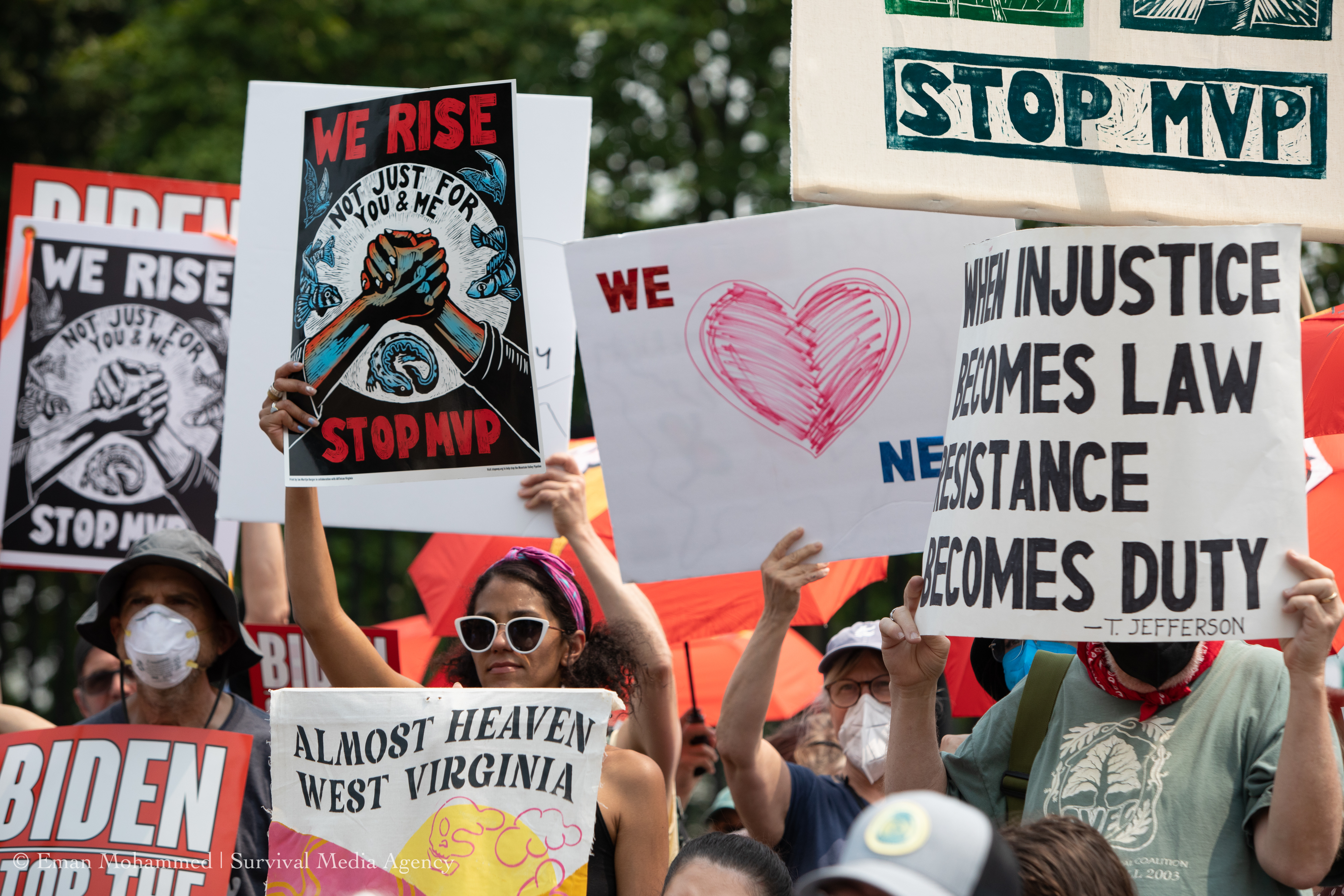
On Thursday, June 8, 2023, hundreds of frontline and Appalachian climate activists rallied at the White House against President Biden’s endorsement of the Mountain Valley Pipeline. (POWHR/Eman Mohammed/Survival Media Agency)
This spring’s passage of federal legislation raising the debt ceiling came with one provision that clean energy advocates had fought hard against: it sweeps away several legal challenges to the Mountain Valley Pipeline (MVP) that have stalled completion for more than four years. The pipeline is supposed to carry methane gas from the fracking fields of West Virginia into Virginia to connect to an existing interstate pipeline here, and getting it built has long been a priority of West Virginia Senator Joe Manchin.
Manchin surely believes he notched a victory with the inclusion of this provision in must-pass legislation. And in one respect, he’s right. Pipeline opponents aren’t conceding defeat, but stopping the MVP in court just got a heck of a lot harder.
Whether the pipeline’s developers should be celebrating is another matter. The wisdom of building a new methane gas pipeline was questionable nine years ago when the MVP was conceived. Today, with the U.S. transitioning away from fossil fuels, the folly of building new gas infrastructure should be obvious to anyone who hasn’t already committed billions of dollars to the project.
Dominion Energy figured this out three years ago when it dropped plans to develop the Atlantic Coast Pipeline. Dominion is a big energy conglomerate and had other projects to pursue. Canceling the Atlantic Coast Pipeline saved it billions of dollars that it is now investing in offshore wind and other renewable energy assets.
MVP’s two largest minority partners are also diversified companies with other options. NextEra Energy, which owns a 31% share in the partnership through its subsidiary Next Energy Resources, wrote off the value of its investment in MVP in 2021 and 2022, saying it planned to “reevaluate its investment in the Mountain Valley Pipeline.”
A NextEra spokesperson did not answer my question about what the company plans to do about MVP now. But if a picture is worth a thousand words, take a look at NextEra Energy Resources’ homepage. MVP isn’t mentioned anywhere on the website, which is largely a celebration of the company’s renewable energy assets.
The third-largest stakeholder in the MVP is Consolidated Edison, with an initial 12.5% stake. In 2019 it exercised an option to cap its investment in MVP, and in 2020 it wrote down the value of its investment by almost half. ConEd CEO John McAvoy told investors that year the company would no longer invest in gas transmission projects and “certainly would” consider selling its stake in MVP.
“We made those investments five to seven years ago,” he said, “and at that time we — and frankly many others — viewed natural gas as having a fairly large role in the transition to the clean energy economy. That view has largely changed, and natural gas, while it can provide emissions reductions, is no longer … part of the longer-term view.”
Unfortunately, these views aren’t shared by MVP’s majority owner and operator. Equitrans Midstream is solely a pipeline and gas storage company, having been spun off from a larger corporation, EQT, in 2018. MVP is its key to growth. The exit door may be wide open, but Equitrans doesn’t want to leave because it has nowhere to go.
That doesn’t mean it makes sense to stay, either. Many a gambler has learned the hard way that continuing to feed coins into a slot machine does not make it more likely to disgorge the jackpot.
And really, if there ever was a jackpot for MVP, it is gone by now. In 2015, EQT saw an opportunity to undercut the price charged by existing pipelines to ship gas to an energy-hungry Southeast. Today, though, demand for methane gas has cooled in the face of cheap wind and solar, while MVP’s costs have ballooned to $6.6 billion from the initial projection of $3.25 billion. Analysts say MVP’s competitive advantage has evaporated, and its prospects for profitability look grim.
Equitrans maintains that there is still a pressing need for its pipeline, but demand has always been hypothetical. From the very beginning, the partnership seemingly indulged in “build it and they will come” magical thinking.
Getting a permit to build from the Federal Energy Regulatory Commission requires that pipeline developers have their customers lined up ahead of time in order to demonstrate a “need” for the project. Even in 2015 there were not enough customers clamoring for MVP’s services, so the partners named themselves as the buyers for more than half of the pipeline’s capacity. FERC’s approach to permitting allows this self-dealing, though the commission has been heavily criticized for it.
Obviously, Equitrans was never going to be a customer; it isn’t in the business of generating power or selling gas at retail. Its field of dreams assumed demand for gas would grow, customers would be clamoring for pipeline capacity, and Equitrans would be able sell its share of the capacity and just reap the profits from owning the pipeline.
It’s hard to imagine that happening now. Economics had already started to favor wind and solar over fossil fuels when the MVP broke ground. Total natural gas consumption has been mostly flat nationwide since 2018, and the Energy Information Agency (EIA) projects it will decline steadily for the next decade. EIA also projects that more than half of all new electric generating capacity this year will be solar, with natural gas additions down to a mere 14%. Here in Virginia, methane gas burned by electric utilities has declined from a high in 2020.
The future will only get brighter for renewables and dimmer for gas. In 2020, Virginia committed to a zero-carbon energy future, and in 2022 Congress passed the strongest set of clean energy incentives in history. Betting on fossil fuels in today’s environment makes no sense.
Sure, Governor Youngkin is doing his level best to throw a wrench in the works, and Dominion Energy Virginia just proposed building a 1,000-megawatt gas combustion turbine, citing growing demand from data centers and electric vehicles. Misguided as that proposal is, it doesn’t signal good times ahead for the gas industry. Combustion turbines are not baseload plants; they run only when demand exceeds other sources of supply. Dominion has no plans to build new baseload gas plants.
MVP knows finding customers in Virginia will be hard. Before litigation and permit denials put construction on hold in 2018, the partnership had proposed an extension of the pipeline into North Carolina, perhaps hoping for better pickings in Duke Energy territory. Now that MVP has the congressional seal of approval, it is seeking to revive the proposed Southgate Extension, to the dismay of North Carolina activists. Yet economics don’t favor gas over solar there, either.
The liquefied natural gas export market has also been floated as a potential source of growth, but critics say the lack of liquefied natural gas terminal capacity prevents that from happening.
It’s time to stop this travesty. Equitrans claims MVP is 94% complete, but opponents say the true figure is more like 56%, with many of the most difficult segments (like stream crossings) still to be tackled. Those are also the most environmentally sensitive parts of the line. Pulling the plug on MVP now would avoid not only the cost of completing the pipeline, but also the cost of fixing leaks, erosion damage and other problems critics believe are inevitable given the terrain and geology.
That would be a much better result for everyone concerned than completing the pipeline to serve a market that doesn’t exist – a Pyrrhic victory if there ever was one.
This article was originally published in the Virginia Mercury on June 28, 2023.
Last December, Dominion Energy produced a remarkable document: a climate report predicting that by 2040 its electricity supply will be dominated by renewable energy. Coal will be gone by 2030, and methane gas will hang around in ever-smaller amounts, just to fill in the energy gaps. Small modular nuclear reactors (SMRs) probably won’t play a role for at least 15 years, during which time solar will become the mainstay of the electricity supply. According to the report, this strategy will allow Dominion to meet its goal of becoming carbon-neutral by 2050.
Fast forward a few months, and the same company, using the same information, projects a future full of new methane-burning plants and SMRs. Dominion Energy Virginia’s 2023 Integrated Resource Plan (IRP), released May 1, now insists that the phenomenal growth of the data center industry and, to a lesser degree, the adoption of electric vehicles require so much energy that it can’t possibly meet legally-mandated climate goals. Accordingly, the plan doesn’t even try.
Instead of decarbonizing in accordance with Virginia’s role in the Regional Greenhouse Gas Initiative (RGGI) and the requirements of the Virginia Clean Economy Act (VCEA), Dominion now says it must build new methane-burning plants and keep old, expensive coal plants running “beyond statutory retirement deadlines established in the VCEA.” All the alternatives examined in the IRP “assume that Virginia exits the Regional Greenhouse Gas Initiative (‘RGGI’) before January 1, 2024,” in violation of Virginia law. Most of the alternatives include the same SMRs its Climate Report recognized as unready. Compared to Dominion’s 2022 IRP update (filed just last September!), now costs have ballooned and CO2 emissions will skyrocket.
What could possibly have happened in the course of a few months to produce this about-face? The astounding growth projections for the data center industry may be news to many Virginians, but not to the utility that provides their power. Vehicle electrification is hardly a surprise either. SMRs did not achieve any breakthroughs in technology or economics this winter, nor did anyone suddenly discover a way for new gas plants to make sense for the climate or ratepayers. Dominion makes a big deal out of the Christmas cold snap, but you have to try pretty hard to believe that requires upending all previous planning.
What did happen was the 2023 General Assembly session, in which Gov. Glenn Youngkin played a decisive role in handing Dominion a major – and unaccustomed – defeat. With Dominion Energy holding its shareholder meeting today, the company badly needs to show it is back in the governor’s good graces. And the governor, as we know, is not a fan of the energy transition.
In other words, the IRP is a political document, not a serious approach to meeting Virginia’s electricity needs, at a time when climate change is accelerating and fossil fuels are giving way to superior renewable energy technologies.
Market watchers will recall that Dominion’s stock price tanked in the fall of 2022, losing more than 30% of its value from August to November. So the company came up with a bill that would have increased the profit margin for its Virginia utility from 9.35% to 10.77%. This number was calculated to improve Dominion’s standing on Wall Street but would cost consumers an extra $4 billion, according to the State Corporation Commission’s estimate. The company also expected to be able to defeat pro-consumer legislation that would return more authority over rates to the SCC.
Dominion’s bill was widely panned, but that hardly made it a non-starter. In past years, the company has gotten what it wanted more often than not, thanks to powerful friends like Senate Majority Leader Dick Saslaw, D-Fairfax, and House Majority Leader Terry Kilgore, R-Scott. This is the beauty of doing business in a state that allows corporations, even public utilities, to supply unlimited campaign donations to elected officials. Over the years, Dominion’s contributions to Republican Kilgore nearly match its contributions to Democrat Saslaw. Most other General Assembly members get contributions from Dominion, too, helping to cement bipartisan support for the company’s priorities.
As the patrons of this year’s money bill, Saslaw and Kilgore should have been able to deliver enough votes from members of both parties to ensure a profitable outcome for their biggest campaign donor. They were not counting on the governor poking holes in the plan.
Dominion’s beating this year grew from seeds it sowed in 2021. That year, Dominion made a bad bet on Democrat Terry MacAuliffe to win the governorship, secretly funding a dark money group to run ads attacking Youngkin.
This year, Youngkin took his revenge. As a Wall Street guy himself, he knows how to hit a corporation where it hurts.
Youngkin forced Dominion to accept changes to the bill that increase the company’s return on equity modestly (and only temporarily), but take away other avenues of profit. Adding insult to injury, the General Assembly also adopted the pro-consumer legislation that allows the SCC to set “fair and reasonable” rates in the future.
Dominion declared itself satisfied with the result, but Wall Street judged otherwise. The company’s stock, which had started to rally in January, reached a ten-year low this spring.
Aside from punishing Dominion, the governor achieved none of his energy goals in the legislative session. Rolling back the VCEA, exiting RGGI through legislation, reversing the Clean Car Standard — none of that happened. And as long as the Democrats keep control of at least one chamber in the General Assembly in this fall’s election, none of that is likely to happen.
So Dominion’s IRP violates Virginia’s laws and the public’s trust (such as it is), makes a mockery of its own climate plan and proposes “solutions” that will drive up both costs and carbon emissions. As a plan, it can’t be taken seriously.
All that, however, is beside the point. It makes the governor happy. And what makes the governor happy, Dominion hopes, will make its shareholders happy.
That assumes the shareholders don’t care about climate change, or that they hold values that are as malleable as those of Dominion CEO Bob Blue and the rest of the company’s leadership.
Climate change? What climate change?
An earlier version of this article was published in the Virginia Mercury on May 10, 2023.
Virginia’s first commercial offshore wind farm is on track to start construction next year and to be fully operational in 2026. The Coastal Virginia Offshore Wind (CVOW) project being developed by Dominion Energy will be the single largest offshore wind farm in the U.S. and among the first full-scale commercial wind projects built in U.S. waters.
Yet it has taken us 10 years to get this far. Future projects will have shorter timelines now that the industry is gaining its footing and government bodies have figured out how to regulate it. Even so, the complexity of planning, permitting and building giant wind turbines 25 miles out in the ocean means Virginia needs to start planning the next project now to ensure that the supply chain businesses that have located here, and the workers we are training to build CVOW, still have reason to remain in Virginia come 2027.
For most Virginians, offshore wind may still feel experimental because it has produced only two small projects in the U.S.: a 5-turbine wind farm off of Rhode Island’s Block Island built in 2016 and a two-turbine pilot project 27 miles out from Virginia Beach that started generating power in 2020. But at least 30 other projects are underway up and down the East Coast, including one currently under construction off Massachusetts and another off of New York that will begin construction this year. Plans are also underway for wind farms in the Great Lakes, off the West Coast and in the Gulf of Mexico.
Together these projects add up to more than 53,000 megawatts (MW), exceeding the Biden Administration’s 30,000 MW by 2030 goal – enough to power 10 million homes with clean, renewable energy. According to the U.S. Department of Energy, independent forecasts show that goal to be solidly realistic. The U.S. offshore wind industry itself recently announced a longer-term target of 110,000 MW, reflecting the business community’s expectations for growth.
The industry is also far more mature in other parts of the world. Global capacity passed the 50,000 MW milestone last year, and the global pipeline stands at more than 368,000 MW. (Surprise, surprise: China is eating our lunch, installing 13,790 MW in 2021 alone.)
Perhaps the most compelling evidence for the promise of the offshore wind industry in the U.S. is the size of industry events. In the course of a dozen years, U.S. offshore wind conferences have gone from gatherings of a few hundred academics, environmentalists and entrepreneurs in a hotel ballroom to the nearly 4,000 business people and hundreds of exhibitors who packed the Baltimore convention center at the end of March for the Business Network for Offshore Wind’s International Offshore Wind Partnering Forum (IPF).
Often the governor of a state hosting one of these annual conferences uses the occasion to unveil new goals or infrastructure investments; Maryland Gov. Wes Moore did not miss his chance this year. He announced that Maryland plans to develop 8,500 MW once the federal Bureau of Ocean Energy Management makes new lease areas available, a goal behind only New Jersey’s 11,000 MW target and New York’s 9,000 MW. Virginia’s goal begins to look cautious by comparison.
The industry does face challenges. Inflation and supply chain issues have disrupted timelines and threatened profitability. There aren’t enough workers. Transmission constraints hinder the ability to get power to customers. Permitting is a pain in the neck. Here in the mid-Atlantic, it’s hard to identify new areas of the ocean suitable for wind farms, in large part because the Department of Defense wants it all for itself.
Other challenges are more of the good kind, such as the fact that wind turbine sizes are increasing faster than ships capable of transporting and installing them can be built. Larger turbines mean more power at less cost, and no one is quite sure what the upper size limit might be. On land, the difficulty of transporting blades that can be the length of a football field means turbines are limited to about 3 MW. Fabricating parts at coastal facilities allows turbines to scale up as far as physics and advanced material manufacturing allow.
Dominion installed 6-MW turbines for its pilot project, which was seen as the new standard a few years ago. Today the company plans to use 15-MW turbines. Each one of these massive turbines is said to produce enough energy to power 20,000 European households. I have not seen that figure translated into U.S. suburban McMansions, but it is still an eye-popping amount of emissions-free power from a single structure.
Oh, and Dominion handled the installation ship issue by building its own vessel, which it will rent out for the Massachusetts and New York projects until it is needed for Virginia’s and others in the queue. Problem solved, at least for Virginia, though the industry needs many more ships.
Will the cost of energy come down?
Virginia’s CVOW project has been criticized for its high overall cost, largely the result of our immature domestic industry. The Biden Administration has set a goal to lower costs by one-third by 2030. If history is any indication, this should be readily achievable. A National Renewable Energy Laboratory (NREL) analysis shows costs have fallen by more than half since 2016, and projects that by 2030, the levelized cost of energy from offshore wind turbines will fall by another third.
Scaling up turbines to capture more wind energy is one approach to bringing the per-kilowatt-hour price down. Economies of scale, a U.S. supply chain, and a range of innovative technologies are all expected to contribute. And of course, the Inflation Reduction Act, with its tax credits for domestic manufacturing and renewable energy, is creating a gold rush of sorts, as companies compete to get a piece of the action.
Another significant factor in reducing costs is automation and machine learning. Some of the gains are incremental, such as optimizing turbine operation and improving turbine siting through improved wind and wake modeling. Other advances seem like windows into a future where robots take charge. Multiple exhibitor booths at IPF displayed crewless, self-piloting survey and depth-monitoring vessels and underwater robots capable of doing more tasks than humans can. Biologists and geologists stay comfortably ashore while on-board computers collect information at sea around the clock and send the data back.
Today’s innovation will inform the next great leap forward for the industry: floating wind turbines that open deep water to energy production. Right now, floating turbines must be tethered to the seafloor and connected to cables to bring power to shore. For various reasons this technology is more expensive than fixed-foundation turbines, but here, too, the industry expects to become competitive in the future.
Some people are thinking much bigger. Walt Musial, a principal engineer at NREL who is one of the top researchers in the field, gave an IPF audience a look into the future. There, automation and AI could make it possible for unmoored, cableless turbines to pilot themselves around the oceans, chasing the best winds, avoiding hurricanes and turning electricity into liquid fuels like ammonia to drop off at ports of call or offshore “energy islands.” Musial even referred to these turbines as “vessels,” evoking a whole new kind of wind-powered transportation.
A display at the Business Network for Offshore Wind’s IPF conference exhibits an autonomous wind turbine that could contribute to the nation’s future wind energy capacity. (Ivy Main/The Virginia Mercury)
It’s a great time for workers entering the industry — if you can find them
Though un-crewed, AI-directed traveling wind turbines may be the future, the present still requires foundations, cables, service vessels and, especially, a large workforce. Attracting and training an offshore wind workforce has become such an urgent issue that the topic earned its own track at IPF.
To its credit, this heavily male, heavily white-dominated industry says it is committed to recruiting a diverse workforce and ensuring equitable development of offshore wind, also a goal of the Biden Administration. It will have to; right now, no one has enough workers, so finding them means recruiting from overlooked communities and addressing the social and economic barriers that have kept many people out of the skilled labor force.
While not new to other large infrastructure projects, Community Benefit Agreements with detailed commitments covering local job creation and other investments, are new for offshore wind. Dominion has not entered any such agreement in Virginia, but as part of its case before the State Corporation Commission last fall in which it received permission to proceed with CVOW, the company signed a stipulation agreeing to an extensive and diverse community outreach program. Eileen Woll, Offshore Energy Program Director for the Sierra Club’s Virginia Chapter, told me Dominion is following through on this pledge.
Woll is also part of a task force made up of academic and community groups from the Hampton Roads area that has developed a plan for community engagement and outreach to identify potential workers from harder-to-reach demographic groups. She told me the “Breaking Barriers” project team has applied for a $500,000 grant from the U.S. Department of Energy to fund their work.
The Virginia booth at IPF. (Ivy Main)
Halting steps towards Virginia’s next project
The Virginia Clean Economy Act made special provision for Dominion’s CVOW project as part of an overall target of 5,200 MW. If CVOW makes up 2,600 MW, where will the rest come from? A project under development off Kitty Hawk, North Carolina, would connect to the grid in Virginia Beach, but Dominion has shown no interest in buying the power; nor has Duke Energy. Dominion makes more money acting as its own developer. Huge energy users like the data centers operated by Amazon Web Services in Virginia could absorb all the energy from several Kitty Hawks, but Amazon hasn’t stepped up either.
Meanwhile, the federal Bureau of Ocean Energy Management (BOEM) has identified 1.7 million acres offshore North Carolina, Virginia, Maryland and Delaware with potential for new leasing. The challenge is to make space for wind in an area already claimed by fishing interests, the Coast Guard, and the Department of Defense. If Virginia leaders are serious about building an enduring offshore wind industry here, they will have to engage in some tough negotiations.
For his part, Gov. Glenn Youngkin seems to be trying to ensure that the next Virginia project will be subject to competitive bidding to avoid a repeat of the process that made Dominion Energy the sole developer and holder of the only Virginia lease area. The governor amended an offshore wind bill from Sen. Mamie Locke, D-Hampton, that was something of a nothingburger as passed by the General Assembly. Youngkin’s amendment turns the legislation into a plan requiring Dominion to work with the State Corporation Commission and other government agencies on a competitive solicitation process for the next offshore wind project.
There is no guarantee that this will work, given that BOEM awards leases to high bidders. But if BOEM offers multiple wind energy areas for lease near Virginia, and awards the leases to multiple developers, then an SCC-led competitive process seems feasible, with a better result for consumers.
The governor’s language may have been inspired by a House bill from Del. Suhas Subramanyam, D-Loudoun, that would have had the SCC study the ownership structure of offshore wind projects and report on how to achieve the best outcome for consumers. Republicans killed that bill, but presumably they will be more open to promoting competition when the idea comes from their own party.
The General Assembly will consider the governor’s amendment when it reconvenes on April 12. Let’s hope his amendment indicates that Youngkin is ready and willing to start the next phase of Virginia’s offshore wind industry.
This article was originally published in the Virginia Mercury on April 10, 2023.
At the heart of the political fight over Virginia’s participation in the Regional Greenhouse Gas Initiative (RGGI) is a seemingly simple question: does a requirement that Virginia power plants pay for the right to spew CO2 actually lower CO2 emissions? Critics argue no; supporters say yes. There is evidence for both, but in the long run, the benefits of RGGI for both Virginia and the climate are clear.
RGGI operates as a carbon cap-and-trade agreement between 12 northeastern states. Carbon-emitting power plants must buy allowances through an auction process. This makes high-carbon fossil fuel electricity more expensive relative to zero-carbon sources like wind, solar and nuclear. The result, in theory, is that utilities are incentivized to buy less of the former and more of the latter. In states like Virginia, where utilities own generating plants, RGGI provides an incentive for them to abandon coal plants and build more zero-carbon sources.
RGGI administrators say it has succeeded in lowering carbon emissions in member states by more than 50%, twice as fast as the nation as a whole. RGGI states typically spend at least some of the money raised in the carbon allowance auctions on energy efficiency improvements that allow people to use less electricity, further reducing emissions.
But RGGI doesn’t operate in isolation. Several RGGI states are members of the PJM regional grid, comprising 13 states, including some that don’t participate in RGGI. Critics point out that, instead of building or buying renewable energy, a utility in a RGGI state can buy electricity produced in a state that doesn’t participate in RGGI. Fossil fuel plants in a non-RGGI state like West Virginia don’t have to pay to pollute, giving them a competitive edge over similar Virginia plants.
This is known as “leakage,” a loophole that lets fossil fuel energy “leak” into RGGI states. If there were enough leakage, lower carbon emissions in RGGI could be offset by the higher emissions elsewhere in PJM, leaving overall emissions unchanged.
Stephen Haner, a respected advocate for low energy rates at the conservative Thomas Jefferson Institute for Public Policy, says this is what’s happening in Virginia. He cites data to show a big jump in electricity imports from 2020 to 2022. According to this calculation, CO2 emissions actually increased under RGGI, when they were supposed to be decreasing.
But there are problems with this analysis, starting with the fact that Virginia entered RGGI in 2020, at the onset of the pandemic. That year saw energy demand — and emissions — plummet. It would be strange indeed if Virginia emissions did not rise when the economy rebounded.
Energy demand is also increasing in Virginia due to the boom in data center construction. Data centers are huge energy hogs, and they are being built faster than our utilities can build new electricity generation to serve them. The new generation will be zero-emission solar and, soon, offshore wind; meanwhile the electricity has to be imported from elsewhere in PJM.
Bill Shobe, an economist with the Weldon Cooper Center at the University of Virginia who has done extensive work in support of Virginia’s energy transition, told me in an email there are other reasons to be skeptical of the conclusion that RGGI caused Virginia’s carbon emissions to increase. I’ll spare you the weedy details, but among other things, Virginia’s nuclear production decreased significantly from 2020 to 2021, which has nothing to do with RGGI. And as Shobe notes, the data centers would get built somewhere, if not here, so perhaps they should not be counted against us.
I am not as forgiving of data centers as Shobe is. Tech companies have chosen Virginia for its fiber optic network and generous tax incentives, and they point to Virginia’s climate laws as progress in meeting their own sustainability commitments. Data centers are taking our money and busting our carbon cap; they owe it to us to procure their own renewable energy, if not in Virginia, then within PJM.
Data centers notwithstanding, Shobe’s own calculations show leakage to be much less than Haner’s data suggests. “It is abundantly clear that emission leakage is relatively modest,” he told me. “In the end, the other advantages of RGGI (lowering compliance costs, revenue for efficiency and flood resilience, etc.) will swamp the small leakage margin.”
For RGGI critics like Haner and Gov. Glenn Youngkin, of course, effects on CO2 emissions are really beside the point anyway. They would gladly accept higher emissions if it meant lower rates.
This is analogous to what happens when American manufacturers move operations to countries with cheaper labor and lax environmental laws. One way to stem the tide would be to lower our own environmental standards and suppress wages in the U.S., removing the incentive to offshore operations by making life equally miserable everywhere.
The better alternative is to raise the bar everywhere so that everyone benefits. That’s not just the right thing to do; it actually works. In the international arena, American leadership on clean energy investment is already forcing other countries to discuss upping their game. Here in the U.S., RGGI has attracted new member states — like Virginia — and prompted discussions within PJM about creating a region-wide clean energy market.
Of course, Virginia alone doesn’t have the market power to force other states to change. Fortunately for us and for the climate, leakage will become less of an issue over time as renewable energy outcompetes fossil fuel power everywhere. PJM’s carbon emissions have trended steadily lower, first as methane displaced coal, and more recently as renewable energy displaces all fossil fuels. That displacement will accelerate with federal clean energy incentives in place and innovation continuing to drive renewable energy costs lower.
Meanwhile, Virginia crafted its energy transition framework with an eye for ensuring our economy gains, no matter what other states do. As Shobe noted, lowering carbon emissions is just one benefit of RGGI membership; carbon auctions fund energy efficiency and flood control projects here, and the switch away from high-emission coal plants means our residents breathe cleaner air.
Our RGGI law is also part of a larger package designed to create jobs and economic development here at home. The Virginia Clean Economy Act provides for utilities to procure electricity from solar and wind generating facilities and battery storage located in Virginia, which will reduce leakage over time. It also requires an increasing percentage of Dominion and Appalachian Power’s electricity to come from renewable energy. After 2025, most of that must come from in-state facilities.
As I’ve shown before, building low-cost wind and solar helps to lower rates and provides price stability when fossil fuel costs spike. Virginia’s energy transition is just getting underway, but it will deliver benefits for years to come.
This article was originally published in the Virginia Mercury on March 29, 2023.
A seemingly simple question came across my desk a few weeks ago: What does Dominion Energy Virginia charge residents per kilowatt-hour (kWh)? Given how frequently I write about Dominion, I was embarrassed not to have a quick answer. In my own defense, though, Dominion makes it hard to find out. And when you do find out, the answer is, it depends.
Examine a recent bill, and you will see the number of kilowatt-hours you used in the preceding month, a confusing list of charges and the dollar amount that you owe. You can do the math to figure out what you paid this month per kilowatt-hour, but that’s more of a snapshot than the whole picture.
A Fairfax resident’s Mar. 6, 2023 Dominion Energy electricity bill. (Ivy Main/The Virginia Mercury)
I asked colleagues to send me their utility bills to see what people were actually paying, and I got out my calculator. Everyone’s rate was different, and the more electricity they used, the less they paid per kWh. Even after I removed state and local taxes from the equation, rates ranged from a low of 12.2 cents per kWh for a home that used 2930 kWh in February, to a high of 17.3 cents for a home that, thanks to solar panels, drew just 179 kWh from the grid in the same time period.
As that solar home shows, the flat rate of the basic customer charge skews the average price higher. That basic charge is currently $6.58 per month, according to Dominion’s residential rate schedule, but you won’t see it on your bill.
The rate schedule reveals other information your bill doesn’t tell you, and that’s where the real impact lies: you pay less per kWh, in both generation and distribution charges, for the electricity you use in excess of 800 kilowatts per month from October through May. From June to September, you pay less in distribution charges for every kilowatt over 800, but more in generation charges.
You’re also charged a single rate year-round for transmission, which is different from distribution. Plus, every kilowatt-hour is subject to a list of riders – “charges applied to certain rate schedules to recover various costs associated with Dominion Energy’s electric operations and electricity production,” according to Dominion – and non-bypassable charges. The rate schedule doesn’t identify these charges, but the bill does, albeit with no explanation for how the amounts are determined. Your bill also lists fuel as a separate charge under Electricity Supply, though fuel does not appear in the rate schedule.
Still with me? No? All of this must make sense to the State Corporation Commission, which approved the rate schedule, but it is thoroughly opaque to customers.
The sufficiently dogged can find a worksheet on Dominion’s website that breaks out all these costs. If you plug in the month and a number of kWh you used, it will calculate a bill. You still need to do the math yourself to arrive at the price per kWh, but you can then play with numbers to see how usage affects rates.
Doing that confirms what I saw in my colleagues’ bills. Assuming 1,000 kWh, the number Dominion uses to represent the “typical” customer, the price works out to 14 cents in winter. Change that to a frugal 500 kWh and you get 15 cents. Raise it to 2,000 kWh, and it goes down to about 13 cents.
When challenged about this in the past, Dominion justified its buy-more, pay-less winter rate structure by arguing it was needed to make bills affordable for customers with electric heating, whose use can double or triple in the wintertime. The company didn’t mention that it also benefits wealthier people with large homes, and decreases the incentive for customers to conserve energy.
It also turns out that large homes do well in summer, too. According to the worksheet, a customer using 1,000 kWh in June would pay 14.6 cents per kWh. For 2,000 kWh, it rises slightly to 14.7 cents. The customer who uses only 500 kWh pays the highest rate, at 15 cents. Energy efficiency, alas, is not rewarded.
So Dominion’s bills aren’t just confusing, they mask a perverse incentive in the rate structure that rewards people who use more electricity. This year’s utility legislation changes a lot of things, but it doesn’t require greater clarity in billing, nor does it fix that upside-down incentive.
All utility bills are not equal
This perverse incentive is shared by some other Virginia utilities, though not all, and not all hide the ball the way Dominion does. Appalachian Power’s website shows it charges a single rate no matter how much you use. There’s neither a price break nor a penalty for higher consumption. The website provides two examples, for customers using 1,000 and 2,000 kWh, respectively. This makes it easy to calculate what you’re paying per kWh (about 16.5 cents), though you won’t find that number on either the website or the bills themselves. But neither the bill nor APCo’s website mentions the existence or amount of the basic customer charge, which can only be inferred from the website examples.
I also looked at February bills sent me by customers of Northern Virginia Electric Cooperative (NOVEC) and Rappahannock Electric Cooperative (REC). In both cases the bills were easy to understand. They identify the flat monthly charge, though in both cases the charge is unfortunately more than twice as high as Dominion’s. The bills also list the rates applicable per kWh for generation, transmission and distribution. Both utilities give a year-round volume discount on the distribution charge for higher levels of usage, another regrettable feature. However, REC’s SCC filing shows it imposes a higher electricity supply charge in summer for monthly usage over 800 kWh. I could not find current information about NOVEC’s rates online; I hope its customers have better access.
Being able to understand your electric bill matters. Virginia’s average residential rates increased 20% between December 2021 and December 2022, according to the U.S. Energy Information Agency, mostly due to last year’s spike in the price of methane gas and coal. Even before last year, our bills were higher than those in most other states.
Consumers have an array of options to help them lower their energy costs, including new federal and state programs and incentives for weatherization, energy efficient appliances and renewable energy. But customers who are confused about what they currently pay are less likely to act.
For the same reason, utility rate structures should incentivize customers to take steps that conserve energy. Lower rates for using more electricity undercut the value of investments in energy efficiency.
If utilities want to help their customers, they can start by sending the right message.
This article was originally published in the Virginia Mercury on March 16, 2023.
For followers of Virginia energy policy, 2023 will be remembered as the year Dominion Energy lost its stranglehold on the General Assembly. The utility’s all-out campaign to boost its return on equity earned it little more than crumbs. By contrast, a bill to return authority over rates to the State Corporation Commission garnered overwhelming support.
Another surprise loser was the nuclear industry. Gov. Youngkin and boosters of small modular reactors (SMRs) expected a lot more love, and incentives, than legislators proved willing to dole out this early in the technology’s development.
Less noticed was the rise to political power of one of Dominion’s largest customers, Amazon Web Services. Many legislators may still not have caught on, but the corps of lobbyists who haunt the hallways of the General Assembly building know a 500-pound gorilla when they see one. As one lobbyist put it: “Amazon is the new Dominion.”
These are the standout takeaways from a legislative session in which, otherwise, few significant energy bills emerged from the scrum. Senate Democrats ably protected the energy transition framework established in 2020 and 2021, but modest efforts to accelerate the transition mostly failed. Of the roughly 60 bills I followed this session, only a handful made it to the governor’s desk.
Republican attacks on the energy transition failed
The three foundational bills of Virginia’s energy transition — the Regional Greenhouse Gas Initiative (RGGI), the Virginia Clean Economy Act (VCEA) and Clean Cars — all came under attack this year, as they did last year. And again, repeal efforts failed every time.
Senate Democrats blocked the one bill that would have pulled Virginia out of RGGI. Gov. Youngkin remains bent on achieving the pullout by regulation through Department of Environmental Quality rulemaking.
In the transportation sector, every bill to repeal the Air Pollution Control Board’s authority to implement the Advanced Clean Car Standard failed in the Senate as Democrats held the line.
Efforts to undermine key parts of the VCEA failed, including House and Senate bills that would have given the State Corporation Commission more authority over closures of fossil fuel plants and require it to conduct annual reviews designed to second-guess the VCEA’s framework for lowering emissions and building renewable energy.
A House bill that would have exempted certain industrial customers categorized as “energy-intensive trade-exposed industries” from paying their share of the VCEA’s costs passed the House on a party-line basis. However, with the bill facing certain death in Senate Commerce and Labor, patron Lee Ware, R-Powhatan, requested it be stricken. At the time, he had reason to expect that a compromise approach proposed by Sen. Jeremy McPike, D-Prince William, would pass. McPike’s bill would have had the SCC put together a group of experts to study the issue and make recommendations. After passing the Senate, however, McPike’s study bill went to House Energy and Commerce, which insisted on amending it to mirror Del. Ware’s bill. That did not go over well in the Senate, where the House substitute was unanimously rejected. McPike then asked the Senate to kill his own bill, and the energy-intensive trade-exposed industries got nothing.
Raids on the VCEA produced mixed results
One of the VCEA’s strengths is in creating incentives for clean energy. That’s also a vulnerability, because everybody and their brother wants in on the incentives — and this year, once again, the brothers came peddling some pretty sketchy stuff.
In the end, however, the VCEA sustained little damage. An effort to open up the renewable energy category to coal mine methane was modified to become simply a policy to encourage the beneficial capture and use of methane that would otherwise escape from old coal mines into the air. However, methane extraction jobs in four Southwest Virginia counties will now qualify for a “green jobs” tax credit.
More successful was an effort by the forestry industry to allow more woody biomass to qualify for the renewable portfolio standard (RPS); this was in spite of drawbacks including high levels of pollution, expense and large climate impact. As passed, the House and Senate bills will allow Dominion-owned biomass plants to remain open and have their output qualify for the RPS, so long as they burn only waste wood from forestry operations. Climate advocates opposed the change, but remain hopeful that Dominion and the SCC will want to close these uneconomic biomass plants to protect ratepayers.
Two different Housebills that tried to shoehorn nuclear and hydrogen into the RPS failed in the Senate. A third bill promoting small modular nuclear reactors (SMRs) got more traction initially; it would have had the SCC develop a pilot program for SMRs with a goal of having the first one operational by 2032. After it passed the House, the Senate Commerce and Labor committee adopted amendments to require the SCC to examine the cost of any SMRss relative to alternatives, and to prevent ratepayers from being charged for the costs if an SMR never became operational. The Senate voted unanimously for the bill with these protections included, but the House rejected them. Ultimately, the bill died, a remarkable setback for the governor’s nuclear ambitions.
Utility reform consumed most of the session (again)
Dominion’s money grabs have turned into near-annual food fights. This one almost wrecked the cafeteria.
The action proceeded along two fronts. One consisted of bipartisan, pro-consumer House and Senate legislation promoted as the Affordable Energy Act, intended to return ratemaking authority to the SCC. As passed, it merely authorizes the SCC to modify Dominion’s or Appalachian Power’s base rates going forward, if it determines that current rates will produce revenues outside the utility’s authorized rate of return. If that strikes you as hard to argue with, you’re not alone; no one in either chamber voted against it.
Far more divisive was Dominion’s own effort to secure an increased rate of return on equity (ROE). This legislation earned its own bipartisan support from Dominion loyalists, led by Senate Majority Leader Dick Saslaw, D-Fairfax, for the Senate bill and House Majority Leader Terry Kilgore, R-Scott, for the House bill.
As initially drafted, it probably should have been called the Unaffordable Energy Act instead of the reassuringly bureaucratic-sounding Virginia Electric Utility Regulation Act. The bill described a formula for determining Dominion’s allowed ROE that SCC staff calculated could result in an ROE as high as 11.57%, up from the currently-allowed 9.35%. SCC staff told legislators this could cost ratepayers $4 billion through 2040. In return, the bill offered some near-term savings for customers but also would have removed the last vestige of retail competition and opened VCEA coal plant retirement commitments to second-guessing by the SCC.
Dominion pulled out all the stops. The company supplemented its own in-house lobbying corps of 13 with another 17 top lobbyists from around Richmond. Former senator John Watkins signed on, as did former FERC commissioner Bernard McNamee. CEO Bob Blue showed up personally to push the bill. Dominion ran full-page ads in the Washington Post and Virginia newspapers touting a provision of the bill that would save ratepayers $300 million (neglecting to mention that it was the ratepayers’ own money). The ad featured a dog so people could be sure Dominion was being friendly.
It didn’t work. The consumer advocates hung tough, and Gov. Youngkin, possibly a cat person, added his weight to the resistance. As the Mercury reported, the “compromise” that all parties now swear they are delighted with gives Dominion very little kibble. The coal plants will be retired on schedule, ratepayers will see savings and a larger percentage of over earnings will be returned to customers in the future. In exchange, Dominion’s future return on equity will be bumped up to 9.7%, but only for two years, after which the SCC will have discretion to set the ROE as it deems fair. (That is, if Dominion doesn’t start the next food fight first.)
Appalachian Power had its own troubles this session. APCo-only legislationthat would have replaced the requirement for an integrated resource plan with an “annual true-up review” was radically amended to become an entirely different bill. It now allows both utilities to finance the high fuel costs they’ve incurred due to soaring natural gas and coal prices. The amendments were welcomed both as a way to handle the fuel debt and so that no one had to figure out what a true-up review is. The bills passed handily.
One other successful piece of legislation may help avoid future food fights. Sen. Scott Surovell, D-Fairfax, and Del. Kilgore worked together to resuscitate the Commission on Electric Utility Regulation (CEUR) and create more transparency around utility planning. The original bill also created a structure for state energy planning, but that proved too much for House Republicans, who amended it down to the lean bill that passed.
Over the years CEUR earned a bad reputation as an entity that rarely met but that served as an excuse for legislators to defer action on pro-consumer bills. That makes advocates somewhat wary of this bill. On the other hand, provisions welcoming stakeholders into the utility integrated resource planning process seems likely to benefit the public, if not the utilities.
Elsewhere, consumers did poorly
Dominion may have taken a drubbing on its money grab, but it did pretty well in guarding its monopoly. The Dominion-friendly Senate Commerce and Labor committee killed a bill to allow customers to buy renewable energy at a competitive rate from a provider other than their own utility. Bills to expand shared solar passed the Senate but died in the House.
Indeed, the House turned into a killing field for any bill with the word “solar” in it, no matter how innocuous or popular. A House Rules subcommittee killed a bill that would have helped schools take advantage of onsite solar, though it had passed the Senate unanimously. A resolution to study barriers to local government investments in clean energy was left in House Rules. A bill to create a solar and economic development fund passed the Senate but was tabled in House Appropriations. A resolution directing the Department of Transportation to study the idea of putting solar panels in highway medians never got a hearing in House Rules. A consumer-protection effort for buyers of rooftop solar was tabled in House Commerce and Energy. A bill clarifying the legality of solar leases passed the Senate unanimously, only to be left in House Commerce and Energy.
Do we detect a little frustration on the part of House Republicans at the complete failure of their anti-clean energy agenda? Why, yes. Yes, we do.
The only pro-consumer legislation to pass was a very modest bill requiring the SCC to establish annual energy efficiency savings targets for Dominion customers who are low-income, elderly, disabled or veterans of military service. But legislation that would have made homeowners eligible for low-cost loans through property-assessed clean energy (PACE) programs failed.
Offshore wind remains on track
Dominion beat back an effort to make it hold ratepayers harmless if its Coastal Virginia Offshore Wind project fails to produce as much energy as expected. A bill to allow the company to create an affiliate to secure financing for the project passed.
Legislation to move up the VCEA’s deadline for offshore wind farm construction from 2034 to 2032 passed; the law now also requires that the SCC consider economic and job creation benefits to Virginia in overseeing cost recovery. However, a bill that would have required the SCC to issue annual reports on the progress of CVOW failed. That bill would also have required the SCC to analyze alternative ownership structures that might save ratepayers money.
The gas ban ban fails again
This year’s attempt to bar local governments from prohibiting new gas connections passed the House on a party-line vote but was killed in Senate Commerce and Labor. A Senate companion bill from Democrat Joe Morrissey, which had caused something of a tizzy initially, was stricken at Morrissey’s request.
And this year’s big winner is … Amazon!
With data centers now making up over 21% of Dominion’s load and since they have already sucked up over a billion dollars in tax subsidies, this should have been the year Virginia government woke up to the need for state oversight of the industry. Alas, no. Bills that would limit where data centers could be sited failed. Senate legislation that would have simply tasked the Department of Energy with studying the impact of data centers passed the Senate on a voice vote but was killed in a subcommittee of House Rules on a 3-2 vote, the same fate suffered by a similar House bill.
Who could be against studying the impact of an industry this big? Aside from the data center industry that is enjoying the handouts, the answer is the Youngkin administration. The governor is so pleased with Amazon’s plan to spend $35 billion on more data centers across Virginia that he promised the company even greater handouts.
Those handouts take the form of a bill creating the Cloud Computing Cluster Infrastructure Grant Fund, with parameters that ensure only Amazon gets $165 million. In addition, the far more impactful sales and use tax exemption, currently set to expire in 2035, will be continued out to 2040 with an option to go to 2050; again, this is all just for Amazon, unless some other company manages to pony up $35 billion in data center investments. In return, Amazon must create a total of just 1,000 new jobs across the entire commonwealth, and only 100 of them must pay “at least one and a half times the prevailing wage.” A jobs bill, this is not.
With the sales and use tax exemption already costing Virginia $130 million per year and growing rapidly, this legislation will be very costly. You would not know it, though, from the budget analysis performed for legislators. Through the magic of accounting rules, that analysis managed to conclude that the budget impact of this legislation would be zero.
As preposterous as that is, it may explain why only a few legislators voted against the bill. They have no idea what the governor is getting us into.