Unknown's avatar

Hey Dominion, what’s up with the gas plants?

Dominion Energy headquarters, Richmond, VA

Flush with success after the SCC ignored legal deficiencies and approved the company’s plan for a large gas peaker plant in Chesterfield, Dominion Energy is pushing its luck with a proposal for a massively bigger gas combined-cycle plant.

The 3,000 MW facility slated for Cumberland County would be Dominion’s biggest fossil fuel plant ever, the size of three nuclear reactors. And unlike the Chesterfield plant, which is designed to run only intermittently, Dominion expects the new one to run most of the time. 

With Chesterfield, Dominion argued that a peaker plant was needed for reliability. You know the refrain: the sun doesn’t always shine, the offshore wind won’t always blow, batteries might run out of juice. That argument doesn’t fly for a combined-cycle plant, but the company still waves the banner of reliability. For Cumberland, though, it just says growing demand means it needs the power.  

The demand part is true. Every time Dominion revises its projections for future demand, the number goes higher. The obvious reason is the data center boom, though Dominion generally avoids saying so. It cites electric vehicles, building electrification and new manufacturing, trying to create a “we’re all in this together” vibe. 

But energy efficiency has largely kept pace with those kinds of higher usage. When the SCC pushed Dominion to separate data center demand from total demand, it became clear that residents and non-data center businesses aren’t the drivers. We are just the ones paying the consequences.

Why should we residents be stuck with 30 years of paying for a honking-big, fracked-gas-burning, climate-change-driving monstrosity whose sole purpose is to feed the tech companies’ competitive drive for the most advanced chatbots?  

Indeed, there are all kinds of reasons why the SCC should say no, including the unfairness, high cost, illegality and – to use a technical term – stupidity of building another plant to burn fossil fuels.

 The new plant proposal uses different technology from the Chesterfield project but comes with similar problems. 

Both carry the weight of environmental injustice. Just last year Cumberland County approved construction of a mega-landfill over strong opposition from the rural, historically Black community. Residents had hoped the county would instead lean into its rich history to promote “tourism not trash.”Layering on a massive gas plant in an area that is already about to be burdened with one of the largest landfill projects in the state surely raises issues of equity and fairness.

The SCC showed little interest in those problems in the Chesterfield case, and may well ignore them in Cumberland. If so, maybe it will be more persuaded by the economic argument.

Only a couple of years ago, developers had mostly stopped investing in new gas generation for the simple reason that combined-cycle plants are expensive to build and can’t compete against cheaper renewables on a dollars-per-megawatt-hour basis. 

(By contrast, peaker plants are cheap to build but inefficient and much more expensive to run, so they only get fired up for short periods when demand peaks and power prices are at their highest. That’s a role batteries increasingly fill at less cost.)

As recently as 2024, only 4% of new electric generation in the U.S. came from fossil fuels; almost all the rest came from solar, batteries and wind. This was partly because federal tax incentives made wind and solar more attractive in the Biden era, but the data shows that even without subsidies, renewable energy remains the most cost-competitive form of generation.   

A couple of things have changed since then. The onslaught of power-hungry data centers overwhelmed the ability of electric grids to keep generation in balance with demand. At the same time, the Trump administration erected one barrier after another to the wind and solar projects that would most quickly and cheaply bring the balance back. Instead, it is aggressively supporting fossil fuels and weakening pollution limits. 

For a utility needing more power at any cost, suddenly gas plants are back on the table. But for the people who have to live with them and pay for them, a gas plant will be an ongoing liability.

Wind and solar exploded in popularity not just because they don’t pollute the air, but also because they have no fuel cost. You build them once, and you know your power price for the next 25-30 years. Fossil gas, on the other hand, carries a price beyond the capital cost of building the plant, but you don’t know what that price will be. Even with a robust domestic supply, gas prices gyrate wildly.

When Dominion proposes building a gas plant, it makes a guess about what the price will be in the future. There is no penalty for the company in guessing too low. If prices go up unexpectedly, it’s the ratepayers who foot the bill. The SCC can’t tell Dominion to eat the extra cost; by law, fuel costs are passed directly through to consumers. 

Indeed, this spring, for the second time just this decade, Dominion told the SCC it needs to raise bills to cover past fuel costs that were higher than it planned. In this case, it wants collect from us more than a billion dollars. Paying off the full amount over one year would add $22 to the monthly electricity bill of the average residential customer. 

This “average” customer is said to use 1,000 kWh per month. Those of us with heat pumps use much more than that in the winter months, so $22 can become a multiple of that. This amount will appear on top of the fuel charges that already make up about 25% of generation charges on residential bills.

But given the pain a hike of this magnitude would cause to residents, not to mention the outrage that would result, Dominion proposes instead to spread the cost out over several years. This is what it did in 2023 to recoup $1.2 billion in excess fuel costs racked up in 2021-22. According to the “deferred fuel charge” on my bill, we are still paying off that debt. 

Fool us once, fool us twice, and are you really willing to go along with Dominion’s claim that fossil gas will be an inexpensive, reliable and desirable fuel source over the next 30 years while we pay off this project, with interest?

And then there’s the fact that building a gigantic new plant to burn fracked gas is politically stupid. Global warming doesn’t factor into the Trump administration’s energy “planning,” such as it is, but climate action was a priority for the previous administration and is going to be one for future administrations. Global warming isn’t going away; it’s getting worse, and wishing away reality is not a long-term strategy. 

Moreover, future leaders will have to deal with the fact that clinging to an extraction economy has left the U.S. behind our geopolitical rivals on implementing advanced technologies like solar (where China dominates), offshore wind (China again), electric vehicles (there again, China) and storage (do I even need to say China?). 

I’d rather bet the U.S. won’t continue down this path of self-destruction. If and when our leaders course-correct, attention will revert back to building out our supply of clean energy, with greater urgency to make up for lost time. That’s where Virginia’s focus should be. 

The General Assembly meant for the Virginia Clean Economy Act and our participation in the Regional Greenhouse Gas Initiative to future-proof our power supply and deter Dominion from sinking its customers’ money into ill-conceived fossil fuel plants. 

“Reliability” isn’t supposed to be a get-out-of-jail-free card. Dominion has to meet energy efficiency targets, satisfy environmental justice requirements and prove that there aren’t cost-effective clean energy options available. It can’t do it.

Of course, Dominion didn’t meet those conditions when it proposed the Chesterfield peaker plant, and the SCC approved it anyway. But we have to stop digging our carbon hole sometime. Let it be now.

A version of this article appeared in the Virginia Mercury on May 20. 2026.
Unknown's avatar

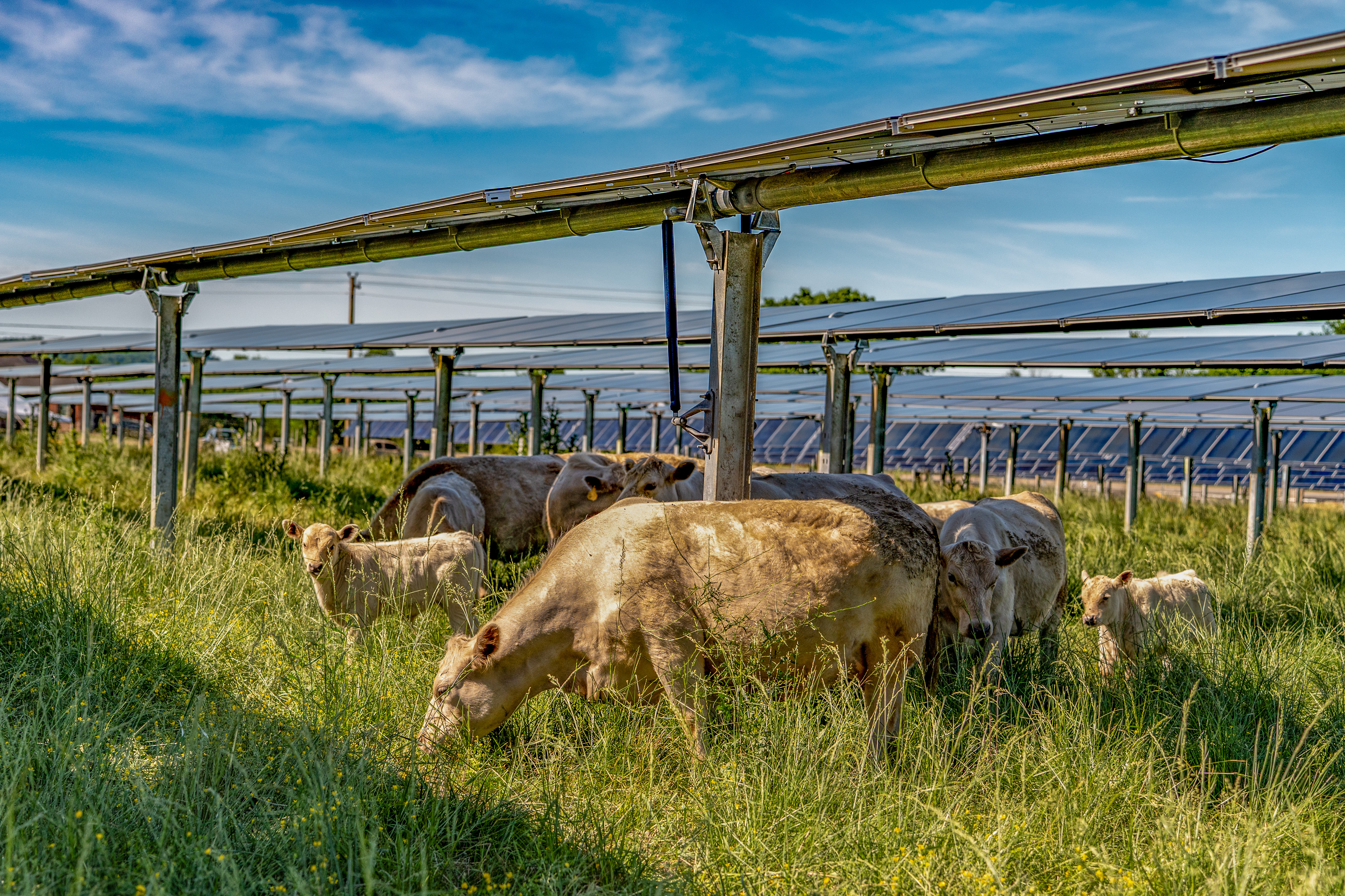
Move over, sheep. Cattle are grazing solar sites, too, and that’s good news for Virginia.

Cattle graze under solar panels.
Cattle graze at the Christiana Solar Farm,. Photo courtesy of Silicon Ranch.

The conventional wisdom was wrong. And having helped spread the conventional wisdom, I was wrong, tooMea culpa. It turns out sheep aren’t the only animals capable of handling the job of vegetation management on solar sites. 

Farmers are finding that cattle also thrive among solar panels – and they will get their chance to prove it in Virginia.

What’s that, you say? You didn’t know there was a conventional wisdom on this topic, maybe because you really haven’t given much thought at all to solar grazing, so while you have nothing but respect for cattle, sheep and other ruminants, this strikes you as perhaps a bit, shall we say, niche? 

Oh, but it’s not. Persuading cattle farmers that it’s in their interest to embrace solar is the key to unlocking low-cost energy supplies in Virginia and ending the rural war on solar. 

Not that there’s anything wrong with sheep! In fact, sheep deliver such perfect synergy with solar that including them at solar farms is no longer novel. 

The sheep thrive with the forage and shade, and in return they eat the vegetation that would otherwise grow up around the solar panels. Their grazing largely replaces labor-intensive (and polluting) mowers and herbicides while improving soil quality. Thanks to this symbiotic relationship, farmers have managed to keep their land and even grow their operations at farms across the U.S.

The advantages on all sides are so well understood within the solar industry that it’s common these days for new utility-scale projects in Virginia to include plans for grazing. Developers and utilities including Dominion Energy tout the local benefits of their partnerships with sheep farmers and beekeepers.

Yet there are more than 15 times as many cattle as sheep in Virginia, many of them in small herds on family farms. 

The market for beef is vastly bigger than the market for lamb, so persuading farmers they should diversify into sheep as well as solar is a tall order.  But if cattle prove as compatible with solar as sheep are, there will be vastly more opportunities for both farmers and the solar industry. Given the dire economic situation facing small farms in Virginia today, “cattle-voltaics” could offer a lifeline for rural communities.

Solar site owners and farmers have proceeded cautiously with cattle, fearing the animals might damage expensive solar infrastructure – or themselves – given their great weight and propensity for rubbing their heads on things. And being much taller than sheep, they don’t fit as well under solar panels, which at some times of the day will tilt close to the ground to take maximum advantage of the sun’s rays. Making the supports taller and stronger adds cost. Hence the preference for sheep.

That’s all wrong, according to Josh Bennett, an executive with Colorado-based Huwa Enterprises who spoke at the Virginia Solar Summit in Richmond last month. Since 2023, Huwa has been helping farmers and ranchers integrate cattle with solar in Colorado and elsewhere, and Bennett is now intent on spreading the word that it works. 

At a 2000-acre solar farm in Indiana, he said, Huwa “hardened” the site for the cattle but did not raise the panels or change their tilt. According to Bennett they had “zero problems” with the cattle, all yearlings of a docile breed that stand about four and a half feet tall. Contrary to expectations, the cattle have shown no interest in using the steel poles as scratching posts.

Elsewhere, Tennessee-based Silicon Ranch, which includes sheep grazing on 15,000 acres across its 15-state solar portfolio, recently launched a technology that it calls CattleTracker

The software automatically tilts solar panels to horizontal when cattle are present, allowing the animals to graze underneath. When the cattle are moved to other parts of the site, the panels return to their optimum tilt. Silicon Ranch has been testing the approach at its 3.5-MW solar farm in Rutherford County, Tennessee since 2023, while delivering the power to a local electric cooperative. 

Here in Virginia, Marcus and Jess Gray see great potential in solar cattle. The husband-and-wife owners of Gray’s Lambscaping are among the half dozen or so Virginia sheep graziers who contract with owners of large solar farms for vegetation management. 

The American Solar Grazing Association featured the Grays, along with beekeeper Allison Wickham of Charlottesville-based Siller Pollinator Company, in a terrific video that was shown at the Solar Summit to great applause from the home team. 

For the Grays, solar cattle are the obvious next step in integrating solar into Virginia’s farm culture.  At the Solar Summit, Marcus Gray described how he is raising Dexter cattle, a breed that is smaller and more docile than some others, with plans to graze them under solar panels. However, Gray did not provide a target date or site to graze what he calls his “inverter cattle.”

Virginia leaders recognize the importance of further developing agrivoltaics as a way to support both farming and energy production. 

The General Assembly passed a bill this session defining agrivoltaics, and the administration of Gov. Abigail Spanberger plans to form a working group to promote it. In addition to grazing and beekeeping, agrivoltaics can include raising crops between rows of panels, a practice that is mostly still in the research stage in Virginia.

The administration’s working group should look for ways to encourage all of these practices, but if it only does one thing, it should create a demonstration program to help farmers understand how to integrate solar and cattle grazing into their operations. Virginia has a huge stake in making solar appealing to rural communities. We need to save our family farms, and we need the low-cost energy that solar provides.  

The potential of agrivoltaics is huge, but until farmers see solar as a valuable opportunity for themselves and their families, Virginia will struggle to produce enough electricity to meet our growing demand.

This article was originally published in the Virginia Mercury on May 8, 2026.

Unknown's avatar

As legislators battle over treatment of data centers in the budget, the rest of this year’s energy and data center bills get finalized

Virginia's capitol building in Richmond.

One of the things I like about involving myself in Virginia policy-making is the feeling that it’s possible for an ordinary citizen to participate. Sure, you’re a little fish in a big pond, but legislators will meet with you, and even listen if you propose a bill or suggest changes to legislation. That’s unlike trying to be heard at the federal level, where folks without money and connections typically have no entrée. 

But sometimes, even in Virginia, you do what you can and then you just have to wait to see what the big fish do. Some things, my friends, are out of our hands.

That’s the situation now with the Virginia budget, which is hung up on the question of whether to end the data center sales tax exemption and thereby liberate $1.6 billion for other priorities, as the Senate budget provides, or continue the exemption while conditioning it on data centers meeting energy efficiency and clean energy targets, as the House budget provides. 

Gov. Abigail Spanberger is caught in the middle of a battle being fought by formidable generals on both sides and from her own party. Spanberger’s pro-business instincts naturally align her with the House approach, which would also bolster her environmental bona fides if the deal includes the clean energy conditions. But mainly, I suspect, she just wants this fight over with. 

Can Spanberger negotiate a resolution that keeps the promises made to operators of existing data centers, caps the exemption for future development and imposes clean energy requirements on all of them, while providing at least some savings? 

It’s a big challenge, and we little fish don’t have much of a role here. Yet a lot rides on the outcome, not just for data centers but for those of us who care about livable communities, climate and clean air. (Which ought to be everyone, but somehow isn’t.)

Apart from whatever happens with the budget, this was a good year for clean energy but a surprisingly poor year for data center legislation. A Democratic trifecta, concerns about rising utility rates and public sentiment mostly opposed to data center sprawl were not enough to pass bills mandating limits on water use, stricter pollution controls and stronger siting standards. 

On the other hand, it was another good year for Dominion Energy. Witness what happened when the governor proposed amendments to Louise Lucas’s Senate Bill 253 and Destiny LeVere Bolling’s House Bill 1393. As passed by the General Assembly, the legislation expanded Dominion’s ability to stick ratepayers with the cost of an expensive program for putting distribution lines underground. Spanberger proposed limits on that program’s ratepayer impacts, but then she went further. In a whole new paragraph, she proposed to cap Dominion’s return on equity at 9.3% (down from the current 9.8%), with excess profits to be returned to ratepayers. 

This would have saved millions of dollars for ratepayers, but the General Assembly turned down the changes, supporting Dominion’s ability to charge ratepayers for its undergrounding program and protecting its profitability. The amendments were rejected by voice vote, because who wants to go on record with something like that? 

However, legislators did accept other amendments from the governor requiring the SCC to exercise stricter scrutiny of costs associated with data centers to ensure they are not borne by other ratepayers, including residents. Lucas had put something like this in her bill, but legislators recognized that the governor’s language was better. 

With some amendments agreed to and others rejected, SB253 and HB1393 are now back with the governor, who will have to either accept the General Assembly’s version or veto them outright. 

Other data center bills

Apart from SB 253/HB 1393 and the proposed budget amendments, only a few new laws will impact data center development. Most important among these is one allowing utilities to delay providing service to customers when necessary for grid reliability or to avoid exceeding capacity constraints. Other legislation requires utilities to developdemand flexibility programs for data centers, but such programs would be voluntary. 

In an effort to limit the potential for overbuilding infrastructure, Dominion will now be required to provide information allowing the SCC to investigate the utility’s electric load forecasting. The General Assembly accepted an amendment from the governor increasing access to information used in making forecasts.

Residents impacted by data center development won very little in the way of protections. Localities will now have to require data centers to conduct site assessments before they can get special use permits or in rezoning. The Department of Environmental Quality will be prohibited from issuing air permits for diesel generators that don’t meet a Tier 4 equivalent standard for pollution controls, and beginning July 1, 2027, data centers will be required to report their water use. In addition, the Department of Energy will lead efforts to find ways to use the waste heat from data centers.

Renewable energy and storage

The General Assembly passed contentious solar siting legislation that raises standards while requiring localities that reject projects to report their reasons to the SCC. The governor’s minor amendments were accepted; they include a cross-reference to other legislation defining agrivoltaics.

The governor signed legislation significantly increasing the amount of storage Dominion and APCo are required to procure, and adding new targets for long-duration storage (over 10 hours). A separate bill requires Dominion to model economic dispatch scenarios for storage in its IRPs.

An energy storage facility that is co-located with a solar farm that already has an approved special exception will not be required to go through a new permitting process. Legislators acceded to the governor’s amendment limiting the capacity of the storage facility to 100% of the nameplate capacity of the solar facility. 

Shared solar, a/k/a community solar, is set to expand significantly under bills approved for Dominion and APCoterritories. While the existing program in Dominion territory has so far benefited only low-income customers, the legislation requires that the expanded program enroll nearly as many non-low-income customers.

Though most of the renewable energy action this year has been around solar, the governor also approved legislation establishing an offshore wind industry workforce program

Distributed resources

The percentage of renewable energy certificates that Dominion must obtain from projects below 1 MW is set to increase. The 50-kW minimum for power purchase agreements (PPAs) will no longer apply, allowing residents and small commercial customers to use solar or wind PPAs.    

Standby charges for net-metered solar can now be assessed only above 20 kW for residential projects in Dominion territory. (In 2020, the VCEA removed them entirely in Appalachian Power territory.)

Balcony solar, also called plug-in solar, will become legal, with no local permit or utility approval required. The legislation provides for a maximum output from the solar panels of 1200 kW. The SCC will develop a notification form that the customer must provide to the utility.

Localities can now require solar canopies to be included on some new parking lots.

Appalachian Power must develop a virtual power plant (VPP) program, following similar legislation last year for Dominion. Separate legislation authorizes VPP programs for electric cooperatives.

By July 1, 2028, localities must adopt streamlined permitting software for residential solar, which can be an existing platform like the national SolarAPP+ or a Virginia-specific platform to be developed by Virginia’s Department of Energy. 

consumer protection bill requires solar companies to provide a set of disclosures to residential customers in an effort to eliminate predatory practices.

distributed energy resources task force will meet to discuss additional ways to support distributed solar and storage. The governor amended this bill mainly to specify that the task force will be chaired by the Chief Energy Officer, which the House and Senate concurred with. In March the governor appointed Southern Environmental Law Center attorney Josephus Allmond to this new cabinet position, a move applauded by distributed energy advocates.

Finance

Most proposed grant funds for renewable energy did not survive their voyages to the Finance and Appropriations committees, but two avoided the shoals and have now been approved by the governor. One is a new clean energy innovation bank and fund. The other is a one-year, $2 million grant fund to defray solar interconnection costs incurred by public bodies. 

Utility regulation

The governor approved the General Assembly’s overhaul of the utility planning process. Among the changes, Appalachian Power will once again have to submit integrated resource plans (IRPs) to the State Corporation Commission, all IRPs will use a 20-year planning period instead of 15 years, and both utilities must align their IRPs more closely with the VCEA. 

Also approved was a bill requiring the SCC to consider and make recommendations on proposals concerning performance-based regulation of utilities.  

Dominion and APCo will now have to submit annual reports to the SCC disclosing their votes at regional transmission organization PJM and explaining how these votes are in the public interest. The utilities’ votes were previously secret. Rising electricity rates due to data center demand and PJM’s failure to move on renewable energy projects awaiting interconnection have triggered suspicions that the utilities with voting power at PJM might be acting – ahem – other than in their customers’ best interests. 

Of course, the move that will most affect the plans of utilities and other power generators is Virginia’s return to the Regional Greenhouse Gas Initiative, required now by statute. The timeline and procedure is laid out in the budget, but the administration hasn’t waited for that to be finalized. A statement from RGGI welcoming Virginia back into its fold says our participation will be in effect in time for this September’s carbon auction.

Grid optimization

The governor proposed, and legislators agreed to, a disappointing amendment to a bill requiring Dominion and APCo to assess their surplus interconnection capacities and establish pilot programs to add solar and storage at these connection points. The General Assembly had set hard targets for the pilot programs, subject to SCC approval; the amendment loosens the targets with the addition of the phrase “up to” those amounts. This further weakens a bill that was already a skinny version of its original handsome self. 

Finally, Dominion and APCo will need to report grid utilization metrics to the SCC, which will use that data to report on the potential for increased grid utilization using non-wires alternatives.