
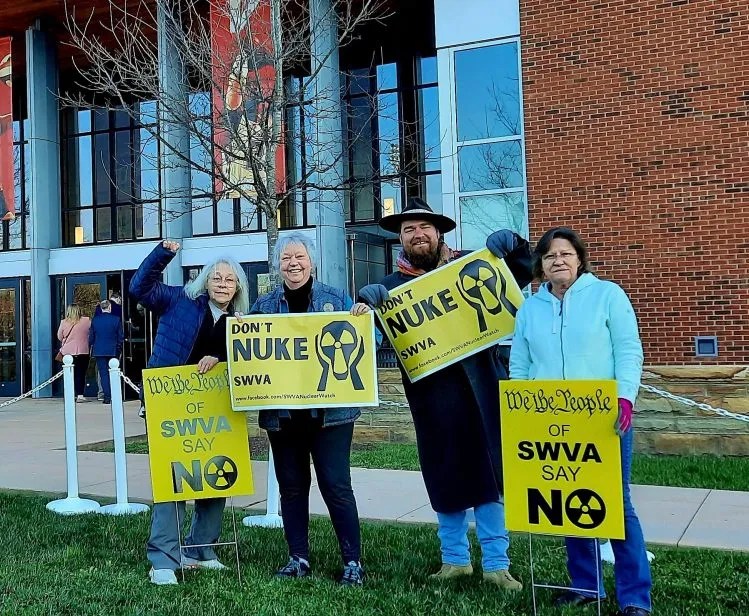
Gov. Glenn Youngkin wants to bring a small modular nuclear reactor (SMR) to Southwest Virginia in the course of the next decade. The administration has put together a small amount of funding to search for a larger amount of funding to pay for a study. One of the study questions is what they would use the reactor for – research, possibly, and to provide electricity for the University of Virginia at Wise, or perhaps a data center that the region has yet to attract.
If this all sounds a little sketchy, that’s because SMRs remain a little sketchy. Nuclear companies haven’t yet demonstrated they can attain the holy grail of safe, 24/7 carbon-free power at a competitive cost.
It’s not for lack of trying. At last count, the Nuclear Energy Agency was tracking some 98 different design technologies around the world for SMRs ranging in size from 1 MW microreactors to utility-scale reactors of more than 300 MW. Only a handful of these have reached the construction phase, and none are operational in the U.S.
This meager track record hardly reflects the enthusiasm surrounding the industry. It’s not just politicians and profit-seekers; many climate advocates believe the industry must succeed if the world is to have any hope of transitioning our energy supply away from fossil fuels. And polling shows that 56% of the public supports building more nuclear plants. That’s way less than the levels of support for wind and solar but more than support for fracking and coal mining. Still, concerns remain about safety and the proliferation of nuclear waste, a problem neither the industry nor the government yet has a strategy to deal with.
And then there’s the cost. SMRs haven’t shown an ability to compete in the energy marketplace, even against other carbon-free alternatives. As renewable energy and storage technologies continue to drop in price, the economic case for new nuclear remains an open question.
Nonetheless, both of Virginia’s publicly-owned utilities are exploring SMRs, having secured legislation last year that will allow them to charge customers for millions of dollars in early development costs. Appalachian Power is targeting a site near Lynchburg (not Southwest Virginia), while Dominion Energy says it is evaluating the feasibility of an SMR next to its existing conventional reactors at North Anna.
Dominion’s 2024 integrated resource plan shows an SMR could be part of its power mix as early as 2035; APCo has no timeline. For either utility, actually building an SMR will require making the economic case to the State Corporation Commission.
The slow timeline and cloudy cost picture have not dampened enthusiasm for nuclear among Virginia’s elected leaders. The data center boom is exacerbating a shortage of energy and causing utility bills to skyrocket. Keeping the party going means making messy tradeoffs between polluting fuels with volatile prices and low-cost but land-hungry solar. No wonder Youngkin and other leaders hope nuclear will magically allow them to sidestep the hard decisions and party on.
But wishful thinking doesn’t put megawatts on the grid. A recent article surveying the state of the nuclear industry makes it clear that these are early times in the nuclear renaissance, if such it is. The industry won’t be able to scale unless and until production-line manufacturing becomes a reality, and that will be years from now.
Fortunately for the nuclear industry, it has always been a darling of U.S. policymakers, and that remains true. Nuclear subsidies survived the axe in this year’s Republican budget law, while tax credits for wind and solar were revoked.
Indeed, President Donald J. Trump is doing his best to further the industry’s prospects, albeit in a ham-handed fashion that almost seems calculated to erode public trust.
Last month a representative of his Department of Government Efficiency reportedly told the head of the Nuclear Regulatory Commission, charged with ensuring the safety of the industry, that it was expected to provide “rubber stamp” approval to nuclear plant applications after they were tested by the Department of Energy or Defense. A few days later, Trump dismissed all but one of the members of the U.S. Nuclear Waste Technical Review Board, which provides oversight of spent fuel storage.
These alarming moves may not do much to dampen the enthusiasm of the Youngkin administration and other boosters. The administration even hopes to lure nuclear manufacturing to Virginia – but it would be in Lynchburg, not Southwest Virginia.
That calls into question Youngkin’s claims of economic benefits for an SMR in Wise County. If the SMR would be just a one-off for “research” purposes and needs a rich company or state-supported customer to buy the electricity, is it really an investment in the region, or a solution in search of a problem?
Many local residents are skeptical of the administration’s plans, trusting neither the governor nor the nuclear industry. Sharon Fisher, one of the leaders of the Southwest Virginia Nuclear Watch grassroots movement, told me in an email that her group “has extensively researched the nuclear industry with its enormous costs and contaminations.”
She pointed me to a 2023 study of health trends in a Tennessee county where a company called Nuclear Fuel Services generates highly enriched uranium fuels for naval reactors. Over the years, unintended releases of enriched uranium, plutonium and other substances have caused an accumulation of radioactivity in the local air, water, and food. The study documented rising cancer and mortality rates in the county, including a rate of premature deaths that is 61% above the U.S. average.
Rees Shearer, an activist with the Appalachian Peace Education Center, told me in a phone call that SMRs are “the next wave of exploitation” of Southwest Virginia’s resources.
“First they came for the timber, then they came for the coal, now they are coming with radioactivity,” Shearer said.
He explained, “Coal left a terrible legacy of abandoned mines, polluted creeks, and leaking methane. But this pales compared to the potential legacy of high-level nuclear waste stored on site. With SMRs, the amount of this waste can be 100 times more per megawatt than conventional nuclear. This is waste that will last millions of years. This isn’t a fair trade.”
An SMR would also come with the risk of terrorism, either from hacking or a drone attack. “It makes a place that was never a target into a target,” he noted.
Both Fisher and Shearer challenged the notion that SMRs would provide jobs for Wise County residents, even in the construction phase. Modular facilities would be manufactured offsite and assembled by an expert crew from out of the area. The Nuclear Regulatory Commission has even approved remote operation of nuclear reactors from an offsite facility, they pointed out.
Well-paying jobs are certainly a priority for the area. Unemployment rates for Southwest Virginia counties have risen only slightly from their Biden-era lows, but poverty rates in some counties remain stubbornly high.
But Fisher says the key to a healthy economy lies in diversification.
“Wise County was once a major producer of apples. We have vineyards and breweries, and fields for growing grains. Tourism is growing. [We should be] investing in local entrepreneurs and farmers, getting equitable tax revenues from the thousands of large absentee landholdings, which should be used for housing and development.”
Energy jobs needn’t be off the table, but, said Shearer, “We think the better approach is to put solar on the abandoned mines. We have a ready workforce already trained to do this.” He pointed to an effort already underway that’s being spearheaded by the environmental group Appalachian Voices.
What the region shouldn’t do, concluded Fisher, is “rely on one industry again that puts our lives and land at tremendous risk.”
This article was originally published in the Virginia Mercury on August 4, 2025.
 Power for the People VA