
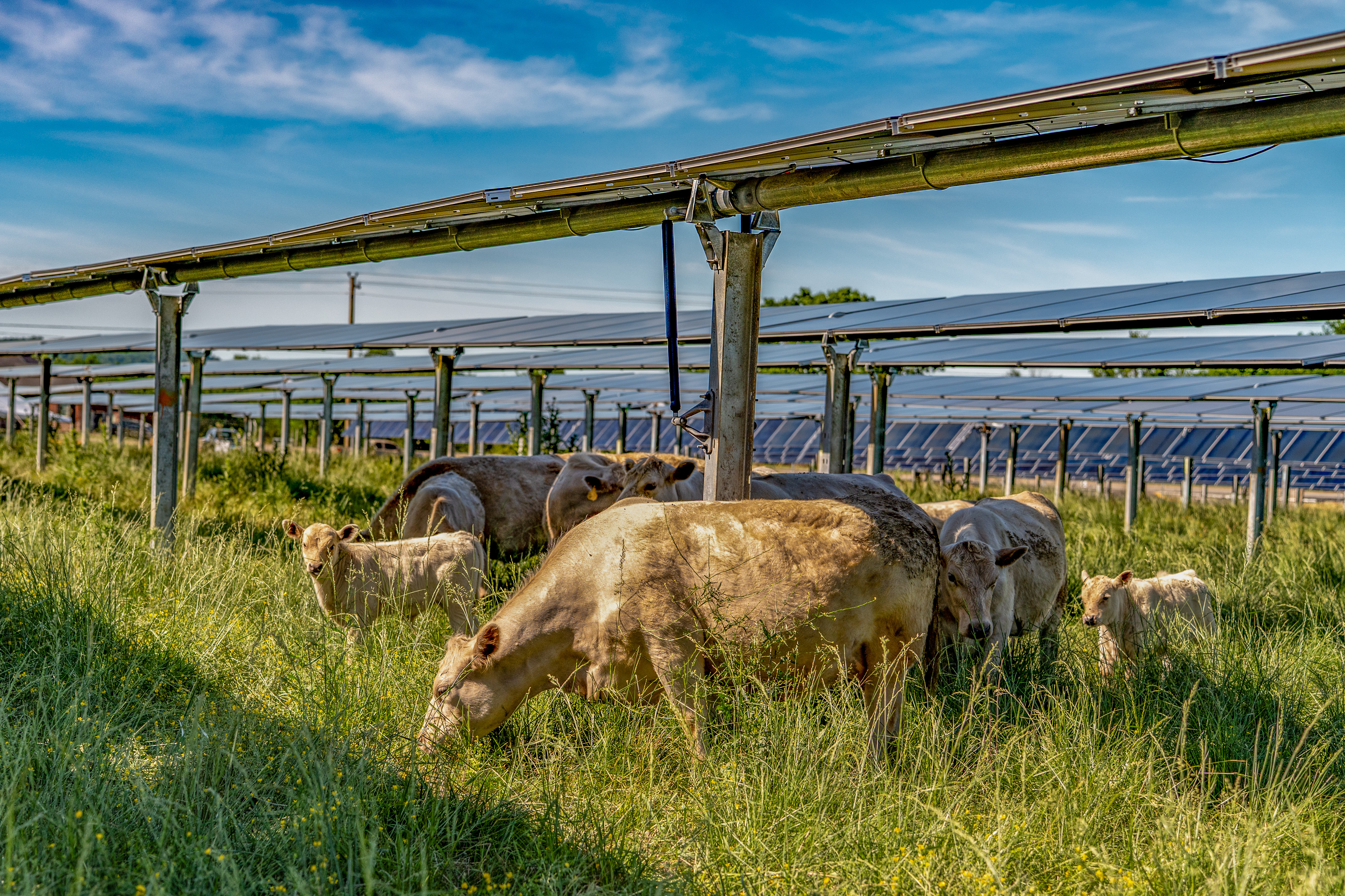
The conventional wisdom was wrong. And having helped spread the conventional wisdom, I was wrong, too. Mea culpa. It turns out sheep aren’t the only animals capable of handling the job of vegetation management on solar sites.
Farmers are finding that cattle also thrive among solar panels – and they will get their chance to prove it in Virginia.
What’s that, you say? You didn’t know there was a conventional wisdom on this topic, maybe because you really haven’t given much thought at all to solar grazing, so while you have nothing but respect for cattle, sheep and other ruminants, this strikes you as perhaps a bit, shall we say, niche?
Oh, but it’s not. Persuading cattle farmers that it’s in their interest to embrace solar is the key to unlocking low-cost energy supplies in Virginia and ending the rural war on solar.
Not that there’s anything wrong with sheep! In fact, sheep deliver such perfect synergy with solar that including them at solar farms is no longer novel.
The sheep thrive with the forage and shade, and in return they eat the vegetation that would otherwise grow up around the solar panels. Their grazing largely replaces labor-intensive (and polluting) mowers and herbicides while improving soil quality. Thanks to this symbiotic relationship, farmers have managed to keep their land and even grow their operations at farms across the U.S.
The advantages on all sides are so well understood within the solar industry that it’s common these days for new utility-scale projects in Virginia to include plans for grazing. Developers and utilities including Dominion Energy tout the local benefits of their partnerships with sheep farmers and beekeepers.
Yet there are more than 15 times as many cattle as sheep in Virginia, many of them in small herds on family farms.
The market for beef is vastly bigger than the market for lamb, so persuading farmers they should diversify into sheep as well as solar is a tall order. But if cattle prove as compatible with solar as sheep are, there will be vastly more opportunities for both farmers and the solar industry. Given the dire economic situation facing small farms in Virginia today, “cattle-voltaics” could offer a lifeline for rural communities.
Solar site owners and farmers have proceeded cautiously with cattle, fearing the animals might damage expensive solar infrastructure – or themselves – given their great weight and propensity for rubbing their heads on things. And being much taller than sheep, they don’t fit as well under solar panels, which at some times of the day will tilt close to the ground to take maximum advantage of the sun’s rays. Making the supports taller and stronger adds cost. Hence the preference for sheep.
That’s all wrong, according to Josh Bennett, an executive with Colorado-based Huwa Enterprises who spoke at the Virginia Solar Summit in Richmond last month. Since 2023, Huwa has been helping farmers and ranchers integrate cattle with solar in Colorado and elsewhere, and Bennett is now intent on spreading the word that it works.
At a 2000-acre solar farm in Indiana, he said, Huwa “hardened” the site for the cattle but did not raise the panels or change their tilt. According to Bennett they had “zero problems” with the cattle, all yearlings of a docile breed that stand about four and a half feet tall. Contrary to expectations, the cattle have shown no interest in using the steel poles as scratching posts.
Elsewhere, Tennessee-based Silicon Ranch, which includes sheep grazing on 15,000 acres across its 15-state solar portfolio, recently launched a technology that it calls CattleTracker.
The software automatically tilts solar panels to horizontal when cattle are present, allowing the animals to graze underneath. When the cattle are moved to other parts of the site, the panels return to their optimum tilt. Silicon Ranch has been testing the approach at its 3.5-MW solar farm in Rutherford County, Tennessee since 2023, while delivering the power to a local electric cooperative.
Here in Virginia, Marcus and Jess Gray see great potential in solar cattle. The husband-and-wife owners of Gray’s Lambscaping are among the half dozen or so Virginia sheep graziers who contract with owners of large solar farms for vegetation management.
The American Solar Grazing Association featured the Grays, along with beekeeper Allison Wickham of Charlottesville-based Siller Pollinator Company, in a terrific video that was shown at the Solar Summit to great applause from the home team.
For the Grays, solar cattle are the obvious next step in integrating solar into Virginia’s farm culture. At the Solar Summit, Marcus Gray described how he is raising Dexter cattle, a breed that is smaller and more docile than some others, with plans to graze them under solar panels. However, Gray did not provide a target date or site to graze what he calls his “inverter cattle.”
Virginia leaders recognize the importance of further developing agrivoltaics as a way to support both farming and energy production.
The General Assembly passed a bill this session defining agrivoltaics, and the administration of Gov. Abigail Spanberger plans to form a working group to promote it. In addition to grazing and beekeeping, agrivoltaics can include raising crops between rows of panels, a practice that is mostly still in the research stage in Virginia.
The administration’s working group should look for ways to encourage all of these practices, but if it only does one thing, it should create a demonstration program to help farmers understand how to integrate solar and cattle grazing into their operations. Virginia has a huge stake in making solar appealing to rural communities. We need to save our family farms, and we need the low-cost energy that solar provides.
The potential of agrivoltaics is huge, but until farmers see solar as a valuable opportunity for themselves and their families, Virginia will struggle to produce enough electricity to meet our growing demand.
This article was originally published in the Virginia Mercury on May 8, 2026.


Pingback: Ivy Main: "Farmers are finding that cattle also thrive among solar panels – and they will get their chance to prove it in Virginia." – Blue Virginia | Solar Now
Farming tends to be a tight margin operation, and having a second substantive income stream from solar gives farmers the added cushion they need to weather drought years without worrying about bankruptcy.