Unknown's avatar

More 2018 bills: energy efficiency, storage, and electric vehicles


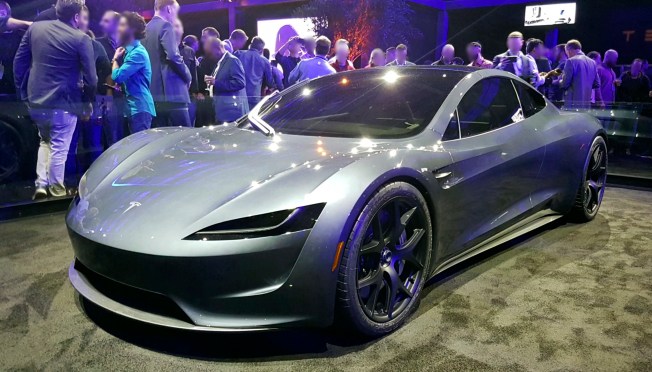
This prototype of the 2020 Tesla Roadster is not among the EVs available for test drives at Conservation Lobby Day. I’m using the picture anyway because it is as close as I will ever come to owning one. Photo credit Smnt via Wikimedia Commons.

My post last week covered the significant renewable energy bills, especially solar bills, introduced by the end of the first week of the 2018 legislative session. In this post I tackle three other bill categories of interest to clean energy advocates: energy efficiency, energy storage, and electric vehicles.

There is more to some of these bills than my brief description indicates; I just highlight the points I think are most interesting. Also, as with the solar bills, there may be more bills added in the coming week, so keep checking back for updates.

Energy Efficiency

Virginia’s woeful performance on energy efficiency was the subject of a recent guest post here by my colleague Melissa Christensen. A number of legislators have tried in recent years to turn this around, with remarkably little success.

Delegate Rip Sullivan has worked as hard as anyone on finding legislative fixes. He has several efficiency bills this year. HB 963 is the most impactful, requiring electric and gas utilities to meet energy efficiency targets, and to submit plans to the State Corporation Commission (SCC) for its approval describing how they will achieve the targets. The bill would also require utilities and the SCC to prioritize money-saving efficiency measures over proposals for new generation or transmission facilities.

Taking a narrower approach to the problem, two other Sullivan bills address the four tests the SCC uses to determine whether to approve an energy efficiency program proposed by a utility. The SCC has relied on the Ratepayer Impact Measure (RIM) test to reject programs that otherwise would provide cost-effective energy savings. HB 964 removes the RIM test from the list of tests the SCC is required to consider when determining that an energy efficiency program proposed by an electric utility is in the public interest. Instead, the SCC would consider whether the net present value of a program’s benefits exceeds the net present value of its costs as determined under the Total Resource Cost Test, the Utility Cost Test, and the Participant Test.

Taking a different tack, HB 965 defines the Total Resource Cost Test as a test to determine if the benefit-cost ratio of a proposed energy efficiency program or measure is greater than one. An energy efficiency program or measure that meets the Total Resource Cost Test is declared to be in the public interest. If it fails the test, it would then be reviewed under the other tests.

Delegate Tim Hugo’s HB 1261 proposes another way to undercut the SCC’s over-reliance on the RIM test. The bill provides that an energy efficiency program proposed by an electric utility is in the public interest if the net present value of the benefits exceeds the net present value of the costs as determined by any three of the existing law’s four benefit-cost tests. At least, that is surely the intent. Other reviewers say the bill’s wording could potentially be interpreted in a way that undermines its intent.

Two other Sullivan bills also deserve mention. HB 560 establishes a revolving fund to provide no-interest loans to any locality, school division, or public institution of higher education for energy conservation or efficiency projects. HB 204 would allow localities to adopt ordinances to assist commercial building owners in getting energy usage data for tenants in the building.

Finally, Delegate Bell’s HB 58 would generally require state agencies to use LED bulbs instead of incandescent light bulbs for new outdoor lighting fixtures or when replacing bulbs in existing fixtures.

Energy storage

Energy storage is one of the hot topics in energy today. In most states, the focus is on advanced battery technology, which can take the form of battery packs small enough for residential and commercial customers, or arrays large enough to provide utilities with an alternative to new generating plants. The value of customer-sited battery systems goes beyond being able to use solar energy at night; batteries can also provide grid services and help communities prepare for widespread power outages caused by storms or attacks on the grid.

In Virginia, Dominion Energy currently seems more interested in pumped storage hydropower, a decades-old technology that uses reservoirs to store surplus energy, traditionally energy generated at night from coal and nuclear plants, for use in the daytime. A 2017 law gives Dominion support for pumped storage using old coal mines, potentially a boost for the economy of Southwest Virginia but an unproven technology rife with questions about its economic viability and environmental impacts.

At any rate, energy storage will be playing an increasingly important role in Virginia as elsewhere, and three of this year’s bills address it. Delegate Toscano’s HB 1018 seeks to incentivize customer acquisition of energy storage systems with a tax credit of 30% of an energy storage system’s cost, up to $5,000 for a residential storage system or $75,000 for a commercial system. Delegate Habeeb’s HB 782 addresses energy storage at the utility level. It requires the SCC to establish a pilot program under which Dominion and APCo would submit proposals to deploy batteries, up to 10 MW for APCo and up to 30 MW for Dominion.

HJ 101 (Toscano) is a study bill. It tasks the Department of Mines, Minerals and Energy with conducting a two-year study to determine what regulatory reforms and market incentives are necessary to increase the use of energy storage devices in Virginia (including pumped storage hydropower).

Electric Vehicles

As with battery storage, electric vehicle technology is only just starting to register as an important topic in Virginia, and its impact—on utilities, the grid, air pollution and the economy—is just beginning to be discussed. This may be the year legislators become engaged. DriveElectric RVA, an electric vehicle advocacy group, plans to offer test drives of EVs at the capitol on January 22, Conservation Lobby Day.

Three bills deal with EVs this year. HB 469 (Reid) offers a tax credit of up to $3,500 for purchase of a new electric vehicle. HB 922 authorizes local governments to install charging stations and charge for the electricity (individuals and businesses can already do so). HJ 74 (Reid) requires a study of the impacts of vehicle electrification, including on workers in the automotive repair industry. One of the selling points for EVs is that they require minimal maintenance.

Unknown's avatar

Virginia legislators face a flood of new solar bills

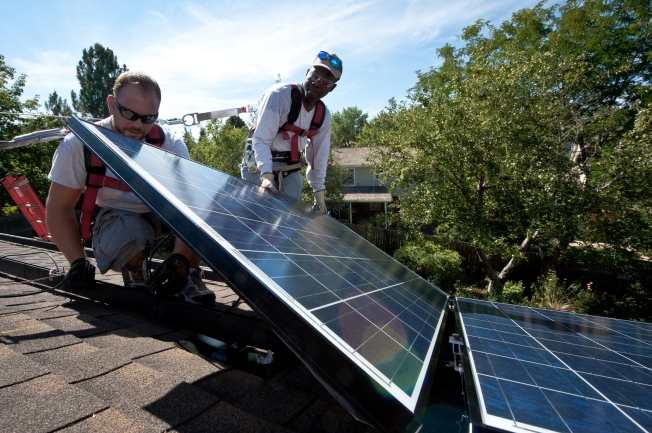
Photo courtesy of Department of Energy, via Wikimedia Commons.

It’s true that Republicans remain in control of the General Assembly, and the way things run in Richmond, having only the narrowest of margins diminishes the majority’s power remarkably little. Yet the Blue Wave swept in a set of younger, more diverse, and more progressive delegates, many of whom are as interested in reforming energy policy as they are in social and economic issues.

As a result, I count more than 50 bills dealing with solar, energy efficiency, electric vehicles and battery storage; several more that affect clean energy by addressing carbon emissions; and still others that deal with utility regulation in ways that have implications for renewables and storage. And bills are still being filed.

In this post, I cover just the renewable energy bills of general interest filed to date, saving energy efficiency, storage, EVs and climate for later.

Most of these bills cover renewable energy generally. Bills submitted by the Rubin Group (the private negotiating group consisting mostly of utilities and solar industry members) are limited to solar.

One bill this year takes a new run at a mandatory renewable portfolio standard (RPS). This is Delegate Sullivan’s HB 436, which narrows the kind of resources eligible for the program (now mostly wind, solar and hydro) as well as making it mandatory. As currently drafted it is so ambitious that it would likely mean utilities would have to buy a lot of Renewable Energy Certificates from out of state to meet the early year targets, but changes to the bill may be in the works.

Delegate Sullivan has also proposed HB 54, which would provide a state tax credit of 35% of the cost of installing certain kinds of renewable energy property, up to a maximum credit of $15,000.

Several bills enable community solar programs, to provide options beyond the utility-controlled program passed last year that more closely resembles a green tariff. SB 313 (Edwards) SB 311 (Edwards) offer two different customer-controlled models. SB 586 (Gooditis) would authorize, but not require, utilities to set up utility-controlled programs; it differs from last year’s bill in that customers would have a direct connection with a specific renewable energy project. Since it would not be limited to solar, it could open a new option for community wind.

The Rubin Group drafted three pieces of legislation. The centerpiece bill, SB 284 (Saslaw) and HB 1215 (Hugo) raises from 500 megawatts (MW) to 4,000 MW (by 2024) the amount of large-scale solar utilities can build or buy that is deemed to be “in the public interest,” a designation that takes this determination away from the State Corporation Commission. The bill also makes it in the public interest for utilities to own or buy up to 500 MW of small-scale solar projects (under 1 MW each). These will be distributed projects, but utility-controlled, along the lines of Dominion’s not-very-successful Solar Partnership Program.

SB 284 and HB 1215 don’t actually require the utilities to do anything, but the legislation is widely seen as signaling their intent to move forward with additional solar development. While a very welcome signal, legislators should keep in mind that a Solar Foundation analysis earlier this year noted it would take as much as 15,000 MW of solar to provide just 10% of Virginia’s electricity supply.

Recognizing this reality, Delegate Mark Keam has introduced HB 392, which declares it in the public interest for the Commonwealth to get 10% of its electricity from solar, and raises to 15,000 MW the amount of utility solar in the public interest.

The two other Rubin Group bills deal with land use, putting language into the code giving people the right to put up solar panels on their own property for their own use, except where local ordinances specifically prohibit it, and subject to setback requirements, historic districts, etc. The bills are SB 429 (Stanley), its companion bill HB 508 (Hodges), SB 179 (Stanley) and companion bill HB 509 (Hodges).

The Rubin Group tried and failed to negotiate changes to Virginia’s net metering program, which affects most customer-sited solar projects, including residential rooftop solar. This is hardly a surprise; a group that works on consensus gives every member veto power. With utilities hostile to any perceived incursion on their monopoly power, and solar advocates pledged to protect the rights of residents, there aren’t a whole lot of opportunities for consensus here.

With the Rubin Group out of the net metering space, legislative champions have stepped into the vacuum to propose a host of bills that would support customers who install solar for their own use:

  • HB 393 (Keam) removes the 1% cap on net metered projects, and provides that when net metered projects reach 1% of a utility’s electric load, the SCC will conduct a study of the impact of net metering and make recommendations to the General Assembly about the future of the program. HB 1060 (Tran) simply removes the cap.
  • SB 191 (Favola) provides that Virginia customers who wish to self-generate electricity with renewable energy using the net metering provisions of the Code may install up to 125% of their previous 12 months’ electric demand, or in the case of new construction, of the electric demand of similar buildings. A 2015 law currently limits customers to 100% of previous demand.
  • HB 421 (Sullivan) allows owners of multifamily residential buildings to install renewable energy facilities and sell the output to occupants. This bill does not provide for the electricity to be net metered.
  • HB 930 (Lopez) requires the SCC to establish a net metering program for multifamily customer-generators, such as condominiums, apartment buildings, and homeowner associations.
  • HB 978 (Guzman) requires utilities to justify standby charges with a value of solar study. As currently written, the bill does not appear to have retroactive effect, so it might not repeal the existing, much-hated standby charges already approved by the SCC.
  • SB 82 (Edwards) expands the agricultural net metering program, increasing the project size limit from 500 kW to 1 MW, providing that the electricity can be attributed to meters on multiple parcels of land, and repealing the 2017 law ending agricultural net metering in coop territory.

Finally, several bills once again tackle third-party power purchase agreements (PPAs), which the Virginia Code appears to make legal, but which utilities have consistently maintained are a violation of their monopoly on the sale of electricity. HB 1155 (Simon) reaffirms the legality of PPAs. SB 83 (Edwards) replaces the existing PPA pilot program that dates from 2013 and directs the SCC to establish a broader program.

HB 1252 (Kilgore) replaces the existing pilot, which has different rules for Dominion and APCo, with a new program renamed “net metering power purchase agreements” that would be consistent for both utilities. It would open up APCo territory more than at present, by allowing any tax-exempt entity to participate rather than just the private colleges and universities that won inclusion last year. However, as currently drafted, it would narrow the program as it exists in Dominion territory by eliminating the eligibility of for-profit customers. Although it is the least customer-friendly option among the PPA bills, Kilgore’s position as chairman of House Commerce and Labor, which will hear the bill, gives it the strongest chance of passage.

Note that most of the renewable energy bills (other than those dealing with tax credits and land use) will go to the Commerce and Labor committees. In the House, a subcommittee usually meets once to hear all the bills (and typically to kill all but the ones anointed by chairman Terry Kilgore). While the schedule is not set, in the past the subcommittee meeting has been held in early February.


Important dates:

First Day of Session: Wednesday, January 10

Bill filing Deadline: Friday, January 19

Crossover (last day on which bills passed in one chamber can go to be heard in the other): Wednesday, February 14

Sine Die (end of Session): Saturday, March 10 

How to research a bill:

I’ve hot-linked the bills discussed here, but you can also find them all online pretty easily. On the home page of the General Assembly website, you will see options at the lower right that direct you to the Legislative Information Service, or LIS. If you know the number of a bill, you can type it into the first box (omitting spaces), and click “GO.” This will take you to a page with information about the bill, including a summary of the bill, the bill’s sponsor (called a “patron” in Virginia), the committee it has been assigned to, and its current status. Follow links to learn more about the committee, such as who is on it and when it meets. You will also see a link to the full text of a bill as a PDF.

Always read the full text of a bill rather than simply relying on the summary. Summaries sometimes contain errors or omit critical details, and bills can get amended in ways that make them very different from what the summary says. For the same reason, make sure you click on the latest version of the bill’s text.

If you don’t know a bill number, the General Assembly home page also lets you search “2018 Regular Session Tracking.” When you hit “GO,” this button brings you to a page with options for finding a bill, including by the name of the legislator (“member”), the committee hearing it, or the subject.

When you click on the name of a committee, you will see the list of bills referred to that committee, with short descriptions. It also tells you who is on the committee, when the committee meets and where. You can click on “Agendas” to see which bills are scheduled to be heard at the next committee meeting. Unfortunately the agendas are not set until a day or two before the meeting.


Unknown's avatar

Virginia renewables report shows huge solar gains in 2017

The Virginia Renewable Energy Alliance (VA-REA) says Virginia had a total of 570 megawatts (MW) of solar installed at the end of 2017, well over twice the 176 MW we had at the end of 2016. VA-REA projects the industry will add another 376 MW in 2018.

The numbers are included in VA-REA’s “2017 Development Report,” which also summarizes other aspects of renewable energy development in the past year. The report is available on the group’s website.

VA-REA members include companies from the solar, wind, and other renewable energy industries in Virginia, as well as utilities, some environmental groups, and other advocates.

As we head into the General Assembly session beginning this Wednesday, the strong showing by the solar industry in 2017 should give added momentum to the raft of pro-solar bills we hear are in the works. So far most have not yet been filed, but I will be posting about them when they reach a critical mass.

Unknown's avatar

Want more solar in Virginia? Here’s how to get it.

A Solar Foundation analysis showed Virginia could create 50,000 new jobs by committing to build enough solar to meet 10% of energy demand. Photo credit: Dennis Schroeder, NREL

If there is an energy issue that Republicans and Democrats can agree on, it is support for solar energy. It’s homegrown and clean, it provides local jobs, it lowers our carbon footprint, and it brings important national security and emergency preparedness benefits. Dominion Energy Virginia even says it’s now the cheapest option for new electric generation.

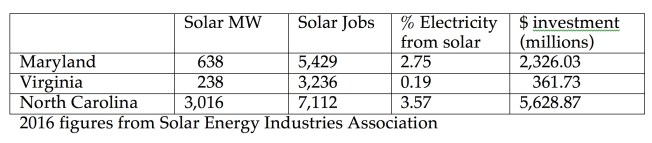
Yet currently Virginia lags far behind Maryland and North Carolina in total solar capacity installed, as well as in solar jobs and the percentage of electricity provided by solar. And at the rate we’re going, we won’t catch up. Dominion’s current Integrated Resource Plan calls for it to build just 240 megawatts (MW) per year for its ratepayers. How can we come from behind and score big?

First, our leaders have to set a serious goal. Virginia could create more than 50,000 new jobs by building enough solar to meet just 10 percent of our electricity demand by 2023. That requires a total of 15,000 MW of solar. Legislators should declare 15,000 MW of solar in the public interest, including solar from distributed resources like rooftop solar.

The General Assembly should consider a utility mandate as well. Our weak, voluntary Renewable Portfolio Standard (RPS) will never be met with wind and solar, and making it mandatory wouldn’t change that. (To understand why, read section 4 of my 2017 guide to Virginia wind and solar policy, here.) Getting solar into the RPS would require 1) making it mandatory; 2) increasing the targets to meaningful levels (including removing the nuclear loophole); 3) including mandatory minimums for solar and wind so they don’t have to compete with cheap renewable energy certificates (RECs) from out-of-state hydroelectric dams; and 4) providing a way for utilities to count the output of customer-owned solar facilities in the total, possibly through a REC purchase program to be set up by the State Corporation Commission.

The other way to frame a utility mandate would be to ignore the RPS and just require each utility to build (or buy the output of) its share of 15,000 MW of solar. Allowing utilities to count privately-owned, customer-sited solar towards the total would make it easier to achieve, and give utilities a reason to embrace customer investments in solar.

Second, the General Assembly has to remove existing barriers to distributed solar. Customers have shown an eagerness to invest private dollars in solar; the government and utilities should get out of the way. That means tackling several existing barriers:

  • Standby charges on residential solar facilities between 10 and 20 kilowatts (kW) should be removed. Larger home systems are growing in popularity to enable charging electric vehicles with solar. That’s a good thing, not something to be punished with a tax.
  • The 1% cap on the amount of electricity that can be supplied by net-metered systems should be repealed.
  • Currently customers cannot install a facility that is larger than needed to serve their previous year’s demand; the limitation should be removed or raised to 125% of demand to accommodate businesses with expansion plans and homeowners who plan to buy electric vehicles.
  • Customers should be allowed to band together to own and operate solar arrays in their communities to meet their electricity requirements. This kind of true community solar (as distinguished from the utility-controlled programs enabled in legislation last year) gives individuals and businesses a way to invest in solar even if they don’t have sunny roofs, and to achieve economies of scale. If community solar is too radical a concept for some (it certainly provokes utility opposition), a more limited approach would allow condominiums to install a solar facility to serve members.
  • Local governments should be allowed to use what is known as municipal net metering, in which the output of a solar array on government property such as a closed landfill could serve nearby government buildings.
  • Third-party power purchase agreements (PPAs) offer a no-money-down approach to solar and have tax advantages that are especially valuable for universities, schools, local governments and non-profits. But while provisions of the Virginia Code clearly contemplate customers using PPAs, Virginia utilities perversely maintain they aren’t legal except under tightly-limited “pilot programs” hammered out in legislation enacted in recent years. The limitations are holding back private investment in solar; the General Assembly should pass legislation expressly legalizing solar third-party PPAs for all customers.

Third, the Commonwealth should provide money to help local governments install solar on municipal facilities. Installing solar on government buildings, schools, libraries and recreation centers lowers energy costs for local government and saves money for taxpayers while creating jobs for local workers and putting dollars into the local economy. That makes it a great investment for the state, while from the taxpayer’s standpoint, it’s a wash.

If the state needs to prioritize among eager localities, I recommend starting with the Coalfields region. The General Assembly rightly discontinued its handouts to coal companies in that region, which were costing taxpayers more than $20 million annually. Investing that kind of money into solar would help both the cash-strapped county governments in the area and develop solar as a clean industry to replace lost coal jobs.

Coupled with the ability to use third-party PPA financing, a state grant of, say, 30% of the cost of a solar facility (either immediately or paid out over several years) would drive significant new investment in solar.

Fourth, a tax credit for renewable energy property would drive installations statewide. One reason North Carolina got the jump on Virginia in solar was it had a robust tax credit (as well as a solar carve-out to its RPS). One bill has already been introduced for Virginia’s 2018 General Assembly session offering a 35% tax credit for renewable energy property, including solar, up to $15,000. (The bill is HB 54.)

Fifth, Virginia should enable microgrids. Unlike some other East Coast states, we’ve been lucky with recent hurricanes. The unlucky states have learned a terrible lesson about the vulnerability of the grid. They are now promoting microgrids as one way to keep the lights on for critical facilities and emergency shelters when the larger grid goes down. A microgrid combines energy sources and battery storage to enable certain buildings to “island” themselves and keep the power on. Solar is a valuable component of a microgrid because it doesn’t rely on fuel supplies that can be lost or suffer interruptions.

The General Assembly should authorize a pilot program for utilities, local governments and the private sector to collaborate on building solar microgrids with on-site batteries as a way to enhance community preparedness, provide power to buildings like schools that also serve as emergency shelters, and provide grid services to the utilities.

One way or another, solar energy is going to play an increasingly large role in our energy future. The technology is ready and the economics are right. The only question is whether Virginia leaders are ready to make the most of it in the coming year.

Unknown's avatar

Just in time for the 2018 legislative session, a way to actually understand Virginia energy law

The sections of the Virginia Code devoted to energy law present a nearly impenetrable thicket to anyone who isn’t a lawyer—and indeed, to most lawyers as well. Sentences sometimes go on for pages without a break, with clauses wrapped in other clauses like a set of Russian nesting dolls. Words don’t always mean what they do in ordinary English, but you won’t know that unless you find your way to separate sections containing the surprise definitions. And references to “Phase I” and “Phase II” utilities seem deliberately calculated to confuse. (For the record, they mean Dominion and APCo.)

Lawyers are said to like complicated and obscure language because it ensures their services remain in demand, but I’ve never met a fellow lawyer who actually subscribed to this cynical view. Most believe we are all better off when laws are easy to understand, both so we can comply and, when necessary, make reforms. This is especially true when the laws are like Virginia’s: packed with favors to powerful monopolies and riddled with booby-traps for consumers. It’s hard to change a law if you can’t make head or tail of it to begin with.

So the law firm GreeneHurlocker deserves applause for its new guide to the Virginia Code’s electric utility laws. The 33-page booklet pulls together the major relevant code sections and annotates them in clear and concise English with virtual sticky notes. Principles of Electric Utility Regulation in Virginia is not a textbook or even a primer, but something more like a travel guide, complete with a map and signposts directing the traveler to sites of particular interest.

In announcing the release of the guidebook, GreeneHurlocker lawyer William Reisinger said the intent was to provide a sort of “’Cliffs Notes’ for some of the complicated utility statutes. We have no agenda with this document, other than to help demystify some of these laws and provide some useful background.”

They’ve succeeded. Those who are used to rummaging around the online version of the Code in search of the right section to answer a particular question will find the guidebook a huge timesaver. For others who don’t even know where to begin with the Code, it offers a way in.

Perhaps most importantly, for legislators and other leaders used to relying on lobbyists to tell them what is in the Code, the guidebook will make it easier for them to do their own research.

When I first saw the guidebook, I had a momentary fear (which was also a momentary hope) that it would put my own annual “Guide to wind and solar policy” out of business as a source for policy information. As it turns out, though, the two take very different approaches and are useful for different purposes.

So you may find a use for both, but in any case you will certainly want GreeneHurlocker’s guide.

Unknown's avatar

Sierra Club takes State Corporation Commission to court over failure to review Atlantic Coast Pipeline deal

Photo credit Chesapeake Climate Action Network

Sierra Club is asking the Supreme Court of Virginia to require the State Corporation Commission (SCC) to review a key deal for shipping capacity on the Atlantic Coast Pipeline. The SCC has thus far declined to exercise its oversight authority over this arrangement, despite a Sierra Club petition filed last May urging that Virginia’s Affiliates Act requires the Commission’s review in this case. In Sierra Club’s appeal filed yesterday by attorneys with Appalachian Mountain Advocates, the law firm representing it in court, the Club argues that the SCC was wrong to reject its petition and seeks an order reversing the SCC’s decision.

The Atlantic Coast Pipeline (ACP) is being developed by a partnership called Atlantic Coast Pipeline LLC, whose largest shareholder – Dominion Energy – is parent company of the public utility Virginia Electric and Power Company, now operating as Dominion Energy Virginia (having changed its name earlier this year from Dominion Virginia Power). Under the arrangement noted above, Dominion Energy Virginia must, through one of its subsidiaries, purchase pipeline capacity on the ACP for a period of 20 years, with Atlantic Coast Pipeline LLC— the utility’s own corporate affiliate—bringing in tens or even hundreds millions of dollars per year in revenue. What’s more, Dominion is nearly certain to request that Virginia’s ratepayers ultimately foot the bill for this arrangement.

The utility’s deal with Atlantic Coast Pipeline LLC underpins Dominion Energy’s claim that the ACP has enough customers to justify its construction. Without that arrangement, Dominion and its partners would likely have had trouble getting approval from the Federal Energy Regulatory Commission (FERC) to build the pipeline.

Under the Virginia Affiliates Act, public utilities like Dominion Energy Virginia are required to submit their “contracts or arrangements” with affiliated companies to the SCC for approval before they can take effect, something the utility failed to do. But on September 19, the SCC rejected Sierra Club’s petition for an order holding that Dominion must comply with the Act and requiring a formal proceeding to determine whether the ACP deal is in the public interest.

Sierra Club and other critics contend that this arrangement is a loser for ratepayers because Dominion Energy Virginia already has all the pipeline capacity it needs: several years ago, it purchased 20 years’ worth of capacity from Transcontinental to service the same power plants that it now claims must receive gas—at a much higher shipping rate—from the ACP. As a result, the utility’s arrangement with Atlantic Coast Pipeline LLC will very likely increase, not decrease, electricity prices in Virginia. It is hard to imagine that if the SCC were to examine the facts of the deal, as the Affiliates Act requires it do, it would find that this expensive and redundant arrangement is actually in the public interest.

“We have grave concerns that Dominion’s deal for shipping capacity on the ACP will only serve to benefit the company’s bottom line, not the needs of the public,” says Andres Restrepo, a Sierra Club lawyer involved in the matter. “Luckily, the Affiliates Act is crystal clear: arrangements like Dominion’s must be reviewed and approved by the SCC before they can take effect. That’s why we’re confident that the Supreme Court will rule in our favor and require Dominion and its subsidiaries to comply with this critical review requirement.”

According to Restrepo, the Supreme Court will likely solicit briefing on the appeal and hold oral arguments during the first half of 2018. If Sierra Club is successful, Dominion would then have to file its agreement under the Affiliates Act, and the SCC would have to open a case docket and hold a hearing to consider whether the deal is in the public interest.

A ruling by the SCC rejecting Dominion’s plan could have significant ramifications. Namely, it would undermine the basis on which FERC approved construction of the ACP this fall. FERC approval for new pipeline rests on a showing that the pipeline is “needed,” and the Commission has recently found that such need exists where the project proponent has customer contracts for most or all of the pipeline’s capacity. Without valid contracts, this basis for a need determination vanishes.

Sierra Club and other pipeline opponents have asked FERC to reconsider its approval of the ACP, based in part on the question of whether Dominion and its partners have properly shown need. A decision by the SCC rejecting Dominion Energy Virginia’s deal with Atlantic Coast Pipeline LLC could prompt FERC to reconsider its prior approval.

An SCC ruling could also impact the ACP’s construction timetable and even its economic rationale. How will investors feel about spending $5 billion to build a pipeline through Virginia when most of its Virginia customer base has disappeared?

But first, the SCC must actually review the deal. In its September order rejecting Sierra Club’s petition, the SCC essentially said that it didn’t need to make a determination now; it could wait until Dominion comes to it asking to charge ratepayers for the ACP deal in future proceedings. But the Affiliates Act requires review and approval of inter-affiliate agreements before they take effect. Furthermore, any later proceedings to determine rate impacts would happen only after the pipeline had been built and become operational.

Yes, that’s nuts. Dominion seems to be willing to construct the pipeline now and gamble on SCC’s approval of cost reimbursement further down the road, but the rest of us—Virginia’s ratepayers—shouldn’t be forced into such a gamble. Virginians, who have to suffer the environmental destruction the ACP will cause in addition to likely impacts to their electric rates, deserve to have their needs considered now, just as the law requires, and not later, as Dominion would prefer.

The fact is simple: contrary to its ruling in September, the SCC must review Dominion Energy Virginia’s deal for ACP shipping capacity now to determine whether it is in the public interest. The Affiliates Act requires no less. Here’s hoping Virginia’s Supreme Court holds the SCC to its obligations and mandates a formal review process. After all, better late than never.

Unknown's avatar

Northern Virginia governments look at major renewable energy energy purchase

If the Northern Virginia Regional Commission has its way, local jurisdictions will buy power from a solar or wind farm in the near future. Photo credit Christoffer Reimer.

The Northern Virginia Regional Commission has selected a consultant to assist area localities in a joint procurement of renewable energy. Participating cities and counties will be able to aggregate their demand to get the kind of economies of scale that have allowed corporations like Amazon and Facebook to lower their energy cost by investing in large solar and wind farms.

On November 17, NVRC announced that Customer First Renewables, a national expert in matching large energy users with renewable energy projects, will serve as its technical advisor. Customer First Renewables and NVRC plan to issue a Request for Proposals (RFP) to identify one or more “shovel-ready,” large scale projects to present to NVRC’s thirteen member governments. Those local governments will individually decide whether to participate in the group purchase.

According to a Request for Qualifications that NVRC issued in its search for a consultant, the project(s) to be selected must be greater than 10 megawatts in size and result in new renewable energy capacity added to the grid. Preference will go to projects located in Virginia or in the regional grid that serves Virginia, known as PJM.

NVRC will act as a central contact and facilitator, but it will be up to the participating localities to negotiate a contract. NVRC Director Robert Lazaro said discussions with representatives of area localities indicate the interest is there for a major renewable energy buy like this. Arlington, Alexandria, Manassas Park, and Falls Church are among the jurisdictions most interested, with others possibly joining as they learn more.

“We see this as a way to green the grid, save money, and assist the solar industry in Virginia,” said Lazaro.

Niels Crone, Senior Vice President for Business Development at Customer First Renewables, said his company was excited to be involved in the procurement effort. “We are delighted to work with NVRC to help Northern Virginia jurisdictions get affordable, large-scale renewable energy,” he said.

NVRC is following an ambitious timeline. A project workshop for local government staff is scheduled for December 11, and a Request for Proposals (RFP) is due January 2, 2018.

How does a group purchase work?

Amazon and other large corporations have become major drivers of new wind and solar projects in PJM, including several large solar farms in Virginia. The steadily-tumbling costs of wind and solar make it possible for the companies to green their energy supply while lowering their overall energy costs using innovative financing approaches. Not all of these would work in Virginia, but one that does is the wholesale, or “virtual” power purchase agreement.

A virtual PPA allows a customer to buy and sell energy in the wholesale market, avoiding potential obstacles such as a utility’s monopoly on the retail sale of electricity.

Local governments in Virginia buy electricity from Dominion Energy Virginia at retail under a contract negotiated by the Virginia Energy Purchasing Governmental Association (VEPGA). That contract makes Dominion their only electricity supplier, and Dominion currently does not offer wind or solar as an option. A virtual PPA would not change this relationship; Dominion will continue to supply localities with electricity from its (decidedly un-green) power plants.

A virtual PPA would, however, let participating localities contract for the output of a renewable energy project, with the electricity sold into the wholesale market rather than delivered to the localities. Given the right project, the price for the electricity in the wholesale market could exceed the price paid to the project owner under the PPA, allowing the localities to pocket the difference—indirectly lowering their energy costs. The localities would also receive an additional benefit in the form of renewable energy certificates generated by the projects, demonstrating they have legally “greened” their energy supply.

There is some financial risk involved, since the PPA price is fixed, while wholesale prices fluctuate. Part of Customer First Renewables’ job will be to find the best project economics with the least risk. Corporate buyers, universities and large institutions around the country have used this approach successfully to lower their energy costs and meet their sustainability goals.

As members of the Metropolitan Washington Council of Governments (MWCOG), Northern Virginia localities are committed to reducing greenhouse gas emissions to 80 percent below 2005 levels by 2050, with an interim goal of 20 percent by 2020. MWCOG’s 2017-2020 Regional Climate and Energy Action Plan (available here) also sets a target of meeting 20 percent of the region’s electric consumption from renewable sources by 2020.

As the report notes, however, “There needs to be an immense undertaking to meet the 2020 and 2050 goals.” Here’s hoping Northern Virginia is ready to do its share.

Unknown's avatar

Show up and be counted

Just in case you own neither a television nor a mailbox, don’t read a newspaper, only use your computer to watch videos of a Japanese cat with a thing for boxes, and never answer a telephone call from an unfamiliar number because it might be Rachel from Cardholder Services . . .

Tomorrow is Election Day in Virginia. Judging from the ads, politicians think you are most interested in which candidate has a hidden agenda of coddling violent gang members, or which one will dramatically lower our taxes simply by cutting the waste that every one of his predecessors somehow missed.

But I’d like to put in a plug for choosing candidates who support people over corporations, the public good over special interests, the environment over polluters, and the free market over monopoly. And if the candidates you’re choosing between don’t do any of those things as well as they should, vote anyway, because only by voting do you have the right to hold elected officials accountable.

The Virginia Chapter of the Sierra Club has endorsed candidates at the state and local level whose background and responses to questionnaires and interviews show they are most likely to support the environment in office. The endorsements are made by the chapter’s Political Committee and the volunteer Executive Committee, in consultation with members most knowledgeable about the issues and the candidates. As a non-partisan organization, the Sierra Club can and does endorse Republicans as well as Democrats, but the Republican vow of ignorance on climate change tends to make it hard to find ones the Club can endorse. (The standout exception is Republican Delegate Randy Minchew of Leesburg.)

A group called Activate Virginia has also compiled a handy list of candidates who have pledged not to take contributions from the likes of Dominion Energy, which has used its remarkable influence to enrich itself at the expense of consumers and lull even otherwise savvy leaders into supporting the expansion of fossil fuel infrastructure.

Personally, I find it pretty easy to know who to vote for. No serious candidate still denies that the planet is warming or that humans are causing it. (Regrettably, we have a lot of un-serious candidates.) Governor McAuliffe finally put in motion a proposed rulemaking that would lower carbon emissions from power plants. Ralph Northam has pledged to see it through if he is elected Governor. Ed Gillespie has pledged to kill it. Northam gets my vote.

New fracked gas pipelines will raise energy prices and commit Virginia to decades more of rising greenhouse gas emissions, while crowding out cleaner and cheaper renewable energies like wind and solar. Candidate for Lieutenant Governor Justin Fairfax opposes the pipelines, while Jill Vogel repeats the mindless “all of the above” pablum so popular with politicians who aren’t troubled by the difference between a mountaintop dotted with wind turbines and one blown up for its coal. Fairfax gets my vote.

Attorney General Mark Herring has been a champion for the environment and consumers in court and before the State Corporation Commission. His challenger John Adams has a cool name. Herring gets my vote.

Unknown's avatar

Times-Dispatch articles expose Dominion’s manipulation of government for its own enrichment—and that ain’t the half of it

Over the past few days the Richmond Times-Dispatch has run a three-part special report detailing Dominion Energy’s grip on the Virginia General Assembly and the company’s abuse of that power to enrich itself at the expense of its captive customers. Journalists Robert Zullo and Michael Martz examine how Dominion’s use of business and personal connections, campaign contributions and lobbying led to a series of laws that enriched the company and eroded the State Corporation Commission’s regulatory authority.

And Dominion still gets off too easy.

But before we get into that, first let me praise the RTD for even running this series. As recently as a few years ago, the paper assiduously avoided printing anything critical of Dominion outside the narrow confines of letters to the editor. News articles almost invariably adopted Dominion’s messaging and quoted Dominion spokespersons with no effort at independent verification. A single quote from an environmentalist or other critic, buried deep in the text, represented the only nod towards journalistic balance.

This has changed, as the paper’s remarkable exposé demonstrates. Zullo and Martz are not alone; columnist Jeff Schapiro frequently criticizes Dominion in ways that would never have seen print before. Somehow the RTD’s editors have found their spine.

The authors don’t editorialize. They quote a wide array of insiders and observers, though the absence of voices from the environmental community is striking. The coverage of personalities is sometimes even positive; Dominion CEO Tom Farrell, for example, comes off more as an upstanding citizen than as a master manipulator.

Indeed, many of the critics interviewed for the series pull their punches. Most of those quoted are full participants in the “Virginia Way,” a system in which going along to get along is embedded in the political culture. They are careful when criticizing Dominion, unwilling to tar their colleagues and, perhaps, aware they owe their own professional success to the same system that got us into this mess.

Overall, however, Dominion is right to hate the hot white light of journalistic scrutiny. Corporate greed doesn’t look good in print when the readers are its victims, and Dominion’s machinations are recorded here in excruciating detail. They culminate in the passage of 2015’s SB 1349, the law stripping the State Corporation Commission of its authority to review utility base rates and order refunds until 2022.

Dominion positioned its bill as a way to “protect” customers from the costs of complying with the federal Clean Power Plan, but it was not hard to recognize the Clean Power Plan as a politically charged fig leaf. SB 1349 was always about letting Dominion keep excess earnings. The Clean Power Plan, after all, was not scheduled to kick in until 2022, when rates would unfreeze. Meanwhile, as one SCC commissioner estimates, Dominion will keep as much as a billion dollars of money it has not earned.

Yet by concentrating on the money, the RTD misses bigger implications. Dominion’s corruption of our legislative process doesn’t just mean consumers are getting ripped off. It means Dominion has been able to undermine efforts to reduce energy use, protect our electric grid, move to greater use of renewable energy, and free us from dependence on fossil fuels.

Heck, under Dominion’s influence, elected leaders don’t even appreciate why these should be their priorities. Politicians genuinely think building fracked-gas pipelines like the Atlantic Coast and Mountain Valley pipelines will lower energy costs. (In case you missed it, they won’t.) This is the real damage Dominion does, that legislators don’t even know they’ve internalized the utility’s propaganda. This is the exercise of the “third dimension of power,” the hidden type of power described in former UVA professor Vivian Thomson’s recent book Climate of Capitulation.

As a result it doesn’t occur to our elected leaders to ask questions when Dominion promises to reduce carbon emissions while planning to build more fossil fuel generation. (The answer to the question is in the fine print; or if you prefer blunt speech, it’s a lie.)

These leaders acquiesce when Dominion lobbyists urge them to reject mandatory energy efficiency standards on the basis that Virginia has such low-cost electricity (wrong) that we can’t succeed at energy efficiency the way other states do (and anyway the SCC won’t let us, so we shouldn’t even try).

Dominion takes baby steps on renewable energy, and elected officials express their gratitude without noticing how dismally far behind our neighboring states we remain. (How kind of Dominion! Let’s give them some more money!) Democrats used to try to pass renewable energy mandates; they don’t any more. Dominion doesn’t like to be told what to do. So rather than fight and lose, legislators now say they don’t like mandates. That’s a true climate of capitulation.

In short, the people’s representatives pass bills Dominion wants, or reject ones Dominion opposes, and persuade themselves the legislature is in charge.

The RTD cites one especially telling example of this. “Since 1996, Dominion has been [Delegate Ken Plum’s] top political donor, contributing $105,750, according to the Virginia Public Access Project.” Yet, “’I’ve never felt squeezed by them,’ Plum said of the utility’s lobbying corps. ‘I have felt informed by them.’”

That’s what you call good lobbying. The lobbied official never feels squeezed, just informed.

It’s obvious enough that Dominion distributes money to legislators from both parties because it expects to buy influence. Legislators know this, and many acknowledge that it works on their colleagues. As for themselves, however, they are certain they can take money without being influenced. Even Ken Cuccinelli, who advocates for the SCC to regain its authority over Dominion, dismisses the idea of banning campaign contributions from public utilities. (Mind you, he offers no other solutions.)

Voters are rightly more skeptical, as demonstrated by the groundswell of support for Senator Chap Petersen’s proposals to repeal the rate freeze and to bar campaign contributions from regulated public utilities. Dozens of candidates seeking office this year have pledged not to take Dominion money, and according to the group Activate Virginia, 8 incumbents and 46 House candidates have promised to roll back the rate freeze.

In both cases, the question is why so few incumbents have signed on. Perhaps, after reading the RTD’s report, they will understand why they should. What’s at stake goes way beyond money.

Unknown's avatar

A 5-year plan for economic growth: 10% solar and 50,000 new jobs

Source: The Solar Foundation

A new analysis from the non-profit Solar Foundation shows Virginia could create 50,400 jobs if it commits to building enough solar energy in the next five years to provide just 10% of our electricity supply.

The analysis takes the form of an “infographic” showing the implications of 10% solar. It would require building 15,000 megawatts of solar, divided among utility-scale solar farms, commercial installations, and the rooftops of houses. At the end of 2016, Virginia had a total of only 241 MW of solar installed, representing one-tenth of 1 percent of total electricity consumption. Getting to 10% by the end of 2023 would mean an annual growth rate of 61 percent. That would be impressive growth, but well below the 87 percent growth rate averaged by California and North Carolina over the past 6 years.

So 10% in five years should be doable. And indeed, viewed against the need to dramatically lower our carbon footprint, it seems like a very small step indeed. The McAuliffe administration wants to significantly cut statewide carbon emissions, and it is hard to see how we can do that without replacing the dirtiest fossil fuels with solar (and wind, and energy efficiency).

The good news is that the market is in our favor. Dominion Energy’s 2017 Integrated Resource Plan (IRP) identified utility-scale solar as the least-cost energy resource available in Virginia today. And participants in local cooperative buying programs for homeowners and businesses, known as “Solarize” programs, report payback times of under 10 years for rooftop solar, after which they will have nearly free electricity for 20 or 30 years.

Recent solar deals involving Amazon, Microsoft, and now Facebook show just how strong the demand is from customers. The very companies that our political leaders want so desperately to attract to Virginia are insisting on renewable electricity.

These deals demonstrate the direction of the market, and they will give an initial boost to solar employment, especially in the rural communities that are the best locations for solar farms. But restricting solar to a handful of new companies just coming into Virginia won’t get us to 15,000 MW and 10% solar. It’s also fundamentally unfair to the rest of us who are stuck with a dirty grid. Why should existing customers get left with polluting sources, while big tech companies get solar?

For us, Dominion’s IRP caps its solar plans at 240 MW per year, an amount it admits is arbitrary. In other words, Amazon got 260 MW, Facebook is getting 130 MW, but all the rest of Dominion’s customers put together will get just 240 MW per year.

As for customers who are determined to take matters into their own hands with rooftop solar, a host of unnecessary restrictions continue to limit growth. Virginia needs to put policies in place to push utilities to do more, to support local governments and schools that want solar, and to remove the barriers that limit private investment.

Solar companies around the state say if we can do that, they will do their part by hiring more Virginians. Here’s what some of them had to say about the 10% solar goal, and how to achieve it:

“We believe, as Virginians, that we can solve our energy challenges. Ours is a Virginia company founded and based in Charlottesville, and we are committed to building Virginia-based energy production facilities that benefit all Virginians. But the fact is that over the past few years our growth has come from business in other states. We have 26 employees in Virginia now, and we could increase that dramatically if Virginia promotes solar through policy changes that incentivize business owners to invest, allows competition, and supports the environmental message.” –Paul Risberg, President of Altenergy, Charlottesville

“The economics have never been better for solar in Virginia than they are right now. Prospect Solar has grown from two employees in 2010 to 16 full time employees today. Roles such as electricians, skilled labor, engineers, project managers, and sales people are integral to the success of each project. We hope Virginia will commit to a rapid, sustained buildout of all sectors of the solar industry, allowing us to continue adding local jobs.” –Andrew Skinner, Project Manager at Prospect Solar, Sterling

“Nationwide, the solar market was a 23 billion dollar industry in 2016. One out of every 50 new jobs in America was created by the solar industry last year. Sigora has been part of that. We have doubled in size in the past year and now employ 80 people in the Commonwealth.” –Karla Loeb, Vice President of Policy and Development for Sigora Solar, Charlottesville

“Local energy, local jobs, local investment. Our workforce is made up of local people—three of us went to Virginia Tech, one went to New River Community College, which has an Alternative Energy Program. An increase in demand of this scale would mean we’d hire more local people.” –Patrick Feucht, Manager of Baseline Solar, Blacksburg

“Residential and commercial rooftop solar has created most of the solar jobs in Virginia to date, and it has to be a part of the push to 10 percent. As we know, rooftop solar creates more jobs than utility solar, and these are good-paying, local jobs for local people. That’s one reason Virginia should lift the outdated 1 percent cap on net-metered solar, and leave the market open to anyone who wants to invest in their own home-grown energy supply.” –Sue Kanz, President of Solar Services, Virginia Beach

“Ten percent solar is a modest goal to shoot for given the strong economics of solar and the demand we are seeing from customers. Virginia has been held back by restrictive policies that have made it a ‘dark state.’ Reforming our policies would lead to a lot more economic development around solar.” –Tony Smith, President of Secure Futures LLC, Staunton