Unknown's avatar

Pass the Coastal Protection Act to cut carbon, raise millions

With today’s start of the Virginia legislative session, a lot of energy and climate bills are pouring in–some good, some not so good, some downright terrible. I’ll have an overview of them coming soon, but meanwhile guest blogger Dawone Robinson gives us a look at one of the best of the bills, the Coastal Protection Act, HB 2205 (Villanueva). A shorter version of his post appeared as an oped in the January 12 edition of the Richmond Times-Dispatch. Many thanks to Dawone for letting me run this. 

——————————
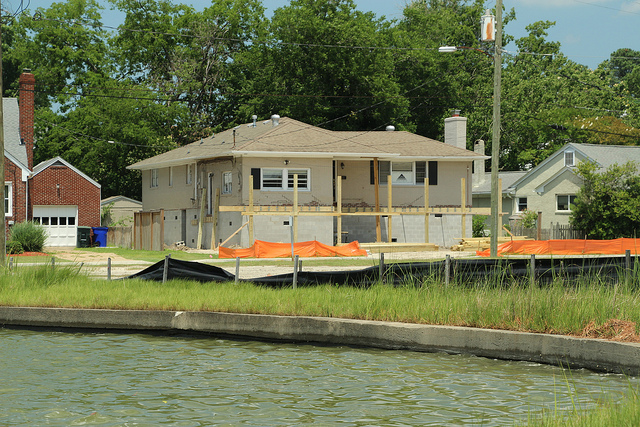
A house in the process of being elevated, a very expensive solution to the problem of recurrent flooding due to sea level rise in Virginia. Photo credit: CCAN

A house in the process of being elevated, a very expensive solution to the problem of recurrent flooding due to sea level rise in Virginia. Photo credit: CCAN

Have you ever put together a list of items you would purchase if you won the lottery—before you remembered that you haven’t even purchased a ticket? Upon reflection, how premature was that list you so perfectly pieced together?

In Virginia, we face a similar dilemma when it comes to addressing the mounting crisis of flooding along our coast.

We’ve got plenty of laudable lists in the works. Last year, Virginia lawmakers unanimously passed a resolution establishing a joint subcommittee to study recurrent flooding issues and adopt recommendations. Legislators from both parties sent a unified message: flooding is a problem in Hampton Roads and we need to do something about it.

In 2008, former Governor Tim Kaine’s Climate Change Commission laid out more than 100 recommendations to mitigate and adapt to climate change and sea level rise. So far the state has failed to adopt a plan to execute them. To his credit, Governor Terry McAuliffe recently launched a similar commission. This panel, the state’s Secure Commonwealth Panel, and the General Assembly’s aforementioned recurrent flooding subcommittee all have the same mandate: convene, discuss, deliberate, and draft a set of recommendations.

So what’s the catch? While what needs to be done is relatively easy to identify, the cost is significant—if not staggering. Virginia needs to win the equivalent of a multi-hundred-million-dollar lottery every year to fund the adaptation measures required to protect coastal residents and infrastructure.

Hampton Roads is home to the world’s largest naval base, more than $80 billion in economic activity, and 1.7 million residents who routinely feel the effects of sea level rise. Streets need to be raised, levees need to be built, and homes and businesses need to be protected. The U.S. branch of the Dutch engineering firm Fugro estimated that it would cost the city of Norfolk at least $1 billion to fully adapt to rising seas and frequent flooding—which equals Norfolk’s entire annual government operating budget.

The non-profit group Wetlands Watch reports that the cost to either elevate or purchase the homes of residents in just five Hampton Roads localities that have sustained multiple flood losses of $1,000 or more in the last ten years would exceed $430 million. Relying on federal assistance alone, it could take up to 244 years to assist all homeowners seeking help in these five localities.

Meanwhile, the Virginia Institute of Marine Science warns that sea levels could rise by as much as seven feet along Virginia’s coast within this century. We can’t afford to keep creating unfunded wish lists, and we can’t wish the problems away.

Virginia needs a dedicated stream of state funding to help coastal families and localities fight climate change. Obviously, there’s no lottery for this. But thankfully there is a common-sense legislative approach being introduced in the Virginia General Assembly by Republican Virginia Beach Delegate Ron Villanueva. His bill, called the Virginia Coastal Protection Act, would help solve our massive coastal flooding problem with a first-ever state funding mechanism that is good for the economy and good for our communities.

By joining the state into the highly successful and fully established Regional Greenhouse Gas Initiative, or RGGI, the bill would generate more than $200 million per year in new state funds to invest in coastal adaptation and other climate change solutions. This relief could come when localities in Hampton Roads need it most. It would come without adding any new demands to the state’s tight budget. It would also come through a system proven to rein in energy costs while reducing emissions and raising revenue.

RGGI is a cooperative effort of nine East Coast states that caps and reduces greenhouse gas pollution. Since the program’s inception in 2008, RGGI states have reduced their carbon footprint 2.7 times faster than non-RGGI states. In the same time period, electricity prices have dropped by 8 percent in participating states, compared to a 6 percent rise throughout the rest of the nation.

Under RGGI, power plants purchase allowances for every ton of carbon they emit. The sale of carbon allowances gets reinvested back to the states. Under Del. Villanueva’s bill, half of Virginia’s projected $200 million in annual auction revenues would fund coastal adaptation efforts, 35 percent would fund energy efficiency and renewable energy projects, and 10 percent would fund workforce development, education, and economic assistance in Southwest Virginia.

The Virginia Coastal Protection Act is a win-win-win solution. We can establish a consistent and significant source of revenue to tackle flooding in Hampton Roads and generate funds to invest in other statewide priorities, while putting policies in place to help Virginia meet carbon reduction goals in an efficient and practical manner.

Virginia’s lawmakers are on the record in their overwhelming bipartisan support for finding solutions to the state’s growing flooding woes. Delegate Villanueva has put forward the best plan to take us beyond wish lists, and to start funding urgently needed solutions.

Dawone Robinson is Virginia Policy Director with the Chesapeake Climate Action Network, a regional climate-change policy and advocacy organization with more than 30,000 supporters in Virginia. You can reach him at dawone@chesapeakeclimate.org

UPDATE: State Senator Don McEachin (D-Richmond) has agreed to introduce the Coastal Protection Act into the Senate as a companion bill to Delegate Villanueva’s (SB 1428), making this now a bipartisan effort.
Unknown's avatar

Virginia’s amazing year in energy: gas rises, coal falls, and solar shines (but it’s still not okay to say “climate change”)

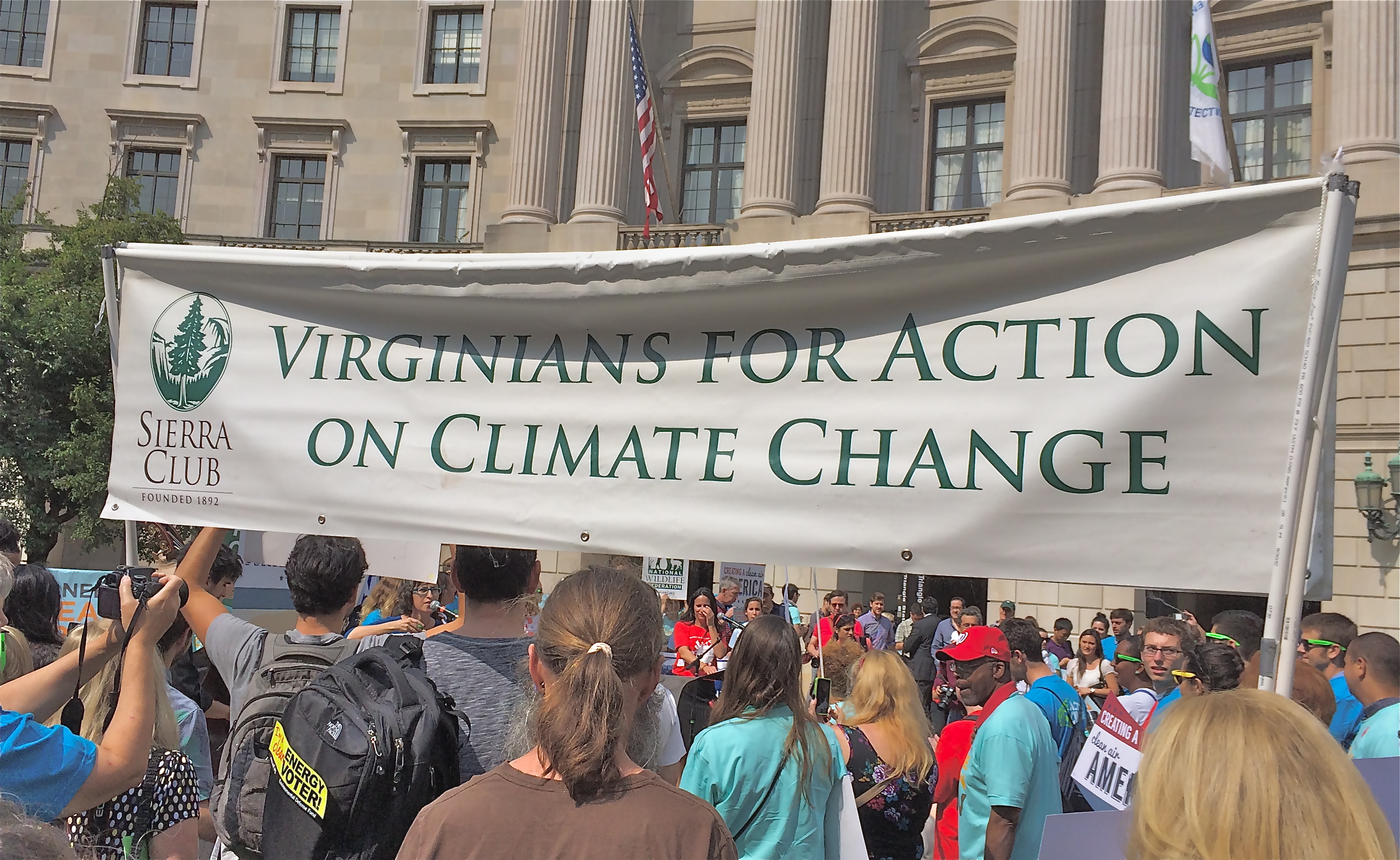
Virginians rally in front of U.S. EPA Headquarters in Washington, DC in support of the Clean Power Plan

Virginians rally in front of U.S. EPA Headquarters in Washington, DC in support of the Clean Power Plan

Nobody laughed a few years ago when former governor Bob McDonnell dubbed Virginia the “Energy Capital of the East Coast”; we were all too astounded by the hyperbole. And today, even “Energy Suburb” still seems like a stretch. Yet, if you measure achievement by the sheer level of activity, Virginia is making a play for importance. The year’s top energy stories show us fully engaged in the worldwide battle between fossil fuels and renewable energy. Of course, while the smart money says renewables will dominate by mid-century, Virginia seems determined to drown rather than give up its fossil fuel addiction.

Coal falls hard; observers disagree on whether it bounces or goes splat. Nationwide, 2014 was a bad year for the coal industry. Coal stocks fell precipitously; mining jobs continued to decline; and the one thing electric utilities and the public found to agree on is that no one likes coal. Even in Virginia, with its long history of mining, coal had to play defense for what may have been the first time ever. So when Governor McAuliffe released the state’s latest energy plan in October, what was otherwise a paean to “All of the Above” omitted the stanza on coal. And this month, the governor proposed a rollback of the subsidies coal companies pocket by mining Virginia coal.

Of course, coal is not going quietly; Senator Charles Carrico (himself heavily subsidized by Alpha Natural Resources) has already responded with a bill to extend the subsidies to 2022.

EPA opens a door to a cleaner future, and Republicans try to brick it up. Speaking of hard times for coal, in June the EPA unveiled its proposal to lower carbon emissions from existing power plants 30% nationwide by 2030. Instead of targeting plants one-by-one, EPA proposed a systemic approach, offering a suite of options for states to reach their individualized targets.

The proposal drew widespread support from the public, but Virginia’s 38% reduction target set off howls of protest from defenders of the status quo. The staff of the State Corporation Commission claimed the rule was illegal and would cost ratepayers $6 billion. Republicans convened a special meeting of the House and Senate Energy and Commerce Committees, where they tried out a number of arguments, not all of which proved ready for prime time. The rule, they said, threatens Virginia with a loss of business to more favored states like—and I am not making this up—West Virginia. Also, Virginia should have received more credit for lowering its carbon emissions by building nuclear plants back in the 1970s when no one was thinking about carbon emissions.

Meanwhile, the Southern Environmental Law Center analyzed the rule and concluded that actually, compliance will not be hard. Virginia is already 80% of the way there, and achieving the rest will produce a burst of clean-energy jobs coupled with savings for consumers through energy efficiency.

Undaunted, Republicans have already introduced a thumb-your-nose-at-EPA bill developed by the fossil fuel champions at the American Legislative Exchange Council.

The “solarize” movement takes Virginia by storm. For the last few years, solar energy has been exploding in popularity across the U.S., but Virginia always seemed to be missing the party. So it surprised even advocates this year when pent-up consumer demand manifested itself in the blossoming of local solar buying cooperatives and other bulk-purchase arrangements. “Solarize Blacksburg” made its debut in March, going on to sign up hundreds of homeowners for solar installations. It was followed in quick succession by the launch of similar programs in Richmond, Charlottesville, Harrisonburg, Northern Virginia, Halifax, Floyd, and Hampton Roads.

The main reason for the solarize programs’ success was the steep decline in the cost of solar energy. 2014 saw the cost of residential installations in Virginia fall to record low prices, making the investment worthwhile to a broad swath of homeowners for the first time.

Utilities say maybe to solar, but only for themselves. Virginia still boasts no utility-scale solar, but utilities elsewhere signed long-term power purchase contracts for solar energy at prices that were sometimes below that of natural gas: under 6.5 cents/kilowatt-hour in Georgia, and under 5 cents in Texas. Compare that to the estimated 9.3 cents/kWh cost of power from Dominion Virginia Power’s newest and most up-to-date coal plant, the Virginia City Hybrid Energy Plant, and you’ll understand why Dominion has suddenly taken an interest in solar projects. Sadly, it’s own foray into rooftop solar so far stands as an example of what not to do, and a testament to why the private market should be allowed to compete.

Yet Virginia utilities continued their hostility to customer-owned solar. Dominion put the kibosh on a bill that would have expanded access to solar energy through community net-metering, while Appalachian Power matched Dominion’s earlier success in imposing punitive standby charges on owners of larger residential systems.

Fracking, pipelines, and gas plants, oh my! Renewable energy may be the future, but the present belongs to cheap natural gas. Yes, the fracking process is dirty, noisy and polluting, and yes, methane leakage around gas wells is exacerbating climate change. But did we mention gas is cheap?

2014 saw proposals to drill gas wells east of I-95, while the Virginia government began updating its regulations to govern fracking. Dominion Power started construction on a second new gas power plant, and talked up its plans for a third. The utility giant, a major player in the gas transmission business, also got approval to turn its liquefied natural gas import terminal in Cove Point, Maryland, into an export terminal. With visions of customers dancing in its head, it also announced plans for a major new pipeline to bring fracked gas from West Virginia through Virginia and into North Carolina—one of three proposed pipelines that would cut through the Virginia countryside and across natural treasures like the Appalachian Trail. The pipeline created an instant protest movement but gained the wholehearted approval of Governor McAuliffe.

Flooding in Hampton Roads becomes the new normal; it’s still not okay to ask what’s causing it. A cooler-than-normal year for the eastern United States gulled many landlubbers into believing that global warming was taking a breather, but meanwhile the ocean continued its inexorable rise along Virginia’s vulnerable coastline. It’s one thing to shrug off the occasional storm, said residents; it’s harder to ignore seawater that cuts off your parking lot at every high tide. 2014 will go down as the year everyone finally agreed we have a problem—even in the General Assembly, which passed legislation to develop a response to the “recurrent flooding.” But while the bill recognized that the problem will just get worse, it avoided noting why.

The public gets it, though. The Richmond Times-Dispatch reports that climate change was the number one topic of interest to writers of letters to the editor in 2014. And loud cheers greeted Governor McAuliffe’s announcement that he would reestablish the state’s commission on climate change, which Bob McDonnell had disbanded. As one environmental leader quipped, “People in Tidewater are tired of driving through tidal water.”

Public corruption: in Virginia, it’s not just for politicians. Everyone can agree that it was a really bad year for the Virginia Way, that gentlemanly notion that persons of good character don’t need no stinkin’ ethics laws. But we also saw plenty to prove the adage that the real scandal is what’s legal. As we learned, Virginia law allows unlimited corporate contributions to campaigns, and puts no limits on what campaigns can spend money on. So if some legislators act more like corporate employees than servants of the public, well, that’s how the system was set up to work.

But the system only works when corporations get their money’s worth from the politicians, and that quid pro quo usually comes at the public’s expense. For example, take Dominion Power’s North Anna 3 shenanigans (please). In an exceptionally bold exploitation of the Virginia Way, Dominion Power secured passage of legislation allowing it to bill customers for hundreds of millions of dollars it had spent towards a new nuclear plant that it is unlikely to build. (And the irony is that ratepayers will still be better off throwing the money down that rathole than they will be if Dominion does manage to build it.)

So as we look ahead to 2015’s energy battles, anyone wondering who the winners and losers will be needs only one piece of guidance: in Virginia, just follow the money.

Unknown's avatar

Tiny Virginia subcommittee tasked with deciding future of bills related to EPA’s Clean Power Plan; meeting set for December 17

Photo credit: Sierra Club

Photo credit: Sierra Club

The EPA’s proposed Clean Power Plan could reshape Virginia’s energy future for the next fifteen years, and possibly permanently. If the state takes advantage of this opportunity, it will reduce carbon pollution, improve human health, save money for consumers, drive job creation in the fast-growing technology sector, and make our grid stronger and more secure.

If the state doesn’t act, EPA will design its own plan for Virginia, ensuring reduced carbon emissions but without the flexibility the state would have by doing it for itself.

This presents a conundrum for Virginia’s General Assembly, which is not known for embracing federal environmental regulations. The usual skepticism was on display on November 19, when the Senate and House Commerce and Labor Committees met in a joint session to take up the Clean Power Plan—or more precisely, to give utilities and the State Corporation Commission staff the chance to attack it.

At the conclusion of that meeting, the two Republican committee chairs, Senator John Watkins and Delegate Terry Kilgore, named three members of each committee—two Republicans and one Democrat from each chamber—to a special subcommittee tasked with deciding what kind of legislative action the General Assembly should take in response to the Clean Power Plan. Kilgore also put himself on the subcommittee, which will now take up any bills that Virginia legislators introduce related to the Plan.

This subcommittee has scheduled its first meeting for December 17 at 1:00 p.m. in Senate Room A of the General Assembly building in Richmond. By law, all committee meetings are open to the public.

According to General Assembly procedure, before anyone else in the entire legislature can consider a bill, it will have to pass muster with these seven men. So who are these hugely important people, and what is the likelihood that they will seize this historic opportunity to make Virginia a leader in clean energy?

The Senate members consist of Republicans Frank Wagner and Benton Chafin and Democrat Dick Saslaw. Wagner and Saslaw were obvious choices given their seniority on the committee and active role on energy issues. Chafin—well, we’ll get to him in a moment.

Frank Wagner is from Virginia Beach and is known for his interest in energy generally, and especially in promoting new projects. He sponsored the legislation that led to the Virginia Energy Plan in 2006 and has been an important supporter of offshore wind development, perhaps reflecting his undergraduate degree in Ocean Engineering and his Tidewater residence.

The General Assembly website says Wagner is the president of Davis Boatworks, a vessel repair facility whose principal customer is the Defense Department. Living in the Hampton Roads area, Wagner is aware of how real sea level rise is; presumably he understands the connection to climate change.

In spite of his interest in offshore wind, coal rules when it comes to funding Wagner’s political campaigns. The Virginia Public Access Project shows coal giant Alpha Natural Resources was Wagner’s second-best donor over the years, with a total of $43,643 in campaign money since 2003, ahead of Dominion Power’s $37,350. Energy and mining interests combined gave gifts totaling $188,152. Of this, $350 came from Highland New Wind Development LLC back in 2008 and $250 came from the offshore wind company Seawind in 2010.

Of course, who gives money to an elected official does not necessarily dictate how that official votes. But it probably should be mentioned that for the 2014 session, Wagner earned an F on the Sierra Club’s Climate and Energy Scorecard, disappointing clean energy advocates who have sometimes had reason to see him as an ally.

Also a low performer on the energy scorecard is Dick Saslaw, scraping by with a D. Saslaw is a career politician who was first elected to the GA in 1976, when he was 36. (He is now 74.) His biography lists his background as an owner and operator of gas stations.

Saslaw is the Senate Democratic Leader and used to be Chair of the Senate Commerce and Labor Committee, until his party lost the Senate. In theory, his leadership position in the Democratic Party should make him a defender of President Obama’s climate initiative. In practice, not so much.

Although he is a Fairfax County Democrat, Saslaw does not share his constituents’ enthusiasm for wind and solar, nor in general, their concern for the environment. Somebody once told him that renewable energy costs a lot; that’s been his story ever since, and he’s sticking with it, facts be damned.

Saslaw is proud of his close ties to Dominion Virginia Power, whose interests reliably predict his votes on any given bill. The Virginia Public Access Project reports that Dominion has given more money to Saslaw than to any other legislator. In 2014 alone, Dominion gave Saslaw $25,000. Over the years, Dominion’s contributions to Saslaw have totaled $240,508, making the utility Saslaw’s top donor.

Saslaw has also received more money from Appalachian Power than any other Democrat–$44,000–even though that utility does not provide service anywhere in his district. In addition, coal interests gave him $90,250, natural gas companies ponied up $50,250, and the nuclear industry chipped in $28,000.

A single contribution of $250 makes up the only entry under “alternative energy.”

This brings us to new Senator Ben Chafin, the Republican delegate from Southwest Virginia who replaced Democratic Senator Phil Puckett (he of the Tobacco Commission scandal). Chafin is a lawyer and farmer, and as his website informs us, “Ben Chafin has a proven record fighting for the coal industry. Ben sponsored successful legislation (House Bill 1261) to fight against Obama EPA’s effort to kill the industry through over-regulation. Ben will continue to work in Richmond to protect coal and grow other Southwest industries like natural gas.”

Not surprisingly, coal interests led all other industry donors to Chafin’s 2013 campaign for Delegate and his 2014 campaign for Senate ($59,000 altogether), though he did pretty well by natural gas, too ($14,150). As a delegate, Chafin earned a gentleman’s C on the Sierra Club scorecard, but it would probably be a mistake to pin our hopes on his becoming a clean energy champion. His role on the subcommittee is surely to give Coal a voice.

On the other hand, Chafin must recognize that the economics of fracked gas and ever-more competitive wind and solar means Virginia coal has no chance of ever regaining its former glory. Southwest Virginia now needs to craft a strategic retreat from mining and work on economic diversification. That’s not inconsistent with the Clean Power Plan.

On the House side—but here I have to digress for a moment to comment on the seemingly random composition of the House Commerce and Labor Committee. The Senate side is bad enough; any Democrat who has evinced environmental sympathies over the years has been dumped from the Senate Commerce and Labor, and when he was in power, Saslaw did a lot of the dumping.

But it’s worse over at the House. The leadership keeps reshuffling its energy committee, as if in a frantic effort to make sure nobody learns anything, while the delegates who actually came to the job with an interest and knowledge of energy never seem to get a turn. Energy law is a hard area to learn. It’s complicated, and if you don’t have time to master it, you are even more likely to accept guidance from either the party leader who tells you how he wants you to vote, or the glib industry lobbyists who assure you they have the public’s welfare at heart just as much as you do. (Plus they give you money!)

So Chairman Terry Kilgore had little enough to work with on his committee. The three delegates he named to this incredibly important subcommittee, though they are undoubtedly smart and hardworking people, bring no discernable expertise on either climate or energy to the General Assembly’s review of the Clean Power Plan.

Well, digression over.

Terry Kilgore himself is a lawyer and a 20-year member of the House from the coalfields region of southwest Virginia. Dominion is his top individual donor, at $122,000, but coal interests together make up the single biggest category of givers to his campaigns, at $243,188, with electric utilities at $218,680, natural gas at $97,830, the oil industry at $16,400, and nuclear energy at $8,500. Just since 2013, he’s taken in over $136,000 from energy and mining interests.

That’s awfully good money for a safe seat, and his votes have reflected it. His energy votes earned him a D on the Sierra Club scorecard. It’s unlikely that he will abandon his coal friends, but like Senator Chafin, he will serve his constituents best if he works to attract new business to his struggling region. Home weatherization and energy efficiency programs would be popular there, and solar energy is one of the fastest-growing industries in America.

The other House subcommittee members Kilgore appointed are Republicans Jackson Miller and Ron Villanueva and Democrat Mathew James. Jackson Miller is a Manassas Realtor and former police officer who has been in the House since 2006. The bills he has introduced primarily reflect his interests in real estate and criminal law, although he also introduced legislation supporting uranium mining. He has received a total of $79,252 from energy and mining companies since 2010, primarily electric utilities, natural gas, coal, nuclear, and uranium. He earned a D on the Climate and Energy Scorecard. Why he is on this subcommittee is anyone’s guess, but certainly Northern Virginia stands to gain a lot of technology jobs if the state develops its clean energy industries as it should.

Virginia Beach Republican Ron Villanueva has not been as popular with the energy and mining companies, whose donations to his campaigns have totaled $20,550. Villanueva’s website says he was the first Filipino-American elected to state office in Virginia when he became a delegate in 2009. Villanueva has been friendly to the solar industry, and while he received a D on the scorecard, he also received an award from the Sierra Club for his work on a bill to provide a tax credit for renewable energy projects. (The bill was converted to a grant in the Senate but not funded.)

Like Delegate James and Senator Wagner, Villanueva lives in an area that is feeling the effects of climate change sooner than any other part of Virginia, so his constituents know how much the Clean Power Plan matters. For that matter, his day job as a partner with SEK Solutions, a military contractor, should mean he’s aware of the Pentagon’s focus on climate change as a national security issue, as well as a threat to its coastal assets.

Portsmouth Democrat Matthew James also hasn’t been especially popular in the energy industry. Since 2009, when he first ran for delegate, he has accepted a mere $5,000 from Dominion, $3,500 from coal interests, and $3,350 from the natural gas companies—token amounts by Virginia standards, but they may be due for a sudden increase.

James does not seem to have introduced any energy-related bills. However, his votes earned him an A on the Sierra Club scorecard. James is listed as the President and CEO of the Peninsula Council for Workforce Development. Maybe he will see an opportunity in the Clean Power Plan to develop jobs in the solar, wind, and energy efficiency industries, which have outperformed the economy generally.

So there you have the five Republicans and two Democrats who get first crack at any bill either facilitating Virginia’s compliance with the Clean Power Plan, or hostile to it. If they like a bill, it moves to the full Commerce and Labor committees. If they scuttle a bill, no one else in the entire legislature will get to vote on it.

That’s how it works, or doesn’t, in the Old Dominion.

Unknown's avatar

“Virginia Climate Fever” shows us where we’re going, and why we don’t want to go there

The mid-Atlantic enjoyed one of the most delightful summers in memory this year, causing a lot of snickering to the effect that if climate change means moderate temperatures and low humidity, then bring it on, baby! Elsewhere on the planet, though, “bringing it on” translated into a whole lot of hot. For a good laugh at our own parochial mindset, check out the map of relative temperatures that accompanies this article about NOAA declaring 2014 on track to be the hottest year on record.

This sad reality check shows that global warming has not paused or gone away, and Virginians had better try to understand what’s coming so we can start preparing. It turns out our problems go well beyond sea level rise, as we learn this week from guest blogger Seth Heald.

Oh, and don’t miss the note at the bottom about the November 6 event. 

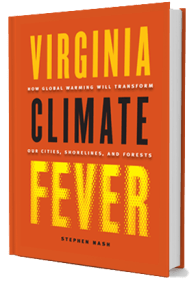
Featured imageVirginia climate activists (and indeed all Virginians) should cheer Stephen Nash, whose Virginia Climate Fever (just published by The University of Virginia Press) lays out clearly the costs of our decades of inaction on global warming. The book’s subtitle nicely sums up the point: How Global Warming Will Transform Our Cities, Shorelines, and Forests.

Why a climate book focused on just one state?

One of many confounding challenges of global warming is how to get people (and politicians and businesses) to take action commensurate with the size of the problem. As the popular British social scientist Roman Krznaric asks, “how can we close the gap between knowledge and action on climate change?” Krznarik’s answer is to seek ways to increase our empathy for people who live in distant places, or will live in future times. Certainly that is needed. (The U.S. edition of Krznarik’s book on empathy comes out in November.)

But since the day of increased empathy has yet to arrive, climate communications experts have focused on the need to get people to realize that climate change is happening here and now. It’s not just about our grandchildren, or even our children. It’s about us too. Now. And it’s not just about poor people living at sea level in Bangladesh, or the soon-to-disappear Maldives, or where melting glaciers threaten tens of millions of people’s water supply. Global warming is happening to us in America, and right here in Virginia. What’s more, it’s not limited to low-lying, frequently flooded parts of coastal Virginia, like Norfolk. Climate disruption is happening all across the commonwealth—from the shore to the tidal Potomac near Alexandria and Washington to the Piedmont to the mountains.

Climate communications experts agree that people are more likely to act (and demand that their leaders act) on global warming if they understand that it will have serious effects in their lives, and where they live.

Virginia Climate Fever does a superb job of bringing climate change home to Virginia. Nash, a journalist who writes with a deft touch, has taught at The University of Richmond since 1980, and he clearly knows Virginia well. He is is well versed in the science of climate disruption, and very good at explaining it. The book is filled with information gathered from interviews with scientists, including several at Virginia universities.

One leading climatologist featured prominently is Katharine Hayhoe, head of the Climate Science Center at Texas Tech University. As the book explains, she also happens to be an evangelical Christian whose faith informs and inspires her work. At Nash’s request, Hayhoe and a colleague prepared color maps of Virginia for Virginia Climate Fever, showing stunningly how much hotter our summers and winters are likely to be in the coming decades under different levels of future carbon emissions. It’s hard for me (at age 61) to look at these and contemplate my own hotter future here, much less my children’s.

Most disturbing to my mind was Nash’s description of the future of what those maps mean for our forests. We often hear about sea-level rise and how it will combine with more-severe storms to harm Virginia, especially in the Hampton Roads area. And well we should—the situation in Virginia’s coastal areas is dire indeed. But Nash reveals that our inland and mountain forests are just as threatened. And so not surprisingly are many plant and animal species that live in or near them. Many species face the prospect of extinction this century. Nash quotes the bioclimatologist Ron Neilson as saying that large areas of Virginia forest could “go into drought stress and potentially burn up,” resulting in “some very rapid conversions from forest to savannah.” Nash asked Neilson if this could happen in the next twenty or thirty years. Neilson’s answer: “How about now?”

Virginia Climate Fever is not strictly speaking a book about energy or energy policy. Rather it’s about climate impacts from our past, present, and future energy choices. But for those on the more well-informed side of the current “I’m not a scientist, what do I know?” climate-science-denial catchphrase, Virginia’s current and future energy choices will come to mind on every page of the book.

Nash does include a chapter on possible prescriptions for our climate fever. He tellingly notes: “we don’t lack for examples among other states,” citing North Carolina and Maryland as two of many states considerably farther along in addressing changing climate. He cites with approval Maryland’s efficiency and conservation measures, and its mandatory renewable portfolio standard, noting that Virginia is one of only nineteen states with no mandatory renewable standard at all. He mentions Maryland’s participation in the multistate Regional Greenhouse Gas Initiative. Again, “Virginia is not on the list.”

Nash asked Virginia’s Department of Environmental Quality about climate change and got this written response: “The Virginia [DEQ] does not have the expertise to study climate change issues.” One could not find a better sentence to sum up the four lost years of the McDonell-Cuccinelli administration’s climate denialism.

Governor Terry McAuliffe and Senator Mark Warner enthuse about a mindless “all of the above” energy policy that includes fracking (and associated pipelines), offshore oil drilling, coal exports, and ever more reliance on fossil fuels. (To his credit, Senator Tim Kaine has said that “all of the above” is not a strategy—yet nevertheless supports offshore oil drilling.) Virginia Climate Fever is a wake-up call for them, and for the “I’m not a scientist” crowd, and for all Virginians.

But of course there have been other such calls in the past few decades. The question is, when will enough Virginians hear them clearly, and begin to act with a sense of urgency?

Seth Heald is vice chair of the Sierra Club Virginia Chapter. He is a student in the Master of Science in Energy Policy and Climate program at Johns Hopkins University.

Note: Northern Virginians will have an opportunity on November 6 to meet Stephen Nash in Alexandria at an author talk and book signing. Details and RSVP form are here.


Unknown's avatar

Virginia’s SCC staff attacks EPA over the Clean Power Plan

Virginians rally in front of U.S. EPA Headquarters in Washington, DC in support of the Clean Power Plan

Virginians rally in front of U.S. EPA Headquarters in Washington, DC in support of the Clean Power Plan

In recent years paleontologists have come to believe that the dinosaurs did not go extinct; they evolved into today’s chickens and other birds. It turns out, however, that some of them did not evolve. Instead, they took jobs at Virginia’s State Corporation Commission.

Now they’ve put their DNA on full display with comments they filed on the EPA’s Clean Power Plan. The proposed EPA rules, under section 111(d) of the Clean Air Act, would require states to reduce the power plant CO2 emissions driving climate change. The staffers assert primly that they “take no position on the broad policy issues,” but that they feel “compelled” to point out all the ways the plan is “arbitrary, capricious, unsupported, and unlawful.” These mostly boil down to their claims that the plan will force coal plant closures, raise rates significantly and threaten service reliability—claims experts say are badly off-base.

Note that the commissioners themselves didn’t sign onto these comments. They come from the career staff at the Energy Regulatory Division, led by Bill Stevens, the Director, and Bill Chambliss, the General Counsel. This is pretty peculiar. I can’t think of a single other agency of government where the staff would file comments on a federal rulemaking without the oversight of their bosses.

Bill and Bill acknowledge in a footnote that the staff comments represent only their own views and not those of the commissioners. But that distinction has already been lost on at least one lawmaker. Today Speaker of the House William J. Howell released a statement declaring, “The independent, nonpartisan analysis of the State Corporation Commission confirms that President Obama’s environmental policies could devastate Virginia’s economy.”

And really, “devastate”? But that’s the kind of hysteria you hear from opponents of the Clean Power Plan. While the rest of us see healthier air, huge opportunities for job growth in the clean energy sector, and the chance to avoid the worst effects of climate disruption, the Friends of Coal see only devastation. And no wonder: Howell accepted $14,000 from the coal industry just this year alone.

But back to what the Bills over at the SCC think about the Clean Power Plan. How did they arrive at their conclusion that it would raise rates? According to Cale Jaffe, a lawyer with the Southern Environmental Law Center who practices extensively before the SCC, “Staff never did an analysis of an actual plan to comply with the Clean Power Plan, which has a lot of flexibility built into it. Instead, the Staff simply took Dominion Virginia Power’s last Integrated Resource Plan from 2013 and used it as a proxy for a compliance plan. That’s a significant flaw that skews the Staff’s analysis.  The Dominion plan, after all, was released nearly a year before the EPA even announced its rule.”

Compounding the error, says Jaffe, the staff “artificially inflated the cost by assuming that the only compliance strategy would be for Dominion to build a new nuclear reactor: the most expensive resource, which is not a required compliance option.”

We can all agree with the staff that nuclear plants are appallingly expensive. That may be why the EPA doesn’t assume most states will build them as part of their compliance strategy. To the contrary, the expectation is that states will respond with energy efficiency, wind and solar—all resources that are plentiful in Virginia but largely untapped so far.

As Jaffe notes, “an independent analysis of the actual Clean Power Plan itself shows that Virginia can achieve its goals at a fraction of the cost while lowering Virginians’ bills by 8%.”

We have seen time and again that the SCC staff has never been friendly to either renewable energy or energy efficiency, so it’s no surprise that their comments dismiss them as unworkable. Indeed, it is clear from the comments they filed that their real interest is promoting an anti-EPA, pro-coal agenda. Otherwise it would be hard to understand why they would stray so far from their own area of practice to attack the very legality of the Clean Power Plan.

Jaffe lists a number of other ways the SCC staff screwed up, but you get the picture: careful, reasoned analysis wasn’t the point. Still, you’d think that if agency staffers decide to go rogue like this, they would be careful to get the facts right.

———————————

Update: I have heard from some sources that the SCC staff had the blessing of at least one commissioner in putting forth their comments, and that all three commissioners may have known. If so, that’s even worse.

Unknown's avatar

Why we can’t just shut up and eat our cookies (or embrace natural gas)

Fracking site, Marcellus Shale. Photo courtesy of U.S. Geologic Survey.

Fracking site, Marcellus Shale. Photo courtesy of U.S. Geologic Survey.

I grew up with brothers, so I knew from an early age that the easiest way to make friends with guys was to feed them chocolate chip cookies. I took this strategy with me to college, commandeering the tiny kitchen in our coed dorm. The aroma wafting down the hallways reliably drew a crowd.

One fan was so enthusiastic that he wanted to learn to make cookies himself. So the next time, he showed up at the start of the process. He watched me combine sugar and butter, eggs and white flour.

Instead of being enthusiastic, he was appalled. It had never occurred to him that anything as terrific as a cookie could be made of stuff so unhealthy. It’s not that he thought they were created from sunshine and elf magic; he just hadn’t thought about it at all. He left before the cookies even came out of the oven.

I felt so bad about it, I ate the whole batch.

But I can empathize with that guy when I’m told that as an environmentalist, I should love natural gas. Natural gas is the chocolate chip cookie of fossil fuels. At the point of consumption, everybody loves it. It’s cheap, there’s gobs of it, and it burns cleaner than coal, with only half the carbon dioxide emissions. Disillusionment sets in only when you look at the recipe. (“First, frack one well. . .”)

I realize we have only ourselves to blame. For years, environmentalists talked about gas as a “bridge fuel” that could carry us from a fossil fuel past to a future powered by renewable energy. No one would tarry on that bridge, we figured, because gas was expensive. We’d hurry along to the promised land of wind and solar.

But that was before hydrofracking and horizontal drilling hit the scene. Fracking opened up vast swaths of once-quiet forest and farmland to the constant grinding of truck traffic heading to drilling rigs that operate all day and night, poisoning the air with diesel fumes and sometimes spilling toxic drilling fluids onto fields and into streams. It was before studies documented well failures that let toxic chemicals and methane seep back up along the well borings and into aquifers, contaminating drinking water.

And it was before scientists sounded the alarm on “fugitive” methane emissions from wellheads: gas that escapes into the air unintentionally, sometimes at levels so high as to cancel out the climate advantage of burning natural gas instead of coal.

But just as environmentalists were thinking, “Whoa, natural gas turns out to be a bridge to nowhere,” electric utilities were embracing fracked gas in a big way. Fracking has made gas so cheap that giving up coal is no sacrifice. It’s so cheap they see no reason to get off the bridge and embrace renewable energy. At one conference I attended, a gas company executive gushed, “Natural gas is no longer a bridge fuel. It’s a destination fuel!”

All I could think was, “In that case, the destination must be Cleveland.” Which was surely unfair to Cleveland.

Just to be clear: environmentalists are not opposed to gas because we are spoil-sports, or purists, or hold stock in solar companies. The problem with natural gas is that it isn’t made by Keebler elves, but extracted through a nasty process that is harming the planet in ways both local and global.

If the best anyone can say about natural gas is that it’s not as bad as coal, then lingering on the bridge makes no sense. And anything we do that keeps us here—opening up Virginia to fracking, or building a huge new pipeline to bring fracked gas from other states—is both foolish and dangerous. Foolish, because embracing cheap gas distracts us from the serious business of building wind and solar and using energy more efficiently; and dangerous, because the planet will not stop warming while we play shell games with carbon.


Unknown's avatar

Children need the EPA’s carbon pollution standard

This post, from guest blogger Samantha Ahdoot, originally appeared in the August 21 edition of the Fairfax County Times. I’ve written about the threat that increasing summer temperatures poses for people who have to work outdoors in ; here, Dr. Ahdoot tells us what carbon pollution means for children.

The end of summer fun? Higher temperatures resulting from carbon pollution could limit children's outdoor time.

The end of summer fun? Higher temperatures resulting from carbon pollution could limit children’s outdoor time.

Every day, parents protect their children from a myriad of risks. By strapping them in car seats, placing them on their backs to sleep and cutting their grapes into quarters, parents do everything in their power to insure their children against harm. President Obama’s Clean Power Plan will be called many things in the upcoming months, but it is ultimately an insurance plan. It is insurance for our children against the dangers of carbon pollution and resulting climate change.

Carbon pollution presents a major risk to the health, safety and security of current and future children. Rising atmospheric carbon is making our planet hotter. While skeptics may say this remains uncertain, our major scientific organizations (NASA, NOAA, IPCC) tell us it is at least very, very likely. With this increased heat, many other climactic changes are already occurring, including melting glaciers, rising sea levels and worsening storms. These fundamental changes ultimately impact human health, and children are amongst the most vulnerable to these changes. Some impacts are already affecting children today and are being seen by pediatricians like myself.

Allergic rhinitis, for example, affects about 10 percent of American children. With later first frost and earlier spring thaw due to rising global temperature, the allergy season has become longer. In the Northern Virginia region, where I practice, it has lengthened by about two weeks. More northern regions of the country have experienced greater lengthening. Higher carbon dioxide in the atmosphere also causes ragweed plants today to produce more pollen than in preindustrial times. Allergy season is therefore both longer and more severe.

Some infectious disease patterns have already been impacted by climactic changes. As global temperatures rise, many plants and animals are migrating poleward. They are bringing diseases, like Lyme disease, with them. There is now Lyme disease in Canada, and large increases in reported cases of Lyme have occurred in the northern U.S. Maine had 175 cases in 2003 and 1300 cases in 2013, while New Hampshire had 262 cases in 2002 and greater than 1300 cases in 2013. Children under five years old, who spend the most time outside playing in high-risk areas, have the highest incidence of Lyme disease.

Increasingly long and severe heat waves also place children at risk of heat-related illness. While the elderly are at highest risk from extreme heat, some groups of children also appear to be vulnerable. Infants less than one year, for example, have immature thermoregulation, and infant mortality has been found to increase due to extreme heat. A study from MIT found that by the end of the 21st century, under a “business as usual” scenario, infant mortality rates would increase by 5.5 percent in females and 7.8 percent in males due to heat-related deaths. U.S. student athletes are a high-risk group for heat injury. Teenage boys, most commonly football players, made up 35 percent of the roughly 5,900 people treated yearly in emergency rooms for exertional heat illness between 2001 and 2009. According to the CDC, heat illness is a leading cause of disability in high school athletes, with a national estimate of 9,237 illnesses annually.

Health impacts on individuals and communities will grow significantly if we allow carbon emissions, and global temperatures, to rise unchecked. Power plants contribute approximately one-third of U.S. greenhouse gas pollution. Reducing emissions from existing fossil fuel-fired power plants represents a major step towards altering our emissions, and climate, trajectory. Obama’s Clean Power Plan is, ultimately, like a car seat- an insurance plan for our children against a significant risk of harm. The road of climate change will be long and hazardous. Our children deserve to be strapped in.

Dr. Samantha Ahdoot is pediatrician in Alexandria. She is a Fellow of the American Academy of Pediatrics (AAP), and a member of the Executive Committee of the AAP’s Council on Environmental Health.

Unknown's avatar

Energy Plan must prepare Virginia for hotter summers

A version of this blogpost was previously published in theHampton Roads Virginian-Pilot on July 20, 2014

Virginians rally in front of U.S. EPA Headquarters in Washington, DC

Virginians rally in front of U.S. EPA Headquarters in Washington, DC

“Over the past 30 years, the average resident of [the Southeast] has experienced about 8 days per year at 95° or above. Looking forward, if we continue our current emissions path, the average Southeast resident will likely experience an additional 17 to 52 extremely hot days per year by mid-century and an additional 48 to 130 days per year by then end of the century.”

            —Risky Business: The Business Risks of Climate Change in the United States

This quote comes from a report issued in June by an all-star group of business and government leaders, laying out the costs involved in higher temperatures and sea level rise. The section on the Southeast is especially likely to make you want to move north and west.

Virginia has started to focus attention on rising sea levels because they are already taking a toll on Tidewater areas, regularly flooding neighborhoods in Norfolk and eating away at the Eastern Shore. In 2013, at the behest of the General Assembly, the Virginia Institute of Marine Science produced an in-depth report on sea level rise and our options for dealing with it. The report says southeast Virginia should expect another one to two feet of sea level rise by 2040, and up to 7.5 feet by the end of the century. We have our work cut out for us, but at least we’re facing up to it.

By contrast, we have not yet begun planning for higher summer temperatures. As the Risky Business report warns, these higher temperatures will make much of the humid Southeast literally uninhabitable without air conditioning. And that has profound implications for our energy planning, starting now.

More intense summer heatwaves will place additional stress on the electric grid and cause costly spikes in power demand. Power outages, today mostly an inconvenience, will become public health emergencies unless there are back-up sources of power readily available, such as solar PV systems with battery storage distributed throughout every community.

Better building construction will be critical to keeping homes and businesses cool reliably and affordably. Since buildings last for many decades, we shouldn’t wait for summers to become deadly before we start mandating better insulation. It is vastly cheaper and more effective to build energy efficiency into a building than to retrofit it later.

This makes it especially unfortunate that the McDonnell administration caved to the home builders’ association last year and did not adopt the updated residential building codes, which would have required these kinds of improvements in new additions to our housing stock. Governor McAuliffe’s failure to reverse the decision this year remains incomprehensible.

However, the McAuliffe administration is now engaged in three planning exercises that ultimately converge around Virginia’s future in a warming world. The Department of Mines, Minerals and Energy is currently writing an update to the Virginia Energy Plan as required by statue every four years, and which must be submitted to the General Assembly this October. On a slower track, a revived Climate Commission will begin conducting its work over the course of the next year. And most recently, the Department of Environmental Quality has announced listening sessions this summer focused on the U.S. EPA’s proposed climate rules.

This timeline puts the (energy) cart before the (climate) horse. The writers of the Energy Plan will not have the benefit of the climate commission’s deliberations, and won’t know what the final EPA rules will require. With pressure from utilities, fossil fuel interests and home builders, business-as-usual thinking might prevail. That would be a mistake.

We don’t know whether the worst extremes cited in the Risky Business report will become reality, or whether the U.S. and the rest of the world will manage to reduce greenhouse gas emissions enough to slow the rise of the oceans and check the worst of the heatwaves. But while we hope for the best, it makes sense to plan for the worst.

And in this case, planning for the worst will also reduce the likelihood of it happening. If we improve building efficiency starting now, we will cut down on the emissions driving a Risky Business future. If our disaster preparedness includes solar panels on businesses and government buildings, we cut emissions and make the grid more resilient.

Global warming has to be part of Virginia’s energy planning from now on. It’s just too risky to ignore it.


Unknown's avatar

Now’s your chance: Virginia seeks public input on carbon rules

Photo by Josh Lopez, courtesy of the Sierra Club.

Photo by Josh Lopez, courtesy of the Sierra Club.

On June 2 the U.S. EPA proposed a Clean Power Plan for the states, and now the Virginia Department of Environmental Quality wants to know what Virginians think about it. Starting July 22, DEQ is holding four “listening sessions” to get the public’s views:

  • Tues, July 22 in Wytheville, VA, Snyder Auditorium, Wytheville Community College, 1000 East Main Street, 5 PM to 8 PM.
  • Thurs, July 24 in Alexandria, VA, Meeting Room, John Marshall Library, 6209 Rose Hill Drive, 5 PM to 8 PM.
  • Mon, July 28 in Virginia Beach, VA, Auditorium, Virginia Beach Public Library, 4100 Virginia Beach Blvd., 5 PM to 8 PM.
  • Thurs, Aug 7 in Henrico, VA, Administration Board Room, Henrico County Govt. Center, 4301 East Parham Rd., 5 PM to 8 PM.

Depending on turnout, speakers may be limited to 3-5 minutes, though written testimony can be any length. Written comments can also be submitted to ghg@deq.virginia.gov.

The purpose of the listening sessions, according to DEQ, is to help the agency determine what comments it will file on the EPA plan, and how Virginia can implement the rules as they have been proposed.

The first question is one for the public—do we support EPA’s plan to cut carbon emissions? The answer, of course, is an emphatic yes. In fact, EPA’s proposal is too modest, and we can do better.

Carbon pollution affects everyone in Virginia: residents of coastal areas experiencing recurrent flooding and beach erosion due to sea level rise; farmers whose crops will suffer from higher summer temperatures and drought; people who have asthma or heart disease; the elderly, who suffer most during heat waves; and parents who want to leave a healthier planet for our children and grandchildren. DEQ needs to hear from all these residents.

DEQ’s second question is how we should go about cutting carbon. The EPA plan proposes a carbon budget for Virginia that would reduce our emissions by 38.5% over 2005 levels by 2030. It wouldn’t tell us how to do it, but outlines four broad categories of options:

  • Increasing the efficiency of existing coal plants to reduce carbon emissions;
  • Increasing utilization of existing natural gas-fired power plants;
  • Expanding the use of wind, solar, or other low- or zero-emitting alternatives; and
  • Reducing consumption through energy efficiency.

We may be able to do all of these, but the third and fourth categories offer the big opportunities. Virginia lags behind other states on energy efficiency, has so little solar that the industry trade groups haven’t bothered to track it, and has no wind power at all. As a result, we have a lot of low-hanging fruit to go after. So EPA’s 38.5% is readily achievable if we refocus our energy policies to support energy efficiency and zero-emission energy sources like solar and wind.

This is hardly a new theme, though the EPA plan gives it new impetus. For years environmental groups have argued to the State Corporation Commission, utilities and the legislature (and anyone else who will listen), that a sound energy policy for Virginia should include substantial investments in energy efficiency, solar and wind. That combination offers the most bang for the buck and provides the most benefit to Virginians in the way of clean air, jobs and business opportunities.

It’s been a hard sell; Virginia utilities make more money when they sell more power, so they don’t like efficiency measures that lower demand, and the SCC has always favored “cheap” energy, no matter what it costs us. EPA’s plan can help us overcome these barriers if Virginia adopts the right policies. These could take the form of an energy efficiency resource standard (EERS) and a law giving teeth to our renewable portfolio standard (RPS). Alternatively or in addition, we could join a regional cap-and-trade system that effectively puts a price on carbon, such as the northeast’s very successful Regional Greenhouse Gas Initiative.

If any of these are to become a reality, it will take public demand to make it happen. Even with carbon taking center stage now, there is room for utilities to carry us in the wrong direction. Dominion Virginia Power sees carbon regulation as an opportunity to develop nuclear power at ratepayer expense, in spite of the costs, the risks, the shortage of cooling water, and the lack of any long-term plan for radioactive waste. Expensive central power stations, heavily subsidized by the public but comfortably familiar to executives and lucrative for shareholders, remain Dominion’s top choice.

With Dominion using its cash and clout liberally in Richmond, its preference for more gas and more nuclear will carry greater weight with decision-makers than such an approach deserves. So if the public wants anything else, it had better speak up—and now’s the time to do it.


Unknown's avatar

Governor McAuliffe gets his chance on energy and climate


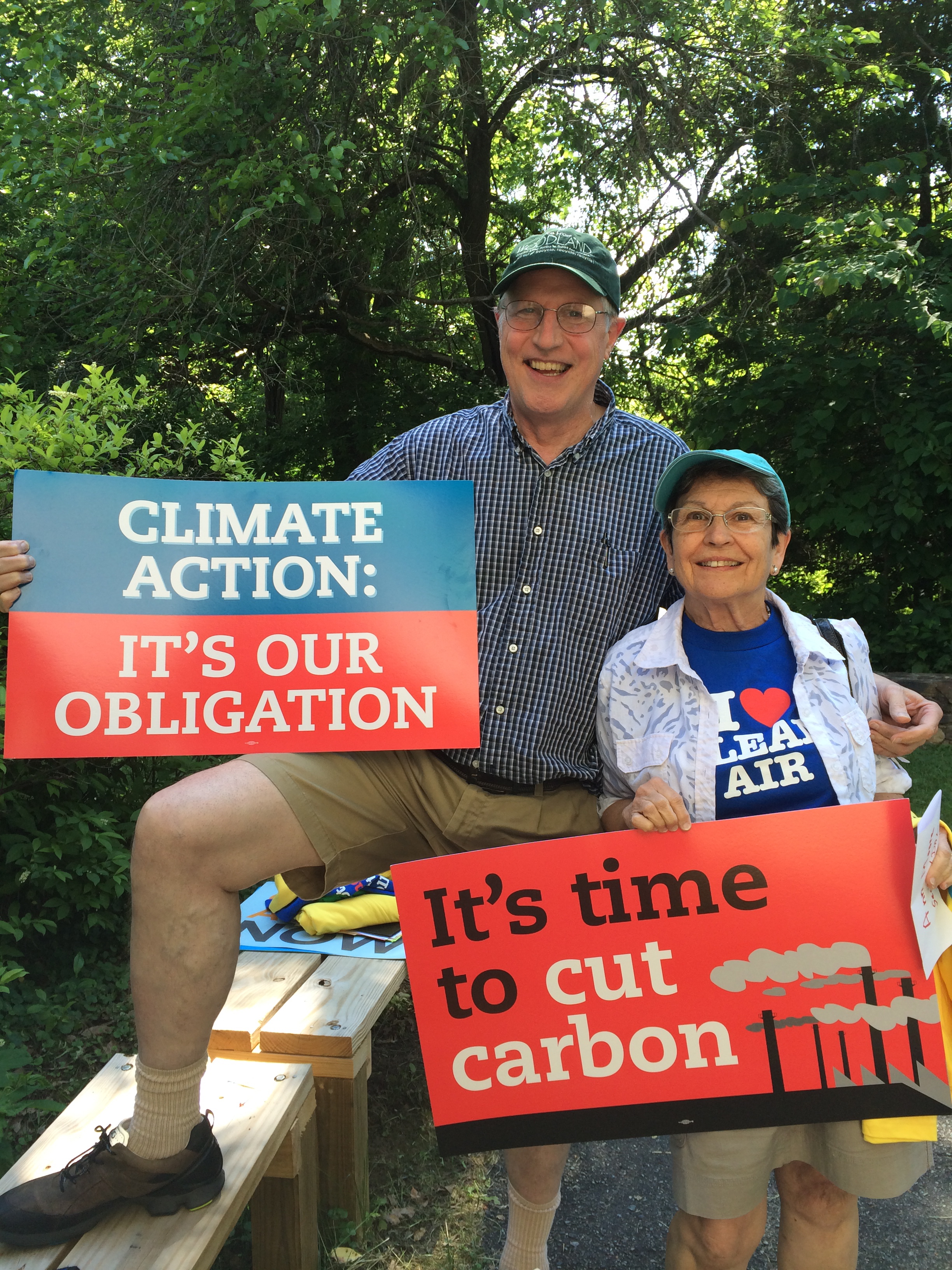
Virginia Sierra Club activists Tom Ellis and Ann Moore. Photo by Ivy Main

Virginia Sierra Club activists Tom Ellis and Ann Moore. Photo by Ivy Main

2014 is shaping up to be an exceedingly interesting year for energy policy in Virginia. The rewrite of the Virginia Energy Plan, the re-establishment of the Governor’s Climate Commission, and EPA’s just-proposed carbon rule create three separate pathways that will either intersect to form a coherent and coordinated state policy, or will take us into a chaotic tangle of competing agendas.

Add in the myopia of the State Corporation Commission and the control of the General Assembly by utility and coal interests, and we’ve got an unpredictable plotline here. All you energy watchers are going to want to stock up on popcorn for this show. Or better yet, become a player—read on to find out how.

First there’s the energy plan. Virginia law requires a new iteration every four years, with this year’s due October 1. To help with the work, Governor McAuliffe appointed the Virginia Energy Council two weeks ago. The Council consists primarily of energy industry members, with only one environmental representative and no consumer advocates. (Although come to think of it, that might be because Virginia doesn’t have any consumer advocates. But still.)

The Council will be working with the staff of the Department of Mines, Minerals and Energy, which has already begun holding “listening sessions” and accepting comments to get input from the public. The next one will be held tonight, June 17, in Annandale, Virginia. Get there early and sign up for a speaking slot. Other locations include South Boston on June 19, Abingdon on June 24, Norfolk on June 26, and Harrisonburg on July 1.

The existing energy plan, created under Governor McDonnell, is the sort of “all of the above” hodgepodge that you’d expect from a process where you bring in a bunch of energy company executives and say, “Have at it!” I’d be concerned that the same fate awaits the new one, but for a couple of new factors: the reboot of the Governor’s Commission on Climate Change and the looming threat of EPA’s carbon rule. (Making this the first time ever that I’ve welcomed anything I called a looming threat.)

The Climate Commission was supposed to have launched by now, and if it had, I might have been able to say something definite about how it will interact with the Energy Council. Unfortunately, Governor McAuliffe got a little sidetracked by something you may have heard about: the political chaos that ensued when a certain Democratic senator resigned his seat and threw the Senate into Republican hands under suspect circumstances in the middle of a battle over the Governor’s signature initiative.

(In fairness. the senator’s backers insist he acted only out of the purest self-interest and not because he’d been bribed, there being a legal difference. Still, from now on anyone who screws over a large number of friends at once will be said to have “Pucketted” them.)

As you may remember, Governor Kaine established the first Governor’s Commission on Climate Change back in 2007 to study the effects of global warming on Virginia and to make recommendations on what to do about it. The commission issued a well-thought-out report replete with excellent suggestions. The report was put on a shelf and admired for a while, until Governor McDonnell found out about it. He acted swiftly, taking down the Commission’s web page lest anyone think he believed in rising sea levels and flooding and predictions about the dire consequences of global warming—you know, the sort of thing you can actually see going on now in Hampton Roads, the second-largest metropolitan area in Virginia.

Governor McAuliffe, on the other hand, not only “believes in” climate change and the risks it poses to Virginia, but also believes there are huge job and growth opportunities to be had by taking action in response. He has made it clear he does not want his commission to start from scratch, but rather to pick up where the Kaine commission left off.

McAuliffe’s Energy Plan must also take account of carbon emissions in a way the McDonnell plan never tried to. On June 2, EPA issued a proposed rule to address carbon pollution from existing electric generating plants, intended to reduce overall emissions nationwide by 30% by 2030. Although the rule won’t be final for a year, and states will then have as long as two years to implement it, and there will be lawsuits trying to block it from ever being implemented—still it means no one can ignore carbon now.

If you want to weigh in on the carbon rule, EPA will be holding hearings around the country, including in Washington, DC on July 30, or you can email your comments.

The proposed rule is not simple. Each state has been given a carbon budget for all its electric generating plants combined, expressed in pounds per megawatt-hour, and arrived at by some still-rather-opaque notion of what a given state is capable of. The cleanest states are thought to have policies in place to get even cleaner, so their targets are more ambitious than those of the dirtiest states. The dirty, coal-intensive states, having done so little to clean up in the past, are thought incapable of making a whole lot of progress now, and so are rewarded by being graded on a curve. Interestingly, it is not the clean states crying foul, but the dirty ones.

Virginia’s carbon target falls in the middle, but achieving it will require improvements of 37.5% over 2012 levels. This sounds harder than it is, given that we have several natural gas plants under construction that will presumably count towards lowered emissions as they dilute the coal in the state’s power mix. EPA also assumes that existing plants can operate at higher efficiencies that will reduce emissions per unit of energy produced.

The carbon rule also contains what seems to be a freebie of 6% of existing nuclear power, a provision intended to encourage the continued operation of nuclear plants that still have time remaining on their licenses but are no longer economic. In Virginia’s regulated market, our nuclear plants don’t have to compete on the open market and so aren’t in danger of being shut down for economic reasons, but apparently we get the freebie anyway.

Beyond that, however, the carbon rule will clearly put a thumb on the scale in favor of energy efficiency and carbon-free power sources. The EPA is right to think we have plenty of those to call on. A few years ago, ACEEE released a study showing Virginia could readily achieve energy efficiency savings of almost 20% cost-effectively, and much more if we really rolled up our sleeves. Since then, the few utility programs that have addressed energy efficiency have barely moved the needle. This means the low-hanging fruit still clings there, only now it’s really, really ripe.

Add in offshore wind (which can provide about 10% of state energy needs just from the initial lease area that Dominion Power bought rights to), some land-based wind (a few more percentage points) and solar energy (estimated to be able to produce 18-25% of our demand), and we know we can blow right through the EPA target.

As we also know, though, Dominion CEO Tom Farrell has his heart set on a new nuclear plant, which would suck up all the money that might otherwise go to renewables and dampen the utility’s interest in efficiency. Given nuclear’s high cost, the need for taxpayer and ratepayer subsidies, and the public safety risks involved, the free market isn’t on his side. But with captive ratepayers and the legislature on the company payroll, Farrell’s dream remains a possibility in Virginia.

As I say, it’s going to be an interesting year.