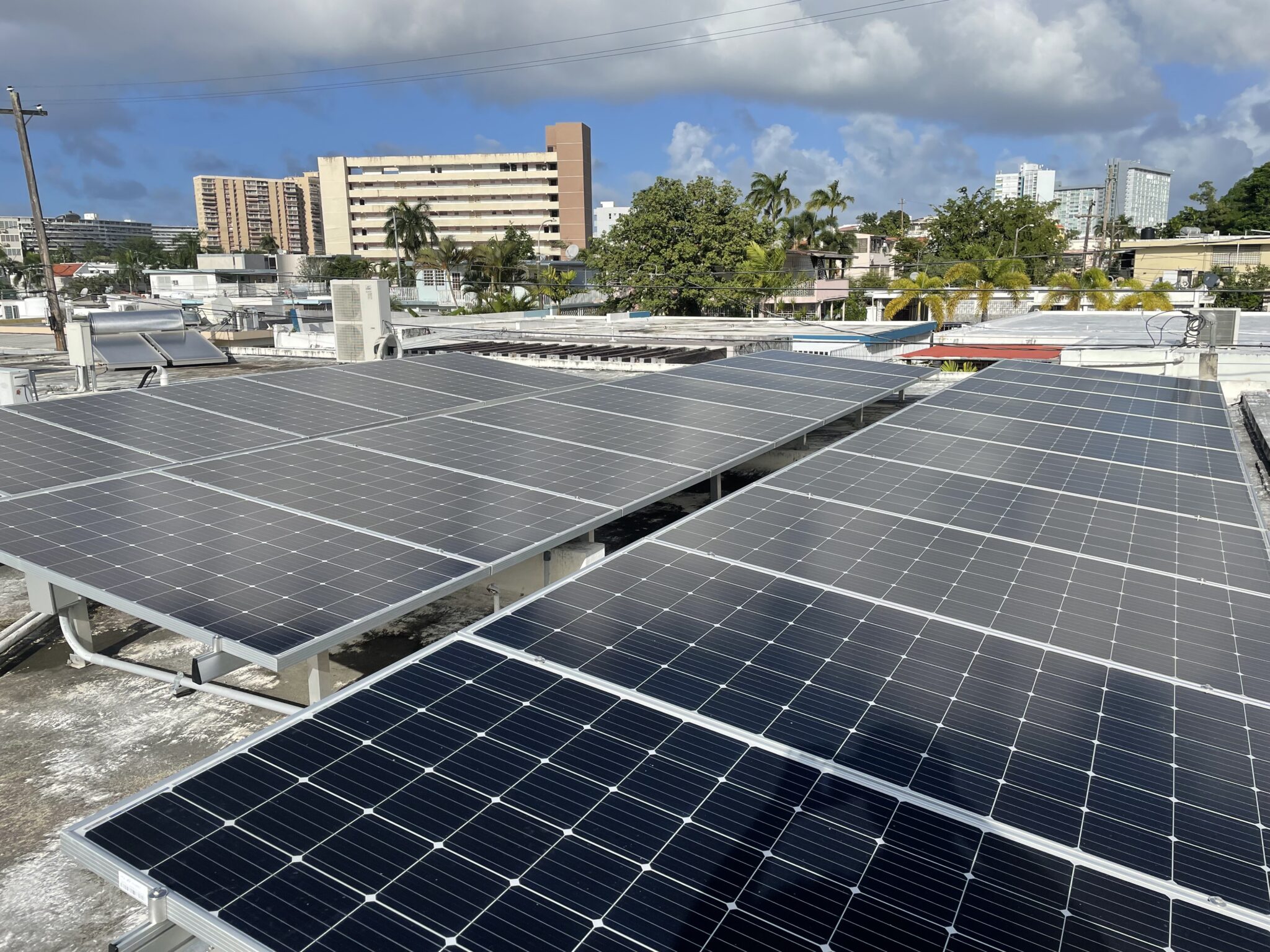
Rooftop solar panels are helping generate electricity after Hurricane Maria destroyed much of the island electrical infrastructure. (Photo by Aaron Sutch/Solar United Neighbors)
Back in 2017, a hurricane destroyed Puerto Rico’s power grid. The island struggled to rebuild it, with limited success, and continues to experience a severe electricity shortage and frequent power outages. Customers and nonprofits have stepped into the void, installing solar panels on rooftops all over the island and backing them up with batteries. Today, 175,000 households have solar — about 1 in 7 – and at least 160,000 of those also have battery backup. Thousands of new installations go in every month.
The solar and batteries don’t just secure electricity for the customers who install them. Through programs like one managed by the solar company Sunrun, Puerto Rico’s grid can draw on the batteries to provide power in times of emergency, reducing the frequency and duration of power outages for everyone.
Last month, as hurricane season got underway again, Puerto Rico’s grid operator announced it had reached a “major energy milestone.” In a statement posted on X, LUMA Energy said it “successfully dispatched approximately 70,000 batteries, contributing around 48 MW of energy to the grid.” That’s about as much as a gas peaker plant, with no need for fuel.
Puerto Rico’s experience shows how residents and businesses no longer need to be passive energy consumers. With a well-designed program they can play an active role in keeping the lights on in their communities, and get paid for it.
This customer participation creates what is called a “virtual power plant” (VPP), sometimes also called a community power plant. The VPP may use battery aggregation, as in Puerto Rico, or demand reduction measures like temporary adjustments to smart thermostats or shifting electric vehicle charging to off-peak times. The more these measures are combined, the bigger the benefit to the grid, and the less a utility needs to invest in new generation to meet peaks in demand.
VPPs offer such promise that this year Virginia’s General Assembly directed Dominion Energy to develop a pilot program for its customers, to be overseen by the State Corporation Commission.
HB2346, from Del. Phil Hernandez, D-Norfolk, calls for a program of up to 450 MW to “optimize demand” with distributed energy resources, mainly batteries but also smart thermostats, electric vehicle charging and non-battery storage (e.g., electric hot water heaters). The proposal, due to be filed with the SCC by December 1, must include incentives for at least 15 MW of residential batteries. The legislation calls for stakeholder participation in the development of the VPP, with opportunities for public input.
Dominion is also tasked with expanding the electric school bus program it began in 2019, which allows the utility to make use of school bus batteries at times of the day when the buses are not needed to transport children. As of March of 2024, Dominion had 135 electric buses in the program, spread across 25 school districts in Virginia.
The impact of VPPs can be significant. This summer, California’s grid operator conducted an experiment to determine how much customer batteries could contribute to the needs of the grid. More than 100,000 residential batteries across California delivered an average of 535 MW of power from 7 to 9 p.m. on July 29, an output equivalent to that of a coal plant.
Many other states are also using VPPs. Some are limited to solar-powered battery aggregation, like Xcel’s Colorado program and a new Texas program, while others involve demand response programs using smart appliances – anything that can be turned off and on remotely for short periods. In Michigan, DTE pays electric vehicle owners to charge at off-peak times, while Arizona Public Service’s VPP pays customers for the ability to access their smart thermostats to reduce peak demand.
Vermont’s Green Mountain Power runs two popular battery programs, one for people who own their own batteries and the other that leases batteries to customers. Both allow the utility to draw on the batteries when the power grid requires more capacity.
While Virginia has not had a VPP program before, appliance-based demand response will be familiar to residents who opted into Dominion Energy’s “Smart Cooling Rewards” program. Participants allowed the utility to remotely turn their air conditioners on and off for a few minutes at a time on hot days in exchange for an annual $40 payment. This helped the utility shave peak demand without affecting residents’ comfort.
Dominion ended the cooling rewards program in 2022 and now offers a “Peak Time Rebate” program that rewards customers for reducing energy use during certain times of high energy demand. This program, however, requires residents to take affirmative measures themselves, like adjusting thermostats and delaying laundry. A well-designed VPP program, by contrast, takes the burden off the individual.
Josephus Allmond, a lawyer with the Southern Environmental Law Center who helped to craft the Virginia VPP legislation, told me in an email that he expects school buses and smart thermostats will make up most of Dominion’s program initially, but he’d like to see the residential battery component grow significantly from the initial 15 MW. Even 100,000 aggregated residential batteries would be a minor share of Dominion’s 2.8 million residential accounts, he pointed out.
I emailed Nathan Frost, Dominion’s general manager for new business and customer solutions, to ask for more information about the VPP program. Frost replied only that Dominion is “actively developing our VPP framework and will be engaging stakeholders soon.”
Stakeholders, including customers themselves, are likely to have a lot to say. Clean energy advocates have long urged that VPPs, distributed generation sources and microgrids can contribute to a more efficient, secure and resilient grid, at less cost to everyone.
No doubt recentering the grid around customers is too tall an order for a monopoly utility with a profit model based on centralized generation. But from what we’ve seen in Puerto Rico, California and elsewhere, harnessing even some of the power of customer-owned resources is a worthwhile project whose time has finally come.
This article was originally published in the Virginia Mercury on September 2, 2025.
Update: on September 15, Dominion sent this note:
Dominion Energy Virginia is preparing to file a virtual power plant (“VPP”) pilot proposal by December 1, 2025, pursuant to House Bill 2346 and Senate Bill 1100. As part of this effort, Dominion Energy Virginia is seeking stakeholder input. Please visit our website at https://www.dominionenergy.com/vpp. The website contains an overview of the legislation, a timeline, an informational webinar about VPPs and the Company’s plan, and additional information. We encourage all interested stakeholders to review the materials posted on the website and provide feedback through the link on the website by October 6, 2025.
This year’s General Assembly session notably failed to produce legislation addressing the widening gap between electricity demand and supply in Virginia. Legislators shied away from measures that would address the growing demand from data centers, but they also couldn’t bring themselves to improve the supply picture by supporting landowners who want to host solar facilities. By the time the session ended, a mere handful of bills had passed that could improve our ability to meet demand.
Still, the initiatives that did pass offered positive steps forward on energy efficiency, distributed generation, interconnection of rooftop solar, energy storage, EV charging and utility planning. In addition, two data center-related bills passed requiring more planning and transparency during the local permitting process and tasking utilities with developing a demand response program to relieve some of the added burden on the grid.
Sadly, however, Republican Gov. Glen Youngkin decided to use his powers of veto and amendment to water down or scuttle the limited (and mostly bipartisan) progress legislators made. The only two data center bills were effectively killed, as were most energy bills – some by veto, others by amendments that made them worse than no action at all.
There’s nothing very subtle going on here. The governor loves data centers and isn’t about to limit their growth, regardless of the consequences to residential ratepayers and communities. He’s also stuck in a rut of attacking the Virginia Clean Economy Act (VCEA), which prioritizes low-cost renewable energy over legacy fossil fuels. He won’t be in office when the chickens come home to roost in the form of an electricity shortfall and skyrocketing rates, but he’s setting up his party to cast blame on the liberal climate agenda.
Data centers
The General Assembly failed to pass legislation that would have shifted responsibility for sourcing clean energy onto the data center operators. The only bill to pass that even makes energy a consideration in the siting of data centers is HB 1601, sponsored by Del. Josh Thomas, D-Gainesville. In addition to site assessment provisions at the permitting stage, it requires the utility serving the facility to describe any new electric generating units, substations and transmission voltage that would be required.
Limited as these provisions are, the governor proposed amendments to further weaken the bill, then added a clause requiring that for the bill to take effect, it has to be passed all over again in 2026. That’s a veto by another name.
SB 1047 from Sen. Danica Roem, D-Manassas, requires utilities to implement demand-response programs for customers with a power demand of more than 25 MW, a way of relieving grid constraints during times of high demand. The governor vetoed the bill, deeming it unnecessary.
The only data center-related bill that did get the governor’s approval is one of questionable utility. HB 2084 from Del. Irene Shin, D-Herndon, merely requires the SCC to use its existing authority during a regular proceeding sometime in the next couple of years to determine whether Dominion and Appalachian Power are using reasonable customer classifications in setting rates, and if not, whether new classifications are reasonable. The SCC seems to be doing this already anyway, but maybe this lets our leaders claim they are doing something to protect residential ratepayers. Plus, they can now call it a bipartisan effort!
Utility reform
With Virginia fixed on a collision course between growing demand for energy from data centers and our leaders’ refusal to support low-cost solar to provide the power, it is more important than ever that our utilities engage in transparent and comprehensive planning through the integrated resource plans (IRPs) filed with the State Corporation Commission. Over the course of last fall, the Commission on Electric Utility Regulation hammered out what I think is truly good legislation to ensure Dominion and APCo present the information the SCC and the public need to be sure our utilities are making the decisions that will improve our energy position and put the needs of ratepayers ahead of corporate profits.
In vetoing SB 1021 from Sen. Scott Surovell, D-Fairfax, and HB 2413 from Del. Candi Mundon King, D-Dumfries, the governor offered this muddled statement: “The State Corporation Commission has the expertise and the authority to make requirements and changes to the integrated resource plan process. The Virginia Clean Economy Act is failing Virginia and those that champion it should stop trying to buttress this failing policy. But rather should be focused on procuring the dependable power needed to meet our growing demand through optimizing for reliability, affordability, and increasingly clean power generation.”
We get it: Johnny One-Note doesn’t like the VCEA. He said that already. But right now, APCo isn’t filing IRPs at all, and the SCC has been so frustrated with Dominion’s filings that it didn’t approve the last one, and demanded a supplement to the most recent one even before it was filed. Clearly the SCC could use a little help here.
Distributed energy sources
Advocates for small-scale solar were more successful this year than their colleagues who focus on utility-scale projects. Bipartisan majorities seemed to agree that if we can’t or won’t site large solar farms, at least we should make it easier to put solar on rooftops and other small sites close to users.
Sadly, however, only one bill survived the governor’s scrutiny relatively unscathed, though it’s an important one for customer-sited solar. HB 2266 from Del. Kathy Tran, D-Springfield, resolves the interconnection dispute that has stalled commercial solar projects in the 250 kW to 3 MW size range, which includes most rooftop solar on schools. Tran’s bill requires the SCC to approve upgrades to the distribution system that utilities say are needed to accommodate grid-connected solar, a safeguard that will prevent the utility from larding on costs. The utility must then spread the costs across all projects that benefit from the expanded capacity.
Youngkin’s proposed amendment rearranges the language a bit and places it into a new section of code, but does not otherwise change it. He then adds a provision in the tax code to make grid upgrades tax-deductible. I would have thought they would be anyway, as business expenses, but it can only be helpful to spell it out.
Unfortunately, that’s it for the good news.
HB 1883 from Del. Katrina Callsen, D-Charlottesville, and SB 1040 from Sen. Schuyler VanValkenburg, D-Richmond, contain several provisions aimed at increasing the amount of distributed solar in Virginia. Among other things, the legislation increases the percentage of Dominion’s renewable portfolio standard (RPS) obligation that must be met with renewable energy certificates (RECs) from behind-the-meter small solar projects, a change that would make rooftop and other distributed solar more profitable for homeowners and businesses.
HB 1883 also increases to 3 MW from 1 MW the size of solar projects that could qualify for this favored category. Additionally, for the first time it would give all residential ratepayers the right to use power purchase agreements (PPAs) to install solar with no money down, and would increase the amount of electricity Dominion would build or buy from solar facilities on previously developed project sites. To give the market a chance to ramp up, Callsen’s bill excuses Dominion from having to meet its REC obligations from Virginia projects for an additional two years, pushing that date from this year to 2027.
Among all those changes, the only one the governor liked is the idea of softening the requirements around REC purchases. His proposed amendment would make all REC compliance voluntary for four years. Effectively, Virginia would have no renewable energy requirements until 2028, undercutting solar development of any size. His preferred version scraps all of the provisions of Callsen’s bill, leaving no provisions to support solar development and replacing them with an open attack on the VCEA.
I checked in with Callsen by email to get her reaction. She responded, “We sent the administration bipartisan legislation that protects ratepayers, gives Virginians more options for solar on our homes and businesses, and saves rural land. Rather than sign HB 1883 into law,” Callsen wrote, “the governor used this opportunity to attack the Clean Economy Act from 2020. Instead of looking at the past, our Administration should look around; we have a developing energy crisis and are reliant on importing energy to meet our needs.”
The governor also offered a destructive amendment to HB 2346 from Del. Phil Hernandez, D-Norfolk, and SB 1100 from Sen. Ghazala Hashmi, D-Richmond, legislation establishing a pilot program in Dominion territory for virtual power plants (VPPs), which aggregate customer solar and storage resources and demand response capabilities. Although VPPs don’t by themselves add electricity on the grid, they allow time-shifting and other efficiencies that make it easier for utilities to meet peak demand without having to build new generation. The payments utilities make to customers for this service can justify customers’ investments in things like solar, battery storage and smart appliances.
Instead of improving on the pilot program, however, the governor’s amendment scraps it and calls for the SCC to convene a proceeding to talk about VPPs. On the plus side, Youngkin suggests that the conversation include Appalachian Power as well as Dominion, and consider allowing the service to be provided by either the utilities or third-party aggregators, the latter being the favored approach of many industry members. Still, the amendment pushes off any hope of a program for at least another year, until the SCC has made its recommendations. Since it would have been feasible to both start a pilot program this year and have the SCC consider parameters for a broader program in the future, it’s hard to see the governor’s amendment as a step forward.
When I asked her for a comment, Hashmi did not mince words, saying it was “incredibly disappointing” that Youngkin chose to offer a substitute instead of signing the legislation.
“This legislation was the result of several months of conversation among a variety of stakeholders, including our utility companies, energy partners, and environmental groups. The Virtual Power Plant has the promise of helping Virginia meet the goals of our increasing energy demands. The Governor’s substitute shows that he is not serious about responding to the growth of Virginia’s energy needs,” Hashmi wrote.
Other solar bills drew outright vetoes, including Mundon King’s HB 2356, establishing an apprenticeship program to help develop a clean energy workforce. The bill requires participants to be paid prevailing wages, a provision that was a certain veto magnet for Youngkin, whose veto statement reads, “This bill will increase the construction costs which will ultimately be passed along to ratepayers, raising costs for consumers.”
Another bill that drew an outright veto was HB 2037 from Del. David Bulova, D-Fairfax. His bill would allow local governments to include in their land development ordinances a requirement that certain non-residential applicants install solar on a portion of a parking lot.
The governor vetoed it because, he said, it would be expensive for developers, and if it weren’t, they would do it without having to be told. (It’s a strange objection. Does he not understand the whole concept of government acting in the public good? Well, maybe not; see the veto.)
Also vetoed was Shin’s HB 2090, changing the rules around multifamily solar. Admittedly I was not crazy about this bill; although it allows solar facilities to be placed on nearby commercial buildings instead of being restricted to the multifamily building itself, it also imports the requirement for minimum bills that has made other shared solar programs in Virginia unworkable for all but the low-income customers who are excused from the minimum bills.
Maybe the trade-off would have opened new opportunities for apartment buildings serving low-income households, which would make it a plus on balance. But among his objections to HB2090, the governor noted that excusing low-income customers from high minimum bills would shift costs onto other customers.
Energy efficiency
The governor vetoed SB 1342 from Sen. Lamont Bagby, D-Richmond, and HB 2744 from Del. Mark Sickles, D-Franconia, that would have pushed Dominion and APCo harder to provide energy efficiency upgrades to low-income homes, setting a target of 30% of qualifying households.
He also vetoed SB 777 from Sen. Mamie Locke, D-Hampton, and HB 1935from Del. Destiny LeVere Bolling, D-Richmond, which would have established a task force to address the needs of low-income customers for weatherization and efficiency upgrades. The governor said it isn’t needed.
If you notice a pattern here when it comes to helping low-income households with their energy burden, you are not alone.
Reached on maternity leave, LeVere Bolling had this to say: “Across our Commonwealth, high utility bills are forcing Virginians to choose between essentials like groceries and medication and keeping their home at a safe temperature during hot summers and cold winters. Virginia has the 10th least affordable residential energy bills in the country. Over 75% of Virginia households have an energy burden higher than the 6% affordability threshold.” She added that the governor’s veto represents a “missed opportunity to address the pressing energy needs of Virginia’s most vulnerable communities.”
Electric vehicles
The governor offered a substitute for a bill intended to support electric vehicle charging. As passed by the General Assembly, Shin’s HB 2087requires Dominion and APCo to file detailed plans to “accelerate transportation electrification,” including for rural areas and economically disadvantaged communities. It also allows the utilities to file proposed tariffs with the SCC to supply the distribution infrastructure necessary for EV charging stations.
The utilities are also authorized to develop their own fast-charging stations, but only at a distance from privately-owned charging stations, with the SCC determining the proper distance. This provision responds to the request of gas station chains like Sheetz that say they want to expand their EV charging options, but don’t want to face unfair competition from utilities that can rate-base their investments.
The governor’s amendment would prohibit Dominion and APCo from owning EV charging stations at all; in addition, it would allow retail providers of EV charging stations to buy electricity from any competitive service provider. However, the amendment repeals the section of code that allows the utilities to recover costs of investments in transportation electrification.
According to Steve Banashek, EV legislative lead with the Virginia Sierra Club, that “negates the purpose of the enrolled bill.” The amendment, he told me in an email, “removes the requirement for utilities to file for tariffs to support implementation of EV charging and to plan for transportation electrification growth via the IRP process, which is critical for speeding up the transition to electric transportation.”
As for the prohibition on the utilities owning charging stations, Banashek noted that there are areas of the state where private businesses aren’t likely to do it, including in those economically disadvantaged and rural communities. If we don’t want these areas left behind, either the utilities have to step up, or the state does.
Apparently, however, Youngkin doesn’t intend for the state to do it either. Along with his amendments to Shin’s bill, the governor also vetoed HB 1791 from Sullivan, creating a fund to support EV charging in rural areas of the state.
Energy storage
The need for more energy storage seems like it would be one area of bipartisan consensus. Batteries and other forms of energy storage are critical to filling in the generation gaps for low-cost, intermittent forms of energy like wind and solar.
But storage is also required to make full use of baseload sources like nuclear that either can’t be ramped down at times when there is a surplus of energy being produced, or where doing so makes it harder to recover the cost of building the generation. (The already-high projected cost of electricity from small modular nuclear reactors becomes even higher if you assume they don’t run when the power isn’t needed.)
Sullivan’s HB 2537 increases the energy storage targets for Dominion and APCo, and includes new targets for long-duration energy storage. Unfortunately, Youngkin’s substitute language repeals the entire section of code that includes Virginia’s renewable portfolio standard as well as even the existing storage targets. It’s another bit of anti-VCEA flag-waving that won’t help anyone.
Just in case you thought Youngkin might be adhering to conservative free market principles with some kind of consistency, I note that he signed HB 2540 and SB 1207 from two Republicans, Del. Danny Marshall of Danville and Sen. Tammy Brankley Mulchi of Clarksville, which provides a $60 million grant to a manufacturer of lithium-ion battery separators.
I asked Sullivan for a comment on the governor’s action on his bill. He replied, “The Governor’s ridiculous ‘recommendation’ on HB 2537 was disappointing, but hardly surprising. This was not an amendment; he deleted everything – everything – having to do with energy storage, and turned it into a one-sentence bill which would repeal the entire Clean Economy Act.”
Moreover, wrote Sullivan, “HB 2537 was the most closely and extensively negotiated bill among stakeholders that I’ve been involved with since the VCEA. It had broad support – including from Dominion – and should have easily fit into the Governor’s ‘all of the above’ energy strategy and his economic development goals, since it would have brought all sorts of business, jobs, and companies to the Commonwealth.”
Sullivan concluded, “Needless to say, we cannot agree to the amendment. We’ll easily pass this bill next session, and I suspect Governor Spanberger will sign it.”
Sullivan may be right that it will take a new administration before Virginia gets serious about meeting its energy challenges – if it does even then – but this session needn’t have ended in a partisan stalemate and near-zero progress. Most of the bills the governor vetoed or gutted were passed with the help of Republicans, making Youngkin’s actions less of a rebuke to Democrats than to the members of his own party who were simply trying to do their job. The results, sadly, are bad for everyone.
This article originally appeared in the Virginia Mercury on April 1, 2025.
UPDATE May 8: As expected, the General Assembly rejected the governor’s destructive amendments to the bills described. The governor then vetoed all but one. The exception is HB2346 from Hernandez and SB1100 from Hashmi, establishing a pilot program in Dominion territory for virtual power plants (VPPs). That one has been signed into law, along with Tran’s HB2266.
For low-cost electricity, Virginia needs renewable energy — not gas plants
Photo credit Stiller Beobachter via Wikimedia.
Southwest Virginia leaders are up in arms over electricity rate hikes. It’s understandable: Appalachian Power, which serves residents in 34 counties, has raised rates by over 46% since July 2021, and its rates now rank among the state’s highest. Last March, it sought another increase that would have resulted in residents paying $10.22 more per month on average. Although the State Corporation Commission’s November ruling granted APCo a much smaller rate hike, customers are raising a ruckus about the high bills.
Complaints have reached such a fever pitch that Del. James Morefield, a Republican who represents parts of five southwest Virginia counties, filed legislation this month to cap the rates APCo can charge. Over in the Senate, another southwest Virginia Republican, Travis Hackworth, has launched a direct attack on APCo’s monopoly: His legislation would allow any residential customer of APCo whose monthly bill exceeds 125% of the statewide average to buy electricity from another provider.
These bills might be more performative than serious. But in this case, legislators themselves are at least partly to blame. In 2023, another Southwest Virginia Republican, Israel O’Quinn, drove legislation that excused APCo from having to write integrated resource plans (IRPs) – those pesky documents that tell regulators how a utility plans to comply with state laws and meet the needs of customers at least cost. Both Hackworth and Morefield voted for the bill.
In 2024, O’Quinn also championed legislation that allows APCo to charge customers for costs of developing a small modular nuclear reactor. Hackworth also supported this new burden on ratepayers, though Morefield did not.
This year, the Commission on Electric Utility Regulation is promoting legislation to reform the IRP process, including making APCo file plans again. That may help. Fundamentally, though, the primary reason APCo’s customers are paying so much is that the utility remains so dependent on fossil fuels. As of the date of its 2022 IRP, APCo relied on coal and fracked gas for 85% of its electricity. Prices for both fuels spiked so high in 2021 and 2022 that utilities were left with huge bills to pay.
In 2022, APCo told the SCC it had spent an extra $361 million over budget on gas and coal. Virginia law allows fuel costs to be passed through to customers, so the SCC couldn’t prevent bills from rising to cover the outlay. Instead, the SCC allowed the company to recover the excess fuel costs from its customers over two years by charging roughly $20 more per month to residents, spreading out the pain but also extending it. O’Quinn’s 2023 legislation let the company finance the costs, which meant customers pay interest on top of the fuel costs.
APCo was not the only utility passing along high gas costs. Dominion Energy Virginia also got caught off guard and asked to spread its excess fuel costs out over three years, adding an average of $15 to residential customer bills. Dominion customers are not happy either.
Gas prices have since dropped, and the remarkably short memories of legislators have led them to think they will now stay low forever. Having learned precisely nothing, they also insist that the only way to ensure an adequate supply of reliable, low-cost energy to serve the data center boom is for Virginia to increase its reliance on gas instead of transitioning away from it.
The evidence does not support this fantasy. Contrary to Republican orthodoxy, new renewable energy is cheaper than new fossil fuel generation. That’s why in 2024, 94% of all new power capacity in the U.S. came from solar, batteries and wind energy. Fossil gas made up just 4% of new generating capacity. Yes, many states are now proposing to build new gas plants, so the trend could reverse, but that’s only because the rush of data centers and new manufacturing has made large users desperate for more energy at any cost.
It’s true that solar, Virginia’s least-cost resource, only produces electricity when the sun shines. But even adding battery storage to solar energy, allowing it to serve as baseload power or a peak power resource, still results in lower electricity costs than the gas combustion plants that are used to produce electricity at peak times. (In Virginia, Del. Rip Sullivan, D-Fairfax, has introduced legislation to expand storage targets for Dominion and APco, including for long-duration storage.)
The era of low-cost renewable energy is fairly new, but it is already impacting utility bills across the country. Virginia used to boast of its low rates; now there are 22 states with lower residential electricity rates than Virginia. And of those, U.S. Energy Information data shows that all but five generate a higher percentage of their electricity from renewable energy.
With data centers proliferating across Virginia unchecked, utility rates are under even more pressure now. The Joint Legislative and Audit Review Commission data center study, released last month, warns that ratepayer costs will inevitably rise under an “unrestrained growth” scenario that reflects current policy.
It’s too early to tell whether any of the many bills to protect residential ratepayers and put guardrails on data center development will pass. For now, the governor and many Republicans seem to prefer to use the crisis to crush the transition to renewable energy. As in past years, Republicans have introduced bills to repeal the Virginia Clean Economy Act or undermine it in variousways.
Making solar more difficult and expensive to build is also part of the strategy. The party that used to stand for individual liberty and personal property rights now instead champions local governments that deny farmers the ability to put solar on their land.
Talking up fossil fuels and dumping on solar may make for good politics with the folks in rural districts. That doesn’t mean it’s in their interests. If high utility bills are what really matter, legislators should be pushing renewable energy and storage, not expensive gas plants.
This article appeared in the Virginia Mercury on January 20, 2025. Interestingly, today writers at two other publications, Cardinal News and Bacon’s Rebellion, took up one aspect of this topic that I only alluded to, the fact that Virginia “imports” more electricity than any other state. Virginia politicians have been exercised on this topic for as long as I’ve been writing, and it has always struck me as strange. It’s not like we need to worry about the political ramifications of a trade imbalance with Pennsylvania.
But as Duane Yancey noted, those electrons coming into Virginia from elsewhere in PJM do tend to be dirty. That’s especially the case for APCo, which operates coal plants in West Virginia and has been ordered by the West Virginia Public Utilities Commission to run those plants at a 69% capacity factor, regardless of the economics. I have not been able to find out anywhere the percentage of APCo’s generation that comes from coal as opposed to gas, but the West Virginia PUC order unquestionably means APCo’s Virginia customers are paying too much.
One other thing to note on the topic of imports: when I wrote that APCo’s resource mix is 85% fossil fuels, that did not mean the other 15% is renewable. In fact, most of the rest is purchased power, meaning mostly fossil fuels also.
By the way, readers may notice a few discrepancies among the articles, which is worth explaining. Both Yancey and James Bacon cite figures for Virginia electricity rates and how they compare to other states that are different from my numbers. The reason is that they are working from combined rates for residential, commercial and industrial, where I’m using residential only. Virginia’s combined rate compares more favorably to those of other states than does its residential rate because our commercial and industrial rates are lower.
Virginia’s low commercial rates have been a major draw for data centers. But if you’re a residential customer right now, maybe that’s pretty cold comfort.
Eight years ago last week, I wrote a column titled, “Why Trump won’t stop the clean energy revolution.” Calling global warming a hoax, businessman and reality TV star Donald J. Trump had just been elected with a promise to save coal jobs and pull the U.S. out of the Paris climate accord.
Climate activists were deeply distraught then, as now. I wrote in 2016, “Reading the news Wednesday morning was like waking up from a nightmare to discover that there really is a guy coming after you with a meat cleaver.”
But as I also wrote, there is only so much damage a president can do when technology, popular opinion and – especially – economics don’t support his agenda. Trump couldn’t save the coal industry (though he tried). Instead, his administration oversaw a 24% decline in coal employment. And where coal supplied 30% of U.S. electricity in 2016, by the time Trump left office it had fallen to 20%.
In the intervening years, Trump seems to have lost interest in coal mining, even as he continues to embrace fossil gas production. His enthusiasm for gas fracking fits with his drill-baby-drill approach to energy, but it was also intended to win over voters in Pennsylvania, a major producer of shale gas. Ironically, the gas industry insists on calling methane “clean” precisely because burning it emits less CO2 than coal.
While coal was dying, wind and solar were well on their upswing when Trump took office in 2017, and they continued to advance through his first administration. By 2020, wind and solar had become the cheapest forms of new electric generation. Today, renewable energy supplies more than 21% of the nation’s electricity, while coal’s share has dropped further, to just 16%. Trump or no Trump, technological advances and a thirst for cleaner energy continue to drive new wind and solar generation.
Indeed, the offshore wind industry – famously reviled by Trump – wasted no time last week in congratulating its erstwhile foe on his victory and insisting, hilariously, that his election is a big win for the industry. The first Trump administration, they noted hopefully, “laid out the fundamental framework for our modern offshore wind industry.”
Well, okay. From their lips to Trump’s ears. Trump is hardly known for consistency, and it is not impossible to imagine him softening his position on an industry that is creating well-paying jobs for the blue-collar workers who make up a portion of his base. His Virginia acolyte, Republican Gov. Glenn Youngkin, boasts of overseeing the building of the nation’s largest offshore wind farm. Why shouldn’t Trump pivot?
Early in the Republican primaries, one candidate opined that all the solar panels and batteries sold in the U.S. are made in China. That wasn’t actually true. For years one U.S. company, First Solar, has ranked among the world’s top ten solar panel manufacturers. Among the domestic manufacturers of both EVs and batteries, one of the largest is Tesla, whose CEO Elon Musk is now a Trump darling. It is going to be fascinating to find out whether Musk uses his influence to benefit the clean energy transition generally, or only himself.
Yet the notion that China dominates solar and battery production is also not wrong. China is eating our lunch on clean energy. Chinese companies produce 80% of the world’s solar panels and more than half of its electric vehicles. Sadly, perhaps, these are not cheap imitations of superior American products. They are world-leading technology.
Chinese dominance of the world market was a major reason that President Joe Biden’s signature climate law, the Inflation Reduction Act (IRA), put so much emphasis on supporting domestic manufacturing. Tariffs on Chinese goods, Trump’s preferred approach, help U.S. companies compete for American consumers, but they don’t support an export market when other countries produce better goods for less money. Even at home, critics note, tariffs mostly just raise prices.
Yet Trump has vowed to repeal the IRA, and given that Congress passed it without Republican support, there is certainly a danger that a Republican Congress will comply. On the other hand, observers note that 80% of the manufacturing tax credits have gone to red states, and this August, 18 House Republicans signed a letter to Speaker Mike Johnson asking to keep the credits.
I don’t want to sound too optimistic. Wait, let me rephrase that: I don’t feel optimistic at all. We are facing headwinds today that weren’t around in 2016. At that time, gains in energy efficiency meant electricity demand was not increasing, in spite of a growing population. With wind and solar displacing coal, there was a clear pathway for CO2 emissions from the electric sector to continue falling.
Today, however, the skyrocketing demand for electricity from data centers threatens the progress we’ve made on clean energy. It remains to be seen whether artificial intelligence will unleash efficiency gains and novel technologies that can put carbon reductions back on track. Right now, though, tech companies are so desperate for power that they will take it from wherever they can get it, and regardless of carbon content. (I notice, though, that they still want it to be cheap and are happy to greenwash it to meet their sustainability goals).
Perhaps the biggest change from eight years ago is simply that we are that much closer to reaching catastrophic climate tipping points. 2023 was the warmest year on record, and 2024 is on track to surpass it. The effects are evident in the number and costliness of severe weather and wildfires made worse by global warming. (Just ask insurance companies.) It is frustrating, to say the least, to contemplate losing the next four years to an administration that thinks climate change wouldn’t be an issue if we would just stop talking about it.
Yet Americans of all political stripes continue to support renewable energy by wide margins. And apart from a small minority of vocal climate deniers, most Americans want the U.S. to take stronger action on climate.
This election revealed deep fault lines among the American public, but one thing we all have in common is the faith that our ability to solve intractable problems is stronger even than our tendency to wish the problems away.
That’s why, even in the face of such serious headwinds, the clean energy revolution will continue.
This column was originally published in the Virginia Mercury on November 12, 2024.
Drill down far enough into the earth, and you will hit hot rocks. Energy companies have used this heat to generate carbon-free electricity for more than a century. It’s an elegant concept, but it worked only where pockets of heat lay close to the surface, accompanied by steam ready-made to turn turbines. Those limitations confined geothermal power plants to geologically active areas like Iceland, parts of Indonesia, and a few locations in the American West. As of 2023, geothermal energy made up less than half of 1% of U.S. electricity generation.
Suddenly, that is changing. New technology derived from oil and gas fracking methods is allowing energy companies to drill deep into the earth in places far from geologic activity. Wells can reach miles beneath the surface before branching out horizontally and creating fissures in hard, hot rock. Water injected into the wells comes back to the surface as steam to generate electricity. The steam is recaptured and re-injected to take up heat again, in a virtuous cycle powered by the earth itself.
The benefits
These “enhanced geothermal” systems can produce 24/7 baseload electricity or fill in around variable sources like wind and solar. They can even be used like batteries to store energy, including for long durations.
Unlike drilling for fossil fuels, geothermal companies avoid the shale formations that hold hydrocarbons, instead targeting non-porous rock. And since the product is not fossil fuel but steam, the technology produces zero-carbon energy without toxic or radioactive waste.
Freed from geographic limitations and using the same technology and workforce as the oil and gas industry, geothermal energy is ready to take off fast. The U.S. Department of Energy (DOE) sees it spreading across the country to provide as much as 125 gigawatts (GW) of electricity by 2050. A global estimate suggests the industry could eventually produce 4,600 GW of electricity at a cost of 50 euros (around $55) per megawatt-hour or less.
In 2022 DOE launched an “Earthshot Initiative” to reduce the cost of enhanced geothermal energy in the U.S. to $45 per megawatt-hour (MWh) by 2035. If successful, that would put it at or below the cost of any other new, dispatchable energy source.
Is this technology the answer to the surging demand for electricity from data centers and artificial intelligence? And could it allow Virginia to keep adding data centers without blowing up its climate goals?
The challenges
We do have to keep in mind that not all silver bullets prove to be sterling. Small modular nuclear reactors (SMRs) are evidence that some highly-anticipated technologies don’t follow the rosy timelines and price projections their boosters promise.
Unlike SMRs, though, enhanced geothermal systems have already achieved commercial deployment. After successfully demonstrating the technology with a 3.5 MW pilot facility, Fervo Energy signed a contract last year with Google to provide electricity for its data centers from a 115-MW enhanced geothermal power plant in Nevada. Fervo will deliver the power to the local utility, NV Energy, which will then charge a slightly higher price to Google via a proposed new “clean transition tariff.” Fervo has also signed a deal for an even bigger project that will deliver 400 MW to California utilities.
Using a different fracking-based technology it calls a “Geopressured Geothermal System,” Houston-based Sage Geosystems recently agreed to supply 150 MW of power for Meta’s data centers beginning in 2027. Sage says it can make electricity not just by extracting heat but also by using pressure, an add-on technology that allows it to offer energy storage independent of steam production.
Both Fervo and Sage say their methods can be used almost anywhere, and both cite advantages over established energy sources. Like wind and solar, geothermal is renewable and carbon-free, but it isn’t dependent on weather. It also doesn’t require fuel sources like coal and gas that are highly polluting and sometimes unreliable in extreme weather.
Finally, with a small physical footprint relative to the energy produced, geothermal facilities could be located in urban areas or next to data centers and other large customers without the need for major new transmission lines.
But of course, the fact that geothermal technology can be used anywhere does not mean it can be deployed profitably everywhere, or at least not yet. A map compiled by the National Renewable Energy Laboratory shows the most ideal areas are still in the West, where hot rocks lie within a few kilometers of the Earth’s surface. In most of the eastern U.S., deeper wells would be needed to reach the same temperatures. For this reason, DOE sees the technology proving out in the West first before spreading east.
But favorability is not purely a function of geology, according to Ben Serrurier, manager of government affairs and policy at Fervo. I wanted to know how soon geothermal systems could start providing electricity to the world’s largest concentration of data centers, in Northern Virginia. He said the biggest impediment for the industry is not location, but the high cost of capital and the paucity of government support compared to SMRs, hydrogen, and other new technologies.
In spite of these challenges, Serrurier predicted geothermal would be deployed in Virginia by the latter part of the 2030s, noting that his company is already ahead of DOE’s projected timeline for the technology’s maturation. Eastern data centers present an especially attractive market, he said, because demand is increasing so quickly, and utilities have limited options for carbon-free energy.
Alas, observers of the data center industry know that while renewable energy is nice to have, cheap energy is even nicer. So I wanted to talk about cost.
Serrurier told me Fervo’s first project will deliver power to NV Energy at a price of $107 per MWh, and Google will pay slightly more than that to the utility. That is twice DOE’s target cost for 2035, yet it still puts the price below the U.S average of 13.1 cents per kilowatt-hour ($131 per MWh) for commercial customers, and competitive with the average Nevada commercial rate of 10.92 cents, according to Energy Information Agency data.
That price is, however, more than the 9.54 cents/kWh that the average commercial customer in Virginia pays for electricity derived primarily from fossil fuels. And Fervo’s price is for drilling in the West, not in the less favorable geology of the East.
But heck, anywhere in the country, 10.7 cents for zero-carbon baseload power — with no waste to be cleaned up and no added healthcare costs from pollution — still sounds compelling. Google may have chosen to be a first mover in order to show leadership and promote a new technology, but it is also locking in a solid deal.
Sage does not make its costs public, but Lance Cook, the company’s chief technical officer, told me their process is competitive with combined cycle gas plants when the cost of fossil gas is above $6 per thousand cubic feet. (According to the Energy Information Agency, the price of gas is currently below that level in most states, though gas prices are famously volatile.)
An additional benefit, said Cook, is that a geothermal plant could be co-located with a data center, foregoing a grid connection and obviating the need for transmission lines. “We can turn electricity into data,” he told me. “It is much easier to connect data than to wait for a grid connection.”
Both Cook and Serrurier are confident that geothermal will beat new nuclear price-wise, which today sounds like a safe bet. Analysts warn that cost continues to be a significant issue for the nuclear industry. Current projections for the cost of electricity from SMRs start at $142/MWh.
Cook noted that Sage’s technology can also provide long-duration energy storage that isn’t dependent on the heat of the earth. This approach can be used anywhere to turn solar and wind power into baseload energy. Sage’s website claims it can achieve this for less than the cost of batteries or pumped hydro.
With all this promise, enhanced geothermal has been slow to catch the attention of Virginia utilities and policy-makers. The Virginia Code includes geothermal energy in its definition of renewable energy, but enhanced geothermal is not on the list of energy sources that qualify for the state’s renewable portfolio standard (RPS).
The General Assembly did pass legislation this year from Senate Majority Leader Scott Surovell, D-Fairfax, to include a similarly-named, but quite different, kind of geothermal energy – geothermal heating and cooling systems, also known as ground-source heat pumps – in the RPS. Geothermal heat pumps use the near-constant temperature of the ground just a few feet under our feet to help heat and cool buildings, much as air-source heat pumps do but with greater efficiency. A working group under the auspices of the State Corporation Commission is currently trying to figure out how to award renewable energy certificates (RECs) for a technology that does not produce electricity.
But drilling down two miles or more and generating electricity at the utility level is quite another thing. Making enhanced geothermal systems eligible for the RPS would be essential to putting the technology on an even footing with other renewables for use in Virginia.
In an email, Surovell told me, “I have read about the Google geothermal project and believe there is significant potential in Virginia.I understand it is different, but we need to do all we can to try to meet the demand for energy created by data centers without upsetting the carbon-free goals we set with the Virginia Clean Energy Act.” He added, “Geothermal also has the potential to create thousands of well-paying trade jobs in drilling and pipefitting in the Commonwealth.”
I also contacted Dominion Energy Virginia to gauge the utility’s level of interest. Dominion is facing an enormous challenge to meet the explosion of demand from data centers. Its 2023 integrated resource plan (IRP) proposed building new gas plants as early as 2028 and an SMR in 2034, but no geothermal energy. The plan failed to meet the carbon-cutting requirements of Virginia law, so the company ought to see the need to up its game for its 2024 IRP, due in October.
Dominion’s answer was not encouraging. Aaron Ruby, Dominion’s director of Virginia and offshore wind media, responded with an email that made reference to the working group for geothermal heat pump RECs.
“We’re certainly looking at the potential for geothermal in Virginia. The SCC is leading a geothermal working group, and there are lots of knowledgeable experts taking a close look. Most of the potential in Virginia appears to be geothermal heat pumps, with maybe less potential for power generation. The process is ongoing, so still more to learn.”
Echoing Gov. Glenn Youngkin’s rhetoric on energy, he added, “As you know, we’re experiencing an unprecedented growth in power demand. Reliably serving that growth requires an ‘all of the above’ approach, including offshore wind, solar, battery storage, next generation nuclear and natural gas. Emerging technologies like clean hydrogen, longer-duration storage and geothermal could also play a role.”
It’s not a great sign that Dominion ranks geothermal dead last. The company seems quite content to keep adding data centers to its customer base with no plan to meet its climate commitments.
Data center developers, on the other hand, could vote with their metaphorical feet. If Dominion will not bring geothermal technology to Virginia data centers, maybe the data centers will go to the geothermal technology. Some data center operators say they need to be in Virginia to be close to customers in the East, but the industry’s rapid spread into other states shows many have flexibility. So why should they face public opposition and rising electricity rates in Virginia when they can go to Utah, Nevada or Texas to access low-cost, zero-carbon energy delivered 24/7 from a source that might even be located onsite?
Especially since, in so doing, they would provide the capital and demand required for enhanced geothermal to achieve DOE’s goals ahead of time, and hasten the day when Dominion presents an IRP with a real zero-carbon plan.
This article was previously published in the Virginia Mercury on September 10, 2024.
Greenpeace protesters at the site of Amazon’s HQ2 in Arlington, Virginia, in 2019 called out the company for failing to make progress towards its commitment to power the cloud with renewable energy. Since then, the company has actually increased its carbon emissions. Photo courtesy of Greenpeace.
When Amazon announced this month that it had achieved 100% renewable energy seven years ahead of schedule, that sounded like really good news for Virginia. Amazon owns more data centers here than anyone else, and data center energy demand is driving Dominion Energy Virginia’s plan to renege on its climate commitments, keep dirty coal plants online and build expensive new gas plants and transmission lines.
Unfortunately, Amazon’s announcement is so full of asterisks it looks like a starry night.
Let’s start with the good news. Amazon’s claim that it has purchased enough renewable energy to “match” its energy use is likely true, though its sustainability report doesn’t reveal essential details like how much energy the company uses. Amazon also says it is the largest corporate purchaser of renewable energy in the world, an impressive achievement.
Some of that renewable energy is in Virginia, so it is reasonable to say it serves the company’s data centers here. A map on Amazon’s website shows the company has invested in 19 solar farms in Virginia, with a capacity that totals around 1,386 MW – about a quarter of all solar installed in Virginiato date. That’s terrific. If every company operating in Virginia did as much, we’d be rolling in solar, figuratively speaking.
So what am I complaining about?
One problem is that the energy appetite of Amazon’s data centers in Virginia far outstrips the output of all of its solar farms here. The other problem is that producing renewable energy in the middle of the day can only very loosely be said to “match” energy used at other times of the day and night. Meeting energy demand on a 24/7 basis is harder, and Amazon isn’t even trying.
Let’s start with the numbers. Because the sun doesn’t shine all the time, a large solar array produces, on average, 22-25% of what it produces on a cloudless day at noon. (That percentage is known as the facility’s capacity factor.) At a 25% capacity factor, Amazon’s 1,386 MW worth of solar panels produce enough electricity to “match” about 347 MW of demand.
Amazon keeps its energy demand in Virginia a secret, but we can be pretty sure its 110 data centers here use way more than that. A 2019 Greenpeace report estimated Amazon’s Virginia data center demand at 1,700 MW in operation or under construction, an amount that would call for 6,800 MW of solar. Amazon rejected Greenpeace’s estimate at the time, but it didn’t supply a better one. More recent estimates suggest Amazon’s energy appetite in Virginia is on its way to 2,700 MW, enough to require the output of around 11,000 MW of solar.
Luckily for us, Virginia is part of PJM, a regional transmission grid that covers all or parts of 13 states plus Washington, D.C. Generation sources located anywhere in the region can serve a Virginia customer, and Amazon’s map shows it has utility solar and wind projects in several PJM states. By my count, these add up to as much as 4,000 MW of additional renewable energy that could be allocated to Virginia data centers, if Amazon had no other operations in those states that it wanted to power. (Which, however, it does.)
Adding together its solar in Virginia and elsewhere in PJM still leaves Amazon short of what it likely needs. So, if the company is correct that it has secured enough renewable energy to match all of its demand, a lot of those facilities must be in other regions or other countries. Yet the climate benefit of Amazon’s solar farms in (for example) Spain, which gets more than 50% of its electricity from renewable energy, is significantly less than the climate benefit of solar in PJM, where the percentage of wind and solar combined still hangs in the single digits.
I will – almost – give Amazon a pass on this point. PJM has been so appallingly slow to approve new generation that Amazon could well have as many projects in the “queue” as online. PJM claims it will catch up in the next year and a half, and when that happens, perhaps Amazon won’t feel the need to obfuscate.
Even if Amazon were “matching” all its energy needs with wind and solar in PJM, though, it’s the second problem that troubles me more. Building solar and wind is cheap; Amazon very likely makes a profit on it. Actually ensuring renewable energy provides all the juice for the company’s operations every hour of every day, on the other hand, would require a heck of a lot of expensive energy storage. And Amazon is not doing that.
Without energy storage, solar delivers electricity only while the sun is shining. The rest of the time, Amazon’s data centers run on whatever resource mix the local utility uses. In both Virginia and PJM’s territory, fossil fuels make up the great majority of the mix. Building more Amazon data centers in Virginia increases the burning of fossil fuels, causing more pollution and raising costs that are borne by the rest of us.
The self-styled climate hero turns out to be a climate parasite, harming people to make itself look good.
Combining renewable energy with storage to achieve true carbon neutrality isn’t prohibitively expensive. Other leading tech companies seem to be making that extra effort, with Google notable for its commitment to meeting its energy demand with renewable energy and storage on a 24/7 basis.
Amazon’s failure to rise to this challenge explains why, in spite of its massive investments in wind and solar, the company’s carbon footprint actually rose by 34% since the launch of its Climate Pledge in 2019, when it set a target of net zero carbon emissions by 2040.
That explains why, a year ago, the Science Based Targets initiative, a U.N.-backed organization that monitors corporate net-zero plans, removed Amazon from a list of companies taking action on climate goals. According to press reports, Amazon failed “to implement its commitment to set a credible target for reducing carbon emissions.”
Among those least impressed with the company’s efforts are its own workers. Last year, Amazon Employees for Climate Justice accused the company of failing in its climate commitments, and the group released its own report this month alleging multiple climate failures, including using “creative accounting” to inflate its achievements.
If Virginia is serious about meeting the climate challenge, we can’t blindly accept rosy claims from corporations whose central goal is not sustainability, but growth. Data centers whose energy demand isn’t met on a 24/7 basis from zero-carbon sources located on the same grid are not part of the climate solution, they are part of the problem. And currently, Amazon’s data centers are making the problem worse.
This article was first published in the Virginia Mercury on July 24, 2024.
Who says solar can’t be an asset to the land? Photo credit Center for Pollinators in Energy, fresh-energy.org
It’s a problem that divides communities and stymies lawmakers: Virginia’s transition to clean energy depends on building thousands of acres’ worth of large solar facilities, but a backlash from some rural neighbors makes siting projects increasingly difficult.
Most of the objections are aesthetic – few people prefer to look at rows of solar panels if they once enjoyed a bucolic country scene – but some opponents say they worry about the loss of farmland and trees. Solar, they fear, is bad for the land as well as the eyes. It doesn’t help that some early solar development suffered from corner-cutting that resulted in soil compaction and erosion. If that is solar, many people want no part of it.
In 2022, land conservation groups banded together with agriculture and logging interests to lobby for legislation requiring mitigation whenever a solar project would disturb more than 50 acres of forest or 10 acres of “prime agricultural soils.” House Bill 206 applies to any solar project developed under Virginia’s sort-of-streamlined “permit by rule” process, which is available to all but the largest facilities.
The solar industry initially fought the legislation, joined by some climate advocacy groups. They pointed out that no other industry is subject to mitigation requirements, and that solar provides greater climate benefits than forests and agriculture. Moreover, solar panels can be removed and the land returned to farming or forestry. By contrast, once land is converted to a housing subdivision or strip mall or data center, the damage is permanent.
Eventually the solar industry accepted compromise language that put off the effective date until the start of 2025 and gave industry members a voice in an advisory panel under the auspices of Virginia’s Department of Environmental Quality (DEQ). The law tasked this group with helping to develop “criteria to determine if a significant adverse impact to prime agricultural soils or forest lands is likely to occur as a result of a proposed solar project,” and if so, the actions that should be considered in any mitigation plan. DEQ was to use the working group’s conclusions to draw up regulations.
As it turned out, the working group agreed on very little. Its 717-page report found consensus on only a few points, leaving DEQ itself with the task of resolving key issues. On May 13, the agency published its proposed regulations. The regulations are currently under executive branch review, after which Interested parties and the public will have the opportunity to comment.
Meanwhile, a few things have happened since the passage of HB 206.
In March of 2022, DEQ toughened its stormwater regulations to address the runoff and erosion problems that had given solar a bad name in some communities. Building on that, the agency just released a new stormwater handbook that will become effective July 1, 2024, with sections specific to solar development.
Some solar industry members complain that DEQ’s stormwater regulations are unreasonably onerous, but no one questions the importance of preventing runoff and erosion. In any case, many companies are already using land-friendly practices that make it easier to meet tougher rules. One is the use of terrain following trackers, a technology that allows solar to be installed on uneven terrain instead of bringing in bulldozers to level the site. The trackers maximize solar production in hilly areas while preserving topsoil and vegetation.
The new tracker technology is among the suite of low-impact approaches gaining ground as the solar industry matures. DEQ encourages another eco-friendly practice: planting native species among and around solar arrays. Native plants provide food and habitat for insects whose numbers have plummeted in recent years, threatening our ecosystems. Though only a few solar projects have achieved DEQ’s pollinator-smart certification to date, most of the developers I’ve spoken with say they are open to it.
Photo credit Solar Power World and Nexamp
Gaining traction even faster is the practice of using grazing animals for vegetation management. Sheep hit the sweet spot: project owners save money they would have to spend on humans operating machinery, while the sheep thrive in the shade of solar panels and return nutrients to the soil. Already, 2% of sheep in the U.S. are being grazed under solar panels, according to an American Solar Grazing Association webinar, including at several large Virginia facilities providing power to Dominion Energy. Elsewhere, cattle graze under solar panels or crops grow between the rows, further erasing the distinction between solar facilities and agricultural use.
All-terrain trackers, topsoil preservation, native plants and incorporating active farming or grazing: all these practices ensure farmland isn’t “lost” to solar. Yet DEQ’s tougher stormwater rules, the solar industry’s increasingly land-friendly practices, and even the passage of HB 206 haven’t allayed concerns among solar opponents. Instead, rural counties have stepped up the pace of bans, caps and moratoriums.
One suspects the continued hostility isn’t because opponents lack familiarity with the ways solar can be eco-friendly, but because the opposition’s primary motivation isn’t preserving farmland. If what they really care about is keeping solar from cluttering up the viewshed (“preserving our rural heritage” is the euphemistic framing), then adding a new layer of mitigation requirements won’t change anything.
Admittedly, I never supported HB 206 in the first place. From an environmental perspective, solar is no worse for the land than monoculture pine plantations or commodity crops grown with pesticides and petroleum-based fertilizers. Done in a habitat-friendly way, solar can increase biodiversity and help heal the land. And solar addresses our CO2 problem, far more even than trees.
Still, DEQ’s job was to try to find a middle ground between the solar industry and its detractors, and in fairness, their effort gets some things right. The proposed rules recognize that there are degrees of impact a solar facility can have, and that practices like leaving topsoil undisturbed or incorporating agrivoltaics should be rewarded with lower mitigation requirements. A neat table delineates the various levels of impact and proposes differing levels of mitigation to match. Mitigation mostly takes the form of land set-asides, but can also be satisfied with per-acre payments.
And yet the proposal misses the mark on at least three fronts. First, it fails to give full credit to solar projects that minimize soil disturbance and incorporate agrivoltaics. DEQ should recognize that adopting best practices is itself mitigation, which should obviate the need for land set-asides or monetary payments.
Second, the proposed regulations make no exceptions for projects owned and operated by local farmers who incorporate solar into their farm activities in order to increase and diversify their income without having to sell their land. If the point of HB 206 was to protect farming, DEQ has shot wide of the mark.
Finally, the dollar amounts that DEQ proposes in lieu of land set-asides are punishingly high, with perverse effects. A solar company that has to pay a stiff penalty must pass that cost along in the form of a higher price for the electricity produced. If a utility has to pay more for electricity, ratepayers ultimately foot the bill.
The alternative is equally counterproductive. I noted at the start that DEQ’s permit-by-rule process is available to all but the largest projects, but it is not the only pathway open to developers. Projects over 150 MW are required to go to the SCC for approval, but smaller projects aren’t foreclosed from doing so. If DEQ makes its own process too onerous, solar developers will go to the SCC instead. The SCC requires that a developer secure a local permit, but not that it employ soil-saving practices, agrivoltaics or mitigation.
It would be great if DEQ could turn the lemon that is HB 206 into a lemonade of a solar industry adopting eco-friendly development practices and incorporating pollinator plantings, sheep grazing, and other agrivoltaic businesses. What we have instead is a proposal that may kill the permit-by-rule program without producing any benefit to anyone – in effect, turning lemonade into lemons.
There is still time to get it right. DEQ may not be able to resolve the solar wars, but a good set of regulations would position Virginia to make the most of a solar industry that is essential to our future.
This article was originally published in the Virginia Mercury on June 12, 2024.
For the third year in a row, a tug-of-war is going on in the General Assembly over whether Virginia stays the course of the energy transition laid out in 2020 and 2021, or rolls it back hard.
Democrats remain committed to a renewable energy future to address pollution, high electricity costs and the causes of catastrophic climate change. Gov. Glenn Youngkin and most Republican legislators cling to the familiar (dis)comfort of fossil fuels. Republicans are still lobbing grenades at the Virginia Clean Economy Act (VCEA) and the Clean Car Standard; Democrats are holding the line on those advances.
Last year House Republicans used small subcommittees to kill Democrats’ energy bills, even those that passed the Senate on a bipartisan basis. This year the Democrats’ slim majority in both chambers will let more bills get to the governor’s desk. But with the threat of a veto tempering expectations, the party of clean energy is not running big, ambitious bills, but is instead focused on solving problems that have popped up along the march to zero carbon.
Committees have already begun work on the hundreds of energy bills filed in past days. That’s too many for even the Mercury’s dedicated readers to review without more caffeine than is good for you, so let’s focus on just some that would have the most consequence for the clean energy transition.
To be: Democrats work to further the clean economy
Many of the Democratic bills contain small fixes to existing law that add up to big gains for clean energy. One of these is HB 638, from Del. Rip Sullivan, D-Fairfax, and SB 230, from Sen. Ghazala Hashmi, D-Richmond. Most of its provisions are tweaks to the VCEA. Among them are increasing from 1% to 5% the percentage of Dominion Energy Virginia and Appalachian Power’s renewable energy purchasing that must come from small projects like rooftop solar; streamlining the State Corporation Commission’s review of energy efficiency programs by creating a single cost-effectiveness test; and supporting competition in the development of renewable energy and energy storage facilities by specifying that “at least”35% of projects must come from third-party developers, instead of the simple 35% number currently in the law.
The bill also contains a provision that goes beyond the VCEA. It states that the SCC has an “affirmative duty” to implement the Commonwealth Energy Policy at “lowest reasonable cost.” (Two other bills, one from Sen. Jennifer Carroll Foy, D-Fairfax, and the other from Del. Phil Hernandez, D-Norfolk, contain only this provision.) The energy policy is separate from the VCEA, and it sets ambitious goals for the decarbonization of Virginia’s whole economy, including a faster timeline for achieving net zero in the electricity sector. The catch is that the policy does not have teeth, and for that reason it is routinely ignored. Requiring the SCC not just to take account of it, but also to implement it, is a step towards broader decarbonization, though it is not clear how it would actually play out at the SCC.
Legislation from Sen. Scott Surovell, D-Fairfax and Sullivan would resolve problems with the shared solar program in Dominion territory (including putting restraints on the minimum bill that the utility can charge) and expand it to Appalachian Power territory.
SB 79, from Sen. Barbara Favola, D-Arlington, would save taxpayers money by requiring new or substantially renovated (over 50%) public buildings to have solar-ready roofs or, if solar is deemed impractical, to meet one of two high-efficiency alternatives. New or substantially renovated schools would have to be designed and built to net-zero energy standards, unless the locality determines that to be impractical or the school is a historic building.
Sullivan and Sen. Suhas Subramanyam, D-Loudoun, have introduced legislation to resolve the interconnection problem that has stalled commercial solar projects across Dominion territory. The House and Senate bills specify that customers are responsible for costs on their side of the meter, while the utility pays for costs on its side, including upgrades to the distribution grid.
A few bills seek to break through the local-level gridlock that has bedeviled utility-scale solar and wind projects. The most significant of these is HB 636from Sullivan and SB 567 from Sen. Creigh Deeds, D-Charlottesville, which provides an alternative permitting process for larger utility solar (50 MW or more), wind (100 MW or more) and renewable energy storage projects (at least 50 MW nameplate and discharge capacity of 200 MWh or more) that go through the local permitting process but end up without permits. Developers get a second chance at the SCC if they meet a list of requirements. These include safeguards for farmland protection, stormwater, setbacks, wetlands, wildlife corridors, etc. Applicants are also charged $75,000 to cover the locality’s cost of participating in the SCC proceeding. (There is some irony here that small projects, which have less impact, are left at the mercy of local whims, while the most impactful projects have what amounts to a right of appeal.)
Vehicle electrification would also get support from Democratic legislation. One bill of particular interest is Sullivan’s HB 118, which requires Dominion and Appalachian Power to take charge of upgrades to the distribution grid needed to support EV charging by non-residential customers. The utilities are also tasked with filing detailed plans to “accelerate widespread transportation electrification across the Commonwealth in a manner designed to lower total ratepayer costs.”
Regardless of the fate of these bills, Virginia’s efforts to transition to a zero-carbon economy will be swamped by new demand from the fast-growing data center industry, unless the industry itself can be made part of the solution. A dozen or so bills seek to put conditions on the industry in one way or another, but one takes on the energy demand directly. HB116, from Sullivan, and SB192, from Subramanyam, condition data center operators’ receipt of tax credits on demonstrating compliance with minimum standards for energy efficiency and renewable energy procurement, as well as not using diesel generators for backup power.
Not to be: Republicans try out arguments against the energy transition
Many of the Republican anti-clean energy transition bills are blunt instruments that are more about campaigning in Trump country than low-cost energy. For example, HB 397, from freshman Del. Tim Griffin, R-Bedford, would repeal most of the important provisions of the VCEA, while declaring that development of new nuclear is “in the public interest” (a phrase that pretty much means “watch your wallet”).
Similarly, five bills seek to repeal outright the Advanced Clean Cars law passed in 2021, which effectively put Virginia among the states that follow California’s path to vehicle electrification. The law does not kick in until 2025, but trying to repeal it has become a Republican standby. A more subtle bill from Del. Lee Ware, R-Powhatan, would condition repeal on the Virginia Automobile Dealers certifying that Virginia is not meeting its annual EV sales targets.
Some anti-EV bills are merely performative. One non-starter, from Griffin again, would provide a tax credit for purchases of vehicles with internal combustion engines. A bill from Sen. William Stanley, R-Franklin, would require any business selling an EV or any EV component to a public body to provide a sworn declaration that there was no child labor involved not just in the manufacturing but at any point anywhere along the supply chain, starting with mining minerals abroad.
If Stanley were truly concerned about child labor violations, of course, he would seek to apply this sworn declaration requirement to all industries. He could start with the domestic meatpacking industry, where child labor violations are rife, including in Virginia. Ah, if only that were the point.
It’s not just state-level decarbonization that comes in for a brute-force attack. A bill from another new delegate, Eric Zehr, R-Lynchburg, makes its target any federal regulations that “may threaten the production or supply of affordable, reliable, and secure energy within the Commonwealth.” If alerted to such a threat by a utility or the SCC, the Attorney General’s office would be required to intervene. This sort of bill is not intended to survive its first committee hearing, if it even gets a hearing. Its only purpose is to show off the patron’s hard right bona-fides.
To be fair, there are Republicans who are actually trying to solve real problems in the energy sector. As one example, take SB562 from Sen. Travis Hackworth, R-Tazewell. His bill would create a ratepayer-funded pilot program for utilities to figure out a way to use coalbed methane for electricity without burning it (perhaps with fuel cells?). The problem is, he proposes to make this electricity eligible for Virginia’s renewable portfolio standard (RPS). It’s a creative, if expensive-sounding, response to the real climate problem of methane leaking from old and often abandoned coal mines, part of the true cost of coal. But calling fossil methane renewable is, shall we say, counterfactual. Some problems are more effectively tackled head-on, using tax dollars or tax credits, rather than being used to undermine the integrity of the RPS.
To be: somewhere else entirely
The reality of renewable energy is that we have to build a great many wind, solar and storage projects, each one taking months or years of design, permitting and construction work and requiring acreage we would rather use for something else. Yes, it means economic activity, investment and jobs, but it’s also something of a slog. Wouldn’t it be nice if we had a magic solution that could just provide carbon-free electricity without all that bother?
That’s the dream that continues to attract both Democrats and Republicans to nuclear energy. Opinion is divided on whether small modular reactors (SMRs) could hold the answer to all our energy woes, or are just the latest con from an industry looking to attract a new set of deep-pocketed suckers.
Three things are clear at this point. One, SMRs are still many years away from commercialization, coming too late to solve the climate problem that is here and now. Second, SMRs are going to cost a lot. Not only is there no free nuclear lunch, there isn’t even a low-priced breakfast. And third, Dominion is frothing at the bit to build an SMR – but only if customers have to pay for it.
Some legislators are happy to oblige, even with all these drawbacks. The most concerning of the bills are HB 1323 from Del. Danny Marshall, R-Danville, and SB 454 from Sen. David Marsden, D-Fairfax. The legislation would allow Dominion or Appalachian Power to charge ratepayers “at any time” to recover development costs of a small modular nuclear reactor, defined as a nuclear reactor not larger than 500 MW. Not only is that not small, but by the language of the bill it need not even be modular or use advanced technology. Heck, it doesn’t even have to be in Virginia. Dominion could build any kind of nuclear plant, anywhere it chooses, and satisfy the terms of the bill.
But it’s that “at any time” language that should be a red flag for lawmakers. Charging customers for a nuclear plant before and during construction, including cost overruns and with no guarantee of completion, is precisely how residents of South Carolina got stuck paying billions of dollars for a hole in the ground.
That amount of money buys a lot of low-cost renewable energy and storage, right in the here and now. Virginia needs to be a clean energy state for the sake of ratepayers, the economy and the climate, and there is no time to waste.
This article was first published on January 21, 2024 in the VIrginia Mercury.
A ribbon-cutting ceremony marked Norfolk Solar’s array installation at the historic Wesley Union AME Zion church in Norfolk in September 2022. (Wesley Union AME Zion Church)
In 2019, Ruth Amundsen and Alden Cleanthes formed a company with a mission to bring the benefits of rooftop solar to low-income communities. Targeting development in Qualified Opportunity Zones, Norfolk Solar installed solar at the historic Wesley Union AME Zion church in Norfolk, the Southside Boys and Girls Club, a Habitat for Humanity ReStore, and other nonprofits. To increase the local benefits, Amundsen and Cleanthes required installers to hire local, low-income and typically minority workers. All told, the company did $2 million in business between 2019 and 2022, while creating jobs for local residents in the clean energy economy.
And then, it all came to a screeching halt. Last December, Dominion Energy Virginia unilaterally imposed new – and prohibitively expensive – interconnection requirements for most commercial solar. A solar array seeking interconnection approval this year faces total project costs that are 20 to 40% higher than they were last year under the old rules.
Though Norfolk Solar had hundreds of thousands of dollars of investor money committed to new projects, Cleanthes told me they were forced to break contracts and turn away funders. The company has not done a single project in 2023.
Nonprofits are not the only victims of Dominion’s move. Plans to put solar on schools and municipal buildings have ground to a halt all across Dominion territory. A community solar project that would have served low-income residents had to be scuttled last December when Dominion demanded the developer install a high-speed fiber optic line that would have increased project costs by 50%.
A new solar array atop Meridien High School in Falls Church received interconnection approval before Dominion imposed onerous new requirements for net-metered solar. Now, advocates fear it may be one of the last projects of its kind built in Dominion’s territory. Photo: Ivy Main
Dominion says its requirements are about safety and reliability. Solar developers challenge that, noting that the equipment they install already meets industry standards, and that other utilities don’t demand the upgrades Dominion wants. They suspect Dominion is trying to offload onto solar customers the cost of grid improvements that Dominion will use for other purposes, and in so doing to crush the small competitors it has battled with for years.
The details of the dispute are, to put it mildly, highly technical, but the impacts are readily discernible in the near-collapse of Virginia’s commercial solar market. Most noticeably, solar school projects have stalled out across Dominion’s service territory. Schools that were counting on using solar panels to lower their energy costs have been forced to cancel plans.
Cathy Lin, energy manager for Arlington Public Schools, told me she was shocked when the county’s solar developer told her about the increased costs, which she considers exorbitant. “We want to put on more solar,” she said. “We can’t afford to. The extra interconnection fees make solar unaffordable for us.”
The Distributed Solar Alliance (of which I am a co-founder as a solar advocate) has spent much of this year fighting Dominion at the State Corporation Commission. The SCC ruled in the DSA’s favor on all points in August, but in November an SCC hearing examiner unexpectedly authorized Dominion to impose many of the same requirements on an “interim” basis – with no end in sight.
Taking off my advocacy hat for a moment, I actually have some sympathy for the hearing examiner. If a utility tells you it has to have the latest in fiber-optic technology and fancy-pants equipment as a matter of safety and reliability, you’d better have a pretty deep understanding of grid technology before you say no. This guy had no expertise. How surprised can we be that he basically punted?
But the results are terrible for an entire sector of Virginia’s economy. The ruling is bad for developers like Norfolk Solar, which will not be able to continue its mission to bring solar and job training to low-income areas. It’s bad for schools, universities and other customers, who can’t afford to complete long-planned projects that were supposed to bring energy savings.
And though the fight at the SCC is specific to net-metered solar projects between 250 kilowatts and 3 megawatts, allowing Dominion to impose requirements without demonstrating that they’re actually needed has dire implications for all distributed generation up and down the scale – and, logically, even for distributed battery storage and EV charging.
Really, this result is not even great for Dominion, because relying on a single customer to fund an expensive substation or line upgrade will usually result in no upgrade happening. That’s no way to run a grid.
Fortunately, there is a way to resolve this matter without risking safety and reliability, while at the same time reinvigorating the distributed generation market and allowing stalled solar projects to move forward.
The General Assembly could simply clarify that solar developers are responsible for safety equipment and other costs of interconnection on the premises. For off site improvements – including new fiber-optic lines, substation upgrades, and other investments that enhance the distribution system for all customers – Dominion should be specifically empowered to undertake this work and recover the costs from ratepayers, subject to SCC approval, as it does for the rest of its grid modernization program.
This approach would tamp down suspicion that Dominion is gold-plating its interconnection requirements as a way of stifling third-party solar. More importantly, it would support the kind of distribution grid upgrades needed to support all the elements of a resilient 21st century grid.
The energy transition is in full swing across the U.S. and the world, but the changes now underway are not simple or linear. In an economy as complex and connected as ours, progress in one area will often affect other parts of the economy, creating winners and losers.
And then there are the changes that work together synergistically and leave everyone better off. This is what we will see as renewable energy overtakes fossil fuels and electric vehicles go mainstream. These transformations will deliver another enormous benefit, this time to farmland, as they pull the rug out from under the expensive and wasteful ethanol industry.
Counting Corn
Across the United States, more than 30 million acres of farmland is currently devoted to growing corn for a purpose other than feeding humans and animals. The corn – over 5 billion bushels every year — is processed into ethanol and then added to gasoline to comply with a federal mandate.
The U.S. Renewable Fuel Standard (RFS), enacted in 2005, requires the nation’s oil refiners to mix 15 billion gallons of corn-based ethanol into the nation’s gasoline supply annually; this is the reason why most gasoline sold in the U.S. includes 10% ethanol. The mandate was intended to cut U.S. dependence on energy imports, support farmers and reduce emissions.
As it turned out, the RFS was primarily successful in increasing the acreage devoted to growing corn. Because of the ethanol mandate, an additional 6.9 million acres of corn were planted between 2008 and 2016. Corn is now the nation’s number one crop and, according to the U.S. Department of Agriculture, ethanol production accounts for 45% of the U.S. corn crop. Most of the rest goes to animal feed, with only 15% destined for human consumption. (A mere half of one percent of the total corn crop is sweet corn, a different plant entirely.)
As a way to reduce emissions, however, the mandate proved a failure. A study funded by the U.S. Department of Energy and the National Wildlife Federation concluded that ethanol is at least 24% more carbon-intensive than gasoline, once land use impacts are factored in.
It’s a bad deal for taxpayers, too. In addition to the ethanol mandate, the U.S. government subsidizes corn farmers through the federal crop insurance program, with taxpayers covering an average of 62% of the cost of insurance premiums. More than a quarter of the insurance subsidy goes to corn, and very little goes to small farms. Add to this the many concerns about water use, fertilizer, pesticides and land degradation, and it is hard to find much good in the corn ethanol program.
EVs threaten King Corn
The world is a different place now than it was in 2005, with the U.S. having become the largest oil producer in the world and a net exporter. Yet the ethanol subsidy is fiercely guarded by the corn lobby and, in spite of occasional bipartisan efforts at repeal, it seems to be untouchable politically. Indeed, last year’s Inflation Reduction Act, passed by Democrats, actually contains new credits for biofuel production that corn-state Republicans are keen on keeping even as they continue to seek rollbacks of other clean energy incentives.
The biggest threat to the corn lobby, though, isn’t a repeal of the mandate, it’s electric vehicles. When people no longer need gasoline, they can no longer be forced to buy corn ethanol.
Electric vehicle sales reached 5% of the U.S. new car market in 2022, and already this year they’ve hit 8.6%. JD Power projects 70% of new vehicles will be electric by 2035, with California leading the way at 94% by then.
Many agricultural communities are in denial about EVs, preferring to believe they will never catch on in numbers enough to threaten the importance of the corn crop. And indeed, it will take decades before the last gasoline-powered cars drive off to the junkyard. But most of us can see the writing on the wall. As more vehicles become electric, more land that is now devoted to corn ethanol will become available for other purposes.
While the ethanol industry looks to jet fuel and other possible new uses for its product, a far more promising “crop” is renewable energy. Planting wind turbines and solar panels, either alone or combined with actual crops that feed people, provides higher returns with less risk and is better for the planet.
“Planting” more solar energy instead of corn
Wind turbines already coexist with farmland across the Great Plains, but let’s focus on solar, since that is the form of renewable energy best suited to Virginia’s landscape. Solar energy is somewhat land-intensive, but not compared to corn. A decade ago, the National Renewable Energy Laboratory calculated that we could power the country’s entire electricity demand with 10 million acres of solar panels. That’s only one-third of the land now devoted to corn ethanol.
Since that study, solar efficiency has increased, while electricity demand has risen only modestly. With the electrification of vehicles, buildings, and everything else that can be electrified, however, electricity demand is likely to double. But even if we had no wind energy, hydropower or nuclear, and we needed 20 million acres of solar to meet the demand, that would represent only two-thirds of the land currently devoted to corn ethanol, leaving millions of acres more freed up for food crops, land conservation and rewilding.
A comparison of the energy yield of corn vs. solar shows why displacing ethanol with solar energy would be a welcome change. An acre of corn yields 328 gallons of ethanol, which is one-third less efficient than gasoline. If you could run an internal combustion automobile entirely on ethanol (you can’t), a car averaging 40 miles per gallon could go 8,738 miles on an acre of corn.
But that same acre “planted” in solar panels would yield 394-447 MWh per year of electricity. Even at the low end, that’s enough to power a Tesla Model 3 for over 100,000 miles.
Much of the corn crop is grown in places like Iowa and Nebraska, but even here in Virginia, 540,000 acres were planted in corn last year, second only to soybeans. Assuming 45% of Virginia’s crop goes to corn ethanol (I could not find an actual breakdown by state), that amounts to 243,000 acres that could be put to better use. That’s worth keeping in mind for the next time someone frets about farmland being “lost” to solar development.
Solar is also a more reliable crop, and a better one for small farmers. The profitability of corn growing varies by state and by year, but it is never exactly a lucrative business for any but the largest farm operations. In a good year, such as 2022, corn might return a profit of $450 per acre, minus land rents (or taxes). In a down year, such as the current one, returns can be negative once land costs are accounted for. (Rents vary considerably, averaging about $325 per acre.)
Meanwhile, solar lease rates range from $250 to $2000 per acre, depending on location and suitability. A guaranteed payment for 20 or 30 years with no work involved is a pretty attractive deal. Even putting just a portion of a farm into solar provides a form of insurance, guaranteeing a steady income flow regardless of weather and commodity price swings.
Solar is also a better deal than corn for the community, since it provides tax revenue, diversifies the local economy and conserves water. If the developer plants pollinator-friendly species around the solar panels or uses sheep instead of machinery to control grass, the benefits to the local economy increase further.
The ethanol industry is already looking for new uses for their product, but if they don’t find takers, it is one fuel we don’t need to mourn losing.
This article first appeared in the Virginia Mercury on September 19,2023.