Unknown's avatar

Dominion’s ties to ALEC, McDonnell’s conviction, all part of one corrupt package

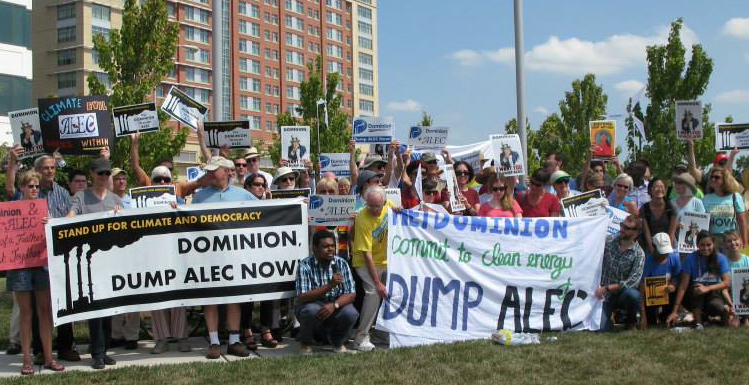
Group Dominion quit ALEc image 2

Protesters gather outside the Crystal City headquarters of ALEC

A crowd of protesters gathered at the Arlington headquarters of the American Legislative Exchange Council (ALEC) on September 4 to demand that Dominion Resources, the parent of public utility monopoly Dominion Virginia Power, drop its membership in the right wing “bill mill.”

On the very same day, a jury convicted ex-Governor Bob McDonnell and his wife on federal corruption charges, setting off a new round of debate about Virginia’s lax ethics laws.

The two news items sound like different topics, but in fact they are both about the corruption undermining our democratic system. The McDonnell trial, with its focus on swank vacations, golf clubs, designer clothes and other neat stuff, actually missed the bigger breach of public trust that goes on every day. This takes the form of unlimited corporate campaign contributions and gifts to members of both parties, and the influence over legislation purchased by this largesse.

Dominion Power has spent decades and many millions of dollars building its influence in Richmond this way, to the point where most legislators don’t bother pursuing a bill if the utility signals its opposition. That’s why Virginia has not followed so many other states in requiring its utilities to invest in energy efficiency, wind and solar. Economic arguments, jobs, electricity rates—all these are talked about in committee, and all are irrelevant to the fate of a bill. The only relevant question for legislators is, “What does Dominion think?”

What Dominion thinks, though, is not about what’s good for its customers, but what’s good for its own bottom line. And this is where ALEC comes in. Dominion Virginia Power’s president, Bob Blue, sits on an ALEC committee with representatives from the climate-denial group Heartland Institute, the Koch-funded anti-environment group Americans for Prosperity, and that most oxymoronic of lobby shops, the American Coalition for Clean Coal Electricity. Their purpose is to craft model state bills that protect fossil fuel profits and attack all efforts to regulate carbon emissions.

Dominion provides a straight shot from ALEC’s back-room bill-brokering to Virginia’s statute books, trampling environmental protections along the way and giving the lie to Dominion’s façade of environmental responsibility. No wonder so many of last week’s protesters were Dominion customers who objected to the utility using the money it charges them for electricity to pay its ALEC dues.

We see the result every year in the General Assembly, as bills drafted by ALEC pop up all over the place without attribution. In addition to attacking clean energy, ALEC bills oppose worker protections and minimum wage initiatives, promote stand-your-ground bills like the one at issue in the Trayvon Martin case, and of course, undermine the kinds of clean-government efforts that would reduce the influence of corporations—like campaign finance reform.

And because the voters are the only people who could prove more powerful than corporations—and the only ones who might ultimately cut off the corporate cash flow—ALEC works to undermine voting rights as well.

In the wake of the McDonnells’ convictions, Virginia legislators are once again mumbling about tightening up the rules on gifts. The discussion is half-hearted; the pay for their work is paltry and the hours are long, so they aren’t anxious to give up the perks.

But it’s too late for half-measures. Elected officials are going to have to subject themselves to a ban on gifts, and the prohibition should extend to ballgame tickets, golf getaways and sit-down dinners. The loophole that currently allows campaign funds to be used for personal use must also be closed to avoid an end-run around the gift ban.

But until we turn off the corporate cash spigot, our democracy will still have special interests, not voters, calling too many shots.

Unknown's avatar

Report confirms Dominion’s worst-place standing on clean energy

photo courtesy of the Sierra Club

photo courtesy of the Sierra Club

A new report from the non-profit group Ceres shows Dominion Resources, the parent of Dominion Virginia Power, winning last place among investor-owned utilities on a nationwide ranking of renewable energy sales and energy efficiency savings.

That’s left Virginians wondering how a company that talks so big succeeds in doing so little. And more importantly, what would it take for Dominion to rank even among the average?

Dominion came in 30th out of 32 in renewable energy sales, at 0.52%. On energy efficiency, it achieved 31st out of 32 on savings measured cumulatively (0.41%), and 32nd out of 32 measured on an incremental annual level (at 0.03%). Together these put our team in last place overall—a notable achievement for a utility that trumpets its solar investments and carbon-cutting progress.

To show just how awful Dominion’s performance is, the top five finishers achieved between 16.67% and 21.08% on renewable energy sales, 10.62-17.18% on cumulative annual energy efficiency, and 1.46-1.77% on incremental annual energy efficiency. National averages were 5.29% for renewable energy sales, 4.96% for cumulative efficiency savings, and 0.73% for incremental annual efficiency savings. Rankings were based on 2012 numbers, the latest year for which data were available.

In case you’re wondering, American Electric Power, the parent company of Appalachian Power Co., earned 24th place for renewable energy, with 2.65% of sales from renewables—a number only half the national average and one we might have called pathetic if it weren’t five times higher than Dominion’s. AEP’s efficiency rankings also placed it firmly in the bottom half of utilities, running 23d and 20th for cumulative and incremental efficiency savings, respectively. However, AEP earned its own laurels recently as the nation’s largest emitter of carbon pollution from power plants due to its coal-centric portfolio.

A study of the rankings reveals that Dominion’s major competition for the title of absolute worst came from other utilities based in the South. The critic’s favorite, Southern Company, nabbed 31st place on the renewable energy sales measure, but failed to make the bottom five on one of the efficiency rankings. Another southeastern utility, SCANA, achieved rock bottom on renewable energy; but like Southern, its marginally better performance on efficiency disqualified it from an overall last-place ranking.

Why do utilities in the South do so poorly? Probably because they can. Most of the poor performers have monopoly control over their territories and are powerful players in their state legislatures. Lacking in competition, they do what’s best for themselves. Possessing political power, they are able to keep it that way.

Of course, they still have to contend with public opinion and the occasional legislator who gets out of line. For that it helps to have a well-worn narrative handy, like the one about how expensive clean energy is. Dominion has found that Virginia’s leaders fall for that one readily, even though it’s false.

And so, when asked about the Ceres report, Dominion responded that Virginia wouldn’t want to be like the states that have high-performing utilities. Dominion spokesman Dan Genest told the Daily Press, “The three states — California, Connecticut and Massachusetts — the report mentions as being leaders in those categories also have among the highest electric rates in the nation. Typical residential customer monthly bills are $228.85, $206.07 and $191.04, respectively. Dominion Virginia Power customers pay $112.45.”

This would be an excellent point, if it were true. Alas, Genest’s numbers appear to be a product of a fevered imagination. According to recent data reported in the Washington Post, California’s average monthly electric bill is only $87.91, Connecticut’s comes in at $126.75, and Massachusetts’ at $93.53, while Virginia’s is $123.72. (Virginia’s numbers presumably reflect an average of bills paid by customers statewide, probably accounting for the higher figure than Genest cites for Dominion’s “typical” customer.)

That’s right: in spite of higher rates, Californians pay way less for electricity than Virginians do, in part because they have achieved high levels of energy efficiency. If you do that, you can afford to invest in more renewable energy without people’s bills going up.

This is such a great idea that it seems like it would be worth trying it here. Remarkably, this is precisely the strategy that environmental groups have been urging for years in their conversations with legislators and their filings at the State Corporation Commission. With the pressure on from global warming and the EPA’s Clean Power Plan, this would seem to be a great opportunity to save money, cut carbon, and move us into the 21st century.

So go for it, Dominion. Aspire to lead! Or failing that, at least shoot for average.


Unknown's avatar

APCo wants higher bills for homeowners who go solar

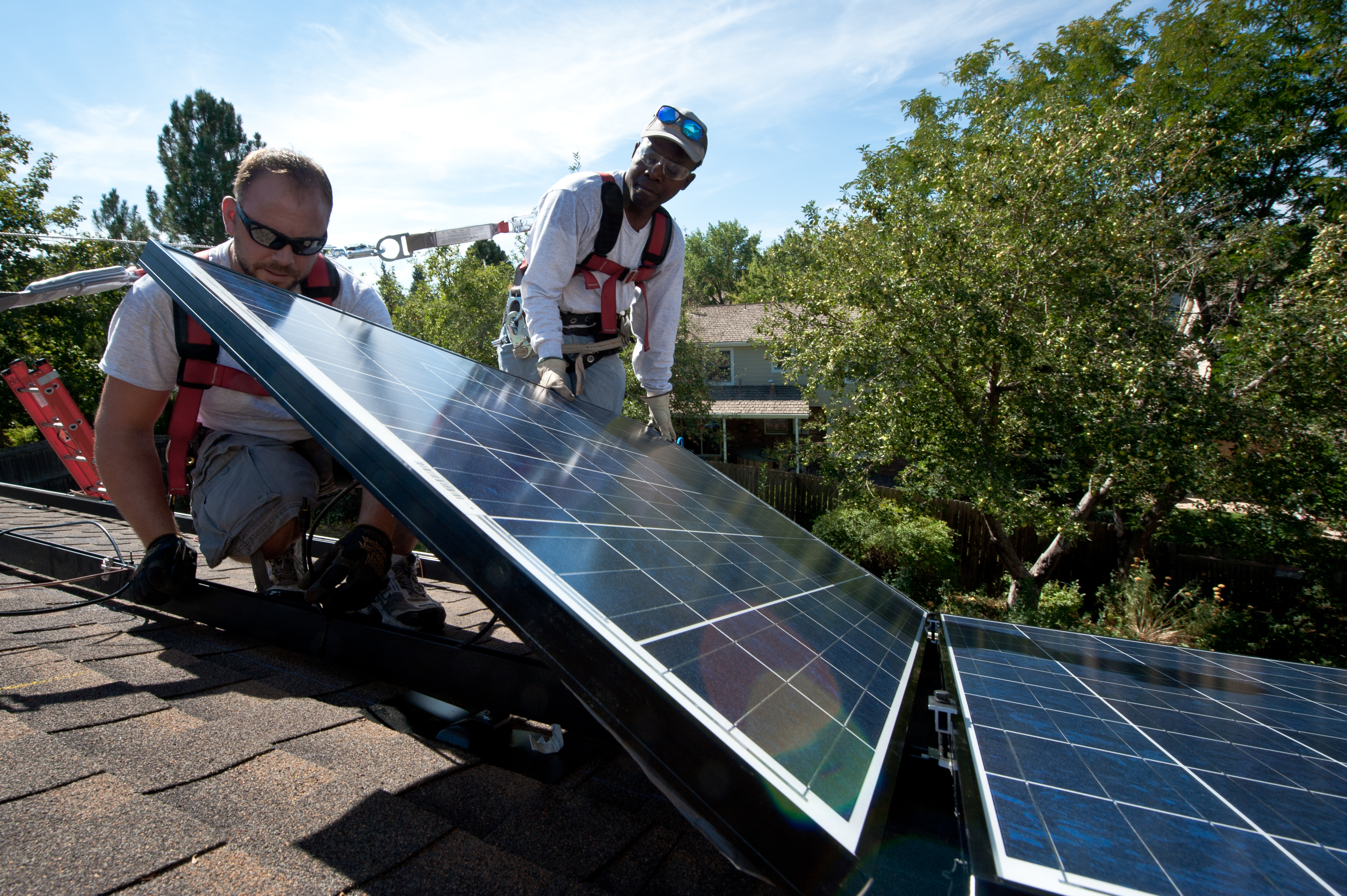
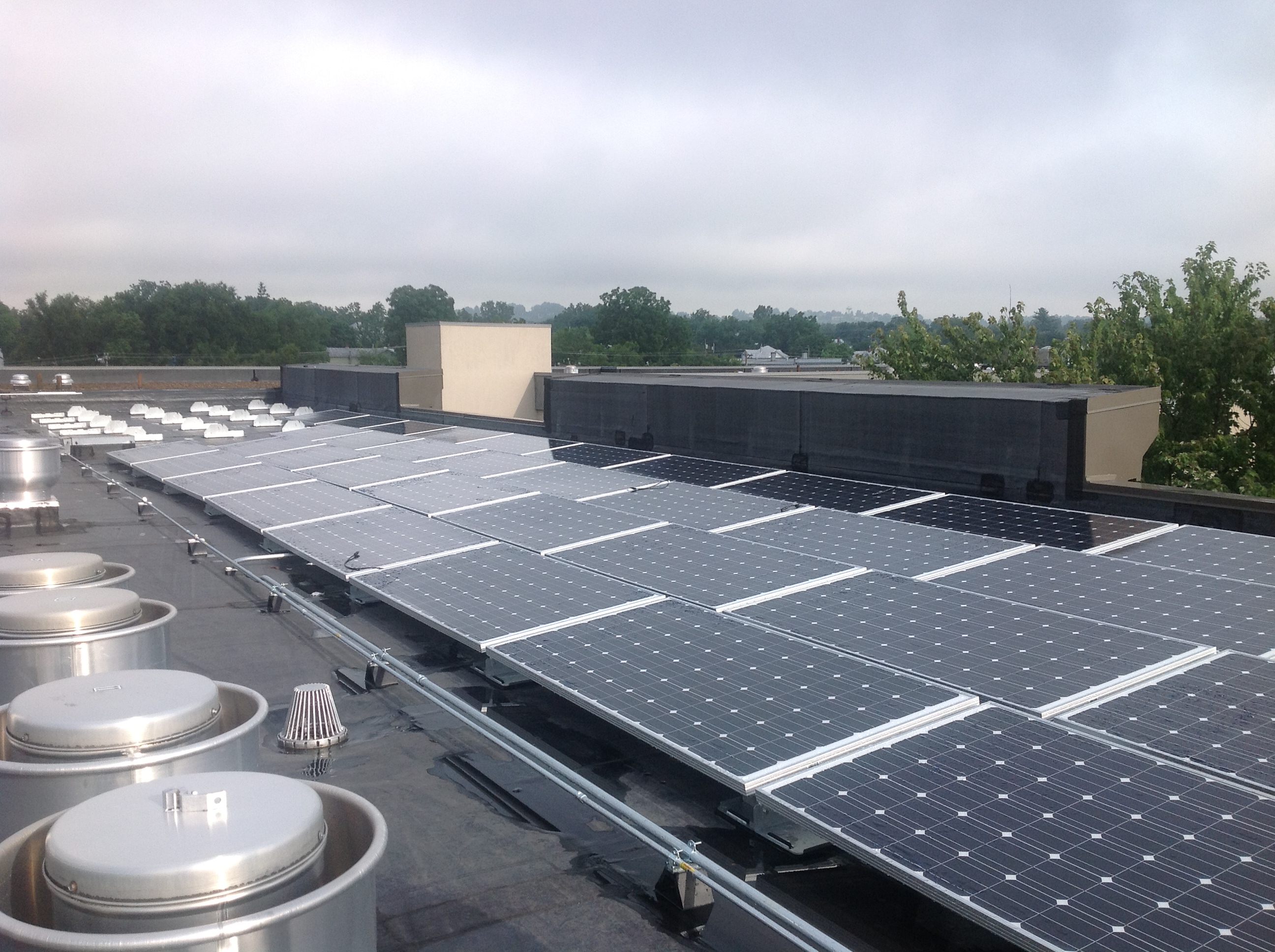
Workers installing solar on a roof. Photo credit: Dennis Schroeder, NREL

Workers installing solar on a roof. Photo credit: Dennis Schroeder, NREL

Update: The SCC approved APCo’s standby charges with a small modification. As it had when considering Dominion’s standby charge, the SCC declined to consider the benefits of solar to APCo. See http://www.scc.virginia.gov/docketsearch/DOCS/303%2301!.PDF at page 36-37.


Appalachian Power Company (APCo) is seeking permission from utility regulators to impose new “standby” charges on residential customers who install solar systems over 10 kilowatts (kW). The fee is included in the company’s latest rate proposal, now before the State Corporation Commission.

According to the filing, the transmission and distribution charges would add $3.77 per kW to the monthly bill of a customer who goes solar with a large residential system. That means homeowners with 10 kW systems would pay an added $37.70 per month. Charges would escalate to $75.40 per month for homes with 20 kW systems, the largest size allowed under net-metering rules.

So the potential is there for a solar homeowner to owe over $900 per year in new charges on his electric bill. But according to APCo, only three customers in all of its Virginia territory have systems large enough to qualify for a standby charge, with no additional big systems in the queue.

That’s right: APCo is spending many, many thousands of dollars on lawyers and consultants so it can change rules that affect three people.

Ahem. Lest anyone think APCo is worried about cost. APCo’s decision to move now proves this is not about freeloaders on the grid. This is about protecting the corporate monopoly on electric power by shutting down the independent solar industry while it is still small.

In this, APCo is following the lead of Dominion Power, which got the SCC to approve similarly onerous standby charges on its own large residential solar customers in 2011. The utility’s ability to do so was authorized that year by a bill amending section 56-594 of the Virginia Code. The statute leaves it up to utilities and the SCC to determine the amount.

The Virginia solar industry acquiesced to the standby charge language as part of a deal that raised the residential net metering limit from 10 kW to 20 kW. Industry members assumed any charges the SCC approved under the law would be modest, given the many benefits solar brings to the grid.

Their assumption proved spectacularly wrong. The SCC bought Dominion’s arguments about solar homeowners not paying their “fair share,” dismissing expert testimony and findings from other states that solar enhances grid security and offsets peak demand.

The result has been a clear setback for the solar industry’s ability to sell larger home systems. Dominion’s steep standby charges “are forcing the solar industry to take a step backward when we’ve worked so hard to make positive steps forward,” says Andrew Skinner, Project Manager with Prospect Solar in Sterling, Virginia. “Working with several small farms and residences in rural VA, we have had to design right up to the threshold of the standby charge to make the economic case most compelling.”

Dominion and APCo are following the playbook of the American Legislative Exchange Council (ALEC), a secretive corporate lobbying organization that seeks to roll back pro-renewable energy laws across the country. The parent companies of both Dominion and APCo are members of ALEC, and Dominion’s president, Bob Blue, served on ALEC’s energy and environment task force with representatives from the American Petroleum Institute, the American Coalition for Clean Coal Electricity, the science-obfuscation shop Heartland Institute, and other champions of all things fossil. (Greenpeace recently announced that six utilities have resigned from ALEC; unfortunately our guys were not among them.)

Given that APCo’s proposed standby charges are so similar to Dominion’s, APCo probably figures its request is a slam-dunk at the SCC. And given how few people are affected, it may be tempting to ignore it. But just last summer Dominion signaled its intent to try to extend its own standby charges to more solar customers, which makes the issue relevant to everyone who owns a solar system, wants one, or supports the rights of others to buy them.

Whether utilities should be loading up their solar customers with added fees is also at the heart of two studies getting underway in Virginia this year examining the costs and benefits of solar, one of them under the auspices of the Department of Mines, Minerals and Energy and the Department of Environmental Quality, and the other by the SCC itself. With a consumer backlash growing nationwide against utility efforts to “tax the sun,” APCo’s move looks like a way to lock in a rate increase on solar owners before the data is in—and before its customers catch on.

It’s especially unfortunate that the utilities’ push against net metered solar comes at a time when we are beginning to see a flourishing of the solar market. Total installed solar in Virginia has leapt from under 5 megawatts just a couple of years ago to perhaps 18 megawatts today. Okay, that’s a paltry figure compared to, say, North Carolina’s 557 megawatts or New Jersey’s more than 1200 megawatts, but starting from next to nothing gives us a really fantastic growth curve.

The rapid drop in solar prices has been a major factor driving Virginia sales. Says Skinner, “With the advancements in the solar market over the past couple years, even here in Virginia, we have been inching closer to the 10 year or less payback period. We talk to people every day that tell us they’ll go solar here when the payback is less than 10 years. A standby charge reverses that trend based on an argument with flawed economics. While other states are making progress on the true value of solar, we’re here with our head held under water.”

He concludes, “Even while holding our breath we are still creating jobs and installing solar arrays all over our beautiful state. I was born and raised here, and I’m proud to work for a VA based company; we just need to get rid of these backward policies so we can keep moving forward.”

APCo’s rate case is PUE-2014-00026, which can be found on the SCC website. For a discussion of the standby charge proposal, look for the exhibit containing the testimony of Jennifer Sebastian. The deadline for submitting comments on APCo’s application is September 9, 2014, and a public hearing will be held on September 16 at the SCC offices in Richmond.


Unknown's avatar

A new business model for non-profits brings solar into hostile territory


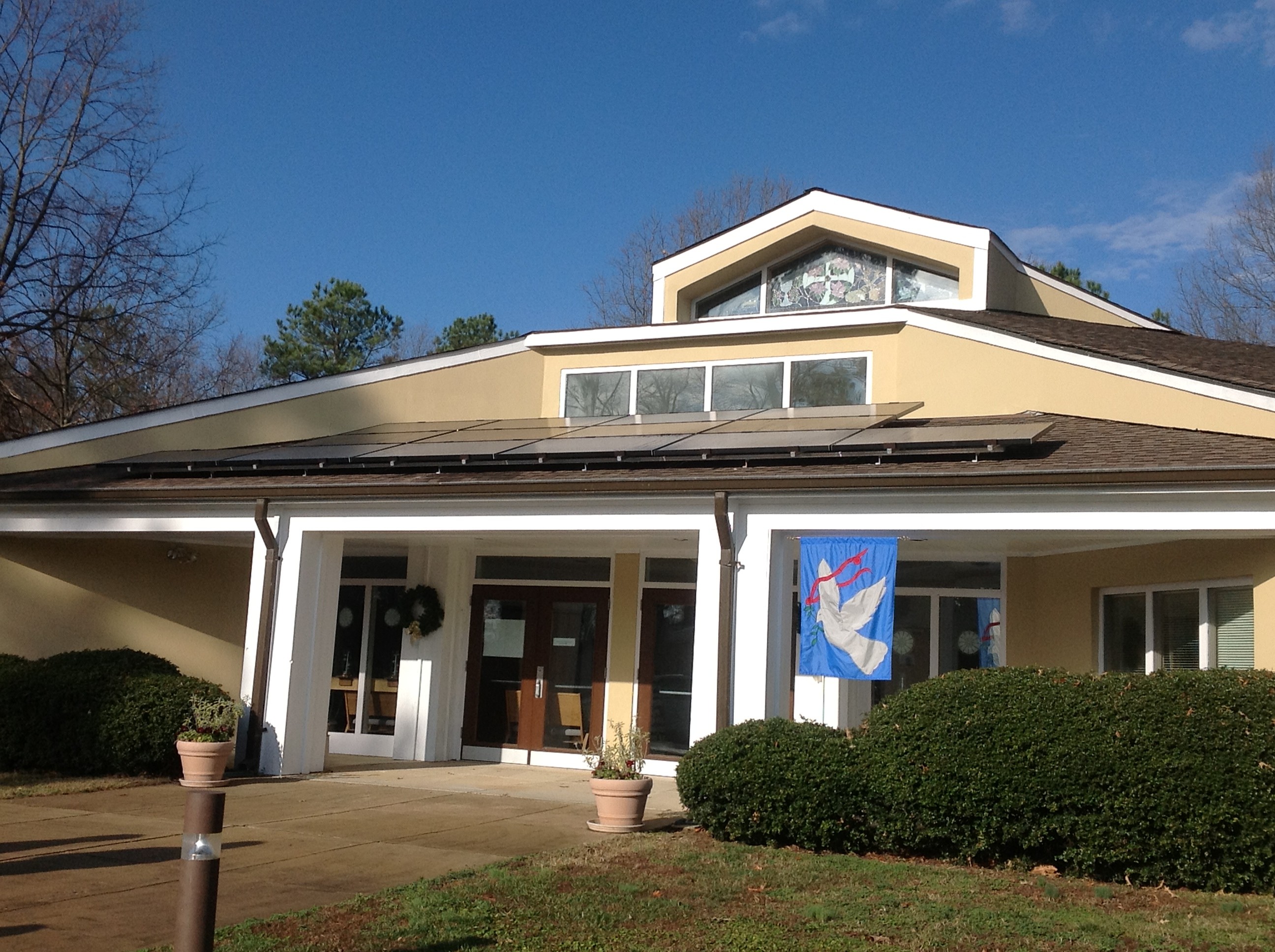
Solar panels over the entrance to the First Congregational Christian United Church of Christ. Photo credit: Matt Ruscio

Solar panels over the entrance to the First Congregational Christian United Church of Christ. Photo credit: Matt Ruscio

Fourteen solar panels crown the entrance to the First Congregational Christian United Church of Christ in Chesterfield, Virginia. The small array generates 10% or so of the church’s electricity, but the project is notable for a different reason: it was the first solar system installed anywhere under a new kind of contract called a Customer Self-Generation Agreement. The agreement allowed the church go solar with no money down, and without increasing its electricity costs.

The Customer Self-Generation Agreement (CSGA) is the brainchild of Tony Smith, founder and CEO of Secure Futures LLC, a solar developer based in Staunton, Virginia. Under its agreement with the church, Secure Futures owns the solar panels and reaps the federal tax benefits that make solar affordable. The church gets the electrical output of the system over the twenty-year life of the contract. Neither a lease (which would bar the church from getting the tax benefits) nor a third-party power purchase agreement (which the incumbent utility would have opposed), the CSGA occupies a financing niche all of its own.

For Secure Futures, the CSGA was born of necessity. In 2011, the company was blocked from completing a solar array at Washington and Lee University when Dominion Virginia Power sent “cease and desist” letters claiming the parties’ use of a third-party power purchase agreement (PPA) violated the utility’s monopoly on the sale of electricity. Although convinced it had the law on its side, Secure Futures backed down in the face of expensive litigation. The solar installation was only completed by turning the PPA into a lease and losing some of the tax benefits.

Tony Smith. Courtesy of Secure Futures.

Tony Smith. Courtesy of Secure Futures.

Secure Futures had been building a place for itself in the nonprofit world, appealing especially to colleges and universities that want solar power as part of their sustainability goals. The company’s 104-kW solar array at Eastern Mennonite University in Harrisonburg, Virginia, completed in 2010, was the first PPA in Virginia and, at the time, the largest solar array in the state. But that project was not in Dominion’s territory.

For a state like Virginia with few policies to support solar, accessing the federal tax credits is critical to financing a solar project. Tax-exempt entities like municipalities, schools and churches are a natural customer base for solar, but because they cannot use the federal tax credits themselves, they must partner with a tax-paying company that can own the project. Third-party PPAs have been the answer in states that allow them. PPAs also frequently offer a no-money-down option, which has proven a huge market driver in recent years for homes and businesses as well as non-profits.

Solar array installed by Secure Futures for the Harrisonburg Redevelopment and Housing Authority using a CSGA. Photo courtesy of Secure Futures.

Solar array installed by Secure Futures for the Harrisonburg Redevelopment and Housing Authority using a CSGA. Photo courtesy of Secure Futures.

But after the Washington and Lee experience demonstrated both Dominion’s hostility to PPAs and its willingness to use its legal firepower, Tony Smith decided to seek another way through the legal thicket. Working with regulatory lawyer Eric Hurlocker and tax specialists at Hunton and Williams, Secure Futures developed an innovative contract model that could provide the tax benefits of a PPA without running afoul of utility monopoly claims. CSGAs are contracts for solar services but, crucially, don’t involve the sale of electricity.

Although Dominion Power eventually relented enough to cooperate on a bill passed in 2013 that allows a small number of PPAs within its territory on a “pilot project” basis, Secure Futures has continued to use the CSGA model in subsequent projects because it offers features that a standard PPA does not.

Perhaps more importantly, neither Dominion nor any other utility has signaled opposition to CSGAs. Suddenly, Secure Futures’ niche looks huge. The ability to use CSGAs wherever PPAs would make financial sense opens up new opportunities among non-profits not just in Virginia, but in all of the 28 states where PPAs are currently either illegal or of uncertain status. As Smith notes, no state bars customers from generating electricity for their own use.

While Smith is eager to see his company grow, he says his larger goal has always been to open the floodgates for solar projects across the country where they are held back now only by outdated laws and flawed policies. He hopes to license the CSGA approach, ideally to a non-profit that could work with developers across the South to make this contract model widely available.

Virginia has always been a hard place to do business for solar companies, so much so that Smith refers to it as a ”dark state.” Knocking down the PPA barrier won’t bring the sunshine in all by itself, but it does create an opening.


Unknown's avatar

From Massachusetts to New York, offshore wind energy now ready to deliver

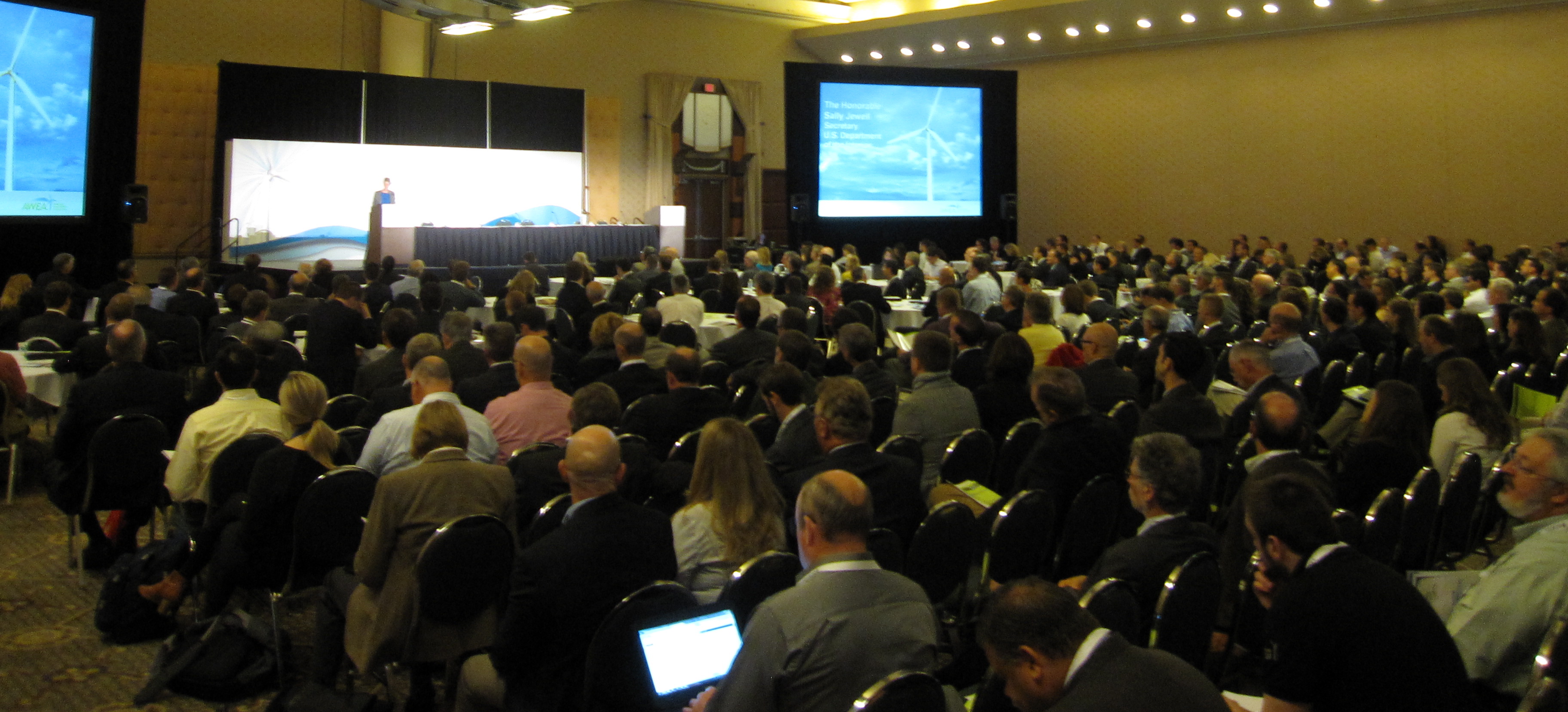
Interior Secretary Sally Jewell addresses a packed ballroom

Interior Secretary Sally Jewell addresses a packed ballroom at the American Wind Energy Association offshore wind conference

The long-awaited Cape Wind offshore wind farm will finally begin construction off the coast of Massachusetts in 2014. So, too, will the much smaller Block Island Wind Farm off Rhode Island. When completed, Cape Wind’s 130 wind turbines will supply almost 75% of the power needs of Cape Cod, Martha’s Vineyard and Nantucket, while the 5-turbine Block Island Farm will supply enough clean energy to power over 17,000 homes.

2014 also seems likely to see a power purchase agreement for some of the energy to be generated by a 900 MW wind farm off the tip of Long Island that would feed power to a growing and hungry New York market, at a cost that’s economic now.

And with a second round of grants from the Department of Energy expected next spring, demonstration projects of 12-25 MW will also go forward in three more locations, producing power in 2017 and helping set the stage for rapid growth in the industry. The first-round grants went to projects in Oregon, Texas, Ohio, Maine, New Jersey and Virginia.

These were a few of the highlights from the American Wind Energy Association 2013 offshore wind conference, held October 22 and 23 in Providence, Rhode Island. More than 700 attendees packed a ballroom to hear Secretary of Interior Sally Jewell, Rhode Island Governor Lincoln Chafee, U.S. Senator Sheldon Whitehouse and others make the case for why offshore wind energy will play a growing role in the U.S., starting in the Northeast.

Five years have passed since the American Wind Energy Association, the University of Delaware and the Sierra Club brought together researchers and wind developers for America’s first-ever conference on offshore wind energy, in Dover, Delaware. Since then, the conference has grown in scope and attendance, but the only wind turbine to make it to U.S. waters is a one-eighth-scale test model off the coast of Maine.

While Europe surged ahead and now has more than fifty offshore wind farms, the U.S. has been hampered by a slow federal leasing process, uncertainty about tax credits, and a political process ill-suited to the long-range planning and regional cooperation needed to realize the potential of this industry.

But as this year’s conference showed, the industry is moving ahead. The Obama Administration and several states identify offshore wind as a critical part of the response to climate change, as well as an opportunity to develop jobs. As many speakers explained, there is also a strong business case to be made for it. Given the price spikes that have plagued natural gas in New England and elsewhere, it makes sense to diversify power sources. In addition to providing price stability, wind energy has been shown to suppress wholesale energy prices, saving consumers money.

Perhaps most significantly, offshore wind power is likely to be the least-cost option in locations where demand is high, energy is expensive, and alternatives are few. This describes much of the Northeast, especially the densely populated area from northern New Jersey up to Massachusetts.

An analysis from AWS Truepower showed several factors that make offshore wind energy a good option in these areas:

  • A growing demand for power, driven in part by new data centers;
  • An already-congested transmission grid, coupled with the difficulty of either building new generation close to the load center or adding new transmission lines to bring in power from outside the area;
  • The proximity of offshore wind energy areas to these load centers along the coast;
  • High localized marginal prices for electricity, making offshore wind competitively priced; and
  • The ability of offshore wind to provide power when demand is greatest.

This last element is especially compelling for utilities, which have to meet a demand for power that changes throughout the day. Unlike onshore wind, which blows most strongly at night, and solar energy, which peaks in the middle of the day, offshore wind picks up in the late morning and continues through the evening hours, matching times of highest demand. According to Bruce Bailey, CEO of AWS Truepower, this fact means that in the New York market, the revenues from offshore wind energy will be about two and a half times that of onshore wind energy.

Whitney Wilson, the engineer who conducted the analysis for AWS Truepower, told me that when they looked at all the factors and then at the potential locations for offshore wind farms, one location stood out: a tract of ocean thirty miles off the coast of Montauk Point on Long Island, within the southern section of the Massachusetts/Rhode Island Wind Energy Area. Building wind farms there, her analysis showed, would provide the biggest bang for the buck.

Developer Deepwater Wind, LLC, won the right to develop the lease area last summer in the U.S.’s first-ever offshore wind lease auction. One likely customer may be the Long Island Power Authority, which put out an RFP for 280 MW of renewable energy, specifically mentioning offshore wind.

Lisa Dix, a Senior Campaign Representative with the Sierra Club’s Beyond Coal Campaign in New York who was also at the conference, says offshore wind makes perfect sense for Long Island, and complements the Long Island utility’s recent approval of a feed-in tariff for solar energy.

Other utilities seem likely to follow suit as they assess the benefits of offshore wind for their own customers. A greater understanding of these benefits will lead to the full buildout of the RI/MA area and the soon-to-be-leased New Jersey area.

The experience of Deepwater, Cape Wind, and the developers of the DOE-funded demonstration projects will help build the industry supply chain and workforce, and will produce the kind of learning that leads to lower prices for future projects. One such project involves the 2000 MW of the Virginia Wind Energy Area, which Dominion Power now holds the right to develop. While the economics are not currently as compelling in the cheap-energy South, this would change if the early movers achieve the cost reductions they are aiming for.

If states work together, these cost reductions and the development of a robust, domestic supply chain and workforce will happen better, sooner and smarter. Coordinated regional planning will support rapid growth in the industry while driving down costs in a virtuous cycle.

Given the urgency of climate change and the need to move the electric grid beyond fossil fuels as quickly as possible, Congress also has to make the growth of the offshore wind industry a national priority. Passing a long-term extension of the investment tax credit is a critical first step to support the tremendous renewable resource just off our coast.

Unknown's avatar

What’s wrong with Dominion’s Green Power Program

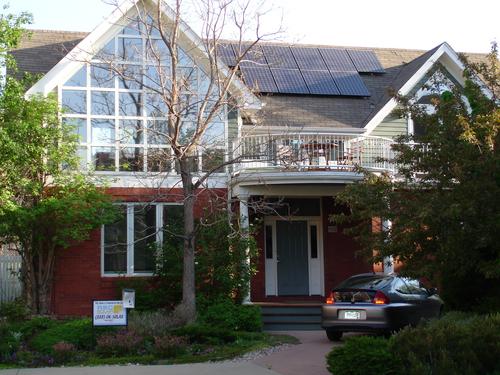
Better than Green Power: installing a solar system yourself. Photo credit: NREL

Better than Green Power: installing a solar system yourself. Photo credit: NREL

Renewable energy advocates in Virginia were astonished to learn a few weeks ago that the U.S. Environmental Protection Agency has given Dominion Virginia Power an award for its Green Power Program.

Dominion’s program is not, to put it mildly, a good one. Half of the money its customers contribute is siphoned off for overhead and “education.” The rest goes to buy renewable energy certificates from out of state. Over the years Dominion has collected millions of dollars in these voluntary contributions without building a single wind or solar facility to supply the program. Surely the only green award this merits is one for greenwashing.

So I called the EPA to find out what criteria they use in determining who gets an award. It turns out the agency only measures the growth of a green power program, and Dominion has signed up more customers than other utility programs have.

I had to laugh. Customers of utilities in most other states have real options to buy wind and solar. If you can buy wind energy from an alternative supplier or participate in a community solar project, or if your utility is aggressively incorporating renewables into its power supply, you don’t need a green power program.

But Dominion has never built more than token amounts of renewable energy, and it continues to use its monopoly position to erect barriers to competition from others. The utility has signed up 19,000 Green Power participants only because it has effectively denied its Virginia customers any meaningful way of participating in the renewable energy market.

News of this award will surely lure more people in. Yet even if every one of Dominion’s customers signed up for the program, it wouldn’t shrink Virginia’s carbon footprint. Instead, Dominion’s latest integrated resource plan reveals plans for more fossil fuel generation and increasing greenhouse gas emissions over the next fifteen years.

And it’s worse than that. As of this year, Dominion is actually using the Green Power Program to bankroll an attack on renewable energy—one the State Corporation Commission shamefully endorsed when it approved the company’s 3-megawatt “solar purchase program.”

In this charade, Dominion buys solar power from homeowners and businesses to resell to the Green Power Program. The deal nets sellers a few cents over the retail price of electricity, but costs the Green Power Program almost three times as much. This overcharging of the Green Power Program would be bad enough. But the more insidious problem lies in Dominion’s justification for the high charge. It claims that rooftop solar energy is no more valuable than power from fossil fuels that it can buy at wholesale.

Dominion’s position flies in the face of recent studies demonstrating the benefits of solar energy to the grid, including generating power where demand is, providing power during peak hours when energy is most expensive, avoiding the need for transmission upgrades, eliminating line losses, and reducing the need for new generation.

It also runs counter to trends in states like Georgia, where Georgia Power has put a higher–than-retail value on the solar distributed generation it plans to buy, and says that paying the extra won’t put upward pressure on rates.

This makes it especially difficult to understand why Virginia’s State Corporation Commission approved Dominion’s Green Power rip-off. And predictably, Dominion has followed up its win with a deeply flawed study it plans to use as a basis for a new round of standby charges on customers who net meter. (The case is PUE-2012-00064, available on the SCC web site.)

So what is a dedicated renewable energy advocate to do?

There are options. If you are determined to buy RECs, you don’t have to go through Dominion. Buy from another source. But better yet, install solar yourself if you can. The price of solar panels has dropped so precipitously over the past few years (down 60% since the start of 2011) that you may find it worth taking out a home equity loan.

If you don’t have a sunny roof yourself or can’t afford the whole upfront cost, you can work with your school, community center or place of worship to install solar panels in your neighborhood. Interest in solar is very high among Virginia faith congregations, driving large turnouts for presentations on the topic given by Sierra Club and others in cooperation with the solar industry.

Or you can take the money you were spending on Dominion’s program and give it to a charity that will use it to install renewable energy here in Virginia; this may even get you a tax deduction. Low-income housing providers like Richmond’s Better Housing Coalition now put solar panels on many of their facilities, and will accept donations specifically for that purpose.

The Virginia Center for Wind Energy at James Madison University accepts donations to its Wind for Schools program, which helps public schools across the commonwealth install wind turbines for educational purposes.

A new non-profit, Three Birds Foundation, is working to put solar on public schools that serve low-income children in Virginia and elsewhere.

All these charities are committed to doing what Dominion, apparently, doesn’t want to do: install solar and wind energy in Virginia.

Unknown's avatar

Nuclear power: lessons from Japan (and Murphy)

Dominion Virginia Power said Monday that it intends to move forward with plans for a third reactor at its North Anna Power Station as the international nuclear energy industry reels from the disaster at the Dai-ichi nuclear plant in Japan.—WSLS10, March 15, 2011

The operator of Japan’s tsunami-hit nuclear power plant sounded the alarm on the gravity of the deepening crisis of containment at the coastal site on Friday, saying that there are more than 200,000 tons of radioactive water in makeshift tanks vulnerable to leaks, with no reliable way to check on them or anywhere to transfer the water. –The New York Times, August 23, 2013

A friend asked me recently whether I thought the ongoing disaster at the Fukishima nuclear plant in Japan would have repercussions here in Virginia, where Dominion Power operates four nuclear reactors at two plants and wants to build another. I feel pretty sure the answer is no. Economics will kill Dominion’s nuclear dream, but not risk. We just don’t think that way.

We think like this: Fukishima was taken out by a tsunami. There are no tsunamis in central Virginia. Ergo, there is no risk to Virginia’s nuclear plants from a tsunami, so Japan’s sudden revulsion against nuclear power shouldn’t put us off our feed half a world away.

So why did countries like Germany, which also has no tsunamis, freak out and swear off nuclear for good?

They drew an entirely different lesson: Japan is a smart, technologically-advanced nation. Japan did not anticipate the disaster that destroyed Fukishima. Ergo, unanticipated disasters happen even in smart, technologically-advanced nations.

Or put another way: Murphy’s Law also applies to nuclear plants. We ignore Murphy at our peril.

But ignore him we do. We had our own brush with nuclear disaster two years ago, when a rare, magnitude 5.8 earthquake shook central Virginia and led to a months-long shutdown of the two North Anna nuclear reactors. No one expected an earthquake of this strength there, least of all the plants’ designers. Fortunately, the reactors survived intact, but I don’t know of anyone who wants to repeat the experiment. Presumably Dominion intends the “next” North Anna reactor to be designed to withstand stronger earthquakes. Do you feel better about nuclear now, or worse?

Murphy’s Law operates with ferocity across the energy sector. An industry expert told me the BP oil spill in the Gulf happened in spite of four different safeguards in place on the drilling rig, each of which should have stopped the blowout from happening. And that spill was not an isolated incident; only the year before, a similar blowout off the coast of Australia created a 2,300 square mile oil slick—about the size of Delaware. U.S. papers largely ignored it. Spills are so common in oil drilling that they rarely warrant a headline. Yet somehow those who support offshore oil drilling off the coast of Virginia feel sure it won’t happen here.

Or take mountaintop removal coal mining (please). Right now powerful explosives are blasting away the tops of mountains in southwest Virginia and across Appalachia. The rubble is being dumped into stream valleys, while huge machines scrape off the thin seams of coal. Federal law provides that no streams should be harmed, and the mountains should afterwards be restored—requirements so fanciful that neither mining companies nor state officials take them seriously. So it’s not surprising that streams and rivers are polluted, species disappear, building foundations crack, and residents die young. That’s not the plan going wrong, it’s the plan.

In the past most Americans participated in an unspoken agreement to ignore the risks involved in producing energy, because we had no intention of stopping what we were doing. If it’s a choice between risky energy and no energy, we will go with risky every time. Denying the risks is a coping mechanism that lets us sleep at night. Not incidentally, this is also the strategy used by fossil fuel interests to keep the public from demanding action on climate change.

But the widespread availability of cleaner alternatives gives us energy options we didn’t feel we had before. Increases in energy efficiency and tumbling prices for wind and solar mean we can afford to look more honestly at the damage we do and the risks we run by powering our 21st century economy with 20th century fuels.

I like to think the Virginia legislature’s decision to maintain the ban on uranium mining—for now—shows that our ability to ignore risks has its limits. Mining anything hazardous is inherently risky in a climate like Virginia’s, where rainfall continually recharges the water table. Put nasty stuff between the rain and the water table, and you will find contamination downstream. The idea that water can be kept out of millions of tons of radioactive mine tailings for thousands of years strains credulity. The idea that this might be accomplished by a mining company whose sole purpose is to make money shatters credulity altogether.

The fact that a good many of Virginia’s politicians lined up on the side of the mining company anyway is not necessarily evidence of their capacity for ignoring risk. More likely, it simply demonstrates how extreme is the corrupting power of money in Virginia politics. Unfortunately, that shows no signs of changing.

Unknown's avatar

Renewable energy makes small gains in Virginia’s 2013 legislative session

The Virginia General Assembly will soon wrap up its work on the 2013 legislative session. Renewable energy advocates began the session with high hopes for a series of bills that promised to reform our renewable energy law, expand net-metering, and open up new opportunities for financing solar systems and small wind turbines.

So how did we do? Well, this is Virginia. Progress is slow, the utilities are powerful, and half the legislature doesn’t believe in climate change. On the other hand, they do believe in business. Under the circumstances, we did okay.

Renewable Portfolio Standards: bye-bye, bonuses

Readers of this blog already know the long, miserable tale of Virginia’s weak and ineffective, voluntary renewable portfolio standard (RPS), which has enriched utilities with tens of millions of dollars in incentives without bringing any new renewable energy projects to Virginia. This year the legislature went halfway to fixing the problem. Legislation negotiated between the office of the Attorney General and the utilities will deprive utilities of future ill-gotten gains for meeting the RPS law, but won’t change the pathetic nature of the law itself.

Stripping out the RPS incentives was only part of a bigger, more complex bill that sweetens the deal for utilities in other ways, so it’s hard to judge whether the legislation as a whole marks a victory for consumers. Skeptics will note that Dominion’s stock price has actually gone up several percentage points since the deal was announced, which you wouldn’t expect if the AG were correct that the bill will save consumers close to a billion dollars over time.

What is clear is that the RPS remains as voluntary and as crummy as it ever was, but the utilities can no longer use it to rip off ratepayers while pretending to be good citizens. Some environmental groups consider stripping out the incentives a bad thing, on the theory that only by giving utilities a bonus can we expect them to meet the goals. Other groups (including the Sierra Club) believe Dominion, at least, will want to maintain its greenwashed public image by continuing to meet the RPS goals, and that ending the consumer rip-off is worth celebrating.

Sure, if the goals had brought wind and solar to Virginia, the Sierra Club would have considered the incentives a tolerable price to pay. As it happened, Dominion and the other utilities continuously rebuffed efforts over the years to improve the RPS. Had Dominion approached the RPS as an opportunity to bring real renewable energy to Virginia rather than as a cash cow to be milked for its own advantage, the company would have saved itself a public relations fiasco and likely kept its bonuses, too. Surely, someone at HQ should be out of a job right now.

Taking the long view, it is also worth noting that getting rid of the free money is a necessary first step towards a mandatory RPS in Virginia, which would unleash market forces for renewable energy that don’t emerge with a voluntary law. Utilities would oppose such a move more vigorously if they still had incentives to protect that were available only under the voluntary program.

. . . but reform efforts fail again

These views all assume the legislature will someday pass a bill to improve the goals and bring wind and solar projects to Virginia, without which the RPS is meaningless anyway. Surely legislators must recognize how pointless it is to have an RPS that can be met with out-of-state, pre-World War II hydro, plus some trash and wood-burning and a few assorted projects that put no power on the grid. (Even without the performance incentives, utilities remain entitled to pass along to customers the cost of meeting the RPS goals.)

Bills to improve the goals should have passed the legislature this year as part of the reform package. HB 1946 (Lopez) and SB 1269  (McEachin) even received the support of Dominion Power for provisions that would limit most future purchases for the RPS to high-quality projects like wind and solar. What killed the bills seems to have been a combination of opposition from vested interests and sheer cussedness on the part of some Republicans, who were engaged in partisan maneuvers that had nothing at all to do with renewable energy.

As usual, we are left hoping for better luck next year.  Meanwhile, however, a couple of other RPS bills made incremental progress. Most notably, HB 1917 (Surovell) adds solar thermal energy to the definition of renewable energy; as of this writing it has passed the House and is on the Senate floor.

A loss for more honest competition among fuels

There are more ways to support renewable energy than through an RPS, of course. One of my favorite bills would have required utilities and the State Corporation Commission to consider the long-term price stability of fuels used in electric power generation. HB 1943 (Lopez) would have helped price-stable wind and solar compete against notoriously price-volatile natural gas. It’s an idea that should appeal to fair-minded conservatives, so it’s a shame it hasn’t gained traction since first being introduced in 2012. However, it died in committee in the face of opposition from Dominion Power, which doesn’t want any interference with its plans for new natural gas plants.

Power Purchase Agreements get a “pilot”

Two bills passed the legislature to allow some third-party power purchase agreements (PPAs) for wind and solar within Dominion’s territory. Under a PPA, an installer retains ownership of the solar equipment, with the customer buying the electricity that is generated. This arrangement has two primary advantages: the customer can “go solar” with no money down and no responsibility for the equipment; and in the case of a tax-exempt entity like a church or a university, it provides a way to access federal tax credits worth 30% of the system cost.

The bills were designed to prevent a recurrence of a dispute that erupted in 2011 when a Staunton-based solar company, Secure Futures, installed a large solar system at Washington & Lee University under a PPA. Dominion issued “cease and desist” letters insisting that only it could sell electricity in its assigned territory. Although Virginia law is unclear on this point, the university and the solar company capitulated in the face of massive litigation costs. Since then Dominion’s army of lawyers has proven as effective as any statute in stopping further efforts to use PPAs in Virginia.

This year’s bills, SB 1023 (Edwards) and HB 2334 (Yancey), were originally written to allow third-party PPAs wherever customers can currently install renewable energy systems that they own themselves. They were significantly scaled back to win acceptance from Dominion Power. (AEP and the coops wouldn’t play at all, so legal ambiguity remains the rule in their territories.)

The bills allow up to 50 megawatts’ worth of solar and wind installations using PPAs, in Dominion territory only, as a pilot program.  Whether net-metered or not, they will be counted against the current net-metering cap of 1% of the utility’s generation. Tax-exempt entities can have a facility of any size up to 1 megawatt (500 kW if they net meter); taxable entities must have a minimum size of at least 50 kW (so no homeowner need apply). PPAs that do not meet the requirements are expressly prohibited in Dominion territory.

Agricultural net metering, yes; community net metering, no

A bill to allow agricultural net metering also passed this year. HB 1695 (Minchew) allows the electricity from a single solar, wind, or digester gas facility to be attributed to two or more electricity meters as long as they are all on the same property and have the same owner. Thus, for example, a farmhouse, barn and other out-buildings can all share in the benefits of solar panels on one of the buildings, even if each building is separately metered.

Originally the bill would also have enabled community net metering, sometimes known as solar gardens, but the utilities opposed it. Bowing to political reality, Delegate Minchew scaled it back. The bill is notable, however, for making progress without including any provisions that seem capable of doing mischief.

A note about all the bills: In Virginia, the governor can sign a bill, veto it, or send it back to the legislature with amendments of his own, so none of these bills are final as of this writing.

Unknown's avatar

Virginia, Energy Suburb

Today marks the start of the third Governor’s Conference on Energy in Virginia, which means it is the third year of the Governor’s Confusion of Virginia with some other state, because he is once again promoting the slogan, “Virginia, Energy Capital of the East Coast.”

The first year, nobody said anything. He was a new governor, and it didn’t seem polite to point out the error. Rookie mistake, the conference attendees told each other. Someone will clue him in.

The second year, the slogan reappeared, and we were dumbfounded. People nudged each other and said, “You tell him.” “No, you tell him.” We drew straws, but apparently whoever got the short straw welched. And now, after three years, well, it would be really, really awkward to point out that while the slogan is charming, it is not exactly factual.

In factual terms, Virginia isn’t an energy capital, or even an energy major city. If Governor McDonnell were to call Virginia the Energy Suburb of the East Coast, that would be closer to the truth. We’re a bigger importer of electricity than any state except California. Of course it’s not like we’re importing our electrons from a hostile foreign nation. West Virginia isn’t suddenly going to cut us off if we don’t release their political prisoners.

And really, you might think there is something to be said for letting other states foul their own air with power plants while sending the electrons over to us. It’s like outsourcing manufacturing to China; they get the jobs and the pollution, we get cheap electronics that we toss in our landfills every time there’s an upgrade. In the case of out-of-state power plants, we get the electricity to run the cheap electronics.

But since emissions from power plants sneak across state lines and head straight for anyone who happens to be breathing, we are getting the pollution as well as the electrons, and all we’re losing to other states is the jobs. To a governor, losing jobs to other states is the Worst Thing Ever. If you are a governor, your highest priority is luring businesses to your state instead of to the state next door, to keep up with whatever luring that state is doing to get business away from your state. The governor with the most jobs wins.

So Governor McDonnell has been trying very hard to develop energy projects in Virginia. His signature plan was to open our coast to environmentally safe offshore oil drilling, with Congress cutting Virginia in on the royalties so we could fund our transportation priorities without taxing ourselves. But while Congress was still giggling at the revenue-sharing proposal, an environmentally safe offshore oil rig exploded and sent 5 million barrels of environmentally unsafe crude oil into the Gulf of Mexico, shutting down the fishing industry and fouling several hundred miles of Louisiana shoreline.

Our governor did not blink. He is not a man to learn from mere actual events. Nonetheless, he turned his attention to other projects that could still make Virginia an energy leader. After all, McDonnell is an “all of the above” man, so in addition to oil, he likes nuclear, coal and natural gas. These haven’t worked out so well, either. The Energy Information Agency has since announced that the price tag for new nuclear now exceeds that for solar energy. Since Virginians regard solar as a luxury for wine-sipping liberal urbanites, that can only be a bad sign for nuclear.

And then there’s coal. McDonnell came into office a champion of coal, in proportion to the amount of campaign money he received from coal and coal-burning utilities. You cannot accuse the man of disloyalty. When some critics tried to suggest that taxpayers should not be shelling out $45 million per year in handouts for coal mining, he took umbrage. He also took more money. All that give and take did nothing to prevent the coal industry in Virginia from continuing its long decline.

This leaves natural gas. One of the panels for this year’s conference is titled, “What do we do with all this natural gas?” There isn’t an exclamation point at the end of the question, but there should be. Nationally, gas fracking has saved energy’s Old Guard, just when it looked like fossil fuels were washed up. The old energy guys are ecstatic. It’s not like they would ever have admitted that God’s carbon gifts might be finite, but there was an ugly shadow looming for a while that has backed off. They are hoping they can shove it into a closet with other difficult ideas, like groundwater pollution, global warming, ocean acidification and sea level rise.

From Governor McDonnell’s perspective, the only problem with Virginia being the Fracking Capital of the East Coast is how little shale gas we have, compared with Pennsylvania and New York. Still, a few counties in the western part of the state could host drilling rigs if they chose, along with the round-the-clock truck traffic, land disturbance, noise, and inevitable spills of contaminated wastewater. For some reason, they’ve rejected the idea. Look for legislation this year to take away their right to refuse.

Meanwhile, what can our governor do to make Virginia a leader on energy? There’s only one area left untried: renewable energy. We could build wind and solar facilities in Virginia, adding jobs without pollution. We know we have the resources and the businesses eager to build if the state wants them.

Until 2008, our annual energy conference was known as the Commonwealth of Virginia Energy and Sustainability Conference (COVES). Governor McDonnell discarded  “sustainability,” and since then the conference has offered less and less to interest wind and solar businesses. Yet there’s no law saying the only way to become the Energy Capital of the East Coast is by burning coal and gas.

At least, there isn’t yet. I shouldn’t give the governor any ideas.

Unknown's avatar

The case for diversity: natural gas plus renewables

Natural gas is currently cheap. It’s so cheap right now that some producers are losing money with every cubic foot they pump out of the ground. So what better time to be a buyer, right? That’s the thinking of utilities like Dominion Virginia Power, which plans to shut its oldest, worst-performing coal plants and replace them only with new natural gas-fired electric generation.

In fact, it’s the thinking of utilities across the U.S., many of which are planning the same move. But ratepayers and regulators at Virginia’s State Corporation Commission should insist that Dominion take this opportunity to diversify its fuels. New natural gas generation should be at least evenly balanced with price-stable renewable energy like wind and solar. Here are three reasons why.

Natural gas prices will not stay low. Producers are currently pulling back on production because they can’t afford to lose money selling below their costs. And with utilities rushing to build new gas-fired electric generating plants, demand is set to soar in the coming years. Exports of liquid natural gas (LNG) will also serve new markets overseas, where gas prices are much higher than in the U.S., further pushing up demand here. Finally, with the price of oil about 10 times the current price of gas when measured per unit of energy, gas will increasingly displace oil in other uses such as powering heavy trucks and possibly conversion of gas to liquid fuels.

With all these factors pushing up demand, the price of natural gas has to go up, and the only question is how high. Longer term production will likely increase as well, dampening the price shocks, but natural gas prices have a long history of volatility, and there is no reason to think they will stabilize now.

Gas plants might outlive the boom. The Energy Information Agency says the U.S. has enough “technically recoverable” natural gas to last us 92 years at 2010 consumption levels,[1] a figure it has revised so often, and by so much, that no one places much confidence in it. Assuming they have it right this time, 92 years at 2010 levels is not as reassuring as it sounds. Higher consumption rates as utilities replace coal with gas plants, coupled with a rise in exports of LNG into the international market, will cause that 92 year-supply figure to shrink dramatically. Supplying gas generating plants for their full 30-plus year lifespans might require us to pay much higher prices or to import LNG at whatever price the international market sets. (Indeed, LNG terminals conceived just a few years ago were built as import terminals.)

Recoverable gas supplies could also decrease dramatically if states or localities impose drilling bans or cutbacks due to concerns about drinking water contamination and air pollution associated with gas “fracking”; because of problems disposing of the contaminated wastewater; or due to an unwillingness in dry states to allocate the huge amounts of fresh water consumed in the fracking process.

Price stability doesn’t matter to utilities—but it does to consumers. Utilities pass through the cost of fuel directly to ratepayers, so price spikes have no effect on a utility’s bottom line. Dominion Virginia Power earns a high profit on the capital cost of a new generating plant, so its incentive is to build as much new generation as it can. From a profit standpoint, it is indifferent to fuel costs.

From a consumer’s perspective, however, fuel costs matter very much. We pay for both the construction of the new plant and for the cost of fuel for as long as the plant operates.  For us, a new coal or gas plant is like a variable rate mortgage; we know what our monthly payment will be in the first year, but after that it is anybody’s guess. Worse, we’re locked in for 30 years with no ability to refinance or renegotiate. If you had a choice, would you agree to buy something for 30 years when you only know the price today?

As it happens, we do have a choice. Wind turbines and solar panels are like a fixed-rate mortgage. Once you’ve built the wind farm or installed the solar panels, the fuel is free. You know from the start exactly what you will be paying over the life of the project. People choose higher fixed-rate mortgages over variable rate mortgages for the same reasons we should favor renewable energy over new fossil fuel plants, even with the ultra-low teaser rate being offered for natural gas today.

Virginia’s State Corporation Commission has been reluctant to embrace renewable energy, feeling itself on solid ground only with the certainty of fossil fuels priced with time horizons of three years or less. This attitude has likely influenced Dominion to favor a natural-gas-only strategy over one that would hedge unsustainably low current gas prices with the long-term price stability of renewable energy. Yet a hedging strategy would be the more prudent one. Using the savings from cheap gas today to pay for equal amounts of renewable energy would give us lower electricity costs both now and for the next thirty years, compared to what we would have with natural gas alone.

There are many other reasons for Virginia to invest in renewable energy, from job creation to cleaner air and water, to getting in on the ground floor of innovative technologies. Dominion should not close off these options by filling all its new generation needs with natural gas plants that commit us for the next 30 years. Ratepayers should insist on a strategy that incorporates at least as much renewable energy as natural gas.

A version of this article originally appeared in the Virginian-Pilot on September 16, 2012