Unknown's avatar

Governor Northam’s Executive Order, Dominion Energy’s about-face on offshore wind: is Virginia off to the clean energy races?

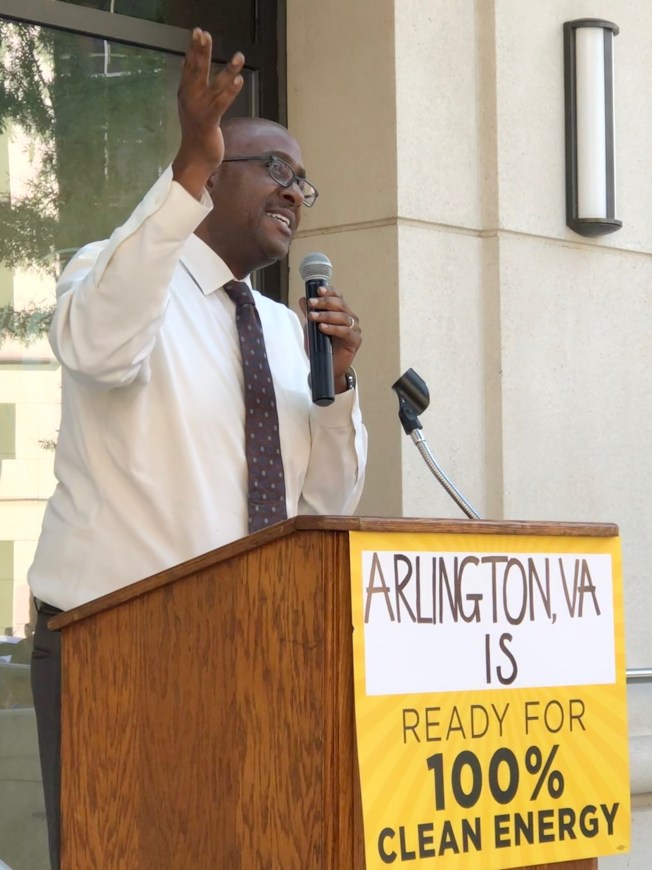
Man at podium

Arlington County Board Chair Christian Dorsey speaking to clean energy supporters on September 21, following the Board’s adoption of its new Community Energy Plan. Arlington’s plan would produce a carbon-free grid 15 years earlier than Governor Northam’s plan, while also tackling CO2 emissions from transportation and buildings.

A single week in September brought an unprecedented cascade of clean energy announcements in Virginia. On Tuesday, September 24, Governor Northam issued an Executive Order aimed at achieving 30 percent renewable energy by 2030 and 100 percent carbon-free energy by 2050, and with near-term state procurement targets.

On Thursday, Dominion Energy announced it would fully build out Virginia’s offshore wind energy area by 2026, in line with one of the goals in the Governor’s order.

Then, Saturday morning, the Democratic Party of Virginia unanimously passed resolutions endorsing the Virginia Green New Deal and a goal of net zero carbon emissions for the energy sector by 2050.

Saturday afternoon, Arlington became the first county in Virginia to commit to 100 percent renewable electricity by 2035, and economy-wide carbon neutrality by 2050.

So is Virginia off to the clean energy races? Well, let’s take a closer look at that Executive Order.

The governor’s order sounds great, but how real are its targets?

Executive Order 43, “Expanding access to clean energy and growing the clean energy jobs of the future,” directs the Department of Mines, Minerals and Energy (DMME) and other state agencies to “develop a plan of action to produce 30 percent of Virginia’s electricity from renewable energy sources by 2030 and one hundred percent of Virginia’s electricity from carbon-free sources by 2050.”

The difference between “renewable energy” and “carbon-free” sources is intentional. The latter term is a nod to nuclear energy, which provides about a quarter of Virginia’s electricity today. Keeping Dominion’s four nuclear reactors in service past 2050 may not prove feasible, economical or wise, but the utility wants to keep that option open.

The order also doesn’t define “renewable energy.” It talks about wind and solar, but it doesn’t specifically exclude carbon-intensive and highly-polluting sources like biomass and trash incinerators, which state code treats as renewable. Dominion currently meets Virginia’s voluntary renewable energy goals with a mix of old hydro and dirty renewables, much of it from out of state. Dominion will want to keep these subsidies flowing, especially for its expensive biomass plants, which would undermine the carbon-fighting intent of the order.

Finally, there is the question whether all of the renewable energy has to be produced in Virginia. Old Dominion Electric Cooperative, which supplies electricity to most of the member-owned cooperatives in the state, buys wind energy from outside Virginia. Surely that should count. But what if a Virginia utility just buys renewable energy certificates indicating that someone, somewhere, produced renewable energy, even if it was consumed in, say, Ohio? Those had better not count, or we’ll end up subsidizing states that haven’t committed to climate action.

What will DMME’s plan look like?

In describing what should be in the action plan, Northam’s order largely recites existing goals and works in progress, but it also directs DMME and the other agencies to consider going beyond existing law and policy to achieve specific outcomes:

  • Ensure that utilities meet their existing commitments to solar and onshore wind energy development, including recommending legislation to reduce barriers to achieving these goals. These goals include 500 MW of utility-owned or controlled distributed wind and solar. Customer-owned solar is not mentioned.
  • Make recommendations to ensure the Virginia offshore wind energy area is fully developed with as much as 2,500 MW of offshore wind by 2026.
  • Make recommendations for increased utility investments in energy efficiency, beyond those provided for by the passage of SB 966 in 2018, the Grid Modernization Act.
  • Include integration of storage technologies into the grid and pairing them with renewable generation, including distributed energy resources like rooftop solar.
  • Provide for environmental justice and equity in the planning, including “measures that provide communities of color and low- and moderate-income communities access to clean energy and a reduction in their energy burdens.”

Can the administration do all that?

Nothing in this part of the order has any immediate legal effect; it just kicks off a planning process with a deadline of July 1, 2020. Achieving some of the goals will require new legislation, which would have to wait for the 2021 legislative session.

That doesn’t mean the governor will sit on his hands until then – delay is the enemy of progress — but it could have the effect of slowing momentum for major climate legislation in 2020.

Cynics, if you know any, might even suggest that undercutting more aggressive Green New Deal-type legislation is one reason for the order.

A second part of Northam’s order, however, will have immediate effect, limited but impressive. It establishes a new target for state procurement of solar and wind energy of 30 percent of electricity by 2022, up from an 8 percent goal set by former Governor Terry McAuliffe. This provision will require the Commonwealth to negotiate amendments to the contract by which it buys electricity for state-owned facilities and universities from Dominion. The order also calls for at least 10 MW annually of power purchase agreements (PPAs) for on-site solar at state facilities, and requires agencies to consider distributed solar as part of all new construction.

State facilities will also be subject to new energy savings requirements to reduce state consumption of electricity by 10 percent by 2022, measured against a 2006 baseline, using energy performance contracting.

These provisions do for the state government what the action plan is intended to do for Virginia as a whole, but 8 years faster and without potential loopholes.

Thirty percent by 2030? Gee, where have we heard that before?

Just this spring, Virginia’s Department of Environmental Quality finalized regulations aimed at lowering carbon emissions from Virginia power plants by 30 percent by 2030. These numbers look so similar to Northam’s goal of 30 percent renewable energy by 2030 that it’s reasonable to ask what the order achieves that the carbon rule doesn’t. (This assumes the carbon regulations take effect; Republicans used a budgetary maneuver to stall implementation by at least a year.)

The answer goes back to the reason Dominion opposed the carbon rule. Dominion maintains—wrongly, says DEQ and others—that requiring lower in-state carbon emissions will force it to reduce the output of its coal and gas plants in Virginia and buy more power from out of state. That, says Dominion, would be bad for ratepayers.

As the company’s August update of its Integrated Resource Plan showed, Dominion would much prefer a rule requiring it to build more stuff of its own. As it turns out, that would be even more expensive for ratepayers, but definitely better for Dominion’s profitability.

So legislation to achieve Governor Northam’s renewable energy goals would take the pain out of the carbon regulations for Dominion. Whether it might also lower carbon emissions beyond DEQ’s 30 percent target remains to be seen.

The 2050 carbon-free goal, on the other hand, goes beyond anything on the books yet. Dominion’s corporate goal is 80 percent carbon-free by 2050, and it has no roadmap to achieve even that.

Is there anything in the order about pipelines?

No. In fact, there is no mention of any fossil fuel infrastructure, though shuttering coal and gas plants is the main way you cut carbon from the electricity supply.

That doesn’t mean Northam’s order leaves the Mountain Valley and Atlantic Coast pipelines in the clear. If Dominion joins Duke Energy in its pledge to go to zero carbon by 2050, the use of fracked gas to generate electricity in Virginia and the Carolinas has to go down, not up, over the coming decades (Duke’s own weird logic notwithstanding). As word gets around that Virginia is ditching fossil fuels, pipeline investors must be thinking about pulling out and cutting their losses.

What about Dominion’s offshore wind announcement?

I saved the best for last. For offshore wind advocates like me, Dominion’s announcement was the really big news of the week: it’s the Fourth of July, Christmas and New Years all at once. Offshore wind is Virginia’s largest long-term renewable energy resource opportunity, and we can’t fully decarbonize without it.

Dominion has taken a go-slow approach to offshore wind ever since winning the right to develop the federal lease area in 2013. Until this year, it refused to commit to anything more than a pilot project. The two, 6-MW turbines are currently under construction and will be installed next summer.

Then in March, Dominion CEO Tom Farrell told investors his company planned to build one commercial offshore wind farm, of unspecified size, to be operational in 2024. In its Aug. 28 resource plan update filed with the state regulators, Dominion Energy Virginia included for the first time an 880-MW wind farm, pushed back to 2025.

A mere three weeks later, the plan has changed to three wind farms, a total of 220 turbines with a capacity of 2,600 MW, with the start date moved up again to 2024, and all of them in service by 2026, exactly Northam’s target (except his was 2,500 MW).

Certainly the case for developing the full lease area has been improving at a rapid clip. Costs are falling dramatically, and it appears Dominion expects to maximize production by using massive 12 MW turbines, which did not even exist until this year.

But if the situation has changed that dramatically from August to September, all I can say is, I can’t wait to see what October brings.

Maybe it will bring answers to questions like who will build these wind farms, who will pay for them, and how Dominion expects to meet this accelerated timeline. As Sarah Vogelsong reports, several northeastern states have wind farms slated for development in the early-to-mid-2020s, too. Industry members are already worried about bottlenecks in everything from the supply chain to installation vessels, workforce training and the regulatory approval process.

That is to say, we’re coming to the party pretty late to expect good seats. But hey, it’s going to be a great party, and I’m glad we won’t miss it.

This article originally appeared in the Virginia Mercury on September 27, 2019.

Unknown's avatar

Ignoring state climate rules, Dominion decides what carbon regulations should look like

woman in dinosaur costume holding sign reading clean energy now

Four out of five dinosaurs agree. The fifth, that would be Dominion. Photo courtesy of Sierra Club Virginia Chapter.

For several years now, Dominion Energy Virginia has factored into its plans an assumption that electricity from carbon-emitting power plants will eventually include a cost reflecting CO2’s role as the primary driver of global warming. Dominion says it has even integrated this into its corporate goals, targeting an 80 percent reduction in CO2 emissions by 2050.

That promise may be more propaganda than corporate lodestar, but in any case the utility’s Integrated Resource Plans regularly point to the probability of future carbon regulations as a reason to build new renewable energy facilities and close old coal plants.

Planning for constraints on CO2 emissions proved wise this spring when Virginia’s Department of Environmental Quality finalized a state carbon cap-and-trade program. The DEQ regulations call for Virginia power plant owners to trade carbon allowances with those in the member states of the Regional Greenhouse Gas Initiative (RGGI). A Republican budget maneuver has delayed implementation of the new rules, but once they take effect they are expected to hasten the retirement of expensive old coal plants and support investments in new renewable energy projects.

But it’s not the DEQ regulations that Dominion is planning around. The utility’s 2019 update to its 2018 IRP, filed with the State Corporation Commission on Aug. 29, treats the DEQ regulations as hypothetical. Instead, it posits some unspecified future federal carbon regulations that, apparently, it would like much better.

The update describes three alternative scenarios, down from five in the 2018 IRP. The first is a “base case” that assumes no carbon emission constraints. The second assumes the state carbon limits take effect as well as some future federal regulations, and the third assumes federal (but not state) limits. However, the cover letter makes it clear that only the third scenario actually describes what Dominion intends to do. As it happens, that is the most expensive— and most profitable —plan.

The primary feature of the base case is that it keeps some old coal units running that will be closed in the other scenarios. According to Dominion, this makes it the least-cost approach to meeting electricity demand. Whether that’s true is a matter of dispute; these units hardly run at all any more, and experts for environmental organizations in the IRP hearing testified that retiring them will save money for customers.

It suits Dominion’s political strategy, however, to pretend that coal remains a low-cost option. This fiction makes coalfield legislators happy, and it allows Dominion to blame rising electricity rates on environmental regulations instead of on its own profligate spending and excess profits.

But Dominion Energy made a big bet on fracked gas, not coal. It won’t fight to keep outdated coal plants online and spewing out CO2 if it’s cheaper to close them. Gas plants are another matter. Dominion Energy’s massive investments in gas transmission and storage make the company keen to keep Virginia gas plants running full-tilt, and to build as much new gas generation as possible.

For that reason, Dominion hates the DEQ regulations. It warns the regional cap and trade plan will result in power from outside the state replacing electricity from Dominion’s combined-cycle gas plants, which provide baseload power. Dominion argues this will lead to higher, rather than lower, carbon emissions as well as higher consumer costs.

DEQ and others disagree on both counts, though the SCC takes Dominion’s view. So although Dominion labels its second scenario RGGI-compliant, it treats the DEQ regulations as hypothetical, as if Gov. Ralph Northam might change his mind any day now and order them scrapped.

Instead, Dominion offers its third scenario, positing only unspecified and (with Trump as president) truly hypothetical future federal carbon regulations. In Dominion’s fantasy, a federal plan will be strong enough to support Dominion building profitable new renewable energy and storage projects, but not so strong that it can’t also build a bunch of new gas plants.

Ergo, that’s what Dominion is shooting for. The cover letter accompanying the IRP update makes it clear that Dominion is already pursuing projects that appear only in the third plan. These include a 300 MW pumped hydro storage project that will take a decade to develop and cost upwards of $1.5 billion (if indeed it pans out), and an 852 MW offshore wind project slated for 2025, a year later than what Dominion told investors in March.

The third scenario also includes more than 3,000 MW of solar between now and the end of 2034, but that’s actually a whole lot less solar than under the RGGI scenario. Even the base case has more solar. Go figure.

Still missing is the rest of the 2,000 MW of offshore wind that the Virginia lease area can support. Also still missing are thousands more megawatts of wind and solar that Virginia would need if, instead of a gas-friendly plan, the federal government were to enact regulations actually sufficient to the climate crisis.

Dominion has not even modeled that possibility. The update’s third scenario still includes 10 new fracked-gas combustion turbines, a total of 2,425 MW, with two units coming online every year from 2022 through 2026.

Maybe the Dominion executive team thinks it knows more than the rest of us do about the federal climate plan we’ll see once Donald Trump is sent packing in 2020. More likely, Dominion is simply using its IRP carbon assumptions to bolster its case for more spending and higher profits.

In which case, the more things get updated, the more they stay the same.


This article originally appeared in the Virginia Mercury on September 13, 2019.

Unknown's avatar

Dominion Energy’s new choices are really about limiting choices

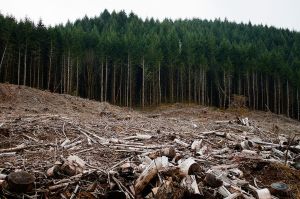
Trees clearcut.

Dominion’s renewable energy products contain copious amounts of biomass, also known as burning trees. Photo by Calibas, Creative Commons.

An annual survey conducted by Yale and George Mason universities shows concern about climate change is surging. Seventy-three percent of Americans think climate change is happening, and 69% are at least somewhat worried about it, the highest percentages since the surveys began in 2011.

Another Yale survey found that “a large majority of registered voters (85%) – including 95% of Democrats and 71% of Republicans – support requiring utilities in their state to produce 100% of their electricity from clean, renewable sources by 2050. Nearly two in three conservative Republicans (64%) support this policy.”

Yet here in Virginia, Dominion Energy expects to reduce carbon emissions less in the future than in the past, and it has no plan to produce 100% of its electricity from clean, renewable sources by 2050. For all the talk here of solar, Virginia still had one-seventh the amount of solar installed as North Carolina at the end of 2018 and no wind energy.

Dominion has developed a few solar projects and new tariffs to serve tech companies and other large customers, but ordinary residents still lack meaningful choices. So this spring, Dominion decided to do something about that.

The wrong thing, of course.

Dominion has asked the State Corporation Commission for permission to market two quasi-environmentally-responsible products. One is for people who are willing to pay a premium for renewable energy, and don’t read labels, and the other is for people who want a bargain on renewable energy, and don’t read labels.

There may be plenty of both kinds of customers out there, but that doesn’t mean the SCC should approve either product. Indeed, while the purpose of the bargain product is to offer a choice nobody wants, the purpose of the premium product is to close off better choices.

Let’s look first at the product for bargain-hunters, a super-cheap version of the utility’s Green Power Program. Dominion is calling it “Rider REC.” A better name for it would be the “You Call This Green? Power Program.”

Rider REC consists of the dregs of the renewable energy category, the stuff that isn’t good enough for the Green Power Program. That’s a low bar already, because the Green Power Program doesn’t sell green power. It sells renewable energy certificates (RECs), the “renewable attributes” of electrons from facilities labeled renewable.

Customers who pay extra for RECs still use whatever mix of energy their utility provides. For Dominion customers, that’s fracked gas, nuclear and coal, plus a tiny percentage of oil, biomass, hydro and solar.

Buying RECs lets good-hearted people feel better about using dirty power by donating money to owners of renewable energy facilities somewhere else. The facilities might be in Virginia, or they might be clear across the country.

For example, say a utility out west builds a wind farm because wind is the cheapest way to generate power. If the state doesn’t have a renewable portfolio standard that requires the utility to use the RECs for compliance (most windy states don’t), the RECs can be sold to buyers in liberal East Coast states, lowering energy prices for the utility’s own customers.

RECs don’t even have to represent clean sources like wind. Some RECs subsidize industries that burn trees (aka biomass), black liquor (a particularly dirty waste product of paper mills) and trash.

Dominion’s Green Power Program uses RECs that meet the standards of a national certification program called Green-e. Green-e requires that facilities be no more than 15 years old and meet minimum environmental standards, such as requirements that woody biomass be sustainably grown and that generators don’t violate state and federal pollution limits.

But Virginia’s definition of renewable energy is, shall we say, more forgiving than Green-e’s. Our law does not discriminate against decades-old facilities like hydroelectric dams, or energy from trees that have been clear-cut. (Nor does it recognize that burning trees produces even more lung-damaging, asthma-inducing pollution than coal, and more climate-warming CO2 as well.) Virginia’s definition of renewable energy even includes a vague category of “thermal” energy that may be another way paper mills profit from the REC racket.

This loose definition of “renewable” creates a business opportunity for anyone unscrupulous enough to seize it. Dominion proposes to package up these otherwise unmarketable RECs from sketchy sources across the continental United States and pawn them off on unsuspecting consumers here in Virginia.

There is always money to be made by suckering well-meaning folks, but that’s not a good enough reason for the SCC to let Dominion do it. The case is PUR-2019-00081. Public comments are due by Aug. 15.

So what about the more expensive quasi-environmentally responsible product? “Rider TRG” consists of real, straight-from-the-facility electricity on the power grid serving Virginia, not RECs from out west. And while it is not dirt-cheap like Rider REC, Rider TRG would cost residential customers a premium of only about $50 per year.

Unfortunately, Virginia’s kitchen-sink definition of renewable energy means the sources still don’t have to be new or carbon-free or sustainable. It appears most of them won’t be.

Dominion’s filing indicates the program will use the energy from the Gaston hydroelectric dam built in 1963; the Roanoke Rapids hydro station built in 1955; the Altavista, Southampton and Hopewell power stations that were converted from coal to wood-burning in 2013; and several solar farms the company has already built or contracted for.

In addition, Dominion proposes to allocate to the program the portion of electricity from its Virginia City coal plant representing the percentage of wood that is burned along with the coal.

That’s right, Dominion intends for renewable energy buyers to subsidize its coal plant. The idea is cynical enough to have come from the Trump administration.

Dominion knows full well that customers who want renewable energy want new wind and solar, so why is its first product for residential customers so loaded with dirty biomass and old hydro?

The answer is that Dominion doesn’t care if no one signs up for Rider TRG. The point isn’t to give customers what they want, it’s to prevent them from shopping elsewhere for better options. Like Appalachian Power before it, Dominion wants to close off the narrow opening provided by Virginia law that allows customers to shop for 100% renewable energy from other providers only if their own utility doesn’t offer it. The SCC approved APCo’s renewable energy tariff some months ago. Dominion is following APCo’s successful strategy.

Yet APCo’s product consists of hydro, wind and solar, so it is nefarious, but not actually bad. Dominion’s is nefarious and bad.

An SCC decision in 2017 confirmed customers’ right to shop for renewable energy as long as the incumbent utility doesn’t offer it. Currently at least two other providers, Direct Energy and Calpine Energy Solutions, offer renewable energy to commercial customers in Dominion territory. Yet according to documents provided by Direct Energy, Dominion is refusing to let its customers transfer to Direct Energy and Calpine, triggering competing petitions to the SCC.

Dominion no doubt hopes to resolve the dispute permanently by terminating its customers’ right to switch providers at all.

The case is PUR-2019-00094. Comments may be submitted until Nov. 14, and a public hearing will be held on Nov. 21.


This article first appeared in the Virginia Mercury on July 22, 2019.


UPDATE November 5: The SCC approved Dominion’s Rider REC, the Green Power For Suckers program, on October 31, disregarding the recommendation of SCC staff to deny it. It hasn’t yet ruled on Rider TRG. However, the SCC staff has pointed out that if Dominion left the controversial biomass elements out of the program, it would cost less than half as much.

Unknown's avatar

Dominion’s plans to tackle global warming are mostly hot air

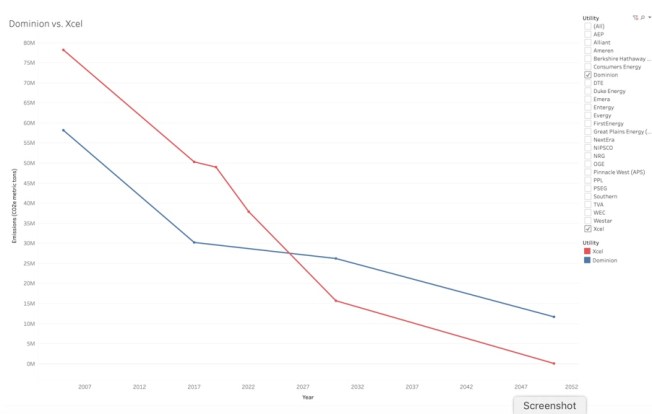
Graph compares CO2 reductions by Dominion Energy and Xcel

Dominion (blue line) starts out with lower total CO2 emissions than the larger Xcel (red line), but after switching out old coal for new fracked gas, Dominion’s carbon-cutting slows to a crawl, while Xcel’s keeps going.

My readers will be shocked, shocked to learn that contrary to Dominion Energy’s propaganda, the company plans to cut carbon emissions by only about 1% per year between now and 2030, a slower pace than it has achieved in the past.

According to an analysis of Dominion’s own data by the Energy and Policy Institute, “the company reduced its carbon emissions at an average rate of 4% per year from 2005 to 2017, mostly by retiring coal plants in the later years of that period. That reduction rate plummets to 1% per year between now and 2030 under Dominion’s new goal.”

“The company’s reduction pace would increase again between 2030 and 2050 in order to meet its later goal [of 80% carbon reduction from 2005 to 2050], though only to about 2.8%, still lower than its pace from 2005 to 2017.”

Fracked gas investments are both the reason Dominion has brought carbon emissions down as much as it has, and the reason it can’t keep up the pace. Closing expensive, old coal plants is an easy way to cut carbon and save money at the same time. Replace the output of a coal plant with the same output from a gas plant, and you’ve slashed carbon emissions almost in half overnight.

But it’s not such a great trick if it requires you to build a new gas plant with a useful life of 30 years. That makes it much harder to decarbonize further by replacing gas with carbon-free renewables.

This is exactly Dominion Energy Virginia’s problem. A comparison of the utility’s 2013 and 2018 integrated resource plans shows coal fell from 22% of the total energy mix to 18%, while natural gas jumped from 17% to 32%, displacing purchased energy as well as coal.

The company achieved this feat with three new, huge combined-cycle gas plants it brought online just in the past five years: Warren (1,370 MW) in 2014, Brunswick (1,358 MW) in 2016, and Greensville (1,588 MW) in 2018. Together these plants increased Dominion’s natural gas generating capacity by more than 50%.

Not only did Dominion stick utility ratepayers with these big new gas plants, its parent company promised investors the utility will burn enough gas to justify spending $7 billion-plus on the Atlantic Coast Pipeline. Decarbonizing violates the business plan.

Dominion is in good company — by which I mean bad company — in making bold claims about carbon cuts that prove inadequate on closer inspection. According to the Energy and Policy Institute, the other southeastern monopoly utilities, Duke, Southern, and NextEra, are all using the same playbook.

Other utilities have avoided the gas trap. National leaders like Minneapolis-based Xcel, Consumers Energy in Michigan, and NIPSCO in Indiana are replacing coal with renewables and leapfrogging over new gas. That puts them in a position to deliver on their promises of rapid emissions cuts.

The Energy and Policy Institute analysis pointedly contrasts Xcel with Dominion:

Xcel Energy is one of the country’s largest electric utilities, with operations in eight states, primarily Colorado and Minnesota. Xcel pledged in December 2018 to reduce its carbon emissions 80 percent by 2030 from 2005 levels, and to fully decarbonize by 2050. Xcel’s new goal is an upgrade of a previous one to cut carbon emissions 60 percent by 2030. It says it plans to lean heavily on renewable energy and batteries will save its customers money. In a detailed report released in March, Xcel says its goals fall within the range compatible with Intergovernmental Panel on Climate Change scenarios that achieve either a 2°C or 1.5°C target.

Graphing Xcel’s trajectory vs. Dominion’s is telling: the companies’ decarbonization pathways tracked one another closely from 2005 until 2017. At that point, Xcel’s trajectory starts turning sharply downward, while Dominion’s flattens out.

Another contrast you’ll notice between Xcel and Dominion: Dominion has no plans to get to zero emissions, ever. It’s hard not to conclude that the company’s leaders are simply putting the best climate face on a gas strategy that hasn’t changed.

Eventually, though, the falling costs of wind and solar and the public’s demand for climate action will force Dominion to follow Xcel and others into deep decarbonization.

It may not be the business plan, but it is the future.

This post was originally published in the Virginia Mercury on July 15, 2019. 


Unknown's avatar

Customer-owned utilities should be leaders on clean energy. Why do most of them fail to deliver?

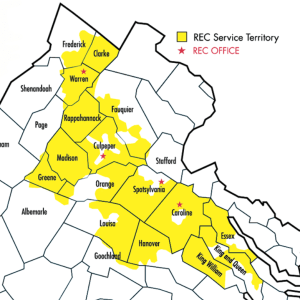
map shows territory of Rappahannock Electric Cooperative

The territory of the Rappahannock Electric Cooperative in Virginia, from the coop’s website.

More than one in six Virginia residents gets electricity from a rural electric cooperative rather than a big investor-owned utility like Dominion Energy or Appalachian Power. Co-ops don’t get much attention from clean energy advocates and the press, but that might be a mistake. Co-op members aren’t just customers; they’re owners.

In theory, that should put co-ops at the head of the energy transition.

The current reality is mostly quite different, both in Virginia and nationwide. While a few co-ops have adopted innovative customer-friendly programs, most actively resist change. Here in Virginia, a battle over reform of the Rappahannock Electric Cooperative (REC) shows how difficult it is for co-op members to make their voices heard.

According to the reform group Repower REC, the co-op’s management not only refuses to make changes that would save members money, it actively cuts members out of the decision-making process. Repower REC is endorsing a slate of reform board candidates and proposing amendments to the co-op’s bylaws that would give members the right to fair elections and to obtain basic information about REC’s management and finances.

The lack of transparency and democracy at REC turns out to be a common failing of co-ops. A 2016 report from the Institute for Self-Reliance described three reasons why co-ops are laggards rather than leaders in the energy transition: overreliance on coal, long-term contracts with suppliers and a failure of democracy in governance.

Coal accounts for 75% of energy generated by electric cooperatives nationwide, compared to less than 28% today for all utilities nationally. Worse, failing to see the promise of distributed generation, most co-ops have locked themselves into long-term supply contracts that give them little room for self-generation with solar and wind. Having tied their members to fossil fuels, it’s not surprising that co-op managers don’t want their governance scrutinized too closely.

In fact, stuck with the dirty black stuff, rural electric cooperatives are much more likely than investor-owned utilities to support coal and oppose climate regulations. This may even help explain why rural voters are so much more likely than urban voters to support coal even in non-coal states, and to doubt climate science. Certainly their co-ops, which are supposed to educate consumers about the electric power industry, are not helping to educate them about the realities of climate science.

But according to the Institute’s report, it’s the third reason that holds co-ops back the most. Co-op member-owners have the right to vote but mostly don’t, often because they’re presented with no real choices, and lack basic information needed to cast an informed vote.

A host of other barriers, such as a lack of transparency, and the practice of collecting blank “proxy ballots” that incumbent board members complete as they see fit, ensures the reelection of entrenched board members and their hand-picked successors. Board members pay themselves handsomely for very part-time work, with many staying on boards for decades if not life.

All of these problems are present at REC, according to Repower REC. Seth Heald, a Repower REC founder who’s been an REC member for over a decade, says “the total lack of transparency surrounding the co-op’s board meetings seems designed to keep REC members from knowing whether their board members are well-informed, engaged and advocating for consumers. It also prevents us from learning the extent to which management may exercise control over compliant board members.”

To be fair, other Virginia co-ops show the promise of the member-owned model. The only community solar programs offered in Virginia today are run by coops: BARC in southwest Virginia and Central Virginia Electric Cooperative in the Charlottesville area. BARC also installed solar on all three Bath County schools, putting it way ahead of larger and richer jurisdictions like Fairfax and Loudoun that get power from Dominion.

Virginia co-ops also reached a deal with the solar industry this year designed to ease some of the barriers to rooftop solar, a deal neither Dominion nor APCo would agree to.

But Virginia co-ops haven’t adopted the kinds of aggressive energy efficiency programs that have lowered energy demand and saved money for members of the nation’s most innovative co-ops, such as Roanoke Electric Cooperative in North Carolina and Ouachita Electric Cooperative in Arkansas. In both places, utility financing of efficiency improvements and federal grants from the Department of Agriculture have allowed even very low-income members to pay for insulation and appliance upgrades while simultaneously lowering electric bills.

(Ouachita also installed Arkansas’ largest solar farm in 2017.)

It’s hard to believe more co-ops wouldn’t offer programs like these if they truly had their members’ interests at heart.

REC members will be voting this month on board candidates and Repower REC’s proposed bylaw amendments, using proxy/ballot forms attached to the cover of the July Cooperative Living magazine. Forms must be mailed back in time to arrive by Aug. 19. Members may also vote through REC’s SmartHub online tool by Aug. 19, or in person at the August 22 annual meeting.

Unknown's avatar

Lies, damn lies, and advertising: Dominion goes for the green

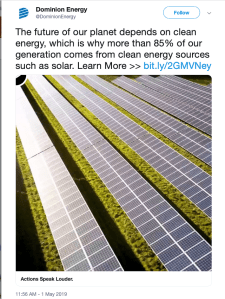
Twet from Dominion Energy claiming its power is 85% green. Picture shows solar panels.

From Dominion Energy’s Twitter feed.

Recently I criticized a Dominion Energy advertisement that boasted, misleadingly and inaccurately, about the company’s investments in solar energy.

By contrast, the company’s investments in greenwashing are transparent and heartfelt. Dominion has suffered through several bad months here in Virginia and would very much like to change the conversation.

Indeed, the company’s problems keep mounting. In the course of just two days this month, SCC commissioners lit into the company for telling Wall Street one thing and regulators another; the corporate customers behind Virginia’s data center boom filed a letter saying they want no part of Dominion’s fracked-gas build-out; and a coalition of libertarian, environmental and social justice groups called for a breakup of Dominion’s monopoly.

Fortunately, Dominion’s PR offensive was only just ramping up. A full-page newspaper ad, predictably light on detail, promises the company will cut its climate-heating methane emissions in half. That would be a nice trick from the company whose Atlantic Coast Pipeline will be responsible for more greenhouse gas emissions than all Virginia’s power plants put together.

In case you doubt the company’s sincerity, Dominion just joined a corporate coalition calling for a price on carbon. This must have been in the works about the same time Dominion was criticizing Virginia’s proposed entry into the Regional Greenhouse Gas Initiative, which actually puts a price on carbon.

Hey, The Washington Post fell for it. Greenwashing works.

And that brings us to the (literally) incredible claim that recently appeared in Dominion Energy’s Twitter feed: “The future of our planet depends on clean energy, which is why more than 85% of our generation comes from clean energy sources such as solar.”

Let us pause for a moment to reflect that this tweet comes from a company whose solar generation amounts to a rounding error.

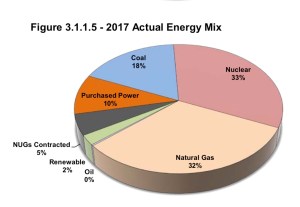
Pie chart showing sources of electricity.

From Dominion Energy Virginia’s 2018 Integrated Resource Plan.

Dominion Energy Virginia’s most recent Integrated Resource Plan includes a handy pie chart revealing what is actually in its energy mix:

  • Nuclear: 33%
  • Natural gas: 32%
  • Coal: 18%
  • Purchased (wholesale) power: 10% (that’s coal and gas)
  • Non-Utility Generation (purchased under contract): 5% (more coal)
  • Renewable: 2% (almost all hydro and biomass, plus a smidgen of solar)
  • Oil: 0%

Now, it is true that Dominion Energy the holding company owns more generation than Dominion Energy Virginia the electric utility. For one thing, it just bought another utility in South Carolina. According to the information Dominion provided to investors in March, its South Carolina generation looks like this:

  • Natural gas: 39%
  • Coal: 36%
  • Nuclear: 21%
  • Hydro: 3%

Nobody looking at these figures could find a basis in reality for a claim of 85% clean energy. It is so preposterous that I just have to ask: Why only 85%?

I mean, seriously, if you have traveled this far into the realm of fantasy, why not claim 100%? Or heck, with a nod to Spinal Tap, why not 110%? Clearly the people making this stuff up are rank amateurs.

All of which is to say: come on, Dominion, you can do better.

Unknown's avatar

Dominion keeps trying to pull the wool over our eyes


Sheep like these are used to keep grass mowed around solar panels.

Dominion’s ad would have done a better job of distracting us if it had included baby animals. Their failure is my opportunity! These lambs keep the grass short around the solar panels at a farm near New Hope, Virginia. Owners Ann and Riley Murray shared this picture.

When your kid greets you at the door with the cheery news that he’s swept the floor for you without being asked, you are probably right to wonder which breakable item is no longer in its usual place.

I have the same feeling about the series of full-page ads Dominion Energy has taken out in newspapers over the past few weeks bragging about the company’s investments in solar energy. The ads are misleading—I’ll get to that in a minute—but the more interesting question is what the company is up to that it hopes we’re too busy looking at solar panels to notice.

Here are some possible answers:

• It was recently reported that Dominion Energy paid no federal income tax for 2018, in spite of earning over $3 billion in U.S. income. In fact, the company received a $45 million rebate, making its effective tax rate -1%. That’s pretty sharp manipulation of the tax laws. No wonder CEO Thomas Farrell II is the highest paid executive in the utility sector, with a reported $20.6 million in income.

• Most of that untaxed income comes from customers here in Virginia, but not all of it is earned. Let’s recap just a few of the high points: In 2014, the General Assembly passed a law letting Dominion charge customers for hundreds of millions of dollars incurred in planning for a new nuclear plant the company isn’t building. Then in 2015 Dominion persuaded legislators to “freeze” regulators’ ability to examine the books and order refunds of what turned out to be hundreds of millions more in customer overpayments. Regulators said the number might eventually rise as high as a billion dollars. When grumbling about that reached a fever pitch, Dominion persuaded the still-compliant (!) legislature to pass another billlast year letting it spend the money instead of refunding it.

• After getting authority to spend all that customer money, one of Dominion’s first moves was to interpret “spending” as “keeping.” Instead of the massive spending on energy efficiency that the legislature put into the law, Dominion tried to discount the number by 40 or 50% so it could keep the rest as “lost revenue.”

• Dominion’s Atlantic Coast Pipeline could shape up to be a huge profit center for the company, but also a huge financial burden for utility customers. Dominion fought hard against a bill this year that would have protected customers if and when the pipeline ever gets built. The company eventually defeated the bill in a Dominion-friendly Senate committee, but not before voting revealed deep fault lines in the House.

• Slides from a presentation to an investor meeting in March show Dominion bragging about Virginia having a favorable regulatory environment (read: utilities get their way).

• That presentation caught the interest of several House Democrats for another reason: it boasted customer-funded spending numbers at least $3 billion higher than it gave its regulators at the State Corporation Commission just two weeks before. In a news release May 2, the seven delegates demanded Dominion produce a full accounting of its future spending plans. Del. Elizabeth Guzman, D-Prince William, whose office issued the release, said “Dominion’s days of facing no consequences when telling Virginians one thing and Wall Street another are coming to an end. The SCC is right to uncover Dominion’s inconsistencies and hold the monopoly accountable since it is Virginia ratepayers who will ultimately pay the price.”

• The delegates also noticed Dominion has decided it wants to make even more profit from its Virginia customers. This spring the company asked the State Corporation Commission to raise its rate of return on common equity from 9.2% to 10.75%, an astounding increase at a time of low interest rates and easy access to capital. Dominion may believe that by overreaching, it will win some middle ground. In the March presentation, Dominion told shareholders the company expects to earn an average 10.2% return on equity from its Virginia investments, still a full percentage point higher than the utility is currently authorized to earn.

• The Virginia Attorney General’s Office is fighting Dominion’s attempts to collect $247 million from ratepayers for environmental upgrades at its Chesterfield power plant, calling the spending “imprudent” given that it will provide “little or no value to customers.”

All of this should feel pretty brazen to Virginia leaders and the public, but when you want something you don’t deserve, it helps to be shameless.

Yet at least some Dominion leaders seem to be aware that other people think the company should be ashamed of its greed, and that some of these people are voters who may eject its friendly legislators from office this fall. Their answer is to run an ad about solar panels to distract us and change the conversation.

But the ad just starts its own conversation — and not in the intended way.

The ad brags, “At Dominion Energy, we’ve increased the number of solar panels in Virginia from 5,250 to over 2 million since 2015. And we’re now the 4th largest solar producer in the nation.”

First off, a minor point, but a symptomatic one: that “fourth largest” claim doesn’t hold up. As of last September, a ranking of the largest solar owners put Dominion in 10th place. Even using the updated number (2,600 MW) from Dominion’s March 2019 investor presentation wouldn’t get the company to fourth place unless other companies have been hastily selling off projects. It does appear Dominion can rightly claim to be the fourth largest solar owner among energy holding companies that own electric utilities. But so what?

The Virginia number catches our attention, though. Two million solar panels sounds like a lot. It’s just that — well, somebody check my math here, but if those are average 300-watt panels, that comes out to 600 MW, which is a pitifully small amount compared to Dominion’s fossil fuel investments. We’re glad to have any solar at all, but it isn’t something to write friends in California about (they’ve got 24,000 MW of solar and counting).

Speaking of California, that and North Carolina are where the rest of Dominion’s solar projects are, in case you’re wondering. The laws are better there. Dominion didn’t write their laws.

Also, while we are at it, almost none of the solar Dominion is developing is for ordinary residents, in spite of what the ad implies. Almost all of it is for data centers and other large customers. Dominion is counting the 350 MW of solar it is developing for Facebook towards the commitment it made to the General Assembly last year to develop 3,000 MW of renewable energy by 2022.

Legislators who thought Dominion would build a lot of solar for regular folks when they agreed to last year’s boondoggle bill should find that disappointing. If they didn’t get solar for their constituents, what exactly did they get?

Unfortunately for Dominion, that brings us back to the long list of things the company was hoping we would ignore while we look at bright shiny objects. Ads about solar panels aren’t enough to distract people from the billions of dollars Dominion is taking from our pockets.

Perhaps the executives at Dominion will conclude the ad just wasn’t good enough. Next time they could try putting sheep in the picture with the solar panels. Especially baby sheep.

Maybe they thought about it and were afraid it would remind Virginians they were getting fleeced.

But they had better try something. Because right now, frankly, no one is distracted.

This article first appeared in the Virginia Mercury on May 6, 2019. 

Unknown's avatar

A revised generation plan leaves Dominion’s case for its pipeline in shambles

In December of last year, regulators at the State Corporation Commission (SCC) took the unprecedented step of rejecting Dominion Energy Virginia’s Integrated Resource Plan (IRP). Among other reasons, the SCC said the utility had over-inflated projections of how much electricity its customers would use in the future.

On March 8, Dominion came back with a revised plan. And sure enough, when it plugged in the more realistic demand projections used by independent grid operator PJM, and accounted for some energy efficiency savings, the number of new gas plants it planned for dropped in half. Instead of 8-13 new gas combustion turbines, the revised plan listed only 4-7 of these small “peaker” units.

Yet there is a good chance Dominion is still overinflating its demand numbers.  Although the re-filed IRP is short and vague, it appears Dominion isn’t figuring in the full amount of the energy efficiency programs it must develop under legislation passed last year.

SB 966 required Dominion to propose $870 million in energy efficiency and demand-response programs designed to reduce energy use and the need for new generation. But Dominion has proposed just $118 million in its separate demand-side management filing (case PUR-2018-00168).

Moreover, the company has concocted a theory whereby it can satisfy that $870 million requirement by spending just 40 or 50 percent of it and pocketing the rest. In its DSM case Dominion argues that since the Virginia Code allows a utility to recover lost revenue resulting from energy efficiency savings, it can simply reduce the required spending by the amount of lost revenue it anticipates.

It’s a great theory, and suffers only from being wrong. (Oh, and also from infuriating legislators, energy efficiency advocates, and pretty much everyone else who was involved in crafting SB 966.)

It also indicates that Dominion’s demand figures in the IRP are based on plans to spend just a fraction of the $870 million in energy efficiency, achieving much less demand reduction than backers of the law envisioned.

If the SCC decides Dominion can’t withhold hundreds of millions of dollars in efficiency spending, that additional spending will have to be factored into demand projections. Thus the IRP’s demand projection can only go down—and with it, the number of gas plants that might be “needed.”

And yet even the resulting number is likely too high. Several of Dominion’s large corporate customers have been trying to leave its fond embrace to seek better renewable energy offerings elsewhere. (The SCC recently rejected Walmart’s effort to defect.) If they were allowed to leave, how much would that further reduce the need for new generation?

For that matter, those customers and many others, including many of the tech companies responsible for what demand growth there is, say they want renewable energy, not fossil fuels. Dominion claims the renewable generation will have to be backed by gas peaker plants, but energy storage would serve the same purpose and further reduce the need for gas. The SCC will rule on that question when—and if—Dominion ever requests permission to build one of those peakers. It is possible the utility will never build another gas plant.

That’s bad news for Dominion Energy’s other line of business, gas transmission and storage. With demand for new gas generation falling off a cliff, Dominion’s ability to rely on its customer base as an anchor client for the Atlantic Coast Pipeline becomes increasingly doubtful.

Dominion may actually have conceded as much in its re-filed IRP. In response to the SCC’s order that Dominion include pipeline costs in its modeling of the costs of gas generation, Dominion merely stated, without discussion, that it is using the tariff of the pipeline owned by the ACP’s competitor Transco, which supplies gas to Dominion’s existing plants.

This statement continues a pattern of Dominion avoiding any mention of the ACP in SCC proceedings, lest it invite hard questions. But Dominion can’t have it both ways. If it will use Transco, it doesn’t need the ACP. If it plans to use the much more expensive ACP and just isn’t saying so, it has lowballed the cost of gas generation and is misleading the SCC.

This is unfair to customers, and it may backfire on Dominion. The ACP received its federal permit on the strength of contracts with affiliate utilities, but Dominion hasn’t yet asked the SCC to approve the deal. Leaving the ACP out of the discussion in the IRP year after year makes it harder to win approval. When and if the company finally asks the SCC for permission to (over)charge ratepayers for its contract with the ACP, it will not have built any kind of a case for a public need or benefit.

This is not just a risk that Dominion Energy chose to take, it is a risk of the company’s own creation. It defied the Sierra Club’s efforts to have the SCC review the ACP contract early on, knowing it would face vigorous opposition from critics. But since then, its chances for approval have only gotten worse. Back then, the pipeline cost estimate came in at $3 billion less than it is today, Dominion Virginia Power was halfway through a massive buildout of combined-cycle gas plants, and the IRP included several more big, new, gas-hungry combined-cycle plants.

Now the ACP’s cost has climbed above $7 billion and may go as high as $7.75 billion, excluding financing costs, CEO Tom Farrell told investors last month in an earnings call. Meanwhile, the IRP includes an ever-shrinking number of gas plants, to be served by a different pipeline.

One investment management company told clients in January the spiraling price tag may make the ACP uncompetitive with existing pipelines. And Farrell faced a host of cost-related questions in his call with investors.

But Farrell downplayed the risk when it came to a question from Deutsche Bank about the need for SCC approval. Managing Director Jonathan Arnold asked, “On ACP, when you guys are talking about customers, does that include the anchor utility customers, your affiliate customers? Does whatever you’re going to negotiate with them need to be approved by the state regulatory bodies?”

Farrell’s answer sounds nonchalant. “In Virginia, it’s like any other part of our fuel clause. It will be part of the fuel clause case in 2021 or 2022 along with all the other ins and outs of our fuel clause.”

Oh, Mr. Farrell, it is not going to be that easy.

An earlier version of this article first appeared in the Virginia Mercury on March 20, 2019.

Unknown's avatar

As Virginia prepares to join carbon-trading states, arguments erupt over the price of admission

photo courtesy of the Sierra Club

Virginia won’t enter the nine-state carbon emissions trading program known as the Regional Greenhouse Gas Initiative until 2020 under regulations being finalized by the state, but debate about how much it might cost utility ratepayers is already heating up.

Estimates range from little or no cost — or even a cost savings — to as high as $12 per month for the average household, depending on who is doing the calculations and the assumptions they make.

An Associated Press article reports that State Corporation Commission staff testified before a legislative committee that joining RGGI via the Virginia Coastal Protection Act, SB 1666 and HB 2735, would cost Virginia households an added $7-12 per month. The Northam administration disputed the SCC figure, saying the true cost would be about a dollar per month.

Republicans killed the bill in both the Senate and House committees that day.

A few days later, the anti-RGGI bill, HB 2611 (Poindexter), sailed through the House on a party-line vote. It would prevent Virginia from participating in RGGI or any other carbon-reduction regimen. If it also passes the Senate in coming weeks, it faces certain veto by the governor.

So is joining RGGI an inexpensive way to incentivize utilities to save energy and lower carbon emissions, or will it pile costs onto customers?

RGGI, for those of you who need a quick brush-up on your carbon policies, is a cooperative, market-based effort that has been running in New England and the Mid-Atlantic states as far south as Maryland for the past decade.

It works by auctioning carbon pollution allowances to major emitters, gradually ratcheting down the number of allowances made available each year to incentivize conservation and the use of lower-carbon fuels. States use the money they raise to fund energy efficiency, community solar, weatherization and other programs, often focusing especially on low-income residents.

First things first: RGGI works.

According to a 2018 report by Analysis Group, the RGGI region has met its targets, and benefited economically as well:

“Over three years (2015-2017), the RGGI program led to $1.4 billion (net present value) of net positive economic activity in the nine-state region,” the report says. “Each RGGI state’s electricity consumers and local economy also experienced net benefits from the RGGI program. When spread across the region’s population, these economic impacts amount to nearly $34 in net positive value added per capita.”

Virginia’s carbon reduction plan, now in the final stages of drafting at DEQ, will have Virginia participate in the RGGI auctions but not raise money from auctioning allowances.

Beginning in 2020, RGGI will add Virginia carbon emissions (28 million tons, the baseline DEQ has chosen) to the total for the existing members (56 million tons), and our utilities will bid for and trade allowances with the utilities in the other nine states.

But unlike the existing RGGI states, under DEQ’s plan Virginia will distribute its share of carbon allowances to our utilities at no cost, based on their previous year’s electricity sales. Utilities will sell the allowances into the RGGI auction bucket and buy back as many as they need. Initially, at least, the effect on ratepayers should be pretty much a wash.

Chris Bast, chief deputy at the Virginia Department of Environmental Quality said DEQ’s modeling program estimated rates would increase about 1 percent as a result of the new regulations. That’s a much lower figure than the $7 per month the SCC estimated the program would cost even with free allowances.

State Corporation Commission spokesman Ken Schrad said the DEQ “has understated the price of carbon emissions and understated Dominion’s cost of money for future capital investments (borrowed from lenders or invested by shareholders).”

“DEQ modeled Dominion as if it was a deregulated utility in a competitive market,” Schrad said. “Dominion’s fossil fuel generating units must be paid for in rates regardless of whether they are generating electricity under its vertically integrated structure.”

Bast takes issue with this. “I don’t know where the SCC got its numbers,” Bast told me. “Many folks, including the DEQ, have done extensive modeling to determine the environmental and economic impacts of the rule. That modeling is part of the public record and is part of the extensive public process that has gone into crafting this regulation. The SCC’s analysis is an outlier by several orders of magnitude – nearly 600%. The SCC has not provided any comment about ratepayer impact during any of our regulatory proceedings.

“We’re simply asking the SCC to show their work. But, to date, they have refused to provide us with the analysis that supports their conclusions.”

Bast says DEQ has not modeled what the program would cost if utilities had to pay for allowances, as contemplated under the Coastal Protection Act. Paying for allowances, according to the SCC, could drive costs up by an additional $5 per month.

This is a moot point, for now, since the Coastal Protection Act did not pass. But advocates believe that auctioning allowances offers an opportunity to raise funds to invest in energy efficiency and climate programs, so the idea remains on everyone’s radar for next year.

How RGGI works:

Under the Coastal Protection Act, auction proceeds would go into the state’s coffers to fund energy efficiency and resiliency programs that benefit the public. Utilities would be able to recover the costs of buying allowances from their customers, so there would be more impact on rates than there would be if allowances are free.

The Coastal Protection Act takes an extra step and actually requires investor-owned utilities to build wind and solar to achieve at least 50 percent of the required emissions reduction. If that amount were to exceed what they planned to build anyway, it would mean more costs paid for by customers—though maybe not a lot, if it speeds up the retirement of old fossil fuel plants that ought to close anyway.

RGGI reduces carbon emissions over time by gradually decreasing the number of auction allowances available in the region year after year. As the carbon cap tightens, either allowances become more expensive, or utilities reduce emissions, or both.

So far the RGGI states have succeeded in reducing emissions without higher allowance prices. They have done this in large part by closing coal plants and investing in energy efficiency and renewable energy, including programs paid for by auctioning the carbon emissions allowances.

Most RGGI states also have mandates for efficiency and renewable energy, which Virginia lacks. (In spite of the hoopla around it, last year’s “grid mod” bill did not require utilities to achieve any specific efficiency or renewable energy outcomes.) The combined effect of all these actions is that the prices paid for auction allowances in RGGI have stayed low.

According to the Analysis Group, consumers in RGGI states have benefited:

“On the one hand, the inclusion of the cost of CO2 allowances in wholesale prices tends to increase wholesale electricity prices in the RGGI region at the beginning of the 2015-2017 period,” the report says.

“But these near-term impacts are more than offset during these years and beyond, because the states invest a substantial amount of the RGGI auction proceeds on energy efficiency programs that reduce overall electricity consumption and on renewable energy projects that reduce the use of higher-priced power plants. Consumers gain because their overall electricity bills go down.

“Since RGGI’s commencement in 2009, energy and dollar savings resulting from all states’ investments in energy efficiency and renewable energy has more than offset the wholesale market price increases associated with inclusion of allowance costs in market bids.”

Virginia is as well-positioned as any of the RGGI states to meet the carbon-reduction goals.

Utilities can reduce energy demand through energy efficiency, resulting in less need for carbon-emitting fuel to be burned. They can also replace coal-fired generation with power from gas (with about half the CO2 of coal) or renewables (zero C02 for wind, water and solar; biomass has CO2 emissions as high as coal, but decision-makers pretend it’s carbon neutral).

Our nuclear plants, which provide a big chunk of Virginia’s electricity, are already operating at full capacity, and that’s not expected to change.

Intuitively, the solutions wouldn’t be expected to cost very much. Some of Virginia’s coal plants aren’t running very much these days anyway, putting them precariously close to the point where it is cheaper to close them than keep paying to have them available. As for alternatives, Dominion says solar is the cheapest form of new energy.

And energy efficiency is, famously, the lowest-cost energy resource, and vastly underutilized in Virginia.

In fact, projections have Dominion coming in under the RGGI cap for at least several years, putting our utilities in the happy (for them) position of possibly making money in the auctions.

But that doesn’t quite settle the matter.

There is one other consideration that could affect rates: Virginia utilities participate in the regional transmission organization known as PJM, which runs the wholesale power market. Anything that makes Virginia power more expensive makes it less attractive to the market.

That is surely part of the SCC staff’s concern.

To understand this dynamic, I consulted economist Bill Shobe, a professor at the Center for Economic and Policy Studies at the Weldon Cooper Center for Public Service at the University of Virginia, who studies carbon markets.

Shobe said that if Virginia utilities get CO2 allowances for free based on their previous year’s electricity generation, as the DEQ plan calls for, there should be no impact on their power plants’ competitiveness in PJM. The cost to customers would be little or nothing.

But if a coal or gas plant has to add the cost of CO2 allowances to its price of power, as happens in other RGGI states, power plants from non-RGGI states that don’t have to charge for CO2 will have a price advantage.

Shobe said if a Virginia utility adds the cost of CO2 allowances to the price of power from its own fossil fuel plants, those plants won’t run as much. Even the utility itself might buy cheaper wholesale power rather than run its own plants. Worse, the imported power could be higher in CO2 than the Virginia power it displaces, a problem known as “leakage.”

Dominion Energy Virginia’s 2018 Integrated Resource Plan, a document that forecasts how the utility will meet electric demand, predicted that if Virginia joined RGGI, its four big gas plants would run only an average of 64 percent of the time in 2025, compared to 79 percent in a scenario with no carbon constraints.

Dominion also claimed the cheaper imported power would come with such a higher carbon footprint than the power it was replacing that the whole deal would be counterproductive as a CO2 reduction strategy.

Skeptics should note that Dominion didn’t report the assumptions behind the modeling. Even its consultant, ICF, included a disclaimer that it was using the information Dominion gave it but “makes no assurances as to the accuracy of any such information or any conclusions based thereon.”

It’s also not clear that Dominion recognized any difference between getting free allowances and having to pay for them.

Shobe explained that Dominion’s modeling program didn’t account for DEQ’s use of “output-based allocation”— that is, distributing carbon allowances for free based on a utility’s generation in the previous year. This approach, said Shobe, incentivizes the utility to keep generating as much zero- or low-carbon electricity as it can so it will get as many allowances the next year as possible, and it will use its allowances to keep its own power competitive with imports.

The modeling that ICF did for Dominion, say Shobe, “treats all allowances as if they are sold at auction. Period. They don’t even attempt to model free allowances much less output-based allocation.”

With free allowances, customer costs should be minimal.

What if we auction the allowances?

Shobe said auctioning allowances instead of distributing them for free would make the power from Virginia’s fossil fuel plants less competitive in the PJM market. Yet customers will still have to pay for the capital cost of these huge gas plants that the SCC itself foolishly allowed Dominion to build, even if the power they generate is less competitive in PJM.

(“Foolishly” is obviously my term for it. The SCC not only doesn’t admit it did anything wrong, it rejected Dominion’s IRP in part because the company didn’t propose building yet another giant gas plant.)

The SCC’s high-end estimate seems to be based on this concern, but its numbers are much higher than even Dominion’s.

Dominion’s IRP estimated that joining RGGI would “cost Virginia customers about $530 million over the period 2020 to 2030,” or $53 million per year. The IRP says the impact would be about $3.50-$5 per month for residential customers, depending on the approach taken.

Even that estimate has to be taken with a bucket of salt. As the SCC staff noted at the time, Dominion overestimated the costs of joining RGGI by using overly high demand projections and failing to assume any decrease in demand from the hundreds of millions of dollars in efficiency programs the utility is required to design.

Obviously, those programs will also lower carbon emissions, helping Virginia meet the RGGI targets—as will building the solar energy envisioned by the grid mod bill.

So how the SCC staff has now come up with cost estimates even higher than Dominion’s is a head-scratcher. Nothing in the Coastal Protection Act appears to add costs beyond what Dominion knew about for its IRP.

This debate is surely not over.

We hope DEQ and the SCC will come together on a shared set of facts and assumptions, but meanwhile it is worth noting two points.

One is that even Dominion agrees some sort of carbon regulation at the federal level is likely eventually, even if it doesn’t happen under President Donald Trump’s administration.

Starting to shrink our carbon footprint now instead of later is going to save us money, even apart from its climate and health benefits.

The other is that the RGGI approach brings proven economic benefits to customers. As the Analysis Group report showed, customers in RGGI states actually saw lower bills in spite of higher rates because of the investments in energy efficiency.

If that happens in Virginia, joining RGGI will actually put more money in the pockets of customers.


A version of this article first appeared in the Virginia Mercury on February 6, 2019. 

Unknown's avatar

Your guide to 2019 climate and energy bills

Virginia statehouse, where the General Assembly meetsUpdated (again!) January 23.

Clean energy and climate action are mainstream concepts with the public these days, but at Virginia’s General Assembly they have yet to gain much traction. Last year saw one renewable energy bill after another die in committee, along with legislation mandating lower energy use through energy efficiency and climate measures like having Virginia join the Regional Greenhouse Gas Initiative (RGGI).

The only major energy legislation to pass the GA in 2018 was the infamous SB 966, the so-called “grid mod” bill that included spending on energy efficiency and a stipulation that 5,500 megawatts (MW) of utility-owned or controlled solar and wind is “in the public interest.” But the bill didn’t actually mandate any efficiency savings or renewable energy investments, and it contained no support for customer-owned solar.

So clean energy advocates and climate activists are trying again, though the odds against them look as tough as ever. Republicans hold a bare majority of seats overall, but they dominate the powerful Commerce and Labor Committees that hear most energy bills. And Republicans overall (though with some exceptions) are more hostile to clean energy legislation than Democrats, and more willing to side with utilities against customers and competitors.

In particular, the House energy subcommittee has been a regular killing field for renewable energy bills. It consists of 7 Republicans and 4 Democrats, and last year every clean energy bill but one lost on party-line votes. Bills don’t advance to the full committee, much less to the House floor, unless they garner a majority in the subcommittee.

Over at Senate Commerce and Labor, Republicans hold an 11-4 majority on the full committee, and none of the Democrats are what you would call environmental champions. The electric utility subcommittee does not appear to be active this year.

A scattering of other clean energy and climate bills have been assigned to House Rules (which Republicans dominate 11-6) and Appropriations (12-10), where a subcommittee will several energy-related bills with fiscal impacts (at least three have been assigned to date). Some Senate bills will go to Finance.

Of course, this is an election year in Virginia, with every House and Senate seat up this fall. Legislators have reason to worry that the 2017 “blue wave” could turn into a 2019 flood tide that sweeps out not just vulnerable Republicans, but Democrats facing primary challenges from the left.

Will that persuade some of them to finally support clean energy, or at least some of the pragmatic initiatives that have broad popular support?

That’s the hope driving a number of bills framed around supporting market competition and customer choice, enabling private investments in renewable energy, and saving money for consumers and taxpayers. These are themes that appeal as much to conservatives as to liberals.

But a lot of these bills have the same problem they’ve always had. Dominion Energy opposes them, and Dominion controls the legislature.

Both Dominion and elected leaders maintain the fiction that it’s the other way around. That fiction allowed Senator Wagner and Delegate Kilgore, the chairmen of the Commerce and Labor Committees, to “refer” solar bills for secret negotiation between utilities and the solar industry via the private, closed-door Rubin Group.

About that Rubin Group

Frankly, I’ve never understood the notion that the solar industry ought to be able to work things out with the utilities so legislators don’t have to make decisions themselves. Solar installers negotiating with Dominion is like mice negotiating with the cat. The cat is not actually interested in peaceful coexistence, so it’s hard to imagine an outcome that makes life better for the mice.

And however much they insist they support solar, Kilgore, Wagner and company act like they’re secretly pleased that Kitty is such a good mouser. I don’t know how else to explain the way they lecture the mice on the virtues of compromise.

The Rubin Group has managed to produce legislation where the interests of the utilities and the solar industry align, primarily in ways that help utility-scale solar farms. When it comes to net metering and customer solar generally, however, Dominion hasn’t been willing to give up anything unless it gets something in return—and as it already has everything but the crumbs, progress seems to have stalled. I hear negotiations remain ongoing, however, so this isn’t the last word.

On the other hand, the solar industry did reach an accommodation with the electric cooperatives this year over customer solar. As member-owned non-profits, the coops are sometimes more responsive to the desires of their customer-owners, and this seems to be evidence of that. (Though see this blogpost from Seth Heald about the failures of democracy and transparency at Virginia’s larges coop, an issue now in litigation before the SCC.)

With the solar industry stalled in its talks with Dominion and a sense of urgency mounting, customer groups and other solar industry alliances have stepped into the void. Several bills seek to preserve and expand the market for customer solar with bills removing policy barriers. The most comprehensive of these is the Solar Freedom legislation put forward by Delegate Keam (HB 2329) and Senators McClellan and Edwards (SB 1456), removing 8 non-technical barriers to renewable energy deployment buy customers. Other net metering bills have similar provisions that tackle just one barrier at a time.

Another group of bills don’t seem intended to win Republican support, much less Dominion’s. Bills that will dramatically alter our energy supply, put Virginia at the forefront of climate action and rein in utility power have no chance of passage this year, but may become part of a platform for strong climate action next year if a pro-environment majority wins control of the GA.

The list below may look overwhelming, so let me just note that this is not even comprehensive, and additional bills may yet be filed.

I’ve separated the bills into categories for easier reference, but watch for overlap among them. I’ve put Solar Freedom up first (because I can!); after that, bills are ordered by number, with House bills first.

Solar Freedom 

HB 2329 (Keam) and SB 1456 (McClellan and Edwards) is the Solar Freedom bill that removes barriers to renewable energy installations by utility customers, mostly in the net metering provisions, and adds language to the Commonwealth Energy Policy supporting customer solar. The 8 provisions are:

  • Lifting the 1% cap on the total amount of solar that can be net metered in a utility territory
  • Making third-party financing using power purchase agreements (PPAs) legal statewide for all customer classes
  • Allowing local government entities to install solar facilities of up to 5 MW on government-owned property and use the electricity for other government-owned buildings
  • Allowing all customers to attribute output from a single solar array to multiple meters on the same or adjacent property of the same customer
  • Allowing the owner of a multi-family residential building or condominium to install a solar facility on the building or surrounding property and sell the electricity to tenants
  • Removing the restriction on customers installing a net-metered solar facility larger than required to meet their previous 12 months’ demand
  • Raising the size cap for net metered non-residential solar facilities from 1 MW to 2 MW
  • Removing standby charges for residential and agricultural net metering customers

Other renewable energy bills

HB 1683 (Ware) gives electric cooperatives greater autonomy, including authority to raise their total system caps for net metering up to 5% of peak load.

HB 1809 (Gooditis) follows up on last year’s HB 966 by making the renewable energy and energy efficiency provisions mandatory. If utilities don’t meet annual targets, they have to return their retained overearnings to customers.

HB 1869 (Hurst), SB 1483 (Deeds) and SB 1714 (Edwards) creates a pilot program allowing schools that generate a surplus of solar or wind energy to have the surplus credited to other schools in the same school district.

HB 1902 (Rasoul) would provide a billion dollars in grant funding for solar projects, paid for by utilities, who are required to contribute this amount of money through voluntary contributions (sic).

HB 1928 (Bulova) and SB 1460 (McClellan) expands utility programs allowing third-party power purchase agreements (PPAs) for renewable energy while continuing to restrict the classes of customers who are allowed to have access to this important financing tool.

HB 2117 (Mullin) and SB 1584 (Sutterlein) fixes the problem that competitive service providers can no longer offer renewable energy to a utility’s customers once the utility has an approved renewable energy tariff of its own. Now that the SCC has approved a renewable energy tariff for APCo, this is a live issue.

HB 2165 (Davis and Hurst) and HB 2460 (Jones and Kory), and SB 1496 (Saslaw) provide an income tax credit for nonresidential solar energy equipment installed on landfills, brownfields, in economic opportunity zones, and in certain utility cooperatives. This is a Rubin Group bill.

HB 2192 (Rush) and SB 1331 (Stanley) is a school modernization initiative that includes language encouraging energy efficient building standards and net zero design. It also encourages schools to consider lease agreements with private developers, but does not seem to contemplate the more common use of third-party power purchase agreements.

HB 2241 (Delaney) establishes a green jobs training tax credit.

HB 2500 (Sullivan) establishes a mandatory renewable portfolio standard (RPS) for Virginia, eliminates carbon-producing sources from the list of qualifying sources, kicks things off with an extraordinarily ambitious 20% by 2020 target, and ratchets up the targets to 80% by 2027.

HB 2547 (Hugo) and SB 1769 (Sturtevant) makes changes to the net metering program for customers of electric cooperatives. The overall net metering cap is raised from the current 1 percent to a total of 5%, divided into separate buckets by customer type and with an option for coops to choose to go up to 7%. Customers will be permitted to install enough renewable energy to meet up to 125% of previous year’s demand, up from 100% today. Third-party PPAs are generally legal, with a self-certification requirement. However, the coops will begin imposing demand charges on customers with solar, to be phased in over several years, replacing any standby charges. In the House version only, one additional provision allows investor-owned utilities (Dominion and APCo) to ask the SCC to raise the net metering cap if they feel like it, but I’m told it is not expected to be in the final legislation. This bill was negotiated between the coops and the solar industry via the “Rubin Group.”

HB 2621 (Ingram) and SB 1398 (Stanley) authorize a locality to require the owner or developer of a solar farm, as part of the approval process, to agree to a decommissioning plan. This is a Rubin Group bill.

HB 2641 (Gooditis) makes third-party power purchase agreements for distributed renewable energy resources legal statewide.

HB 2692 (Sullivan) allows the owner of a multifamily residential building to install a renewable energy facility and sell the output to occupants or use for the building’s common areas.

HB 2741 (Aird) establishes a rebate program for low and moderate-income households that install solar.

HB 2792 (Tran) and SB 1779 (Ebbin) establishes a 6-year pilot program for municipal net metering for localities that are retail customers of investor-owned utilities.

HJ 656 (Delaney) would have the Virginia Resources Authority study the process of transitioning Virginia’s workforce from fossil-fuel jobs to green energy jobs.

SB 1091 (Reeves) imposes expensive bonding requirements on utility-scale solar farms, taking a more drastic approach than HB 2621 (Ingram) and SB 1398 (Stanley) to resolving the concerns of localities about what happens to solar farms at the end of their useful life.

Energy Efficiency (some of which have RE components)

HB 2243 (Sullivan) creates an energy efficiency revolving fund to offer no-interest loans to local government, public schools, and public institutions of higher learning.

HB 2292 (Sullivan) and SB 1662 (Wagner), dubbed the “show your work bill,” requires the SCC to provide justification if it rejects a utility energy efficiency program.

HB 2293 (Sullivan) establishes a stakeholder process to provide input on the development of utility energy efficiency programs.

HB 2294 (Sullivan) establishes mandatory energy efficiency goals for electric and gas utilities.

HB 2295 (Sullivan) creates an energy efficiency fund and board to administer it.

HB 2332 (Keam) protects customer data collected by utilities while allowing the use of aggregated anonymous data for energy efficiency and demand-side management efforts.

SB 1111 (Marsden) requires utilities to provide rate abatements to certain customers who invest at least $10,000 in energy efficiency and, by virtue of their lower consumption, end up being pushed into a tier with higher rates.

SB 1400 (Petersen) removes the exclusion of residential buildings from the Property Assessed Clean Energy (PACE) program, which allows localities to provide low-interest loans for energy efficiency and renewable energy improvements on buildings.

HB 2070 (Bell, John) provides a tax deduction for energy saving products, including solar panels and Energy Star products, up to $10,000.

Energy transition and climate

HB 1635 (Rasoul, with 9 co-patrons) imposes a moratorium on fossil fuel projects, including export facilities, gas pipelines and related infrastructure, refineries and fossil fuel exploration; requires utilities to use clean energy sources for 80% of electricity sales by 2028, and 100% by 2036; and requires the Department of Mines, Minerals and Energy to develop a (really) comprehensive climate action plan, which residents are given legal standing to enforce by suit. This is being referred to as by the Off Act. (Update: HB 1635 passed Commerce and Labor on January 23 and heads to the floor of the House. Read this blogpost to understand what’s going on.)

HB 2735 (Toscano) and SB 1666 (Lewis and Spruill) is this year’s version of the Virginia Coastal Protection Act, which would have Virginia formally join the Regional Greenhouse Gas Initiative (RGGI). It dedicates money raised by auctioning carbon allowances to climate adaptation efforts, energy efficiency programs, and coalfields transition. The Governor has made this bill a priority.

HB 1686 (Reid, with 14 co-patrons) and SB 1648 (Boysko) bans new or expanded fossil fuel generating plants until Virginia has those 5,500 MW of renewable energy we were promised. This is referred to as the Renewables First Act.

HB 2611 (Poindexter) would prohibit Virginia from joining or participating in RGGI without support from two-thirds of the members of the House and Senate, making it sort of an anti-Virginia Coastal Protection Act.

HB 2501 (Rasoul) directs the Division of Energy at DMME to include a greenhouse gas emissions inventory in the Virginia Energy Plan.

HB 2645 (Rasoul, with 13 co-patrons), nicknamed the REFUND Act, prohibits electric utilities from making nonessential expenditures and requires refunds if the SCC finds they have. It also bars fuel cost recovery for more pipeline capacity than appropriate to ensure a reliable supply of gas. Other reforms in the bill would undo some of the provisions of last year’s SB 966, lower the percentage of excess earnings utilities can retain, and require the SCC to determine rates of return based on cost of service rather than peer group analysis.

HB 2747 (Kilgore) and SB 1707 (Chafin) create a Southwest Virginia Energy Research and Development Authority which will, among other things, promote renewable energy on brownfield sites, including abandoned mine sites, and support energy storage, including pumped storage hydro.

HJ 724 (Rasoul) is a resolution “Recognizing the need for a Green New Deal in Virginia which promotes a Just Transition to a clean energy economy through lifting working families.”

Other utility regulation

HB 1718 (Ware) requires an electric utility to demonstrate that any pipeline capacity contracts it enters are the lowest-cost option available, before being given approval to charge customers in a fuel factor case.

HB 1840 (Danny Marshall) allows utilities to develop transmission infrastructure at megasites in anticipation of development, charging today’s customers for the expense of attracting new customers.

HB 2477 (Kilgore) would eliminate one of the few areas of retail choice allowed in Virginia by preventing large customers from using competitive retail suppliers of electricity, including for the purpose of procuring renewable energy, in any utility territory with less than 2% annual load growth. (I haven’t confirmed this, but that might be Dominion as well as APCo.)

HB 2503 (Rasoul) requires the State Corporation Commission to conduct a formal hearing before approving any changes to fuel procurement arrangements between affiliates of an electric utility or its parent company that will impact rate payers. This addresses the conflict of interest issue in Dominion Energy’s arrangement to commit its utility subsidiary to purchase capacity in the Atlantic Coast Pipeline.

HB 2691 (O’Quinn) establishes a pilot program for electric utilities to provide broadband services in underserved areas, and raise rates for the rest of us to pay for it, proclaiming this to be in the public interest.

HB 2697 (Toscano) and SB 1583 (Sutterlein) supports competition by shortening the time period that a utility’s customer that switches to a competing supplier is barred from returning as a customer of its utility from 5 years to 90 days.

HB 2738 (Bagby) and SB 1695 (Wagner) authorizes utilities to acquire rights of way on land that the Virginia Economic Development Partnership Authority decides could attract new customers to the site, and allows utilities to recover costs from existing customers. Because, you know, having utilities seize Virginians’ land for speculative development is already going so well for folks in the path of the pipelines. Who could complain about paying higher rates to help it happen more places?

SB 1780 (Petersen) requires, among other things, that utilities must refund to customers the costs of anything the SCC deems is a nonessential expenditure, including spending on lobbying, political contributions, and compensation for employees in excess of $5 million. It directs the SCC to disallow recovery of fuel costs if a company pays more for pipeline capacity from an affiliated company than needed to ensure a reliable supply of natural gas. It requires rate reviews of Dominion and APCo in 2019 and makes those biennial instead of triennial, and provides for the SCC to conduct an audit going back to 2015. It tightens provisions governing utilities’ keeping of overearnings and provides for the allowed rate of return to be based on the cost of providing service instead of letting our utilities make what all the other monopolists make (“peer group analysis”).


This article originally appeared in the Virginia Mercury on January 17, 2019. I’ve updated it to include later-filed bills and one or two that I missed originally.