Unknown's avatar

Is it too hot for common sense?

smokestack
Photo credit Stiller Beobachter

Maybe it’s the heat. Heat-addled brains might explain the thinking of many Virginia lawmakers that what we need to do right now is burn more fossil fuels. 

Scientists have documented the way high temperatures affect the brain, impairing cognition and causing impulsivity and trouble concentrating. And this summer is already starting out hot, which is saying something given that 2024 was the hottest year on record, bumping 2023 off its baking pedestal. Scientists say this global fever is the natural result of burning fossil fuels and driving CO2 levels to their highest in millions of years.

Since burning more fossil fuels will drive more global warming, it’s exactly the reverse of what we should be doing.  Yes, but, these state leaders respond, how else are we going to power ever more data centers? 

Northern Virginia is the data center capital of the world, and data centers are notoriously power-hungry. Without them, Virginia electricity demand would be flat, and we could easily meet our electricity needs while gradually decarbonizing along the pathway laid out in the Virginia Clean Economy Act (VCEA).

Instead, Virginia taxpayers subsidize some of the richest corporations in America to the tune of almost a billion dollarsevery year to entice them to rip up land in Loudoun, Prince William and other Virginia counties instead of Atlanta or Dallas. In return, the tech companies keep construction workers busy, underwrite their host counties’ finances, make life miserable for nearby residents, raise everyone’s power bills, drain our rivers and aquifers and pollute our air with enough diesel generators to light up a major city.  

Virginia legislators obviously consider this a fair deal, because that’s what they keep voting for. Whether their constituents agree is another question; the evidence says they don’t.

For anyone just getting up to speed on data center issues, the Virginia Sierra Club’s new report, “Unconstrained Demand: Virginia’s Data Center Expansion and Its Impacts” (to which I contributed), covers the current state of data center development in Virginia and the problems that come with it. Fun fact: More than half of all the nation’s energy consumption attributed to data centers occurs in Virginia. 

That puts a special burden of leadership on our lawmakers. If we allow data centers to undermine our sustainability efforts here, we can only expect a race to the bottom in other states. As Virginia goes, so goes the nation. 

And yet we haven’t heard much outcry from Virginia leaders against the plans of our largest utility to build new generating plants powered by fracked gas. Dominion Energy laid out its plans in its 2024 integrated resource plan as well as a proposal for a 944 megawatts of gas combustion turbines in Chesterfield now pending before the State Corporation Commission. 

Dominion and its allies say more gas is needed for reliability, which could make it allowable under the VCEA. Indeed, “reliability” is a word that fossil fuel advocates frequently toss down like a trump card (in the unpresidential sense but with the same lack of thoughtful analysis). The claim is suspect. Fussing about reliability when your state ranks 24th in the nation for renewable energy is like worrying about the taxes you’ll owe if you win the lottery: we should be so lucky. 

Gov. Glenn Youngkin and Republican legislators are explicit in wanting to see the VCEA repealed and more gas plants built. Democrats defend the VCEA’s goals, but worry about the challenges of implementation and the effect on electricity rates. They all cite data center demand as the reason they contemplate backsliding on clean energy.

I wish I could say that our rich and powerful tech companies were aggressively championing carbon-free energy for their data centers in Virginia, but they are not. I attended a meeting of the Commission on Electric Utility Regulation where legislators were hashing out the problems of too much demand and too little supply. Representatives from the Data Center Coalition stood in the back of the room, observing but refusing to engage. Out of sight, they successfully lobbied against any bills that would slow the data center boom, force them to absorb more of its costs, or require them to source their own clean energy. 

Publicly, many tech companies tout their commitments to decarbonization. Amazon says it even met its goal to run its operations entirely on renewable energy. Yes, and I’m the Queen of Sheba. In fact, these companies are in a fierce competition to develop artificial intelligence as fast as possible. They’d like carbon-free power, but really, they’ll take whatever energy they can get wherever they can get it, and even among the industry’s best actors, climate now takes a back seat

Yet the likes of Mark Zuckerberg and Jeff Bezos would not be significantly worse off if forced to meet their climate commitments. Virginia leaders know – or at any rate, they have been exposed to the information, which I realize is not the same thing – that building new fossil gas generating plants is not just bad for the planet but more expensive than pursuing carbon-free alternatives.

Oh, I know, Congress just yanked back the federal tax incentives that helped make wind and solar as cheap as it is, one of the myriad ill-considered elements of the big beautiful debt bomb Republicans adopted against everyone’s better judgment. (Apparently heat affects spines as well as brains.) With passage of that bill, developers will need to have begun construction on new facilities by this time next year in order to qualify for the existing tax credits. 

There will be a mad rush to get construction underway immediately for facilities in the development pipeline. Thereafter, projects on the margin won’t get built. But others will, because even the loss of federal subsidies won’t destroy solar’s competitive edge against most new-build gas. 

Even so, utilities and their customers will pay higher prices for unsubsidized new renewable energy – as well as for existing fossil fuel generation that will command higher prices in the coming supply crunch. The Clean Energy Buyers Association estimates that commercial electricity costs in Virginia will be about 10% higher after the phase-out of federal incentives. 

A years-long backlog for orders of gas turbines will further squeeze energy supply and drive up prices for fossil power. On the plus side, the lack of available turbines will make fast-to-deploy solar not just the better option, but sometimes the only option.

I’ve never understood the conservative love affair with fossil fuels, when today’s clean technology is cleaner, cheaper and quicker to deploy. Trump would like to crush wind and solar altogether, which would eliminate 90% of the power capacity waiting to be connected to the grid and catapult the U.S into a serious energy crisis. In addition to much higher power prices, observers warn we would likely see a loss of data centers and other energy-intensive industries to parts of the world that are not on a mission to kill low-cost clean energy. 

Well, that would be one way to rid Virginia of the data center scourge.

Fortunately, the worst attacks on solar in Trump’s budget bomb did not survive, but the bill should nonetheless serve as a wake-up call for Virginia leaders. With little time left to secure federal clean energy incentives, our utilities need to acquire all the solar and storage they can right now. With or without data centers, locking in as much fuel-free generation as possible while it’s available at a discount is a prudent move to avoid the coming shortages and escalating costs of energy.

As for the tech companies, lawmakers should embrace the simplest approach to this problem, which happens also to be the one that spares ordinary Virginians from bearing the costs of the data center buildout: shifting responsibility for sourcing electricity onto the companies themselves, and requiring that they live up to their climate claims by making the power they buy carbon-free. 

It’s an approach other states can follow, holding Big Tech to the same responsibility no matter where they put their data centers. Certainly the tech titans can afford it; they just won big with massive tax cuts that our poorest residents will pay for. 

No doubt they will complain. Everyone would like somebody else to pay for what benefits them. But Virginians can’t afford to subsidize Big Tech, and we don’t want to. 

As for those legislators who think we should continue to do it anyway – well, all I can think is, it’s got to be the heat.

This article was originally published on July 8, 2025. On July 7, President Trump signed an executive order directing cabinet members to find more ways to hobble wind and solar energy, including directing the Secretary of the Treasury to interpret “beginning of construction” in a way that requires “a substantial portion” of a facility to have been built in order to qualify for tax incentives, counter to current regulation.

Unknown's avatar

Under pressure from the SCC, Dominion reveals the true cost of data centers

New filing shows electricity demand would be flat without the industry

Data center between housing community and a bike path
A data center in Ashburn, Virginia. Photo by Hugh Kenny, Piedmont Environmental Council.

Ever since data centers started spreading across the Virginia landscape like an invasive pest, one important question has remained unanswered: How much does the industry’s insatiable demand for energy impact other utility customers? Under pressure from the SCC, this month Dominion Energy Virginia finally provided the answer we feared: Ordinary Virginia customers are subsidizing Big Tech with both their money and their health.

Dominion previously hid data centers among the rest of its customer base, making it impossible to figure out if residents were paying more than their fair share of the costs of building new generation and transmission lines. Worse, if data centers are the reason for burning more fossil fuels, then they are also responsible for residents being subjected to pollution that is supposed to be eliminated under the 2020 Virginia Clean Economy Act (VCEA). The VCEA calls for most coal plants in the state to be closed by the end of this year – which is not happening – and sets rigorous conditions before utilities can build any new fossil fuel plants. 

Dominion’s 2023 Integrated Resource Plan (IRP), filed a year and a half ago, projected steep increases in energy demand and the cost of electricity. The utility asserted that for reliability purposes it needed to keep coal plants operating, build new methane gas generating units without meeting the VCEA’s conditions, and add small nuclear reactors beginning in 2034.

Dominion’s failure to file a plan that complied with the VCEA led to an unusual stalemate at the SCC, with the IRP neither approved nor rejected. Ignoring the foul-weather warning, Dominion filed a similarly-flawed 2024 IRP in October.  None of the modeled scenarios showed coal plants closing, none met the energy efficiency requirements set by law, and all proposed building new gas and nuclear reactors, with the first small nuclear plant now pushed off to 2035.

Neither of the two filings separated out the role of data centers in driving the changes. 

Even before the 2024 IRP was filed, though, the SCC directed the utility to file a supplement. It was obvious the IRP would project higher costs and increased use of fossil fuels. How much of that, the SCC demanded to know, is attributable to data centers? 

A lot, as it turns out. Though Dominion continues to obfuscate key facts, the document it filed on November 15 shows future data center growth will drive up utility spending by about 20%. Dominion did not take the analysis further to show the effect on residential rates.  

The filing also shows that but for new data centers, peak demand would actually decrease slightly over the next few years, from 17,353 MW this year to 17,280 MW in 2027, before beginning a gentle rise to 17,818 MW in 2034 and 18,608 MW in 2039. 

In other words, without data centers, electricity use in Dominion territory would scarcely budge over the next decade. Indeed, the slight decrease over the next three years is especially interesting because near-term numbers tend to be the most reliable, with projections getting more speculative the further out you look.  

Surprised? You’re not alone. We’ve heard for years that electric vehicles and building electrification will drive large increases in energy demand. When Dominion talks about the challenges of load growth, it cites these factors along with data centers, suggesting that ordinary people are part of the problem. We’re not. 

Decreasing demand is a testament to the profound effect of energy efficiency, as advances in things like lighting, heat pumps and other appliances allow consumers to do more with less. Presumably, the electrification of transportation and buildings will eventually outpace gains in efficiency – no doubt reflected in the projections for slightly increasing demand over the 2030s – but the effect is still modest. Electrification is not to blame for demand growth; data centers are.

In a future without new data centers, there should be no reason for Virginia’s energy transition to get off track. Solar, offshore wind and battery storage could increasingly displace fossil fuels, clean our air and bring down greenhouse gas emissions at an orderly pace. 

At least, that’s the intuitive result, though Dominion fights hard to counter it. The new filing is supposed to show what a VCEA-compliant plan would look like without data centers, but it retains assumptions from its IRPs that skew the results in favor of fossil fuels. These include limiting energy efficiency and artificially capping the amounts of solar and storage that its computer model could select. Obviously, if you won’t invest in low-cost energy efficiency and solar, you need more of something else. 

Dominion’s computer model also doesn’t choose offshore wind in spite of the fact that the 2,600-MW Virginia Coastal Offshore Wind project is under construction. No doubt the higher cost of offshore wind is responsible for this counter-factual omission, but again, leaving it out requires that something else be selected. Nuclear similarly doesn’t make the cut due to cost. 

By limiting or eliminating all zero-carbon options, Dominion would like you to conclude that, with or without data centers, it “needs” more gas plants.

There are other reasons to be skeptical of this manufactured result. As with the 2024 IRP itself, Dominion does not appear to have incorporated the social cost of carbon in its supposedly-VCEA-compliant plan, a mandatory consideration for any new fossil fuel generation. It’s also worth noting that Dominion will once again have to buy carbon emission allowances to run its coal and gas plants now that a court has nullified Gov. Glenn Youngkin’s illegal withdrawal of Virginia from the Regional Greenhouse Gas Initiative (RGGI). (Youngkin has vowed to appeal.) 

On the other hand, President-elect Donald Trump and Republicans in Congress seem likely to overturn new EPA regulations tightening pollution standards for fossil fuel plants. That would make fossil fuels appear cheaper by shifting costs onto residents in the form of worse health outcomes and climate-related weather disasters. 

In addition to showing what the energy mix might look like without data centers, the SCC directed Dominion to identify which of its approximately 200 planned transmission projects were needed solely because of data centers. The 4-page table in Dominion’s supplemental filing reveals that about half of the projects are solely data center-driven, with two or three dozen more serving a mix of customers that includes data centers. I tried to add up the numbers but lost track at a billion dollars’ worth of projects needed solely for data centers – and I was still on the second page. 

There is one more caveat to keep in mind. Since the SCC’s order applied only to future growth, Dominion’s new numbers don’t show the cost and energy impact of data centers in operation today. Data centers already make up a quarter of Dominion’s sales, and that growth was the main reason the utility pivoted back to fossil fuels in its 2023 IRP. 

Still, most of the data center growth lies ahead of us, as does Dominion’s plans for new fossil fuel and nuclear generation. With state leaders avidly chasing more data centers in the name of economic development, ordinary Virginians are left to watch the assault on their energy supply, their water, and their environment and wonder: Is anyone going to fix this?

This article was originally published in the Virginia Mercury on November 26, 2024.

Unknown's avatar

Amazon claims to power all its operations with renewable energy. Yes, and I’m the Queen of Sheba.

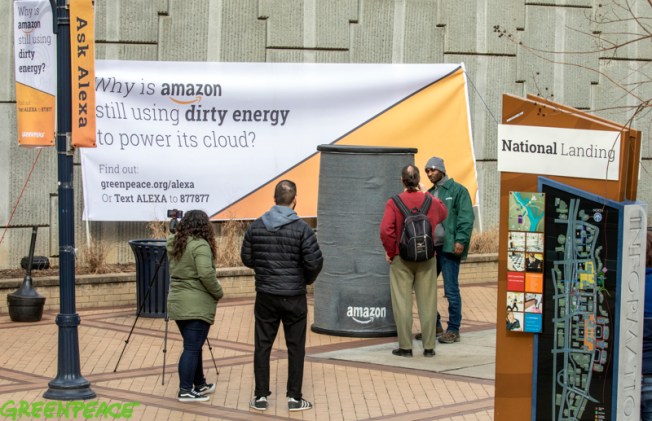
Greenpeace protesters at the site of Amazon’s HQ2 in Arlington, Virginia, in 2019 called out the company for failing to make progress towards its commitment to power the cloud with renewable energy. Since then, the company has actually increased its carbon emissions. Photo courtesy of Greenpeace.

When Amazon announced this month that it had achieved 100% renewable energy seven years ahead of schedule, that sounded like really good news for Virginia. Amazon owns more data centers here than anyone else, and data center energy demand is driving Dominion Energy Virginia’s plan to renege on its climate commitments, keep dirty coal plants online and build expensive new gas plants and transmission lines.  

Unfortunately, Amazon’s announcement is so full of asterisks it looks like a starry night. 

Let’s start with the good news. Amazon’s claim that it has purchased enough renewable energy to “match” its energy use is likely true, though its sustainability report doesn’t reveal essential details like how much energy the company uses. Amazon also says it is the largest corporate purchaser of renewable energy in the world, an impressive achievement. 

Some of that renewable energy is in Virginia, so it is reasonable to say it serves the company’s data centers here. A map on Amazon’s website shows the company has invested in 19 solar farms in Virginia, with a capacity that totals around 1,386 MW  – about a quarter of all solar installed in Virginiato date. That’s terrific. If every company operating in Virginia did as much, we’d be rolling in solar, figuratively speaking. 

So what am I complaining about? 

One problem is that the energy appetite of Amazon’s data centers in Virginia far outstrips the output of all of its solar farms here. The other problem is that producing renewable energy in the middle of the day can only very loosely be said to “match” energy used at other times of the day and night. Meeting energy demand on a 24/7 basis is harder, and Amazon isn’t even trying. 

Let’s start with the numbers. Because the sun doesn’t shine all the time, a large solar array produces, on average, 22-25% of what it produces on a cloudless day at noon. (That percentage is known as the facility’s capacity factor.) At a 25% capacity factor, Amazon’s 1,386 MW worth of solar panels produce enough electricity to “match” about 347 MW of demand. 

Amazon keeps its energy demand in Virginia a secret, but we can be pretty sure its 110 data centers here use way more than that. A 2019 Greenpeace report estimated Amazon’s Virginia data center demand at 1,700 MW in operation or under construction, an amount that would call for 6,800 MW of solar. Amazon rejected Greenpeace’s estimate at the time, but it didn’t supply a better one. More recent estimates suggest Amazon’s energy appetite in Virginia is on its way to 2,700 MW, enough to require the output of around 11,000 MW of solar. 

Luckily for us, Virginia is part of PJM, a regional transmission grid that covers all or parts of 13 states plus Washington, D.C. Generation sources located anywhere in the region can serve a Virginia customer, and Amazon’s map shows it has utility solar and wind projects in several PJM states. By my count, these add up to as much as 4,000 MW of additional renewable energy that could be allocated to Virginia data centers, if Amazon had no other operations in those states that it wanted to power. (Which, however, it does.) 

Adding together its solar in Virginia and elsewhere in PJM still leaves Amazon short of what it likely needs. So, if the company is correct that it has secured enough renewable energy to match all of its demand, a lot of those facilities must be in other regions or other countries. Yet the climate benefit of Amazon’s solar farms in (for example) Spain, which gets more than 50% of its electricity from renewable energy, is significantly less than the climate benefit of solar in PJM, where the percentage of wind and solar combined still hangs in the single digits

I will – almost – give Amazon a pass on this point. PJM has been so appallingly slow to approve new generation that Amazon could well have as many projects in the “queue” as online. PJM claims it will catch up in the next year and a half, and when that happens, perhaps Amazon won’t feel the need to obfuscate.

Even if Amazon were “matching” all its energy needs with wind and solar in PJM, though, it’s the second problem that troubles me more. Building solar and wind is cheap; Amazon very likely makes a profit on it. Actually ensuring renewable energy provides all the juice for the company’s operations every hour of every day, on the other hand, would require a heck of a lot of expensive energy storage. And Amazon is not doing that.

Without energy storage, solar delivers electricity only while the sun is shining. The rest of the time, Amazon’s data centers run on whatever resource mix the local utility uses. In both Virginia and PJM’s territory, fossil fuels make up the great majority of the mix. Building more Amazon data centers in Virginia increases the burning of fossil fuels, causing more pollution and raising costs that are borne by the rest of us. 

The self-styled climate hero turns out to be a climate parasite, harming people to make itself look good.

Combining renewable energy with storage to achieve true carbon neutrality isn’t prohibitively expensive. Other leading tech companies seem to be making that extra effort, with Google notable for its commitment to meeting its energy demand with renewable energy and storage on a 24/7 basis.

Amazon’s failure to rise to this challenge explains why, in spite of its massive investments in wind and solar, the company’s carbon footprint actually rose by 34% since the launch of its Climate Pledge in 2019, when it set a target of net zero carbon emissions by 2040. 

That explains why, a year ago, the Science Based Targets initiative, a U.N.-backed organization that monitors corporate net-zero plans, removed Amazon from a list of companies taking action on climate goals. According to press reports, Amazon failed “to implement its commitment to set a credible target for reducing carbon emissions.”  

Among those least impressed with the company’s efforts are its own workers. Last year, Amazon Employees for Climate Justice accused the company of failing in its climate commitments, and the group released its own report this month alleging multiple climate failures, including using “creative accounting” to inflate its achievements.

If Virginia is serious about meeting the climate challenge, we can’t blindly accept rosy claims from corporations whose central goal is not sustainability, but growth. Data centers whose energy demand isn’t met on a 24/7 basis from zero-carbon sources located on the same grid are not part of the climate solution, they are part of the problem. And currently, Amazon’s data centers are making the problem worse.

This article was first published in the Virginia Mercury on July 24, 2024.

Unknown's avatar

Why are Dominion Energy’s customers footing the bill for Virginia’s data center buildout?

Dominion Energy headquarters, Richmond, VA


Virginia’s embrace of the data center industry produced new fallout this spring when Dominion Energy Virginia released its latest Integrated Resource Plan (IRP). With data center growth the “key driver,” Dominion projects a massive increase in the demand for electricity. As a result, the utility claims the state-mandated transition to clean energy is now impossible to achieve. 

Jettisoning its commitment to the Virginia Clean Economy Act (VCEA), Dominion proposes to keep running uneconomic coal and biomass plants that were previously slated for closure, build a new fossil gas plant and pay penalties instead of meeting state renewable energy targets, all of which mean higher costs for customers.

As I said at the time, this IRP is primarily a political document aimed at currying favor with a gas-loving governor. It is not a serious plan. For example, a Sierra Club filing with the State Corporation Commission describes how Dominion put artificial constraints into its computer modeling (including limits on new solar) to ensure the plan came out fossil-friendly. Moreover, Dominion’s demand projections are inflated, according to the clean energy industry group Advanced Energy United.

But for the sake of discussion, let’s take the IRP at face value. And in that case, I have some questions. How did Dominion let itself get blindsided by the data center growth spurt? Why are the rest of us expected to pay for infrastructure that’s only needed for data centers? Does the Governor understand that his deal to bring another $35 billion worth of new Amazon data centers to Virginia  is driving up energy rates for everyone else? 

Oh, and while I’m at it, are tech company commitments to sourcing renewable energy just a pack of lies?

Virginia’s data center problem is well known. Northern Virginia has the largest concentration of data centers in the world, by far. Data centers are Dominion’s single largest category of commercial power users, already consuming more than 21% of total electricity supply and slated to hit 50% by 2038. In addition to the new generation that will be required, data centers need grid upgrades including new transmission lines, transformers and breakers, with the costs spread to all ratepayers. 

Residents are not happy. Controversy around data centers’ diesel generators, their water use, noise and visual impacts have spread outward from Loudoun County into Prince William, Fauquier, and even other parts of Virginia as massive new developments are proposed. 

Data center developers don’t build without assurance they will have access to the huge amount of electricity they need for their operations, so they have to start discussions with their utility early. Yet in July of 2022, Dominion stunned the data center industry by warning it would not be able to meet new demand in Loudoun County until 2025 or 2026. The utility said, however, that the problem was not generating capacity, but transmission. So, what gives?

Not that it would be better if Dominion anticipated the oncoming tsunami but kept it secret until this spring. You have to wonder whether the General Assembly would have approved hundreds of millions of dollars in grants and tax subsidies for new Amazon data centers in February if legislators understood the effect would be to upend the VCEA and drive up energy costs for residents. 

Some Republicans are no doubt pleased that Dominion’s IRP undermines the VCEA, but they shouldn’t be. Dominion proposes keeping coal plants open not for economic reasons, but in spite of them. These plants were slated for closure in previous IRPs because they were costing ratepayers too much money. Now Dominion says it needs more generating capacity and can’t (or rather, won’t) build enough low-cost solar to keep up with new data center demand.

Dominion also proposes to build a new methane gas combustion “peaker” plant that wasn’t in its last IRP, and again the company points to data center growth as the reason. Peaker plants are an expensive way to generate power; on average, the cost of energy from gas combustion is about double that of a solar/storage combination, or even triple once you factor in federal clean energy incentives.

Keeping the fossil fuel party going instead of embracing more solar isn’t the only way this IRP drives rates higher for customers. Limiting its solar investments means Dominion expects to miss the VCEA’s renewable energy percentage targets by a mile. The shortfall would subject Dominion to significant penalties. The kicker is, Dominion can pass the cost of those penalties  on to ratepayers, too. 

Regardless of your political persuasion, then, this IRP is bad news for Virginia consumers. 

It’s also concerning that the driver of all these higher costs and carbon emissions is the high-tech industry that is so eager to be seen as a leader in sustainability. If these tech companies were meeting their power needs with renewable energy, Dominion wouldn’t be able to claim a “need” to keep its old coal plants belching away.  

Amazon, the number one beneficiary of state data center largesse, says it is the leading corporate purchaser of renewable energy globally. Its website claims the company is “on a path to powering our operations with 100% renewable energy by 2025.” A map shows it has developed around 16 solar projects in Virginia, adding up to over 1,100 megawatts. That’s great, but the company’s Virginia data centers are such energy hogs that they would need many times as much solar, plus a huge amount of battery storage to meet their 24/7 demand. And of course, Amazon’s demand will skyrocket with that next $35 billion in new data centers.

That same map, by the way, shows that Amazon has on-site solar at warehouses and Whole Foods stores all over the Northeast, but none in Virginia. Northeastern states have higher commercial power rates than Virginia does, so on-site solar means bigger bill savings in those states. One cannot help but suspect that Amazon’s commitment to renewable energy is really just a commitment to cheap energy.  

The Data Center Coalition’s filing in the IRP case does nothing to reassure us otherwise. Instead of chiding Dominion for reneging on its clean energy commitments, the Coalition’s Josh Levi essentially argues data centers are so important it doesn’t matter. 

I have no beef with data centers as a general proposition. They are an integral component of today’s economy, and the developments that now drive their explosive growth — machine learning and artificial intelligence — will also help us achieve a zero-carbon future.  

I just think data centers should try a little harder to be part of the solution instead of part of the problem.  

This article was first published in the Virginia Mercury on August 16, 2023.

Unknown's avatar

Don’t give data centers a pass on pollution


Senator Petersen and a group of advocates
Senator Chap Petersen talks with advocates at the General Assembly on February 3. Photo courtesy of Piedmont Environmental Council

In 2019, with Northern Virginia’s data center boom well underway, I worked with the Sierra Club to provide comments to the Department of Environmental Quality (DEQ) on a proposed major source air permit for a data center. 

We urged that the data center, owned by Digital Realty, be required to minimize its reliance on highly-polluting, back-up diesel generators by installing on-site solar and battery storage. While rooftop solar alone wouldn’t produce more than a fraction of the energy a data center uses, solar panels and batteries could provide a strong first line of defense against grid outages, without the air pollution. 

It wasn’t a new idea; other data centers elsewhere were using clean energy and storage or installing microgrids capable of providing all of the power the facility needed. Yet DEQ rejected the suggestion and gave the go-ahead for the data center to install 139 diesel generators with no pollution controls. 

Three years later, data centers have proliferated to such a degree that the power grid can’t keep up. DEQ is now proposing that more than 100 data centers in Loudoun, Prince William and Fairfax counties be given a variance from air pollution controls so they can run their diesel generators any time the transmission system is strained. DEQ is taking comments on the proposal through March 14 and will hold a hearing at its office in Woodbridge on February 27.

As a resident of Fairfax County, I’ll be one of the people forced to breathe diesel pollution to keep data centers running. Make no mistake: There would be no grid emergency without these data centers’ thousands of megawatts worth of electricity demand. And there wouldn’t be a threat to Northern Virginia’s air quality without their diesel generators. 

It’s fair to ask: Should these data centers have been built if the infrastructure to deliver power to them wasn’t ready? I’d also like to know why DEQ thinks it’s okay to impose on residents the combined pollution from many thousands of diesel generators firing at once, when it has known since at least 2019 that viable, clean alternatives exist. 

Batteries alone are an obvious solution for short-term emergency use, and can provide exactly the kind of help to the grid that will be needed this year. Instead of calling on data centers to run diesel generators, a grid operator can avoid the strain by tapping into a data center’s battery, a solution Google is implementing.      

But data centers can economically lower their energy and water costs as well as reduce strain on the electric grid by reducing their energy use and using on-site renewable energy. Global energy management companies like Schneider Electric, Virginia AECOM and Arlington’s  The Stella Group design microgrid solutions for data centers and other facilities that need 24/7 power.

I contacted Stella Group president Scott Sklar to ask how feasible it is for Northern Virginia’s data centers to meet their needs without diesel generators, given land constraints that limit their ability to meet demand with on-site solar. He told me data centers can start by reducing their cooling load by two-thirds by using efficiency and waste heat; cooling, he says, accounts for 38% to 47% of electricity demand. Cost-effective energy efficiency can reduce energy demand by one-third, and waste-heat-to-electricity can meet another 25% to 38% of the remaining electric load. “If you cut the cooling load and use waste heat to electricity, then you only need renewable energy and batteries for a maximum of half,” he concluded. “That’s doable.”

If Virginia data centers don’t start taking these kinds of measures, the situation will get worse. This year’s grid strain may be relieved through construction of new generation and transmission infrastructure, but the industry’s staggering growth rate threatens to create future problems. In 2019, when the Sierra Club was urging DEQ to think about the environmental impact of data centers, the industry consumed 12% of Dominion Virginia Energy’s total electric supply. Today, that number has risen to 21%, a figure that does not include the many data centers served by electric cooperatives rather than Dominion.  

Just last month, Gov. Youngkin announced that Amazon Web Services will invest $35 billion in  new data centers in Virginia, at least doubling Amazon’s existing investments here. By way of thanks, Youngkin wants taxpayers to provide up to $140 million in grant funding to Amazon and extend Virginia’s already-generous tax subsidy program. Ratepayers would also subsidize the build-out by contributing to the cost of new generation and transmission.

Amazon claims to lead the list of tech companies buying renewable energy, though its investments are mostly in other states and abroad. A scathing report in 2019 showed Amazon owned the majority of the data centers in Virginia at that time, but had made few investments in renewable energy here. Since then, Amazon has developed new solar facilities statewide, including enough to power its new Arlington headquarters. But as I discussed in a previous column, all the solar in Virginia would not be enough to make a dent in the energy appetite of Northern Virginia’s data centers, of which Amazon owns more than 100.  

I have no special beef with Amazon, but I do think that a rich tech company with pretensions to sustainability leadership should do more to walk the walk in the state that hosts so much of its operations. Surely that includes not relying solely on diesel generators for back-up power at its data centers. 

I also have no beef with data centers in general. They provide necessary services in today’s world, and they have to go somewhere. Data centers could be a valuable source of revenue and economic development for Southwest Virginia and other parts of the state that are not grid-constrained, if there are guardrails in place to protect nearby communities and the environment, and if they help rather than hurt our clean energy transition. Right now, none of this is the case.

Unfortunately, Gov. Youngkin not only doesn’t want guardrails, he doesn’t even want to know where and why they are needed. On February 3, a representative of his administration spoke in committee in opposition to legislation filed by Sen. Chap Petersen, D-Fairfax that would have the Department of Energy and DEQ study the impact of data centers on Virginia’s environment, energy supply and climate goals. The Senate agreed to the study, but a similar bill died in the House, and a House subcommittee killed Petersen’s Senate version Monday on a 2-1 vote. (The vote was later changed to 3-2 when two delegates who missed the meeting, and the discussion, added their votes. Killing a bill in a tiny subcommittee is one way House procedures allow delegates to avoid accountability on controversial issues — but that’s a topic for another day.)

I spoke with Sen. Petersen by phone after the subcommittee hearing. He pointed out that the administration would have been able to shape the study any way the governor wanted, and would have had control over the recommendations as well. Petersen’s conclusion: “He just doesn’t want anyone looking at it.”

Refusing to look at a problem, however, never makes it go away. And in this case, the problem is just getting bigger.

This article was originally published in the Virginia Mercury on February 15, 2023.

Update: On March 7, DEQ issued a new permit variance limited to data centers in Loudoun County. Although DEQ doesn’t say so, it appears that the original proposal has been modified. The comment period will now run through April 21, and another hearing will be held on April 6.

Unknown's avatar

Growth in data centers overpowers Virginia’s renewable energy gains


Greenpeace rebranded National Landing, the future home to Amazon’s HQ2, with a human-sized Alexa, lamppost signs and street posters highlighting the company’s stalled progress towards its commitment to power its cloud with 100% renewable energy. Photo credit Greenpeace.


More than 100 massive data centers, over 10 million square feet of building space, dot the Northern Virginia landscape around Dulles Airport in what is known as “Data Center Alley.”

And the industry is growing fast.

Local governments welcome the contribution to their tax revenue, but these data centers come with a dark downside: they are energy hogs, and the fossil fuel energy they consume is driving climate change.

A new report from Greenpeace called Clicking Clean Virginia: The Dirty Energy Powering Data Center Alley describes the magnitude of the problem:

“Not including government data centers, we estimate the potential electricity demand of both existing data centers and those under development in Virginia to be approaching 4.5 gigawatts, or roughly the same power output as nine large (500-megawatt) coal power plants.”

As these data center operations continue to grow, they are providing the excuse for utilities, primarily Dominion Energy Virginia, to build new fracked-gas infrastructure, including gas generating plants and the Atlantic Coast Pipeline.

Many of these same tech companies have publicly committed to using renewable energy, and in some cases they have invested heavily in solar and wind power in other states. With the exception of Apple, however, all these data center operators are falling far short in meeting their Virginia energy demand with renewables. Intentionally or not, that makes them complicit in Dominion’s fossil-fuel expansion.

One tech company in particular stands out in the report, due to the sheer size of its operations. Greenpeace calculates that Amazon Web Services, the largest provider of cloud hosting services in the world, has a larger energy load than the next four largest companies combined.

For a while, it looked like AWS would provide leadership commensurate with its size. In 2015, AWS helped break open the solar market in Virginia with an 80-megawatt solar farm. A year later it added another 180 megawatts of solar here, as well as a wind farm in North Carolina in Dominion territory.

Then the investments stopped, while the data center growth continued.

Today, Greenpeace estimates that AWS uses close to 1,700 megawatts for its Virginia data centers. Adjusted for their capacity factors, the renewable energy projects total just 132 megawatts, or less a tenth of the energy the data centers use.

The capacity factor of an energy facility reflects how much energy it actually produces, as opposed to its “nameplate” capacity. A solar facility produces only in daylight, but a data center consumes energy 24/7. To match all of its energy demand with solar energy, AWS would need more than 7,000 megawatts of solar—at least 15 times the amount in all of Virginia today.

For a company whose website promises a commitment to 100 percent renewable energy, that’s a major fail.

The Greenpeace report shows Amazon is not alone in data center operators that are dragging their feet on clean energy. It is simply, by far, the largest. The next three biggest data center operators—Cloud HQ, Digital Reality, and QTS—have no renewable energy at all in Virginia.

Better-known names like Microsoft and Facebook also operate Virginia data centers. Although both have invested in Virginia solar farms, they also fall well short of meeting their energy needs with renewables.

The tech giants are not entirely to blame in all this. As the Greenpeace report details, many of them have asked the General Assembly and the State Corporation Commission for more and better options for purchasing renewable energy. Their requests have largely been ignored.

Virginia’s monopoly system makes it hard for the companies to buy clean electricity from other providers. Our number one monopoly, Dominion Energy, claims to be working hard to meet the large customers’ demand for renewable energy, but its extensive investments in gas infrastructure pose a clear conflict of interest.

Surely, though, if anyone can stand up to Dominion on its home turf, it should be Amazon — which, of course, plans to make Virginia its home turf as well.

And AWS does have options, including more solar as well as land-based wind from the Rocky Forge wind farm and offshore wind from Virginia or North Carolina.

The fact that Amazon doesn’t even seem to be trying should be of great concern to Virginians. As Greenpeace puts it, “AWS’ decision to continue its rapid expansion in Virginia without any additional supply of renewable energy is a powerful endorsement of the energy pathway Dominion has chosen, including the building of the ACP, and a clear signal that its commitment to 100 percent renewable energy will not serve as a meaningful basis for deciding how its data center are powered.”

Amazon has already fired back at the Greenpeace report. In a statement, it asserts that “Greenpeace’s estimates overstate both AWS’ current and projected energy usage.”

However, the statement did not offer a different estimate. It also points to its investments in Virginia renewable energy (the same ones described in the report) and concludes, “AWS remains firmly committed to achieving 100 percent renewable energy across our global network, achieving 50 percent renewable energy in 2018. We have a lot of exciting initiatives planned for 2019 as we work towards our goal and are nowhere near done.”

Well, that’s nice.

But meanwhile, those data centers are using electricity generated from burning fossil fuels, driving climate change, and providing an excuse for new fracked gas infrastructure. Given the rapid pace of data center construction in Virginia, it’s going to take a lot of exciting initiatives from AWS — and all the other data center operators — to make any kind of meaningful impact.

Unknown's avatar

All I want for Christmas is a 500 MW offshore wind farm

Ivy Main with wind turbine

Yes, you will say I have expensive taste. But it’s not for me, it’s for the children! Picture their shining faces on Christmas morning when they find Santa has delivered 62 SiemensGamesa 8.0-megawatt, pitch-regulated, variable speed offshore wind turbines sporting a rotor diameter of 167 meters each, to a patch of ocean 27 miles east of Virginia Beach. 

Or the turbines could be GE’s sleek Haliade 150-6 MW like my friends up in Rhode Island got two years ago, or the MHI Vestas 10 MW beast that the cool kids are talking about. It sports a hub height of 105 meters and has blades 80 meters long. A single one of those bad boys can power over 5,000 homes.

But really I am not particular; these are just suggestions. 

I know we’re getting two turbines in 2020 as a demonstration project, and I’m grateful, I really am. But all the clued-in states are serious about offshore wind, and they’re building projects of 200 MW and up. We’ll be left behind if we don’t get in the game.

The states north of us are making port upgrades, attracting new businesses, and doing workforce training. They look at offshore wind as not just a jobs generator, but as a way to save money on energy costs, meet sustainability goals, improve the environment and reduce their reliance on fracked gas and imported energy. 

They’re positioning themselves to be serious players in a huge industry that a decade from now will employ tens of thousands of Americans. In the decade after that, offshore wind turbines will start delivering power to the West Coast, Hawaii and the Great Lakes region.  The effect will be transformative, as offshore wind energy feeds East Coast cities, pushes out the last of the Midwestern coal plants and leaves the fracking industry without a market.

Think that’s just the eggnog talking? Consider these indicators of an industry that’s taking off: 

1. Offshore wind is now a global industry.Offshore wind got its start in Europe more than 20 years ago as a way to get more wind energy without sacrificing valuable land space. But just in the last few years, it has spread to China, South Korea, Taiwan, Japan, and Vietnam in addition to the U.S. Analysts estimate China alone will have 28,000 megawatts installed by 2027. 

Offshore wind has been slow to advance in the U.S. because building 600-foot tall machines and planting them twenty-five miles out to sea is not cheap or easy, and the federal government had to devise a regulatory scheme from scratch. As the kinks get worked out and a manufacturing and supply chain emerges, the U.S. will move to the forefront of the industry. We always do.

2. Offshore wind competes on price in many markets. Offshore wind is cheaper than fossil fuels and nuclear in Europe already. That hasn’t been so true in the U.S. thanks to abundant coal and fracked gas, but even here, tumbling offshore wind prices have states looking at offshore wind as a way to help customers save money on energy. Bloomberg reported that Massachusetts’ first commercial-scale offshore wind farm will save electricity users $1.4 billion over 20 years. 

3. Early movers in the U.S. are already doubling down. Massachusetts and New York, which committed to a limited number of offshore wind projects early in order to capture a piece of the jobs pie, now want more projects. New York has set a goal of 2,400 MW by 2030; this fall Governor Andrew Cuomo announced a solicitation for 800 MW. This fall New Jersey announced a solicitation for 1,100 MW of capacity, a down payment on the state’s goal of 3,500 MW by 2030. 

3. Large multinational companies are buying the entrepreneurial start-ups.This year Ørsted, the energy giant formerly known as DONG Energy (for Danish Oil and Natural Gas) acquired Deepwater Wind, the scrappy developer of the Block Island project as well as projects in other states. French company EDF Renewables bought Fishermen’s Energy, another homegrown company that sought to give fishing interests a stake in wind projects. 

Along with big developers have come big law firms. You know there’s going to be serious money involved when $800 an hour lawyers trawl for clients at industry conferences. 

4. Oil and gas companies have moved in. Shell Oil and its partner EDP Renewables just spent $135 million for the right to develop a lease area off Massachusetts large enough to accommodate 1,600 MW of wind turbines. Norway’s Equinor (formerly Statoil) also put in $135 million for another section of the lease area, with the third piece going to a European partnership. 

American oil companies haven’t shown the same level of interest yet, but their suppliers in the Gulf of Mexico are handing out cards at offshore wind conferences, advertising their offshore expertise in everything from cables to shipbuilding.

5.  Offshore wind turbines have evolved away from their land-based kin. Unfettered by space limitations, offshore turbines now average close to 6 MW, more than twice the size of the typical land-based turbine. Wind farms slated for completion over the next several years will use even larger turbines, ranging in size up to a General Electric 12 MW turbine expected to deploy in 2021, and even larger ones still on the drawing boards. 

Foundations are diversifying, too, away from the original “monopile” design that mimics its land-based counterparts. Floating turbines will become mainstream in the next decade, enormously increasing design options as well as potential locations for wind farms. 

This will prove a special boon to the U.S., because while most of the East Coast is blessed with a shallow outer continental shelf that allows for fixed foundations even 30 miles from shore, the deep waters of the West Coast require floating technology to feed energy-hungry California. And the open ocean offers a lot of space.

So what’s holding Virginia back?

Dominion Energy holds the lease on the commercial-scale Wind Energy Area off Virginia. The company won it for a mere $1.6 million back in 2013, and not a whole lot seems to have happened with it since then. Dominion needs a customer, or perhaps just competition.

But Governor Northam is determined to see Virginia become a supply chain hub for at least the Mid-Atlantic states, and he has adopted a goal of achieving 2,000-MW of wind energy off our coast by 2030. 

That means I am not the only person in Virginia who wants a wind farm in my Christmas stocking, although I am likely the only one trying to get you to picture that image.

Admittedly, even Santa could find this a tall order (ho ho ho!), but Virginia is now rife with data centers that consume huge amounts of energy, owned by corporations that have promised the energy will be clean. So far the actions of these corporate players have lagged behind their promises. 

So if Santa can’t bring the governor and me a 500 MW wind farm off the coast of Virginia, maybe Amazon will deliver.

This column originally appeared in the Virginia Mercury on December 24, 2018. As this is now December 26, perhaps you think people are asking me if I got my wind farm yesterday. But no one has. Because of course they know it is out there, only waiting for us to do the hard work to make it a reality.

Unknown's avatar

Amazon will need even more energy in Virginia. Will they make it clean?

Entrance to Crystal City Metro Station in Arlington, Virginia

Crystal City in Arlington will be the heart of Amazon’s new Virginia headquarters. Renewable energy options on site are limited. Photo credit Woogers via Wikimedia Commons.

Amazon Web Services jump-started the utility solar industry in Virginia in 2015, when it announced plans for its first solar farm in Accomack County. Three years later, Amazon remains the biggest purchaser of solar in the commonwealth, allowing it to offset some of the enormous amount of energy used by its data centers.

Yet the company’s energy footprint in Virginia far exceeds the energy output of its solar projects. The addition of a new headquarters in Arlington will further increase its need for electricity, and will attract new residents who will also use electricity. All this demand poses a problem for the company and the climate: Dominion Virginia Power will burn more coal and fracked gas to meet Amazon’s energy need, unless Amazon acts to ensure the power comes from renewable sources.

Like many big tech companies, Amazon has adopted aggressive sustainability goals, including a “long-term commitment to achieve 100% renewable energy usage” for its data centers. But the details of its commitment are fuzzy, and the qualifier “long-term” makes the commitment meaningless.

Earth to Jeff Bezos: in the “long term” climate change will put HQ2 under water.

If Amazon still wants a habitable planet to compete in, it should consider the entire energy footprint of its operations, and make sure it is meeting these needs 24/7 with clean, renewable energy. Solar should be a big part of the plan, but so should land-based wind and offshore wind, which complement solar by providing power in the evening and at night. An investment in battery storage would round out the package nicely.

Virginia officials made a perfunctory mention of renewable energy availability to Amazon in the state’s bid package (see page 184). This was accompanied by a quote from Bob Blue of Dominion Energy, promising to sell the company renewable energy. (Be pleased, Mr. Bezos; that’s not a promise he’s made to the rest of us.)

Arlington County has reportedly discussed with Amazon how to make its new campus as environmentally-friendly as possible. Arlington is considering making a commitment to 100 percent renewable energy by 2035, so it has a real incentive to ensure that newcomers are part of the solution, not part of the problem.

Given today’s building technology, there is no reason the National Landing campus should not set a new standard for energy-efficient design. Ideally that will include on-site solar as well. Local officials also want to see enough improvements to transit, pedestrian and biking routes to keep 25,000 new commuters from spewing air pollution while they sit in traffic.

Even if Amazon and Arlington do everything right, though, the campus will need to purchase electricity from off-site generation—and there is still the matter of those power-hungry data centers.

Amazon can take Bob Blue up on his offer and let Dominion supply the company with all the renewable energy it needs. Caveat emptor, though: Dominion’s idea of renewable energy includes resources of dubious value to the climate, like the burning of trash and woody biomass.

And, thanks largely to Dominion’s clout in the General Assembly, Virginia has many barriers to on-site solar, which limit customers’ ability to supply their own renewable energy. We also boast a renewable portfolio standard that works approximately opposite to that of every other state, by ensuring wind and solar will never be part of our resource mix.

Come to think of it, we could really use Amazon’s negotiating chops with our legislators.

In any case, with or without Dominion’s help, Amazon will find plenty of opportunities to procure wind as well as more solar in Virginia. Apex Clean Energy’s Rocky Forge wind farm near Roanoke is already permitted and ready for construction as soon as a customer shows up. Apex now has two additional wind farms in development in southwest Virginia—a nice way to support areas of the state outside of Northern Virginia.

Offshore wind is another opportunity to deliver energy at scale while supporting jobs in the Hampton Roads region. Although offshore wind is poised to become a huge industry in the U.S. within the next ten years, right now only the northeastern states are moving forward with offshore wind farms in the near term. Amazon could make it happen here, too.

Dominion Energy has secured approval for two test turbines off the Virginia coast, but the utility has been slow-walking plans to develop hundreds more turbines in the commercial lease area it owns the rights to. In part that’s because Dominion doesn’t see how to get the State Corporation Commission (SCC) to approve the cost to ratepayers.

That wouldn’t be an issue if Amazon were the buyer, but nor is Amazon limited to Dominion as a supplier of offshore wind. Amazon could let Dominion and its developer, Ørsted, compete against Avangrid, the developer that holds the lease on the Kitty Hawk offshore wind area just over the border in North Carolina. The power from both areas has to come to shore at the same point in Virginia Beach, where a high-voltage transmission line is available. Avangrid has already announced that it is speeding up its development work in hopes of appealing to Virginia customers.

It will take several years for Amazon to build out HQ2, but given how much electricity the company already uses in Virginia, there is no reason to wait on making new investments in renewable energy. Virginians, and the planet, will thank you.

This post first appeared in the Virginia Mercury on November 26, 2018. 

Unknown's avatar

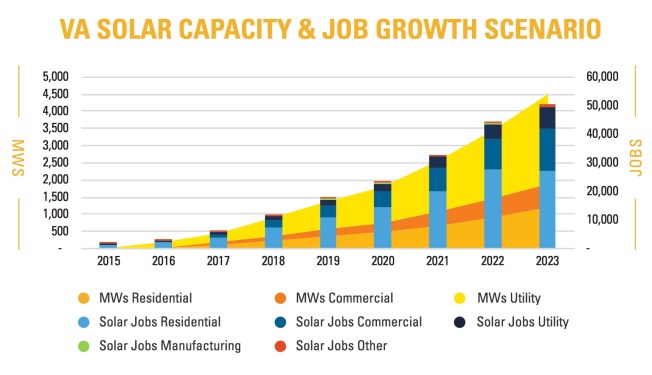
A 5-year plan for economic growth: 10% solar and 50,000 new jobs

Source: The Solar Foundation

A new analysis from the non-profit Solar Foundation shows Virginia could create 50,400 jobs if it commits to building enough solar energy in the next five years to provide just 10% of our electricity supply.

The analysis takes the form of an “infographic” showing the implications of 10% solar. It would require building 15,000 megawatts of solar, divided among utility-scale solar farms, commercial installations, and the rooftops of houses. At the end of 2016, Virginia had a total of only 241 MW of solar installed, representing one-tenth of 1 percent of total electricity consumption. Getting to 10% by the end of 2023 would mean an annual growth rate of 61 percent. That would be impressive growth, but well below the 87 percent growth rate averaged by California and North Carolina over the past 6 years.

So 10% in five years should be doable. And indeed, viewed against the need to dramatically lower our carbon footprint, it seems like a very small step indeed. The McAuliffe administration wants to significantly cut statewide carbon emissions, and it is hard to see how we can do that without replacing the dirtiest fossil fuels with solar (and wind, and energy efficiency).

The good news is that the market is in our favor. Dominion Energy’s 2017 Integrated Resource Plan (IRP) identified utility-scale solar as the least-cost energy resource available in Virginia today. And participants in local cooperative buying programs for homeowners and businesses, known as “Solarize” programs, report payback times of under 10 years for rooftop solar, after which they will have nearly free electricity for 20 or 30 years.

Recent solar deals involving Amazon, Microsoft, and now Facebook show just how strong the demand is from customers. The very companies that our political leaders want so desperately to attract to Virginia are insisting on renewable electricity.

These deals demonstrate the direction of the market, and they will give an initial boost to solar employment, especially in the rural communities that are the best locations for solar farms. But restricting solar to a handful of new companies just coming into Virginia won’t get us to 15,000 MW and 10% solar. It’s also fundamentally unfair to the rest of us who are stuck with a dirty grid. Why should existing customers get left with polluting sources, while big tech companies get solar?

For us, Dominion’s IRP caps its solar plans at 240 MW per year, an amount it admits is arbitrary. In other words, Amazon got 260 MW, Facebook is getting 130 MW, but all the rest of Dominion’s customers put together will get just 240 MW per year.

As for customers who are determined to take matters into their own hands with rooftop solar, a host of unnecessary restrictions continue to limit growth. Virginia needs to put policies in place to push utilities to do more, to support local governments and schools that want solar, and to remove the barriers that limit private investment.

Solar companies around the state say if we can do that, they will do their part by hiring more Virginians. Here’s what some of them had to say about the 10% solar goal, and how to achieve it:

“We believe, as Virginians, that we can solve our energy challenges. Ours is a Virginia company founded and based in Charlottesville, and we are committed to building Virginia-based energy production facilities that benefit all Virginians. But the fact is that over the past few years our growth has come from business in other states. We have 26 employees in Virginia now, and we could increase that dramatically if Virginia promotes solar through policy changes that incentivize business owners to invest, allows competition, and supports the environmental message.” –Paul Risberg, President of Altenergy, Charlottesville

“The economics have never been better for solar in Virginia than they are right now. Prospect Solar has grown from two employees in 2010 to 16 full time employees today. Roles such as electricians, skilled labor, engineers, project managers, and sales people are integral to the success of each project. We hope Virginia will commit to a rapid, sustained buildout of all sectors of the solar industry, allowing us to continue adding local jobs.” –Andrew Skinner, Project Manager at Prospect Solar, Sterling

“Nationwide, the solar market was a 23 billion dollar industry in 2016. One out of every 50 new jobs in America was created by the solar industry last year. Sigora has been part of that. We have doubled in size in the past year and now employ 80 people in the Commonwealth.” –Karla Loeb, Vice President of Policy and Development for Sigora Solar, Charlottesville

“Local energy, local jobs, local investment. Our workforce is made up of local people—three of us went to Virginia Tech, one went to New River Community College, which has an Alternative Energy Program. An increase in demand of this scale would mean we’d hire more local people.” –Patrick Feucht, Manager of Baseline Solar, Blacksburg

“Residential and commercial rooftop solar has created most of the solar jobs in Virginia to date, and it has to be a part of the push to 10 percent. As we know, rooftop solar creates more jobs than utility solar, and these are good-paying, local jobs for local people. That’s one reason Virginia should lift the outdated 1 percent cap on net-metered solar, and leave the market open to anyone who wants to invest in their own home-grown energy supply.” –Sue Kanz, President of Solar Services, Virginia Beach

“Ten percent solar is a modest goal to shoot for given the strong economics of solar and the demand we are seeing from customers. Virginia has been held back by restrictive policies that have made it a ‘dark state.’ Reforming our policies would lead to a lot more economic development around solar.” –Tony Smith, President of Secure Futures LLC, Staunton


Unknown's avatar

A Candidate’s Guide to Clean Energy and the Pipelines

Photo courtesy of Chris Tandy.

Recently I attended a forum where a candidate for statewide office discussed his energy policies and voiced his support for wind and solar. He embraced a goal of Virginia reaching at least 30% renewable energy by 2030, which was roundly applauded. But then he added that we couldn’t get started on it without advances in battery storage, because, he said, without storage there is no way to put surplus wind and solar on the grid.

People around the room look dumbfounded. They weren’t energy experts, but they knew that was flat-out wrong. Later he made other statements that showed he misunderstood facts about energy, climate change and the grid, hadn’t questioned what he’d been told by utility lobbyists, or just hadn’t been paying much attention.

Maybe you are a candidate yourself (or you work for one), and you don’t want to embarrass yourself by saying so, but you frankly don’t understand what was wrong with that statement about wind and solar. Or perhaps you are an activist and you’d like to help your local candidate for office bone up on some of the most important issues he or she will have to vote on while in office.

Allow me to help. Here is what you need to know about the hot-button energy issues in Virginia today. I’ll also offer my opinion about where you should stand on those issues, but that part is up to you.

Solar is coming on strong—and it is the cheapest energy in Virginia today. This astounds people who don’t keep up with energy trends, but it’s what Dominion Energy Virginia’s latest integrated resource plan (IRP) reveals. Utility-scale solar farms, 20 megawatts (MW) and up, can produce electricity at a cost that beats coal, gas and nuclear. That’s why Dominion’s IRP proposes a build-out of 240 MW of solar per year. It’s why Amazon Web Services has been building 260 MW of solar in five Virginia counties to supply its data centers. It’s why, over the past year, developers have proposed more than 1,600 MW of additional solar capacity in counties across the state. It’s also why today, solar already employs more Virginians than coal.

None of the solar under development includes battery storage. It doesn’t have to, because electricity from solar all goes into one big grid.

The grid is HUGE. If you’re from around here, you probably remember the earthquake of August 2011. It was centered in Mineral, Virginia, but did damage all the way to Washington, D.C. It also caused an immediate shutdown of Dominion’s two nuclear reactors at North Anna that lasted for more than three months. That meant 1,790 megawatts (MW) of generating capacity, enough to power 750,000 homes, suddenly went offline. Do you remember what happened to your power supply at home? You probably don’t. Why not? Because your power didn’t go out.

That’s because the North Anna nuclear plants are only two out of more than 1,300 generating units (power plants) feeding a 13-state portion of the transmission grid managed by independent operator PJM Interconnection. When one unit fails, PJM calls on others. PJM’s job is to balance all this generation to meet demand reliably at the lowest cost.

The grid has no problem with solar. While solar makes up less than 1% of its electricity supply currently, a PJM study concluded the grid could handle up to 20% solar right now, without any new battery storage. Wind and solar together could make up as much as 30% of our electricity with no significant issues. The result would be less coal, less gas, and less carbon pollution—and $15.6 billion in energy savings.

Virginia already has energy storage. You could even say we are swimming in it. Bath County, Virginia is home to the world’s largest “battery” in the form of “pumped storage.” A pair of reservoirs provide over 3,000 megawatts of hydropower generating capacity that PJM uses to balance out supply and demand.

Actual batteries are also an option today, not sometime in the future. The price has dropped by half since 2014, to the point where solar-plus-storage combinations compete with new gas peaker plants. Batteries are also being paired with solar today to form microgrids that can power emergency shelters and other critical functions during widespread outages.

If Virginia goes totally gangbusters with solar, a day will come when there is so much electricity being generated from the sun in some areas that we’d need batteries. But, sadly, we aren’t anywhere near there yet.

So, you should definitely get on board with battery storage; just don’t make the mistake of thinking we can’t ramp up renewable energy today without it.

Make renewable energy your BFF. It probably polls better than you do. Renewable energy has favorability ratings most politicians only dream about. A Gallup poll last year showed 73% of Americans prefer alternative energy to oil and gas, a number that rises to 89% among Democrats. Republicans love it, too; North Carolina-based Conservatives for Clean Energy found that 79% of registered Republicans in their state are more likely to support lawmakers who back renewable energy options.

Distributed renewable energy—think rooftop solar—is especially popular with the greenies on the left and the libertarians on the right, and pretty much everyone in between. It offers benefits that utility solar does not. The policy that makes it affordable is called net metering. It gives solar owners credit for the excess solar electricity they put on the grid in the daytime, to be applied against the power they draw from the grid at night. If you want to support your constituents’ ability to power their own homes with solar, you should protect and expand their right to net meter their electricity.

People who understand Dominion’s pipeline hate Dominion’s pipeline. The proposed Atlantic Coast Pipeline would carry fracked gas 600 miles from inside West Virginia through the heart of Virginia and into North Carolina. Instead of following highways, it cuts across mountains, rivers, forests and farms, and requires land clearing 150 feet wide the whole way. Landowners along the route are furious, as are lovers of the national forests and the Appalachian Trail, people who care about water quality, people who care about climate change, and fans of caves, bats and other wildlife.

The gas it will carry is extracted from shale formations deep underground using hydraulic fracturing, or fracking, a loud, dirty and dangerous practice that doesn’t poll well in Virginia. More quietly (but in many ways worse), leaking wells, pipes, and storage reservoirs are estimated to emit enough greenhouse gases to cancel out the climate advantages of burning gas over coal, and increase smog. An analysis using industry data found that building the ACP and a second controversial pipeline project, the Mountain Valley Pipeline, would more than double the carbon footprint of Virginia’s power sector.

Sea level rise is already taking a toll in Virginia with “sunny day” flooding regularly crippling low-lying areas of Hampton Roads. If you’ve pledged to address climate change, you need to understand how building gas pipelines will undermine the very efforts to reduce such threats.

Now, if you don’t want to oppose Dominion, you might be inclined to minimize all these issues, or to tell voters the destruction of all we hold dear is just the price we pay for cheap energy. I’m sure you can phrase it better than that.

Before you do, though, you should also spend a few minutes to understand why critics say the ACP will raise energy prices, not lower them. That’s because Dominion’s gas-burning electric generating plants already have long-term contracts to use another company’s pipeline, for less money. Using the ACP instead of cheaper alternatives means raising costs to consumers.

Dominion also plans to build more gas-fired power plants so it can fill the pipeline. Gas plants are built to last 30 years or more, pipelines 50 years. Locking us into gas infrastructure for decades when solar is already cheaper than gas now is a seriously bad bet.

And if you think Dominion is going to shoulder the loss of a bad bet, better think again. That’s what its captive ratepayers are for.

Another name for those people is “voters.”