Unknown's avatar

McAuliffe touts gas and nuclear, says it’s not his job to worry about risks

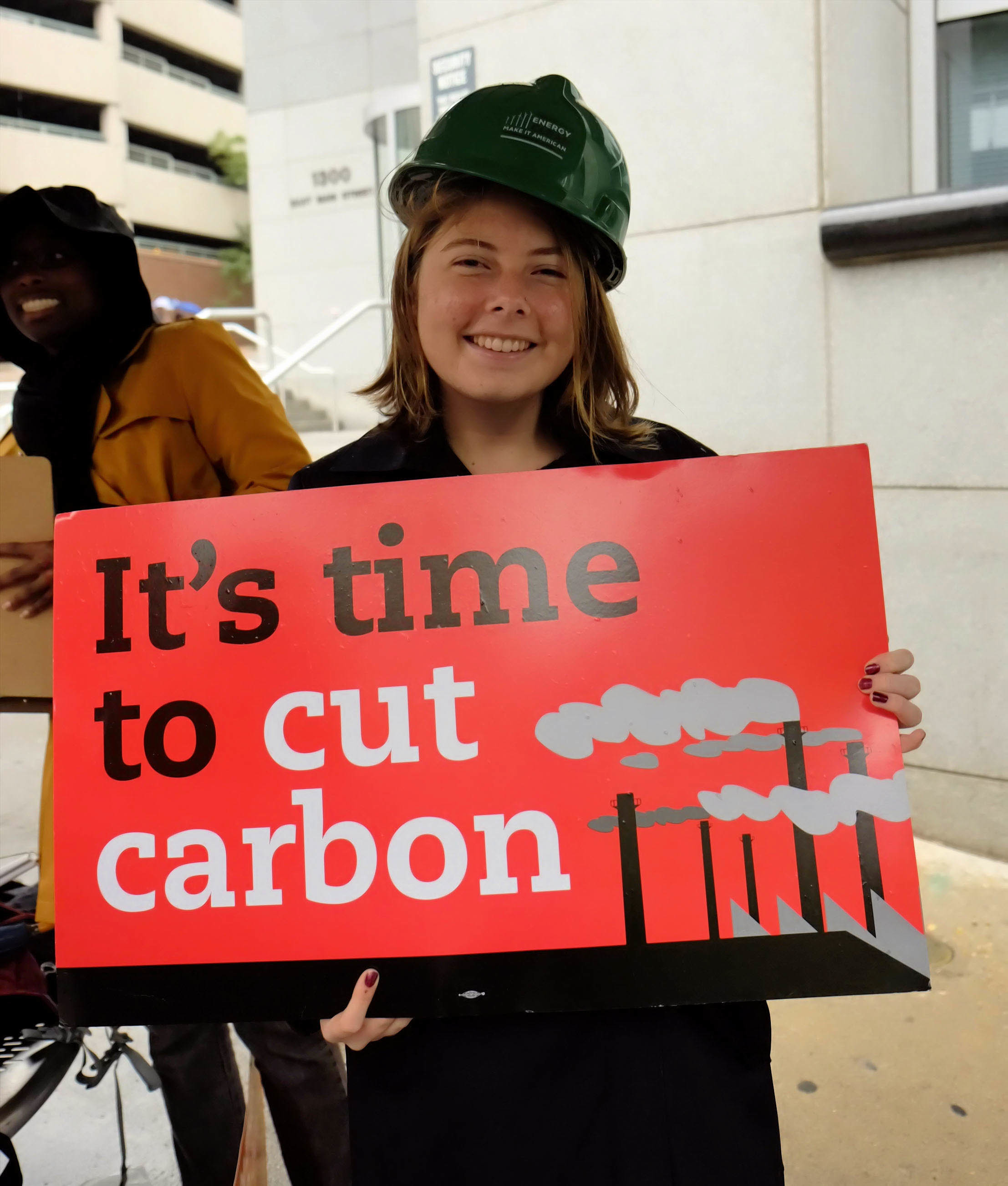
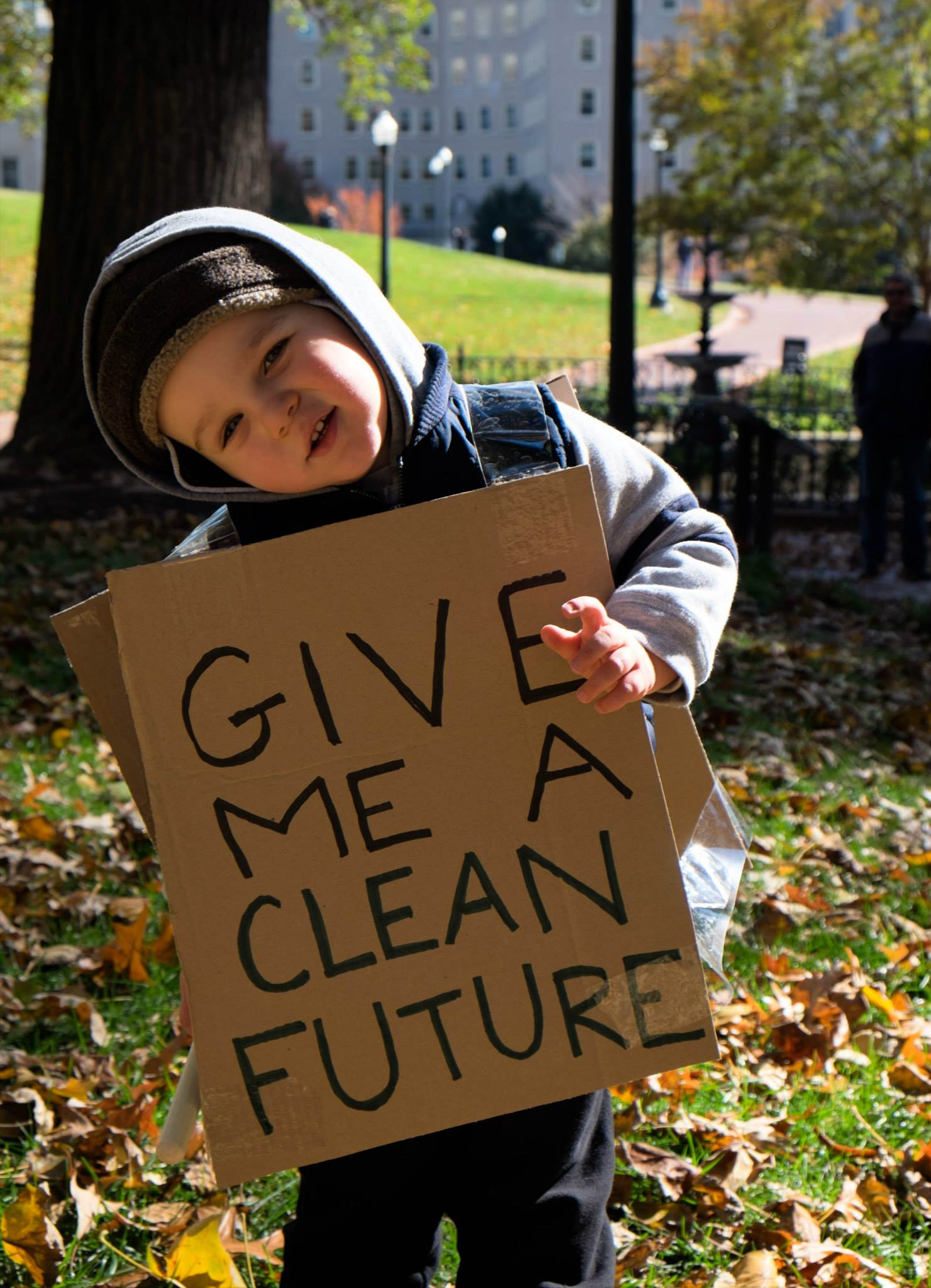
And he'll have to, given the hash we adults are making of it.  Photo courtesy of Glen Besa.

And he’ll have to, given the hash we adults are making of it. Photo courtesy of Glen Besa.

A forum on climate change held last Wednesday in Richmond was supposed to be about moving to clean energy, but it sometimes seemed to be more of a platform for Governor Terry McAuliffe to tout plans for more natural gas and nuclear energy in the Commonwealth. It wasn’t that he neglected energy efficiency, wind and solar—he had plenty of good things to say about these, and even a few initiatives to boast of. It was just that they paled against the backdrop of massive new natural gas and nuclear projects, to which he seems even more firmly committed.

The event was a conference called “The Next Frontier of Climate Change,” organized by The New Republic magazine and the College of William and Mary. Moderator Jeffrey Ball of Stanford University shaped the conference as a series of interviews, beginning with Governor McAuliffe. You can see video of the interview here.

Ball started out asking about the politics of climate change, which gave McAuliffe a chance to reiterate his convictions that climate change is real, that we can see it happening today in Hampton Roads, and that part of meeting the challenge involves supporting the kind of 21st century technologies that will also make Virginia an exciting and attractive place to live. That includes offshore wind and solar.

But McAuliffe also made it clear he sees everything through the lens of economic growth, and his top priority is attracting new business to fill the gap left by shrinking federal spending in the state. “When I ran for governor,” he explained, “I tried to put everything in an economic issue: what is good for the Commonwealth, how do you grow and diversify. I preside over a commonwealth that, we are the number one recipient of Department of Defense dollars, number one. Now, that’s great when they’re spending, but when they’re cutting like they’re cutting today, it has a dramatic impact.”

He is also persuaded that renewable energy, even with all its job benefits, won’t get him as much economic growth as cheaper fossil energy can, and his friends at Dominion Resources and its subsidiary, Dominion Virginia Power, have convinced him that means backing their plans for natural gas and nuclear.

McAuliffe said he supports EPA’s Clean Power Plan, and said in the course of the interview that he thought it would result in lower electricity rates for Virginians over the long run; but he’d still like it to demand less of our utilities. He echoed assertions from legislators and utilities that the draft plan’s treatment of existing nuclear plants makes it “unfair” to Virginia. Repeating a line that is now standard among Virginia politicians, he claimed the Clean Power Plan doesn’t give us “full credit” for reducing our carbon emissions by building nuclear reactors back in the 70’s. He has been raising the issue with the Obama Administration, and feels confident EPA will make the changes he requested.

Neither McAuliffe nor anyone else has explained why we should get credit for doing something 40 years ago for entirely different reasons, at a time when very few people had climate change on their radar screens. But never mind that; according to this theory, which he asserted again at the conference, the Clean Power Plan’s failure to credit us for our nukes puts us at a disadvantage compared to coal-heavy states like West Virginia and Kentucky that haven’t done diddley-squat.

(You know, I hope someone is passing all this along to the folks in West Virginia and Kentucky, who have been screaming bloody murder about how tough it will be for them to comply with the Clean Power Plan. I don’t get the sense they are aware they have this terrific advantage over Virginia and can expect shortly to begin luring away our businesses. Mitch McConnell, for one, seems entirely oblivious of the favor the EPA is doing his state. What a shame it would be if all of McConnell’s anti-EPA rhetoric were based on a simple misunderstanding!)

Maybe our governor needs to put a few items on his reading list, like the PJM analysis that shows the Clean Power Plan puts Virginia at an advantage over neighboring states, especially if it joins a regional compliance program. He should also check out a new report from Virginia Advanced Energy Industries Coalition and the Advanced Energy Economy Institute that describes the tremendous job growth in renewable energy and energy efficiency that will flow from compliance with the Clean Power Plan. Given the opportunities presented, the Governor should embrace more stringent goals, and should look to clean energy rather than nuclear as the money-saving, job-creating approach to compliance.

However, McAuliffe’s enthusiasm for nuclear goes beyond using it to wangle a softer carbon reduction target out of the EPA. He told Ball repeatedly that he is a “huge fan” of nuclear energy, thinks a new nuclear plant should be part of Virginia’s compliance with the Clean Power Plan, and expressed delight over Dominion’s plans for a third reactor at North Anna.

And yet, when confronted with a question from the audience about the wisdom of building another nuclear plant on an earthquake fault line, he said cheerfully that the Nuclear Regulatory Commission won’t approve a plant that isn’t safe. Worrying about it isn’t his job.

We’d better hope his confidence in the NRC is well placed—and hope too that the NRC successfully resists the political pressure to approve the plant that it will no doubt receive from Governor McAuliffe.

Ball suggested that what was behind the question on nuclear was a contention that if the state ramped up its investments in efficiency and renewable energy it would not need to build a new nuclear plant. McAuliffe assured Ball that wind, solar and efficiency couldn’t do that yet. He knew that because—ahem—he’d heard it from Dominion.

I guess no one has told the Governor that asking Dominion for its take on efficiency is like asking Exxon about electric cars.

McAuliffe’s enthusiasm for big projects that promise more business for Virginia (and Dominion) has also caused ongoing friction between the Governor and members of the public over natural gas pipelines. This led to the incident at the conference that grabbed headlines, with an angry protester trying to shout down the Governor.

At issue was McAuliffe’s support for Dominion’s controversial Atlantic Coast Pipeline. The proposed 550-mile natural gas transmission project will require the seizure and clear-cutting of a 125-foot wide right-of-way across Virginia from West Virginia to the coast in North Carolina, through national forests and private land. And of course, it will increase Virginia’s carbon footprint by enabling the burning of more fossil fuel here.

Pipeline opponents had brought into the New Republic event a banner reading “McAuliffe: Pipeline will be Climate Chaos.” During the Q&A period the protester reminded McAuliffe that he had once opposed natural gas fracking in Virginia.

But McAuliffe remained unruffled even as the protester hurled insults at him, until she was escorted from the room. “We’re not doing the fracking here,” he said, by way of explaining his support for the pipeline. “The fracking is done elsewhere. I’m not, as the governor of Virginia, going to stop fracking in America today.” Therefore, he concluded, we might as well take advantage of the fracking going on elsewhere to “bring cheap gas to parts of Virginia that can open up and build the economy.”

It seemed no one had alerted him to research indicating the gas boom will start to go bust just five years from now. If that happens, of course, higher gas prices will make the Governor’s manufacturing renaissance go bust, too, leaving Virginia worse off than before. Coupled with Dominion’s plans to bring online a staggering 4,300 MWs of new natural gas generating plants by 2019, Virginia is putting itself at the mercy of a natural gas market that is entirely outside our control.

But when I asked the Governor if he wasn’t worried about the risks of over-investing in natural gas, he shrugged off the concern. It’s not his job to review Dominion’s plans, he said.

Well, sure. But there’s a problem with cheerleading for every big energy project that comes along and taking no responsibility for their downsides. This is the “all of the above” strategy that brought us the climate crisis. From a governor who knows climate change is happening before our eyes in Virginia, we’re still hoping for better.

Unknown's avatar

As sea level rise accelerates, buying shorefront property becomes a game of musical chairs

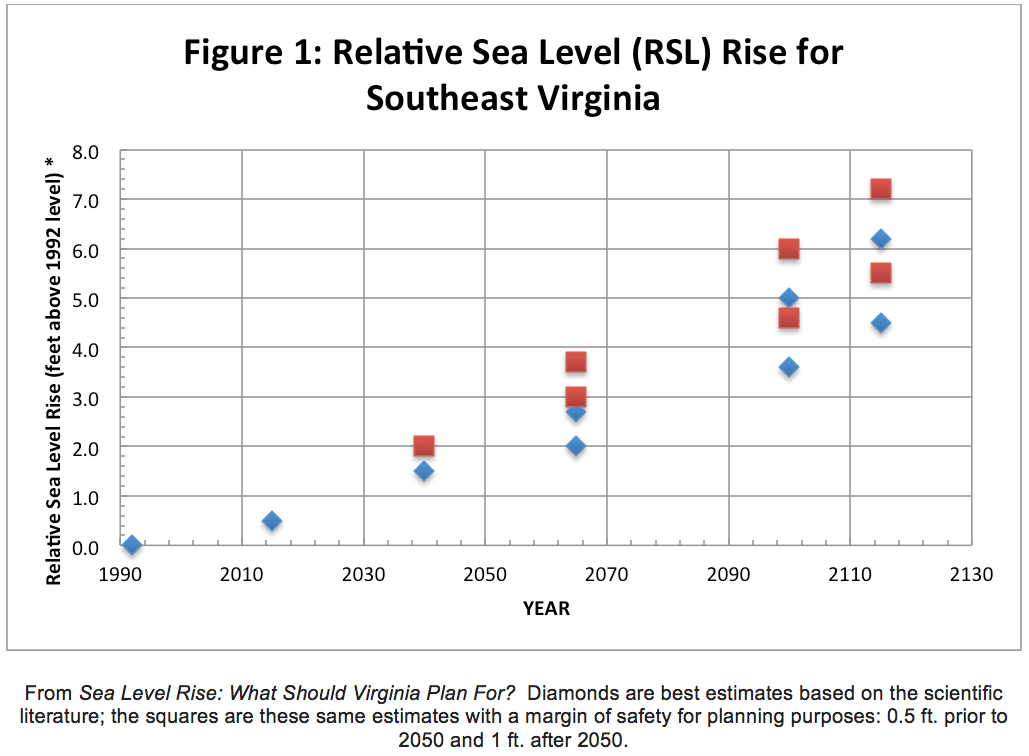
Sea level rise graphThank God for climate change deniers. They may eventually be the only buyers for shorefront real estate.

Sea level rise may not cause widespread flooding until later in this century or into the next one, but real estate deals involve long timelines: the useful life of a new house or a commercial building can be at least fifty years, while an infrastructure project might last a hundred years or more.

And of course, it’s one thing to lose your house, and another to lose the ground beneath it. Sea level rise means low-lying real estate now comes with an expiration date.

So smart buyers—and landowners—have to consider not just today’s flood maps, but also ones that haven’t been drawn yet. If a rising sea will threaten property some decades from now, it will depreciate over time, like a car. At some point only chumps and climate deniers will buy.

Head-in-the-sand posturing still dominates the headlines, like Florida Governor Rick Scott’s alleged ban on the use of the term “climate change,” or the North Carolina legislature’s silly (and costly) attempt to legislate sea level rise out of existence. Now the Federal Emergency Management Agency (FEMA) hopes to force states to get serious about climate change by requiring states to do a better job planning for natural disasters caused in part by global warming. FEMA’s goal is to save money through better planning, but conservatives have attacked the requirement as politically motivated.

Meanwhile, however, many states and localities have already begun using sea level rise forecasting in their planning. The projections will help land use planners determine not just where to allow growth, but also where to defend existing development against the incursion of the sea, and where the wiser course is to retreat. And of course, the studies should inform the decisions of anyone thinking of buying property on the coast.

Two recent studies provide a picture of sea level rise in Virginia. The Virginia Institute of Marine Science (VIMS) issued its report in January 2013, titled Recurrent Flooding Study for Tidewater Virginia. Building on that study and others, on March 10 of this year the Sierra Club released Sea Level Rise: What Should Virginia Plan For?

Both studies agree on some pretty sobering numbers. By the end of this century, the sea level in Norfolk, Virginia, is projected to be 3.6-5 feet above the level in 1992. By that point, the sea will be rising more than half a foot per decade. The numbers are higher for Virginia than for many states, in part because the land around Hampton Roads is also sinking at a rate of about one foot per century.

Although Hampton Roads gets most of the media attention, sea level rise threatens the entire Virginia coastline and the tidal portions of rivers, including the Potomac River all the way up to Alexandria and Washington, D.C. A whole lot of people should be consulting topographic maps before they make their next real estate decision.

The Sierra Club report focuses in on specific timeframes that matter in real estate decisions: twenty-five years for short-term projects, fifty years for new homes, and a hundred years for infrastructure projects. With a one-foot margin of safety added in, the report recommends that anyone considering a new project or building today with a 50-year expected life should plan for as much as 3.7 feet of sea level rise over the 1992 baseline. That number becomes 5.5-7.2 feet when the planning horizon is extended out a hundred years, to 2115.

(The “good” news is that the sea rose half a foot between 1992 and today, so you get to subtract six inches from these projections if you are starting now.)

Results are stated as a range rather than a precise number because the actual level will depend on many factors. Researchers agree that a certain amount of sea level rise is “baked in” as a result of greenhouse gas emissions to date, but future emissions will play a big role in determining how much the seas rise in the long run. Providing a range allows users to decide how much risk they are willing to take. Even at the high end, there are caveats; new information about melting ice in Eastern Antarctica could make today’s projections too conservative.

Right now many shore communities are hosting a game of musical chairs. Developers continue to build and sell new housing, figuring they can earn a good return on their investment and get out before the market collapses. Buyers aren’t told about the risks. Sea level rise is bad for business, so business would rather not talk about it. And some local governments soft-peddle the news, afraid of setting off a panic that will make the collapse of the real estate market a self-fulfilling prophecy.

The Virginia General Assembly took action this year to require localities in the Hampton Roads Planning District Commission to include measures addressing sea level rise in their comprehensive plans. The District includes 16 local governments in southeast Virginia, but that’s only a fraction of the counties and cities vulnerable to sea level rise.

Another bill requires that the disclaimer form provided to home buyers across the state include language warning that the seller makes no representations about whether the property is located in a “special flood hazard area” or may require flood insurance, putting the onus on buyers to inquire. While prudent buyers will follow through (and mortgage lenders will make sure they do), today’s flood maps don’t reflect tomorrow’s reality.

So these bills are a good start, but Virginia needs to do more. Local governments outside of Hampton Roads need specific guidance for planning, and the public needs better education about the floods to come. By the time the sea claims low-lying neighborhoods from Virginia Beach up to Alexandria, there may not be enough climate deniers left to buy everyone out.

Unknown's avatar

Virginia’s legislative session ends. How did we do?

Photo credit: Corrina Beall

The General Assembly made a mad dash to the end of the 2015 legislative session last week. House Republicans were in a hurry to finish up a day early, even if bills suffered as a result, in the peculiar belief that prioritizing speed over quality would demonstrate their competence.

Apparently they thought that would play to the anti-government crowd. And I guess it does; if you weren’t anti-government before they pulled a stunt like that, you probably are now.

Being in a rush had to be their excuse for that ethics bill they pushed through in the final hours. I can finally understand why Senator Dick Saslaw says, “You can’t legislate ethics.” What he means is that the Virginia General Assembly can’t legislate ethics. Most of the rest of us would have no problem doing it. Our legislators, however, are just too fond of living well on the tab of corporate lobbyists.

So the new bill drops the gift limit from $250 to $100—but then removes the aggregate cap, allowing for an unlimited number of $99 gifts. Gifts that go over the limit but that are donated to charity now don’t count, providing a nice way for a legislator to buy popularity at no expense to himself.

A report from the group ProgressVA analyzes the bill’s effect and concludes that some 70% of lobbyists’ 2014 giving would still be legal under the new law, while opening up some brand-new loopholes. Among the most egregious is that lobbyists and their clients will now be able to pay for legislators to fly around the state for official meetings without the travel having to be disclosed, much less reimbursed. This means legislators from southwest Virginia can expect even more face time with coal lobbyists, but now on corporate jets—and their constituents will never know about it.

Addressing (or not) the issue of extravagant vacations paid for by companies with business before the legislature, the bill imposes a requirement that there be “a reasonable relationship between the purpose of the travel and the official duties of the requester.” That means junkets to France paid for by Virginia Uranium are still okay. So is letting corporate America pay for you to attend meetings of the American Legislative Exchange Council (ALEC), where lobbyists can teach you how to hobble environmental regulators and suppress voting.

If you can’t figure out a way to meet the reasonable relationship test (and I’m embarrassed for you if you have so little imagination), you can still accept a fun travel adventure as long as Virginia’s toothless ethics council approves it—or simply doesn’t act within five days of your request.

And of course, this so-called ethics reform makes no attempt to address the biggest obstacles to honest government in Virginia: the flood of corporate money into campaign chests and the ability of legislators to use campaign money for personal expenses. Even if Governor McAuliffe fixes the serious flaws in the ethics bill, nothing in it will stop companies like Dominion Resources from continuing to use cash to corrupt the democratic process.

Which brings us to energy legislation. The Associated Press summed up the situation very nicely: “Virginia’s 2015 legislative session was a good one for energy giant Dominion Resources Inc., the state’s most politically influential company. Legislation it wanted passed, passed. Bills it didn’t like did not.”

Chief among the legislation Dominion wanted was Senator Wagner’s SB 1349, which spares Dominion from having to refund excess profits for the next five years. Pretty much every newspaper in the state editorialized against it, so I’ll spare you a rehash of its failings.

Sadly, Governor McAuliffe signed the bill without amendments. He told reporters, “It was clear to Dominion that at the end of the day a veto would have been devastating for them.” If so, that’s a lot of leverage the Administration squandered.

And really, Governor, “devastating”? But since you fell for that, can I interest you in a bridge in Brooklyn?

SB 1349 does contain some welcome language calling solar energy projects of at least 1 MW in size, and up to an aggregate of 500 MW, “in the public interest,” a phrase that will help utilities when they seek approval for these projects at the State Corporation Commission. But nothing actually requires the utilities to build these projects, and the 1 MW size minimum has been carefully crafted to be above the limit for net-metered solar projects. Dominion wrote the bill for itself, not for ordinary people who want to go solar on their own.

The solar language was not originally part of SB 1349; it was imported from another Dominion bill, Delegate Yancey’s HB 2237, as a way to get buy-in from the solar industry and Democrats.

As for customer-owned solar, this was another bad year. The only concession won from Dominion was an increase in the size cap for net-metered projects from 500 kW to 1 MW, a compromise from the initial proposal of 2 MW.

Wherever else solar advocates faced utility opposition, they lost. That includes bills on community net metering, solar gardens, RPS improvements, expanded 3d party PPA availability, and a higher hurdle for standby charges. Also going down to early defeat was the renewable energy grant program that had been celebrated last year as a near-triumph (it only lacked passage again this year, plus—oh yeah—funding).

The GA did pass one of the Governor’s solar priorities, establishing the Virginia Solar Energy Development Authority (HB 2267 and others). The Authority is explicitly tasked with helping utilities find financing for solar projects; there is no similar language about supporting customer-owned solar. The Authority is supposed to identify barriers to solar, but isn’t given any tools to remove them. So we shall see.

Bills that did not require Dominion’s approval did better. Chief among these was legislation enabling Property Assessed Clean Energy (PACE) loans for commercial customers. This should help bring low-cost financing to energy efficiency and renewable energy projects at the commercial level.

And while Dominion’s sole concession to energy efficiency this year was agreeing to a “pilot program” of unspecified size as part of the SB1349 deal, natural gas utilities sought and won legislation (SB 1331) that makes it easier to win regulatory approval for energy efficiency programs that could benefit lots of customers. The difference is that natural gas companies have “decoupled” profits from sales, so it’s in their interest to help customers use energy more wisely. Dominion and Appalachian Power, by contrast, have a profit model that requires ever-increasing sales, making efficiency bad for business.

While legislators repeatedly shot down any solar bills that might be characterized as subsidies, they dropped their free market principles when it came to subsidies for coal mining. Unless the governor vetoes HB 1879, Virginia taxpayers will continue to pay tens of millions of dollars annually to prop up an uncompetitive industry with a long legacy of poisoning our air, land and water. Anyone who is ever tempted to believe a Virginia Republican’s claim to legislate based on his conservative principles and not merely on politics should check how they voted on this bill. (Here are the House votes, and here are the Senate votes.)

The limited progress made this year towards greening our energy supply does not bode well for compliance with the EPA’s Clean Power Plan. The only legislation that would have moved Virginia decisively towards compliance, by having us join the Regional Greenhouse Gas Initiative, died in committee. On the other hand, a number of bills that would have hindered compliance also died. True, SB 1349 makes the process harder by adding a hurdle to the closure of coal plants. Republicans also pushed through a bill that requires the Department of Environmental Quality to waste time and money studying whether the federal carbon reduction rules have health benefits beyond those gained by regulating conventional pollutants.

But overall, the session ended in a draw on climate issues. On the one hand, that’s bad, given that 2014 was the hottest year on record globally.* On the other hand, this is Virginia. Merely not regressing counts as progress here.

———————–

*I know, 2014 was not hot in eastern North America, and 2015 has started out with one of those winters that make people say they could use a little global warming. Nature has a keen sense of irony. But while you were shivering, the rising sea ate a little more of our shoreline.


Unknown's avatar

Surprise endings to a week of bad news on energy and climate bills

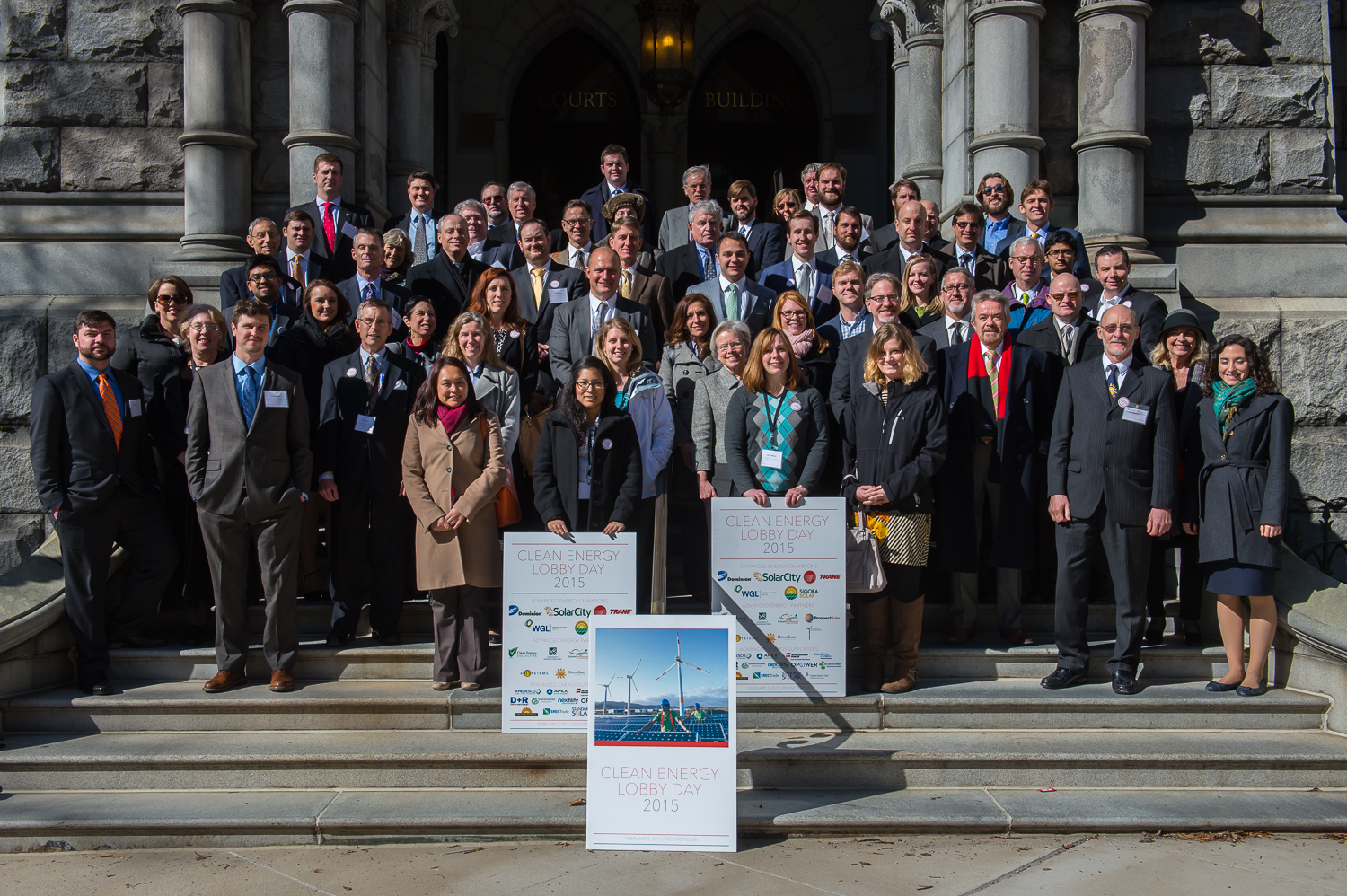
The fourth annual Clean Energy Lobby Day on February 3d brought representatives from businesses across the state to Richmond. Photo courtesy of MDV-SEIA.

The fourth annual Clean Energy Lobby Day on February 3d brought representatives from businesses across the state to Richmond. Photo courtesy of MDV-SEIA.

More than a hundred representatives of energy efficiency and renewable energy businesses descended on Richmond Tuesday for Clean Energy Lobby Day. After meetings with legislators, many of them stayed to attend a critical subcommittee meeting where most of this year’s clean energy bills came up for votes. And they came away with one overpowering impression: the only bills that can make it out of committee are the ones supported by the state’s utilities, especially Dominion Power.

But that wasn’t quite the end of the story. Because by the end of the week, they also found that the groundwork they had laid with their lobbing, and their tenaciousness before the subcommittee, created an opening they would not otherwise have had.

First, the bad news, and plenty of it

Things started bleakly. The House Commerce and Labor Subcommittee on Energy turned back multiple proposals that would have benefited Virginia’s small renewable energy and energy efficiency businesses, as well as their customers. Going down to defeat were bills to improve the renewable portfolio standard (HB 1913), create an energy efficiency resource standard (HB 1730), require a more rigorous study before utilities can impose standby charges (HB 1911), make third-party PPAs legal across the state (HB 1925), and enable an innovative vehicle-to-grid (V2G) project (HB 2073).

Left in limbo for the day was Delegate Minchew’s community solar bill, HB 1636. Minchew wasn’t ready to give up on it, but he had not found a way to get the utilities to back off their opposition. It went without saying that, without Dominion’s buy-in, the subcommittee members wanted nothing to do with it. Out of respect for a fellow Republican, however, they were willing to give him a couple of days’ grace. (On Thursday they killed the bill off.)

One small success was the raising of the cap for individual commercial renewable energy projects from the current 500 kilowatts to 1 megawatt (MW) (HB 1950). Bills to increase it to 2 MW were discarded. The bill was also passed out of the full committee on Thursday.

Also reported out was HB 2267, creating the Virginia Solar Development Authority. It passed in the full committee on Thursday but was then referred to the Committee on Appropriations.

With a few exceptions, the good bills lost on party-line voice votes following testimony from utilities in opposition to the measures. Republican committee members repeatedly expressed their concern about the potential impact on other ratepayers of bills that would make it easier for utility customers to generate their own power, or that would require utilities to buy a smidgeon more renewable energy.

Indeed, anyone who thinks Republicans don’t care about poor people should have been in that room. The outpouring of concern for struggling families was tremendously affecting. These brave souls made it abundantly clear that nothing that could be construed as a subsidy would sneak by on their watch.

Those of us who had seen some of the same delegates vote just last week to continue giving tens of millions of dollars annually in subsidies to coal companies, could not help noting the inconsistency.

Then a funny thing happened on the way to rubber-stamping Dominion’s solar bill

The anti-subsidy rhetoric was further undercut when, a few minutes later, the subcommittee unanimously approved Delegate Yancey’s bill (HB 2237) declaring it in the public interest for the state’s largest utility to install up to 500 MW of solar and offshore wind projects. Chairman Terry Kilgore did ask Dominion Power’s lobbyist if it would raise rates, but he was easily satisfied with the assurance that it would not—even though solar was “marginally more expensive.”

This was all the committee wanted to hear, and a motion had already been made to report the bill when the members were suddenly treated to an earful from the solar industry—not in support of the bill, but in opposition. Francis Hodsoll of Virginia Advances Energy Industries and Jon Hillis of MDV-SIEA, the solar industry trade association, praised the goal but urged that the bill be amended to open up competition for building the solar projects. Utilities might prefer to build the projects themselves to earn their guaranteed return on investment, said Hodsoll, but ratepayers would benefit from lower costs and in-state jobs if independent companies were eligible to bid.

Tony Smith of Secure Futures, LLC, further explained that federal tax incentives strongly favor independent companies developing projects instead of the utilities doing it themselves. He said an independent firm that develops a 20 MW project can sell solar for 5 cents per kilowatt-hour, a far better price than a utility can achieve building the same project itself.

Andy Bidea of Sigora Solar put the case most simply. “This is America. Let’s give capitalism a chance, right?”

Catchy idea. The committee proceeded to report the bill without changes, but Kilgore encouraged the patron to work with the solar industry on possible amendments prior to the full committee meeting on Thursday.

The industry’s stand had an effect. When the bill was taken up on Thursday, it included an amendment allowing utilities to buy power from a third-party developer before purchasing the project itself. This should be significant because the SCC would presumably insist on the lowest-cost approach. In an email, Francis Hodsoll told me the industry now supports the bill, which passed the full committee.

With Dominion’s recent announcements of its plans to move forward with as much as 400 MW of large-scale solar projects in Virginia, this is a hopeful sign for utility solar in the state. Only one project has actually been announced, a 20 MW project in Remington, Virginia. It should also make it easier for Dominion to move forward on offshore wind, a major plus.

Admittedly, the struggle for distributed solar continues. The happy ending on the Yancey bill means little to members of the industry struggling to make a living doing residential and small commercial projects. They had pinned a lot of hope on the grant program that passed with such fanfare a year ago, only to sink like a stone in a House subcommittee this session.

On the other hand, those who take the long view believe that once Virginians get familiar with the benefits of solar, it will become an unstoppable force. The indicators point to success in coming years whether utilities like it or not.

Climate? What climate?

In addition to the clean energy bills, the subcommittee also took action on two climate bills Tuesday. It rejected Delegate Villanueva’s HB 2205, which would have had Virginia join the Regional Greenhouse Gas Initiative as a vehicle to reduce carbon emissions. (The Senate companion bill died on a party-line vote last week.) It was the only legislation this year that would have taken positive action to address climate change and raise some of the enormous sums of money that will be needed to address the consequences of sea level rise.

Instead, it passed HB 2291 (O’Quinn), a bill that would require the Department of Environmental Quality (DEQ) to get approval from the General Assembly before submitting to the U.S. EPA a plan to implement the Clean Power Plan. Since the Republican majority has made its hostility to the Clean Power Plan clear, this is widely seen as a way to keep the state from acting at all. The bill also passed the full committee Thursday on a straight party-line vote, a clear indication that it is about party politics and anti-Obama Administration sentiment, not climate change.

Over in the Senate, however, saner heads prevailed. Senator Watkins amended his companion bill, SB 1365, simply to give DEQ direction on what to consider in developing the plan, and to require it to consult with the SCC and to meet with General Assembly members. The substitute bill passed Senate Agriculture unanimously.

Dominion’s Ratepayer Rip-off Act hits a bump in the road

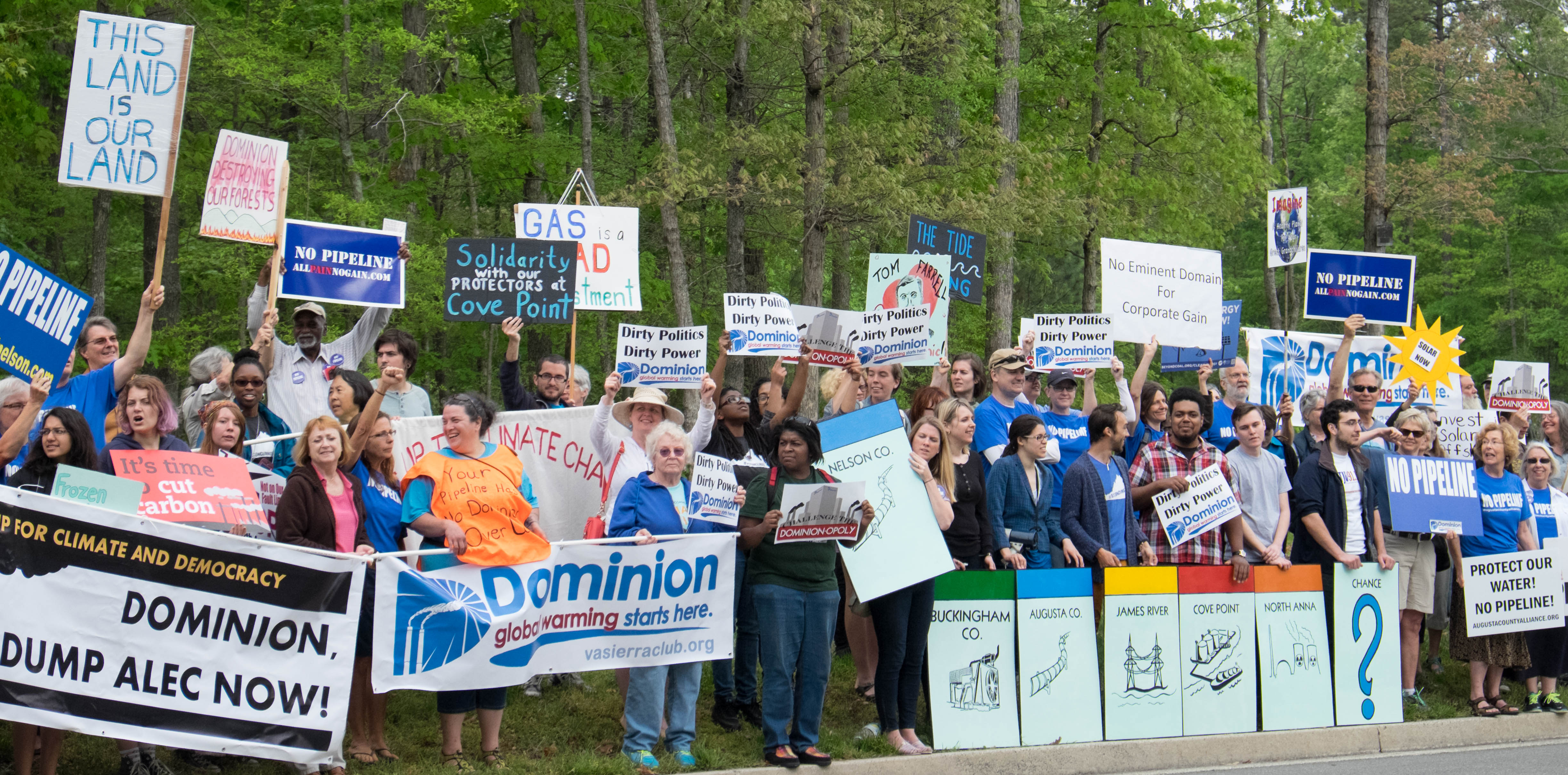
Meanwhile, Senator Wagner’s bill to protect utility profits and shield Dominion (and now APCo too) from SCC scrutiny through the end of the decade sailed through Senate Commerce and Labor in spite of sparking the kind of outrage and condemnation in the press usually reserved for bills on guns and abortion. Editorial boards excoriated the legislation; Wagner was forced to sell his Dominion stock. Environmental groups, which had first sounded the alarm, staged a protest outside the General Assembly on Thursday morning and spurred thousands of constituents to write letters opposing the ratepayer rip-off.

As a consequence, SB 1349 ran into trouble on the Senate floor Thursday afternoon, and a substitute was introduced consisting of two pages of such dense regulatory detail that I cannot possibly tell you what it means. Anyone with the gumption to try to understand it may be wasting their time anyway, because I hear it remains in flux, with negotiations underway right now. Senator Donald McEachin reportedly is working to make it less objectionable. One thing seems certain: the senators who will be asked to vote on this will have no chance to review the language and reach their own conclusions.

It’s a lousy way to make sausage, but it’s ours.


Unknown's avatar

Your 2015 legislative session cheat sheet, part 3: climate bills

Photo credit: Corrina Beall

Photo credit: Corrina Beall

Anti-Clean Power Plan bills

When the EPA released its Clean Power Plan last June, clean energy advocates celebrated America’s first serious response to rising carbon emissions. At hearings held across Virginia, supporters of the plan outnumbered opponents by as much as five to one, making it clear the public welcomes EPA’s plan as a way to break the rise in carbon emissions while opening the door to new economic opportunities in solar, wind, and energy efficiency.

Alas, the response of most Republican legislators was to man the barricades and protect the fossil fuel status quo. That impulse to panic translated into a spate of bills aimed at rejecting or undermining EPA authority and hobbling the ability of the state to implement the Clean Power Plan.

SB 740 (Carrico), SB 1365 (Watkins and Chaffin), and HB 2291 (O’Quinn) instruct the state Department of Environmental Quality (DEQ) to hold hearings and examine witnesses in the development of its compliance plan and take a “least-cost” approach to compliance. DEQ is also required to get approval from the General Assembly for the plan before it can submit it to the EPA for approval—and if either chamber doesn’t like it, DEQ has to do it over again, until the time allowed for state compliance runs out.

SB 1202 (Wagner) goes further. Before DEQ can even write its plan, the State Corporation Commission has to find that the EPA has made changes to the Clean Power Plan that fix all the things the SCC staff claim are wrong with it. The SCC staff have already accused the EPA of acting illegally, arbitrarily, and capriciously, so it’s safe to say that under Wagner’s bill, we’ll see pigs fly before DEQ writes a carbon plan.

HJ 608 (Kilgore) is a resolution asserting that electricity regulation is a sovereign state function and complaining that EPA is infringing on state turf. The resolution is silly on its face; Virginia’s grid is part of an interstate transmission system (PJM), our utilities operate in multiple states, much of our electricity is generated outside our borders, and all of our generating plants, transmission lines, and everything else associated with providing power in Virginia are covered by federal regulations of one sort or another. HJ 608 has nothing to do with reality. But reality is not the point. The point is that Terry Kilgore and the fossil fuel companies he represents are loaded for bear and want to prove it.

SJ 273 (Wagner) directs DEQ to study whether the health benefits of the Clean Power Plan are really any different from those already expected from compliance with other air quality regulations. The reason, according to the bill, is that “if the EPA is claiming the same health benefits under two different sets of regulations, its effort to attribute future pollution reductions to the proposed Plan amounts to ‘double counting.’” If you’re wondering how that is relevant to Virginia’s obligation to comply with the Clean Power Plan, then once again you’re missing the point. This is about posturing, not compliance.

SJ 308 (Wagner yet again!) would let the GA’s Joint Rules Committee hire its own counsel to sue the EPA to block the Clean Power Plan if the Attorney General won’t do it. HJ 529 (Bob Marshall) would have a similar effect, though his bill is more of an all-caps version aimed at anything the federal government does that he opposes.

Virginia Republicans didn’t invent the attack-challenge-delay approach that is the common theme of these bills. The strategy comes from the American Legislative Exchange Council (ALEC), the conservative “bill mill” heavily funded by fossil fuel interests, and of which Dominion Power is a member. ALEC developed a game plan for state-by-state resistance to the EPA plan.

ALEC’s model bill, called the RASP Act, forbids a governor from complying with the EPA regulations without getting approval from the legislature. Sound familiar? And yet it’s a cut-off-your-nose-to-spite-your-face reaction. The longer a state delays, the harder compliance becomes. Delay too long, and EPA writes your plan for you. That’s not a good outcome for either Virginia or the climate.

Coastal Protection Plan

The EPA Clean Power Plan allows multiple pathways to compliance. On of them is the regional compliance plan: states can band together on a market approach to reduce cost and disruption. Several northeastern states already have this cap-and-trade approach in place, known as the Regional Greenhouse Gas Initiative (RGGI). Similar regional efforts exist for some Midwestern and Western states as well. These all predate the Clean Power Plan, but a recent analysis by PJM, the regional transmission operator that runs Virginia’s grid, found that a regional cap-and-trade approach would cost 30% less than a state-by-state approach to meeting carbon regulations.

Even many Virginia Republicans have said they favor a regional approach to compliance with the Clean Power Plan, once they have done challenging everything they can about it.

One of the attractive elements of RGGI is the market mechanism. Polluters must buy carbon allowances, generating money for the state. HB 2205 (Villanueva) and SB 1428 (McEachin), the Coastal Protection Plan, would have Virginia join RGGI, and use half of the money generated to address the problems created by sea level rise. SB 1323 (Lewis) would merely have DEQ study the idea.

For a fuller explanation of the bill, see Dawone Robinson’s guest post here. The Coastal Protection Act is already picking up endorsements, from the Washington Post to the Virginia Housing Coalition and local governments including Norfolk.

The Dominion Power Ratepayer Rip-Off Act of 2015

When Dominion Virginia Power offers to do something to protect ratepayers, watch your wallet. Last year’s act of generosity cost us hundreds of millions of dollars to cover Dominion’s initial expenses for a nuclear plant it may never build.

This year it’s a bill, SB 1349 (Wagner), that would freeze rates (but notably not utility bills) until at least 2023. Like last year’s money bill, this one prevents the State Corporation Commission from requiring the utility to refund money to ratepayers and/or lower rates if the utility earns more than the law entitles it to. In other words, it lets Dominion keep the windfall.

Senator Wagner presents his bill as a protection for ratepayers in the face of the EPA’s Clean Power Plan, which he claims will be costly for ratepayers. But here’s the thing: Dominion’s obligation to its shareholders is to maximize profit. The company wouldn’t support a rate freeze if it meant losing money. Dominion’s support for Wagner’s bill can only mean the utility expects to make a lot of money at current rates, even under the EPA plan.

This makes sense to the clean energy advocates, who point to analyses showing the Clean Power Plan will benefit consumers rather than costing them more. That’s because energy efficiency—a major component of the plan—saves money. If Virginia consumers do save money under the plan, though, the Wagner bill makes sure they won’t see the benefit.

Indeed, it doesn’t even protect them from higher bills, because Dominion can still increase other charges that make up customers’ bills. The “rate freeze,” in other words, will set a floor on electric utility bills, but not a ceiling.

Unknown's avatar

Pass the Coastal Protection Act to cut carbon, raise millions

With today’s start of the Virginia legislative session, a lot of energy and climate bills are pouring in–some good, some not so good, some downright terrible. I’ll have an overview of them coming soon, but meanwhile guest blogger Dawone Robinson gives us a look at one of the best of the bills, the Coastal Protection Act, HB 2205 (Villanueva). A shorter version of his post appeared as an oped in the January 12 edition of the Richmond Times-Dispatch. Many thanks to Dawone for letting me run this. 

——————————

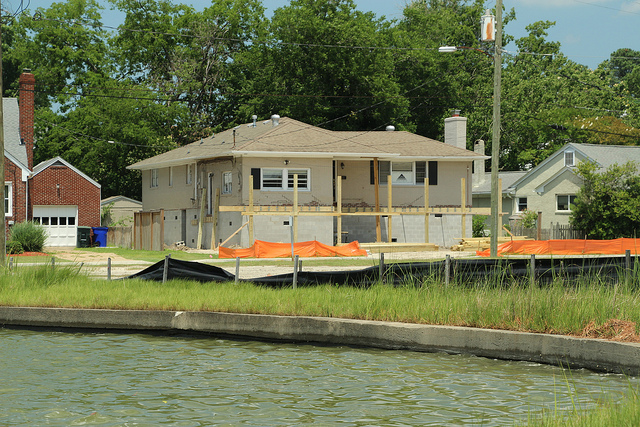
A house in the process of being elevated, a very expensive solution to the problem of recurrent flooding due to sea level rise in Virginia. Photo credit: CCAN

A house in the process of being elevated, a very expensive solution to the problem of recurrent flooding due to sea level rise in Virginia. Photo credit: CCAN

Have you ever put together a list of items you would purchase if you won the lottery—before you remembered that you haven’t even purchased a ticket? Upon reflection, how premature was that list you so perfectly pieced together?

In Virginia, we face a similar dilemma when it comes to addressing the mounting crisis of flooding along our coast.

We’ve got plenty of laudable lists in the works. Last year, Virginia lawmakers unanimously passed a resolution establishing a joint subcommittee to study recurrent flooding issues and adopt recommendations. Legislators from both parties sent a unified message: flooding is a problem in Hampton Roads and we need to do something about it.

In 2008, former Governor Tim Kaine’s Climate Change Commission laid out more than 100 recommendations to mitigate and adapt to climate change and sea level rise. So far the state has failed to adopt a plan to execute them. To his credit, Governor Terry McAuliffe recently launched a similar commission. This panel, the state’s Secure Commonwealth Panel, and the General Assembly’s aforementioned recurrent flooding subcommittee all have the same mandate: convene, discuss, deliberate, and draft a set of recommendations.

So what’s the catch? While what needs to be done is relatively easy to identify, the cost is significant—if not staggering. Virginia needs to win the equivalent of a multi-hundred-million-dollar lottery every year to fund the adaptation measures required to protect coastal residents and infrastructure.

Hampton Roads is home to the world’s largest naval base, more than $80 billion in economic activity, and 1.7 million residents who routinely feel the effects of sea level rise. Streets need to be raised, levees need to be built, and homes and businesses need to be protected. The U.S. branch of the Dutch engineering firm Fugro estimated that it would cost the city of Norfolk at least $1 billion to fully adapt to rising seas and frequent flooding—which equals Norfolk’s entire annual government operating budget.

The non-profit group Wetlands Watch reports that the cost to either elevate or purchase the homes of residents in just five Hampton Roads localities that have sustained multiple flood losses of $1,000 or more in the last ten years would exceed $430 million. Relying on federal assistance alone, it could take up to 244 years to assist all homeowners seeking help in these five localities.

Meanwhile, the Virginia Institute of Marine Science warns that sea levels could rise by as much as seven feet along Virginia’s coast within this century. We can’t afford to keep creating unfunded wish lists, and we can’t wish the problems away.

Virginia needs a dedicated stream of state funding to help coastal families and localities fight climate change. Obviously, there’s no lottery for this. But thankfully there is a common-sense legislative approach being introduced in the Virginia General Assembly by Republican Virginia Beach Delegate Ron Villanueva. His bill, called the Virginia Coastal Protection Act, would help solve our massive coastal flooding problem with a first-ever state funding mechanism that is good for the economy and good for our communities.

By joining the state into the highly successful and fully established Regional Greenhouse Gas Initiative, or RGGI, the bill would generate more than $200 million per year in new state funds to invest in coastal adaptation and other climate change solutions. This relief could come when localities in Hampton Roads need it most. It would come without adding any new demands to the state’s tight budget. It would also come through a system proven to rein in energy costs while reducing emissions and raising revenue.

RGGI is a cooperative effort of nine East Coast states that caps and reduces greenhouse gas pollution. Since the program’s inception in 2008, RGGI states have reduced their carbon footprint 2.7 times faster than non-RGGI states. In the same time period, electricity prices have dropped by 8 percent in participating states, compared to a 6 percent rise throughout the rest of the nation.

Under RGGI, power plants purchase allowances for every ton of carbon they emit. The sale of carbon allowances gets reinvested back to the states. Under Del. Villanueva’s bill, half of Virginia’s projected $200 million in annual auction revenues would fund coastal adaptation efforts, 35 percent would fund energy efficiency and renewable energy projects, and 10 percent would fund workforce development, education, and economic assistance in Southwest Virginia.

The Virginia Coastal Protection Act is a win-win-win solution. We can establish a consistent and significant source of revenue to tackle flooding in Hampton Roads and generate funds to invest in other statewide priorities, while putting policies in place to help Virginia meet carbon reduction goals in an efficient and practical manner.

Virginia’s lawmakers are on the record in their overwhelming bipartisan support for finding solutions to the state’s growing flooding woes. Delegate Villanueva has put forward the best plan to take us beyond wish lists, and to start funding urgently needed solutions.

Dawone Robinson is Virginia Policy Director with the Chesapeake Climate Action Network, a regional climate-change policy and advocacy organization with more than 30,000 supporters in Virginia. You can reach him at dawone@chesapeakeclimate.org

UPDATE: State Senator Don McEachin (D-Richmond) has agreed to introduce the Coastal Protection Act into the Senate as a companion bill to Delegate Villanueva’s (SB 1428), making this now a bipartisan effort.

Unknown's avatar

Tiny Virginia subcommittee tasked with deciding future of bills related to EPA’s Clean Power Plan; meeting set for December 17

Photo credit: Sierra Club

Photo credit: Sierra Club

The EPA’s proposed Clean Power Plan could reshape Virginia’s energy future for the next fifteen years, and possibly permanently. If the state takes advantage of this opportunity, it will reduce carbon pollution, improve human health, save money for consumers, drive job creation in the fast-growing technology sector, and make our grid stronger and more secure.

If the state doesn’t act, EPA will design its own plan for Virginia, ensuring reduced carbon emissions but without the flexibility the state would have by doing it for itself.

This presents a conundrum for Virginia’s General Assembly, which is not known for embracing federal environmental regulations. The usual skepticism was on display on November 19, when the Senate and House Commerce and Labor Committees met in a joint session to take up the Clean Power Plan—or more precisely, to give utilities and the State Corporation Commission staff the chance to attack it.

At the conclusion of that meeting, the two Republican committee chairs, Senator John Watkins and Delegate Terry Kilgore, named three members of each committee—two Republicans and one Democrat from each chamber—to a special subcommittee tasked with deciding what kind of legislative action the General Assembly should take in response to the Clean Power Plan. Kilgore also put himself on the subcommittee, which will now take up any bills that Virginia legislators introduce related to the Plan.

This subcommittee has scheduled its first meeting for December 17 at 1:00 p.m. in Senate Room A of the General Assembly building in Richmond. By law, all committee meetings are open to the public.

According to General Assembly procedure, before anyone else in the entire legislature can consider a bill, it will have to pass muster with these seven men. So who are these hugely important people, and what is the likelihood that they will seize this historic opportunity to make Virginia a leader in clean energy?

The Senate members consist of Republicans Frank Wagner and Benton Chafin and Democrat Dick Saslaw. Wagner and Saslaw were obvious choices given their seniority on the committee and active role on energy issues. Chafin—well, we’ll get to him in a moment.

Frank Wagner is from Virginia Beach and is known for his interest in energy generally, and especially in promoting new projects. He sponsored the legislation that led to the Virginia Energy Plan in 2006 and has been an important supporter of offshore wind development, perhaps reflecting his undergraduate degree in Ocean Engineering and his Tidewater residence.

The General Assembly website says Wagner is the president of Davis Boatworks, a vessel repair facility whose principal customer is the Defense Department. Living in the Hampton Roads area, Wagner is aware of how real sea level rise is; presumably he understands the connection to climate change.

In spite of his interest in offshore wind, coal rules when it comes to funding Wagner’s political campaigns. The Virginia Public Access Project shows coal giant Alpha Natural Resources was Wagner’s second-best donor over the years, with a total of $43,643 in campaign money since 2003, ahead of Dominion Power’s $37,350. Energy and mining interests combined gave gifts totaling $188,152. Of this, $350 came from Highland New Wind Development LLC back in 2008 and $250 came from the offshore wind company Seawind in 2010.

Of course, who gives money to an elected official does not necessarily dictate how that official votes. But it probably should be mentioned that for the 2014 session, Wagner earned an F on the Sierra Club’s Climate and Energy Scorecard, disappointing clean energy advocates who have sometimes had reason to see him as an ally.

Also a low performer on the energy scorecard is Dick Saslaw, scraping by with a D. Saslaw is a career politician who was first elected to the GA in 1976, when he was 36. (He is now 74.) His biography lists his background as an owner and operator of gas stations.

Saslaw is the Senate Democratic Leader and used to be Chair of the Senate Commerce and Labor Committee, until his party lost the Senate. In theory, his leadership position in the Democratic Party should make him a defender of President Obama’s climate initiative. In practice, not so much.

Although he is a Fairfax County Democrat, Saslaw does not share his constituents’ enthusiasm for wind and solar, nor in general, their concern for the environment. Somebody once told him that renewable energy costs a lot; that’s been his story ever since, and he’s sticking with it, facts be damned.

Saslaw is proud of his close ties to Dominion Virginia Power, whose interests reliably predict his votes on any given bill. The Virginia Public Access Project reports that Dominion has given more money to Saslaw than to any other legislator. In 2014 alone, Dominion gave Saslaw $25,000. Over the years, Dominion’s contributions to Saslaw have totaled $240,508, making the utility Saslaw’s top donor.

Saslaw has also received more money from Appalachian Power than any other Democrat–$44,000–even though that utility does not provide service anywhere in his district. In addition, coal interests gave him $90,250, natural gas companies ponied up $50,250, and the nuclear industry chipped in $28,000.

A single contribution of $250 makes up the only entry under “alternative energy.”

This brings us to new Senator Ben Chafin, the Republican delegate from Southwest Virginia who replaced Democratic Senator Phil Puckett (he of the Tobacco Commission scandal). Chafin is a lawyer and farmer, and as his website informs us, “Ben Chafin has a proven record fighting for the coal industry. Ben sponsored successful legislation (House Bill 1261) to fight against Obama EPA’s effort to kill the industry through over-regulation. Ben will continue to work in Richmond to protect coal and grow other Southwest industries like natural gas.”

Not surprisingly, coal interests led all other industry donors to Chafin’s 2013 campaign for Delegate and his 2014 campaign for Senate ($59,000 altogether), though he did pretty well by natural gas, too ($14,150). As a delegate, Chafin earned a gentleman’s C on the Sierra Club scorecard, but it would probably be a mistake to pin our hopes on his becoming a clean energy champion. His role on the subcommittee is surely to give Coal a voice.

On the other hand, Chafin must recognize that the economics of fracked gas and ever-more competitive wind and solar means Virginia coal has no chance of ever regaining its former glory. Southwest Virginia now needs to craft a strategic retreat from mining and work on economic diversification. That’s not inconsistent with the Clean Power Plan.

On the House side—but here I have to digress for a moment to comment on the seemingly random composition of the House Commerce and Labor Committee. The Senate side is bad enough; any Democrat who has evinced environmental sympathies over the years has been dumped from the Senate Commerce and Labor, and when he was in power, Saslaw did a lot of the dumping.

But it’s worse over at the House. The leadership keeps reshuffling its energy committee, as if in a frantic effort to make sure nobody learns anything, while the delegates who actually came to the job with an interest and knowledge of energy never seem to get a turn. Energy law is a hard area to learn. It’s complicated, and if you don’t have time to master it, you are even more likely to accept guidance from either the party leader who tells you how he wants you to vote, or the glib industry lobbyists who assure you they have the public’s welfare at heart just as much as you do. (Plus they give you money!)

So Chairman Terry Kilgore had little enough to work with on his committee. The three delegates he named to this incredibly important subcommittee, though they are undoubtedly smart and hardworking people, bring no discernable expertise on either climate or energy to the General Assembly’s review of the Clean Power Plan.

Well, digression over.

Terry Kilgore himself is a lawyer and a 20-year member of the House from the coalfields region of southwest Virginia. Dominion is his top individual donor, at $122,000, but coal interests together make up the single biggest category of givers to his campaigns, at $243,188, with electric utilities at $218,680, natural gas at $97,830, the oil industry at $16,400, and nuclear energy at $8,500. Just since 2013, he’s taken in over $136,000 from energy and mining interests.

That’s awfully good money for a safe seat, and his votes have reflected it. His energy votes earned him a D on the Sierra Club scorecard. It’s unlikely that he will abandon his coal friends, but like Senator Chafin, he will serve his constituents best if he works to attract new business to his struggling region. Home weatherization and energy efficiency programs would be popular there, and solar energy is one of the fastest-growing industries in America.

The other House subcommittee members Kilgore appointed are Republicans Jackson Miller and Ron Villanueva and Democrat Mathew James. Jackson Miller is a Manassas Realtor and former police officer who has been in the House since 2006. The bills he has introduced primarily reflect his interests in real estate and criminal law, although he also introduced legislation supporting uranium mining. He has received a total of $79,252 from energy and mining companies since 2010, primarily electric utilities, natural gas, coal, nuclear, and uranium. He earned a D on the Climate and Energy Scorecard. Why he is on this subcommittee is anyone’s guess, but certainly Northern Virginia stands to gain a lot of technology jobs if the state develops its clean energy industries as it should.

Virginia Beach Republican Ron Villanueva has not been as popular with the energy and mining companies, whose donations to his campaigns have totaled $20,550. Villanueva’s website says he was the first Filipino-American elected to state office in Virginia when he became a delegate in 2009. Villanueva has been friendly to the solar industry, and while he received a D on the scorecard, he also received an award from the Sierra Club for his work on a bill to provide a tax credit for renewable energy projects. (The bill was converted to a grant in the Senate but not funded.)

Like Delegate James and Senator Wagner, Villanueva lives in an area that is feeling the effects of climate change sooner than any other part of Virginia, so his constituents know how much the Clean Power Plan matters. For that matter, his day job as a partner with SEK Solutions, a military contractor, should mean he’s aware of the Pentagon’s focus on climate change as a national security issue, as well as a threat to its coastal assets.

Portsmouth Democrat Matthew James also hasn’t been especially popular in the energy industry. Since 2009, when he first ran for delegate, he has accepted a mere $5,000 from Dominion, $3,500 from coal interests, and $3,350 from the natural gas companies—token amounts by Virginia standards, but they may be due for a sudden increase.

James does not seem to have introduced any energy-related bills. However, his votes earned him an A on the Sierra Club scorecard. James is listed as the President and CEO of the Peninsula Council for Workforce Development. Maybe he will see an opportunity in the Clean Power Plan to develop jobs in the solar, wind, and energy efficiency industries, which have outperformed the economy generally.

So there you have the five Republicans and two Democrats who get first crack at any bill either facilitating Virginia’s compliance with the Clean Power Plan, or hostile to it. If they like a bill, it moves to the full Commerce and Labor committees. If they scuttle a bill, no one else in the entire legislature will get to vote on it.

That’s how it works, or doesn’t, in the Old Dominion.

Unknown's avatar

“Virginia Climate Fever” shows us where we’re going, and why we don’t want to go there

The mid-Atlantic enjoyed one of the most delightful summers in memory this year, causing a lot of snickering to the effect that if climate change means moderate temperatures and low humidity, then bring it on, baby! Elsewhere on the planet, though, “bringing it on” translated into a whole lot of hot. For a good laugh at our own parochial mindset, check out the map of relative temperatures that accompanies this article about NOAA declaring 2014 on track to be the hottest year on record.

This sad reality check shows that global warming has not paused or gone away, and Virginians had better try to understand what’s coming so we can start preparing. It turns out our problems go well beyond sea level rise, as we learn this week from guest blogger Seth Heald.

Oh, and don’t miss the note at the bottom about the November 6 event. 

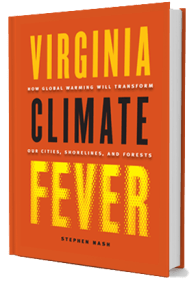
Featured imageVirginia climate activists (and indeed all Virginians) should cheer Stephen Nash, whose Virginia Climate Fever (just published by The University of Virginia Press) lays out clearly the costs of our decades of inaction on global warming. The book’s subtitle nicely sums up the point: How Global Warming Will Transform Our Cities, Shorelines, and Forests.

Why a climate book focused on just one state?

One of many confounding challenges of global warming is how to get people (and politicians and businesses) to take action commensurate with the size of the problem. As the popular British social scientist Roman Krznaric asks, “how can we close the gap between knowledge and action on climate change?” Krznarik’s answer is to seek ways to increase our empathy for people who live in distant places, or will live in future times. Certainly that is needed. (The U.S. edition of Krznarik’s book on empathy comes out in November.)

But since the day of increased empathy has yet to arrive, climate communications experts have focused on the need to get people to realize that climate change is happening here and now. It’s not just about our grandchildren, or even our children. It’s about us too. Now. And it’s not just about poor people living at sea level in Bangladesh, or the soon-to-disappear Maldives, or where melting glaciers threaten tens of millions of people’s water supply. Global warming is happening to us in America, and right here in Virginia. What’s more, it’s not limited to low-lying, frequently flooded parts of coastal Virginia, like Norfolk. Climate disruption is happening all across the commonwealth—from the shore to the tidal Potomac near Alexandria and Washington to the Piedmont to the mountains.

Climate communications experts agree that people are more likely to act (and demand that their leaders act) on global warming if they understand that it will have serious effects in their lives, and where they live.

Virginia Climate Fever does a superb job of bringing climate change home to Virginia. Nash, a journalist who writes with a deft touch, has taught at The University of Richmond since 1980, and he clearly knows Virginia well. He is is well versed in the science of climate disruption, and very good at explaining it. The book is filled with information gathered from interviews with scientists, including several at Virginia universities.

One leading climatologist featured prominently is Katharine Hayhoe, head of the Climate Science Center at Texas Tech University. As the book explains, she also happens to be an evangelical Christian whose faith informs and inspires her work. At Nash’s request, Hayhoe and a colleague prepared color maps of Virginia for Virginia Climate Fever, showing stunningly how much hotter our summers and winters are likely to be in the coming decades under different levels of future carbon emissions. It’s hard for me (at age 61) to look at these and contemplate my own hotter future here, much less my children’s.

Most disturbing to my mind was Nash’s description of the future of what those maps mean for our forests. We often hear about sea-level rise and how it will combine with more-severe storms to harm Virginia, especially in the Hampton Roads area. And well we should—the situation in Virginia’s coastal areas is dire indeed. But Nash reveals that our inland and mountain forests are just as threatened. And so not surprisingly are many plant and animal species that live in or near them. Many species face the prospect of extinction this century. Nash quotes the bioclimatologist Ron Neilson as saying that large areas of Virginia forest could “go into drought stress and potentially burn up,” resulting in “some very rapid conversions from forest to savannah.” Nash asked Neilson if this could happen in the next twenty or thirty years. Neilson’s answer: “How about now?”

Virginia Climate Fever is not strictly speaking a book about energy or energy policy. Rather it’s about climate impacts from our past, present, and future energy choices. But for those on the more well-informed side of the current “I’m not a scientist, what do I know?” climate-science-denial catchphrase, Virginia’s current and future energy choices will come to mind on every page of the book.

Nash does include a chapter on possible prescriptions for our climate fever. He tellingly notes: “we don’t lack for examples among other states,” citing North Carolina and Maryland as two of many states considerably farther along in addressing changing climate. He cites with approval Maryland’s efficiency and conservation measures, and its mandatory renewable portfolio standard, noting that Virginia is one of only nineteen states with no mandatory renewable standard at all. He mentions Maryland’s participation in the multistate Regional Greenhouse Gas Initiative. Again, “Virginia is not on the list.”

Nash asked Virginia’s Department of Environmental Quality about climate change and got this written response: “The Virginia [DEQ] does not have the expertise to study climate change issues.” One could not find a better sentence to sum up the four lost years of the McDonell-Cuccinelli administration’s climate denialism.

Governor Terry McAuliffe and Senator Mark Warner enthuse about a mindless “all of the above” energy policy that includes fracking (and associated pipelines), offshore oil drilling, coal exports, and ever more reliance on fossil fuels. (To his credit, Senator Tim Kaine has said that “all of the above” is not a strategy—yet nevertheless supports offshore oil drilling.) Virginia Climate Fever is a wake-up call for them, and for the “I’m not a scientist” crowd, and for all Virginians.

But of course there have been other such calls in the past few decades. The question is, when will enough Virginians hear them clearly, and begin to act with a sense of urgency?

Seth Heald is vice chair of the Sierra Club Virginia Chapter. He is a student in the Master of Science in Energy Policy and Climate program at Johns Hopkins University.
Note: Northern Virginians will have an opportunity on November 6 to meet Stephen Nash in Alexandria at an author talk and book signing. Details and RSVP form are here.


Unknown's avatar

Why we can’t just shut up and eat our cookies (or embrace natural gas)

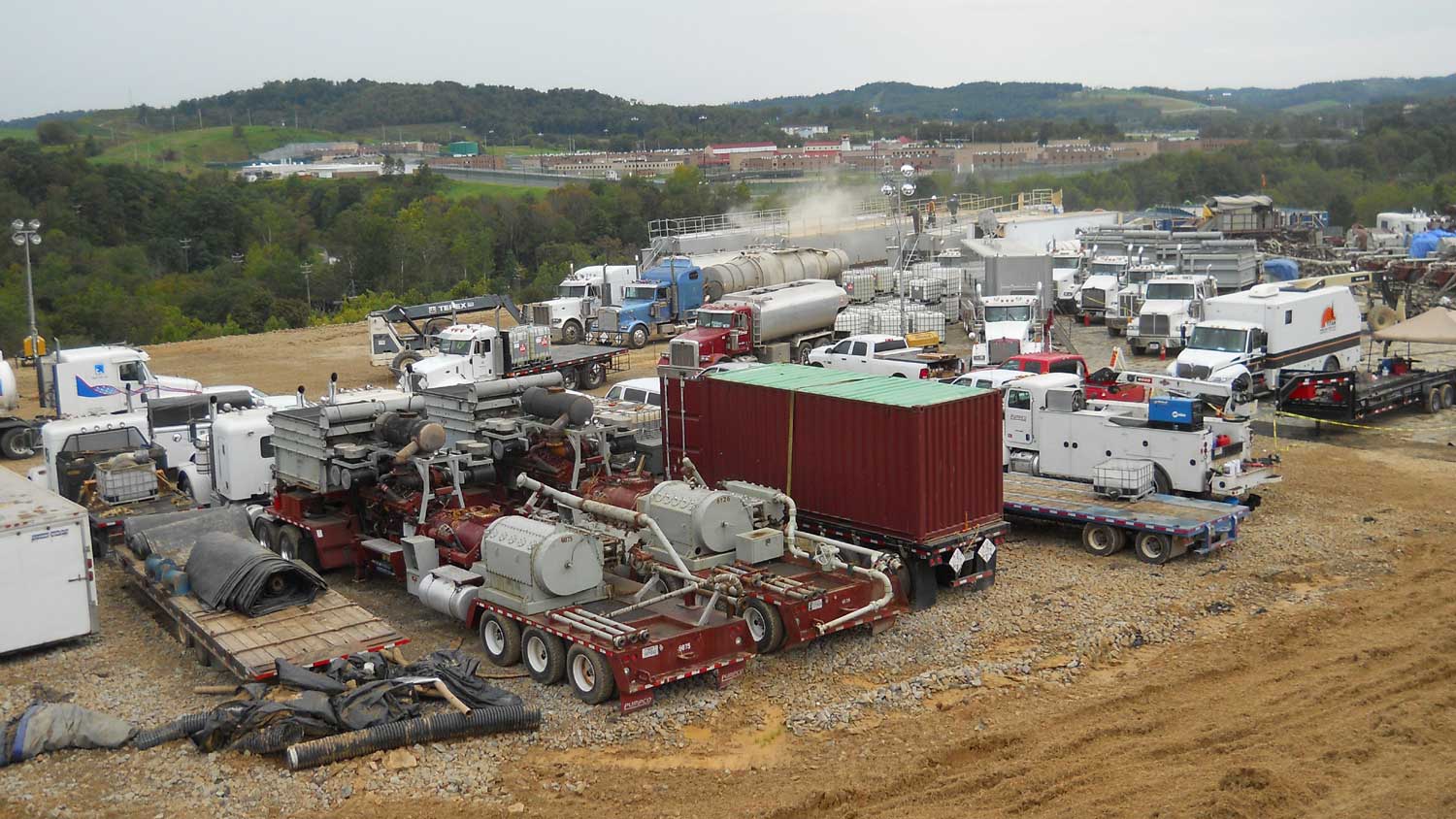
Fracking site, Marcellus Shale. Photo courtesy of U.S. Geologic Survey.

Fracking site, Marcellus Shale. Photo courtesy of U.S. Geologic Survey.

I grew up with brothers, so I knew from an early age that the easiest way to make friends with guys was to feed them chocolate chip cookies. I took this strategy with me to college, commandeering the tiny kitchen in our coed dorm. The aroma wafting down the hallways reliably drew a crowd.

One fan was so enthusiastic that he wanted to learn to make cookies himself. So the next time, he showed up at the start of the process. He watched me combine sugar and butter, eggs and white flour.

Instead of being enthusiastic, he was appalled. It had never occurred to him that anything as terrific as a cookie could be made of stuff so unhealthy. It’s not that he thought they were created from sunshine and elf magic; he just hadn’t thought about it at all. He left before the cookies even came out of the oven.

I felt so bad about it, I ate the whole batch.

But I can empathize with that guy when I’m told that as an environmentalist, I should love natural gas. Natural gas is the chocolate chip cookie of fossil fuels. At the point of consumption, everybody loves it. It’s cheap, there’s gobs of it, and it burns cleaner than coal, with only half the carbon dioxide emissions. Disillusionment sets in only when you look at the recipe. (“First, frack one well. . .”)

I realize we have only ourselves to blame. For years, environmentalists talked about gas as a “bridge fuel” that could carry us from a fossil fuel past to a future powered by renewable energy. No one would tarry on that bridge, we figured, because gas was expensive. We’d hurry along to the promised land of wind and solar.

But that was before hydrofracking and horizontal drilling hit the scene. Fracking opened up vast swaths of once-quiet forest and farmland to the constant grinding of truck traffic heading to drilling rigs that operate all day and night, poisoning the air with diesel fumes and sometimes spilling toxic drilling fluids onto fields and into streams. It was before studies documented well failures that let toxic chemicals and methane seep back up along the well borings and into aquifers, contaminating drinking water.

And it was before scientists sounded the alarm on “fugitive” methane emissions from wellheads: gas that escapes into the air unintentionally, sometimes at levels so high as to cancel out the climate advantage of burning natural gas instead of coal.

But just as environmentalists were thinking, “Whoa, natural gas turns out to be a bridge to nowhere,” electric utilities were embracing fracked gas in a big way. Fracking has made gas so cheap that giving up coal is no sacrifice. It’s so cheap they see no reason to get off the bridge and embrace renewable energy. At one conference I attended, a gas company executive gushed, “Natural gas is no longer a bridge fuel. It’s a destination fuel!”

All I could think was, “In that case, the destination must be Cleveland.” Which was surely unfair to Cleveland.

Just to be clear: environmentalists are not opposed to gas because we are spoil-sports, or purists, or hold stock in solar companies. The problem with natural gas is that it isn’t made by Keebler elves, but extracted through a nasty process that is harming the planet in ways both local and global.

If the best anyone can say about natural gas is that it’s not as bad as coal, then lingering on the bridge makes no sense. And anything we do that keeps us here—opening up Virginia to fracking, or building a huge new pipeline to bring fracked gas from other states—is both foolish and dangerous. Foolish, because embracing cheap gas distracts us from the serious business of building wind and solar and using energy more efficiently; and dangerous, because the planet will not stop warming while we play shell games with carbon.


Unknown's avatar

Children need the EPA’s carbon pollution standard

This post, from guest blogger Samantha Ahdoot, originally appeared in the August 21 edition of the Fairfax County Times. I’ve written about the threat that increasing summer temperatures poses for people who have to work outdoors in ; here, Dr. Ahdoot tells us what carbon pollution means for children.

The end of summer fun? Higher temperatures resulting from carbon pollution could limit children's outdoor time.

The end of summer fun? Higher temperatures resulting from carbon pollution could limit children’s outdoor time.

Every day, parents protect their children from a myriad of risks. By strapping them in car seats, placing them on their backs to sleep and cutting their grapes into quarters, parents do everything in their power to insure their children against harm. President Obama’s Clean Power Plan will be called many things in the upcoming months, but it is ultimately an insurance plan. It is insurance for our children against the dangers of carbon pollution and resulting climate change.

Carbon pollution presents a major risk to the health, safety and security of current and future children. Rising atmospheric carbon is making our planet hotter. While skeptics may say this remains uncertain, our major scientific organizations (NASA, NOAA, IPCC) tell us it is at least very, very likely. With this increased heat, many other climactic changes are already occurring, including melting glaciers, rising sea levels and worsening storms. These fundamental changes ultimately impact human health, and children are amongst the most vulnerable to these changes. Some impacts are already affecting children today and are being seen by pediatricians like myself.

Allergic rhinitis, for example, affects about 10 percent of American children. With later first frost and earlier spring thaw due to rising global temperature, the allergy season has become longer. In the Northern Virginia region, where I practice, it has lengthened by about two weeks. More northern regions of the country have experienced greater lengthening. Higher carbon dioxide in the atmosphere also causes ragweed plants today to produce more pollen than in preindustrial times. Allergy season is therefore both longer and more severe.

Some infectious disease patterns have already been impacted by climactic changes. As global temperatures rise, many plants and animals are migrating poleward. They are bringing diseases, like Lyme disease, with them. There is now Lyme disease in Canada, and large increases in reported cases of Lyme have occurred in the northern U.S. Maine had 175 cases in 2003 and 1300 cases in 2013, while New Hampshire had 262 cases in 2002 and greater than 1300 cases in 2013. Children under five years old, who spend the most time outside playing in high-risk areas, have the highest incidence of Lyme disease.

Increasingly long and severe heat waves also place children at risk of heat-related illness. While the elderly are at highest risk from extreme heat, some groups of children also appear to be vulnerable. Infants less than one year, for example, have immature thermoregulation, and infant mortality has been found to increase due to extreme heat. A study from MIT found that by the end of the 21st century, under a “business as usual” scenario, infant mortality rates would increase by 5.5 percent in females and 7.8 percent in males due to heat-related deaths. U.S. student athletes are a high-risk group for heat injury. Teenage boys, most commonly football players, made up 35 percent of the roughly 5,900 people treated yearly in emergency rooms for exertional heat illness between 2001 and 2009. According to the CDC, heat illness is a leading cause of disability in high school athletes, with a national estimate of 9,237 illnesses annually.

Health impacts on individuals and communities will grow significantly if we allow carbon emissions, and global temperatures, to rise unchecked. Power plants contribute approximately one-third of U.S. greenhouse gas pollution. Reducing emissions from existing fossil fuel-fired power plants represents a major step towards altering our emissions, and climate, trajectory. Obama’s Clean Power Plan is, ultimately, like a car seat- an insurance plan for our children against a significant risk of harm. The road of climate change will be long and hazardous. Our children deserve to be strapped in.

Dr. Samantha Ahdoot is pediatrician in Alexandria. She is a Fellow of the American Academy of Pediatrics (AAP), and a member of the Executive Committee of the AAP’s Council on Environmental Health.