

When the State Corporation Commission approved Dominion Energy Virginia’s proposal to build a new, 944 MW gas peaker plant on November 25, it looked like the end of a long, drawn-out battle over the future of fossil fuels in Virginia.
The approval seemed to signal that for now, at least, the Virginia Clean Economy Act (VCEA) would not stand in the way of new gas-burning turbines in spite of their high greenhouse gas emissions. According to the SCC’s order, the surge in power demand from data centers had triggered a reliability exception to the VCEA’s ban on new fossil fuel construction.
Then suddenly, on December 16, the SCC granted the Southern Environmental Law Center’s (SELC) motion to reconsider the decision the commission had rendered just weeks before, suspending approval of Dominion’s plan. What the heck?
The SCC did not limit what it intends to reconsider, suggesting it will look anew at each of the four issues SELC raised. Since those issues cover pretty much everything about the gas plant’s approval, it’s impossible to guess what is going on.
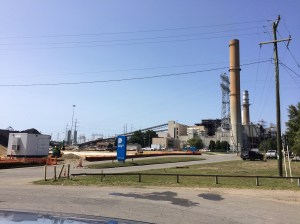
Certainly, there are many reasons to criticize the initial approval of the Chesterfield Energy Reliability Center (CERC), beyond its climate impacts. The majority-Black community where the plant would be located suffered for decades from exposure to toxic air pollution spewing from the huge coal plant on the site. Closure of the coal plant had brought a welcome respite. Residents fear they will once again serve as a sacrifice zone for decades to come, in spite of environmental justice protections written into the VCEA.
In addition, Dominion had gamed the planning process so thoroughly that this alone might have caused the SCC to reject the proposal. Dominion had gone ahead and put in an order for the gas turbine even before soliciting proposals from third parties to address reliability concerns, as the law requires. On top of that, the company told the SCC that an independent third party had reviewed the options, which was false.
Dominion, it turned out, never had any intention of awarding the project to anyone but itself or of considering alternatives that didn’t involve fossil gas. How could the SCC reward such malfeasance?
The VCEA prioritizes the security and reliability of the power supply even over its carbon-cutting and cost-saving goals, but there are conditions attached to approving new power plants, intended to make new fossil fuel generation something of a last resort. SELC and other environmental groups had made a strong case both that Dominion failed to meet those conditions, and that there were non-fossil fuel alternatives that could provide reliability at less cost.
But if Dominion’s gaming of the process should have sparked outrage at the SCC, it also succeeded in putting the regulators in a difficult position. The mere suggestion of a future with rolling blackouts if a power company doesn’t get its way would cow any public utility commission, let alone one in a state facing an unprecedented surge in demand.
That explains the SCC’s order approving a certificate of public convenience and necessity (CPCN) for the gas plant Dominion swears is its only viable option. What, then, explains the about face on December 16, less than 24 hours after receiving the motion to reconsider?
Four possible errors
In its motion, the Southern Environmental Law Center (SELC), representing Appalachian Voices, the NAACP and Mothers Out Front, argued that the SCC erred on four points around environmental justice, the cost of the gas plant compared to alternatives, the burden of proof on reliability and the legal mechanism for cost recovery.
If the SCC were to agree with any of the first three arguments, the result would require new analysis, and might even send Dominion back to the drawing board. Agreement on the fourth point, however, would only change how Dominion charges ratepayers for the cost of the project. It would require the company to put the cost into base rates instead of a new rider, making CERC potentially less profitable for the company.
This last point looks like something of a legal slam-dunk. A provision in the VCEA allows rate recovery through a rider only when a utility has met its energy efficiency targets – something all parties agree Dominion has not done.
SELC also alleged that the commission failed to ensure the development of CERC “does not have a disproportionate adverse impact on historically economically disadvantaged communities,” another statutory requirement. The SCC’s original order addressed the point but appears to have misread this section of the law. That fact alone would justify a reconsideration of the November 25 order, though it would not alter the core of the decision to approve a CPCN for the gas plant.
SELC’s other three points put CERC in greater jeopardy, if the SCC agrees.
The commission’s environmental justice analysis consisted mainly of a judgment that a gas plant would be less harmful to the surrounding Black and Hispanic community than the coal plant that was formerly on the site. This may or may not be true, but that’s not the standard. On the contrary, a minority community that has suffered decades of pollution shouldn’t be first in line for the next polluting project to come along. That “disproportionate” impact is precisely what the VCEA and the Environmental Justice Act prohibit.
If the SCC were to side with the local community on this point, it wouldn’t stop Dominion from building a gas plant, but it would require the company to find a new location.
The two final arguments attack the decision that a large gas peaker plant is the right remedy for a looming energy crisis. SELC contends that Dominion didn’t prove the cost of the gas plant is reasonable, citing the company’s deeply flawed process for considering alternatives and its failure to include fuel cost data. SELC also complains the SCC didn’t require Dominion to prove that its claimed threat to reliability could only be satisfied with a fossil fuel plant, but had merely taken the company’s word for it.
These are accurate complaints about Dominion’s flawed process and strained analysis, and compelling reasons to reject Dominion’s plan — but they were just as compelling on November 25, when the SCC issued its order granting the CPCN.
Indeed, the SCC had to both close its eyes and grasp at straws to reach the conclusions it did. For example, a footnote in the SCC’s order cites a Dominion witness’ testimony for the proposition that a Sierra Club witness had agreed a gas plant would be needed eventually. The commissioners did not take the time to find and review the Sierra Club’s testimony, which would have shown the Dominion witness had mischaracterized the evidence. Indeed, the Sierra Club’s modeling showed an alternative portfolio of clean resources would provide more energy than CERC at less cost.
But apparently, gaming the process, ignoring the law and mischaracterizing the evidence are all things Dominion is willing to do to get an expensive fossil fuel plant approved in the face of the rigorous conditions set by the VCEA.
On December 29, the SCC set a date of January 23 for Dominion to reply to the issues raised by SELC in its motion for reconsideration; presumably the commission will then set a date for a new hearing on those issues. The timeline could push a final decision on CERC out beyond the end of this year’s legislative session, making the interplay of politics and policy all the more interesting.
This article was originally published in the Virginia Mercury.
Update: After all that, in February the SCC decided not to make any changes to its order. Environmental groups are taking the matter to court.

 Power for the People VA