Unknown's avatar

How Gov. Spanberger and a Democratic majority can make energy more affordable

An aggressive legislative agenda this year will demonstrate national leadership on managing the data center buildout while delivering climate, health and economic benefits to all Virginians
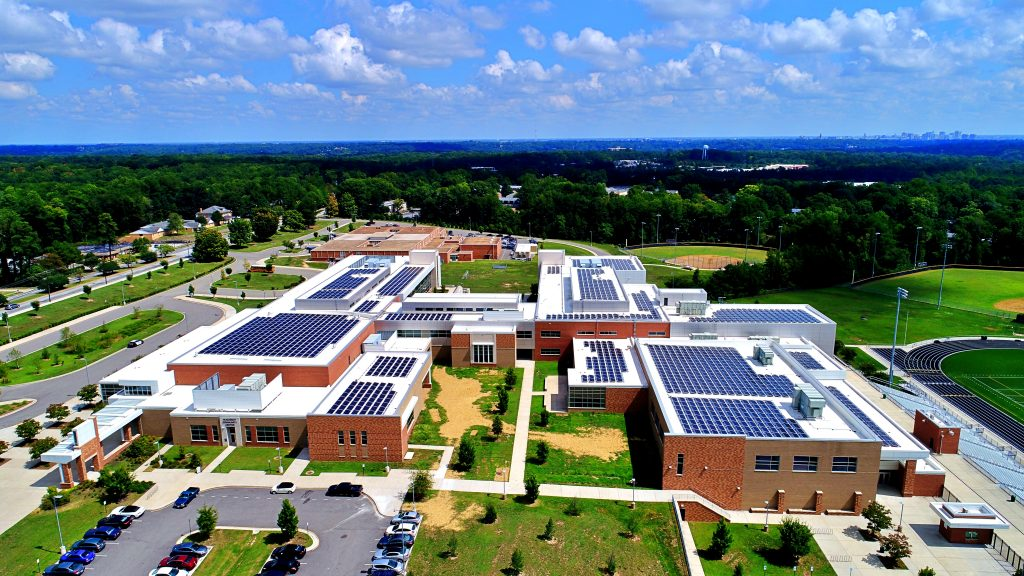
Solar on schools and other public buildings reduce pressure on the grid while saving money for taxpayers. Photo courtesy of Secure Solar Futures LLC

If Virginia’s election last month was more than an unleashing of anti-Trump sentiment (and it definitely was that), it was about affordability. Governor-elect Abigail Spanberger made the cost of living the focus of her campaign, frequently mentioning high energy bills. House Democrats, whose majority has been boosted by the addition of 13 new members of their party, are also expected to focus on these bread-and-butter issues. 

In Virginia, the cause of these high bills is not hard to identify: Data centers are driving up demand well beyond the available supply, and high fossil fuel prices are pinching a state that relies on natural gas for most of its electricity. Spanberger has committed to making data centers “pay their fair share,” and both she and legislators will be looking for other opportunities to lower costs.

The bad news is that adding ever more data centers across Virginia means the upward pressure on electricity prices will continue. If the governor and legislators don’t want to kick tech companies to states with spare capacity, and if the administration of President Donald Trump continues to throttle the energy supply with its war on wind and solar, lowering energy costs in the near term likely isn’t possible. 

Even so, there is a lot that Spanberger and the General Assembly can do to protect residential consumers from these higher prices. 

Making data centers pay their fair share means more than tweaking rate structures. Several Virginia utilities have created special rate classes for large load users like data centers. The utilities will require data center operators to sign long-term contracts committing them to paying for a large percentage of the electricity and transmission they say they need, even if they don’t end up using that much or leave the Virginia market prematurely. 

These new tariffs can help protect other customers from some – though not all – of the risk involved in serving data centers, but they don’t address the “fair share” issue. The current allocation of transmission costs, with residential ratepayers picking up most of the tab for new lines that don’t benefit them, needs to change. If the SCC determines it doesn’t have authority to do that on its own, the General Assembly and Spanberger should pass legislation to make it happen. 

The harder problem is how to make residents whole for rate increases that result from data centers gobbling up all available power. The supply and demand problem has been compounded by a lot of bad decisions, with plenty of blame to go around. The federal government has driven up fossil fuel prices by allowing the export of increasing amounts of natural gas, while hindering and even blocking solar and offshore wind projects that could make up the deficit. 

Outgoing Gov. Glenn Youngkin is to blame for illegally pulling Virginia out of the Regional Greenhouse Gas Initiative (RGGI), removing the market incentive for Virginia utilities to increase investments in low-cost renewable energy instead of burning expensive fossil fuels. (His promotion of the false narrative that gas is “cheap” doesn’t help.) 

Virginia utilities share the blame for relying too much on natural gas and high-priced electricity imported from other PJM states. And grid operator PJM is to blame for failing to approve enough new generation, including wind and solar facilities that make up the vast majority of projects waiting for approval to interconnect.

This history leaves Spanberger with a fine mess. Keeping prices in check now requires two things that can actually be accomplished during the next four years: a greater buildout of solar generation and energy storage to get more capacity on the grid; and investments in energy efficiency and rooftop solar to take pressure off the demand side.    

Solve utility solar siting with agrivoltaics. Virginia needs more energy, and solar is the only source that can be built quickly. Yet one of the knottiest problems confronting the General Assembly in the past few years has been the rise of anti-solar sentiment in rural counties. 

Landowners who want to lease their property for solar, or even to install arrays for their own use, find themselves stymied by opposition from neighbors who don’t like the look and are able to persuade county boards to deny permits. As we’ve seen, sometimes denial of a solar permit even follows approval of an energy-sucking data center.

Last year the General Assembly came close to passing a bill that would require solar developers to implement industry best practices. Passing legislation like that this year will address the legitimate concerns of localities around controlling erosion and maintaining native plant buffers. But more can be done to make solar look and function like a normal part of Virginia’s agricultural economy.

Already, solar facilities have become integrated with agriculture, as sheep and sometimes cattle take over vegetation management and farmers learn which crops do well growing between rows of solar arrays. It’s a trend that offers benefits to the land and the community alike. Farmers are struggling; solar can provide a stable income while protecting land from permanent development and putting much-needed energy on the grid. 

Businesses are ahead of public policy on this. Virginia-based Gray’s Lambscaping manages vegetation with over 800 sheep at solar farms across the state, and the company plans to grow to over 5,000 sheep by the end of this year. Meanwhile, solar panels have proven compatible with a wide range of food crops.  

Virginia should take a leading role in expanding agrivoltaics. Virginia law already recognizes the right to farm as an exception to localities’ authority over land use decisions, and this should be extended to farmers who put solar on their land, as long as they are also using the same land for traditional agricultural practices like grazing and crops. 

Install solar on new public buildings and schools. Heck, put it everywhere.  In the past ten years or so, Virginia’s commercial solar sector has blossomed while saving taxpayers money. To date, an estimated 150 Virginia schools have installed solar panels, saving schools about 25% on their energy bills. Solar on every sunny school rooftop would add up to more than 1,000 MW of carbon-free generation. Extend the effort to the roofs of all suitable public buildings across the state, and that number can go much higher. 

Dominion and APCo have long tried to squelch competition from rooftop solar, a war that looks increasingly foolish as Virginia finds itself short on energy for all customers. Earlier this year Congress drastically accelerated the phase-out of solar tax incentives, but the savings remain available for commercial and utility-scale projects for the next two years. There is no shortage of good ideas out there to be acted upon. Spanberger and legislators should take full advantage of that opportunity to install as much solar as possible. 

Battery storage at data centers does triple duty. While solar is the cheapest, cleanest, and fastest way to generate power, it needs batteries or other forms of energy storage to make it into a 24/7 resource, and storage remains relatively expensive. For tech companies, however, the calculus makes more sense.

Data centers need backup power anyway; they typically have three layers of redundancy so that they never risk losing power when the grid goes down. Today the backup power is mostly provided by massive diesel generators, sometimes three times as many as they might actually need. Most of these have no pollution controls and are therefore not supposed to run except in emergencies and for testing and maintenance. That’s sill a lot of run time — and DEQ is proposing to make matters worse by expanding the definition of “emergency” to include scheduled outages.

Some tech companies are now installing generators with selective catalytic converters that produce fewer emissions. The catch is that these can legally be used in non-emergency situations, raising the possibility that they might be used for demand-response or peak shaving. In effect, data centers would be solving the peak demand problem with one of the dirtiest forms of energy. The cumulative effect on air quality could be worrisome, and Virginia’s carbon footprint would grow at a time when the law says it should be shrinking. 

What if, instead of diesel generators, data centers installed storage as their first line of defense against power outages, leaving diesel generators to be used only in the rare case of extended grid outages? Air quality would benefit, carbon emissions would decrease, and the data centers would have the backup power they need. The tech companies would pay more upfront but could be compensated by utilities for using their storage capability for grid services and demand response, lowering their draw from the grid at peak demand times. 

All the data centers in Virginia today use 6 gigawatts of power. That much storage would exceed the targets set in the VCEA for Dominion and APCo combined.  Even limiting the requirement to two hours of storage at new data centers would bring enough storage online quickly to eliminate the expensive demand peaks that drive the high price of energy.  

Require data center operators to source their own zero-carbon electricity. Most of the tech companies have sustainability commitments that they aren’t meeting, so it isn’t asking too much of them to put them in charge of this effort. Legislation to require this as a condition of accepting Virginia’s generous tax subsidies has been defeated for the past two years. The difference this year is that rising energy prices are now affecting everyone. 

Under this proposal, the zero-carbon electricity doesn’t have to come from Virginia, as long as it is available to customers here. Maybe the tech companies could even tap into their considerable influence with the Trump administration to make electricity more plentiful and affordable by reversing its war on solar and wind energy.

Why, after all, should Virginia residents sacrifice for the richest corporations in the world? If “paying their fair share” means anything, it should mean that data centers, not residents, bear the costs of making enough energy available to Virginia, and complying with our clean energy mandate.

Lower demand with energy efficiency and distributed solar. The gap between energy supply and demand does not have to be filled entirely through supply-side solutions. Lowering demand should also be part of the solution. Virginia utilities, Dominion in particular, have done a poor job of running energy efficiency programs. Looking on the bright side, though, that means plenty of opportunities remain.

House Democrats have already started work on this issue, with a focus on lowering winter heating costs for lower-income households. As reported in the Mercury last week, HB 2, from Farifax Del. Mark Sickles, requires Dominion and APCo to make their “best, reasonable efforts” to provide energy efficiency and weatherization to 30% of income-qualified customers by the end of 2031. HB 3, from  Del. Destiny Levere Bolling, D-Henrico, sets up a task force to study income-qualified energy efficiency and weatherization.  

These steps are okay for starters, and they would be juiced by the influx of money from RGGI carbon auctions (see next section), earmarked for low-income energy efficiency. But Dominion has repeatedly failed to meet the energy efficiency targets the legislature sets for it, and after all, why stop with 30% of low-income customers when all households could benefit from more comprehensive programs? Virginia can do much better.  

My last column discussed Rewiring America’s proposal to have tech companies pay for heat pumps, solar and batteries in the residential sector, saving money for households and freeing up capacity for data centers to come online sooner. An independent provider could run the program and verify the energy savings.  

(If the tech companies complain that an awful lot of the solutions I’m proposing come at their expense, it’s true. But the industry benefits from a state tax subsidy that has reached nearly a billion dollars per year, and will only grow further as the number of data centers doubles and triples. They can afford to give back.) 

Use RGGI for long-term affordability. Gov.-elect Spanberger has committed to seeing Virginia rejoin the Regional Greenhouse Gas Initiative (RGGI), the compact of northeastern states working to lower carbon emissions by 30% by 2030. RGGI works by requiring owners of carbon-emitting generating plants to buy carbon allowances at auction, penalizing carbon-intensive generation and rewarding investments in zero-carbon facilities like wind, solar and nuclear. States collect the auction proceeds, which in Virginia are dedicated to low-income energy efficiency and climate adaptation measures.

Republicans have already renewed their attacks on RGGI, calling it a tax on energy consumers. To the extent that’s true, it’s a tax mostly paid by the largest consumers (including data centers) for the benefit of low-income residents and people most vulnerable to storms and sea level rise. Moreover, all energy consumers benefit over the longer term as low-cost clean energy increasingly replaces expensive fossil fuels. 

Beef up efficiency standards in the residential building code. Most people who buy a new home assume that modern building codes incorporate the latest standards for insulation and efficient technology. In Virginia, they do not. Buyers would be dismayed to learn that their homes are costing them more on their utility bills than they saved on a purchase price supposedly made more affordable by poorer-quality insulation and appliances. Buyers are rarely consulted on these trade-offs, and few have the expertise to question a builder’s choices. Building codes are supposed to do that job.

Unfortunately, Virginia’s Board of Housing and Community Development, which writes the code, is dominated by the homebuilding industry. The industry wants to build homes as cheaply as possible to ensure the highest profit possible on the homes it sells. Even as national model code standards have become more rigorous, homebuilders have protected their own interests by keeping weak energy efficiency requirements in Virginia’s residential building code. 

In 2021, Virginia adopted legislation requiring the board to consider and adopt energy standards “at least as stringent as” the latest national model code standards when the benefits over time to residents and the public exceed the incremental costs of construction. But the board simply didn’t do it. Will this be the year legislators realize that a board dominated by the industry it regulates won’t act in the public interest without explicit directions? 

This is Virginia’s moment. Since the passage of the Virginia Clean Economy Act in 2020, renewable energy and storage have only gotten cheaper, while energy efficiency opportunities remain plentiful. Coal has solidified its place as the most expensive baseload source, and fossil gas remains stubbornly expensive compared to solar. Spanberger and the Democratic majority have an opening this year to go big on clean energy. An aggressive legislative agenda this year will demonstrate national leadership on managing the data center buildout while delivering climate, health and economic benefits to all Virginians.  

This column was originally published in the Virginia Mercury on December3, 2025.
Unknown's avatar

Five things every Virginia candidate (and voter!) should know about energy

What lights up your life? Photo by Pixabay on Pexels.com

Running for office requires candidates to know about topics they might never have given much thought to. Most Virginia campaigns are won or lost on hot-button issues like taxes, education, reproductive rights, guns and gay marriage, so everyone who runs for office has a position on these questions. This holds true for candidates in this year’s high-stakes races for the state’s executive branch and all 100 House of Delegates seats. 

Inevitably, though, there are topics the average candidate doesn’t completely grasp. Some are narrow and – thankfully – nonpartisan. Where do you stand on Sunday hunting? Should I-81 have more lanes? How do you feel about skill games? Will you vote to save the menhaden, whatever a menhaden is? (It’s a fish, and I encourage you to say yes.)

Other topics affect the lives of every Virginian, but they are, frankly, complicated. One of these is energy. Not only is it hard to get up to speed on energy issues, but technology is changing so rapidly that keeping abreast of developments would be a full-time job. Who would spend that kind of time on such a dreary topic?

Uh, that would be me. 

So here we go: I’m going to cover five things political hopefuls need to know about energy in Virginia before you get to the General Assembly and start passing laws that affect your constituents’ wallets and futures. And for voters, these are things you should ask candidates about before they earn your vote. 

First up:

If you are going to talk about energy, you have to talk about data centers

By now you surely know that Virginia has embraced the most energy-intensive industry to come along since the steam engine launched the Industrial Revolution. Northern Virginia hosts the world’s largest concentration of data centers, which already consume an estimated 25% of the state’s electricity, with massively more development planned. The reason isn’t vacation photos or Instagram cat videos; it’s the competition to develop artificial intelligence (AI).  

After putting tax incentives in place to attract the industry 15 years ago, the General Assembly and the current governor have rejected all attempts to put guardrails on development or make data centers more energy efficient. The subsidies now cost taxpayers a billion dollars per year (and counting). Virginia asks for almost nothing in return. 

Under the best of circumstances, the skyrocketing demand for electricity would put upward pressure on energy prices. But our situation is even worse: Virginia already imports about half our electricity from other states, and the regional grid that we’re part of faces its own energy crunch. 

Grid manager PJM has been so slow to approve new generation that governors from member states, including Virginia Gov. Glenn Youngkin, wrote a letter taking PJM to task and urging it to move faster. But the damage has been done. Supply is tight, electricity prices have risen, and prices will continue to rise unless and until supply catches up.

PJM has decided to fast-track new high-cost, gas-fired generating plants ahead of the cheaper renewable energy projects that make up 95% of the queue. It’s a much-criticized move and seems more likely to increase costs. Once built, fossil gas plants burn a fuel that has doubled in price just over the past year, threatening a repeat of the post-pandemic price surge that Virginia ratepayers are still paying for. And there is no relief in sight, with utilities now having to compete with a doubling of U.S. natural gas exports.

Short of unleashing all the renewable energy stuck in the queue, there is no easy way to protect Virginia residents from higher electricity costs. Dominion Energy, Appalachian Power, and at least one of the electric cooperatives have proposed special rate classes for large-load customers, but that would shield residents from only some of the costs of serving the data centers. 

Utility bills are going up. Dominion Energy is seeking hefty rate increases that would push up residential bills by an average of more than $10 per month in base rates plus almost $11 per month in fuel costs, primarily due to those higher natural gas prices. Coal-heavy APCo has seen even steeper rate increases in the past few years.

Virginia needs new legislation ensuring data centers bear the full expense and risks of serving Big Tech, and they should be required to source their own clean energy. Localities, meanwhile, must be required to evaluate the costs to all Virginians before they issue permits to data centers, including considerations like where the energy will come from, water impacts, and the siting of transmission lines.  

You can’t get from here to there without solar

Virginia wasn’t producing all of its own energy even before the data center rush, and PJM’s problems are now pushing us into a crisis. Our near-term options are limited; new data centers are breaking ground at a breathtaking rate, and only solar can be installed on the timeline needed to prevent an energy shortfall. Even if we were willing to pay for high-priced gas or nuclear plants, developers face a backlog of as long as seven years for gas turbines, and advanced nuclear is still not commercially viable. 

Fortunately, solar is not just the fastest energy source to deploy, it’s also the cheapest and cleanest. Though President Donald Trump blames rising electricity prices on renewable energy, that’s false, just one of many myths the fossil fuel industry has propagated against solar. Nor is solar unreliable, another myth. When solar is paired with battery storage, it can match the rise and fall of demand perfectly.

It’s true, however, that while the great majority of Virginians support solar energy, many rural residents oppose it on aesthetic grounds. Of course, they would also oppose nuclear reactors and gas fracking in their neighborhoods. Legislators should  be sensitive to their concerns – but having chosen to welcome data centers, Virginia leaders can’t just shrug off the need for energy.

We also have to recognize that many farmers need to lease their land for solar in order to keep the land in their family and generate stable income. This should be as important a consideration to lawmakers as the objections of people who aren’t paying the taxes on the farm. Preventing landowners from making profitable use of their land is more likely to lead to the land being sold for development than to it remaining agricultural. 

The good news is that solar panels are compatible with agricultural uses including livestock grazing, beekeeping, vineyards and some crops. Dominion Energy uses sheep instead of lawnmowers at several of its solar facilities in Virginia and plans to expand the practice. The combination is a beautiful synergy: sheep and native grasses improve the soil, and in 30 years when the solar panels are removed, the land has not been lost to development.

While there is no getting around the need for utility-scale solar projects, rooftop solar also has an important role to play. In addition to harnessing private dollars to increase electricity generation, distributed solar saves money for customers and makes communities more resilient in the face of extreme weather.

This year the governor vetoed a bill to expand the role of distributed solar in Virginia. The legislation had garnered strong bipartisan support, so it will likely pass again next year. However, lawmakers will need to go further to encourage customer investments in solar now that federal tax credits will be eliminated for residential consumers at the end of this year.  

Batteries: For all your reliability needs

The fastest-growing energy sector today is battery storage. Batteries allow utilities to meet peaks in demand without having to build gas combustion turbines that typically run less than 10% of the time. Batteries also pair perfectly with intermittent energy sources like wind and solar, storing their excess generation and then delivering electricity when these resources aren’t available.  

Battery prices have tumbled to new lows, while the technology continues to improve. Most lithium-ion batteries provide 4 hours of storage, enough to meet evening peak demand with midday solar. When renewable energy becomes a larger part of Virginia’s energy supply (it’s less than 10% now) we will need longer term storage, such as the iron-air batteries that are part of a Dominion pilot program. This year the governor vetoed a bill that would have increased the amount of storage our utilities must invest in. Given the increasing importance of batteries to the grid, the legislation will likely be reintroduced next year.

Batteries installed at homes and businesses can also play a vital role in supporting the grid. Alone or combined with distributed solar, smart meters and electric vehicle charging, customer devices can be aggregated into a virtual power plant (VPP) to make more electricity available to the grid at peak demand times. Dominion will be developing a VPP pilot program under the terms of legislation passed this year. 

Advanced nuclear is still in Maybeland

The enormous expense of building large nuclear plants using conventional light-water technology has made development almost nonexistent in this century. Proponents believe new technology will succeed with scaled-down plants that can, in theory, be standardized and modularized to lower costs. Many political and tech leaders hope these small modular reactors (SMRs) will prove a carbon-free solution to the data center energy problem. 

It’s hard not to think they’re kidding themselves, or maybe us. Dominion Energy and Appalachian Power plan to develop one SMR each, with Dominion shooting to have one in service in 2035. Not only is this too late to meet today’s energy crunch, but a single SMR would add less energy to the supply side than new data centers add to the demand side each year. Virginia still needs near-term solutions, which means solar and batteries. 

Industry enthusiasts believe the 2035 timeline can be shortened, while critics say SMRs may never reach commercial viability. SMRs have to be able to compete on cost with much cheaper renewable energy, including wind, solar and emerging geothermal technologies, and cost parity is a long way off. The economic case for nuclear reactors also requires that they generate power all the time, including when the demand isn’t there, so SMRs need batteries almost as much as renewable energy does.

Finally, radioactive waste remains a challenging issue, as much (or more) for SMRs as for legacy nuclear plants. The U.S. has never resolved the problem of permanent storage, so nuclear waste is simply kept onsite at generating stations. The risk of accidents or sabotage makes it unlikely that communities will accept SMRs in their midst, especially if the idea is for SMRs to proliferate on the premises of privately-owned data centers near residential areas statewide.  

A nuclear technology with less of a waste problem is fusion energy. A fusion start-up plans to build its first power plant in Virginia in the “early 2030s,” if the demonstration plant it is building in Massachusetts proves successful. While fusion would be an energy game-changer, there are so many uncertainties around timeline and cost that only an inveterate gambler would bet on it helping us out of our predicament. 

Pretending climate change isn’t real won’t make it go away

We don’t have to talk about climate change to make the case for transitioning to carbon-free renewable energy, but global warming hovers in the background of any energy debate like an unwanted guest. If you need a primer or are even slightly tempted to say you “don’t know” whether human activity is responsible because you’re not a scientist, read the Intergovernmental Panel on Climate Change’s summary for policymakers. The continued habitability of the planet is too important for ignorance to be an acceptable dodge – and of course you, as a respectable candidate, would never stoop to such a thing.

Virginia codified its own action plan in 2020 with two major laws. One provides for the commonwealth to participate in the Regional Greenhouse Gas Initiative (RGGI), a multistate compact that uses auctions of carbon emission allowances to incentivize a shift away from fossil fuels and raise money for energy efficiency and climate adaptation. After taking office in 2022,  Youngkin removed Virginia from RGGI – illegally, as a court ruled. Virginia remains outside RGGI while the appeals process continues. 

The second law is the Virginia Clean Economy Act (VCEA), which creates a pathway for Dominion and APCo to transition to carbon-free electricity by 2050. The VCEA includes provisions requiring Dominion and APCo to invest in renewable energy, storage and energy efficiency and make renewable energy an increasing portion of their electricity supply. 

The VCEA contains special provisions for offshore wind, which I haven’t addressed here because  Trump is determined not to allow projects to move forward while he is in office. This is a shame, as there is bipartisan support in Virginia for this industry and the huge economic development opportunities that come with it. Still, Virginia’s Coastal Virginia Offshore Wind (CVOW) project is 60% complete and will start delivering power next year. Eventually, hopefully, it will be remembered as the first of many.

The VCEA also prohibited new investments in fossil fuel plants except under certain conditions. Dominion is currently seeking permission from the State Corporation Commission to build a $1.5 billion, fossil gas-fired peaker plant, citing data center demand and a need for reliability. Local residents, environmental organizations and ratepayer advocates oppose the plant and filed expert testimony showing that solar, storage and other less expensive technologies would better serve consumers.

In what passes for a bombshell in the energy space, Dominion was forced to admit last month that it had not obtained an independent review of the bid process before selecting its own gas plant over resources offered by third-party bidders.

“No regrets” solutions are progressive and conservative

As you’ve probably figured out by now, there is no perfect power source available today. And yet we would need new generation even if we stopped data center construction cold in its tracks – which isn’t in the plans. Solar is the cheapest, cleanest, and fastest source of generation, allowing us to preserve land – and keep options open – for the future. If the data center boom goes bust, having surplus clean energy on the grid will let us eliminate dirty sources faster, while saving money. 

Who would run against that?

First published in the Virginia Mercury on September 15, 2025.

Unknown's avatar

Let’s hear it for the losers!


In Wise County earlier this month I met the candidate daring enough, or foolish enough, to run against the most powerful Republican member of Virginia’s House of Delegates. 

When I walked into the community center in Norton, where I was to give a presentation at the invitation of the Clinch River Coalition, I found a volunteer wrangling wires to plug in the audio equipment. He was introduced to me as Josh Outsey, the man who had taken on the thankless job of Democratic challenger to Del. Terry Kilgore, R-Scott, in this fall’s election. 

Before I could stop myself, I laughed. Terry Kilgore has been in the House for 31 years, and ran unopposed in the last three elections. A politically powerful member of a politically powerful family, Kilgore represents a district that’s over 92% White and voted 83.1% for Donald J. Trump. The 63-year-old lawyer was recently elected House Republican leader.

Joshua Outsey (pronounced OOT-see), 38, is a Black actor, singer and community organizer. As of June 5, Kilgore had raised $469,509, according to the Virginia Public Access Project. Outsey had raised $200. 

Outsey gives a respectable pitch for his candidacy, grounded in both experience and policy. If this were a contest for a seat in a more balanced district, I’d have no business being amused. But no one, least of all Outsey, is under any illusions that he can unseat Kilgore. 

Still, I am filled with admiration. It is one thing to say that democracy works best when voters have choices, and quite another to agree to make yourself that choice against impossible odds. 

I’ve seen up close what even a hopeless campaign can require. A couple or three decades ago, my friend Tom Horton ran for Congress against a well-funded Republican incumbent who was firmly entrenched in Virginia politics. Tom had no trouble securing the Democratic nomination – nobody else wanted it – but he didn’t have money for a staff, and he needed a policy director. I was at home with young children and glad for the mental stimulation, so I signed on. 

Unburdened by any real prospect of success, I had a great time writing position papers based largely on my own opinions. Every once in a while, I would stop and ask myself, “I wonder what Tom thinks about this?” then shrug and plunge on. Very occasionally, Tom would balk at a position I proposed he take, and then we would talk it out.

But mostly, he didn’t have time for that. Poor Tom spent every day of the campaign on the phone trying to raise money. In the evenings he knocked on doors. If he was lucky, sometimes he was interviewed on the radio or got a quote in the paper. It was an uphill slog all the way, and none of it mattered. He lost by about the same wide margin that polls had shown him losing by at the outset of the campaign. 

He had to be disappointed, but Tom told me he loved every minute of it and would run again in a heartbeat, if he didn’t have a family to support.

Maybe this is why I have a special place in my heart for underdogs. People like Tom who try, knowing they are likely to fail, and then indeed do fail, only to pick themselves up and say it was worth it anyway – they are heroes to me. Winners are dull by comparison. 

Outsey is far from being the only sacrificial lamb this election. Democrats are fielding candidates in every House race this fall, including other long-shot seats like those held by Will Morefield, another coalfields delegate who won in 2023 with 85% of the vote, and Minority Leader Todd Gilbert, who won his Shenandoah Valley district by more than 77%.

Republicans are not similarly contesting every seat, but some are taking on Democratic incumbents even in deep blue districts, including a few who are making a repeat appearance on the ballot.

These include retired technology professional Kristin Hoffman, who is challenging McLean Democratic Del. Rip Sullivan for the second time, in spite of losing by 23 points in the last election. A few miles to the east, in another Fairfax County district that voted overwhelmingly for Harris over Trump last fall, retired federal worker Ed McGovern will face Del. Kathy Tran for a third time. He lost by 20 points in 2021 and 30 points in 2023.  

I was unsuccessful in trying to reach these folks, so I don’t know their motivations. Regardless, I salute them.

Running against impossible odds can serve a purpose beyond dedication to the democratic process. Democrat Melody Cartwright told a Cardinal News reporter that she sees running for a second time against Del. Eric Phillips, R-Henry, after losing in 2023 by 40 points, as a way to support Abigail Spanberger’s gubernatorial campaign. She added candidly that forcing Republicans to spend money to defend Phillips’ seat would leave them less money to attack Democrats elsewhere.

Running for office with no expectation of winning can also be a tactic for raising awareness of a neglected cause, as many a Green Party candidate can attest. My colleague at the Mercury, Roger Chesley, recalls a candidate by the name of Gail Parker who ran for various local, state and federal offices seven times between 2006 and 2019. Calling herself “Gail for Rail,” she campaigned on the single issue of promoting light rail. A 2007 Washington Post headline snarkily called her a “One-Track Candidate.” Fair enough, but the record will reflect that Metro now extends out to Loudoun County. 

Deep in the heart of every candidate, of course, is the hope that lightning may strike. The opponent might stumble badly enough, or voters suddenly realize that who they wanted all along was someone just like the scrappy upstart, leading to an upset victory. 

It has happened. In a 2014 primary, libertarian college professor David Brat defeated Congressman Eric Cantor, the House Majority Leader at the time, in an upset that shocked the political establishment and gave hope to long-shot candidates everywhere. Brat won the general election, too, and served two terms.

Brat’s win over Cantor, followed by his loss to a Democrat in 2018 – to Abigail Spanberger, as it happened – demonstrates a final point: the political winds can shift suddenly, and when it happens, the people who benefit are the ones who’ve got their sails ready. 

Democrats have been able to field so many candidates this year because they sense such a shift coming as part of a backlash to the Trump presidency. Republicans say otherwise. Still, no matter which party wins control this fall, the outcome won’t help the longest of long-shot candidates. 

But that’s okay. Just running is a win for democracy.

This article was originally published in the Virginia Mercury on June 30, 2025.

Unknown's avatar

Trump’s attack on offshore wind is hurting Virginia. Why aren’t Republican leaders fighting for us?

On May 5, attorneys general from 17 states and the District of Columbia — not including Virginia, regrettably —  sued the Trump administration over its attacks on the wind industry. The lawsuit challenges an executive order, signed by President Donald J. Trump on his first day in office, stopping all approvals, permits and funding for wind projects across the country and offshore. 

Since the order was signed, the administration hasn’t just blocked new projects, it’s issued a stop-work order for one project under construction in New York and revoked a permit for another. The actions inflict enormous damage on the wind industry and on the economies of states that need the energy and jobs this industry could deliver.

One state that will lose big under Trump’s order is Virginia, which has positioned itself to be a national leader in offshore wind deployment, supply chain and manufacturing. On top of that, Virginia badly needs the electricity from offshore wind to help meet the demand from data centers; it can’t afford to have a major new source of energy strangled in its infancy. Yet Attorney General Jason Miyares did not join the lawsuit.

Sure, Miyares wants to be a good soldier in the Trump putsch. And no doubt he wouldn’t feel at home among all those Democratic AGs (there were no Republicans signing the complaint). But he could at least speak up in his state’s interest. Some well-timed advocacy would go a long way in showing the administration that wind energy is not a partisan matter. 

It doesn’t have to be just our attorney general, either. The silence from Gov. Glen Youngkin has been equally deafening. What are they afraid of? Youngkin can’t run for reelection, and Miyares has already secured his party’s nomination in his bid for reelection this fall.

Any politician who styles himself as pro-business ought to be pushing back on the Trump administration’s interference with contracts, destruction of American jobs and infliction of billions of dollars in damage to a growing domestic industry. Especially when it is happening to their own state, the big risk is in not speaking out.

And let’s face it, attacking wind energy is Trump’s own peculiar hobbyhorse, not his party’s. Though Republican support for wind energy has dropped a bit in recent years, it remains above 50%. Onshore wind is the largest source of electricity in Iowa and South Dakota and a major source in several other Republican strongholds. Wind power is responsible for billions of dollars in economic investment while keeping utility rates low in states that rely on it. 

Offshore wind is more expensive, but states have embraced it for its potential to lower electricity bills over time while relieving grid congestion, creating well-paying jobs and providing clean, zero-carbon power to East Coast cities. Thirteen states have established offshore wind development goals, totaling over 112 gigawatts (GW) by 2050. 

In Virginia, Republican leaders have been among the biggest boosters of offshore wind for more than 15 years. Legislators from both parties supported the creation of the Virginia Offshore Wind Development Authority. With a boost from then-Gov. Bob McDonnell, the Virginia Department of Energy partnered with Dominion Energy on a research project that produced the nation’s first offshore wind turbines in federal waters. Republican support also paved the way for Dominion’s development of the 2.6 GW Coastal Virginia Offshore Wind (CVOW) project, now more than halfway to completion and expected to begin delivering electricity next year. 

Nor is CVOW a one-off; the Virginia Clean Economy Act declares twice as much offshore wind power to be “in the public interest.” At the offshore wind International Partnering Forum held in Virginia Beach last month, Dominion displayed a poster of the projects it has in the works. These include a project off Kitty Hawk, North Carolina, which Dominion acquired last October, as well as a huge lease area east of CVOW, which Dominion secured in a lease auction from the federal government last August. All told, Dominion’s projects could deliver a total of 9 GW of clean, renewable power. 

A poster displaying Dominion Energy’s planned offshore wind projects.

As important as the energy itself is, Virginia leaders believe offshore wind can be a driver of economic development and job creation for the Hampton Roads area. The Virginia Economic Development Partnership touts Virginia’s strategic location, strong maritime industry and ready workforce as draws for businesses up and down the offshore wind supply chain.

Some businesses have already set up shop in Virginia to serve the industry. These include most recently a Korean subsea cable manufacturer that is investing almost $700 million for a facility in Chesapeake. Gov. Glen Youngkin was on hand for the groundbreaking last month, calling it “a proud moment for Virginia.” Attracting the company was only possible because of Virginia’s commitment to the wind industry – as well as the availability of federal tax credits that Trump also intends to eliminate. 

CVOW will likely survive Trump’s attacks (albeit at a higher cost due to his tariffs), but Virginia’s ability to develop an offshore wind workforce and supply chain are very much at risk. The Trump administration’s war on wind power already threatens developers with losses in the billions of dollars. With permitting at a halt, companies are headed for the exits instead of creating the project pipeline necessary for offshore wind to become the powerhouse industry that it is in Europe and Asia.

Trump may have planned his economic sabotage to hurt northeastern states with Democratic governors, but the collateral damage to Virginia is considerable. As it is, our economy has taken a hit from Trump’s mass firings of federal workers, thousands of whom live here. We can’t afford to lose four years of offshore wind progress for no better reason than that Trump wills it. 

Silence is not an acceptable response. Miyares and Youngkin must speak up for Virginia.

Originally published in the Virginia Mercury on May 19, 2025.

Update: On May 20 we learned Trump’s Department of the Interior rescinded its order to shut down the $5 billion Empire Wind project in New York, reportedly after Gov. Kathy Hochul agreed to reverse a decision five years ago denying a permit to a natural gas pipeline. This is being billed as a “compromise,” which is apparently what extortion is called when the Trump administration does it.

Unknown's avatar

Remember when ethics in government mattered?

Protesters in front of a Tesla building.
People line up in front of a Tesla Service Center to protest Elon Musk. Rockville, Maryland. Photo by G. Edward Johnson via Wikimedia

It was only a decade ago that a governor of Virginia, Bob McDonnell, was embroiled in a corruption scandal resulting from his acceptance of $177,000 in gifts and loans from a businessman in exchange for promoting the company’s diet supplement. The quid pro quo struck many people at the time as more tacky than corrupt; and indeed, the U.S. Supreme Court eventually overturned his conviction on the grounds that using the governor’s mansion as a promotion venue wasn’t a sufficiently “official” act. 

These days, the kerfuffle raised by the exposure of McDonnell’s little side hustle feels almost quaint. It also feels like foreshadowing, anticipating President Donald Trump’s use of the White House lawn as a Tesla showroom to thank Elon Musk for his hard work in destroying American government. 

In the present-day version, though, it does not appear the carmaker’s $290 million in election spending played a role beyond instilling a warm fuzzy feeling in the bosom of the president. So while ordinary people may be appalled, and Democratic leaders like Rep. Gerry Connolly of Virginia are demanding an investigation, it’s hard to see the Supreme Court batting an eye. Is it so different from Justice Clarence Thomas accepting a luxury RV from a wealthy businessman?

Trading favors among the rich and powerful seems to be how it works in Trump’s America. Anyone who isn’t using his public position for his own gain is a chump. And while the laws prohibiting corruption are still on the books, Trump has ensured there are no federal prosecutors left with the independence to go after his allies. 

Besides which, in the unlikely event your cupidity actually gets you convicted of a crime, the president has a history going back to his first term of handing out pardons to MAGA loyalists regardless of their crimes. Sufficiently demonstrating fealty to the president may be enough to secure your place in his No Grifter Left Behind program. Frankly, the judge who sentences you has more to fear from the president than you do.  

By design, Trump’s attacks on American government, civil society and the world order have been so various and extreme as to leave opponents breathless. The resistance looks like a team of firefighters trying to deal with a large and very determined pack of juvenile arsonists. 

Yet, of all the fires now burning, Trump’s attacks on the rule of law might pose the single greatest threat to the country’s stability and prosperity. Trump’s firing of government watchdogs, blacklisting a law firm that represented his enemies, and defying judges who rule against him are unprecedented in modern U.S. history. Our economy as well as our democracy was built on a system of checks and balances that made corruption the newsworthy exception rather than the dismal norm.

This was brought home to me in a conversation I had recently with a rancher in, of all places, Patagonia, at the far tip of South America. (When the going gets tough, the not-very-tough go hiking.) The owner of an 8,000-acre estancia turned out to have been involved in Chilean politics for 30 years, representing his region in the Chilean Congress. He didn’t know much about what was going on in the U.S., he admitted, but he felt encouraged by the news that Trump was cutting waste and fraud. 

Okay, yes, I guffawed, but I was also struck that, with all the turmoil and crises going on in Washington, the only thing that survived a distance of 6,000 miles was Trump’s spin on his actions. Still, you hardly need to go to Chile to find people who accept Trump’s through-the-looking-glass framing of his dismantling of government institutions. 

A pro-Trump family member, as big-hearted a guy as you will ever meet, told me he was sad that people in developing countries would go without food and medicine as a result of Trump shutting down foreign aid, but it had to be done “because of all the fraud.” Virginia Gov. Glenn Youngkin is also an ardent supporter of Trump’s ever-expanding trims, last week defending the slashing of thousands of federal workers’ jobs as “dislocation” necessary to “gain efficiencies and reduce costs in the federal government.”

That’s the power of language. What Trump calls fraud and corruption turns out to be grants for things he doesn’t like, but his choice of words makes it seem he is fighting for the kind of honest government he is actually working to undermine. 

It’s not wrong for people to worry about corruption, though, whether it is the imaginary kind Trump invokes or the real kind we will face when no watchdogs are left to hold his appointees accountable. Whether conservative or socialist, corruption in government leads to a siphoning off of public dollars, the erosion of social cohesion and trust, economic distortion and lower levels of investment in education and health care. Sure, some businesses are going to prosper when they can evade laws with just a well-placed application of palm grease, but economists find that overall, official corruption is a drag on a country’s economic performance. Not to mention, most of us see it as fundamentally unAmerican.  

But has Trump actually launched the U.S. on a slippery slide down the corruption index? I talked over my concerns with a fellow Mercury contributor, Michael O’Grady. O’Grady is a research economist and Ph.D. candidate at Virginia Commonwealth University who studies public policy and administration, and he thinks the situation is even worse than I suggest. 

Like many scholars, he feels the face-off between Trump and the courts has brought the U.S. to what he calls “the biggest inflection point since at least U.S. v. Nixon, and maybe since Marbury v. Madison in 1803.”  And, he points out, if Musk’s Department of Government Efficiency was really uncovering fraud in government contracts, we should have seen cases being referred to the Department of Justice for prosecution. 

Meanwhile, he says, the firing of government watchdogs and the politicization of the federal government will have real consequences on people’s lives, affecting everything from housing costs to the stock market. When government oversight lapses, corporations tend to engage in market manipulation and tax evasion. To take one example, last summer the DOJ sued a company called RealPage for allowing competing landlords to collude in setting apartment rents. We aren’t likely to see that kind of action from the Trump administration.

O’Grady doesn’t see how this can end well, and neither do I. I’d like to think that in the U.S., our fifty state governments could provide some kind of pushback against malfeasance at the federal level. But I’m aware that’s delusional. For one thing, my own experience is that federal bureaucrats are saints compared to state and local officials, who have much more motivation to swap favors with people and businesses in their communities. And for another, Republican fealty to Trump is so strong that it’s hard to imagine a state attorney general from his own party taking action even if state laws were implicated. Recall that it wasn’t a state prosecutor who indicted Bob McDonnell; it was the U.S. Department of Justice. 

I’d have much less concern over Democrats rallying around a party leader if roles were reversed. Loyalty is a conservative value, not a liberal one. Recall how Democratic governor Ralph Northam was called on to resign by members of his own party over a blackface incident. Democrats eat their own.

For now, at least, one bulwark against Trumpism remains: an independent, non-partisan press committed to reporting the facts and holding government officials accountable. There has never been as great a need for unbiased journalism as there is today, or more need for ordinary Americans to support it. 

O’Grady reminded me of the (probably apocryphal) story of Benjamin Franklin describing the young United States as “a republic, if you can keep it.” Whether we keep it now depends on us.

This article was published in the Virginia Mercury on March 25, 2025.

Unknown's avatar

The clean energy revolution will continue

Photo credit iid.com

Eight years ago last week, I wrote a column titled, “Why Trump won’t stop the clean energy revolution.” Calling global warming a hoax, businessman and reality TV star Donald J. Trump had just been elected with a promise to save coal jobs and pull the U.S. out of the Paris climate accord. 

Climate activists were deeply distraught then, as now. I wrote in 2016, “Reading the news Wednesday morning was like waking up from a nightmare to discover that there really is a guy coming after you with a meat cleaver.”

But as I also wrote, there is only so much damage a president can do when technology, popular opinion and – especially – economics don’t support his agenda. Trump couldn’t save the coal industry (though he tried). Instead, his administration oversaw a 24% decline in coal employment. And where coal supplied 30% of U.S. electricity in 2016, by the time Trump left office it had fallen to 20%. 

In the intervening years, Trump seems to have lost interest in coal mining, even as he continues to embrace fossil gas production. His enthusiasm for gas fracking fits with his drill-baby-drill approach to energy, but it was also intended to win over voters in Pennsylvania, a major producer of shale gas. Ironically, the gas industry insists on calling methane “clean” precisely because burning it emits less CO2 than coal. 

While coal was dying, wind and solar were well on their upswing when Trump took office in 2017, and they continued to advance through his first administration. By 2020, wind and solar had become the cheapest forms of new electric generation. Today, renewable energy supplies more than 21% of the nation’s electricity, while coal’s share has dropped further, to just 16%. Trump or no Trump, technological advances and a thirst for cleaner energy continue to drive new wind and solar generation.

Indeed, the offshore wind industry – famously reviled by Trump – wasted no time last week in congratulating its erstwhile foe on his victory and insisting, hilariously, that his election is a big win for the industry. The first Trump administration, they noted hopefully, “laid out the fundamental framework for our modern offshore wind industry.”

Well, okay. From their lips to Trump’s ears. Trump is hardly known for consistency, and it is not impossible to imagine him softening his position on an industry that is creating well-paying jobs for the blue-collar workers who make up a portion of his base. His Virginia acolyte, Republican Gov. Glenn Youngkin, boasts of overseeing the building of the nation’s largest offshore wind farm. Why shouldn’t Trump pivot? 

Early in the Republican primaries, one candidate opined that all the solar panels and batteries sold in the U.S. are made in China. That wasn’t actually true. For years one U.S. company, First Solar, has ranked among the world’s top ten solar panel manufacturers. Among the domestic manufacturers of both EVs and batteries, one of the largest is Tesla, whose CEO Elon Musk is now a Trump darling. It is going to be fascinating to find out whether Musk uses his influence to benefit the clean energy transition generally, or only himself. 

Yet the notion that China dominates solar and battery production is also not wrong. China is eating our lunch on clean energy. Chinese companies produce 80% of the world’s solar panels and more than half of its electric vehicles. Sadly, perhaps, these are not cheap imitations of superior American products. They are world-leading technology. 

Chinese dominance of the world market was a major reason that President Joe Biden’s signature climate law, the Inflation Reduction Act (IRA), put so much emphasis on supporting domestic manufacturing. Tariffs on Chinese goods, Trump’s preferred approach, help U.S. companies compete for American consumers, but they don’t support an export market when other countries produce better goods for less money. Even at home, critics note, tariffs mostly just raise prices.

Yet Trump has vowed to repeal the IRA, and given that Congress passed it without Republican support, there is certainly a danger that a Republican Congress will comply. On the other hand, observers note that 80% of the manufacturing tax credits have gone to red states, and this August, 18 House Republicans signed a letter to Speaker Mike Johnson asking to keep the credits. 

I don’t want to sound too optimistic. Wait, let me rephrase that: I don’t feel optimistic at all. We are facing headwinds today that weren’t around in 2016. At that time, gains in energy efficiency meant electricity demand was not increasing, in spite of a growing population. With wind and solar displacing coal, there was a clear pathway for CO2 emissions from the electric sector to continue falling. 

Today, however, the skyrocketing demand for electricity from data centers threatens the progress we’ve made on clean energy. It remains to be seen whether artificial intelligence will unleash efficiency gains and novel technologies that can put carbon reductions back on track. Right now, though, tech companies are so desperate for power that they will take it from wherever they can get it, and regardless of carbon content.  (I notice, though, that they still want it to be cheap and are happy to greenwash it to meet their sustainability goals). 

Perhaps the biggest change from eight years ago is simply that we are that much closer to reaching catastrophic climate tipping points. 2023 was the warmest year on record, and 2024 is on track to surpass it. The effects are evident in the number and costliness of severe weather and wildfires made worse by global warming. (Just ask insurance companies.) It is frustrating, to say the least, to contemplate losing the next four years to an administration that thinks climate change wouldn’t be an issue if we would just stop talking about it.  

Yet Americans of all political stripes continue to support renewable energy by wide margins. And apart from a small minority of vocal climate deniers, most Americans want the U.S. to take stronger action on climate. 

This election revealed deep fault lines among the American public, but one thing we all have in common is the faith that our ability to solve intractable problems is stronger even than our tendency to wish the problems away. 

That’s why, even in the face of such serious headwinds, the clean energy revolution will continue. 

This column was originally published in the Virginia Mercury on November 12, 2024.

Unknown's avatar

Virginia climate advocates find progress requires more than a Democratic majority

Virginia's capitol building in Richmond.

Climate advocates felt hopeful last fall when Democrats won control of both the Senate and House with promises to protect the commonwealth’s climate laws, including the Virginia Clean Economy Act (VCEA) and the Clean Car Standard. It seemed possible the General Assembly might pass much-needed initiatives modest enough to avoid a veto from a Republican governor.   

Apparently not. Democrats did fend off attacks on the VCEA and Clean Cars, and killed a lot of terrible bills. Through the budget process, they’re trying to require Virginia’s renewed participation in the carbon-cutting Regional Greenhouse Gas Initiative. But Gov. Youngkin won’t even get his shot at most of the priority bills from the environmental community. Of the bills that did pass, most were so watered down as to make their usefulness questionable. A few bills died even when they went unopposed. Some successful bills seem likely to add to Virginia’s energy problems rather than help solve them.

A lot of the blame can be laid at the feet of Dominion Energy, which took a bipartisan drubbing in the 2023 session, but was back this year stronger than ever like a plague that surges when we let our guard down.

But that’s only half the story. As a party, Democrats seemed to have simply lost interest in the fight. Climate change may be an urgent issue in the rest of the world, but in Virginia, a lot of lawmakers seem to think they already checked that box. 

Two steps forward

In the spirit of optimism, let’s start with the positive highlights of the session, though admittedly they were more like flashlight beams than floodlights.

Most consequential for the energy transition is legislation establishing a statewide green bank, a requirement for accepting hundreds of millions of dollars in federal funding for clean energy projects. The House and Senate versions are different and will go to a conference committee. A show of opposition from Republicans in both chambers could attract a veto, but most governors welcome free money.

Similarly, new legislation directs the Department of Energy to identify federal funding available to further the commonwealth’s energy efficiency goals. 

Another encouraging piece of legislation updates and expands on existing energy efficiency requirements for new and renovated public buildings, a category that would now include schools. Provisions for EV charging capabilities, resilience measures, and onsite renewable energy and storage are included. The measure attracted only a couple of Republican votes, so it may be at risk of a veto.

Another change will bring sales of residential rooftop solar within the consumer protections that apply to other contractors. Virginia’s Board for Contractors will be required to issue regulations requiring relevant disclosures.

The net metering law that supports customer-sited solar will now include provisions for the leasing of solar panels and the use of batteries under a measure that is not expected to draw a veto. A solar facility paired with a battery of equal capacity will be exempt from standby charges, and the customer may use the batteries in demand-response and peak-shaving programs. Though none of the bill’s provisions were controversial, Dominion exacted a price in the form of a line directing the SCC to “make all reasonable efforts to ensure that the net energy metering program does not result in unreasonable cost-shifting to nonparticipating electric utility customers.” Our utilities hope this will undermine the current full retail value for net metered solar when the SCC considers the future of net metering in proceedings later this year and next year. 

bill to require the Board of Education to develop materials for teaching students about climate change passed mainly along party lines. 

Another bill allows, but does not require, local governments to create their own “local environmental impact funds,” to assist residents and businesses with the purchase of energy efficient lawn care and landscaping equipment, home appliances, HVAC equipment, or micro mobility devices (like electric scooters). Almost all Republicans voted against it, so modest as it is, it may draw a veto.

Both chambers have agreed to request the SCC form a work group to consider a program of on-bill financing for customer energy projects such as renewable energy, storage and energy efficiency improvements. The SCC will also be asked to study performance-based regulation and the impact of competitive service providers. Dominion will now also have to assess the usefulness of various grid enhancing technologies in its Integrated Resource Planning at the SCC.

Efficiency advocates had high hopes for a bipartisan measure they dubbed the SAVE Act to strengthen requirements for Dominion and APCo to achieve energy efficiency savings and to make it easier for efficiency programs to pass SCC scrutiny. Unfortunately, the final legislation does almost nothing, with most improvements pushed off to 2029.  

bill passed that designates each October 4 as Energy Efficiency Day. (I said these were small victories.)

https://virginiamercury.com/2024/01/25/as-youngkin-takes-an-axe-to-the-deep-state-what-could-possibly-go-wrong/embed/#?secret=WWoGYRV68g#?secret=u72DtPLbbq

Finally, in a rejection of one of the more inane initiatives of the governor’s regulation-gutting agenda, both Houses overwhelmingly passed legislation preventing changes to the building code before the next regular code review cycle. I imagine the governor will have to veto the bill, and Republican legislators will then be caught between party loyalty and a duty to govern intelligently, but any way you look at it, eggs are meeting faces.

Two steps back 

Failure to pass a bill might seem to leave matters where they are, with no winners or losers. Inaction in the face of climate change, however, means we lose time we can’t afford to waste.

Inaction can also have devastating consequences in the here and now. Solar projects on public schools and other commercial properties in Dominion Energy’s territory have been delayed or outright canceled for more than a year due to new rules imposed by Dominion in December of 2022 that raised the cost of connecting these projects to the grid exponentially. Legislation promoted by the solar industry and its customers would have divided responsibility for grid upgrades between the customer and the utility, while giving Dominion the ability to recover costs it incurred. Through its lobbyists’ influence on legislators, Dominion killed the bills not for any compelling reason, but because it could. 

Dominion’s obfuscations and half-truths often work magic when the subject is technical. But of all the votes taken this year on energy bills, this one actually shocks me. No one listening to the committee testimony could have misunderstood the significance of the legislation, affecting dozens of school districts and local governments. In desperation, the solar industry offered amendments that (in my opinion) would have given away the store, to no avail.  

A cross-check of votes and campaign contributions shows the legislation failed due to the votes of committee members who happen to accept large campaign contributions from Dominion. This dynamic tanked a number of other climate and energy bills as well, and underlines why utilities must be barred from making campaign contributions.  

Dominion’s influence also killed a priority bill for the environmental community that would have required the SCC to implement the Commonwealth Energy Policy, slimmed down SCC review of efficiency programs to a single test, increased the percentage of RPS program requirements that Dominion must meet from projects of less than 1 megawatt, and increased the percentage of renewable energy projects reserved for third-party developers. Two other bills that were limited to the Commonwealth Energy Policy provision also failed.

Dominion’s opposition was also enough to kill a bill designed to expand EV charging infrastructure statewide, especially in rural areas, in part by protecting gas station owners who install electric vehicle charging from competition by public utilities. Sheetz and other fuel retailers testified that they want to invest in charging infrastructure but won’t take the risk as long as Dominion can install its own chargers nearby. The reason is that using ratepayer money allows a public utility to undercut private business. Other states have dealt with this by prohibiting utilities from getting into the EV charging business. Here, the retailers asked for 12 miles between themselves and any utility-owned chargers. Dominion opposed the bill, and the fuel retailers lost in subcommittee. A second bill that would have created an EV rural infrastructure fund passed the House but could not get funding in the Senate. 

Bills in both the House and Senate would have required most new local government buildings to include renewable energy infrastructure, especially solar. The House bill, though unopposed, was killed by Democrats in Appropriations because a fiscal impact statement erroneously said it might cost something, in spite of bill language exempting situations where the improvements would not be cost-effective. Then the same committee felt tradition-bound to kill the Senate bill when it came over, although that bill carried no fiscal impact concerns and it was by then clear that killing the House bill had been a mistake. A foolish consistency is the hobgoblin of little minds, but also of mindless rules.  

Moving along: all of the bills that would have put limits on the ability of localities to bar solar projects in their jurisdictions failed, as did legislation that would have given solar developers essentially a right to appeal an adverse decision to the SCC.

None of the many bills supporting customer choice in electricity purchasing passed. Legislation to allow localities to regulate or ban gas-powered leaf blowers also failed, as did a bill that would have required Dominion and APCo to reveal how they voted in working groups advising grid operator PJM. This bill passed the House but, like so many others, it died in the heavily pro-utility Senate Commerce and Labor committee.

Two steps sideways?

Community solar, known as shared solar in Virginia, staggered a few steps forward, or maybe just sideways. Readers will recall that the Dominion program authorized in 2020 has proven a success only for low-income customers who don’t have to pay the high minimum bill Dominion secured in the SCC proceeding that followed enactment.  

Trying to make the program work for the general public was the goal of legislation that advanced this year but may or may not help. As passed, the compromise language offers an opportunity to expand the program a little bit and to take the argument about the minimum bill back to the SCC with a different set of parameters.  

In addition to modifying the program in Dominion territory, shared solar now has a modest opening in Appalachian Power territory under a similar bill. Again, the final bill offers far less than advocates hoped, and it lacks even the special provisions for low-income subscribers that make the original Dominion program work at all. Like Dominion, APCo fought the bill, though unlike Dominion, APCo’s rate base has been shrinking, so losing customers to alternative suppliers is a more legitimate concern. 

(At least for now. All APCo needs to do to reverse the decline is to lure a couple of data centers from up north. Data centers are such energy hogs that they would swamp any losses from shared solar, and residents of NoVa would be glad to forgo a few. Or for that matter, a few dozen.) 

Other new measures garnered support from many in the environmental community, but don’t really move the needle. One allows geothermal heat pumps, which reduce a building’s energy demand but don’t generate electricity, to qualify under Virginia’s renewable portfolio standard (RPS). Another allows an old hydroelectric plant to qualify for the RPS, a move that adds no new renewable energy to the grid but means the electric cooperative that gets the electricity from the plant can now sell the renewable energy certificates to Dominion and APCo.

Lying down and rolling over

In the face of the single greatest threat to Virginia’s — and the nation’s — energy security and climate goals, the General Assembly’s leaders chose to do nothing. In fact, doing nothing was their actual game plan for data centers. A quick death was decreed for legislation requiring data centers to meet energy efficiency and renewable energy procurement requirements as a condition of receiving state tax subsidies. Also killed were a bill that sought to protect other ratepayers from bearing the costs of serving data centers, and more than a dozen bills dealing with siting impacts, water resources, noise abatement, undergrounding of transmission lines and other location-specific issues. 

The excuse for inaction is that the Joint Legislative Audit and Review Committee is undertaking a study to examine the energy and environmental effects of data centers. However, legislators did not impose a concomitant pause in data center development while the study is ongoing. Instead, for at least another year, Virginia’s leaders decreed that there will be no restraints or conditions on the growth of the industry, even as ever more new data center developments are announced and community opposition increases. 

And falling for the boondoggle

Nuclear energy has always had its true believers at the General Assembly, and the prospect of small modular reactors (SMRs) has excited them again. Many of the same legislators who busied themselves killing climate and energy bills this year insist Virginia needs SMRs to address climate change. They are more than happy to let utilities charge ratepayers today for a nuclear plant tomorrow — or rather, ten years from now, or maybe never if things go as badly here as they did in South CarolinaGeorgia and Idaho.

More cautious lawmakers say if Dominion or APCo wants to go all in on an unproven and risky technology like small modular reactors, they should shoulder the expense themselves and only then make the case for selling the power to customers. 

Dominion has achieved a terrific success rate with boondoggles over the years. (See, e.g. its coal plant in Wise County, spending on a North Anna 3 reactor that was never built, and the so-called rate freeze, followed by the also-lucrative legislation undoing the rate freeze.) By now you’d think more legislators would have joined Team Skeptic. But as always, utility donations and lobbyists’ promises are the great memory erasers. So once again, the General Assembly voted to allow ratepayer money to be spent on projects that may never come to fruition. 

This year APCo is in on the act as well. Two bills, one for APCo and the other for Dominion, will allow the utilities to charge ratepayers for initial work on nuclear plants of up to 500 MW. The final language of both bills requires SCC oversight and imposes limits on spending. That is, for now.

Will the real climate champions please step forward?

This round-up might leave readers thinking there aren’t many lawmakers in Richmond who take climate change seriously. Fortunately, this is not the case. Close to two dozen legislators introduced bills targeting stronger measures on energy efficiency, renewable energy, electric vehicles and utility reform. Del. Rip Sullivan, D-Fairfax, led the pack both in the sheer number of initiatives he introduced and the tenacity with which he pursued them, but he was not alone. 

A few Republicans also supported good energy legislation, and even, in the case of Del. Michael Webert, R-Fauquier, sponsored priority bills like the SAVE Act. With groups like Energy Right and Conservatives for Clean Energy making the case from a conservative perspective, maybe we will see progress towards a bipartisan climate caucus to build on Virginia’s energy transition. 

If that sounds too optimistic, consider that the alternative right now is the near-total inaction that marked this year’s session; we just don’t have time for that.

Unknown's avatar

In this arms race, the public loses

The more things change, the more they stay the same.

A year after Dominion Energy suffered its biggest legislative loss in decades, Virginia’s largest utility is back as the most powerful political force in Richmond. Its influence appears to be greater than ever, powered by campaign donations so large that they warp what it means for legislators to serve the public.

As recently as 2017 I could argue that Dominion did not buy legislators. The amount of money changing hands just wasn’t enough. Former Senate Majority Leader and famous friend-of-Dominion Dick Saslaw received $57,500 over the two-year period 2015-2016. Most rank-and-file legislators got $5,000 or less. It was a lot for those days, but if a politician were going to sell their soul to a utility, you’d expect them to demand a higher price.  

What Dominion’s campaign contributions did buy was access for its many lobbyists, which led to relationships of trust, which in turn produced friendly votes. But if a legislator decided to vote against Dominion’s interest, the threat of losing a few thousand dollars in campaign cash would not have been a serious consideration.

It’s harder to make this case today. The amount of money Dominion contributes to its favored politicians has reached staggering heights. According to the Virginia Public Access Project (VPAP), Dominion has given out more than $11 million in campaign contributions so far in the 2023-2024 cycle, with the top five recipients of its largesse — three Democrats, two Republicans — each receiving at least $400,000. (As in the past, Dominion gives almost equally to Democrats and Republicans.) 

VPAP shows the top recipient is House Majority Leader Don Scott, D-Portsmouth, whose campaign has accepted $720,000 from Dominion in this election cycle. Of this, $125,000 came in on January 5, 2024, five days before the start of the current legislative session. Legislators are not permitted to accept donations during session, presumably to avoid (or at any rate, slightly lessen) the odor of undue influence. 

Scott received a total of 12 donations from Dominion between the end of the 2023 legislative session and the opening of the 2024 session, some of them to his campaign, others to the PAC he controls, from which he doles out donations to other Democrats.

I don’t mean to pick on Majority Leader Scott. Or rather, yes, I do, too, but it’s not just him. House Minority Leader Todd Gilbert, R-Shenandoah, reports receiving over $590,000 from Dominion since last April. Del. Terry Kilgore, R-Scott, has accepted $465,000 this election cycle. 

In the Senate, the top recipient of Dominion dollars is Mamie Locke, D-Hampton, at $515,000 in 2023. Sen. Louise Lucas, D-Portsmouth, reports $400,000 from the utility in 2023. Senate Majority Leader Scott Surovell, D-Fairfax, received “only” $280,000 from Dominion, which almost makes one question the strength of the relationship.  

The reason for the skyrocketing inflation in Dominion campaign contributions can be traced to a single source: the formation of the public interest group Clean Virginia in 2018. Wealthy businessman Michael Bills formed Clean Virginia specifically to counter Dominion’s influence. The deal was that Clean Virginia would donate to campaigns only if candidates agreed not to accept money from Dominion or Appalachian Power.

In its first couple of years, this meant Clean Virginia donated $2,500-$5,000 to most qualifying campaigns, which was more than ordinary rank-and-file members would have gotten from Dominion in the old days. Contributions in 2018 topped out at $12,659 for then-Sen. Chap Petersen, a well-known champion of campaign finance reform. Most, but not all, of those agreeing to eschew utility donations were Democrats, though the offer was nonpartisan. Clean Virginia’s contributions to all campaigns in 2018-2019 totaled $373,119. 

Bills probably had no idea he was setting off a campaign finance arms race. Dominion fought back by increasing its donations to legislators who still accepted its money, causing Clean Virginia to do likewise. The nonprofit’s total contributions skyrocketed to more than $7 million over the 2021-22 cycle — but Dominion doled out over $7.6 million. In just the first year of the 2023-24 cycle, Clean Virginia’s donations totaled over $8.5 million, while Dominion’s exceeded $10.6 million.

Clean Virginia has also matched Dominion in the generosity of its donations. Seven Democrats received $400,000 or more in 2023, with freshman Sen. Russet Perry, D-Loudoun, leading the pack at $593,149. Four Republicans also received Clean Virginia backing, in amounts ranging from $5,000 to $155,000.

Where does this end? So far, at least, Dominion seems to be doubling down. In addition to increasing campaign contributions tenfold, Dominion has nearly doubled the ranks of its lobbyists, from 16 in 2017 to 31 today, at a cost of millions of dollars more. Add in the gifts its charitable arm makes to pet charities of legislators it wants to curry favor with, and all this political influence gets very expensive. Clearly, Dominion believes it makes a return on its investment in the form of favorable legislative outcomes, or it wouldn’t be doing this. (And this legislative session seems to be proving it right, as I’ll discuss in my next column.) But how long will Dominion’s shareholders be willing to keep this up?

For his part, Michael Bills seems to have dug in for the long haul. No longer content to serve as just a counterweight to utility money, Clean Virginia has expanded its own team of lobbyists and become an advocate for ratepayer interests at the General Assembly. Its donations swamp those of all other public interest groups, including the environmental groups that have traditionally battled Dominion. But almost all of Clean Virginia’s funding comes from Bills. How long will he keep this up?

Ironically, the more money gets spent by both sides, the harder it may be to get campaign finance reform passed. The arms race may be just too lucrative for all legislators. 

Take what happened this year with Clean Virginia’s priority bill from Sen. Danica Roem, D-Prince William, which would bar campaign contributions from public utilities. Dominion opposed the legislation, as it always does. Nonetheless, the bill passed out of the Privileges and Elections committee on an 8-6 vote. The vote fell along party lines, but more telling was the fact that none of those supporting the bill accept money from Dominion; all those who voted against it do. 

The vote should have meant clear sailing to the Senate floor, but Louise Lucas, the powerful Chair of Senate Finance (and a Democrat), insisted on the bill being re-referred to Finance, where she never put it on the docket. As a result, the rest of the Senate never voted on it. 

Lucas, as noted before, accepted $400,000 from Dominion in 2023, four times as much as she received from the next largest donor, a homebuilder executive. Whether Dominion gave her so much money because of her long history of supporting the utility’s interests, or whether she supports the utility because they give her so much money, ultimately doesn’t matter. 

Almost all of the campaign reform bills introduced this year are now dead, most from the same kind of machinations that killed Roem’s bill. Sadly, it’s not just Dominion allies doing the killing. As the Mercury reported, the House counterpart to Roem’s bill died when not a single one of the 22-member House Privileges and Elections Committee made a motion for or against it, including those on Clean Virginia’s good-guy list. Their inaction may well have been on orders from their leadership, but the result is that the arms race continues.

However our senators and delegates justify their votes, this is bad for democracy. If a legislator can count on an easy $200,000 by taking Dominion money, or a just-as-easy $200,000 by not taking Dominion money, there’s a growing danger of small donors – of small voices  – becoming irrelevant.

And with the failure of election reform legislation this year, I’m afraid it will just get worse.

This post was first published in the Virginia Mercury on February 27, 2024.

Update: A colleague (not associated with Clean Virginia) wrote to complain that I had unfairly equated Dominion, a profit-seeking business entity, with Clean Virginia, a non-profit public interest group, making donations from both equally problematic. I would have said it is obvious that the public interest is not a special interest, but I have now made a memo to myself: if it goes without saying, say it anyway.

Unknown's avatar

As Youngkin takes an axe to the deep state, what could possibly go wrong?

The letter landed in email inboxes Monday morning like a grenade tucked into a plain manila envelope. In keeping with Gov. Glenn Youngkin’s Executive Directive Number One requiring agencies to eliminate 25% of government regulations “not mandated by federal or state statute,” the administration planned to take its axe to the building code. 

Yes, the building code. The Board of Housing and Community Development has been told to remove a quarter of the rules that protect homes and businesses against fires, bad weather and shoddy workmanship. 

The Board only last summer completed its triennial update of the Virginia building code, so you’d think they would have removed any unnecessary provisions already. But that’s not the point. The point is that the Axe of Freedom must fall wherever regulations gather in big bunches, and the building code is, by definition, a bunch of regulations. 

Wasting no time, the board plans to meet on January 26 to kick off what it is calling “the reduction cycle.” Virginians will have a chance to comment, although in keeping with what I’ve found to be board practice, only the comments the board likes will count. And as the governor appoints the board members, successful opinions will be those that confirm Youngkin’s vision. 

From that perspective, the building code is shot full of nanny state rubbish. It dictates things like safe wiring and roofs that don’t fly off in a storm and plumbing that actually works. The governor no doubt believes we can safely trust these kinds of things to profit-maximizing corporations without state inspectors second-guessing their work. (I assume the requirement for inspections also falls to the Axe. There is nothing more nanny-state than inspections.)

But if the government does away with standards, won’t builders cut corners? Yes, of course they will. That is the whole point, because then they can make more money. And making money is the ultimate conservative value, second only to owning the libs. 

As for the people who wind up living in unsafe, flimsy firetraps, I expect the administration thinks it’s about time those snowflakes took personal responsibility for the quality of their homes. If they can’t correct hidden defects before a house erupts in flames or grows black mold or the basement floods, that’s on them. 

Housing advocates worry the administration might especially target energy efficiency requirements, though Lord knows the board already watered those down plenty, and illegally so. But things can always get worse, and Youngkin seems committed to ensuring they do. 

(Indeed, that would make a great tagline for Youngkin’s 25% initiative. “Glenn Youngkin: Making Virginia Government One-Quarter Worse.” Feel free to use it, governor, with my compliments.)

Anyway, excising the energy efficiency section of the housing code could be a retro move to appeal to old folks’ nostalgic yearning for the days when houses were so drafty you could feel a breeze with the windows closed. Maybe you never thought we’d let new homes get built that were like those of my childhood, where the kitchen pipes froze when the temperature plunged unless you put a hot water bottle in the cupboard under the sink and left the faucet dripping. 

But here we are. Will the board also remove the bans on lead paint and asbestos insulation?

The building code may be the first place to look for regulations to cut, but reaching his 25% goal will require Youngkin to take the Axe of Freedom to regulations wherever they lurk. And they lurk all over the place. Virginia’s administrative code contains 24 titles. 

One colleague suggests simply removing every fourth word from every section of every title, which would have the virtue of wreaking havoc with the entire Deep State bureaucracy at once. And it would keep lawyers busy! Though not everyone would appreciate that feature (and sure enough, my colleague is a lawyer).

Another easy option might be to just remove a quarter of the titles indiscriminately. Chopping off the last 6 of the 24 would eliminate the following: 

     • Public safety (creating an interesting experiment in anarchy) 

     • Public utilities and telecommunications (turning the management of these critical functions over to the private sector, but what could go wrong?) 

     • Securities and retail franchising (as I have only a dim idea of what those are all about, it’s okay by me, but I expect these things have their defenders) 

     • Social services (this could be dicey when combined with the anarchy thing) 

     • Taxation (a popular title to jettison, with the added benefit of making the rest of government unworkable) and 

     • Transportation and motor vehicles (which would either allow everyone to speed to their heart’s content, or mean no one would do road repair; we’d just have to see how that went)

You will object that I’m proposing a totally mindless approach to regulatory reform. On the contrary, I’m just trying to help implement the governor’s regulatory reform agenda using the same level of care and foresight he did. 

Let the Axe of Freedom fall!

This article was published in the Virginia Mercury on January 25, 2023. Later that day, the Department of Housing and Community Development sent out another letter, this one scheduling an additional meeting for January 31 due to “quorum concerns” surrounding the upcoming January 26 meeting. No explanation was offered as to why board members had chosen to absent themselves.

Unknown's avatar

Up for a vote in this election: clean energy, data centers and utility influence

Virginia voters will decide next month who will represent them at the State Capitol in January.

How much do Virginia’s elections matter in an off year? Measured by the turnout in past elections, you’d think the answer is “not much.” The percentage of registered voters who show up at the polls in Virginia typically drops well below 50% when no federal or statewide candidates are on the ballot. 

But measured by how much the outcome of this year’s election could affect the lives of regular people, the battle for control of the Virginia Senate and House of Delegates matters enormously. With a Republican in the governor’s mansion, a Democratic edge in either or both chambers would continue the status quo of divided government and (mostly) consensus-based lawmaking. A Republican takeover of both chambers, on the other hand, would lead to a wave of new legislation imposing the conservative social agenda on abortion, gay rights, transgender issues, education and welfare.

It would also put an end to Virginia’s leadership on climate and clean energy and lead to costly initiatives protecting fossil fuels, at the expense of consumers and the environment.

Some of the divisions between the two parties are well-known, and the consequences of one party edging out the other are clear. For some issues, however, the party positions are not as obvious, and it takes a look under the hood to understand where elections matter. 

Virginia’s clean energy transition is at risk

Let’s start with the obvious: the broad framework of Virginia’s energy transition to clean energy is a signature achievement of Democrats that Republicans have in the crosshairs. 

Three and a half years ago, Virginia made history as the first Southern state to commit to zero-carbon electricity by 2050 with detailed and specific guidance. The next year, the General Assembly followed up with legislation to begin the transition to electric vehicles. 

Clean energy investments soared after passage of the Virginia Clean Economy Act (VCEA). Solar installations in 2020 and 2021 dwarfed previous numbers, and the state solar market is now a $5.1 billion industry employing over 4,700 workers. Private investment dollars have poured into small-scale renewable energy as well, funding solar on schools, churches and government buildings. 

The VCEA’s support for offshore wind gave that industry the certainty it needed to move beyond the pilot project stage. Foundations for the first of 176 turbines of the Coastal Virginia Offshore Wind project are currently on their way to the Portsmouth Marine Terminal. By the end of 2026, the turbines are expected to provide enough electricity to power more than 600,000 homes. 

Communities benefited from Virginia’s entry into the carbon-cutting Regional Greenhouse Gas Initiative (RGGI), as $730 million in new revenue flowed to the Commonwealth for flood mitigation and low-income home weatherization. 

And after passage of the Clean Cars law, sales of electric vehicles in Virginia are set to double by the end of next year, and to double again by 2026.

In 2021, however, the election of Gov. Glenn Youngkin and a narrow Republican majority in the House of Delegates put these gains at risk. Early on, Youngkin declared his intent to repeal the VCEA and the Clean Cars law and pull Virginia out of RGGI. Only a Democratic majority in the Senate stopped legislative rollbacks passed by House Republicans in 2022 and 2023. Loss of that majority would ensure repeal of Clean Cars and the evisceration of VCEA.

As for RGGI, the failure to repeal the law led Youngkin to attempt to pull Virginia out through an administrative rulemaking that will be contested in court. He could sidestep a court battle and do it legally through legislation if his party takes control of the General Assembly. 

“No-brainer” bills killed in small committees

While a clear divide separates the two parties on signature Democratic initiatives like VCEA and RGGI, party membership is the determining factor on other energy and climate bills in less obvious ways. House rules allow a subcommittee consisting of as few as 5 members to vote down a bill by majority vote, keeping it from being heard by the full committee. With Republicans in control of the House, every subcommittee has a Republican majority, and Democratic bills routinely die on 3-2 votes. This can be true even if a bill has already passed the Senate, and even if the Senate vote was bipartisan – or for that matter, unanimous.

The Senate operates very differently. There, a subcommittee can only make recommendations. It takes a vote of the full committee to kill a bill in the Senate. 

You might wonder: if a bill is such a no-brainer that it passes the Senate unanimously or by a wide bipartisan majority, why would it get voted down in the House at all? Wouldn’t the bipartisan endorsement suggest this is actually a good bill that even the party in charge of the House would want to support, or at least have heard in full committee?

Indeed, when a no-brainer bill is killed in a tiny House subcommittee along party lines, it is rarely because the bill’s patron just happened to find the only few people in the General Assembly who don’t like the bill. More typically, it’s because the governor or the caucus itself has taken a position against the bill, but doesn’t want to draw attention to that fact. The subcommittee members tasked with doing the killing let everyone else in the party keep their hands clean. 

This explains the fate of Fairfax Democrat Sen. Chap Petersen’s bill to study the effect of data centers on Virginia’s environment, economy, energy resources and ability to meet carbon-reduction goals. The bill passed unanimously by voice vote in the Senate before dying at the hands of three Republicans in a five-person subcommittee of the House Rules committee. 

The data center study was the very definition of a no-brainer bill. The unbridled growth of data centers has ignited protests in communities across Virginia, and the industry’s voracious appetite for energy is blowing up Virginia’s climate goals, according to Dominion Energy. How can it be that House Republicans don’t even want to study the issue?

The answer lies in the fact that the Youngkin administration testified against the three data center bills that were heard in the Senate. One of Youngkin’s proudest achievements in office was the deal with Amazon to bring another $35 billion worth of data centers to Virginia. He does not want a study that would bring negative realities to light, so the bill had to die. The Republican members of the subcommittee were merely the executioners.

Another no-brainer bill that never made it to a full committee vote is one that gets introduced year after year: a prohibition on using campaign funds for personal purposes. This year’s legislation passed the Senate unanimously before just five Republicans voted to scuttle the bill in a House Privileges and Elections subcommittee.

My guess is you could not find a voter anywhere in Virginia who thinks legislators should be able to take money donated to their election campaigns and spend it on themselves. Justifying it requires legislators to turn themselves into logical pretzels. 

The combination of unlimited campaign giving by donors and unrestricted spending by the recipients makes it easy for powerful corporations like Dominion Energy to buy influence. Dominion has long been the largest corporate donor to legislators of both parties. The company’s influence has cost consumers billions of dollars and kept its fossil fuel plants burning.

Dominion’s influence was clearly at work this year when a House subcommittee killed a bill from Fairfax Senator Scott Surovell that would have made shared solar available to more Virginians, over Dominion’s opposition. The bill passed the Senate with bipartisan support before losing 4-2 on a party-line vote in a House Commerce and Energy subcommittee. 

It is less clear whether Dominion had a hand in the death of a bill that would help localities put solar on schools. The legislation passed the Senate unanimously before being killed in House Appropriations, again on a straight party-line vote. 

Certainly, there have been plenty of Democrats over the years who have voted for Dominion’s interest time and again. Conversely, not all the no-brainer bills killed by House Republicans reflect a hostility to the energy transition; sometimes the problem seems to be a hostility to environmental protections in general. Thus a bill to require customer notification when water tests show contamination from PFAS – known commonly as “forever chemicals” – passed the Senate unanimously and then was killed in a House subcommittee on, yet again, a party-line vote. 

It would be hard to identify a consistent line of reasoning behind all the anti-environment votes across all the various subcommittees, but the pattern is clear enough. It reflects not just the positions of individual legislators, but a firm party line. 

Whether voters care about these votes now is not clear, mainly because the news media rarely look at the role of the environment, climate and energy in elections. Regardless, these issues will be very much at stake at the polls next month. 

This article originally appeared in the Virginia Mercury on October 4, 2023.