Unknown's avatar

Virginia buys Dominion’s pig in a poke

How Dominion sees the bill.

A pig in a poke is defined as “an object offered in a manner that conceals its true value, especially its lack of value.” The expression is said to go back about five hundred years to English marketplaces. A poke was a sort of sack, but why 16th century people bought pigs in sacks, and why they would have bought a sack without looking inside, is not at all clear. I’m guessing the seller was the local pig monopoly, and the buyers were timid leaders who meekly paid their farthings and hoped for the best. After all, that is how we do it in the marketplace of Virginia’s General Assembly when Dominion Energy Virginia comes peddling legislation.

And indeed, the true value (or lack of value) of this year’s boondoggle bill (HB 1558/SB 966) will probably not be understood for months or even years to come. The General Assembly passed this legislation that will govern billions of dollars of new spending paid for by Virginia customers after just a handful of hearings over a few weeks, and with no study or input from outside experts. If you will excuse the expression, this is a lousy way to make sausage.

Arguably, the only thing worse than this bill is the law it seeks to fix, the infamous “rate freeze” legislation of 2015 that simply let Dominion keep a billion dollars of customer money to line its own pockets. You’d think legislators would have learned something about legislating in haste and repenting at leisure.

But the legislation could have been worse. We know this because it was worse; the bills Dominion originally put forward returned even less money to consumers, gave the utilities even more leeway on spending, and included the infamous “double dip” that the SCC said would let Dominion charge customers twice for the same projects. The bills improved over the next few weeks under pressure from progressive Democrats, conservative Republicans, the SCC, the Attorney General’s office, the Governor, and consumer and environmental groups.

Whether it is good enough now remains a matter of debate. Conservatives for Clean Energy and the League of Conservation Voters support the bill, especially the provisions relating to investments in energy efficiency and renewable energy. The Sierra Club, an early opponent, used what leverage it had to get the worst provisions changed before removing its opposition late in the game (while still not supporting the bill). The AG’s Office of Consumer Counsel and Appalachian Voices never dropped their opposition.

Nevertheless, the poke has been bought, so you should definitely take a look at the pig. The Virginia Poverty Law Center and the Southern Environmental Law Center produced a handy summary of the bill’s final provisions compared to both the original bill and the status quo under the 2015 law (and sometimes also to the pre-2015 law).

The summary describes the categories of new spending authorized by the law, but a lot is left to interpretation—Dominion’s interpretation, mostly. Customers don’t seem to have any say in how their money gets spent. They are just supposed to feel happy with the provisions granting them some initial refunds reflecting a portion of the overearnings from past years, plus the utility’s savings from the federal tax cut. Going forward, though, the likelihood of further refunds or rate cuts seems remote. The whole point of the bill is to allow utilities to spend overearnings and avoid refunds. And as always, rates can continue to go up through “rate adjustment clauses” (RACs) like the ones that tacked new charges onto electricity bills even when base rates were frozen.

Moreover, what VPLC’s summary (understandably) lacks is a comparison to what ought to be in there: full refunds based on a review of past earnings rather than legislative guesstimates; mandatory—and much higher—levels of energy efficiency, wind and solar; proper regulatory oversight of rates and spending; and an independent assessment of grid modernization needs rather than blanket permission for a utility to indulge in projects that benefit itself most.

We’ll have to wait until next year for any new legislation, but it is not too early to start laying the groundwork. Governor Northam should direct his administration to begin working with national experts on a comprehensive grid modernization study. The goal should not be to tinker around the edges of current law and policy, but to draft a new and better approach from the ground up. (For a great discussion of why we need this study and what it should look like, see Tom Hadwin’s blogpost from last week.)

Meanwhile, legislators should promise their constituents that they will never again allow a public utility to write our energy laws and force through massive and complex changes over the course of a few weeks of the legislative session. Next time Dominion offers a pig in a poke, the answer should be no.

Unknown's avatar

Sierra Club takes State Corporation Commission to court over failure to review Atlantic Coast Pipeline deal

Photo credit Chesapeake Climate Action Network

Sierra Club is asking the Supreme Court of Virginia to require the State Corporation Commission (SCC) to review a key deal for shipping capacity on the Atlantic Coast Pipeline. The SCC has thus far declined to exercise its oversight authority over this arrangement, despite a Sierra Club petition filed last May urging that Virginia’s Affiliates Act requires the Commission’s review in this case. In Sierra Club’s appeal filed yesterday by attorneys with Appalachian Mountain Advocates, the law firm representing it in court, the Club argues that the SCC was wrong to reject its petition and seeks an order reversing the SCC’s decision.

The Atlantic Coast Pipeline (ACP) is being developed by a partnership called Atlantic Coast Pipeline LLC, whose largest shareholder – Dominion Energy – is parent company of the public utility Virginia Electric and Power Company, now operating as Dominion Energy Virginia (having changed its name earlier this year from Dominion Virginia Power). Under the arrangement noted above, Dominion Energy Virginia must, through one of its subsidiaries, purchase pipeline capacity on the ACP for a period of 20 years, with Atlantic Coast Pipeline LLC— the utility’s own corporate affiliate—bringing in tens or even hundreds millions of dollars per year in revenue. What’s more, Dominion is nearly certain to request that Virginia’s ratepayers ultimately foot the bill for this arrangement.

The utility’s deal with Atlantic Coast Pipeline LLC underpins Dominion Energy’s claim that the ACP has enough customers to justify its construction. Without that arrangement, Dominion and its partners would likely have had trouble getting approval from the Federal Energy Regulatory Commission (FERC) to build the pipeline.

Under the Virginia Affiliates Act, public utilities like Dominion Energy Virginia are required to submit their “contracts or arrangements” with affiliated companies to the SCC for approval before they can take effect, something the utility failed to do. But on September 19, the SCC rejected Sierra Club’s petition for an order holding that Dominion must comply with the Act and requiring a formal proceeding to determine whether the ACP deal is in the public interest.

Sierra Club and other critics contend that this arrangement is a loser for ratepayers because Dominion Energy Virginia already has all the pipeline capacity it needs: several years ago, it purchased 20 years’ worth of capacity from Transcontinental to service the same power plants that it now claims must receive gas—at a much higher shipping rate—from the ACP. As a result, the utility’s arrangement with Atlantic Coast Pipeline LLC will very likely increase, not decrease, electricity prices in Virginia. It is hard to imagine that if the SCC were to examine the facts of the deal, as the Affiliates Act requires it do, it would find that this expensive and redundant arrangement is actually in the public interest.

“We have grave concerns that Dominion’s deal for shipping capacity on the ACP will only serve to benefit the company’s bottom line, not the needs of the public,” says Andres Restrepo, a Sierra Club lawyer involved in the matter. “Luckily, the Affiliates Act is crystal clear: arrangements like Dominion’s must be reviewed and approved by the SCC before they can take effect. That’s why we’re confident that the Supreme Court will rule in our favor and require Dominion and its subsidiaries to comply with this critical review requirement.”

According to Restrepo, the Supreme Court will likely solicit briefing on the appeal and hold oral arguments during the first half of 2018. If Sierra Club is successful, Dominion would then have to file its agreement under the Affiliates Act, and the SCC would have to open a case docket and hold a hearing to consider whether the deal is in the public interest.

A ruling by the SCC rejecting Dominion’s plan could have significant ramifications. Namely, it would undermine the basis on which FERC approved construction of the ACP this fall. FERC approval for new pipeline rests on a showing that the pipeline is “needed,” and the Commission has recently found that such need exists where the project proponent has customer contracts for most or all of the pipeline’s capacity. Without valid contracts, this basis for a need determination vanishes.

Sierra Club and other pipeline opponents have asked FERC to reconsider its approval of the ACP, based in part on the question of whether Dominion and its partners have properly shown need. A decision by the SCC rejecting Dominion Energy Virginia’s deal with Atlantic Coast Pipeline LLC could prompt FERC to reconsider its prior approval.

An SCC ruling could also impact the ACP’s construction timetable and even its economic rationale. How will investors feel about spending $5 billion to build a pipeline through Virginia when most of its Virginia customer base has disappeared?

But first, the SCC must actually review the deal. In its September order rejecting Sierra Club’s petition, the SCC essentially said that it didn’t need to make a determination now; it could wait until Dominion comes to it asking to charge ratepayers for the ACP deal in future proceedings. But the Affiliates Act requires review and approval of inter-affiliate agreements before they take effect. Furthermore, any later proceedings to determine rate impacts would happen only after the pipeline had been built and become operational.

Yes, that’s nuts. Dominion seems to be willing to construct the pipeline now and gamble on SCC’s approval of cost reimbursement further down the road, but the rest of us—Virginia’s ratepayers—shouldn’t be forced into such a gamble. Virginians, who have to suffer the environmental destruction the ACP will cause in addition to likely impacts to their electric rates, deserve to have their needs considered now, just as the law requires, and not later, as Dominion would prefer.

The fact is simple: contrary to its ruling in September, the SCC must review Dominion Energy Virginia’s deal for ACP shipping capacity now to determine whether it is in the public interest. The Affiliates Act requires no less. Here’s hoping Virginia’s Supreme Court holds the SCC to its obligations and mandates a formal review process. After all, better late than never.

Unknown's avatar

Show up and be counted

Just in case you own neither a television nor a mailbox, don’t read a newspaper, only use your computer to watch videos of a Japanese cat with a thing for boxes, and never answer a telephone call from an unfamiliar number because it might be Rachel from Cardholder Services . . .

Tomorrow is Election Day in Virginia. Judging from the ads, politicians think you are most interested in which candidate has a hidden agenda of coddling violent gang members, or which one will dramatically lower our taxes simply by cutting the waste that every one of his predecessors somehow missed.

But I’d like to put in a plug for choosing candidates who support people over corporations, the public good over special interests, the environment over polluters, and the free market over monopoly. And if the candidates you’re choosing between don’t do any of those things as well as they should, vote anyway, because only by voting do you have the right to hold elected officials accountable.

The Virginia Chapter of the Sierra Club has endorsed candidates at the state and local level whose background and responses to questionnaires and interviews show they are most likely to support the environment in office. The endorsements are made by the chapter’s Political Committee and the volunteer Executive Committee, in consultation with members most knowledgeable about the issues and the candidates. As a non-partisan organization, the Sierra Club can and does endorse Republicans as well as Democrats, but the Republican vow of ignorance on climate change tends to make it hard to find ones the Club can endorse. (The standout exception is Republican Delegate Randy Minchew of Leesburg.)

A group called Activate Virginia has also compiled a handy list of candidates who have pledged not to take contributions from the likes of Dominion Energy, which has used its remarkable influence to enrich itself at the expense of consumers and lull even otherwise savvy leaders into supporting the expansion of fossil fuel infrastructure.

Personally, I find it pretty easy to know who to vote for. No serious candidate still denies that the planet is warming or that humans are causing it. (Regrettably, we have a lot of un-serious candidates.) Governor McAuliffe finally put in motion a proposed rulemaking that would lower carbon emissions from power plants. Ralph Northam has pledged to see it through if he is elected Governor. Ed Gillespie has pledged to kill it. Northam gets my vote.

New fracked gas pipelines will raise energy prices and commit Virginia to decades more of rising greenhouse gas emissions, while crowding out cleaner and cheaper renewable energies like wind and solar. Candidate for Lieutenant Governor Justin Fairfax opposes the pipelines, while Jill Vogel repeats the mindless “all of the above” pablum so popular with politicians who aren’t troubled by the difference between a mountaintop dotted with wind turbines and one blown up for its coal. Fairfax gets my vote.

Attorney General Mark Herring has been a champion for the environment and consumers in court and before the State Corporation Commission. His challenger John Adams has a cool name. Herring gets my vote.

Unknown's avatar

New pipelines report shows the ACP is part of a widespread, systemic market failure

Photo courtesy of Chris Tandy.

Anyone who examines the corporate deals that underlie the Atlantic Coast Pipeline comes away with a strong sense of looking at a broken regulatory system. The Federal Energy Regulatory Commission (FERC) is supposed to approve only those pipelines that can demonstrate they are actually needed. Pipeline companies demonstrate need by showing that customers have contracted for most or all of the pipeline’s capacity. In the case of the ACP, Dominion Energy and its partners manufactured the need by making their own affiliates the customers of the pipeline.

What’s weird is that FERC seems to be okay with this. It recently approved another pipeline with a similar setup—the Nexus pipeline that will carry fracked gas from Ohio through Michigan to Canada. FERC ignored blatant self-dealing between the pipeline company and its regulated utility affiliate, including clear evidence the regulated utility affiliate increased its share of the pipeline’s capacity only to create a “need” for its parent company’s project.

A new report from Oil Change International concludes the U.S. is currently building unneeded fracked-gas pipelines as a result of FERC’s regulatory failures, including its failure to police self-dealing. The result will be excess pipeline capacity, paid for by regulated utility customers.

The primary cause of the overbuilding, and the reason companies like Dominion engage in self-dealing to create the impression of “need,” is that FERC sets an absurdly high rate of return on pipelines—14%, compared to a typical utility rate of return of 10%. FERC set the high rate back in 1997 when interest rates were double what they are now, so it was more expensive to build large infrastructure. FERC hasn’t changed the rate since then even though it is causing obvious market distortions—and creating an incentive for utilities to jump into the pipeline business.

What is even weirder is that Virginia’s State Corporation Commission seems to be okay with self-dealing, too. The ACP is also using affiliate contracts that commit the customers of state-regulated electric utilities (including Dominion Energy Virginia) to pay for the use of the pipelines.

The SCC’s job is to protect electric utility customers from precisely this kind of exploitation. These customers don’t have the option to walk away from the likes of Dominion Energy Virginia; they are required by law to get their electricity from that utility and no other. If the SCC looks at self-dealing and shrugs, where are the customers supposed to go for protection?

That’s why Virginia has a law called the Affiliates Act that requires SCC approval before a regulated utility can commit its customers to any contract or arrangement with an affiliated company. Dominion had to commit electricity customers to the ACP in order to show FERC the pipeline was needed. Yet Dominion never even asked the SCC for approval.

Recognizing the risk to ratepayers, the Sierra Club petitioned the SCC to require Dominion to comply with the Affiliates Act by disclosing the affiliate relationship and seeking approval of the arrangement that affects captive customers. Without SCC approval, Dominion would seem to be on thin ice telling FERC it has the contracts in place that demonstrate the “need” for the ACP.

One would have thought the SCC would jump at the chance to weigh in. The FERC filings show it will cost ratepayers three to four times more to use the ACP than to stick with the competing pipeline that Dominion already has long-tem contracts with.

But on September 19, the SCC denied the Sierra Club’s petition. One of the reasons cited was that Dominion will have to get SCC approval before it actually charges ratepayers for any gas carried by the pipeline.

Meaning, the SCC says it will consider the merits of the problem only after Dominion has secured FERC approval, and after the ACP has already ripped a 600-mile gash across the countryside, dispossessing landowners, tearing up forests, and endangering streams and water supplies.

Well, that poses a bit of a problem, doesn’t it? If the SCC turns down Dominion’s rate recovery request at that point, its decision will cancel out the very argument of “need” that Dominion and its partners used to get the ACP approved by FERC. Meaning, the ACP should never have been built.

But the pipeline will be there in all its razed-earth, $5 billion glory. What then? Perhaps Dominion will instead use the pipeline to serve its LNG export terminal at Cove Point or go hawking its expensive gas to new industrial customers, as some politicians hope. But more likely, this being Virginia, we would expect our General Assembly to order the SCC to grant rate recovery anyway, citing energy security or whatever fig leaf Dominion comes up with.

And a systemic market failure will leave Virginians, along with residents of other states, paying more to burn fracked gas for decades, unwillingly and unfairly doing our part to exacerbate the climate crisis.

Unknown's avatar

Who leads on climate and energy in the General Assembly—and how to get your legislators to up their game

Sierra Club Legislative Chair Susan Stillman presents the Good Government award to Senator Chap Petersen. Photo credit Sierra Club.

Each year the Virginia Chapter of the Sierra Club issues grades to Virginia legislators for their votes on bills related to energy and climate change. It’s not an easy task, especially in the House, where too many good bills die on unrecorded voice votes in small subcommittees, defying attempts to hold legislators accountable. Other bills become victims of party politics. In spite of this, the scorecard manages to separate the champions from the also-rans, not to mention the boneheads running in the opposite direction. Guest blogger Corrina Beall, Legislative Director for the Virginia Sierra Club, lays it all out for you.


By Corrina Beall

The Sierra Club Virginia Chapter 2017 Climate and Energy Scorecard grades the Commonwealth’s state-level elected officials on their votes during the 2017 General Assembly Session on legislation that will have an impact on Virginia’s energy policies and standards to fight climate change. Eighteen of Virginia’s 40 senators and 36 of 100 delegates received a score of 80 percent or better on the 2017 Scorecard, reflected in their A+, A and B grades.

Check out your Senator’s and Delegate’s grades and let them know what you think! Thank them for supporting good environmental policies, or let them know that they need to do better. Scorecard available online, here: http://www.sierraclub.org/virginia/general-assembly-scorecard

As a voter, your elected officials care about your opinions even when you disagree. Regardless of party affiliation, your legislator will be interested to know that passionate environmentalists live in his or her district. Even if you never thought it was possible, you may be able to find some common ground. Talk with your legislator about shared values, and from there, the outcome of a friendly conversation about how we govern is anybody’s guess.

Legislators at all ends of the political spectrum need to hear from environmentalists who live in the districts they represent. The environment isn’t a partisan issue: everyone wants clean air to breathe, clean water to drink, and to protect those resources for future generations.

Nine legislators deserve your special thanks this year for their work to protect our environment our air, water or land during the 2017 Legislative Session. Seven will be awarded by are receiving awards from the Virginia Chapter this summer:

  1. Senator Chap Petersen, Good Government Award
  2. Senator Scott Surovell, Water Champion Award
  3. Delegate Mark Keam, Energy Freedom Award
  4. Senator Jennifer Wexton, Energy Freedom Award
  5. Delegate Rip Sullivan, Legislative Leader Award
  6. Senator Jeremy McPike, Environmental Justice Award
  7. Delegate Kaye Kory, Environmental Justice Award

In addition, Senators Amanda Chase and Richard Stuart will be recognized for outstanding contributions on specific bills that help protect Virginia’s water quality from the consequences of our fossil fuel dependency.

Here is the full run-down:

Senator Richard Stuart (R-28) has led on water quality issues in coastal Virginia during his tenure in the Virginia Senate. Since the first commercial oil well was drilled in 1896 in Virginia, it is estimated that seven thousand oil and gas wells have been drilled in the state. Until 1950, there were no permitting or environmental requirements of well operators– and wells no longer in use were not plugged or closed, but simply abandoned. These abandoned wells, and those that are abandoned by insolvent companies, are called “orphan” wells.

According to the latest state review of oil and natural gas environmental regulations, there are at least 130 orphaned wells in Virginia. Orphaned wells that predate regulation often go unnoticed because their locations were never recorded. According to the Virginia Department of Mines, Minerals and Energy (DMME), the cost of plugging an orphaned well is between $50,000 and $60,000. It took fifteen years for DMME to accumulate sufficient funds to complete a project of plugging seven wells.

Virginia’s orphan well program is funded by fees charged to well operators when they apply for a well site permit. The fee was set at $50 in 1990, and remained stagnant until this General Assembly Session. Sen. Stuart introduced successful legislation Senate Bill 911 that will increase the fee from $50 to $200.

Senator Chap Petersen (D-34) showed remarkable leadership by proposing to repeal a statute enacted in 2015 (the now-infamous SB 1349), which froze electric rates at levels that are designed to allow Dominion and Appalachian Power to over-collect money from customers. Virginians are now paying too much for their electricity because our largest utilities are earning unjustified profits. Petersen’s bill would have unfrozen utility rates, and allowed for base rate reviews for both utilities, ultimately resulting in lower electric bills and possibly a refund to consumers.

Additionally, Petersen sponsored Senate Bill 1593, which would ban political contributions from regulated monopolies. Petersen’s stand brought the issue of money in politics to the forefront, a focus that has spilled over into the gubernatorial race.

Senator Scott Surovell (D-36) introduced successful legislation this year to place a moratorium on coal ash disposal permits until the issue has been studied and information has been provided to the regulating entity, the Department of Environmental Quality. Senate Bill 1398 requires Dominion to assess a range of alternatives for disposing or recycling coal ash, the toxic byproduct of burning coal for electricity.

Despite the dangers associated with coal ash, it remains both ever-present and under-regulated. Coal ash is the second largest industrial waste stream in the United States. Vast quantities of poorly-contained ash sit in numerous pits along many of the Commonwealth’s most prized rivers, including the James, the Clinch, and the Potomac Rivers. In many cases, coal ash disposal sites are located upstream from popular fishing, kayaking, and hunting destinations.

The bill is an important step toward protecting every Virginian’s right to clean water. Senator Amanda Chase (R-11) co-patroned the bill. Chase raised the profile of this issue and rallied support around this measure, and after a weakened version of the bill passed in both chambers, she pushed for the Governor to strengthen the bill by amending it to include a prohibition on future issuance of permits until the studies are submitted to DEQ in December of 2017.

At the Request of the Virginia Distributed Solar Collaborative, Senator Jennifer Wexton (D-33) and Delegate Mark Keam (D-35) introduced companion legislation to establish community-owned renewable energy programs in Virginia with Senate Bill 1208 and House Bill 2112. Community-owned projects are not legal in Virginia, but could provide the option to power homes and businesses with clean energy for renters, apartment and condo dwellers, low-income families, and buildings that have unfavorable characteristics for on-site generation like deep shade.

Development of wind or solar energy that provides power to multiple community members leverages an economy of scale to reduce the price for each individual customer. By owning or leasing the solar or wind system, each community member taking part in the project can reduce his or her utility bills. Although these bills failed, they helped legislators understand what a true “community solar” bill looks like, and have helped set the stage for future efforts.

Delegate Rip Sullivan (D-48) introduced a suite of bills on energy efficiency this year in addition to a bill to establish renewable energy property tax credits in Virginia, HB 1632. Sullivan’s bills include HB 1703 (energy efficiency goals), HB 1636 (adjusting energy efficiency programs’ criteria for approval by the SCC), and HB 1465. Only HB 1465 passed.

House Bill 1465, which will become law in July, requires the Department of Mines, Minerals, and Energy (DMME) to track and report on the state’s progress towards meeting its energy efficiency goal. Virginia has a voluntary goal, set in 2007, of reducing electricity consumption by 10 percent by 2022, and we are only a tenth of the way there. Despite the modesty of our goal, at our current pace we will not attain it. This legislation requires that the Governor, the General Assembly and the Governor’s Executive Committee on Energy Efficiency will receive an annual report on our progress. Sullivan’s bill will provide a tool to hold the Commonwealth accountable for reaching our energy efficiency goal, and increase government transparency.

Senator Jeremy McPike (D-29) and Delegate Kaye Kory (D-38) introduced Senate Bill 1359 and its companion, House Bill 2089, which require every public school board in the state to adopt a plan to test for lead in each school’s drinking water. Children are particularly vulnerable to the harmful effects of lead poisoning, but often do not look sick. Lead in the body can cause brain damage and developmental problems including learning disabilities, impulsive behavior, poor language skills and memory problems. This bill will become law in July.

Unknown's avatar

Sierra Club files petition with SCC seeking Affiliates Act review before Dominion commits to Atlantic Coast Pipeline deal


By Pax Ahimsa Gethen – Own work, CC BY-SA 4.0, https://commons.wikimedia.org/w/index.php?curid=55451003

Today the Sierra Club filed a petition with the Virginia State Corporation Commission seeking a Declaratory Judgment that Dominion Virginia Power’s arrangement to obtain gas capacity in the Atlantic Coast Pipeline is subject to Commission approval under the Virginia Affiliates Act. That law requires a public service corporation to get the approval of the Commission before it enters into a “contract or arrangement” with an affiliated company.

The Affiliates Act applies, according to the Sierra Club, because Dominion Virginia Power’s parent corporation, Dominion Resources, is a partner in the Atlantic Coast Pipeline joint venture, and Dominion Virginia Power’s (DVP) fuel procurement subsidiary, Virginia Power Services Energy Corporation (VPSE), contracted for capacity on the pipeline. Put more simply, a utility—Dominion Virginia Power– and two of its corporate affiliates have negotiated a business deal, and the Affiliates Act directs the Commission to carefully review that deal to ensure that consumers don’t get the short end of the stick.

If the Commission grants Sierra Club’s petition, DVP will have to submit its agreement with Atlantic Coast to the Commission for formal review and approval. Sierra Club and other interested parties will then have a chance to weigh in on whether the agreement will actually benefit consumers.

There is good reason to think it won’t benefit consumers. Bill Penniman, a retired energy attorney who serves as Conservation Co-Chair for the Virginia Chapter of the Sierra Club, has studied Atlantic Coast’s filings with the Federal Energy Regulatory Commission (FERC). He notes that as of now, the amount of money that DVP (via VPSE) will pay Atlantic Coast for pipeline capacity is secret. The public filings reveal, however, that the maximum amount Atlantic Coast can charge any customer is more than three times the amount that another company, Transcontinental, can charge for pipeline capacity that services the exact same power plants as Atlantic Coast. And as it happens, says Penniman, DVP already has twenty-year shipping agreements with Transcontinental. The fact that DVP is now trying to enter into a whole new contract to ship gas to the same power plants via a much costlier pipeline ought to raise a lot of eyebrows.

If this talk of parent companies and subsidiaries is confusing, it might help to picture Dominion Resources as a giant spider with DVP as one leg and other Dominion-owned companies as other legs. Some of those legs have hairs on them; they are subsidiaries of the subsidiaries, but still part of the spider. VPSE is a hair on the DVP leg; its job is to buy fuel and whatever else the utility needs to run its power plants and make electricity.

In this case, VPSE has contracted with Atlantic Coast to buy a big chunk of space on the pipeline. DVP will use this pipeline capacity to deliver the gas needed to fire its Greenville and Brunswick facilities. Yet another leg on the spider, Dominion Transmission, has been hired to build and operate both Atlantic Coast and a connecting line called the Supply Header (which ups the price of the whole system).

To top it all off, the spider itself, Dominion Resources, owns 48% of the Atlantic Coast venture, along with Duke Energy and Southern Company. You can picture the Dominion spider teaming up with its spider buddies on the project, but I don’t recommend that if you tend towards arachnophobia and are already not happy with this analogy.

Having VPSE contract for capacity on Atlantic Coast is absolutely critical to the success of the whole pipeline venture. Atlantic Coast can’t get permission from the Federal Energy Regulatory Commission (FERC) to build the pipeline unless it can show the pipeline is needed, and the only way to show need is by having customers lined up to buy the capacity. If VPSE didn’t sign that contract, Atlantic Coast couldn’t get built.

But here’s the thing: while FERC has final authority for approving or rejecting the pipeline itself, Virginia’s State Corporation Commission has authority to decide whether any agreements between regulated utilities and their corporate affiliates are in the public interest. In fact, the law says that the Commission must review and approve inter-affiliate agreements before they take effect.

However, even though DVP has directed VPSE to buy pipeline capacity on Atlantic Coast for DVP to use at its power plants, DVP has never submitted VPSE’s arrangement with Atlantic Coast for Commission review. Atlantic Coast has assured FERC it has enough customers to justify building the pipeline, but the fact of the matter is, one of its key customers—VPSE (and, by extension, DVP)—may not have had authority to enter into the deal in the first place.

This is what the Affiliates Act is supposed to prevent. Virginia Code section 56-77 says that any “contract or arrangement” between a public service company and an affiliated interest for goods, property, or services requires prior approval from the Commission. The fact that VPSE is acting as a contractual middle man between DVP and Atlantic Coast makes no difference: this is an arrangement between DVP, VPSE, and Atlantic Coast that is made specifically for the benefit of DVP. They’re all the legs (and leg-hairs) of the same spider, and they are likely to put the spider’s welfare above anyone else’s. And that’s exactly the reason the General Assembly passed the Affiliates Act.

The Atlantic Coast Pipeline is a big deal for Dominion Resources. The company is all-in on natural gas, and building this $5 billion pipeline is expected to generate a lot of profit for shareholders. What’s missing from this equation is the public interest, and there are good reasons for the Commission to be skeptical. How does it benefit Virginians to construct an extraordinarily expensive pipeline when much cheaper pipeline capacity already exists? That’s the question the Sierra Club will pose to the Commission if grants the petition and requires DVP to submit its Atlantic Coast agreement for review.

Furthermore, why should DVP commit itself (and its customers) to a huge amount of natural gas capacity over twenty-year period when there are better, cleaner options available? While Dominion and all its spider legs may think that burning more gas is a great idea, the reality is, natural gas increasingly looks less like a long-term energy solution and more like a trap for companies that made the wrong bet. At the same time, renewable energy and efficiency resources are growing ever cheaper. The Commission might well question Dominion’s plan to lock its customers into a bad investment in fossil fuels over the next twenty years at the expense of smarter renewable alternatives.

There’s a reason the Affiliates Act exists, and this is it. Here’s hoping the Commission grants Sierra Club’s petition and gives the Dominion spider a good, hard look under the microscope.


Unknown's avatar

The “fuel” that’s helping America fight climate change isn’t natural gas

You’ve heard the good news on climate: after a century or more of continuous rise, U.S. CO2 emissions have finally begun to decline, due largely to changes in the energy sector. According to the Energy Information Agency (EIA), energy-related CO2 emissions in 2015 were 12% below their 2005 levels. The EIA says this is “because of the decreased use of coal and the increased use of natural gas for electricity generation.”

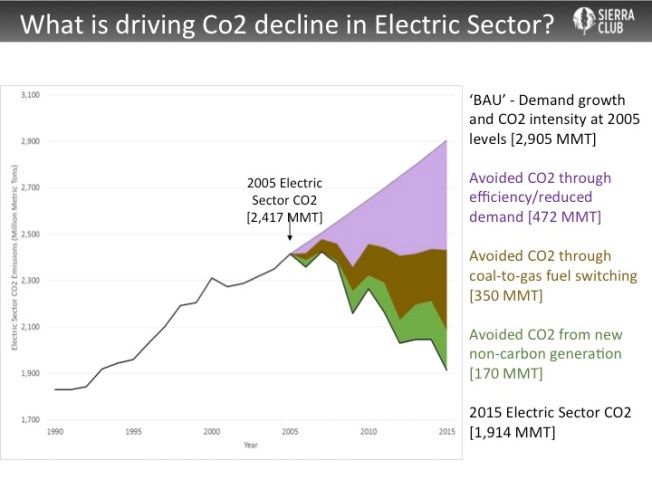
Is the EIA right in making natural gas the hero of the CO2 story? Hardly. Sure, coal-to-gas switching is real. But take a look at this graph showing the contributors to declining carbon emissions. Natural gas displacement of coal accounts for only about a third of the decrease in CO2 emissions.

Courtesy of the Sierra Club Beyond Coal Campaign, using data from the Energy Information Agency.

Courtesy of the Sierra Club Beyond Coal Campaign, using data from the Energy Information Agency.

By far the biggest driver of the declining emissions is energy efficiency. Americans are using less energy overall, even as our population grows and our economy expands

Energy efficiency is sometimes called the “first fuel” because cutting waste is a cheaper and faster way to meet energy demand than building new power plants. Improvements in energy performance cut across all sectors of the economy, from industrial machines to home electronics to innovations like LED bulbs replacing famously wasteful incandescent light bulbs.

Energy efficiency’s stunning success in lowering carbon emissions should get more attention, and not just because it is cheaper than building new natural gas-fired power plants. Efficiency has no downsides. Natural gas has plenty. Indeed, when methane leakage from drilling and infrastructure is factored in, natural gas doesn’t look much like a climate hero at all.

And that’s not the full story. A growing share of the credit for carbon reductions also goes to non-carbon-emitting sources, primarily wind, and solar. Both sources exhibit double-digit growth rates. Wind power in the U.S. has grown from a little over 9,000 megawatts (MW) in 2005 to more than 74,000 MW by the end of 2015. In 2005, the solar market scarcely existed. By early this year, we had 29,000 MW installed.

The solar trend is particularly exciting because we are just starting to see the big numbers that result from solar’s exponential growth. In the first quarter of 2016, more solar came online in the U.S. than all other power sources combined. Analysts like Bloomberg New Energy Finance see solar becoming the world’s dominant energy source over the next 25 years, driving out not just coal but also a lot of gas generation as solar becomes the cheapest way to make energy.

For an inspiring look at how this will happen, check out this presentation by author Tony Seba. As Seba argues, solar isn’t a commodity like fossil fuels; it is a technology like computers and cell phones. When technologies like these take off, they take over. Seba refers to solar technology, battery storage, electric vehicles and self-driving vehicles as “disruptive” technologies that are advancing together to upend our energy and transportation sectors.

Another graph shows us how critical these advancements will be. The U.S. is on track to achieve President Obama’s goal announced last year of lowering carbon emissions 17% below 2005 levels by 2020, but we will need more aggressive measures to meet our Paris Agreement target of 26-28% below 2005 levels by 2025. After 2025, of course, we will have to cut greenhouse emissions even further and faster.

Slide4Given the urgency of the climate crisis, we don’t have the option of waiting around for the solar revolution to bankrupt the oil and gas industry and fossil-bound electric utilities. These companies will not go quietly; already they are maneuvering to lock customers into fossil fuels. Power producers are engaged in a mad rush to build natural gas plants, and wherever possible, to stick utility customers with the costs.

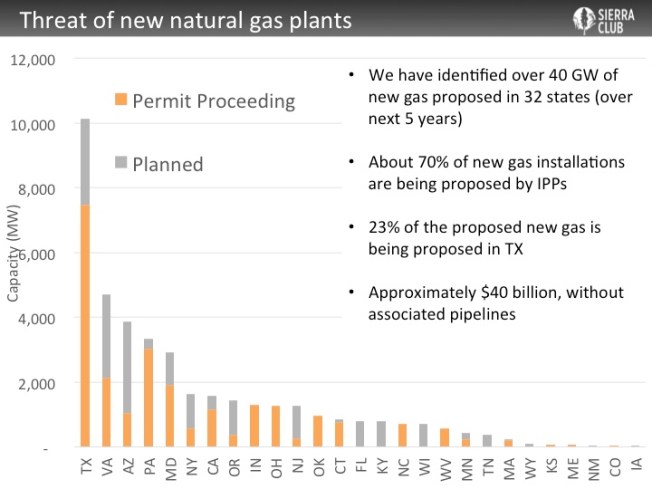
For Virginians who have felt especially under attack from fracked gas projects recently, this final graph shows it’s not your imagination: Virginia is second only to Texas in new gas plant development underway. And this graph captures only a fraction of the new gas that Virginia’s major utility, Dominion Virginia Power, wants to build. In presentations to state officials, it revealed plans for more than 9,000 megawatts of additional gas generating capacity.

Based on Energy Information Agency data. Chart excludes natural gas generating units already under construction as well as those scheduled to come online after 2020.

Based on Energy Information Agency data. Chart excludes natural gas generating units already under construction as well as those scheduled to come online after 2020.

Dominion and other gas-happy utilities are betting that once plants are built and consumers are on the hook, regulators won’t want to see them idled ten years from now just because renewable energy has made them obsolete.

Indeed, Dominion and other utilities, including Duke Energy, Southern Company, and NextEra in the Southeast and DTE Energy in the Midwest, even plan to use electricity customers to make money for the gas pipelines they are building, locking Americans further into gas.

This is madness. The only sound energy plan today is one that looks forward to an era of minimal fossil fuel use. It puts efficiency and renewables front and center, shifting natural gas and other fuels to supporting roles that will shrink over time.

The shift is inevitable. Delaying it means allowing the climate crisis to worsen, while sticking customers with higher bills for decades to come. That may suit some utilities just fine, but the cost is too high for the rest of us.


Unknown's avatar

Southeastern electric utilities find their way to higher profits through gas pipelines and captive consumers

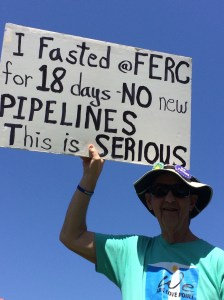
Charlie Strickler of Harrisonburg, Virginia, was one of a dozen activists who fasted last September in protest of FERC's role in approving natural gas pipelines, citing their contribution to climate change and harm to communities in their path. Photo by Ivy Main.

Charlie Strickler of Harrisonburg, Virginia, was one of a dozen activists who fasted last September in protest of FERC’s role in approving natural gas pipelines, citing their contribution to climate change and harm to communities in their path. Photo by Ivy Main.

Duke Energy, Southern Company, NextEra Energy and Dominion Resources—four of the largest investor-owned utilities in the U.S., all headquartered in the Southeast—have simultaneously adopted a growth strategy reliant on large volumes of fracked gas. With the nation’s energy sector turning decisively away from coal and nuclear energy, these companies are betting natural gas will be the dominant fuel for at least the next several decades. All four are investing billions of dollars in gas pipelines and other gas infrastructure to profit from the fracking boom.

Pipelines are attractive investments because they are typically allowed rates of return of around 14%, compared with the average regulated utility return allowed by public utility commissions of about 10%.

For the southeastern utilities, however, that rate of return is only part of the attraction. In a strategy that ought to concern regulators and electricity consumers, Duke, Dominion and NextEra all plan to use their regulated electric power subsidiaries to guarantee demand for the pipelines they’re building. The subsidiaries will build natural gas generating plants, paid for by electricity consumers, to be supplied with gas carried through the pipelines owned by their sister companies.

Southern is also investing in pipelines, but it currently doesn’t need new generation beyond the coal and nuclear plants it is struggling to complete—themselves object lessons in why coal and nuclear are kaput.

Southern just announced completion of its $12 billion acquisition of AGL Resources, a natural gas pipeline and distribution company. The move makes Southern Company “the nation’s second-largest combined gas and electric utility by customer base,” according to Utility Dive.

Dominion Resources was already heavily invested in the natural gas sector before it announced a $4.4 billion purchase of Questar Corp. News reports say the acquisition will bring Dominion an additional 27,500 miles of gas distribution pipelines, 3,400 miles of gas transmission pipeline and 56 billion cubic feet of working gas storage.

Duke Energy is making a $4.9 billion purchase of Piedmont Natural Gas, a natural gas transmission and distribution company. And NextEra recently spent $2.1 billion to acquire Texas-based NET Midstream through the limited partnership it formed, NextEra Partners, LLC.

Moody’s Investor Services issued a report in March criticizing Dominion, Southern and Duke for their natural gas transmission buys, saying the added financial risks offset the benefits of diversifying their businesses.

Moody’s may not have known how the utilities plan to use electricity customers as a hedge for at least two planned pipelines, the Atlantic Coast Pipeline (ACP) and Sabal Trail.

Using electricity customers to pay for pipelines

Companies owned by Duke, Southern and Dominion are partners in the 550-mile ACP, which will carry fracked gas from West Virginia through Virginia to the North Carolina coast. Duke and NextEra are partners in Sabal Trail, a 515-mile pipeline proposed to run from an existing pipeline in Alabama through Georgia to Florida, where Duke says it will fuel gas plants owned by Duke Energy Florida and Florida Power and Light, a subsidiary of NextEra.

ACP and Sabal Trail are only two of 15 new pipelines proposed on the East Coast competing to carry fracked gas flowing out of the Marcellus shale in Pennsylvania and West Virginia. So many pipelines are in development that analysts say there simply isn’t enough gas to fill them all. At the 2016 Marcellus-Utica Midstream Conference in February, attendees were warned that pipeline capacity “will be largely overbuilt by the 2016-2017 timeframe.”

But the ACP and Sabal Trail have an advantage most of the competition lacks. The utility partners all own electric power subsidiaries that use fracked gas to generate electricity. If the subsidiaries build new gas plants, these pipelines will be guaranteed a customer base. That means they can be profitable for their investors even when other pipelines struggle to find customers.

Indeed, Duke and Dominion’s electricity subsidiaries are making the kinds of investments you’d expect to see if the success of the pipelines were their top priority. Dominion Virginia Power is in the middle of a three-plant, 4,300 MW gas generation build-out. In the ACP’s application to the Federal Energy Regulatory Commission (FERC), Dominion Resources justifies the ACP in part by saying it will supply the newer of these plants. And the utility is just getting started with new gas generation; Dominion Virginia Power told Virginia officials last fall it expects to build another 9,000 MW of gas plants by 2040.

Meanwhile, Duke’s regulated subsidiaries, Duke Energy Carolinas and Duke Energy Progress, filed integrated resource plans in North and South Carolina that call for up to nine new natural gas generating units, totaling 8,300 MW. In February of this year, Duke received approval to build two 280 MW gas units in Asheville, NC, and sought approval for a third.

Bigger investments, greater risks

Linking pipelines to captive customers should prove a profitable arrangement for the utilities. For the customers who bear the costs and risks, it’s much more problematic. But state law gives them no say in the matter. In these southern states, the electric power subsidiaries hold legal monopolies in their designated territories. Once federal regulators approve the pipelines and state regulators approve the gas plants, the captive customers bear the loss if the bet turns sour.

Any one of several scenarios would make the gas investments a bad bet. The age of plentiful shale gas could end almost as quickly as it started, as some analysts predict, or gas prices could resume their historic volatility for other reasons. The U.S. could adopt newer, tighter carbon rules to meet international climate obligations, or enact a carbon tax that increases the cost of fossil fuels. Alternatives like wind, solar and energy storage seem likely to continue their astonishing march towards domination of the electric sector. As they become increasingly competitive, much new gas infrastructure is destined to become stranded investments.

And finally, the demand for natural gas, and for the pipelines themselves, may simply not be there; Americans are using less electricity, and generating more of it themselves through rooftop solar systems. The vertically-integrated, monopoly utility model that prevails in the Southeast relies on ever-increasing sales, which means it doesn’t require much of a change in consumer behavior to turn black ink red.

So while environmentalists are enraged by the recklessness of the southeastern utilities’ natural gas strategy in an age of climate change, customers who only care about the bottom line on their utility bills have reason to be just as upset. Capitalism is supposed to ensure that corporate shareholders bear the costs as well as receive the benefits of risky bets. With the risks of their gas gamble shifted onto captive customers, the utilities won’t be punished for not choosing clean energy instead.

Bucking the trend towards renewables and efficiency

It’s worth noting that the plans of Dominion, Duke and their fellow monopoly utilities run counter to the expressed desires of their customers. Natural gas companies work to brand their product as “clean,” but polls show Americans overwhelmingly believe the U.S. should emphasize wind and solar over oil and gas production, and oppose the use of fracking to extract oil and gas. Major corporations now threaten to vote with their feet, refusing to locate where they can’t access electricity from renewable sources.

It is not a coincidence that Duke and Dominion fall near the bottom of a just-released survey conducted by Ceres that ranks major utilities by their performance on energy efficiency and renewable energy. NextEra and Southern do no better. NextEra’s electricity subsidiary, Florida Power and Light, came in dead last for renewable energy sales. Ceres says it was unable to include Southern this year because it did not respond to requests for data, but in 2014 Southern ranked 31 out of 32 on renewable energy sales.

The southeastern utilities stand in marked contrast to utilities like Berkshire Hathaway’s Mid-American, which has announced a goal of meeting 85% of its customers’ needs with wind power. Even Dominion’s Virginia rival, Appalachian Power Company, filed an integrated resource plan last year with more new wind and solar generation projected than new natural gas. Perhaps that’s because neither Appalachian Power nor its parent company, American Electric Power, own any gas pipelines.

Effects on competition and consumers trigger an antitrust complaint

Customers may be the biggest losers when utilities use their electricity subsidiaries to guarantee the success of their gas subsidiaries, but the arrangement also harms other business interests. These include pipeline operators who don’t have the same self-dealing opportunity; non-utility electricity generators who can’t sell their product to utilities because the utilities now prefer to build their own gas generation; and companies that build wind and solar projects, who find themselves boxed out.

Already one non-utility generator is crying foul: Columbia Energy LLC, an operator of a 523 MW independent combined cycle gas generating plant that wants to sell electricity to Duke Power but finds itself left out in the cold. Columbia is challenging both Duke’s application for approval of a new gas plant in Ashville and the merger of Duke with Piedmont Natural Gas, another partner in the Atlantic Coast Pipeline.

The potential of the ACP to harm consumers and competition led to the filing in May of a complaint with the Federal Trade Commission (FTC). The complainant, retired Department of Justice antitrust lawyer Michael Hirrel, believes the utilities’ abuse of their legitimate monopoly power violates federal antitrust laws, and he is urging the FTC to investigate.

The Virginia Chapter of the Sierra Club, which opposes both the ACP and Dominion’s gas build-out, followed up with its own letter delving more deeply into the facts of Duke and Dominion’s self-dealing. (The letter and supporting documents, including Hirrel’s complaint, can be found at http://wp.vasierraclub.org/LetterInFull.pdf. Note that it’s a big file and may take time to load.) Hirrel has added both documents to the FERC file on the ACP application.

(Full disclosure: I led the team compiling the information for the Sierra Club submission. I’ve never met Mr. Hirrel and only learned about his complaint weeks after it was filed. However, I had been doing my own complaining—though evidently not to the proper authorities—about the utilities’ conflict of interest.)

But is anyone listening?

Aside from the FTC filing, opponents of the gas plants have pinned their hopes on state public utility commissions, while pipeline opponents are focused on the Federal Energy Regulatory Commission (FERC). Neither venue offers grounds for optimism. Virginia’s State Corporation Commission (SCC) has approved three of Dominion’s new gas plants in a row over the objections of environmental advocates, and North Carolina’s Utility Commission recently approved Duke’s new gas units in Asheville (though for now it has turned down a request for a third).

FERC poses its own challenge. Activists want FERC to review gas transmission proposals collectively instead of singly, to avoid overbuilding and the unnecessary damage to the environment and local communities that would result. This would be a departure for the agency, which traditionally reviews proposals individually, and has approved nearly every pipeline proposal that has come before it.

So far FERC has resisted arguments of this nature, as well as objections based on climate concerns. But in a possible sign that the agency recognizes times are changing, it has recently slowed the approval process for some proposed new pipelines, apparently to conduct more thorough environmental reviews.

There is no sign yet that the public utility commissions and FERC are communicating with each other or with the FTC. That leaves anti-pipeline groups and environmental activists in a difficult position. They can make a strong case the utilities are taking unfair advantage of captive ratepayers for a purpose that harms both the environment and the public. But is anyone listening?

Unknown's avatar

Northern Virginia activists are ready for 100% renewable energy future


Ready for 100 Community Outreach Coordinator Taylor Bennett, Mount Vernon Group of the Sierra Club Chair Dean Amel, and Virginia Chapter Sierra Club Chair Seth Heald.

Ready for 100 Community Outreach Coordinator Taylor Bennett, Mount Vernon Group of the Sierra Club Chair Dean Amel, and Virginia Chapter Sierra Club Chair Seth Heald at Alexandria’s Earth Day celebration in April.

Clean energy advocates in Virginia know we are engaged in a steep uphill climb, and are still so far from the top that we have only a general idea of what it will look like. But activists in Arlington and Alexandria believe it’s time for bold leadership. They are calling on their communities to set a goal of 100% clean and renewable electricity by 2035.

The Ready for 100 Campaign launched today as part of a push by the Sierra Club to show that a future without fossil fuels is achievable. Sierra Club volunteers are working with community groups and other leaders to promote the benefits of clean energy locally. According to Seth Heald, Chair of the Virginia Chapter of the Sierra Club, fifteen U.S. cities, including San Diego, CA, Georgetown, TX, and Columbia, MD, have already committed to 100% clean energy.

Arlington County already has a reputation for its leadership in the energy sector, with a commitment to reduce its greenhouse gas emissions by 80% by 2050 and a number of innovative programs to reduce energy consumption. Now, says Heald, it is time for Arlington to take the next step to “eliminate the fossil-fuel generated pollution that comes from electricity production and is damaging our health and undermining our quality of life.”

Arlingtonians for a Clean Environment (ACE) has signed on as a partner in the effort. “Arlington County has already set a high bar for Virginia, but we can do even better,” said Executive Director Elenor Hodges. “I think this is an effort many residents will get behind.”

Copy of Copy of 1168 ReadyFor100_Logo_Color“Our current dependence on fossil fuels means that my generation will be dealing with the impact of climate change for our entire lives,” said Helene Turvene a junior at Washington-Lee High School. “A commitment now to 100% renewable energy not only will help to begin reversing those impacts, but it will position our community for a more sustainable future. Students want to know that local leaders are acting with us, and future generations, in mind.”

Alexandria residents are also behind the effort. Samantha Adhoot is an Alexandria-based pediatrician who has often sounded the alarm about the effects of climate change and fossil fuel pollution on children’s health. “By transitioning to 100% clean energy, our city could prevent thousands of asthma attacks and dozens of premature deaths every year,” she said. “This would be a big step in the right direction toward allowing our kids to breathe easier.”

Although the 2035 goal is long-term, the campaign’s benefits could be immediate. The solar industry now employs over 200,000 people nationwide, and with fewer than 1% of them in Virginia, we have tremendous room for growth. And of course, investments in energy efficiency mean savings on utility bills that keep adding up. Stanford scientists say the transition to 100% renewable energy will save the average American family $260 dollars per year in energy costs, and another $1,500 per year in health care costs.

Taylor Bennett, Community Outreach Coordinator for the Ready for 100 Campaign, is hoping to hear from others who want to join the effort. She can be reached at Taylor.Bennett@SierraClub.org.

Unknown's avatar

Virginia wind and solar companies say tax credit extensions cue up a happy new year

Photo by Dennis Schroeder / NREL

Photo by Dennis Schroeder / NREL

Congress included a welcome gift to the wind and solar industries in last week’s package of goodies that made up the year-end spending bill. For the wind industry, the renewal of the expired production tax credit (PTC) with a five-year phase-out finally ends the guessing game that has driven repeated boom-and-bust cycles—and will help Virginia’s first-ever wind farm move forward.

For solar, the extension of the investment tax credit (ITC) beyond the end of next year ensures that one of the fastest-growing industries in the U.S. won’t face a major disruption that would have driven many small companies out of business. That’s critical in Virginia, where the lack of incentives has left the market mostly to small players able to get by on small profit margins. As the economics of solar continuously improve, these small companies see a bright future in the Commonwealth.

I asked several Virginia industry members how they were feeling after Congress’ year-end gift.

“The certainty the tax credit extension gives our business is critical,” answered Jeff Nicholson, Director of Development for Waynesboro-based Sigora Solar. “While there won’t be as much of a crunch to get systems installed next year, we can hire without being concerned that the market for solar will plummet in a year.”

Sigora has been one of Virginia’s most remarkable small business success stories, growing from 11 employees at the beginning of 2015 to 44 today. With the ITC extension, the company now foresees a “long-term, steady stream of business” through the rest of the decade, said Nicholson.

The 30% ITC had been set to expire at the end of 2016 for residential customers, while dropping to 10% for commercial and utility-scale projects. Under the bill passed by Congress and signed by President Obama on December 18, the tax credit will remain at 30% for all systems through 2018, and then taper off gradually until it reaches 10% in 2022. If current price trends continue, the extra few years may be enough to make solar competitive with other fuels without subsidies.

“We know solar is a solid energy production fuel, every bit as viable as coal, oil, nuclear and wind, and it is clear that the more we build, the more cost effective it becomes,” said Paul Risberg, President of Charlottesville-based Altenergy Incorporated. Altenergy grew by 40% in 2015, and Risberg told me he now expects that trend to continue in 2016.

Another Virginia success story is Staunton-based Secure Futures LLC, which has carved out a niche supplying solar energy to tax-exempt entities like universities and local government entities in Virginia, using third-party power purchase agreements. CEO Tony Smith told me, “The ITC extension means that our business can continue to offer at or below grid-parity solar electricity to our commercial scale customers beyond 2016.”

But, he added, “It still remains challenging to attract investment in Virginia due to the disparity in incentives to solar in our state as compared with our neighboring states, especially for behind-the-meter third party owned solar.  We remain hopeful that our industry will continue to build support in Richmond to reduce the barriers to solar investment in Virginia.”

The Virginia solar industry got an extra year-end gift on Monday when Governor Terry MacAuliffe announced plans for the state government to buy 110 megawatts of solar over the next three years, accounting for 8% of its electricity usage. While 75% of that will be utility-scale solar to be built by Virginia Dominion Power, 25% will consist of on-site projects of less than 2 megawatts in size, to be built by third-party developers using power purchase agreements.* The state will follow a competitive procurement process, but in response to a question at the press conference, MacAuliffe said it will not limit participation to Virginia-based companies.

Still, the Virginia industry members were optimistic the announcement would help boost the profile of solar energy in the Commonwealth. The industry trade group, MDV-SEIA, says it participated in the discussions leading to the announcement.

Virginia has a lot of catching-up to do, of course; neighboring states are so far ahead and have so much momentum that, as the Virginia Sierra Club’s Glen Besa observed, “If Dominion sticks to its commitment (of 400 megawatts of solar by 2020), we’ll be further behind on solar than we are now.”

Photo credit NREL

Photo credit NREL

Like the ITC for solar, the 2.3 cents per kilowatt-hour PTC has been a crucial support for the wind industry, making it the second-biggest source of new electric generation in the U.S. for many years now. But until last week, Congress had been reluctant to extend the PTC for more than a year at a time, sometimes retroactively, causing havoc for planners and developers and leading to boom-and-bust cycles deeply damaging to growth.

Now the PTC will be extended through 2016 before tapering off and expiring altogether at the end of 2019. Projects that “commence construction” by the end of a given year will qualify at that year’s level. (“Commence construction” language was also added to the solar ITC.) The predictability that comes with the five-year tapering-off period is expected to finally bring stability to project planning.

And like the solar industry, the wind industry now predicts bright days ahead. Bruce Burcat, Executive Director of the Mid-Atlantic Renewable Energy Coalition, told me, “Sound policies like the PTC have driven innovation which has helped reduce the cost of wind energy down by about 66 percent over the past six years, making it highly price competitive with traditional forms of energy resources. This trend bodes well for the opportunity for wind to take hold in Virginia.”

Burcat is undeterred by Virginia’s lack of success with wind farms to date. “While no wind farms have been developed in Virginia, we believe that with the right signals from the Commonwealth, Virginia could see its first wind farms developed sometime in the next few years,” he said. “Wind farms would bring investment and jobs and other economic development opportunities to Virginia.  Wind farms would also be a very important tool for cleanly and cost-effectively helping Virginia meet the requirements of the EPA’s Clean Power Plan.”

Virginia’s first wind farm is expected to be Apex Clean Energy’s 75-MW Rocky Forge project in Botetourt County, which the company projects to have operational in 2017. Tyson Utt, Apex’s Director of Development for the Mid-Atlantic, told me, “The extension of the PTC will enable the facility to charge less for the energy it produces, saving electricity consumers money.” And, he added, “The project will be built on private land with private investment and will help diversify Virginia’s energy mix while injecting millions into the local economy.”

Apex also has a second wind farm of up to 180 MW under development in Pulaski County, scheduled for completion in 2017 or 2018.

Utt agrees the wind industry won’t need incentives for long to compete with fossil fuels. “The PTC exists to help level the playing field for renewable energy, relative to legacy generation sources that have benefited from permanent subsidies for decades. That said, renewable energy is becoming so economically competitive on its own that the industry now feels comfortable accepting a phase out of the PTC over the next five years, and the tax extenders package that just passed through congress does exactly this. Of course, wind energy offers additional benefits that are not currently reflected in our incentive structure, including the ability to generate electricity without producing carbon dioxide or consuming water. We expect that as our nation moves towards the recognition that there should be a price placed on carbon, wind energy will become even more competitive with conventional generation sources.”

[UPDATE: on January 6, the Associated Press reported that Appalachian Power is seeking to buy up to 150 MW of wind power through direct ownership or long-term power purchase agreements.]

In addition to the tax credit extensions for wind and solar, Congress passed other clean energy incentives that have gotten less attention. Scott Sklar, President of the Arlington-based Stella Group, Ltd. and an adjunct professor at George Washington University, noted that other renewable technologies also qualified for tax credits, and a tax deduction for energy efficiency improvements in commercial buildings was renewed. He also pointed to provisions in the Highway Authorization Act passed into law this month that favor renewable energy. As a result, he told me, “The end-of-year passage by Congress of extensions for the entire portfolio of energy efficiency and renewable energy, coupled with the infrastructure incentives for renewable energy in the highway bill, will more than double private investment into these sectors over the next six years.”

Sklar is bullish on clean energy. “With expanding markets, allowing these technologies to-scale even further, will insure electric grid and fuel parity before 2020, and also insure that renewable energy and energy efficiency will become the dominant energy provider both in the US and the world.”

I should note, though, that not everyone was entirely happy with Congress last week. Though they lauded the tax credit extensions, environmental groups including the Sierra Club opposed the lifting of the oil export ban that Republicans demanded in return. Exporting American crude oil, they fear, will lead to more drilling in the U.S. and higher oil consumption worldwide, further driving climate change. And while wind and solar compete head-to-head with the biggest climate culprit, coal, currently they offer little competition for oil in the transportation sector.

But with a world-wide oil glut that shows no signs of easing, observers including Sklar think lifting the export ban won’t have much effect in the near term. The extension of the renewable energy tax credits, on the other hand, will help push clean energy pricing to a point where wind and solar dominate the market for new electricity generation. According to an analysis by the Council on Foreign Relations, “Extension of the tax credits will do far more to reduce carbon dioxide emissions over the next five years than lifting the export ban will do to increase them.”

So it’s easy to see coal as the biggest loser here, but Big Oil shouldn’t feel too smug. As battery storage becomes more affordable and electric cars gain market share, wind and solar will begin to displace oil, too. The future, my friends, belongs to clean energy.

Here’s to 2016!

________________________

*The astute reader may wonder how the Governor persuaded Dominion to allow it to buy electricity from third-party providers in spite of Dominion’s tireless defense of its monopoly on electricity sales and its reluctance to allow other customers to use PPAs outside the narrow confines of a pilot program. Unlike most of us, the state purchases power from Dominion under a contract, rather than under a tariff overseen by the State Corporation Commission. So allowing the state to use PPAs required negotiating a change to the contract but does not have immediate ramifications for lesser folk. But still: at some point, doesn’t it become obvious that restrictions on PPAs are simply holding the market back?

And even all you astute readers may not have thought to ask: when the state buys solar electricity from Dominion or third parties, who will own the RECs? After all, it is not the guy with the solar system on his roof who can legally claim to be using solar energy, but the guy holding the renewable energy certificates (RECs) associated with that energy. If the state wants to brag about meeting its new goal of 8% of its electricity from solar, it had better hold the RECs to prove it—and not, for example, allow Dominion to sell the RECs to a Pennsylvania utility or to the voluntary participants of its Green Power Program. When I asked Deputy Secretary of Commerce Hayes Framme about this, however, he said the question of who will own the RECs “has yet to be determined.”