Unknown's avatar

Grid Transformation for the 21st Century: why Virginia needs to get this right

Thomas Hadwin served as an executive with electric and gas utilities in Michigan and New York. He is actively involved in promoting a modern energy system for Virginia.
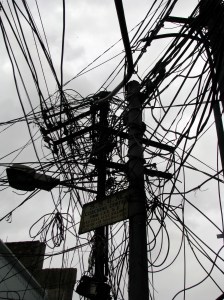
With proper planning, the 21st century power grid will be smart, efficient and resilient. Without good planning, it could be an expensive mess. Photo credit McKay Savage, India.

The General Assembly recently passed a bill intended to promote modernization of our existing electricity grid. It is important for Virginians to understand the costs, benefits and various ways of upgrading our state’s grid, so that they can decide for themselves whether the new legislation provides the best path forward. Making the right choices about this affects our family finances and the competitiveness of our state economy.

An electricity grid is the system of wires and facilities that move electricity from where it is produced to where it is used. Thomas Edison created the first utility in New York City in 1882. A portion of it was still in use until 2007.

The Traditional Grid

For over a century, the grid met the same basic functions and contained equipment that Edison would have recognized, at least in concept. The system evolved to have electricity produced at a distance from where it is used. Since more electricity is lost the farther it is transported, high voltage transmission lines were developed to minimize these losses. These are the very tall, usually lattice-like, steel towers with long drooping lines that you see from the highway. We can’t use electricity at such high voltage, so it is stepped down using big transformers to lower levels. Sometimes several types of lower voltage lines are used to get the energy closer to where it needs to go.

The transmission lines bring the electricity to a population center or industrial complex to where it will be used. At this point a complex set of equipment called a substation is used to reduce to reduce the voltage to the various levels used by industries, businesses and residences. Once the voltage is reduced at the substation, it enters the distribution system. These are the lines that you see on the poles along the street where you live, where the voltage is reduced one last time to the level you use in your home. Other wires are also on those poles for telephone and cable TV service. If you live in a city, or a new subdivision, those lines are often underground.

Electricity doesn’t move like cars on a road, from Point A to Point B. So you can’t really say where electricity was produced or where it was used.

For about 100 years, the design of the system worked well. There was a steady increase in demand. As generating stations got bigger, electricity became cheaper to produce. The centralized power plants feeding distant loads were easy to manage. Electricity flowed one-way, as did the information back to the utility grid supervisors.

Some things began to change in the second half of the 20th century. Transmission lines were interconnected between utilities so a surplus in one area could be used to meet a shortfall in another. These early “power pool” arrangements evolved into the sophisticated Regional Transmission Organizations (RTOs) and Independent System Operators (ISOs) that we have today. PJM is the organization that manages electric generation and transmission in a 13-state region that includes Virginia.

A Shift 40 years in the making

By the mid-1970s, new power plants became so expensive (especially nuclear units) that a fundamental change occurred. Every time a new conventional power plant (fossil or nuclear) was built, the price of electricity went up.

As fuel costs and electricity prices increased, appliances and buildings were designed to use energy more efficiently. Demand continued to increase, however, as a larger population and greater economic activity kept electricity use rising.

When the recession hit in 2008, families tightened their belts and businesses found ways to produce more goods and services using less energy. For the first time, growth in population and economic activity no longer created a higher demand for electricity. Over the past ten years, growth in U.S. electricity demand has been relatively flat. In 2017, a year of population growth and greater economic activity, total electricity use in the U.S. was 2.1 % lower than the year before.

Stable or declining growth in demand disrupted the utility business model which depended on the steady increase in electricity use to provide enough revenue to cover past investments and provide funds for new projects.

About the same time, new technologies were introduced that further complicated matters for utilities. Concern about environmental impacts associated with extracting and burning fossil fuels increased interest in methods of generating electricity using ways that did not require fuel. Electricity generated from solar and wind power used energy that was naturally renewed. These fuel-free methods were primarily technology driven and took advantage of a learning-curve that has resulted in on-going price reductions of 50% every 4-5 years.

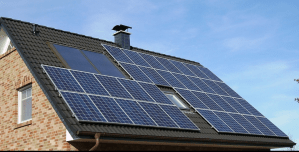
Small modular solar units allowed electricity to be generated at customer locations. Although this reduced customer costs, it made things more challenging for utilities. It reduced their revenues at a time when those revenues were already challenged by flat growth in demand. And these units were located within the distribution network which could result in the flow of electricity opposite to the direction for which the system was designed.

The Modern Grid

It is a huge shift for utilities that have operated in the same way for 100 years to move to a new way of doing business. The energy industry is undergoing a similar transition to what the computer industry experienced several decades ago. We once had highly centralized mainframe computers controlled by a few specialists. Now we have networks of personal computers that provide choices and new possibilities for everyone.

Putting customer needs at the center of the modern grid requires a new mindset. Utilities, especially those owned by private holding companies, have been mostly focused on creating revenue streams to reward shareholders and reducing the effects of regulators’ actions on profits. Many utilities do not even think in terms of “customers.” Instead they talk about “ratepayers” because, from their private parent company’s point of view, that’s where the money comes from.

Smart meters, solar, and batteries

Creating a modern grid will require replacing old electro-mechanical controls and monitoring equipment with modern digital devices. Having a two-way flow of information will help utilities more quickly determine when a line is down and dispatch a crew to the correct location. Smart meters provide utilities with more information about customer usage and save the cost of reading meters. But regulators should be sure that the hundreds of millions spent on new meters (and paid for by ratepayers) also benefit the customers. If designed correctly, with reliable, rapid communications, customers can access that data for use by home energy systems that optimize comfort and lower costs. Water heaters, as well as heating and cooling systems, can be controlled remotely by utilities or private aggregators to turn off for a short period to reduce peaks and save customers money.

A system dependent on digital devices and software control is much more vulnerable to cyber-security threats and must be designed with that in mind.

Creating a two-way flow of energy will also make the grid more capable. Utility-scale solar provides clean energy at a lower cost, but it still follows the old central station philosophy and requires a connection to transmission lines. By installing a significant amount of new solar at dispersed locations within the distribution system, it improves the reliability and resiliency of the grid.

Output from solar units can be variable. But those variations can be highly predictable. Anticipated changes can be matched from other contributions throughout the grid, especially with PJM’s large surplus of generation. Batteries have economic applications now, but will be even more useful as prices decline by half every 4-5 years. Energy storage can supply backup power, frequency and voltage regulation, and other valuable grid services.

Consolidated Edison, the utility that serves New York City, is intending to use distributed solar, storage, energy efficiency and other grid improvements to avoid the need to construct a new $1 billion substation. When utilities avoid building new facilities in order to save customers money, they need to have other means of remaining financially sound.

Soon the use of electric vehicles will be widespread. Batteries paid for as part of the price of the vehicle can be used to store renewable energy during the times when it is plentiful for use at other times when it is more valuable.

Resilience and Reliability

Some grid investments improve the ability to withstand stresses without loss of service. This is called resilience. It can involve undergrounding distribution lines to reduce the exposure to storm damage. Resilience is in a large part about what does not happen and therefore, is closely related to reliability. But investments in undergrounding can be very expensive and have diminishing returns. Other investments might be more cost-effective.

Having some local generation and the ability to temporarily isolate from the larger grid, using microgrids, can maintain some level of operation if the larger grid goes down. Public buildings, hospitals, university and commercial campuses, and industrial parks can benefit from this. Battery storage can also contribute to both resiliency and reliability. These are complex issues and the tradeoffs must be carefully evaluated.

Transmission lines put underground can have lower reliability than overhead lines, which are typically not very vulnerable to storm damage. Underground transmission is projected to have half the life span of overhead lines. Once the great disruption during the lengthy construction period is complete, they do have less of a visual impact, however. But this comes at a much higher cost.

Creating a Modern Grid: the roles of regulators and utilities

States that are well underway with grid modernization have begun with a legislative directive that broadly defines the goals to be achieved and empowers the state regulator to embark on the process of establishing the regulatory framework to facilitate the necessary activities. Usually milestones are specified to evaluate progress.

Legislation often specifies the major goals of the modernized system such as: a more flexible grid that offers a wider variety of more personalized energy options; that is more secure against threats; with decisions made considering both cost and environmental sustainability; and has a more diverse mix of both centralized and distributed generation, etc. New laws also often encourage the development of research and development activities to attract innovative new businesses, and the establishment of funding sources that provide low-cost financing for energy efficiency and small-scale renewable projects.

The regulators then convene a series of stakeholder workshops to better understand the challenges faced by the utilities and the desires of their customers. This can be a transformative experience for a state. Collaboration between many interests can set the stage for long-term cooperation that lowers costs, provides new employment, and makes the state an attractive location for both businesses and residents.

Utility regulators must be strong and independent to objectively review and balance the various interests. A cooperative relationship with the legislature and the executive branch is helpful when new laws might be required to ensure the financial health of utilities serving in a new role.

Utilities have a central role in developing our modern grid, but not the only role. States that have provided opportunities for innovative private companies to provide various energy services have created a path for lower energy costs and greater employment. Utilities must provide the platform for this to take place and they can profit by providing services that enable transactions between private companies and utility customers.

We must give utilities a fair return on their legacy investments and provide an opportunity for them to prosper by serving their customers better, perhaps with performance based rates. A modern grid should not create winners and losers. It should be a place for many to prosper by providing value to customers.

The wires are the natural monopoly. The utilities have accepted regulatory oversight and fair rates in exchange for a fair return and freedom from competition (on the wires side). That agreement should remain intact and proper regulatory oversight must occur. Utilities can be responsible for the distribution platform and still allow opportunities for private companies to provide a variety of services that have value to customers and the grid. This leads to a vibrant state economy, lower costs and increased employment.

The high cost of doing it wrong

If we do not move forward, we will pay a price. If utilities are allowed to drag 20th century habits deep into the 21st century, it will eventually harm them and the rest of the state as well. For example, Duke Energy has proposed a $13 billion grid modernization program. Critics, including Google and the North Carolina ratepayer advocate, say the plan has little justification and will not benefit customers or clean energy.

The North Carolina Utility Commission has said that Duke has not provided “compelling evidence” that its plan to modernize the grid would result in “meaningful benefits to ratepayers despite its cost.” Duke, like Dominion, is struggling to justify building new power plants in the face of flat demand for electricity. Investments in “gold-plated distribution infrastructure” will provide it with the revenue it desires. A Google representative said the costs attributed by Duke to grid modernization are “seemingly arbitrary.” The staff of the state regulatory commission agreed, saying that they are “not persuaded that all the components of the . . .  initiative will result in modernizing the grid.” The staff went on to say there is “substantial uncertainty regarding what exactly will be included.”

The general counsel of the North Carolina Sustainable Energy Association noted that, “Some grid modernization is certainly needed, but the price tag put forward by Duke is shocking, and what’s in their proposal is shocking as well.” He added that “there’s been very little meaningful public input.”

“If the customers are paying for 100 percent of these programs in their rates,” said an EDF spokesman, “then let’s give them 100 percent of the benefits.”

Lessons for Virginia

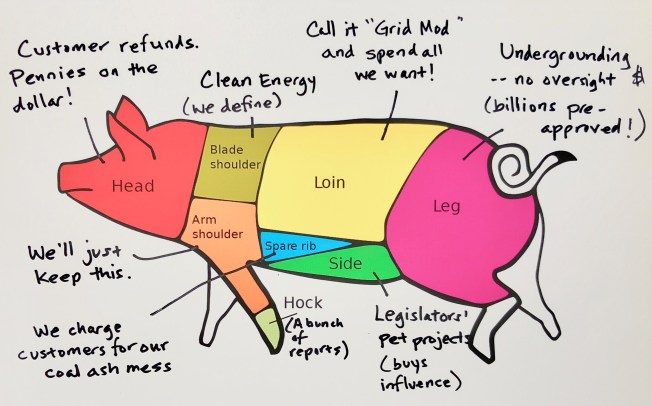
This sounds like the opportunity just squandered by the Virginia General Assembly. Instead of putting us on the path to an effective modern grid, the legislators have given the utilities permission to spend billions over the next 10 years with diminished regulatory involvement. This will add significantly to utility bills in Virginia that are already the 10th highest in the nation. There are no specifics in the bill that identify how this money will be spent or whether the money paid by customers will actually result in a modern grid similar to what is being developed in other states.

Virginia can do much better than this. We should immediately embark on a program to get this right in the next legislative session in a way that is fair to the regulated utilities and their customers. Bringing in objective outside specialists could guide us toward an innovative, lower cost, clean, efficient and reliable energy future.

 

Unknown's avatar

After losing a vote on the double dip, is Dominion losing Power?

An earthquake shook Richmond, Virginia on the afternoon of Monday, February 12, rocking the House of Delegates just as it was supposed to be passing HB 1558, Dominion Energy’s Ratepayer Rip-Off Act of 2018. The bill was intended to help the utility lock in stupendous unearned profits for its parent company, courtesy of the monopoly’s captive customers, under the guise of supporting clean energy and grid investments.

And the bill did pass the House, but only after delegates adopted an amendment offered by Minority Leader David Toscano stripping away a lucrative provision that Dominion both desperately wanted and swore didn’t exist: the infamous “double dip” that the SCC has said would allow Dominion to charge customers more than twice over for a large portfolio of infrastructure projects. With billions of dollars worth of projects on the drawing board, the double dip meant serious money.

Anyone who didn’t believe the double dip was real only needed to listen to Dominion lobbyist Jack Rust respond to repeated questions about it during a Senate Commerce and Labor Committee hearing two weeks earlier. It was a “yes or no” question that Rust wouldn’t answer with a yes or a no.

Obfuscation, however, was good enough for the Senate, which passed SB 966 last week by a bi-partisan vote of 26-13. It was good enough for Governor Northam, too, who had already pledged to sign the bill. A few environmental groups broke ranks to support the bill, too, cheering the provisions for energy efficiency and the promise of more renewables.

Admittedly, the Attorney General’s Office of Consumer Counsel remained opposed. So did other environmental and consumer groups, complaining not just about the double dip, but about ceding control over the future of Virginia’s electric grid to a profit-driven monopoly. But when has the General Assembly ever cared what environmental and consumer groups thought? So passing the bill through the House should have been easy.

And then Toscano called Dominion’s bluff. If the double dip is real, said Toscano, his amendment would fix it. If the bill doesn’t already allow for double-dipping, then making doubly sure of that does no harm.

The logic was unassailable, though bill patron and Friend of Dominion Terry Kilgore assailed it anyway. As the Associated Press reported, Kilgore tried to persuade legislators to reject Toscano’s amendment. Yet even some fellow Republicans deserted him on the vote, helping Democrats pass it 55-41. A quick-thinking Delegate Habeeb, apparently recognizing bad optics for the Republicans, called for a second vote, and this time the amendment passed 96-1, with even Kilgore supporting it.

By all accounts, the vote was unprecedented. Dominion does not lose floor votes. The vote rocked the House.

In hindsight, perhaps Dominion should have known a fault line had formed. Grassroots groups were agitating against the power of monopoly. A new group called Clean Virginia was agitating against the bill. Almost all the freshmen Democrats had pledged not to accept Dominion money—and there were a lot of them, thanks to last fall’s “blue wave” election. But the Republicans had already scuttled most of their bills; surely they had learned humility? They had not. They all supported Toscano’s amendment, and all but one followed him in opposing final passage of the bill, which passed 63-35.

The earthquake could be felt over at Dominion headquarters, where reporters could be seen inspecting the foundation for damage. CEO Tom Farrell called in his damage control specialists, heavy-hitting lobbyists Eva Teig Hardy and Bill Thomas, to persuade legislators to support the Senate version of the bill over the House version—or failing that, to lard it up with new favors to the utilities.

According to the AP, Kilgore continued to maintain after the vote that the double dip was “more perception than reality.” But he also said, “Toscano’s amendment takes ‘a lot of stuff out that needs to stay in’ the legislation. ‘I’m going to have to fix it.’”

One might think Dominion and its allies would be embarrassed to defend a provision they say doesn’t exist. Reportedly they have pivoted to a different argument, that the company would have no incentive to invest in renewable energy if it isn’t allowed to rip off ratepayers in the process. Accordingly, they are holding solar investments hostage, knowing how much Democrats want them.

Dominion’s new argument is simply posturing. Its 2017 Integrated Resource Plan declared solar to be the cheapest form of energy in Virginia, and it had signaled via the Rubin Group its plan to build at least 3,000 MW of solar in the coming years. Saying now that it might take its ball and go home is a sign its lobbyists are out of good arguments.

In the past, good arguments were not a requirement for Dominion to get what it wants; political power has always been enough. It will be interesting to see now whether Dominion emerges with some semblance of its omnipotence intact, or whether this earthquake presages new shocks that could crack the fortress.


Unknown's avatar

General Assembly chews on, spits out healthy legislation, while still trying to digest a huge hunk of pork

They just keep getting fatter.

If you were bewildered by the sheer volume of bills addressing solar, efficiency, storage, and other energy topics that I outlined last month, take heart: clean energy advocates don’t have nearly as many bills to keep track of now. So few bills survived the Finance and Commerce and Labor Committees that it will be easier to talk about what is left than what got killed.

The bigger story, of course, is the Dominion Ratepayer Rip-Off Act of 2018, which the utility would dearly love you to think of as the “grid modernization bill,” but which might be better imagined as an oozing pork barrel. Recent amendments do make it less obnoxious than it was last week (begging the question of why it wasn’t introduced that way in the first place). The Governor now says he supports the bill, the Attorney General continues to oppose it, and the SCC keeps issuing poisonous analyses.

But right now let’s just run down the fate of the other bills we’ve been following. For explanations of these bills, see previous posts on solar; efficiency, storage and EVs; and energy choice, carbon and coal.

Of the bills affecting customer-sited solar, only a handful remain:

  • HB 1252 (Kilgore), expanding the pilot program for third-party PPAs in APCo territory to cover all nonprofits and local government: amendment ensures current Dominion pilot is unchanged, passes the House, goes to the Senate
  • HB 1451 (Sullivan), allowing a school district to attribute surplus electricity from a solar array on one school to other schools in the district: amendment turns it into a pilot program, passes House C&L
  • SB 191 (Favola), allowing customers to install solar arrays large enough to meet 125% of previous demand (up from 100% today): amended to exclude customers in coop territory*, passes Senate C&L

Delegate Toscano’s bills promoting energy storage remain alive. HB 1018, offering a tax credit for energy storage devices, passed a House Finance subcommittee last week with an amendment to delay its start date to 2020. HJ 101, calling for a study, passed Rules but then was sent to Appropriations, where it was to be heard yesterday. (The Legislative Information Service does not yet show its fate.)

HB 922 (Bulova), allowing localities to install EV charging stations, has been reported from General Laws with amendments. The companion bill, SB 908 (McClellan) passed the Senate.

The Rubin Group’s land use bills passed their respective houses with amendments. The bills are SB 429 (Stanley), its companion bill HB 508 (Hodges), SB 179 (Stanley) and companion bill HB 509 (Hodges).

All other customer-focused solar bills died. So did energy efficiency goals, the mandatory renewable portfolio standard, LED light bulb requirements, and tax credits for EVs and renewable energy. Direct Energy’s energy choice legislation died in both House and Senate in the face of Dominion’s opposition, in spite of an astonishingly diverse array of business supporters; even the support of Conservatives for Clean Energy was not enough to garner any Republican votes in the House C&L subcommittee.

Republicans also killed the Governor’s RGGI bills while passing Delegate Poindexter’s anti-RGGI bill, HB 1270, in the House. Delegate Yancey’s anti-regulation HB 1082, appears to be alive in a subcommittee, though Delegate Freitas’ anti-regulation bill died, and Senator Vogel’s effort to change the constitution to allow legislative vetoes of regulations died in committee.

Delegate Kilgore’s HB 665, restoring tax subsidies to coal companies to facilitate destroying Virginia mountains, passed House Finance on a party-line vote. Shockingly, Senator Chafin’s similar bill, SB 378, passed the Senate with support from Democrats Marsden, Petersen, Edwards, Dance, Lewis, Mason and Saslaw.

So once again, in spite of a remarkable election that swept progressive Democrats into the House and nearly upended Republican rule, clean energy advocates have done poorly this year. Some of their priorities are now part of the Dominion pork barrel legislation, to be sure. But that legislation enables utility solar and utility spending; it does nothing for customer-owned renewable energy, market competition, climate action, or consumer choice.

Dominion still rules the General Assembly, though the legislators who voted in line with the utility’s wishes won’t admit it—or give any other explanation. The Republican members of the House Commerce and Labor subcommittee slashed their way through the pro-consumer bills with ruthless efficiency, and did not bother explaining their votes. (A special shout-out goes to Democratic delegates Kory, Ward, Heretick and Bourne for just as stubbornly voting in support of the good bills.)

But over in Senate C&L, chairman Frank Wagner tried to maintain the pretense that he was merely “referring” his colleagues’ bills to the Rubin Group instead of actually killing them.

The closed-door, private, invitation-only, utility-centric Rubin Group has no legislators among its members and proposes only changes to the law that all its members like, so “sending” a bill there that the utilities oppose is pure farce. Yet that was the fate of Senator Edwards’ bills on third party PPAs, agricultural net metering, and community solar, and Senator Wexton’s community solar bill. Wagner instructed these Senators to “work with” the Rubin Group on their bills. None of the other committee members objected.

But it’s not like the Rubin Group achieved much, either. Its hallmark legislation putting 4,000 MW of utility solar in the public interest got thrown into the Dominion pork barrel (and was later upped to 5,000 MW), along with energy efficiency bills designed to eliminate the SCC’s over-reliance on the RIM test, requirements for utility spending on energy efficiency, and Delegate Habeeb’s nice battery storage pilot program. They all became tasty morsels designed to offset legislators’ queasiness over the ratepayer rip-off and, not incidentally, to maneuver advocates and bill patrons into supporting Dominion’s bill as the only way to get their own legislation passed into law.


Unknown's avatar

Think I was being harsh about the Dominion bill? Read what the SCC had to say.

Last week I called it a pig of a bill, because calling it a dog was too nice. The SCC must agree, because they just gave us the dirt.

The State Corporation Commission just weighed in on this year’s boondoggle legislation Dominion Energy concocted with Senators Dick Saslaw and Frank Wagner, and they are not happy.

Recall that when last we looked, eleven senators had sent a letter over to the SCC asking about effects of the legislation on ratepayers. The SCC responded with the kind of alacrity we do not customarily see from them, for example when we have to wait a year to get a decision on a case, and then get an order that avoids answering the important questions. This time it appears they were just waiting for the chance to make it very, very clear, they do not like this legislation.

Here is how the SCC answered the opening question:

Q: In general, how can the likely effect of SB 966 and SB 967 on ratepayers be summarized?

A: As explained in greater detail within this document, the key impacts on ratepayers can be summarized as follows:

  1. There will be no opportunity to consider base-rate reductions or refunds to customers for at least six years, and then only if the utility over-earns for two consecutive three-year periods effectively extending the current base-rate freeze further into the future.
  2. There may be only a partial return of the reduction in federal income taxes currently being collected in base rates.
  3. The provision in current law that allows utilities to keep more than 30% of their excess earnings is continued.
  4. The legislation allows the utilities to keep future excess earnings (i.e. customer overpayments) and, rather than return them to customers, use them for capital projects chosen by the utility. In addition, the utilities can charge customers for these same projects in base rates.
  5. The legislation deems certain capital projects to be “in the public interest,” thus impacting the SCC’s authority to evaluate whether such projects are cost-effective or whether there are alternatives available at lower costs to customers. This provision could potentially result in billions of dollars of additional costs that will be charged to customers in higher rates.
  6. An amount that appears to represent the customers’ portion of prior period excess earnings is returned to customers, but the amount has not been examined in a formal proceeding to determine its accuracy.

Answers to other questions mostly reiterate what a great deal this is for the utilities and what a terrible deal it is for ratepayers. Liberal use of underlining prevails throughout. But there is one answer I just have to reproduce here because it shows how truly ingenious the rip-off is:

Q: If customers’ refund money is reduced by distribution grid transformation and renewable generation projects (“Projects”), are the Projects considered paid in full?

A: No, under the legislation if the utility has spent money on Projects, customer refunds will be reduced by that amount and base rates will recover the same amount with interest and profit margin.

For example, suppose the SCC determines after two Triennial Reviews that customers are owed a refund of $100 million. Assume further, that during the six year period of the Triennial Review, an electric utility spends $100 million on distribution grid transformation investment. As a result, customer refunds are offset by this utility spending (customers would not receive any refunds). Then, customers will pay the full $100 million for these distribution grid transformation projects, plus interest and a profit margin, through base rates. Effectively, customers are more than $200 million out of pocket ($100 million lost refund + $100 million paid through base rates + interest/profit margin) for these $100 million of new distribution grid transformation projects.

Wow, get that? Dominion can charge customers for a project in order to spend enough money that it avoids having over-earnings. Having done that, it can then charge the customers for the same project all over again, and this time add a percentage for profit and another percentage for interest.

Come on, that’s impressive. I could never have come up with anything so devious and underhanded. I can’t even follow the money. Heck, I bet there isn’t a legislator in the General Assembly who could have figured out the tricks in this legislation!

We can only assume that was exactly the point. But now that the SCC has uncovered the tricks and laid it out for all to read how extraordinarily bad this bill is for consumers, Dominion, we hear, is making some concessions. Saslaw promises a new version next week.

My advice? Read the fine print.

Unknown's avatar

The remaining energy bills: energy choice, carbon trading, the SCC, and coal. Plus, will Dominion be forced to give up its ill-gotten gains?

This is the last of my three-part review of energy legislation introduced in Virginia’s 2018 session. The first post covered solar bills; the second focused on energy efficiency, storage, and electric vehicles. I’m concluding with bills from the miscellaneous file–some of which, however, will likely be among the most significant energy bills addressed this year.

Energy Choice

Readers will recall the ruckus at the SCC that ensued when third-party electricity provider Direct Energy proposed to offer renewable energy to current Dominion customers. The SCC confirmed last spring that this is allowed under the Virginia Code, but only until Dominion wins approval for its own renewable energy tariff. Dominion immediately filed a tariff, though eight months later, the SCC has yet to rule on it. Irked by the delay, Dominion has gotten two of its best friends to introduce bills forcing the SCC to act faster when Dominion wants something. The bills are SB 285 (Saslaw) and HB 1228 (Hugo).

Meanwhile, Senator Sutterlein has introduced SB 837, allowing customers of Dominion and APCo to purchase electricity generated 100% from renewable energy from any supplier licensed to do business in the state, and eliminating the condition that permits such purchases only if the utility itself does not offer a tariff for 100 percent renewable energy. This would resolve Direct Energy’s conundrum, since the approval of a similar Dominion tariff would not nullify an existing—or future—renewable energy offering from Direct Energy or anyone else. HB 1528 (Mullin) is the companion bill in the House.

Carbon trading

Last May, Governor McAuliffe announced Executive Directive 11, which started the process for drafting regulations that would have Virginia participate in a carbon emissions trading program known as the Regional Greenhouse Gas Initiative (RGGI). Electric utilities would be allotted, or would buy, carbon emission allowances. This makes non-carbon-emitting sources and energy efficiency more attractive to utilities than fossil fuel generation. Draft regulations were released in late December, and a comment period runs until April 9, 2018. Governor Northam has pledged to follow through on the program.

As part of this effort, the Administration’s bills include SB 696 (Lewis) and HB 1273 (Bulova), which provide for the state to join RGGI. The legislation is not necessary for Virginia to trade with RGGI, but there is an advantage to the state in doing so: RGGI member states auction off carbon allowances to polluters, rather than giving them away. That provides a significant source of income to the state that can be used to support clean energy, climate adaptation, or other priorities. Accordingly, HB 1273 spells out how the auction revenues would be spent. Energy efficiency and renewable energy would both get pieces of the pie.

Republican critics have counter-attacked. HB 1270 (Poindexter) would prohibit Virginia from joining RGGI or implementing carbon rules. Delegate Yancey, whose lucky win following a tied election barely returned him to office, is affirming his Tea Party credentials with HB 1082, prohibiting state agencies from adopting any rules more stringent than what is required by federal law. And then there is HB 549 (Freitas), which tries to hobble the General Assembly itself, prohibiting any future laws that would direct state agencies to adopt regulations that “are likely to have a significant economic impact” (defined as anything over $500!) unless they pass the bill twice to prove they really, truly mean it.

None of these bills pose a real threat to the Administration’s carbon initiative; the Governor will veto any that pass. A more serious challenge takes the form of a constitutional amendment, because it would not be subject to the Governor’s veto. Last year, Republicans pushed through a bill approving a constitutional amendment that would allow the General Assembly (read: the Republican majority) to nullify any existing regulations enacted by any Virginia state agency on any topic at any time. Since constitutional amendments have to be passed two years in a row before going to the voters for ratification, the same language (which Senator Vogel has reintroduced via SB 826 and SJ69) has to pass again this year.

Bills aimed at the SCC

Our investor-owned utilities are not the only barrier to cleaner energy in Virginia; often the SCC does us no favors either. Some of the energy efficiency bills discussed in my last post would force the SCC to evaluate utility efficiency programs differently. Two other bills are also worth noting:

HB 33 (Kory) repeals a provision prohibiting the SCC from imposing environmental conditions that go beyond what is in a permit, and expressly permits (though it does not require) the SCC to consider environmental effects, including carbon impacts, when evaluating new generating sources.

HB 975 (Guzman) would prohibit the SCC from approving new fossil fuel generating plants unless at least 20% of the generating capacity approved that year uses renewable energy. Too bad we didn’t have a rule like this a few years ago, when Dominion sought (and got) approval for the last of its giant combined-cycle gas plants. Today, however, this could be moot. No utility has proposed a new fossil fuel plant other than relatively small gas combustion turbines (peaker plants), which could meet the 20% rule when paired with even the modest levels of solar generation Dominion contemplates.

Coal subsidies

You think you killed the zombie, but it pops right back up. HB 665 (Kilgore) and SB 378 (Chafin) would reinstate the expired tax subsidies for the mining companies who despoil Virginia mountains. There is little risk of this corporate welfare becoming law again, because the governor would surely veto the legislation if it passes. The more interesting question is whether it gets through this year’s more closely divided General Assembly.

Undoing the Dominion handouts

The boondoggle Dominion won in 2015—the now infamous SB 1349, which allowed the utility to keep overearnings and avoid SCC rate reviews until into the next decade—has been in the news a lot lately. Under pressure from legislators and the media, Dominion has agreed to revisit the so-called “rate freeze.” That doesn’t mean it wants to give the money back. We hear the company is working on a deal with House and Senate leaders that lets it spend its ill-gotten gains on things it wants to do anyway: some for renewables, some for grid upgrades, anything but refunds.

So far, Dominion’s friends in the Senate have its back. Under the guidance of Frank Wagner, the original SB 1349 patron, and Dick Saslaw, Dominion’s top ally among the Democrats, the Commerce and Labor Committee today killed Chap Petersen’s SB 9, which would have restored the SCC’s ability to review utility spending and order refunds. The House companion bill, HB 96 (Rasoul) has not yet been taken up. Currently, no other bills are on file addressing the overearnings, but both Saslaw and Republican Tommy Norment have promised they have excellent bills in the works.

UPDATE January 23: On the last day to file legislation, Terry Kilgore presented us with the first of the new utility boondoggle bills. HB 1558 calls for a small portion of the overcharges to be rebated to customers, after which overcharging would go back to being the normal course of business. Wagner, Saslaw and Newman filed their own bills, supposedly on January 19, though these evaded posting on the website until today. I hear they are similar but haven’t ha time to read them. Petersen, meanwhile, played a new card, introducing SB 955, which would empower the SCC to review the overearnings and order refunds as appropriate.


Unknown's avatar

More 2018 bills: energy efficiency, storage, and electric vehicles


This prototype of the 2020 Tesla Roadster is not among the EVs available for test drives at Conservation Lobby Day. I’m using the picture anyway because it is as close as I will ever come to owning one. Photo credit Smnt via Wikimedia Commons.

My post last week covered the significant renewable energy bills, especially solar bills, introduced by the end of the first week of the 2018 legislative session. In this post I tackle three other bill categories of interest to clean energy advocates: energy efficiency, energy storage, and electric vehicles.

There is more to some of these bills than my brief description indicates; I just highlight the points I think are most interesting. Also, as with the solar bills, there may be more bills added in the coming week, so keep checking back for updates.

Energy Efficiency

Virginia’s woeful performance on energy efficiency was the subject of a recent guest post here by my colleague Melissa Christensen. A number of legislators have tried in recent years to turn this around, with remarkably little success.

Delegate Rip Sullivan has worked as hard as anyone on finding legislative fixes. He has several efficiency bills this year. HB 963 is the most impactful, requiring electric and gas utilities to meet energy efficiency targets, and to submit plans to the State Corporation Commission (SCC) for its approval describing how they will achieve the targets. The bill would also require utilities and the SCC to prioritize money-saving efficiency measures over proposals for new generation or transmission facilities.

Taking a narrower approach to the problem, two other Sullivan bills address the four tests the SCC uses to determine whether to approve an energy efficiency program proposed by a utility. The SCC has relied on the Ratepayer Impact Measure (RIM) test to reject programs that otherwise would provide cost-effective energy savings. HB 964 removes the RIM test from the list of tests the SCC is required to consider when determining that an energy efficiency program proposed by an electric utility is in the public interest. Instead, the SCC would consider whether the net present value of a program’s benefits exceeds the net present value of its costs as determined under the Total Resource Cost Test, the Utility Cost Test, and the Participant Test.

Taking a different tack, HB 965 defines the Total Resource Cost Test as a test to determine if the benefit-cost ratio of a proposed energy efficiency program or measure is greater than one. An energy efficiency program or measure that meets the Total Resource Cost Test is declared to be in the public interest. If it fails the test, it would then be reviewed under the other tests.

Delegate Tim Hugo’s HB 1261 proposes another way to undercut the SCC’s over-reliance on the RIM test. The bill provides that an energy efficiency program proposed by an electric utility is in the public interest if the net present value of the benefits exceeds the net present value of the costs as determined by any three of the existing law’s four benefit-cost tests. At least, that is surely the intent. Other reviewers say the bill’s wording could potentially be interpreted in a way that undermines its intent.

Two other Sullivan bills also deserve mention. HB 560 establishes a revolving fund to provide no-interest loans to any locality, school division, or public institution of higher education for energy conservation or efficiency projects. HB 204 would allow localities to adopt ordinances to assist commercial building owners in getting energy usage data for tenants in the building.

Finally, Delegate Bell’s HB 58 would generally require state agencies to use LED bulbs instead of incandescent light bulbs for new outdoor lighting fixtures or when replacing bulbs in existing fixtures.

Energy storage

Energy storage is one of the hot topics in energy today. In most states, the focus is on advanced battery technology, which can take the form of battery packs small enough for residential and commercial customers, or arrays large enough to provide utilities with an alternative to new generating plants. The value of customer-sited battery systems goes beyond being able to use solar energy at night; batteries can also provide grid services and help communities prepare for widespread power outages caused by storms or attacks on the grid.

In Virginia, Dominion Energy currently seems more interested in pumped storage hydropower, a decades-old technology that uses reservoirs to store surplus energy, traditionally energy generated at night from coal and nuclear plants, for use in the daytime. A 2017 law gives Dominion support for pumped storage using old coal mines, potentially a boost for the economy of Southwest Virginia but an unproven technology rife with questions about its economic viability and environmental impacts.

At any rate, energy storage will be playing an increasingly important role in Virginia as elsewhere, and three of this year’s bills address it. Delegate Toscano’s HB 1018 seeks to incentivize customer acquisition of energy storage systems with a tax credit of 30% of an energy storage system’s cost, up to $5,000 for a residential storage system or $75,000 for a commercial system. Delegate Habeeb’s HB 782 addresses energy storage at the utility level. It requires the SCC to establish a pilot program under which Dominion and APCo would submit proposals to deploy batteries, up to 10 MW for APCo and up to 30 MW for Dominion.

HJ 101 (Toscano) is a study bill. It tasks the Department of Mines, Minerals and Energy with conducting a two-year study to determine what regulatory reforms and market incentives are necessary to increase the use of energy storage devices in Virginia (including pumped storage hydropower).

Electric Vehicles

As with battery storage, electric vehicle technology is only just starting to register as an important topic in Virginia, and its impact—on utilities, the grid, air pollution and the economy—is just beginning to be discussed. This may be the year legislators become engaged. DriveElectric RVA, an electric vehicle advocacy group, plans to offer test drives of EVs at the capitol on January 22, Conservation Lobby Day.

Three bills deal with EVs this year. HB 469 (Reid) offers a tax credit of up to $3,500 for purchase of a new electric vehicle. HB 922 authorizes local governments to install charging stations and charge for the electricity (individuals and businesses can already do so). HJ 74 (Reid) requires a study of the impacts of vehicle electrification, including on workers in the automotive repair industry. One of the selling points for EVs is that they require minimal maintenance.

Unknown's avatar

Virginia legislators face a flood of new solar bills

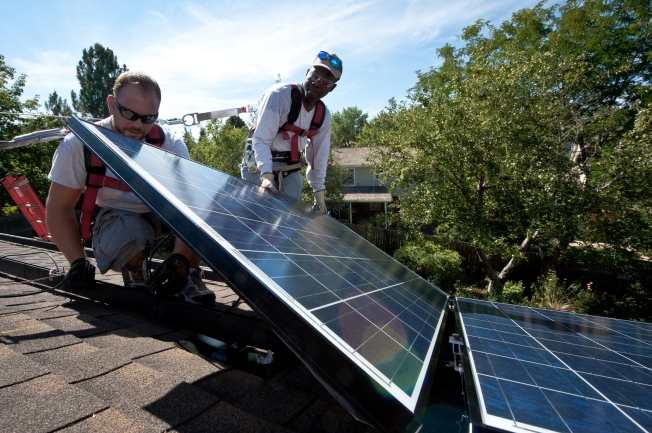
Photo courtesy of Department of Energy, via Wikimedia Commons.

It’s true that Republicans remain in control of the General Assembly, and the way things run in Richmond, having only the narrowest of margins diminishes the majority’s power remarkably little. Yet the Blue Wave swept in a set of younger, more diverse, and more progressive delegates, many of whom are as interested in reforming energy policy as they are in social and economic issues.

As a result, I count more than 50 bills dealing with solar, energy efficiency, electric vehicles and battery storage; several more that affect clean energy by addressing carbon emissions; and still others that deal with utility regulation in ways that have implications for renewables and storage. And bills are still being filed.

In this post, I cover just the renewable energy bills of general interest filed to date, saving energy efficiency, storage, EVs and climate for later.

Most of these bills cover renewable energy generally. Bills submitted by the Rubin Group (the private negotiating group consisting mostly of utilities and solar industry members) are limited to solar.

One bill this year takes a new run at a mandatory renewable portfolio standard (RPS). This is Delegate Sullivan’s HB 436, which narrows the kind of resources eligible for the program (now mostly wind, solar and hydro) as well as making it mandatory. As currently drafted it is so ambitious that it would likely mean utilities would have to buy a lot of Renewable Energy Certificates from out of state to meet the early year targets, but changes to the bill may be in the works.

Delegate Sullivan has also proposed HB 54, which would provide a state tax credit of 35% of the cost of installing certain kinds of renewable energy property, up to a maximum credit of $15,000.

Several bills enable community solar programs, to provide options beyond the utility-controlled program passed last year that more closely resembles a green tariff. SB 313 (Edwards) SB 311 (Edwards) offer two different customer-controlled models. SB 586 (Gooditis) would authorize, but not require, utilities to set up utility-controlled programs; it differs from last year’s bill in that customers would have a direct connection with a specific renewable energy project. Since it would not be limited to solar, it could open a new option for community wind.

The Rubin Group drafted three pieces of legislation. The centerpiece bill, SB 284 (Saslaw) and HB 1215 (Hugo) raises from 500 megawatts (MW) to 4,000 MW (by 2024) the amount of large-scale solar utilities can build or buy that is deemed to be “in the public interest,” a designation that takes this determination away from the State Corporation Commission. The bill also makes it in the public interest for utilities to own or buy up to 500 MW of small-scale solar projects (under 1 MW each). These will be distributed projects, but utility-controlled, along the lines of Dominion’s not-very-successful Solar Partnership Program.

SB 284 and HB 1215 don’t actually require the utilities to do anything, but the legislation is widely seen as signaling their intent to move forward with additional solar development. While a very welcome signal, legislators should keep in mind that a Solar Foundation analysis earlier this year noted it would take as much as 15,000 MW of solar to provide just 10% of Virginia’s electricity supply.

Recognizing this reality, Delegate Mark Keam has introduced HB 392, which declares it in the public interest for the Commonwealth to get 10% of its electricity from solar, and raises to 15,000 MW the amount of utility solar in the public interest.

The two other Rubin Group bills deal with land use, putting language into the code giving people the right to put up solar panels on their own property for their own use, except where local ordinances specifically prohibit it, and subject to setback requirements, historic districts, etc. The bills are SB 429 (Stanley), its companion bill HB 508 (Hodges), SB 179 (Stanley) and companion bill HB 509 (Hodges).

The Rubin Group tried and failed to negotiate changes to Virginia’s net metering program, which affects most customer-sited solar projects, including residential rooftop solar. This is hardly a surprise; a group that works on consensus gives every member veto power. With utilities hostile to any perceived incursion on their monopoly power, and solar advocates pledged to protect the rights of residents, there aren’t a whole lot of opportunities for consensus here.

With the Rubin Group out of the net metering space, legislative champions have stepped into the vacuum to propose a host of bills that would support customers who install solar for their own use:

  • HB 393 (Keam) removes the 1% cap on net metered projects, and provides that when net metered projects reach 1% of a utility’s electric load, the SCC will conduct a study of the impact of net metering and make recommendations to the General Assembly about the future of the program. HB 1060 (Tran) simply removes the cap.
  • SB 191 (Favola) provides that Virginia customers who wish to self-generate electricity with renewable energy using the net metering provisions of the Code may install up to 125% of their previous 12 months’ electric demand, or in the case of new construction, of the electric demand of similar buildings. A 2015 law currently limits customers to 100% of previous demand.
  • HB 421 (Sullivan) allows owners of multifamily residential buildings to install renewable energy facilities and sell the output to occupants. This bill does not provide for the electricity to be net metered.
  • HB 930 (Lopez) requires the SCC to establish a net metering program for multifamily customer-generators, such as condominiums, apartment buildings, and homeowner associations.
  • HB 978 (Guzman) requires utilities to justify standby charges with a value of solar study. As currently written, the bill does not appear to have retroactive effect, so it might not repeal the existing, much-hated standby charges already approved by the SCC.
  • SB 82 (Edwards) expands the agricultural net metering program, increasing the project size limit from 500 kW to 1 MW, providing that the electricity can be attributed to meters on multiple parcels of land, and repealing the 2017 law ending agricultural net metering in coop territory.

Finally, several bills once again tackle third-party power purchase agreements (PPAs), which the Virginia Code appears to make legal, but which utilities have consistently maintained are a violation of their monopoly on the sale of electricity. HB 1155 (Simon) reaffirms the legality of PPAs. SB 83 (Edwards) replaces the existing PPA pilot program that dates from 2013 and directs the SCC to establish a broader program.

HB 1252 (Kilgore) replaces the existing pilot, which has different rules for Dominion and APCo, with a new program renamed “net metering power purchase agreements” that would be consistent for both utilities. It would open up APCo territory more than at present, by allowing any tax-exempt entity to participate rather than just the private colleges and universities that won inclusion last year. However, as currently drafted, it would narrow the program as it exists in Dominion territory by eliminating the eligibility of for-profit customers. Although it is the least customer-friendly option among the PPA bills, Kilgore’s position as chairman of House Commerce and Labor, which will hear the bill, gives it the strongest chance of passage.

Note that most of the renewable energy bills (other than those dealing with tax credits and land use) will go to the Commerce and Labor committees. In the House, a subcommittee usually meets once to hear all the bills (and typically to kill all but the ones anointed by chairman Terry Kilgore). While the schedule is not set, in the past the subcommittee meeting has been held in early February.


Important dates:

First Day of Session: Wednesday, January 10

Bill filing Deadline: Friday, January 19

Crossover (last day on which bills passed in one chamber can go to be heard in the other): Wednesday, February 14

Sine Die (end of Session): Saturday, March 10 

How to research a bill:

I’ve hot-linked the bills discussed here, but you can also find them all online pretty easily. On the home page of the General Assembly website, you will see options at the lower right that direct you to the Legislative Information Service, or LIS. If you know the number of a bill, you can type it into the first box (omitting spaces), and click “GO.” This will take you to a page with information about the bill, including a summary of the bill, the bill’s sponsor (called a “patron” in Virginia), the committee it has been assigned to, and its current status. Follow links to learn more about the committee, such as who is on it and when it meets. You will also see a link to the full text of a bill as a PDF.

Always read the full text of a bill rather than simply relying on the summary. Summaries sometimes contain errors or omit critical details, and bills can get amended in ways that make them very different from what the summary says. For the same reason, make sure you click on the latest version of the bill’s text.

If you don’t know a bill number, the General Assembly home page also lets you search “2018 Regular Session Tracking.” When you hit “GO,” this button brings you to a page with options for finding a bill, including by the name of the legislator (“member”), the committee hearing it, or the subject.

When you click on the name of a committee, you will see the list of bills referred to that committee, with short descriptions. It also tells you who is on the committee, when the committee meets and where. You can click on “Agendas” to see which bills are scheduled to be heard at the next committee meeting. Unfortunately the agendas are not set until a day or two before the meeting.


Unknown's avatar

Want more solar in Virginia? Here’s how to get it.

A Solar Foundation analysis showed Virginia could create 50,000 new jobs by committing to build enough solar to meet 10% of energy demand. Photo credit: Dennis Schroeder, NREL

If there is an energy issue that Republicans and Democrats can agree on, it is support for solar energy. It’s homegrown and clean, it provides local jobs, it lowers our carbon footprint, and it brings important national security and emergency preparedness benefits. Dominion Energy Virginia even says it’s now the cheapest option for new electric generation.

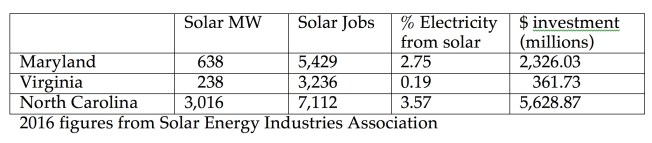
Yet currently Virginia lags far behind Maryland and North Carolina in total solar capacity installed, as well as in solar jobs and the percentage of electricity provided by solar. And at the rate we’re going, we won’t catch up. Dominion’s current Integrated Resource Plan calls for it to build just 240 megawatts (MW) per year for its ratepayers. How can we come from behind and score big?

First, our leaders have to set a serious goal. Virginia could create more than 50,000 new jobs by building enough solar to meet just 10 percent of our electricity demand by 2023. That requires a total of 15,000 MW of solar. Legislators should declare 15,000 MW of solar in the public interest, including solar from distributed resources like rooftop solar.

The General Assembly should consider a utility mandate as well. Our weak, voluntary Renewable Portfolio Standard (RPS) will never be met with wind and solar, and making it mandatory wouldn’t change that. (To understand why, read section 4 of my 2017 guide to Virginia wind and solar policy, here.) Getting solar into the RPS would require 1) making it mandatory; 2) increasing the targets to meaningful levels (including removing the nuclear loophole); 3) including mandatory minimums for solar and wind so they don’t have to compete with cheap renewable energy certificates (RECs) from out-of-state hydroelectric dams; and 4) providing a way for utilities to count the output of customer-owned solar facilities in the total, possibly through a REC purchase program to be set up by the State Corporation Commission.

The other way to frame a utility mandate would be to ignore the RPS and just require each utility to build (or buy the output of) its share of 15,000 MW of solar. Allowing utilities to count privately-owned, customer-sited solar towards the total would make it easier to achieve, and give utilities a reason to embrace customer investments in solar.

Second, the General Assembly has to remove existing barriers to distributed solar. Customers have shown an eagerness to invest private dollars in solar; the government and utilities should get out of the way. That means tackling several existing barriers:

  • Standby charges on residential solar facilities between 10 and 20 kilowatts (kW) should be removed. Larger home systems are growing in popularity to enable charging electric vehicles with solar. That’s a good thing, not something to be punished with a tax.
  • The 1% cap on the amount of electricity that can be supplied by net-metered systems should be repealed.
  • Currently customers cannot install a facility that is larger than needed to serve their previous year’s demand; the limitation should be removed or raised to 125% of demand to accommodate businesses with expansion plans and homeowners who plan to buy electric vehicles.
  • Customers should be allowed to band together to own and operate solar arrays in their communities to meet their electricity requirements. This kind of true community solar (as distinguished from the utility-controlled programs enabled in legislation last year) gives individuals and businesses a way to invest in solar even if they don’t have sunny roofs, and to achieve economies of scale. If community solar is too radical a concept for some (it certainly provokes utility opposition), a more limited approach would allow condominiums to install a solar facility to serve members.
  • Local governments should be allowed to use what is known as municipal net metering, in which the output of a solar array on government property such as a closed landfill could serve nearby government buildings.
  • Third-party power purchase agreements (PPAs) offer a no-money-down approach to solar and have tax advantages that are especially valuable for universities, schools, local governments and non-profits. But while provisions of the Virginia Code clearly contemplate customers using PPAs, Virginia utilities perversely maintain they aren’t legal except under tightly-limited “pilot programs” hammered out in legislation enacted in recent years. The limitations are holding back private investment in solar; the General Assembly should pass legislation expressly legalizing solar third-party PPAs for all customers.

Third, the Commonwealth should provide money to help local governments install solar on municipal facilities. Installing solar on government buildings, schools, libraries and recreation centers lowers energy costs for local government and saves money for taxpayers while creating jobs for local workers and putting dollars into the local economy. That makes it a great investment for the state, while from the taxpayer’s standpoint, it’s a wash.

If the state needs to prioritize among eager localities, I recommend starting with the Coalfields region. The General Assembly rightly discontinued its handouts to coal companies in that region, which were costing taxpayers more than $20 million annually. Investing that kind of money into solar would help both the cash-strapped county governments in the area and develop solar as a clean industry to replace lost coal jobs.

Coupled with the ability to use third-party PPA financing, a state grant of, say, 30% of the cost of a solar facility (either immediately or paid out over several years) would drive significant new investment in solar.

Fourth, a tax credit for renewable energy property would drive installations statewide. One reason North Carolina got the jump on Virginia in solar was it had a robust tax credit (as well as a solar carve-out to its RPS). One bill has already been introduced for Virginia’s 2018 General Assembly session offering a 35% tax credit for renewable energy property, including solar, up to $15,000. (The bill is HB 54.)

Fifth, Virginia should enable microgrids. Unlike some other East Coast states, we’ve been lucky with recent hurricanes. The unlucky states have learned a terrible lesson about the vulnerability of the grid. They are now promoting microgrids as one way to keep the lights on for critical facilities and emergency shelters when the larger grid goes down. A microgrid combines energy sources and battery storage to enable certain buildings to “island” themselves and keep the power on. Solar is a valuable component of a microgrid because it doesn’t rely on fuel supplies that can be lost or suffer interruptions.

The General Assembly should authorize a pilot program for utilities, local governments and the private sector to collaborate on building solar microgrids with on-site batteries as a way to enhance community preparedness, provide power to buildings like schools that also serve as emergency shelters, and provide grid services to the utilities.

One way or another, solar energy is going to play an increasingly large role in our energy future. The technology is ready and the economics are right. The only question is whether Virginia leaders are ready to make the most of it in the coming year.

Unknown's avatar

Just in time for the 2018 legislative session, a way to actually understand Virginia energy law

The sections of the Virginia Code devoted to energy law present a nearly impenetrable thicket to anyone who isn’t a lawyer—and indeed, to most lawyers as well. Sentences sometimes go on for pages without a break, with clauses wrapped in other clauses like a set of Russian nesting dolls. Words don’t always mean what they do in ordinary English, but you won’t know that unless you find your way to separate sections containing the surprise definitions. And references to “Phase I” and “Phase II” utilities seem deliberately calculated to confuse. (For the record, they mean Dominion and APCo.)

Lawyers are said to like complicated and obscure language because it ensures their services remain in demand, but I’ve never met a fellow lawyer who actually subscribed to this cynical view. Most believe we are all better off when laws are easy to understand, both so we can comply and, when necessary, make reforms. This is especially true when the laws are like Virginia’s: packed with favors to powerful monopolies and riddled with booby-traps for consumers. It’s hard to change a law if you can’t make head or tail of it to begin with.

So the law firm GreeneHurlocker deserves applause for its new guide to the Virginia Code’s electric utility laws. The 33-page booklet pulls together the major relevant code sections and annotates them in clear and concise English with virtual sticky notes. Principles of Electric Utility Regulation in Virginia is not a textbook or even a primer, but something more like a travel guide, complete with a map and signposts directing the traveler to sites of particular interest.

In announcing the release of the guidebook, GreeneHurlocker lawyer William Reisinger said the intent was to provide a sort of “’Cliffs Notes’ for some of the complicated utility statutes. We have no agenda with this document, other than to help demystify some of these laws and provide some useful background.”

They’ve succeeded. Those who are used to rummaging around the online version of the Code in search of the right section to answer a particular question will find the guidebook a huge timesaver. For others who don’t even know where to begin with the Code, it offers a way in.

Perhaps most importantly, for legislators and other leaders used to relying on lobbyists to tell them what is in the Code, the guidebook will make it easier for them to do their own research.

When I first saw the guidebook, I had a momentary fear (which was also a momentary hope) that it would put my own annual “Guide to wind and solar policy” out of business as a source for policy information. As it turns out, though, the two take very different approaches and are useful for different purposes.

So you may find a use for both, but in any case you will certainly want GreeneHurlocker’s guide.

Unknown's avatar

Sierra Club takes State Corporation Commission to court over failure to review Atlantic Coast Pipeline deal

Photo credit Chesapeake Climate Action Network

Sierra Club is asking the Supreme Court of Virginia to require the State Corporation Commission (SCC) to review a key deal for shipping capacity on the Atlantic Coast Pipeline. The SCC has thus far declined to exercise its oversight authority over this arrangement, despite a Sierra Club petition filed last May urging that Virginia’s Affiliates Act requires the Commission’s review in this case. In Sierra Club’s appeal filed yesterday by attorneys with Appalachian Mountain Advocates, the law firm representing it in court, the Club argues that the SCC was wrong to reject its petition and seeks an order reversing the SCC’s decision.

The Atlantic Coast Pipeline (ACP) is being developed by a partnership called Atlantic Coast Pipeline LLC, whose largest shareholder – Dominion Energy – is parent company of the public utility Virginia Electric and Power Company, now operating as Dominion Energy Virginia (having changed its name earlier this year from Dominion Virginia Power). Under the arrangement noted above, Dominion Energy Virginia must, through one of its subsidiaries, purchase pipeline capacity on the ACP for a period of 20 years, with Atlantic Coast Pipeline LLC— the utility’s own corporate affiliate—bringing in tens or even hundreds millions of dollars per year in revenue. What’s more, Dominion is nearly certain to request that Virginia’s ratepayers ultimately foot the bill for this arrangement.

The utility’s deal with Atlantic Coast Pipeline LLC underpins Dominion Energy’s claim that the ACP has enough customers to justify its construction. Without that arrangement, Dominion and its partners would likely have had trouble getting approval from the Federal Energy Regulatory Commission (FERC) to build the pipeline.

Under the Virginia Affiliates Act, public utilities like Dominion Energy Virginia are required to submit their “contracts or arrangements” with affiliated companies to the SCC for approval before they can take effect, something the utility failed to do. But on September 19, the SCC rejected Sierra Club’s petition for an order holding that Dominion must comply with the Act and requiring a formal proceeding to determine whether the ACP deal is in the public interest.

Sierra Club and other critics contend that this arrangement is a loser for ratepayers because Dominion Energy Virginia already has all the pipeline capacity it needs: several years ago, it purchased 20 years’ worth of capacity from Transcontinental to service the same power plants that it now claims must receive gas—at a much higher shipping rate—from the ACP. As a result, the utility’s arrangement with Atlantic Coast Pipeline LLC will very likely increase, not decrease, electricity prices in Virginia. It is hard to imagine that if the SCC were to examine the facts of the deal, as the Affiliates Act requires it do, it would find that this expensive and redundant arrangement is actually in the public interest.

“We have grave concerns that Dominion’s deal for shipping capacity on the ACP will only serve to benefit the company’s bottom line, not the needs of the public,” says Andres Restrepo, a Sierra Club lawyer involved in the matter. “Luckily, the Affiliates Act is crystal clear: arrangements like Dominion’s must be reviewed and approved by the SCC before they can take effect. That’s why we’re confident that the Supreme Court will rule in our favor and require Dominion and its subsidiaries to comply with this critical review requirement.”

According to Restrepo, the Supreme Court will likely solicit briefing on the appeal and hold oral arguments during the first half of 2018. If Sierra Club is successful, Dominion would then have to file its agreement under the Affiliates Act, and the SCC would have to open a case docket and hold a hearing to consider whether the deal is in the public interest.

A ruling by the SCC rejecting Dominion’s plan could have significant ramifications. Namely, it would undermine the basis on which FERC approved construction of the ACP this fall. FERC approval for new pipeline rests on a showing that the pipeline is “needed,” and the Commission has recently found that such need exists where the project proponent has customer contracts for most or all of the pipeline’s capacity. Without valid contracts, this basis for a need determination vanishes.

Sierra Club and other pipeline opponents have asked FERC to reconsider its approval of the ACP, based in part on the question of whether Dominion and its partners have properly shown need. A decision by the SCC rejecting Dominion Energy Virginia’s deal with Atlantic Coast Pipeline LLC could prompt FERC to reconsider its prior approval.

An SCC ruling could also impact the ACP’s construction timetable and even its economic rationale. How will investors feel about spending $5 billion to build a pipeline through Virginia when most of its Virginia customer base has disappeared?

But first, the SCC must actually review the deal. In its September order rejecting Sierra Club’s petition, the SCC essentially said that it didn’t need to make a determination now; it could wait until Dominion comes to it asking to charge ratepayers for the ACP deal in future proceedings. But the Affiliates Act requires review and approval of inter-affiliate agreements before they take effect. Furthermore, any later proceedings to determine rate impacts would happen only after the pipeline had been built and become operational.

Yes, that’s nuts. Dominion seems to be willing to construct the pipeline now and gamble on SCC’s approval of cost reimbursement further down the road, but the rest of us—Virginia’s ratepayers—shouldn’t be forced into such a gamble. Virginians, who have to suffer the environmental destruction the ACP will cause in addition to likely impacts to their electric rates, deserve to have their needs considered now, just as the law requires, and not later, as Dominion would prefer.

The fact is simple: contrary to its ruling in September, the SCC must review Dominion Energy Virginia’s deal for ACP shipping capacity now to determine whether it is in the public interest. The Affiliates Act requires no less. Here’s hoping Virginia’s Supreme Court holds the SCC to its obligations and mandates a formal review process. After all, better late than never.