Unknown's avatar

As Virginia prepares to join carbon-trading states, arguments erupt over the price of admission

photo courtesy of the Sierra Club

Virginia won’t enter the nine-state carbon emissions trading program known as the Regional Greenhouse Gas Initiative until 2020 under regulations being finalized by the state, but debate about how much it might cost utility ratepayers is already heating up.

Estimates range from little or no cost — or even a cost savings — to as high as $12 per month for the average household, depending on who is doing the calculations and the assumptions they make.

An Associated Press article reports that State Corporation Commission staff testified before a legislative committee that joining RGGI via the Virginia Coastal Protection Act, SB 1666 and HB 2735, would cost Virginia households an added $7-12 per month. The Northam administration disputed the SCC figure, saying the true cost would be about a dollar per month.

Republicans killed the bill in both the Senate and House committees that day.

A few days later, the anti-RGGI bill, HB 2611 (Poindexter), sailed through the House on a party-line vote. It would prevent Virginia from participating in RGGI or any other carbon-reduction regimen. If it also passes the Senate in coming weeks, it faces certain veto by the governor.

So is joining RGGI an inexpensive way to incentivize utilities to save energy and lower carbon emissions, or will it pile costs onto customers?

RGGI, for those of you who need a quick brush-up on your carbon policies, is a cooperative, market-based effort that has been running in New England and the Mid-Atlantic states as far south as Maryland for the past decade.

It works by auctioning carbon pollution allowances to major emitters, gradually ratcheting down the number of allowances made available each year to incentivize conservation and the use of lower-carbon fuels. States use the money they raise to fund energy efficiency, community solar, weatherization and other programs, often focusing especially on low-income residents.

First things first: RGGI works.

According to a 2018 report by Analysis Group, the RGGI region has met its targets, and benefited economically as well:

“Over three years (2015-2017), the RGGI program led to $1.4 billion (net present value) of net positive economic activity in the nine-state region,” the report says. “Each RGGI state’s electricity consumers and local economy also experienced net benefits from the RGGI program. When spread across the region’s population, these economic impacts amount to nearly $34 in net positive value added per capita.”

Virginia’s carbon reduction plan, now in the final stages of drafting at DEQ, will have Virginia participate in the RGGI auctions but not raise money from auctioning allowances.

Beginning in 2020, RGGI will add Virginia carbon emissions (28 million tons, the baseline DEQ has chosen) to the total for the existing members (56 million tons), and our utilities will bid for and trade allowances with the utilities in the other nine states.

But unlike the existing RGGI states, under DEQ’s plan Virginia will distribute its share of carbon allowances to our utilities at no cost, based on their previous year’s electricity sales. Utilities will sell the allowances into the RGGI auction bucket and buy back as many as they need. Initially, at least, the effect on ratepayers should be pretty much a wash.

Chris Bast, chief deputy at the Virginia Department of Environmental Quality said DEQ’s modeling program estimated rates would increase about 1 percent as a result of the new regulations. That’s a much lower figure than the $7 per month the SCC estimated the program would cost even with free allowances.

State Corporation Commission spokesman Ken Schrad said the DEQ “has understated the price of carbon emissions and understated Dominion’s cost of money for future capital investments (borrowed from lenders or invested by shareholders).”

“DEQ modeled Dominion as if it was a deregulated utility in a competitive market,” Schrad said. “Dominion’s fossil fuel generating units must be paid for in rates regardless of whether they are generating electricity under its vertically integrated structure.”

Bast takes issue with this. “I don’t know where the SCC got its numbers,” Bast told me. “Many folks, including the DEQ, have done extensive modeling to determine the environmental and economic impacts of the rule. That modeling is part of the public record and is part of the extensive public process that has gone into crafting this regulation. The SCC’s analysis is an outlier by several orders of magnitude – nearly 600%. The SCC has not provided any comment about ratepayer impact during any of our regulatory proceedings.

“We’re simply asking the SCC to show their work. But, to date, they have refused to provide us with the analysis that supports their conclusions.”

Bast says DEQ has not modeled what the program would cost if utilities had to pay for allowances, as contemplated under the Coastal Protection Act. Paying for allowances, according to the SCC, could drive costs up by an additional $5 per month.

This is a moot point, for now, since the Coastal Protection Act did not pass. But advocates believe that auctioning allowances offers an opportunity to raise funds to invest in energy efficiency and climate programs, so the idea remains on everyone’s radar for next year.

How RGGI works:

Under the Coastal Protection Act, auction proceeds would go into the state’s coffers to fund energy efficiency and resiliency programs that benefit the public. Utilities would be able to recover the costs of buying allowances from their customers, so there would be more impact on rates than there would be if allowances are free.

The Coastal Protection Act takes an extra step and actually requires investor-owned utilities to build wind and solar to achieve at least 50 percent of the required emissions reduction. If that amount were to exceed what they planned to build anyway, it would mean more costs paid for by customers—though maybe not a lot, if it speeds up the retirement of old fossil fuel plants that ought to close anyway.

RGGI reduces carbon emissions over time by gradually decreasing the number of auction allowances available in the region year after year. As the carbon cap tightens, either allowances become more expensive, or utilities reduce emissions, or both.

So far the RGGI states have succeeded in reducing emissions without higher allowance prices. They have done this in large part by closing coal plants and investing in energy efficiency and renewable energy, including programs paid for by auctioning the carbon emissions allowances.

Most RGGI states also have mandates for efficiency and renewable energy, which Virginia lacks. (In spite of the hoopla around it, last year’s “grid mod” bill did not require utilities to achieve any specific efficiency or renewable energy outcomes.) The combined effect of all these actions is that the prices paid for auction allowances in RGGI have stayed low.

According to the Analysis Group, consumers in RGGI states have benefited:

“On the one hand, the inclusion of the cost of CO2 allowances in wholesale prices tends to increase wholesale electricity prices in the RGGI region at the beginning of the 2015-2017 period,” the report says.

“But these near-term impacts are more than offset during these years and beyond, because the states invest a substantial amount of the RGGI auction proceeds on energy efficiency programs that reduce overall electricity consumption and on renewable energy projects that reduce the use of higher-priced power plants. Consumers gain because their overall electricity bills go down.

“Since RGGI’s commencement in 2009, energy and dollar savings resulting from all states’ investments in energy efficiency and renewable energy has more than offset the wholesale market price increases associated with inclusion of allowance costs in market bids.”

Virginia is as well-positioned as any of the RGGI states to meet the carbon-reduction goals.

Utilities can reduce energy demand through energy efficiency, resulting in less need for carbon-emitting fuel to be burned. They can also replace coal-fired generation with power from gas (with about half the CO2 of coal) or renewables (zero C02 for wind, water and solar; biomass has CO2 emissions as high as coal, but decision-makers pretend it’s carbon neutral).

Our nuclear plants, which provide a big chunk of Virginia’s electricity, are already operating at full capacity, and that’s not expected to change.

Intuitively, the solutions wouldn’t be expected to cost very much. Some of Virginia’s coal plants aren’t running very much these days anyway, putting them precariously close to the point where it is cheaper to close them than keep paying to have them available. As for alternatives, Dominion says solar is the cheapest form of new energy.

And energy efficiency is, famously, the lowest-cost energy resource, and vastly underutilized in Virginia.

In fact, projections have Dominion coming in under the RGGI cap for at least several years, putting our utilities in the happy (for them) position of possibly making money in the auctions.

But that doesn’t quite settle the matter.

There is one other consideration that could affect rates: Virginia utilities participate in the regional transmission organization known as PJM, which runs the wholesale power market. Anything that makes Virginia power more expensive makes it less attractive to the market.

That is surely part of the SCC staff’s concern.

To understand this dynamic, I consulted economist Bill Shobe, a professor at the Center for Economic and Policy Studies at the Weldon Cooper Center for Public Service at the University of Virginia, who studies carbon markets.

Shobe said that if Virginia utilities get CO2 allowances for free based on their previous year’s electricity generation, as the DEQ plan calls for, there should be no impact on their power plants’ competitiveness in PJM. The cost to customers would be little or nothing.

But if a coal or gas plant has to add the cost of CO2 allowances to its price of power, as happens in other RGGI states, power plants from non-RGGI states that don’t have to charge for CO2 will have a price advantage.

Shobe said if a Virginia utility adds the cost of CO2 allowances to the price of power from its own fossil fuel plants, those plants won’t run as much. Even the utility itself might buy cheaper wholesale power rather than run its own plants. Worse, the imported power could be higher in CO2 than the Virginia power it displaces, a problem known as “leakage.”

Dominion Energy Virginia’s 2018 Integrated Resource Plan, a document that forecasts how the utility will meet electric demand, predicted that if Virginia joined RGGI, its four big gas plants would run only an average of 64 percent of the time in 2025, compared to 79 percent in a scenario with no carbon constraints.

Dominion also claimed the cheaper imported power would come with such a higher carbon footprint than the power it was replacing that the whole deal would be counterproductive as a CO2 reduction strategy.

Skeptics should note that Dominion didn’t report the assumptions behind the modeling. Even its consultant, ICF, included a disclaimer that it was using the information Dominion gave it but “makes no assurances as to the accuracy of any such information or any conclusions based thereon.”

It’s also not clear that Dominion recognized any difference between getting free allowances and having to pay for them.

Shobe explained that Dominion’s modeling program didn’t account for DEQ’s use of “output-based allocation”— that is, distributing carbon allowances for free based on a utility’s generation in the previous year. This approach, said Shobe, incentivizes the utility to keep generating as much zero- or low-carbon electricity as it can so it will get as many allowances the next year as possible, and it will use its allowances to keep its own power competitive with imports.

The modeling that ICF did for Dominion, say Shobe, “treats all allowances as if they are sold at auction. Period. They don’t even attempt to model free allowances much less output-based allocation.”

With free allowances, customer costs should be minimal.

What if we auction the allowances?

Shobe said auctioning allowances instead of distributing them for free would make the power from Virginia’s fossil fuel plants less competitive in the PJM market. Yet customers will still have to pay for the capital cost of these huge gas plants that the SCC itself foolishly allowed Dominion to build, even if the power they generate is less competitive in PJM.

(“Foolishly” is obviously my term for it. The SCC not only doesn’t admit it did anything wrong, it rejected Dominion’s IRP in part because the company didn’t propose building yet another giant gas plant.)

The SCC’s high-end estimate seems to be based on this concern, but its numbers are much higher than even Dominion’s.

Dominion’s IRP estimated that joining RGGI would “cost Virginia customers about $530 million over the period 2020 to 2030,” or $53 million per year. The IRP says the impact would be about $3.50-$5 per month for residential customers, depending on the approach taken.

Even that estimate has to be taken with a bucket of salt. As the SCC staff noted at the time, Dominion overestimated the costs of joining RGGI by using overly high demand projections and failing to assume any decrease in demand from the hundreds of millions of dollars in efficiency programs the utility is required to design.

Obviously, those programs will also lower carbon emissions, helping Virginia meet the RGGI targets—as will building the solar energy envisioned by the grid mod bill.

So how the SCC staff has now come up with cost estimates even higher than Dominion’s is a head-scratcher. Nothing in the Coastal Protection Act appears to add costs beyond what Dominion knew about for its IRP.

This debate is surely not over.

We hope DEQ and the SCC will come together on a shared set of facts and assumptions, but meanwhile it is worth noting two points.

One is that even Dominion agrees some sort of carbon regulation at the federal level is likely eventually, even if it doesn’t happen under President Donald Trump’s administration.

Starting to shrink our carbon footprint now instead of later is going to save us money, even apart from its climate and health benefits.

The other is that the RGGI approach brings proven economic benefits to customers. As the Analysis Group report showed, customers in RGGI states actually saw lower bills in spite of higher rates because of the investments in energy efficiency.

If that happens in Virginia, joining RGGI will actually put more money in the pockets of customers.


A version of this article first appeared in the Virginia Mercury on February 6, 2019. 

Unknown's avatar

The Commerce & Labor Committee did WHAT?

Today the Republican-controlled House Commerce & Labor Committee endorsed the most sweeping energy transformation package in history by passing Democratic Delegate Sam Rasoul’s HB 1635, a bill known as the “Off Act” that would transition Virginia away from fossil fuels by 2035.

Or rather, they passed the bill. Saying they endorsed it: I’m making that up. The Republicans who run Commerce & Labor are wholly indebted to the fossil fuel companies whose campaign contributions keep them in office. Most of them don’t even believe in human-caused climate change. They cannot conceive of an economy reshaped around clean energy.

They didn’t allow this bill to pass out of committee because they support it, but because they want a bigger venue in which to kill it.

The Off Act is serious climate action. It starts with a complete fossil fuel moratorium and goes from there. The Republicans think it is so extreme that even most Democrats will vote against it when push comes to shove. And a vote on the floor of the House is a great place for verbal pushing and shoving. They intend to create some serious theater in the cause of preserving America’s dependence on dinosaur-based hydrocarbons.

How do we know this is the plan? Let’s play the video of the committee hearing.

First, Delegate Rasoul introduces the bill, and a cross-section of Virginia residents step up to testify in support—women, men, black, white, Asian-American. They are followed by a line of older white men representing fossil fuel interests. Each of these highly-paid lobbyists explains how this radical bill will cost too much and hurt poor people.

Then the committee members vote, and gradually we understand that the reason this bill, and this bill alone, did not go to the usual subcommittee to die, is that the Republicans have selected it as the vote they will take to the floor. To do that, they need just one of their members to vote in support.

Tim Hugo, who won reelection by only about 110 votes last year and will be in the crosshairs of grassroots progressives this fall, is the R designated to vote in favor. You will notice, however, that he does not speak in favor of the bill in committee, and as a conservative and close ally of Dominion Energy there is no way he actually supports it (though he will trumpet his vote when he needs to, come November).

But the Republicans screw up the first vote; it is 8-8, not enough to pass the bill. Kathy Byron, who voted against it, calls for a re-vote, and this time withholds her vote, allowing it to pass.

The smile on committee chair Terry Kilgore’s face afterwards seems to be recognition that the snafu revealed the plan all too well.

Update: You all will be shocked–shocked!–to know that the bill died on January 31 after a very vigorous debate on the House floor. 

Unknown's avatar

Your guide to 2019 climate and energy bills

Virginia statehouse, where the General Assembly meetsUpdated (again!) January 23.

Clean energy and climate action are mainstream concepts with the public these days, but at Virginia’s General Assembly they have yet to gain much traction. Last year saw one renewable energy bill after another die in committee, along with legislation mandating lower energy use through energy efficiency and climate measures like having Virginia join the Regional Greenhouse Gas Initiative (RGGI).

The only major energy legislation to pass the GA in 2018 was the infamous SB 966, the so-called “grid mod” bill that included spending on energy efficiency and a stipulation that 5,500 megawatts (MW) of utility-owned or controlled solar and wind is “in the public interest.” But the bill didn’t actually mandate any efficiency savings or renewable energy investments, and it contained no support for customer-owned solar.

So clean energy advocates and climate activists are trying again, though the odds against them look as tough as ever. Republicans hold a bare majority of seats overall, but they dominate the powerful Commerce and Labor Committees that hear most energy bills. And Republicans overall (though with some exceptions) are more hostile to clean energy legislation than Democrats, and more willing to side with utilities against customers and competitors.

In particular, the House energy subcommittee has been a regular killing field for renewable energy bills. It consists of 7 Republicans and 4 Democrats, and last year every clean energy bill but one lost on party-line votes. Bills don’t advance to the full committee, much less to the House floor, unless they garner a majority in the subcommittee.

Over at Senate Commerce and Labor, Republicans hold an 11-4 majority on the full committee, and none of the Democrats are what you would call environmental champions. The electric utility subcommittee does not appear to be active this year.

A scattering of other clean energy and climate bills have been assigned to House Rules (which Republicans dominate 11-6) and Appropriations (12-10), where a subcommittee will several energy-related bills with fiscal impacts (at least three have been assigned to date). Some Senate bills will go to Finance.

Of course, this is an election year in Virginia, with every House and Senate seat up this fall. Legislators have reason to worry that the 2017 “blue wave” could turn into a 2019 flood tide that sweeps out not just vulnerable Republicans, but Democrats facing primary challenges from the left.

Will that persuade some of them to finally support clean energy, or at least some of the pragmatic initiatives that have broad popular support?

That’s the hope driving a number of bills framed around supporting market competition and customer choice, enabling private investments in renewable energy, and saving money for consumers and taxpayers. These are themes that appeal as much to conservatives as to liberals.

But a lot of these bills have the same problem they’ve always had. Dominion Energy opposes them, and Dominion controls the legislature.

Both Dominion and elected leaders maintain the fiction that it’s the other way around. That fiction allowed Senator Wagner and Delegate Kilgore, the chairmen of the Commerce and Labor Committees, to “refer” solar bills for secret negotiation between utilities and the solar industry via the private, closed-door Rubin Group.

About that Rubin Group

Frankly, I’ve never understood the notion that the solar industry ought to be able to work things out with the utilities so legislators don’t have to make decisions themselves. Solar installers negotiating with Dominion is like mice negotiating with the cat. The cat is not actually interested in peaceful coexistence, so it’s hard to imagine an outcome that makes life better for the mice.

And however much they insist they support solar, Kilgore, Wagner and company act like they’re secretly pleased that Kitty is such a good mouser. I don’t know how else to explain the way they lecture the mice on the virtues of compromise.

The Rubin Group has managed to produce legislation where the interests of the utilities and the solar industry align, primarily in ways that help utility-scale solar farms. When it comes to net metering and customer solar generally, however, Dominion hasn’t been willing to give up anything unless it gets something in return—and as it already has everything but the crumbs, progress seems to have stalled. I hear negotiations remain ongoing, however, so this isn’t the last word.

On the other hand, the solar industry did reach an accommodation with the electric cooperatives this year over customer solar. As member-owned non-profits, the coops are sometimes more responsive to the desires of their customer-owners, and this seems to be evidence of that. (Though see this blogpost from Seth Heald about the failures of democracy and transparency at Virginia’s larges coop, an issue now in litigation before the SCC.)

With the solar industry stalled in its talks with Dominion and a sense of urgency mounting, customer groups and other solar industry alliances have stepped into the void. Several bills seek to preserve and expand the market for customer solar with bills removing policy barriers. The most comprehensive of these is the Solar Freedom legislation put forward by Delegate Keam (HB 2329) and Senators McClellan and Edwards (SB 1456), removing 8 non-technical barriers to renewable energy deployment buy customers. Other net metering bills have similar provisions that tackle just one barrier at a time.

Another group of bills don’t seem intended to win Republican support, much less Dominion’s. Bills that will dramatically alter our energy supply, put Virginia at the forefront of climate action and rein in utility power have no chance of passage this year, but may become part of a platform for strong climate action next year if a pro-environment majority wins control of the GA.

The list below may look overwhelming, so let me just note that this is not even comprehensive, and additional bills may yet be filed.

I’ve separated the bills into categories for easier reference, but watch for overlap among them. I’ve put Solar Freedom up first (because I can!); after that, bills are ordered by number, with House bills first.

Solar Freedom 

HB 2329 (Keam) and SB 1456 (McClellan and Edwards) is the Solar Freedom bill that removes barriers to renewable energy installations by utility customers, mostly in the net metering provisions, and adds language to the Commonwealth Energy Policy supporting customer solar. The 8 provisions are:

  • Lifting the 1% cap on the total amount of solar that can be net metered in a utility territory
  • Making third-party financing using power purchase agreements (PPAs) legal statewide for all customer classes
  • Allowing local government entities to install solar facilities of up to 5 MW on government-owned property and use the electricity for other government-owned buildings
  • Allowing all customers to attribute output from a single solar array to multiple meters on the same or adjacent property of the same customer
  • Allowing the owner of a multi-family residential building or condominium to install a solar facility on the building or surrounding property and sell the electricity to tenants
  • Removing the restriction on customers installing a net-metered solar facility larger than required to meet their previous 12 months’ demand
  • Raising the size cap for net metered non-residential solar facilities from 1 MW to 2 MW
  • Removing standby charges for residential and agricultural net metering customers

Other renewable energy bills

HB 1683 (Ware) gives electric cooperatives greater autonomy, including authority to raise their total system caps for net metering up to 5% of peak load.

HB 1809 (Gooditis) follows up on last year’s HB 966 by making the renewable energy and energy efficiency provisions mandatory. If utilities don’t meet annual targets, they have to return their retained overearnings to customers.

HB 1869 (Hurst), SB 1483 (Deeds) and SB 1714 (Edwards) creates a pilot program allowing schools that generate a surplus of solar or wind energy to have the surplus credited to other schools in the same school district.

HB 1902 (Rasoul) would provide a billion dollars in grant funding for solar projects, paid for by utilities, who are required to contribute this amount of money through voluntary contributions (sic).

HB 1928 (Bulova) and SB 1460 (McClellan) expands utility programs allowing third-party power purchase agreements (PPAs) for renewable energy while continuing to restrict the classes of customers who are allowed to have access to this important financing tool.

HB 2117 (Mullin) and SB 1584 (Sutterlein) fixes the problem that competitive service providers can no longer offer renewable energy to a utility’s customers once the utility has an approved renewable energy tariff of its own. Now that the SCC has approved a renewable energy tariff for APCo, this is a live issue.

HB 2165 (Davis and Hurst) and HB 2460 (Jones and Kory), and SB 1496 (Saslaw) provide an income tax credit for nonresidential solar energy equipment installed on landfills, brownfields, in economic opportunity zones, and in certain utility cooperatives. This is a Rubin Group bill.

HB 2192 (Rush) and SB 1331 (Stanley) is a school modernization initiative that includes language encouraging energy efficient building standards and net zero design. It also encourages schools to consider lease agreements with private developers, but does not seem to contemplate the more common use of third-party power purchase agreements.

HB 2241 (Delaney) establishes a green jobs training tax credit.

HB 2500 (Sullivan) establishes a mandatory renewable portfolio standard (RPS) for Virginia, eliminates carbon-producing sources from the list of qualifying sources, kicks things off with an extraordinarily ambitious 20% by 2020 target, and ratchets up the targets to 80% by 2027.

HB 2547 (Hugo) and SB 1769 (Sturtevant) makes changes to the net metering program for customers of electric cooperatives. The overall net metering cap is raised from the current 1 percent to a total of 5%, divided into separate buckets by customer type and with an option for coops to choose to go up to 7%. Customers will be permitted to install enough renewable energy to meet up to 125% of previous year’s demand, up from 100% today. Third-party PPAs are generally legal, with a self-certification requirement. However, the coops will begin imposing demand charges on customers with solar, to be phased in over several years, replacing any standby charges. In the House version only, one additional provision allows investor-owned utilities (Dominion and APCo) to ask the SCC to raise the net metering cap if they feel like it, but I’m told it is not expected to be in the final legislation. This bill was negotiated between the coops and the solar industry via the “Rubin Group.”

HB 2621 (Ingram) and SB 1398 (Stanley) authorize a locality to require the owner or developer of a solar farm, as part of the approval process, to agree to a decommissioning plan. This is a Rubin Group bill.

HB 2641 (Gooditis) makes third-party power purchase agreements for distributed renewable energy resources legal statewide.

HB 2692 (Sullivan) allows the owner of a multifamily residential building to install a renewable energy facility and sell the output to occupants or use for the building’s common areas.

HB 2741 (Aird) establishes a rebate program for low and moderate-income households that install solar.

HB 2792 (Tran) and SB 1779 (Ebbin) establishes a 6-year pilot program for municipal net metering for localities that are retail customers of investor-owned utilities.

HJ 656 (Delaney) would have the Virginia Resources Authority study the process of transitioning Virginia’s workforce from fossil-fuel jobs to green energy jobs.

SB 1091 (Reeves) imposes expensive bonding requirements on utility-scale solar farms, taking a more drastic approach than HB 2621 (Ingram) and SB 1398 (Stanley) to resolving the concerns of localities about what happens to solar farms at the end of their useful life.

Energy Efficiency (some of which have RE components)

HB 2243 (Sullivan) creates an energy efficiency revolving fund to offer no-interest loans to local government, public schools, and public institutions of higher learning.

HB 2292 (Sullivan) and SB 1662 (Wagner), dubbed the “show your work bill,” requires the SCC to provide justification if it rejects a utility energy efficiency program.

HB 2293 (Sullivan) establishes a stakeholder process to provide input on the development of utility energy efficiency programs.

HB 2294 (Sullivan) establishes mandatory energy efficiency goals for electric and gas utilities.

HB 2295 (Sullivan) creates an energy efficiency fund and board to administer it.

HB 2332 (Keam) protects customer data collected by utilities while allowing the use of aggregated anonymous data for energy efficiency and demand-side management efforts.

SB 1111 (Marsden) requires utilities to provide rate abatements to certain customers who invest at least $10,000 in energy efficiency and, by virtue of their lower consumption, end up being pushed into a tier with higher rates.

SB 1400 (Petersen) removes the exclusion of residential buildings from the Property Assessed Clean Energy (PACE) program, which allows localities to provide low-interest loans for energy efficiency and renewable energy improvements on buildings.

HB 2070 (Bell, John) provides a tax deduction for energy saving products, including solar panels and Energy Star products, up to $10,000.

Energy transition and climate

HB 1635 (Rasoul, with 9 co-patrons) imposes a moratorium on fossil fuel projects, including export facilities, gas pipelines and related infrastructure, refineries and fossil fuel exploration; requires utilities to use clean energy sources for 80% of electricity sales by 2028, and 100% by 2036; and requires the Department of Mines, Minerals and Energy to develop a (really) comprehensive climate action plan, which residents are given legal standing to enforce by suit. This is being referred to as by the Off Act. (Update: HB 1635 passed Commerce and Labor on January 23 and heads to the floor of the House. Read this blogpost to understand what’s going on.)

HB 2735 (Toscano) and SB 1666 (Lewis and Spruill) is this year’s version of the Virginia Coastal Protection Act, which would have Virginia formally join the Regional Greenhouse Gas Initiative (RGGI). It dedicates money raised by auctioning carbon allowances to climate adaptation efforts, energy efficiency programs, and coalfields transition. The Governor has made this bill a priority.

HB 1686 (Reid, with 14 co-patrons) and SB 1648 (Boysko) bans new or expanded fossil fuel generating plants until Virginia has those 5,500 MW of renewable energy we were promised. This is referred to as the Renewables First Act.

HB 2611 (Poindexter) would prohibit Virginia from joining or participating in RGGI without support from two-thirds of the members of the House and Senate, making it sort of an anti-Virginia Coastal Protection Act.

HB 2501 (Rasoul) directs the Division of Energy at DMME to include a greenhouse gas emissions inventory in the Virginia Energy Plan.

HB 2645 (Rasoul, with 13 co-patrons), nicknamed the REFUND Act, prohibits electric utilities from making nonessential expenditures and requires refunds if the SCC finds they have. It also bars fuel cost recovery for more pipeline capacity than appropriate to ensure a reliable supply of gas. Other reforms in the bill would undo some of the provisions of last year’s SB 966, lower the percentage of excess earnings utilities can retain, and require the SCC to determine rates of return based on cost of service rather than peer group analysis.

HB 2747 (Kilgore) and SB 1707 (Chafin) create a Southwest Virginia Energy Research and Development Authority which will, among other things, promote renewable energy on brownfield sites, including abandoned mine sites, and support energy storage, including pumped storage hydro.

HJ 724 (Rasoul) is a resolution “Recognizing the need for a Green New Deal in Virginia which promotes a Just Transition to a clean energy economy through lifting working families.”

Other utility regulation

HB 1718 (Ware) requires an electric utility to demonstrate that any pipeline capacity contracts it enters are the lowest-cost option available, before being given approval to charge customers in a fuel factor case.

HB 1840 (Danny Marshall) allows utilities to develop transmission infrastructure at megasites in anticipation of development, charging today’s customers for the expense of attracting new customers.

HB 2477 (Kilgore) would eliminate one of the few areas of retail choice allowed in Virginia by preventing large customers from using competitive retail suppliers of electricity, including for the purpose of procuring renewable energy, in any utility territory with less than 2% annual load growth. (I haven’t confirmed this, but that might be Dominion as well as APCo.)

HB 2503 (Rasoul) requires the State Corporation Commission to conduct a formal hearing before approving any changes to fuel procurement arrangements between affiliates of an electric utility or its parent company that will impact rate payers. This addresses the conflict of interest issue in Dominion Energy’s arrangement to commit its utility subsidiary to purchase capacity in the Atlantic Coast Pipeline.

HB 2691 (O’Quinn) establishes a pilot program for electric utilities to provide broadband services in underserved areas, and raise rates for the rest of us to pay for it, proclaiming this to be in the public interest.

HB 2697 (Toscano) and SB 1583 (Sutterlein) supports competition by shortening the time period that a utility’s customer that switches to a competing supplier is barred from returning as a customer of its utility from 5 years to 90 days.

HB 2738 (Bagby) and SB 1695 (Wagner) authorizes utilities to acquire rights of way on land that the Virginia Economic Development Partnership Authority decides could attract new customers to the site, and allows utilities to recover costs from existing customers. Because, you know, having utilities seize Virginians’ land for speculative development is already going so well for folks in the path of the pipelines. Who could complain about paying higher rates to help it happen more places?

SB 1780 (Petersen) requires, among other things, that utilities must refund to customers the costs of anything the SCC deems is a nonessential expenditure, including spending on lobbying, political contributions, and compensation for employees in excess of $5 million. It directs the SCC to disallow recovery of fuel costs if a company pays more for pipeline capacity from an affiliated company than needed to ensure a reliable supply of natural gas. It requires rate reviews of Dominion and APCo in 2019 and makes those biennial instead of triennial, and provides for the SCC to conduct an audit going back to 2015. It tightens provisions governing utilities’ keeping of overearnings and provides for the allowed rate of return to be based on the cost of providing service instead of letting our utilities make what all the other monopolists make (“peer group analysis”).


This article originally appeared in the Virginia Mercury on January 17, 2019. I’ve updated it to include later-filed bills and one or two that I missed originally. 

Unknown's avatar

What will it take for Virginia’s largest jurisdiction to raise the bar on energy policy?

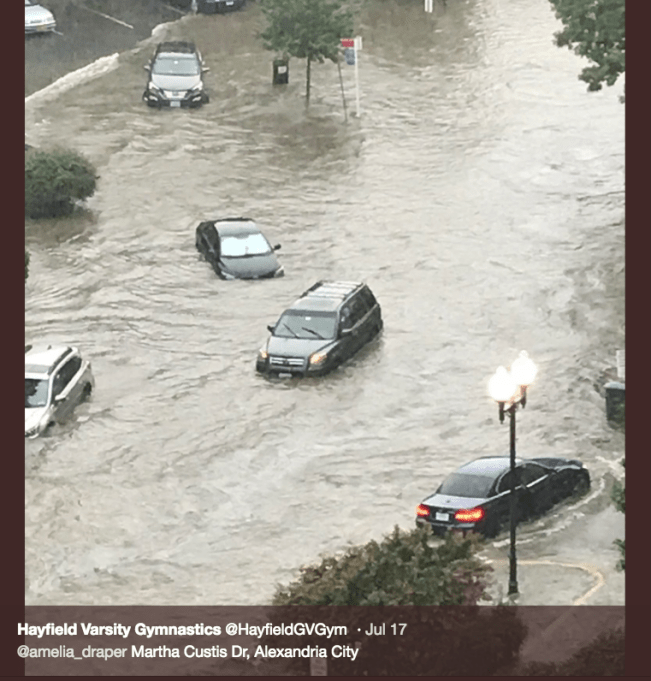
cars on a flooded roadway

Cars caught in a flash flood during Northern Virginia’s intense rainstorm on July 17. Photo courtesy of Hayfield Varsity Gymnastics, https://twitter.com/hayfieldgvgym?lang=en.

Last week, 40 drivers traveling on the George Washington Parkway had to be rescued near National Airport when a flash flood brought water up to their car doors. This week, Northern Virginia experienced a tornado, more flash flooding and road closures, more rescues and more power outages.

Extreme weather events like these are among the effects climate scientists were warning about in 2007, when Fairfax County adopted the Cool Counties Climate Stabilization Declaration. The County committed to reduce greenhouse gas (GHG) emissions by 20% below its 2005 baseline by 2020 and by 80% by 2050.

So how is the County doing with that? Not so good.

Last week, more than 10 years after its Cool Counties Declaration, the Fairfax County Board of Supervisors finally adopted what it called an Operational Energy Strategy for its own facilities, vehicles, and other operations with specific—but astonishingly weak—targets and deadlines for action. Supervisors who voted for the plan called it  “a step forward” or “a baseline.” (Watch the video here; discussion begins at 1:29:22.)

Local activists were less kind. “It may not be fiddling while Rome burns, but it comes close,” wrote the co-founder of Faith Alliance for Climate Solutions (FACS) Scott Peterson in a Washington Post op-ed.

To their credit, Supervisors John Foust (Dranesville District) and Dan Storck (Mt. Vernon District) urged their colleagues to adopt stronger measures. “We are out of the mainstream on renewable energy,” Foust told his colleagues.

“Do we really believe this effort is proportional to the challenges or the opportunities?” asked Storck. “The waters are rising, and they are rising in the Mt. Vernon District.”

The Board’s action is yet another disappointment for Fairfax residents interested in aggressive action to combat climate change and to reduce the county’s long-term energy costs. The Sierra Club, FACS and others have tried for years to get Fairfax County to live up to the commitment it made in 2007. (In those days I was part of a citizen’s group that offered advice to the County on ways to implement energy savings. Our suggestions were ignored, and in 2009 the County disbanded our group.)

The County Board is dominated by Democrats who say they care about climate change, but even meeting the County’s obligations as a member of the Metropolitan Washington Council of Governments (MWCOG) seems to lie beyond their ambitions. A chart prepared by the Sierra Club comparing Fairfax County’s climate and energy goals for its local operations to those of MWCOG and other local jurisdictions makes the County’s shortcomings clear. The most striking example: MWCOG says its members should meet 20% of their electricity needs with renewable energy by 2020. Fairfax County’s plan for renewable energy begins and ends with a single solar facility on one warehouse in Springfield.

Moreover, in sharp contrast to D.C., Arlington, and Montgomery County, Fairfax County has not implemented a community energy and climate action plan to address the 97% of GHG emissions contributed by the private sector.  In fact, the county has not even begun to develop such an action plan. The recommendations of a 2012 Private Sector Energy Task Force, initiated by the Board Chair, have languished.

Fairfax County’s inaction is as puzzling as it is disappointing. With a population of over 1.1 million, Fairfax is Virginia’s largest county as well as the second-richest county in the nation, after neighboring Loudoun. One in seven Virginians lives in Fairfax. We’ve got 414,000 homes and 116,000 businesses, including a strong tech sector that increasingly demands renewable energy—not least of all because it can save them money.

Nor is Fairfax held back by politics. The county has steadily grown more Democratic in elections. In 2017, Democrat Ralph Northam beat his Republican challenger by a whopping 36 points.

So what would it take to move Fairfax County from left-behind to leader? Advocates agree the County needs to make three big changes: commit to serious targets for renewable energy and energy efficiency in county operations; actively assist residents and businesses to save energy and go solar; and become an advocate for stronger state policies, including removing barriers to customer-sited solar.

A ten-point action plan might look like this:

1).  Ensure that County staff provides a thorough one-year review of the approach, cost savings, and GHG reductions under the County Operations Energy Strategy, including the consideration of options necessary to meet the goals of the MWCOG Climate and Energy Action Plan for 2017 to 2020.

2). Expedite the proposed Request for Proposals for Solar Purchase Power Agreements (PPA) announced on July 11th(but curiously not included in the Energy Strategy).  By late 2018, the County should finalize a PPA contract to facilitate the installation of on-site solar on county buildings.  By drafting the RFP and contract to allow the Fairfax County Public Schools and other localities to ride the contract, Fairfax County government could jumpstart solar development and jobs in Northern Virginia.

3).  Participate in a September 7 workshop at the County Government Center on budget-neutral clean energy funding alternatives (e.g., Energy Savings Performance Contracts, Solar Power Purchase Agreements, public-private partnerships).  This workshop will provide an improved understanding of the opportunities provided by these funding alternatives to support more aggressive energy and climate goals while limiting impacts on county real estate taxes. FCPS has achieved several million dollars in energy savings using ESPCs to obtain GHG reductions and can serve as a model of success.

4).  Complete its ongoing Commercial Property Assessed Clean Energy (C-PACE) initiative by enacting an ordinance necessary to support a C-PACE Program and by implementing the program by late 2019.  This action will provide critical financing to supercharge the inclusion of energy efficiency and renewable energy measures in eligible buildings, thereby supporting the County’s goals to repurpose and revitalize underutilized buildings.

5).  Develop and implement a County-wide Energy and Climate Action Plan to address GHG emissions from residents and businesses.

6).  Develop and implement an action plan to increase county resiliency in order to prepare for the impacts of climate change and help reduce the impact and costs of extreme weather events.

7).  Meet all obligations under Cool Counties and the Metropolitan Washington Council of Governments Climate Plan.

8). Support county staff by increasing staffing levels for energy and climate functions and by establishing a dedicated Energy Office reporting directly to the County Executive. Without an effective organizational structure and adequate resources, implementation of key recommendations is highly uncertain and the county is unlikely to maximize energy cost savings or meet its own climate goals.

9).  Engage in strong advocacy with the General Assembly and the Governor to promote the enactment of legislation removing barriers to customer-sited solar.  This legislation has already been endorsed by the county’s Environmental Quality Advisory Committee.  Removing these barriers would allow the County to pursue the installation of a major solar array on the Lorton Landfill.

10).  Work with the Virginia Association of Counties to enlist its support for legislation to remove barriers to on-site solar.

Given its size and resources, Fairfax County can’t continue to sit back and wait for others to do the hard work. Climate change has reached us. To paraphrase Supervisor Storck, the waters are rising, and they are rising here.


Unknown's avatar

A Candidate’s Guide to Clean Energy and the Pipelines

Photo courtesy of Chris Tandy.

Recently I attended a forum where a candidate for statewide office discussed his energy policies and voiced his support for wind and solar. He embraced a goal of Virginia reaching at least 30% renewable energy by 2030, which was roundly applauded. But then he added that we couldn’t get started on it without advances in battery storage, because, he said, without storage there is no way to put surplus wind and solar on the grid.

People around the room look dumbfounded. They weren’t energy experts, but they knew that was flat-out wrong. Later he made other statements that showed he misunderstood facts about energy, climate change and the grid, hadn’t questioned what he’d been told by utility lobbyists, or just hadn’t been paying much attention.

Maybe you are a candidate yourself (or you work for one), and you don’t want to embarrass yourself by saying so, but you frankly don’t understand what was wrong with that statement about wind and solar. Or perhaps you are an activist and you’d like to help your local candidate for office bone up on some of the most important issues he or she will have to vote on while in office.

Allow me to help. Here is what you need to know about the hot-button energy issues in Virginia today. I’ll also offer my opinion about where you should stand on those issues, but that part is up to you.

Solar is coming on strong—and it is the cheapest energy in Virginia today. This astounds people who don’t keep up with energy trends, but it’s what Dominion Energy Virginia’s latest integrated resource plan (IRP) reveals. Utility-scale solar farms, 20 megawatts (MW) and up, can produce electricity at a cost that beats coal, gas and nuclear. That’s why Dominion’s IRP proposes a build-out of 240 MW of solar per year. It’s why Amazon Web Services has been building 260 MW of solar in five Virginia counties to supply its data centers. It’s why, over the past year, developers have proposed more than 1,600 MW of additional solar capacity in counties across the state. It’s also why today, solar already employs more Virginians than coal.

None of the solar under development includes battery storage. It doesn’t have to, because electricity from solar all goes into one big grid.

The grid is HUGE. If you’re from around here, you probably remember the earthquake of August 2011. It was centered in Mineral, Virginia, but did damage all the way to Washington, D.C. It also caused an immediate shutdown of Dominion’s two nuclear reactors at North Anna that lasted for more than three months. That meant 1,790 megawatts (MW) of generating capacity, enough to power 750,000 homes, suddenly went offline. Do you remember what happened to your power supply at home? You probably don’t. Why not? Because your power didn’t go out.

That’s because the North Anna nuclear plants are only two out of more than 1,300 generating units (power plants) feeding a 13-state portion of the transmission grid managed by independent operator PJM Interconnection. When one unit fails, PJM calls on others. PJM’s job is to balance all this generation to meet demand reliably at the lowest cost.

The grid has no problem with solar. While solar makes up less than 1% of its electricity supply currently, a PJM study concluded the grid could handle up to 20% solar right now, without any new battery storage. Wind and solar together could make up as much as 30% of our electricity with no significant issues. The result would be less coal, less gas, and less carbon pollution—and $15.6 billion in energy savings.

Virginia already has energy storage. You could even say we are swimming in it. Bath County, Virginia is home to the world’s largest “battery” in the form of “pumped storage.” A pair of reservoirs provide over 3,000 megawatts of hydropower generating capacity that PJM uses to balance out supply and demand.

Actual batteries are also an option today, not sometime in the future. The price has dropped by half since 2014, to the point where solar-plus-storage combinations compete with new gas peaker plants. Batteries are also being paired with solar today to form microgrids that can power emergency shelters and other critical functions during widespread outages.

If Virginia goes totally gangbusters with solar, a day will come when there is so much electricity being generated from the sun in some areas that we’d need batteries. But, sadly, we aren’t anywhere near there yet.

So, you should definitely get on board with battery storage; just don’t make the mistake of thinking we can’t ramp up renewable energy today without it.

Make renewable energy your BFF. It probably polls better than you do. Renewable energy has favorability ratings most politicians only dream about. A Gallup poll last year showed 73% of Americans prefer alternative energy to oil and gas, a number that rises to 89% among Democrats. Republicans love it, too; North Carolina-based Conservatives for Clean Energy found that 79% of registered Republicans in their state are more likely to support lawmakers who back renewable energy options.

Distributed renewable energy—think rooftop solar—is especially popular with the greenies on the left and the libertarians on the right, and pretty much everyone in between. It offers benefits that utility solar does not. The policy that makes it affordable is called net metering. It gives solar owners credit for the excess solar electricity they put on the grid in the daytime, to be applied against the power they draw from the grid at night. If you want to support your constituents’ ability to power their own homes with solar, you should protect and expand their right to net meter their electricity.

People who understand Dominion’s pipeline hate Dominion’s pipeline. The proposed Atlantic Coast Pipeline would carry fracked gas 600 miles from inside West Virginia through the heart of Virginia and into North Carolina. Instead of following highways, it cuts across mountains, rivers, forests and farms, and requires land clearing 150 feet wide the whole way. Landowners along the route are furious, as are lovers of the national forests and the Appalachian Trail, people who care about water quality, people who care about climate change, and fans of caves, bats and other wildlife.

The gas it will carry is extracted from shale formations deep underground using hydraulic fracturing, or fracking, a loud, dirty and dangerous practice that doesn’t poll well in Virginia. More quietly (but in many ways worse), leaking wells, pipes, and storage reservoirs are estimated to emit enough greenhouse gases to cancel out the climate advantages of burning gas over coal, and increase smog. An analysis using industry data found that building the ACP and a second controversial pipeline project, the Mountain Valley Pipeline, would more than double the carbon footprint of Virginia’s power sector.

Sea level rise is already taking a toll in Virginia with “sunny day” flooding regularly crippling low-lying areas of Hampton Roads. If you’ve pledged to address climate change, you need to understand how building gas pipelines will undermine the very efforts to reduce such threats.

Now, if you don’t want to oppose Dominion, you might be inclined to minimize all these issues, or to tell voters the destruction of all we hold dear is just the price we pay for cheap energy. I’m sure you can phrase it better than that.

Before you do, though, you should also spend a few minutes to understand why critics say the ACP will raise energy prices, not lower them. That’s because Dominion’s gas-burning electric generating plants already have long-term contracts to use another company’s pipeline, for less money. Using the ACP instead of cheaper alternatives means raising costs to consumers.

Dominion also plans to build more gas-fired power plants so it can fill the pipeline. Gas plants are built to last 30 years or more, pipelines 50 years. Locking us into gas infrastructure for decades when solar is already cheaper than gas now is a seriously bad bet.

And if you think Dominion is going to shoulder the loss of a bad bet, better think again. That’s what its captive ratepayers are for.

Another name for those people is “voters.”

Unknown's avatar

Who leads on climate and energy in the General Assembly—and how to get your legislators to up their game

Sierra Club Legislative Chair Susan Stillman presents the Good Government award to Senator Chap Petersen. Photo credit Sierra Club.

Each year the Virginia Chapter of the Sierra Club issues grades to Virginia legislators for their votes on bills related to energy and climate change. It’s not an easy task, especially in the House, where too many good bills die on unrecorded voice votes in small subcommittees, defying attempts to hold legislators accountable. Other bills become victims of party politics. In spite of this, the scorecard manages to separate the champions from the also-rans, not to mention the boneheads running in the opposite direction. Guest blogger Corrina Beall, Legislative Director for the Virginia Sierra Club, lays it all out for you.


By Corrina Beall

The Sierra Club Virginia Chapter 2017 Climate and Energy Scorecard grades the Commonwealth’s state-level elected officials on their votes during the 2017 General Assembly Session on legislation that will have an impact on Virginia’s energy policies and standards to fight climate change. Eighteen of Virginia’s 40 senators and 36 of 100 delegates received a score of 80 percent or better on the 2017 Scorecard, reflected in their A+, A and B grades.

Check out your Senator’s and Delegate’s grades and let them know what you think! Thank them for supporting good environmental policies, or let them know that they need to do better. Scorecard available online, here: http://www.sierraclub.org/virginia/general-assembly-scorecard

As a voter, your elected officials care about your opinions even when you disagree. Regardless of party affiliation, your legislator will be interested to know that passionate environmentalists live in his or her district. Even if you never thought it was possible, you may be able to find some common ground. Talk with your legislator about shared values, and from there, the outcome of a friendly conversation about how we govern is anybody’s guess.

Legislators at all ends of the political spectrum need to hear from environmentalists who live in the districts they represent. The environment isn’t a partisan issue: everyone wants clean air to breathe, clean water to drink, and to protect those resources for future generations.

Nine legislators deserve your special thanks this year for their work to protect our environment our air, water or land during the 2017 Legislative Session. Seven will be awarded by are receiving awards from the Virginia Chapter this summer:

  1. Senator Chap Petersen, Good Government Award
  2. Senator Scott Surovell, Water Champion Award
  3. Delegate Mark Keam, Energy Freedom Award
  4. Senator Jennifer Wexton, Energy Freedom Award
  5. Delegate Rip Sullivan, Legislative Leader Award
  6. Senator Jeremy McPike, Environmental Justice Award
  7. Delegate Kaye Kory, Environmental Justice Award

In addition, Senators Amanda Chase and Richard Stuart will be recognized for outstanding contributions on specific bills that help protect Virginia’s water quality from the consequences of our fossil fuel dependency.

Here is the full run-down:

Senator Richard Stuart (R-28) has led on water quality issues in coastal Virginia during his tenure in the Virginia Senate. Since the first commercial oil well was drilled in 1896 in Virginia, it is estimated that seven thousand oil and gas wells have been drilled in the state. Until 1950, there were no permitting or environmental requirements of well operators– and wells no longer in use were not plugged or closed, but simply abandoned. These abandoned wells, and those that are abandoned by insolvent companies, are called “orphan” wells.

According to the latest state review of oil and natural gas environmental regulations, there are at least 130 orphaned wells in Virginia. Orphaned wells that predate regulation often go unnoticed because their locations were never recorded. According to the Virginia Department of Mines, Minerals and Energy (DMME), the cost of plugging an orphaned well is between $50,000 and $60,000. It took fifteen years for DMME to accumulate sufficient funds to complete a project of plugging seven wells.

Virginia’s orphan well program is funded by fees charged to well operators when they apply for a well site permit. The fee was set at $50 in 1990, and remained stagnant until this General Assembly Session. Sen. Stuart introduced successful legislation Senate Bill 911 that will increase the fee from $50 to $200.

Senator Chap Petersen (D-34) showed remarkable leadership by proposing to repeal a statute enacted in 2015 (the now-infamous SB 1349), which froze electric rates at levels that are designed to allow Dominion and Appalachian Power to over-collect money from customers. Virginians are now paying too much for their electricity because our largest utilities are earning unjustified profits. Petersen’s bill would have unfrozen utility rates, and allowed for base rate reviews for both utilities, ultimately resulting in lower electric bills and possibly a refund to consumers.

Additionally, Petersen sponsored Senate Bill 1593, which would ban political contributions from regulated monopolies. Petersen’s stand brought the issue of money in politics to the forefront, a focus that has spilled over into the gubernatorial race.

Senator Scott Surovell (D-36) introduced successful legislation this year to place a moratorium on coal ash disposal permits until the issue has been studied and information has been provided to the regulating entity, the Department of Environmental Quality. Senate Bill 1398 requires Dominion to assess a range of alternatives for disposing or recycling coal ash, the toxic byproduct of burning coal for electricity.

Despite the dangers associated with coal ash, it remains both ever-present and under-regulated. Coal ash is the second largest industrial waste stream in the United States. Vast quantities of poorly-contained ash sit in numerous pits along many of the Commonwealth’s most prized rivers, including the James, the Clinch, and the Potomac Rivers. In many cases, coal ash disposal sites are located upstream from popular fishing, kayaking, and hunting destinations.

The bill is an important step toward protecting every Virginian’s right to clean water. Senator Amanda Chase (R-11) co-patroned the bill. Chase raised the profile of this issue and rallied support around this measure, and after a weakened version of the bill passed in both chambers, she pushed for the Governor to strengthen the bill by amending it to include a prohibition on future issuance of permits until the studies are submitted to DEQ in December of 2017.

At the Request of the Virginia Distributed Solar Collaborative, Senator Jennifer Wexton (D-33) and Delegate Mark Keam (D-35) introduced companion legislation to establish community-owned renewable energy programs in Virginia with Senate Bill 1208 and House Bill 2112. Community-owned projects are not legal in Virginia, but could provide the option to power homes and businesses with clean energy for renters, apartment and condo dwellers, low-income families, and buildings that have unfavorable characteristics for on-site generation like deep shade.

Development of wind or solar energy that provides power to multiple community members leverages an economy of scale to reduce the price for each individual customer. By owning or leasing the solar or wind system, each community member taking part in the project can reduce his or her utility bills. Although these bills failed, they helped legislators understand what a true “community solar” bill looks like, and have helped set the stage for future efforts.

Delegate Rip Sullivan (D-48) introduced a suite of bills on energy efficiency this year in addition to a bill to establish renewable energy property tax credits in Virginia, HB 1632. Sullivan’s bills include HB 1703 (energy efficiency goals), HB 1636 (adjusting energy efficiency programs’ criteria for approval by the SCC), and HB 1465. Only HB 1465 passed.

House Bill 1465, which will become law in July, requires the Department of Mines, Minerals, and Energy (DMME) to track and report on the state’s progress towards meeting its energy efficiency goal. Virginia has a voluntary goal, set in 2007, of reducing electricity consumption by 10 percent by 2022, and we are only a tenth of the way there. Despite the modesty of our goal, at our current pace we will not attain it. This legislation requires that the Governor, the General Assembly and the Governor’s Executive Committee on Energy Efficiency will receive an annual report on our progress. Sullivan’s bill will provide a tool to hold the Commonwealth accountable for reaching our energy efficiency goal, and increase government transparency.

Senator Jeremy McPike (D-29) and Delegate Kaye Kory (D-38) introduced Senate Bill 1359 and its companion, House Bill 2089, which require every public school board in the state to adopt a plan to test for lead in each school’s drinking water. Children are particularly vulnerable to the harmful effects of lead poisoning, but often do not look sick. Lead in the body can cause brain damage and developmental problems including learning disabilities, impulsive behavior, poor language skills and memory problems. This bill will become law in July.

Unknown's avatar

McAuliffe, on his way out, makes his bold move on climate–and drives Republicans crazy

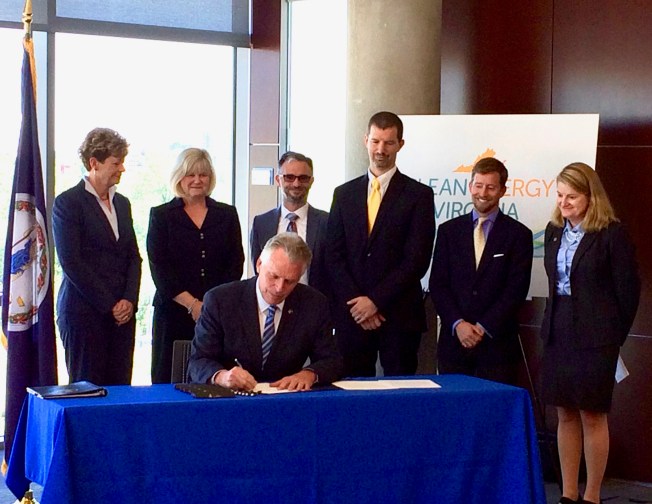
Governor Terry McAuliffe signs an Executive Directive on climate.

Terry McAuliffe dangled climate bait in front of Virginia Republicans, and they swallowed it hook, line and sinker.

Three weeks ago Governor McAuliffe announced he was directing the state’s Department of Environmental Quality (DEQ) to develop a rule capping greenhouse gas emissions from power plants. His Executive Directive gives DEQ until the end of December to put out a draft rule for public comment—meaning McAuliffe will be out of office before any rule takes effect, and its fate really lies with the winner of November’s gubernatorial election.

Democratic contenders Ralph Northam and Tom Perriello praised the initiative, but Republicans were too much in campaign mode to react rationally. Instead they went ballistic, ensuring that climate change will be an election issue in Virginia for the first time. Ed Gillespie, the frontrunner in the Republican primary, denounced the directive as “job killing and cost-increasing,” and used the opportunity to make common cause with coal companies. Corey Stewart called global warming “obviously a hoax” and promised to restore the taxpayer subsidies Virginia once lavished on the coal barons. Frank Wagner used his status as a state senator to convene a committee hearing so he could inveigh against McAuliffe’s directive.

Last week President Trump further elevated climate as an issue when he announced he was pulling the U.S. out of the international climate accord. ExxonMobil and ConocoPhillips criticized the move, but the Republican Party of Virginia celebrated it with a “Pittsburgh, not Paris” rally at the White House.

Only Virginia and New Jersey will elect governors in 2017, so our election is widely regarded as a bellwether for the 2018 federal electons. With almost 60% of Americans backing the Paris accord, Trump’s pullout—and the choice of Virginia Republicans to embrace an unpopular president over a divisive decision—makes McAuliffe’s directive look like a winning move for Democrats.

It is long past time for climate to become an important issue in national discourse. On the other hand, it’s painful to see it used as a political cudgel in partisan fights, and even worse to see Republicans double down on denying that a threat exists or that we have the tools to address it. Climate change is not something that happens only to one party’s target voter demographic. God sendeth the rain on the just and on the unjust. We are all in this together.

To be fair, there are Republicans who take climate change seriously and believe we need to address it. Unfortunately, the ones who hold elected office rarely have the courage to say it. Their party does not have their backs.

Political clickbait or not, the climate rule McAuliffe envisions is conceptually simple and economically efficient. It would have DEQ set greenhouse gas emissions limits from power plants pegged to those of the eleven states that currently regulate emissions, with a goal of enabling our utilities to trade emissions allowances with utilities in other states.

In effect, Virginia utilities would trade with those of the northeastern states that are members of the Regional Greenhouse Gas Initiative (RGGI), but Virginia would not actually join RGGI. That’s too bad; joining RGGI would let the state auction emissions allowances instead of giving them away, bringing in money for climate adaptation and clean energy programs. According to Deputy Natural Resources Director Angela Navarro, however, joining RGGI would require passage of legislation. Republicans in the General Assembly have blocked such legislation for the past three years in a row.

Auction revenue would be welcome, but the carbon reduction plan still makes sense. Navarro told me the RGGI states are currently achieving reductions of 2.5% year over year and driving clean energy investments. Using this approach would enable Virginia to achieve the 30% by 2030 reductions that the environmental community has been urging. It would also put Virginia in a stronger position when the U.S. eventually adopts nationwide carbon limits. Indeed, McAuliffe’s plan looks better than the Clean Power Plan the Trump administration is trying to scuttle, which applies only to existing power plants and might allow unlimited construction of new fracked gas plants.

A market-friendly cap-and-trade approach is the kind of solution that would appeal to Republicans, if they cared to get into the solution business. Unfortunately, Senator Wagner’s response is likely to be typical of what we can expect from Virginia’s Republican General Assembly when it reconvenes in January 2018. The ink was barely dry on McAuliffe’s directive when Wagner called a meeting of the Joint Commission on Administrative Rules to give himself a pre-primary platform to attack the climate initiative.

Wagner expected a member of the Administration to attend the meeting so he’d have someone to lecture—but wouldn’t you know, it turned out that every single Administration official with any connection to the issue was busy that day. That did not stop Wagner and his fellow Republicans from attacking McAuliffe’s directive as expensive and potentially unconstitutional. (Attorney General Mark Herring had released an opinion the previous week supporting its constitutionality.)

Democrats on the committee were unimpressed with Wagner’s grandstanding, and complained of being summoned to review a rule that hadn’t even been drafted yet. Even more to the point was the testimony from Virginia residents who came to speak in favor of climate action, not as a matter not of politics, but of public health. Dr. Janet Eddy of Virginia Clinicians for Climate Action and Dr. Matthew Burke of the Medical Society Consortium on Climate and Health described how a warming climate means more asthma and heat stroke, longer allergy seasons, and the northward spread of malaria and other infectious diseases.

These are serious problems, and they deserve serious attention. The Republican Party line that global warming isn’t happening, it isn’t our fault, and we can’t afford to stop has all the coherence of the thief who tells the judge he didn’t steal anyone’s wallet, and anyway there wasn’t much cash in it (and he can’t mend his ways because he has a gambling addiction).

Virginia voters will go to the polls on Tuesday to choose their party’s nominees for statewide office and the House of Delegates, so citizens are thinking about the issues that matter to them. The good news is that this year, climate may finally be one of them.

Unknown's avatar

UVA Prof. Vivian Thomson’s “Climate Of Capitulation” is Essential Reading In This Election Year

capitulationbook

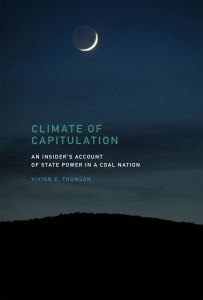
When University of Virginia environmental science professor Vivian E. Thomson researched and wrote her thoughtful account of environmental battles during her years on Virginia’s Air Pollution Control Board (2002 to 2010), she could not have known how fortuitously timed her book’s eventual publication would be. But as luck would have it, the just-published Climate of Capitulation: An Insider’s Account of State Power in a Coal Nation (MIT Press) comes out at a particularly opportune moment.

Donald Trump’s election, and his administration’s efforts to dismantle federal climate and environmental protections, means the states have a more important role to play than ever before as the U.S. tries to address the climate crisis. A primary theme in Thomson’s book is the outsized power of the commonwealth’s largest utility, Dominion Energy, over Virginia politicians and regulators. That is also fortuitous, since 2017 appears to be the year when, finally, Dominion’s unhealthy influence over Virginia politics could be a significant election issue. More than 50 candidates for the Virginia House of Delegates this year have pledged to refuse Dominion campaign contributions, as has gubernatorial candidate Tom Perriello. And Dominion’s proposed Atlantic Coast Pipeline for fracked gas is a significant issue in the Democratic gubernatorial primary.

Adding to Climate of Capitulation’s uncanny timeliness is Governor Terry McAuliffe’s executive directive this month requiring Virginia’s Department of Environmental Quality to draft proposed regulations to limit climate-disrupting carbon-dioxide emissions from electric-power plants. DEQ must submit its proposal to the state’s Air Pollution Control Board by December 31, just before McAuliffe’s term expires. Electric utilities and environmental groups will be watching that process closely, hoping to influence the final result. And of course the outcome of this year’s gubernatorial race will greatly affect the ultimate fate of McAullife’s effort to reduce carbon emissions.

Another main theme in Climate of Capitulation is DEQ’s lackluster environmental enforcement record over the years, and efforts by politicians of both major parties, including then-governor Tim Kaine, to rein in the Air Board’s efforts to strengthen environmental enforcement. Citing contemporaneous emails obtained from the Library of Virginia’s database, Thomson describes how the Kaine administration, DEQ director David Paylor, and state legislators worked to limit the Air Board’s effectiveness and expand it from five to seven members. According to Thomson, the size increase was specifically designed to weaken the power of the board’s three-member majority, which threatened to run afoul of business interests in pushing for pollution limits well within legal requirements, but significantly more stringent than what DEQ proposed to allow.

With DEQ and the Air Board likely to be in the spotlight for the rest of 2017 and beyond, Climate of Capitulation is must reading for Virginians concerned about climate change and carbon reduction.

Thomson notes that the part-time nature of Virginia’s legislature, combined with a chronically underfunded DEQ, deprives the state’s legislative and executive branches of the technical expertise needed to enforce complex air-pollution laws. As a result, Thomson argues, government officials too often end up relying for technical expertise on the large corporations that are regulated by those laws. The corporations, of course, are more than happy to oblige, and the result is predictable.

Perhaps the most provocative and insightful aspect of Thomson’s analysis is her description of what she calls “the third face of power.” The concept comes from the New York University sociologist Steven Lukes’s “three dimensions of power,” where the third, almost invisible dimension of power is the ability, in Thomson’s words, to shape people’s “perceptions over time without conscious knowledge.” She finds this third dimension of power in Virginia’s “traditionalistic political culture, which devalues public participation and civil servants,” “protects the status quo,” and too often favors corporate interests over citizens. This culture is encapsulated in an expression heard often in Richmond—“the Virginia Way,” although Thomson doesn’t use that term. The Virginia Way sometimes involves politicians in both major parties working to maintain the status quo, especially when that serves to favor large polluters. Thomson says “strong, sustained leadership” is needed to avoid capitulating to such a powerful, inertia-favoring force.

I wish Thomson had devoted more space to fleshing out this dimensions-of-power concept as applied to Virginia, for it seems key to understanding the commonwealth’s slow pace in deploying clean energy and addressing climate change. It further explains DEQ’s failure to take more aggressive, science-based positions that might conflict with powerful polluters’ interests. Inertia and the Virginia Way may not be bad in all situations. But inertia is not our friend in dealing with the climate crisis and multiple threats to clean air and water.

Vivian Thomson has done a great service in describing the sometimes-hidden influences that hinder enforcement of our environmental laws and slow efforts to address climate change. Virginia’s current political leaders, as well those hoping to replace them in this important election year, should read Climate of Capitulation. So should Virginia voters.

Seth Heald received a master of science degree in energy policy and climate from Johns Hopkins University this month. He is chair of the Sierra Club’s Virginia chapter.


Unknown's avatar

Shareholder vote shows growing unease over Dominion’s role in climate change

Dominion 2017 Ped Bridge

Black curtains are visible inside the pedestrian bridge over Marshall Street leading to the Richmond Convention Center (background on the left). They were installed to block shareholders’ view of protesters lining the sidewalk outside Dominion Resources’ 2017 shareholder meeting last week. Photo credit: Chesapeake Climate Action Network.

A stunning development occurred during Dominion Resources’ annual shareholder meeting in Richmond last Wednesday. But as shareholders, board members, and company officials left the meeting, no one yet knew about it. What’s more, the Richmond Times-Dispatch’s coverage also missed it, focusing instead on the company’s name change to Dominion Energy. (To its credit, the Norfolk Virginian-Pilot did break the story two days later.) Dominion’s hometown newspaper didn’t just bury the lede; it overlooked it altogether. And therein lies an interesting tale.

What was so stunning? Simply this—some 48 percent of Dominion shares that were voted supported the resolution of a major shareholder, the New York State Common Retirement fund, calling on the company’s board of directors to report on how the company will deal in coming years with the fact that the world needs to reduce greenhouse-gas emissions to an extent consistent with limiting global warming to 2 degrees Celsius. The resolution’s full text is available on p. 60 of Dominion’s 2017 proxy statement.

Understanding why the vote on this resolution is stunning requires some context.

Shareholders have been submitting resolutions for at least eight years urging Dominion’s board to face up to global warming and the company’s role as a major carbon polluter contributing to that warming. In the past, some resolutions have gotten favorable votes as high as 24 percent, while others have been in single digits. Many large investors routinely follow the company board’s advice, and Dominion’s board always recommends a “no” vote on any environment- or climate-related resolution. Getting favorable votes is an uphill battle when a company’s powerful board is working against you.

That’s why the 48 percent vote for the retirement fund’s resolution this year is so huge. The total value of the nearly 198 million shares voting for the resolution was $15.5 billion, based on Dominion’s May 9 closing stock price.

“The vote by Dominion’s shareholders speaks volumes,” said New York State comptroller Thomas P. DiNapoli, trustee of the state’s retirement fund. “This is a wake-up call for the company to be responsive and explain how the Paris Agreement’s worldwide effort to rein in global warming will impact its business. Shareholders need to know what steps Dominion is prepared to take to address climate risk.”

But there’s still more to the tale. The stunning vote spike didn’t become known until hours after the meeting, and even then only to those who knew where to find the results and had a calculator handy to compute the vote percentages. That delay was no accident, but the result of Dominion’s efforts to keep the news from coming out during the meeting.

Until a few years ago, Dominion announced vote totals on shareholder resolutions during each meeting. That’s easy enough to do, since virtually all votes are cast in advance, and literally just a handful are cast on paper ballots collected during the meeting. But as favorable vote percentages on shareholder resolutions crept upwards over the years, Dominion discontinued the practice of announcing vote counts during the meeting. Instead it now reports only whether the resolutions got more than 50 percent of the vote. So this year it was simply announced during the meeting that the four shareholder resolutions on the ballot failed to get a majority of votes. End of story; nothing more to see here, folks.

By law, however, Dominion must report the actual shareholder vote totals to the Securities and Exchange Commission for public disclosure. It did so in the afternoon following the meeting, and put its SEC filing on the company’s website. Those who thought to look for them and knew where to look could find the vote results. Then, with a calculator or spreadsheet they could compute the vote percentages.

Dominion’s quiet move to prevent shareholders (and reporters) attending the meeting from learning the vote totals until later in the day is part of a pattern of subtle and not-so-subtle company efforts to tightly control messaging at its shareholder meetings. The control efforts have evolved each year as more shareholders have questioned the company’s environmental and climate record during meetings, and as demonstrators have begun to appear regularly outside to protest.

The company’s control effort reached somewhat absurd levels this year, as shareholders had to show their drivers’ licenses and admission tickets at four separate checkpoints before gaining entry to the meeting. As shareholders crossed an elevated pedestrian bridge across Marshall Street from the parking garage to the Richmond Convention Center, they found black curtains temporarily set up on floor stands to line the glass walls of the bridge, serving no purpose but to block any views of demonstrators on the street below. Then, when shareholders descended an escalator to the hallway outside the first-floor meeting room, they also found a long line of temporary stands of more black curtains. They were about eight feet high—just enough to block views through the wall of windows facing Marshall Street, where protesters had gathered on the sidewalk. This served to cast a bit of a funereal pall over the hallway, as shareholders drank coffee and ate Virginia ham biscuits before the meeting.

But enough about the voting process and window curtains. Understanding the true significance of the big vote spike for the retirement fund’s climate resolution requires a brief look at how Dominion addresses, and fails to address, the climate crisis. Dominion occasionally talks up its reductions in carbon intensity in electricity generation over the years. That’s the amount of carbon dioxide emitted per unit of electricity. And the company touts new solar projects, which are growing, but not nearly fast enough to catch up with Virginia’s neighboring states or to reduce carbon emissions on the needed timetable.

But Dominion has plans to increase its total carbon-dioxide emissions over the next fifteen years. And what the company never, ever does, is link its plans and its planned future greenhouse-gas emissions to what climate science tells us is needed to keep global warming to no more than 2 degrees Celsius. Indeed, as I wrote last year, Dominion executives studiously avoid even mentioning climate change in public, even when the topic is right in front of them, begging for attention. George Mason University climate-communication expert Edward Maibach and coauthors reported last year that silence on climate change can lead to more silence, in what they call a “climate spiral of silence.”

Meanwhile, while publicly silent about climate, Dominion still belongs to and supports the American Legislative Exchange Council (ALEC), which has a long track record of misinforming state legislators about climate science and working to block meaningful action to reduce greenhouse-gas emissions.

That’s why the 48 percent vote for the retirement fund’s resolution is so huge. Shareholders owning nearly half of the Dominion shares that were voted last week told the company’s board of directors and management that they need to start publicly talking and seriously thinking about climate change, and to explain how they will operate a business that is consistent with the need to keep global warming under 2 degrees.

Perhaps Dominion’s board believes, as at least one Dominion executive does, that climate change is an overblown issue that is pushed by “warmists,” that there’s been no global warming for fifteen years, and that global warming (which by the way isn’t happening) may not be human-caused. Such a belief would allow the board to ignore this shareholder vote, and assume that in future years the resolution will never get a majority vote because climate change concerns will go away as more people see climate change as a hoax. But maybe Dominion’s board, or at least a majority of its members, know better and will listen to the wake-up call delivered to them last week.

As I left the meeting I passed again by the black curtains in the convention hall windows and on the pedestrian bridge over Marshall Street. Just as Dominion used curtains to block views of protesters, its executives seemingly wear blinders to avoid looking at (and talking about) climate change. It’s past time for the blinders to come off and for Dominion’s management and board to look around at the wider world out there.

On May 22, Seth Heald will receive a master of science degree in energy policy and climate from Johns Hopkins University. His final paper in the program was about climate silence and moral disengagement. He is a Dominion Energy shareholder, and chair of the Sierra Club’s Virginia Chapter.

Unknown's avatar

For minorities and the poor, “cheap” energy comes at a high cost

Utilities and other energy companies often resist clean energy mandates and tighter environmental regulation, but they swear it’s not about their lost profits. No, it is their single-minded devotion to the public good that drives them to defend fossil fuel pollution. Only by fouling the air and water can they keep energy costs low, especially—cue the crocodile tears—for minorities and poor people. Guest blogger Kendyl Crawford weighs in with a closer look at the real effect of fossil fuels on the folks polluters say they care about.

Children from the Southeast Care Coalition make their point about the link between air quality and asthma.

Children from the Southeast Care Coalition make their point about the link between air quality and asthma.

By Kendyl Crawford

There is an old adage that goes, “When White America sneezes, Black America catches pneumonia.” It describes the way problems affecting the economy as a whole are magnified for African-Americans, whose place on the economic ladder is already tenuous. The same can be said for Latinos, recent immigrants, and members of low-income communities. And just as these Americans are the ones hardest hit by economic setbacks, so they are the ones who suffer most from an energy economy based on fossil fuels.

Worse, they are often used as pawns by fossil fuel companies who declare that poor people need cheap energy, without accounting for the true cost of that energy. And that true cost can be very high. Over half a million people in Virginia live within 3 miles of coal-fired power plants. Of this group, 52% are minorities and 34% are members of the low-income community. This doesn’t seem like much of a disparity until you realize that Virginia has a total minority population of 35% and a low-income population of 26%.

The fossil fuel industry has a long history of siting power plants strategically, avoiding upper class, white areas whose residents have the power and influence to be able to cry NIMBY (Not In My Back Yard). Communities with less political and economic power got stuck with the facilities—often along with other unwanted neighbors like highways, heavy industry, and waste dumps. In many cases, the communities were there first and then became the victims of zoning changes that gave the green light to polluting facilities. Residents ended up with higher environmental health burdens and lower home values, often with no compensating economic boost from the presence of the facility. The term for siting highly-polluting facilities in these communities now even has its own acronym: PIMBY, for “Put it In Minorities’ Back Yard.”

The 2014 NAACP Coal Blooded: Putting Profits before People report gave five Virginia power plants an F for their environmental justice performance, a grade based on how much a particular plant impacts both low-income and minority communities. The score takes into account the amount of sulfur dioxide and nitrogen oxides air pollution; total population within a three-mile radius of a facility; median income; and the percentage of minorities that make up the population in the close vicinity.

The NAACP report also gave a failing environmental justice performance score to Virginia’s largest utility, Dominion Resources. Dominion ranked as the 6th worst performing company in the U.S. and a “worst offender” in terms of environmental justice.

It’s not just coal. The Clean Air Task Force report Gasping for Breath highlights the fact that nationwide the oil and gas industry releases 9 million tons of pollution such as methane and benzene annually. Many of these toxic pollutants have been linked to cancer and respiratory disorders as well as increasing smog. Every summer there are 2,000 visits to the emergency room for acute asthma attacks and more than 600 hospital admissions for respiratory diseases that are directly related to the ozone smog that results from oil and gas pollution.

Not surprisingly, asthma takes its greatest toll on minorities. According to the EPA, black children are about four times more likely to die from asthma than white children. They are also twice as likely to be hospitalized for asthma. From 2001 to 2009, the asthma rate for black children increased almost 50%. African Americans, with lower rates of health insurance coverage, have fewer resources to manage these added stressors.

Latino children fare similarly poorly. Higher poverty rates and lower rates of insurance coverage mean Latino children have more severe asthma attacks than non-Hispanic white children and are more likely to end up in emergency rooms.

Of course, it’s not just minorities who suffer the harmful consequences of fossil fuels. Low-income people in general have fewer choices in where to live, have less access to health care, and often have little political power. In Virginia, this includes many residents of coalfields communities, whose families may have worked in coal mines for generations and yet have little to show for it.

Climate change will only increase the burden on minorities and low-income communities. For instance, many African American communities have historically been relegated to the least-valued land in a particular city or county, and this land is often low-lying. A recent article exposed the fact that when public housing is destroyed due to sea level rise, stronger storm surges and more extreme storms, it often doesn’t get rebuilt, forcing folks to relocate permanently.

Atmospheric warming will also lead to more health issues related to air pollution, which tends to increase with higher temperatures. But heat itself will take a toll, too, especially for those in substandard housing or who can’t afford air conditioning.

Most at risk will be those who work outdoors, among them construction workers, landscapers and farmworkers. Again, these are disproportionately minorities. Latinos make up about 48% of farm workers and almost 30% of construction workers in the U.S. As noted in the report Nuestro Futuro: Climate Change and U.S. Latinos, Latinos are already three times more likely to die from heat-related causes on the job than non-Hispanic whites. Climate change is expected to increase temperatures further. Hispanic communities are also generally located in areas of cities that are the hottest due to lack of vegetation and green spaces and the use of heat-trapping building materials.

These health impacts will be compounded by high poverty levels and low rates of health insurance. A Hispanic who is employed has less of a chance of having health insurance than a non-Hispanic person. When conditions like cardiovascular disease or diabetes are not treated and controlled, they can trigger visits to the emergency room after being exposed to extreme heat. Not to mention, language barriers can make it harder to obtain care.

Recent immigrants may also face greater difficulties following severe weather events, which are expected to increase in both frequency and intensity. Depending on their immigration status, disaster assistance may be hard to obtain or even completely unavailable.

So when utilities and fossil fuel companies urge our political leaders to keep energy costs low for the poor folks, we should recognize that what they really want is to keep profits high for themselves. They aren’t doing their customers any favors.

Kendyl Crawford is a Program Conservation Manager with the Virginia Chapter of the Sierra Club.