Unknown's avatar

Your 2015 Virginia legislative session cheat sheet, part 2: Fossil Fuels

Photo credit: Corrina Beall

Photo credit: Corrina Beall

My last post covered clean energy bills introduced into the 2015 legislative session, which began last week and ends at the end of February. Time to hustle on to the oil, gas, and coal bills.

Coal subsidies

Coal companies claim to be victims of a “war on coal,” but for nearly two decades they’ve been conducting a war on Virginia taxpayers. Virginia’s tax code offers so many preferences that a 2012 study concluded the coal industry costs Virginia more than it gives back. Among other preferences, two different subsidies in the Code have allowed coal companies to siphon off tens of millions of dollars annually from the General Fund since 1996.

The subsidies come with nominal sunset dates, currently January 1, 2017. Over nearly twenty years, no matter how fat or lean the state’s financial condition, the legislature has repeatedly passed extensions, and they are being asked to do so again this year. HB 1879 (Kilgore) and SB 741 (Carrico) would extend the giveaway out to 2022.

(According to VPAP.org, Delegate Kilgore, chairman of the Commerce and Labor Committee, gets a check for $10,000 every year from coal giant Alpha Natural Resources. Alpha also gives ten grand a year to Senator Carrico, who just happens to sit on Senate Finance, which will hear the bill. I mention these facts only in passing. It would be cynical to suggest a connection.)

Supporters of the subsidies seem to believe coal companies need the inducement to blow up our mountains and dump waste into stream valleys. And they maintain this is a good thing for the people of Southwest Virginia, who can enjoy gainful employment by participating in the destruction of their communities.

The coal companies certainly do benefit from this arrangement, but coal jobs have declined to less than 5,000 total in Virginia today, and it’s clear to everyone that Southwest Virginia needs to diversify its economy or face a future of poverty and high unemployment. The coal subsidies suck up money that could be spent on new jobs and a better-educated workforce.

The McAuliffe administration, facing a budget shortfall, has suggested cutting the subsidies way back, and has no plans to extend them. HB 2181 (Toscano) reduces the amount of the subsidies for 2015 and 2016 but does not eliminate them. It also limits the amount that can be claimed on any one tax return to $500,000 under each Code provision.

HB 1877 (Krupicka) would end the subsidies altogether a year early. His bill goes further: it would redirect the savings into a fund to provide grants to students enrolled in Virginia public colleges and universities. Half the money would be required to go to students from the Coalfields region.

Natural gas

SB 1338 (Hanger) repeals a provision of the Code known as the Wagner Act (after Senator Frank Wagner, who introduced the legislation ten years ago). That provision allows interstate natural gas companies to enter private property without the consent of the owner in order to make “examinations, tests, hand auger borings, appraisals, and surveys.”

The Wagner Act gained notoriety last year when Dominion Power sued landowners who resisted efforts to survey their land. We think of Dominion as an electric utility, but Dominion Resources also owns a gas transmission company, and it plans to build a huge new pipeline to bring fracked gas from Ohio and West Virginia and deliver it to industrial customers and export facilities on the coast. Turns out, a lot of people don’t like strangers coming on their land without permission, especially when the point is to let the strangers decide whether they might want to seize the land for a pipeline. Well, who could have expected that?

But in case the GA doesn’t have an appetite for repealing the Wagner Act, how about making it harder to use? SB 1169 (Hanger again) amends it to add a pre-condition. Before any natural gas company can enter someone’s property without permission, the governing board of the locality must have adopted a resolution in support of the pipeline or gas works. Moreover, the resolution “shall not be adopted unless the governing body has found that locating the line or works within the city or county is consistent with its comprehensive plan, master plan, or any general development plan and that there exists a demonstrated public need for the line or works.”

HB 1475 (Ware) and SB 1163 (Saslaw) allow natural gas utilities to expand their systems to reach more retail customers. This legislation is not related to the interstate gas pipelines sought by Dominion and others. It deals with pipelines within the state that would connect customers who currently don’t have access to natural gas for heating and cooking (a more efficient use of energy than burning gas for electricity to perform the same functions).

But the gas utilities have taken a page from the Dominion playbook and overreached with their legislative language, including by declaring its plans and business goals to be “in the public interest” (the magic words that limit SCC review). We hear the bill is likely to be amended to take out the offending language.

Really a bill about energy efficiency, SB 1331 (Petersen) changes how the SCC evaluates natural gas conservation programs proposed by utilities. It instructs the SCC to determine the cost-effectiveness of a program by looking at the utility’s whole portfolio of conservation programs and not each judged separately. This should make it easier to get conservation programs approved, and it’s to the credit of the retail gas companies that they want it passed. Senator Petersen’s office informed me the bill originated with the governor’s office, which supports it.

Offshore oil drilling

Virginia doesn’t control the deep waters off our coast where oil may be lurking, and drilling is still years away, if it happens at all. But that has never stopped state lawmakers from making plans to spend the money we might earn from oil drilling, if Congress were to share some of the revenue with us. Most of us will recognize this game as, “Imagine if you won the lottery.”

Back in 2010, Governor McDonnell pushed through a bill to fund transportation projects with the imaginary money. In 2014, the law was amended to put $50 million into an emergency response fund to combat what would have to be a pretty small imaginary oil spill, with all the extra imaginary money going to the General Fund.

HB 1702 (Davis) proposes to amend the law again to take half of the imaginary General Fund money and put it into public schools. Well, who could object to that? Except for the imaginary part, of course.
Unknown's avatar

Your 2015 Virginia legislative session cheat sheet, part one: Clean energy bills

photo credit: Amadeus

photo credit: Amadeus

I’m starting my review of 2015 energy legislation with a look at bills dealing with renewable energy and energy efficiency. Most of these bills will be heard in the committees on Commerce and Labor, though bills that cost money (tax credits and grants) usually go to Finance.

Bills referred to Senate Commerce and Labor are heard by the full committee, which meets on Monday afternoons. It consists of 14 members: 11 Republicans and 3 Democrats. They form a tough lineup; none of these senators received better than a “C” on the Sierra Club’s Climate and Energy Scorecard.

The House bills are typically assigned to the 13-member Special Subcommittee on Energy (10 Republicans and 3 Democrats, no fixed schedule). Bills that do not meet the approval of Dominion Power can expect a quick death here on an unrecorded voice vote, never to be heard from again. But on the plus side, the meetings are often quite lively, like old-fashioned hangings.

Net metering bills

Net metering is the policy that allows owners of solar (or other renewable) energy systems to be credited for the excess power they feed back into the grid when the systems produce a surplus; the owners use the credits when their systems aren’t supplying power and they need to draw electricity from the grid. Virginia law restricts who can use net metering, and how much. Expanding net metering is a major goal of renewable energy advocates, who argue it offers a free market approach to growth—give customers the freedom to build solar projects, get the utility out of the way, and solar will thrive.

This year’s initiatives include:

  • SB 833 and SB 764 (Edwards—apparently identical bills), HB 1950 (McClellan), and HB 1912 (Lopez) raise the maximum size of a commercial project eligible for net metering, from 500 kilowatts (kW) currently to 2 megawatts (MW). This is a much-needed expansion of the net metering program if Virginia is going to make real headway with solar. We are told Edwards plans to conform his legislation to HB 1622, below.
  • HB 1622 (Sullivan) raises the maximum size of a commercial project to 1 MW, and the maximum size of a residential system from the current 20 kW to a whopping 40 kW. But note that it does nothing to limit the standby charges utilities can charge for residential projects over 10 kW. Given that these charges are so punitive as to kill the projects, raising the cap wouldn’t create new market opportunities unless it is accompanied by a limit on the amount of standby charges that utilities can tack on.
  • HB 1911 (Lopez) amends the language allowing utilities to impose standby charges on residential and agricultural customers with systems over 10 kW to add the requirement that the State Corporation Commission conduct a “value of solar” analysis prior to approving the charges. Most solar advocates would rather see the legislature repeal the standby charge provision altogether, given how the utilities have abused it. Barring that, legislators should set a dollar limit of no more than five or ten bucks a month. But in the absence of any such reforms, it does make sense to at least require the SCC to do this more substantive analysis, ideally building on the framework developed over the summer by the Solar Stakeholder Group.
  • HB 1636 (Minchew) establishes “community net metering” as well as increasing the commercial project cap to 2 MW. This bill is a high priority for the solar industry and the environmental community. It provides the solution for owners with shaded roofs, renters and others who can’t install solar themselves by letting them subscribe to a community generation facility in their own or a neighboring county. Other forms of renewable energy are also allowed, so residents in windy areas could go in on a small wind turbine that wouldn’t make sense for a single household.
  • HB 1729 (Sullivan) creates “solar gardens” consisting of community organizations with 10 or more subscribers. The generation facility can be as large as 2 MW. The bill seems intended to accomplish much the same purpose as Minchew’s bill, although it is limited to solar. However, it allows the utility to impose “a reasonable charge as determined by the [State Corporation Commission] to cover the utility’s costs of delivering to the subscriber’s premises the electricity generated by the community solar garden, integrating the solar generation with the utility’s system, and administering the community solar garden’s contracts and net metering credits.” Boy, we’ve seen that movie before. Given what we’ve seen the SCC do with standby charges, the bill should be amended to put a cap on the amount of that “reasonable charge” so legislators know they aren’t writing a blank check.
  • SB 350 (Edwards) authorizes programs for local governments to use net metering for municipal buildings, using renewable energy projects up to 5 MW. It also allows a form of community net metering targeted to condominiums, apartment buildings, homeowner associations, etc., with a renewable energy facility located on land owned by the association. These customers would be exempt from standby charges.

Third-party power purchase agreements (PPAs)

HB 1925 (Lopez) and SB 1160 (Edwards) replace the current PPA program in Dominion territory with one that applies to both Dominion and APCo territories. It increases the project cap from the current 500 kW to 1 MW, and raises the overall program size to 100 MW from (50 MW). As with the current program, projects under 50 kW aren’t eligible unless the customer is a tax-exempt organization.

Utility-scale solar

HB 2219 (Yost) declares it to be in the public interest for Dominion Virginia Power or Appalachian Power to build up to 500 MW of solar power—a truly welcome objective—and authorizes the utilities to apply to the SCC for a certificate of public convenience and necessity for individual facilities of at least 20 MW in size, regardless of whether the facility is located in the utility’s own service territory.

“In the public interest” are the magic words that push the SCC to approve something it might not otherwise. Both utility giants have shown an interest in building and owning utility-scale solar, even as they have taught the SCC to believe that solar owned by anyone else burdens the grid. The magic words let them escape the corner they backed themselves into. That would be necessary here, given that our SCC wrongly believes the public interest requires the lowest cost energy regardless of the consequences to public health, the environment, national security, and the economy.

The solar industry has two concerns about HB 2219: the effect on ratepayers, since Dominion’s previous solar efforts have cost well above market rates; and the effect on the Virginia solar industry—or rather, the lack of an effect, since Dominion has hired only out-of-state companies. Virginia ratepayers could save money and the state could build more solar if legislation simply required the utilities to buy 500 MW of solar, and let the market decide who builds it. But of course, that’s now how things work in Virginia.

I also think it is unfortunate that the bill allows utilities to build solar plants that are not in the utilities’ own service territories, and that it does not require them to use Virginia contractors. Surely there would be more support for a bill promising projects that support local economies with jobs and tax revenues, and that requires the hiring of local installers. These seem like small enough things to ask.

HB 2237 (Yancey) allows Dominion or APCo to recover the costs of building or buying a solar facility in the state of Virginia of at least 5 MW, plus an enhanced rate of return on equity, through a rate adjustment clause. It also states that construction or purchase of such a facility, and the planning and development activities for solar energy facilities, are in the public interest. (The magic words again.)

This bill doesn’t require anything or make huge changes. It simply treats solar the way the Code currently treats other forms of generation, with the exception that the “in the public interest” language was previously used only to endorse a coal plant (what became the Virginia City Hybrid Energy Plant in Wise County). And note that this bill requires that the facility be in Virginia, and opens up the possibility of our utilities buying the facility rather than constructing it themselves, which could open the door to competition. This seems like a good way to proceed.

Grants and tax credits

HB 1728 (Sullivan) establishes a tax credit for renewable energy. Great idea, but last year the Senate Finance Committee made it clear they would not pass a new tax credit, so I assume this is a non-starter.

Last year’s renewable energy tax credit bill was amended to create a grant program instead. It passed both houses, but without funding and with the requirement that it be passed again this year. It is back this year as HB 1650 (Villanueva). (It has been assigned to House Committee on Agriculture, Chesapeake and Natural Resources and is on the docket for 8:30 a.m. Wednesday, January 21. Odd: it ought to be in Finance.) The grant would equal 35% of the costs of a renewable energy facility, including not just wind and solar, but also things like biomass, waste, landfill gas, and municipal waste incinerators. Facilities paid for by utility ratepayers are not eligible, and the grant total is capped at $10 million per year. Prospects for the program aren’t great given the state’s tight budget situation, but the bill is a high priority for the solar industry.

Another tax-related bill is HB 1297 (Rasoul), which authorizes localities to charge a lower tax on renewable projects than on other kinds of “machinery and tools.” Last year, you may recall, the solar industry was successful in getting passage of a bill that exempted solar equipment entirely from local machinery and tools taxes. Proponents are trying to ensure that Delegate Rasoul’s well-intentioned bill doesn’t reverse last year’s victory on solar.

Bills specific to energy efficiency

HB 1730 (Sullivan) establishes energy efficiency goals for electric and natural gas utilities. The good news: the goals are mandatory. The bad news: the goals are modest to a fault: a total of 2% energy savings by 2030 for electricity and 1% for natural gas.

HB 1345 (Carr) extends the sales tax holiday for Energy Star and WaterSense products to include all Energy Star light bulbs; currently only compact fluorescent light bulbs are eligible.

PACE bills

PACE (Property Assessed Clean Energy) is a way to finance energy efficiency, renewable energy and water conservation upgrades to commercial and non-profit-owned buildings. Local governments sponsor the financing for improvements and collect payments via property tax bills. Since the energy savings more than pay for the increased assessments, PACE programs have been hugely successful in other states.

Last year a bill that would have let localities extend “service districts” to cover clean energy (PACE by another name) failed in the face of opposition from the banking industry. This year’s bills are also not labeled PACE bills, but they achieve the same end. Apparently the parties have worked out the problems, a hopeful sign that a multi-year effort will finally meet with success.

SB 801 (Watkins) and HB 1446 (Danny Marshall) are companion bills that would authorize local governments to work with third parties to offer loans for clean energy and water efficiency improvements, creating “voluntary special assessment liens” against the property getting the improvements. The Department of Mines, Minerals and Energy would develop underwriting guidelines for local loans to finance the work. HB 1665 (Minchew) is similar, and we are told it will be conformed to HB 1446.

Virginia Solar Energy Development Authority

HB 1725 (Bulova) and SB 1099 (Stuart) establish the Virginia Solar Energy Development Authority to “facilitate, coordinate, and support the development of the solar energy industry and solar-powered electric energy facilities in the Commonwealth.” This implements a proposal in the 2014 Virginia Energy Plan and is not expected to be controversial.

Virginia SREC registry

HB 2075 (Toscano) requires the SCC to establish a registry for solar renewable energy certificates (SRECs). It would not suddenly make Virginia SRECs valuable, but it would put the administrative framework in place to support a voluntary SREC market, or even a real one if Virginia were to adopt legislation requiring utilities to buy solar power.

Cross-cutting approaches to clean energy

A few bills would have a more sweeping effect on energy efficiency and renewable energy. HB 2155 (Sickles) is billed as an “Energy Diversity Plan.” It was supposed to be a “grand bargain” between utilities and the clean energy industries, with the McAuliffe administration participating as well, but we understand there are outstanding issues that make the bill’s future uncertain.

The big idea is to put all non-emitting energy sources into one category: primarily wind, solar, hydro and nuclear, but also adding in combined heat and power, demand response and energy efficiency. The bill creates a timeline that requires utilities to ramp up use of new, non-emitting sources gradually, beginning with 0.25% of retail sales in 2016 and ramping up to 35% in 2030.

The bill has the support of clean energy industries, but the idea of treating nuclear as a benign source of power on an even footing with efficiency and renewables concerns the environmental community.

I’ll write more about this bill if it looks like it has legs.

HB 1913 (Lopez) is the only bill of the bunch that directly targets Virginia’s Renewable Portfolio Standard (RPS). Maybe that shouldn’t be a surprise. Our RPS is a poor, sickly thing that most people have left for dead. To his credit, Lopez keeps trying. His bill keeps the RPS voluntary but beefs up the provisions to make the program meaningful, if a utility chooses to participate. Instead of mostly buying renewable energy certificates from things like old, out of state hydro dams, the bill would ensure that actual, real-world renewable projects get built. You know, what an RPS is supposed to do.

In addition, the bill folds into the RPS the state’s existing goal of 10% energy efficiency gains by 2022. Utilities have done very little toward meeting this goal. Putting it into the voluntary RPS might be the prod needed to get more efficiency programs underway.

Or it might cause a utility to drop out. Either way, the result would be better than what we have now, where Virginia pretends to have an RPS, and utilities pretend to care.

Update: Another net metering bill has been filed. SB 1395 (Dance) raises the commercial net metering cap from 500 kW to 2 MW.

Unknown's avatar

Pass the Coastal Protection Act to cut carbon, raise millions

With today’s start of the Virginia legislative session, a lot of energy and climate bills are pouring in–some good, some not so good, some downright terrible. I’ll have an overview of them coming soon, but meanwhile guest blogger Dawone Robinson gives us a look at one of the best of the bills, the Coastal Protection Act, HB 2205 (Villanueva). A shorter version of his post appeared as an oped in the January 12 edition of the Richmond Times-Dispatch. Many thanks to Dawone for letting me run this. 

——————————

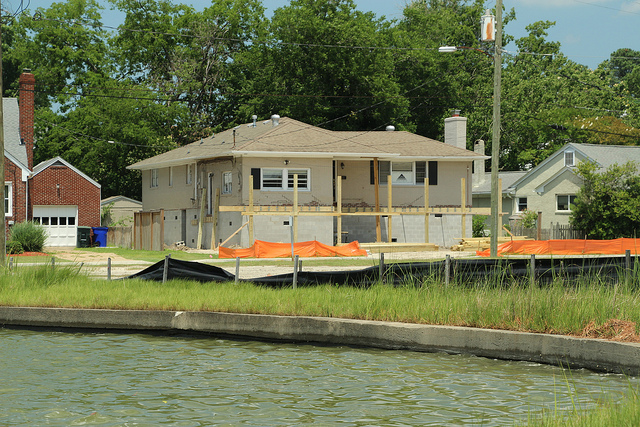
A house in the process of being elevated, a very expensive solution to the problem of recurrent flooding due to sea level rise in Virginia. Photo credit: CCAN

A house in the process of being elevated, a very expensive solution to the problem of recurrent flooding due to sea level rise in Virginia. Photo credit: CCAN

Have you ever put together a list of items you would purchase if you won the lottery—before you remembered that you haven’t even purchased a ticket? Upon reflection, how premature was that list you so perfectly pieced together?

In Virginia, we face a similar dilemma when it comes to addressing the mounting crisis of flooding along our coast.

We’ve got plenty of laudable lists in the works. Last year, Virginia lawmakers unanimously passed a resolution establishing a joint subcommittee to study recurrent flooding issues and adopt recommendations. Legislators from both parties sent a unified message: flooding is a problem in Hampton Roads and we need to do something about it.

In 2008, former Governor Tim Kaine’s Climate Change Commission laid out more than 100 recommendations to mitigate and adapt to climate change and sea level rise. So far the state has failed to adopt a plan to execute them. To his credit, Governor Terry McAuliffe recently launched a similar commission. This panel, the state’s Secure Commonwealth Panel, and the General Assembly’s aforementioned recurrent flooding subcommittee all have the same mandate: convene, discuss, deliberate, and draft a set of recommendations.

So what’s the catch? While what needs to be done is relatively easy to identify, the cost is significant—if not staggering. Virginia needs to win the equivalent of a multi-hundred-million-dollar lottery every year to fund the adaptation measures required to protect coastal residents and infrastructure.

Hampton Roads is home to the world’s largest naval base, more than $80 billion in economic activity, and 1.7 million residents who routinely feel the effects of sea level rise. Streets need to be raised, levees need to be built, and homes and businesses need to be protected. The U.S. branch of the Dutch engineering firm Fugro estimated that it would cost the city of Norfolk at least $1 billion to fully adapt to rising seas and frequent flooding—which equals Norfolk’s entire annual government operating budget.

The non-profit group Wetlands Watch reports that the cost to either elevate or purchase the homes of residents in just five Hampton Roads localities that have sustained multiple flood losses of $1,000 or more in the last ten years would exceed $430 million. Relying on federal assistance alone, it could take up to 244 years to assist all homeowners seeking help in these five localities.

Meanwhile, the Virginia Institute of Marine Science warns that sea levels could rise by as much as seven feet along Virginia’s coast within this century. We can’t afford to keep creating unfunded wish lists, and we can’t wish the problems away.

Virginia needs a dedicated stream of state funding to help coastal families and localities fight climate change. Obviously, there’s no lottery for this. But thankfully there is a common-sense legislative approach being introduced in the Virginia General Assembly by Republican Virginia Beach Delegate Ron Villanueva. His bill, called the Virginia Coastal Protection Act, would help solve our massive coastal flooding problem with a first-ever state funding mechanism that is good for the economy and good for our communities.

By joining the state into the highly successful and fully established Regional Greenhouse Gas Initiative, or RGGI, the bill would generate more than $200 million per year in new state funds to invest in coastal adaptation and other climate change solutions. This relief could come when localities in Hampton Roads need it most. It would come without adding any new demands to the state’s tight budget. It would also come through a system proven to rein in energy costs while reducing emissions and raising revenue.

RGGI is a cooperative effort of nine East Coast states that caps and reduces greenhouse gas pollution. Since the program’s inception in 2008, RGGI states have reduced their carbon footprint 2.7 times faster than non-RGGI states. In the same time period, electricity prices have dropped by 8 percent in participating states, compared to a 6 percent rise throughout the rest of the nation.

Under RGGI, power plants purchase allowances for every ton of carbon they emit. The sale of carbon allowances gets reinvested back to the states. Under Del. Villanueva’s bill, half of Virginia’s projected $200 million in annual auction revenues would fund coastal adaptation efforts, 35 percent would fund energy efficiency and renewable energy projects, and 10 percent would fund workforce development, education, and economic assistance in Southwest Virginia.

The Virginia Coastal Protection Act is a win-win-win solution. We can establish a consistent and significant source of revenue to tackle flooding in Hampton Roads and generate funds to invest in other statewide priorities, while putting policies in place to help Virginia meet carbon reduction goals in an efficient and practical manner.

Virginia’s lawmakers are on the record in their overwhelming bipartisan support for finding solutions to the state’s growing flooding woes. Delegate Villanueva has put forward the best plan to take us beyond wish lists, and to start funding urgently needed solutions.

Dawone Robinson is Virginia Policy Director with the Chesapeake Climate Action Network, a regional climate-change policy and advocacy organization with more than 30,000 supporters in Virginia. You can reach him at dawone@chesapeakeclimate.org

UPDATE: State Senator Don McEachin (D-Richmond) has agreed to introduce the Coastal Protection Act into the Senate as a companion bill to Delegate Villanueva’s (SB 1428), making this now a bipartisan effort.

Unknown's avatar

Virginia’s amazing year in energy: gas rises, coal falls, and solar shines (but it’s still not okay to say “climate change”)

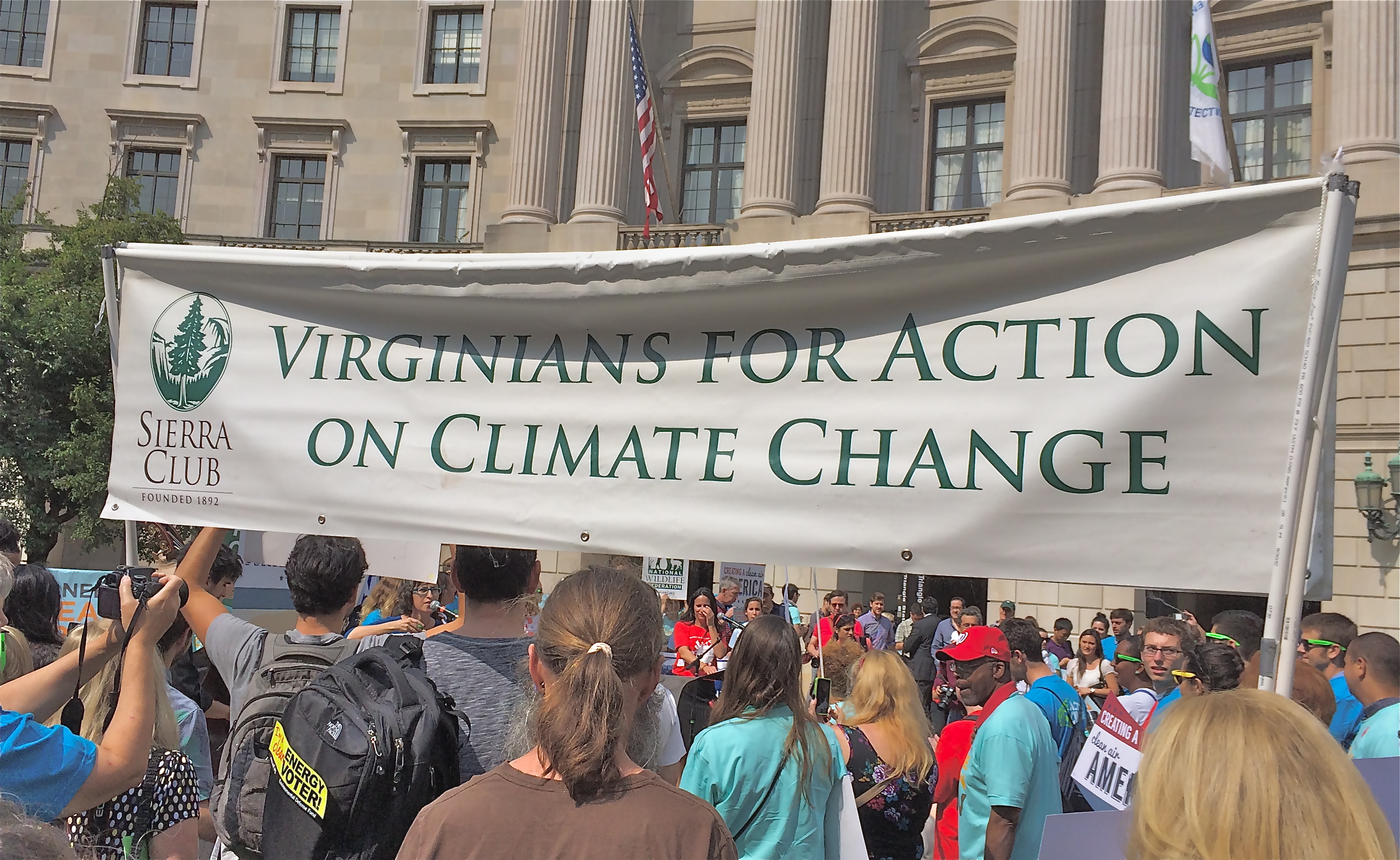
Virginians rally in front of U.S. EPA Headquarters in Washington, DC in support of the Clean Power Plan

Virginians rally in front of U.S. EPA Headquarters in Washington, DC in support of the Clean Power Plan

Nobody laughed a few years ago when former governor Bob McDonnell dubbed Virginia the “Energy Capital of the East Coast”; we were all too astounded by the hyperbole. And today, even “Energy Suburb” still seems like a stretch. Yet, if you measure achievement by the sheer level of activity, Virginia is making a play for importance. The year’s top energy stories show us fully engaged in the worldwide battle between fossil fuels and renewable energy. Of course, while the smart money says renewables will dominate by mid-century, Virginia seems determined to drown rather than give up its fossil fuel addiction.

Coal falls hard; observers disagree on whether it bounces or goes splat. Nationwide, 2014 was a bad year for the coal industry. Coal stocks fell precipitously; mining jobs continued to decline; and the one thing electric utilities and the public found to agree on is that no one likes coal. Even in Virginia, with its long history of mining, coal had to play defense for what may have been the first time ever. So when Governor McAuliffe released the state’s latest energy plan in October, what was otherwise a paean to “All of the Above” omitted the stanza on coal. And this month, the governor proposed a rollback of the subsidies coal companies pocket by mining Virginia coal.

Of course, coal is not going quietly; Senator Charles Carrico (himself heavily subsidized by Alpha Natural Resources) has already responded with a bill to extend the subsidies to 2022.

EPA opens a door to a cleaner future, and Republicans try to brick it up. Speaking of hard times for coal, in June the EPA unveiled its proposal to lower carbon emissions from existing power plants 30% nationwide by 2030. Instead of targeting plants one-by-one, EPA proposed a systemic approach, offering a suite of options for states to reach their individualized targets.

The proposal drew widespread support from the public, but Virginia’s 38% reduction target set off howls of protest from defenders of the status quo. The staff of the State Corporation Commission claimed the rule was illegal and would cost ratepayers $6 billion. Republicans convened a special meeting of the House and Senate Energy and Commerce Committees, where they tried out a number of arguments, not all of which proved ready for prime time. The rule, they said, threatens Virginia with a loss of business to more favored states like—and I am not making this up—West Virginia. Also, Virginia should have received more credit for lowering its carbon emissions by building nuclear plants back in the 1970s when no one was thinking about carbon emissions.

Meanwhile, the Southern Environmental Law Center analyzed the rule and concluded that actually, compliance will not be hard. Virginia is already 80% of the way there, and achieving the rest will produce a burst of clean-energy jobs coupled with savings for consumers through energy efficiency.

Undaunted, Republicans have already introduced a thumb-your-nose-at-EPA bill developed by the fossil fuel champions at the American Legislative Exchange Council.

The “solarize” movement takes Virginia by storm. For the last few years, solar energy has been exploding in popularity across the U.S., but Virginia always seemed to be missing the party. So it surprised even advocates this year when pent-up consumer demand manifested itself in the blossoming of local solar buying cooperatives and other bulk-purchase arrangements. “Solarize Blacksburg” made its debut in March, going on to sign up hundreds of homeowners for solar installations. It was followed in quick succession by the launch of similar programs in Richmond, Charlottesville, Harrisonburg, Northern Virginia, Halifax, Floyd, and Hampton Roads.

The main reason for the solarize programs’ success was the steep decline in the cost of solar energy. 2014 saw the cost of residential installations in Virginia fall to record low prices, making the investment worthwhile to a broad swath of homeowners for the first time.

Utilities say maybe to solar, but only for themselves. Virginia still boasts no utility-scale solar, but utilities elsewhere signed long-term power purchase contracts for solar energy at prices that were sometimes below that of natural gas: under 6.5 cents/kilowatt-hour in Georgia, and under 5 cents in Texas. Compare that to the estimated 9.3 cents/kWh cost of power from Dominion Virginia Power’s newest and most up-to-date coal plant, the Virginia City Hybrid Energy Plant, and you’ll understand why Dominion has suddenly taken an interest in solar projects. Sadly, it’s own foray into rooftop solar so far stands as an example of what not to do, and a testament to why the private market should be allowed to compete.

Yet Virginia utilities continued their hostility to customer-owned solar. Dominion put the kibosh on a bill that would have expanded access to solar energy through community net-metering, while Appalachian Power matched Dominion’s earlier success in imposing punitive standby charges on owners of larger residential systems.

Fracking, pipelines, and gas plants, oh my! Renewable energy may be the future, but the present belongs to cheap natural gas. Yes, the fracking process is dirty, noisy and polluting, and yes, methane leakage around gas wells is exacerbating climate change. But did we mention gas is cheap?

2014 saw proposals to drill gas wells east of I-95, while the Virginia government began updating its regulations to govern fracking. Dominion Power started construction on a second new gas power plant, and talked up its plans for a third. The utility giant, a major player in the gas transmission business, also got approval to turn its liquefied natural gas import terminal in Cove Point, Maryland, into an export terminal. With visions of customers dancing in its head, it also announced plans for a major new pipeline to bring fracked gas from West Virginia through Virginia and into North Carolina—one of three proposed pipelines that would cut through the Virginia countryside and across natural treasures like the Appalachian Trail. The pipeline created an instant protest movement but gained the wholehearted approval of Governor McAuliffe.

Flooding in Hampton Roads becomes the new normal; it’s still not okay to ask what’s causing it. A cooler-than-normal year for the eastern United States gulled many landlubbers into believing that global warming was taking a breather, but meanwhile the ocean continued its inexorable rise along Virginia’s vulnerable coastline. It’s one thing to shrug off the occasional storm, said residents; it’s harder to ignore seawater that cuts off your parking lot at every high tide. 2014 will go down as the year everyone finally agreed we have a problem—even in the General Assembly, which passed legislation to develop a response to the “recurrent flooding.” But while the bill recognized that the problem will just get worse, it avoided noting why.

The public gets it, though. The Richmond Times-Dispatch reports that climate change was the number one topic of interest to writers of letters to the editor in 2014. And loud cheers greeted Governor McAuliffe’s announcement that he would reestablish the state’s commission on climate change, which Bob McDonnell had disbanded. As one environmental leader quipped, “People in Tidewater are tired of driving through tidal water.”

Public corruption: in Virginia, it’s not just for politicians. Everyone can agree that it was a really bad year for the Virginia Way, that gentlemanly notion that persons of good character don’t need no stinkin’ ethics laws. But we also saw plenty to prove the adage that the real scandal is what’s legal. As we learned, Virginia law allows unlimited corporate contributions to campaigns, and puts no limits on what campaigns can spend money on. So if some legislators act more like corporate employees than servants of the public, well, that’s how the system was set up to work.

But the system only works when corporations get their money’s worth from the politicians, and that quid pro quo usually comes at the public’s expense. For example, take Dominion Power’s North Anna 3 shenanigans (please). In an exceptionally bold exploitation of the Virginia Way, Dominion Power secured passage of legislation allowing it to bill customers for hundreds of millions of dollars it had spent towards a new nuclear plant that it is unlikely to build. (And the irony is that ratepayers will still be better off throwing the money down that rathole than they will be if Dominion does manage to build it.)

So as we look ahead to 2015’s energy battles, anyone wondering who the winners and losers will be needs only one piece of guidance: in Virginia, just follow the money.

Unknown's avatar

Fiscal and environmental sanity get a boost as McAuliffe proposes to roll back coal subsidies

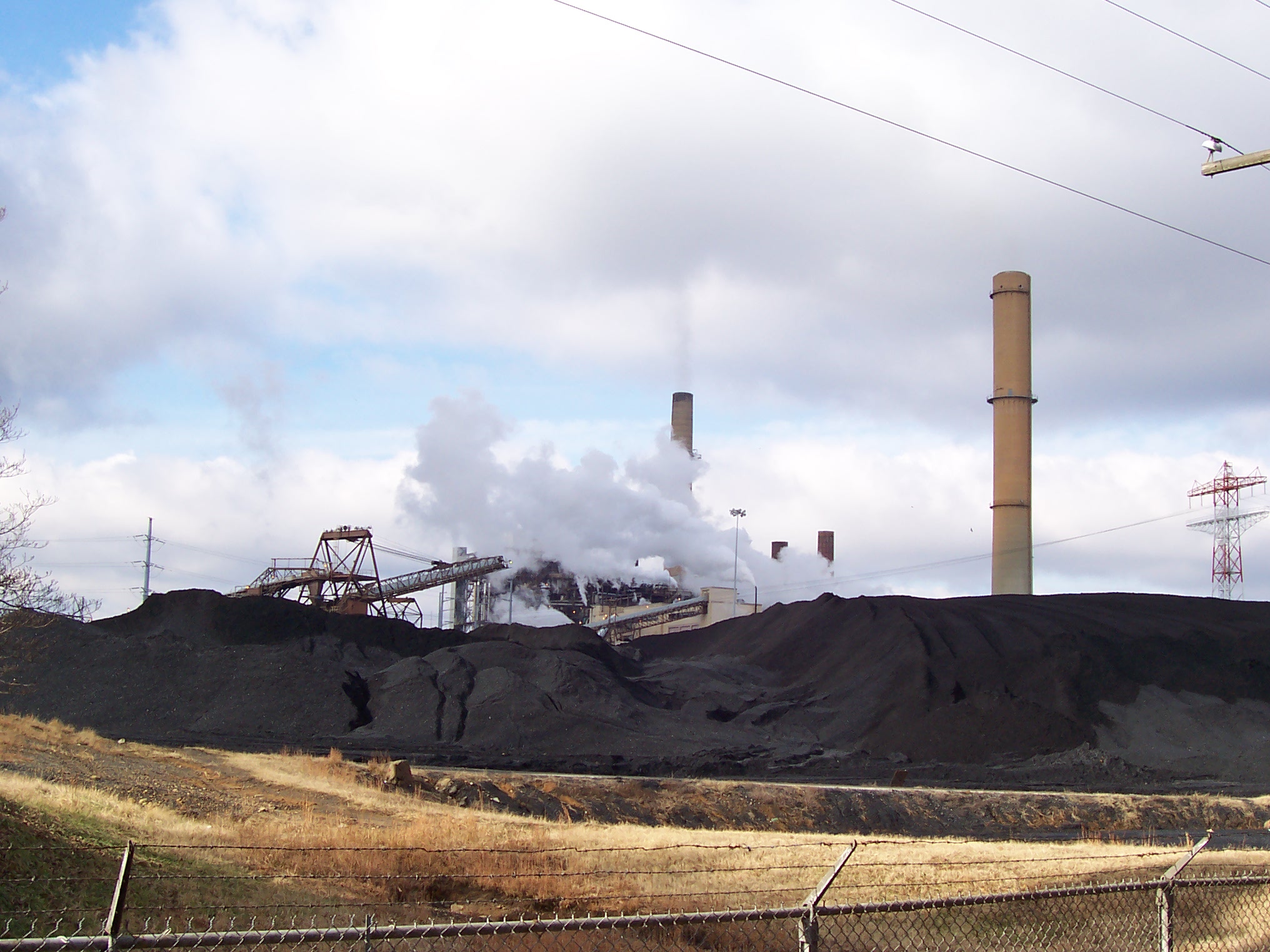
Your taxpayer dollars at work!

Your taxpayer dollars at work!

Thanks to the state’s budget deficit, Virginia may finally scale way back a notorious fossil fuel subsidy that currently transfers tens of millions of dollars annually from taxpayers to the pockets of corporations that mine Virginia coal. The Richmond Times Dispatch reports that if Governor McAuliffe has his way, the Virginia Coal Employment and Production Incentive Tax Credit and the Coalfield Employment Enhancement Tax Credit will be limited to $500,000 per year, saving the government $20 million per year.

The refundable tax credits were intended to make Virginia coal cheaper for utilities to buy, and thus more competitive with coal mined in other states. In theory, that was supposed to mean more coal mining jobs in southwest Virginia. In practice, the subsidies meant some coal companies paid no state taxes, and actually received significant cash handouts, even as coal jobs declined. And because the subsidies are based on tons of coal mined and not on the number of people employed, mining companies suffered no penalty from capital investments that maximized production while cutting jobs.

Critics of the subsidies thought they had won their point three years ago when the Joint Legislative Audit and Review Committee (JLARC) issued a critique of the various Virginia tax credits that was especially critical of the handouts to coal companies. As it describes beginning on page 67, the subsidies did not stop coal employment from falling 54% since 1990, or slow the steady decline in production:

“The precursor to one of the current coal credits was in place before the decline began, while the other was enacted shortly thereafter. It is important to note that with or without the credits, the decline in Virginia coal production was predicted by numerous analysts because over two-thirds of recoverable coal reserves in Virginia have already been mined.”

Indeed, the report continued, coal employment and production was actually worse with the credits in place:

“In the process of developing and refining the credit, analysts projected that coal employment and production would decline by 28 percent between 1996 and 2005 without the credit. However, actual mining employment was substantially lower than expected during this period, declining 36 percent.”

In spite of this damning analysis, in 2012 the General Assembly actually extended the expiration date of the coal subsidies until 2017. Insiders say Senate Democrats were persuaded to vote for the extension as a favor to coalfields senator Phil Puckett, who needed the backing of coal companies to hold his seat in 2013 and keep Democrats in control of the Senate. (Some might say he failed to return the favor.)

The coal subsidies have long infuriated environmentalists and community activists in the Coalfields region. In their view, Virginia taxpayers should not be forced to reward mining companies for blowing off the tops of our mountains, filling ancient stream valleys with rubble, poisoning wells and rivers, and destroying homes to get at the last, thin seams of Virginia coal.

So Coalfields activists welcomed the Governor’s proposal as a “good first step” in planning a future where coal is no longer the economic engine it once was. “We need to take our heads out of the sand and invest heavily in diversifying our economy in Southwest Virginia,” said Wise County resident Jane Branham, Vice President of Southern Appalachian Mountain Stewards. “Supporting outdoor recreation, tourism, sustainable agriculture, reforestation and a new generation of entrepreneurs is the path forward in the mountains, not subsidizing bad actor coal companies that continue to poison the natural resources our future depends on.”

Renewable energy advocates have also complained that by making coal cheaper, the subsidies make it harder for other forms of energy to compete. One would expect this argument to resonate with free market advocates, a category that supposedly includes all Virginia Republicans and a lot of the Democrats. Yet in spite of criticism from some Democrats, the subsidies have not faced serious opposition before now.

Acquiescence in such an expensive and counter-productive corporate welfare program mostly reflects the influence of the Virginia coal industry. (See last week’s post for a sampling of how coal companies work to buy votes with campaign cash.) But the drafters sweetened the deal with a provision that siphons off a portion of the excess cash to fund the Virginia Coalfield Economic Development Authority (VACEDA), which is supposed to help the region diversify beyond coal. (It might work better if coal executives didn’t sit on the board.)

Under McAuliffe’s proposal, VACEDA would get a direct appropriation of $1.2 million to replace the money it would lose by the scaling back of the tax credits. That should satisfy those legislators whose primary concern is helping residents of southwest Virginia.

Those whose primary concern is helping coal companies, however, aren’t likely to be happy. Congressman Morgan Griffith has already been quoted as suggesting Governor McAuliffe’s proposal to scale back the coal subsidies amounts to a “war on coal.”

He expressed no concern about coal’s war on the people of southwest Virginia. For those who care about that, Governor McAuliffe’s move feels like a breath of clean air.

——————–

Addendum: Senator Bill Carrico (R-Alpha Natural Resources) has now filed a bill, S741, to extend the coal subsidies until 2022. 

Unknown's avatar

Tiny Virginia subcommittee tasked with deciding future of bills related to EPA’s Clean Power Plan; meeting set for December 17

Photo credit: Sierra Club

Photo credit: Sierra Club

The EPA’s proposed Clean Power Plan could reshape Virginia’s energy future for the next fifteen years, and possibly permanently. If the state takes advantage of this opportunity, it will reduce carbon pollution, improve human health, save money for consumers, drive job creation in the fast-growing technology sector, and make our grid stronger and more secure.

If the state doesn’t act, EPA will design its own plan for Virginia, ensuring reduced carbon emissions but without the flexibility the state would have by doing it for itself.

This presents a conundrum for Virginia’s General Assembly, which is not known for embracing federal environmental regulations. The usual skepticism was on display on November 19, when the Senate and House Commerce and Labor Committees met in a joint session to take up the Clean Power Plan—or more precisely, to give utilities and the State Corporation Commission staff the chance to attack it.

At the conclusion of that meeting, the two Republican committee chairs, Senator John Watkins and Delegate Terry Kilgore, named three members of each committee—two Republicans and one Democrat from each chamber—to a special subcommittee tasked with deciding what kind of legislative action the General Assembly should take in response to the Clean Power Plan. Kilgore also put himself on the subcommittee, which will now take up any bills that Virginia legislators introduce related to the Plan.

This subcommittee has scheduled its first meeting for December 17 at 1:00 p.m. in Senate Room A of the General Assembly building in Richmond. By law, all committee meetings are open to the public.

According to General Assembly procedure, before anyone else in the entire legislature can consider a bill, it will have to pass muster with these seven men. So who are these hugely important people, and what is the likelihood that they will seize this historic opportunity to make Virginia a leader in clean energy?

The Senate members consist of Republicans Frank Wagner and Benton Chafin and Democrat Dick Saslaw. Wagner and Saslaw were obvious choices given their seniority on the committee and active role on energy issues. Chafin—well, we’ll get to him in a moment.

Frank Wagner is from Virginia Beach and is known for his interest in energy generally, and especially in promoting new projects. He sponsored the legislation that led to the Virginia Energy Plan in 2006 and has been an important supporter of offshore wind development, perhaps reflecting his undergraduate degree in Ocean Engineering and his Tidewater residence.

The General Assembly website says Wagner is the president of Davis Boatworks, a vessel repair facility whose principal customer is the Defense Department. Living in the Hampton Roads area, Wagner is aware of how real sea level rise is; presumably he understands the connection to climate change.

In spite of his interest in offshore wind, coal rules when it comes to funding Wagner’s political campaigns. The Virginia Public Access Project shows coal giant Alpha Natural Resources was Wagner’s second-best donor over the years, with a total of $43,643 in campaign money since 2003, ahead of Dominion Power’s $37,350. Energy and mining interests combined gave gifts totaling $188,152. Of this, $350 came from Highland New Wind Development LLC back in 2008 and $250 came from the offshore wind company Seawind in 2010.

Of course, who gives money to an elected official does not necessarily dictate how that official votes. But it probably should be mentioned that for the 2014 session, Wagner earned an F on the Sierra Club’s Climate and Energy Scorecard, disappointing clean energy advocates who have sometimes had reason to see him as an ally.

Also a low performer on the energy scorecard is Dick Saslaw, scraping by with a D. Saslaw is a career politician who was first elected to the GA in 1976, when he was 36. (He is now 74.) His biography lists his background as an owner and operator of gas stations.

Saslaw is the Senate Democratic Leader and used to be Chair of the Senate Commerce and Labor Committee, until his party lost the Senate. In theory, his leadership position in the Democratic Party should make him a defender of President Obama’s climate initiative. In practice, not so much.

Although he is a Fairfax County Democrat, Saslaw does not share his constituents’ enthusiasm for wind and solar, nor in general, their concern for the environment. Somebody once told him that renewable energy costs a lot; that’s been his story ever since, and he’s sticking with it, facts be damned.

Saslaw is proud of his close ties to Dominion Virginia Power, whose interests reliably predict his votes on any given bill. The Virginia Public Access Project reports that Dominion has given more money to Saslaw than to any other legislator. In 2014 alone, Dominion gave Saslaw $25,000. Over the years, Dominion’s contributions to Saslaw have totaled $240,508, making the utility Saslaw’s top donor.

Saslaw has also received more money from Appalachian Power than any other Democrat–$44,000–even though that utility does not provide service anywhere in his district. In addition, coal interests gave him $90,250, natural gas companies ponied up $50,250, and the nuclear industry chipped in $28,000.

A single contribution of $250 makes up the only entry under “alternative energy.”

This brings us to new Senator Ben Chafin, the Republican delegate from Southwest Virginia who replaced Democratic Senator Phil Puckett (he of the Tobacco Commission scandal). Chafin is a lawyer and farmer, and as his website informs us, “Ben Chafin has a proven record fighting for the coal industry. Ben sponsored successful legislation (House Bill 1261) to fight against Obama EPA’s effort to kill the industry through over-regulation. Ben will continue to work in Richmond to protect coal and grow other Southwest industries like natural gas.”

Not surprisingly, coal interests led all other industry donors to Chafin’s 2013 campaign for Delegate and his 2014 campaign for Senate ($59,000 altogether), though he did pretty well by natural gas, too ($14,150). As a delegate, Chafin earned a gentleman’s C on the Sierra Club scorecard, but it would probably be a mistake to pin our hopes on his becoming a clean energy champion. His role on the subcommittee is surely to give Coal a voice.

On the other hand, Chafin must recognize that the economics of fracked gas and ever-more competitive wind and solar means Virginia coal has no chance of ever regaining its former glory. Southwest Virginia now needs to craft a strategic retreat from mining and work on economic diversification. That’s not inconsistent with the Clean Power Plan.

On the House side—but here I have to digress for a moment to comment on the seemingly random composition of the House Commerce and Labor Committee. The Senate side is bad enough; any Democrat who has evinced environmental sympathies over the years has been dumped from the Senate Commerce and Labor, and when he was in power, Saslaw did a lot of the dumping.

But it’s worse over at the House. The leadership keeps reshuffling its energy committee, as if in a frantic effort to make sure nobody learns anything, while the delegates who actually came to the job with an interest and knowledge of energy never seem to get a turn. Energy law is a hard area to learn. It’s complicated, and if you don’t have time to master it, you are even more likely to accept guidance from either the party leader who tells you how he wants you to vote, or the glib industry lobbyists who assure you they have the public’s welfare at heart just as much as you do. (Plus they give you money!)

So Chairman Terry Kilgore had little enough to work with on his committee. The three delegates he named to this incredibly important subcommittee, though they are undoubtedly smart and hardworking people, bring no discernable expertise on either climate or energy to the General Assembly’s review of the Clean Power Plan.

Well, digression over.

Terry Kilgore himself is a lawyer and a 20-year member of the House from the coalfields region of southwest Virginia. Dominion is his top individual donor, at $122,000, but coal interests together make up the single biggest category of givers to his campaigns, at $243,188, with electric utilities at $218,680, natural gas at $97,830, the oil industry at $16,400, and nuclear energy at $8,500. Just since 2013, he’s taken in over $136,000 from energy and mining interests.

That’s awfully good money for a safe seat, and his votes have reflected it. His energy votes earned him a D on the Sierra Club scorecard. It’s unlikely that he will abandon his coal friends, but like Senator Chafin, he will serve his constituents best if he works to attract new business to his struggling region. Home weatherization and energy efficiency programs would be popular there, and solar energy is one of the fastest-growing industries in America.

The other House subcommittee members Kilgore appointed are Republicans Jackson Miller and Ron Villanueva and Democrat Mathew James. Jackson Miller is a Manassas Realtor and former police officer who has been in the House since 2006. The bills he has introduced primarily reflect his interests in real estate and criminal law, although he also introduced legislation supporting uranium mining. He has received a total of $79,252 from energy and mining companies since 2010, primarily electric utilities, natural gas, coal, nuclear, and uranium. He earned a D on the Climate and Energy Scorecard. Why he is on this subcommittee is anyone’s guess, but certainly Northern Virginia stands to gain a lot of technology jobs if the state develops its clean energy industries as it should.

Virginia Beach Republican Ron Villanueva has not been as popular with the energy and mining companies, whose donations to his campaigns have totaled $20,550. Villanueva’s website says he was the first Filipino-American elected to state office in Virginia when he became a delegate in 2009. Villanueva has been friendly to the solar industry, and while he received a D on the scorecard, he also received an award from the Sierra Club for his work on a bill to provide a tax credit for renewable energy projects. (The bill was converted to a grant in the Senate but not funded.)

Like Delegate James and Senator Wagner, Villanueva lives in an area that is feeling the effects of climate change sooner than any other part of Virginia, so his constituents know how much the Clean Power Plan matters. For that matter, his day job as a partner with SEK Solutions, a military contractor, should mean he’s aware of the Pentagon’s focus on climate change as a national security issue, as well as a threat to its coastal assets.

Portsmouth Democrat Matthew James also hasn’t been especially popular in the energy industry. Since 2009, when he first ran for delegate, he has accepted a mere $5,000 from Dominion, $3,500 from coal interests, and $3,350 from the natural gas companies—token amounts by Virginia standards, but they may be due for a sudden increase.

James does not seem to have introduced any energy-related bills. However, his votes earned him an A on the Sierra Club scorecard. James is listed as the President and CEO of the Peninsula Council for Workforce Development. Maybe he will see an opportunity in the Clean Power Plan to develop jobs in the solar, wind, and energy efficiency industries, which have outperformed the economy generally.

So there you have the five Republicans and two Democrats who get first crack at any bill either facilitating Virginia’s compliance with the Clean Power Plan, or hostile to it. If they like a bill, it moves to the full Commerce and Labor committees. If they scuttle a bill, no one else in the entire legislature will get to vote on it.

That’s how it works, or doesn’t, in the Old Dominion.

Unknown's avatar

Dominion’s ties to ALEC, McDonnell’s conviction, all part of one corrupt package

Group Dominion quit ALEc image 2

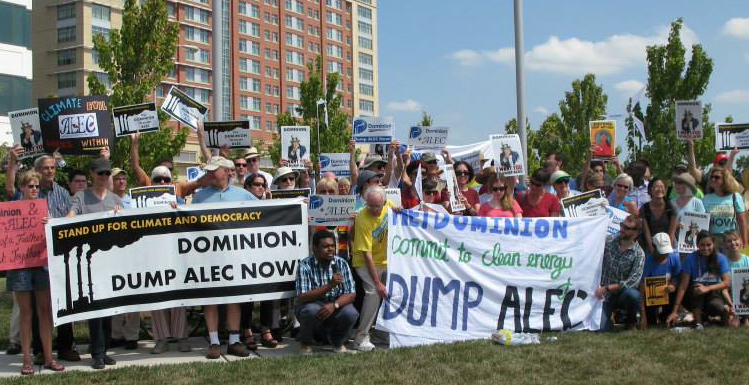
Protesters gather outside the Crystal City headquarters of ALEC

A crowd of protesters gathered at the Arlington headquarters of the American Legislative Exchange Council (ALEC) on September 4 to demand that Dominion Resources, the parent of public utility monopoly Dominion Virginia Power, drop its membership in the right wing “bill mill.”

On the very same day, a jury convicted ex-Governor Bob McDonnell and his wife on federal corruption charges, setting off a new round of debate about Virginia’s lax ethics laws.

The two news items sound like different topics, but in fact they are both about the corruption undermining our democratic system. The McDonnell trial, with its focus on swank vacations, golf clubs, designer clothes and other neat stuff, actually missed the bigger breach of public trust that goes on every day. This takes the form of unlimited corporate campaign contributions and gifts to members of both parties, and the influence over legislation purchased by this largesse.

Dominion Power has spent decades and many millions of dollars building its influence in Richmond this way, to the point where most legislators don’t bother pursuing a bill if the utility signals its opposition. That’s why Virginia has not followed so many other states in requiring its utilities to invest in energy efficiency, wind and solar. Economic arguments, jobs, electricity rates—all these are talked about in committee, and all are irrelevant to the fate of a bill. The only relevant question for legislators is, “What does Dominion think?”

What Dominion thinks, though, is not about what’s good for its customers, but what’s good for its own bottom line. And this is where ALEC comes in. Dominion Virginia Power’s president, Bob Blue, sits on an ALEC committee with representatives from the climate-denial group Heartland Institute, the Koch-funded anti-environment group Americans for Prosperity, and that most oxymoronic of lobby shops, the American Coalition for Clean Coal Electricity. Their purpose is to craft model state bills that protect fossil fuel profits and attack all efforts to regulate carbon emissions.

Dominion provides a straight shot from ALEC’s back-room bill-brokering to Virginia’s statute books, trampling environmental protections along the way and giving the lie to Dominion’s façade of environmental responsibility. No wonder so many of last week’s protesters were Dominion customers who objected to the utility using the money it charges them for electricity to pay its ALEC dues.

We see the result every year in the General Assembly, as bills drafted by ALEC pop up all over the place without attribution. In addition to attacking clean energy, ALEC bills oppose worker protections and minimum wage initiatives, promote stand-your-ground bills like the one at issue in the Trayvon Martin case, and of course, undermine the kinds of clean-government efforts that would reduce the influence of corporations—like campaign finance reform.

And because the voters are the only people who could prove more powerful than corporations—and the only ones who might ultimately cut off the corporate cash flow—ALEC works to undermine voting rights as well.

In the wake of the McDonnells’ convictions, Virginia legislators are once again mumbling about tightening up the rules on gifts. The discussion is half-hearted; the pay for their work is paltry and the hours are long, so they aren’t anxious to give up the perks.

But it’s too late for half-measures. Elected officials are going to have to subject themselves to a ban on gifts, and the prohibition should extend to ballgame tickets, golf getaways and sit-down dinners. The loophole that currently allows campaign funds to be used for personal use must also be closed to avoid an end-run around the gift ban.

But until we turn off the corporate cash spigot, our democracy will still have special interests, not voters, calling too many shots.

Unknown's avatar

Dominion won’t explain ties to anti-clean energy “bill mill” ALEC

Dominion Resources, the parent of Dominion Virginia Power, held its shareholder meeting today in Cleveland, Ohio. Unhappy Dominion shareholders have introduced many resolutions over the years seeking to reform aspects of the company’s business practices, from buying mountaintop-removal-mined coal to exposing investors to risks from climate disruption. Although Dominion routinely challenges the resolutions, seeking to keep them off the ballot, this year half a dozen resolutions made it through the legal obstacle course to be voted on. One of the resolutions, submitted by the New York State Common Retirement Fund, called on Dominion to disclose its financial support for the secretive American Legislative Exchange Council, which works to defeat and roll back renewable energy and climate initiatives across the country. The resolution prompted guest blogger Seth Heald, in Cleveland today for the shareholder meeting, to offer this commentary.  

Dominion's coal-fired Chesterfield Power Station, on the James River, has been driving climate change since 1952. Photo credit Ed Brown, Wikimedia Commons.

Dominion’s coal-fired Chesterfield Power Station, on the James River, has been driving climate change since 1952. Photo credit Ed Brown, Wikimedia Commons.

In the past week or so communities across Virginia staged Earth Day festivals and other events to raise environmental awareness and support environmental protection. Virginia’s largest electric utility, Dominion Virginia Power, had tables or booths at a number of these events, touting the company’s environmental record.

The utility’s parent corporation—Dominion Resources, Inc.—attempts to defend the company’s environmental practices on its website. Chief environmental officer Pamela F. Faggert explains “[e]nvironmental awareness is the responsibility of each Dominion employee. It is woven into the fabric of our culture ….”

What you won’t find on Dominion’s website or in its Earth Day handouts is any mention of its work to undermine environmental protections through its financial contributions to the American Legislative Exchange Council, widely known as “ALEC.” ALEC has been described as “a corporate bill mill.” It brings together corporations and state legislators and comes up with “model legislation” for the legislators to introduce back home. Sometimes state legislatures pitch in with their own additional financial support. A report on ALEC’s influence in Virginia, issued by the group Progress VA, states that between 2001 and 2010, Virginia spent over $230,000 of taxpayers’ money to send legislators to ALEC conferences “to meet with corporate lobbyists behind closed doors.” The report notes that more than 50 bills drawn from ALEC sources have been introduced in the Virginia General Assembly in recent years.

ALEC gained notoriety recently because of its sponsorship of “stand your ground” laws, such as the one in Florida connected to the Trayvon Martin shooting death. According to The Guardian, more than 60 corporations withdrew from ALEC after that connection was publicized.

ALEC’s proposed energy and environmental legislation reliably favors corporate polluters’ interests over the environment. An ALEC model resolution intended to stymie efforts to address climate change expressed the goal of “prohibiting EPA by any means necessary from regulating greenhouse gas emissions, including if necessary defunding EPA greenhouse gas regulatory activities.” As reported in the Virginian-Pilot, a Virginia delegate introduced this resolution in the House of Delegates after it was presented to him by the coal industry. A different ALEC resolution called for opposition to “all Federal and state efforts to establish a carbon tax on fuels for electricity and transportation.” A list of ALEC model legislation is available at http://www.alecexposed.org/.

The nonprofit watchdog Center for Media and Democracy reports that Dominion Resources has participated on ALEC’s energy, environment and agriculture task force. A 2010 “roster” of people on that task force (obtained by the group Common Cause and posted online) includes Dominion executive Robert Blue, who currently is Dominion Virginia Power’s president. Blue and other Dominion executives served alongside Joseph Bast, president of the Heartland Institute—an extremist group notorious for its support of climate-science denial and comparing those who “still believe” in climate science to mass murderers.

Also on ALEC’s environment task force roster serving alongside Dominion executives were representatives of the American Petroleum Institute, Koch Companies Public Sector LLC (affiliated with Koch Industries and the Koch brothers), the American Coalition for Clean Coal Electricity (a coal-industry group that lobbies against carbon-emission restrictions), and the Koch-backed right-wing, anti-environment group Americans for Prosperity.

ALEC has been linked to sponsorship of recent efforts to block or roll back state legislation that promotes renewable energy. ALEC has also backed efforts to water down laws requiring disclosure of fracking chemicals, and efforts to block federal regulation of toxic coal-ash storage sites. (Federal regulation, had there been any, might have served to prevent the recent Duke Energy coal-ash spill in North Carolina, which flowed downstream into Danville, Virginia.)

You simply can’t square these anti-environment positions with Dominion’s professed corporate culture of environmental awareness, supposedly woven into the company’s very fabric. No wonder Dominion keeps quiet about its ALEC involvement.

At Dominion’s May 7 shareholder meeting I asked the company’s chairman and CEO, Thomas Farrell, II, why Dominion participates in ALEC and what the company gets from that participation. Farrell clearly didn’t want to say much. His entire answer was “We see value in it and that’s why we participate.”

EPA records reveal that Dominion is the largest emitter of carbon-dioxide pollution in Virginia. Meanwhile Virginia’s Hampton Roads area, where many Dominion customers live, is one of the most vulnerable places in the nation to harm from climate change caused by carbon emissions. Virginia continues to suffer from the recent Duke Energy spill of toxic coal ash into the Dan River.

ALEC’s efforts to block environmental protections harm all Virginians, indeed all Americans. The people of Virginia—Dominion’s customers—should press Dominion to work to reduce its carbon emissions sharply rather than waxing poetic about its environmental “culture” while quietly supporting groups like ALEC that seek to block efforts to address climate change.

Seth Heald is vice chair of the Sierra Club Virginia Chapter, and is also a Dominion Resources shareholder. He is a graduate student in the Master of Science in Energy Policy and Climate program at Johns Hopkins University.


Unknown's avatar

2014 legislative session ends with modest progress on solar, not much else to brag about

photo credit: Amadeus

photo credit: Amadeus

The 2014 Virginia legislative session wrapped up this weekend, sort of. Legislators still have to return to work out a budget deal, and in six weeks they will be back again to consider any bills vetoed or amended by the governor. But it’s still a good time to survey the battlefield.

Advocates of enlightened energy policy march into session every January bright-eyed and optimistic, only to become mired in the slough of despond. We watch the best bills die, while bills we thought too backward to survive the light of day flourish like an invasive species. Yet even in Virginia, the past few years have produced glimmers of hope that suggest a slowly shifting mindset among legislators.

There is, for example, a growing movement in favor of solar energy that is as strong on the Republican right as it is on the Democratic left. They haven’t quite formed a Solar Caucus yet, but you might say we are beginning to see a Solar Consensus.

Last year, after a long battle, this consensus produced a law specifically allowing some third-party-owned solar and wind projects, a critical step for nonprofits to install solar economically. This year, the legislature removed the second major hurdle to these projects, local “machinery and tools” taxes on solar equipment that would have made third-party-owned projects impossible in most Virginia jurisdictions.  Assuming the Governor signs, SB 418 and HB 1239 take effect January 1, 2015.

In a near-rerun of two years ago, Senator Chap Petersen’s SB 222, nullifying homeowner bans on solar, passed the House and Senate. Back then Governor McDonnell surprised us all by vetoing similar legislation, an action not expected from Governor McAuliffe.

This year, too, the legislature voted to establish a grant program to help fund renewable energy projects. Originally conceived as an ambitious, $100 million tax credit, the legislation was quickly scaled back to $10 million and turned into a grant, causing it to run into trouble when money couldn’t be found in the budget to fund it. (Sorry, we spent it all on coal.) So SB 653 won’t take effect until fiscal year 2015-2016, and even for that to happen the bill must be reenacted in 2015. Too many contingencies, you say? Well, yes. But passing the bill at all is a remarkable milestone for this legislature. Let’s appreciate this moment.

Solar advocates also tried for a second year to pass a bill that would require the State Corporation Commission to set up a registration system for Virginia renewable energy certificates. While the bill did not pass, the SCC has agreed to examine whether it can do the job administratively, and if legislation is required, to suggest the necessary language for the 2015 session. Again, it’s a small victory, but it reflects an increasing acceptance of solar energy as an inevitable part of our energy mix.

Okay, sure, the defeats were far more numerous. Reforms to our farcical Renewable Portfolio Standard were whittled down to why-bother status before passage (SB 498 and HB 822). Efforts to ensure that both utilities and regulators take account of the long-term costs of fossil fuels (HB 808) and their climate change impacts (HB 363) never made it out of House subcommittee. Every effort to expand residents’ access to solar energy by opening up net-metering failed (SB 350, HB 879HB 1158HB 906 and SB 350).

One of the net-metering champions, Senator John Edwards, put in a resolution in the final days of the session to organize a study of the value that distributed solar generation provides to utilities and the grid. The bill was introduced on March 3d and scuttled on the 6th (surely some kind of record), but advocates expect the study to go forward administratively. The study will make use of the Small Solar Working Group that formed last year, facilitated by the Department of Environmental Quality and consisting of solar advocates, utilities, local governments and others.

This value-of-solar issue is at the heart of the national battle over the expansion of distributed solar and the effort by utilities to nip it in the bud to preserve their monopolies. We expect Virginia utilities to continue their push for a very low valuation, one that would justify the barriers currently in place and add new ones like standby charges.

There were other disappointments, too, like the failure of HB 766, a bill that would have allowed localities to form service districts for energy projects, just as they do for things like trash collection, and HB 1001, which would have required electric utilities to offer on-bill financing of energy efficiency improvements.

But as I wrote in my last post, the worst news for consumers this year was the passage of SB 459, a bill allowing Dominion to write off hundreds of millions of dollars it has spent developing plans for a third nuclear reactor at Lake Anna. Last week we spoke with lawyers at the Attorney General’s office about this boondoggle, which they also oppose, and received confirmation that our reading of the bill is correct. In spite of the propaganda coming from Dominion about “no ratepayer impact,” customers of the utility will indeed pay these costs.

Worse, while we know Dominion has spent $570 million so far, the company has not disclosed how much more it intends to spend—and charge us for—in the future. The AG’s office told us Dominion has this estimate but won’t disclose it publicly, insisting the figure is confidential. Apparently it is not for the likes of us customers to know such things.

Legislators not only signed us up for this open-ended boondoggle, they specifically rejected an amendment offered by Delegate Ware that would have ensured we got our money back if Dominion doesn’t build the nuclear plant.

Given the lopsided vote tally, the Governor is not likely to veto the bill. Knowing this, the AG’s office is recommending amendments that would allow the State Corporation Commission to review the money spent (the bill as written jettisons even that minor consumer protection), but isn’t suggesting a wholesale rewrite.

Looking for a silver lining? There are two. First, Dominion may have pursued this legislation not because it wants to build North Anna 3, but because it intends to abandon the project and figures it might as well get ratepayers to cover the sunk costs while it’s still possible to pretend everything is full-speed-ahead. That would actually come as a relief; not building a financially uncompetitive nuclear plant on an earthquake fault line is way better than building it.

Second, the bitter pill of this legislation comes with a little chaser of sugar in the form of a second bill, SB 643, that provides the same treatment for the costs of developing an offshore wind farm. So far these costs have been tiny in comparison to what’s been spent on North Anna 3, but putting them into the rate base will lower the cost of building turbines offshore.

Some people have suggested it’s inconsistent to like the wind bill while hating the nuclear bill, but surely it’s only reasonable to fish a pearl out of a dung heap. There are good reasons to distinguish the bills, beyond the dangers of nuclear and the planet-friendly qualities of wind power. Most obvious is that there is real doubt whether the federal government will approve a nuclear plant with the serious siting issues confronting Lake Anna, while it has already approved the site of the offshore wind farm and given Dominion a lease.

Since my last update, a few other bills have seen action. Senator Stuart’s bill to control fracking in the Tidewater area, SB 48, died in the killing fields of House Commerce and Labor.  SJ3 and HJ16, Virginia’s first bills to deal with the effects of climate change, had to go to conference on the question of who would be part of the subcommittee studying “recurrent flooding” and how much power they would have. The compromise calls for three senators and five delegates to be part of the 11-member subcommittee. Absurdly, it gives the majority of either the senators or the delegates veto power over any recommendation. Senators Locke, McWaters and Watkins, and Delegates Stolle, Knight and Hester have already been appointed.

Unknown's avatar

Where ethics and utility profits intersect, a stain spreads across the “Virginia Way”

Dominion buildingThe Virginia General Assembly has punted on ethics reform, preparing to pass watered-down legislation that does very nearly nothing. At the same time, legislators are about to pass a law that will cost Dominion Power’s customers more than half a billion dollars as a down payment on a nuclear plant that hasn’t been approved and isn’t likely to be built.

These are not separate issues.

Virginia has had an ethics problem since long before Bob McDonnell met Jonnie Williams. As many people have noted, the real scandal is how hard it is to break our ethics laws. So long as you fill out a form disclosing the gift, it’s legal for politicians to accept anything of value from anyone, to use for any purpose. By this standard, McDonnell’s biggest failure was one of imagination.

The legislation that appears likely to come out of the General Assembly merely puts a $250 cap on the price tag of any one gift, with no limit on the number of lesser gifts and no limit on the value of so-called “intangible” gifts like all-expense-paid vacations. The mocking of this bill has already begun.

Conveniently, the bill deals with a tiny side stream of tainted cash compared to the river of money flowing from corporations and ladled out by lobbyists. Corporations don’t usually give out Rolexes and golf clubs. Instead, they give campaign contributions. Here again, Virginia law places no limits on the amount of money a politician can take from any donor. Five thousand or seventy-five thousand, as long as your campaign reports the gift, you can put it in your wallet.

And here’s the interesting part: you don’t have to spend the money on your campaign. If gerrymandering has delivered you a safe district, you can use your war chest to help out another member of your party—or you can buy groceries with it. The distinction between campaign money and personal money is merely rhetorical. A spokeswoman for the State Board of Elections was quoted in the Washington Post saying, “If they wanted to use the money to send their kids to college, they could probably do that.”

In an eye-popping editorial, the Post ripped into one Virginia delegate who charged his campaign more than $30,000 in travel and meals, and another $9600 in cellphone charges, in the course of just 18 months.

As with taking the money, the only rule in spending campaign funds is that you file timely paperwork showing what you spent it on; the reports are not even audited. The theory originally may have been that the threat of public disclosure would keep a gentleman from taking money from unsavory persons. If you took it anyway, the voters would learn of it and throw you out. How quaintly respectful of the energy and capabilities of voters! How pre-gerrymandering.

And how pre-corporation. The smartest companies today spread the wealth around: more to the legislators in charge of the important committees, less where they just need floor votes. The largesse is bipartisan, making everyone happy but the voters. Certainly, a legislator who accepts thousands of dollars from a lobbyist would be churlish to criticize the company writing the check.

So what do you call someone who pays for his meals out of the check he gets from a company?

How about, “an employee”?

Environmental groups and good-government advocates have long decried the influence of corporate money in Virginia politics. In their 2012 report, Dirty Money, Dirty Power, the Sierra Club, Appalachian Voices, and Chesapeake Climate Action Network documented the rising tide of utility and coal company contributions to Virginia politicians, coinciding with a series of votes enriching these special interests.

Dominion Power has consistently led the “dirty money” pack. As the single largest donor of campaign funds aside from the Republican and Democratic parties themselves, its influence in Richmond is widely acknowledged, even taken for granted.  Most legislators will not bother to introduce a bill that Dominion opposes, even if they like it themselves. Critics joke that the General Assembly is a wholly-owned subsidiary of Dominion Resources.

According to Dirty Money, Dirty Power, Dominion’s contributions to elected officials totaled $5.2 million from 2004 to 2011. The Virginia Public Access Project shows another $1.4 million in 2012 and 2013. The contributions overall somewhat favor Republicans, but often the contributions are so even-handed as to be comical, like the $20,000 each to Mark Herring and Mark Obenshain in the Attorney General’s race last fall. These contributions are not about supporting a preferred candidate; they are about buying influence.

Note that much of the donations don’t go directly to General Assembly members but to the parties’ PACs, which then dole out the money. This gives Dominion extra influence with party leaders—again, on both sides.

The result has been spectacularly successful for Dominion, which rarely fails to get its way. Bills it opposes die in subcommittee (witness this year’s bills to expand net metering). Bills it wants succeed.

That brings us to this year’s money bills. As you may have read here or in Virginia papers, Dominion has been “over-earning,” collecting more money from ratepayers than allowed by law. In the ordinary course of things, this would result in both a rebate to customers and a resetting of rates going forward to produce less revenue for the utility.

For Dominion, the solution is a bill that lets the company charge ratepayers for expenses it isn’t entitled to pass along under current law. (Indeed, in a nice touch, the bill actually requires Dominion to pass along these expenses.) Presto: it’s no longer earning too much, owes no rebate, and doesn’t have to cut rates.

In return, the ratepayers get the satisfaction of assuming the sunk costs of a new nuclear reactor that will probably never be built, plus whatever more money the utility spends on it going forward. I believe the technical parlance for this is “blank check.”

“But we must have nuclear,” our legislators murmur as they sign our names on the check. Um, why? Nuclear energy today can’t compete economically. Just last year Duke Energy gave up on two nuclear plants it had been building, after billing ratepayers close to a billion dollars in construction costs. (BloombergBusinessweek headlined its article on the subject, “Duke Kills Florida Nuclear Project, Keeps Customers’ Money.”)

Dominion itself understands the wretched economics of nuclear perfectly well; its parent company, Dominion Resources, just closed an existing nuclear plant in Kewaunee, Wisconsin, because it couldn’t produce power cheaply enough to attract customers. And that’s from a plant that’s paid for; energy from new plants is now more expensive than natural gas, wind, and even some solar.

Memo to Democrats: when the cheaper alternative is renewable energy, no self-respecting progressive signs on to nuclear.

The steadily falling price of wind energy, and more recently, solar energy, helps explain why nuclear is on its way out nationwide. The only nuclear plants under construction in the U.S. today are over budget and reliant on billions of dollars in federal loan guarantees.

Memo to Republicans: no self-respecting, Solyndra-bashing conservative signs on to nuclear.

The State Corporation Commission also understands the economic picture, and it has been skeptical of Dominion’s nuclear ambitions. On top of that, there are serious concerns whether a third reactor at North Anna could even get a license from the Nuclear Regulatory Commission in the wake of the earthquake that shut the existing units for four months in 2011. (For a good short history of the North Anna reactors, including the fine Dominion paid in 1975 for hiding the existence of the fault line, see this article in the local Fluvanna Review.)

So there’s a pretty good chance that Virginia ratepayers will find themselves following in the path of Duke Energy’s customers, with many hundreds of millions of dollars thrown down a rathole and nothing to show for it.

The elected officials voting for this boondoggle, on the other hand, will have plenty to show for it, unfettered by rules of ethics.