Unknown's avatar

Who leads on climate and energy in the General Assembly—and how to get your legislators to up their game

Sierra Club Legislative Chair Susan Stillman presents the Good Government award to Senator Chap Petersen. Photo credit Sierra Club.

Each year the Virginia Chapter of the Sierra Club issues grades to Virginia legislators for their votes on bills related to energy and climate change. It’s not an easy task, especially in the House, where too many good bills die on unrecorded voice votes in small subcommittees, defying attempts to hold legislators accountable. Other bills become victims of party politics. In spite of this, the scorecard manages to separate the champions from the also-rans, not to mention the boneheads running in the opposite direction. Guest blogger Corrina Beall, Legislative Director for the Virginia Sierra Club, lays it all out for you.


By Corrina Beall

The Sierra Club Virginia Chapter 2017 Climate and Energy Scorecard grades the Commonwealth’s state-level elected officials on their votes during the 2017 General Assembly Session on legislation that will have an impact on Virginia’s energy policies and standards to fight climate change. Eighteen of Virginia’s 40 senators and 36 of 100 delegates received a score of 80 percent or better on the 2017 Scorecard, reflected in their A+, A and B grades.

Check out your Senator’s and Delegate’s grades and let them know what you think! Thank them for supporting good environmental policies, or let them know that they need to do better. Scorecard available online, here: http://www.sierraclub.org/virginia/general-assembly-scorecard

As a voter, your elected officials care about your opinions even when you disagree. Regardless of party affiliation, your legislator will be interested to know that passionate environmentalists live in his or her district. Even if you never thought it was possible, you may be able to find some common ground. Talk with your legislator about shared values, and from there, the outcome of a friendly conversation about how we govern is anybody’s guess.

Legislators at all ends of the political spectrum need to hear from environmentalists who live in the districts they represent. The environment isn’t a partisan issue: everyone wants clean air to breathe, clean water to drink, and to protect those resources for future generations.

Nine legislators deserve your special thanks this year for their work to protect our environment our air, water or land during the 2017 Legislative Session. Seven will be awarded by are receiving awards from the Virginia Chapter this summer:

  1. Senator Chap Petersen, Good Government Award
  2. Senator Scott Surovell, Water Champion Award
  3. Delegate Mark Keam, Energy Freedom Award
  4. Senator Jennifer Wexton, Energy Freedom Award
  5. Delegate Rip Sullivan, Legislative Leader Award
  6. Senator Jeremy McPike, Environmental Justice Award
  7. Delegate Kaye Kory, Environmental Justice Award

In addition, Senators Amanda Chase and Richard Stuart will be recognized for outstanding contributions on specific bills that help protect Virginia’s water quality from the consequences of our fossil fuel dependency.

Here is the full run-down:

Senator Richard Stuart (R-28) has led on water quality issues in coastal Virginia during his tenure in the Virginia Senate. Since the first commercial oil well was drilled in 1896 in Virginia, it is estimated that seven thousand oil and gas wells have been drilled in the state. Until 1950, there were no permitting or environmental requirements of well operators– and wells no longer in use were not plugged or closed, but simply abandoned. These abandoned wells, and those that are abandoned by insolvent companies, are called “orphan” wells.

According to the latest state review of oil and natural gas environmental regulations, there are at least 130 orphaned wells in Virginia. Orphaned wells that predate regulation often go unnoticed because their locations were never recorded. According to the Virginia Department of Mines, Minerals and Energy (DMME), the cost of plugging an orphaned well is between $50,000 and $60,000. It took fifteen years for DMME to accumulate sufficient funds to complete a project of plugging seven wells.

Virginia’s orphan well program is funded by fees charged to well operators when they apply for a well site permit. The fee was set at $50 in 1990, and remained stagnant until this General Assembly Session. Sen. Stuart introduced successful legislation Senate Bill 911 that will increase the fee from $50 to $200.

Senator Chap Petersen (D-34) showed remarkable leadership by proposing to repeal a statute enacted in 2015 (the now-infamous SB 1349), which froze electric rates at levels that are designed to allow Dominion and Appalachian Power to over-collect money from customers. Virginians are now paying too much for their electricity because our largest utilities are earning unjustified profits. Petersen’s bill would have unfrozen utility rates, and allowed for base rate reviews for both utilities, ultimately resulting in lower electric bills and possibly a refund to consumers.

Additionally, Petersen sponsored Senate Bill 1593, which would ban political contributions from regulated monopolies. Petersen’s stand brought the issue of money in politics to the forefront, a focus that has spilled over into the gubernatorial race.

Senator Scott Surovell (D-36) introduced successful legislation this year to place a moratorium on coal ash disposal permits until the issue has been studied and information has been provided to the regulating entity, the Department of Environmental Quality. Senate Bill 1398 requires Dominion to assess a range of alternatives for disposing or recycling coal ash, the toxic byproduct of burning coal for electricity.

Despite the dangers associated with coal ash, it remains both ever-present and under-regulated. Coal ash is the second largest industrial waste stream in the United States. Vast quantities of poorly-contained ash sit in numerous pits along many of the Commonwealth’s most prized rivers, including the James, the Clinch, and the Potomac Rivers. In many cases, coal ash disposal sites are located upstream from popular fishing, kayaking, and hunting destinations.

The bill is an important step toward protecting every Virginian’s right to clean water. Senator Amanda Chase (R-11) co-patroned the bill. Chase raised the profile of this issue and rallied support around this measure, and after a weakened version of the bill passed in both chambers, she pushed for the Governor to strengthen the bill by amending it to include a prohibition on future issuance of permits until the studies are submitted to DEQ in December of 2017.

At the Request of the Virginia Distributed Solar Collaborative, Senator Jennifer Wexton (D-33) and Delegate Mark Keam (D-35) introduced companion legislation to establish community-owned renewable energy programs in Virginia with Senate Bill 1208 and House Bill 2112. Community-owned projects are not legal in Virginia, but could provide the option to power homes and businesses with clean energy for renters, apartment and condo dwellers, low-income families, and buildings that have unfavorable characteristics for on-site generation like deep shade.

Development of wind or solar energy that provides power to multiple community members leverages an economy of scale to reduce the price for each individual customer. By owning or leasing the solar or wind system, each community member taking part in the project can reduce his or her utility bills. Although these bills failed, they helped legislators understand what a true “community solar” bill looks like, and have helped set the stage for future efforts.

Delegate Rip Sullivan (D-48) introduced a suite of bills on energy efficiency this year in addition to a bill to establish renewable energy property tax credits in Virginia, HB 1632. Sullivan’s bills include HB 1703 (energy efficiency goals), HB 1636 (adjusting energy efficiency programs’ criteria for approval by the SCC), and HB 1465. Only HB 1465 passed.

House Bill 1465, which will become law in July, requires the Department of Mines, Minerals, and Energy (DMME) to track and report on the state’s progress towards meeting its energy efficiency goal. Virginia has a voluntary goal, set in 2007, of reducing electricity consumption by 10 percent by 2022, and we are only a tenth of the way there. Despite the modesty of our goal, at our current pace we will not attain it. This legislation requires that the Governor, the General Assembly and the Governor’s Executive Committee on Energy Efficiency will receive an annual report on our progress. Sullivan’s bill will provide a tool to hold the Commonwealth accountable for reaching our energy efficiency goal, and increase government transparency.

Senator Jeremy McPike (D-29) and Delegate Kaye Kory (D-38) introduced Senate Bill 1359 and its companion, House Bill 2089, which require every public school board in the state to adopt a plan to test for lead in each school’s drinking water. Children are particularly vulnerable to the harmful effects of lead poisoning, but often do not look sick. Lead in the body can cause brain damage and developmental problems including learning disabilities, impulsive behavior, poor language skills and memory problems. This bill will become law in July.

Unknown's avatar

2017 guide to Virginia wind and solar policy

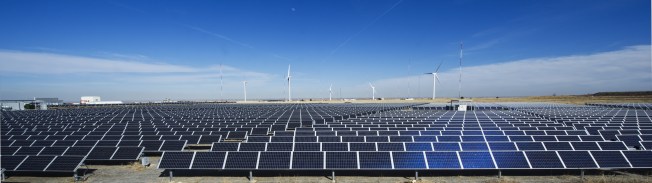
You can tell this picture wasn’t taken in Virginia because it has wind turbines in it. But at least the solar farm will look familiar to many Virginians these days. Photo credit Dennis Schroeder, NREL.

[This is an awesome guide, isn’t it? But you don’t want to bother with it, because the 2018 update is now available here.]

After several years of writing this annual update and often finding little to cheer about, I can finally share some good news. The nationwide boom in utility-scale solar has hit Virginia full force, juiced by low panel prices, corporate and state government demand, favorable tax policy and an abundance of good sites near transmission lines. We are a long way from unleashing our full potential; a lack of incentives, utility-inspired barriers, and a legislature still in thrall to fossil fuel interests continue to hold us back. In spite of this, Virginia is now attracting hundreds of millions of dollars in solar energy investments, and today the solar industry employs more of our residents than the coal industry.

The same cannot be said for wind energy; we are alone among all neighboring states in having no operating wind farms. Distributed generation like rooftop solar also remains a weak spot, even as customer interest continues to grow.

This survey of current policy is intended to help decision-makers, industry, advocates and consumers understand where we are today, who the players are, and where we could be going in the coming year. A few disclaimers: I don’t cover everything, the opinions expressed are purely my own, and as legal advice it is worth exactly what you’re paying for it.

  1. Overview: Virginia still lags, but we’ve now got some mo’

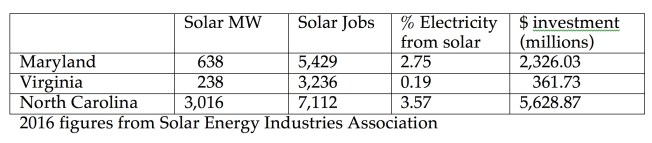
Even last summer it was clear utility-scale solar was on a roll in the commonwealth, leading me to predict Virginia would hit 200 megawatts (MW) by the end of 2016, up from 22 MW at the end of 2015. According to the Solar Energy Industries Association, we beat that number and then some.

Maryland North Carolina W. Virginia Tennessee Virginia
Solar* 637.8 3,015.8 3.4 171.1 238.3
Wind** 191 208 686 29 0
Total 828.8 3,223.8 689.4 200.1 238.3

Installed capacity measured in megawatts (MW) at the end of 2016. One megawatt is equal to 1,000 kilowatts (kW). Note that SEIA does not provide 2016 numbers for W. Virginia; shown are 2015.

*Source: Solar Energy Industries Association **Source: American Wind Energy Association 

The big numbers, however, still lie ahead. At the May event where Governor McAuliffe announced his directive to the Department of Environmental Quality (DEQ) to develop a carbon limit for Virginia, he also reported that Virginia has a total of more than 1,800 MW of solar installed or under development.

Several developments are driving these numbers:

  • Once the federal investment tax credit is factored in, the levelized cost of energy from solar is now below that of coal, nuclear, and natural gas.
  • Dominion committed to 400 MW of solar as part of 2015 legislation, and now indicates in its IRP an intent to build 240 MW per year through at least 2032.
  • Governor McAuliffe committed the state to getting 8% of its electricity from solar, a total of 110 MW.
  • Corporations, led by Amazon, are using new approaches to procure renewable energy on favorable terms, including indirect and virtual PPAs; this forces utilities to cooperate or be cut out of the action.
  • Other customers have stepped up pressure on their utilities to provide renewable energy.

You can find the list of projects that have submitted permit applications on the DEQ website. The list currently does not include regulated utility-owned projects, which until this year received permits from the State Corporation Commission (SCC). Under legislation passed in 2017, however, these projects will also be governed by the DEQ permit-by-rule process.

Industry experts caution that not all of these solar projects will get built; we may even be seeing a speculative bubble of sorts, reflecting a scramble to lock up the good sites now and worry about customers later.

You will find only one wind project on the DEQ list: Apex Clean Energy’s 75 MW Rocky Forge wind farm, which received its permit earlier this year but has not yet begun construction.

And in spite of Dominion Virginia Power having won the right to develop an estimated 2,000 MW of wind power offshore of Virginia Beach, there is still no timeline for offshore wind in Virginia. Dominion continues to include its two-turbine, 12 MW pilot project in its 2017 Integrated Resource Plan, with a projected in-service date of 2021. It does not include the larger resource as an option.

  1. Most customers still can’t buy renewable energy from Virginia utilities

Currently, the average Virginia resident can’t pick up the phone and call their utility to buy electricity generated by wind and solar farms (unless they are members of some rural electric cooperatives—see below). Worse, they can’t buy renewable energy elsewhere, either.

Virginia law is not the problem. Section 56-577(A)(6) of the Virginia code allows utilities to offer “green power” tariffs, and if they don’t, customers are supposed to be able to go elsewhere for it. Ideally, a utility would use money from voluntary green power programs to build or buy renewable energy for these customers. However, our two big investor-owned utilities, Dominion Energy Virginia (formerly Dominion Virginia Power) and Appalachian Power Company (APCo), have not done this. Instead, the utilities pay brokers to buy renewable energy certificates (RECs) on behalf of the participants. Participation by consumers is voluntary. Participants sign up and agree to be billed extra on their power bills for the service. Meanwhile, they still run their homes and businesses on regular “brown” power.

In Dominion’s case, these RECs meet a recognized national standard, and some of them originate with wind turbines, but they primarily represent power produced and consumed out of state, and thus don’t displace any fossil fuel burning in Virginia. For a fuller discussion of the Dominion Green Power Program, see What’s wrong with Dominion’s Green Power Program.

Since RECs are not energy, Dominion customers are free to buy RECs from other providers, such as Arcadia. If you’re considering this route, read this post first so you understand what you are getting. Personally, I recommend instead making monthly tax-deductible donations to GRID Alternatives to put solar on low-income homes.

Appalachian Power’s “green pricing” program is worse than Dominion’s, consisting only of RECs from an 80 MW hydroelectric dam in West Virginia. In April of 2016 APCo filed a proposal with the SCC for a true renewable energy tariff under of §56-577(A)(6) that would combine wind, solar and hydro. None of the power would come from new projects; partly as a result, the tariff will cost more. That led a hearing examiner to recommend that the SCC reject the tariff as not in the public interest. A ruling by the SCC is expected this summer or fall.

Can you go elsewhere? Since the State Corporation Commission has ruled that REC-based programs do not qualify as selling renewable energy, under the terms of §56-577(A)(6), customers are currently permitted to turn to other licensed suppliers of electric energy “to purchase electric energy provided 100 percent from renewable energy.”

That means you should be able to go elsewhere to buy wind and solar. But Virginia utilities claim that the statute’s words should be read as requiring not only that another licensed supplier provide 100% renewable energy, but that it also supply 100% of the customer’s demand, all the time. Obviously, the owner of a wind farm or solar facility cannot do that. Ergo, say the utilities, a customer cannot go elsewhere.

In August of 2016, a hearing examiner for the SCC rejected this reading in favor of the plain language of the statute. Unfortunately, the case was terminated without the commissioners themselves ruling on the issue.

In spite of the roadblocks, an independent power seller called Direct Energy announced plans last year to sell a renewable energy product to Virginia residents in Dominion’s territory. (The company described the product as a combination of wind and municipal waste biomass.) This spring the SCC confirmed Direct Energy’s right to enter the Virginia market, but also ruled that Direct Energy will have to stop signing up customers once Dominion has its own approved renewable energy tariff. As of this writing, Direct Energy has not decided whether to proceed.

Within a few weeks of the ruling, Dominion filed plans for several new 100% renewable energy tariffs for large commercial customers, and indicated it expected to offer a residential renewable energy tariff as well. Until we see the details, it is hard to know whether this should be viewed as a genuinely positive step for customers or is merely intended to scare off competitors like Direct Energy. Because Dominion’s tariff is designed to meet the company’s “100% of the time” interpretation of the statute, it will include sources like forest biomass, which counts as renewable under the Virginia code but is highly polluting and doesn’t meet many national standards for sustainability. That makes it questionable whether anyone will want to pay extra for its product. If the SCC confirms its hearing examiner’s report rejecting the similar APCo tariff, Dominion may be forced back to the drawing board. (Note to Dominion CEO Robert Blue: Bob, you have the nation’s largest pumped storage facility. Wind, solar and pumped hydro would combine beautifully. You do not need to foist biomass on customers to meet your notion of 100% renewable.)

A new solar option is in the works. For both APCo and Dominion customers, another option is on the way. Under legislation passed this year under the misleading banner of “community solar,” both utilities will contract for power from solar farms to sell to consumers. Details—including price—still have to be worked out in a rulemaking proceeding at the State Corporation Commission. The new programs explicitly do not count as ones selling “electric energy provided 100 percent from renewable energy,” though ironically, they may be the first programs from Dominion and APCo to do exactly that for residential consumers.

Some coop members do have wind and solar options. Recently I learned that there are good green power programs in place in Virginia, available to members of some rural electric cooperatives. Old Dominion Electric Cooperative (ODEC), which supplies power to member cooperatives, buys the output of three wind farms in Maryland and Pennsylvania, and has contracted for two solar farms in Virginia that are slated to come online this year. Not all coops participate; ODEC has the list of those that do on its website.

  1. Community solar

Dominion loves the name “community solar.” The reality, not so much. The solar tariff discussed in section 2 uses that name but keeps the utility in control and gives customers no ownership interest. Dominion opposed true community solar legislation this year (as in past years) that would have put consumers in the driver’s seat.

This is not the first time Dominion has used the name “community solar” for a program that isn’t. In 2015 Dominion received SCC approval for a program it billed as an offer to sell electricity from solar panels. Unfortunately it turned out the “Dominion Community Solar” program would have involved customers paying extra so Dominion could sell solar energy to other people. Reading the details, it seemed clear it would attract customers only to the extent they didn’t understand it. Fortunately the company still hasn’t launched the program, but I’ve seen no formal withdrawal.

As for true community solar, only one Virginia utility offers it: a member-owned rural electric cooperative in southwestern Virginia called BARC.

  1. The miserable sham that is Virginia’s Renewable Portfolio Standard (RPS)

Many renewable energy advocates focus on an RPS as a vehicle for inducing demand. In Virginia, that’s a non-starter. Virginia has only a voluntary RPS, which means utilities have the option of participating but don’t have to. And unfortunately, the statute takes a kitchen-sink approach to what counts as renewable energy, so meeting it requires no new investment and no wind or solar. The SCC also insists that utilities take a least-cost approach to meeting the RPS, which means they use RECs from trash incinerators, wood burning, and old out-of-state hydro projects built prior to World War II. If utilities build wind and solar, they are required to sell the high-value RECs from these projects and buy low-cost junky ones instead. Thus, no matter how much solar Dominion builds, the RPS operates to ensure customers will never see solar as part of their energy mix.

The targets are also modest to a fault. Although nominally promising 15% renewables by 2025, the statute sets a 2007 baseline and contains a sleight-of-hand in the definitions section by which the target is applied only to the amount of energy not produced by nuclear plants. The combined result is an effective 2025 target of about 7%.

There appears to be no appetite in the General Assembly for making the RPS mandatory, and efforts to improve the voluntary goals have repeatedly failed in the face of utility and other industry opposition. The utilities have offered no arguments why the goals should not be limited to new, high-value, in-state renewable projects, other than that it would cost more to meet them than to buy junk RECs.

But with the GA hostile to a mandatory RPS and too many parties with vested interests in keeping the kitchen-sink approach going, it is hard to imagine our RPS becoming transformed into a useful tool to incentivize wind and solar.

That doesn’t mean there is no role for legislatively-mandated wind and solar. But it would be easier to pass a bill with a simple, straightforward mandate for buying or building a certain number of megawatts than it would be to repair a hopelessly broken RPS.

  1. Customer-owned generation 

Given the lack of wind or solar options from utilities, people who want renewable energy generally have to build it themselves. Low panel prices and the federal 30% tax credit make it cost-effective for most customers. The emergence of bulk purchasing coops, sometimes also called “solarize” programs, such as those offered through nonprofits VA-SUN and LEAP, makes the process easy for homeowners and businesses and further reduces costs.

Virginia allows net energy metering at the retail rate, though with limits (see section 6). Large commercial customers should also consider the advantages of solar in reducing high demand charges.

In 2016 the GA passed legislation enabling Property Assessed Clean Energy (PACE) loans for commercial customers. Localities now have an option to offer low-cost financing for energy efficiency and renewable energy projects at the commercial level. Arlington County received a federal grant to develop a PACE program that is expected to launch this year and be a model for other jurisdictions. A bill to extend PACE authorization to residential customers did not get out of committee last year.

Virginia offers no cash incentives or tax credits for wind or solar. The lack of a true RPS in Virginia means Virginia utilities generally will not buy solar renewable energy certificates (SRECs) from customers. SRECs generated here can sometimes be sold to utilities in other states or to brokers who sell to voluntary purchasers.

  1. Limits on retail net metering

Section 56-594 of the Virginia code allows utility customers with wind and solar projects to net energy meter at the retail rate. System owners get credit from their utility for surplus electricity that’s fed into the grid at times of high output. That offsets the grid power they draw on when their systems are producing less than they need. Their monthly bills reflect only the net energy they draw from the grid.

Residential customers can net meter systems up to 20 kW, although standby charges will apply to those between 10 and 20 kW (see section 8). Commercial customers can net meter up to 1,000 kW (1 MW). There is an overall cap of 1% of a utility’s peak demand that can be supplied by net metered systems (as measured at their rated capacity).

If a system produces more than the customer uses in a month, the credits roll over to the next month. However, at the end of the year, the customer will be paid for any excess credits only by entering a power purchase agreement with the utility. This will likely be for a price that represents the utility’s “avoided cost” of about 4.5 cents, rather than the retail rate, which for homeowners is about 12 cents. This effectively stops most people from installing larger systems than they can use themselves.

In 2015, the definition of “eligible customer-generator” was tightened to limit system sizes to no larger than needed to meet the customers demand, based on the previous 12 months of billing history. The SCC wrote implementing regulations (see 20VAC5-315-10 et seq.) but failed to address what happens with new construction.

The limitation presents a new barrier to current customers who want to expand their solar arrays because their business is expanding or they plan to buy an electric car. Why should they have to wait twelve months? But the limitation is also stupid. If customers want to install more clean, renewable energy than they need and are willing to sell the surplus electricity for avoided cost, why would you stop them from performing this service to society?

  1. Progress on meter aggregation derailed by agricultural solar bill

Under a bill passed in 2013, owners of Virginia farms with more than one electric meter are permitted to attribute the electricity produced by a system that serves one meter (say, on a barn) to other meters on the property (e.g., the farmhouse and other outbuildings). This is referred to as “agricultural net metering.” Unfortunately, there have been complaints from installers about a lack of cooperation from utilities in actually using this provision.

Advocates had hoped that agricultural net metering would be a first step towards broader meter aggregation options, but 2017 legislation instead took agricultural customers in a new direction. Beginning this year, farmers can elect to devote up to a quarter of their acreage to solar panels, up to 1.5 MW or 150% of their own electricity demand. The electricity must be sold to the utility at its avoided cost, while the farmer must buy all its electricity from the utility at retail. A farmer who chooses to do this cannot also use agricultural net metering. Agricultural net metering will be terminated entirely in 2019 in territory served by electric cooperatives, though existing customers are grandfathered.

The change would seem to give farmers no rights they did not already have under federal law, but industry sources I trust say some farmers will indeed be able to make money this way. However, taking away the agricultural net metering option is a backward step for farmers who want to use the solar they produce and aggregate meters.

  1. Standby charges on larger home systems

The current system capacity limit for net-metered residential solar installations is 20 kW. However, for residential systems between 10 kW and 20 kW, a utility is allowed to apply to the State Corporation Commission to impose a “standby” charge on those customers. Both Dominion and APCo have approval from the SCC to impose standby charges so high that solar installers say the larger systems often don’t make economic sense.

Utilities argue that customers with solar panels don’t pay their fair share of the upkeep of the grid, shifting costs to those who don’t own solar. A range of “value of solar” studies in other states have generally found the reverse, concluding that distributed solar provides a net benefit to the grid and to society at large. A stakeholder group in Virginia completed the initial phase of a value of solar study in 2014 but got no further after the utilities pulled out of the process.

Standby charges and other net metering issues will be a major focus of attention this year as a topic in the “Rubin Group” discussion. See section 19.

  1. Homeowner associations cannot ban solar

Homeowner association (HOA) bans and restrictions on solar systems have been a problem for residential solar. In the 2014 session, the legislature nullified bans as contrary to public policy. The law contains an exception for bans that are recorded in the land deeds, but this is said to be highly unusual; most bans are simply written into HOA covenants. In April of 2015 the Virginia Attorney issued an opinion letter confirming that unrecorded HOA bans on solar are no longer legal.

Even where HOAs cannot ban solar installations, they can impose “reasonable restrictions concerning the size, place and manner of placement.” This language is undefined. The Maryland-DC-Virginia Solar Energy Industries Association has published a guide for HOAs on this topic.

  1. Third-party ownership

One of the primary drivers of solar installations in other states has been third-party ownership of the systems, including third-party power purchase agreements (PPAs), under which the customer pays only for the power produced by the system. For customers that pay no taxes, including non-profit entities like churches and colleges, this is especially important because they can’t use the 30% federal tax credit to reduce the cost of the system if they purchase it directly. Under a PPA, the system owner can take the tax credit (as well as accelerated depreciation) and pass along the savings in the form of a lower electricity price.

The Virginia Code seems to sanction this approach to financing solar facilities in its net metering provisions, specifically §56-594, which authorizes a “customer generator” to net meter, and defines an eligible customer generator as “a customer that owns and operates, or contracts with other persons to own or operate, or both, an electrical generating facility that . . . uses as its total source of fuel renewable energy. . . “ (emphasis added).

Notwithstanding this provision, in 2011, when Washington & Lee University attempted to use a PPA to finance a solar array on its campus, Dominion Virginia Power issued cease and desist letters to the university and its Staunton-based solar provider, Secure Futures LLC. Dominion claimed the arrangement violated its monopoly on power sales within its territory. Secure Futures and the university thought that even if what was really just a financing arrangement somehow fell afoul of Dominion’s monopoly, surely they were covered by the exception in §56-577(A)(6) available to customers whose own utilities do not offer 100% renewable energy. (See Section 2, above.)

Yet the threat of prolonged and costly litigation was too much. The parties turned the PPA contract into a lease, allowing the solar installation to proceed but without the advantages of a PPA.

(Note that PPAs are sometimes referred to as “leases,” but they are distinct legally. Leasing solar equipment is like renting a generator; both provide power but don’t involve the sale of the electricity itself. I have never heard of a utility objecting to a true lease.)

In 2013 Dominion and the solar industry negotiated a compromise that specifically allows customers in Dominion territory to use third-party PPAs to install solar or wind projects under a pilot program capped at 50 MW. Projects must have a minimum size of 50 kW, unless the customer is a tax-exempt entity, in which case there is no minimum. Projects can be as large as 1 MW. The SCC is supposed to review the program every two years beginning in 2015 and has authority to make changes to it. I’m not aware the SCC has reviewed the program to date.

Appalachian Power and the electric cooperatives declined to participate in the PPA deal-making, so the legal uncertainty about PPAs continues in their territories. In June of 2015, Appalachian Power proposed an alternative to PPAs. An evidentiary hearing was held September 29, 2015. A veritable parade of witnesses testified that APCo”s program was expensive, unworkable and unnecessary, given the plain language of the statute allowing PPAs.

Almost a year later, on August 31, 2016, the hearing examiner finally issued her report, recommending that APCo’s application be rejected, both because it was a lousy program and because she, too, read the Code to allow PPAs currently, making a utility alternative unnecessary. Before the commission itself could confirm the ruling, APCo withdrew its application.

In 2017, the legislature passed a bill to allow private colleges and universities—but no one else—in APCo territory to use PPAs to install a maximum of 7 MW of renewable energy.

Meanwhile, Secure Futures has developed a third-party-ownership business model that it says works like a PPA for tax purposes but does not include the sale of electricity. This allows the company to install larger projects in more parts of Virginia (including most recently a 1.3 MW solar array to be installed at Carilion New River Valley Medical Center in Southwest Virginia, which I have to mention here because the project combines solar and sheep farming and therefore will make for cute photos). Currently Secure Futures is the only solar provider offering this option, which it calls a Customer Self-Generation Agreement.

  1. Tax exemption for third-party owned solar

In 2014 the General Assembly passed a law exempting solar generating equipment “owned or operated by a business” from state and local taxation for installations up to 20 MW. It did this by classifying solar equipment as “pollution abatement equipment.” Note that this applies only to the equipment, not to the buildings or land underlying the installation, so real estate taxes aren’t affected.

The law was a response to a problem that local “machinery and tools” taxes were mostly so high as to make third-party PPAs uneconomic in Virginia. In a state where solar was already on the margin, the tax could be a deal-breaker.

The 20 MW cap was included at the request of the Virginia Municipal League and the Virginia Association of Counties, and it seemed at the time like such a high cap as to be irrelevant. However, with solar increasingly attractive economically, Virginia’s tax exemption rapidly became a draw for solar developers, including Virginia utilities.

In 2016 Dominion proposed changing the exemption to benefit its own projects at the expense of those of independent developers. In the end, the statute was amended in a way that benefits utility-scale projects without unduly harming smaller projects. Many new projects will now be only 80% exempt, rather than entirely exempt. However, the details are complex, with different timelines and different size classes, and anyone looking to use this provision should study it carefully.

  1. Dominion-owned distributed solar

In 2011, the General Assembly passed a law allowing Dominion to build up to 30 MW of solar energy on leased property, such as roof space on a college or commercial establishment. The demonstration program was intended to help Dominion learn about grid integration. The SCC approved $80 million of spending, to be partially offset by selling the RECs (meaning the solar energy would not be used to meet Virginia’s RPS goals). The “Solar Partnership Program” resulted in several commercial-scale projects on university campuses and corporate buildings, but the program did not offer any economic advantages, and it seems to have fizzled out. The new Dominion Energy web page still mentions it, but currently the link does not lead to more information.

  1. Dominion Solar Purchase Program

The same legislation that enabled the “Solar Partnership” initiative also authorized Dominion to establish “an alternative to net metering” as part of the demonstration program. The alternative is a buy-all, sell-all deal for up to 3 MW of customer-owned solar. As approved by the SCC, the program allows owners of small solar systems on homes and businesses to sell the power and the associated RECs to Dominion at 15 cents/kWh, while buying regular grid power at retail for their own use. Dominion then sells the power to the Green Power Program at a hefty markup. It is not clear whether the program continues to be available; the links on the new Dominion Energy website don’t lead anywhere helpful.

I ripped this program from the perspective of the Green Power Program buyers, but many installers also feel it is a bad deal for customers, given the costs involved and the likelihood that the payments represent taxable income. Finally, selling the electricity may make new system owners ineligible for the 30% federal tax credit on the purchase of the system.

  1. Utility renewable energy tariffs for large customers

In May of this year, Dominion applied to the SCC for permission to offer six new voluntary schedules for customers with a peak demand of at least 1,000 kW (1 MW). The tariff would use a mix of sources that count as renewable under the Virginia Code but still pollute, including biomass—making it only sort-of green.

For large customers that want wind and solar, the options are more limited. In 2013, Dominion Power introduced a Renewable Generation Tariff to allow customers to buy renewable power from providers, with the utility acting as a go-between and collecting a monthly administrative fee. The program was poorly designed and got no takers.

In 2015, Amazon Web Services made Dominion’s RG tariff irrelevant. Amazon contracted directly with a developer for an 80 MW solar farm, avoiding Dominion’s monopoly restrictions with a plan to sell the electricity directly into the PJM (wholesale) market. Dominion Energy (the merchant affiliate of Dominion Virginia Power) then bought the project, and Dominion Virginia Power negotiated a special rate with Amazon for the power. This contract became the basis for an “experimental” tariff that Dominion now offers to customers with a peak demand of 5 MW or more, with a program cap of 200 MW.

Since that first deal, Dominion and Amazon have followed up with contracts for an additional 180 MW of solar in five Virginia counties.

Dominion used a different model for a deal with Microsoft. After the SCC turned down Dominion’s application to charge ratepayers for a 20-MW solar farm in Remington, Virginia, Dominion reached an agreement with Microsoft and the Commonwealth of Virginia under which the state will buy the output of the project, while Microsoft buys the RECs.

Dominion has also entered into a contract to sell the output of a 17 MW solar facility to the University of Virginia and the Darden School of Business.

Dominion has a strong incentive to make deals with large institutions that want a lot of renewable energy: if they don’t like what Dominion is offering, they can do an end run around the utility. Amazon has shown other companies how to use PJM rules that let anyone develop projects for the wholesale market regardless of utility monopolies, and then “attribute” the solar or wind energy to their operations in any state. With the tax exemption discussed in section 11, Virginia projects apparently now pencil out pretty well.

Some observers caution that the process is still not easy. One of the tasks the Rubin Group says it plans to take on this year is considering further changes to help large customers.

  1. Dominion continues to add utility-scale solar for its own portfolio

Even before Amazon and Microsoft showed an interest in large-scale solar projects here, Dominion had announced it wanted to develop 400 MW of solar in Virginia. In 2015, two bills promoted the construction of utility-scale solar by declaring it in the public interest for utilities to build solar energy projects of at least 1 MW, and up to an aggregate of 500 MW. The bill was amended at the solar industry’s behest to allow utilities the alternative of entering into PPAs for solar power prior to purchasing the generation facilities at a later date, an option with significant tax advantages.

Dominion got off to a rocky start when the SCC rejected the company’s plan to charge ratepayers for its first project, a 20 MW solar farm in Remington, Virginia because the company had not considered cheaper third-party alternatives. Governor McAuliffe helped save the project by working out a deal with Microsoft, as discussed above. Further projects fared better, however, and Dominion is now so enthusiastic about solar that its latest Integrated Resource Plan (IRP) calls for it to engage in a continuous build-out at a rate of 240 MW per year, all for the benefit of its regular ratepayers.

Although Dominion will be able to charge ratepayers for these projects, the SCC will probably insist that the RECs be sold—whether to utilities in other states that have RPS obligations, or to customers who want them for their own sustainability goals, or perhaps even to voluntary green power customers. If this happens, the result will be that Dominion still won’t use solar to meet the Virginia RPS, and ordinary customers will still not have solar as part of the electricity they pay for. That’s the weird world of RECs for you.

  1. Governor McAuliffe initiates program to purchase 110 MW of solar

Following a recommendation by the Governor’s Climate Change and Resiliency Commission, on December 21, 2015, Governor McAuliffe announced that the Commonwealth would commit to procuring 8% of its electricity from solar, with 75% of that built by Dominion and 25% by private developers.

The first deal that will count towards this goal is an 18 MW project at Naval Station Oceana, announced on August 2, 2016. The Commonwealth will buy the power and the RECs. (The Remington Project did not count, because as the buyer of the RECs, only Microsoft can claim the right to be buying solar power.) A 17 MW solar farm supplying the University of Virginia will also count towards the 8%, according to Deputy Secretary of Commerce and Trade Hayes Framme.

  1. Still waiting for wind

No Virginia utility is actively moving forward with a wind farm on land. Dominion Power’s website used to list 248 MW of land-based wind in Virginia as “under development,” without any noticeable progress. The current web page omits mention of these projects.

On the other hand, Appalachian Power’s most recent IRP suggests an interest in wind as a low-cost renewable resource. The bad news is that it isn’t proposing to build any new wind in Virginia.

With no utility buyers, Virginia has not been a friendly place for independent wind developers. In previous years a few wind farm proposals made it to the permitting stage before being abandoned, including in Highland County and on Poor Mountain near Roanoke.

Nonetheless, Apex Clean Energy has obtained a permit to develop a 75-MW Rocky Forge wind farm in Botetourt County. No customer has been announced, but the company believes the project can produce electricity at a competitive price, given its good location and improved turbine technology. Construction, once planned for this year, is now slated for 2018.

As for Virginia’s great offshore wind resource, little progress has been made towards harnessing it, even as the nation’s first offshore wind project began generating electricity in the waters off Rhode Island last year. Dominion won the federal auction for the right to develop about 2,000 MW of wind power off Virginia Beach in 2013, and the company has completed a Site Assessment Plan (SAP) that is awaiting approval.

We had originally been told the federal government’s timeline would lead to wind turbines being built off Virginia Beach around 2020. Now, however, the Bureau of Ocean Energy Management says Dominion has five years from approval of the SAP to submit its construction and operations plan, after which we’ll have to wait for review and approval. Presumably the project will also require an environmental impact statement. So the whole process would be quite slow even if Dominion were committed to moving forward expeditiously.

But in fact, it seems increasingly clear that Dominion is just going through the motions and has little interest in seeing the project through. Its 2017 Integrated Resource Plan (IRP) does not even include offshore wind in any of its scenarios for the next 15 years, except for the 12 MW that would be produced by the two test turbines of its VOWTAP project.

Yes, so what about VOWTAP? Dominion had been part of a Department of Energy-funded team to try out new technology, with two pilot turbines due to be installed in 2017. After a second round of bids to build the project still came in higher than expected, Dominion told DOE last spring it could not commit to construction even by 2020, upon which DOE pulled funding. Dominion executives have not declared the project dead, however, and while there has been no public discussion of reviving it, the 2017 IRP suggests an in-service date of 2021.

[Update: on July 10, 2017, Dominion announced it had signed a memorandum of understanding with Denmark-based DONG Energy, one of the largest offshore wind developers in Europe, to complete the two pilot turbines. According to a Dominion press release, the MOU also gives DONG “the exclusive rights to discuss a strategic partnership with Dominion Energy about developing the commercial site based on successful deployment of the initial test turbines.”]

  1. The EPA Clean Power Plan is (probably) dead; long live the McAuliffe clean energy plan!

The Trump administration’s pullback on the Paris accord and the Clean Power Plan are depressing evidence that the Koch brothers have more influence on government than the American people do. Yet the practical effect in Virginia is small. The Clean Power Plan’s targets for Virginia were modest to a fault, and the state could have written an implementation plan that complied with the federal law while still allowing construction of an unlimited number of new gas-burning plants, sending total carbon emissions soaring.

Governor McAuliffe’s recent Executive Directive 11, on the other hand, ties emissions reductions from Virginia power plants to those in other states that have committed to reducing carbon emissions, leaving somewhat less room for mischief in implementation. There are still plenty of pitfalls ahead, and some Republican leaders have vowed to prevent it from ever taking effect. But any constraints on greenhouse gas emissions would serve to increase the value of emissions-free sources like wind and solar. The DEQ web page will show public participation opportunities.

  1. Solar initiatives underway ahead of the 2018 Session

The legislative initiatives that passed in 2017 dealt primarily with utility-scale solar. Since then, the solar industry has announced plans to focus more on removing barriers to distributed generation, a decided challenge given the utilities’ determination to curtail net metering.

The utilities and the solar industry have reconvened solar policy discussions via the Rubin Group, named for its moderator, Mark Rubin. Steering committee members this year include the electric cooperatives, Dominion, APCo, the solar industry trade group MDV-SEIA, the farm advocate Powered by Facts, the environmental group Southern Environmental Law Center, and the Virginia Manufacturer’s Association. The Rubin Group held a meeting on June 19 to get input from other stakeholders, and a follow-up email announced plans for the following subgroups:

  • Large Customer  (Convener: Katharine Bond, Dominion Energy, with Advanced Energy Economy, Ceres, and World Wildlife Fund as Key Participants)
  • Large Developer/Utility-Scale Solar (Convener: Francis Hodsoll, SolUnesco & MDV-SEIA Board Member)
  • Net Metering (Co-Conveners: Sam Brumberg, Virginia’s Electric Cooperatives & Scott Thomasson, Vote Solar & MDV-SEIA Board Member)
  • Land Use (Convener: Karen Schaufeld, Powered by Facts)
  • Community Solar Implementation for Dominion Energy (Conveners: Katharine Bond & Nate Frost, Dominion Energy)

The Rubin Group will accept comments at RubinGroup2017@gmail.com. [Update: Although this was the email address given out at the public meeting, we have learned it goes to Sam Brumberg, attorney for the electric cooperatives, who says he checks it only a few times per month. He recommends contacting Mark Rubin directly at rubin.mark3@gmail.com.]

A separate initiative is the Virginia Distributed Solar Alliance, which includes solar companies, environmental groups, consumers and solar advocates, but not utilities. As its name suggests, it focuses on removing barriers to smaller-scale, customer-sited projects, defending net metering and educating the public about the added benefits distributed solar bring to the grid and the community. The VA-DSA recently launched its website and is welcoming members.



Unknown's avatar

Memo to legislators: Virginia is not a low-cost energy state

Sure, there is something to be said for using a lot of energy–if you’re a Jack Russel Terrier. For the rest of us, not so much.
Photo credit Steve-65 – Own work, CC BY-SA 3.0, https-::commons.wikimedia.org:w:index.php?curid=17865919

Anyone who has attended the annual meeting of the House Energy Subcommittee has watched the Republican majority vote down all manner of legislation designed to improve Virginia’s poor ranking on energy efficiency. Since energy bills have to survive this subcommittee before the rest of the General Assembly gets to hear them, this little band of naysayers effectively holds back progress on initiatives that would save money and reduce energy use.

Why would they do that? As discussed in my last post, these delegates almost invariably vote the way Dominion Virginia Power wants them to. And Dominion doesn’t like these bills. The utility is in the business of selling electricity, and energy efficiency is bad for business.

Of course the utilities don’t put it that way. At this year’s subcommittee meeting, Dominion Virginia Power lobbyist Bill Murray explained his company’s opposition to one of Delegate Rip Sullivan’s energy efficiency bills by saying that real efficiency gains depend on the actions of individuals, and Virginians aren’t incentivized to take these actions because Dominion keeps our rates so admirably low.

This might put you in mind of former Vice President Dick Cheney’s dismissal of conservation as a sign of personal virtue but not a sound basis for energy policy. Let’s set that aside. Murray’s comments might also be thought unfair to his own client, which has tried and failed to get approval from the State Corporation Commission for various programs that would help consumers practice personal virtue. (If you wonder why, in that case, he was standing there opposing legislation designed to produce a better result, you are missing the point of the Subcommittee Hearing. It’s Kabuki theatre, people, and you really shouldn’t miss it.)

For now, however, let’s simply ask whether Mr. Murray’s claim is correct. Are we really paying less for energy than residents of other states?

We should first clarify whether we are talking about rates, or bills. Dominion prefers to focus on rates, but what people pay are bills. Few people can tell you what their electricity rate is, but most have a sense of the bottom line on their monthly bill.

According to the U.S. Energy Information Agency, Virginia’s 2016 residential rates stand at an average of 10.72 cents per kilowatt-hour, which is indeed about 12% below the national average of 12.21.* The average for our peer group, the South Atlantic region, is 11.11 cents per kWh, with Maryland at the high end (14.01 cents), and Georgia at the low end (9.92 cents).

When it comes to monthly bills, however, Virginia residential customers ($130.58) pay almost exactly the South Atlantic average ($131.20), but we are way above the national average ($114.03). (Note the bills are based on 2015 data; the EIA has not updated this chart for 2016.) If having to pay more for electricity is the primary motivation to adopt energy efficiency measures, Virginians are more motivated than most Americans.

Several factors can make a state have lower bills despite higher rates. Among these is energy efficiency. Energy efficiency is why a state like California, with high incomes and notoriously high residential electricity rates (16.99 cents/kWh), still has average monthly bills ($94.59) that are 30% below Virginia’s. California has succeeded in keeping per capita energy use flat for decades while the U.S. average climbed steadily, only flattening out in the past ten years. California is currently ranked 49th in the nation for per capita energy consumption, and 49th in total energy costs. “California” is a bad word among Virginia Republicans, who assume anything that state does must be bad, but California’s experience has to be considered by anyone who cares about energy costs.

Back at the Energy Subcommittee meeting, Bill Murray did not mention California, but he did offer his opinion on the cause of Virginia’s higher-than-average bills. He noted that many Virginians use electric heat pumps to heat their homes, which drives up winter electricity use, resulting in higher bills on average. (An EIA analysis using 2009 data showed that 55% of Virginia households heat with electricity, higher than the U.S. average but less than the South Atlantic average.)

To get a look at the whole energy picture across states, I created the table below that compares residents’ costs of electricity, natural gas and fuel oil across the U.S. Virginia ranked 18th out of 51. Because it isn’t weather-adjusted, it can’t tell the full story. However you slice it, though, Virginia is not a low-cost energy state.

It may still be true that middle-class homeowners don’t feel the bite of energy bills enough to go to the trouble of figuring out what they should do to save energy. If it’s hard, people don’t do it—which is one reason energy efficiency programs are designed to make it easier. But middle-class homeowners also aren’t the only ones who would benefit. Across Virginia, people with incomes below 50% of the poverty level spend at least 40%, and often more than half their income, on energy bills.

So if cost equals motivation, Virginians are motivated. What’s lacking are the energy efficiency programs to help people save energy, and the laws to enable those programs.


Overall Rank State Total Energy Cost Monthly Electricity Cost (Rank) Monthly Natural-Gas Cost (Rank) Monthly Home Heating-Oil Cost (Rank)
1 Connecticut $304 $155

(7)

$44

(20)

$104

(1)

2 Rhode Island $259 $107

(39)

$61

(5)

$91

(4)

3 Massachusetts $253 $115

(34)

$60

(6)

$78

(6)

4 Alaska $241 $129

(20)

$53

(13)

$59

(7)

5 New Hampshire $234 $127

(25)

$20

(44)

$87

(5)

6 Vermont $231 $120

(30)

$18

(48)

$93

(3)

7 New York $220 $115

(32)

$66

(3)

$39

(9)

8 Maine $217 $107

(40)

$6

(49)

$104

(2)

9 Pennsylvania $211 $121

(28)

$50

(15)

$40

(8)

10 Maryland $209 $145

(13)

$43

(22)

$21

(11)

11 Delaware $208 $152

(9)

$37

(26)

$19

(12)

12 Georgia $203 $157

(6)

$46

(19)

$0

(42)

13 New Jersey $200 $115

(33)

$63

(4)

$22

(10)

14 Alabama $197 $171

(3)

$26

(40)

$0

(39)

15 South Carolina $196 $177

(1)

$19

(47)

$0

(32)

16 Mississippi $184 $163

(4)

$21

(43)

$0

(49)

17 Ohio $183 $120

(29)

$59

(7)

$4

(19)

18 Virginia $182 $141

(14)

$31

(32)

$10

(13)

18 Hawaii $182 $177

(2)

$5

(50)

$0

(51)

20 Kansas $181 $125

(27)

$56

(11)

$0

(47)

21 Michigan $180 $106

(43)

$72

(2)

$2

(25)

22 North Dakota $179 $140

(15)

$32

(31)

$7

(15)

22 Texas $179 $155

(8)

$24

(41)

$0

(50)

24 Missouri $178 $134

(18)

$44

(21)

$0

(36)

25 Indiana $177 $129

(21)

$47

(17)

$1

(29)

26 Illinois $176 $96

(47)

$80

(1)

$0

(35)

27 Oklahoma $175 $135

(17)

$40

(24)

$0

(43)

28 Tennessee $174 $147

(10)

$27

(37)

$0

(37)

29 Wisconsin $171 $109

(37)

$57

(9)

$5

(17)

30 Minnesota $170 $108

(38)

$57

(10)

$5

(16)

31 Louisiana $169 $146

(11)

$23

(42)

$0

(46)

32 North Carolina $168 $145

(12)

$20

(45)

$3

(22)

33 Kentucky $167 $136

(16)

$30

(34)

$1

(30)

33 South Dakota $167 $129

(23)

$34

(28)

$4

(20)

35 Florida $164 $160

(5)

$4

(51)

$0

(44)

36 West Virginia $162 $126

(26)

$32

(30)

$4

(18)

36 Iowa $162 $109

(36)

$52

(14)

$1

(27)

38 Nevada $161 $128

(24)

$33

(29)

$0

(31)

38 Nebraska $161 $119

(31)

$42

(23)

$0

(33)

40 Arkansas $158 $129

(22)

$29

(36)

$0

(41)

41 Wyoming $154 $107

(41)

$46

(18)

$1

(28)

42 Arizona $153 $134

(19)

$19

(46)

$0

(48)

43 District of Columbia $148 $82

(51)

$58

(8)

$8

(14)

44 Idaho $146 $113

(35)

$30

(35)

$3

(23)

45 Montana $145 $103

(44)

$40

(25)

$2

(26)

46 Utah $144 $89

(49)

$55

(12)

$0

(34)

47 Colorado $141 $92

(48)

$49

(16)

$0

(38)

48 Oregon $135 $107

(42)

$26

(38)

$2

(24)

49 California $126 $96

(45)

$30

(33)

$0

(40)

50 Washington $125 $96

(46)

$26

(39)

$3

(21)

51 New Mexico $124 $88

(50)

$36

(27)

$0

(45)


Data derived from WalletHub, “2016’s Most & Least Energy-Expensive States,’ July 13, 2016, https://wallethub.com/edu/energy-costs-by-state/4833/#methodology. I was only interested in energy consumption in buildings, so I backed out the numbers for motor fuel cost.

______________________________

*The EIA data reflect statewide averages. Dominion’s own residential rates tend to be lower than Virginia’s statewide average. It costs more to bring electricity to rural areas, so APCo and the coops would be expected to have higher rates. And urban dwellers use less electricity on average than rural residents, which keeps bills lower for city folks in Dominion territory. But since most states have a mix of urban and rural residents, it seems correct to compare statewide averages.

Note, too, that the discussion here—and at the Energy Subcommittee meeting—concerned residential rates. Virginia’s commercial rates are significantly better than the U.S. average.


Unknown's avatar

Does Dominion buy votes? Sure, but not the way you think.

By Djembayz – Own work, CC BY-SA 3.0, https://commons.wikimedia.org/w/index.php?curid=26128831

Observers, critics, and even legislators agree that utility giant Dominion Resources is the single most powerful force in the Virginia General Assembly. It gets the legislation passed that it wants, and it almost always succeeds in killing bills it doesn’t like. Media stories point out one reason for this huge influence: the company gives more money to political campaigns than does any other individual or corporation.

But it’s more complicated than that. Dominion distributes its largesse among Republicans and Democrats alike according to rank and power, not according to party affiliation, and not according to how they vote. Legislators stay on the gravy train even when they occasionally vote against Dominion’s interests. (No lawmaker consistently votes against Dominion’s interests. That would be weird. It is, after all, a utility.)

In the General Assembly, the most money goes to members of the Senate and House Commerce and Labor Committees, which hear most of the bills affecting energy policy. But Dominion also donates to the campaigns of nearly every incumbent lawmaker, regardless of committee assignment. It does not, however, donate to their challengers. Only to the victors go the spoils.

So today let’s look at some of the lucky recipients of Dominion’s money. This information comes from the Virginia Public Access Project, vpap.org, supplemented by information available on the General Assembly website. 

Legislators whose campaigns have received more than $50,000 from Dominion (lifetime)

Recipient Party District number and region Total $ from Dominion 2014-2015 election cycle
Sen. Saslaw D 35  NoVa (Fairfax/Falls Church) 298,008 57,500
Del. Kilgore R 1    Southwest 162,000 35,000
Sen. Deeds D 25   Piedmont 109,700 1,500
Sen. Norment R 3    Middle Peninsula/Tidewater 107,740 21,500
Del. Cox* R 66   Central 90,799 29,099
Sen. Wagner R 7    Tidewater 79,735 26,885
Del. Plum** D 36   NoVa 78,750 4,000
Del. Hugo R 40  NoVa 54,400 11,000
Sen. Obenshain R 26  Shenandoah Valley 51,000 5,000

Notes:

  • Lifetime totals may include more than one campaign committee. Creigh Deeds collected money for Delegate, Senate, AG and Governor’s races, which explains how he racked up this much in donations; he was also formerly a member of Commerce and Labor, but by 2014 he’d been removed from the committee.
  • I chose 2014-2015 as a single election cycle comparison because both House and Senate seats were up that year.
  • *Cox is not on Commerce and Labor but is House Majority Leader, a position that propelled him into the ranks of top Dominion recipients.
  • **Plum is a former member of House Commerce and Labor and currently a member of the Commission on Electric Utility Regulation. (Other Commission members include Delegates Kilgore, Hugo, Miller, Villanueva and James; and Senators Norment, Lucas, Saslaw and Wagner.)

Saslaw, Kilgore, Norment, Wagner, Hugo and Obenshain all sit on the Commerce and Labor committees that hear most of the bills affecting Dominion’s business dealings. Wagner chairs Senate C&L and runs it as his personal fiefdom; Saslaw did the same when Democrats held the Senate. He will be Chairman again if control switches back. In addition to sitting on Senate C&L, Norment is the Senate Majority Leader.

Kilgore chairs House C&L, and like Wagner, he controls not just the docket but usually the outcome of votes. Hugo is House Majority Caucus Chairman in addition to being a member of C&L.

These powerful men (they are all men, and all white) get the biggest donations, but anyone with a seat on the committee can expect to collect donations from Dominion.

Dominion donations to Commerce and Labor Committee members

Senate

Senator Party District number and region Total $ from Dominion 2014-2015 election cycle
Wagner (Chair) R 7  Tidewater 81,985 26,885
Saslaw (former Chair, Minority Leader) D 35  NoVa (Fairfax/Falls Church) 298,008 57,500
Norment R 3    Middle Peninsula to Tidewater 107,740 21,500
Newman R 23 Roanoke area 20,500 3,000
Obenshain R 26  Shenandoah Valley 51,000 5,000
Stuart R 28  Fredericksburg area 20,750 6,000
Stanley R 20  Southside 19,500 9,000
Cosgrove R 14  Tidewater 7,000 2,000
Chafin R 38  Southwest 10,500 6,500
Dance D 16  Central 25,692 9,000
Lucas D 18  Tidewater 31,950 5,200
McDougle R 4    Central 47,250 10,000
Black R 13  NoVa (outer suburbs) 9,750 1,000
Sturtevant* R 10  Central 4,000
Spruill D 5    Tidewater 35,419 4,200

*Sturtevant joined the Senate in 2016.

House Commerce and Labor Special Subcommittee on Energy

Delegate Party District number, region Total $ from Dominion 2014-2015 cycle
Kilgore (Chair) R 1    Southwest 162,000 (top) 35,000
Byron R 22  Southwest 24,500 4,000
Ware, L. R 65  Central 26,800 4,000
Hugo R 40  NoVa 54,400 11,000
Marshall, D.W. R 14  Southside 20,250 5,000
Cline R 24  West (Lexington area) 13,750 3,000
Miller, J R 50  NoVa (western suburbs) 29,000 7,500
Loupassi R 68  Central 20,000 5,000
Habeeb R 8    Southwest 12,500 5,000
Villanueva R 21  Tidewater 11,000 3,500
Tyler D 75  Southside 17,000 4,000
Keam D 35  NoVa 8,750 2,750
Lindsey D 90  Tidewater 3,300 2,300

Other House Commerce and Labor members (not on energy subcommittee)

Delegate Party District number, region Total $ from Dominion 2014-2015 cycle
Bell, Robert B. R 58  Piedmont 14,500 3,500
Farrell* R 56  Central 0 0
O’Quinn R 5    Southwest 6,500 3,000
Yancey R 94  Tidewater 10,000 3,500
Ransone R 99  Northern Neck 8,500 2,500
Ward, J D 92  Tidewater 23,500 5,000
Filler-Corn D 41  NoVa 10,500 3,000
Kory D 38  NoVa 6,250 1,000
Bagby D 74  Central 2,000 1,000
  • Names appear in the order they are listed on the General Assembly website for each committee. In the Senate, this reflects seniority; in the House, Republicans come first, and then seniority.
  • *Peter Farrell is the son of Thomas Farrell, II, CEO of Dominion Resources. He gets no cash from Dominion and abstains on votes that directly affect the utility. Those who worry that the family relationship might keep him off the gravy train will be relieved to know his dear old dad gives his campaign $10,000 a year, and more than a dozen other top Dominion executives also pitch in hundreds or thousands of dollars apiece annually to make sure he stays on the public payroll.

Compared to whom?

One problem with singling out Dominion is that it is only the biggest and most conspicuous player of the influence game. It has plenty of company. Appalachian Power Company (APCo) also donates generously to legislators in leadership positions and those on C&L. And our utilities are not exceptions. Richmond is awash in corporate cash.

So let’s look at Appalachian Power Company’s top dozen Senate and House recipients in 2014-2015. We can compare these amounts to what these guys (all men again) received from Dominion and Altria, another large Virginia company that isn’t in the utility business. And just for fun, I’ve added columns showing donations from the solar industry trade group MDV-SEIA and the environmental group Sierra Club.

Recipient Party APCo Dominion Altria MDV-SEIA** Sierra Club***
Sen. Saslaw D 20,000 57,500 27,500 1,000 0
Sen. McDougle R 15,000 10,000 26,500 0 0
Sen. Wagner R 12,500 26,885 10,500 2,500 0
Sen. Norment R 12,500 21,500 35,000 2,500 0
Del. Hugo R 10,000 11,000 2,500 500 0
Del. Cox R 10,000 29,099 0 0 0
Del. Kilgore R 7,500 35,000 2,000 0 0
Del. Miller R 6,500 7,500 2,000 0 0
Sen. Alexander* D 4,500 5,000 1,500 0 0
Del. Habeeb R 4,000 5,000 500 0 0
Sen. Obenshain R 2,500 5,000 1,000 0 0
Sen. Stanley R 3,600 9,000 6,000 0 0
  • *Kenny Alexander was a member of Senate Commerce and Labor in 2014 and 2015.
  • **MDV-SEIA donated to only five candidates in the 2014-2015 election cycle. In addition to the contributions shown, the association gave $2,500 to Delegate Villanueva.
  • ***Sierra Club-Va. Chapter made a total of $33,410 in campaign contributions during the 2014-2015 election cycle, but very few of its recipients sit on Commerce & Labor. Of those who do, Delegate Villanueva received the largest donation, $200. Sierra Club Legislative Director Corrina Beall notes that “most of Sierra Club’s donations are in-kind donations rather than cash donations. Our contributions are made in staff time spent communicating with our members and supporters about candidates who we have endorsed.”

What do you get if you’re not a big shot or on C&L?

Dominion gives to almost everyone; after all, bills that pass committee still have to go to the floor. I chose half a dozen lesser-known delegates at random to compare to the Commerce and Labor committee members. All have been in the General Assembly for at least six years.

Here’s what they got for the 2014-2015 legislative cycle. I threw in APCo and Altria for comparison.

$ From Dominion $ From APCo $ from Altria
Anderson, R (R) 2,000 275 1,000
Edmunds, J   (R) 1,500 0 1,000
Knight, B (R) 3,500 1,275 1,000
McQuinn, D (D) 3,750 1,500 500
Watts, V (D) 2,000 500 1,000
Helsel, G (R)* 0 0 1,000
  • *Helsel received $2,500 from Dominion in 2011-2012 but nothing since, and has never received money from APCo.

So the little people did about as well as the C&L members who aren’t on the energy subcommittee, but less well than the subcommittee members.

What does the money buy?

Legislators swear they don’t allow the money to influence their votes. And yet it seems obvious that donors expect that very thing. There’s a clear gap between what the donors think their money buys, and what legislators think they give in return. You might call this the “credibility gap.” And yet as I’ve observed before, if a few thousand bucks is enough to buy a vote, then the real scandal isn’t that legislators can be bought, but that they can be bought so cheaply. Obviously, there is more to it.

Defenders of unlimited campaign contributions like to think donors give money to candidates whose views they share, or to lawmakers who have done a good job in office and need the money to win election and continue doing a fabulous job. That seems to describe Sierra Club’s approach, but it certainly doesn’t describe Dominion’s. Dominion gives money to everyone, and almost none of the recipients need the money to stay in office.

According to VPAP, more than 50% of Virginia legislators ran unopposed during the last election. Only 10% of members had races that could be described as anything close to competitive (defined as a margin of less than 10%). Even if you totally approve of the job these legislators are doing, you don’t need to give them money to make sure they keep their seats. The only purpose of contributions to these members is to buy influence by helping them build power.

House Commerce and Labor Chairman Terry Kilgore, for example, has not had an opponent since 2007, when he took 72% of the vote. Yet since 2008, he has collected $135,500 from Dominion, among almost $2 million in contributions from all sources.

What does he do with all that money? VPAP shows that during the 2014-2015 season he spent some $80,000 on staff and political consultants, $50,000 on legal and accounting, $35,000 on fundraising (hello?), $23,000 on something called “Community Goodwill,” $22,000 on mail, printing and postage, $12,000 on “Legislative Session,” $11,000 on travel and meals, $28,000 on advertising, signage, and phone calls, and another $15,000 or so on other campaign-related things. All this for a part-time legislator running unopposed.

But the biggest expense Kilgore reported was not for his campaign, but for the campaigns of fellow Republicans. Donations to other candidates and party committees in 2014 and 2015 added up to about $174,000. Dominion’s money indirectly helps candidates who might have competitive campaigns; directly, it helps Kilgore build power and influence for himself.

We could do a similar analysis on the Democratic side with Senator Saslaw, who draws at least token opposition in every election but has never won by less than a 17-point margin. He still collected over a million dollars in campaign contributions in 2014-2015, and spent all but a fraction of it on donations to party committees and other candidates.

In both cases, and for all the other top recipients of Dominion’s cash, the campaign donations have nothing to do with candidates getting elected, and everything to do with securing the loyalty of legislative power brokers who, by doling out money themselves, can deliver the votes on Dominion-backed bills when needed. Rank-and-file legislators don’t vote for a Dominion bill because they got a $1,000 donation. They vote for a bill when their party leader tells them to, especially when that leader can remind them he’s helped direct tens of thousands of dollars to their campaigns.

And then there’s this troubling aspect . . .

I’d be remiss not to mention one other peculiarity of Virginia election law, which is that candidates are not prohibited from using campaign money for personal expenses. The Washington Post ran a series of outraged editorials about this a few years ago that is worth looking up (I wrote about it here). This same practice cost now-Vice President Mike Pence an election way back in 1990, when records showed Pence used campaign donations to pay his mortgage and other personal expenses. But here in Virginia, the Post’s revelations about Delegate Hugo paying his cell phone bills with campaign money produced neither repercussions nor changes in the law.

Some legislators introduce legislation every year to ban the use of campaign cash for private gain; every year it fails in an unrecorded subcommittee vote. See, e.g., Delegate Marcus Simon’s HB 1446 this year.

Why doesn’t anyone turn down the money?

It’s pretty hard to find legislators who don’t take Dominion’s money. The vast majority who do includes Senator Chap Petersen, who made news this year first by calling for a repeal of the 2015 boondoggle that will net Dominion a billion-dollar windfall at customer expense, and when that bill failed (in Senate Commerce & Labor, ahem), by calling for a ban on campaign contributions from public service corporations like Dominion. Petersen received $2,500 from Dominion in the 2014-2015 cycle, and another $1,000 in 2016. Of course, that was before the 2017 session brouhaha.

One legislator who has sworn off Dominion’s money is Delegate Rip Sullivan, an Arlington Democrat known for his bills to improve Virginia’s dismal achievements on energy efficiency—bills that Dominion opposes when they come before Commerce and Labor. (The only efficiency bill that passed this year is one from Senator Dance that merely requires tracking of energy efficiency progress. Sullivan’s identical House bill was killed in the House energy subcommittee.)

I asked Sullivan why he doesn’t take Dominion’s money. I liked his answer so much that I’ll give him the last word:

“I have very publicly made clear from the day I announced for the HOD that I would not take any money from Dominion. I have been equally clear that a major part of my agenda in RVA relates to climate and renewable energy–as you know, I’ve introduced numerous bills on renewable energy tax credits, community solar, energy efficiency, etc. . . .

“I have also made clear that I understand the reality that to make progress on these issues in the GA I will need to interact and hopefully work with Dominion. And I have tried to establish and maintain relationships there to hopefully facilitate dialogue, understanding and hopefully progress on environmental issues. But I never want there to be any question about where–or with whom–I stand on these issues, and I don’t want anyone questioning my motives or actions with any suggestion about getting money from Dominion. And, of course, I want Dominion to understand that I am not beholden to them in any way. Frankly, it’s just cleaner (pardon the pun) to not take Dominion money, and shame on me if I can’t find somewhere else anyway to raise the thousand bucks they’d give me.”

Unknown's avatar

Virginia legislative session wraps up with action on solar, coal ash, and pumped storage

Next year I'm bringing him to lobby with me. Photo credit: Sierra Club

Next year I’m bringing him to lobby with me. Photo credit: Sierra Club

The Virginia General Assembly wraps up its 2017 session on Saturday, February 25. As usual, the results are a mixed bag for energy. On the plus side is the promise of a new solar purchase option for customers. On the downside, utility opposition to energy efficiency and distributed generation meant a lot of worthwhile initiatives never made it out of subcommittee.

Putting it into perspective, it could have been worse. For clean energy advocates in Virginia, that’s what we call a success!

Governor Terry McAuliffe has already acted on some of the bills that passed and will have until March 27 to act on the remaining bills. Under Virginia law, the governor can sign, veto, or amend the bills for legislators’ consideration.

“Rubin Group” bills move renewable energy forward—and back.

Negotiations between utilities, the solar industry trade association MDV-SEIA, and the group Powered by Facts produced three pieces of legislation that appear likely to become law (and all of which I’ve discussed previously). The most significant of these “Rubin Group” bills (named for facilitator Mark Rubin) is SB 1393 (Wagner), the so-called “community solar” bill, which is designed to launch a utility-controlled and administered solar option for customers. The utilities will contract for the output of solar facilities to be built in Virginia and will sell the electricity to subscribers under programs to be approved by the State Corporation Commission. Critical details such as the price of the offering will be determined during a proceeding before the State Corporation Commission.

This was the only one of the Rubin Group bills that had participation from members of the environmental community (Southern Environmental Law Center and Virginia League of Conservation Voters), and it received widespread (though not unanimous) support from advocates.

Broader legislation that would have enabled true community solar programs did not move forward. SB 1208 (Wexton) and HB 2112 (Keam and Villanueva), modeled on programs in other states, had the backing of the Distributed Solar Collaborative, a stakeholder group composed of everyone but utilities. In the Senate, Wexton’s bill was “rolled into” Wagner’s bill, but only her name, not the provisions of her bill, carried over.

SB 1395 (Wagner), a second Rubin Group bill, increases from 100 MW to 150 MW the size of solar or wind projects eligible to use the state’s Permit by Rule process, which is overseen by the Department of Environmental Quality. The legislation also allows utilities to use the PBR process for their projects instead of seeking a permit from the SCC, if the projects are not being built to serve their regulated ratepayers.

The third Rubin Group bill establishes a buy-all, sell-all program for agricultural generators of renewable energy. Although supported by MDV-SEIA as part of the package deal, passage of SB 1394 (Wagner) and HB 2303 (Minchew) should be considered a loss for solar. The program replaces existing agricultural net metering rules for members of rural cooperatives and could lead these coops to reach their 1% net metering cap prematurely, blocking other customers from being able to use net metering. And while negotiators say the program should be economically beneficial to participants, it appears to offer generators no options they don’t already have under existing federal PURPA law.

The governor has until March 27 to act on these bills.

Appalachian Power PPAs for private colleges only

Under HB 2390 (Kilgore), the existing pilot program that allows some third-party power purchase agreements (PPAs) in Dominion Power territory will be extended to Appalachian Power territory, but only for the private colleges and universities who could afford to hire a lobbyist to negotiate the special favor, and only up to a 7 MW program cap. APCo is expected to use passage of the bill to assert that PPAs for all other customers are now illegal. The governor has not indicated whether he will sign the bill.

Intellectual property

SB 1226 (Edwards, D-Roanoke) allows solar developers to keep confidential certain proprietary information that would otherwise be subject to disclosure under the state’s Freedom of Information Act (FOIA). It resolves a problem that has held up a solar project on the Berglund Center, a public building in Roanoke.

Storage, pumped or otherwise

HB 1760 (Kilgore) and SB 1418 (Chafin) allow Dominion Power to seek rate recovery for a scheme to use abandoned coal mines for pumped storage facilities. If you think this sounds weird and possibly dangerous, you are not alone. Usually the idea is to keep water out of coal mines to avoid the leaching of toxic chemicals into groundwater. Apparently no one has ever used coal mines for pumped storage before, and neither the company that would construct the project, nor the sites under consideration, nor the technology to be used, have been revealed.

SB 1258 (Ebbin) adds storage to the mandate of the Virginia Solar Energy Development Authority.

Dominion’s nuclear costs, and the politics of the “rate freeze”

HB 2291 (Kilgore) allows Dominion to charge ratepayers for the costs of upgrading its nuclear facilities. Because the charges will appear as a rider on top of base rates, consumers would not be protected by the “rate freeze” Dominion pushed through in 2015’s SB 1349.

That 2015 legislation, of course, was supposedly designed to shield customers from the impact of the EPA’s Clean Power Plan, a ruse that has been since laid bare. Instead, it will allow Dominion to keep an estimated billion dollars of customers’ money it would otherwise have had to refund or forego. This year, with the CPP on death row under Trump, Senator Chap Petersen introduced SB 1095, which would repeal the rate freeze. His bill was promptly killed in committee, but continues to gain support everywhere outside the General Assembly. Governor McAuliffe belatedly announced his support for Petersen’s bill, but did not use his authority to resurrect it.

Petersen is encouraging the Governor to offer an amendment to Kilgore’s HB 2291 that would repeal the rate freeze, an option allowed by Virginia’s legislative procedure since both provisions affect the same provision of the Code.

Dominion, of course, says the CPP isn’t actually dead and buried just yet, and Republicans seem to fear its resurrection. HB 1974 (O’Quinn) requires the Department of Environmental Quality to submit any Clean Power Plan implementation plan to the General Assembly for approval, so they can stab it with their steely knives.  The governor is expected to veto the bill.

State’s failures on energy efficiency will now be tracked

SB 990 (Dance) requires the Department of Mines, Minerals and Energy to track and report on the state’s progress towards meeting its energy efficiency goals. Or in Virginia’s case, its lack of progress.

HB 1712 (Minchew) expands the provisions of state law that allow public entities to use energy performance-based contracting.

That’s it for energy efficiency legislation this year. Several good bills were offered but killed off in the House Energy Subcommittee, notably HB 1703 (Sullivan), which would have required electric utilities to meet efficiency goals, and HB 1636 (Sullivan again), which would have changed how the SCC evaluates energy efficiency programs. Delegate Sullivan, by the way, introduced a companion bill to SB 990, but his was killed in that same House subcommittee, all on the same day.

Coal ash legislation watered down but passes

SB1398 (Surovell) will require Dominion Power to monitor pollution and study options for the closure of its coal ash impoundments, including removal of the ash to secure, lined landfills. Unfortunately amendments in the House will allow Dominion to proceed with capping the waste in unlined pits while it completes the study. As one editorial put it, “Why not do it right the first time?” The editorial—along with a lot of people who have to live near the coal ash dumps—would like to see the governor offer amendments to the bill, but we’ve heard nothing from the governor’s office on that yet.

Republicans keep trying to throw taxpayer money down a rathole; Governor vetoes

Governor McAuliffe has already vetoed HB 2198 (Kilgore), which would reinstate the coal employment and production incentive tax credit and extend the allowance of the coalfield employment enhancement tax credit. SB 1470 (Chafin) is identical to HB 2198 and so likely faces a veto as well.

Unknown's avatar

Dominion Power defends its billion-dollar handout from ratepayers; squashes dissent; asks for more.

DominionLogoA Senate committee quickly killed SB 1095, a bill introduced by Chap Petersen (D-Fairfax) that could have brought an early end to a five-year prohibition on regulators’ ability to review Dominion Virginia Power’s earnings and to order refunds where warranted. The prohibition, passed two years ago as part of 2015’s SB 1349 (Frank Wagner, R-Virginia Beach), will mean as much as a billion dollars in extra cash to the utility—money that would otherwise be returned to customers.

After losing the vote on SB 1095 in Senate Commerce and Labor, Petersen introduced SB 1593, a bill that would have prohibited campaign contributions from public service corporations like Dominion Power. He was forced to withdraw the bill when Senate leaders complained he had filed it late.

Score two for Dominion. But in case you thought the utility giant might choose to lie low for a while, consider another of this year’s bills: HB 2291 (Terry Kilgore, R-Gate City). The legislation allows Dominion to seek approval to charge customers for billions of dollars in nuclear power plant upgrades. Kilgore has collected $162,000 in campaign contributions from Dominion’s parent company over the years, even though he represents an area of the state that is not served by Dominion Virginia Power (meaning it won’t be his constituents paying for his bill). Astoundingly, the bill passed the House of Delegates with only two dissenting votes (cast by Mark Keam, D-Vienna, and Sam Rasoul, D-Roanoke).

Obviously, there is a pattern here. It actually began at least as far back as 2014, when another Kilgore-sponsored bill passed allowing Dominion to shift onto its customers several hundred million dollars of nuclear development costs that otherwise would not have been recovered for many years, if ever. The legislation inspired much criticism, but little action.

Taken together, these legislative giveaways add up to enormous sums of money. The 2015 legislation involved as much as a billion dollars in customer payments that exceed the profit margin allowed by the State Corporation Commission, according to an estimate offered by one commissioner. In the absence of SB 1349, Dominion would likely have had to issue refunds, lower rates, or both.

At the time, Dominion claimed that the EPA’s proposed Clean Power Plan would impose huge costs on ratepayers unless the General Assembly acted to stop base rates from rising. Legislators weren’t told the real effect of SB 1349 would be to keep base rates from falling. And meanwhile, customers’ utility bills could continue to rise because base rates make up only a portion of monthly bills.

Petersen’s bill this year took notice of the fact that the Clean Power Plan is now highly unlikely to take effect. SB 1095 would have reinstated the SCC’s authority to review rates if and when the Clean Power Plan was deemed truly dead. This misses the mark only in being way too generous to Dominion. As the SCC has pointed out, the review freeze period will be over before the Clean Power Plan is slated to take effect, so SB 1349 could not possibly protect ratepayers from compliance costs anyway.

SB 1349 is currently being challenged in court as an unconstitutional abrogation of the SCC’s power. Two former Attorneys General, Republican Ken Cuccinelli and Democrat Andy Miller, have weighed in on the side of consumers. The current Attorney General, Democrat Mark Herring, was harshly critical of the bill when it was before the General Assembly, but now says he is obligated to defend the law.

SB 1349 passed the General Assembly two years ago amid great confusion about what was in the bill and what it all meant. Legislators padded it out with modest solar-energy and energy-efficiency provisions to make it palatable to skeptical Democrats and ensure it would be signed by Governor McAuliffe.

But this year, legislators have no such excuse. They cannot have missed the torrent of criticism the law inspired, or the point that Dominion won’t spend a dime of its ill-gotten gain on compliance with the Clean Power Plan. It is hard to see the 9-2 vote in Commerce and Labor to kill Petersen’s SB 1095 as anything but a blatant, bipartisan gift to Dominion. (The dissenting votes came from Republicans Dick Black and Stephan Newman.)

Dominion’s corrosive effect on Virginia politics is one of the main threads of a book published last year called Virginia Politics & Government in a New Century: The Price of Power. Author Jeff Thomas outlines a whole host of ways in which Virginia politics have become mired in corruption. SB 1349 is Exhibit A.

Now the unearned largesse for Dominion—and the ignominious end to Senator Petersen’s effort to rein in Dominion’s influence—have become an issue in this year’s governor’s race. Republicans Denver Riggleman and Corey Stewart and Democrat Tom Perriello are all taking aim at the connection between Dominion’s campaign spending and the billion-dollar boondoggle it received from SB 1349. If Kilgore’s HB 2291 passes the Senate this month, they will have another example on which to build their case that Dominion’s campaign donations have corrupted Virginia’s legislative process.

Legislators themselves publicly reject the idea of a causal relationship between the steady stream of campaign cash and their votes in favor of the bills, while privately acknowledging the sway Dominion holds over the General Assembly. Indeed, the comfortable fiction that campaign donations don’t affect a politician’s votes is such an insult to voters’ intelligence that the wonder is why it took so many years to become a campaign issue.

Given Wagner and Kilgore’s leadership roles in the Republican-controlled House and Senate, the issue might not seem like obvious fodder for the Republican primary campaign. Of course, Wagner is also running for governor on the Republican ticket, so the assaults of challengers Riggleman and Stewart might simply be tactics designed to undermine the competition. If voters respond, though, we can expect to hear a lot more discussion of government corruption.

In today’s chaotic political environment, Democrats who don’t speak out could find themselves under fire, too. Lieutenant Governor Ralph Northam, the other Democrat running for Governor, has accepted over $97,000 from Dominion since 2008, according to VPAP.org, and so far seems not to have joined the chorus of voices criticizing Dominion’s influence.

The anti-corporate sentiments that fueled Bernie Sanders’ campaign have only intensified with Donald Trump’s embrace of bankers and oil barons. Democratic voters today are less likely than ever to forgive leaders of their own party for cozying up to big corporations. If either Democratic candidate for governor cedes the issue of clean government to the other—or to Republicans—this might be the election in which it matters.

Unknown's avatar

Renewable energy bills begin an uncertain journey through Virginia’s general assembly

VA capital Corrina BeallThree Senate Republicans and one Democrat met on Thursday to consider the fate of many of this year’s renewable energy bills. Reported out were two bills introduced by Frank Wagner that were crafted by utilities, the solar industry trade association MDV-SEIA, and Powered by Facts (a group currently focused on farms).

Other bills were not as lucky as these two. In theory all bills get another bite at the apple in the full Senate Commerce and Labor Committee, where they are on the docket for Monday afternoon. However, expectations are that the bills voted down in subcommittee will meet the same fate in full committee.

Wagner, the chairman of the Senate committee, named himself to his subcommittee along with fellow Republicans Ben Chafin and Glen Sturtevant, and Democrat Rosalyn Dance. So it was not surprising that this hand-picked group supported his bills. More disappointing was the solid opposition to anyone else’s proposals, including ones with even better potential to improve the solar market. That opposition came not only from the Wagner, Chafin and Sturtevant, but also from MDV-SEIA.

The two Wagner bills reported out are SB 1393 (the so-called community solar program) and SB 1394 (small agricultural generators). The bills have undergone some more recent changes, which I will get to in a bit.

The committee voted down Edwards’ SB 917 (containing minor fixes to the agricultural net metering law), Edwards’ SB 918 (expanding authorized uses of third party power purchase agreements), and Wexton’s SB 1208 (a more expansive community solar bill). Following a common practice in the General Assembly, SB 1208 was “rolled into” SB 1393, which is simply a polite way of extinguishing a bill. Similarly, SB 917 was rolled into SB 1394, even though the two are only vaguely related.

Over in House Commerce and Labor, several renewable energy bills will be heard by the energy subcommittee when it meets Tuesday afternoon. These include Keam’s HB 2112, the companion to Wexton’s SB 1208, and Minchew’s HB 2303, the companion to Wagner’s SB 1394. (The text of some House bills has not yet been updated to conform to changes in the Senate bills, but this seems likely to happen.)

Two new bills on third-party power purchase agreements have been added since my initial roundup. Chairman Kilgore introduced HB 2390, a bill that would, for a narrow class of privileged customers, extend to Appalachian Power territory the PPA pilot program currently running in Dominion territory. The pilot program specifically allows certain third-party power purchase agreements while forbidding all others. In Dominion territory the program is capped at 50 MW; the bill would place a 10 MW cap on the APCo program.

The PPA pilot program has allowed customers like Albermarle County Public Schools and the University of Richmond to install solar cost-effectively, and APCo customers have been itching to join it.

But Kilgore’s bill contains a limitation that is really pretty offensive. Unlike the pilot project in Dominion territory, where participants may include any non-profit of any size, as well as commercial customers with facilities of over 50 kW, Kilgore’s bill would allow only private colleges and universities to compete for the 10 MW in APCo territory. No public colleges, no churches, no community centers or town buildings. For a guy with a folksy demeanor, Kilgore seems to be one heck of an elitist.

A better PPA bill is Toscano’s HB 1800, stating that nonresidential and agricultural customers have the right to contract with other people to own and operate renewable energy facilities on the customer’s premises. Although a hearing examiner recently agreed with the solar industry and environmentalists that this right already exists in the Virginia Code, utilities have blocked on-site PPAs. Toscano’s bill would put an end to this harassment, while giving up on residential consumer PPAs. (The concession sounds bad but isn’t; residential customers can use leases to achieve the same result that PPAs afford.)

Other House bills. Also up in the House subcommittee on Tuesday will be the three worthy energy efficiency bills from Delegate Sullivan. In addition, Villanueva’s Alternative Energy and Coastal Protection Act is back for a third year as HB 2018. It would provide money for renewables and efficiency as well as badly-needed funds to help communities adapt to consequences of climate change such as sea level rise.

Now, about those Wagner bill changes:

Following revisions, “community” solar still looks like a winner, except for the community part. SB 1393 met with support from all corners of the room at the Senate subcommittee meeting on Thursday. Everyone, it seems, wants more solar options for consumers and is excited that the utilities seem willing to move forward to meet this growing demand.

Just don’t expect community solar. As now drafted, utilities control every aspect of the program. Although third-party developers would build the solar projects, the utilities can choose to buy the electricity through a PPA or buy and own the project themselves. Also, the project size limit of 2 MW, which has a community-scale feel to it, does not apply if a utility is simply designating 2 MW of a larger project to this program. In effect, if the utility contracts for a number of large projects across the state (which Dominion is indeed doing), it can simply designate parts of each as “community solar,” and fill the program that way.

That doesn’t make it a bad bill, just not a community solar bill. And while it looks like a tariff for the sale of renewable energy to participating customers, the bill continues to state that it is not a tariff for the supply of 100% renewable electricity—language that supposedly dodges the fight about under what circumstances third parties can legally sell renewable energy in Virginia.

Even with changes, agricultural RE bill’s possible benefits for some come at a cost to others. SB 1394 was reported unanimously from the Senate subcommittee Thursday, but drew opposition from both the Sierra Club and the solar consumer group VA-SUN. The current language of the bill contains improvements over the original (discussed here), but however well intentioned, it remains a bad bill.

The legislation establishes a pilot program that allows farmers to use a portion of their land for solar and enter a buy-all, sell-all contract with the utility. They will buy their power at retail and sell at a price that might not be much more than wholesale, so whether the program pencils out for farmers is uncertain. But that’s not my beef with it.

The problem is that this program is offered as a replacement to an entirely different program, one that allows farms to attribute the power output of a single solar array or wind turbine to all the various meters on the farm under the net metering statute. That’s a valuable option for farmers who want to meet their electric needs with renewable energy. Removing this option is a backwards step for wineries, breweries, organic farms, and any other farmer for whom solar power is an important part of their branding and marketing. (Consider that this bill applies to wind as well as solar; a small farmer would likely have only one wind turbine to serve the whole farm. You can’t put a little wind turbine on every building with an electric meter.)

The date at which agricultural generators can no longer opt to use the agricultural net metering provisions has been moved to 2019 (from 2018 in the original draft legislation), and the termination of the net metering option now applies only to coop members, not customers of Dominion and APCo. Existing agricultural net metering customers can continue to use the net metering provisions for 25 years, up from 20. These are all incremental improvements but don’t change the fundamental problem that the legislation trades away the rights of some customers in an effort to help others.

There is another problem. Projects developed under the buy-all, sell-all program would count against the 1% cap on the total amount of electricity produced by net metering in a utility’s service territory. This is wrong as a matter of principle (if they aren’t net metering, it shouldn’t count against a net metering limit) and also because a few large farmers using the buy-all, sell-all program would max out the 1% and leave nothing for homeowners or other coop customers.

From the coops point of view, that’s not a bug, that’s a feature; killing net metering is precisely their goal. That’s why the buy-all, sell-all program is not being offered as an option, which would be fine, but as a replacement, which is not.

I asked Dana Sleeper, Director of MDV-SEIA, why her organization was supporting the bill. She responded:

We felt that with the changes made in committee, it was more additive (creating options) then limiting. We had some models made in order to confirm that the proposed legislation would be a viable path for businesses to pursue, and my intent is to make those models publicly available so they may be helpful to those interested in pursuing the AgGEN option, should the bill pass. 

As for why MDV-SEIA opposed other pro-solar bills like Wexton’s and Edwards’, she answered:

MDV-SEIA was a participant in the Rubin stakeholder group process over the course of many months and, along with the other stakeholders, agreed to support a slate of bills that moved the needle on solar issues in VA. As part of the group, we included professional lobbyists in order to ensure that political perspective was built in. One of the recommendations from the lobbyists was to draw clear lines around those bills coming out of our stakeholder process versus those put forward by other groups, as it would cause confusion among legislators who have a lot on their plates during a short session. 

For that reason, any bills that were seen by legislators as being duplicative were folded into the Rubin group bills. That’s not to say we don’t see the merit of them, it’s simply that there were many concerns about those proposals which were addressed by the Rubin bills. Our lobbyist, when asked, noted that while we appreciated the thought and effort put into the legislation, we recommended folding them into our bill. There were some bills that did not cover the same topics as those discussed in the working group (for example, the tax credit bill), and we supported them wholeheartedly. 

Lobby efforts underway. MDV-SEIA is inviting supporters to its second Clean Energy Lobby Day on Tuesday; register here.

Separately, Secure Futures LLC and other solar industry members are also encouraging advocates of distributed generation to attend the House subcommittee meeting on Tuesday. They urge support for HB 1800 and HB 2112, and opposition to HB 2303 and HB 2390. (Opposition to HB 2303 puts them at odds with MDV-SEIA on the agricultural solar issue.)

Unknown's avatar

Virginia General Assembly session opens. What can we expect?

Photo credit: Corrina Beall

Photo credit: Corrina Beall

The General Assembly failed to act on clean energy bills in 2016, but as the 2017 legislative session gets underway, advocates hope the delay will have only increased pressure for progress this year.

New energy legislation includes the four bills negotiated over the summer by the utilities and the solar industry promoting utility, community-scale, and agricultural renewable energy projects. The “Rubin Group” (named for facilitator Mark Rubin) brought together utilities, the solar industry trade group MDV-SEIA, and a group called Powered by Facts, but largely excluded environmental and consumer interests. Not surprisingly, the resulting bills are heavily weighted towards utility-scale solar, and utility control of solar in general.

But if the chairmen of House and Senate Commerce and Labor thought the Rubin Group’s work would mean no one else would float new renewable energy bills, they were certainly wrong.

Community-scale solar. I’ve previously addressed the Rubin Group’s legislation that enables a utility-administered, community-scale program to sell solar to participants on a voluntary basis. I see Senator Wagner will be carrying the bill in the Senate, now designated SB 1393. I haven’t had time to compare the current bill to the draft previously shared with stakeholders, but I’m cautiously optimistic that it will produce a viable solar option for consumers. Even better would be HB 2112 from Delgate Keam and SB 1208 from Senator Wexton, which authorize a broader set of community solar models. Delegate Krizek’s solar gardens bill, HB 618, also authorizes shared solar.

Utility-scale solar. Another bill from the Rubin Group, SB 1395 (Wagner), would raise from 100 MW to 150 MW the size of wind and solar projects that qualify as “small renewable energy projects” subject to Permit By Rule (PBR) permitting by DEQ, and allowing utilities to use that process for facilities that won’t be rate-based. In contrast, Senator Deeds’ SB 1197 would undo much of the streamlining gained by the PBR process, sending projects to the SCC if they either disturb an area of 100 acres or more or are within five miles of a boundary between political subdivisions.

The third Rubin Group bill, Wagner’s SB 1388, would allow utilities to earn a margin when they obtain solar energy via power purchase agreements with (lower cost) third-party developers rather than building projects themselves.

Senator Marsden’s SB 813 exempts investor-owned utilities from the requirement that they consider alternative options, including third-party market alternatives, when building solar facilities that have been declared in the public interest. This is surely an attempt to smooth the way for utility-owned solar at the SCC. However, if you’re trying to get utilities to keep costs down by using third-party installers, this is the wrong incentive.

Agricultural net metering. The last bill from the Rubin Group, Senator Wagner’s SB 1394, would revoke the recently enacted code provisions that allow agricultural customers to attribute electricity from a renewable energy facility to more than one meter on their property for the purposes of net metering. The proposed legislation would terminate this provision in 2018 (grandfathering existing net metering customers for 20 years) and instead offer farmers a buy-all, sell-all option for their renewable production.

Under the proposed bill, negotiated between the utilities and Powered by Facts, farmers would have to buy all their (dirty) power from their utility at retail, and sell their renewable power to the utility at the utility’s avoided cost—essentially wholesale. This doesn’t sound like a good deal for the farmers, but we’re told it more or less pencils out. On the plus side, the bill would allow farmers to build up to 1.5 megawatts of renewable capacity on up to 25% of their land, or up to 150% of the amount of electricity they use, whichever is less, which is more than they can under today’s rules. (But since federal law allows anyone to sell power they produce from a qualifying facility into the grid at avoided cost, even this part of the bill is of dubious added benefit.)

Regardless, removing the net metering option seems both unnecessary and unwise; many farmers specifically want to run their farms on solar, for marketing reasons or otherwise, and taking away their ability to aggregate meters and use net metering will be viewed as a serious setback.

The first draft of this bill that I had seen contained a provision that projects under the new program would apply against the state’s 1% cap on total net metering output, even though the projects would not be net metered. Fortunately, I don’t see that in the current version. [Update: this provision does appear in the version of the bill reported out of the Senate subcommittee on January 27, presenting a reason sufficient in itself to oppose the legislation.]

An agricultural bill that is more readily supportable is Senator Edwards’ SB 917, which eases the rules for agricultural customer-generators and increases the size of projects that can qualify for meter aggregation under the net metering statute. It also extends the law to include small hydro projects.

PPAs. Two bills attempt to resolve the ongoing dispute over customers’ rights to use third-party power purchase agreements for their on-site renewable facilities. Delegate Toscano’s HB 1800 essentially reiterates what solar advocates believe to be existing law allowing on-site PPAs, but—as a peace offering to utilities—narrows it to exclude residential customers. Senator Edwards’ SB 918 takes a different approach, replacing the Dominion PPA pilot program with a permanent statewide program to be designed by the State Corporation Commission.

Tax credits. Delegate Hugo’s HB 1891 provides a tax credit for residents who install geothermal heat pumps—a nice idea, but it will face tough sledding in a tight budget year. That budget reality could also doom Delegate Sullivan’s HB 1632, offering a broader renewable energy property tax credit (it would include geothermal heat pumps).

In spite of the current budget deficit, Republicans are making a new attempt to reinstate taxpayer subsidies for coal mining companies (Delegate Kilgore’s HB 2198). Delegate Morefield’s HB 1917 takes a better approach, offering a new tax credit for “capital investment in an energy production facility in the coalfield region.” This is worth watching, as it is not limited to coal facilities but applies to any facility that has “the primary purpose of producing energy for sale.”

Climate. Republicans seem inclined to make a renewed attack on the EPA’s Clean Power Plan (Delegate O’Quinn’s HB 1974), even though Trump’s election seems likely to send it to an early grave. This probable fate inspired Senator Petersen’s SB 1095, which says that if and when the Clean Power Plan is really declared dead, then the notorious “rate-freeze” imposed two years ago will end. As readers know, that law (Wagner’s SB 1349 from the 2015 session), will allow Dominion to keep an estimated $1 billion in excess revenues; at the time, Dominion said the law was needed to protect its customers from rate hikes required by compliance with the Clean Power Plan. Unfortunately the condition in Petersen’s bill doesn’t seem likely to kick in for at least a year or two, and possibly more; we’d prefer to see the legislation revoke the freeze immediately, and put the ill-gotten gains to use as a massive stimulus package supporting clean energy jobs.

On the flip side, Delegate Villanueva is gamely making another run at getting Virginia to join the Regional Greenhouse Gas Initiative (HB 2018) as a way to change utility incentives and raise money for climate adaptation and clean energy.

Nuclear. Delegate Kilgore has introduced HB 2291, a bill to make it easier for Dominion Virginia Power to stick ratepayers with the costs of any upgrades it makes to its nuclear power plants. The bill further attacks and undermines the SCC’s authority to determine whether expenses are reasonable, the sort of favor to Dominion that has become a theme in recent years. Kilgore doesn’t even represent any Dominion customers; he’s in APCo territory. I guess that’s why he’s okay with raising rates for Dominion customers.

Energy efficiency. Efficiency bills suffered the same fate as renewable energy bills last year; many were offered, but few were chosen. (Actually, it might have been none. We don’t do much energy efficiency in Virginia.)

Delegate Sullivan is trying again to set energy efficiency goals with HB 1703, or at the very least to have government track our progress towards meeting (or rather, not meeting) the state’s existing goal, with HB 1465. He is also trying again to change how the SCC evaluates energy efficiency programs to make them easier to implement (HB 1636). Senator Dance’s SB 990 also sets an energy consumption reduction goal.

Delegate Krizek’s HJ 575 would authorize a study of infrastructure investments that yield energy savings. Delegate Minchew’s HB 1712 authorizes energy performance-based contracting for public bodies.

Miscellaneous. Delegate Kilgore’s HB 1760 supports a new pumped storage facility in the Coalfields region (news to me). Senator Ebbin’s SB 1258 would add energy storage to the work of the Virginia Solar Development Authority, which seems eminently sensible.

More bills are likely to be filed in the coming days, and I would promise to update you on them if I weren’t marking Trump’s inauguration by leaving the country for a week. Serious advocates should peruse the LIS website and perhaps sign up for the bill tracking service “Lobbyist in a Box.” Also watch for a clean energy lobby day that MDV-SEIA will organize, likely on the yet-to-be-announced day the House Commerce and Labor Subcommittee on Energy meets, usually in early February.

This year’s legislative session lasts a mere 45 days, weekends included. Cynics say the tight schedule limits the damage politicians can do, but in reality it just means lawmakers have to lean heavily on lobbyists and constituents—and as the lobbyists are on hand, and the constituents are at home, the schedule favors the lobbyists. So if you want to make your voice heard, now’s the time.

Unknown's avatar

Virginia utilities back legislation to offer consumers a solar option

Photo credit iid.com

Photo credit iid.com

A group comprised primarily of Virginia utilities and solar industry members has proposed four pieces of legislation for the 2017 Virginia legislative session. The bills address four areas the group agreed to work on: creating a pilot program to offer solar energy to customers on a voluntary basis, under the name of “community solar”; raising from 100 MW to 150 MW the size limit for wind and solar projects that can take advantage of the streamlined Permit by Rule process, and allowing utilities to use that process in some circumstances; creating a program to allow farmers to sell some surplus solar to the grid; and allowing utilities to earn a profit on solar facilities they don’t build themselves (an incentive for them to do more deals with developers, whose costs are less and who receive more favorable tax treatment).

The group, referred to as the Rubin Group after its moderator, Richmond lawyer Mark Rubin, formed earlier this year when the Commerce and Labor Committees of the General Assembly refused to act on a suite of renewable energy and energy efficiency bills offered during the 2016 session. The committee chairmen, Senator Frank Wagner and Delegate Terry Kilgore, said members needed more time to consider the proposals, though they were similar to ones submitted (and killed) in previous years. Wagner and Kilgore assigned a special subcommittee to study the legislation and make recommendations for next year.

The subcommittee met once in the spring to hear summaries of the bills. It took no further action until December 8, when four members showed up to hear presentations from the Rubin Group and ask a few questions. The hearing took half an hour. No one mentioned energy efficiency.

Setting aside more contentious issues, the Rubin Group had agreed to focus on drafting legislation where they felt compromise between the solar industry and the utilities was possible. That left out a lot, including the many bills dealing with net metering issues and third-party ownership. They also chose not to bring in environmental or consumer groups until they had nearly completed drafting their bills, though they did include an advocacy group called Powered by Facts that focused on agricultural customers. Representatives from Southern Environmental Law Center and League of Conservation Voters were finally brought in to review and comment solely on the community solar bill. Other stakeholders were briefed on the bills in late November but not allowed to see the legislation until today. (As of this writing, the bills had not yet been posted anywhere I can link to.)

The community solar bill has generated the most interest, especially from residential customers who can’t put solar on their own roofs and are eager for options. And a review of the language suggests that in concept, at least, this bill holds a great deal of promise for bringing solar to average Virginians.

However, the name “community solar” is something of a misnomer for the Rubin Group’s bill, which might better be described as enabling a program for utility-administered, community-scale solar. The legislation provides for the utility to solicit bids for new solar facilities to be built by private developers around the state. The utility will contract for the output of the facilities and sell the electricity to customers who want to buy solar. Customers will never own the projects.

The bill is labeled a three-year pilot program. It consists of generating facilities up to 2 megawatts in size, for an initial total of 4 MW for APCo and 25 MW for Dominion. When a program is 90% subscribed, the utilities will add facilities up to a total of 10 MW for APCo and 40 MW for Dominion. Each utility will issue requests for proposals (RFPs) from developers, and will purchase the output and the associated renewable energy certificates (RECs). The utility will retire the RECs on the customer’s behalf, which assures customers they are actually getting solar. Electric cooperatives are also authorized to conduct similar pilot programs.

The utilities will be allowed to recover all of their costs through a rate schedule, including for squishy categories like administrative and marketing charges, plus a margin determined by the “weighted average cost of capital.”

The legislation does not set the price of the electricity, something left to the State Corporation Commission to decide under tight parameters. Leaving the price out of the legislation is reasonable, given that the RFPs haven’t even been issued yet, but it does mean we have no idea at this point whether customers will see a savings from the program either immediately (highly unlikely) or in the future. But the legislation does allow customers to lock in a fixed price for as long as they are in the program, giving them the price stability that is one of the major benefits of solar.

In addition, the members of the Rubin Group say they have agreed to abide by a Memorandum of Understanding they drafted to guide implementation of the bill at the SCC. This MOU has not been made public, and in any case the SCC would not be bound by it, but it may help ensure that regulations implementing the pilot program meet the parties’ expectations.

So how much of a difference could this program make? As a rule of thumb, supplying an average Virginia household with 100% solar energy requires the output of 10 kilowatts (kW) worth of solar panels. Thus the program total of 50 MW (50,000 kW) would be enough to supply 5,000 average Virginia households if they were to meet their entire electric load this way, or more if they are energy efficient or plan to meet only a portion of their load with solar. By comparison, Dominion alone claims to have over 30,000 customers in its Green Power Program. That program offers mostly wind RECs from other states, and does not reduce customers’ use of ordinary grid power from fossil fuels and nuclear. Thus there seem to be more than enough customers primed to sign up for a program that is infinitely better than what they are paying extra for today.

The astute reader will wonder why Dominion didn’t just change its Green Power Program to a Virginia solar program, something it could do through the State Corporation Commission without new legislation. If any astute reader figures that out, please let me know, because I’ve been wondering about it for years.

Regardless, the Rubin bill holds promise as an option for customers who can’t put solar on their own rooftops. It would mean more solar projects get built in Virginia, creating jobs and bringing new economic development to localities across the state. It would decrease demand for dirty power and possibly persuade our utilities that the future really does lie with solar, not with fracked gas.

Calling it community solar seems unwise, however. Virginians are wary of a bait-and-switch from a utility with a long history of promising the moon and delivering green cheese.

For real community solar, we will have to look to legislation developed by the Virginia Distributed Solar Collaborative. This broad-based group of solar stakeholders includes consumers, local government employees and environmentalists as well as solar industry representatives (but not utilities). The Collaborative developed its own model bill this summer based on legislation from other states. The model bill gives much greater freedom to customers to cooperate in the development and ownership of renewable energy facilities for their own benefit. Customers don’t have to wait for their utility to choose a developer, and they can choose to own a share of a facility, not just buy some of the electricity generated. Utilities can own facilities, but so can non-profit or for-profit entities. Utilities are required to purchase the output of the community facilities, and to issue bill credits to its customers who are subscribers.

As a practical matter, members of the Virginia Distributed Solar Collaborative don’t expect the General Assembly to adopt their model instead of something that comes with the Dominion Power seal of approval. But it’s important for legislators to understand what the alternative looks like, and why their constituents may feel that a utility-operated program shouldn’t be the only option.

Unknown's avatar

Your 2016 guide to Virginia wind and solar policy

[NOTE: The 2017 Guide is now available. You can find it here.]

I could make short work of this year’s update by saying that not much has changed in the way of Virginia renewable energy policy in the past year. The General Assembly punted on almost all of the relevant bills that were presented this winter, and a subcommittee that was formed to review those bills has taken no action to date.

But if the policies haven’t changed, the landscape has. While our legislators sat on their hands, everyone else embarked on what, for Virginia, amounts to a solar binge. Dominion Virginia Power began making good on a pledge to install 400 megawatts (MW) of solar in state by the end of the decade. The Governor has taken the first steps to fulfill a pledge to have state agencies meet 8% of their electric demand with solar. Large corporations suddenly want to take advantage of low solar prices and favorable tax policies to do deals in Virginia. Residents are flocking to bulk purchasing cooperatives for rooftop solar. A few universities and schools are using third-party power purchase agreements (PPAs) to install solar under the limited provisions of Dominion Power’s pilot program.

Very little of this is reflected in the statistics—yet. According to the Solar Energy Industries Association, Virginia increased its total renewable energy capacity from 14 MW at the end of 2014 to 22 MW at the end of 2015. A few years ago, an increase of more than 50% would have been amazing. Today we just have to point out that 22 MW is how much solar capacity North Carolina installs on average every single week.

  1. The further we go, the behinder we get
Maryland North Carolina W. Virginia Tennessee Virginia
Solar* 465 2,294 3.4 132 22
Wind** 190 0 583 29 0
Total 655 2,294 586 161 22

Installed capacity measured in megawatts (MW) at the end of 2015. One megawatt is equal to 1,000 kilowatts (kW).

*Source: Solar Energy Industries Association **Source: American Wind Energy Association 

This year we will show real progress. Based on the projects announced to date, Virginia will likely have more than 200 MW of solar online by the end of 2016, with more projects in the queue for 2017. So we are headed in the right direction, but these numbers still represent only a tiny fraction of what we could see if we removed the barriers currently holding back private investment in the solar industry and pushed our utilities to make renewables central to their planning.

Moreover, we still have no wind farms in the state, and neither of our investor-owned utilities included Virginia wind in their latest Integrated Resource Plans (with the exception of Dominion Power’s two pilot offshore wind turbines, which probably won’t get built). The one bright spot on wind energy is that Apex Clean Energy continues to move forward with its Rocky Forge wind farm, scheduled for completion next year.

We also have to view Virginia’s progress on solar in the broader context of energy development. Dominion Virginia Power will have built 4,300 MW of new natural gas generation by the end of the decade and has indicated its interest in building far more. The company will add this to a portfolio that’s already 96% fossil fuel and nuclear. This summer two more companies announced plans to build natural gas plants in Virginia, aiming to burn some of the fracked gas that Dominion plans to bring through the Atlantic Coast Pipeline. When the state’s dominant utility is all-in on natural gas, it’s hard for a different energy model to find elbow room.

But we do have good solar and wind resources, and plenty of demand. What we need are policies that welcome participants to the market.

  1. Virginia utilities won’t sell wind or solar to customers*

(*except those with billions of dollars and famous CEOs—see section 14)

Currently, the average Virginia resident can’t pick up the phone and call their utility to buy electricity generated by wind and solar farms. Worse, they can’t buy renewable energy elsewhere, either.

This wasn’t supposed to happen. Section 56-577(A)(6) of the Virginia code allows utilities to offer “green power” tariffs, and if they don’t, customers are supposed to be able to go elsewhere for it. Ideally, a utility would use money from voluntary green power programs to build or buy renewable energy for these customers. However, Virginia utilities have not done this, except in very tiny amounts. Instead, utilities pay brokers to buy renewable energy certificates (RECs) on behalf of the participants. Participation by consumers is voluntary. Participants sign up and agree to be billed extra on their power bills for the service. Meanwhile, they still run their homes and businesses on regular “brown” power, which is not what they want.

In Dominion’s case, these RECs meet a recognized national standard, and some of them originate with wind turbines, but they primarily represent power produced and consumed out of state, and thus have no effect on the power mix in Virginia. For a fuller discussion of the Dominion Green Power Program, see What’s wrong with Dominion’s Green Power Program.

Appalachian Power’s “green pricing” program is even worse, offering RECs from an 80 MW hydroelectric dam in West Virginia. No wind, and no solar.

Other REC programs are available to Virginia consumers. If you’re considering this route, read this post first.

The State Corporation Commission has ruled that REC-based programs do not qualify as selling renewable energy, so under the terms of §56-577(A)(6), customers are currently permitted to turn to other licensed suppliers of electric energy “to purchase electric energy provided 100 percent from renewable energy.”

So you should be able to go elsewhere to buy wind and solar—say, from a solar facility on someone else’s land, or even from a facility on your own rooftop that someone else owns and operates for you. (For more on that, see section 10 on third-party power purchase agreements.) But Virginia utilities claim that the statute’s words mean that not only must another licensed supplier provide 100% renewable energy, it must also supply 100% of the customer’s demand, all the time. Obviously, the owner of a wind farm or solar facility cannot do that. Ergo, say the utilities, a customer cannot go elsewhere.

On August 31, however, a hearing examiner for the SCC rejected this reading. If the SCC agrees, Virginia residents might have new options.

Anticipating the possibility of an adverse ruling from the SCC, this spring APCo filed a proposal with the SCC for a new tariff under of §56-577(A)(6). Instead of RECs, APCo now proposes to offer real green power, combining wind, solar and hydro. None of the power will come from new projects; partly as a result, the tariff will cost more. The SCC will hold a hearing on the proposal this fall. If approved, APCo customers would finally be able to order renewable energy from their utility. But it would also likely close off customers’ ability under the statute to turn to other suppliers of renewable energy.

Dominion has not yet followed APCo’s lead on this one. If the SCC rules that the statute means what it says, we would expect Dominion to offer a green power program consisting of true renewable energy. Indeed, Dominion seems to be working on a green tariff this fall that it is calling “community solar” (see next session). Its real interest may well be the same as APCo’s.

We hope the SCC will require both APCo and Dominion to follow best practices recommended by groups like Advanced Energy Economy Institute: “Utility renewable energy tariff programs must require that utilities build, purchase or contract for a portfolio of renewable energy through a competitive process, and charge customers according to the actual cost of the portfolio, whether that be a net premium or net savings for customers.”

  1. Community solar? Not hardly

Last year Dominion received SCC approval for a program it billed as an offer to sell electricity from solar panels. Notwithstanding its name, however, the “Dominion Community Solar” program is not an offer to sell electricity generated from solar energy, and reading the details, one can only conclude it would attract customers only to the extent they were deceived about it. Perhaps someone within Dominion pointed out to the brass how close this looks to consumer fraud; at any rate, a year has passed and the company still hasn’t launched it.

As for true community solar, only one Virginia utility offers it: a member-owned rural electric cooperative in southwestern Virginia called BARC. The rest of you are out of luck at the moment. Every year for the past several years, legislation has been introduced to support community solar, and every year it has died in the face of utility opposition.

A few bills this year would have enabled community solar, but they were “carried over to 2017”—i.e., killed. A small working group put together by the solar industry association and the utilities is currently trying to come up with a program that utilities will find acceptable. The group has issued a “Request for Information,” available online, and is holding public meetings this fall to get input on a proposal that looks much more like a green tariff than like community solar. (Clearly Dominion likes the name “community solar”–just not, you know, actual community solar.) Another group, the Distributed Solar Collaborative, which includes all stakeholders except utilities, is also evaluating models from other states and plans to put forward a true community solar alternative.

  1. Virginia’s Renewable Portfolio Standard (RPS) is a miserable sham

Many advocates focus on an RPS as a vehicle for inducing demand. In Virginia, that’s a mistake. Virginia has only a voluntary RPS, which means utilities have the option of participating but don’t have to. Any costs they incur in meeting the goals can be charged to ratepayers. Until a few years ago, utilities even got to collect bonus money as a reward for virtue, until it became clear that there was nothing very virtuous going on.

Making our RPS mandatory rather than voluntary would do nothing for wind and solar in Virginia without a complete overhaul. The statute takes a kitchen-sink approach to what counts as renewable energy, so meeting it requires no new investment and no wind or solar.

The targets are also modest to a fault. Although nominally promising 15% renewables by 2025, the statute sets a 2007 baseline and contains a sleight-of-hand in the definitions section by which the target is applied only to the amount of energy not produced by nuclear plants. The combined result is an effective 2025 target of about 7%.

The RPS is as impotent in practice as it is in theory. In the case of Dominion Virginia Power, the RPS has been met largely with old hydro projects built prior to World War II, trash incinerators, and wood burning, plus a small amount of landfill gas and—a Virginia peculiarity—RECs representing R&D rather than electric generation.

There appears to be no appetite in the General Assembly for making the RPS mandatory, and efforts to improve the voluntary goals have repeatedly failed in the face of utility or industry opposition. The utilities have offered no arguments why the goals should not be limited to new, high-value, in-state renewable projects, other than that it would cost more to meet them than to buy junk RECs.

But with the GA hostile to a mandatory RPS and too many parties with vested interests in keeping the kitchen-sink approach going, it is hard to imagine our RPS becoming transformed into a useful tool to incentivize wind and solar.

That doesn’t mean there is no role for legislatively-mandated wind and solar. But it would be easier to pass a bill with a simple, straightforward mandate for buying or building a certain number of megawatts than it would be to repair a hopelessly broken RPS.

  1. Customer-owned generation: for most, the only game in town

Given the lack of wind or solar options from utilities, people who want renewable energy generally have to build it themselves. A federal 30% tax credit makes it cost-effective for those with cash or access to low-cost financing, and bulk purchasing through nonprofits VA-SUN and LEAP makes the process easier and reduces costs.

Last year the GA passed legislation enabling Property Assessed Clean Energy (PACE) loans for commercial customers. Localities now have an option to offer low-cost financing for energy efficiency and renewable energy projects at the commercial level. A bill to extend PACE authorization to residential customers did not get out of committee this year.

Virginia offers no cash incentives or tax credits for wind or solar. The Virginia legislature passed a bill in 2014 that would offer an incentive, initially as a tax credit and then as a grant program, but it did not receive funding. The same bill, reintroduced in 2015, died in a subcommittee.

The lack of a true RPS in Virginia means Virginia utilities generally will not buy solar renewable energy certificates (SRECs) from customers. SRECs generated here can sometimes be sold to utilities in other states (as of now only Pennsylvania) or to brokers who sell to voluntary purchasers.

  1. Limits to net metering hamper growth

Section 56-594 of the Virginia code allows utility customers with wind and solar projects to net energy meter. System owners get credit from their utility for surplus electricity that’s fed into the grid at times of high output. That offsets the grid power they draw on when their systems are producing less than they need. Their monthly bills reflect only the net energy they draw from the grid.

If a system produces more than the customer uses in a month, the credits roll over to the next month. However, at the end of the year, the customer will be paid for any excess credits only by entering a power purchase agreement with the utility. This will likely be for a price that represents the utility’s “avoided cost” of about 4.5 cents, rather than the retail rate, which for homeowners is closer to 12 cents. This effectively stops most people from installing larger systems than they can use themselves.

Legislation passed in 2015 makes it less likely that new solar owners will have any surplus. At Dominion’s insistence, the definition of “eligible customer-generator” was amended to limit system sizes to no larger than needed to meet the customers demand, based on the previous 12 months of billing history. The SCC wrote implementing regulations (see 20VAC5-315-10 et seq.) but failed to address what happens with new construction. The solar trade association MDV-SEIA continues to work towards a solution to that problem.

The new limitation is a problem for other reasons as well. Some solar customers want to install larger systems than they previously needed because their business is expanding or they plan to buy an electric car. But the limitation is also stupid. If customers want to install more clean, renewable energy than they need and are willing to sell the surplus electricity into the grid at the wholesale power price, why would you stop them from performing this service to society? I can understand that the paperwork isn’t worth the hassle for very small amounts of excess electricity, but if there isn’t an app for that yet, I bet some Virginia Tech students could make one.

  1. Aggregated net metering allowed for farms only

Under a bill introduced by Delegate Randy Minchew (R-Leesburg) and passed in 2013, owners of Virginia farms with more than one electric meter are permitted to attribute the electricity produced by a system that serves one meter (say, on a barn) to other meters on the property (the farmhouse and other outbuildings). This is referred to as “agricultural net metering.” Efforts to expand aggregated net metering beyond farms have not succeeded.

  1. Standby charges hobble the market for larger home systems and electric cars

Dominion Power and Appalachian Power are at the forefront of a national pushback against policies like net metering that facilitate customer-owned generation.

The current system capacity limit for net-metered solar installations is 1 MW for commercial, 20 kW for residential. However, for residential systems between 10 kW and 20 kW, a utility is allowed to apply to the State Corporation Commission to impose a “standby” charge on those customers.

Seizing the opportunity, Dominion won the right to impose a standby charge of up to about $60 per month on these larger systems, eviscerating the market for them just as electric cars were increasing interest in larger systems. (SCC case PUE- 2011-00088.) Legislative efforts to roll back the standby charges were unsuccessful, and more recently, Appalachian Power instituted even more extreme standby charges. (PUE-2014-00026.)

The standby charges supposedly represent the extra costs to the grid for transmission and distribution, though there is a great deal of disagreement on that score, and a lot of suspicion that utilities’ real concern is that they will make less money as demand for their dirty energy product falls.

In the summer of 2013, in a filing with the SCC (PUE-2012-00064, Virginia Electric and Power Company’s Net Metering Generation Impacts Report), Dominion claimed it could also justify standby charges for its generation costs, and indicated it expected to seek them after a year of operating its Solar Purchase Program (see discussion below). As far as I can tell, it hasn’t carried out this threat yet, and it would likely need legislation to do so.

  1. Good news for residential solar: homeowner association bans are largely a thing of the past

Homeowner association (HOA) bans and restrictions on solar systems have been a problem for residential solar. In the 2014 session, the legislature nullified bans as contrary to public policy. The law contains an exception for bans that are recorded in the land deeds, but this is said to be highly unusual; most bans are simply written into HOA covenants. In April of 2015 the Virginia Attorney issued an opinion letter confirming that unrecorded HOA bans on solar are no longer legal.

Even where HOAs cannot ban solar installations, they can impose “reasonable restrictions concerning the size, place and manner of placement.” This language is undefined. The Maryland-DC-Virginia Solar Energy Industries Association has published a guide for HOAs on this topic.

  1. Virginia utilities continue their fight against PPAs; now a losing battle?

One of the primary drivers of solar installations in other states has been third-party ownership of the systems, including third-party power purchase agreements (PPAs), under which the customer pays only for the power produced by the system. For customers that pay no taxes, including non-profit entities like churches and colleges, this is especially important because they can’t use the 30% federal tax credit to reduce the cost of the system if they purchase it directly. Under a PPA, the system owner can take the tax credit (as well as accelerated depreciation) and pass along the savings in the form of a lower electricity price.

The Virginia Code seems to sanction this approach to financing solar facilities in its net metering provisions, specifically §56-594, which authorizes a “customer generator” to net meter, and defines an eligible customer generator as “a customer that owns and operates, or contracts with other persons to own or operate, or both, an electrical generating facility that . . . uses as its total source of fuel renewable energy. . . “

Notwithstanding this provision, in 2011, when Washington & Lee University attempted to use a PPA to finance a solar array on its campus, Dominion Virginia Power issued cease and desist letters to the university and its Staunton-based solar provider, Secure Futures LLC. Dominion claimed the arrangement violated its monopoly on power sales within its territory. Secure Futures and the university thought that even if what was really just a financing arrangement somehow fell afoul of Dominion’s monopoly, surely they were covered by the exception in §56-577(A)(6) available to customers whose own utilities do not offer 100% renewable energy. (See Section 2, above.)

Yet the threat of prolonged and costly litigation was too much. The parties turned the PPA contract into a lease, allowing the solar installation to proceed but without the advantages of a PPA.

After a long and very public fight in the legislature and the press, in 2013 Dominion and the solar industry negotiated a compromise that specifically allows customers in Dominion territory to use third-party PPAs to install solar or wind projects under a pilot program capped at 50 MW. Projects must have a minimum size of 50 kW, unless the customer is a tax-exempt entity, in which case there is no minimum. Projects can be as large as 1 MW. The SCC is supposed to review the program every two years beginning in 2015 and has authority to make changes to it. I’m not aware the SCC has reviewed the program to date.

Appalachian Power and the electric cooperatives declined to participate in the PPA deal-making, so the legal uncertainty about PPAs continues in their territories. In June of 2015, Appalachian Power proposed an alternative to PPAs. An evidentiary hearing was held September 29, 2015. A veritable parade of witnesses testified that APCo”s program was expensive, unworkable and unnecessary, given the plain language of the statute allowing PPAs.

Almost a year later, on August 31, 2016, the hearing examiner finally issued her report, recommending that APCo’s application be rejected, both because it is a lousy program and because she, too, reads the Code to allow PPAs currently, making a utility alternative unnecessary. If the commissioners agree with her, this would be a victory for the solar industry and customers. How useful it will be depends on the scope of the final order, however, and on how they view APCo’s effort to close off the opening afforded by §56-577(A)(6) by offering its own renewable energy product.

The problem cries out for a legislative fix. Advocates pushed hard for legislation this year that would open the Virginia market to private investment through third-party PPAs; but as previously noted, the Commerce and Labor committees ducked their responsibilities and failed to act on the bills.

Meanwhile, Secure Futures has developed a third-party-ownership business model that it says works like a PPA for tax purposes but does not include the sale of electricity, and therefore should not trigger a challenge from Appalachian Power or other utilities. Currently Secure Futures is the only solar provider offering this option, which it calls a Customer Self-Generation Agreement.

  1. Tax exemption for third-party owned solar proves a market driver

In 2014 the General Assembly passed a law exempting solar generating equipment “owned or operated by a business” from state and local taxation for installations up to 20 MW. It did this by classifying solar equipment as “pollution abatement equipment.” Note that this applies only to the equipment, not to the buildings or land underlying the installation, so real estate taxes aren’t affected.

The law was a response to a problem that local “machinery and tools” taxes were mostly so high as to make third-party PPAs uneconomic in Virginia. In a state where solar was already on the margin, the tax could be a deal-breaker.

The 20 MW cap was included at the request of the Virginia Municipal League and the Virginia Association of Counties, and it seemed at the time like such a high cap as to be irrelevant. However, with solar increasingly attractive economically, Virginia’s tax exemption rapidly became a draw for solar developers, including Virginia utilities.

In 2016 Dominion proposed changing the exemption to benefit its own projects at the expense of those of independent developers. In the end, the statute was amended in a way that benefits utility-scale projects without unduly harming smaller projects. Many new projects will now be only 80% exempt, rather than entirely exempt. However, the details are complex, with different timelines and different size classes, and anyone looking to use this provision should study it carefully.

  1. Dominion “Solar Partnership” Program encounters limited success

In 2011, the General Assembly passed a law allowing Dominion to build up to 30 MW of solar energy on leased property, such as roof space on a college or commercial establishment. The SCC approved $80 million of spending, to be partially offset by selling the RECs (meaning the solar energy would not be used to meet Virginia’s RPS goals). The program has resulted in several commercial-scale projects on university campuses and corporate buildings. Unfortunately, it has also been plagued by delays and over-spending.

The program was supposed to proceed in two phases, with 10 MW in place by the end of 2013, and another 20 MW by December 31, 2015. However, the program got off to a very slow start. In August of 2014 the company acknowledged it was behind schedule and would likely not achieve more than 13 or 14 MW of the 30 MW authorized before it ran out of money. On May 7, 2015 Dominion filed a notice with the SCC that it needed to extend the phase 2 end date to December 31, 2016, and confirmed that it would install less than 20 MW altogether.

Although Dominion’s web page suggests that it is still taking applications, I’m doubtful.

  1. Dominion’s Solar Purchase Program: bad for sellers, bad for buyers, and not popular with anyone

The same legislation that enabled the “Solar Partnership” initiative also authorized Dominion to establish “an alternative to net metering” as part of the demonstration program. The alternative turned out to be a buy-all, sell-all deal for up to 3 MW of customer-owned solar. As approved by the SCC, the program allows owners of small solar systems on homes and businesses to sell the power and the associated RECs to Dominion at 15 cents/kWh, while buying regular grid power at retail for their own use. Dominion then sells the power to the Green Power Program at an enormous markup.

I ripped this program from the perspective of the Green Power Program buyers, but the program is also a bad deal for most sellers. Some installers who have looked at it say it’s not worth the hassle given the costs involved and the likelihood that the payments represent taxable income to the homeowner. There is also a possibility that selling the electricity may make homeowners ineligible for the 30% federal tax credit on the purchase of their system. Sellers beware.

And then there’s the problem that selling the solar power means you aren’t powering your home or business with solar—which is the whole point of installing it, right?

  1. Dominion’s Renewable Generation tariff for large users of energy finds no takers; Amazon forces a change, with a new tariff in the works that will be available to others

Currently non-utility renewable energy facilities are subject to a size limit of 1 MW for net-metered projects. These limitations constrain universities, corporations, data centers, and other large users of energy that might want to run on wind or solar. On top of this, the utilities’ interpretation of Virginia law prohibits a developer from building a wind farm or a solar array and selling the power directly to users under a power purchase agreement.

In 2013, Dominion Power rolled out a Renewable Generation Tariff (PUE-2012-00142) to allow customers to buy larger amounts of renewable power from providers, with the utility acting as a go-between and collecting a monthly administrative fee.

From the start the program appeared cumbersome and bureaucratic, and Dominion confirmed to me this summer that they have never had any takers. Then suddenly last year, Amazon Web Services made Dominion’s tariff irrelevant. Amazon contracted directly with a developer for an 80 MW solar farm, avoiding Dominion’s monopoly restrictions with a plan to sell the electricity directly into the PJM (wholesale) market. Dominion Energy (an affiliate of Dominion Virginia Power) then bought the project, and Dominion Virginia Power negotiated a special rate with Amazon for the power. This contract became the basis for an “experimental” tariff that Dominion proposes to offer to customers with a peak demand of 5 MW or more, with a program cap of 200 MW. A hearing examiner at the SCC has recommended approval of the special rate.

Dominion used a different model for its deal this year with Microsoft. After the SCC turned down Dominion’s application to charge ratepayers for a 20-MW solar farm in Remington, Virginia, Dominion reached an agreement with Microsoft and the Commonwealth of Virginia under which the state will buy the output of the project, while Microsoft buys the RECs.

Dominion has a strong incentive to make deals with large corporations that want a lot of renewable energy: if they don’t like what Dominion is offering, they can do an end run around the utility. Amazon has shown other companies how to use PJM rules that let anyone develop projects for the wholesale market regardless of utility monopolies, and then “attribute” the solar or wind energy to their operations in any state. With the tax exemption discussed in section 11, Virginia projects apparently now pencil out pretty well.

  1. Dominion moves into utility-scale solar

Well before Amazon and Microsoft showed an interest in large-scale solar projects here, Dominion had announced it wanted to develop 400 MW of solar in Virginia. In 2015, at the utility’s behest, two bills promoted the construction of utility-scale solar by declaring it in the public interest for utilities to build solar energy projects of at least 1 MW, and up to an aggregate of 500 MW. The bill was amended at the solar industry’s behest to allow utilities the alternative of entering into PPAs for solar power prior to purchasing the generation facilities at a later date, an option with significant tax advantages.

Dominion’s first solar project will be a 20 MW solar farm in Remington, Virginia; however, the SCC rejected the company’s plan to charge ratepayers for the project because the company had not considered cheaper third-party alternatives. Governor McAuliffe helped save the project by working out a deal with Microsoft, as discussed above. Meanwhile, Dominion had also solicited bids for additional projects. To date, three have been announced, totaling 56 MW.

Although Dominion will be able to charge ratepayers for these projects, the SCC insists that the RECs be sold—whether to utilities in other states that have RPS obligations, or to customers who want them for their own sustainability goals, or perhaps even to voluntary green power customers. The result is that Dominion still won’t have any solar in its fuel mix. That’s the weird world of RECs for you.

  1. Governor McAuliffe promises the state will purchase 110 MW of solar

Following a recommendation by the Governor’s Climate Change and Resiliency Commission, on December 21, 2015, Governor McAuliffe announced that the Commonwealth would commit to procuring 8% of its electricity from solar, with 75% of that built by Dominion and 25% by private developers.

The first deal that will count towards this goal is an 18 MW project at Naval Station Oceana, announced on August 2, 2016. The Commonwealth will buy the power and the RECs. (The Remington Project did not count, because as the buyer of the RECs, only Microsoft can claim the right to be buying solar power.)

  1. Will a Solar Development Authority help?

One of the MacAuliffe Administration’s initiatives last year was a bill to establish the Virginia Solar Development Authority. The Authority is explicitly tasked with helping utilities find financing for solar projects; there is no similar language about supporting customer-owned solar. So far, nothing seems to have come of it.

  1. Any wind energy yet? Nope, still waiting

No Virginia utility is actively moving forward with a wind farm on land. Dominion Power’s website used to list 248 MW of land-based wind in Virginia as “under development,” without any noticeable progress. Now it just says 247 MW are “being evaluated.” That’s closer to reality, but they probably should put it in the past tense. There has been a lot of press about the standoff in Tazewell County, where supervisors blocked Dominion’s proposed wind farm. Today, Dominion’s advocacy for its project feels perfunctory. The company has signaled it prefers solar, and its 2016 IRP dismisses wind as too costly.

On the other hand, Appalachian Power’s IRP suggests an interest in wind as a low-cost renewable resource. The bad news is that it isn’t proposing to build any new wind in Virginia.

With no utility buyers, Virginia has not been a friendly place for independent wind developers. In previous years a few wind farm proposals made it to the permitting stage before being abandoned, including in Highland County and on Poor Mountain near Roanoke.

Nonetheless, Apex Clean Energy is in the development stages for the 75-MW Rocky Forge wind farm in Botetourt County. No customer has been announced, but the company believes the project can produce electricity at a competitive price, given its good location and improved turbine technology. Construction is planned for 2017.

As for Virginia’s great offshore wind resource, little progress has been made towards harnessing it, even as the nation’s first offshore wind project will begin generating electricity this fall in the waters off Rhode Island. In 2013 Dominion won the federal auction for the right to develop about 2,000 MW of wind power off Virginia Beach, and the company completed a Site Assessment Plan (SAP) this spring.

We had originally been told the federal government’s timeline would lead to wind turbines being built off Virginia Beach around 2020. Now, however, the Bureau of Ocean Energy Management says Dominion has five years from approval of the SAP to submit its construction and operations plan, after which we’ll have to wait for review and approval. Presumably the project will also require an environmental impact statement. So the whole process would be quite slow even if Dominion were committed to moving forward expeditiously. But in fact, it seems increasingly clear that Dominion is just going through the motions and has no interest in seeing the project through. Its 2016 Integrated Resource Plan (IRP) does not even include offshore wind in any of its scenarios for the next 15 years, except for the 12 MW that would be produced by the two test turbines of its VOWTAP project.

Yes, so what about VOWTAP? Dominion had been part of a Department of Energy-funded team to try out new technology, with the pilot turbines due to be installed in 2017. After a second round of bids to build the project still came in higher than expected, Dominion told DOE this spring it could not commit to construction even by 2020, upon which DOE pulled funding. Dominion executives swear the project isn’t necessarily dead, but that puts me in mind of the “ex-parrot” in the Monty Python skit, still on its perch only because it’s been nailed there.

  1. The Clean Power Plan tries to make it better to switch than fight

On August 3, 2015, EPA issued the final rule known as the Clean Power Plan. Under the rule, states with existing fossil-fuel generating plants must develop plans to reduce total carbon pollution from power plants, which could include using renewable energy as an offset to fossil fuel. In Virginia, the task of developing a state implementation plan (SIP) falls to the Department of Environmental Quality. Earlier this year the Supreme Court stayed implementation of the EPA rule while a Circuit Court considers a challenge, following which Virginia Republicans pushed through a budget provision prohibiting DEQ from developing a SIP while the federal rule is stayed.

Assuming the Clean Power Plan survives challenge, it could help incentivize construction of wind and solar facilities. While Virginia’s goals under the plan are modest, the rule means the state, utilities and the SCC must for the first time take carbon emissions into account in their planning. The EPA has signaled a strong interest in seeing wind and solar deployed as solutions.