Unknown's avatar

Even Appalachian Power doesn’t like its third-party solar option

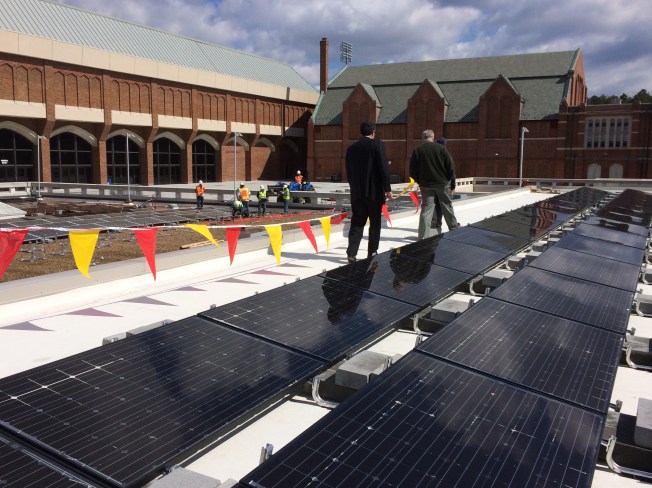
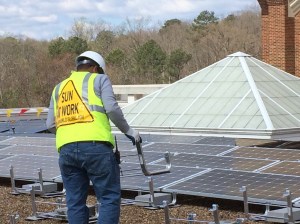
Colleges in APCo territory want to use PPAs to install solar facilities like the one recently installed at the University of Richmond, in Dominion territory.

Colleges in APCo territory want to use PPAs to install solar facilities like the one recently installed at the University of Richmond, in Dominion territory.

Facing a withering report from a Virginia hearing examiner recommending denial of its request for a renewable energy “Rider RGP,” Appalachian Power Company (APCo) has responded with a simple message to the State Corporation Commission: um, never mind.

APCo proposed Rider RGP as an alternative to third-party power purchase agreements (PPAs) for customers wanting to install rooftop solar. The proposal would have put APCo in the middle of the deal and created a buy-all, sell-all scheme. But the proposal was roundly criticized at last year’s hearing and in witness statements as convoluted and expensive.

On September 19 APCo asked to withdraw its application, citing changed circumstances. In reality, of course, nothing has changed since the Hearing Examiner’s August 31 report, other than APCo learning it was about to lose.

The company probably doesn’t mind being rejected for a program that witnesses said no one would sign up for. The much bigger issue for the company is that if the SCC adopts the hearing examiner’s view, APCo could lose its battle to block PPAs in its service territory.

For those of you just coming to the story, here’s the Cliff Notes version (this earlier post has the unabridged telling): APCo’s customers want the ability to install solar on their property through PPAs, a financing arrangement in which a solar developer installs and owns the panels, selling the electricity that’s generated to the customer. Often this means the customer can reduce its electricity bills without incurring an up-front cost. For tax-exempt institutions like colleges that can’t take advantage of the federal 30% tax credit for solar, the PPA model means the developer can take the tax credit and pass along the savings.

Virginia utilities say this arrangement violates their monopoly on the sale of electricity. Customers point to two statutory provisions that make PPAs legal. One provision allows customers to buy renewable energy from third parties if their utility doesn’t offer it. (No utility in Virginia does.) The other provision defines a net metering customer to include one who contracts with someone else to install and operate a solar facility on the customer’s property—an apt description of a PPA arrangement. Customers would seem to have the better of the argument, surely, but no bank will finance a PPA when a deep-pocketed utility is threatening to sue.

Dominion temporarily settled the issue in its territory with a pilot program that allows some PPAs, but APCo declined to participate. Under pressure from educational institutions that want solar, APCo proposed Rider RGP as an alternative for its territory. Customers and solar advocates seized the opportunity to seek a clear ruling from the SCC on the legality of PPAs. They argued, and the Hearing Examiner agreed, that Rider RGP wasn’t just badly designed, but unnecessary, given the provisions of the statute that already allow PPAs.

APCo doesn’t want the SCC commissioners to confirm this conclusion. It hopes that by withdrawing Rider RGP, the SCC will dismiss the case and not reach the merits of the argument on PPA legality. It is urging the SCC not to consider the point at all, or if it does so, not to take it up until it considers APCo’s plan, announced in April, to offer a green tariff to customers.

That green tariff is the “changed circumstances” APCo says makes Rider RGP unnecessary. If the SCC approves the green tariff, APCo will offer to sell real renewable energy to customers who want it. APCo clearly believes that having that tariff available to customers closes off the statutory provision that allows customers to go to third-party sellers if their own utility doesn’t offer renewable energy.

The green tariff would not, however, affect the legality of PPAs under the other statutory provision, the one that defines net metering customers to include those who have renewable energy facilities located on their property but owned and operated by someone else. Nor does the offer of a green tariff seem likely to satisfy customer demand for PPAs; buying electricity from a utility through a green tariff is a very different animal from having solar panels on your own roof.

The SCC is considering APCo’s request to withdraw its proposal for Rider RGP. It issued an order asking the parties to the case to comment by September 26. Advocates are expected to oppose APCo’s request and to ask the SCC to rule definitively on the legality of PPAs. By doing so, the Commission would finally bring legal clarity to an issue that has been holding back solar development in Virginia.


Update: September 26, Dominion Virginia Power filed a motion to intervene out of time, with a brief begging the SCC not to even look at the legality of PPAs, or if it did, to reject the hearing examiner’s reading of the statute on the grounds that her opinion disagrees with Dominion’s.  Dominion’s brief notes that it wrote its own opinion into a tariff, which the SCC approved, and therefore that ought to be more important than whatever the General Assembly actually said.

On October 7, the SCC allowed APCo to withdraw its proposal, ducking the issue of PPA legality and ensuring that more time and money will be wasted on future proceedings.

Unknown's avatar

Your 2016 guide to Virginia wind and solar policy

[NOTE: The 2017 Guide is now available. You can find it here.]

I could make short work of this year’s update by saying that not much has changed in the way of Virginia renewable energy policy in the past year. The General Assembly punted on almost all of the relevant bills that were presented this winter, and a subcommittee that was formed to review those bills has taken no action to date.

But if the policies haven’t changed, the landscape has. While our legislators sat on their hands, everyone else embarked on what, for Virginia, amounts to a solar binge. Dominion Virginia Power began making good on a pledge to install 400 megawatts (MW) of solar in state by the end of the decade. The Governor has taken the first steps to fulfill a pledge to have state agencies meet 8% of their electric demand with solar. Large corporations suddenly want to take advantage of low solar prices and favorable tax policies to do deals in Virginia. Residents are flocking to bulk purchasing cooperatives for rooftop solar. A few universities and schools are using third-party power purchase agreements (PPAs) to install solar under the limited provisions of Dominion Power’s pilot program.

Very little of this is reflected in the statistics—yet. According to the Solar Energy Industries Association, Virginia increased its total renewable energy capacity from 14 MW at the end of 2014 to 22 MW at the end of 2015. A few years ago, an increase of more than 50% would have been amazing. Today we just have to point out that 22 MW is how much solar capacity North Carolina installs on average every single week.

  1. The further we go, the behinder we get
Maryland North Carolina W. Virginia Tennessee Virginia
Solar* 465 2,294 3.4 132 22
Wind** 190 0 583 29 0
Total 655 2,294 586 161 22

Installed capacity measured in megawatts (MW) at the end of 2015. One megawatt is equal to 1,000 kilowatts (kW).

*Source: Solar Energy Industries Association **Source: American Wind Energy Association 

This year we will show real progress. Based on the projects announced to date, Virginia will likely have more than 200 MW of solar online by the end of 2016, with more projects in the queue for 2017. So we are headed in the right direction, but these numbers still represent only a tiny fraction of what we could see if we removed the barriers currently holding back private investment in the solar industry and pushed our utilities to make renewables central to their planning.

Moreover, we still have no wind farms in the state, and neither of our investor-owned utilities included Virginia wind in their latest Integrated Resource Plans (with the exception of Dominion Power’s two pilot offshore wind turbines, which probably won’t get built). The one bright spot on wind energy is that Apex Clean Energy continues to move forward with its Rocky Forge wind farm, scheduled for completion next year.

We also have to view Virginia’s progress on solar in the broader context of energy development. Dominion Virginia Power will have built 4,300 MW of new natural gas generation by the end of the decade and has indicated its interest in building far more. The company will add this to a portfolio that’s already 96% fossil fuel and nuclear. This summer two more companies announced plans to build natural gas plants in Virginia, aiming to burn some of the fracked gas that Dominion plans to bring through the Atlantic Coast Pipeline. When the state’s dominant utility is all-in on natural gas, it’s hard for a different energy model to find elbow room.

But we do have good solar and wind resources, and plenty of demand. What we need are policies that welcome participants to the market.

  1. Virginia utilities won’t sell wind or solar to customers*

(*except those with billions of dollars and famous CEOs—see section 14)

Currently, the average Virginia resident can’t pick up the phone and call their utility to buy electricity generated by wind and solar farms. Worse, they can’t buy renewable energy elsewhere, either.

This wasn’t supposed to happen. Section 56-577(A)(6) of the Virginia code allows utilities to offer “green power” tariffs, and if they don’t, customers are supposed to be able to go elsewhere for it. Ideally, a utility would use money from voluntary green power programs to build or buy renewable energy for these customers. However, Virginia utilities have not done this, except in very tiny amounts. Instead, utilities pay brokers to buy renewable energy certificates (RECs) on behalf of the participants. Participation by consumers is voluntary. Participants sign up and agree to be billed extra on their power bills for the service. Meanwhile, they still run their homes and businesses on regular “brown” power, which is not what they want.

In Dominion’s case, these RECs meet a recognized national standard, and some of them originate with wind turbines, but they primarily represent power produced and consumed out of state, and thus have no effect on the power mix in Virginia. For a fuller discussion of the Dominion Green Power Program, see What’s wrong with Dominion’s Green Power Program.

Appalachian Power’s “green pricing” program is even worse, offering RECs from an 80 MW hydroelectric dam in West Virginia. No wind, and no solar.

Other REC programs are available to Virginia consumers. If you’re considering this route, read this post first.

The State Corporation Commission has ruled that REC-based programs do not qualify as selling renewable energy, so under the terms of §56-577(A)(6), customers are currently permitted to turn to other licensed suppliers of electric energy “to purchase electric energy provided 100 percent from renewable energy.”

So you should be able to go elsewhere to buy wind and solar—say, from a solar facility on someone else’s land, or even from a facility on your own rooftop that someone else owns and operates for you. (For more on that, see section 10 on third-party power purchase agreements.) But Virginia utilities claim that the statute’s words mean that not only must another licensed supplier provide 100% renewable energy, it must also supply 100% of the customer’s demand, all the time. Obviously, the owner of a wind farm or solar facility cannot do that. Ergo, say the utilities, a customer cannot go elsewhere.

On August 31, however, a hearing examiner for the SCC rejected this reading. If the SCC agrees, Virginia residents might have new options.

Anticipating the possibility of an adverse ruling from the SCC, this spring APCo filed a proposal with the SCC for a new tariff under of §56-577(A)(6). Instead of RECs, APCo now proposes to offer real green power, combining wind, solar and hydro. None of the power will come from new projects; partly as a result, the tariff will cost more. The SCC will hold a hearing on the proposal this fall. If approved, APCo customers would finally be able to order renewable energy from their utility. But it would also likely close off customers’ ability under the statute to turn to other suppliers of renewable energy.

Dominion has not yet followed APCo’s lead on this one. If the SCC rules that the statute means what it says, we would expect Dominion to offer a green power program consisting of true renewable energy. Indeed, Dominion seems to be working on a green tariff this fall that it is calling “community solar” (see next session). Its real interest may well be the same as APCo’s.

We hope the SCC will require both APCo and Dominion to follow best practices recommended by groups like Advanced Energy Economy Institute: “Utility renewable energy tariff programs must require that utilities build, purchase or contract for a portfolio of renewable energy through a competitive process, and charge customers according to the actual cost of the portfolio, whether that be a net premium or net savings for customers.”

  1. Community solar? Not hardly

Last year Dominion received SCC approval for a program it billed as an offer to sell electricity from solar panels. Notwithstanding its name, however, the “Dominion Community Solar” program is not an offer to sell electricity generated from solar energy, and reading the details, one can only conclude it would attract customers only to the extent they were deceived about it. Perhaps someone within Dominion pointed out to the brass how close this looks to consumer fraud; at any rate, a year has passed and the company still hasn’t launched it.

As for true community solar, only one Virginia utility offers it: a member-owned rural electric cooperative in southwestern Virginia called BARC. The rest of you are out of luck at the moment. Every year for the past several years, legislation has been introduced to support community solar, and every year it has died in the face of utility opposition.

A few bills this year would have enabled community solar, but they were “carried over to 2017”—i.e., killed. A small working group put together by the solar industry association and the utilities is currently trying to come up with a program that utilities will find acceptable. The group has issued a “Request for Information,” available online, and is holding public meetings this fall to get input on a proposal that looks much more like a green tariff than like community solar. (Clearly Dominion likes the name “community solar”–just not, you know, actual community solar.) Another group, the Distributed Solar Collaborative, which includes all stakeholders except utilities, is also evaluating models from other states and plans to put forward a true community solar alternative.

  1. Virginia’s Renewable Portfolio Standard (RPS) is a miserable sham

Many advocates focus on an RPS as a vehicle for inducing demand. In Virginia, that’s a mistake. Virginia has only a voluntary RPS, which means utilities have the option of participating but don’t have to. Any costs they incur in meeting the goals can be charged to ratepayers. Until a few years ago, utilities even got to collect bonus money as a reward for virtue, until it became clear that there was nothing very virtuous going on.

Making our RPS mandatory rather than voluntary would do nothing for wind and solar in Virginia without a complete overhaul. The statute takes a kitchen-sink approach to what counts as renewable energy, so meeting it requires no new investment and no wind or solar.

The targets are also modest to a fault. Although nominally promising 15% renewables by 2025, the statute sets a 2007 baseline and contains a sleight-of-hand in the definitions section by which the target is applied only to the amount of energy not produced by nuclear plants. The combined result is an effective 2025 target of about 7%.

The RPS is as impotent in practice as it is in theory. In the case of Dominion Virginia Power, the RPS has been met largely with old hydro projects built prior to World War II, trash incinerators, and wood burning, plus a small amount of landfill gas and—a Virginia peculiarity—RECs representing R&D rather than electric generation.

There appears to be no appetite in the General Assembly for making the RPS mandatory, and efforts to improve the voluntary goals have repeatedly failed in the face of utility or industry opposition. The utilities have offered no arguments why the goals should not be limited to new, high-value, in-state renewable projects, other than that it would cost more to meet them than to buy junk RECs.

But with the GA hostile to a mandatory RPS and too many parties with vested interests in keeping the kitchen-sink approach going, it is hard to imagine our RPS becoming transformed into a useful tool to incentivize wind and solar.

That doesn’t mean there is no role for legislatively-mandated wind and solar. But it would be easier to pass a bill with a simple, straightforward mandate for buying or building a certain number of megawatts than it would be to repair a hopelessly broken RPS.

  1. Customer-owned generation: for most, the only game in town

Given the lack of wind or solar options from utilities, people who want renewable energy generally have to build it themselves. A federal 30% tax credit makes it cost-effective for those with cash or access to low-cost financing, and bulk purchasing through nonprofits VA-SUN and LEAP makes the process easier and reduces costs.

Last year the GA passed legislation enabling Property Assessed Clean Energy (PACE) loans for commercial customers. Localities now have an option to offer low-cost financing for energy efficiency and renewable energy projects at the commercial level. A bill to extend PACE authorization to residential customers did not get out of committee this year.

Virginia offers no cash incentives or tax credits for wind or solar. The Virginia legislature passed a bill in 2014 that would offer an incentive, initially as a tax credit and then as a grant program, but it did not receive funding. The same bill, reintroduced in 2015, died in a subcommittee.

The lack of a true RPS in Virginia means Virginia utilities generally will not buy solar renewable energy certificates (SRECs) from customers. SRECs generated here can sometimes be sold to utilities in other states (as of now only Pennsylvania) or to brokers who sell to voluntary purchasers.

  1. Limits to net metering hamper growth

Section 56-594 of the Virginia code allows utility customers with wind and solar projects to net energy meter. System owners get credit from their utility for surplus electricity that’s fed into the grid at times of high output. That offsets the grid power they draw on when their systems are producing less than they need. Their monthly bills reflect only the net energy they draw from the grid.

If a system produces more than the customer uses in a month, the credits roll over to the next month. However, at the end of the year, the customer will be paid for any excess credits only by entering a power purchase agreement with the utility. This will likely be for a price that represents the utility’s “avoided cost” of about 4.5 cents, rather than the retail rate, which for homeowners is closer to 12 cents. This effectively stops most people from installing larger systems than they can use themselves.

Legislation passed in 2015 makes it less likely that new solar owners will have any surplus. At Dominion’s insistence, the definition of “eligible customer-generator” was amended to limit system sizes to no larger than needed to meet the customers demand, based on the previous 12 months of billing history. The SCC wrote implementing regulations (see 20VAC5-315-10 et seq.) but failed to address what happens with new construction. The solar trade association MDV-SEIA continues to work towards a solution to that problem.

The new limitation is a problem for other reasons as well. Some solar customers want to install larger systems than they previously needed because their business is expanding or they plan to buy an electric car. But the limitation is also stupid. If customers want to install more clean, renewable energy than they need and are willing to sell the surplus electricity into the grid at the wholesale power price, why would you stop them from performing this service to society? I can understand that the paperwork isn’t worth the hassle for very small amounts of excess electricity, but if there isn’t an app for that yet, I bet some Virginia Tech students could make one.

  1. Aggregated net metering allowed for farms only

Under a bill introduced by Delegate Randy Minchew (R-Leesburg) and passed in 2013, owners of Virginia farms with more than one electric meter are permitted to attribute the electricity produced by a system that serves one meter (say, on a barn) to other meters on the property (the farmhouse and other outbuildings). This is referred to as “agricultural net metering.” Efforts to expand aggregated net metering beyond farms have not succeeded.

  1. Standby charges hobble the market for larger home systems and electric cars

Dominion Power and Appalachian Power are at the forefront of a national pushback against policies like net metering that facilitate customer-owned generation.

The current system capacity limit for net-metered solar installations is 1 MW for commercial, 20 kW for residential. However, for residential systems between 10 kW and 20 kW, a utility is allowed to apply to the State Corporation Commission to impose a “standby” charge on those customers.

Seizing the opportunity, Dominion won the right to impose a standby charge of up to about $60 per month on these larger systems, eviscerating the market for them just as electric cars were increasing interest in larger systems. (SCC case PUE- 2011-00088.) Legislative efforts to roll back the standby charges were unsuccessful, and more recently, Appalachian Power instituted even more extreme standby charges. (PUE-2014-00026.)

The standby charges supposedly represent the extra costs to the grid for transmission and distribution, though there is a great deal of disagreement on that score, and a lot of suspicion that utilities’ real concern is that they will make less money as demand for their dirty energy product falls.

In the summer of 2013, in a filing with the SCC (PUE-2012-00064, Virginia Electric and Power Company’s Net Metering Generation Impacts Report), Dominion claimed it could also justify standby charges for its generation costs, and indicated it expected to seek them after a year of operating its Solar Purchase Program (see discussion below). As far as I can tell, it hasn’t carried out this threat yet, and it would likely need legislation to do so.

  1. Good news for residential solar: homeowner association bans are largely a thing of the past

Homeowner association (HOA) bans and restrictions on solar systems have been a problem for residential solar. In the 2014 session, the legislature nullified bans as contrary to public policy. The law contains an exception for bans that are recorded in the land deeds, but this is said to be highly unusual; most bans are simply written into HOA covenants. In April of 2015 the Virginia Attorney issued an opinion letter confirming that unrecorded HOA bans on solar are no longer legal.

Even where HOAs cannot ban solar installations, they can impose “reasonable restrictions concerning the size, place and manner of placement.” This language is undefined. The Maryland-DC-Virginia Solar Energy Industries Association has published a guide for HOAs on this topic.

  1. Virginia utilities continue their fight against PPAs; now a losing battle?

One of the primary drivers of solar installations in other states has been third-party ownership of the systems, including third-party power purchase agreements (PPAs), under which the customer pays only for the power produced by the system. For customers that pay no taxes, including non-profit entities like churches and colleges, this is especially important because they can’t use the 30% federal tax credit to reduce the cost of the system if they purchase it directly. Under a PPA, the system owner can take the tax credit (as well as accelerated depreciation) and pass along the savings in the form of a lower electricity price.

The Virginia Code seems to sanction this approach to financing solar facilities in its net metering provisions, specifically §56-594, which authorizes a “customer generator” to net meter, and defines an eligible customer generator as “a customer that owns and operates, or contracts with other persons to own or operate, or both, an electrical generating facility that . . . uses as its total source of fuel renewable energy. . . “

Notwithstanding this provision, in 2011, when Washington & Lee University attempted to use a PPA to finance a solar array on its campus, Dominion Virginia Power issued cease and desist letters to the university and its Staunton-based solar provider, Secure Futures LLC. Dominion claimed the arrangement violated its monopoly on power sales within its territory. Secure Futures and the university thought that even if what was really just a financing arrangement somehow fell afoul of Dominion’s monopoly, surely they were covered by the exception in §56-577(A)(6) available to customers whose own utilities do not offer 100% renewable energy. (See Section 2, above.)

Yet the threat of prolonged and costly litigation was too much. The parties turned the PPA contract into a lease, allowing the solar installation to proceed but without the advantages of a PPA.

After a long and very public fight in the legislature and the press, in 2013 Dominion and the solar industry negotiated a compromise that specifically allows customers in Dominion territory to use third-party PPAs to install solar or wind projects under a pilot program capped at 50 MW. Projects must have a minimum size of 50 kW, unless the customer is a tax-exempt entity, in which case there is no minimum. Projects can be as large as 1 MW. The SCC is supposed to review the program every two years beginning in 2015 and has authority to make changes to it. I’m not aware the SCC has reviewed the program to date.

Appalachian Power and the electric cooperatives declined to participate in the PPA deal-making, so the legal uncertainty about PPAs continues in their territories. In June of 2015, Appalachian Power proposed an alternative to PPAs. An evidentiary hearing was held September 29, 2015. A veritable parade of witnesses testified that APCo”s program was expensive, unworkable and unnecessary, given the plain language of the statute allowing PPAs.

Almost a year later, on August 31, 2016, the hearing examiner finally issued her report, recommending that APCo’s application be rejected, both because it is a lousy program and because she, too, reads the Code to allow PPAs currently, making a utility alternative unnecessary. If the commissioners agree with her, this would be a victory for the solar industry and customers. How useful it will be depends on the scope of the final order, however, and on how they view APCo’s effort to close off the opening afforded by §56-577(A)(6) by offering its own renewable energy product.

The problem cries out for a legislative fix. Advocates pushed hard for legislation this year that would open the Virginia market to private investment through third-party PPAs; but as previously noted, the Commerce and Labor committees ducked their responsibilities and failed to act on the bills.

Meanwhile, Secure Futures has developed a third-party-ownership business model that it says works like a PPA for tax purposes but does not include the sale of electricity, and therefore should not trigger a challenge from Appalachian Power or other utilities. Currently Secure Futures is the only solar provider offering this option, which it calls a Customer Self-Generation Agreement.

  1. Tax exemption for third-party owned solar proves a market driver

In 2014 the General Assembly passed a law exempting solar generating equipment “owned or operated by a business” from state and local taxation for installations up to 20 MW. It did this by classifying solar equipment as “pollution abatement equipment.” Note that this applies only to the equipment, not to the buildings or land underlying the installation, so real estate taxes aren’t affected.

The law was a response to a problem that local “machinery and tools” taxes were mostly so high as to make third-party PPAs uneconomic in Virginia. In a state where solar was already on the margin, the tax could be a deal-breaker.

The 20 MW cap was included at the request of the Virginia Municipal League and the Virginia Association of Counties, and it seemed at the time like such a high cap as to be irrelevant. However, with solar increasingly attractive economically, Virginia’s tax exemption rapidly became a draw for solar developers, including Virginia utilities.

In 2016 Dominion proposed changing the exemption to benefit its own projects at the expense of those of independent developers. In the end, the statute was amended in a way that benefits utility-scale projects without unduly harming smaller projects. Many new projects will now be only 80% exempt, rather than entirely exempt. However, the details are complex, with different timelines and different size classes, and anyone looking to use this provision should study it carefully.

  1. Dominion “Solar Partnership” Program encounters limited success

In 2011, the General Assembly passed a law allowing Dominion to build up to 30 MW of solar energy on leased property, such as roof space on a college or commercial establishment. The SCC approved $80 million of spending, to be partially offset by selling the RECs (meaning the solar energy would not be used to meet Virginia’s RPS goals). The program has resulted in several commercial-scale projects on university campuses and corporate buildings. Unfortunately, it has also been plagued by delays and over-spending.

The program was supposed to proceed in two phases, with 10 MW in place by the end of 2013, and another 20 MW by December 31, 2015. However, the program got off to a very slow start. In August of 2014 the company acknowledged it was behind schedule and would likely not achieve more than 13 or 14 MW of the 30 MW authorized before it ran out of money. On May 7, 2015 Dominion filed a notice with the SCC that it needed to extend the phase 2 end date to December 31, 2016, and confirmed that it would install less than 20 MW altogether.

Although Dominion’s web page suggests that it is still taking applications, I’m doubtful.

  1. Dominion’s Solar Purchase Program: bad for sellers, bad for buyers, and not popular with anyone

The same legislation that enabled the “Solar Partnership” initiative also authorized Dominion to establish “an alternative to net metering” as part of the demonstration program. The alternative turned out to be a buy-all, sell-all deal for up to 3 MW of customer-owned solar. As approved by the SCC, the program allows owners of small solar systems on homes and businesses to sell the power and the associated RECs to Dominion at 15 cents/kWh, while buying regular grid power at retail for their own use. Dominion then sells the power to the Green Power Program at an enormous markup.

I ripped this program from the perspective of the Green Power Program buyers, but the program is also a bad deal for most sellers. Some installers who have looked at it say it’s not worth the hassle given the costs involved and the likelihood that the payments represent taxable income to the homeowner. There is also a possibility that selling the electricity may make homeowners ineligible for the 30% federal tax credit on the purchase of their system. Sellers beware.

And then there’s the problem that selling the solar power means you aren’t powering your home or business with solar—which is the whole point of installing it, right?

  1. Dominion’s Renewable Generation tariff for large users of energy finds no takers; Amazon forces a change, with a new tariff in the works that will be available to others

Currently non-utility renewable energy facilities are subject to a size limit of 1 MW for net-metered projects. These limitations constrain universities, corporations, data centers, and other large users of energy that might want to run on wind or solar. On top of this, the utilities’ interpretation of Virginia law prohibits a developer from building a wind farm or a solar array and selling the power directly to users under a power purchase agreement.

In 2013, Dominion Power rolled out a Renewable Generation Tariff (PUE-2012-00142) to allow customers to buy larger amounts of renewable power from providers, with the utility acting as a go-between and collecting a monthly administrative fee.

From the start the program appeared cumbersome and bureaucratic, and Dominion confirmed to me this summer that they have never had any takers. Then suddenly last year, Amazon Web Services made Dominion’s tariff irrelevant. Amazon contracted directly with a developer for an 80 MW solar farm, avoiding Dominion’s monopoly restrictions with a plan to sell the electricity directly into the PJM (wholesale) market. Dominion Energy (an affiliate of Dominion Virginia Power) then bought the project, and Dominion Virginia Power negotiated a special rate with Amazon for the power. This contract became the basis for an “experimental” tariff that Dominion proposes to offer to customers with a peak demand of 5 MW or more, with a program cap of 200 MW. A hearing examiner at the SCC has recommended approval of the special rate.

Dominion used a different model for its deal this year with Microsoft. After the SCC turned down Dominion’s application to charge ratepayers for a 20-MW solar farm in Remington, Virginia, Dominion reached an agreement with Microsoft and the Commonwealth of Virginia under which the state will buy the output of the project, while Microsoft buys the RECs.

Dominion has a strong incentive to make deals with large corporations that want a lot of renewable energy: if they don’t like what Dominion is offering, they can do an end run around the utility. Amazon has shown other companies how to use PJM rules that let anyone develop projects for the wholesale market regardless of utility monopolies, and then “attribute” the solar or wind energy to their operations in any state. With the tax exemption discussed in section 11, Virginia projects apparently now pencil out pretty well.

  1. Dominion moves into utility-scale solar

Well before Amazon and Microsoft showed an interest in large-scale solar projects here, Dominion had announced it wanted to develop 400 MW of solar in Virginia. In 2015, at the utility’s behest, two bills promoted the construction of utility-scale solar by declaring it in the public interest for utilities to build solar energy projects of at least 1 MW, and up to an aggregate of 500 MW. The bill was amended at the solar industry’s behest to allow utilities the alternative of entering into PPAs for solar power prior to purchasing the generation facilities at a later date, an option with significant tax advantages.

Dominion’s first solar project will be a 20 MW solar farm in Remington, Virginia; however, the SCC rejected the company’s plan to charge ratepayers for the project because the company had not considered cheaper third-party alternatives. Governor McAuliffe helped save the project by working out a deal with Microsoft, as discussed above. Meanwhile, Dominion had also solicited bids for additional projects. To date, three have been announced, totaling 56 MW.

Although Dominion will be able to charge ratepayers for these projects, the SCC insists that the RECs be sold—whether to utilities in other states that have RPS obligations, or to customers who want them for their own sustainability goals, or perhaps even to voluntary green power customers. The result is that Dominion still won’t have any solar in its fuel mix. That’s the weird world of RECs for you.

  1. Governor McAuliffe promises the state will purchase 110 MW of solar

Following a recommendation by the Governor’s Climate Change and Resiliency Commission, on December 21, 2015, Governor McAuliffe announced that the Commonwealth would commit to procuring 8% of its electricity from solar, with 75% of that built by Dominion and 25% by private developers.

The first deal that will count towards this goal is an 18 MW project at Naval Station Oceana, announced on August 2, 2016. The Commonwealth will buy the power and the RECs. (The Remington Project did not count, because as the buyer of the RECs, only Microsoft can claim the right to be buying solar power.)

  1. Will a Solar Development Authority help?

One of the MacAuliffe Administration’s initiatives last year was a bill to establish the Virginia Solar Development Authority. The Authority is explicitly tasked with helping utilities find financing for solar projects; there is no similar language about supporting customer-owned solar. So far, nothing seems to have come of it.

  1. Any wind energy yet? Nope, still waiting

No Virginia utility is actively moving forward with a wind farm on land. Dominion Power’s website used to list 248 MW of land-based wind in Virginia as “under development,” without any noticeable progress. Now it just says 247 MW are “being evaluated.” That’s closer to reality, but they probably should put it in the past tense. There has been a lot of press about the standoff in Tazewell County, where supervisors blocked Dominion’s proposed wind farm. Today, Dominion’s advocacy for its project feels perfunctory. The company has signaled it prefers solar, and its 2016 IRP dismisses wind as too costly.

On the other hand, Appalachian Power’s IRP suggests an interest in wind as a low-cost renewable resource. The bad news is that it isn’t proposing to build any new wind in Virginia.

With no utility buyers, Virginia has not been a friendly place for independent wind developers. In previous years a few wind farm proposals made it to the permitting stage before being abandoned, including in Highland County and on Poor Mountain near Roanoke.

Nonetheless, Apex Clean Energy is in the development stages for the 75-MW Rocky Forge wind farm in Botetourt County. No customer has been announced, but the company believes the project can produce electricity at a competitive price, given its good location and improved turbine technology. Construction is planned for 2017.

As for Virginia’s great offshore wind resource, little progress has been made towards harnessing it, even as the nation’s first offshore wind project will begin generating electricity this fall in the waters off Rhode Island. In 2013 Dominion won the federal auction for the right to develop about 2,000 MW of wind power off Virginia Beach, and the company completed a Site Assessment Plan (SAP) this spring.

We had originally been told the federal government’s timeline would lead to wind turbines being built off Virginia Beach around 2020. Now, however, the Bureau of Ocean Energy Management says Dominion has five years from approval of the SAP to submit its construction and operations plan, after which we’ll have to wait for review and approval. Presumably the project will also require an environmental impact statement. So the whole process would be quite slow even if Dominion were committed to moving forward expeditiously. But in fact, it seems increasingly clear that Dominion is just going through the motions and has no interest in seeing the project through. Its 2016 Integrated Resource Plan (IRP) does not even include offshore wind in any of its scenarios for the next 15 years, except for the 12 MW that would be produced by the two test turbines of its VOWTAP project.

Yes, so what about VOWTAP? Dominion had been part of a Department of Energy-funded team to try out new technology, with the pilot turbines due to be installed in 2017. After a second round of bids to build the project still came in higher than expected, Dominion told DOE this spring it could not commit to construction even by 2020, upon which DOE pulled funding. Dominion executives swear the project isn’t necessarily dead, but that puts me in mind of the “ex-parrot” in the Monty Python skit, still on its perch only because it’s been nailed there.

  1. The Clean Power Plan tries to make it better to switch than fight

On August 3, 2015, EPA issued the final rule known as the Clean Power Plan. Under the rule, states with existing fossil-fuel generating plants must develop plans to reduce total carbon pollution from power plants, which could include using renewable energy as an offset to fossil fuel. In Virginia, the task of developing a state implementation plan (SIP) falls to the Department of Environmental Quality. Earlier this year the Supreme Court stayed implementation of the EPA rule while a Circuit Court considers a challenge, following which Virginia Republicans pushed through a budget provision prohibiting DEQ from developing a SIP while the federal rule is stayed.

Assuming the Clean Power Plan survives challenge, it could help incentivize construction of wind and solar facilities. While Virginia’s goals under the plan are modest, the rule means the state, utilities and the SCC must for the first time take carbon emissions into account in their planning. The EPA has signaled a strong interest in seeing wind and solar deployed as solutions.

Unknown's avatar

Virginia hearing examiner says renewable energy PPAs are legal, but will the ruling stick?

A third-party PPA made it possible to build this solar facility at the University of Richmond. Appalachian Power Company contends that a project like this would be illegal in its territory.

A third-party PPA made it possible to build this solar facility at the University of Richmond. Appalachian Power Company contends that a project like this would be illegal in its territory.

A hearing examiner for the Virginia State Corporation Commission recommended on August 31 that the SCC reject Appalachian Power Company’s proposed alternative to third-party power purchase agreements (PPAs) for renewable energy, concluding the program is not in the public interest. The parties will have three weeks to comment before the recommendation goes to the Commissioners for a final decision. The case is PUE-2015-00040.

The ruling against APCo’s proposed Rider RGP is less important to customers than the reasoning behind it. In addition to finding a myriad of faults with the proposal, the Hearing Examiner concluded it isn’t needed because PPAs are already legal under the Virginia Code. This is an outcome long sought by the solar industry and environmental groups, and one supported by the Attorney General’s Office of Consumer Counsel.

However, the Hearing Examiner’s report is merely a recommendation. Nothing is final until the Commissioners rule, and they could make a decision about Rider RGP without addressing the current legality of PPAs. Moreover, earlier this year, APCo proposed another program that it clearly hopes will nip in the bud any surge of PPA activity that might result from a decision in the present case. (I’ll get to that in a moment.)

The rejection of Rider RGP won’t disappoint any would-be customers. A long line of witnesses testified at the hearing on September 29, 2015 that APCo’s expensive and convoluted program would find no takers. As the Solar Research Institute summarized it, the proposed Rider RGP “would require a customer interested in a solar PPA to first pay for 100% of their service under the standard tariff, pay for 100% of the solar energy generated, pay a $30 program fee, and receive excess payments back through a Renewable Output Credit.” Oh, and they still wouldn’t be using renewable energy. (Note that although solar energy was the focus of the discussion for participants, the decision applies to other forms of renewable energy as well.)

The SCC staff made some suggestions to improve the program, but the hearing examiner, Deborah Ellenberg, concluded it was really beyond saving. Not only that, but the plain language of the Virginia Code makes third-party PPAs legal in the state already. Thus, there is no need for a utility-sponsored alternative.

Ellenberg pointed to two statutory provisions that support the legality of third-party PPAs. First, Virginia Code §56-577 A 5 provides that customers may purchase renewable energy from third-party sellers if their own utility does not offer a tariff for renewable energy. Specifically, customers may:

[P]urchase electric energy provided 100 percent from renewable energy from any supplier of electric energy licensed to sell retail electric energy within the Commonwealth . . . if the incumbent electric utility serving the exclusive service territory does not offer an approved tariff for electric energy provided 100 percent from renewable energy. . . .

Until now, APCo has offered only a green power program that sells RECs, which the SCC says doesn’t count.

The language of §56-577 sounds clear enough, but APCo and Dominion Power have maintained that this section only allows customers to go elsewhere if the other supplier can provide 100% of their electricity from renewable energy, something that can’t be done with a solar facility or a wind turbine.

This flimsy reading of the statute was the basis on which Dominion challenged a PPA at Washington and Lee University back in 2011. The issue was temporarily resolved two years later when Dominion and the solar industry agreed to a pilot program that now allows a limited number of PPAs in Dominion territory, under tight parameters that exclude residential customers. The program never applied in APCo territory, however—a sore point to customers there. APCo has clung to its reading of §56-577, regardless of the growing clamor for renewable energy in southwestern Virginia.

Ellenberg’s report flatly rejects the utility interpretation. If the SCC adopts her reading, any customer in APCo territory would be free to buy renewable energy from third-party suppliers, until APCo offers a qualifying program.

Ellenberg also cited Virginia’s net metering statute. Virginia Code §56-594 authorizes “customer generators” to enter into behind-the-meter PPAs with third parties that own and operate a renewable facility for the customer. Code §56-594 B defines an eligible customer generator for net metering purposes as “a customer that owns and operates, or contracts with other persons to own or operate, or both, an electrical generating facility that . . . uses as its total source of fuel renewable energy . . .” (emphasis added).

Interpreting this provision takes no special legal talent, surely. It would seem to cover residential and commercial facilities installed and owned by third-party developers, including the familiar no-money-down contract offered to residential customers by Solar City. But again, APCo and Dominion Virginia Power claim the Code doesn’t mean what it says. For more than five years they’ve backed up their position with threats of lawsuits, creating the kind of uncertainty that is toxic to development deals.

If the SCC’s final order endorses the hearing examiner’s finding that PPAs are currently legal, the result could be to open up the Virginia solar (and wind) market to large amounts of private investment statewide.

However, Ellenberg’s finding that PPAs are currently legal appears in her discussion but not in her recommendations to the commissioners; her recommendations are limited to the actions she proposes (rejecting or modifying the tariff). The SCC does not have to rule on the question of PPA legality in order to decide this case. Surely, though, it would be strange if it were to duck the opportunity now that the issue has been fully briefed. With solar a hot commodity across the state, the current legal limbo has become a significant economic drag that the SCC ought not to ignore.

As I mentioned, though, APCo still has one card up its sleeve. This spring it proposed a new tariff to offer its customers 100% renewable energy derived from existing wind, solar and hydro projects. The product appears to meet the condition of §56-577. If approved, it would slam shut the door that the Hearing Examiner just opened (or rather, that she said was open all along, if you had dared to go through it into the toxic miasma where gray-suited lawyers lay in wait). APCo’s request for approval of the tariff (PUE-2016-00051) is scheduled to be heard by the SCC on November 15, with comments due by November 8.

Solar advocates take a dim view of APCo’s move. The new tariff won’t build any new facilities; it simply shifts the burden of paying for existing renewable energy projects onto volunteers, at a significant premium. In today’s market, third-party developers can offer electricity generated by new solar projects at competitive prices. So APCo’s tariff looks less like an accommodation to its eco-conscious customers, and more like a maneuver to prevent anyone from building solar on its turf.

It’s high time the SCC put a stop to this anti-competitive behavior and let Virginians build solar projects with their own money. The Commissioners can follow the Hearing Examiner’s advice, or they can take a pragmatic approach and recognize that PPAs are really just a way to finance projects. They don’t turn solar developers into utilities, and APCo should stop wasting everyone’s time and money blocking private investment in a part of the Commonwealth that desperately needs it.

Unknown's avatar

Yay, Dominion is building solar! Just not for you.

solar installation public domainThis week’s news of an 18 megawatt solar facility to be installed at Naval Station Oceana in Newport News marks the latest in a string of announcements of new solar projects to be built in Virginia. The Commonwealth had only about 22 megawatts of solar installed as of the end of 2015, but by the end of this year, we should be comfortably into the triple digits. That’s still trivial compared to neighboring North Carolina, which added over 1,000 megawatts last year alone, but it’s grounds for celebration here in the “dark state.”

How is this happening? Customer demand, coupled with falling costs, finally wrought a change of attitude at Dominion Virginia Power. The state’s largest utility dragged its feet on solar for years until announcing, in early 2015, plans to spend $700 million on 400 megawatts of solar power in Virginia by 2020.

The welcome change comes with a caveat: while these new projects will supply solar to important and influential customers like Microsoft, Amazon, and even the state government itself, Dominion offers no programs to supply solar to ordinary Virginians. And indeed, even where ratepayers are footing the bill for projects, our regulators insist that the renewable energy certificates—the right to say it’s solar power—should be sold to someone else.

Dominion’s early adventures in solar were not altogether encouraging. In 2012 the General Assembly authorized the utility to “study” solar by building up to 30 megawatts of distributed (mostly rooftop) projects. The SCC approved $80 million for the “Solar Partnership Program” the following year, with the stipulation that Dominion should sell the renewable energy certificates to reduce the cost to ratepayers. A steep learning curve made for slow and expensive going, and while a number of schools, universities and commercial businesses signed up to host projects, they weren’t permitted to purchase the solar energy being produced right on their property.

In 2013, Dominion created a special tariff “Schedule RG” especially to allow commercial customers to buy renewable energy. Cumbersome, limited and expensive, it never attracted any takers. Dominion spokesman David Botkins suggested to reporters last May the problem was Dominion’s low rates. As in, who wants renewable energy when dirty power is so cheap?

That was one month before Amazon Web Services announced it had contracted for the output of an 80 megawatt solar farm to be built in Accomack County. The project sidestepped Dominion’s limitations by feeding power directly into the Delmarva Power grid in Maryland. Dominion promptly bought the project.

Schedule RG was clearly a failure, but just as clearly, there was money to be made on solar. Dominion just needed to figure out how.

The utility was already trying. In January of 2015 Dominion proposed to build a 20 megawatt solar farm near Remington, Virginia. The State Corporation Commission (SCC) originally rejected Dominion’s proposal, saying the company had not considered third-party alternatives that might be cheaper for ratepayers. (They were proved right when it turned out the Amazon project was slated to deliver power at a cost that was 25% less.)

Dominion didn’t give up on Remington, nor was it willing to turn the project over to a private developer. Instead, it got to work rejiggering the deal into what, this spring, became a public-private partnership. Governor McAuliffe arranged to have the state government, rather than ratepayers, buy the power output from Dominion, while Microsoft agreed to buy the renewable energy certificates (RECs) to meet its corporate commitment to buying renewable energy. (In every solar deal, watch what happens to the RECs.*)

Although I wondered at the time if the state might be taking a financial hit to make the deal work, more recent information suggests the opposite. According to Dominion’s website, “the construction and deployment of this solar asset will lower the cost of the energy purchased by the Commonwealth. The Commonwealth is projected to save $500,000 to $1M in energy costs over the lifetime of the project.”

This tells us two things: one, obviously, we should sell more solar to Microsoft. And two, either the website omits key details about the financing, or the cost of energy produced by solar panels is now pretty darn competitive.

The projects have started coming in more quickly in recent months. In February of this year, Dominion announced it would buy the output of a 20 megawatt solar farm in Chesapeake through a power purchase agreement (PPA) with a North Carolina developer. Other PPAs are said to be under consideration.

Then, on June 30, the SCC gave Dominion approval to move forward on building three new projects totaling 56 megawatts in Powhatan, Louisa, and Isle of Wight counties. The 800 local jobs associated with the projects sparked news stories across the state.

That brings us to this week’s announcement of the deal with the Commonwealth and the Department of the Navy at Oceana. According to Dominion’s press release, Dominion Virginia Power will own and operate the facility, and the Commonwealth will buy the electricity, with Dominion retiring the RECs on the Commonwealth’s behalf.

Deputy Secretary of Commerce Hayes Framme confirmed to me this deal is the first step toward satisfying Governor McAuliffe’s commitment to having the state government get 8% of its power from solar by the time he leaves office, an amount equal to roughly 110 megawatts. That should mean there will be more announcements to come.

The Navy’s role here is especially interesting. Although some news outlets reported the Navy would buy the electricity, this appears to be a misreading of the Navy’s press release. Naval Station Oceana will instead receive “in-kind consideration in the form of electrical infrastructure upgrades” for hosting the project on its land. But the press release dwells mainly on the benefit to the regional grid that serves the naval station:

“Renewable energy projects, like the one at NAS Oceana and others throughout the Mid-Atlantic Region, are win-win-win collaborations. They’re good for the utility companies, good for our installations and good for the communities surrounding our installations,” said Rear Adm. Jack Scorby, Jr., commander, Navy Region Mid-Atlantic. “These projects increase the energy security, energy diversity and energy resiliency of our bases. Energy security, or having assured access to reliable supplies of energy and the ability to protect and deliver sufficient energy to meet mission-essential requirements, is critical to our installations’ roles to support the Fleet.”

The reference to “energy security, energy diversity and energy resiliency” is key here. The Navy will benefit from having a large renewable generation source onsite, one that can be protected from attack and that is not susceptible to fuel supply disruptions.

Come to think of it, “energy security, energy diversity and energy resiliency” are three of the prime reasons we need more solar projects all across the state, and why the benefits shouldn’t be limited to large, influential customers. So yay, Dominion, for getting rolling on all these solar projects! Now please stop blocking the way for the rest of us.


*RECs were invented as a way to identify units of electricity generated by wind, solar and other sources, since the electrons themselves can’t be dyed green. But RECs don’t have to just follow electrons around; they can also be bought and sold separately from the underlying electricity. When the RECs associated with a solar project are sold separately (in the case of the Remington solar project, to Microsoft), the electricity loses its green quality, and the buyer (in this case, the Commonwealth) can’t claim to be buying solar energy. For a fuller explanation of RECs, see this earlier post on the subject.

Unknown's avatar

Virginia’s energy future is up for discussion this Wednesday in Arlington

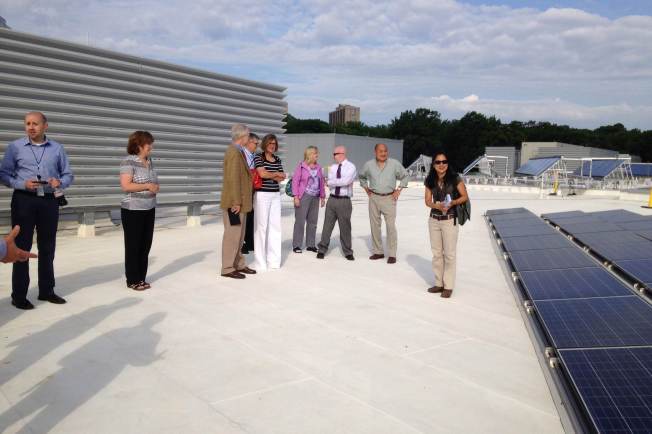
Visitors tour the solar installation on the roof of Wakefield HS in Arlington. Photo credit Phil Duncan

Visitors tour the solar installation on the roof of Wakefield HS in Arlington. Photo credit Phil Duncan

Those of you in Northern Virginia might be interested in attending a screening of the film “The Future of Energy” at the Arlington Cinema and Drafthouse on Wednesday, May 25 at 7:30 p.m. I will be leading a discussion of energy issues and the future of renewable energy in Virginia following the movie.

“The Future of Energy: Lateral Power to the People” is billed as “a positive film about the renewable energy revolution,” and “the people and communities leading the way towards a renewable energy future.” You can watch the trailer on the website of the Arlington Cinema and Drafthouse.

Arlingtonians for a Clean Environment (ACE) is hosting the screening. Tickets are $10, or $5 for students at the door. Doors open at 6:30, which is a good time to arrive if you want to order dinner and drinks and talk to some of the local environmental leaders who are attending.

ACE and the Sierra Club have teamed up on a campaign called “Ready for 100,” with a goal of leading Arlington and the city of Alexandria towards a goal of 100% renewable energy for the electric sector by 2035. ACE’s director, Elenor Hodges, and Dean Amel, Chair of the Mount Vernon Group of the Sierra Club, will be on hand to provide more information about the “Ready for 100” campaign. Arlington Energy Manager John Morrill will also be there to answer questions.

ACE is also working with VA-SUN on a new solar bulk-purchasing cooperative for Northern Virginia residents and businesses called the Potomac Solar Co-op and will have information available about it on Wednesday. An information session for the co-op is planned for June 8.

Arlington is already recognized for its leadership on clean energy, with groundbreaking projects like a net-zero-energy elementary school. But getting to 100% will take a truly determined, collective effort on the part of homeowners, businesses and local government. We will also likely need to see reforms to state policies and laws that currently present barriers to renewable energy. These state barriers affect all Virginians, so while Wednesday’s focus will be on Arlington, the discussion will be relevant to everyone who wants to see a clean energy future in Virginia.

Unknown's avatar

Virginia legislators named to review clean energy bills

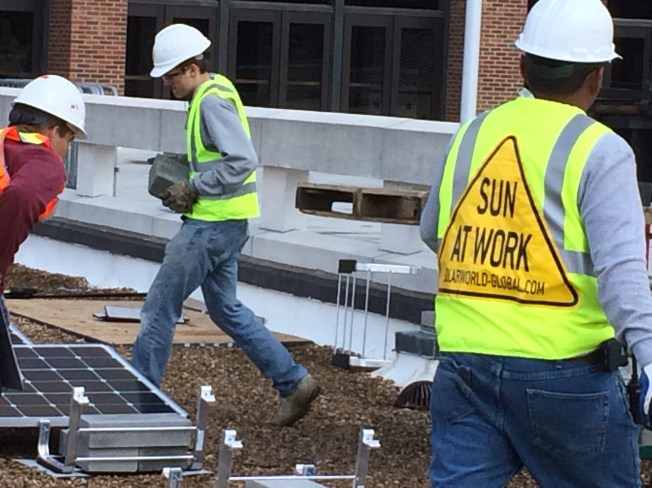
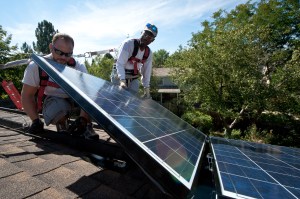
Workers install solar panels at the University of Richmond.

Workers install solar panels at the University of Richmond.

Virginia’s 2016 legislative session began with a host of worthy bills promoting energy efficiency, wind and solar, but ended with almost none of the legislation even having been considered in committee. The Republican chairmen of the Senate and House Commerce and Labor committees instead “carried over” the bulk of the bills, announcing plans for a new subcommittee to study them and make recommendations for 2017.

Members of the subcommittee have now been named. Senator Frank Wagner has tapped Senators Black, Cosgrove, Stuart and Dance to serve. This information is now on the General Assembly website. Delegate Terry Kilgore has named Delegates Ware, Hugo, Ransome, Miller and Keam.

No meeting schedule has been announced, but lobbyists for the utilities and the solar industry trade association, MDV-SEIA, have begun meeting in private to discuss potential compromises. This can’t be called a stakeholder process; the meetings are not open to the public, and they have not invited participation by environmentalists or, with one exception, anyone on the consumer side representing the interests of local government, colleges and universities, churches, eco-friendly businesses or residential customers.

(The exception is a lobbyist for Loudoun County landowner Karen Schaufeld, a newcomer to energy issues who formed a group called Powered by Facts and hired lobbyists to advocate for expanded agricultural net metering and other pro-solar reforms.)

Anything that emerges from these meetings will likely have a significant impact on the subcommittee. Yet, given the importance of this issue to the commonwealth, the subcommittee should ensure it hears from all solar stakeholders. More importantly, committee members should explicitly adopt as their measure of progress a simple test: whether the language of a bill will lead to greater private investment in solar in Virginia. Wagner and Kilgore have said they want to see the growth of solar here, and all of the legislators publicly subscribe to the values of free market competition and consumer choice. But without a guidepost, we are likely to see the utilities bully the solar industry into a “compromise” that shifts the ground a bit but continues to strangle the private market–and leaves us further than ever behind other states.

Who’s who on the committee

All of the legislators named to the study committee are Commerce and Labor committee members, but beyond that, many of these appointments are surprising, as they don’t necessarily reflect demonstrated interest in the subject. It is also disturbing that only one Democrat was named from each side. (Dance is the Senate Democrat, Keam the House Democrat. They are also the only minorities represented.) There is no reason energy efficiency and renewable energy should be partisan issues, but in the past, party affiliation has been the single most powerful predictor of votes on clean energy.

To gage how these legislators approach the issues, I took a look at the Sierra Club’s Climate and Energy Scorecard for 2014 and 2015. Scores for 2016 are not yet available. It is important to note that in the House, most renewable energy legislation has been killed by unrecorded voice votes in the Commerce and Labor subcommittee, preventing the votes from being scored. So the scorecard is only a starting point.

The Senators

Frank Wagner himself earned a D in 2015, with a voting percentage of 60%. This was up from an F in 2014. The Virginia Beach Republican is the only member on this subcommittee to have exhibited a serious interest in energy issues, having shaped many of Virginia’s current policies. Unfortunately, he is closely allied with Dominion Power, voted for tax subsidies for the coal industry, tends to doubt the reality of climate change, and has been sharply critical of the EPA Clean Power Plan. On the plus side, he believes renewable energy should play an important role and was instrumental in launching the state’s bid for offshore wind. He also genuinely welcomes input from the public at meetings he runs.

That makes his committee choices all the more peculiar. Dick Black is better known as a social crusader who lines up with the far right wing of his party, most notably in opposition to abortion, gay rights and gun limits. Most recently, he made headlines by meeting with Syrian president Bashar Assad and urging the U.S. to lift economics sanctions against the Assad regime.

Black is a climate denier of the delusional variety, insisting at an event last August that global temperatures have not risen in 17 years and that no major hurricanes have hit the American mainland in 9 years. (2014 was the hottest year on record until 2015 seized the trophy. Superstorm Sandy, the largest Atlantic hurricane on record, struck in 2012.)

The forum was an “American for Prosperity grassroots event” (sic). The “crowd of about 18 people” included former Senator Ken Cuccinelli, no slouch himself in the climate denial department. Black compared EPA employees to “Bolshevik communists.” He and Cuccinelli used the event to criticize the Clean Power Plan as “part of a government scheme to send billions in taxpayer funds to ‘wind and solar scams’ and ‘billionaire liberals.’”

He received a grade of F from the Sierra Club in both 2014 and 2015. With a voting percentage of just 14% last year, he had the worst record in the Senate on climate and energy bills. In sum, the appointment of Dick Black to this committee can’t be called an effort to seek out thoughtful voices on the issues.

John Cosgrove is a solid conservative on name-brand issues like guns and abortion, though decidedly lacking Black’s flair for headlines. With a 67% score, he received a grade of D from the Sierra Club in 2015, up from an F in 2014. A review of the bills he has introduced in the last two years showed none related to climate or energy, again raising the question of why he was chosen for this particular subcommittee.

Richard Stuart’s voting record of 50% earned him an F in 2015, down from a C in 2014. However, he earned an award from the Sierra Club in 2014 for introducing a bill to regulate fracking; the bill did not pass. Senator Stuart also received “extra credit” on the 2015 scorecard for introducing the bill that established the Virginia Solar Energy Development Authority. In 2016, he also introduced one of the more ambitious renewable energy bills, working with Schaufeld’s Powered by Facts.

Roslyn Dance is the lone Democrat and only woman selected from the Senate. She has consistently voted on the side of clean energy, and was the patron of 2015 legislation raising the size limit on net-metered projects from 500 kW to 1 megawatt. This work earned her an award from the Sierra Club that year.

Dance scored 100% on both the 2014 scorecard (when she was a delegate) and the 2015 scorecard, for a grade of A+ each year. However, she came in for intense criticism in the 2016 session for abstaining on Senator Surovell’s coal ash bill, knowing it would fail in committee without her vote. The bill would have required Dominion Virginia Power to move stored coal ash out of unlined ponds along rivers for disposal in lined facilities away from water sources. Dance’s abstention was widely thought to be a favor to Dominion Power, saving the company from what might have been a nasty fight on the Senate floor.

The Delegates

Terry Kilgore, Chairman of House Commerce and Labor, represents part of rural southwest Virginia, and has close ties to Appalachian Power Company and the coal industry, both of which contribute generously to his campaigns. Bills opposed by utilities have little chance in his committee. In 2015, he earned an F on the energy and climate scorecard, with a 50% score, down from a D (63%) in 2014.

Lee Ware represents a suburban and rural area west of Richmond, stretching from the western side of Chesterfield County. He earned a C (75%) in 2014 and an F (50%) in 2015. In spite of these scores, he has shown an independent, thoughtful approach to energy legislation, and has demonstrated a serious interest in promoting energy efficiency. His bill to change how the State Corporation Commission evaluates utility efficiency programs is one of the pieces of legislation to be considered this summer.

Tim Hugo represents a suburban Northern Virginia district. He earned a D (67%) in 2014, with extra credit for introducing a bill that reclassified solar equipment as “pollution control equipment,” earning it a critical exemption from a local business property tax known as a “machinery and tools” tax. In 2015 his score dropped to an F (56%), in spite of an extra credit bump from introducing the House version of the Solar Development Authority bill.

As Majority Caucus Chair, Hugo’s poor scores reflect the leadership’s pro-coal, anti-regulation platform. He is nonetheless keenly interested in promoting solar energy, at least where he can do so without running into utility opposition. His close ties to Dominion have often meant he led the opposition to pro-solar net metering reforms, keeping them from moving out of the committee.

Margaret Ransone is the only woman named to the House subcommittee. She received an F (57%) in 2015, down from a C (71%) in 2014. She represents counties along the Northern Neck, near Richmond. She is not on the Commerce and Labor energy subcommittee, and has shown no particular interest in the subject. Her website suggests a mix of the ideological (pro-gun, anti-abortion) and the practical (high speed internet for rural areas).

Jackson Miller received an F (44%) in 2015, down from a D (63%) in 2014. His district is close to Hugo’s, covering the City of Manassas and part of Prince William County in the outer suburbs of Northern Virginia. Miller is Majority Whip for the House. He has consistently voted against expanding net metering options.

Mark Keam is the only Democrat on the House subcommittee as well as the only ethnic minority (he is Korean). He received an A+ (100%) in 2015, up from an A (88%) in 2014. He has generally supported expanded opportunities for renewable energy.

Unknown's avatar

McAuliffe rides to Dominion’s rescue on Remington solar plant

photo credit Kanadaurlauber

photo credit Kanadaurlauber

Last October, Virginia’s State Corporation Commission turned down an application from Dominion Virginia Power to build a 20-megawatt solar facility on land it owns near Remington, Virginia. The SCC told Dominion it had failed to meet its statutory obligation to consider third-party market alternatives that could save ratepayers money.

Rather than going back to the drawing board, we learned today that Dominion has found another way to build the project. In what is being billed as a “public-private partnership,” Dominion will sell the power from the project to the state of Virginia, and then will sell the associated renewable energy certificates (RECs) to Microsoft to help it meet its renewable energy goals for its data centers.

Governor McAuliffe announced the deal today at an event in Richmond, touting its ability “to reduce Virginia’s carbon emissions and diversify our energy portfolio.”

The deal seems to offer a great outcome for Dominion and Microsoft. A Dominion spokesperson told me the company will have to file a new application with the SCC for a certificate of public convenience and necessity, which they anticipate doing in May. But with no ratepayer impact now, they don’t expect the SCC would deny it this time around.

In this way, Dominion avoids having to consider less expensive means of acquiring solar energy, such as power purchase agreements or bids from third party developers.

The announcement did not say whether the state would pay a premium for power generated at the Remington site. It is also not clear how the deal relates to Governor McAuliffe’s goal, announced last December 21, of having the state derive 8% of its electricity from solar energy within three years. Legally, if Microsoft buys the RECs from the Remington project, the state cannot claim to be purchasing solar energy. So we hope the Governor has not been misled into thinking the state is buying solar energy with this deal.

As a general matter, though, supporting a large solar project fits well within the Governor’s ambitious jobs agenda, and it may be money well spent if it leads to more projects and greater investment. Certainly it beats handing out tens of millions of dollars annually to an ever-shrinking coal industry, as Virginia still does.

But we should keep this 20 MW project in perspective. North Carolina installed 1,134 MW of solar in 2015 alone. And meanwhile over at the SCC, Dominion is awaiting approval of its latest natural gas plant, the 1,600-MW Greensville Power Station, which will increase Virginia’s CO2 emissions by much more than the Remington project could possibly reduce them.

Which is to say, the further we go, the behinder we get.

Unknown's avatar

Facing utility opposition, Virginia legislators punt on renewable energy bills

Expanding solar financing to include third-party ownership would allow more houses and farms to host solar arrays. Photo credit Dirk Franke via Wikimedia Commons.

Expanding solar financing to include third-party ownership would allow more houses and farms to host solar arrays. Photo credit Dirk Franke via Wikimedia Commons.

Most Virginia legislators say they want more renewable energy. They listen to their constituents, they understand the economic opportunities, they support consumer choice, and they think it’s important to diversify our energy supply, even if they aren’t against fossil fuels. But when it comes to voting, only one voice counts with them, and that’s Dominion’s.

And so Dominion Virginia Power once again succeeded in blocking legislation that would have opened the market for wind and solar to greater private investment through third-party power purchase agreements (PPAs), community solar programs, removal of standby charges and the lifting of size caps. (I described most of these bills in a previous post.)

Rather than capitulate publicly, however, the chairs of the Senate and House Commerce and Labor Committees, Senator Frank Wagner and Delegate Terry Kilgore, determined to “carry over” to next year the bulk of the renewable energy bills, assigning them to a new subcommittee to be named later, and which will consider the bills sometime later in the year.

If you are a pessimist, you will notice this means that none of the bills even got a hearing in committee, and all are effectively dead for the year, with no legislators you can hold accountable. You will also have doubts about the likelihood of this subcommittee delivering results favorable to solar and wind advocates, given that Mssrs. Wagner and Kilgore are not known for standing tall against utility interests.

If you are an optimist, however (and what choice do you have?), you will respond with hope that this subcommittee will browbeat the utilities into accepting at least some legislative reforms in the service of the public good. You will point out that legislators’ unwillingness to simply kill bills at the utilities’ behest is progress in itself, driven by an outpouring of constituent support for renewable energy and backed by new lobbying firepower.

In past years, Dominion never gave more than it got, and routinely killed off legislation. And this year, Dominion’s approach to the most important piece of legislation—Delegate Randy Minchew’s HB 1286—followed the utility’s standard operating procedure. Over many weeks Dominion lobbyists met with members of the industry coalition and persuaded them to strip away parts of the legislation—first one provision, then another, all in the name of “compromise.” Eventually the bill was reduced to a single paragraph recognizing the legality of third-party PPAs, with all sides in agreement.

Then two days before the subcommittee hearing on the bill, Dominion reneged and produced substitute language that eliminated authority for all but a narrow subset of PPAs, while suddenly slapping new standby charges on small commercial customers who install renewable energy systems, a provision entirely separate from the PPA issue.

The standby charges were a known poison pill. In 2012 Dominion convinced the solar industry to accept the idea of standby charges in exchange for raising the size limit on residential solar systems from 10 to 20 kW. The industry assumed the charges would be modest at worst, given the value of distributed solar to the grid. But Dominion then persuaded the State Corporation Commission to approve charges so high as to kill the market for the larger systems. Appalachian Power followed suit.

Dominion would dearly love to institute standby charges on more customers, so this year the company is ransacking renewable energy bills looking for opportunities. I’m told that after Delegate Minchew elected to have HB 1286 carried over rather than accede to the standby charge language, Dominion lobbyists went to Senator Richard Stuart and tried to use another pro-renewables bill as the vehicle for standby charges.*

This obnoxious tactic smacks of desperation, and must be as irritating to legislators as it is to renewable energy advocates. We should not be surprised to see it a point of contention later this year when the subcommittee meets. Standby charges may be bogus, but utilities see them as their best tool to prevent the spread of customer-owned generation that threatens utility profits.


*That bill is SB 779, a latecomer filed at the request of Loudoun County farmer and philanthropist Karen Schaufeld. Her new group, Powered by Facts, initiated several pro-solar bills separate from those of the solar industry. Although Stuart’s bill as written includes sweeping reforms for farmers who want to sell excess renewable energy, we hear it was suffering the same death-by-a-thousand-amendments even before the standby charge issue came up. For now, however, the legislative information website continues to show the bill with its original language. It will likely be heard on Monday if it is heard at all; we expect to see it bounced to the new subcommittee.


Unknown's avatar

Virginia wind and solar companies say tax credit extensions cue up a happy new year

Photo by Dennis Schroeder / NREL

Photo by Dennis Schroeder / NREL

Congress included a welcome gift to the wind and solar industries in last week’s package of goodies that made up the year-end spending bill. For the wind industry, the renewal of the expired production tax credit (PTC) with a five-year phase-out finally ends the guessing game that has driven repeated boom-and-bust cycles—and will help Virginia’s first-ever wind farm move forward.

For solar, the extension of the investment tax credit (ITC) beyond the end of next year ensures that one of the fastest-growing industries in the U.S. won’t face a major disruption that would have driven many small companies out of business. That’s critical in Virginia, where the lack of incentives has left the market mostly to small players able to get by on small profit margins. As the economics of solar continuously improve, these small companies see a bright future in the Commonwealth.

I asked several Virginia industry members how they were feeling after Congress’ year-end gift.

“The certainty the tax credit extension gives our business is critical,” answered Jeff Nicholson, Director of Development for Waynesboro-based Sigora Solar. “While there won’t be as much of a crunch to get systems installed next year, we can hire without being concerned that the market for solar will plummet in a year.”

Sigora has been one of Virginia’s most remarkable small business success stories, growing from 11 employees at the beginning of 2015 to 44 today. With the ITC extension, the company now foresees a “long-term, steady stream of business” through the rest of the decade, said Nicholson.

The 30% ITC had been set to expire at the end of 2016 for residential customers, while dropping to 10% for commercial and utility-scale projects. Under the bill passed by Congress and signed by President Obama on December 18, the tax credit will remain at 30% for all systems through 2018, and then taper off gradually until it reaches 10% in 2022. If current price trends continue, the extra few years may be enough to make solar competitive with other fuels without subsidies.

“We know solar is a solid energy production fuel, every bit as viable as coal, oil, nuclear and wind, and it is clear that the more we build, the more cost effective it becomes,” said Paul Risberg, President of Charlottesville-based Altenergy Incorporated. Altenergy grew by 40% in 2015, and Risberg told me he now expects that trend to continue in 2016.

Another Virginia success story is Staunton-based Secure Futures LLC, which has carved out a niche supplying solar energy to tax-exempt entities like universities and local government entities in Virginia, using third-party power purchase agreements. CEO Tony Smith told me, “The ITC extension means that our business can continue to offer at or below grid-parity solar electricity to our commercial scale customers beyond 2016.”

But, he added, “It still remains challenging to attract investment in Virginia due to the disparity in incentives to solar in our state as compared with our neighboring states, especially for behind-the-meter third party owned solar.  We remain hopeful that our industry will continue to build support in Richmond to reduce the barriers to solar investment in Virginia.”

The Virginia solar industry got an extra year-end gift on Monday when Governor Terry MacAuliffe announced plans for the state government to buy 110 megawatts of solar over the next three years, accounting for 8% of its electricity usage. While 75% of that will be utility-scale solar to be built by Virginia Dominion Power, 25% will consist of on-site projects of less than 2 megawatts in size, to be built by third-party developers using power purchase agreements.* The state will follow a competitive procurement process, but in response to a question at the press conference, MacAuliffe said it will not limit participation to Virginia-based companies.

Still, the Virginia industry members were optimistic the announcement would help boost the profile of solar energy in the Commonwealth. The industry trade group, MDV-SEIA, says it participated in the discussions leading to the announcement.

Virginia has a lot of catching-up to do, of course; neighboring states are so far ahead and have so much momentum that, as the Virginia Sierra Club’s Glen Besa observed, “If Dominion sticks to its commitment (of 400 megawatts of solar by 2020), we’ll be further behind on solar than we are now.”

Photo credit NREL

Photo credit NREL

Like the ITC for solar, the 2.3 cents per kilowatt-hour PTC has been a crucial support for the wind industry, making it the second-biggest source of new electric generation in the U.S. for many years now. But until last week, Congress had been reluctant to extend the PTC for more than a year at a time, sometimes retroactively, causing havoc for planners and developers and leading to boom-and-bust cycles deeply damaging to growth.

Now the PTC will be extended through 2016 before tapering off and expiring altogether at the end of 2019. Projects that “commence construction” by the end of a given year will qualify at that year’s level. (“Commence construction” language was also added to the solar ITC.) The predictability that comes with the five-year tapering-off period is expected to finally bring stability to project planning.

And like the solar industry, the wind industry now predicts bright days ahead. Bruce Burcat, Executive Director of the Mid-Atlantic Renewable Energy Coalition, told me, “Sound policies like the PTC have driven innovation which has helped reduce the cost of wind energy down by about 66 percent over the past six years, making it highly price competitive with traditional forms of energy resources. This trend bodes well for the opportunity for wind to take hold in Virginia.”

Burcat is undeterred by Virginia’s lack of success with wind farms to date. “While no wind farms have been developed in Virginia, we believe that with the right signals from the Commonwealth, Virginia could see its first wind farms developed sometime in the next few years,” he said. “Wind farms would bring investment and jobs and other economic development opportunities to Virginia.  Wind farms would also be a very important tool for cleanly and cost-effectively helping Virginia meet the requirements of the EPA’s Clean Power Plan.”

Virginia’s first wind farm is expected to be Apex Clean Energy’s 75-MW Rocky Forge project in Botetourt County, which the company projects to have operational in 2017. Tyson Utt, Apex’s Director of Development for the Mid-Atlantic, told me, “The extension of the PTC will enable the facility to charge less for the energy it produces, saving electricity consumers money.” And, he added, “The project will be built on private land with private investment and will help diversify Virginia’s energy mix while injecting millions into the local economy.”

Apex also has a second wind farm of up to 180 MW under development in Pulaski County, scheduled for completion in 2017 or 2018.

Utt agrees the wind industry won’t need incentives for long to compete with fossil fuels. “The PTC exists to help level the playing field for renewable energy, relative to legacy generation sources that have benefited from permanent subsidies for decades. That said, renewable energy is becoming so economically competitive on its own that the industry now feels comfortable accepting a phase out of the PTC over the next five years, and the tax extenders package that just passed through congress does exactly this. Of course, wind energy offers additional benefits that are not currently reflected in our incentive structure, including the ability to generate electricity without producing carbon dioxide or consuming water. We expect that as our nation moves towards the recognition that there should be a price placed on carbon, wind energy will become even more competitive with conventional generation sources.”

[UPDATE: on January 6, the Associated Press reported that Appalachian Power is seeking to buy up to 150 MW of wind power through direct ownership or long-term power purchase agreements.]

In addition to the tax credit extensions for wind and solar, Congress passed other clean energy incentives that have gotten less attention. Scott Sklar, President of the Arlington-based Stella Group, Ltd. and an adjunct professor at George Washington University, noted that other renewable technologies also qualified for tax credits, and a tax deduction for energy efficiency improvements in commercial buildings was renewed. He also pointed to provisions in the Highway Authorization Act passed into law this month that favor renewable energy. As a result, he told me, “The end-of-year passage by Congress of extensions for the entire portfolio of energy efficiency and renewable energy, coupled with the infrastructure incentives for renewable energy in the highway bill, will more than double private investment into these sectors over the next six years.”

Sklar is bullish on clean energy. “With expanding markets, allowing these technologies to-scale even further, will insure electric grid and fuel parity before 2020, and also insure that renewable energy and energy efficiency will become the dominant energy provider both in the US and the world.”

I should note, though, that not everyone was entirely happy with Congress last week. Though they lauded the tax credit extensions, environmental groups including the Sierra Club opposed the lifting of the oil export ban that Republicans demanded in return. Exporting American crude oil, they fear, will lead to more drilling in the U.S. and higher oil consumption worldwide, further driving climate change. And while wind and solar compete head-to-head with the biggest climate culprit, coal, currently they offer little competition for oil in the transportation sector.

But with a world-wide oil glut that shows no signs of easing, observers including Sklar think lifting the export ban won’t have much effect in the near term. The extension of the renewable energy tax credits, on the other hand, will help push clean energy pricing to a point where wind and solar dominate the market for new electricity generation. According to an analysis by the Council on Foreign Relations, “Extension of the tax credits will do far more to reduce carbon dioxide emissions over the next five years than lifting the export ban will do to increase them.”

So it’s easy to see coal as the biggest loser here, but Big Oil shouldn’t feel too smug. As battery storage becomes more affordable and electric cars gain market share, wind and solar will begin to displace oil, too. The future, my friends, belongs to clean energy.

Here’s to 2016!

________________________

*The astute reader may wonder how the Governor persuaded Dominion to allow it to buy electricity from third-party providers in spite of Dominion’s tireless defense of its monopoly on electricity sales and its reluctance to allow other customers to use PPAs outside the narrow confines of a pilot program. Unlike most of us, the state purchases power from Dominion under a contract, rather than under a tariff overseen by the State Corporation Commission. So allowing the state to use PPAs required negotiating a change to the contract but does not have immediate ramifications for lesser folk. But still: at some point, doesn’t it become obvious that restrictions on PPAs are simply holding the market back?

And even all you astute readers may not have thought to ask: when the state buys solar electricity from Dominion or third parties, who will own the RECs? After all, it is not the guy with the solar system on his roof who can legally claim to be using solar energy, but the guy holding the renewable energy certificates (RECs) associated with that energy. If the state wants to brag about meeting its new goal of 8% of its electricity from solar, it had better hold the RECs to prove it—and not, for example, allow Dominion to sell the RECs to a Pennsylvania utility or to the voluntary participants of its Green Power Program. When I asked Deputy Secretary of Commerce Hayes Framme about this, however, he said the question of who will own the RECs “has yet to be determined.”

Unknown's avatar

Getting the policy right could mean massive investments in solar for Virginia


As_solar_firmengebaude.Christoffer.Reimer

There’s more where this came from–but will it come to Virginia? Photo credit Christoffer Reimer/Wikimedia

Virginia is poised to see hundreds of megawatts of new solar built in 2016, an enormous acceleration from today’s 20-or-so. Some of this is the result of recent utility commitments, but the rest represents demand from the private market. And there’s a catch: many of these projects could be tripped up or squelched altogether by unnecessary policy barriers.

The list of projects shows just how broad the appeal of solar has become, and how all parts of the Commonwealth will benefit. On the utility side, Dominion Virginia Power’s solar plans include the 20 MW Remington project, another 56 MW from three projects it plans to buy from developers, and 47 MW worth of power purchase agreements with third-party developers.* Old Dominion Electric Cooperative is building two projects totaling 30 MW to serve its member cooperatives, and Appalachian Power has put out a request for proposals for 10 MW of solar.

Projects not initiated by utilities include Amazon’s 80 MW solar farm in Accomack County, which has now been purchased by Dominion’s parent company, Dominion Resources, along with with the contract for the sale of the power. (Dominion Resources will own the project through its “merchant” arm, so it will not come under the banner of Dominion Virginia Power.)

More recently, the Council of Independent Colleges of Virginia (CICV) issued a request for proposals for up to 38 MW of solar spread among its fourteen members statewide.

Beyond these projects, grid operator PJM Interconnection lists hundreds of MW of Virginia solar in its “queue”—projects mostly still on the drawing board, but reflecting the desire of developers to build and sell solar in Virginia.

The new-found popularity of Virginia solar is not limited to multi-megawatt projects like these. Residential solar is also growing rapidly, in part due to the discount “solarize” programs popping up all across the state. In addition, projects on low-income housing and on schools in Albermarle, Lexington, Arlington and elsewhere have turned civic leaders into proponents.

While customers like the social and environmental benefits of solar, virtue isn’t bankable; the real driving force here is economics. The price of solar panels has declined so much that Dominion Power touted savings on electric bills as the reason residents should support its plans for a Louisa County solar farm.

Yet what’s holding back the market is a list of policies in place because Virginia utilities opposed the growth of solar for so long. At first utilities said they wanted to protect the grid from the unknown effects of intermittent generation. Now, having gotten into the act themselves, they are more concerned with protecting their monopolies from the known effects of competition. The result is years of projects going to other states, and a very damaging level of market uncertainty today.

For example, some of the CICV members won’t be able to proceed unless the State Corporation Commission rejects the utilities’ contention that third party power purchase agreements (PPAs) violate Virginia law outside the narrow confines of a pilot project Dominion negotiated in 2013, or the General Assembly acts to bring clarity to the law. And all of the colleges are constrained by legal limits on the size of the projects they can install.

In addition, Virginia limits the size of net-metered renewable energy projects to 1 megawatt (up from 500 kilowatts last year, but still below the 2 MW limit that the industry sought), and places an overall cap on these projects of 1% of a utility’s overall sales. Residential projects are limited to 20 kilowatts, with systems sized between 10 and 20 kW subject to punitive standby charges. Commercial and residential projects are limited to just the size required to meet a customer’s demand based on the previous year’s electricity usage, unfairly constraining customers who plan to expand or buy electric vehicles.

With so much interest in the Virginia solar market, these barriers only hurt the state in its efforts to attract new businesses and development. Even two years ago, more than 60% of Fortune 100 companies had adopted renewable energy procurement and greenhouse gas reduction goals. Household names like Walmart, Johnson & Johnson, Proctor & Gamble and Goldman Sachs have pledged to source 100% of their electricity from renewable energy. More companies are expected to join them, creating opportunities in states that want to accommodate them.

Yet the only reason Amazon could proceed with its Virginia project was because the developer arranged to sell the power into the grid in Maryland, beyond Dominion’s reach. The fact that Dominion’s parent corporation then bought the project and the PPA for its own investment portfolio underscores the hypocrisy of our utilities in opposing other companies’ right to enter PPAs.

Writing last week, energy consultant and developer Francis Hodsoll argues that Dominion Virginia Power actually needs a thriving private market to help it establish the market price of solar, which it can use to justify its own projects to regulators.

Utility-owned solar and private investments are not an either/or proposition. Virginia is at the bare beginning of the clean energy transition, and there are plenty of opportunities for all—if our leaders will take down the walls.

__________________

*The State Corporation Commission’s rejection of Dominion’s plan to build and own the Remington plant means a cloud still hangs over plans for that project as well as the three projects making up the 56 MW package. But apparently the clever legal minds at Dominion have a plan. The gist of it is that they will use pricing from the 47 MW of PPA solar to demonstrate the company isn’t overspending, which will meet the requirement that the company consider market alternatives. Now all that remains is to get the blessing of the IRS to allow them to use the federal tax credits as effectively as a third-party developer could.

I seem to be the only one to regard that last detail as a hitch. Other than that, though, I’m impressed. Dominion ratepayers can be proud that their money pays the salaries of people so skilled in manipulating energy laws and tax codes. Just imagine what could be achieved if all that talent were put to work improving Dominion’s abysmal record on energy efficiency and renewable energy.