Unknown's avatar

Basic change in utility business and regulation is inevitable: Advanced energy is coming to all utilities, like it or not.

Photo credit: Sierra Club

Photo credit: Sierra Club

Occasionally I ask other people to write for this blog, not merely because I am lazy, but also because energy policy is such a broad topic that I sometimes overlook new developments and perspectives. This week guest blogger Jane Twitmyer takes a step back from the battle over our energy future to point out that the battlefield itself is shifting under our feet—a fact which, if ignored, could cost utility customers dearly.  –I.M.

A favorite utility narrative holds that the federal Clean Power Plan is the reason we must upgrade our electric utility system and reduce emissions from fossil fuels. Without it, we could continue to run our big coal and gas plants and leave unchanged the transmission grid that has served us so well. But the truth is, the EPA as ‘bully’ is a myth. A new report from the North American Electric Reliability Corporation (NERC) concludes “significant changes are occurring” in the way we generate and use electricity regardless of whether or not the Clean Power Plan, still under court challenge, is implemented. One change: NERC has tripled the amount of new renewable energy generation it predicts for next year.

NERC is just catching up with analysts and investment banks, who have been documenting the changes for several years. The Rocky Mountain Institute warns that grid-connected, solar-plus-battery-storage systems “will be economic within the next 10-15 years for many customers in many parts of the country,” undercutting utility sales and turning electricity markets “upside down.”

Investment analysts agree. CitiGroup predicts utilities could suffer a “50%+ decline in their addressable market.” Elon Musk, CEO of Tesla, just made an offer to buy SolarCity because he believes on-site generation will eventually supply a third of our total electricity, and will be accompanied by huge amounts of battery storage like Tesla’s Powerpack.

Musk believes electric cars will increase demand for electricity, but other analysts see energy efficiency lowering demand. Efficient buildings are given a central place in the new energy mix in the NERC report.

Using less energy, or increasing our energy intensity, will reduce demand significantly without creating the economic disaster we have been warned will occur. Minnesota found the state’s efficiency program returned $4 for every $1 invested, helping to create almost $6 billion in new economic output. One of Warren Buffet’s utilities expects to reduce demand enough to close a couple of old coal plants and still not need any new generation until 2028. The utility is financing those retrofits for its customers’ buildings.

E-Lab, a group at the Rocky Mountain Institute that works with all industry stakeholders to chart our electricity systems, also sees changes in grid management systems making delivery of electricity more efficient. Pilot projects using new technology with grid-regulating software and designed with a variety of regulatory changes and financing models are being tested all around the country.

Each kilowatt-hour supplied by a rooftop solar panel, stored in an on-site battery, or saved by an efficient building, means one less kilowatt-hour utilities must generate. This inevitable reduction in central grid demand is why the future isn’t just about switching resources, like burning gas instead of coal, or even building solar and wind farms. The future is about a re-imagined system that allows and encourages you and me and our local mall to make our own electricity on-site, feeding some of what we make into storage and some onto the grid, and allowing us to draw on the grid when we need to.

We have the technology to create the new system, and regardless of any new EPA rules, this is the right time to replace the old technology. In 2010, 70% of our coal plants and all of our nuclear facilities were more than 30 years old. Recently SNL Energy identified 21,357 MW of coal, gas and nuclear generation “at risk” of early closure through 2020, plants that are inefficient and no longer economic to run.

Here in Virginia, our utilities don’t seem to be getting the message. Dominion Virginia Power has chosen to put most of its new investment dollars into large-scale natural gas plants, not renewable energy. Five or six years ago natural gas was believed to be the ‘transition’ fuel that could take us from coal to renewables-based electricity. We now understand that methane, released when extracting and distributing gas, is 86 times more potent as a greenhouse gas than CO2 while it is in the atmosphere. In addition, methane emissions have been both underreported and inaccurately measured, raising concerns that the climate impact of natural gas may be far greater than originally thought. New methane rules are being developed that should give us a better picture of actual emission levels, but it is already clear that if natural gas is a bridge fuel, the bridge must be a short one.

With analysts predicting the transition to renewable energy will happen sooner rather than later, investing heavily in new gas plants carries a significant economic risk as well as a climate risk. Investors like UBS Bank believe too many large plants will be “structural losers,” assets whose use is diminished before they are paid for. Going forward, we will still need to use some measure of natural gas, but natural gas can no longer be labeled the ‘transition’ fuel.

Our utility systems are at a crossroad. One road requires our utilities, our regulators and our legislators to re-imagine our electricity system, rethinking the old monopoly rate regulations that reward centralized fossil fuel generation. This reimagined system will require a grid that is no longer the rigid one-directional distributer of electricity, but rather one that finds value in resources that generate and store electricity where it is used. If we fail to take that road, the alternative path will lead to ‘grid defection’: customers choosing to leave the grid and provide their own electricity by installing solar with batteries and retrofitting their buildings to use less. One thing is certain: a top down, monopolistic, state-regulated system is NOT the future.

As NERC concluded, changes to the energy mix, and to the level of demand, are happening with or without the Clean Power Plan. They are happening because it is time to rebuild our aging energy infrastructure. They are happening because the technology is now available to create an energy system that protects our air and our water as well as our atmosphere. And the changes are happening because a rebuilt system, designed as an interactive network, not a one directional, top-down grid, will actually be a cheaper system. It will be a system that is more reliable and more resilient, as well as more secure from storms and attack. That rebuilt system will serve Virginia’s electricity customers better without risk to our air, our water or our climate.

Jane Twitmyer is a renewable energy consultant and advocate.


Unknown's avatar

Complaint: utilities’ role in Atlantic Coast Pipeline violates antitrust laws

pipelinemadnessDominion Resources’ plan to use the captive ratepayers of its electricity subsidiary to guarantee a customer base for its Atlantic Coast Pipeline venture has caused critics—including me—to complain that the scheme presents a clear conflict of interest. According to a complaint filed with the Federal Trade Commission (FTC), it’s also a violation of federal antitrust laws.

Lawyer Michael Hirrel, who retired last year from the Antitrust Division of the U.S. Department of Justice, has asked the FTC to investigate “whether ACP’s project constitutes a prohibited monopolization by Dominion, Duke and Piedmont, under Section 2 of the Sherman Act, and an unfair method of competition, under Section 5 of the Federal Trade Commission Act.”

Dominion Virginia Power is currently engaged in an aggressive build-out of natural gas generating plants, with three new units representing 4,300 megawatts of generating capacity, coming online between 2014 and 2019. The company’s latest integrated resource plan and presentations to stakeholders reveal plans for over 9,000 megawatts more. By comparison, the company has promised a mere 400 megawatts of solar.

Where there are gas plants, there must be gas, and this massive build-out means a guaranteed stream of income for the lucky owners of gas transmission pipelines. The fact that one such pipeline is partly owned by Dominion Virginia Power’s parent corporation is clearly a conflict of interest. Because Dominion holds a monopoly on electricity sales, its customers will be stuck paying for gas—and guaranteeing a revenue stream for pipeline owners—for decades to come.

This is a bad deal for customers and the climate, but according to Hirrel, it is also anticompetitive and warps the normal decision-making of the companies involved.

(In addition to Dominion Resources, the other owners of the Atlantic Coast Pipeline are Duke Energy, Piedmont Natural Gas and AGL Resources. AGL is being acquired by Southern Company, meaning three of the four partners own electricity subsidiaries that are regulated monopolies that can stick ratepayers with the cost of paying for gas. As for the fourth partner, Piedmont is a regulated monopoly distributor of natural gas. Just to make things even more cozy, Piedmont is being acquired by Duke.)

Hirrel’s complaint notes: “If Dominion, Duke and Piedmont were to acquire their gas and its transportation, plus electricity generation, in competitive markets, they would, the Commission must suppose, engage in a very different decision making process. But that process will be rendered moot when they acquire and transport their own natural gas, and generate their own electricity. They will distribute the electricity and gas to their own monopoly retail customers, who have no alternative. Those customers must pay the costs of Dominion, Duke and Piedmont’s decisions, whether the costs were efficiently assumed or not.”

Hirrel also points out that in a truly competitive market, Dominion and Duke might not pursue a natural gas strategy at all, because of the economic risks involved. They might, for example, consider whether investments in wind and solar would be more economical and avoid the potential for stranded investments.

“But in the present universe,” he concludes, “the one in which Dominion, Duke and Piedmont propose to become the monopoly suppliers of the inputs for their own monopoly customers, they need not engage in any such economically efficient decision making process. If they make bad decisions, they will not suffer. The costs of those bad decisions will be borne by the monopoly customers of their retail electricity and natural gas distribution systems.”

I called Mr. Hirrel to ask what action he expects the FTC to take. He says the Commission typically takes anywhere from two weeks to two months to determine whether to open an investigation when it receives a complaint like this. If it chooses to investigate, it may also ask the Federal Energy Regulatory Commission (FERC) to delay its approval process for the ACP pending conclusion of the FTC investigation.

Hirrel copied FERC on his complaint, making it a public document within the ACP docket (CP15-554).

Update: on June 23, the Virginia Chapter of the Sierra Club submitted a letter to the FTC providing further information supporting the antitrust complaint. The letter and supporting documents can be found at http://wp.vasierraclub.org/LetterInFull.pdf.

Unknown's avatar

Charging green customers more without doing more: Appalachian Power discovers the beauty of market segmentation, and moves to block competition

This wind farm isn't in Virginia, and APCo's proposal doesn't include building any new wind. But the cows are cute. Photo credit: NREL

This wind farm isn’t in Virginia, and APCo’s proposal doesn’t include building any new wind. But the cows are cute. Photo credit: NREL

Appalachian Power Company has asked the State Corporation Commission to approve a 100% renewable energy product it wants to offer its environmentally-conscious electricity customers. These customers would pay about 18% more for a combination of wind and hydro than they currently do for “brown” power. But APCo doesn’t plan to build new facilities. It will simply segregate out some of its existing wind and hydro (none of it in Virginia) to package as a new, higher-priced product.[i] The case is PUE-2016-00051.

Since APCo currently sells the renewable energy certificates (RECs) associated with these wind and hydro projects to buyers elsewhere, the change means it would terminate those contracts and provide the RECs to its green energy customers along with the electricity. RECs represent the “renewable attributes” of the power (the bragging rights, if you will), so the electricity by itself doesn’t count as renewable if it doesn’t come with the RECs.

The price of RECs represents only a part of the 18% premium. RECs are really cheap nationally, because supply exceeds demand.[ii] Another driver of the premium is that wind energy was more expensive back in 2007-2010, when these projects were built. Falling wind prices and a natural gas glut have pushed overall energy prices down since then. APCo customers are still paying off the cost of its wind farms (or in the case of two of them, are still paying on power purchase contracts). APCo proposes to shift the burden of paying for those wind farms onto the customers it believes are willing to pay more. At least theoretically, this means it will also reduce the price it charges the rest of its customers, who (it assumes) don’t care where their power comes from.

APCo says if demand is high enough, it will invest in new renewable energy facilities to add supply, which might decrease the cost of the tariff in the future. Cost declines have made new wind competitive with fossil fuels, so a tariff based on new facilities would have lower pricing.

Page 37 of APCo’s filing shows the effect of the accounting change on a customer’s bill for a residential customer using 120 kWh/month:

100% RE: $160,  non-RE customers: $135

or an extra $25/month, $300/year

By my math that comes out to:

100% RE: 13.3 cents/kWh,   non-RE customers: 11.3 cents/kWh

No doubt APCo is responding to consumer demand in proposing this renewable energy tariff. Virginians have become much more vocal, and much less patient, about wanting their utilities to invest in clean energy. But APCo has less virtuous motives as well. Offering electricity generated by 100% renewable energy closes off one avenue under which solar developers currently argue that third-party power purchase agreements (PPAs) are legal. PPAs are a common tool for financing solar projects, and are the only way some customers can afford to buy renewable energy. They are not being used today in APCo territory because of the risk that the utility will sue, claiming a violation of its monopoly on electricity sales.

The Virginia Code contains an exception to utilities’ exclusive monopoly in their territory: if a utility doesn’t sell 100% renewable energy to its customers, anyone else can. The SCC previously ruled that selling RECs doesn’t count, so APCo and Dominion’s own green power programs (consisting mostly of overpriced RECs) do not close the loophole. I have always wondered why they didn’t just do what APCo now proposes, if for no other reason than to close the loophole. The Code says nothing about the green power having to be reasonably priced.

Recall that we are still waiting for the SCC to rule on APCo’s terrible PPA-alternative proposal. The solar industry and environmental groups opposed the proposal not just because it was expensive, convoluted and certain to fail, but also because the Code’s renewable energy exception appears to allow PPAs already, making the APCo program unnecessary.[iii]

APCo and Dominion argue that the Code exception applies only where the seller supplies 100% of the customer’s demand, 100% of the time, with 100% renewable energy. A single wind farm can’t guarantee around-the-clock output, so APCo has combined wind energy with some hydro. That’s something a wind or solar developer can’t do, especially when the developer is merely putting solar panels on a customer’s roof.

These are nice legal arguments guaranteed to keep lawyers employed and the market in limbo. From the public policy point of view, though, there is nothing to be gained by suppressing the renewable energy market. Why squelch private investment and deny customers the right to use a popular financing tool to install wind and solar? For customers willing to pay a premium, why limit them to APCo’s product? If a company wants only wind power or solar power, why not let them contract with any willing provider?

The SCC should definitively declare in favor of PPAs, open the market to competition, and let the free market get to work. If the SCC won’t do it, the legislature should. If customers want APCo’s renewable energy product, terrific. If they can do better elsewhere, let them. We all win by creating new clean energy jobs, having carbon-free electricity displace fossil fuels, and giving customers the products they want.


[i] Page 6 of APCo’s Petition states: “Initially, the Company will assign to Rider REO the output of its renewable generators that are currently under long-term Purchased Power Agreements (the ‘Renewable PPAs’): the Summerville hydro-electric facility, and the Camp Grove, Fowler Ridge, Beech Ridge, and Grand Ridge wind facilities.” The Summersville dam, in West Virginia, was built in 2001. The Camp Grove Wind farm is in Illinois and began operation in 2007. Fowler Ridge, in Indiana, was commissioned in 2008. Beech Ridge, in West Virginia, became operational in 2010. Grand Ridge, in Illinois, was built in 2009.

[ii] It appears from APCo’s filing that its wind RECs sell for $18/MWh, or 1.8 cents/kWh. I don’t see a price stated for hydro RECs in APCO’s filing, but they typically have little value.

[iii] A second basis for believing that PPAs are legal does not rely on the Code exception. Rulings from Iowa and New Hampshire have recognized that PPAs involving rooftop solar are not the kind of electricity sales covered by public utility regulations. APCo’s new offering does not undercut that argument.


Update: on June 21, 2017, a Hearing Examiner recommended that the SCC reject APCo’s application, finding it not in the public interest. See my discussion of that ruling here. The SCC commissioners will have the final say, however.

Unknown's avatar

Why does Dominion Power support EPA’s Clean Power Plan?

DominionLogoWhen utility giant Dominion Resources Inc. filed a brief in support of the federal Clean Power Plan last week, a lot of people were caught off guard. Hadn’t Dominion CEO Tom Farrell said as recently as January that it would cost consumers billions of dollars? Why, then, is the utility perfectly okay with it now?

Well, first, because the mere threat of the plan has already cost Virginia consumers a cool billion, but it’s all going straight into Dominion’s pockets. What’s not to like? Otherwise, as applied to the Commonwealth, the Clean Power Plan itself is a creampuff that could even save money for ratepayers. Farrell’s claim that it will cost billions, made at a Virginia Chamber of Commerce-sponsored conference, seems to have been a case either of pandering to his conservative audience, or of wishful thinking. (Looking at you, North Anna 3!)

And second, Dominion’s amicus brief indicates its satisfaction with the way it thinks Virginia will implement the Clean Power Plan. Dominion has been lobbying the Department of Environmental Quality to adopt a state implementation plan allowing for unlimited construction of new natural gas plants (and perhaps that new nuclear plant), which happens to be Dominion’s business plan.

If you can get everything you want and still look like a green, progressive company, why wouldn’t you support the Clean Power Plan?

The only risk here is that it makes Virginia Republicans look like idiots. Their number one priority this legislative session was stopping the Clean Power Plan, largely on the grounds of cost. They ignored the hard numbers showing the plan essentially gives Virginia a pass, and instead relied on propaganda from fossil fuel-backed organizations like Americans for Prosperity and, crucially, the word of Dominion Power lobbyists.

Sure, it wasn’t just Republicans; a lot of Virginia Democrats swallowed Dominion’s argument during the 2015 legislative session that the Clean Power Plan would be so expensive for consumers that the General Assembly had to pass a bill—the notorious SB 1349—freezing electricity rates through the end of the decade so they would not skyrocket.

SB 1349 suspended the ability of regulators at the State Corporation Commission to review Dominion’s earnings. One outraged commissioner, Judge Dimitri, calculated that the effect of this “rate freeze” would be to allow Dominion to pocket as much as a billion dollars in excess earnings, money that ratepayers would otherwise have received in refunds or credits.

Nor has SB 1349 even prevented rates from going up, since the State Corporation Commission’s approval of Dominion’s latest mammoth gas plant[1] will tack on 75 cents to the average customer’s monthly bill.

Environmental groups had opposed the gas plant, arguing approval is premature since we don’t know what Virginia’s Clean Power Plan will look like, and that Dominion hadn’t properly considered other options.

It gets worse. Building more of its own gas plants allows Dominion to terminate contracts to buy power from other generators. In theory, this should represent an offsetting savings for consumers. But as Judge Dimitri explained in a concurrence, SB 1349 means Dominion doesn’t have to subtract this savings from the bill it hands those ratepayers.[2]

As Sierra Club Virginia Chapter Director Glen Besa noted, “The State Corporation Commission decision today proves that there really is no electricity rate freeze. The SCC just allowed Dominion to raise our electricity rates and increase carbon pollution for a power plant we don’t need.”

Now, let’s have a look at what is actually in Dominion’s Clean Power Plan brief. In part, it is a defense of EPA’s holistic approach to regulating generation and a rejection of the conservative claim that the agency should not be allowed to regulate “outside the fence line” of individual plants. Adopting the conservative view, argues Dominion, could lead to widespread, expensive coal plant closures.

But mostly, Dominion likes the Clean Power Plan because the company feels well positioned to take advantage of it. The brief makes this argument with classic corporate understatement:

Dominion believes that, if key compliance flexibilities are maintained in the Rule, states adopt reasonable implementation plans, and government permitting and regulatory authorities efficiently process permit applications and perform regulatory oversight required to facilitate the timely development of needed gas pipeline and electric transmission infrastructure, then compliance is feasible for power plants subject to the Rule.

What Dominion means by “reasonable implementation plans” requires no guesswork. Virginia clean energy advocates want a mass-based state implementation plan that includes new sources, so power plant CO2 emissions from Virginia don’t actually increase under the Clean Power Plan. You or I might think that reasonable, given the climate crisis and EPA’s carbon-cutting goals. But that’s not what Dominion means by “reasonable.”

Dominion’s business plan, calling for over 9,000 megawatts of new natural gas generation, would increase CO2 emissions by 60%. To Dominion, a 60% increase in CO2 must therefore be reasonable. Anything that hinders Dominion’s plans is not reasonable. QED.

“Needed gas pipeline . . . infrastructure” is no puzzle either. Dominion wants approval of its massive Atlantic Coast Pipeline. That pipeline, and more, will be needed to feed the gaping maws of all those gas plants. Conversely, Dominion, having gone big into the natural gas transmission business, needs to build gas generating plants to ensure demand for its pipelines.

Dominion is not the only electric utility betting big on natural gas. Southern Company and Duke Energy have also recently spent billions to acquire natural gas transmission and distribution companies. Moody’s is criticizing these moves because of the debt incurred. From a climate perspective, though, the bigger problem is that this commitment to natural gas comes right at the time when scientists and regulators are sounding the alarm about methane leakage.

There is surely some irony that Dominion, while defending the EPA’s plan to address climate change, is doing its level best to increase the greenhouse gas emissions that drive it.

Indeed, anyone reading Dominion’s brief and looking for an indication that Dominion supports the Clean Power Plan because it believes the utility sector needs to respond to the climate crisis would be sadly disappointed.

On the other hand, the brief positively sings the praises of “market-based measures” for producing the lowest possible costs. This is a little hard to take, coming from a monopoly that uses its political and economic clout to keep out competition and reap excessive profits through legislation like SB 1349, and which intends to use its captive ratepayers to hedge the risks of its big move into natural gas transmission.


[1] SCC case PUE-2015-00075 Final Order, March 29, 2016.

[2] Commissioner Dimitri, in a concurring opinion:

“I would find that SB 1349 cannot impact the Commission’s authority in this matter because it violates the plain language of Article IX, Section 2, of the Constitution of Virginia, for the reasons set forth in my separate opinion in Case No. PUE-2015-00027.

“Indeed, the instant case further illustrates how SB 1349 fixes base rates as discussed in that separate opinion. The evidence in this case shows that Dominion plans to allow certain NUG contracts, currently providing power to customers, to expire while base rates are frozen by SB 1349. The capacity costs associated with these contracts, however, are currently included in those base rates. Thus, as explained by Consumer Counsel, this means that “the Company’s base rates will remain inflated” because Dominion (i) will no longer be paying these NUG capacity costs, but (ii) will continue to recover such costs from its customers since base rates are frozen under SB 1349. Based on Dominion’s cost estimates, between now and the end of 2019, it will have recovered over $243 million from its customers for NUG capacity costs that the Company no longer incurs. While other costs and revenues are likely to change up and down during this period and would not be reflected in base rate changes precluded by SB 1349, these NUG costs are known, major cost reductions that will not be passed along to customers.” [Footnotes omitted.]


Unknown's avatar

McAuliffe rides to Dominion’s rescue on Remington solar plant

photo credit Kanadaurlauber

photo credit Kanadaurlauber

Last October, Virginia’s State Corporation Commission turned down an application from Dominion Virginia Power to build a 20-megawatt solar facility on land it owns near Remington, Virginia. The SCC told Dominion it had failed to meet its statutory obligation to consider third-party market alternatives that could save ratepayers money.

Rather than going back to the drawing board, we learned today that Dominion has found another way to build the project. In what is being billed as a “public-private partnership,” Dominion will sell the power from the project to the state of Virginia, and then will sell the associated renewable energy certificates (RECs) to Microsoft to help it meet its renewable energy goals for its data centers.

Governor McAuliffe announced the deal today at an event in Richmond, touting its ability “to reduce Virginia’s carbon emissions and diversify our energy portfolio.”

The deal seems to offer a great outcome for Dominion and Microsoft. A Dominion spokesperson told me the company will have to file a new application with the SCC for a certificate of public convenience and necessity, which they anticipate doing in May. But with no ratepayer impact now, they don’t expect the SCC would deny it this time around.

In this way, Dominion avoids having to consider less expensive means of acquiring solar energy, such as power purchase agreements or bids from third party developers.

The announcement did not say whether the state would pay a premium for power generated at the Remington site. It is also not clear how the deal relates to Governor McAuliffe’s goal, announced last December 21, of having the state derive 8% of its electricity from solar energy within three years. Legally, if Microsoft buys the RECs from the Remington project, the state cannot claim to be purchasing solar energy. So we hope the Governor has not been misled into thinking the state is buying solar energy with this deal.

As a general matter, though, supporting a large solar project fits well within the Governor’s ambitious jobs agenda, and it may be money well spent if it leads to more projects and greater investment. Certainly it beats handing out tens of millions of dollars annually to an ever-shrinking coal industry, as Virginia still does.

But we should keep this 20 MW project in perspective. North Carolina installed 1,134 MW of solar in 2015 alone. And meanwhile over at the SCC, Dominion is awaiting approval of its latest natural gas plant, the 1,600-MW Greensville Power Station, which will increase Virginia’s CO2 emissions by much more than the Remington project could possibly reduce them.

Which is to say, the further we go, the behinder we get.

Unknown's avatar

Dominion Virginia Power ordered to refund $19.7 million to customers, but gets to keep a billion in future overcharges

"Keep counting, Mr. Farrell. There's a billion more where this came from." Photo courtesy of Wikimedia Commons Valdemar-Melanko-1965 public domain.

“Keep counting, Mr. Farrell. There’s a billion more where this came from.” Photo courtesy of Wikimedia Commons Valdemar-Melanko-1965 public domain.

The State Corporation Commission has ordered Dominion Virginia Power to refund $19.7 million to customers, reflecting excess earnings during 2013 and 2014. But according to the November 23 order, the company will not have to lower its rates going forward, due to its success last winter in getting a bill passed that freezes base rates and eliminates rate reviews until 2022.*

That legislation, SB 1349, was widely criticized (including by me) as a handout to Dominion. How big a handout is now clear: “over a billion dollars,” according to the calculation of Judge James Dimitri, one of the three SCC commissioners.

Writing in a partial dissent, Judge Dimitri called SB 1349 unconstitutional, noting that Article IX, Section 2 of Virginia’s Constitution explicitly assigns rate-setting authority to the SCC. Thus, said Dimitri, the SCC should give no credence to SB 1349, and consequently should order a refund covering 2013 and 2014, and follow normal procedure to lower base rates going forward.

A rate decrease is appropriate, according to Dimitri, because “The record in this case and other biennial review proceedings demonstrate that, when conventional rate standards are applied, there have been, and are projected to continue to be, excessive base rates that are being paid by Dominion customers. “

And again: “The trend of current rates producing revenues over cost and a fair return has been continuing. For 2015, the Commission Staff projects revenues over a fair return of $301 million, and $299 million for 2016. . . The current rate levels, which the Commission has not been authorized to adjust, are designed to produce and have been producing annual excess revenues of hundreds of millions of dollars.”

As a result, concludes Judge Dimitri, “If base rates are fixed at current levels for at least the next seven years, earnings over and above the Company’s cost of service and a fair return have the potential to reach well over a billion dollars, at customer expense.”

The two other judges, Mark Christie and Judith Jagdmann, don’t address the constitutionality issue in their opinion for the majority. Indeed, it appears that none of the parties in the case raised the constitutional question in the proceedings, nor did any of the judges request briefing of the issue later, as sometimes happens.

Taking a cue from Judge Dimitri, however, on December 11 the Virginia Committee for Fair Utility Rates, one of the parties to the rate case, filed a Petition for Rehearing or Reconsideration, objecting to the commission’s order for failing to rule explicitly on the issue. The Committee asked for a hearing on the constitutional issue and asking for an order finding the provisions of SB 1349 unconstitutional.

Three days later, however, the SCC denied the petition in a second order, noting that the constitutional argument had not been raised during the rate case. Dmitri again dissented, saying he would grant reconsideration.

What happens now? Ordinarily any decision issued by the SCC can be appealed to the Virginia Supreme Court; but then, ordinarily you have to raise an issue during a proceeding before you can appeal it. It’s not clear whether the Court will agree to hear an appeal of these two orders if the Virginia Committee for Fair Utility Rates decides to pursue it.

With a billion dollars at stake, this is not an argument that should be ignored merely because it wasn’t raised in time. But there is also a reason the claim wasn’t raised earlier in the case: it’s a rate case looking backwards, not forwards, so the SCC didn’t actually have to address SB 1349.

Legal experts tell me that the Virginia Committee for Fair Utility Rates—or anyone else for that matter—can still challenge the constitutionality of SB 1349 by filing a new and separate case seeking a declaratory judgment from the SCC. A new case, with new arguments, yielding a decision on the merits, would most certainly be appealable to the Court.

__________________________

*The case is PUE-2015-00027. Links to documents on the SCC website work only some of the time. That counts as an improvement.

Unknown's avatar

Getting the policy right could mean massive investments in solar for Virginia


As_solar_firmengebaude.Christoffer.Reimer

There’s more where this came from–but will it come to Virginia? Photo credit Christoffer Reimer/Wikimedia

Virginia is poised to see hundreds of megawatts of new solar built in 2016, an enormous acceleration from today’s 20-or-so. Some of this is the result of recent utility commitments, but the rest represents demand from the private market. And there’s a catch: many of these projects could be tripped up or squelched altogether by unnecessary policy barriers.

The list of projects shows just how broad the appeal of solar has become, and how all parts of the Commonwealth will benefit. On the utility side, Dominion Virginia Power’s solar plans include the 20 MW Remington project, another 56 MW from three projects it plans to buy from developers, and 47 MW worth of power purchase agreements with third-party developers.* Old Dominion Electric Cooperative is building two projects totaling 30 MW to serve its member cooperatives, and Appalachian Power has put out a request for proposals for 10 MW of solar.

Projects not initiated by utilities include Amazon’s 80 MW solar farm in Accomack County, which has now been purchased by Dominion’s parent company, Dominion Resources, along with with the contract for the sale of the power. (Dominion Resources will own the project through its “merchant” arm, so it will not come under the banner of Dominion Virginia Power.)

More recently, the Council of Independent Colleges of Virginia (CICV) issued a request for proposals for up to 38 MW of solar spread among its fourteen members statewide.

Beyond these projects, grid operator PJM Interconnection lists hundreds of MW of Virginia solar in its “queue”—projects mostly still on the drawing board, but reflecting the desire of developers to build and sell solar in Virginia.

The new-found popularity of Virginia solar is not limited to multi-megawatt projects like these. Residential solar is also growing rapidly, in part due to the discount “solarize” programs popping up all across the state. In addition, projects on low-income housing and on schools in Albermarle, Lexington, Arlington and elsewhere have turned civic leaders into proponents.

While customers like the social and environmental benefits of solar, virtue isn’t bankable; the real driving force here is economics. The price of solar panels has declined so much that Dominion Power touted savings on electric bills as the reason residents should support its plans for a Louisa County solar farm.

Yet what’s holding back the market is a list of policies in place because Virginia utilities opposed the growth of solar for so long. At first utilities said they wanted to protect the grid from the unknown effects of intermittent generation. Now, having gotten into the act themselves, they are more concerned with protecting their monopolies from the known effects of competition. The result is years of projects going to other states, and a very damaging level of market uncertainty today.

For example, some of the CICV members won’t be able to proceed unless the State Corporation Commission rejects the utilities’ contention that third party power purchase agreements (PPAs) violate Virginia law outside the narrow confines of a pilot project Dominion negotiated in 2013, or the General Assembly acts to bring clarity to the law. And all of the colleges are constrained by legal limits on the size of the projects they can install.

In addition, Virginia limits the size of net-metered renewable energy projects to 1 megawatt (up from 500 kilowatts last year, but still below the 2 MW limit that the industry sought), and places an overall cap on these projects of 1% of a utility’s overall sales. Residential projects are limited to 20 kilowatts, with systems sized between 10 and 20 kW subject to punitive standby charges. Commercial and residential projects are limited to just the size required to meet a customer’s demand based on the previous year’s electricity usage, unfairly constraining customers who plan to expand or buy electric vehicles.

With so much interest in the Virginia solar market, these barriers only hurt the state in its efforts to attract new businesses and development. Even two years ago, more than 60% of Fortune 100 companies had adopted renewable energy procurement and greenhouse gas reduction goals. Household names like Walmart, Johnson & Johnson, Proctor & Gamble and Goldman Sachs have pledged to source 100% of their electricity from renewable energy. More companies are expected to join them, creating opportunities in states that want to accommodate them.

Yet the only reason Amazon could proceed with its Virginia project was because the developer arranged to sell the power into the grid in Maryland, beyond Dominion’s reach. The fact that Dominion’s parent corporation then bought the project and the PPA for its own investment portfolio underscores the hypocrisy of our utilities in opposing other companies’ right to enter PPAs.

Writing last week, energy consultant and developer Francis Hodsoll argues that Dominion Virginia Power actually needs a thriving private market to help it establish the market price of solar, which it can use to justify its own projects to regulators.

Utility-owned solar and private investments are not an either/or proposition. Virginia is at the bare beginning of the clean energy transition, and there are plenty of opportunities for all—if our leaders will take down the walls.

__________________

*The State Corporation Commission’s rejection of Dominion’s plan to build and own the Remington plant means a cloud still hangs over plans for that project as well as the three projects making up the 56 MW package. But apparently the clever legal minds at Dominion have a plan. The gist of it is that they will use pricing from the 47 MW of PPA solar to demonstrate the company isn’t overspending, which will meet the requirement that the company consider market alternatives. Now all that remains is to get the blessing of the IRS to allow them to use the federal tax credits as effectively as a third-party developer could.

I seem to be the only one to regard that last detail as a hitch. Other than that, though, I’m impressed. Dominion ratepayers can be proud that their money pays the salaries of people so skilled in manipulating energy laws and tax codes. Just imagine what could be achieved if all that talent were put to work improving Dominion’s abysmal record on energy efficiency and renewable energy.


Unknown's avatar

Virginia wind and solar policy, 2015 update

where are the renewables 1

[Note: Although this is a terrific article, it is now a bit dated.  You can find the 2017 update to the Virginia Wind and Solar Policy Guide here.]

The past year has seen a lot of activity on wind and solar in the Old Dominion, and yet Virginia lags further than ever behind neighboring states in installations to date. Why? And more importantly, what can we do about it?

I’ll try to answer these questions as briefly as possible in this third annual update of Virginia renewable energy law and policy. But yes, this is a long post. If you’re the kind of person who only reads executive summaries or prefers the elevator pitch to the full Ted Talk, let me try this:

Virginia’s utility model is built on monopoly control and large, centralized generating systems, and this model does not serve 21st century needs and technologies. The free market solution is to open Virginia’s electricity market to competition and lower the barriers to customer-sited wind and solar generation.

Virginia is further than ever behind
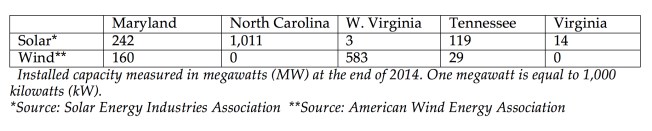
2015 wind and solar table copy

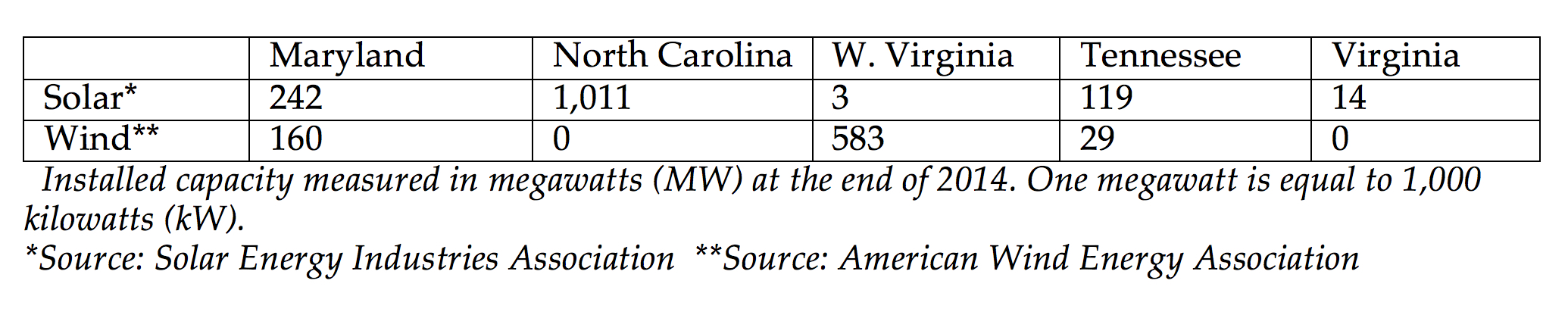
Virginia still has no utility scale wind or solar projects and very little in the way of customer-owned and other distributed generation. The 2015 legislative session improved prospects for solar at the utility scale, but utility interest in wind remains low. Meanwhile, barriers to the rapid adoption of customer-owned generation remain firmly in place.

Virginia utilities won’t sell wind or solar to customers (and they won’t let anyone else do it either)

With one very narrow exception for commercial customers, Virginia residents can’t pick up the phone and call their utility to buy electricity generated by wind and solar farms. Worse, they can’t even buy renewable energy elsewhere.

This wasn’t supposed to happen. Section 56-577(A)(6) of the Virginia code allows utilities to offer “green power” programs, and if they don’t, customers are supposed to be able to go elsewhere for it. (See the section on third-party-owned systems for what happened when one customer tried to go elsewhere.)

Ideally, a utility would use money from voluntary green power programs to build or buy renewable energy for these customers. However, Virginia utilities have not done this, except in very tiny amounts. Instead, utilities pay brokers to buy renewable energy certificates (RECs) on behalf of the participants. Participation by consumers is voluntary. Participants sign up and agree to be billed extra on their power bills for the service. Meanwhile, they still run their homes and businesses on regular “brown” power.

In Dominion’s case, these RECs meet a recognized national standard, and some of them originate with wind turbines, but they primarily represent power produced and consumed out of state, and thus have no effect on the power mix in Virginia. For a fuller discussion of the Dominion Green Power Program, see What’s wrong with Dominion’s Green Power Program.

In the case of Appalachian Power, the RECs come from an 80 MW hydroelectric dam in West Virginia. No wind, and no solar.

The State Corporation Commission ruled that REC-based programs like these do not qualify as selling renewable energy, so under the terms of §56-577(A)(6), customers are permitted to turn to other licensed suppliers of electric energy “to purchase electric energy provided 100 percent from renewable energy.” Unfortunately (and in this English major’s opinion, wrongly), Virginia utilities claim that the statute’s words mean that not only must another licensed supplier provide 100% renewable energy, it must also supply 100% of the customer’s demand. Obviously, the owner of a wind farm or solar facility cannot do that; the customer will need to draw from the grid part of the time. Ergo, say the utilities, a customer cannot go elsewhere. Checkmate!

The SCC may rule on this interpretation some day, but there is still another problem with the statute: under its terms, customers are allowed to turn to other electric suppliers only if their own utility doesn’t offer a qualifying program. So if the SCC sides with the English majors on this one, Dominion could (and surely would) gin up a variation of its Green Power Program consisting of true renewable energy. It would still not have to offer Virginia-based wind and solar—crappy biomass and old hydro would do, so long as it was actual energy “bundled” with the RECs. Nor would it have to offer a competitive price.

Really, the statute doesn’t ask much. It’s astonishing the utilities haven’t taken steps already to close that loophole. But surely they’re ready, and that’s enough to scare off any would-be competitors.

Earlier this year Dominion seemed poised to offer customers a program to sell electricity from solar panels, which would have qualified. Notwithstanding its name, however, the “Dominion Community Solar” program is not an offer to sell electricity generated from solar energy, and seems likely to attract customers only to the extent they are deceived into believing it is something it is not.

For customers to have real energy choice in Virginia, the GA has to change the terms of §56-577(A)(6). Let people buy wind and solar from any willing seller, whether it be their utilities or the private market. Utilities will benefit by customers taking on their job of lowering Virginia’s carbon emissions. Virginians will benefit from cleaner air, new clean energy jobs, and a stronger grid.

Virginia’s Renewable Portfolio Standard (RPS) is a miserable sham

Many advocates focus on an RPS as a vehicle for inducing demand. In Virginia, that’s a mistake. Virginia has only a voluntary RPS, which means utilities have the option of participating but don’t have to. On the other hand, it costs them nothing to do it, because any costs they incur in meeting the goals can be charged to ratepayers. Until a few years ago, utilities even got to collect bonus money as a reward for virtue, until it became clear that there was nothing very virtuous going on.

Merely making our RPS mandatory rather than voluntary would do nothing for wind and solar in Virginia without a complete overhaul. Most important, the statute takes a kitchen-sink approach to what counts as renewable energy, so meeting it requires no new investment and no wind or solar.

The targets are also modest to a fault. Although nominally promising 15% renewables by 2025, the statute sets a 2007 baseline and contains a sleight-of-hand in the definitions section by which the target is applied only to energy not produced by nuclear plants. The combined result is an effective 2025 target of about 7%.

The RPS is as impotent in practice as it is in theory. In the case of Dominion Virginia Power, the RPS has been met largely with old hydro projects built prior to World War II, trash incinerators, and wood burning, plus a small amount of landfill gas and—a Virginia peculiarity—RECs representing R&D rather than electric generation.

There appears to be no appetite in the General Assembly for making the RPS mandatory, and even efforts to improve the voluntary goals have failed in the face of utility opposition. The utilities have offered no arguments why the goals should not be limited to new, high-value, in-state renewable projects, other than that it would cost more to meet them than to buy junk RECs.

But with the GA hostile to a mandatory RPS and too many parties with vested interests in keeping the kitchen-sink approach going, it is hard to imagine our RPS becoming transformed into a useful tool to incentivize wind and solar.

That doesn’t mean there is no role for legislatively-mandated wind and solar. But it will be easier to pass a bill with a simple, straightforward mandate for buying or building a certain number of megawatts than it would be to repair a hopelessly broken RPS.

Customer-owned generation: for most, the only game in town

Given the lack of wind or solar options from utilities, people who want renewable energy generally have to build it themselves. A federal 30% tax credit makes it cost-effective for those with cash or access to low-cost financing. The credit is available until the end of 2016 (when it falls to 10% for commercial but goes away entirely for residential).

This year the GA passed legislation enabling Property Assessed Clean Energy (PACE) loans for commercial customers. This should help bring low-cost financing to energy efficiency and renewable energy projects at the commercial level. That would make it the year’s most helpful piece of legislation from the standpoint of customer-owned generation.

Now that some barriers to residential PACE have been removed at the federal level, we hope the legislature will extend the law to let localities offer PACE loan programs to homeowners in the near future.

Virginia offers no cash incentives or tax credits for wind or solar. The Virginia legislature passed a bill in 2014 that would offer an incentive, initially as a tax credit and then as a grant program, but it did not receive funding, and the same bill, reintroduced in 2015, died in a subcommittee. North Carolina’s tax credit for solar is widely credited with making that state a solar leader, and it could have the same effect here. With solar panel prices continuing their breathtaking descent, utility and commercial-scale solar probably won’t need that kind of help for long, so a modest program of three-to-five years duration would suffice to catalyze the market. Residential solar would benefit from longer-lasting support.

The lack of a true RPS in Virginia means Virginia utilities generally will not buy solar renewable energy certificates (SRECs) from customers. SRECs generated here can sometimes be sold to utilities in other states (as of now only Pennsylvania) or to brokers who sell to voluntary purchasers.

Limits to net metering hamper growth

Section 56-594 of the Virginia code allows utility customers with wind and solar projects to net energy meter. System owners get credit from their utility for surplus electricity that’s fed into the grid at times of high output. That offsets the grid power they draw on when their systems are producing less than they need. Their monthly bills reflect only the net energy they draw from the grid.

If a system produces more than the customer uses in a month, the credits roll over to the next month. However, at the end of the year, the customer will be paid for any excess credits only by entering a power purchase agreement with the utility. This will likely be for a price that represents the utility’s “avoided cost” of about 4.5 cents, rather than the retail rate, which for homeowners is closer to 11 cents. Given the current cost of installing solar, this effectively stops people from installing larger systems than they can use themselves.

Legislation passed in 2015 makes it less likely that new solar owners will have any surplus. At Dominion’s insistence, the definition of “eligible customer-generator” was amended to limit system sizes to no larger than needed to meet the customers demand, based on the previous 12 months of billing history. The SCC is currently writing regulations that should address issues of new construction as well as questions arising from other new language in the law.

This limitation is crazy, no? If customers want to install more clean, renewable energy than they need and sell the surplus electricity into the grid at the wholesale power price, why would you stop them from performing this service to society? And what were Dominion lobbyists thinking, since it is clearly in their company’s interest to buy peak power at a cut-rate price? We can only speculate that the primal fear of customers with solar must be stronger even than the smell of money.

Virginia law also does not allow system owners to share the electricity with other consumers through community net metering or solar gardens. Several bills that would have permitted this were introduced in the 2013 and 2014 sessions but defeated due to utility opposition. Community net metering remains one of the solar industry’s highest priorities as a way to open the market to people who can’t own solar facilities themselves. It would also spur the market for community wind.

In August of this year, Dominion received permission from the SCC to begin a program the company is calling “Dominion Community Solar.” Reading the fine print, however, makes it apparent that participants will not actually buy solar power. They will pay a significant premium on their electric bills to fund construction of a solar installation, but the electricity generated will be sold to other people rather than credited to the participants.

Under a bill introduced by Delegate Randy Minchew (R-Leesburg) and passed in 2013, owners of Virginia farms with more than one electric meter are permitted to attribute the electricity produced by a system that serves one meter (say, on a barn) to other meters on the property (the farmhouse and other outbuildings). This is referred to as “agricultural net metering.” The law took effect July 1, 2014 for investor-owned utilities (Dominion and Appalachian Power) and July 1, 2015 for the cooperatives.

Standby charges hobble the market for larger home systems and electric cars

Dominion Power and Appalachian Power are at the forefront of a national pushback against policies like net metering that facilitate customer-owned generation.

The current system capacity limit for net-metered solar installations is 1 MW for commercial, 20 kW for residential. However, for residential systems between 10 kW and 20 kW, a utility is allowed to apply to the State Corporation Commission to impose a “standby” charge on those customers.

Seizing the opportunity, Dominion won the right to impose a standby charge of up to about $60 per month on these larger systems, eviscerating the market for them just as electric cars were increasing interest in larger systems. (SCC case PUE- 2011-00088.) Legislative efforts to roll back the standby charges were unsuccessful, and more recently, Appalachian Power instituted even more extreme standby charges. (PUE-2014-00026.)

The standby charges supposedly represent the extra costs to the grid for transmission and distribution. In the summer of 2013, in a filing with the SCC (PUE-2012-00064, Virginia Electric and Power Company’s Net Metering Generation Impacts Report), Dominion claimed it could also justify standby charges for its generation costs, and indicated it expected to seek them after a year of operating its Solar Purchase Program (see discussion below). As far as I can tell, it hasn’t carried out this threat yet, and it would likely need legislation to do so.

A bit of good news for residential solar: homeowner association bans on solar are largely a thing of the past

Homeowner association (HOA) bans and restrictions on solar systems have been a problem for residential solar. In the 2014 session, the legislature nullified bans as contrary to public policy. The law contains an exception for bans that are recorded in the land deeds, but this is said to be highly unusual; most bans are simply written into HOA covenants. In April of 2015 the Virginia Attorney issued an opinion letter confirming that unrecorded HOA bans on solar are no longer legal.

Even where HOAs cannot ban solar installations, they can impose “reasonable restrictions concerning the size, place and manner of placement.” This language is undefined. The Maryland-DC-Virginia Solar Energy Industries Association has published a guide for HOAs on this topic.

Third-party ownership of renewable energy facilities could open the market, but Virginia utilities won’t step aside

One of the primary drivers of solar installations in other states has been third-party ownership of the systems, including third-party power purchase agreements (PPAs), under which the customer pays only for the power produced by the system. For customers that pay no taxes, including non-profit entities like churches and colleges, this is especially important because they can’t use the 30% federal tax credit to reduce the cost of the system if they purchase it directly. Under a PPA, the system owner can take the tax credit and pass along the savings in the form of a lower electricity price.

In 2011, when Washington & Lee University attempted to use a PPA to finance a solar array on its campus, Dominion Virginia Power issued cease and desist letters to the university and its Staunton-based solar provider, Secure Futures LLC. Dominion claimed the arrangement violated its monopoly on power sales within its territory, under that same §56-577(A)(6) we previously discussed. Secure Futures and the university thought that even if what was really just a financing arrangement somehow fell afoul of Dominion’s monopoly, surely they were covered by the exception available to customers whose own utilities do not offer 100% renewable energy.

Yet the threat of prolonged and costly litigation was too much. The parties scuttled the PPA contract, though the solar installation was able to proceed using a different financial arrangement.

After a long and very public fight in the legislature and the press, in 2013 Dominion and the solar industry negotiated a compromise that specifically allows customers in Dominion territory to use third-party PPAs to install solar or wind projects under a pilot program capped at 50 MW. Projects must have a minimum size of 50 kW, unless the customer is a tax-exempt entity, in which case there is no minimum. Projects can be as large as 1 MW. The SCC is supposed to review the program every two years beginning in 2015 and has authority to make changes to it.

Appalachian Power and the electric cooperatives declined to participate in the PPA deal-making, so the legal uncertainty about PPAs continues in their territories. In June of this year, Appalachian Power proposed an alternative to PPAs that does not offer anything like a viable solution. The matter is before the SCC. The case is No. PUE-2015-00040. An evidentiary hearing is scheduled for September 29, 2015.

Meanwhile, Secure Futures has developed a third-party-ownership business model that it says works like a PPA for tax purposes but does not include the sale of electricity, and therefore should not trigger a challenge from Appalachian Power or other utilities. Currently Secure Futures is the only solar provider offering this option, which it calls a Customer Self-Generation Agreement.

Tax exemption for third-party owned solar may prove a market driver

In 2014 the General Assembly passed a law exempting solar generating equipment “owned or operated by a business” from state and local taxation for installations up to 20 MW. The law now classifies solar equipment as “pollution abatement equipment.” Note that this applies only to the equipment, not to the buildings or land underlying the installation, so real estate taxes aren’t affected.

The law was a response to a problem that local “machinery and tools” taxes were mostly so high as to make third-party PPAs uneconomic in Virginia. In a state where solar was already on the margin, the tax could be a deal-breaker.

The 20 MW cap was included at the request of the Virginia Municipal League and the Virginia Association of Counties, and it seemed at the time like such a high cap as to be irrelevant. However, with solar now becoming increasingly attractive economically, Virginia’s tax exemption is turning out to be a draw for solar developers. We are told Amazon’s 80 MW solar farm will proceed in four stages, indicating a desire to work around the cap—and suggesting that the tax exemption may have been a factor in the choice of Virginia as the project’s location.

Dominion “Solar Partnership” Program suggests distributed solar might be better left to the private sector

In 2011, the General Assembly passed a law allowing Dominion to build up to 30 MW of solar energy on leased property, such as roof space on a college or commercial establishment. The SCC approved $80 million of spending, to be partially offset by selling the RECs (meaning the solar energy would not be used to meet Virginia’s RPS goals). The program has resulted in several commercial-scale projects on university campuses and corporate buildings. Unfortunately, it has also been plagued by delays and over-spending.

The program was supposed to proceed in two phases, with 10 MW in place by the end of 2013, and another 20 MW by December 31, 2015. However, the program got off to a very slow start. In August of 2014 the company acknowledged it was behind schedule and would likely not achieve more than 13 or 14 MW of the 30 MW authorized before it ran out of money. On May 7, 2015 Dominion filed a notice with the SCC that it needed to extend the phase 2 end date to December 31, 2016, and confirmed that it would install less than 20 MW altogether.

Dominion’s Solar Purchase Program: bad for sellers, bad for buyers, and not popular with anyone

The same legislation that enabled the Community Solar initiative also allowed Dominion to establish “an alternative to net metering” as part of the demonstration program. The alternative turned out to be a buy-all, sell-all deal for up to 3 MW of customer-owned solar. As approved by the SCC, the program allows owners of small solar systems on homes and businesses to sell the power and the associated RECs to Dominion at 15 cents/kWh, while buying regular grid power at retail for their own use. Dominion then sells the power to the Green Power Program at an enormous markup.

I’ve ripped this program from the perspective of the Green Power Program buyers, but the program is also a bad deal for most sellers. Some installers who have looked at it say it’s not worth the hassle given the costs involved and the likelihood that the payments represent taxable income to the homeowner. There is also a possibility that selling the electricity may make homeowners ineligible for the 30% federal tax credit on the purchase of their system. Sellers beware.

And then there’s the problem that selling the solar power means you aren’t powering your home or business with solar—which is the whole point of installing it, right?

Dominion’s Renewable Generation tariff for large users of energy finds no takers; Amazon votes with its feet

Currently renewable energy projects are subject to a size limit of 1 MW. These limitations constrain universities, corporations, data centers, and other large users of energy that might want to run on wind or solar. On top of this, the utilities’ interpretation of Virginia law prohibits a developer from building a wind farm or a solar array and selling the power directly to users under a power purchase agreement.

In 2013, Dominion Power rolled out a Renewable Generation Tariff (PUE-2012-00142) to allow customers to buy larger amounts of renewable power from providers, with the utility acting as a go-between and collecting a monthly administrative fee.

From the start the program appeared flawed, cumbersome and bureaucratic, and as far as we know there have been no takers. Amazon Web Services chose to contract directly with a developer for the 80 MW solar farm it announced this year (avoiding Dominion’s monopoly restrictions by selling the electricity directly into the PJM market).

2015 marks Dominion’s foray into utility-scale solar

Late in 2014, Dominion signaled an interest in building utility-scale solar in Virginia. In 2015, at the utility’s behest, two bills promoted the construction of utility-scale solar by declaring it in the public interest for utilities to build solar energy projects of at least 1 MW, and up to an aggregate of 500 MW. At the solar industry’s urging, the bill was amended to allow utilities the alternative of entering into PPAs for solar power prior to purchasing the generation facilities at a later date, an option with significant tax advantages.

Dominion’s first solar project is expected to be a 20 MW solar farm in Remington, Virginia. The proposal is before the SCC (PUE-2015-00006). Dominion proposes to build and operate the facility itself, which will earn it a return on investment but give up tax advantages that would save money for ratepayers.

On July 17, Dominion issued a Request for Proposals for third party bidders to develop up to 20 MW of additional projects. The RFP came with an absurdly short deadline, surely limiting the number of good responses, but developers are nonetheless hopeful the results will be strong enough to convince Dominion to follow it with a larger request.

2015 will be another year without a wind farm, but there is hope

No Virginia utility is actively moving forward with a wind farm on land. For the past few years, Dominion Power’s website has listed 248 MW of land-based wind in Virginia as under development, without any noticeable progress. There has been a lot of press about the current standoff in Tazewell County, where supervisors are blocking Dominion’s proposed wind farm. Yet Dominion’s advocacy for its project feels perfunctory. The company has signaled it prefers solar, and its 2015 IRP dismisses wind as too costly. On the other hand, Appalachian Power’s IRP suggests an interest in wind as a low-cost renewable resource that could help it meet the Clean Power Plan.

With no utility buyers, Virginia has not been a friendly place for independent wind developers. In previous years a few wind farm proposals made it to the permitting stage before being abandoned, including in Highland County and on Poor Mountain near Roanoke.

As of 2015, however, Apex Clean Energy is in the development stages for a wind farm of up to 80 MW in Botetourt County. No customer has been announced, but the company believes the project can produce electricity at a competitive price.

As for Virginia’s great offshore wind resource, the perception that offshore wind energy will be costly continues to hold back progress. In 2013 Dominion won the federal auction for the right to develop about 2000 MW of offshore wind power, and the lease terms call for the company to file construction plans within five years. The federal government’s timeline leads to wind turbines being built off Virginia Beach around 2020. As I’ve discussed elsewhere, Dominion is something less than committed to seeing the process through. This puts advocates in the legislature and in the business and environmental communities in the odd position of being keener on a development than the developer is.

Meanwhile, however, Dominion is part of a Department of Energy-funded team designing a pilot project of two 6-MW offshore wind test turbines, originally scheduled for installation in 2017. This year Dominion declared it was taking a “step back” when the sole bid for the contract came in way too high. Stakeholders have been meeting this summer to help chart a path forward.

Will a Solar Development Authority help?

One of the MacAuliffe Administration’s initiatives this year was a bill to establish the Virginia Solar Development Authority. The Authority is explicitly tasked with helping utilities find financing for solar projects; there is no similar language about supporting customer-owned solar. The Authority is supposed to identify barriers to solar, but isn’t given any tools to remove them. The Authority has not been given funding. And members have not been named yet. Meanwhile, the clock is ticking on that December 31, 2016 expiration of the 30% federal tax credit.

The Clean Power Plan: better to switch than fight

On August 3, 2015, EPA issued the final rule known as the Clean Power Plan. Under the rule, states with existing fossil-fuel generating plants must develop plans to reduce total carbon pollution from power plants. In Virginia, the task will fall to the Department of Environmental Quality.

While Virginia’s goals under the plan are modest, the rule means the state, utilities and the SCC must for the first time take carbon emissions into account in their planning. The EPA has signaled a strong interest in seeing wind and solar deployed as solutions.

Some legislators have succumbed to partisan pressure to attack the Clean Power Plan, using talking points provided by fossil fuel front groups. Not only does this do a disservice to Virginians already suffering the effects of climate change, it’s bad economic policy. EPA’s analysis shows Virginia is already on track to meet or come close to our Clean Power Plan goals. Wasting time fighting the plan, or mandating that utilities keep outdated coal plants open, makes far less sense than using the plan as a catalyst to begin an efficient and cost-effective energy transition.

The transition need not even happen fast, as EPA’s numbers suggest that all we need to do is keep our total carbon emissions from increasing over time. Energy efficiency has a huge role to play in achieving this, but so would a requirement that utilities meet any increases in electrical demand with wind and solar. Freeing up the private market will go a long way towards achieving that goal. And of course, when customers install solar “behind the meter,” it keeps electric demand from growing.

The Department of Environmental Quality will be holding “listening sessions” this fall to take public comment prior to developing a state implementation plan under the rule.


Unknown's avatar

As sea level rise accelerates, buying shorefront property becomes a game of musical chairs

Sea level rise graphThank God for climate change deniers. They may eventually be the only buyers for shorefront real estate.

Sea level rise may not cause widespread flooding until later in this century or into the next one, but real estate deals involve long timelines: the useful life of a new house or a commercial building can be at least fifty years, while an infrastructure project might last a hundred years or more.

And of course, it’s one thing to lose your house, and another to lose the ground beneath it. Sea level rise means low-lying real estate now comes with an expiration date.

So smart buyers—and landowners—have to consider not just today’s flood maps, but also ones that haven’t been drawn yet. If a rising sea will threaten property some decades from now, it will depreciate over time, like a car. At some point only chumps and climate deniers will buy.

Head-in-the-sand posturing still dominates the headlines, like Florida Governor Rick Scott’s alleged ban on the use of the term “climate change,” or the North Carolina legislature’s silly (and costly) attempt to legislate sea level rise out of existence. Now the Federal Emergency Management Agency (FEMA) hopes to force states to get serious about climate change by requiring states to do a better job planning for natural disasters caused in part by global warming. FEMA’s goal is to save money through better planning, but conservatives have attacked the requirement as politically motivated.

Meanwhile, however, many states and localities have already begun using sea level rise forecasting in their planning. The projections will help land use planners determine not just where to allow growth, but also where to defend existing development against the incursion of the sea, and where the wiser course is to retreat. And of course, the studies should inform the decisions of anyone thinking of buying property on the coast.

Two recent studies provide a picture of sea level rise in Virginia. The Virginia Institute of Marine Science (VIMS) issued its report in January 2013, titled Recurrent Flooding Study for Tidewater Virginia. Building on that study and others, on March 10 of this year the Sierra Club released Sea Level Rise: What Should Virginia Plan For?

Both studies agree on some pretty sobering numbers. By the end of this century, the sea level in Norfolk, Virginia, is projected to be 3.6-5 feet above the level in 1992. By that point, the sea will be rising more than half a foot per decade. The numbers are higher for Virginia than for many states, in part because the land around Hampton Roads is also sinking at a rate of about one foot per century.

Although Hampton Roads gets most of the media attention, sea level rise threatens the entire Virginia coastline and the tidal portions of rivers, including the Potomac River all the way up to Alexandria and Washington, D.C. A whole lot of people should be consulting topographic maps before they make their next real estate decision.

The Sierra Club report focuses in on specific timeframes that matter in real estate decisions: twenty-five years for short-term projects, fifty years for new homes, and a hundred years for infrastructure projects. With a one-foot margin of safety added in, the report recommends that anyone considering a new project or building today with a 50-year expected life should plan for as much as 3.7 feet of sea level rise over the 1992 baseline. That number becomes 5.5-7.2 feet when the planning horizon is extended out a hundred years, to 2115.

(The “good” news is that the sea rose half a foot between 1992 and today, so you get to subtract six inches from these projections if you are starting now.)

Results are stated as a range rather than a precise number because the actual level will depend on many factors. Researchers agree that a certain amount of sea level rise is “baked in” as a result of greenhouse gas emissions to date, but future emissions will play a big role in determining how much the seas rise in the long run. Providing a range allows users to decide how much risk they are willing to take. Even at the high end, there are caveats; new information about melting ice in Eastern Antarctica could make today’s projections too conservative.

Right now many shore communities are hosting a game of musical chairs. Developers continue to build and sell new housing, figuring they can earn a good return on their investment and get out before the market collapses. Buyers aren’t told about the risks. Sea level rise is bad for business, so business would rather not talk about it. And some local governments soft-peddle the news, afraid of setting off a panic that will make the collapse of the real estate market a self-fulfilling prophecy.

The Virginia General Assembly took action this year to require localities in the Hampton Roads Planning District Commission to include measures addressing sea level rise in their comprehensive plans. The District includes 16 local governments in southeast Virginia, but that’s only a fraction of the counties and cities vulnerable to sea level rise.

Another bill requires that the disclaimer form provided to home buyers across the state include language warning that the seller makes no representations about whether the property is located in a “special flood hazard area” or may require flood insurance, putting the onus on buyers to inquire. While prudent buyers will follow through (and mortgage lenders will make sure they do), today’s flood maps don’t reflect tomorrow’s reality.

So these bills are a good start, but Virginia needs to do more. Local governments outside of Hampton Roads need specific guidance for planning, and the public needs better education about the floods to come. By the time the sea claims low-lying neighborhoods from Virginia Beach up to Alexandria, there may not be enough climate deniers left to buy everyone out.

Unknown's avatar

Criticism mounts over Dominion’s effort to lock in earnings, lock out audits

Dominion buildingSenator Frank Wagner’s bill to permit Virginia’s largest utility to keep its books closed until 2023 cleared a Senate subcommittee last week, but not without a bruising. What Dominion Virginia Power thought would be an easy sell—a promise to freeze rates at their current level—is being widely criticized as another money grab from a company known for resorting to legislative maneuvers to hang on to overearnings. As a result, SB 1349 faces an uncertain future in full committee today, and if it passes, should expect rough treatment on the Senate floor.

As I explained last week, the bill plays on fears that the EPA’s carbon-cutting Clean Power Plan will be costly to implement. According to Senator Wagner and Dominion spokesman Dan Weekly, ratepayers need protection from jarring rate increases.

Of course, if the Clean Power Plan were really likely to raise costs, a for-profit company like Dominion would hardly want to give up the ability to raise rates. Dominion’s eager embrace of a rate freeze puts me in mind of Brer Rabbit’s pleading not to be thrown into the briar patch.

Last year Dominion got away with legislation allowing it to keep hundreds of millions of dollars in over-earnings, catching the press, the new Administration and many legislators flat-footed. It may get away with it again this year, but it won’t be pretty.

For one thing, the press is fully awake this time around. Several papers raised questions, and a hard-hitting article in the Washington Post correctly reframed the issue as whether Dominion should be allowed to escape routine public financial audits. The Post article also hit one of my favorite themes, the outsized influence Dominion wields in the state due to the campaign cash it lavishes on Republicans and Democrats alike. But then it did me one better, noting that Senator Wagner owns stock in Dominion Resources.

An article in the Virginian-Pilot put the value of that stock at $250,000. [Update: a February 2 AP story put the value of Wagner’s stock at only $5,000. Regardless of the actual amount, on February 3, the AP reported that, in response to the story, Wagner sold his Dominion stock.]

Meanwhile the Capital News Service had caught on that the “rate freeze” actually puts a floor, not a ceiling, on utility bills. “Proposal would let Dominion hike electric bills,” ran the headline in multiple newspapers.

So when a small subcommittee of Senate Commerce and Labor* met to consider the bill on Thursday, it was not the easy pass that Senator Wagner and Dominion expected. Lining up against the bill were environmental groups, the Attorney General’s office, SCC staff, and the Virginia Citizens Consumer Council.

Even Senator Dick Saslaw, usually a reliable ally of Dominion, expressed his discomfort with the bill and told Dominion spokesman Dan Weekly that he had better answer the concerns that had been expressed.

But then Saslaw and the other senators voted to move it along. Apparently, just being a bad bill wasn’t enough to kill it.

Update: the full committee of Senate Commerce and Labor reported SB 1349 on a 14-1 vote, with only Senator Newman dissenting. Action now moves to the full Senate, which has many saner heads. But lest optimism get the better of us, I should note that pretty much all of them take Dominion money too.

———————————————

*This is the little hand-picked group I reported on that was supposed to form a joint subcommittee with House members to review all Clean Power Plan legislation. That’s not what happened. The joint subcommittee held two meetings that could best be described as EPA bash-fests, but only Wagner’s bill ended up assigned to the subcommittee, and only the Senate members met to consider his bill. The House members seem to have been unceremoniously dropped from the process altogether.

So what happened to the other climate bills? The Senate bills mostly ended up in Agriculture and Natural Resources, and the House bills mostly in Commerce and Labor (where they have been assigned to the Energy subcommittee). Why the change in plan? Beats me.